EP1147612B1 - Code book construction for variable to variable length entropy encoding - Google Patents
Code book construction for variable to variable length entropy encoding Download PDFInfo
- Publication number
- EP1147612B1 EP1147612B1 EP99968085A EP99968085A EP1147612B1 EP 1147612 B1 EP1147612 B1 EP 1147612B1 EP 99968085 A EP99968085 A EP 99968085A EP 99968085 A EP99968085 A EP 99968085A EP 1147612 B1 EP1147612 B1 EP 1147612B1
- Authority
- EP
- European Patent Office
- Prior art keywords
- symbol
- grouping
- plural
- groupings
- high probability
- Prior art date
- Legal status (The legal status is an assumption and is not a legal conclusion. Google has not performed a legal analysis and makes no representation as to the accuracy of the status listed.)
- Expired - Lifetime
Links
- 238000010276 construction Methods 0.000 title description 2
- 238000000034 method Methods 0.000 claims abstract description 42
- 238000007906 compression Methods 0.000 claims description 11
- 230000006835 compression Effects 0.000 claims description 11
- 239000000470 constituent Substances 0.000 claims description 8
- 238000012545 processing Methods 0.000 description 15
- 238000004891 communication Methods 0.000 description 12
- 230000005540 biological transmission Effects 0.000 description 8
- 230000000717 retained effect Effects 0.000 description 8
- 238000013459 approach Methods 0.000 description 7
- 239000013598 vector Substances 0.000 description 7
- 230000003287 optical effect Effects 0.000 description 5
- 230000008901 benefit Effects 0.000 description 4
- 238000013144 data compression Methods 0.000 description 4
- 230000001427 coherent effect Effects 0.000 description 3
- 230000008569 process Effects 0.000 description 3
- 230000000007 visual effect Effects 0.000 description 3
- 238000010420 art technique Methods 0.000 description 2
- 230000005055 memory storage Effects 0.000 description 2
- 230000002093 peripheral effect Effects 0.000 description 2
- 230000003044 adaptive effect Effects 0.000 description 1
- 238000004590 computer program Methods 0.000 description 1
- 230000001419 dependent effect Effects 0.000 description 1
- 238000010586 diagram Methods 0.000 description 1
- 230000009977 dual effect Effects 0.000 description 1
- 230000000694 effects Effects 0.000 description 1
- 238000000802 evaporation-induced self-assembly Methods 0.000 description 1
- 230000006870 function Effects 0.000 description 1
- 238000012423 maintenance Methods 0.000 description 1
- 238000005259 measurement Methods 0.000 description 1
- 230000037361 pathway Effects 0.000 description 1
- 230000009467 reduction Effects 0.000 description 1
- 238000012546 transfer Methods 0.000 description 1
- 230000009466 transformation Effects 0.000 description 1
Images


Classifications
-
- H—ELECTRICITY
- H03—ELECTRONIC CIRCUITRY
- H03M—CODING; DECODING; CODE CONVERSION IN GENERAL
- H03M7/00—Conversion of a code where information is represented by a given sequence or number of digits to a code where the same, similar or subset of information is represented by a different sequence or number of digits
- H03M7/30—Compression; Expansion; Suppression of unnecessary data, e.g. redundancy reduction
- H03M7/40—Conversion to or from variable length codes, e.g. Shannon-Fano code, Huffman code, Morse code
- H03M7/42—Conversion to or from variable length codes, e.g. Shannon-Fano code, Huffman code, Morse code using table look-up for the coding or decoding process, e.g. using read-only memory
Definitions
- the invention generally relates to data compression, and more specifically relates to a form of entropy coding.
- input data is encoded by an encoder, transmitted over a communication channel (or simply stored), and decoded by a decoder.
- a decoder receives input data from an encoder
- an input signal is typically pre-processed, sampled, converted, compressed or otherwise manipulated into a form for transmission or storage. After transmission or storage, the decoder attempts to reconstruct the original input.
- Huffman encoding which is a particular form of entropy encoding.
- Entropy encoding operates by assigning variable-length codes (e.g., code book entries) to fixed-sized blocks of input. That is, a random variable X, which is known to take on values x 1 ..x m with corresponding probability p 1 ..p m , is mapped to an entry within a set of code words ⁇ Y ⁇ .
- y j k will be referenced simply as y 1 , with k implied.
- the code alphabet is likely to be a series of binary digits ⁇ 0, 1), with code lengths measured in bits. It is assumed code words are constructed so only a single scan of a compressed representation needs to be inspected in order to reconstruct appropriate output.
- the difficulty in entropy encoding the source signal depends on the number m of possible values X may take. For small m , there are few possible messages, and therefore the code book for the messages can be very small (e.g., only a few bits need to be used to unambiguously represent all possible messages).
- One possible set of code book entries is assigning "1" to represent message x 1 , "01” for message x 2 , "000” for message x 3 , and "001" for message x 4 . This gives an average code length of 1.56 bits instead of 2 for encoding the random variable X -- a significant savings.
- vector Huffman coding can compress a coherent source much more efficiently than scalar Huffman coding.
- the efficiency of vector Huffman coding is only limited by practical concerns. In order to achieve higher compression ratios, bigger vector dimensions are needed. Higher dimension, however, increases code book sizes beyond practical limits. For example, for source symbols having 30 possible values, a dimension of only 6 corresponds to a code book of 729 million entries.
- entropy coding are characterized as fixed-to-variable length coding as the source symbols have fixed length and the code words have variable length depending on the probability of the corresponding source symbol.
- Other methods of entropy coding have been attempted which attempt the opposite approach, where a variable number of source symbols are grouped together and then translated into code words having equal length.
- a reverse scheme is provably optimal.
- such solutions require resources exceeding resources practically (if at all) available.
- this variable-to-fixed length approach is not useful.
- EP 0 283 735 A2 describes an adaptive data compression method and apparatus.
- WO 98/40969 A2 describes a text file compression system that creates an alphabetically ordered main dictionary listing all unique words appearing in the text file.
- the compression system further creates a common word dictionary referencing words most often encountered in the text file.
- the common word dictionary and the main dictionary together assign a unique one byte code to each of the most often encountered words comprised in the common word dictionary and a unique two byte code to all other words comprised in the main dictionary.
- a word index is created by replacing each word in the text file with its assigned one or two byte code, thus representing a compressed form of the text file.
- the words most often encountered in the text file are determined by maintaining a count of the number of times each unique dictionary word occurs in the text file.
- variable length codes are assigned to probable input sequences, thus allowing a particular input stream to be encoded in a compressed format.
- the invention may be configured so as to reduce the size of the code book required for performing encoding and decoding.
- variable length code words might only be assigned to inputs that are highly probable, and where default codes can be assigned to less probable sequences.
- the degree of probability required for assignment of a specific code to a specific input is adjusted according to a desired code book size.
- the input stream to encode can be of any data type, such as numbers, characters, or a binary data stream which encodes audio, video or other types of data.
- the input stream is referenced herein as a series of symbols, where each "symbol" refers to the appropriate measurement unit for the particular input.
- a code book is constructed for groupings of symbols, in which variable-sized groups of symbols are each assigned a variable length code based on probability of occurrence of symbol groupings.
- possible groupings of symbols are generated and compared against the probability of the generated grouping occurring in exemplary input used to generate the code book.
- exemplary input is assumed to approximate arbitrary input likely to be received and require encoding.
- the input may be used to drive generation of groupings, or all possible groupings can be tested and compared against the exemplary input; it is assumed herein that the groupings are input driven.
- a data structure may be used to track symbols combinations (e.g., the groupings). This structure is used to associate the new symbol with previously received symbols, so that arbitrarily long groupings of previously received symbols are tracked.
- symbols combinations e.g., the groupings.
- This structure is used to associate the new symbol with previously received symbols, so that arbitrarily long groupings of previously received symbols are tracked.
- One possible configuration for the data structure is a tree-type data structure, in which successive symbol groupings form new leaf nodes. These nodes may contain an entire grouping or just the single symbol extension to a previous parent node. In this latter configuration, the path from the root of the tree corresponds to a particular grouping.
- one or more trivial groupings are selected, such as single symbol "groups" containing symbols from the input alphabet.
- the probability of these initial groupings is evaluated to determine the grouping most likely to occur as input, where such probability is necessarily computed with respect to exemplary inputs.
- the most probable grouping is then expanded with symbols from the alphabet to form tentative groupings.
- the probability of these tentative groupings is then evaluated to identify the most probable tentative expansions, and the least probable groupings combined into a single grouping.
- the concept of a code book is to assign code words to symbol groupings.
- the invention can be configured so that code book size is restricted. One method of doing so is avoiding assigning codes to all input sequences. Instead, only probable input sequences are stored in the code book and assigned an entropy-type code. Improbable sequences are represented in the code book as an input sequence prefix followed by a special expansion character suffix. This suffix character represents all possible input sequence extensions to the prefix. The prefix-suffix pairing represents all possible input sequences beginning with the prefix that do not have an entry in the code book. Thus, after evaluating the tentative extensions, two code book entries result, one for the most probable extension, and one to represent all other extensions (again, assuming only keeping one most probable extension).
- This process of expanding groupings and collapsing groupings is repeated until the data structure has been filled to a predetermined capacity.
- the input may be continued to be scanned so that higher probability entries within the input displace less probable current entries.
- the efficiency of this coding technique is only limited by the book size selected and the typicality of the exemplary input.
- the invention has been implemented in an audio/visual codec. This is only one example of how the invention may be implemented.
- the invention is designed to be utilized wherever entropy-type coding may be utilized, and is applicable to compression of any type of data. Briefly described, optimal entropy encoding requires excessive resources, and the illustrated embodiments provide a nearly optimal encoding solution requiring far fewer resources.
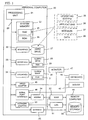
- FIG. 1 and the following discussion are intended to provide a brief, general description of a suitable computing environment in which the invention may be implemented. While the invention will be described in the general context of computer-executable instructions of a computer program that runs on a personal computer, those skilled in the art will recognize that the invention also may be implemented in combination with other program modules. Generally, program modules include routines, programs, components, data structures, etc. that perform particular tasks or implement particular abstract data types. Moreover, those skilled in the art will appreciate that the invention may be practiced with other computer system configurations, including hand-held devices, multiprocessor systems, microprocessor-based or programmable consumer electronics, minicomputers, mainframe computers, and the like.
- the illustrated embodiment of the invention also is practiced in distributed computing environments where tasks are performed by remote processing devices that are linked through a communications network. But, some embodiments of the invention can be practiced on stand alone computers. In a distributed computing environment, program modules may be located in both local and remote memory storage devices.
- an exemplary system for implementing the invention includes a computer 20, including a processing unit 21, a system memory 22, and a system bus 23 that couples various system components including the system memory to the processing unit 21.
- the processing unit may be any of various commercially available processors, including Intel x86, Pentium and compatible microprocessors from Intel and others, the Alpha processor by Digital, and the PowerPC from IBM and Motorola. Dual microprocessors and other multi-processor architectures also can be used as the processing unit 21.
- the system bus may be any of several types of bus structure including a memory bus or memory controller, a peripheral bus, and a local bus using any of a variety of conventional bus architectures such as PCI, AGP, VESA, Microchannel, ISA and EISA, to name a few.
- the system memory includes read only memory (ROM) 24 and random access memory (RAM) 25.
- ROM read only memory
- RAM random access memory
- BIOS basic input/output system
- BIOS basic routines that help to transfer information between elements within the computer 20, such as during start-up, is stored in ROM 24.
- the computer 20 further includes a hard disk drive 27, a magnetic disk drive 28, e.g., to read from or write to a removable disk 29, and an optical disk drive 30, e.g., for reading a CD-ROM disk 31 or to read from or write to other optical media.
- the hard disk drive 27, magnetic disk drive 28, and optical disk drive 30 are connected to the system bus 23 by a hard disk drive interface 32, a magnetic disk drive interface 33, and an optical drive interface 34, respectively.
- the drives and their associated computer-readable media provide nonvolatile storage of data, data structures, computer-executable instructions, etc. for the computer 20.
- a number of program modules may be stored in the drives and RAM 25, including an operating system 35, one or more application programs (e.g., Internet browser software) 36, other program modules 37, and program data 38.
- application programs e.g., Internet browser software
- a user may enter commands and information into the computer 20 through a keyboard 40 and pointing device, such as a mouse 42.
- Other input devices may include a microphone, joystick, game pad, satellite dish, scanner, or the like.
- These and other input devices are often connected to the processing unit 21 through a serial port interface 46 that is coupled to the system bus, but may be connected by other interfaces, such as a parallel port, game port or a universal serial bus (USB).
- a monitor 47 or other type of display device is also connected to the system bus 23 via an interface, such as a video adapter 48.
- personal computers typically include other peripheral output devices (not shown), such as speakers and printers.
- the computer 20 is expected to operate in a networked environment using logical connections to one or more remote computers, such as a remote computer 49.
- the remote computer 49 may be a web server, a router, a peer device or other common network node, and typically includes many or all of the elements described relative to the computer 20, although only a memory storage device 50 has been illustrated in FIG. 1.
- the computer 20 can contact the remote computer 49 over an internet connection established through a Gateway 55 (e.g., a router, dedicated-line, or other network link), a modem 54 link, or by an intra-office local area network (LAN) 51 or wide area network (WAN) 52.
- LAN local area network
- WAN wide area network
- the present invention is described below with reference to acts and symbolic representations of operations that are performed by the computer 20, unless indicated otherwise. Such acts and operations are sometimes referred to as being computer-executed. It will be appreciated that the acts and symbolically represented operations include the manipulation by the processing unit 21 of electrical signals representing data bits which causes a resulting transformation or reduction of the electrical signal representation, and the maintenance of data bits at memory locations in the memory system (including the system memory 22, hard drive 27, floppy disks 29, and CD-ROM 31) to thereby reconfigure or otherwise alter the computer system's operation, as well as other processing of signals.
- the memory locations where data bits are maintained are physical locations that have particular electrical, magnetic, or optical properties corresponding to the data bits.
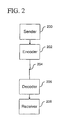
- FIG. 2 shows a basic communication model.
- a data source or sender 200 there is a data source or sender 200, a communication channel 204, and a data receiver 208.
- the source may be someone speaking on a telephone, over telephone wires, to another person.
- the source may be a television or radio broadcast transmitted by wireless methods to television or radio receivers.
- the source may be a digital encoding of some data, whether audio, visual, or other, transmitted over a wired or wireless communication link (e.g., a LAN or the internet) to a corresponding decoder for the information.
- a wired or wireless communication link e.g., a LAN or the internet
- an encoder 202 is used to prepare the data source for transmission over the communication channel 204.
- the encoder is responsible for converting the source data into a format appropriate for the channel 204.
- a decoder 206 is required to reverse the encoding process so as to present sensible data to the receiver.
- the encoder 202 is frequently designed to utilize compression schemes for the transmission of the data. Compression is desirable since, except for unusual circumstances, communication bandwidth is limited. Therefore, for complex data sources, such as audio or video data, the source data needs to be compressed to allow its transmission over conventional transmission paths.
- entropy encoding which utilizes a "code book” containing short code words that have been pre-assigned to highly probable input data.
- An effective coding method is entropy encoding. Such coders can capitalize on the data coherency, and are particularly effective when symbols have nonuniform probability distribution.
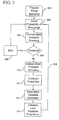
- FIG. 3 is a flowchart showing a preferred method for generating a code book.
- FIG. 3 illustrates how to create a code book having variable length code assignments for variable length symbol groupings.
- prior art techniques either require fixed-length codes or fixed blocks of input.
- Preferred implementations overcome the resource requirements of large dimension vector encoding, and the inapplicability of coding into words of equal lengths, by providing an entropy based variable-to-variable code, where variable length code words are used to encode variable length X sequences.
- the problem is separated into two different tasks.
- the first task is identification of a (sub-optimal) grouping of a set of input symbols ⁇ x i ⁇ through an empirical approach described below.
- the second task is assigning an entropy-type code for the grouped symbols ⁇ y i ⁇ . Note that it is known that if the source is not coherent (i.e., the input is independent or without memory), any grouping that has the same configuration of ⁇ N j ⁇ can achieve the same coding efficiency. In this situation, the first task becomes inconsequential.
- This initial configuration assumes that an exemplary input stream is being used to train creation of the code book.
- a computer may be programmed with software constructions such as data structures to track receipt of each symbol from an input.
- data structures may be implemented as a binary-type tree structure, hash table, or some combination of the two. Other equivalent structures may also be used.
- the probability of occurrence for each y i is computed 302. Such probability is determined with respect to any exemplary input used to train code book generation. As further symbols are added to the symbol data structure, the probabilities are dynamically adjusted.
- the most probable grouping y i is identified 304 (denoted as y mp ). If 306 the highest probability symbol is a grouping of previously lower probability symbols, then the grouping is split 308 into its constituent symbols, and processing restarted from step 302. (Although symbols may be combined, the group retains memory of all symbols therein so that symbols can be extracted.)
- step 310 in which the most probable grouping is then tentatively extended 310 with single symbol extensions x i 's.
- y mp is extended with each symbol from the X alphabet.
- a predictor can be used to only generate an extension set containing only probable extensions, if the alphabet is very large and it is known many extensions are unlikely. For example, such a predictor may be based on semantic or contextual meaning, so that very improbable extensions can be ignored a priori.
- the probability for each tentative expansion of y mp is then computed 312, and only the most probable extension retained 314.
- the rest of the lower probability extensions are collapsed together 316 as a combined grouping and stored in code book with a special symbol to indicate a combined grouping.
- This wild-card symbol represents any arbitrary symbol grouping having y mp as a prefix, but with an extension (suffix) different from the most probable extension. That is, if y mp +x mp is the most probable root and extension, then the other less probable extensions are represented as y mp *, * ⁇ x mp . (Note that this discussion presumes, for clarity; serial processing of single-symbol extensions; however, parallel execution of multiple symbol extensions is contemplated.)
- Code book construction is completed by repeating 318 steps 302-316 until all extensions have been made, or the number of code book entries reaches a predetermined limit.
- One structure for a code book is traversal and storage of a N-ary (e.g., binary, tertiary, etc.) tree, where symbol groupings guide a traversal of the tree structure.
- Leaf nodes of the tree represent the end of a recognized symbol sequence, where an entropy-type code is associated with the sequence.
- Nodes can be coded in software as a structure, class definition, or other structure allowing storage of a symbol or symbols associated with the node.
- the code book may be structured as a table having each string of input symbol sorted by probability of occurrence, with highly probable input at the top of the table.
- the table can be sorted according to the first symbol, i.e., all symbol series beginning with "A” are grouped together, followed by series starting with "B", etc. With this arrangement, all entries within the grouping are sorted according to their probabilities of occurrence. The position of the beginning of each section is marked/tracked so that a hash-type function (e.g., a look-up based on the first symbol) can be used to locate the correct portion of the code book table.
- a hash-type function e.g., a look-up based on the first symbol
- FIGS. 4-10 illustrate creation of a code book pursuant to FIG. 3 for an alphabet (A, B, C ⁇ .
- the code book is defined with respect to an exemplary input stream "A A A B B A A C A B A B B A B".
- one or more exemplary inputs may be used to generate a code book that is then used by encoders and decoders to process arbitrary inputs.
- the code book is presented as a tree structure, although it may in fact be implemented as a linear table, hash table, database, etc.
- the tree is oriented left-to-right, where the left column (e.g., "A” and "X0") represents the top row of a tree-type structure, and successively indented rows represent the "children" of the previous row's node (e.g., in a top-down tree for FIG. 5, node "A” is a first-row parent node for a second-row middle-child node "B".).
- FIG. 4 shows an initial grouping for the input stream "A A A B B A A-C A B A B B A B".
- This initial trivial grouping can be created based on different criteria, the simplest being having a first-level node for every character in the alphabet. However, if the input alphabet is large, the trivial grouping may be limited to some subset of symbols having highest probability, where the remaining symbols are combined into an X grouping.
- FIG. 4 illustrates this technique by starting with only two initial groups, group A 400 having probability 8/15, and group X0 402 having probability 7/15, where X0 represents all remaining low probability symbols in the alphabet, e.g., B and C.
- the leaf-node having highest probability is selected for extension (see also FIG. 3 discussion regarding processing sequence).
- group A 400 is tentatively expanded by each character in the alphabet (or one may limit the expansion to some subset thereof as described for creating the initial grouping).
- Probabilities are then recomputed with respect to the input stream "A A A B B A A C A B A B B A B” to determine values for the tentative extensions A 406, B 408, and C 410.
- FIG. 6 shows the collapse into X1 412 for FIG. 5. Processing repeats with identification of the node having highest probability, e.g., node B 408 at probability 4/9.
- this node 408 is tentatively extended with symbols A 414, B 416, C 418, and as discussed above, the tentative grouping with highest probability is retained.
- the result is eight parsing groups in which the symbol sequence "A B A” 414 appears once, "A B B” 416 appears once, and "A B C” 418 does not appear at all. Since tentative extensions A 414 and B 416 have the same probability of occurrence, a rule needs to be defined to choose which symbol to retain. For this discussion, whenever there are equal probabilities, the highest row node (e.g., the left-most child node in a top-down tree) is retained. Similarly, when there is a conflict between tree rows, the left-most row's node (e.g., the node closest to the root of a top-down tree) is retained.
- code book entries can be created to account for such end of input sequences, or the input having no entry can be escaped with a special character and inserted in the encoded output stream. For example, a special symbol can be used to indicate end of input, therefore implying how to handle the trailing characters on decoding.
- the next step is to expand the node currently having highest probability with respect to the input stream.
- the highest node in the tree (X0 402) is extended. (Although it is only necessary to be consistent, it is preferable to expand higher level nodes since this may increase coding efficiency by increasing the number of long code words.)
- FIG. 10 shows the result of retaining high-probability node B 422. Note that grouping X0 now only represents a single symbol "C”. After revising probabilities, the node having highest probability must be identified and split or extended. As shown, symbol sequence "A B A” appears 1/8, “A B X2" appears 1/8, “A X1” appears 3/8, “B” appears 2/8, and "X0" appears 1/8. Therefore node X1 412, as a combined node, must be split.
Landscapes
- Engineering & Computer Science (AREA)
- Theoretical Computer Science (AREA)
- Compression, Expansion, Code Conversion, And Decoders (AREA)
Applications Claiming Priority (3)
| Application Number | Priority Date | Filing Date | Title |
|---|---|---|---|
| US09/211,532 US6404931B1 (en) | 1998-12-14 | 1998-12-14 | Code book construction for variable to variable length entropy encoding |
| US211532 | 1998-12-14 | ||
| PCT/US1999/029003 WO2000036751A1 (en) | 1998-12-14 | 1999-12-07 | Code book construction for variable to variable length entropy encoding |
Publications (2)
| Publication Number | Publication Date |
|---|---|
| EP1147612A1 EP1147612A1 (en) | 2001-10-24 |
| EP1147612B1 true EP1147612B1 (en) | 2004-04-21 |
Family
ID=22787319
Family Applications (1)
| Application Number | Title | Priority Date | Filing Date |
|---|---|---|---|
| EP99968085A Expired - Lifetime EP1147612B1 (en) | 1998-12-14 | 1999-12-07 | Code book construction for variable to variable length entropy encoding |
Country Status (6)
| Country | Link |
|---|---|
| US (1) | US6404931B1 (enExample) |
| EP (1) | EP1147612B1 (enExample) |
| JP (1) | JP4559631B2 (enExample) |
| AT (1) | ATE265106T1 (enExample) |
| DE (1) | DE69916661T2 (enExample) |
| WO (1) | WO2000036751A1 (enExample) |
Families Citing this family (35)
| Publication number | Priority date | Publication date | Assignee | Title |
|---|---|---|---|---|
| US6624761B2 (en) | 1998-12-11 | 2003-09-23 | Realtime Data, Llc | Content independent data compression method and system |
| US6601104B1 (en) | 1999-03-11 | 2003-07-29 | Realtime Data Llc | System and methods for accelerated data storage and retrieval |
| US6604158B1 (en) | 1999-03-11 | 2003-08-05 | Realtime Data, Llc | System and methods for accelerated data storage and retrieval |
| US20030191876A1 (en) * | 2000-02-03 | 2003-10-09 | Fallon James J. | Data storewidth accelerator |
| US20010047473A1 (en) | 2000-02-03 | 2001-11-29 | Realtime Data, Llc | Systems and methods for computer initialization |
| GB2367459A (en) * | 2000-09-28 | 2002-04-03 | Roke Manor Research | Method of compressing data packets |
| US9143546B2 (en) | 2000-10-03 | 2015-09-22 | Realtime Data Llc | System and method for data feed acceleration and encryption |
| US8692695B2 (en) | 2000-10-03 | 2014-04-08 | Realtime Data, Llc | Methods for encoding and decoding data |
| US7417568B2 (en) | 2000-10-03 | 2008-08-26 | Realtime Data Llc | System and method for data feed acceleration and encryption |
| US6735339B1 (en) * | 2000-10-27 | 2004-05-11 | Dolby Laboratories Licensing Corporation | Multi-stage encoding of signal components that are classified according to component value |
| US7386046B2 (en) | 2001-02-13 | 2008-06-10 | Realtime Data Llc | Bandwidth sensitive data compression and decompression |
| US7016547B1 (en) * | 2002-06-28 | 2006-03-21 | Microsoft Corporation | Adaptive entropy encoding/decoding for screen capture content |
| EP2282310B1 (en) * | 2002-09-04 | 2012-01-25 | Microsoft Corporation | Entropy coding by adapting coding between level and run-length/level modes |
| US7433824B2 (en) * | 2002-09-04 | 2008-10-07 | Microsoft Corporation | Entropy coding by adapting coding between level and run-length/level modes |
| US7313817B2 (en) * | 2003-06-17 | 2007-12-25 | Lockheed Martin Corporation | Data transmission system utilizing efficient complexity estimation of the kolmogorov complexity for data transmission |
| US7782954B2 (en) * | 2003-09-07 | 2010-08-24 | Microsoft Corporation | Scan patterns for progressive video content |
| US7688894B2 (en) * | 2003-09-07 | 2010-03-30 | Microsoft Corporation | Scan patterns for interlaced video content |
| US7724827B2 (en) * | 2003-09-07 | 2010-05-25 | Microsoft Corporation | Multi-layer run level encoding and decoding |
| US7941311B2 (en) * | 2003-10-22 | 2011-05-10 | Microsoft Corporation | System and method for linguistic collation |
| US7599840B2 (en) * | 2005-07-15 | 2009-10-06 | Microsoft Corporation | Selectively using multiple entropy models in adaptive coding and decoding |
| US7684981B2 (en) * | 2005-07-15 | 2010-03-23 | Microsoft Corporation | Prediction of spectral coefficients in waveform coding and decoding |
| US7693709B2 (en) | 2005-07-15 | 2010-04-06 | Microsoft Corporation | Reordering coefficients for waveform coding or decoding |
| US7565018B2 (en) * | 2005-08-12 | 2009-07-21 | Microsoft Corporation | Adaptive coding and decoding of wide-range coefficients |
| US8599925B2 (en) * | 2005-08-12 | 2013-12-03 | Microsoft Corporation | Efficient coding and decoding of transform blocks |
| US7933337B2 (en) * | 2005-08-12 | 2011-04-26 | Microsoft Corporation | Prediction of transform coefficients for image compression |
| US8184710B2 (en) * | 2007-02-21 | 2012-05-22 | Microsoft Corporation | Adaptive truncation of transform coefficient data in a transform-based digital media codec |
| US7774205B2 (en) * | 2007-06-15 | 2010-08-10 | Microsoft Corporation | Coding of sparse digital media spectral data |
| US8179974B2 (en) * | 2008-05-02 | 2012-05-15 | Microsoft Corporation | Multi-level representation of reordered transform coefficients |
| US8406307B2 (en) | 2008-08-22 | 2013-03-26 | Microsoft Corporation | Entropy coding/decoding of hierarchically organized data |
| KR20110011357A (ko) * | 2009-07-28 | 2011-02-08 | 삼성전자주식회사 | 비트의 순서를 변경한 데이터의 부호화, 복호화 방법 및 장치 |
| DE102010009263B4 (de) * | 2010-02-25 | 2012-04-12 | Knorr-Bremse Systeme für Nutzfahrzeuge GmbH | Verfahren zur Datenübertragung zu einem elektronischen Steuergerät |
| DE102012211031B3 (de) | 2012-06-27 | 2013-11-28 | Siemens Aktiengesellschaft | Verfahren zur Codierung eines Datenstroms |
| US10044405B2 (en) | 2015-11-06 | 2018-08-07 | Cable Television Laboratories, Inc | Signal power reduction systems and methods |
| SE542507C2 (en) | 2016-03-31 | 2020-05-26 | Zeropoint Tech Ab | Variable-sized symbol entropy-based data compression |
| US9673836B1 (en) * | 2016-09-23 | 2017-06-06 | International Business Machines Corporation | System level testing of entropy encoding |
Citations (1)
| Publication number | Priority date | Publication date | Assignee | Title |
|---|---|---|---|---|
| WO1998040969A2 (en) * | 1997-03-14 | 1998-09-17 | J.Stream, Inc. | Text file compression system |
Family Cites Families (43)
| Publication number | Priority date | Publication date | Assignee | Title |
|---|---|---|---|---|
| US4122440A (en) | 1977-03-04 | 1978-10-24 | International Business Machines Corporation | Method and means for arithmetic string coding |
| US4464650A (en) | 1981-08-10 | 1984-08-07 | Sperry Corporation | Apparatus and method for compressing data signals and restoring the compressed data signals |
| US4558302A (en) | 1983-06-20 | 1985-12-10 | Sperry Corporation | High speed data compression and decompression apparatus and method |
| JPS61107818A (ja) | 1984-10-30 | 1986-05-26 | Nec Corp | エントロピ−符号化方式とその装置 |
| JPH0821863B2 (ja) | 1985-04-13 | 1996-03-04 | キヤノン株式会社 | データ処理方法 |
| JPS62247626A (ja) | 1986-04-19 | 1987-10-28 | Fuji Photo Film Co Ltd | 符号化方法 |
| US4862167A (en) | 1987-02-24 | 1989-08-29 | Hayes Microcomputer Products, Inc. | Adaptive data compression method and apparatus |
| US5532694A (en) | 1989-01-13 | 1996-07-02 | Stac Electronics, Inc. | Data compression apparatus and method using matching string searching and Huffman encoding |
| US5003307A (en) | 1989-01-13 | 1991-03-26 | Stac, Inc. | Data compression apparatus with shift register search means |
| US5479562A (en) * | 1989-01-27 | 1995-12-26 | Dolby Laboratories Licensing Corporation | Method and apparatus for encoding and decoding audio information |
| DE3943881B4 (de) | 1989-04-17 | 2008-07-17 | Fraunhofer-Gesellschaft zur Förderung der angewandten Forschung e.V. | Digitales Codierverfahren |
| US5254990A (en) | 1990-02-26 | 1993-10-19 | Fujitsu Limited | Method and apparatus for compression and decompression of data |
| US5049881A (en) | 1990-06-18 | 1991-09-17 | Intersecting Concepts, Inc. | Apparatus and method for very high data rate-compression incorporating lossless data compression and expansion utilizing a hashing technique |
| US5227789A (en) | 1991-09-30 | 1993-07-13 | Eastman Kodak Company | Modified huffman encode/decode system with simplified decoding for imaging systems |
| JP3134424B2 (ja) | 1991-10-31 | 2001-02-13 | ソニー株式会社 | 可変長符号化方法及び装置 |
| US5229768A (en) | 1992-01-29 | 1993-07-20 | Traveling Software, Inc. | Adaptive data compression system |
| US5227788A (en) | 1992-03-02 | 1993-07-13 | At&T Bell Laboratories | Method and apparatus for two-component signal compression |
| US5406279A (en) | 1992-09-02 | 1995-04-11 | Cirrus Logic, Inc. | General purpose, hash-based technique for single-pass lossless data compression |
| US5442350A (en) | 1992-10-29 | 1995-08-15 | International Business Machines Corporation | Method and means providing static dictionary structures for compressing character data and expanding compressed data |
| US5400075A (en) | 1993-01-13 | 1995-03-21 | Thomson Consumer Electronics, Inc. | Adaptive variable length encoder/decoder |
| JP2505980B2 (ja) | 1993-04-16 | 1996-06-12 | インターナショナル・ビジネス・マシーンズ・コーポレイション | 静的辞書作成方法及びコンピュ―タ実行システム |
| JP3210996B2 (ja) | 1993-07-30 | 2001-09-25 | 三菱電機株式会社 | 高能率符号化装置及び高能率復号化装置 |
| US5550541A (en) | 1994-04-01 | 1996-08-27 | Dolby Laboratories Licensing Corporation | Compact source coding tables for encoder/decoder system |
| JP3278297B2 (ja) | 1994-07-20 | 2002-04-30 | 富士通株式会社 | データ圧縮方法及びデータ復元方法並びにデータ圧縮装置及びデータ復元装置 |
| JPH08116263A (ja) * | 1994-10-17 | 1996-05-07 | Fujitsu Ltd | データ処理装置及びデータ処理方法 |
| JPH08167852A (ja) * | 1994-12-13 | 1996-06-25 | Fujitsu Ltd | データ圧縮方法及び装置 |
| JPH08205169A (ja) * | 1995-01-20 | 1996-08-09 | Matsushita Electric Ind Co Ltd | 動画像符号化装置及び復号装置 |
| US5731840A (en) * | 1995-03-10 | 1998-03-24 | Kabushiki Kaisha Toshiba | Video coding/decoding apparatus which transmits different accuracy prediction levels |
| US5884269A (en) | 1995-04-17 | 1999-03-16 | Merging Technologies | Lossless compression/decompression of digital audio data |
| JP3181809B2 (ja) | 1995-05-31 | 2001-07-03 | シャープ株式会社 | データ圧縮のための圧縮コードの復元回路 |
| US5825830A (en) | 1995-08-17 | 1998-10-20 | Kopf; David A. | Method and apparatus for the compression of audio, video or other data |
| US5819215A (en) | 1995-10-13 | 1998-10-06 | Dobson; Kurt | Method and apparatus for wavelet based data compression having adaptive bit rate control for compression of digital audio or other sensory data |
| US5933104A (en) | 1995-11-22 | 1999-08-03 | Microsoft Corporation | Method and system for compression and decompression using variable-sized offset and length fields |
| US5831559A (en) | 1996-01-24 | 1998-11-03 | Intel Corporation | Encoding/decoding video signals using multiple run-val mapping tables |
| JP3566441B2 (ja) | 1996-01-30 | 2004-09-15 | シャープ株式会社 | テキスト圧縮用辞書作成装置 |
| JP3277792B2 (ja) | 1996-01-31 | 2002-04-22 | 株式会社日立製作所 | データ圧縮方法および装置 |
| JP3267142B2 (ja) | 1996-02-23 | 2002-03-18 | ケイディーディーアイ株式会社 | 可変長符号生成装置 |
| US5790706A (en) | 1996-07-03 | 1998-08-04 | Motorola, Inc. | Method and apparatus for scanning of transform coefficients |
| DE19637522A1 (de) | 1996-09-13 | 1998-03-19 | Bosch Gmbh Robert | Verfahren zur Reduzierung von Daten in Videosignalen |
| US5959560A (en) | 1997-02-07 | 1999-09-28 | Said; Amir | Data compression via alphabet partitioning and group partitioning |
| US5946043A (en) | 1997-12-31 | 1999-08-31 | Microsoft Corporation | Video coding using adaptive coding of block parameters for coded/uncoded blocks |
| US6100824A (en) | 1998-04-06 | 2000-08-08 | National Dispatch Center, Inc. | System and method for data compression |
| US6029126A (en) | 1998-06-30 | 2000-02-22 | Microsoft Corporation | Scalable audio coder and decoder |
-
1998
- 1998-12-14 US US09/211,532 patent/US6404931B1/en not_active Expired - Lifetime
-
1999
- 1999-12-07 WO PCT/US1999/029003 patent/WO2000036751A1/en not_active Ceased
- 1999-12-07 JP JP2000588899A patent/JP4559631B2/ja not_active Expired - Lifetime
- 1999-12-07 DE DE69916661T patent/DE69916661T2/de not_active Expired - Lifetime
- 1999-12-07 EP EP99968085A patent/EP1147612B1/en not_active Expired - Lifetime
- 1999-12-07 AT AT99968085T patent/ATE265106T1/de not_active IP Right Cessation
Patent Citations (1)
| Publication number | Priority date | Publication date | Assignee | Title |
|---|---|---|---|---|
| WO1998040969A2 (en) * | 1997-03-14 | 1998-09-17 | J.Stream, Inc. | Text file compression system |
Non-Patent Citations (1)
| Title |
|---|
| BAILEY R.L.; MUKKAMALA R.: "Pipelining Data Compression Algorithms", THE COMPUTER JOURNAL, vol. 33, no. 4, August 1999 (1999-08-01), pages 308 - 313 * |
Also Published As
| Publication number | Publication date |
|---|---|
| DE69916661D1 (de) | 2004-05-27 |
| JP4559631B2 (ja) | 2010-10-13 |
| US6404931B1 (en) | 2002-06-11 |
| DE69916661T2 (de) | 2004-08-19 |
| ATE265106T1 (de) | 2004-05-15 |
| JP2002533005A (ja) | 2002-10-02 |
| EP1147612A1 (en) | 2001-10-24 |
| WO2000036751A1 (en) | 2000-06-22 |
Similar Documents
| Publication | Publication Date | Title |
|---|---|---|
| US6404931B1 (en) | Code book construction for variable to variable length entropy encoding | |
| EP1142129B1 (en) | Variable to variable length entropy encoding | |
| US9223765B1 (en) | Encoding and decoding data using context model grouping | |
| US6100824A (en) | System and method for data compression | |
| JP2002532765A (ja) | 周波数領域オーディオ符号化のためのエントロピー符号モード切替え | |
| JPS6356726B2 (enExample) | ||
| Díaz-Domínguez et al. | A grammar compressor for collections of reads with applications to the construction of the BWT | |
| CN119135188A (zh) | 基于霍夫曼编码的数据压缩方法、装置和数据解压方法、装置 | |
| Yang et al. | Universal lossless data compression with side information by using a conditional MPM grammar transform | |
| Tamir et al. | DNA storage in the short molecule regime | |
| Willems et al. | Reflections on “the context tree weighting method: Basic properties” | |
| Jacob et al. | Comparative analysis of lossless text compression techniques | |
| US20060125660A1 (en) | Digital data compression robust relative to transmission noise | |
| WO2025156482A1 (zh) | 基于语义的哈夫曼编码方法、译码方法及相关设备 | |
| CN116471337A (zh) | 一种基于bwt和lzw的报文压缩与解压缩方法及设备 | |
| Kieffer et al. | Survey of grammar-based data structure compression | |
| Rani et al. | A survey on lossless text data compression techniques | |
| Xu et al. | Semantic Huffman coding using synonymous mapping | |
| JPH1155125A (ja) | 文字データの圧縮・復元方法 | |
| Shanmugasundaram et al. | Text preprocessing using enhanced intelligent dictionary based encoding (EIDBE) | |
| Erkan et al. | A New Text Compression Algorithm Based on Index Permutation and Suffix Coding Un nouvel algorithme de compression de texte basé sur la permutation d’index et le codage par suffixe | |
| CN117465471A (zh) | 一种针对文本文件的无损压缩系统及其压缩方法 | |
| EP1678833A2 (en) | Resilient parameterized prefix codes for adaptive coding | |
| Rottenstreich et al. | Optimal compression for two-field entries in fixed-width memories | |
| Gibson | Lossless Source Coding |
Legal Events
| Date | Code | Title | Description |
|---|---|---|---|
| PUAI | Public reference made under article 153(3) epc to a published international application that has entered the european phase |
Free format text: ORIGINAL CODE: 0009012 |
|
| 17P | Request for examination filed |
Effective date: 20010712 |
|
| AK | Designated contracting states |
Kind code of ref document: A1 Designated state(s): AT BE CH CY DE DK ES FI FR GB GR IE IT LI LU MC NL PT SE |
|
| 17Q | First examination report despatched |
Effective date: 20011105 |
|
| GRAP | Despatch of communication of intention to grant a patent |
Free format text: ORIGINAL CODE: EPIDOSNIGR1 |
|
| GRAS | Grant fee paid |
Free format text: ORIGINAL CODE: EPIDOSNIGR3 |
|
| GRAA | (expected) grant |
Free format text: ORIGINAL CODE: 0009210 |
|
| AK | Designated contracting states |
Kind code of ref document: B1 Designated state(s): AT BE CH CY DE DK ES FI FR GB GR IE IT LI LU MC NL PT SE |
|
| PG25 | Lapsed in a contracting state [announced via postgrant information from national office to epo] |
Ref country code: NL Free format text: LAPSE BECAUSE OF FAILURE TO SUBMIT A TRANSLATION OF THE DESCRIPTION OR TO PAY THE FEE WITHIN THE PRESCRIBED TIME-LIMIT Effective date: 20040421 Ref country code: LI Free format text: LAPSE BECAUSE OF FAILURE TO SUBMIT A TRANSLATION OF THE DESCRIPTION OR TO PAY THE FEE WITHIN THE PRESCRIBED TIME-LIMIT Effective date: 20040421 Ref country code: IT Free format text: LAPSE BECAUSE OF FAILURE TO SUBMIT A TRANSLATION OF THE DESCRIPTION OR TO PAY THE FEE WITHIN THE PRESCRIBED TIME-LIMIT;WARNING: LAPSES OF ITALIAN PATENTS WITH EFFECTIVE DATE BEFORE 2007 MAY HAVE OCCURRED AT ANY TIME BEFORE 2007. THE CORRECT EFFECTIVE DATE MAY BE DIFFERENT FROM THE ONE RECORDED. Effective date: 20040421 Ref country code: FI Free format text: LAPSE BECAUSE OF FAILURE TO SUBMIT A TRANSLATION OF THE DESCRIPTION OR TO PAY THE FEE WITHIN THE PRESCRIBED TIME-LIMIT Effective date: 20040421 Ref country code: CY Free format text: LAPSE BECAUSE OF FAILURE TO SUBMIT A TRANSLATION OF THE DESCRIPTION OR TO PAY THE FEE WITHIN THE PRESCRIBED TIME-LIMIT Effective date: 20040421 Ref country code: CH Free format text: LAPSE BECAUSE OF FAILURE TO SUBMIT A TRANSLATION OF THE DESCRIPTION OR TO PAY THE FEE WITHIN THE PRESCRIBED TIME-LIMIT Effective date: 20040421 Ref country code: BE Free format text: LAPSE BECAUSE OF FAILURE TO SUBMIT A TRANSLATION OF THE DESCRIPTION OR TO PAY THE FEE WITHIN THE PRESCRIBED TIME-LIMIT Effective date: 20040421 Ref country code: AT Free format text: LAPSE BECAUSE OF FAILURE TO SUBMIT A TRANSLATION OF THE DESCRIPTION OR TO PAY THE FEE WITHIN THE PRESCRIBED TIME-LIMIT Effective date: 20040421 |
|
| REG | Reference to a national code |
Ref country code: GB Ref legal event code: FG4D |
|
| REG | Reference to a national code |
Ref country code: CH Ref legal event code: EP |
|
| REG | Reference to a national code |
Ref country code: IE Ref legal event code: FG4D |
|
| REF | Corresponds to: |
Ref document number: 69916661 Country of ref document: DE Date of ref document: 20040527 Kind code of ref document: P |
|
| PG25 | Lapsed in a contracting state [announced via postgrant information from national office to epo] |
Ref country code: SE Free format text: LAPSE BECAUSE OF FAILURE TO SUBMIT A TRANSLATION OF THE DESCRIPTION OR TO PAY THE FEE WITHIN THE PRESCRIBED TIME-LIMIT Effective date: 20040721 Ref country code: GR Free format text: LAPSE BECAUSE OF FAILURE TO SUBMIT A TRANSLATION OF THE DESCRIPTION OR TO PAY THE FEE WITHIN THE PRESCRIBED TIME-LIMIT Effective date: 20040721 Ref country code: DK Free format text: LAPSE BECAUSE OF FAILURE TO SUBMIT A TRANSLATION OF THE DESCRIPTION OR TO PAY THE FEE WITHIN THE PRESCRIBED TIME-LIMIT Effective date: 20040721 |
|
| PG25 | Lapsed in a contracting state [announced via postgrant information from national office to epo] |
Ref country code: ES Free format text: LAPSE BECAUSE OF FAILURE TO SUBMIT A TRANSLATION OF THE DESCRIPTION OR TO PAY THE FEE WITHIN THE PRESCRIBED TIME-LIMIT Effective date: 20040801 |
|
| NLV1 | Nl: lapsed or annulled due to failure to fulfill the requirements of art. 29p and 29m of the patents act | ||
| REG | Reference to a national code |
Ref country code: CH Ref legal event code: PL |
|
| PG25 | Lapsed in a contracting state [announced via postgrant information from national office to epo] |
Ref country code: LU Free format text: LAPSE BECAUSE OF NON-PAYMENT OF DUE FEES Effective date: 20041207 Ref country code: IE Free format text: LAPSE BECAUSE OF NON-PAYMENT OF DUE FEES Effective date: 20041207 |
|
| ET | Fr: translation filed | ||
| PG25 | Lapsed in a contracting state [announced via postgrant information from national office to epo] |
Ref country code: MC Free format text: LAPSE BECAUSE OF NON-PAYMENT OF DUE FEES Effective date: 20041231 |
|
| PLBE | No opposition filed within time limit |
Free format text: ORIGINAL CODE: 0009261 |
|
| STAA | Information on the status of an ep patent application or granted ep patent |
Free format text: STATUS: NO OPPOSITION FILED WITHIN TIME LIMIT |
|
| 26N | No opposition filed |
Effective date: 20050124 |
|
| REG | Reference to a national code |
Ref country code: IE Ref legal event code: MM4A |
|
| PG25 | Lapsed in a contracting state [announced via postgrant information from national office to epo] |
Ref country code: PT Free format text: LAPSE BECAUSE OF NON-PAYMENT OF DUE FEES Effective date: 20040921 |
|
| REG | Reference to a national code |
Ref country code: DE Ref legal event code: R082 Ref document number: 69916661 Country of ref document: DE Representative=s name: GRUENECKER, KINKELDEY, STOCKMAIR & SCHWANHAEUS, DE |
|
| REG | Reference to a national code |
Ref country code: GB Ref legal event code: 732E Free format text: REGISTERED BETWEEN 20150115 AND 20150121 |
|
| REG | Reference to a national code |
Ref country code: DE Ref legal event code: R082 Ref document number: 69916661 Country of ref document: DE Representative=s name: GRUENECKER PATENT- UND RECHTSANWAELTE PARTG MB, DE Effective date: 20150126 Ref country code: DE Ref legal event code: R081 Ref document number: 69916661 Country of ref document: DE Owner name: MICROSOFT TECHNOLOGY LICENSING, LLC, REDMOND, US Free format text: FORMER OWNER: MICROSOFT CORP., REDMOND, WASH., US Effective date: 20150126 |
|
| REG | Reference to a national code |
Ref country code: FR Ref legal event code: TP Owner name: MICROSOFT TECHNOLOGY LICENSING, LLC, US Effective date: 20150724 |
|
| REG | Reference to a national code |
Ref country code: FR Ref legal event code: PLFP Year of fee payment: 17 |
|
| REG | Reference to a national code |
Ref country code: FR Ref legal event code: PLFP Year of fee payment: 18 |
|
| REG | Reference to a national code |
Ref country code: FR Ref legal event code: PLFP Year of fee payment: 19 |
|
| PGFP | Annual fee paid to national office [announced via postgrant information from national office to epo] |
Ref country code: DE Payment date: 20171129 Year of fee payment: 19 Ref country code: FR Payment date: 20171113 Year of fee payment: 19 |
|
| PGFP | Annual fee paid to national office [announced via postgrant information from national office to epo] |
Ref country code: GB Payment date: 20171206 Year of fee payment: 19 |
|
| REG | Reference to a national code |
Ref country code: DE Ref legal event code: R119 Ref document number: 69916661 Country of ref document: DE |
|
| GBPC | Gb: european patent ceased through non-payment of renewal fee |
Effective date: 20181207 |
|
| PG25 | Lapsed in a contracting state [announced via postgrant information from national office to epo] |
Ref country code: DE Free format text: LAPSE BECAUSE OF NON-PAYMENT OF DUE FEES Effective date: 20190702 |
|
| PG25 | Lapsed in a contracting state [announced via postgrant information from national office to epo] |
Ref country code: GB Free format text: LAPSE BECAUSE OF NON-PAYMENT OF DUE FEES Effective date: 20181207 |
|
| PG25 | Lapsed in a contracting state [announced via postgrant information from national office to epo] |
Ref country code: FR Free format text: LAPSE BECAUSE OF NON-PAYMENT OF DUE FEES Effective date: 20181231 |