EP1145910A2 - Fahrzeug-Innenauskleidungsteil - Google Patents
Fahrzeug-Innenauskleidungsteil Download PDFInfo
- Publication number
- EP1145910A2 EP1145910A2 EP01108675A EP01108675A EP1145910A2 EP 1145910 A2 EP1145910 A2 EP 1145910A2 EP 01108675 A EP01108675 A EP 01108675A EP 01108675 A EP01108675 A EP 01108675A EP 1145910 A2 EP1145910 A2 EP 1145910A2
- Authority
- EP
- European Patent Office
- Prior art keywords
- lining part
- fibers
- part according
- solidified
- lining
- Prior art date
- Legal status (The legal status is an assumption and is not a legal conclusion. Google has not performed a legal analysis and makes no representation as to the accuracy of the status listed.)
- Withdrawn
Links
- 239000000835 fiber Substances 0.000 claims abstract description 56
- 229920001169 thermoplastic Polymers 0.000 claims abstract description 19
- 239000004416 thermosoftening plastic Substances 0.000 claims abstract description 17
- 238000007596 consolidation process Methods 0.000 claims abstract description 13
- 238000007711 solidification Methods 0.000 claims abstract description 12
- 230000008023 solidification Effects 0.000 claims abstract description 12
- 239000004753 textile Substances 0.000 claims abstract description 12
- 238000005299 abrasion Methods 0.000 claims abstract description 6
- 239000004744 fabric Substances 0.000 claims abstract description 6
- 239000002759 woven fabric Substances 0.000 claims abstract 2
- -1 polypropylene Polymers 0.000 claims description 21
- 239000004743 Polypropylene Substances 0.000 claims description 13
- 229920001155 polypropylene Polymers 0.000 claims description 12
- 239000004698 Polyethylene Substances 0.000 claims description 9
- 238000002844 melting Methods 0.000 claims description 9
- 230000008018 melting Effects 0.000 claims description 9
- 229920000573 polyethylene Polymers 0.000 claims description 8
- XLYOFNOQVPJJNP-UHFFFAOYSA-N water Substances O XLYOFNOQVPJJNP-UHFFFAOYSA-N 0.000 claims description 4
- 239000004745 nonwoven fabric Substances 0.000 claims description 2
- 230000009965 odorless effect Effects 0.000 abstract description 3
- 239000010410 layer Substances 0.000 description 13
- 239000011230 binding agent Substances 0.000 description 5
- 238000004519 manufacturing process Methods 0.000 description 5
- 239000004033 plastic Substances 0.000 description 5
- 229920003023 plastic Polymers 0.000 description 5
- 239000000463 material Substances 0.000 description 4
- 239000002131 composite material Substances 0.000 description 3
- 239000003292 glue Substances 0.000 description 3
- 238000004064 recycling Methods 0.000 description 3
- 238000000926 separation method Methods 0.000 description 3
- 238000010521 absorption reaction Methods 0.000 description 2
- 239000000853 adhesive Substances 0.000 description 2
- 230000001070 adhesive effect Effects 0.000 description 2
- 238000005520 cutting process Methods 0.000 description 2
- 239000002657 fibrous material Substances 0.000 description 2
- 239000006260 foam Substances 0.000 description 2
- 238000000034 method Methods 0.000 description 2
- 238000000465 moulding Methods 0.000 description 2
- 230000035699 permeability Effects 0.000 description 2
- 229920000098 polyolefin Polymers 0.000 description 2
- 238000004080 punching Methods 0.000 description 2
- 239000000126 substance Substances 0.000 description 2
- 241000761389 Copa Species 0.000 description 1
- 239000004952 Polyamide Substances 0.000 description 1
- 239000012790 adhesive layer Substances 0.000 description 1
- 238000003490 calendering Methods 0.000 description 1
- 238000004132 cross linking Methods 0.000 description 1
- 238000009826 distribution Methods 0.000 description 1
- 230000000694 effects Effects 0.000 description 1
- 238000009408 flooring Methods 0.000 description 1
- 238000009499 grossing Methods 0.000 description 1
- 238000009413 insulation Methods 0.000 description 1
- 239000004816 latex Substances 0.000 description 1
- 229920000126 latex Polymers 0.000 description 1
- 239000000155 melt Substances 0.000 description 1
- 238000010309 melting process Methods 0.000 description 1
- 229920002647 polyamide Polymers 0.000 description 1
- 239000000843 powder Substances 0.000 description 1
- 239000002994 raw material Substances 0.000 description 1
- 230000002787 reinforcement Effects 0.000 description 1
- 230000000717 retained effect Effects 0.000 description 1
- 238000007789 sealing Methods 0.000 description 1
- 230000035943 smell Effects 0.000 description 1
- 238000007669 thermal treatment Methods 0.000 description 1
- 239000012815 thermoplastic material Substances 0.000 description 1
- 238000009732 tufting Methods 0.000 description 1
Images
Classifications
-
- D—TEXTILES; PAPER
- D04—BRAIDING; LACE-MAKING; KNITTING; TRIMMINGS; NON-WOVEN FABRICS
- D04H—MAKING TEXTILE FABRICS, e.g. FROM FIBRES OR FILAMENTARY MATERIAL; FABRICS MADE BY SUCH PROCESSES OR APPARATUS, e.g. FELTS, NON-WOVEN FABRICS; COTTON-WOOL; WADDING ; NON-WOVEN FABRICS FROM STAPLE FIBRES, FILAMENTS OR YARNS, BONDED WITH AT LEAST ONE WEB-LIKE MATERIAL DURING THEIR CONSOLIDATION
- D04H11/00—Non-woven pile fabrics
-
- B—PERFORMING OPERATIONS; TRANSPORTING
- B32—LAYERED PRODUCTS
- B32B—LAYERED PRODUCTS, i.e. PRODUCTS BUILT-UP OF STRATA OF FLAT OR NON-FLAT, e.g. CELLULAR OR HONEYCOMB, FORM
- B32B5/00—Layered products characterised by the non- homogeneity or physical structure, i.e. comprising a fibrous, filamentary, particulate or foam layer; Layered products characterised by having a layer differing constitutionally or physically in different parts
- B32B5/22—Layered products characterised by the non- homogeneity or physical structure, i.e. comprising a fibrous, filamentary, particulate or foam layer; Layered products characterised by having a layer differing constitutionally or physically in different parts characterised by the presence of two or more layers which are next to each other and are fibrous, filamentary, formed of particles or foamed
- B32B5/24—Layered products characterised by the non- homogeneity or physical structure, i.e. comprising a fibrous, filamentary, particulate or foam layer; Layered products characterised by having a layer differing constitutionally or physically in different parts characterised by the presence of two or more layers which are next to each other and are fibrous, filamentary, formed of particles or foamed one layer being a fibrous or filamentary layer
- B32B5/26—Layered products characterised by the non- homogeneity or physical structure, i.e. comprising a fibrous, filamentary, particulate or foam layer; Layered products characterised by having a layer differing constitutionally or physically in different parts characterised by the presence of two or more layers which are next to each other and are fibrous, filamentary, formed of particles or foamed one layer being a fibrous or filamentary layer another layer next to it also being fibrous or filamentary
-
- B—PERFORMING OPERATIONS; TRANSPORTING
- B60—VEHICLES IN GENERAL
- B60R—VEHICLES, VEHICLE FITTINGS, OR VEHICLE PARTS, NOT OTHERWISE PROVIDED FOR
- B60R13/00—Elements for body-finishing, identifying, or decorating; Arrangements or adaptations for advertising purposes
- B60R13/02—Internal Trim mouldings ; Internal Ledges; Wall liners for passenger compartments; Roof liners
-
- D—TEXTILES; PAPER
- D04—BRAIDING; LACE-MAKING; KNITTING; TRIMMINGS; NON-WOVEN FABRICS
- D04H—MAKING TEXTILE FABRICS, e.g. FROM FIBRES OR FILAMENTARY MATERIAL; FABRICS MADE BY SUCH PROCESSES OR APPARATUS, e.g. FELTS, NON-WOVEN FABRICS; COTTON-WOOL; WADDING ; NON-WOVEN FABRICS FROM STAPLE FIBRES, FILAMENTS OR YARNS, BONDED WITH AT LEAST ONE WEB-LIKE MATERIAL DURING THEIR CONSOLIDATION
- D04H13/00—Other non-woven fabrics
Definitions
- the invention relates to a lining part from a Textile with a fiber reinforcement on the back for one Vehicle interior.
- nonwovens or Velor fabrics solidified on the back in that a Adhesive layer or binder layer, typically Latex, is applied.
- a Adhesive layer or binder layer typically Latex
- Such solidification is necessary because the one required for a lining part Surface strength with a mechanically bound only Non-woven or velor is not available.
- the lining part is disadvantageous in that the glue or the binder is practically not different from that Fibers can be separated so that the recyclate is not can be used more for the production of pure fibers.
- Another disadvantage is that Lining part initially unpleasant smells spread.
- Bicomponent fibers are known on the market (core / sheath fibers).
- the fiber core consists of a plastic with a higher melting point
- the Fiber sheath consists of a plastic with a lower Melting point.
- Such bicomponent fibers are both as "Single substance" product available (e.g. PET / CoPET; PA / COPA or as "two-material” fibers such as PP / PE; PET / PA etc.).
- One of such bicomponent fibers manufactured nonwoven can be Solidify the effects of temperature thermally. This is done consolidation, however, by melting the "jacket" of the bicomponent fibers and thus binds the nonwoven depending on the location of the FAs and their shares, in total or partially depending on the distribution.
- Such bicomponent fibers are not only expensive, but also have the disadvantage when recycling that they are either two-substance systems or as "single-fiber” different melting points exhibit.
- a recyclable, textile Equipment such as flooring or trunk mat, for polyolefin-based motor vehicles, the from a textile covering and at least one foam sheet consists.
- a textile covering is a pile fleece on the Base of polypropylene fiber material provided with Foam is laminated from polyethylene.
- the Fleece covering can be made using polyethylene powder be pre-consolidated. If this lining part in the Way that should be recycled again unmixed primary products made of polypropylene on the one hand and Polyethylene should be obtained on the other hand, then must be made of polypropylene and polyethylene Parts are separated from each other. Such a separation is hardly economically possible in practice. He follows the separation is not, then only a non-sorted Recyclable plastic material in which polypropylene and Polyethylene are mixed. Such a polyolefin composite is due to the poor tolerance of Polypropylene with polyethylene only one inferior composite product reusable.
- DE 42 11 708 A1 is a molded molding for Motor vehicles known that is recyclable in such a way that the plastic material of the lining part at the Recycling raw material for a new one Liner molding can be.
- the textile cover layer which is woven, knitted, tufted, knitted or needled, as well as the non-textile carrier layer made of non-crosslinking Polypropylene.
- the non-textile carrier layer made of non-crosslinking Polypropylene.
- To manufacture this lining part are at least two prefabricated layers, namely the textile cover layer and the non-textile backing layer necessary. The top layer and the backing layer are solvent-free, thermally bonded together.
- the object of the invention is to provide a lining part of the Specify the type mentioned at the beginning, that without part separation is 100% recyclable, largely odorless, that is inexpensive to manufacture and its surface is sufficiently resistant to abrasion.
- the starting product for the lining part is a Nonwoven or velor fabric that has virtually no bond which has fibers due to binders or adhesives, and accordingly it is hardly resistant to abrasion, and with the fibers easily detach from the fiber composite (pilling).
- the fibers consist at least predominantly of the same thermoplastic.
- the fibers are no bicomponent fibers, but One-component fibers.
- thermoplastic fibers are on the back of the Preproduct to the melting point of the thermoplastic Plastic heated and on the back by fusing solidified.
- the finished lining part has on the back as a result of there thermoplastic consolidation of the fibers smoother structure than in the overlying fiber area, in which the fibers are not thermoplastic bound.
- the one opposite the rear hardening Surface of the lining part can be velor, be structured or smooth.
- the material density is in the area of the back Solidification greater than in the area above.
- the the hardening area facing away from the rear The surface of the lining part is wear-resistant and inclines not to remove fibers (pilling) because the Fibers through the back thermoplastic Solidification compared to that on the starting product only mechanical bond additionally connected are.
- the lining part is inexpensive to manufacture because that inexpensive starting product from inexpensive fiber material only needs to be thermally solidified, with further Process steps such as application of binder or Application of glue, and an additional layer omitted.
- the lining part is already when inserted in the Vehicle interior practically odorless because thermoplastic fibers do not develop an odor per se.
- the lining is recyclable by type because it is practically consists of nothing else than that used thermoplastic.
- the lining part can ultimately be closed again Plastic fibers are processed, which make up a can produce a new lining part.
- the backing of the lining part has also the advantage that the back consolidation too forms a supporting layer of the lining part, wherein the load-bearing layer is a mass factor that the Sound insulation in the respective vehicle interior favors and through the side facing away from the solidification, through whose open surface is the sound absorption in the interior of the vehicle.
- the density of the lining part is preferably in The area of thermal solidification is larger than in the not thermally consolidated area.
- the thickness of the region is one embodiment of the invention the thermal hardening is smaller than the thickness in area of the fibers not thermally consolidated.
- the rear solidification can be designed in such a way that it is permeable to air and / or permeable to water. In this case, it can pass through the lining part an air or steam exchange takes place.
- thermoplastic is preferred Polypropylene or polyethylene. However, it can also other thermoplastics are used.
- the lining part preferably consists of approximately 100% made of polypropylene.
- the lining part essentially contains no melt fibers that have a lower melting point have than the other fibers of thermoplastic Plastic.
- the lining part is preferably made of a needle fleece, in particular flat needle felt.
- the surface facing away from the back can be smoothed thermoplastic, then between the rear thermally hardened area and the thermally smoothed surface a volume determining Area where the fibers are not thermal are bound.
- Such a lining part is particularly suitable for use in a vehicle interior as Floor covering or trunk lining or Hat racks and side panels.
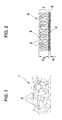
- fleece 1 which is a tangled fleece or a Needle fleece can be
- fibers 2 are mechanically without Binder and bound without glue.
- Fleece can also be a velor or a fabric or Tuftings are used.
- the fibers 2 mainly consist of the same thermoplastic, such as polypropylene, Polyethylene, polyamide or the like thermoplastic.
- the fibers 2 are One-component fibers without different melting points (so no core / sheath fibers). Preferably exist 100% polypropylene fibers.
- the fibers 2 are fused together on the rear side 4 thereof by thermal treatment, as a result of which the fibers 2 are additionally bonded for mechanical binding.
- the lining part 3 is solidified overall in such a way that it has a desired strength against abrasion and pilling, which is not given in the fleece 1 as such.
- the solidified area 6, in which the fibers 2 are thermally bonded forms a load-bearing element of the lining part 3, which ensures the dimensional stability of the lining part 3.
- the density (g / cm 3 ) in the solidified region 6 is greater than in the thermally non-consolidated region 7.
- the thickness d1 of the consolidated region 6 is generally smaller than the thickness d2 of the non-consolidated region 7, so that the textile structure on the top 5 of the lining part 3 is retained.
- the ratio between the thicknesses d1 and d2 can be adjusted in the hardening process depending on the requirements.
- the solidified area 6 is permeable to air, which is the soundproofing properties of the lining part 3 is conducive to sound absorption.
- the unconsolidated area 7 is permeable to air anyway.
- the Air permeability is cheap, because it also makes it Water vapor permeability is reached.
- the solidified area 6 does not have to adhere to the Extend back 4 continuously. It is also possible, that the solidified area 6 only in individual zones is provided, between solidified zones unsolidified zones remain. To maintain the shape of the Liner part to ensure the go solidified zones into each other.
- the top 5 of the lining part 3 can in the way be structured such that fibers 2 end higher or lower. This structuring can be create that the fibers 2 in the pattern of Structure are thermally bonded similar to that of the Back 4 is the case. It is also possible that Top 5 easy to wipe clean. It will for this then the fleece 1 on the top 5 similar thermally hardened, as on the back 4.
- the lining part 3 can be made from the fleece 1 for example by calendering. Doing so the fleece 1 from a roll over a heated roller performed, the fleece 1 on the back Melting temperature of the fibers 2 brings. These merge thereby in the area 6 of the consolidation.
- the thickness d1 to limit the area 6 of the solidification that runs Fleece 1 after the heated roller over a cooled one Roller that ends the melting process.
- Preferably are in one of the sum of the thicknesses d1 and d2 corresponding distance above the rollers mentioned Top rollers, which can be cooled to the thickness d1 of the limit area 6 to be solidified.
- a Structuring or thermoplastic smoothing of the Top 5 is desired, one of the top rollers be heated accordingly.
- a two or three-dimensional spatial shape of the lining part 3 can also be produced from the fleece 1 in that a appropriate fleece cut into a heated mold is inserted.
- the lining part described is advantageous recyclable because it is at least predominantly from the same thermoplastic material, so that the recyclate can be processed back into fibers, from which a new textile can be made.
Landscapes
- Engineering & Computer Science (AREA)
- Textile Engineering (AREA)
- Mechanical Engineering (AREA)
- Laminated Bodies (AREA)
- Vehicle Interior And Exterior Ornaments, Soundproofing, And Insulation (AREA)
- Nonwoven Fabrics (AREA)
Abstract
Description
Claims (13)
- Auskleidungsteil aus einem Textil mit einer rückseitigen Verfestigung für einen Fahrzeuginnenraum,
dadurch gekennzeichnet, dass das Auskleidungsteil(3) aus einem Vlies(1) oder Velours oder Gewebe oder einem getufteten Produkt hergestellt ist, dessen Fasern(2) im wesentlichen nur mechanisch, bindemittelfrei und klebemittelfrei gebunden sind, und bei dem überwiegend alle Fasern(2) aus dem gleichen thermoplastischen Kunststoff bestehen und Einkomponnenten-Fasern sind, und dass die rückseitige Verfestigung(6) und/oder eine oberseitige Verfestigung(5) durch vollflächige oder partielle thermische Verfestigung gebildet ist. - Auskleidungsteil nach Anspruch 1,
dadurch gekennzeichnet, dass die Dichte im Bereich(6) bzw. Oberseite(5) der thermischen Verfestigung größer ist als die Dichte im nicht thermisch verfestigten Bereich(7). - Auskleidungsteil nach Anspruch 1 oder 2,
dadurch gekennzeichnet, dass die Dicke(d1) des thermisch verfestigten Bereichs(6,5) kleiner ist als die Dicke(d2) des thermisch nicht verfestigten Bereichs(7). - Auskleidungsteil nach einem der vorhergehenden Ansprüche,
dadurch gekennzeichnet, dass das Auskleidungsteil(3) im thermisch verfestigten Bereich(6) derart verfestigt ist, dass das Auskleidungsteil(3) an der Oberseite(5) eine hinreichende Festigkeit, insbesondere Abriebfestigkeit und Festigkeit gegen Herauslösen von Fasern(2), aufweist. - Auskleidungsteil nach einem der vorhergehenden Ansprüche,
dadurch gekennzeichnet, dass die Verfestigung luftdurchlässig und/ oder wasserdurchlässig ist. - Auskleidungsteil nach einem der vorhergehenden Ansprüche,
dadurch gekennzeichnet, dass die Verfestigung nur in einzelnen Zonen vorgesehen ist, wobei zwischen verfestigten Zonen unverfestigte Zonen bestehen. - Auskleidungsteil nach einem der vorhergehenden Ansprüche,
dadurch gekennzeichnet, dass der thermoplastische Kunststoff Polypropylen oder Polyethylen ist. - Auskleidungsteil nach Anspruch 7,
dadurch gekennzeichnet, dass das Auskleidungsteil(3) zu etwa 100% aus Polypropylen besteht. - Auskleidungsteil nach einem der vorhergehenden Ansprüche,
dadurch gekennzeichnet, dass das Auskleidungsteil(3) im wesentlichen keine oder keine Schmelzfasern enthält, die einen niedrigeren Schmelzpunkt aufweisen als die übrigen Fasern. - Auskleidungsteil nach einem der vorhergehenden Ansprüche,
dadurch gekennzeichnet, dass das Auskleidungsteil(3) aus einem Nadelvlies(1) hergestellt ist. - Auskleidungsteil nach einem der vorhergehenden Ansprüche,
dadurch gekennzeichnet, dass die der Rückseite(4) abgewandte Oberseite(5) ein Polvlies, ein Gewebe, Gewirke oder ein getuftetes Produkt ist. - Auskleidungsteil nach einem der vorhergehenden Ansprüche,
dadurch gekennzeichnet, dass die der Rückseite(4) abgewandte Oberseite(5) strukturiert ist. - Auskleidungsteil nach einem der vorhergehenden Ansprüche,
dadurch gekennzeichnet, dass die der Rückseite(4) abgewandte Oberseite(5) thermoplastisch geglättet oder strukturiert ist.
Applications Claiming Priority (2)
| Application Number | Priority Date | Filing Date | Title |
|---|---|---|---|
| DE10018004 | 2000-04-11 | ||
| DE10018004.3A DE10018004B4 (de) | 2000-04-11 | 2000-04-11 | Fahrzeug-Innenauskleidungsteil |
Publications (2)
| Publication Number | Publication Date |
|---|---|
| EP1145910A2 true EP1145910A2 (de) | 2001-10-17 |
| EP1145910A3 EP1145910A3 (de) | 2002-07-31 |
Family
ID=7638384
Family Applications (1)
| Application Number | Title | Priority Date | Filing Date |
|---|---|---|---|
| EP01108675A Withdrawn EP1145910A3 (de) | 2000-04-11 | 2001-04-06 | Fahrzeug-Innenauskleidungsteil |
Country Status (2)
| Country | Link |
|---|---|
| EP (1) | EP1145910A3 (de) |
| DE (1) | DE10018004B4 (de) |
Cited By (2)
| Publication number | Priority date | Publication date | Assignee | Title |
|---|---|---|---|---|
| EP1325845A3 (de) * | 2001-12-20 | 2004-04-28 | Ideal Automotive GmbH | Innenverkleidungsteil, insbesondere für Kraftfahrzeuge |
| EP3717698A4 (de) * | 2017-11-28 | 2021-08-04 | Watershed Geosynthetics LLC | Bodenabdeckung mit stabilisiertem wasserstrom |
Families Citing this family (2)
| Publication number | Priority date | Publication date | Assignee | Title |
|---|---|---|---|---|
| DE20218350U1 (de) * | 2002-11-26 | 2004-04-01 | Sai Automotive Sal Gmbh | Material für ein akustisch wirksames Verkleidungselement |
| DE102016201842A1 (de) * | 2016-02-08 | 2017-08-10 | Volkswagen Aktiengesellschaft | Verkleidungsbauteil eines Kraftfahrzeugs und Anordnung einer Tragstruktur eines Kraftfahrzeugs und eines Verkleidungsbauteils |
Family Cites Families (13)
| Publication number | Priority date | Publication date | Assignee | Title |
|---|---|---|---|---|
| DE2050595A1 (en) * | 1970-10-15 | 1972-04-20 | Häfele, Emil, 7062 Rudersberg | Car mat - from needled synthetic fibre felt |
| DE2249138A1 (de) * | 1972-10-06 | 1974-04-11 | Giulini Gmbh Geb | Neue versteifungsmaterialien |
| DE3718424A1 (de) * | 1987-06-02 | 1988-12-22 | Schaeffler Teppichboden Gmbh | Kraftfahrzeug-teppichbodenbelag |
| DE3718434C2 (de) * | 1987-06-02 | 1996-02-08 | Krupp Koppers Gmbh | Verfahren zur Erhöhung des wärmetechnischen Wirkungsgrades des Verkokungsprozesses |
| DE8909952U1 (de) * | 1989-08-19 | 1989-10-05 | Johann Borgers Gmbh & Co Kg, 4290 Bocholt | Recyclingfähiges textiles Ausstattungsteil für Kraftfahrzeuge, wie Bodenbelag, Kofferraummatte o.dgl. |
| DE4211708C2 (de) * | 1992-04-08 | 1997-02-13 | Schaeffler Teppichboden Gmbh | Auskleidungs-Formteil und Verfahren zu dessen Herstellung |
| DE4214389A1 (de) * | 1992-04-30 | 1993-11-04 | Bayerische Motoren Werke Ag | Schichtaufbau, insbesondere eines ausstattungsteils fuer einen fahrzeuginnenraum, sowie verfahren zu dessen herstellung |
| DE4400894A1 (de) * | 1994-01-14 | 1995-07-20 | Otg Otterberger Textil Ges Mbh | Verfahren zur Herstellung von Innenbauteilen für Kraftfahrzeuge |
| WO1996001734A1 (en) * | 1994-07-11 | 1996-01-25 | Foss Manufacturing Co., Inc. | Recyclable thermoformed structural panel made of single polymer type in adhered multi-layers of non-woven fabric |
| US5604009A (en) * | 1994-12-02 | 1997-02-18 | Synthetic Industries, Inc. | Non-adhesive bonded tufted carpet and method for making the same |
| AT405533B (de) * | 1996-12-23 | 1999-09-27 | Asota Gmbh | Zweischichtiges nadelvlies |
| DE19812925A1 (de) * | 1998-03-24 | 1999-09-30 | Asota Gmbh | Dreidimensionale, formstabile Formteile auf Basis von strukturierten Nadelvliesen |
| EP1108807A1 (de) * | 1999-12-17 | 2001-06-20 | Benifin Anstalt | Verfahren zum Verleihen von Festigkeit an Moquette |
-
2000
- 2000-04-11 DE DE10018004.3A patent/DE10018004B4/de not_active Expired - Lifetime
-
2001
- 2001-04-06 EP EP01108675A patent/EP1145910A3/de not_active Withdrawn
Cited By (2)
| Publication number | Priority date | Publication date | Assignee | Title |
|---|---|---|---|---|
| EP1325845A3 (de) * | 2001-12-20 | 2004-04-28 | Ideal Automotive GmbH | Innenverkleidungsteil, insbesondere für Kraftfahrzeuge |
| EP3717698A4 (de) * | 2017-11-28 | 2021-08-04 | Watershed Geosynthetics LLC | Bodenabdeckung mit stabilisiertem wasserstrom |
Also Published As
| Publication number | Publication date |
|---|---|
| DE10018004B4 (de) | 2021-02-11 |
| DE10018004A1 (de) | 2001-10-25 |
| EP1145910A3 (de) | 2002-07-31 |
Similar Documents
| Publication | Publication Date | Title |
|---|---|---|
| EP2536546B1 (de) | Verfahren zur herstellung eines plattenförmigen halbzeugs aus faserverbundwerkstoff, und das so erhaltene halbzeug | |
| EP2847378B1 (de) | Kraftfahrzeug-teppichboden | |
| EP1620260B1 (de) | Faservlies-verbundelement | |
| EP0603774B1 (de) | Auf Basis eines Vlieses hergestellte Mattenware | |
| EP0763418B1 (de) | Verfahren zum Herstellen einer mehrlagigen Bahn insbesondere als Polsterbezugsmaterial für Fahrzeugsitze | |
| EP3423269B1 (de) | Mehrlagiger akustik- und/oder versteifungsvliesstoff | |
| DE102016117622A1 (de) | Herstellungsverfahren eines Innenausstattungsteils eines Kraftfahrzeugs | |
| EP0469309A1 (de) | Faserstruktur und daraus erhaltenes Formteil sowie Verfahren zu dessen Herstellung | |
| WO1993024698A1 (de) | Tuftingteppich und verfahren zu seiner herstellung | |
| EP2463092A1 (de) | Innenraum-Verkleidungsbauteil für ein Kraftfahrzeug | |
| DE102022121174B3 (de) | Isolationsbauteil-herstellungsverfahren sowie strömungsdichtes, leichtes isolationsbauteil für fahrzeuge | |
| DE4211708C2 (de) | Auskleidungs-Formteil und Verfahren zu dessen Herstellung | |
| WO2006111037A1 (de) | Thermoplastisch verarbeitbarer verbundwerkstoff | |
| DE102005053915A1 (de) | Schichtträger für ein Fahrzeuginnenmaterial und Herstellungsverfahren hierfür | |
| DE102005037572A1 (de) | Verkleidungsteil, insbesondere Innenverkleidungs- oder Auskleidungsteil für Kraftfahrzeuge | |
| WO1995015411A1 (de) | Tuftingteppich und verfahren zu seiner herstellung | |
| DE102016122248A1 (de) | Dekorteil und Verfahren zur Herstellung eines Dekorteils | |
| DE3887811T2 (de) | Faseriger Schichtstoff und Verfahren zur Herstellung desselben. | |
| DE102005028627B3 (de) | Warmumgeformtes Trägerteil, insbesondere Hutablage, und Verfahren zur Herstellung eines solchen Trägerteils | |
| DE10018004B4 (de) | Fahrzeug-Innenauskleidungsteil | |
| WO2006050893A1 (de) | Akustisch wirksames teppichformteil für kraftfahrzeuge und verfahren zu dessen herstellung | |
| DE20006659U1 (de) | Fahrzeug-Innenauskleidungsteil | |
| EP3807127B1 (de) | Dreidimensional geformtes nadelvlies | |
| WO2006066601A1 (de) | Thermoformbares trägerteil | |
| DE19508158A1 (de) | Verwendung eines Verbundstoffes zur Herstellung von Sportbällen sowie als wasserdichtes und atmungsaktives Schuhobermaterial |
Legal Events
| Date | Code | Title | Description |
|---|---|---|---|
| PUAI | Public reference made under article 153(3) epc to a published international application that has entered the european phase |
Free format text: ORIGINAL CODE: 0009012 |
|
| AK | Designated contracting states |
Kind code of ref document: A2 Designated state(s): AT BE CH CY DE DK ES FI FR GB GR IE IT LI LU MC NL PT SE TR |
|
| AX | Request for extension of the european patent |
Free format text: AL;LT;LV;MK;RO;SI |
|
| PUAL | Search report despatched |
Free format text: ORIGINAL CODE: 0009013 |
|
| AK | Designated contracting states |
Kind code of ref document: A3 Designated state(s): AT BE CH CY DE DK ES FI FR GB GR IE IT LI LU MC NL PT SE TR |
|
| AX | Request for extension of the european patent |
Free format text: AL;LT;LV;MK;RO;SI |
|
| 17P | Request for examination filed |
Effective date: 20020913 |
|
| 17Q | First examination report despatched |
Effective date: 20030305 |
|
| AKX | Designation fees paid |
Designated state(s): BE DE ES FR GB IT |
|
| STAA | Information on the status of an ep patent application or granted ep patent |
Free format text: STATUS: THE APPLICATION IS DEEMED TO BE WITHDRAWN |
|
| 18D | Application deemed to be withdrawn |
Effective date: 20030716 |