EP1142972A2 - Dispergiermittel zur Herstellung wässriger Pigmentpasten - Google Patents
Dispergiermittel zur Herstellung wässriger Pigmentpasten Download PDFInfo
- Publication number
- EP1142972A2 EP1142972A2 EP01106495A EP01106495A EP1142972A2 EP 1142972 A2 EP1142972 A2 EP 1142972A2 EP 01106495 A EP01106495 A EP 01106495A EP 01106495 A EP01106495 A EP 01106495A EP 1142972 A2 EP1142972 A2 EP 1142972A2
- Authority
- EP
- European Patent Office
- Prior art keywords
- pigment
- mol
- assemblies
- atoms
- radical
- Prior art date
- Legal status (The legal status is an assumption and is not a legal conclusion. Google has not performed a legal analysis and makes no representation as to the accuracy of the status listed.)
- Granted
Links
Classifications
-
- C—CHEMISTRY; METALLURGY
- C09—DYES; PAINTS; POLISHES; NATURAL RESINS; ADHESIVES; COMPOSITIONS NOT OTHERWISE PROVIDED FOR; APPLICATIONS OF MATERIALS NOT OTHERWISE PROVIDED FOR
- C09D—COATING COMPOSITIONS, e.g. PAINTS, VARNISHES OR LACQUERS; FILLING PASTES; CHEMICAL PAINT OR INK REMOVERS; INKS; CORRECTING FLUIDS; WOODSTAINS; PASTES OR SOLIDS FOR COLOURING OR PRINTING; USE OF MATERIALS THEREFOR
- C09D11/00—Inks
- C09D11/02—Printing inks
- C09D11/03—Printing inks characterised by features other than the chemical nature of the binder
-
- C—CHEMISTRY; METALLURGY
- C09—DYES; PAINTS; POLISHES; NATURAL RESINS; ADHESIVES; COMPOSITIONS NOT OTHERWISE PROVIDED FOR; APPLICATIONS OF MATERIALS NOT OTHERWISE PROVIDED FOR
- C09D—COATING COMPOSITIONS, e.g. PAINTS, VARNISHES OR LACQUERS; FILLING PASTES; CHEMICAL PAINT OR INK REMOVERS; INKS; CORRECTING FLUIDS; WOODSTAINS; PASTES OR SOLIDS FOR COLOURING OR PRINTING; USE OF MATERIALS THEREFOR
- C09D17/00—Pigment pastes, e.g. for mixing in paints
- C09D17/001—Pigment pastes, e.g. for mixing in paints in aqueous medium
-
- C—CHEMISTRY; METALLURGY
- C09—DYES; PAINTS; POLISHES; NATURAL RESINS; ADHESIVES; COMPOSITIONS NOT OTHERWISE PROVIDED FOR; APPLICATIONS OF MATERIALS NOT OTHERWISE PROVIDED FOR
- C09D—COATING COMPOSITIONS, e.g. PAINTS, VARNISHES OR LACQUERS; FILLING PASTES; CHEMICAL PAINT OR INK REMOVERS; INKS; CORRECTING FLUIDS; WOODSTAINS; PASTES OR SOLIDS FOR COLOURING OR PRINTING; USE OF MATERIALS THEREFOR
- C09D7/00—Features of coating compositions, not provided for in group C09D5/00; Processes for incorporating ingredients in coating compositions
- C09D7/40—Additives
- C09D7/45—Anti-settling agents
Definitions
- the invention relates to the use of copolymers vinyl-functionalized polyethers for the production of aqueous Pigment preparations.
- dispersants used as the surfactant wetting promote the solid particles to be dispersed and that Make it easier to break up agglomerates. These dispersants also have a stabilizing effect on the dispersions and prevent re-agglomeration or flocculation of the solid particles. Dispersants, for example, are of particular importance for the dispersion of pigments during manufacture of printing inks, paints and varnishes.
- the present invention is therefore based on the object for the dispersion of pigments a large number of the above to overcome disadvantages, especially the storage stability the pigment concentrates with regard to rheological behavior, Flocculation, aggregation and color shift due to extreme Resistance to hydrolysis of the active ingredients used and the Weather resistance and yellowing stability made from it Coatings positively influenced and through the use of the Dispersing additives no volatile organic components in the Formulations should be introduced.
- colesser- or VOC-free pigment concentrates based transparent iron oxides with polymeric wetting and dispersing additives (i.e. avoiding surface-active substances such as alkylphenol alkoxylates with critical toxicological profiles) when high pigment contents and high transparency are reached to manufacture.
- assemblies whose monomer is a vinyl, acrylic acid or methacrylic acid derivative represents to be included.
- the copolymer compounds according to the present invention consist of at least three assemblies a), b), and c).
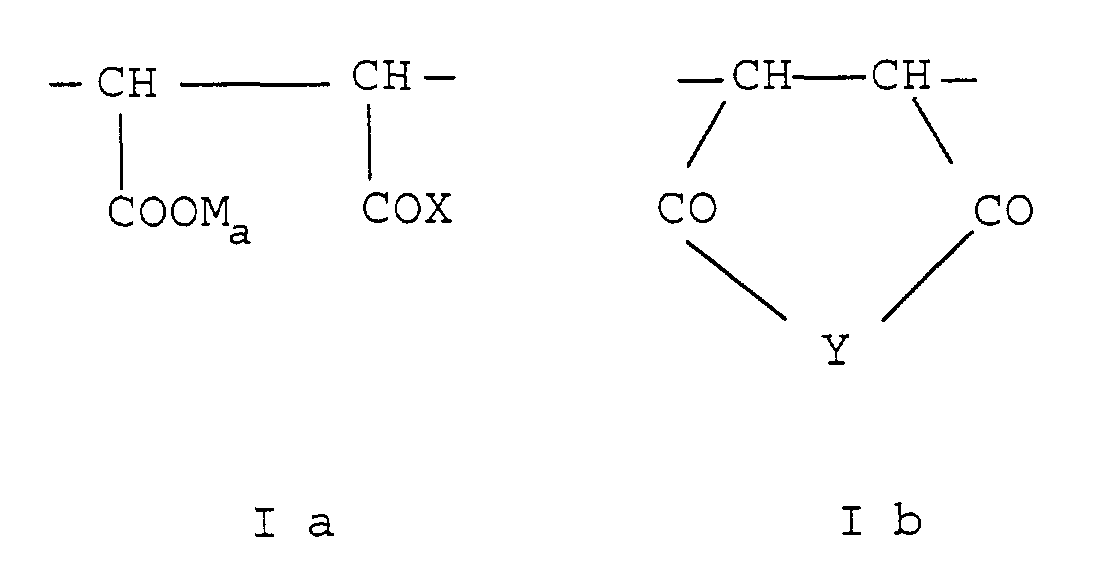
- the first assembly a) is a dicarboxylic acid derivative corresponding to the formula Ia or Ib.
- Sodium, potassium, calcium or magnesium ions are preferably used as the mono- or divalent metal cation.
- Substituted ammonium groups derived from primary, secondary or tertiary C 1 to C 20 alkylamines, C 1 to C 20 alkanolamines, C 5 to C 8 cycloalkylamines and C 6 to C are preferably used as organic amine residues 14 arylamines. Examples of corresponding amines are methylamines, dimethylamine, trimethylamine, ethanolamine, diethanolamine, triethanolamine, cyclohexylamine, dicyclohexylamine, phenylamine, diphenylamine in the protonated (ammonium) form.
- the aliphatic hydrocarbon radicals can be linear or branched and saturated or unsaturated.
- Cyclopentyl or cyclohexyl radicals are preferred cycloalkyl radicals, as preferred aryl residues phenyl or naphthyl residues to look at, which in particular by hydroxyl, carboxyl or sulfonic acid groups can be substituted.
- X can also mean -NHR 2 and / or -NR 2 2 , which corresponds to the mono- or disubstituted monoamides of the corresponding dicarboxylic acid, where R 2 can in turn be identical to R 1 or instead can mean -CO-NH 2 .
- Reaction products with diamines from the group HQ 1 N - Q 2 - NQ 3 Q 4 where Q 1 is a hydrogen radical or a monovalent hydrocarbon radical having 1 to 24 carbon atoms, Q 2 a divalent alkylene radical, can also be used as dicarboxylic acid derivatives corresponding to formula Ia or Ib 2 to 24 carbon atoms, Q 3 and Q 4 are aliphatic and / or alicyclic alkyl radicals having 1 to 12 carbon atoms, which have been oxidized to form amine oxide groups bonded via half-amide or imide groups.
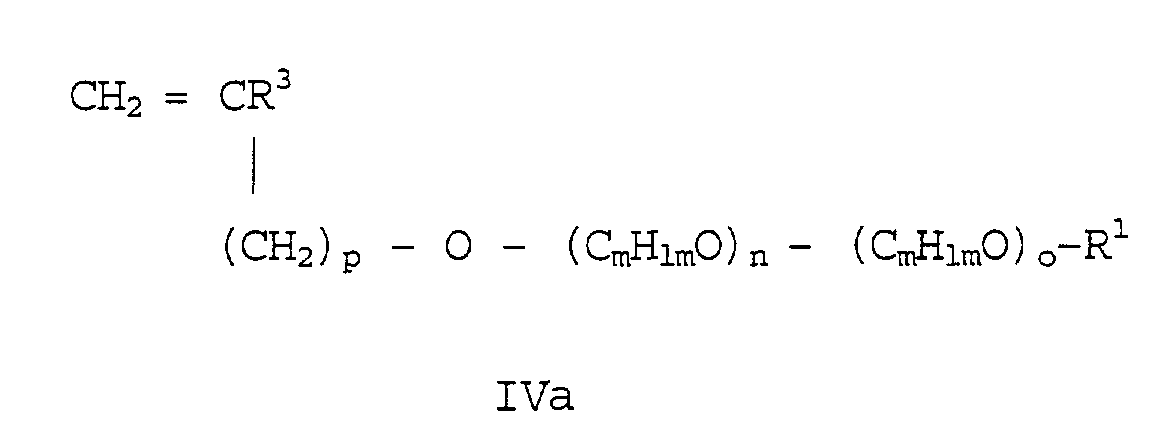
- R 3 is hydrogen or an aliphatic hydrocarbon radical having 1 to 5 C atoms (which can likewise be linear or branched or also unsaturated).
- p can assume values between 0 and 3
- q 0 to 6
- t 0 to 3
- R 1 , l, m, n and o have the meaning given above.
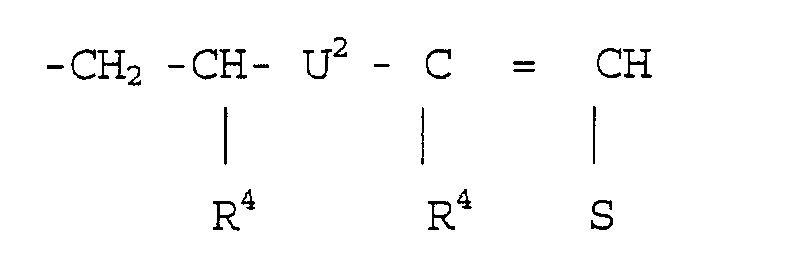
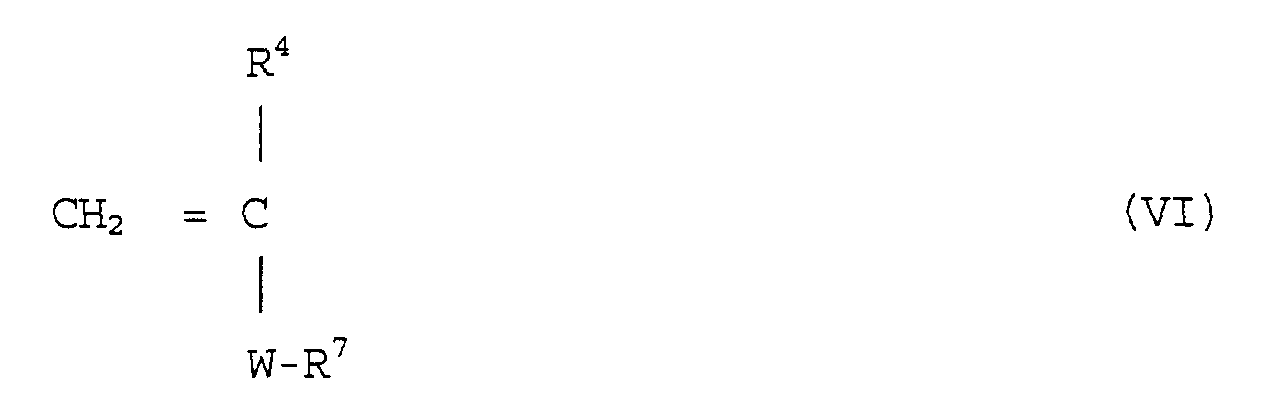
- the third assembly c) corresponds to the formula III a or III b:
- R 4 can be H or CH 3 , depending on whether it is an acrylic or methacrylic acid derivative.
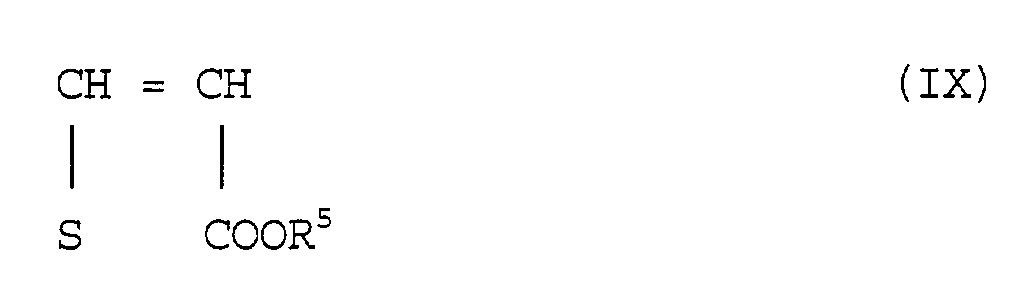
- S can mean -H, COOM a or -COOR 5 , where a and M have the abovementioned meaning and R 5 is an aliphatic hydrocarbon radical having 3 to 20 C atoms, a cycloaliphatic hydrocarbon radical having 5 to 8 C atoms or an aryl radical can be with 6 to 14 carbon atoms.
- the aliphatic hydrocarbon residue can also be linear or branched, saturated or unsaturated.
- the preferred cycloaliphatic hydrocarbon radicals are again cyclopentyl or cyclohexyl radicals and the preferred aryl radicals are phenyl or naphthyl radicals.
- T -COOR 5
- S COOM a or -COOR 5 .
- the assemblies c) can also have other hydrophobic structural elements.
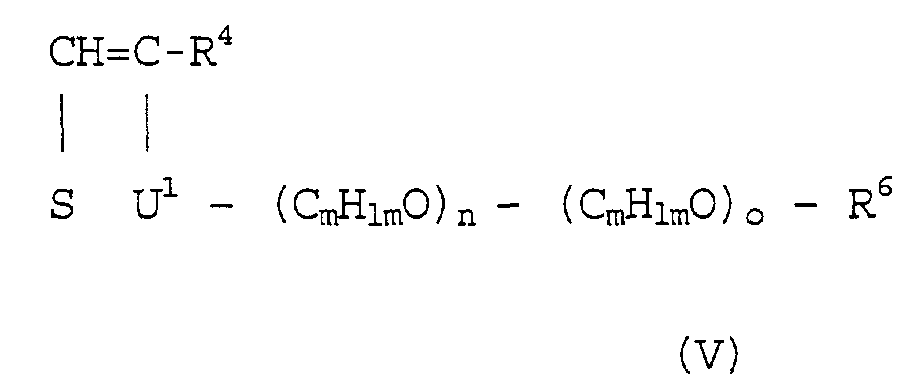
- These compounds are polyalkylene oxide derivatives of the bifunctional alkenyl compounds corresponding to formula III a.
- R 7 can also or his.
- the copolymers from 10 up to 90 mol% of modules of the formula I a and / or I b, 1 to 89 mol% of modules of the formula IIa and / or IIb and 0.1 to 10 mol% of modules of the formula III a and / or III b exist.
- the copolymers particularly preferably consist of 40 to 55 mol% Modules of the formal I a and / or I b, 40 to 55 mol% modules of the formula II a and / or II b and 1 to 5 mol% of assemblies Formal III a and / or III b.
- Embodiment contain the copolymers according to the invention additionally up to 50 mol%, in particular up to 20 mol%, based on the sum of assemblies a), b) and c), assemblies, whose monomer is a vinyl, acrylic acid or methacrylic acid derivative represents.
- the monomeric vinyl derivatives are preferably derived from one Compound, which is selected from the group styrene, ethylene, Propylene, isobutene or vinyl acetate.
- a preferred monomeric Acrylic acid derivative derive the additional assemblies especially of acrylic acid, methyl acrylate or butyl acrylate from.
- the preferred monomeric methacrylic acid derivative is Methacrylic acid, methyl methacrylate, butyl methacrylate and To view hydroxyethyl methacrylate.
- a particular advantage of the copolymers used according to the invention is that you have the amount of substance of the structural units a) to c) can be set such that the corresponding copolymers a balanced ratio of polar to non-polar groupings results, resulting in a targeted Control of the surface-active properties of the corresponding Products is possible; especially the tendency to Stabilization of introduced air in aqueous formulations can be chosen by selection and proportion of the structural element c) to be controlled.
- the number of repeating structure elements is not limited, but it has proven to be particularly beneficial set the number of structural elements so that the copolymers have an average molecular mass of 1000 to Have 2000000, the desired molecular mass in primarily aimed at the area of application.
- aqueous preparations of those used according to the invention Due to the change from hydrophilic to copolymers hydrophobic groups in the macromolecular structure a cloud point on, which is preferably between 20 and 98 ° C and preferably by the proportion of the structural element c) can be controlled.
- the preparation of the copolymers used according to the invention can be done in different ways. It is preferred here that 10 to 90 mol% of an unsaturated dicarboxylic acid derivative, 1 to 89 mol% of an oxyalkylene glycol alkylene ether or Polyalkylene oxide alkenyl ether and 0.1 to 10 mol% of a vinyl Polyalkylene glycol, polyalkylene oxide, polysiloxane or Ester compound using a radical starter polymerized.
- an unsaturated carboxylic acid derivative which belongs to the assemblies of the formula I a or I b are preferably maleic acid, Maleic acid monoesters, maleic acid monoamides, maleic acid acid, Maleimides and maleic anhydride or reaction products with diamines, which may lead to derivatives containing amine oxide groups were oxidized, but also used fumaric acid. Because of their hydrolytic stability in aqueous Preparations are particularly preferred based on copolymers of maleic acid, maleic acid monoamides and urides.
- maleic acid or fumaric acid their single or divalent metal salts, preferably sodium, potassium, Calcium or magnesium salts, their ammonium salts or their Salts with an organic amine residue can be used.
- the preferred substitutions on the aryl radical are hydroxyl, carboxyl or sulfonic acid groups.
- the radicals R 2 of the group -NR 2 2 are identical to R 1 .
- the unsaturated dicarboxylic acid derivatives are preferably used in an amount of 40 to 55 mol%.
- the second component according to the invention for producing the copolymers according to the invention is an oxyalkylene glycol alkenyl ether or polyalkylene oxide alkenyl ether, which is preferably used in an amount of 40 to 55 mol%.
- R 3 is hydrogen or an aliphatic hydrocarbon radical having 1 to 5 carbon atoms (which can also be linear or branched or also unsaturated);
- the third component essential to the invention for introducing the assemblies c) is preferably 1 to 5 mol% of a vinylic polyalkylene glycol, polyalkylene oxide, polysiloxane or ester compound.
- Examples of such monomers are maleic acid N- (methylpolypropylene glycol) monoamide, maleic acid N- (methoxy-polypropylene glycol-polyethylene glycol) monoamide, polypropylene glycol vinyl ether and polypropylene glycol allyl ether.
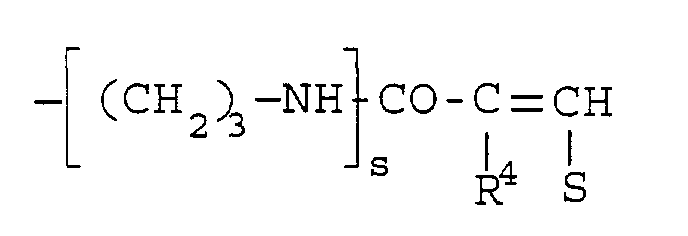
- R 6 ⁇ R 1 these are bifunctional vinyl compounds whose polyalkylene glycol or polyalkylene oxide derivatives are linked to one another via amide or ether groups (-O- or -OCH 2 -).
- examples of such compounds are polypropylene glycol bis-maleic acid, polypropylene glycol diacrylamide, polypropylene glycol dimethacrylamide, polypropylene glycol divinyl ether, polypropylene glycol diallyl ether.
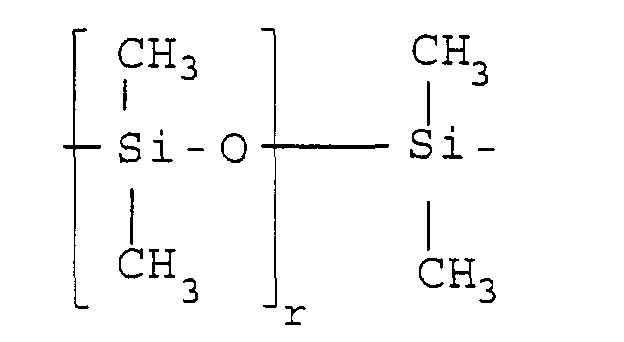
- Examples of such monomers are monovinylpolydimethylsiloxanes.
- R 7 ⁇ R 1 divinyl compounds, such as.
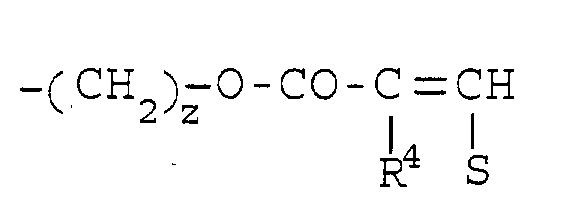
- a further derivative corresponding to formula VIII is suitable as a further vinylic polysiloxane compound, where z can be 0 to 4 and R 4 or W have the meaning given above.
- R 7 can either be R 1 or be, where S is preferably hydrogen.
- R 7 ⁇ R 1 are divinyl compounds, such as. B. polydimethylsiloxane bis (1-propyl-3-acrylate) or polydimethylsiloxane bis (1-propyl-3-methacrylate).
- a and M have the meaning given above.
- ester compounds are di-n-butyl maleate or fumarate or mono-n-butyl maleate or fumarate.
- V can be W (ie a polydimethylsiloxane group), which is a dialkenylpolydimethylsiloxane compound, such as. B. divinylpolydimethylsiloxane.
- V can also -O-CO-C 6 H 4 -CO-O- his.
- These compounds are dialkenyl phthalic acid derivatives. A typical example of such phthalic acid derivatives is diallyl phthalate.
- the molecular masses of the compounds which make up assembly c) form can be varied and lie within further limits preferably between 150 and 10,000.
- a vinyl, acrylic acid or methacrylic acid derivative polymerized Preferred as a monomeric vinyl derivative Styrene, ethylene, propylene, isobutene or vinyl acetate
- a monomeric acrylic acid derivative is preferred
- Acrylic acid, methyl acrylate or butyl acrylate used while finally preferred as monomeric methacrylate acid derivatives
- Methacrylic acid, methyl methacrylate, butyl methacrylate and Hydroxyethyl methacrylate can be used.
- copolymers mentioned can by the usual methods getting produced.
- a particular advantage is that one preferably without solvent or in aqueous solution can work. In both cases, they are unpressurized and therefore safety-friendly reactions.
- the polymerization is carried out at 20 to 100 ° C. using a conventional radical initiator, the concentration of the aqueous solution preferably being set to 30 to 50% by weight.
- the free-radical polymerization can be carried out in the acidic pH range, in particular at a pH between 4.0 and 6.5, it being possible to use the conventional initiators such as H 2 O 2 without it feared ether cleavage, which would have a very negative impact on the yield.
- the method is preferably carried out so that the unsaturated dicarboxylic acid derivative in partially neutralized form in aqueous solution, preferably together with the Polymerization initiator is submitted and the rest Monomers are added as soon as the required Reaction temperature in the template is reached.
- the polymerization aids are added separately the activation threshold of the preferably peroxidic Initiator can lower, so that the copolymerization relatively low temperatures.
- both the unsaturated Dicarboxylic acid derivative as well as the radical generator in separate or common feeds to the reactor template are metered in, thereby ideally solving the problem of heat dissipation can be.
- B. Molecular Weight Regulator is relatively unproblematic, i. H. come as initiators the usual free radical dispensers like hydrogen peroxide, Sodium, potassium or ammonium peroxodisulfate, tert. Butyl hydroperoxide, Dibenzoyl peroxide, sodium peroxide, 2,2'-azobis- (2-amidino-propane) dihydrochloride, Azobis (isobutyronitrile) etc. If redox systems are used, the above mentioned Initiators combined with reducing activators.
- reducing agents examples include Fe (II) salts, Sodium hydroxymethanesulfinate dihydrate, alkali metal sulfites and metabisulfites, sodium hypophosphite, hydroxylamine hydrochloride, Thiourea etc.
- copolymers can also be made without solvent, what with Help the usual radical starters at temperatures between 60 and 150 ° C.
- This variant can economic reasons are used in particular when the copolymers are in their anhydrous form directly Use should be fed because then an expensive Separation of the solvent, especially the water can be omitted for example by spray drying.
- the copolymers used according to the invention are particularly advantageous for the production of aqueous and solvent-free Pigment preparations, the good incorporation of the pigments, advantageous rheology profiles, sediment prevention, high Color strength, high homogeneity and flocculation stability Pigment mixtures, high gloss levels, high hiding power (or if desired high transparency) and particularly outstanding Storage stability of the aqueous preparations and Show weathering stability.
- copolymers 0.1 up to 200% by weight of the copolymers, preferably 0.5 to 50% by weight (based on the weight of the pigments) used.
- the copolymers can either be pre-dispersed with the pigments be mixed or directly into the dispersing medium (water, any glycol ether additives) before or simultaneously with the Add the pigments and any other solids.
- the present invention further relates to a method for Production of watery, highly concentrated, pumpable and flowable Pigment preparations, which is characterized in that the polymer to be used according to the invention, if appropriate in combination with at least one other component, with Mixed water, the pigment in this mixture with stirring sprinkles and until the desired fineness and Dispersion of the suspension dispersed.
- Another procedure for the production of the pigment preparations according to the invention therein a pigment with the copolymers according to the invention First mix dry, using a powdered pigment preparation results. If necessary, this can be in water are dispersed, the pigment preparation according to the invention is obtained.
- a third method according to the invention for Production of watery, highly concentrated, pumpable and flowable Pigment suspensions and pastes consist of one aqueous-moist pigment filter cake with the copolymer move and, for example, with a dissolver in the Incorporate pigment filter cake, this one liquefied.
- Fillers for example dispersed in aqueous paints can be e.g. those based on kaolin, talc, other silicates, chalk, glass fibers, glass beads or Metal powders.
- Any pigment preparations can be lacquered aqueous 1K or 2K paints into consideration.
- aqueous 1-component paints such as those based on of alkyl, acrylate, epoxy, polyvinyl acetate, polyester or polyurethane resins, or aqueous 2-component paints, for example those based on hydroxyl-containing polyacrylate or Polyester resins with melamine resins or optionally blocked polyisocyanate resins as crosslinkers.
- aqueous 1-component paints such as those based on of alkyl, acrylate, epoxy, polyvinyl acetate, polyester or polyurethane resins
- aqueous 2-component paints for example those based on hydroxyl-containing polyacrylate or Polyester resins with melamine resins or optionally blocked polyisocyanate resins as crosslinkers.
- melamine resins or optionally blocked polyisocyanate resins as crosslinkers.
- Water is the preferred solvent for the invention copolymers to be used. But also organic solvents like for example glycol ethers or esters can be used alone or in Mixture with water can be used. Especially for that Drying behavior by means of the invention Pigment pastes produced by copolymers is the addition of Solvents may be advantageous.
- pigment pastes according to the invention can be produced also the addition of other non-inventive, water-dispersible Polymers such as polyacrylate, polyurethane or polysiloxane derivatives.
- auxiliaries such as defoamers, preservatives, wetting agents, deaerators or anti-settling agents, waxes or rheology additives corresponding to the prior art can be used.
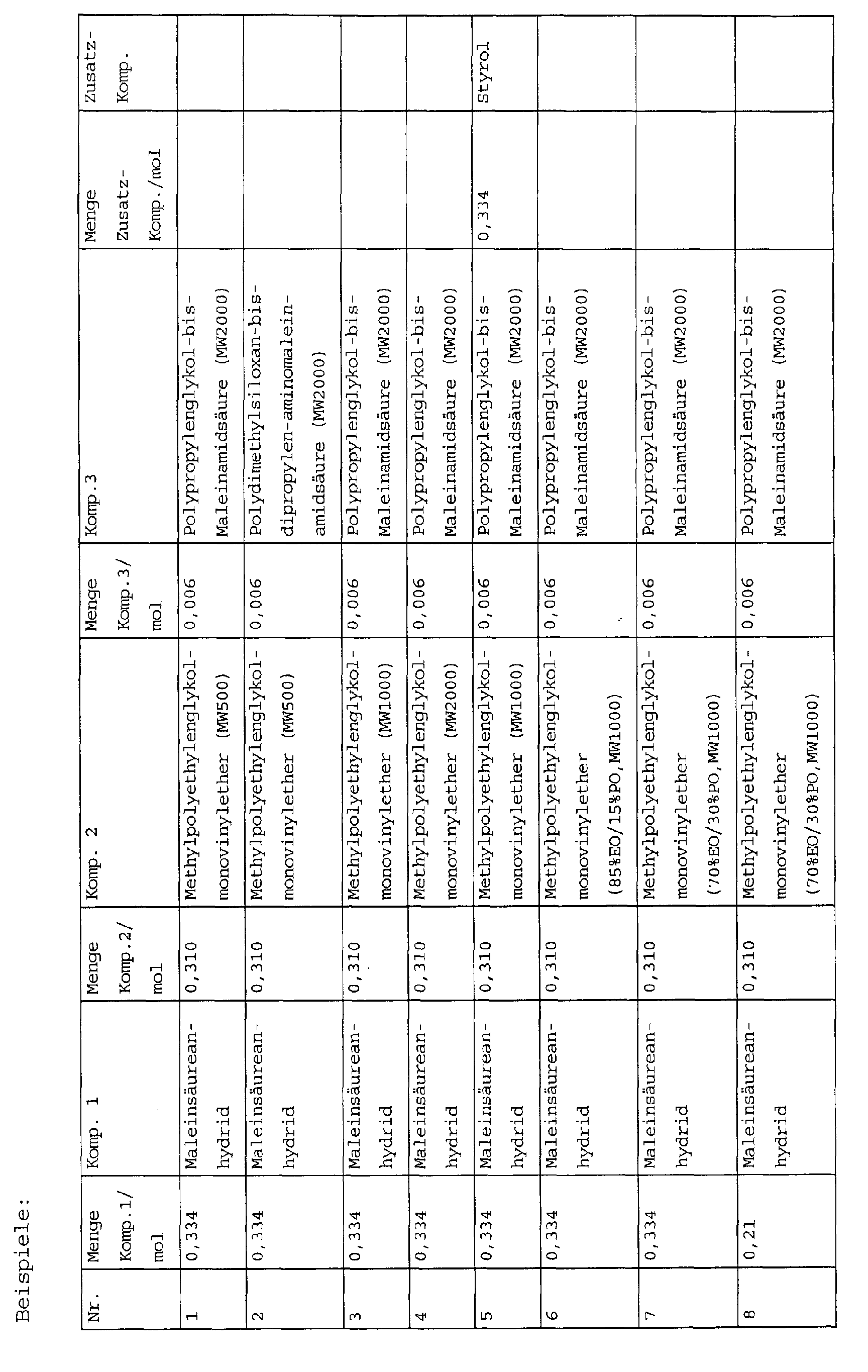
- feed 1 100 mg of iron sulfate heptahydrate and 18.5 g of 30% hydrogen peroxide under Stir added and a solution from separate feed vessels from 5.1 g of sodium hydroxymethanesulfinate dihydrate and 12.5 g Water (feed 1) on the one hand over 75 minutes and a solution from 155 g of methyl polyethylene glycol monovinyl ether and 12.1 g Polypropylene glycol bis-maleic acid (feed 2) on the other hand added over 60 minutes.
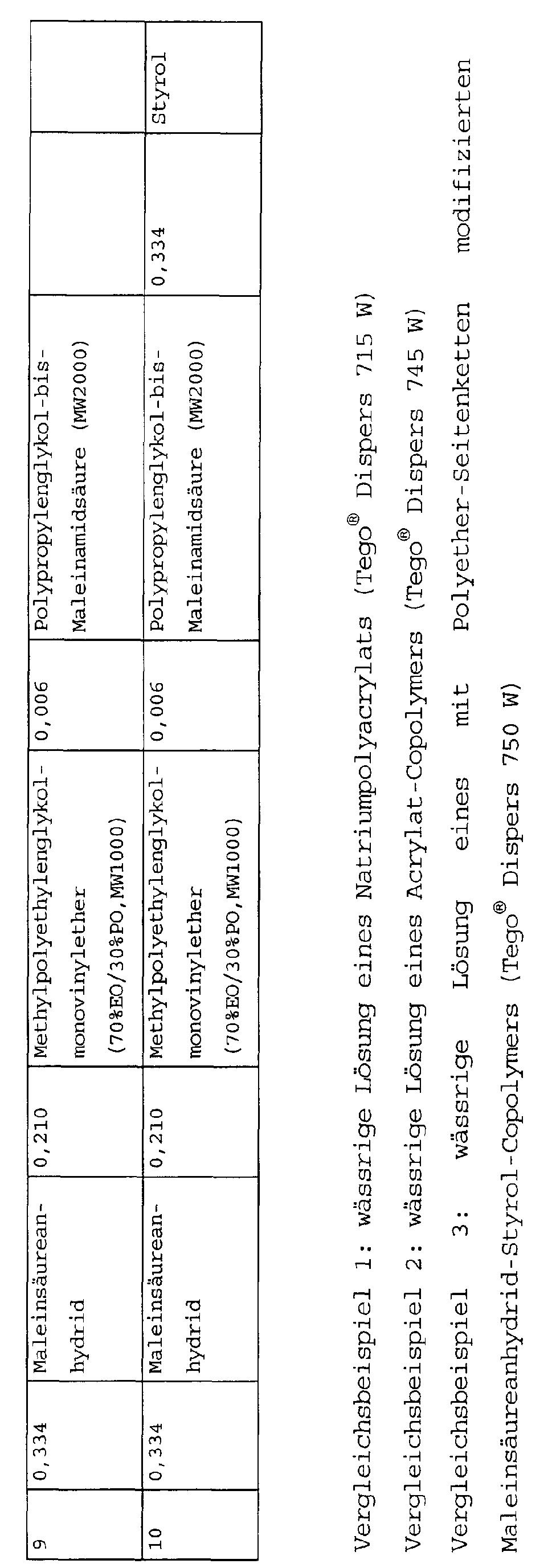
- Examples 3-10 were prepared in an analogous manner or according to the state of the art methods.
- the inventive and non-inventive dispersion additives 40% in water pre-dissolved, mixed with water and additives and then the Pigments added.
- the dispersion took place after the addition of Grinding media (glass balls 2-3 mm, same volume as that Pigment paste) 1 h (titanium dioxide) or 2 h (other pigments) in a Skandex vibrator with air cooling.
- the white pastes were formulated as follows (in% by weight): 16.4 water 12.3 Additive solution, 40% 1.0 Defoamer (Tego® Foamex 810, Tego Chemie Service GmbH) 70.0 Titanium dioxide 2160 (Kronos) 0.3 Aerosil7 A 200 (Degussa)
- the black pastes were formulated as follows (figures in% by weight): 60.3 water 22.3 Additive solution, 40% 1.0 Defoamer (Tego® Foamex 810 or Tego® Foamex 830, Tego Chemie Service GmbH) 1.4 AMP 90 (Angus) 15.0 Color black FW 200 (Degussa)
- the iron oxide pastes were formulated as follows (in% by weight) 40.0 water 24.0 Additive solution, 40% 1.0 Defoamer (Tego® Foamex 810 or Tego® Foamex 830, Tego Chemie Service GmbH) 35.0 Sicotrans® 2817 (BASF)
- Neocryl® XK 90 (Zeneca) 3.0 Texanol®
- Titanium dioxide paste
- copolymers used according to the invention resulted in Comparison to the polymers of Comparative Examples 1 to 3 no impairment of the weather resistance of the paint films - Copolymers that were free of aromatic vinyl building blocks, were characterized by very good yellowing stability.
Landscapes
- Chemical & Material Sciences (AREA)
- Life Sciences & Earth Sciences (AREA)
- Engineering & Computer Science (AREA)
- Materials Engineering (AREA)
- Wood Science & Technology (AREA)
- Organic Chemistry (AREA)
- Chemical Kinetics & Catalysis (AREA)
- General Chemical & Material Sciences (AREA)
- Addition Polymer Or Copolymer, Post-Treatments, Or Chemical Modifications (AREA)
- Macromonomer-Based Addition Polymer (AREA)
- Pigments, Carbon Blacks, Or Wood Stains (AREA)
- Emulsifying, Dispersing, Foam-Producing Or Wetting Agents (AREA)
- Paints Or Removers (AREA)
- Inks, Pencil-Leads, Or Crayons (AREA)
Abstract
Description
- Schwierige Einarbeitung der Pigmente, schlechte Benetzung
- Hohe Viskositäten von Farbpasten, Farben und Lacken
- Sedimentbildung
- Vertikales Ausschwimmen von Pigmenten (flooding)
- Horizontales Ausschwimmen von Pigmenten (floating)
- Geringer Glanzgrad
- Geringes Deckvermögen
- Unzureichende Transparenz
- Ungenügende Farbstärke
- Schlecht reproduzierbare Farbtöne, Farbtonwanderung
- Zu hohe Ablaufneigung von Lacken.

- M =
- Wasserstoff, ein- oder zweiwertiges Metallkation, Ammoniumion, organischer Aminrest
- a =
- 1 oder für den Fall, dass M ein zweiwertiges Metallkation ist, 1/2 ist,
- X =
- -OMa oder -O- (CmHlmO)n-- (CmHlmO)o-R1,
wobei- R1 =
- H, ein aliphatischer Kohlenwasserstoffrest mit 1 bis 20 C-Atomen, ein cycloaliphatischer Kohlenwasserstoff mit 5 bis 8 C-Atomen, ein Arylrest mit 6 bis 14 C-Atomen, der gegebenenfalls substituiert ist,
- l =
- 1 oder 2,
- m =
- 2 bis 18,
- n =
- 0 bis 100 und
- o =
- 0 bis 100,
- NHR2 und/oder - NR2 2 mit
R2 = R1 oder -CO-NH2 sowie - Q1N - Q2 - NQ3Q4, wobei
- Q1
- ein Wasserstoffrest oder ein einwertiger Kohlenwasserstoffrest mit 1 bis 24 Kohlenstoffatomen,
- Q2
- ein zweiwertiger Alkylenrest mit 2 bis 24 Kohlenstoffatomen,
- Q3 und Q4 -
- aliphatische und/oder alicyclische
- Y =
- O, NR2, wobei R2 die oben genannte Bedeutung
hat, oder
N-Q2-NQ3Q4, wobei Q2, Q3 und Q4 die oben genannte Bedeutung haben,


- R3 =
- H, aliphatischer Kohlenwasserstoffrest mit 1 bis 5 C-Atomen,
- p =
- 0 bis 3,
- q =
- 0 bis 6, t = 0 bis 3 sowie

- R4 =
- H, CH3
- S =
- - H, - COOMa, - COOR5
- wobei R5 =
- aliphatischer Kohlenwasserstoffrest mit 3 bis 20 C-Atomen, cycloaliphatischer Kohlenwasserstoffrest mit 5 bis 8 C-Atomen, Arylrest mit 6 bis 14 C-Atomen
- T =
- -U1-O-(CmHlmO)n--(CmHlmO)o-R6


- r = 2 bis 100
- R7 = R1,


- s = 1 oder 2
- z = 0 bis 4 bedeuten,

V =- O - CO - C6H4 - CO - O - oder - W - ist,
V =- O - CO - C6H4 - CO - O - oder - W bedeutet, wobei die Liganden und Indizes jeweils die vorgenannte Bedeutung haben.


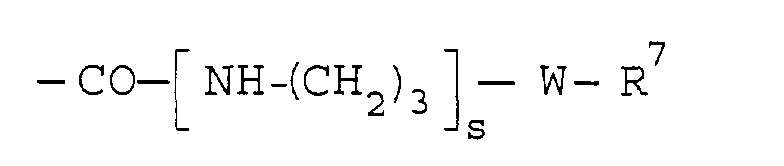
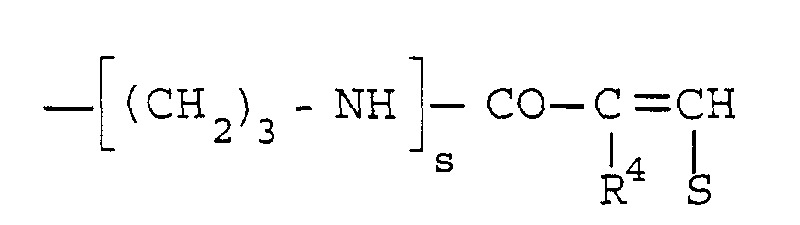



W =



- - Monoazopigmente:
- C.I. Pigment Brown 25;
C.I. Pigment Orange 5, 36 und 67;
C.I. Pigment Red 1, 2 , 3, 48:4, 49, 52:2,
53, 57:1, 251, 112, 170 und 184;
C.I. Pigment Yellow 1, 3, 73, 74, 65,
97,151 und 183; - - Diazopigmente:
- C.I. Pigment Orange 34;
C.I. Pigment Red 144 und 166
C.I. Pigment Yellow 12, 13, 17, 83, 113 und 126; - - Anthrachinonpigmente:
- C.I. Pigment Yellow 147 und 177;
C.I. Pigment Violet 31; - - Anthrapyrimidinpigmente:
- C.I. Pigment Yellow 108;
- - Chinacridonpigmente:
- C.I.Pigment Red 122,202 und 20;
C.I.Pigment Violet 19; - - Chinophthalonpigmente:
- C.I.Pigment Yellow 138;
- - Dioxazinpigmente:
- C.I.Pigment Violet 23 und 27;
- - Flavanthronpigmente:
- C.I. Pigment Yellow 24;
- - Indanthronpigmente:
- C.I. Pigment Blue 60 und 64;
- - Isoindolinpigmente:
- C.I. Pigment Orange 69;
C.I. Pigment Red 260;
C.I. Pigment Yellow 139; - - Isoindolinonpigmente:
- C.I. Pigment Orange 61;
C.I. Pigment Red 257 und 260
C.I. Pigment Yellow 109, 110, 173 und 185; - - Metallkomplexpigmente:
- C.I. Pigment Yellow 117 und 153;
- - Perinonpigmente:
- C.I. Pigment Orange 43;
C.I. Pigment Red 194; - - Perylenpigmente:
- C.I. Pigment Black 31 und 32;
C.I. Pigment Red 123, 149, 178, 179, 190 und 224;
C.I. Pigment Violet 29; - - Phtalocyaninpigmente:
- C.I. Pigment Blue 15, 15:1, 15:2,
15:3, 15:4,15:6 und 16;
C.I. Pigment Green 7 und 36; - - Pyranthronpigmente:
- C.I. Pigment Orange 51;
C.I. Pigment Red 216; - - Thioindigopigmente:
- C.I. Pigment Red 88;
- - Triphenylmethanpigmente:
- C.I. Pigment Blue 1,61, und 62;
C.I. Pigment Green 1;
C.I. Pigment Red 81 und 169;
C.I. Pigment Violet 2 und 3;
- C.I. Pigment Black 1 (Anilinschwarz)
- C.I.Pigment Yellow 101 (Aldazingelb)
- Anorganische Pigmente:
- - Weißpigmente:
- Titandioxid (C.I. Pigment White 6), Zinkweiß, Farbenzinkoxid; Zinksulfid, Lithopone; Bleiweiß;
- - Schwarzpigmente:
- Eisenoxidschwarz (C.I. Pigment Black 11), Eisen-Mangan- Schwarz, Spinellschwarz (C.I.Pigment Black 27); Ruß (C.I. Pigment Black 7);
- - Buntpigmente:
- Chromoxid, Chromoxidhydratgrün;
Chromgrün (C.I. Pigment Green 48);
Cobaltgrün (C.I.Pigment Green 50);
Ultramaringrün;
Kobaltblau (C.I. Pigment Blue 28 und 36); Ultramarinblau; Eisenblau (C.I. Pigment Blue 27); Manganblau;
Ultramarinviolett; Kobalt- und Manganviolett;
Eisenoxidrot (C.I. Pigment Red 101); Cadmiumsulfoselenid (C.I. Pigment Red 108); Molybdatrot (C.I. Pigment Red 104); Ultramarinrot;
Eisenoxidbraun, Mischbraun, Spinell- und Korundphasen (C.I. Pigment Brown 24, 29 und 31),
Chromorange;
Eisenoxidgelb (C.I. Pigment Yellow 42); Nickeltitangelb (C.I. Pigment Yellow 53; C.I. Pigment Yellow 157 und 164); Chromtitangelb, Cadmiumsulfid und Cadmiumzinksulfid, (C.I. Pigment Yellow 37 und 35); Chromgelb (C.I. Pigment Yellow 34), Zinkgelb, Erdalkalichromate, Neapelgelb, Bismutvanadat (C.I. Pigment Yellow 184) ; - - Glanzpigmente:
- Metalleffektpigmente auf Basis metalloxidbeschichteter Metallplättchen; Perglanzpigmente auf der Basis metalloxidbeschichteter Glimmerplättchen.
155,0 g Methylpolyethylenglykolmonovinylether und 7,4 g Polydimethylsiloxan-bis-dipropylenaminomaleinamidsäure. Das Reaktionsgemisch wies nach beendeter Zugabe einen pH-Wert von 5,02 auf und wurde mit 20%iger wässriger Natronlauge (58,3 g) neutralisiert. Im Endprodukt wurden 35,5 Gew-% Feststoff gefunden.
| 16,4 | Wasser |
| 12,3 | Additiv-Lösung, 40%ig |
| 1,0 | Entschäumer (Tego® Foamex 810, Tego Chemie Service GmbH) |
| 70,0 | Titandioxid 2160 (Kronos) |
| 0,3 | Aerosil7 A 200 (Degussa) |
| 60,3 | Wasser |
| 22,3 | Additiv-Lösung, 40%ig |
| 1,0 | Entschäumer (Tego® Foamex 810 oder Tego® Foamex 830, Tego |
| Chemie Service GmbH) | |
| 1,4 | AMP 90 (Angus) |
| 15,0 | Farbruß FW 200 (Degussa) |
| 40,0 | Wasser |
| 24,0 | Additiv-Lösung, 40%ig |
| 1,0 | Entschäumer (Tego® Foamex 810 oder Tego® Foamex 830, |
| Tego Chemie Service GmbH) | |
| 35,0 | Sicotrans® 2817 (BASF) |
| 70,88 | Resydrol® VWA 5477, 40%ig (Hoechst) |
| 0,14 | Entschäumer (Tego® Foamex 810 oder Tego® Foamex 830, |
| Tego Chemie Service GmbH) | |
| 0,68 | Bentone® SD 1 (Rheox) |
| 8,24 | Maprenal® MF 900 (Hoechst) |
| 0,14 | Triethanolamin |
| 19,10 | Wasser |
| 0,68 | Additol® XW 395 (Hoechst) |
| 0,14 | Additiol® XW 329 |
| 97,0 | Neocryl® XK 90 (Zeneca) |
| 3,0 | Texanol® |
| Beispiel | Viskosität /Pas sofort bei 20 1/s | Viskosität /Pas sofort bei 1000 1/s | Viskosität /Pas nach 10 W 40°C bei 20/ 1s | Viskosität /Pas nach 10 W 40°C bei 1000 1/s |
| 1 | 0,64 | 0,13 | 0,84 | 0,28 |
| 2 | 0,68 | 0,17 | 0,82 | 0,33 |
| 3 | 0,65 | 0,16 | 0,78 | 0,32 |
| 4 | 0,68 | 0,19 | 0,77 | 0,30 |
| 5 | 0,58 | 0,12 | 0,73 | 0,29 |
| 6 | 0,59 | 0,14 | 0,74 | 0,27 |
| 7 | 0,58 | 0,13 | 0,77 | 0,26 |
| 8 | 0,64 | 0,16 | 0,79 | 0,30 |
| 9 | 0,63 | 0,15 | 0,81 | 0,32 |
| 10 | 0,65 | 0,17 | 0,80 | 0,31 |
| Vgl.1 | 0,78 | 0,16 | 1,33 | 0,57 |
| Vgl.2 | 0,73 | 0,16 | 1,35 | 0,59 |
| Vgl.3 | 0,76 | 0,18 | 1,28 | 0,55 |
| Beispiel | Viskosität /Pas sofortbei 20 1/s | Viskosität /Pas sofortbei 1000 1/s | Viskosität /Pas nach 10 W 40°C bei 20/ 1s | Viskosität /Pas nach 10 W 40°C bei 1000 1/s |
| 1 | 0,14 | 0,12 | 0,23 | 0,17 |
| 2 | 0,16 | 0,13 | 0,25 | 0,19 |
| 3 | 0,17 | 0,14 | 0,27 | 0,21 |
| 4 | 0,19 | 0,16 | 0,32 | 0,24 |
| 5 | 0,15 | 0,13 | 0,24 | 0,21 |
| 6 | 0,14 | 0,12 | 0,23 | 0,18 |
| 7 | 0,17 | 0,15 | 0,26 | 0,19 |
| 8 | 0,16 | 0,13 | 0,25 | 0,19 |
| 9 | 0,15 | 0,12 | 0,23 | 0,17 |
| 10 | 0,16 | 0,13 | 0,24 | 0,18 |
| Vgl.1 | 0,43 | 0,35 | 0,77 | 0,45 |
| Vgl.2 | 0,41 | 0,34 | 0,71 | 0,43 |
| Vgl.3 | 0,38 | 0,31 | 0,65 | 0,39 |
| Beispiel | Viskosität /Pas sofort bei 20 1/s | Viskosität /Pas sofort bei 1000 1/s | Viskosität /Pas nach 10 W 40°C bei 20/ 1s | Viskosität /Pas nach 10 W 40°C bei 1000 1/s |
| 1 | 0,41 | 0,32 | 0,44 | 0,35 |
| 2 | 0,38 | 0,28 | 0,40 | 0,30 |
| 3 | 0,35 | 0,26 | 0,37 | 0,30 |
| 4 | 0,39 | 0,35 | 0,41 | 0,37 |
| 5 | 0,38 | 0,32 | 0,40 | 0,33 |
| 6 | 0,40 | 0,33 | 0,43 | 0,36 |
| 7 | 0,36 | 0,31 | 0,38 | 0,33 |
| 8 | 0,39 | 0,33 | 0,43 | 0,37 |
| 9 | 0,38 | 0,34 | 0,40 | 0,36 |
| 10 | 0,36 | 0,30 | 0,38 | 0,32 |
| Vgl.1 | 6,44 | 3,63 | 7,55 | 4,22 |
| Vgl.2 | 5,78 | 2,56 | 6,27 | 4,06 |
| Vgl.3 | 0,55 | 0,42 | 1,94 | 1,22 |
| Sofort | nach 10 W 40°C | |||
| Beispiel | Glanz (20°) | Rub-Out | Glanz (20°) | Rub-Out |
| 1 | 63 | 0,5 | 61 | 0,5 |
| 2 | 61 | 0,6 | 60 | 0,5 |
| 3 | 64 | 0,4 | 62 | 0,4 |
| 4 | 62 | 0,4 | 62 | 0,4 |
| 5 | 67 | 0,4 | 66 | 0,4 |
| 6 | 62 | 0,5 | 61 | 0,6 |
| 7 | 61 | 0,4 | 62 | 0,4 |
| 8 | 63 | 0,4 | 61 | 0,3 |
| 9 | 64 | 0,5 | 63 | 0,4 |
| 10 | 68 | 0,4 | 67 | 0,4 |
| Vgl.1 | 50 | 1,2 | 42 | 1,6 |
| Vgl.2 | 55 | 0,9 | 43 | 1,4 |
| Vgl.3 | 61 | 0,5 | 58 | 0,9 |
| Sofort | Nach 10 W 40°C | |||
| Beispiel | Glanz (20°) | Rub-Out | Glanz (20°) | Rub-Out |
| 1 | 75 | 0,7 | 76 | 0,7 |
| 2 | 80 | 0,8 | 78 | 0,7 |
| 3 | 77 | 0,6 | 75 | 0,7 |
| 4 | 79 | 0,6 | 77 | 0,6 |
| 5 | 82 | 0,7 | 80 | 0,6 |
| 6 | 76 | 0,6 | 74 | 0,7 |
| 7 | 75 | 0,7 | 76 | 0,6 |
| 8 | 78 | 0,6 | 77 | 0,7 |
| 9 | 77 | 0,7 | 75 | 0,7 |
| 10 | 84 | 0,6 | 83 | 0,6 |
| Vgl.1 | 68 | 1,6 | 68 | 2,3 |
| Vgl.2 | 72 | 1,4 | 70 | 2,0 |
| Vgl.3 | 80 | 0,8 | 78 | 1,6 |
| Sofort | Nach 10 W 40°C | |||
| Beispiel | Glanz (20°) | Transparenz | Glanz (20°) | Transparenz |
| 1 | 72 | 1-2 | 70 | 1-2 |
| 2 | 74 | 1 | 72 | 1 |
| 3 | 73 | 1 | 74 | 1 |
| 4 | 72 | 1-2 | 73 | 1-2 |
| 5 | 77 | 1 | 75 | 1 |
| 6 | 74 | 1 | 73 | 1 |
| 7 | 73 | 1 | 74 | 1 |
| 8 | 75 | 1 | 74 | 1 |
| 9 | 73 | 1 | 72 | 1 |
| 10 | 76 | 1 | 74 | 1 |
| Vgl.1 | 64 | 3 | 56 | 3 |
| Vgl.2 | 66 | 3 | 59 | 3 |
| Vgl.3 | 71 | 2 | 66 | 2-3 |
| Beispiel | Glanzverlust (Messung im 20°-Winkel) | Farbtonverschiebung DeltaE |
| 1 | 5 | 0,3 |
| 2 | 4 | 0,25 |
| 3 | 6 | 0,25 |
| 4 | 5 | 0,3 |
| 5 | 8 | 0,6 |
| 6 | 4 | 0,2 |
| 7 | 5 | 0,25 |
| 8 | 6 | 0,3 |
| 9 | 4 | 0,2 |
| 10 | 9 | 0,6 |
| Vgl.1 | 10 | 0,5 |
| Vgl.2 | 14 | 1,3 |
| Vgl.3 | 8 | 0,8 |
Claims (8)
- Verwendung von Copolymeren auf Basis von Oxyalkylenglykol- oder Polyalkylenoxid-Alkenylethern und ungesättigten Dicarbonsäure-Derivaten als Dispergieradditive in Lacken und Druckfarben oder zur Herstellung wässriger Pigmentkonzentrate bestehend aus:a) 10 bis 90 Mol-% Baugruppen der Formel Ia und/oder Ibwobei
- M =
- Wasserstoff, ein- oder zweiwertiges Metallkation, Ammoniumion, organischer Aminrest
- a =
- 1 oder für den Fall, dass M ein zweiwertiges Metallkation ist, 1/2 ist,
- X =
- -OMa oder -O- (CmHlmO) n-- (CmHlmO) o-R1,
wobei- R1 =
- H, ein aliphatischer Kohlenwasserstoffrest mit 1 bis 20 C-Atomen, ein cycloaliphatischer Kohlenwasserstoff mit 5 bis 8 C-Atomen, ein Arylrest mit 6 bis 14 C-Atomen, der gegebenenfalls substituiert ist,
- l =
- 1 oder 2,
- m =
- 2 bis 18,
n = 0 bis 100 undo = bis 100,NHR2 und/oder - NR2 2 mit
R2 = R1 oder -CO-NH2 sowieQ1N - Q2 - NQ3Q4, wobei- Q1
- ein Wasserstoffrest oder ein einwertiger Kohlenwasserstoffrest mit 1 bis 24 Kohlenstoffatomen,
- Q2
- ein zweiwertiger Alkylenrest mit 2 bis 24 Kohlenstoffatomen,
- Q3 und Q4 -
- aliphatische und/oder alicyclische Alkylreste mit 1 bis 12 Kohlenstoffatomen sind,
- Y =
- O, NR2, wobei R2 die oben genannte Bedeutung
hat, oder
N-Q2-NQ3Q4, wobei Q2, Q3 und Q4 die oben genannte Bedeutung haben,
b) 1 bis 89 Mol-% Baugruppen der Formel IIa oder IIb worin
worin R3 = H, aliphatischer Kohlenwasserstoffrest mit 1 bis 5 C-Atomen,p = 0 bis 3,q = 0 bis 6, t = 0 bis 3 sowieR1 und l, m, n und o die oben genannte Bedeutung aufweisen,c) 0,1 bis 10 Mol-% Baugruppen der Formel IIIa oder IIIbwobei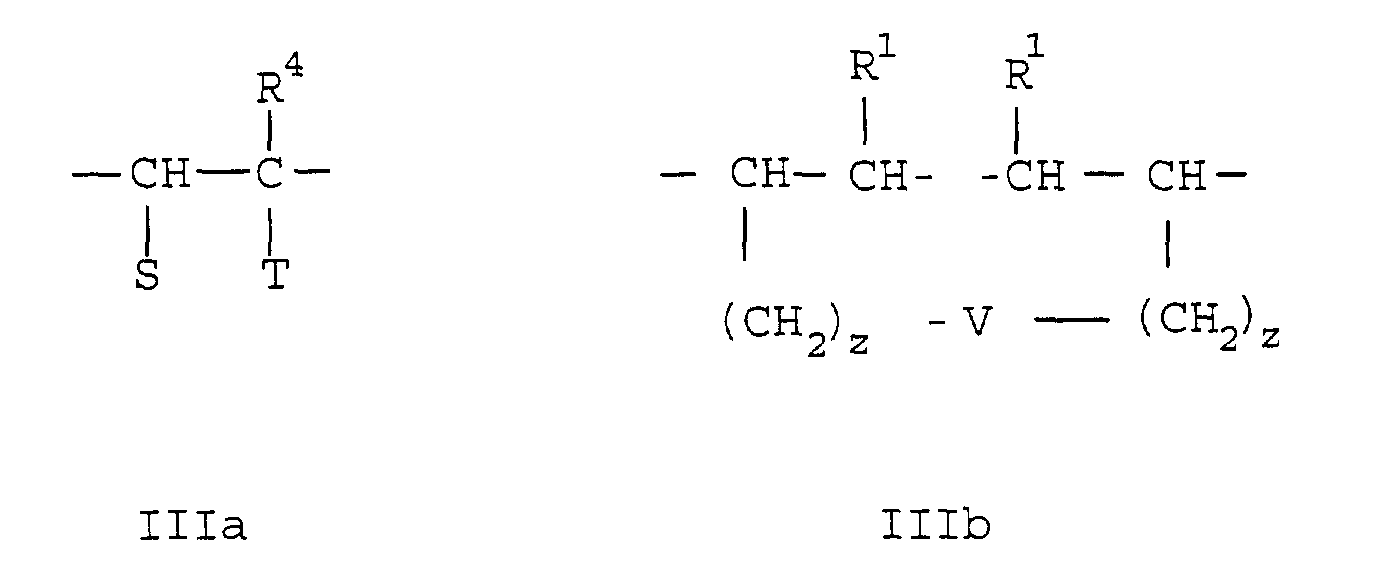
- R4 =
- H, CH3
- S =
- - H, - COOMa, - COOR5
- wobei R5 =
- aliphatischer Kohlenwasserstoffrest mit 3 bis 20 C-Atomen, cycloaliphatischer Kohlenwasserstoffrest mit 5 bis 8 C-Atomen, Arylrest mit 6 bis 14 C-Atomen
- T =
- -U1-O-(CmHlmO)n--(CmHlmO)o-R6
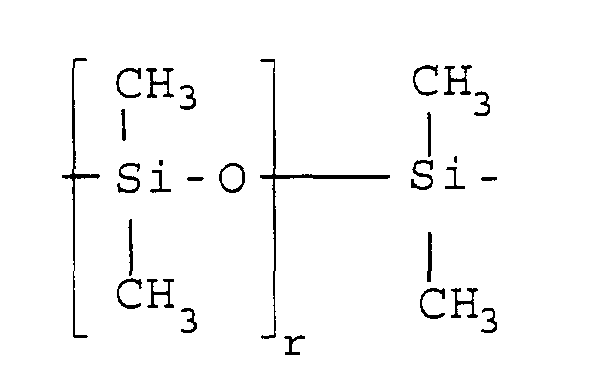
mit l = 1 oder 2, m = 2 bis 18, sowien = 0 bis 100 und o = 0 bis 100,U1 = - CO - NH-, - O -, -CH2O-, wobei U2 = - NH - CO-, - O -, -OCH2 ist,W - R7, wobeiW =
 r = 2 bis 100R7 = R1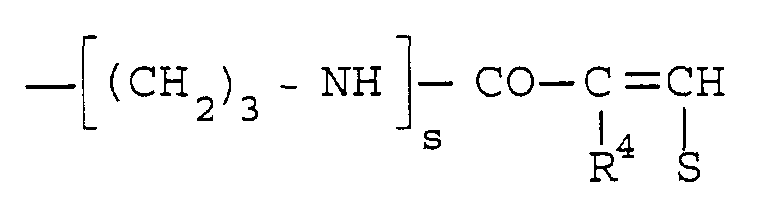
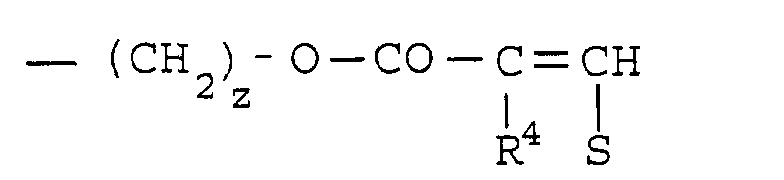 s = 1 oder 2z = 0 bis 4 bedeuten,
V =- O - CO - C6H4 - CO - O - oder - W - ist,
V = - O - CO - C6H4 - CO - O - oder - W bedeutet,
wobei die Liganden und Indizes jeweils die vorgenannte Bedeutung haben. - Verwendung nach Anspruch 1, dadurch gekennzeichnet, dass zusätzlich bis zu 50 Mol-%, insbesondere bis zu 20 Mol-%, bezogen auf die Summe der Baugruppen a), b) und c), Baugruppen, deren Monomere sich von Vinyl-, Acrylsäure- oder Methacrylsäurederivat ableiten, enthalten sind.
- Verwendung nach Anspruch 1 zur Herstellung wässriger oder colöserhaltiger Pigmentkonzentrate, wobei man die Copolymere in Mengen von 0,1 bis 200 Gew.-%, bezogen auf das Pigment einsetzt.
- Verwendung nach Anspruch 1, dadurch gekennzeichnet, dass man Copolymere einsetzt, die aus 40 bis 55% Mol-% Baugruppen Ia und/oder Ib, 40-55 Mol-% Baugruppen IIa und/oder IIb sowie 0,1 bis 5 Mol-% Baugruppen IIIa oder IIIb bestehen.
- Verwendung nach einem der Ansprüche 1 bis 4, dadurch gekennzeichnet, dass ein Teil der Baugruppen der Formeln Ia und/oder Ib aminoxidgruppenhaltige Dicarbonsäurederivate sind.
- Verwendung nach einem der Ansprüche 1 bis 5, dadurch gekennzeichnet, dass ein Teil der Baugruppen der Formeln IIIa und/oder IIIb durch Verwendung vinylischer Polysiloxan-Verbindungen erhalten wird.
- Verwendung nach einem der Ansprüche 1 bis 6, dadurch gekennzeichnet, dass man die Polymerisation in wässriger Lösung bei einer Temperatur von 20 bis 100°C durchführt.
- Verwendung nach einem der Ansprüche 1 bis 7 als Dispergieradditive für anorganische Pigmente, insbesondere (transparente) Eisenoxide oder zur Herstellung wässriger Pigmentkonzentrate mit diesen Pigmenten.
Applications Claiming Priority (2)
| Application Number | Priority Date | Filing Date | Title |
|---|---|---|---|
| DE10017667 | 2000-04-08 | ||
| DE10017667A DE10017667A1 (de) | 2000-04-08 | 2000-04-08 | Dispergiermittel zur Herstellung wässriger Pigmentpasten |
Publications (3)
| Publication Number | Publication Date |
|---|---|
| EP1142972A2 true EP1142972A2 (de) | 2001-10-10 |
| EP1142972A3 EP1142972A3 (de) | 2003-06-04 |
| EP1142972B1 EP1142972B1 (de) | 2004-05-12 |
Family
ID=7638155
Family Applications (1)
| Application Number | Title | Priority Date | Filing Date |
|---|---|---|---|
| EP01106495A Expired - Lifetime EP1142972B1 (de) | 2000-04-08 | 2001-03-26 | Dispergiermittel zur Herstellung wässriger Pigmentpasten |
Country Status (5)
| Country | Link |
|---|---|
| US (1) | US20020019459A1 (de) |
| EP (1) | EP1142972B1 (de) |
| AT (1) | ATE266706T1 (de) |
| DE (2) | DE10017667A1 (de) |
| ES (1) | ES2220609T3 (de) |
Cited By (8)
| Publication number | Priority date | Publication date | Assignee | Title |
|---|---|---|---|---|
| EP1640389A1 (de) | 2004-09-14 | 2006-03-29 | Byk-Chemie GmbH | Copolymerisate, deren Herstellung und Verwendung als Netz- und Dispergiermittel |
| EP1916274A3 (de) * | 2006-10-23 | 2008-05-28 | Clariant International Ltd. | Hydroxyfunktionelle, copolymerisierbare Polyalkylenglykol-Makromonomere, deren Herstellung und Verwendung |
| WO2008080580A3 (de) * | 2006-12-27 | 2008-10-30 | Byk Chemie Gmbh | Modifizierte styrol/maleinsäureanhydrid-basierte kammcopolymere |
| WO2008138487A1 (de) * | 2007-05-10 | 2008-11-20 | Clariant Finance (Bvi) Limited | Wässrige pigmentpräparationen |
| WO2009024232A1 (de) * | 2007-08-23 | 2009-02-26 | Clariant Finance (Bvi) Limited | Wässrige pigmentpräparationen mit anionischen additiven auf allyl- und vinyletherbasis |
| WO2009024233A1 (de) * | 2007-08-23 | 2009-02-26 | Clariant Finance (Bvi) Ltd | Wässrige pigmentpräparationen mit nichtionischen additiven auf allyl- und vinyletherbasis |
| WO2009024234A1 (de) * | 2007-08-23 | 2009-02-26 | Clariant Finance (Bvi) Limited | Anionische wasserlösliche additive auf allyl- und vinyletherbasis |
| US8221539B2 (en) * | 2008-08-16 | 2012-07-17 | Clariant Finance (Bvi) Limited | Dry pigment preparations comprising anionic additives |
Families Citing this family (41)
| Publication number | Priority date | Publication date | Assignee | Title |
|---|---|---|---|---|
| DE10232908A1 (de) * | 2002-07-19 | 2004-01-29 | Goldschmidt Ag | Verwendung organfunktionell modifizierter, Phenylderivate enthaltender Polysiloxane als Dispergier- und Netzmittel für Füllstoffe und Pigmente in wässrigen Pigmentpasten und Farb- oder Lackformulierungen |
| MXPA05010352A (es) * | 2003-03-27 | 2006-03-08 | Constr Res & Tech Gmbh | Suspension colorante liquida. |
| EP1758836B1 (de) | 2004-06-15 | 2013-08-14 | Construction Research & Technology GmbH | Versehen von zementzusammensetzungen mit gefrier- und taubeständigkeit |
| US9088748B2 (en) * | 2004-07-16 | 2015-07-21 | Universal Electronics Inc. | System for providing electronic media and commands via remote control and docking station |
| NZ562556A (en) | 2005-06-14 | 2011-03-31 | Constr Res & Tech Gmbh | Providing freezing and thawing resistance to cementitious compositions |
| DE102007021869A1 (de) * | 2007-05-10 | 2008-11-13 | Clariant International Limited | Anionische wasserlösliche Additive |
| DE102007021867A1 (de) * | 2007-05-10 | 2008-11-20 | Clariant International Limited | Pigmentpräparationen auf Wasserbasis |
| DE102007021868A1 (de) * | 2007-05-10 | 2008-11-20 | Clariant International Limited | Nichtionische wasserlösliche Additive |
| DE102007039785A1 (de) | 2007-08-23 | 2009-02-26 | Clariant International Ltd. | Nichtionische wasserlösliche Additive auf Allyl- und Vinyletherbasis |
| DE102007045230A1 (de) | 2007-09-21 | 2009-04-09 | Clariant International Limited | Polycarboxylatether als Dispergiermittel für anorganische Pigmentformulierungen |
| US7973110B2 (en) | 2008-06-16 | 2011-07-05 | Construction Research & Technology Gmbh | Copolymer synthesis process |
| DE102008040329A1 (de) * | 2008-07-10 | 2010-01-14 | Construction Research & Technology Gmbh | Verfahren zur Herstellung von Copolymeren mit einem reduzierten Acetaldehyd-Gehalt |
| DE102008038071A1 (de) * | 2008-08-16 | 2010-02-18 | Clariant International Limited | Anionische wasser- und lösungsmittellösliche Additive |
| DE102008038072A1 (de) * | 2008-08-16 | 2010-02-18 | Clariant International Ltd. | Nichtionische wasser- und lösungsmittellösliche Additive |
| DE102008038070A1 (de) * | 2008-08-16 | 2010-02-18 | Clariant International Ltd. | Trockene Pigmentpräparationen mit nichtionischen Additiven |
| DE102010009493A1 (de) | 2010-02-26 | 2011-09-29 | Clariant International Limited | Polymere und ihre Verwendung als Dispergiermittel mit schaumhemmender Wirkung |
| US8855470B2 (en) * | 2010-04-06 | 2014-10-07 | Time Warner Cable Enterprises Llc | Use of multiple embedded messages in program signal streams |
| DE102011089535A1 (de) | 2011-12-22 | 2013-06-27 | Evonik Industries Ag | Entschäumerzusammensetzungen für Baustoffmischungen |
| US8845940B2 (en) | 2012-10-25 | 2014-09-30 | Carboncure Technologies Inc. | Carbon dioxide treatment of concrete upstream from product mold |
| BR112015018518A2 (pt) | 2013-02-04 | 2017-07-18 | Coldcrete Inc | sistema e método para aplicar dióxido de carbono durante a produção de concreto |
| US20160107939A1 (en) | 2014-04-09 | 2016-04-21 | Carboncure Technologies Inc. | Methods and compositions for concrete production |
| US10927042B2 (en) | 2013-06-25 | 2021-02-23 | Carboncure Technologies, Inc. | Methods and compositions for concrete production |
| US9388072B2 (en) | 2013-06-25 | 2016-07-12 | Carboncure Technologies Inc. | Methods and compositions for concrete production |
| US9108883B2 (en) | 2013-06-25 | 2015-08-18 | Carboncure Technologies, Inc. | Apparatus for carbonation of a cement mix |
| US9376345B2 (en) | 2013-06-25 | 2016-06-28 | Carboncure Technologies Inc. | Methods for delivery of carbon dioxide to a flowable concrete mix |
| WO2015123769A1 (en) | 2014-02-18 | 2015-08-27 | Carboncure Technologies, Inc. | Carbonation of cement mixes |
| DE102014203231A1 (de) | 2014-02-24 | 2015-08-27 | Evonik Degussa Gmbh | Dispergierharze für Pigmentpräparationen mit geringem flüchtigem organischem Anteil |
| WO2015154174A1 (en) | 2014-04-07 | 2015-10-15 | Carboncure Technologies, Inc. | Integrated carbon dioxide capture |
| US10275139B2 (en) * | 2014-09-18 | 2019-04-30 | Sony Interactive Entertainment LLC | System and method for integrated user interface for electronic devices |
| US9850166B2 (en) | 2015-02-03 | 2017-12-26 | Construction Research & Technology, Gmbh | Liquid coloring suspension and colored cementitious composition |
| DE102015122034A1 (de) | 2015-12-16 | 2017-06-22 | Ferro Gmbh | Thermoplastische Siebdruckpaste |
| SG11201810010PA (en) | 2016-04-11 | 2018-12-28 | Carboncure Tech Inc | Methods and compositions for treatment of concrete wash water |
| EP3642170B1 (de) | 2017-06-20 | 2025-01-15 | Carboncure Technologies Inc. | Verfahren zur behandlung von betonwaschwasser |
| ES3061994T3 (en) | 2018-02-08 | 2026-04-08 | Evonik Operations Gmbh | Aqueous polyorganosiloxane hybrid resin dispersion |
| EP3719076A1 (de) | 2019-04-01 | 2020-10-07 | Evonik Operations GmbH | Wässrige polyorganosiloxanhybridharz-dispersion |
| US12421169B2 (en) | 2019-04-26 | 2025-09-23 | Carboncure Technologies Inc. | Carbonation of concrete aggregates |
| US12521908B2 (en) | 2020-06-12 | 2026-01-13 | Carboncure Technologies Inc. | Methods and compositions for delivery of carbon dioxide |
| CN112143290A (zh) * | 2020-10-22 | 2020-12-29 | 南通朗通纺织辅料有限公司 | 一种环保水性色浆及其制备工艺 |
| CN112940194B (zh) * | 2021-01-29 | 2022-05-24 | 武汉奥克特种化学有限公司 | 一种无机颜填料水性分散剂的制作方法及应用 |
| EP4688880A1 (de) | 2023-03-29 | 2026-02-11 | Basf Se | Verringerung des acetaldehydgehalts in copolymeren auf vinyletherbasis |
| WO2026057412A2 (de) | 2024-09-12 | 2026-03-19 | Evonik Operations Gmbh | Dispergiermittel zur herstellung wässriger pigmentpräparationen |
Family Cites Families (8)
| Publication number | Priority date | Publication date | Assignee | Title |
|---|---|---|---|---|
| EP0056627B1 (de) * | 1981-01-16 | 1984-10-03 | Nippon Shokubai Kagaku Kogyo Co., Ltd | Copolymer und Verfahren zu seiner Herstellung |
| DE3108100A1 (de) * | 1981-03-04 | 1982-09-16 | Basf Ag, 6700 Ludwigshafen | Verfahren zur herstellung von copolymerisaten des maleinsaeureanhydrids |
| JP2692202B2 (ja) * | 1988-11-29 | 1997-12-17 | 日本油脂株式会社 | 無機粉末の油中分散安定剤 |
| JPH08104836A (ja) * | 1994-10-04 | 1996-04-23 | Mitsubishi Chem Corp | 記録液 |
| US5585427A (en) * | 1994-11-07 | 1996-12-17 | Ppg Industries, Inc. | Pigment dispersing additive for coating compositions |
| DE19513126A1 (de) * | 1995-04-07 | 1996-10-10 | Sueddeutsche Kalkstickstoff | Copolymere auf Basis von Oxyalkylenglykol-Alkenylethern und ungesättigten Dicarbonsäure-Derivaten |
| DE19603053A1 (de) * | 1996-01-29 | 1997-07-31 | Bayer Ag | Verfahren zur Herstellung von Polymeren mit wiederkehrenden Succinyl-Einheiten |
| DE19802295C1 (de) * | 1998-01-22 | 1999-04-01 | Goldschmidt Ag Th | Dispergiermittel zur Herstellung wäßriger Pigmentpasten |
-
2000
- 2000-04-08 DE DE10017667A patent/DE10017667A1/de not_active Withdrawn
-
2001
- 2001-03-26 ES ES01106495T patent/ES2220609T3/es not_active Expired - Lifetime
- 2001-03-26 DE DE50102238T patent/DE50102238D1/de not_active Expired - Lifetime
- 2001-03-26 AT AT01106495T patent/ATE266706T1/de not_active IP Right Cessation
- 2001-03-26 EP EP01106495A patent/EP1142972B1/de not_active Expired - Lifetime
- 2001-04-05 US US09/827,584 patent/US20020019459A1/en not_active Abandoned
Cited By (17)
| Publication number | Priority date | Publication date | Assignee | Title |
|---|---|---|---|---|
| EP1640389A1 (de) | 2004-09-14 | 2006-03-29 | Byk-Chemie GmbH | Copolymerisate, deren Herstellung und Verwendung als Netz- und Dispergiermittel |
| US7317062B2 (en) | 2004-09-14 | 2008-01-08 | Byk-Chemie Gmbh | Copolymers, preparation thereof and use as wetting agents and dispersants |
| EP1916274A3 (de) * | 2006-10-23 | 2008-05-28 | Clariant International Ltd. | Hydroxyfunktionelle, copolymerisierbare Polyalkylenglykol-Makromonomere, deren Herstellung und Verwendung |
| WO2008080580A3 (de) * | 2006-12-27 | 2008-10-30 | Byk Chemie Gmbh | Modifizierte styrol/maleinsäureanhydrid-basierte kammcopolymere |
| US8129476B2 (en) | 2006-12-27 | 2012-03-06 | Byk-Chemie Gmbh | Modified comb copolymers |
| US7905955B2 (en) * | 2007-05-10 | 2011-03-15 | Clariant Finance (Bvi) Limited | Aqueous pigment preparations |
| WO2008138487A1 (de) * | 2007-05-10 | 2008-11-20 | Clariant Finance (Bvi) Limited | Wässrige pigmentpräparationen |
| WO2009024233A1 (de) * | 2007-08-23 | 2009-02-26 | Clariant Finance (Bvi) Ltd | Wässrige pigmentpräparationen mit nichtionischen additiven auf allyl- und vinyletherbasis |
| WO2009024234A1 (de) * | 2007-08-23 | 2009-02-26 | Clariant Finance (Bvi) Limited | Anionische wasserlösliche additive auf allyl- und vinyletherbasis |
| WO2009024232A1 (de) * | 2007-08-23 | 2009-02-26 | Clariant Finance (Bvi) Limited | Wässrige pigmentpräparationen mit anionischen additiven auf allyl- und vinyletherbasis |
| CN101679795B (zh) * | 2007-08-23 | 2012-04-18 | 科莱恩金融(Bvi)有限公司 | 含基于烯丙基醚和乙烯基醚的阴离子添加剂的水性颜料制剂 |
| US8202361B2 (en) * | 2007-08-23 | 2012-06-19 | Clariant Finance (Bvi) Limited | Aqueous pigment preparations comprising anionic additives based on allyl ether and vinyl ether |
| US8221538B2 (en) | 2007-08-23 | 2012-07-17 | Clariant Finance (Bvi) Limited | Aqueous pigment preparations having nonionic additives on the basis of alyl and vinyl ether |
| US8318882B2 (en) | 2007-08-23 | 2012-11-27 | Clariant Finance (Bvi) Limited | Anionic water-soluble additives based on allyl ether and vinyl ether |
| KR101477322B1 (ko) * | 2007-08-23 | 2014-12-29 | 클라리언트 파이넌스 (비브이아이)리미티드 | 알릴 및 비닐 에터에 기초한 비이온성 첨가제를 갖는 수성 안료 제제 |
| KR101503951B1 (ko) * | 2007-08-23 | 2015-03-18 | 클라리언트 파이넌스 (비브이아이)리미티드 | 알릴 에터 및 비닐 에터에 기초한 음이온성 첨가제를 포함하는 수성 안료 제제 |
| US8221539B2 (en) * | 2008-08-16 | 2012-07-17 | Clariant Finance (Bvi) Limited | Dry pigment preparations comprising anionic additives |
Also Published As
| Publication number | Publication date |
|---|---|
| ATE266706T1 (de) | 2004-05-15 |
| DE10017667A1 (de) | 2001-10-18 |
| ES2220609T3 (es) | 2004-12-16 |
| US20020019459A1 (en) | 2002-02-14 |
| EP1142972A3 (de) | 2003-06-04 |
| EP1142972B1 (de) | 2004-05-12 |
| DE50102238D1 (de) | 2004-06-17 |
Similar Documents
| Publication | Publication Date | Title |
|---|---|---|
| EP1142972B1 (de) | Dispergiermittel zur Herstellung wässriger Pigmentpasten | |
| EP1529821A2 (de) | Dispergiermittel zur Herstellung wässriger Pigmentpasten | |
| EP1167452B1 (de) | Phosphorsäureester als Pigmentnetzmittel | |
| EP2125910B1 (de) | Modifizierte styrol / maleinsäureanhydrid basierte kammcopolymere | |
| EP2146797B1 (de) | Pigmentpräparationen auf wasserbasis | |
| EP1026178B1 (de) | Aminoxidgruppen enthaltende Maleinsäureanhydrid-Copolymere und ihre Verwendung als Dispergiermittel für Pigmente oder Füllstoffe | |
| EP2183327B1 (de) | Wässrige pigmentpräparationen mit anionischen additiven auf allyl- und vinyletherbasis | |
| EP2147066B1 (de) | Wässrige pigmentpräparationen | |
| EP2183328B1 (de) | Wässrige pigmentpräparationen mit nichtionischen additiven auf allyl- und vinyletherbasis | |
| EP2147062B1 (de) | Anionische wasserlösliche additive | |
| DE69717558T2 (de) | Zweikomponenten-Dispergiermittel für Nassvermahlung | |
| EP0979844B1 (de) | Dispergiermittel zur Herstellung wässriger Pigmentpasten | |
| EP2147061B1 (de) | Nichtionische wasserlösliche additive | |
| WO2009098025A1 (de) | Netz- und dispergiermittel | |
| EP0940406A2 (de) | Phosphorsäureester und ihre Verwendung als Dispergiermittel | |
| DE102006062440A1 (de) | Polymermischung umfassend ein Kammcopolymeres | |
| EP4341353B1 (de) | Universelle dispergiermittel für anorganische und organische pigmente |
Legal Events
| Date | Code | Title | Description |
|---|---|---|---|
| PUAI | Public reference made under article 153(3) epc to a published international application that has entered the european phase |
Free format text: ORIGINAL CODE: 0009012 |
|
| 17P | Request for examination filed |
Effective date: 20010411 |
|
| AK | Designated contracting states |
Kind code of ref document: A2 Designated state(s): AT BE CH CY DE DK ES FI FR GB GR IE IT LI LU MC NL PT SE TR |
|
| AX | Request for extension of the european patent |
Free format text: AL;LT;LV;MK;RO;SI |
|
| PUAL | Search report despatched |
Free format text: ORIGINAL CODE: 0009013 |
|
| AK | Designated contracting states |
Designated state(s): AT BE CH CY DE DK ES FI FR GB GR IE IT LI LU MC NL PT SE TR |
|
| AX | Request for extension of the european patent |
Extension state: AL LT LV MK RO SI |
|
| 17Q | First examination report despatched |
Effective date: 20030728 |
|
| GRAP | Despatch of communication of intention to grant a patent |
Free format text: ORIGINAL CODE: EPIDOSNIGR1 |
|
| AKX | Designation fees paid |
Designated state(s): AT BE CH CY DE DK ES FI FR GB GR IE IT LI LU MC NL PT SE TR |
|
| GRAS | Grant fee paid |
Free format text: ORIGINAL CODE: EPIDOSNIGR3 |
|
| GRAA | (expected) grant |
Free format text: ORIGINAL CODE: 0009210 |
|
| AK | Designated contracting states |
Kind code of ref document: B1 Designated state(s): AT BE CH CY DE DK ES FI FR GB GR IE IT LI LU MC NL PT SE TR |
|
| PG25 | Lapsed in a contracting state [announced via postgrant information from national office to epo] |
Ref country code: IE Free format text: LAPSE BECAUSE OF FAILURE TO SUBMIT A TRANSLATION OF THE DESCRIPTION OR TO PAY THE FEE WITHIN THE PRESCRIBED TIME-LIMIT Effective date: 20040512 Ref country code: FI Free format text: LAPSE BECAUSE OF FAILURE TO SUBMIT A TRANSLATION OF THE DESCRIPTION OR TO PAY THE FEE WITHIN THE PRESCRIBED TIME-LIMIT Effective date: 20040512 Ref country code: TR Free format text: LAPSE BECAUSE OF FAILURE TO SUBMIT A TRANSLATION OF THE DESCRIPTION OR TO PAY THE FEE WITHIN THE PRESCRIBED TIME-LIMIT Effective date: 20040512 |
|
| REG | Reference to a national code |
Ref country code: GB Ref legal event code: FG4D Free format text: NOT ENGLISH |
|
| REG | Reference to a national code |
Ref country code: CH Ref legal event code: EP |
|
| REG | Reference to a national code |
Ref country code: IE Ref legal event code: FG4D Free format text: GERMAN |
|
| REF | Corresponds to: |
Ref document number: 50102238 Country of ref document: DE Date of ref document: 20040617 Kind code of ref document: P |
|
| REG | Reference to a national code |
Ref country code: SE Ref legal event code: TRGR |
|
| PG25 | Lapsed in a contracting state [announced via postgrant information from national office to epo] |
Ref country code: DK Free format text: LAPSE BECAUSE OF FAILURE TO SUBMIT A TRANSLATION OF THE DESCRIPTION OR TO PAY THE FEE WITHIN THE PRESCRIBED TIME-LIMIT Effective date: 20040812 Ref country code: GR Free format text: LAPSE BECAUSE OF FAILURE TO SUBMIT A TRANSLATION OF THE DESCRIPTION OR TO PAY THE FEE WITHIN THE PRESCRIBED TIME-LIMIT Effective date: 20040812 |
|
| GBT | Gb: translation of ep patent filed (gb section 77(6)(a)/1977) |
Effective date: 20040811 |
|
| REG | Reference to a national code |
Ref country code: ES Ref legal event code: FG2A Ref document number: 2220609 Country of ref document: ES Kind code of ref document: T3 |
|
| REG | Reference to a national code |
Ref country code: IE Ref legal event code: FD4D |
|
| ET | Fr: translation filed | ||
| PLBE | No opposition filed within time limit |
Free format text: ORIGINAL CODE: 0009261 |
|
| STAA | Information on the status of an ep patent application or granted ep patent |
Free format text: STATUS: NO OPPOSITION FILED WITHIN TIME LIMIT |
|
| RAP2 | Party data changed (patent owner data changed or rights of a patent transferred) |
Owner name: GOLDSCHMIDT GMBH |
|
| PG25 | Lapsed in a contracting state [announced via postgrant information from national office to epo] |
Ref country code: CY Free format text: LAPSE BECAUSE OF FAILURE TO SUBMIT A TRANSLATION OF THE DESCRIPTION OR TO PAY THE FEE WITHIN THE PRESCRIBED TIME-LIMIT Effective date: 20050326 Ref country code: LU Free format text: LAPSE BECAUSE OF NON-PAYMENT OF DUE FEES Effective date: 20050326 Ref country code: AT Free format text: LAPSE BECAUSE OF NON-PAYMENT OF DUE FEES Effective date: 20050326 |
|
| PG25 | Lapsed in a contracting state [announced via postgrant information from national office to epo] |
Ref country code: LI Free format text: LAPSE BECAUSE OF NON-PAYMENT OF DUE FEES Effective date: 20050331 Ref country code: CH Free format text: LAPSE BECAUSE OF NON-PAYMENT OF DUE FEES Effective date: 20050331 Ref country code: MC Free format text: LAPSE BECAUSE OF NON-PAYMENT OF DUE FEES Effective date: 20050331 |
|
| 26N | No opposition filed |
Effective date: 20050215 |
|
| NLT2 | Nl: modifications (of names), taken from the european patent patent bulletin |
Owner name: GOLDSCHMIDT GMBH |
|
| REG | Reference to a national code |
Ref country code: FR Ref legal event code: CJ Ref country code: FR Ref legal event code: CD |
|
| REG | Reference to a national code |
Ref country code: CH Ref legal event code: PL |
|
| PG25 | Lapsed in a contracting state [announced via postgrant information from national office to epo] |
Ref country code: PT Free format text: LAPSE BECAUSE OF NON-PAYMENT OF DUE FEES Effective date: 20041012 |
|
| REG | Reference to a national code |
Ref country code: FR Ref legal event code: CD |
|
| REG | Reference to a national code |
Ref country code: NL Ref legal event code: TD Effective date: 20100223 Ref country code: NL Ref legal event code: SD Effective date: 20100223 |
|
| REG | Reference to a national code |
Ref country code: ES Ref legal event code: PC2A |
|
| PGFP | Annual fee paid to national office [announced via postgrant information from national office to epo] |
Ref country code: SE Payment date: 20130321 Year of fee payment: 13 Ref country code: ES Payment date: 20130326 Year of fee payment: 13 |
|
| REG | Reference to a national code |
Ref country code: DE Ref legal event code: R081 Ref document number: 50102238 Country of ref document: DE Owner name: EVONIK DEGUSSA GMBH, DE Free format text: FORMER OWNER: EVONIK GOLDSCHMIDT GMBH, 45127 ESSEN, DE Effective date: 20131024 |
|
| REG | Reference to a national code |
Ref country code: GB Ref legal event code: 732E Free format text: REGISTERED BETWEEN 20140320 AND 20140326 |
|
| REG | Reference to a national code |
Ref country code: ES Ref legal event code: PC2A Owner name: EVONIK DEGUSSA GMBH Effective date: 20140424 |
|
| REG | Reference to a national code |
Ref country code: NL Ref legal event code: SD Effective date: 20140502 |
|
| REG | Reference to a national code |
Ref country code: FR Ref legal event code: TP Owner name: EVONIK DEGUSSA GMBH, DE Effective date: 20140411 |
|
| REG | Reference to a national code |
Ref country code: SE Ref legal event code: EUG |
|
| PG25 | Lapsed in a contracting state [announced via postgrant information from national office to epo] |
Ref country code: SE Free format text: LAPSE BECAUSE OF NON-PAYMENT OF DUE FEES Effective date: 20140327 |
|
| REG | Reference to a national code |
Ref country code: ES Ref legal event code: FD2A Effective date: 20150430 |
|
| PG25 | Lapsed in a contracting state [announced via postgrant information from national office to epo] |
Ref country code: ES Free format text: LAPSE BECAUSE OF NON-PAYMENT OF DUE FEES Effective date: 20140327 |
|
| REG | Reference to a national code |
Ref country code: FR Ref legal event code: PLFP Year of fee payment: 16 |
|
| REG | Reference to a national code |
Ref country code: FR Ref legal event code: PLFP Year of fee payment: 17 |
|
| REG | Reference to a national code |
Ref country code: FR Ref legal event code: PLFP Year of fee payment: 18 |
|
| REG | Reference to a national code |
Ref country code: DE Ref legal event code: R081 Ref document number: 50102238 Country of ref document: DE Owner name: EVONIK OPERATIONS GMBH, DE Free format text: FORMER OWNER: EVONIK DEGUSSA GMBH, 45128 ESSEN, DE |
|
| PGFP | Annual fee paid to national office [announced via postgrant information from national office to epo] |
Ref country code: DE Payment date: 20200320 Year of fee payment: 20 Ref country code: GB Payment date: 20200323 Year of fee payment: 20 Ref country code: NL Payment date: 20200319 Year of fee payment: 20 |
|
| PGFP | Annual fee paid to national office [announced via postgrant information from national office to epo] |
Ref country code: BE Payment date: 20200319 Year of fee payment: 20 |
|
| PGFP | Annual fee paid to national office [announced via postgrant information from national office to epo] |
Ref country code: FR Payment date: 20200319 Year of fee payment: 20 |
|
| REG | Reference to a national code |
Ref country code: BE Ref legal event code: HC Owner name: EVONIK OPERATIONS GMBH; DE Free format text: DETAILS ASSIGNMENT: CHANGE OF OWNER(S), CHANGEMENT DE NOM DU PROPRIETAIRE Effective date: 20200403 |
|
| PGFP | Annual fee paid to national office [announced via postgrant information from national office to epo] |
Ref country code: IT Payment date: 20200318 Year of fee payment: 20 |
|
| REG | Reference to a national code |
Ref country code: NL Ref legal event code: HC Owner name: EVONIK OPERATIONS GMBH; DE Free format text: DETAILS ASSIGNMENT: CHANGE OF OWNER(S), CHANGE OF OWNER(S) NAME Effective date: 20200928 |
|
| REG | Reference to a national code |
Ref country code: DE Ref legal event code: R071 Ref document number: 50102238 Country of ref document: DE |
|
| REG | Reference to a national code |
Ref country code: NL Ref legal event code: MK Effective date: 20210325 |
|
| REG | Reference to a national code |
Ref country code: GB Ref legal event code: PE20 Expiry date: 20210325 |
|
| PG25 | Lapsed in a contracting state [announced via postgrant information from national office to epo] |
Ref country code: GB Free format text: LAPSE BECAUSE OF EXPIRATION OF PROTECTION Effective date: 20210325 |
|
| REG | Reference to a national code |
Ref country code: BE Ref legal event code: MK Effective date: 20210326 |