EP1138675A2 - Verfahren zur Herstellung von 2-Methyl-4-amino-5-aminomethylpyrimidin - Google Patents
Verfahren zur Herstellung von 2-Methyl-4-amino-5-aminomethylpyrimidin Download PDFInfo
- Publication number
- EP1138675A2 EP1138675A2 EP01106525A EP01106525A EP1138675A2 EP 1138675 A2 EP1138675 A2 EP 1138675A2 EP 01106525 A EP01106525 A EP 01106525A EP 01106525 A EP01106525 A EP 01106525A EP 1138675 A2 EP1138675 A2 EP 1138675A2
- Authority
- EP
- European Patent Office
- Prior art keywords
- methyl
- amino
- formula
- catalyst
- ammonia
- Prior art date
- Legal status (The legal status is an assumption and is not a legal conclusion. Google has not performed a legal analysis and makes no representation as to the accuracy of the status listed.)
- Withdrawn
Links
Classifications
-
- C—CHEMISTRY; METALLURGY
- C07—ORGANIC CHEMISTRY
- C07D—HETEROCYCLIC COMPOUNDS
- C07D239/00—Heterocyclic compounds containing 1,3-diazine or hydrogenated 1,3-diazine rings
- C07D239/02—Heterocyclic compounds containing 1,3-diazine or hydrogenated 1,3-diazine rings not condensed with other rings
- C07D239/24—Heterocyclic compounds containing 1,3-diazine or hydrogenated 1,3-diazine rings not condensed with other rings having three or more double bonds between ring members or between ring members and non-ring members
- C07D239/28—Heterocyclic compounds containing 1,3-diazine or hydrogenated 1,3-diazine rings not condensed with other rings having three or more double bonds between ring members or between ring members and non-ring members with hetero atoms or with carbon atoms having three bonds to hetero atoms with at the most one bond to halogen, directly attached to ring carbon atoms
- C07D239/32—One oxygen, sulfur or nitrogen atom
- C07D239/42—One nitrogen atom
Definitions
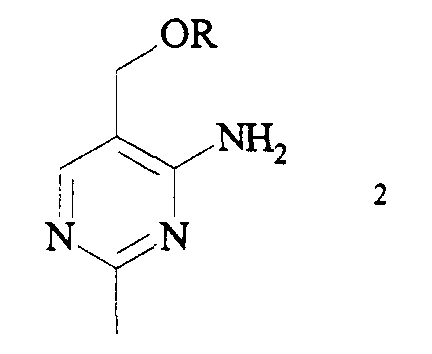
- the present invention relates to an improved process for the preparation of 2-methyl-4-amino-5-aminomethylpyrimidine of the formula 1 (hereinafter referred to as AMP), starting from a 2-methyl-4-amino-5-alkoxymethylpyrimidine of the formula 2, with
- R is C 1 -C 6 alkyl.
- MMP 'Methoxymethylpyrimidine'
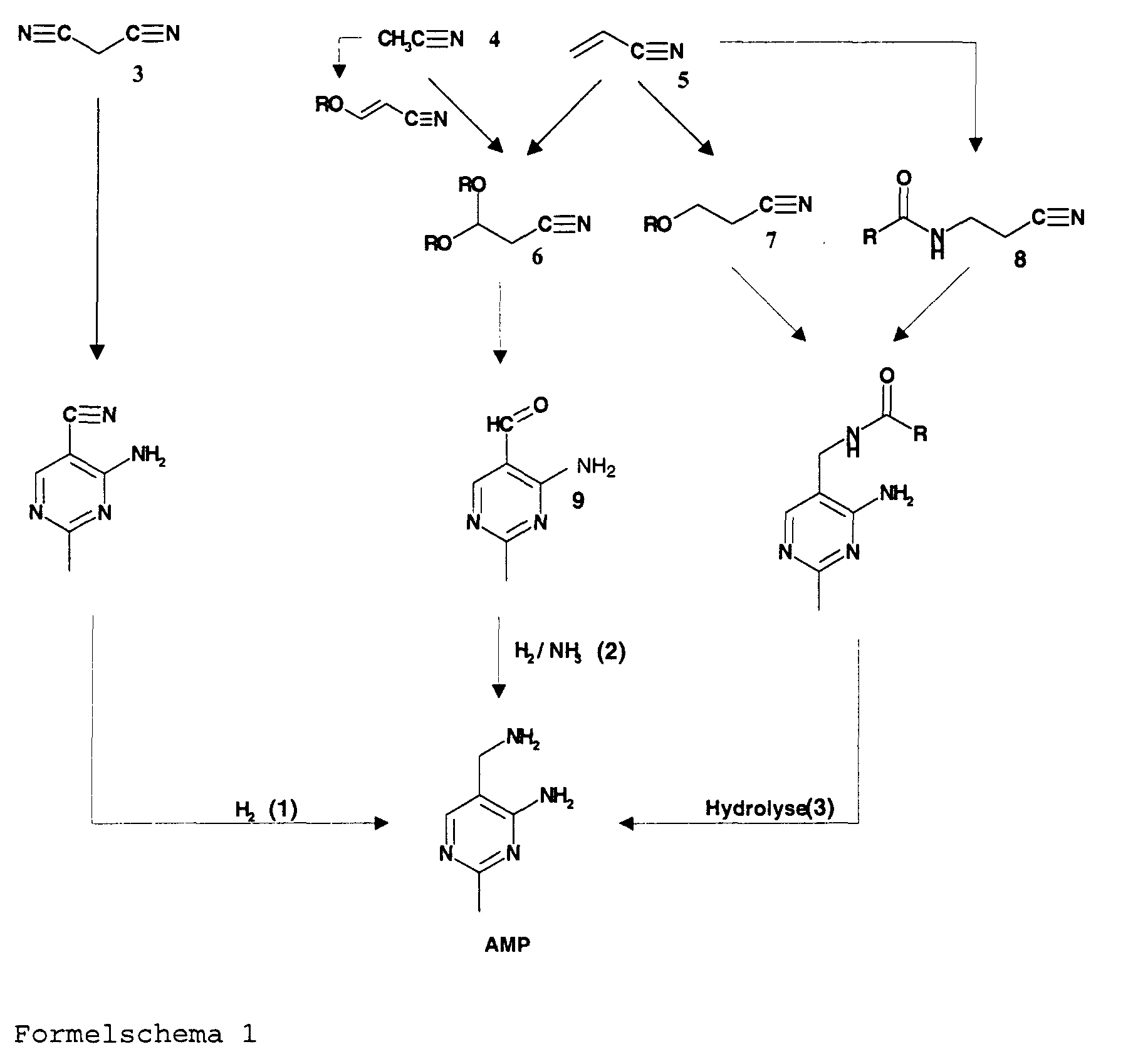
- AMP 1 is the central intermediate product of all technically relevant Process for the production of vitamin B 1 (thiamine). Since the Many attempts have already been made to increase the need for this vitamin an advantageous method of manufacture of the pyrimidine part of thiamine.
- Transformations of functional groups at valuable intermediate stages design a procedure generally cumbersome and therefore uneconomical.
- the route via ⁇ -dialkoxypropionitrile 6 includes the above cumbersome reductive amination of a formylpyrimidine intermediate.
- ⁇ -aminopropionitrile is a safety-related one not unproblematic and also very toxic substance.
- ⁇ -alkoxypropionitriles are practically non-toxic (Ullmann's Encyclopedia of technical chemistry, 4th edition, vol. 17 (1979), P. 330).
- the production of AMP from ⁇ -alkoxypropionitriles, the Because of their low toxicity, intermediate products are easy to handle have been repeatedly described in the literature (see u.a. Chem. Ber. 106 (1973) 893; Bull. Chem. Soc. Japan 45 (1972), 1127; DE-A 1016266).
- This process also produces MMP as a by-product is not converted to AMP, which increases the efficiency of the overall process is affected.
- Type 2 benzyl ethers have been subjected to various ether cleavages in the literature (Chim. Ther. 8 (1973) 1, 98; BE 590665; Khim. Farm. Zh. 23 (1989), 11, 1374; US 3,161,642; GB 953,875). As a rule, drastic conditions are required (strong mineral acids).
- benzyl halide is reacted with NH 3 in a further step (Otkrytiya, Izobret., Prom. Obraztsy, Tovarnye Znaki 1969, 46 (8), 22).
- the selectivity of the monoalkylation of NH 3 with reactive halides is known to be poor. Given the number and complexity of the stages, this method is also very unfavorable.
- the object of the present invention was therefore based on to develop a process for the intermediate ⁇ -alkoxypropionitrile, that leads directly to AMP in a few simple steps, without the To have disadvantages of the prior art.
- C 1 -C 6 alkyl in the radical R means, unless otherwise stated, individually or in combination, for. B. with alkoxy, a straight-chain, branched, saturated or unsaturated radical having 1-6 carbon atoms such as. B. the methyl, ethyl, propyl or isopropyl radical, preferably the methyl radical.
- 2 becomes inert submitted organic solvents or in ammonia itself.
- Preferred solvents are aliphatic or aromatic organic solvents, for example cycloalkanes such as cyclohexane or decalin, or else benzene, toluene, xylene, mesytiles.
- the Solvents can be used alone or in a mixture with each other or be used with ammonia. Preferably 2nd presented in ammonia itself.
- the reaction is carried out in one Temperature range from about 50 - 400 ° C, preferably at about 180 - 350 ° C, particularly preferably in a range of 210-300 ° C by.
- Lewis or Bronsted acids preferably Lewis acidic oxidic compounds of the elements from groups IV A or III B, particularly preferably Al 2 O 3, are used as catalysts.
- Ammonia becomes special with 1 - 500 equivalents, preferably 10 - 300 preferably used with 25 - 250 equivalents per equivalent of 2.
- the starting material for the amination are 2-methyl-4-amino-5-alkoxymethylpyrimidines of formula 2.
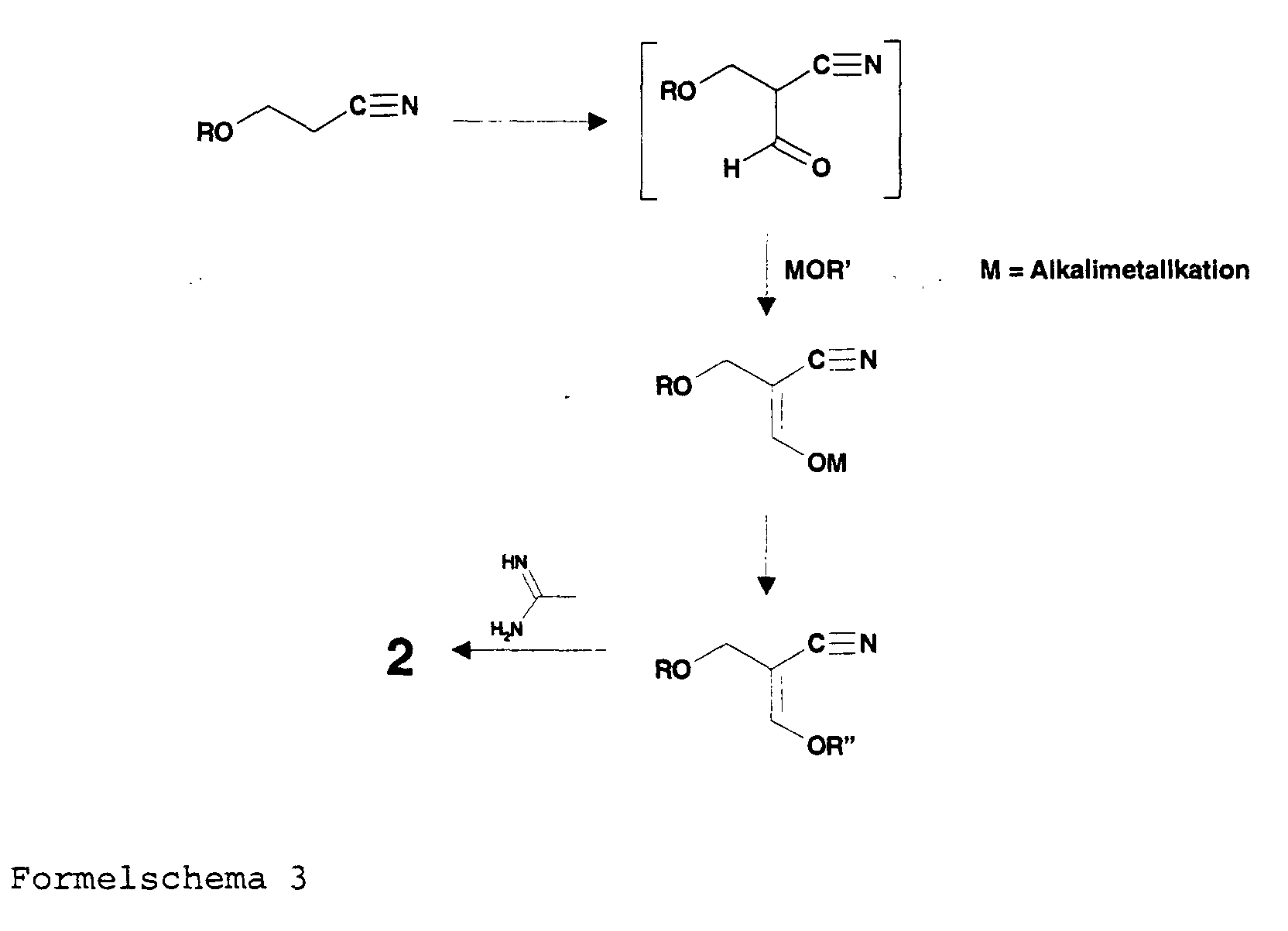
- the synthesis of 2 from the corresponding ⁇ -alkoxypropionitriles is in the prior art (Pharm. Chem. J. 5 (1971), 8, 495; Khim.-Farm. Zh., 12 (1978), 7, 106).
- the ⁇ -alkoxypropionitrile is first in the alkali metal enolate of the corresponding ⁇ -formyl by condensation with a C 1 -C 6 alkyl formate in the presence of an alkali metal alcoholate or by pressure reaction with carbon monoxide in a lower alkanol in the presence of an alkali metal alcoholate (DE-OS 2107990). Conversion to ⁇ -alkoxy-propionitrile.
- the inventive method of direct transfer from 2 in AMP (1) thus enables short and attractive access to this valuable vitamin B 1 precursor, starting from a cheap one and easy-to-use intermediate product.
Landscapes
- Chemical & Material Sciences (AREA)
- Organic Chemistry (AREA)
- Low-Molecular Organic Synthesis Reactions Using Catalysts (AREA)
- Catalysts (AREA)
Abstract


mit Ammoniak in Gegenwart eines Katalysators.
Description


| Eintrag | Katalysator | Temp. [°C] | NH3/MMP [mol/mol] | UMMP [%] | Ausbeute AMP [%] | Selektivität [%] |
| 1 | Al2O3 | 230 | 215 | 87 | 80 | 92 |
| 2 | Al2O3 | 230 | 55 | 45 | 39 | 87 |
| 3 | Al2O3 | 270 | 215 | 98 | 42 | 43 |
| 4 | Al2O3 | 210 | 215 | 40 | 34 | 86 |
| 5 | H3PO4 | 270 | 215 | 25 | 23 | 90 |
| 6 | LaPO4/TiO2 | 270 | 215 | 55 | 13 | 24 |
| 7 | SiO2 | 230 | 215 | 2 | 1 | 50 |
| 8 | TiO2 | 230 | 215 | 41 | 37 | 90 |
| 9 | ZrO2 | 230 | 215 | 25 | 19 | 78 |
Claims (8)
- Verfahren zur Herstellung von 2-Methyl-4-amino-5-aminomethylpyrimidin der Formel 1durch Umsetzung von 2-Methyl-4-amino-5-alkoxymethylpyrimidin der Formel 2

 mit R = C1-C6-Alkylmit Ammoniak in Gegenwart eines Katalysators.
 - Verfahren gemäß Anspruch 1, dadurch gekennzeichnet, daß man als Lösungsmittel ein inertes, organisches Solvens einsetzt.
- Verfahren gemäß einem der Ansprüche 1 oder 2, dadurch gekennzeichnet, daß man Ammoniak als Lösungsmittel einsetzt.
- Verfahren gemäß einem der Ansprüche 1 bis 3, dadurch gekennzeichnet, daß man als Katalysatoren Lewis- oder Brönstedtsäuren einsetzt.
- Verfahren gemäß einem der Ansprüche 1 bis 4, dadurch gekennzeichnet, daß man als Katalysatoren lewissaure oxidische Verbindungen der Elemente aus den Gruppen IV A oder III B, bevorzugt Al2O3, einsetzt.
- Verfahren gemäß einem der Ansprüche 1 bis 5, dadurch gekennzeichnet, daß man als Katalysator Al2O3 einsetzt.
- Verfahren gemäß einem der Ansprüche 1 bis 6, dadurch gekennzeichnet, daß die Verbindung der Formel 2, 2-Methyl-4-amino-5-methoxypyrimidin ist.
- Verfahren gemäß einem der Ansprüche 1 bis 7, dadurch gekennzeichnet, daß nach Zugabe des Katalysators die Umsetzung in einem Temperaturbereich von 50-400°C erfolgt.
Applications Claiming Priority (2)
| Application Number | Priority Date | Filing Date | Title |
|---|---|---|---|
| DE10015470 | 2000-03-29 | ||
| DE10015470A DE10015470A1 (de) | 2000-03-29 | 2000-03-29 | Verfahren zur Herstellung von 2-Methyl-4-amino-5-aminomethyrimidin |
Publications (2)
| Publication Number | Publication Date |
|---|---|
| EP1138675A2 true EP1138675A2 (de) | 2001-10-04 |
| EP1138675A3 EP1138675A3 (de) | 2004-01-02 |
Family
ID=7636753
Family Applications (1)
| Application Number | Title | Priority Date | Filing Date |
|---|---|---|---|
| EP01106525A Withdrawn EP1138675A3 (de) | 2000-03-29 | 2001-03-15 | Verfahren zur Herstellung von 2-Methyl-4-amino-5-aminomethylpyrimidin |
Country Status (5)
| Country | Link |
|---|---|
| US (1) | US6365740B1 (de) |
| EP (1) | EP1138675A3 (de) |
| JP (1) | JP2001316377A (de) |
| CN (1) | CN1176912C (de) |
| DE (1) | DE10015470A1 (de) |
Cited By (1)
| Publication number | Priority date | Publication date | Assignee | Title |
|---|---|---|---|---|
| WO2006079504A3 (en) * | 2005-01-28 | 2007-02-15 | Dsm Ip Assets Bv | Process for the manufacture of a precursor of vitamin b1 |
Families Citing this family (4)
| Publication number | Priority date | Publication date | Assignee | Title |
|---|---|---|---|---|
| CN102712602B (zh) * | 2009-11-23 | 2015-07-08 | 复旦大学 | 2-甲基-4-氨基-5-氰基嘧啶的制备方法 |
| CN103420918B (zh) * | 2013-07-22 | 2015-04-22 | 新发药业有限公司 | 维生素b1关键中间体2-甲基-4-氨基-5-氨基甲基嘧啶的简便制备方法 |
| CN109369540B (zh) * | 2018-12-26 | 2020-09-01 | 浙江本立科技股份有限公司 | 2-甲基-4-氨基-5-甲酰氨甲基嘧啶的合成方法 |
| CN114315738B (zh) * | 2022-01-15 | 2023-08-18 | 重庆东寰科技开发有限公司 | 一种2,4-二氨基嘧啶-3-氧化物的制备方法 |
Family Cites Families (5)
| Publication number | Priority date | Publication date | Assignee | Title |
|---|---|---|---|---|
| CH244837A (de) * | 1945-09-06 | 1946-10-15 | Hoffmann La Roche | Verfahren zur Herstellung von primären Aminen. |
| DE1016266B (de) | 1954-09-01 | 1957-09-26 | Shionogi & Co | Verfahren zur Herstellung von 2-Methyl-4-amino-5-acetaminomethylpyrimidin |
| US3161642A (en) * | 1959-11-20 | 1964-12-15 | Merck & Co Inc | Preparation of pyrimidine derivatives by ether cleavage |
| JPS5946274A (ja) * | 1982-09-10 | 1984-03-15 | Ube Ind Ltd | 2−アルキル−4−アミノ−5−アミノメチルピリミジンの製法 |
| DE3511273A1 (de) * | 1985-03-28 | 1986-10-09 | Basf Ag, 6700 Ludwigshafen | Verbessertes verfahren zur herstellung von 2-methyl-4-amino-5-aminomethyl-pyrimidin |
-
2000
- 2000-03-29 DE DE10015470A patent/DE10015470A1/de not_active Withdrawn
-
2001
- 2001-03-15 EP EP01106525A patent/EP1138675A3/de not_active Withdrawn
- 2001-03-20 US US09/811,433 patent/US6365740B1/en not_active Expired - Fee Related
- 2001-03-28 JP JP2001094120A patent/JP2001316377A/ja not_active Withdrawn
- 2001-03-29 CN CNB011123079A patent/CN1176912C/zh not_active Expired - Fee Related
Cited By (2)
| Publication number | Priority date | Publication date | Assignee | Title |
|---|---|---|---|---|
| WO2006079504A3 (en) * | 2005-01-28 | 2007-02-15 | Dsm Ip Assets Bv | Process for the manufacture of a precursor of vitamin b1 |
| US9108925B2 (en) * | 2005-01-28 | 2015-08-18 | Dsm Ip Assets B.V. | Process for the manufacture of a precursor of vitamin B1 |
Also Published As
| Publication number | Publication date |
|---|---|
| DE10015470A1 (de) | 2001-10-11 |
| JP2001316377A (ja) | 2001-11-13 |
| US20020040141A1 (en) | 2002-04-04 |
| US6365740B1 (en) | 2002-04-02 |
| CN1176912C (zh) | 2004-11-24 |
| EP1138675A3 (de) | 2004-01-02 |
| CN1319592A (zh) | 2001-10-31 |
Similar Documents
| Publication | Publication Date | Title |
|---|---|---|
| DE3123970C2 (de) | ||
| WO2000059868A1 (de) | Substituierte anilinverbindungen | |
| EP1856024B2 (de) | Verfahren zur herstellung substituierter biphenyle | |
| EP1309562B1 (de) | 4-alkoxy-cyclohexan-1-amino-carbonsäureester und verfahren zu ihrer herstellung | |
| DE3112568A1 (de) | Verfahren zur herstellung von n-monosubstituierten carbaminsaeureestern | |
| EP0280781B1 (de) | Verfahren zur Herstellung von N-Alkyl-N'-methyl-alkylenharnstoffen, insbesondere N,N'-Dimethylalkylenharnstoffen | |
| EP0199951B1 (de) | Verfahren zur Herstellung von 2-Amino-3-nitro-6-(4-fluor-benzyl-amino)-pyridin sowie 2-Amino-3-carbethoxyamino-6-(4-fluor-benzyl-amino)-pyridin | |
| EP1138675A2 (de) | Verfahren zur Herstellung von 2-Methyl-4-amino-5-aminomethylpyrimidin | |
| EP0457730B1 (de) | Verfahren zur Herstellung von Alkylydroxyanilino-triazinthioderivaten | |
| EP0135833B1 (de) | Verfahren zur Herstellung von 2-Amino-alkylpyridinen | |
| DE4302156A1 (de) | Verfahren zur Herstellung von Aminomethylenverbindungen | |
| EP0206147B1 (de) | Verfahren zur Herstellung von 4,4'-Dinitrodibenzylen | |
| WO1995018093A1 (de) | Verfahren zur herstellung von n-substituierten glycinsäuren oder glycinestern und verwendung des verfahrens zur indigosynthese | |
| DE2804263C3 (de) | Verfahren zur Herstellung von Indolin-Derivaten | |
| EP0624567B1 (de) | Derivate des 3-Fluorphenols, Verfahren zu ihrer Herstellung und ihre Verwendung | |
| EP0173202B1 (de) | Verfahren zur Herstellung von Chlor-o-nitroanilinen | |
| EP0181618B1 (de) | Verfahren zur Herstellung von Substituierten Piperidinen | |
| EP0630885B1 (de) | Verfahren zur Herstellung von Aminopropionitrilen | |
| EP0923534A1 (de) | Verfahren zur herstellung von racemischen phenethylaminen | |
| EP0152598A1 (de) | Cyanomethyl-(2-cyano-ethyl)-(3-hydroxy-propyl)-amin, seine Verwendung zur Herstellung von 1-(3-Hydroxy-propyl)-1,4-diazepan und 1,4 Bis-[3-(3,4,5-trimethoxy-benzoyloxy)-propyl]-diazepan | |
| DE2617967C3 (de) | Verfahren zur Herstellung von 2,4-Diamino-5-benzylpyrimidinen | |
| EP0697398A1 (de) | Verfahren zur Herstellung von N-Alkenylcarbonsäureamiden | |
| DE2742158A1 (de) | Herstellung substituierter harnstoffe | |
| EP0275436A1 (de) | Verfahren zur Herstellung von tert.-Amylbenzoylbenzosäure | |
| DE3347526A1 (de) | Verfahren zur herstellung substituierter chinazolin-2.4(1h.3h)-dione |
Legal Events
| Date | Code | Title | Description |
|---|---|---|---|
| PUAI | Public reference made under article 153(3) epc to a published international application that has entered the european phase |
Free format text: ORIGINAL CODE: 0009012 |
|
| AK | Designated contracting states |
Kind code of ref document: A2 Designated state(s): AT BE CH CY DE DK ES FI FR GB GR IE IT LI LU MC NL PT SE TR |
|
| AX | Request for extension of the european patent |
Free format text: AL;LT;LV;MK;RO;SI |
|
| PUAL | Search report despatched |
Free format text: ORIGINAL CODE: 0009013 |
|
| AK | Designated contracting states |
Kind code of ref document: A3 Designated state(s): AT BE CH CY DE DK ES FI FR GB GR IE IT LI LU MC NL PT SE TR |
|
| AX | Request for extension of the european patent |
Extension state: AL LT LV MK RO SI |
|
| 17P | Request for examination filed |
Effective date: 20040702 |
|
| AKX | Designation fees paid |
Designated state(s): AT BE CH CY DE DK ES FI FR GB GR IE IT LI LU MC NL PT SE TR |
|
| AXX | Extension fees paid |
Extension state: SI Payment date: 20040702 Extension state: RO Payment date: 20040702 |
|
| GRAP | Despatch of communication of intention to grant a patent |
Free format text: ORIGINAL CODE: EPIDOSNIGR1 |
|
| STAA | Information on the status of an ep patent application or granted ep patent |
Free format text: STATUS: THE APPLICATION HAS BEEN WITHDRAWN |
|
| 18W | Application withdrawn |
Effective date: 20050301 |