EP1130666A2 - An alkaline storage battery that can be used with stability in a wide temperature range - Google Patents
An alkaline storage battery that can be used with stability in a wide temperature range Download PDFInfo
- Publication number
- EP1130666A2 EP1130666A2 EP01105002A EP01105002A EP1130666A2 EP 1130666 A2 EP1130666 A2 EP 1130666A2 EP 01105002 A EP01105002 A EP 01105002A EP 01105002 A EP01105002 A EP 01105002A EP 1130666 A2 EP1130666 A2 EP 1130666A2
- Authority
- EP
- European Patent Office
- Prior art keywords
- alkaline
- storage battery
- nickel
- compound
- battery
- Prior art date
- Legal status (The legal status is an assumption and is not a legal conclusion. Google has not performed a legal analysis and makes no representation as to the accuracy of the status listed.)
- Granted
Links
Images


Classifications
-
- H—ELECTRICITY
- H01—ELECTRIC ELEMENTS
- H01M—PROCESSES OR MEANS, e.g. BATTERIES, FOR THE DIRECT CONVERSION OF CHEMICAL ENERGY INTO ELECTRICAL ENERGY
- H01M4/00—Electrodes
- H01M4/02—Electrodes composed of, or comprising, active material
- H01M4/24—Electrodes for alkaline accumulators
- H01M4/32—Nickel oxide or hydroxide electrodes
-
- H—ELECTRICITY
- H01—ELECTRIC ELEMENTS
- H01M—PROCESSES OR MEANS, e.g. BATTERIES, FOR THE DIRECT CONVERSION OF CHEMICAL ENERGY INTO ELECTRICAL ENERGY
- H01M10/00—Secondary cells; Manufacture thereof
- H01M10/24—Alkaline accumulators
- H01M10/30—Nickel accumulators
-
- H—ELECTRICITY
- H01—ELECTRIC ELEMENTS
- H01M—PROCESSES OR MEANS, e.g. BATTERIES, FOR THE DIRECT CONVERSION OF CHEMICAL ENERGY INTO ELECTRICAL ENERGY
- H01M10/00—Secondary cells; Manufacture thereof
- H01M10/24—Alkaline accumulators
- H01M10/26—Selection of materials as electrolytes
-
- H—ELECTRICITY
- H01—ELECTRIC ELEMENTS
- H01M—PROCESSES OR MEANS, e.g. BATTERIES, FOR THE DIRECT CONVERSION OF CHEMICAL ENERGY INTO ELECTRICAL ENERGY
- H01M4/00—Electrodes
- H01M4/02—Electrodes composed of, or comprising, active material
- H01M4/62—Selection of inactive substances as ingredients for active masses, e.g. binders, fillers
-
- H—ELECTRICITY
- H01—ELECTRIC ELEMENTS
- H01M—PROCESSES OR MEANS, e.g. BATTERIES, FOR THE DIRECT CONVERSION OF CHEMICAL ENERGY INTO ELECTRICAL ENERGY
- H01M2300/00—Electrolytes
- H01M2300/0002—Aqueous electrolytes
- H01M2300/0014—Alkaline electrolytes
-
- Y—GENERAL TAGGING OF NEW TECHNOLOGICAL DEVELOPMENTS; GENERAL TAGGING OF CROSS-SECTIONAL TECHNOLOGIES SPANNING OVER SEVERAL SECTIONS OF THE IPC; TECHNICAL SUBJECTS COVERED BY FORMER USPC CROSS-REFERENCE ART COLLECTIONS [XRACs] AND DIGESTS
- Y02—TECHNOLOGIES OR APPLICATIONS FOR MITIGATION OR ADAPTATION AGAINST CLIMATE CHANGE
- Y02E—REDUCTION OF GREENHOUSE GAS [GHG] EMISSIONS, RELATED TO ENERGY GENERATION, TRANSMISSION OR DISTRIBUTION
- Y02E60/00—Enabling technologies; Technologies with a potential or indirect contribution to GHG emissions mitigation
- Y02E60/10—Energy storage using batteries
-
- Y—GENERAL TAGGING OF NEW TECHNOLOGICAL DEVELOPMENTS; GENERAL TAGGING OF CROSS-SECTIONAL TECHNOLOGIES SPANNING OVER SEVERAL SECTIONS OF THE IPC; TECHNICAL SUBJECTS COVERED BY FORMER USPC CROSS-REFERENCE ART COLLECTIONS [XRACs] AND DIGESTS
- Y02—TECHNOLOGIES OR APPLICATIONS FOR MITIGATION OR ADAPTATION AGAINST CLIMATE CHANGE
- Y02P—CLIMATE CHANGE MITIGATION TECHNOLOGIES IN THE PRODUCTION OR PROCESSING OF GOODS
- Y02P70/00—Climate change mitigation technologies in the production process for final industrial or consumer products
- Y02P70/50—Manufacturing or production processes characterised by the final manufactured product
Definitions
- the present invention relates to an alkaline storage battery.
- An alkaline storage battery comprises an external casing enclosing a group of electrodes.
- the electrode group includes a nickel positive electrode and a negative electrode containing either cadmium hydroxide or hydrogen absorbing alloys as an active material.
- the positive electrode and the negative electrode are rolled or layered together with a separator between the two electrodes.
- the electrode group is impregnated with an alkaline electrolytic solution.
- a closure cap covers an opening of the external casing.
- a gasket usually made of nylon, is inserted between the closure cap and the external casing to seal the opening.
- an alkaline storage battery such as above has excellent charging/discharging characters and can be hermetically sealed so that this alkaline storage battery is used in a variety of appliances.
- the alkaline storage battery is also required to endure a wide temperature range from low to high temperatures.
- Li is added to an electrolytic solution in one known technique (see Japanese Laid-Open Patent Application No. 11-219721), for instance.
- alkaline storage batteries with excellent characteristics at room temperatures and high temperatures.
- these alkaline storage batteries do not have a sufficient discharging capacity at a low temperature of around -40 °C.
- an alkaline storage battery that can be used with stability over a wide temperature range from low to high temperatures have not been achieved yet.
- the present invention therefore aims to provide an alkaline storage battery that can be used with stability over a wide temperature range.
- the alkaline storage battery of the present invention includes: a nickel positive electrode containing one or more types of additive compounds selected from a calcium compound, a strontium compound, a scandium compound, an yttrium compound, and a lanthanoid compound; and an alkaline electrolytic solution having an alkaline concentration of 10 moles/liter (mol/l) or higher.
- the nickel positive electrode When the nickel positive electrode includes the above additive compounds, an oxygen overvoltage at a high temperature increases. This suppresses generation of oxygen gas, and therefore can promote a charging response more than other responses. As a result, charging characteristics at a high temperature enhance.
- an alkaline concentration of an alkaline electrolytic solution is set as 9 mol/l or lower so as to maintain good operating voltage of the storage battery although a high alkaline concentration of 10 mol/l or higher is set for the present invention. Since an alkaline electrolytic solution with a high alkaline concentration has a low freezing point, the alkaline storage battery of the present invention can operate with stability at a low temperature of around -40 °C and maintain a sufficient discharging capacity. It has been also proved that a sufficient operating voltage can be obtained when the alkaline concentration of the alkaline electrolytic solution is 10 mol/l or higher. In this way, the alkaline storage battery of the present invention has both a sufficient operating voltage and improved discharging characteristics at low temperatures.
- a maximum allowable alkaline concentration of the alkaline electrolytic solution should be set within a range in which an electrolyte compound in the electrolytic solution does not deposit at a low temperature although a very high alkaline concentration may lower an operating voltage of the battery. Accordingly, a suitable alkaline concentration should be set with consideration also given to the operating voltage.
- the experiments have proved that an alkaline voltage battery having an alkaline concentration of 10 to 11 mol/l can operate with stability over a wide temperature range from a low temperature to a high temperature.
- the alkaline electrolytic solution for the present invention preferably contains one or more types of compounds selected from cesium hydroxide, rubidium hydroxide, potassium hydroxide, and sodium hydroxide as an electrolyte.
- cesium hydroxide for instance, that has a low water solubility is used for an alkaline electrolytic solution and its concentration is raised, the lithium hydroxide deposits.
- the above electrolyte compounds for the present invention however, have a high water solubility, and therefore are not likely to deposit.
- the alkaline storage battery of the present invention includes a separator made of two or more separator members that are layered together, an internal short circuit can be reduced. This is especially advantageous to a nickel-cadmium storage battery, whose negative electrode contains cadmium. When this storage battery is used at a high temperature, a cadmium dendrite grows and an internal short circuit is likely to occur. Accordingly, the above separator made of two or more separator members are suitable for maintaining good long-term performance of the battery.
- FIG. 1 shows a construction of an alkaline storage battery according to one embodiment of the present invention.
- This alkaline storage battery comprises an electrode group 4, an alkaline electrolytic solution (not shown in the figure), and a cylindrical-shaped external casing 6, which encloses the electrode group 4 and the alkaline electrolytic solution.
- the electrode group 4 includes a sintered nickel positive electrode 1 and a negative electrode 2, which are rolled together with separators 3 being inserted between them.
- the negative electrode 2 is electrically connected via a negative electrode collector 5 to an internal bottom of the external casing 6.
- the external casing 6 has a circular opening on its top, to which a gasket 11 is fitted.
- a closure cap 12 is attached to this gasket 11, and a positive terminal 13 is attached to the closure cap 12.
- a valve which includes a valve plate 8, a retaining plate 9, and a coil spring 10, is formed. This valve is pressed when internal pressure of the alkali storage battery raises so that gas inside the storage battery is released outside.
- the positive terminal 13 is electrically connected with the nickel positive electrode 1 by a positive electrode collector 7 and the closure cap 12.
- the nickel positive electrode 1 is produced as follows. A sintered nickel base member is filled with a predetermined amount of nickel hydroxide according to a chemical impregnating method so that a nickel hydroxide layer is formed. At least one element compound, out of a Ca compound, an Sr compound, an Sc compound, a Y compound, and a lanthanoid compound, is added to the nickel hydroxide layer.
- the lanthanoid refers to fifteen rare earth elements with atomic numbers of 57 to 71, which include La, Ce, Pr, Nd, Pm, Sm, Eu, Gd, Tb, Dy, Ho, Er, Tm, Yb, and Lu.
- the above sintered nickel base member is a porous plate with a porosity of 80 to 85%, and is about 0.5 to 1.0 mm thick.
- the above element compound there are three example methods for adding the above element compound to the nickel hydroxide layer.
- a solid solution is formed by the above element compound with the nickel hydroxide layer.
- the above element compound forms a layer on the surface of the nickel hydroxide layer.
- a nickel hydroxide layer formed as a solid solution with the above element compound is formed on the surface of the nickel hydroxide layer.
- the second and third methods are favorable so as to increase an oxygen overvoltage at a high temperature.
- a metal mole ratio of the element compound to the nickel hydroxide is in a range of 1% to 10% when the element compound is formed as a solid solution with a nickel hydroxide layer, and is 0.3 to 5% when the element compound is formed as a surface layer on a nickel hydroxide layer.
- the nickel positive electrode 1 having the above construction is produced using the following example processes:
- the negative electrode 2 is achieved by a cadmium negative electrode filled with a predetermine amount of a cadmium active material, such as cadmium hydroxide, according to the chemical impregnating method. It is alternatively possible for the negative electrode 2 to be achieved by a non-sintered cadmium negative electrode and a hydrogen absorbing alloy electrode.
- the cadmium negative electrode can be produced by repeatedly performing the following processes so as to have cadmium hydroxide generated. A sintered nickel base member is impregnated with nickel nitrate. After this, alkaline treatment is performed for the nickel base member.
- the separators 3 can be achieved by cutting a commercially available PP separator member to a strip form.
- the separators 3 are preferably made of two or more separator members cut as a strip form to prevent an internal short circuit from occurring.
- the separators 2 are composed of two separator members 3a and 3b that are layered together. This is because, when a nickel-cadmium battery, for instance, is repeatedly charged and discharged, a dendrite of cadmium hydroxide grows in the cadmium negative electrode. Should such dendrite penetrate a separator, an internal short circuit may occur. A cadmium hydroxide dendrite is likely to grow especially when the battery is used at a high temperature, and so an internal short circuit becomes likely to occur. With the two separator members layered as in the present embodiment, an internal short circuit does not occur until both the first and second layers are penetrated, and therefore an internal short circuit can be suppressed.
- the frequency of occurrence of an internal short circuit due to a separator member being penetrated lowers when two separator members with a thickness of 0.2 mm are used than when a single 0.4-mm thick separator member is used.
- the gasket 11 may be made of nylon as is conventionally used although polysulfone may be used instead. Polysulfone has high heat resistance, and therefore maintains good sealing performance at a high temperature over a long period. This is advantageous to maintaining a good battery quality at a high temperature over a long period.
- An electrolyte of the alkaline electrolytic solution may be preferably achieved by CsOH, RbOH, KOH, or NaOH. Alternatively, it is possible to mix at least two out of the above four types of alkaline electrolytes to generate the alkaline electrolytic solution.
- KOH should be preferably used as a major constituent of the alkaline electrolytic solution because it can provide a relatively high battery capacity over a wide temperature range.
- each alkaline electrolyte has a unique temperature range in which a high battery capacity can be achieved.
- Such unique temperature ranges are 0 to 20°C for KOH, approximately 40°C for NaOH, approximately -40°C for RbOH, and approximately 0°C for CsOH.
- a suitable alkaline electrolyte may be selected in accordance with a temperature range in which the battery is used.
- a temperature range that enables a high battery capacity to be realized can be adjusted using two or more types of alkaline electrolytes. For instance, when RbOH is added to KOH to form the alkaline electrolytic solution, battery characteristics at a low temperature is considered to improve more than when only KOH is used as the electrolyte.
- the alkaline electrolytic solution for the present embodiment contains a higher alkaline concentration of 10 ⁇ 11 moles/liter (mol/l) than a conventionally-used alkaline concentration of 9 mol/l or lower.
- the alkaline electrolytic solution freezes at a low temperature of around -40°C so that the conventional alkaline storage battery stops operating.
- the alkaline concentration of 10 mol/l or higher of the present embodiment however, the alkaline electrolytic solution does not freeze at such low temperature, and so the battery operates correctly.
- CsOH, RbOH, KOH, and NaOH used for the present embodiment have relatively high solubilities, and therefore a high alkaline concentration of 10 mol/l or higher can be easily achieved.
- a low alkaline concentration is preferable to obtain a high battery operating voltage at room temperatures.
- the conventional alkaline concentration of 9 mol/l or lower is suitable. It has been verified, however, that the higher alkaline concentration of 10 ⁇ 11 mol/l for the present embodiment has no substantial negative effect on the battery operating voltage.
- the alkaline concentration should be preferably between 10 mol/l and 11 mol/l inclusive.
- Alkaline storage batteries were produced according to the above embodiments so as to be used for charging/discharging tests described later.
- batteries A1-A4 were produced.
- the batteries A1-A4 have an SC size and a nominal capacity of 1200 mAh (ampere-hour).
- Batteries A3 and A4 were produced in accordance with the above embodiments, and batteries A1 and A2 were produced as examples (hereafter called “comparison examples") to be compared with batteries of the present invention.
- a nickel positive electrode of the batteries A1-A4 was produced according to the process (A) described above.
- Step 2 of the process (A) the sintered nickel base member filled with the nickel hydroxide is dipped for thirty minutes into a 0.5 mol/l yttrium nitrate solution having a pH 5, dried, and then immersed into a 8 mol/l alkaline solution.
- Separators of the batteries A1-A4 were made of two 50 g/m 2 separator members that are layered together.
- KOH was used as an electrolyte of the alkaline electrolytic solution for the batteries A1-A4.
- Different alkaline concentrations were used for the batteries A1 to A4 as follows: 8 mol/l for the battery A1; 9 mol/l for the battery A2; 10 mol/l for the battery A3; and 11 mol/l for the battery A4.
- batteries B1-B4 were produced.
- the batteries B1-B4 have an SC size and a nominal capacity of 1200 mAh.
- Batteries B3 and B4 were produced in accordance with the above embodiments, and batteries B1 and B2 were produced as comparison examples.
- a nickel positive electrode of the batteries B1-B4 was produced according to the process (B) described above.
- Step 2 of the process (B) the sintered nickel base member filled with nickel hydroxide is immersed, for thirty minutes, into a solution of pH 5 composed of nickel nitrate and yttrium nitrate, which are mixed at a mole ratio of 80 : 20.
- a total concentration of the nickel nitrate and yttrium nitrate is 0.5 mol/l.
- the immersed nickel base member is then dried, and dipped into a 8 mol/l alkaline solution.
- Separators of the batteries B1-B4 were made of two 50 g/m 2 separator members that are layered together.
- KOH was used as an electrolyte of the alkaline electrolytic solution for the batteries B1-B4.
- Different alkaline concentrations were used for the batteries B1 to B4 as follows: 8 mol/l for the battery B1; 9 mol/l for the battery B2; 10 mol/l for the battery B3; and 11 mol/l for the battery B4.
- batteries C1-C4 were produced.
- the batteries C1-C4 have an SC size and a nominal capacity of 1200 mAh.
- Batteries C3 and C4 were produced in accordance with the above embodiments, and batteries C1 and C2 were produced as comparison examples.
- a nickel positive electrode of the batteries C1-C4 was produced according to the process (C) described above. More specifically, the sintered nickel base member filled with the nickel hydroxide was immersed into a solution composed of nickel nitrate and yttrium nitrate, which are mixed at a mole ratio of 100 : 1. The immersed nickel base member is then dried, and dipped into an alkaline solution. These processes were repeatedly performed.
- Separators of the batteries C1-C4 were made of two 50 g/m 2 separator members that are layered together.
- KOH was used as an electrolyte of the alkaline electrolytic solution for the batteries C1-C4.
- Different alkaline concentrations are used for the alkaline electrolytic solution of the batteries C1 to C4 as follows: 8 mol/l for the battery C1; 9 mol/l for the battery C2; 10 mol/l for the battery C3; and 11 mol/l for the battery C4.
- Batteries D1 to D4 were produced as comparison examples through a process, which is basically the same as used for the batteries A1 to A4 but differs in that Step (2) was not performed for the batteries D1-D4.
- the batteries D1 to D4 have basically the same construction as the batteries A1 to A4 except that nickel positive electrodes of the batteries D1 to D4 do not contain yttrium compound.
- a battery E was produced as a comparison example through a process which is basically the same as used for the batteries D1 to D4 but differs in that it uses, as an alkaline electrolytic solution, an aqueous solution composed of 7 mol/l KOH, 1 mol/l NaOH, and 1 mol/l LiOH.
- the alkaline electrolytic solution contains LiOH and an alkaline concentration of 9 mol/l.
- Each of the above batteries was charged at 25°C and at 60°C to obtain discharging capacities for 25°C and 60°C, respectively.
- a ratio of the obtained discharging capacity for 60°C to the obtained discharging capacity for 25°C is regarded as the high-temperature charging efficiency.
- the discharging capacity for 25°C was obtained by charging each battery for 16 hours by using a current of 0.1 C (120 mA) at 25°C, and then discharging the electric charge of the battery with a current of 1 C (120 mA) at 25°C until a voltage of the battery reaches 0.8 V.
- the discharging capacity for 60°C was obtained by charging each battery for 16 hours with a current of 0.1 C at 60°C, and then discharging the electric charge of the battery with a current of 1 C at 25°C until a voltage of the battery reaches 0.8 V.
- the discharging capacity for 25°C was obtained by charging each battery for one weeks with a current of 0.1 C at 25°C, and then discharging the electric charge of the battery with a current of 1 C at 25°C.
- the discharging capacity for -40°C was obtained by charging each battery at 25°C for one weeks with a current of 0.1 C, and then discharging the electric charge of the battery at -40°C with a current of 1 C.
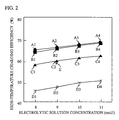
- FIG. 2 shows the high-temperature charging efficiency test result, or a relationship between an alkaline concentration of an alkaline electrolytic solution and high-temperature charging efficiency.
- FIG. 3 shows the low-temperature discharging efficiency test result, or a relationship between an alkaline concentration of an alkaline electrolytic solution and low-temperature discharging efficiency is shown.
- the batteries A1-A4, B1-B4, and C1-C4 which include a nickel positive electrode containing the Y compound have higher high-temperature charging efficiency than the batteries D1-D4 and E including nickel positive electrode that does not contain any yttrium compound.
- the batteries A2-A4, B2-B4, and C2-C4 which have the nickel positive electrode containing the Y compound and the alkaline electrolytic solution containing the alkaline concentration of 9 mol/l or higher, have higher high-temperature charging efficiency than the battery E, which has the nickel positive electrode containing no yttrium compound, and the alkaline electrolytic solution containing LiOH.
- the Y compound is added to the nickel positive electrode; the alkaline electrolytic solution contains KOH as the electrolyte; and an alkaline concentration of the electrolytic solution is in a range from 10 to 11 mol/l.
- the alkaline concentration being in a range from 10 to 11 mol/l when the alkaline electrolyte is not KOH but either: (a) one of NaOH, RbOH, or CsOH; or (b) a mixture containing at least two out of four types of alkaline electrolytes of KOH, NaOH, RbOH, and CsOH.
- the above embodiments use a cylindrical-shaped alkaline storage battery to describe the present invention.
- the present invention does not limit a shape of a battery, and may be applied to an alkaline storage battery of a rectangular cylindrical shape or of a coin type.
- the above embodiment describes the nickel positive electrode as being sintered.
- the present invention can be applied to a non-sintered nickel positive electrode, and the same effect as obtained by the above embodiments can be achieved with such non-sintered nickel positive electrode.
- the non-sintered nickel positive electrode is produced using two methods as follows.
- one compound, out of a Ca compound, an Sr compound, an Sc compound, a Y compound, and a lanthanoid compound, is selected, or some of these compounds are selected to form a mixture.
- Positive electrode active material particles are formed by having the above selected compound or mixture form a solid solution with nickel hydroxide. The formed active material particles are then filled into a positive electrode base member, which is a nickel foaming member, so that the nickel positive electrode can be produced.
- a layer made of the above selected compound or the above mixture is formed on a surface of each active material particle containing nickel hydroxide as a major constituent. These active material particles are filled into a positive electrode base member, so that the nickel positive electrode is produced.
Landscapes
- Chemical & Material Sciences (AREA)
- Chemical Kinetics & Catalysis (AREA)
- Electrochemistry (AREA)
- General Chemical & Material Sciences (AREA)
- Engineering & Computer Science (AREA)
- Manufacturing & Machinery (AREA)
- Secondary Cells (AREA)
- Battery Electrode And Active Subsutance (AREA)
- Sealing Battery Cases Or Jackets (AREA)
- Cell Separators (AREA)
Abstract
Description
Process Step: A sintered nickel base member is immersed into a solution composed of nickel nitrate as a major constituent and yttrium nitrate. Alkaline treatment is performed for this nickel base member. These processes are repeated so as to have the nickel base member filled with nickel hydroxide forming a solid solution with a Y compound.
Claims (10)
- An alkaline storage battery, comprising an electrode element and an alkaline electrolytic solution that are enclosed in a battery casing, the electrode element including a nickel positive electrode and a negative electrode with a separator being inserted therebetween, the nickel positive electrode and the negative electrode being either rolled together or layered,wherein the nickel positive electrode contains one or more types of additive compounds selected from a calcium compound, a strontium compound, a scandium compound, an yttrium compound, and a lanthanoid compound, andwherein the alkaline electrolytic solution has an alkaline concentration of 10 moles/liter or higher.
- The alkaline storage battery of Claim 1, wherein the battery casing includes:an external casing that has an opening;a closure cap that covers the opening; anda gasket that is made of polysulfone and inserted between the external casing and the closure cap.
- The alkaline storage battery of Claim 1,
wherein the alkaline electrolytic solution contains one or more types of electrolyte compounds selected from cesium hydroxide, rubidium hydroxide, potassium hydroxide, and sodium hydroxide as an electrolyte. - The alkaline storage battery of Claim 3, wherein the battery casing includes:an external casing that has an opening;a closure cap that covers the opening; anda gasket that is made of polysulfone and inserted between the external casing and the closure cap.
- The alkaline storage battery of Claim 1,
wherein the nickel positive electrode includes a base member on which an active material layer made of a solid solution is formed, the solid solution being formed by the additive compounds and nickel hydroxide. - The alkaline storage battery of Claim 5,
wherein a metal mole ratio of the additive compounds to the nickel hydroxide is in a range of 1% to 10% inclusive. - The alkaline storage battery of Claim 1,wherein the nickel positive electrode includes a base member on which an active material layer made of nickel hydroxide is formed, andwherein on the active material layer, a layer made of the additive compounds is formed.
- The alkaline storage battery of Claim 7,
wherein a metal mole ratio of the additive compounds to the nickel hydroxide is in a range of 0.3% to 5% inclusive. - The alkaline storage battery of Claim 5 or 7,
wherein the alkaline electrolytic solution contains one or more types of electrolyte compounds selected from cesium hydroxide, rubidium hydroxide, potassium hydroxide, and sodium hydroxide as an electrolyte. - The alkaline storage battery of Claim 1,
wherein the separator includes two or more separator members that are layered.
Applications Claiming Priority (2)
| Application Number | Priority Date | Filing Date | Title |
|---|---|---|---|
| JP2000056428A JP4248119B2 (en) | 2000-03-01 | 2000-03-01 | Alkaline storage battery |
| JP2000056428 | 2000-03-01 |
Publications (3)
| Publication Number | Publication Date |
|---|---|
| EP1130666A2 true EP1130666A2 (en) | 2001-09-05 |
| EP1130666A3 EP1130666A3 (en) | 2004-03-10 |
| EP1130666B1 EP1130666B1 (en) | 2006-11-29 |
Family
ID=18577377
Family Applications (1)
| Application Number | Title | Priority Date | Filing Date |
|---|---|---|---|
| EP01105002A Expired - Lifetime EP1130666B1 (en) | 2000-03-01 | 2001-03-01 | An alkaline storage battery that can be used with stability in a wide temperature range |
Country Status (8)
| Country | Link |
|---|---|
| US (1) | US6605384B2 (en) |
| EP (1) | EP1130666B1 (en) |
| JP (1) | JP4248119B2 (en) |
| KR (1) | KR20010087224A (en) |
| CN (1) | CN1199307C (en) |
| DE (1) | DE60124803T2 (en) |
| HK (1) | HK1040137B (en) |
| TW (1) | TW499773B (en) |
Cited By (1)
| Publication number | Priority date | Publication date | Assignee | Title |
|---|---|---|---|---|
| EP1311017A3 (en) * | 2001-11-12 | 2005-12-14 | Matsushita Electric Industrial Co., Ltd. | Alkaline storage battery |
Families Citing this family (7)
| Publication number | Priority date | Publication date | Assignee | Title |
|---|---|---|---|---|
| CN1300867C (en) * | 2005-05-26 | 2007-02-14 | 中国科学院长春应用化学研究所 | Method for preparing sintered nickel anode for quickly charging type secondary battery |
| CN101267047B (en) * | 2007-03-16 | 2010-10-06 | 深圳市力可兴电池有限公司 | Nickel-hydrogen rechargeable battery |
| JP6232722B2 (en) * | 2013-03-25 | 2017-11-22 | 三洋電機株式会社 | Nickel-cadmium storage battery |
| CN104347849A (en) * | 2013-08-06 | 2015-02-11 | 中国人民解放军63971部队 | Preparation method of sintered nickel electrode |
| CN107871856A (en) * | 2016-09-26 | 2018-04-03 | 深圳市量能科技有限公司 | Nickel-hydrogen battery capable of being used in extremely cold environment and preparation method thereof |
| CN108232333A (en) * | 2017-12-29 | 2018-06-29 | 东莞市朗泰通实业有限公司 | A kind of low-temperature electrolyte of Ni-MH battery |
| CN113421777B (en) * | 2021-06-30 | 2023-03-31 | 昆明理工大学 | Supermolecule-based aqueous alkaline electrolyte with ultra-wide working temperature range |
Family Cites Families (11)
| Publication number | Priority date | Publication date | Assignee | Title |
|---|---|---|---|---|
| JPS59121773A (en) * | 1982-12-28 | 1984-07-13 | Yuasa Battery Co Ltd | Alkaline cell |
| US4812375A (en) * | 1988-06-27 | 1989-03-14 | The United States Of America As Represented By The Secretary Of The Army | Separator for lithium batteries and lithium batteries including the separator |
| JP3400139B2 (en) * | 1994-09-30 | 2003-04-28 | 三井化学株式会社 | Laminated microporous film of olefin polymer, its production method and its use |
| JPH10125318A (en) * | 1996-10-24 | 1998-05-15 | Matsushita Electric Ind Co Ltd | Cathode active material and cathode for alkaline storage batteries |
| US5972531A (en) * | 1996-12-24 | 1999-10-26 | Canon Kabushiki Kaisha | Process and apparatus for recovering constituent components of battery |
| FR2760567B1 (en) * | 1997-03-06 | 1999-04-16 | Alsthom Cge Alcatel | POSITIVE ACTIVE MATERIAL FOR NICKEL ELECTRODE OF ALKALINE ELECTROLYTE BATTERY |
| JP3489960B2 (en) * | 1997-04-01 | 2004-01-26 | 松下電器産業株式会社 | Alkaline storage battery |
| JPH10289716A (en) * | 1997-04-14 | 1998-10-27 | Matsushita Electric Ind Co Ltd | Nickel-hydrogen storage battery |
| JP3923157B2 (en) * | 1997-12-11 | 2007-05-30 | 松下電器産業株式会社 | Alkaline storage battery |
| JPH11219721A (en) * | 1998-02-03 | 1999-08-10 | Matsushita Electric Ind Co Ltd | Alkaline storage battery |
| JPH11233106A (en) * | 1998-02-16 | 1999-08-27 | Canon Inc | Alkaline secondary battery and manufacturing method thereof |
-
2000
- 2000-03-01 JP JP2000056428A patent/JP4248119B2/en not_active Expired - Fee Related
-
2001
- 2001-02-28 KR KR1020010010212A patent/KR20010087224A/en not_active Ceased
- 2001-02-28 US US09/794,407 patent/US6605384B2/en not_active Expired - Lifetime
- 2001-03-01 CN CNB011168641A patent/CN1199307C/en not_active Expired - Fee Related
- 2001-03-01 DE DE60124803T patent/DE60124803T2/en not_active Expired - Lifetime
- 2001-03-01 EP EP01105002A patent/EP1130666B1/en not_active Expired - Lifetime
- 2001-03-01 TW TW090104650A patent/TW499773B/en not_active IP Right Cessation
-
2002
- 2002-03-05 HK HK02101681.0A patent/HK1040137B/en not_active IP Right Cessation
Cited By (2)
| Publication number | Priority date | Publication date | Assignee | Title |
|---|---|---|---|---|
| EP1311017A3 (en) * | 2001-11-12 | 2005-12-14 | Matsushita Electric Industrial Co., Ltd. | Alkaline storage battery |
| US7056621B2 (en) | 2001-11-12 | 2006-06-06 | Matsushita Electric Industrial Co., Ltd. | Alkaline storage battery |
Also Published As
| Publication number | Publication date |
|---|---|
| EP1130666B1 (en) | 2006-11-29 |
| JP4248119B2 (en) | 2009-04-02 |
| KR20010087224A (en) | 2001-09-15 |
| HK1040137A1 (en) | 2002-05-24 |
| TW499773B (en) | 2002-08-21 |
| EP1130666A3 (en) | 2004-03-10 |
| CN1199307C (en) | 2005-04-27 |
| HK1040137B (en) | 2005-11-18 |
| DE60124803T2 (en) | 2007-10-11 |
| US20010033967A1 (en) | 2001-10-25 |
| DE60124803D1 (en) | 2007-01-11 |
| CN1313648A (en) | 2001-09-19 |
| JP2001243973A (en) | 2001-09-07 |
| US6605384B2 (en) | 2003-08-12 |
Similar Documents
| Publication | Publication Date | Title |
|---|---|---|
| US8101121B2 (en) | Hydrogen absorbing alloy for alkaline storage battery | |
| JPH04137368A (en) | Nickel-hydrogen storage battery and its manufacture | |
| EP1130666B1 (en) | An alkaline storage battery that can be used with stability in a wide temperature range | |
| US4702978A (en) | Electrochemical cell | |
| Kaiya et al. | Improvement in cycle life performance of high capacity nickel-metal hydride battery | |
| EP1054463A1 (en) | Positive electrode, alkaline secondary battery, and method for manufacturing alkaline secondary battery | |
| US6368748B1 (en) | Nickel-metal hydride storage cell having a high capacity and an excellent cycle characteristic and manufacturing | |
| JPH0855618A (en) | Sealed alkaline storage battery | |
| JPH04212269A (en) | Alkaline storage battery | |
| US6197448B1 (en) | Hydrogen storage alloy | |
| JP2001266867A (en) | Alkaline storage battery and positive electrode for alkaline storage battery | |
| US5985057A (en) | Method of fabricating hydrogen absorbing alloy electrode | |
| US6924062B2 (en) | Nickel-metal hydride storage battery | |
| US20050056349A1 (en) | Hydrogen absorbing alloy for alkaline storage battery, method for manufacturing the same and alkaline storage battery | |
| JP2001313069A (en) | Nickel hydrogen storage battery | |
| US6926998B2 (en) | Nickel-metal hydride storage battery | |
| JP3851022B2 (en) | Nickel electrode for alkaline storage battery and alkaline storage battery | |
| JP4839433B2 (en) | Sealed nickel hydride secondary battery | |
| JP2001283902A (en) | Alkaline storage battery | |
| JP3482478B2 (en) | Nickel-metal hydride storage battery | |
| JP2000030702A (en) | Nickel-hydrogen secondary battery | |
| JPH04284369A (en) | Nickel-metal hydride storage battery | |
| CN115411265A (en) | Hydrogen storage alloy negative electrode and nickel-hydrogen secondary battery comprising hydrogen storage alloy negative electrode | |
| JP3362400B2 (en) | Nickel-metal hydride storage battery | |
| JP3789702B2 (en) | Positive electrode active material for alkaline storage battery and method for producing the same, positive electrode for alkaline storage battery and alkaline storage battery |
Legal Events
| Date | Code | Title | Description |
|---|---|---|---|
| PUAI | Public reference made under article 153(3) epc to a published international application that has entered the european phase |
Free format text: ORIGINAL CODE: 0009012 |
|
| AK | Designated contracting states |
Kind code of ref document: A2 Designated state(s): AT BE CH CY DE DK ES FI FR GB GR IE IT LI LU MC NL PT SE TR |
|
| AX | Request for extension of the european patent |
Free format text: AL;LT;LV;MK;RO;SI |
|
| PUAL | Search report despatched |
Free format text: ORIGINAL CODE: 0009013 |
|
| AK | Designated contracting states |
Kind code of ref document: A3 Designated state(s): AT BE CH CY DE DK ES FI FR GB GR IE IT LI LU MC NL PT SE TR |
|
| AX | Request for extension of the european patent |
Extension state: AL LT LV MK RO SI |
|
| RIC1 | Information provided on ipc code assigned before grant |
Ipc: 7H 01M 4/32 A Ipc: 7H 01M 4/62 B Ipc: 7H 01M 10/26 B |
|
| 17P | Request for examination filed |
Effective date: 20040603 |
|
| 17Q | First examination report despatched |
Effective date: 20040810 |
|
| AKX | Designation fees paid |
Designated state(s): DE FR GB |
|
| GRAP | Despatch of communication of intention to grant a patent |
Free format text: ORIGINAL CODE: EPIDOSNIGR1 |
|
| GRAS | Grant fee paid |
Free format text: ORIGINAL CODE: EPIDOSNIGR3 |
|
| GRAA | (expected) grant |
Free format text: ORIGINAL CODE: 0009210 |
|
| AK | Designated contracting states |
Kind code of ref document: B1 Designated state(s): DE FR GB |
|
| REG | Reference to a national code |
Ref country code: GB Ref legal event code: FG4D |
|
| REF | Corresponds to: |
Ref document number: 60124803 Country of ref document: DE Date of ref document: 20070111 Kind code of ref document: P |
|
| ET | Fr: translation filed | ||
| PLBE | No opposition filed within time limit |
Free format text: ORIGINAL CODE: 0009261 |
|
| STAA | Information on the status of an ep patent application or granted ep patent |
Free format text: STATUS: NO OPPOSITION FILED WITHIN TIME LIMIT |
|
| 26N | No opposition filed |
Effective date: 20070830 |
|
| PGFP | Annual fee paid to national office [announced via postgrant information from national office to epo] |
Ref country code: GB Payment date: 20130228 Year of fee payment: 13 Ref country code: FR Payment date: 20130325 Year of fee payment: 13 |
|
| PGFP | Annual fee paid to national office [announced via postgrant information from national office to epo] |
Ref country code: DE Payment date: 20140417 Year of fee payment: 14 |
|
| GBPC | Gb: european patent ceased through non-payment of renewal fee |
Effective date: 20140301 |
|
| REG | Reference to a national code |
Ref country code: DE Ref legal event code: R082 Ref document number: 60124803 Country of ref document: DE |
|
| REG | Reference to a national code |
Ref country code: FR Ref legal event code: ST Effective date: 20141128 |
|
| PG25 | Lapsed in a contracting state [announced via postgrant information from national office to epo] |
Ref country code: GB Free format text: LAPSE BECAUSE OF NON-PAYMENT OF DUE FEES Effective date: 20140301 Ref country code: FR Free format text: LAPSE BECAUSE OF NON-PAYMENT OF DUE FEES Effective date: 20140331 |
|
| REG | Reference to a national code |
Ref country code: DE Ref legal event code: R119 Ref document number: 60124803 Country of ref document: DE |
|
| PG25 | Lapsed in a contracting state [announced via postgrant information from national office to epo] |
Ref country code: DE Free format text: LAPSE BECAUSE OF NON-PAYMENT OF DUE FEES Effective date: 20151001 |