EP1124591B1 - Element pourvu d'une couche de fibrine, sa preparation et son utilisation - Google Patents
Element pourvu d'une couche de fibrine, sa preparation et son utilisation Download PDFInfo
- Publication number
- EP1124591B1 EP1124591B1 EP99971333A EP99971333A EP1124591B1 EP 1124591 B1 EP1124591 B1 EP 1124591B1 EP 99971333 A EP99971333 A EP 99971333A EP 99971333 A EP99971333 A EP 99971333A EP 1124591 B1 EP1124591 B1 EP 1124591B1
- Authority
- EP
- European Patent Office
- Prior art keywords
- fibrin
- support
- face
- layer
- fibrinogen
- Prior art date
- Legal status (The legal status is an assumption and is not a legal conclusion. Google has not performed a legal analysis and makes no representation as to the accuracy of the status listed.)
- Expired - Lifetime
Links
Images





Classifications
-
- B—PERFORMING OPERATIONS; TRANSPORTING
- B01—PHYSICAL OR CHEMICAL PROCESSES OR APPARATUS IN GENERAL
- B01D—SEPARATION
- B01D71/00—Semi-permeable membranes for separation processes or apparatus characterised by the material; Manufacturing processes specially adapted therefor
- B01D71/06—Organic material
- B01D71/74—Natural macromolecular material or derivatives thereof
-
- A—HUMAN NECESSITIES
- A61—MEDICAL OR VETERINARY SCIENCE; HYGIENE
- A61L—METHODS OR APPARATUS FOR STERILISING MATERIALS OR OBJECTS IN GENERAL; DISINFECTION, STERILISATION OR DEODORISATION OF AIR; CHEMICAL ASPECTS OF BANDAGES, DRESSINGS, ABSORBENT PADS OR SURGICAL ARTICLES; MATERIALS FOR BANDAGES, DRESSINGS, ABSORBENT PADS OR SURGICAL ARTICLES
- A61L27/00—Materials for grafts or prostheses or for coating grafts or prostheses
- A61L27/28—Materials for coating prostheses
- A61L27/34—Macromolecular materials
-
- A—HUMAN NECESSITIES
- A61—MEDICAL OR VETERINARY SCIENCE; HYGIENE
- A61L—METHODS OR APPARATUS FOR STERILISING MATERIALS OR OBJECTS IN GENERAL; DISINFECTION, STERILISATION OR DEODORISATION OF AIR; CHEMICAL ASPECTS OF BANDAGES, DRESSINGS, ABSORBENT PADS OR SURGICAL ARTICLES; MATERIALS FOR BANDAGES, DRESSINGS, ABSORBENT PADS OR SURGICAL ARTICLES
- A61L27/00—Materials for grafts or prostheses or for coating grafts or prostheses
- A61L27/50—Materials characterised by their function or physical properties, e.g. injectable or lubricating compositions, shape-memory materials, surface modified materials
- A61L27/507—Materials characterised by their function or physical properties, e.g. injectable or lubricating compositions, shape-memory materials, surface modified materials for artificial blood vessels
-
- A—HUMAN NECESSITIES
- A61—MEDICAL OR VETERINARY SCIENCE; HYGIENE
- A61L—METHODS OR APPARATUS FOR STERILISING MATERIALS OR OBJECTS IN GENERAL; DISINFECTION, STERILISATION OR DEODORISATION OF AIR; CHEMICAL ASPECTS OF BANDAGES, DRESSINGS, ABSORBENT PADS OR SURGICAL ARTICLES; MATERIALS FOR BANDAGES, DRESSINGS, ABSORBENT PADS OR SURGICAL ARTICLES
- A61L27/00—Materials for grafts or prostheses or for coating grafts or prostheses
- A61L27/50—Materials characterised by their function or physical properties, e.g. injectable or lubricating compositions, shape-memory materials, surface modified materials
- A61L27/60—Materials for use in artificial skin
-
- B—PERFORMING OPERATIONS; TRANSPORTING
- B01—PHYSICAL OR CHEMICAL PROCESSES OR APPARATUS IN GENERAL
- B01D—SEPARATION
- B01D69/00—Semi-permeable membranes for separation processes or apparatus characterised by their form, structure or properties; Manufacturing processes specially adapted therefor
- B01D69/10—Supported membranes; Membrane supports
-
- Y—GENERAL TAGGING OF NEW TECHNOLOGICAL DEVELOPMENTS; GENERAL TAGGING OF CROSS-SECTIONAL TECHNOLOGIES SPANNING OVER SEVERAL SECTIONS OF THE IPC; TECHNICAL SUBJECTS COVERED BY FORMER USPC CROSS-REFERENCE ART COLLECTIONS [XRACs] AND DIGESTS
- Y10—TECHNICAL SUBJECTS COVERED BY FORMER USPC
- Y10T—TECHNICAL SUBJECTS COVERED BY FORMER US CLASSIFICATION
- Y10T428/00—Stock material or miscellaneous articles
- Y10T428/249921—Web or sheet containing structurally defined element or component
- Y10T428/249953—Composite having voids in a component [e.g., porous, cellular, etc.]
- Y10T428/249955—Void-containing component partially impregnated with adjacent component
-
- Y—GENERAL TAGGING OF NEW TECHNOLOGICAL DEVELOPMENTS; GENERAL TAGGING OF CROSS-SECTIONAL TECHNOLOGIES SPANNING OVER SEVERAL SECTIONS OF THE IPC; TECHNICAL SUBJECTS COVERED BY FORMER USPC CROSS-REFERENCE ART COLLECTIONS [XRACs] AND DIGESTS
- Y10—TECHNICAL SUBJECTS COVERED BY FORMER USPC
- Y10T—TECHNICAL SUBJECTS COVERED BY FORMER US CLASSIFICATION
- Y10T428/00—Stock material or miscellaneous articles
- Y10T428/249921—Web or sheet containing structurally defined element or component
- Y10T428/249953—Composite having voids in a component [e.g., porous, cellular, etc.]
- Y10T428/249955—Void-containing component partially impregnated with adjacent component
- Y10T428/249958—Void-containing component is synthetic resin or natural rubbers
-
- Y—GENERAL TAGGING OF NEW TECHNOLOGICAL DEVELOPMENTS; GENERAL TAGGING OF CROSS-SECTIONAL TECHNOLOGIES SPANNING OVER SEVERAL SECTIONS OF THE IPC; TECHNICAL SUBJECTS COVERED BY FORMER USPC CROSS-REFERENCE ART COLLECTIONS [XRACs] AND DIGESTS
- Y10—TECHNICAL SUBJECTS COVERED BY FORMER USPC
- Y10T—TECHNICAL SUBJECTS COVERED BY FORMER US CLASSIFICATION
- Y10T428/00—Stock material or miscellaneous articles
- Y10T428/249921—Web or sheet containing structurally defined element or component
- Y10T428/249953—Composite having voids in a component [e.g., porous, cellular, etc.]
- Y10T428/249978—Voids specified as micro
-
- Y—GENERAL TAGGING OF NEW TECHNOLOGICAL DEVELOPMENTS; GENERAL TAGGING OF CROSS-SECTIONAL TECHNOLOGIES SPANNING OVER SEVERAL SECTIONS OF THE IPC; TECHNICAL SUBJECTS COVERED BY FORMER USPC CROSS-REFERENCE ART COLLECTIONS [XRACs] AND DIGESTS
- Y10—TECHNICAL SUBJECTS COVERED BY FORMER USPC
- Y10T—TECHNICAL SUBJECTS COVERED BY FORMER US CLASSIFICATION
- Y10T428/00—Stock material or miscellaneous articles
- Y10T428/249921—Web or sheet containing structurally defined element or component
- Y10T428/249953—Composite having voids in a component [e.g., porous, cellular, etc.]
- Y10T428/249978—Voids specified as micro
- Y10T428/249979—Specified thickness of void-containing component [absolute or relative] or numerical cell dimension
-
- Y—GENERAL TAGGING OF NEW TECHNOLOGICAL DEVELOPMENTS; GENERAL TAGGING OF CROSS-SECTIONAL TECHNOLOGIES SPANNING OVER SEVERAL SECTIONS OF THE IPC; TECHNICAL SUBJECTS COVERED BY FORMER USPC CROSS-REFERENCE ART COLLECTIONS [XRACs] AND DIGESTS
- Y10—TECHNICAL SUBJECTS COVERED BY FORMER USPC
- Y10T—TECHNICAL SUBJECTS COVERED BY FORMER US CLASSIFICATION
- Y10T428/00—Stock material or miscellaneous articles
- Y10T428/249921—Web or sheet containing structurally defined element or component
- Y10T428/249953—Composite having voids in a component [e.g., porous, cellular, etc.]
- Y10T428/249978—Voids specified as micro
- Y10T428/24998—Composite has more than two layers
-
- Y—GENERAL TAGGING OF NEW TECHNOLOGICAL DEVELOPMENTS; GENERAL TAGGING OF CROSS-SECTIONAL TECHNOLOGIES SPANNING OVER SEVERAL SECTIONS OF THE IPC; TECHNICAL SUBJECTS COVERED BY FORMER USPC CROSS-REFERENCE ART COLLECTIONS [XRACs] AND DIGESTS
- Y10—TECHNICAL SUBJECTS COVERED BY FORMER USPC
- Y10T—TECHNICAL SUBJECTS COVERED BY FORMER US CLASSIFICATION
- Y10T428/00—Stock material or miscellaneous articles
- Y10T428/249921—Web or sheet containing structurally defined element or component
- Y10T428/249953—Composite having voids in a component [e.g., porous, cellular, etc.]
- Y10T428/249981—Plural void-containing components
Definitions
- the invention relates to an element having a fibrin-based layer, said element comprising (a) a hydrophobic or substantially hydrophobic support which has a porous part with a thickness of 0.1 to 5 mm, and whose pores, extending across its thickness, have an average diameter of 5 to 40 ⁇ m, one face of said porous part being treated with a fibrin and/or fibrinogen-based compound, and (b) a fibrin-based layer covering said treated face of the support, wherein the fibrin layer and at least the face of the support in contact with the fibrin layer contain less than 0.5% by weight of fibrinogen.
- Such elements are known from WO96/07444. and from US 5298255. These known elements are prepared by simply immersing a support in a solution containing fibrinogen and thrombin or by pushing such solution through a porous support. These known elements, when prepared by simple immersion, have a substantially compact fibrin layer and have little or no fibrin in the support pores, or have fibrin in the pores having greater diameters and substantially no fibrin in the pores having smaller diameters, due to an easier passage of fibrin through the pores with greater diameters. This easier passage of fibrin through the pores with greater diameters causes a lack of homogeneity and/or uniformity.
- the fibrin layer according to the present invention is characterized by the lack of fibrinogen, unbound from the fibrin layer.
- the lack of fibrinogen on the fibrin layer may be detected by the absence of the y band in the electrophoresis diagram.
- the lack of fibrinogen in the fibrin layer is caused by the fact that any fibrinogen which has not reacted to form the fibrin layer is sucked through the porous support.
- the element according to the invention is characterized in that, at the contact surface between the fibrin layer and the support, there is substantially preferably no fibrinogen which has not reacted.
- the fibrin layer of the element according to the invention contains less than 2% by weight of fibrinogen which has not reacted to form a fibrin network, preferably less than 1%, particularly less than 0.5% and more particularly less than 0,1%.
- the fibrin layer and at least a support layer extending across a thickness of 10 ⁇ m contains less than 0.5%, preferably less than 0.1% by weight of fibrinogen which has not reacted, with respect to the weight of the fibrin layer.
- fibrin extends across the thickness of the treated porous part of the support, from said treated face to a depth of at least 2 ⁇ m, both through the pores having an average diameter of 10 to 20 ⁇ m and through the pores having an average diameter of more than 20 ⁇ m.
- the porous part of the support has a substantially homogeneous and uniform porosity over the treated face, some fibrin extends homogeneously and uniformly across the thickness of the porous part of the support to a depth of at least 10 ⁇ m.
- the porous support contains fibrinogen in a layer which is at a distance of more than 10 ⁇ m from the face in contact with the fibrin layer, particularly to a depth of 20 ⁇ m.
- the presence of free fibrinogen has to be preferably avoided when the fibrin network has been already formed, in order to prevent new fibrin bonds from forming in the network upon reimmersion of the dried fibrin layer, such bonds reducing the size of the alveoli or of some alveoli of the network.
- some of the fibrin attached to the network extends across the thickness of the treated porous part of the support, from said treated surface to a depth of at least 2 ⁇ m, through the pores having an average diameter of 10 to 20 ⁇ m and through the pores having an average diameter above 20 ⁇ m.
- the support may be made of any hydrophobic or substantially hydrophobic material, it is particularly made of polyethylene, of polyethylene therephthalate or of polytetrafluoroethylene, said materials being advantageously stretched, particularly in both axial directions.
- hydrophobic or substantially hydrophobic material is used herein to identify materials having a bias of 30 to 50°, which bias is measured with the method ASTM D 2578-84.
- the porous part of the support has a substantially homogeneous and uniform porosity over the treated surface, i.e. the pore distribution or number by surface unit is substantially uniform for the porous part.
- the volume of the pores having a diameter of more than 10 ⁇ m in an area of 1 cm 2 of the porous part varies from 0.8 to 1,2, preferably from 0.9 to 1.1 times the average volume of pores having a diameter of more than 10 ⁇ m, for each cm2 of the porous part.
- At least the face of the fibrin layer opposite to the one contacting the porous support is stabilized.
- said fibrin-based layer is at least partially cross-linked, to form a network of adjacent alveoli, having apertures therebetween.
- the layer is advantageously sufficiently cross-linked not to be water-soluble.
- said layer is provided with cells and/or proteins, particularly with proteins mediating cell-fibrin bonds, with fibronectin, etc.
- the thickness of the fibrin layer when it is hydrated and re-hydrated may be of more than 100 ⁇ m, or even of more than 150 ⁇ m, according to a characteristic of one preferred embodiment, the cross-linked fibrin-based layer (in the hydrated or post-hydration state) which covers the porous part of the support is 0.5 to 100 ⁇ m thick, advantageously 2.5 to 50 ⁇ m thick, preferably 5 to 20 ⁇ m thick, with alveoli being formed between the cross-linked fibrin-based molecules or bonds, said alveoli having a volume of 5 to 25 ⁇ m 3 , the average thickness or height of said chamber being of 1 to 5 ⁇ m, particularly of 1 to 3 ⁇ m.
- the pores of the support part, covered by said fibrin layer have inner faces at least partially covered by a water-soluble or substantially water-soluble protein.
- the pores of the support part covered by said fibrin layer are partially covered by fibrinogen, albumin, fibronectin, vibronectin, or by a mixture thereof.
- the support face opposite to the treated face is at least partially covered by a water-soluble or substantially water-soluble protein.
- Such covering is advantageous to improve the adhesion of tissues in contact with the face opposite to the treated face of the support.
- At least the pores of the porous part of the support are at least partially covered by a water-soluble or miscible polar additive.
- a water-soluble or miscible polar additive is preferably non-denaturing for protein and biocompatible structures.
- Such additives may include glycerol, sugars (sucrose, mannitol, sorbitol, etc.). Said additives are particularly soluble or at least miscible in water and are particularly selected amongst water-soluble or miscible additives allowing to lower the freezing temperature as compared with the water freezing temperature at atmospheric pressure.
- the element is dry, for example having a moisture content of less than 0.5% by weight, or even of less than 0.1% by weight.
- the fibrin layer is cross-linked in presence of fibronectin.
- the cross-linked fibronectin content in the fibrin layer is advantageously of 0.5 to 15%, preferably of 1 to 10%, of the fibrin and fibronectin weight in the cross-linked layer. This content corresponds to the weight of fibronectin bonds in the layer as compared to the weight of fibrin and fibronectin bonds of the layer.
- the fibrin layer contains calcium, particularly calcium and chlorine, more precisely calcium chloride.
- the calcium content of the fibrin layer expressed in ⁇ g of calcium by volume unit of the fibrin layer (cm3) is advantageously of 1 to 100 ⁇ g/cm 3 , preferably of 5 to 90 ⁇ g/cm 3 , particularly of 10 to 50 ⁇ g/cm 3 .
- the chlorine content in the fibrin layer is advantageously of 1.5 to 200 ⁇ g/cm 3 , preferably of 8 to 170 ⁇ g/cm 3 , particularly of 16 to 100 ⁇ g/cm 3 .
- the calcium chloride content in the fibrin layer is advantageously of 2.5 to 300 ⁇ g/cm 3 , preferably of 13 to 260 ⁇ g/cm 3 , particularly of 26 to 150 ⁇ g/cm 3 .
- the fibrin layer substantially contains no further salts of alkali or alkaline-earth metals in addition to calcium chloride.
- the content of salts of alkali or alkaline-earth metals differing from the calcium chloride is at least 10 times, preferably 20 times, particularly 50 times smaller than the content of calcium chloride in the fibrin layer.
- the support may be a porous support whatsoever, the element support is preferably a biocompatible and/or biodegradable support.
- the element has two or more superposed fibrin layers.
- the layers have alveoli with different average volumes.
- the fibrin layer which covers the fibrin layer in contact with the porous support has alveoli with a smaller average volume as compared with the average volume of the alveoli of the fibrin layer in contact with the porous support.
- the average volume of alveoli in the fibrin layer which covers the fibrin layer in contact with the support is of less than about 0.5 times the average volume of alveoli in the fibrin layer in contact with the support.
- the fibrin layer covering the fibrin layer in contact with the support partially penetrates said fibrin layer in contact with the support.
- the penetration of the fibrin layer with small alveoli in the fibrin layer with large alveoli is advantageously such that the fibrin layer with small alveoli penetrates at least 50% of the thickness of the fibrin layer with large alveoli, but preferably less than the whole thickness.
- the fibrin of the layer of the element of the invention, as well the fibrin present in the porous substrate is substantially not denatured, preferably not denatured.
- the invention also relates to a process for preparing an element according to the invention.
- the process according to the invention provides an element which complies therewith, as described hereinbefore.
- the fibrin attached to the network is arranged to penetrate the porous support to a depth of at least 2 ⁇ m, both in the pores having an average diameter of 10 to 20 ⁇ m and in the pores having an average diameter of more than 20 ⁇ m.
- the face of the support opposite to said first face is submitted to a pressure of less than 0.8 10 5 Pa, and a pressure difference is created between the two faces of the porous part of at least 0.3 10 5 Pa.
- the support face opposite to said first face is submitted to a pressure of less than 0.5 10 5 , preferably less than or equal to 0.4 10 5 Pa.
- the support face opposite to the first face is intermittently submitted to a first pressure, of less than 0.8 10 5 Pa, preferably less than 0.4 10 5 Pa, said first pressure being at least 5% higher than the second pressure.
- the face of the porous support opposite to said first face is submitted to a pressure of less than 0.8 10 5 Pa, and exposed to a temperature of 0 to 100°C, preferably to a temperature of 15 to 60°C, particularly to a temperature of 25 to 40°C.
- the face of the porous support opposite to said first face is submitted to a solution selected so as to create a reverse osmosis, causing the diffusion of at least the solution water in contact with the first face through the porous part of the support.
- a solution selected so as to create a reverse osmosis causing the diffusion of at least the solution water in contact with the first face through the porous part of the support.
- a solution which contains 5 to 20 mg/ml of fibrinogen-containing materials, particularly a solution which contains 5 to 20 mg/ml of fibrinogen-containing materials and 0.01 to 10 units of thrombin per ml, preferably a solution which contains 5 to 20 mg/ml of fibrinogen-containing materials, factor XIII, and 0.01 to 2, preferably 0.05 to 1 units of thrombin per ml.
- the solution contains less than 0.5 units of thrombin per ml.
- the process according to the invention provides a fibrin layer substantially free of fibrinogen, particularly at the face of the support which is in contact with the fibrin layer.
- a first face of a porous support is placed into contact with a solution containing fibrin and/or fibrinogen-containing materials, while the face of the porous support opposite to said first face is homogeneously and uniformly submitted to a suction force, thus ensuring a diffusion of at least the solution water across the thickness of the porous support and a penetration of fibrin or fibrinogen-containing materials in the porous support to a depth of at least 2 ⁇ m, homogeneously and uniformly with respect to said porous part of the first face and, during a second step, the fibrin and/or fibrinogen layer is stabilized.
- a contact is provided between said part of the first face and a moving aqueous solution.
- the solution containing fibrin or materials containing fibrinogen also contains a polar organic additive.
- a polar organic additive has proved to allow the control of fiber thickness in the fibrin network.
- the presence of such organic additive has also provided advantages in the protection of the fibrin-based layer during the drying step, which may be possibly provided after a washing step.
- the drying operation is advantageously effected at least partially by lyophilization, advantageously at a temperature of -30°C and -100°C, preferably at a temperature of -40°C to -70°C.
- the drying operation is performed in several steps, i.e.
- a first drying step for raising temperature (for example at a temperature of 30 to 70°C) or for creating a vacuum after removal of the fibrin or fibrinogen-containing material solution in contact with the porous part of the support, and a second drying step for lyophilization.
- Drying operations are advantageously performed after one or more washing steps, by means of water, an aqueous solution, e.g. an aqueous solution containing a polar organic additive (e.g. in the order of 1 to 20% by weight, particularly in the order of 5 to 10% by weight), such as glycerin.
- a particular washing operation consists in bringing the fibrin layer integral with the porous support in contact with an aqueous solution, particularly a solution containing glycerol (e.g. 1 to 20% by weight, particularly 5 to 10% by weight) and thereafter in submitting the other face of the support to a suction force, to suck the solution through the porous support.
- Such washing operation provides a fibrinogen-free porous support.
- This operation may be performed on supports provided with a fibrin layer which are not compliant with the invention, thereby allowing to turn a product obtained by a simple contact of the porous support with the fibrinogen-containing solution into an element according to the invention.
- the solution of fibrin or of fibrinogen-containing materials used in the process for forming the fibrin layer according to the invention preferably contains 0 to 20%, particularly 3 to 15%, and more particularly 5 to 10% of said polar organic additive.
- This additive may advantageously be glycerol, a sugar (mannitol, sorbitol, sucrose, glucose, etc.).
- a network of fibrin fibers was obtained, wherein the size of the alveoli is similar to that in the network obtained with a solution which contains fibrinogen-containing materials in the order of 5 to 20 mg/ml, thrombin in the order of 0.01 to 10 units/ml (without glycerol) in the process according to the invention. Nevertheless, the fiber size in the network obtained by using glycerol was smaller, whereby a better use of fibrin or fibrinogen-containing materials in the solution resulted when using glycerol.
- the pH of the solution of fibrin or of fibrinogen-containing materials is advantageously of 5 to 8.5, preferably of 5.5 to 8, particularly of 6 to 7.5.
- the pH of the solution may be controlled by means of a buffer solution (e.g. a tris buffer), by adding a strong (HCl) or weak acid, of mineral or organic origin (citric acid, etc.).
- the solution also advantageously contains at least a water-soluble protein, particularly albumin.
- the concentration of fibrin or fibrinogen compounds in the solution in contact with the first face is controlled in order to ensure a substantially constant water diffusion through the support.
- a biocompatible or biodegradable porous support is used.
- the porous part is treated with an aqueous solution which advantageously contains a wetting agent and/or a water-soluble protein and/or a polar organic additive, before bringing the fibrin- or fibrinogen-containing solution in contact with said porous part.
- the porous support may be also treated, successively, with a solution which contains fibrin or fibrinogen-containing materials to deposit several fibrin layers.
- the porous support may be treated with a solution which contains fibrin or fibrinogen-containing materials but does not contain thrombin, and then the pretreated support may be treated with a solution containing thrombin.
- the invention also relates to a filter including a filtering membrane consisting of an element according to the invention, to a bioreactor including a membrane consisting of an element according to the invention, an implant consisting of an element according to the invention, and an artificial skin produced from an element according to the invention.
- another object of the invention is a compound based on fibrin or on fibrinogen-containing materials, said compound having the form of a dry foam or of particles of dry foam, containing 0.05 to 10% by weight of a water-soluble or miscible polar organic additive, said foam having a porosity consisting of at least 50% by volume of chambers or volume cavities of 5 to 25 ⁇ m2.
- at least 90% by weight of fibrin is in cross-linked form.
- the compound also contains one or more proteins and/or one or more active substances.
- polar additives glycerin is preferred, but other additives may be also used, such as sugars, sucrose, glucose, mannitol, etc.
- the water content is advantageously lower than 0.5% by weight.
- the foam or cross-linked fibrin network is at least partially covered by a water-soluble or miscible polar organic additive.
- the preparation of this compound may be effected in a process wherein, possibly after a pre-drying step, an aqueous solution of fibrin and/or fibrinogen, also containing a water-soluble or miscible polar organic additive, is dried by lyophilization, the organic solvent content of said solution being of 0.05 to 10% by weight, so as to obtain a compound containing less than 0.5% thereof by weight.
- the drying operation by lyophilization is effected at a temperature of -40 to - 100°C, preferably of -50°C to -75°C.
- lyophilization is performed in three steps, each step involving a temperature decrease of the compound or solution to a temperature of -40 to -100°C, followed by a pressure decrease to less than 0.4 bar (0.4 10 5 Pa).
- pressure is lowered to a pressure of 0.2 to 0.4 10 5 Pa
- pressure is decreased to less than 0.2 10 5 Pa.
- the invention also relates to a process allowing to extract the unbound fibrinogen from the fibrin layer, and particularly the fibrinogen which is found in the porous support, in such a way as to obtain a fibrinogen-free fibrin layer, and particularly a porous support and a fibrin layer both free of fibrinogen.
- This process provides that:
- This washing process when using an aqueous solution which contains one or more additives, e.g. one or more soluble proteins, one or more drugs, etc, allows the introduction in the porous support of a certain amount of said additive/s, or the covering of the face of the support which is not in contact with the fibrin layer with said additive/s.
- additives e.g. one or more soluble proteins, one or more drugs, etc.
- the solution suction water is allowed to penetrate the porous support, so that, for example, at a depth of at least 2 ⁇ m from the first face (face bearing the fibrin layer), advantageously of at least 10 ⁇ m, preferably of at least 20 ⁇ m, at least the pores having an average diameter of 10 to 20 ⁇ m are free of fibrinogen.
- the face of the porous support opposite to said first face is submitted to a pressure of less than 0.8 10 5 Pa, and a pressure difference of at least 0.3 10 5 Pa is created between the two faces of the porous part.
- the face of the porous support opposite to said first face is submitted to a pressure of less than 0.5 10 5 Pa, more preferably less than or equal to 0.4 10 5 Pa.
- the face of the porous support opposite to the first face is intermittently submitted to a first pressure of less than 0.8 10 5 Pa, preferably less than about 0.4 10 5 Pa, and to a second pressure of less than 0.8 10 5 Pa, preferably less than 0.4 10 5 Pa, the first pressure being at least 5% higher than the second pressure.
- a first pressure of less than 0.8 10 5 Pa, preferably less than about 0.4 10 5 Pa
- a second pressure of less than 0.8 10 5 Pa, preferably less than 0.4 10 5 Pa, the first pressure being at least 5% higher than the second pressure.
- the face of the porous support opposite to said first face is submitted to a pressure of less than 0.8 10 5 Pa, and to a temperature of 0 to 100°C, preferably to a temperature of 15 to 60°C, particularly to a temperature of 25 to 40°C.
- the face of the porous support opposite to said first face is submitted to a solution selected so as to create a reverse osmosis, causing the diffusion of at least the solution water in contact with the first face through the porous part of the support.
- a solution selected so as to create a reverse osmosis causing the diffusion of at least the solution water in contact with the first face through the porous part of the support.
- a further object of the invention is a process for preparing porous supports covered by a layer made of a bioabsorbable material or of an absorbable polymer, particularly of a polylactic polymer and/or of polyglycol polymers and/or of biopolymers, as well as structural proteins and polysaccharides, said structural proteins being selected in the group including collagen, elastin, fibronectin, laminin and fibrin, and other proteins forming human or animal tissues, as well as recombinant proteins.
- This process provides that an aqueous solution or suspension is prepared, which contains one or more polymers and/or biopolymers and/or materials to form said polymers and/or biopolymers on site.
- This solution or suspension is brought to contact with a first face of a porous support, while sucking at least a part of the water of said solution or suspension from at least one different face of the porous support (advantageously the face opposite to the first face).
- This suction force causes water and advantageously absorbable biopolymers or polymers to be diffused in the porous support.
- the face of the porous support opposite to said first face is submitted to a pressure of less than 0.8 10 5 Pa, while a pressure difference is created between the two faces of the porous part of at least 0.3 10 5 Pa.
- the support face opposite to said first face is submitted to a pressure of less than 0.5 10 5 Pa, preferably less than or equal to 0.4 10 5 Pa.
- the face of the support opposite to the first face is intermittently submitted to a first pressure, of less than 0.8 10 5 Pa, preferably less than 0.4 10 5 Pa, and to a second pressure, of less than 0.8 10 5 Pa, preferably less than 0.4 10 5 Pa, the first pressure being at least 5% higher than the second pressure.
- Said face opposite to the face in contact with the polymer solution or suspension might also be submitted to the influence of a solution selected so as to create a reverse osmosis, causing the diffusion of at least the solution water in contact with the first face through the porous part of the support.
- a solution selected so as to create a reverse osmosis causing the diffusion of at least the solution water in contact with the first face through the porous part of the support.
- Such diffusion ensuring thereby a substantially uniform and regular passage of water at least partially through the thickness of the porous support.
- the solution diffusing through the porous support advantageously is at a temperature of 20 to 70°C, particularly of 30 to 50°C.
- this layer is advantageously dried by lyophilization. Lyophilization is advantageously effected as described with respect the fibrin layer. If drying operations are performed by lyophilization, the solution used to form the layer advantageously contains a polar additive, particularly glycerol, for example in the order of 1 to 15%, particularly of 5 to 10%.
- Figure 1 diagrammatically shows a sectional, larger-scale view of one part of an element according to the invention.
- the element 1 comprises (a) a hydrophobic or substantially hydrophobic support 2, for example PTFE (expanded and stretched in both axial directions), which has a porous part with a thickness E of 0.1 to 5 mm, e.g. of 300 to 500 ⁇ m, and whose pores P, extending across its thickness have an average diameter "d" (porous volume/surface of pores) of 5 to 100 ⁇ m, e.g. of about 30 to 40 ⁇ m, one face 3 of said porous part of said support 2 being treated with a fibrin- and/or fibrinogen-based compound, and (b) a fibrin-based layer 4 covering said treated surface 3 of the support 2.
- a hydrophobic or substantially hydrophobic support 2 for example PTFE (expanded and stretched in both axial directions)
- a porous part with a thickness E of 0.1 to 5 mm, e.g. of 300 to 500 ⁇ m, and whose pores P, extending across its thickness have an average
- Said fibrin-based layer 4 is substantially uniform and homogeneous on said treated face 3. After being washed, the fibrin layer 4 contains no fibrinogen.
- the content of fibrinogen in the layer 4 is below 0.5% by weight; preferably below 0.1% by weight of the fibrin layer.
- Some fibrinogen F may extend across the thickness E of the treated porous part of the support, from said treated face to a depth "e" of at least 10 ⁇ m both in the pores having an average diameter of 10 to 20 ⁇ m (pores whose volume, expressed in ⁇ m 3 , divided by the surface of the pore walls, expressed in ⁇ m 2 , gives 10 to 20 ⁇ m) and in the pores having an average diameter of more than 20 ⁇ m. Particularly, in all the pores of more than 25 ⁇ m of the treated face of the porous part, some fibrinogen extends across the thickness E of the support to a depth "e" of at least 30 ⁇ m. Nevertheless, at the face 3, the support is substantially free of fibrinogen unbound from the network.
- the porous support is free of fibrinogen to a depth of at least 10 ⁇ m, from the face bearing the fibrin layer. According to a particularly advantageous embodiment, the support is free of fibrinogen throughout its thickness.
- the fibrin layer 4 as shown in figure 1, is stabilized by cross-linkage due to the presence of factor XIII. Hence, said layer 4 forms a network of adjacent alveoli 40.
- the thickness "h" of the fibrin layer as determined from the face 3 (in its dehydrated form) is, for example, of about 10 ⁇ m, while the average volume of a chamber or cell is of the order of 10 ⁇ m 3 .
- the alveoli are open and have apertures therebetween.
- the term alveoli defines fibrin-free areas having a volume of more than 5 ⁇ m 3 , surrounded by fibrin bonds.
- the distribution of alveoli over the layer 4 is substantially regular, that is the volume of the alveoli over an area of 1 cm 2 of the face 3 covered by the layer 4 is of 0.8 to 1.2 times (preferably of 0.9 to 1.1 times) the average volume of chambers by unit of surface (cm 2 ) of that area.
- the average height of the chambers, as measured perpendicularly to the face 3 is, for example, of 2 to 3 ⁇ m.
- the element as shown in figure 1 is advantageously in a dry state.
- the moisture content is, for example, of less than 0.01% by weight, which ensures an excellent preservation and stability of the element.
- the fibrin layer inflates, for example, by a factor of more than 1.5, particularly by a factor of 1.6 to 2.5 (the thickness of the fibrin layer after rehydration corresponds to 1.6 to 2.5 times the thickness of the dry fibrin layer).
- the pores P have inner faces at least partially covered by a water- soluble or substantially water-soluble protein and/or the face 6 of the support, opposite to the treated face is at least partially covered by a water-soluble or substantially water-soluble protein.
- Such covering is advantageous to assist, for example, cell fixation, the adhesion of the tissues surrounding the face opposite to the face treated with fibrin or with fibrinogen-containing materials.
- the pores P (inner walls) of the porous part of the support are at least partially covered by a water-soluble or miscible polar organic additive or by traces of such additive.
- This polar organic additive is advantageously also present at least in part on the fibrin layers of the layer 4 and on the faces 3 and 6 of the support.
- This additive may be, for example, glycerol, a sugar, etc. or a mixture of these additives.
- Said additives are particularly soluble or at least miscible in water and are particularly selected amongst water-soluble additives allowing the freezing temperature to be lowered with respect to water freezing temperature at atmospheric pressure.
- the amount of soluble or miscible additive in the fibrin, fibrinogen and/or thrombin solution or in the wet cross-linked fibrin layer is preferably sufficient to lower the freezing temperature at atmospheric pressure of less than -5°C, preferably of less than -10°C.
- the support of the illustrated embodiment is a biocompatible porous support of PTFE
- another biocompatible support can be used, particularly a biodegradable support, or a biocompatible and biodegradable support.
- a vacuum chamber 10 connected to a vacuum pump 11 has been used to create a vacuum or a negative pressure in the chamber with respect to atmospheric pressure.
- This chamber is shown diagrammatically in figure 2.
- the chamber has an intake for letting the solution/s into the inner space or hollow of a tube having an inside diameter of 1 to 100 mm, more particularly of 2 to 10 mm.
- the tube 13 has porous cylindrical parts 13A (average diameter of pores of 20 to 30 ⁇ m) separated by a non-porous ring 13B.
- the tube thickness was of about 200 to 300 ⁇ m for the porous parts.
- the intake 12 includes the means of fastening an end 13C of the tube thereto in a fluid-tight manner.
- the intake 12 is connected by means of a duct 15 to a tank 14 which contains an aqueous solution of a fibrinogen-containing material (with a concentration of 10 to 40 mg/ml), including 0.2 to 20 units of factor XIII per ml (IU/ml) and 100 to 1000 ⁇ g/ml of fibronectin, by means of a duct 16 to a tank 17 which contains an aqueous solution of thrombin (with a concentration of 0.05 to 2 IU/ml) and by means of a duct 18 to a tank 19 which contains water and possibly one or more additives.
- the ducts 15, 16 and 18 are fitted with valves V to allow or prevent the passage of a fluid. Said ducts lead one or more fluids towards the intake, depending on atmospheric pressure.
- a control system 20 controls the vacuum pump operation depending on the desired vacuum and on the vacuum measured inside the chamber.
- the tube end opposite to the one fastened to the intake is closed by a plug 21, advantageously extended by a duct 22 with a valve 23, to allow the evacuation of fluids or solutions contained in the tube.
- the chamber is also provided with a means 24 to adjust the chamber temperature in the range of +60°C to -100°C.
- a solution A containing 20 mg/ml of a fibrinogen-containing material, 1000 ⁇ g of fibronectin per ml and 2IU/ml of factor XIII, and a solution B, containing 0.2IU of thrombin per ml, and 40 mM (millimoles) of calcium chloride per ml, were used.
- the solution A and the solution B were fed into the intake at the same flow rate to obtain a 1:1 mixture of both solutions A and B.
- the mixture obtained thereby contained 10 mg/ml of fibrinogen, 500 ⁇ g/ml of fibronectin, 1 IU/ml of factor XIII, 0.1 IU/ml of thrombin and 20 mM/ml of CaCl 2 .
- the hollow or inner space of the tube was filled with the mixture of solutions A and B, and the chamber pressure was lowered to 0.4 10 5 Pa (that is a negative pressure of about 600 millibar with respect to atmospheric pressure).
- This vacuum creation causes water to be sucked in through the thickness of the porous parts of the tube. Since the vacuum is created on the outer surface of the tube, the latter is slightly stretched or tightened, which assists the diffusion of liquid through the pores of the tube.
- the chamber pressure was progressively reset to atmospheric pressure.
- the inner face of the tube was found to be covered by a cross-linked fibrin layer about 5 ⁇ m thick, with chambers or open cells of 15-20 ⁇ m 3 on the porous parts of the tube (cell height of 2 to 3 ⁇ m, area of 5 to 7 ⁇ m 2 , as measured parallel to the face of the support bearing the layer).
- No fibrinogen unbound from the fibrin layer was found in the fibrin layer, nor on the support interface with the fibrin layer.
- Fibrinogen was found in the pores of the support to a depth (from the inner surface of the tube) of at least about 20 ⁇ m for all pores having an average diameter of more than 10 ⁇ m.
- This tube was subsequently dried by a gas heated to 50°C.
- Example 1 was repeated, except that the washing step was effected by letting demineralized water flow inside the tube to evacuate the fibrinogen solution, while maintaining a pressure of about 0.4 10 5 Pa in the chamber to ensure a diffusion of washing water through the porous support. This diffusion allows fibrinogen to be removed from the porous support.
- Example 1 was repeated, except that the tube was dried by lowering the tube temperature to -60°C to turn water into ice and by lyophilizing it at this temperature.
- Example 3 was repeated, except that glycerol was added in the order of 5% by weight of the mixture consisting of 50% of the solution A and 50% of the solution B. It was noted that the presence of glycerol both in the porous support and in the fibrin layer provided a certain flexibility of the element. Further, the lyophilization step was easier.
- glycerol upon formation of the cross-linked fibrin proved to be advantageous for providing a regular and homogeneous structure of the fibrin layer. Moreover, the presence of glycerol assisted the passage of fibrin and fibrinogen in the pores of the porous part of the tube.
- Example 4 was repeated, except that glycerol was added in the order of 10% by weight of the mixture consisting of 50% of solution A and 50% of solution B. It was noted that the presence of glycerol both in the porous support and in the fibrin layer provided a certain flexibility of the element. Further, the lyophilization step was easier.
- Some parts of the fibrin networks from examples 2 and 4, before and after lyophilization were left for one night in dishes containing a solution of 2 to 2.5% of glutaraldehyde in dishes. Thereafter, a slice of the network fixed by glutaraldehyde was cut transversely by means of a heated scalpel, which slice was dehydrated by 40%, 50%, 70%, 80%, 90% and 100% ethanol solutions.
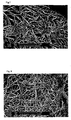
- Figures 3, 4 and 5 are cross-sectional views of slices of fibrin networks from examples 2, 3 and 4 respectively, as taken with an electron microscope (Philips XL20 Scanning Electron Microscope), with a magnification of 5,000 times, before lyophilization
- figures 6, 7 and 8 are cross-sectional views of slices of fibrin networks from examples 2, 3 and 4 respectively, as taken with an electron microscope, with a magnification of 5,000 times, after lyophilization.
- the result is that the alveoli of the fibrin network from examples 2, 3 and 4 before lyophilization are similar, that the alveoli of the fibrin network from examples 2, 3 and 4 after lyophilization are similar, and that the use of glycerol allows the size of the network fibers to be reduced.
- glycerol besides being useful to protect fibers during the lyophilization step, is an agent allowing control of the size or the diameter of the fibers of the fibrin network.
- Example 4 was repeated, except that glycerol was replaced first by glucose and then by mannitol.
- Example 1 was repeated, except for the use of a solution containing fibrinogen in the order of 10 mg/ml and thrombin in the order of 1IU/ml, 10IU/ml and 20 IU/ml respectively.
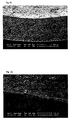
- FIGS. 9, 10, and 11 are cross sectional views of the networks obtained with a solution containing 1 IU/ml, 10 IU/ml and 20 IU/ml of thrombin respectively, with a magnification of 3,500 times.
- Example 1 was repeated, except that thrombin and fibrinogen solutions were prepared, which had a CaCl 2 concentration of 0mM/ml, 2.7mM/ml and 27 mM/ml.
- the cross section of the networks obtained with a solution containing 0mM/ml (figure 12), 2.7mM/ml (figure 13) and 27 mM/ml (figure 14) was examined with an electron microscope (Philips XL20), with a magnification of 5,000 times.
- Example 4 was repeated, except for the use of a solution containing 5% of glycerol, 20 mg/ml of fibrinogen, 500 ⁇ g of fibronectin per ml, 10 IU/ml of factor XIII, 1 IU of thrombin per ml and 40 mM (millimoles) of calcium per ml.
- Example 4 was repeated, except that the chamber vacuum was controlled to cause its intermittent variation from 600 mbar with respect to atmospheric pressure (a pressure of about 0.4 10 5 Pa) to 630 mbar with respect to atmospheric pressure (a pressure of about 0.38 10 5 Pa). This vacuum variation was found to be advantageous for fibrin and fibrinogen diffusion in the pores of the support. After washing with water, bringing the fibrin layer in contact with a water flow and creating a vacuum in the chamber varying from 600 mbar with respect to atmospheric pressure (a pressure of about 0.4 10 5 Pa) to 630 mbar with respect to atmospheric pressure (a pressure of about 0.38 10 5 Pa), the support and the fibrin layer contained no more free fibrinogen.
- the tube may be easily sterilized, if needed, before or after lyophilization, at a temperature of 121°C for 60 minutes, for example in an autoclave. Any other sterilization method may be used, provided that it does not destroy the alveoli structure of the cross-linked fibrin layer, nor the support structure.
- Example 3 was repeated, except that the fibrinogen concentration was controlled in the tube, during the diffusion step, so as to ensure a substantially constant fibrinogen concentration in the tube.
- valve 23 was intermittently opened to evacuate a certain amount of solution out of the tube and a solution containing little or no fibrinogen was fed into the tube. This ensures that the fibrin layer is substantially regular and homogeneous in thickness.
- Example 11 was repeated, except that the fibrinogen concentration was controlled substantially continuously, to decrease this concentration as fibrin is deposited on the inner wall of the tube.
- Example 3 was repeated, except that, before treating the tubes with the fibrinogen solution, demineralized water, an aqueous solution containing 1 mg/ml of albumin, an aqueous solution containing 10 mg/ml of albumin, an aqueous solution containing 30 mg/ml of albumin, were respectively fed into the tubes, so as to fill or saturate the pores with said solution, before treating the tubes with the fibrinogen solution.
- Example 3 was repeated, except that the proteins contained in the solution were 30 mg/ml of albumin and 10 mg/ml of fibronectin.
- Other proteins, such as vibronectin, etc. could be used, individually or in mixture, instead of albumin and/or fibronectin.
- the fibrin layer can be treated either to denature it or to provide it with particular properties.
- the fibrin layer may be treated with water, with one or more salts (possibly in solution), with additives used to improve the biocompatibility of the support provided with the fibrin layer.
- the additives may be selected, for example, amongst proteins, anticoagulants, anti-inflammatory compounds, compounds reducing graft rejection, living cells, cell growth inhibitors, agents stimulating endothelial cells, antibiotics, antineoplastics, genetic materials, proteins promoting or stimulating the growth and/or attachment of endothelial cells on the cross-linked fibrin layer, growth factors, growth factors for heparin bond, substances against cholesterol (ZOCOR® ), etc.
- the fibrin layer may be partially hydrolyzed, if needed, for example by means of a plasmin.
- Example 1 was repeated, except that, during a first step, solution A was fed into the tube to obtain, by creating vacuum in the chamber, a non-cross-linked fibrin or fibrinogen layer, and that, during a second step, solution B (thrombin) was fed into the tube to form fibrin monomers and to obtain a cross-linked structure.
- solution A was fed into the tube to obtain, by creating vacuum in the chamber, a non-cross-linked fibrin or fibrinogen layer
- solution B thrombin
- Example 4 was repeated, except that lyophilization was effected in several steps, i.e. by lowering temperature to -58°C, by maintaining this temperature of -58°C, by creating a vacuum (the lyophilization device had been adjusted with a pressure set-point of 7 Pa, so that the vacuum pump could operate continuously) for 1 to 5 hours, by raising temperature from -58°C to -20°C to -30°C, while maintaining the vacuum, by maintaining the temperature of -20°C to -30°C, while maintaining the vacuum, for at least 10 hours (10 to 100 hours), by increasing the temperature to more than 20°C, while maintaining the vacuum.
- steps i.e. by lowering temperature to -58°C, by maintaining this temperature of -58°C, by creating a vacuum (the lyophilization device had been adjusted with a pressure set-point of 7 Pa, so that the vacuum pump could operate continuously) for 1 to 5 hours, by raising temperature from -58°C to -20°C to -30°C, while maintaining the vacuum,
- Example 1 was repeated, except that the porous tube was successively treated with solution A and with solution B.
- the treatment steps of this example are:
- Example 16 was repeated, except that the intermediate incubation steps d, h and 1 were skipped.
- Example 1 was repeated, except that the porous tube was successively treated with solution A and with solution B.
- the treatment steps of this example are:
- Example 4 was repeated, except that the pH of the solution mixture was changed, upon its introduction, to 6, 6.5, 7, and 7.5 respectively, or except that the pH of the solution in the tube was controlled during the process to maintain it, for example, at 6.5 or 7 or 7.5.
- Example 1 was repeated, except that, instead of placing the porous tube in a vacuum chamber, the tube was placed in a container with a concentrated aqueous solution of salt (NaCl) in order to create, by reverse osmosis, a water and fibrin-fibrinogen diffusion through the wall of the tube towards said concentrated solution.
- salt NaCl
- the fibrinogen and thrombin compound of example 1 was injected by means of a syringe in a tube, to create a fibrin layer on the inner wall of the tube. This process causes fibrinogen to be present on the inner wall of the tube and in the fibrin layer in the proximity of said inner wall.
- the tube After removal of the fibrinogen solution and immersion of the tube in water (prewashing) the tube was placed in the vacuum chamber used in example 1. Then, demineralized water was fed into the tube, whereupon a vacuum was created in the chamber (pressure of 0.3 10 5 Pa), so that water is sucked through the wall of the tube from the inner wall to the outer wall. This diffusion of water through the tube wall allows the unbound fibrinogen to be removed from the fibrin layer and outside the support', so that at least the part of the tube situated in the proximity of the inner wall of the tube is free of fibrinogen.
- Example 22 was repeated, except that an aqueous solution containing 5% of glycerol was used for the washing operation by diffusion of water through the tube wall.
- Example 22 was repeated, except that an aqueous solution containing 5% of glycerol and 1% of albumin was used for the washing operation by diffusion of water through the tube wall.
- fibrin layers were prepared by using fibrinogen and thrombin from human blood. These could be replaced by products available on the market, such as biological glues by CRYOLIFE, e.g. the product FibRx, or by VITEX (the product VIGuard), or even recombinant fibrinogen.
- CRYOLIFE e.g. the product FibRx
- VITEX the product VIGuard
- membranes according to the invention for example the membranes of examples 1 to 13 may be used in several applications, namely as membranes for bioreactors, for example as described in the application EP 96910867 (published as EP 822 976), as membranes for filters, as implants such as artificial internal organs, as artificial veins, as artificial arteries, as antithrombotic materials, as cardiac valves, as artificial skins; the membrane may also be applied to the production of test kits or equipment, etc...
- a culture medium was prepared, from Dulbecco Modified Eagle Medium (DMEM). The following components, in the weight % as specified hereafter, were added to this DMEM medium:
- This medium will be hereafter termed "prepared DMEM medium”.
- the bovine aorta was recovered. After separating the adipose tissues of the aortas, the collateral arteries were ligatured. The inner surface of the aortas was treated for 15 minutes at 37°C with a solution containing 250 IU/ml of collagenase. The cells released in this treatment were recovered and placed in a DMEM culture medium containing valine D, 10% of FCS, 100 IU/ml of penicillin, 100 ⁇ g/ml of streptomycin and 2.5 ⁇ g/ml of amphotericin B. The culture medium was renewed after 24 hours.
- the culture medium was placed in a 70% DMEM culture medium, containing 20% of Ham's F 12, 10% of FCS. 100 IU/ml of penicillin, 100 ⁇ g/ml of streptomycin and 2.5 ⁇ m/ml of amphotericin B.
- the cells were recovered from the DMEM medium prepared by incubation in a trypsin-EDTA medium (5 times as concentrated) for 5 minutes at 37°C, then 10 ml of a culture medium containing 10% of FCS were added to stop the action of the enzyme.
- the number of cells in the medium was determined with the help of a microscope by counting the cells in a Bürker chamber after trypan blue marking. This method will be hereafter named microscope counting method.
- the resulting number of cells was 25,000 cells/ml for a first solution and 125,000 cells/ml for a second solution.
- FIG. 15 is top views of the fibrin layer of the dishes 1, 2, 3, and 4 after 2 hours culture, as taken with an electron microscope (Philips XL20 Scanning Electron Microscope). These figures show good cell attachment on fibrin networks in the different dishes, after two hours of culture.
- the cells are distributed on the upper surface with a regular and flat arrangement.
- the number of viable cells was determined by means of an enzymatic kit, Boehringer Mannheim WST-1 (Catalogue no. 1644807 - batch no. 14890800).
- the principle of this method is based on the cleavage of a tetrazolium salt, added to the medium, into formazan, by a mitochondrial enzyme (succinate-tetrazolium reductase). This reduction only takes place in viable cells.
- the formazan color produced by metabolically active cells is quantified by a scanning spectrophotometer (ELISA reader).
Landscapes
- Health & Medical Sciences (AREA)
- Chemical & Material Sciences (AREA)
- Animal Behavior & Ethology (AREA)
- Veterinary Medicine (AREA)
- Dermatology (AREA)
- Medicinal Chemistry (AREA)
- Oral & Maxillofacial Surgery (AREA)
- Transplantation (AREA)
- Epidemiology (AREA)
- Life Sciences & Earth Sciences (AREA)
- Public Health (AREA)
- General Health & Medical Sciences (AREA)
- Chemical Kinetics & Catalysis (AREA)
- Vascular Medicine (AREA)
- Materials For Medical Uses (AREA)
- Medicines That Contain Protein Lipid Enzymes And Other Medicines (AREA)
- Prostheses (AREA)
- Apparatus Associated With Microorganisms And Enzymes (AREA)
- Separation Using Semi-Permeable Membranes (AREA)
- Filtering Materials (AREA)
- External Artificial Organs (AREA)
- Sampling And Sample Adjustment (AREA)
- Investigating Or Analysing Biological Materials (AREA)
Claims (44)
- Elément doté d'une couche à base de fibrine ou de matériau contenant du fibrinogène, ledit élément comprenant (a) un support hydrophobe ou essentiellement hydrophobe qui comporte une partie poreuse présentant une épaisseur de 0,1 à 5 mm, et dont les pores, s'étendant sur son épaisseur, présentent un diamètre moyen de 5 à 40 µm, une face de la partie poreuse étant traitée avec un composé à base de fibrine et/ou de matériau contenant du fibrinogène, et (b) une couche à base de fibrine couvrant la surface traitée du support, dans lequel la couche de fibrine et au moins la face du support en contact avec la couche de fibrine contiennent moins de 0,5 % en poids de fibrinogène.
- Elément selon la revendication 1, caractérisé en ce que la couche de fibrine et au moins une couche de support s'étendant sur l'épaisseur de 10 µm contiennent de préférence moins de 0,1 % en poids de fibrinogène qui n'a pas réagi, par rapport au poids de la couche de fibrine.
- Elément selon la revendication 1 ou 2, caractérisé en ce que la fibrine s'étend sur l'épaisseur de la partie poreuse traitée du support, de la face traitée jusqu'à une profondeur d'au moins 2 µm, à la fois au travers des pores présentant un diamètre moyen de 10 à 20 µm et au travers des pores présentant un diamètre moyen de plus de 20 µm.
- Elément selon l'une quelconque des revendications précédentes, dans lequel la partie poreuse du support présente une porosité essentiellement homogène et uniforme sur la surface traitée, caractérisé en ce que de la fibrine s'étend de façon homogène et uniforme sur l'épaisseur de la partie poreuse du support jusqu'à une profondeur d'au moins 10 µm.
- Elément selon la revendication 2, caractérisé en ce que le support poreux contient le fibrinogène dans une couche qui est située à une distance de plus de 10 µm de la face en contact avec la couche de fibrine.
- Elément selon la revendication 5, caractérisé en ce que le fibrinogène s'étend sur l'épaisseur du support jusqu'à une profondeur d'au moins 20 µm.
- Elément selon l'une quelconque des revendications précédentes, caractérisé en ce qu'au moins la face de la couche de fibrine opposée à celle qui est en contact avec le support poreux est stabilisée.
- Elément selon la revendication 7, caractérisé en ce que la couche de fibrine est au moins partiellement réticulée, pour former un réseau d'alvéoles adjacentes.
- Elément selon l'une quelconque des revendications précédentes, caractérisé en ce que la couche est dotée de cellules et/ou de protéines, en particulier de protéines induisant des liaisons cellule-fibrine.
- Elément selon l'une quelconque des revendications précédentes, caractérisé en ce que la couche réticulée à base de fibrine qui recouvre la partie poreuse du support, lorsqu'elle est mesurée à l'état sec, est de 0,5 à 100 µm d'épaisseur, de préférence de 2,5 à 50 µm d'épaisseur, les alvéoles étant formées entre les molécules réticulées à base de fibrine ou les liaisons ou les fibres, les alvéoles présentant un volume de 5 à 25 µm2, l'épaisseur moyenne ou la hauteur des alvéoles étant de 1 à 5 µm, en particulier de 1 à 3 µm.
- Elément selon l'une quelconque des revendications précédentes, caractérisé en ce que les pores de la partie de support, recouverts par la couche de fibrine, présentent des faces internes au moins partiellement recouvertes par une protéine hydrosoluble ou essentiellement hydrosoluble.
- Elément selon la revendication 11, caractérisé en ce que la face de support opposée à la face traitée est au moins partiellement recouverte par une protéine hydrosoluble ou essentiellement hydrosoluble.
- Elément selon l'une quelconque des revendications précédentes, caractérisé en ce qu'au moins les pores de la partie poreuse du support sont recouverts par un additif hydrosoluble ou un additif organique polaire miscible.
- Elément selon la revendication 13, caractérisé en ce que le réseau de fibres de fibrine réticulé est au moins partiellement recouvert par un additif polaire hydrosoluble ou miscible et/ou contient celui-ci, de préférence un additif choisi dans le groupe comprenant le glycérol, les sucres et leurs mélanges.
- Elément selon l'une quelconque des revendications précédentes, caractérisé en ce qu'il présente une teneur en humidité de moins de 0,5 % en poids, de préférence de moins de 0,1 % en poids.
- Elément selon l'une quelconque des revendications précédentes, caractérisé en ce que la fibronectine est fixée à la couche de fibrine, la teneur en fibronectine, par rapport au poids de fibrine et de fibronectine dans la couche, étant de 0,5 à 15 %.
- Elément selon l'une quelconque des revendications précédentes, caractérisé en ce que la couche de fibrine contient du calcium de l'ordre de 1 à 100 µg, de préférence de 1 à 50 µg de calcium par cm3 du volume de la couche de fibrine.
- Elément selon la revendication 14, caractérisé en ce que le calcium se présente sous la forme de chlorure de calcium.
- Elément selon l'une quelconque des revendications précédentes, caractérisé en ce que le support présente deux couches de fibrine superposées, la couche en contact avec le support comportant des alvéoles présentant des volumes plus importants que ceux des alvéoles de la couche qui couvre la couche de fibrine en contact avec le support.
- Elément selon l'une quelconque des revendications précédentes, caractérisé en ce que le support est biocompatible et/ou biodégradable.
- Procédé de préparation d'un élément selon l'une quelconque des revendications 1 à 20, dans lequel au moins une partie poreuse d'une première face d'un support poreux est placée en contact avec une solution aqueuse contenant de la fibrine ou un matériau contenant du fibrinogène, dans lequel la face de la partie poreuse du support opposée à la première face est soumise de façon homogène et uniforme à une force d'aspiration de façon à aspirer la solution au moins partiellement, au travers de la partie poreuse, assurant ainsi le dépôt d'une couche à base de fibrine ou sur des matériaux contenant du fibrinogène, de façon homogène et uniforme, par rapport à la partie poreuse, et la diffusion d'au moins l'eau de la solution au travers de la partie poreuse du support poreux ainsi que la pénétration de fibrine ou de fibrinogène au travers du support poreux.
- Procédé selon la revendication 21, dans lequel la face du support opposée à ladite première face est soumise à une pression inférieure à 0,8 105 Pa, et dans lequel une différence de pression d'au moins 0,3 105 Pa est créée entre les deux faces de la partie poreuse.
- Procédé selon la revendication 22, caractérisé en ce que la face de support opposée à la première face est soumise à une pression inférieure à 0,5 105 Pa, de préférence inférieure ou égale à 0,4 105 Pa.
- Procédé selon la revendication 22 ou 23, caractérisé en ce que la face de support opposée à la première face est soumise de manière intermittente à une première pression, inférieure à 0,8 105 Pa, de préférence inférieure à 0,4 105 Pa et à une seconde pression inférieure à 0,8 105 Pa, de préférence inférieure à 0,4 105 Pa, la première pression étant au moins supérieure de 5 % à la seconde pression.
- Procédé selon l'une quelconque des revendications 22 à 24, dans lequel la face du support poreux opposée à la première face est soumise à une pression inférieure à 0,8 105 Pa, et est exposée à une température de 0 à 100° C, de préférence à une température de 15 à 60° C.
- Procédé selon la revendication 21, dans lequel la face du support poreux opposée à la première face est soumise à une solution choisie de façon à créer une osmose inverse, entraînant la diffusion d'au moins l'eau de la solution en contact avec la première face au travers de la partie poreuse du support.
- Procédé selon l'une quelconque des revendications 21 à 26, caractérisée en ce que l'on utilise une solution contenant 5 à 20 mg/ml de matériaux contenant du fibrinogène.
- Procédé selon la revendication 27, caractérisé en ce que l'on utilise une solution contenant 5 à 20 mg/ml de matériaux contenant du fibrinogène et 0,01 à 10 unités de thrombine par ml.
- Procédé selon la revendication 28, caractérisé en ce que l'on utilise une solution contenant 5 à 20 mg/ml de matériaux contenant du fibrinogène, le facteur XIII et 0,01 à 2 unités de thrombine par ml.
- Procédé selon la revendication 29, caractérisé en ce que l'on utilise une solution contenant 0,1 à 10 unités de facteur XIII par ml.
- Procédé selon l'une quelconque des revendications 27 à 30, caractérisé en ce que la solution contient 1 à 40 millimoles de chlorure de calcium par ml.
- Procédé selon l'une quelconque des revendications 27 à 31, caractérisé en ce que la solution contient 0 à 20 % en poids, de manière avantageuse, de 3 à 15 %, de préférence de 5 à 10 % d'additif inorganique polaire hydrosoluble ou miscible.
- Procédé selon la revendication 32, caractérisé en ce que l'additif est le glycérol.
- Procédé selon l'une quelconque des revendications 21 à 33, caractérisé en ce que, pendant la première étape, au moins une partie d'une première face d'un support poreux est placée en contact avec une solution contenant de la fibrine et/ou des matériaux contenant du fibrinogène, dans lequel la face du support poreux opposée à la première face est soumise à une force d'aspiration, assurant ainsi une diffusion d'au moins l'eau de la solution, au travers de l'épaisseur du support poreux et une pénétration de fibrine ou de fibrinogène sur l'épaisseur du support poreux, de façon homogène et uniforme, par rapport à la partie poreuse de la première face et en ce que, pendant une deuxième étape, la couche de fibrine et/ou de fibrinogène est stabilisée.
- Procédé selon l'une quelconque des revendications 21 à 34, caractérisé en ce qu'un contact est assuré entre la partie de la première face et une solution aqueuse se déplaçant.
- Procédé selon l'une quelconque des revendications 21 à 35, caractérisé en ce que l'on utilise une solution aqueuse contenant un agent mouillant pour remplir les pores du support poreux avant de placer le support en contact avec la solution contenant la fibrine ou les matériaux contenant le fibrinogène.
- Procédé selon l'une quelconque des revendications 21 à 36, caractérisé en ce que la couche de fibrine est soumise à une étape de séchage, éventuellement précédée d'une étape de lavage.
- Procédé selon la revendication 37, caractérisé en ce que cette opération de séchage est effectuée au moins partiellement par lyophilisation, de manière avantageuse à une température de -30° c et -100° C, de préférence à une température de -40° C à -70° C.
- Procédé selon l'une quelconque des revendications 28 à 38, caractérisée en ce qu'au moins pour une partie du dépôt de la couche à base de fibrine ou des matériaux contenant le fibrinogène, la concentration de fibrine ou de matériaux contenant le fibrinogène dans la solution en contact avec la première face est contrôlée de façon à assurer une diffusion d'eau essentiellement constante au travers du support.
- Procédé selon l'une quelconque des revendications 21 à 39, caractérisé en ce que l'on utilise un support poreux biocompatible et/ou biodégradable.
- Procédé selon l'une quelconque des revendications 21 à 40, caractérisé en ce que la partie poreuse est traitée avec une solution aqueuse qui contient avantageusement un agent mouillant, une protéine ou un additif polaire organique, ou un mélange de ceux-ci, avant de mettre la solution contenant la fibrine et/ou les matériaux contenant le fibrinogène en contact avec la partie poreuse.
- Filtre comprenant une membrane constituée d'un élément selon l'une quelconque des revendications 1 à 20.
- Bioréacteur comprenant une membrane constituée d'un élément selon l'une quelconque des revendications 1 à 20.
- Implant constitué d'un élément selon l'une quelconque des revendications 1 à 20.
Applications Claiming Priority (3)
| Application Number | Priority Date | Filing Date | Title |
|---|---|---|---|
| BE9800796 | 1998-11-04 | ||
| BE9800796A BE1012536A3 (fr) | 1998-11-04 | 1998-11-04 | Element muni d'une couche de fibrine sa preparation et son utilisation. |
| PCT/US1999/025955 WO2000025838A1 (fr) | 1998-11-04 | 1999-11-04 | Element pourvu d'une couche de fibrine, sa preparation et son utilisation |
Publications (2)
| Publication Number | Publication Date |
|---|---|
| EP1124591A1 EP1124591A1 (fr) | 2001-08-22 |
| EP1124591B1 true EP1124591B1 (fr) | 2006-07-26 |
Family
ID=3891506
Family Applications (1)
| Application Number | Title | Priority Date | Filing Date |
|---|---|---|---|
| EP99971333A Expired - Lifetime EP1124591B1 (fr) | 1998-11-04 | 1999-11-04 | Element pourvu d'une couche de fibrine, sa preparation et son utilisation |
Country Status (9)
| Country | Link |
|---|---|
| US (1) | US7226657B1 (fr) |
| EP (1) | EP1124591B1 (fr) |
| JP (2) | JP4713740B2 (fr) |
| AT (1) | ATE333904T1 (fr) |
| AU (1) | AU763443B2 (fr) |
| BE (1) | BE1012536A3 (fr) |
| CA (1) | CA2348904C (fr) |
| DE (2) | DE1124591T1 (fr) |
| WO (1) | WO2000025838A1 (fr) |
Cited By (15)
| Publication number | Priority date | Publication date | Assignee | Title |
|---|---|---|---|---|
| US10856984B2 (en) | 2017-08-25 | 2020-12-08 | Neovasc Tiara Inc. | Sequentially deployed transcatheter mitral valve prosthesis |
| US10940001B2 (en) | 2012-05-30 | 2021-03-09 | Neovasc Tiara Inc. | Methods and apparatus for loading a prosthesis onto a delivery system |
| US11311376B2 (en) | 2019-06-20 | 2022-04-26 | Neovase Tiara Inc. | Low profile prosthetic mitral valve |
| US11357622B2 (en) | 2016-01-29 | 2022-06-14 | Neovase Tiara Inc. | Prosthetic valve for avoiding obstruction of outflow |
| US11389291B2 (en) | 2013-04-04 | 2022-07-19 | Neovase Tiara Inc. | Methods and apparatus for delivering a prosthetic valve to a beating heart |
| US11413139B2 (en) | 2011-11-23 | 2022-08-16 | Neovasc Tiara Inc. | Sequentially deployed transcatheter mitral valve prosthesis |
| US11419720B2 (en) | 2010-05-05 | 2022-08-23 | Neovasc Tiara Inc. | Transcatheter mitral valve prosthesis |
| US11464631B2 (en) | 2016-11-21 | 2022-10-11 | Neovasc Tiara Inc. | Methods and systems for rapid retraction of a transcatheter heart valve delivery system |
| US11491006B2 (en) | 2019-04-10 | 2022-11-08 | Neovasc Tiara Inc. | Prosthetic valve with natural blood flow |
| US11497602B2 (en) | 2012-02-14 | 2022-11-15 | Neovasc Tiara Inc. | Methods and apparatus for engaging a valve prosthesis with tissue |
| US11602429B2 (en) | 2019-04-01 | 2023-03-14 | Neovasc Tiara Inc. | Controllably deployable prosthetic valve |
| US11737872B2 (en) | 2018-11-08 | 2023-08-29 | Neovasc Tiara Inc. | Ventricular deployment of a transcatheter mitral valve prosthesis |
| US11779742B2 (en) | 2019-05-20 | 2023-10-10 | Neovasc Tiara Inc. | Introducer with hemostasis mechanism |
| US11998447B2 (en) | 2019-03-08 | 2024-06-04 | Neovasc Tiara Inc. | Retrievable prosthesis delivery system |
| US12109111B2 (en) | 2015-12-15 | 2024-10-08 | Neovasc Tiara Inc. | Transseptal delivery system |
Families Citing this family (17)
| Publication number | Priority date | Publication date | Assignee | Title |
|---|---|---|---|---|
| US20020131933A1 (en) * | 1996-01-16 | 2002-09-19 | Yves Delmotte | Biopolymer membrane and methods for its preparation |
| BE1012536A3 (fr) | 1998-11-04 | 2000-12-05 | Baxter Int | Element muni d'une couche de fibrine sa preparation et son utilisation. |
| US7144729B2 (en) * | 2000-09-01 | 2006-12-05 | Dfb Pharmaceuticals, Inc. | Methods and compositions for tissue regeneration |
| IL144446A0 (en) * | 2001-07-19 | 2002-05-23 | Prochon Biotech Ltd | Plasma protein matrices and methods for their preparation |
| DE10204405A1 (de) * | 2002-02-04 | 2003-08-21 | Surface Care Gmbh | Plasmagel |
| US20040126881A1 (en) * | 2002-09-06 | 2004-07-01 | Vincent Ronfard | Fibrin cell supports and methods of use thereof |
| FR2847819B1 (fr) * | 2002-12-03 | 2006-05-19 | Univ Cergy Pontoise | Procede de preparation d'un materiau conducteur a activite fibrinolytique implantable dans l'organisme |
| KR101001117B1 (ko) * | 2003-09-19 | 2010-12-14 | 각고호우징 게이오기주크 | 세포시트를 제작하기 위한 지지체를 코팅하기 위한 조성물,세포시트 제작용 지지체 및 세포시트의 제조방법 |
| CA2616865C (fr) * | 2005-07-28 | 2014-07-08 | Carnegie Mellon University | Polymeres biocompatibles et procedes d'utilisation |
| EP2441477B1 (fr) * | 2009-06-11 | 2019-02-13 | KM Biologics Co., Ltd. | Matériau de recouvrement d'une plaie |
| WO2013066841A1 (fr) * | 2011-10-31 | 2013-05-10 | Ut-Battelle Llc | Membranes nanoporeuses inorganiques pour un prétraitement à haute température d'une biomasse lignocellulosique |
| US9932648B2 (en) | 2011-10-31 | 2018-04-03 | Ut-Battelle, Llc | Flow-through pretreatment of lignocellulosic biomass with inorganic nanoporous membranes |
| US8999376B2 (en) | 2012-02-03 | 2015-04-07 | Xcede Technologies, Inc. | Tissue patch |
| US10772767B2 (en) | 2013-06-28 | 2020-09-15 | 3M Innovative Properties Company | Fibrin-coated wound dressing |
| US10588998B2 (en) | 2015-08-07 | 2020-03-17 | Xcede Technologies, Inc. | Adhesive compositions and related methods |
| US9833538B2 (en) | 2015-08-07 | 2017-12-05 | Xcede Technologies, Inc. | Adhesive compositions and related methods |
| US9540548B1 (en) | 2015-08-07 | 2017-01-10 | Xcede Technologies, Inc. | Adhesive compositions and related methods |
Family Cites Families (116)
| Publication number | Priority date | Publication date | Assignee | Title |
|---|---|---|---|---|
| US2533004A (en) | 1943-10-27 | 1950-12-05 | John D Ferry | Fibrin clots and methods for preparing the same |
| US2576006A (en) | 1947-11-29 | 1951-11-20 | Research Corp | Methods of forming shaped fibrin products |
| US3523807A (en) | 1966-11-25 | 1970-08-11 | Mihaly Gerendas | Method of making a cross-linked fibrin prosthesis |
| US3641240A (en) | 1968-09-27 | 1972-02-08 | Wyandotte Chemicals Corp | Method for the treatment of an embolus or thrombus |
| US3723244A (en) | 1971-01-18 | 1973-03-27 | Atomic Energy Commission | Fibrous fibrin sheet and method for producing same |
| SE452109B (sv) | 1973-01-29 | 1987-11-16 | Pharmacia Ab | Rengoringsmedel for vetskande utvertes sarytor |
| US4537767A (en) | 1973-01-29 | 1985-08-27 | Pharmacia Aktiebolag | Method for cleansing fluid discharging skin surfaces, wounds and mucous membranes and means for carrying out the method |
| US4016877A (en) | 1976-02-23 | 1977-04-12 | Avicon, Inc. | Fibrous collagen derived web having hemostatic and wound sealing properties |
| US4148664A (en) | 1976-05-10 | 1979-04-10 | Avicon, Inc. | Preparation of fibrous collagen product having hemostatic and wound sealing properties |
| US4066083A (en) | 1976-06-03 | 1978-01-03 | Pentapharm A.G. | Sterile surgical collagen product |
| US4116898A (en) | 1977-01-31 | 1978-09-26 | Becton, Dickinson And Company | Non-thrombogenic articles |
| US4238480A (en) | 1978-05-19 | 1980-12-09 | Sawyer Philip Nicholas | Method for preparing an improved hemostatic agent and method of employing the same |
| AT359652B (de) | 1979-02-15 | 1980-11-25 | Immuno Ag | Verfahren zur herstellung eines gewebekleb- stoffes |
| US4675361A (en) | 1980-02-29 | 1987-06-23 | Thoratec Laboratories Corp. | Polymer systems suitable for blood-contacting surfaces of a biomedical device, and methods for forming |
| AT366916B (de) | 1980-04-02 | 1982-05-25 | Immuno Ag | Vorrichtung zur applikation eines gewebeklebstoffes auf basis von menschlichen oder tierischenproteinen |
| US4442655A (en) | 1981-06-25 | 1984-04-17 | Serapharm Michael Stroetmann | Fibrinogen-containing dry preparation, manufacture and use thereof |
| EP0068149A3 (fr) | 1981-06-25 | 1983-07-20 | Serapharm GmbH & Co. KG | Préparation sêche contenant du fibrinogène, son obtention et utilisation |
| SE430218B (sv) | 1981-12-30 | 1983-10-31 | Blombaeck E G B | Filter och sett att framstella ett sadant |
| DE3280147D1 (de) | 1981-12-30 | 1990-05-17 | New York Blood Center Inc | Groessenspezifischer katalysator enthaltend fibrin-gel. |
| US4578067A (en) | 1982-04-12 | 1986-03-25 | Alcon (Puerto Rico) Inc. | Hemostatic-adhesive, collagen dressing for severed biological surfaces |
| DE3214337C2 (de) | 1982-04-19 | 1984-04-26 | Serapharm - Michael Stroetmann, 4400 Münster | Resorbierbares Flachmaterial zum Abdichten und Heilen von Wunden und Verfahren zu dessen Herstellung |
| JPS58180162A (ja) | 1982-04-19 | 1983-10-21 | 株式会社高研 | 抗血栓性医用材料 |
| DE3234084A1 (de) | 1982-09-14 | 1984-03-15 | B. Braun Melsungen Ag, 3508 Melsungen | Pharmazeutische zubereitungen zur behandlung von unerwuenschten verwachsungen sowie deren verwendung |
| DE3248188A1 (de) | 1982-12-27 | 1984-06-28 | Behringwerke Ag, 3550 Marburg | Verfahren zur herstellung eines kollagen-vlieses |
| US4548736A (en) * | 1983-08-29 | 1985-10-22 | Wisconsin Alumni Research Foundation | Preparation of protein films |
| US4837285A (en) | 1984-03-27 | 1989-06-06 | Medimatrix | Collagen matrix beads for soft tissue repair |
| AT379311B (de) | 1984-03-29 | 1985-12-27 | Immuno Ag | Vorrichtung zur applikation eines gewebeklebstoffes |
| EP0166263A1 (fr) | 1984-05-31 | 1986-01-02 | Green Cross Corporation | Composition de remplissage pour défaut ou partie creuse dans un os, "kit" ou "set" pour la préparation de cette composition |
| US4600533A (en) | 1984-12-24 | 1986-07-15 | Collagen Corporation | Collagen membranes for medical use |
| US5223420A (en) | 1985-03-01 | 1993-06-29 | Institut National De La Sante Et De La Recherche Medicale | Elastin-based product, a procedure for its preparation and its biological applications; in particular as biomaterials and artificial supports |
| WO1986007541A1 (fr) | 1985-06-19 | 1986-12-31 | Yasushi Zyo | Composition susceptible d'avoir une activite anti-thrombotique et appareil medical devant etre en contact avec le sang |
| US4690684A (en) | 1985-07-12 | 1987-09-01 | C. R. Bard, Inc. | Meltable stent for anastomosis |
| JPS6229532A (ja) | 1985-07-31 | 1987-02-07 | Koken:Kk | 抗血栓性医用材料及びその製造方法 |
| US5002551A (en) | 1985-08-22 | 1991-03-26 | Johnson & Johnson Medical, Inc. | Method and material for prevention of surgical adhesions |
| US5049393A (en) | 1986-01-07 | 1991-09-17 | Baylor College Of Medicine | Anti-thrombogenic elastomer and objects and prostheses made therefrom |
| US4720512A (en) | 1986-03-24 | 1988-01-19 | Becton, Dickinson And Company | Polymeric articles having enhanced antithrombogenic activity |
| US4786556A (en) | 1986-03-24 | 1988-11-22 | Becton, Dickinson And Company | Polymeric articles having enhanced antithrombogenic activity |
| US4760131A (en) | 1986-04-23 | 1988-07-26 | Collagen Corporation | Wound-healing composition |
| US4840626A (en) | 1986-09-29 | 1989-06-20 | Johnson & Johnson Patient Care, Inc. | Heparin-containing adhesion prevention barrier and process |
| DE3722904A1 (de) | 1987-01-09 | 1988-07-21 | Harald Maslanka | Injektionseinrichtung mit doppelkanuele fuer ein endoskop |
| US5080893A (en) | 1988-05-31 | 1992-01-14 | University Of Florida | Method for preventing surgical adhesions using a dilute solution of polymer |
| US5244799A (en) | 1987-05-20 | 1993-09-14 | Anderson David M | Preparation of a polymeric hydrogel containing micropores and macropores for use as a cell culture substrate |
| US4882148A (en) | 1987-06-18 | 1989-11-21 | Corvita Corporation | Crack prevention and improved thrombogenicity of implanted prostheses by sulfonation |
| ES2045124T3 (es) | 1987-07-14 | 1994-01-16 | Sankyo Co | Un proceso para la preparacion de una composicion antitrombotica. |
| US5260420A (en) | 1987-07-30 | 1993-11-09 | Centre Regional De Transfusion Sanguine De Lille | Concentrate of thrombin coagulable proteins, the method of obtaining same and therapeutical use thereof |
| US4937270A (en) | 1987-09-18 | 1990-06-26 | Genzyme Corporation | Water insoluble derivatives of hyaluronic acid |
| US4978336A (en) | 1987-09-29 | 1990-12-18 | Hemaedics, Inc. | Biological syringe system |
| US5364622A (en) | 1987-12-04 | 1994-11-15 | Dr. Karl Thomae Gmbh | Methods for preventing adhesions to organs and parts of organs by application of tissue plasminogen activator and hydroxyethylcellulose hydrogel |
| US5201745A (en) | 1988-03-15 | 1993-04-13 | Imedex | Visceral surgery patch |
| US5290552A (en) * | 1988-05-02 | 1994-03-01 | Matrix Pharmaceutical, Inc./Project Hear | Surgical adhesive material |
| US5140016A (en) | 1988-05-31 | 1992-08-18 | University Of Florida | Method and composition for preventing surgical adhesions using a dilute solution of polymer |
| AT397203B (de) | 1988-05-31 | 1994-02-25 | Immuno Ag | Gewebeklebstoff |
| US5182317A (en) | 1988-06-08 | 1993-01-26 | Cardiopulmonics, Inc. | Multifunctional thrombo-resistant coatings and methods of manufacture |
| US4874368A (en) | 1988-07-25 | 1989-10-17 | Micromedics, Inc. | Fibrin glue delivery system |
| US4948540A (en) | 1988-08-01 | 1990-08-14 | Semex Medical, Inc. | Method of preparing collagen dressing sheet material |
| US5019393A (en) | 1988-08-03 | 1991-05-28 | New England Deaconess Hospital Corporation | Biocompatible substance with thromboresistance |
| US5126140A (en) | 1988-08-03 | 1992-06-30 | New England Deaconess Hospital Corporation | Thrombomodulin-coated bicompatible substance |
| US5167960A (en) | 1988-08-03 | 1992-12-01 | New England Deaconess Hospital Corporation | Hirudin-coated biocompatible substance |
| US5112615A (en) | 1988-08-03 | 1992-05-12 | New England Deaconess Hospital Corporation | Soluble hirudin conjugates |
| US5213580A (en) | 1988-08-24 | 1993-05-25 | Endoluminal Therapeutics, Inc. | Biodegradable polymeric endoluminal sealing process |
| US5053048A (en) | 1988-09-22 | 1991-10-01 | Cordis Corporation | Thromboresistant coating |
| DE68923423T2 (de) * | 1988-10-28 | 1996-01-25 | Terumo Corp | Antithromotisches medizinisches Material, künstliches inneres Organ und Verfahren zur Herstellung eines antithrombotischen medizinischen Materials. |
| JP2537091B2 (ja) * | 1989-05-22 | 1996-09-25 | テルモ株式会社 | 抗血栓性医用材料および人工血管の製造方法 |
| JPH0638852B2 (ja) * | 1988-10-28 | 1994-05-25 | テルモ株式会社 | 抗血栓性材料及びその製法 |
| US4911926A (en) | 1988-11-16 | 1990-03-27 | Mediventures Inc. | Method and composition for reducing postsurgical adhesions |
| ZA899326B (en) | 1988-12-07 | 1991-08-28 | Johnson & Johnson Patient Care | Low molecular weight heparin,heparinoid and hexuronyl hexosaminoglycan sulfate containing adhesion prevention barrier and process |
| DE3841397A1 (de) | 1988-12-08 | 1990-06-21 | Melzer Wolfgang | Poroeser resorbierbarer arzneistofftraeger |
| WO1991001711A1 (fr) | 1989-08-10 | 1991-02-21 | W.L. Gore & Associates, Inc. | Systeme de distribution medicale de composants adhesifs tissulaires |
| US5525348A (en) | 1989-11-02 | 1996-06-11 | Sts Biopolymers, Inc. | Coating compositions comprising pharmaceutical agents |
| US5318524A (en) | 1990-01-03 | 1994-06-07 | Cryolife, Inc. | Fibrin sealant delivery kit |
| AU7998091A (en) | 1990-05-17 | 1991-12-10 | Harbor Medical Devices, Inc. | Medical device polymer |
| FR2663226B1 (fr) | 1990-06-15 | 1994-11-18 | Fondation Nale Transfusion San | Colle biologique fluide. |
| US5455040A (en) | 1990-07-26 | 1995-10-03 | Case Western Reserve University | Anticoagulant plasma polymer-modified substrate |
| US5209776A (en) | 1990-07-27 | 1993-05-11 | The Trustees Of Columbia University In The City Of New York | Tissue bonding and sealing composition and method of using the same |
| US5292362A (en) | 1990-07-27 | 1994-03-08 | The Trustees Of Columbia University In The City Of New York | Tissue bonding and sealing composition and method of using the same |
| US5071644A (en) | 1990-08-07 | 1991-12-10 | Mediventures, Inc. | Topical drug delivery with thermo-irreversible gels |
| US5173295A (en) | 1990-10-05 | 1992-12-22 | Advance Biofactures Of Curacao, N.V. | Method of enhancing the regeneration of injured nerves and adhesive pharamaceutical formulation therefor |
| WO1992007525A1 (fr) * | 1990-10-31 | 1992-05-14 | Baxter International Inc. | Matiere d'implant pour vascularisation proche |
| US5486357A (en) | 1990-11-08 | 1996-01-23 | Cordis Corporation | Radiofrequency plasma biocompatibility treatment of inside surfaces |
| AU8702491A (en) | 1990-11-08 | 1992-05-14 | Matrix Pharmaceutical, Inc. | Fibrin/collagen membrane material for biomedical use |
| DE69228957T2 (de) | 1991-01-16 | 1999-10-07 | Toyo Boseki K.K., Osaka | Blutverträgliches Material |
| US5156613A (en) | 1991-02-13 | 1992-10-20 | Interface Biomedical Laboratories Corp. | Collagen welding rod material for use in tissue welding |
| US5242792A (en) * | 1991-02-25 | 1993-09-07 | The United States Of America As Represented By The Secretary Of The Navy | Method for the preservation of red blood cells by lyophilization using glycerol or inositol with disaccharides |
| CH681693A5 (fr) | 1991-02-28 | 1993-05-14 | Pentapharm Ag | |
| EP0588895B1 (fr) | 1991-05-31 | 1995-01-11 | Baxter International Inc. | Revetement thromboresistant antimousse |
| JPH06500802A (ja) | 1991-06-14 | 1994-01-27 | アムジエン・インコーポレーテツド | コラーゲンフィルムによるタンパクのドラッグ・デリバリー |
| SE9101853D0 (sv) | 1991-06-17 | 1991-06-17 | Jonas Wadstroem | Improved tissue ashesive |
| FR2679778B1 (fr) | 1991-08-02 | 1995-07-07 | Coletica | Utilisation de collagene reticule par un agent de reticulation pour la fabrication d'une membrane suturable, biocompatible, a resorption lente, ainsi qu'une telle membrane. |
| EP0534178B1 (fr) | 1991-09-27 | 2001-04-18 | Omrix Biopharmaceuticals S.A. | Colle améliorée pour tissus préparée à partir de cryoprécipité |
| US5368563A (en) | 1991-12-18 | 1994-11-29 | Micromedics, Inc. | Sprayer assembly for physiologic glue |
| US5376376A (en) | 1992-01-13 | 1994-12-27 | Li; Shu-Tung | Resorbable vascular wound dressings |
| GB9206509D0 (en) | 1992-03-25 | 1992-05-06 | Jevco Ltd | Heteromorphic sponges containing active agents |
| US5272074A (en) | 1992-04-23 | 1993-12-21 | Mcmaster University | Fibrin coated polymer surfaces |
| US5376692A (en) | 1992-05-15 | 1994-12-27 | Purdue Research Foundation | Method of binding using irradiation and product with albumin bound to biomaterials |
| FR2692582B1 (fr) | 1992-06-18 | 1998-09-18 | Flamel Tech Sa | Nouveaux derives reticulables de collagene, leur procede d'obtention et leur application a la preparation de biomateriaux. |
| KR950702434A (ko) | 1992-07-18 | 1995-07-29 | 로버트 타웁 | 시험관내 수정을 향상시켜주는 2성분 피브린-글루 조성물(a two component fibrin-glue composition for improving in vitro fertilization) |
| CN1091315A (zh) | 1992-10-08 | 1994-08-31 | E·R·斯奎布父子公司 | 血纤维蛋白封闭剂组合物及其使用方法 |
| US5278200A (en) | 1992-10-30 | 1994-01-11 | Medtronic, Inc. | Thromboresistant material and articles |
| US5397816A (en) | 1992-11-17 | 1995-03-14 | Ethicon, Inc. | Reinforced absorbable polymers |
| DE4304716A1 (de) | 1993-02-16 | 1994-08-18 | Melzer Wolfgang | Lokal applizierbares Arzneimittel mit verzögerter Freisetzung |
| US5395923A (en) | 1993-02-23 | 1995-03-07 | Haemacure-Biotech, Inc. | Process for the obtention of a biological adhesive made of concentrated coagulation factors by "salting-out" |
| DE69422165T2 (de) | 1993-03-30 | 2001-10-04 | Omrix Biopharmaceuticals S.A., Bruessel/Bruxelles | Zweikomponenten-fibrinkleber |
| WO1995025547A1 (fr) * | 1994-03-24 | 1995-09-28 | University Of Washington | Dispositif et methodes d'implantation de cellules ayant subi une transduction |
| US5660873A (en) * | 1994-09-09 | 1997-08-26 | Bioseal, Limited Liability Corporaton | Coating intraluminal stents |
| US5578073A (en) | 1994-09-16 | 1996-11-26 | Ramot Of Tel Aviv University | Thromboresistant surface treatment for biomaterials |
| US5605541A (en) | 1994-12-07 | 1997-02-25 | E. R. Squibb And Sons, Inc. | Fibrin sealant applicatoor |
| EP0804257B1 (fr) * | 1995-01-16 | 2003-07-09 | Baxter International Inc. | Materiau du type feuille autonome compose de fibrine reticulee, destine a prevenir les adherences postoperatoires |
| US5580923A (en) | 1995-03-14 | 1996-12-03 | Collagen Corporation | Anti-adhesion films and compositions for medical use |
| US6262255B1 (en) | 1995-04-05 | 2001-07-17 | Biomm, Inc. | Non-immunogenic, biocompatible macromolecular membrane compositions, and methods for making them |
| WO1996037165A1 (fr) * | 1995-05-26 | 1996-11-28 | Bsi Corporation | Article implantable et procede facilitant l'endothelialisation |
| WO1996039212A2 (fr) | 1995-06-06 | 1996-12-12 | Quantic Biomedical Partners | Dispositif et procede pour preparer et appliquer une composition pour proteger les blessures |
| US5824080A (en) * | 1995-09-28 | 1998-10-20 | The General Hospital Corporation | Photochemistry for the preparation of biologic grafts--allografts and xenografts |
| US6162241A (en) | 1997-08-06 | 2000-12-19 | Focal, Inc. | Hemostatic tissue sealants |
| AU1829599A (en) | 1997-12-15 | 1999-07-05 | Presidents and Fellows of Harvard College, The | Bacterial fibrin-dependent plasminogen activator |
| US6056970A (en) | 1998-05-07 | 2000-05-02 | Genzyme Corporation | Compositions comprising hemostatic compounds and bioabsorbable polymers |
| BE1012536A3 (fr) | 1998-11-04 | 2000-12-05 | Baxter Int | Element muni d'une couche de fibrine sa preparation et son utilisation. |
-
1998
- 1998-11-04 BE BE9800796A patent/BE1012536A3/fr active
-
1999
- 1999-11-04 JP JP2000579275A patent/JP4713740B2/ja not_active Expired - Fee Related
- 1999-11-04 AT AT99971333T patent/ATE333904T1/de active
- 1999-11-04 EP EP99971333A patent/EP1124591B1/fr not_active Expired - Lifetime
- 1999-11-04 DE DE1124591T patent/DE1124591T1/de active Pending
- 1999-11-04 WO PCT/US1999/025955 patent/WO2000025838A1/fr not_active Ceased
- 1999-11-04 AU AU14671/00A patent/AU763443B2/en not_active Ceased
- 1999-11-04 US US09/831,121 patent/US7226657B1/en not_active Expired - Fee Related
- 1999-11-04 DE DE69932528T patent/DE69932528T2/de not_active Expired - Lifetime
- 1999-11-04 CA CA2348904A patent/CA2348904C/fr not_active Expired - Fee Related
-
2010
- 2010-06-25 JP JP2010145687A patent/JP2010269154A/ja not_active Withdrawn
Cited By (25)
| Publication number | Priority date | Publication date | Assignee | Title |
|---|---|---|---|---|
| US12611303B2 (en) | 2010-05-05 | 2026-04-28 | Neovasc Tiara Inc. | Transcatheter mitral valve prosthesis |
| US11419720B2 (en) | 2010-05-05 | 2022-08-23 | Neovasc Tiara Inc. | Transcatheter mitral valve prosthesis |
| US11413139B2 (en) | 2011-11-23 | 2022-08-16 | Neovasc Tiara Inc. | Sequentially deployed transcatheter mitral valve prosthesis |
| US12053369B2 (en) | 2011-11-23 | 2024-08-06 | Neovasc Tiara Inc. | Sequentially deployed transcatheter mitral valve prosthesis |
| US12138159B2 (en) | 2012-02-14 | 2024-11-12 | Neovasc Tiara Inc. | Methods and apparatus for engaging a valve prosthesis with tissue |
| US11497602B2 (en) | 2012-02-14 | 2022-11-15 | Neovasc Tiara Inc. | Methods and apparatus for engaging a valve prosthesis with tissue |
| US11617650B2 (en) | 2012-05-30 | 2023-04-04 | Neovasc Tiara Inc. | Methods and apparatus for loading a prosthesis onto a delivery system |
| US10940001B2 (en) | 2012-05-30 | 2021-03-09 | Neovasc Tiara Inc. | Methods and apparatus for loading a prosthesis onto a delivery system |
| US11389294B2 (en) | 2012-05-30 | 2022-07-19 | Neovasc Tiara Inc. | Methods and apparatus for loading a prosthesis onto a delivery system |
| US11389291B2 (en) | 2013-04-04 | 2022-07-19 | Neovase Tiara Inc. | Methods and apparatus for delivering a prosthetic valve to a beating heart |
| US12109111B2 (en) | 2015-12-15 | 2024-10-08 | Neovasc Tiara Inc. | Transseptal delivery system |
| US12193932B2 (en) | 2016-01-29 | 2025-01-14 | Neovasc Tiara Inc. | Prosthetic valve for avoiding obstruction of outflow |
| US11357622B2 (en) | 2016-01-29 | 2022-06-14 | Neovase Tiara Inc. | Prosthetic valve for avoiding obstruction of outflow |
| US11464631B2 (en) | 2016-11-21 | 2022-10-11 | Neovasc Tiara Inc. | Methods and systems for rapid retraction of a transcatheter heart valve delivery system |
| US12201524B2 (en) | 2016-11-21 | 2025-01-21 | Neovasc Tiara Inc. | Methods and systems for rapid retraction of a transcatheter heart valve delivery system |
| US11793640B2 (en) | 2017-08-25 | 2023-10-24 | Neovasc Tiara Inc. | Sequentially deployed transcatheter mitral valve prosthesis |
| US10856984B2 (en) | 2017-08-25 | 2020-12-08 | Neovasc Tiara Inc. | Sequentially deployed transcatheter mitral valve prosthesis |
| US11737872B2 (en) | 2018-11-08 | 2023-08-29 | Neovasc Tiara Inc. | Ventricular deployment of a transcatheter mitral valve prosthesis |
| US11998447B2 (en) | 2019-03-08 | 2024-06-04 | Neovasc Tiara Inc. | Retrievable prosthesis delivery system |
| US11602429B2 (en) | 2019-04-01 | 2023-03-14 | Neovasc Tiara Inc. | Controllably deployable prosthetic valve |
| US12036117B2 (en) | 2019-04-10 | 2024-07-16 | Neovasc Tiara Inc. | Prosthetic valve with natural blood flow |
| US11491006B2 (en) | 2019-04-10 | 2022-11-08 | Neovasc Tiara Inc. | Prosthetic valve with natural blood flow |
| US11779742B2 (en) | 2019-05-20 | 2023-10-10 | Neovasc Tiara Inc. | Introducer with hemostasis mechanism |
| US11931254B2 (en) | 2019-06-20 | 2024-03-19 | Neovasc Tiara Inc. | Low profile prosthetic mitral valve |
| US11311376B2 (en) | 2019-06-20 | 2022-04-26 | Neovase Tiara Inc. | Low profile prosthetic mitral valve |
Also Published As
| Publication number | Publication date |
|---|---|
| ATE333904T1 (de) | 2006-08-15 |
| CA2348904A1 (fr) | 2000-05-11 |
| JP2010269154A (ja) | 2010-12-02 |
| AU763443B2 (en) | 2003-07-24 |
| DE69932528D1 (de) | 2006-09-07 |
| JP2002528233A (ja) | 2002-09-03 |
| WO2000025838A1 (fr) | 2000-05-11 |
| CA2348904C (fr) | 2011-03-22 |
| EP1124591A1 (fr) | 2001-08-22 |
| AU1467100A (en) | 2000-05-22 |
| HK1035872A1 (en) | 2001-12-14 |
| DE1124591T1 (de) | 2002-02-07 |
| WO2000025838A9 (fr) | 2000-11-02 |
| DE69932528T2 (de) | 2007-02-08 |
| JP4713740B2 (ja) | 2011-06-29 |
| BE1012536A3 (fr) | 2000-12-05 |
| US7226657B1 (en) | 2007-06-05 |
Similar Documents
| Publication | Publication Date | Title |
|---|---|---|
| CA2348904C (fr) | Element pourvu d'une couche de fibrine, sa preparation et son utilisation | |
| EP1259269B1 (fr) | Agent de traitement de plaies | |
| AU732726B2 (en) | Biomaterial derived from vertebrate liver tissue | |
| JP3646162B2 (ja) | 軟骨組織の再生用移植体 | |
| US7776596B2 (en) | Vascularization enhanced graft constructs | |
| EP2182887B1 (fr) | Procédé pour améliorer la différenciation des cellules souches mésenchymales à l'aide d'un implant tissulaire à double structure | |
| US5665391A (en) | Cultured, full-thickness integument substitutes based on three-dimensional matrix membranes | |
| KR101474855B1 (ko) | 조직공학용 다공성 스캐폴드의 제조방법 | |
| US8084048B2 (en) | Vascularization enhanced graft constructs | |
| CN101903050B (zh) | 各向异性植入物及其制造方法 | |
| US20150359623A1 (en) | Method for use of a double-structured tissue implant for treatment of tissue defects | |
| US20040191226A1 (en) | Method for repair of body wall | |
| JP2003062062A (ja) | インプラントおよびその製造方法 | |
| US20230277291A1 (en) | Method for use of a double-structured tissue implant for treatment of tissue defects | |
| HK1035872B (en) | Element provided with a fibrin layer, preparation and use thereof | |
| CN112717208A (zh) | 一种防止粘连的复合多层羊膜材料 | |
| CA2696486C (fr) | Procede pour ameliorer la differenciation des cellules souches mesenchymateuses a l'aide d'un implant tissulaire a double structure | |
| HK1145648B (en) | Anisotropic implant and its method of production |
Legal Events
| Date | Code | Title | Description |
|---|---|---|---|
| PUAI | Public reference made under article 153(3) epc to a published international application that has entered the european phase |
Free format text: ORIGINAL CODE: 0009012 |
|
| 17P | Request for examination filed |
Effective date: 20010601 |
|
| AK | Designated contracting states |
Kind code of ref document: A1 Designated state(s): AT BE CH CY DE DK ES FI FR GB GR IE IT LI LU MC NL PT SE |
|
| AX | Request for extension of the european patent |
Free format text: AL;LT;LV;MK;RO;SI |
|
| DET | De: translation of patent claims | ||
| 17Q | First examination report despatched |
Effective date: 20040116 |
|
| GRAP | Despatch of communication of intention to grant a patent |
Free format text: ORIGINAL CODE: EPIDOSNIGR1 |
|
| GRAS | Grant fee paid |
Free format text: ORIGINAL CODE: EPIDOSNIGR3 |
|
| GRAA | (expected) grant |
Free format text: ORIGINAL CODE: 0009210 |
|
| AK | Designated contracting states |
Kind code of ref document: B1 Designated state(s): AT BE CH CY DE DK ES FI FR GB GR IE IT LI LU MC NL PT SE |
|
| PG25 | Lapsed in a contracting state [announced via postgrant information from national office to epo] |
Ref country code: NL Free format text: LAPSE BECAUSE OF FAILURE TO SUBMIT A TRANSLATION OF THE DESCRIPTION OR TO PAY THE FEE WITHIN THE PRESCRIBED TIME-LIMIT Effective date: 20060726 Ref country code: LI Free format text: LAPSE BECAUSE OF FAILURE TO SUBMIT A TRANSLATION OF THE DESCRIPTION OR TO PAY THE FEE WITHIN THE PRESCRIBED TIME-LIMIT Effective date: 20060726 Ref country code: IT Free format text: LAPSE BECAUSE OF FAILURE TO SUBMIT A TRANSLATION OF THE DESCRIPTION OR TO PAY THE FEE WITHIN THE PRE;WARNING: LAPSES OF ITALIAN PATENTS WITH EFFECTIVE DATE BEFORE 2007 MAY HAVE OCCURRED AT ANY TIME BEFORE 2007. THE CORRECT EFFECTIVE DATE MAY BE DIFFERENT FROM THE ONE RECORDED.SCRIBED TIME-LIMIT Effective date: 20060726 Ref country code: FI Free format text: LAPSE BECAUSE OF FAILURE TO SUBMIT A TRANSLATION OF THE DESCRIPTION OR TO PAY THE FEE WITHIN THE PRESCRIBED TIME-LIMIT Effective date: 20060726 Ref country code: CH Free format text: LAPSE BECAUSE OF FAILURE TO SUBMIT A TRANSLATION OF THE DESCRIPTION OR TO PAY THE FEE WITHIN THE PRESCRIBED TIME-LIMIT Effective date: 20060726 Ref country code: BE Free format text: LAPSE BECAUSE OF FAILURE TO SUBMIT A TRANSLATION OF THE DESCRIPTION OR TO PAY THE FEE WITHIN THE PRESCRIBED TIME-LIMIT Effective date: 20060726 |
|
| REG | Reference to a national code |
Ref country code: GB Ref legal event code: FG4D |
|
| REG | Reference to a national code |
Ref country code: CH Ref legal event code: EP |
|
| REG | Reference to a national code |
Ref country code: IE Ref legal event code: FG4D |
|
| REF | Corresponds to: |
Ref document number: 69932528 Country of ref document: DE Date of ref document: 20060907 Kind code of ref document: P |
|
| PG25 | Lapsed in a contracting state [announced via postgrant information from national office to epo] |
Ref country code: SE Free format text: LAPSE BECAUSE OF FAILURE TO SUBMIT A TRANSLATION OF THE DESCRIPTION OR TO PAY THE FEE WITHIN THE PRESCRIBED TIME-LIMIT Effective date: 20061026 Ref country code: DK Free format text: LAPSE BECAUSE OF FAILURE TO SUBMIT A TRANSLATION OF THE DESCRIPTION OR TO PAY THE FEE WITHIN THE PRESCRIBED TIME-LIMIT Effective date: 20061026 |
|
| PG25 | Lapsed in a contracting state [announced via postgrant information from national office to epo] |
Ref country code: ES Free format text: LAPSE BECAUSE OF FAILURE TO SUBMIT A TRANSLATION OF THE DESCRIPTION OR TO PAY THE FEE WITHIN THE PRESCRIBED TIME-LIMIT Effective date: 20061106 |
|
| PG25 | Lapsed in a contracting state [announced via postgrant information from national office to epo] |
Ref country code: MC Free format text: LAPSE BECAUSE OF NON-PAYMENT OF DUE FEES Effective date: 20061130 |
|
| PG25 | Lapsed in a contracting state [announced via postgrant information from national office to epo] |
Ref country code: PT Free format text: LAPSE BECAUSE OF FAILURE TO SUBMIT A TRANSLATION OF THE DESCRIPTION OR TO PAY THE FEE WITHIN THE PRESCRIBED TIME-LIMIT Effective date: 20061226 |
|
| NLV1 | Nl: lapsed or annulled due to failure to fulfill the requirements of art. 29p and 29m of the patents act | ||
| ET | Fr: translation filed | ||
| REG | Reference to a national code |
Ref country code: HK Ref legal event code: GR Ref document number: 1035872 Country of ref document: HK |
|
| PLBE | No opposition filed within time limit |
Free format text: ORIGINAL CODE: 0009261 |
|
| STAA | Information on the status of an ep patent application or granted ep patent |
Free format text: STATUS: NO OPPOSITION FILED WITHIN TIME LIMIT |
|
| 26N | No opposition filed |
Effective date: 20070427 |
|
| PG25 | Lapsed in a contracting state [announced via postgrant information from national office to epo] |
Ref country code: GR Free format text: LAPSE BECAUSE OF FAILURE TO SUBMIT A TRANSLATION OF THE DESCRIPTION OR TO PAY THE FEE WITHIN THE PRESCRIBED TIME-LIMIT Effective date: 20061027 |
|
| PG25 | Lapsed in a contracting state [announced via postgrant information from national office to epo] |
Ref country code: LU Free format text: LAPSE BECAUSE OF NON-PAYMENT OF DUE FEES Effective date: 20061104 |
|
| PG25 | Lapsed in a contracting state [announced via postgrant information from national office to epo] |
Ref country code: CY Free format text: LAPSE BECAUSE OF FAILURE TO SUBMIT A TRANSLATION OF THE DESCRIPTION OR TO PAY THE FEE WITHIN THE PRESCRIBED TIME-LIMIT Effective date: 20060726 |
|
| PGFP | Annual fee paid to national office [announced via postgrant information from national office to epo] |
Ref country code: IE Payment date: 20141126 Year of fee payment: 16 |
|
| PGFP | Annual fee paid to national office [announced via postgrant information from national office to epo] |
Ref country code: AT Payment date: 20141021 Year of fee payment: 16 |
|
| REG | Reference to a national code |
Ref country code: FR Ref legal event code: PLFP Year of fee payment: 17 |
|
| REG | Reference to a national code |
Ref country code: AT Ref legal event code: MM01 Ref document number: 333904 Country of ref document: AT Kind code of ref document: T Effective date: 20151104 |
|
| REG | Reference to a national code |
Ref country code: IE Ref legal event code: MM4A |
|
| PG25 | Lapsed in a contracting state [announced via postgrant information from national office to epo] |
Ref country code: AT Free format text: LAPSE BECAUSE OF NON-PAYMENT OF DUE FEES Effective date: 20151104 |
|
| PG25 | Lapsed in a contracting state [announced via postgrant information from national office to epo] |
Ref country code: IE Free format text: LAPSE BECAUSE OF NON-PAYMENT OF DUE FEES Effective date: 20151104 |
|
| REG | Reference to a national code |
Ref country code: FR Ref legal event code: PLFP Year of fee payment: 18 |
|
| PGFP | Annual fee paid to national office [announced via postgrant information from national office to epo] |
Ref country code: GB Payment date: 20161128 Year of fee payment: 18 Ref country code: DE Payment date: 20161123 Year of fee payment: 18 Ref country code: FR Payment date: 20161123 Year of fee payment: 18 |
|
| REG | Reference to a national code |
Ref country code: DE Ref legal event code: R119 Ref document number: 69932528 Country of ref document: DE |
|
| GBPC | Gb: european patent ceased through non-payment of renewal fee |
Effective date: 20171104 |
|
| REG | Reference to a national code |
Ref country code: FR Ref legal event code: ST Effective date: 20180731 |
|
| PG25 | Lapsed in a contracting state [announced via postgrant information from national office to epo] |
Ref country code: DE Free format text: LAPSE BECAUSE OF NON-PAYMENT OF DUE FEES Effective date: 20180602 Ref country code: FR Free format text: LAPSE BECAUSE OF NON-PAYMENT OF DUE FEES Effective date: 20171130 |
|
| PG25 | Lapsed in a contracting state [announced via postgrant information from national office to epo] |
Ref country code: GB Free format text: LAPSE BECAUSE OF NON-PAYMENT OF DUE FEES Effective date: 20171104 |