EP1122879A2 - Verfahren und Vorrichtung zur Regelung einer rotierenden Maschine, die an eine Strömungsmaschine gekoppelt ist - Google Patents
Verfahren und Vorrichtung zur Regelung einer rotierenden Maschine, die an eine Strömungsmaschine gekoppelt ist Download PDFInfo
- Publication number
- EP1122879A2 EP1122879A2 EP01300774A EP01300774A EP1122879A2 EP 1122879 A2 EP1122879 A2 EP 1122879A2 EP 01300774 A EP01300774 A EP 01300774A EP 01300774 A EP01300774 A EP 01300774A EP 1122879 A2 EP1122879 A2 EP 1122879A2
- Authority
- EP
- European Patent Office
- Prior art keywords
- speed
- voltage
- turbo
- value
- bus voltage
- Prior art date
- Legal status (The legal status is an assumption and is not a legal conclusion. Google has not performed a legal analysis and makes no representation as to the accuracy of the status listed.)
- Withdrawn
Links
Images

Classifications
-
- H—ELECTRICITY
- H02—GENERATION; CONVERSION OR DISTRIBUTION OF ELECTRIC POWER
- H02P—CONTROL OR REGULATION OF ELECTRIC MOTORS, ELECTRIC GENERATORS OR DYNAMO-ELECTRIC CONVERTERS; CONTROLLING TRANSFORMERS, REACTORS OR CHOKE COILS
- H02P9/00—Arrangements for controlling electric generators for the purpose of obtaining a desired output
- H02P9/08—Control of generator circuit during starting or stopping of driving means, e.g. for initiating excitation
-
- F—MECHANICAL ENGINEERING; LIGHTING; HEATING; WEAPONS; BLASTING
- F02—COMBUSTION ENGINES; HOT-GAS OR COMBUSTION-PRODUCT ENGINE PLANTS
- F02N—STARTING OF COMBUSTION ENGINES; STARTING AIDS FOR SUCH ENGINES, NOT OTHERWISE PROVIDED FOR
- F02N11/00—Starting of engines by means of electric motors
- F02N11/08—Circuits specially adapted for starting of engines
Definitions
- the present invention relates to turbo engines, and more particularly to a method for controlling high-speed permanent magnet motors that are coupled to industrial turbo engines.
- PMSM Permanent magnet synchronous motors
- ITG industrial turbo generators
- PMSMs are typically coupled with engines to provide assistance to the engines at lower engine speeds. Because a turbo engine cannot start itself at zero speed, PMSMs using a starter inverter are needed to assist the turbo engine in accelerating to about half of its rated speed. At this speed, the turbo engine has sufficient torque to be driven to its rated speed without a PMSM.
- a starter inverter drives the PMSM, which is coupled to the turbo engine, to an initial desired speed to warm up the turbo engine.
- the starter inverter which converts direct current (DC) into alternating current (AC), takes power from either batteries or a rectified grid.
- DC direct current
- AC alternating current
- the drive is then increased to a second desired speed, typically about half of the rated speed of the turbo engine.
- the turbo engine will then take over the process without the aid of the AC motor and continue accelerating to nominal speed.
- An "open-loop" volts per hertz control method is a commonly used AC motor control method.
- the volts per hertz (V/f) algorithm is used to run the motor at variable speeds.
- the V/f algorithm is very simple and inexpensive to implement in comparison to more sophisticated AC motor control algorithms.
- the "open-loop" control method varies the three-phase output frequency by adjusting the slope, or the ratio between frequency and voltage. Normally, a single straight-line V/f ratio is determined that drives the AC motor to the turbo uncoupling speed, where the turbo engine can produce sufficient torque to accelerate on its own to a desired speed without the aid of an AC motor. No sensing equipment is needed, the calculations are simpler and a less powerful, less expensive motor control unit (MCU) can be used.
- MCU motor control unit
- a method for driving a rotary machine coupled to a turbo engine at a predetermined DC bus voltage comprising the steps of: controlling the speed of the rotary machine as a function of a voltage-offset value, an actual low-speed rated speed value, and an actual high-speed rated speed value.
- a permanent magnet synchronous motor is coupled to an industrial turbo engine.
- a battery or other DC power supply sends a DC voltage to a starter inverter, which modulates the DC bus voltage to a three-phase AC voltage, and sends it to the PMSM.
- the PMSM controller has a V/f algorithm that determines a V/f profile for the given DC bus voltage to drive the PMSM to a speed at which the industrial turbo engine has sufficient torque to accelerate without the aid of the PMSM motor, typically about one-half of the rated speed of the industrial turbo engine.
- the algorithm creates a V/f profile along a pathway where steady state and transient current are minimised.
- the V/f profile created from the V/f algorithm is a function of a calculated voltage-offset value, an actual low-speed rated speed value, and an actual high-speed rated speed value.
- the algorithm takes into account the wide range of potential DC bus voltages from the battery, which may have different charge levels at different times.
- a method and apparatus embodying the present invention provides a volts per hertz (V/f) profile from zero speed to very high-speeds.
- V/f profile factors in the wide range of DC bus values and minimises the line to line current to a permanent magnet generator (PMG) motor.
- PMG permanent magnet generator
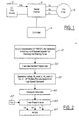
- FIG. 1 is a simplified system diagram for a motor drive system.
- the input to a starter inverter 4 is a DC power supply 2 (or battery) with a bus voltage level (Vdc).
- the output of the inverter 4 is a three-phase AC voltage signal (Va, Vb, Vc) to drive a super high-speed permanent magnet (PM) motor 8.
- a controller 6, preferably microprocessor-based, directs the starter inverter 4 to drive the PM motor 8 from zero speed to a desired speed in such a way as to minimise transient and steady state current.
- the controller 6 drives the motor 8 along a V/f profile that is a function of a voltage-offset value, a low-speed rated speed value, and a high-speed rated speed value.
- the voltage-offset value, the low-speed rated speed value, and the high-speed rated speed value are determined by the controller 6 for a particular DC bus voltage based upon the individual characteristics of the motor 8 and the DC power supply 2.
- FIG. 2 is a logic flow diagram for the method according to a preferred embodiment.
- the characteristics of the PMSM/turbo coupled engine are determined, including the number of poles (p) in the stator. Desired speeds required for the operation are also determined, such as the turbo starting speed (the speed at which the turbo engine is fired, typically around 8,000 rpm), the turbo engine warm-up speed and the turbo uncoupling speed.
- Step 30 a voltage-offset value is calculated, and a V/f profile is determined at low and high-speed operations from this voltage-offset value and from low and high-speed rated speed values. This V/f profile incorporates every possible DC bus voltage value. A more detailed description of Step 30 is detailed below in Figure 3.
- Step 40 sinewaves for three-phases (a, b and c) are generated for the V/f profile and are sent to a three-phase inverter in Step 50.
- the three-phase inverter in Step 50 takes direct current (DC) from either a battery or a rectified power grid (Step 45) and modulates the DC current into an AC current having three-phases, designated Phase A, Phase B and Phase C.
- the three-phase current is fed into a stator winding of the PM motor in Step 60, which creates the motor action to accelerate the coupled turbo engine (not shown) to a desired speed.
- FIG 3 shows the V/f profile subroutine for determining the voltage-offset value and the V/f profile of Step 30 in Figure 2 for all of the possible DC bus voltages.
- the V/f profile (algorithm) controls both the frequency and the AC voltage in a proportional fashion up to the nominal operating frequency (or rated frequency (w rated)). Beyond this frequency, the AC voltage is held at its maximum value (V_max) while only the frequency is changed.
- the low boost voltage (v_offset) at zero speed is mainly dependent on the motor's IR drop and a required starting torque.
- Step 100 the low DC voltage level (Vl) and high DC voltage level (Vh) are determined by known methods for the batteries that supply DC current to the starter inverter.
- Vl is 300 volts and Vh is 450 volts.
- Step 110 a voltage-offset value for low DC voltage (Vosl) corresponding to Vl and a high DC voltage-offset (Vosh) are determined by known experimental methods.
- Step 140 optimal rated speed values for low DC bus voltages at low-speed operations (w_rated_1_1) and high-speed operations (w_rated_1_h) are determined by known methods. Also, optimal rated speed values for high DC bus voltages at low-speed operations (w_rated_h_1) and high-speed operations (w_rated_h_h) are determined by known methods.
- Step 150 an actual rated speed value for low-speed (w_rated_1) operations and high-speed (w_rated_h) operations must be calculated in Step 150.
- V_offset is first plotted at zero speed.
- the V_offset is necessary to adjust the starting current to account for stator resistance and starting torque.
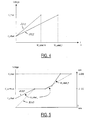
- w_rated_l is plotted at Vl (V_max), and a straight line is drawn between the two points, shown as 202 in Figure 4.
- w_rated_h is plotted at Vh (V_max), and a straight line is drawn between the two points, shown as 200 in Figure 4. This gives the profile that is used to determine how a PMSM motor will accelerate to its predetermined speed.
- the PMSM motor is driven from zero speed to a approximately 21,000 rpm, herein designated the turbo warm-up speed, where the industrial turbo engine coupled to the PMSM motor is warmed up for a maximum of 60 seconds.
- the industrial turbo engine is fired at approximately 8,000 rpm and remains coupled to the PMSM and the starter inverter.
- the PMSM motor is then accelerated from approximately 21,000 rpm to approximately 33,000 rpm, or around one-half of the rated speed for the industrial turbo engine.
- the starter inverter When approximately 33,000 rpm is reached, at the turbo uncoupling speed, the starter inverter will shut off and the industrial turbo engine will accelerate on its own to its desired speed, typically around the rated speed of the industrial turbo engine. At the point when the starter inverter is turned off and the turbo engine approaches its rated speed, the turbo engine drives the PMSM to generate electricity. When this happens, the PMSM is being used as a generator.
- Figure 5 represents the voltage profile as a function of time (shown as 400 on Figure 5) and the speed profile as a function of time (shown as 500 on Figure 5) for driving the PMSM motor from zero speed to the turbo uncoupling speed according to a preferred embodiment of the invention.
- the starter inverter drives the PMSM coupled to an industrial turbo motor from zero speed to the turbo warm-up speed along the low-speed V/f profile line described above in Figure 4.
- the turbo engine is fired at the turbo starting speed (not shown) at a point between zero speed and the turbo warm-up speed along the low-speed V/f profile.
- the PMSM motor is then held at the turbo warm-up speed at the corresponding voltage (designated V_warmup) until the industrial turbo engine warms up (for a maximum of 60 seconds).
- the PMSM motor is then accelerated along the low-speed V/f profile until it reaches a switching speed.
- the PMSM motor will then accelerate along the high-speed V/f profile described in Figure 4 until it reaches V_max, or the maximum AC voltage allowed for the system.
- the PMSM motor is then accelerated to the turbo uncoupling speed by increasing the frequency while the voltage is maintained at V_max.
- the industrial turbo engine will take over and continue accelerating to the rated speed or desired speed. Note that the switching speed is between V_warmup and V_max.
Landscapes
- Engineering & Computer Science (AREA)
- Power Engineering (AREA)
- Control Of Ac Motors In General (AREA)
- Supercharger (AREA)
- Motor And Converter Starters (AREA)
- Control Of Motors That Do Not Use Commutators (AREA)
Applications Claiming Priority (2)
| Application Number | Priority Date | Filing Date | Title |
|---|---|---|---|
| US09/495,443 US6307275B1 (en) | 2000-01-31 | 2000-01-31 | Method and apparatus for controlling a high-speed AC permanent magnet synchronous motor coupled to an industrial turbo engine |
| US495443 | 2000-01-31 |
Publications (2)
| Publication Number | Publication Date |
|---|---|
| EP1122879A2 true EP1122879A2 (de) | 2001-08-08 |
| EP1122879A3 EP1122879A3 (de) | 2003-06-04 |
Family
ID=23968664
Family Applications (1)
| Application Number | Title | Priority Date | Filing Date |
|---|---|---|---|
| EP01300774A Withdrawn EP1122879A3 (de) | 2000-01-31 | 2001-01-29 | Verfahren und Vorrichtung zur Regelung einer rotierenden Maschine, die an eine Strömungsmaschine gekoppelt ist |
Country Status (3)
| Country | Link |
|---|---|
| US (3) | US6307275B1 (de) |
| EP (1) | EP1122879A3 (de) |
| JP (1) | JP4609971B2 (de) |
Cited By (1)
| Publication number | Priority date | Publication date | Assignee | Title |
|---|---|---|---|---|
| WO2006060319A1 (en) * | 2004-11-30 | 2006-06-08 | Honeywell International Inc. | High power density/limited dc ink voltage synchronous motor drive |
Families Citing this family (7)
| Publication number | Priority date | Publication date | Assignee | Title |
|---|---|---|---|---|
| US6307275B1 (en) * | 2000-01-31 | 2001-10-23 | Ford Global Technologies, Inc. | Method and apparatus for controlling a high-speed AC permanent magnet synchronous motor coupled to an industrial turbo engine |
| US7468595B2 (en) * | 2005-07-26 | 2008-12-23 | Eaton Corporation | System and method of controlling the start-up of an adjustable speed motor drive based sinusoidal output power conditioner |
| TWI439041B (zh) | 2011-12-19 | 2014-05-21 | 財團法人工業技術研究院 | 永磁同步馬達驅動方法與裝置 |
| JPWO2013094432A1 (ja) * | 2011-12-22 | 2015-04-27 | 川崎重工業株式会社 | 熱交換器を備えたガスタービンエンジンとその始動方法 |
| WO2013094433A1 (ja) * | 2011-12-22 | 2013-06-27 | 川崎重工業株式会社 | ガスタービンエンジンとその始動方法 |
| CN108443021A (zh) * | 2018-03-16 | 2018-08-24 | 哈尔滨工业大学 | 一种燃气轮发电机系统的启动装置 |
| US11732663B2 (en) * | 2020-05-06 | 2023-08-22 | Safran Power Usa, Llc | Starter-generator speed control |
Family Cites Families (25)
| Publication number | Priority date | Publication date | Assignee | Title |
|---|---|---|---|---|
| DE2110747B2 (de) | 1971-03-06 | 1975-06-26 | Siemens Ag, 1000 Berlin Und 8000 Muenchen | Anfahreinrichtung für einen an eine Turbine angekuppelten Generator |
| US3840799A (en) | 1973-09-11 | 1974-10-08 | Westinghouse Electric Corp | Commutatorless dc motor drive arrangement |
| DE2811123C2 (de) | 1978-03-15 | 1983-09-29 | Barmag Barmer Maschinenfabrik Ag, 5630 Remscheid | Verfahren zum Anfahren und Hochfahren eines Synchronmotors auf Betriebsdrehzahl mit Hilfe eines Umrichters |
| US4456830A (en) | 1982-04-22 | 1984-06-26 | Lockheed Corporation | AC Motor-starting for aircraft engines using APU free turbine driven generators |
| US4565957A (en) | 1983-06-30 | 1986-01-21 | Borg-Warner Corporation | Method and system for starting a motor-commutated SCR inverter |
| JPS62123985A (ja) * | 1985-11-20 | 1987-06-05 | Mitsubishi Electric Corp | インバ−タ制御装置 |
| US4786852A (en) * | 1986-07-18 | 1988-11-22 | Sundstrand Corporation | Inverter operated turbine engine starting system |
| DE3782613T2 (de) | 1986-11-14 | 1993-03-25 | Toshiba Kawasaki Kk | Hilfsantriebsgeraet fuer eine turbine. |
| US4746850A (en) | 1987-02-12 | 1988-05-24 | Westinghouse Electric Corp. | Start-up system for a synchronous motor drive |
| US4908565A (en) * | 1987-02-18 | 1990-03-13 | Sundstrand Corporation | Power generating system |
| US4772802A (en) * | 1987-08-19 | 1988-09-20 | Sundstrand Corporation | Starting/generating system |
| US4883973A (en) * | 1988-08-01 | 1989-11-28 | General Motors Corporation | Automotive electrical system having a starter/generator induction machine |
| US4949021A (en) * | 1988-11-14 | 1990-08-14 | Sunstrand Corporation | Variable speed constant frequency start system with selectable input power limiting |
| US5055700A (en) * | 1989-10-16 | 1991-10-08 | Dhyanchand P John | Brushless generator having prime mover start capability |
| US5144564A (en) | 1991-01-08 | 1992-09-01 | University Of Tennessee Research Corp. | Rotor position estimation of a permanent magnet synchronous-machine for high performance drive |
| US5363032A (en) * | 1993-05-12 | 1994-11-08 | Sundstrand Corporation | Sensorless start of synchronous machine |
| US5594322A (en) | 1993-05-12 | 1997-01-14 | Sundstrand Corporation | Starter/generator system with variable-frequency exciter control |
| US5493200A (en) | 1993-05-12 | 1996-02-20 | Sundstrand Corporation | Control for a brushless generator |
| US5428275A (en) * | 1993-05-12 | 1995-06-27 | Sundstrand Corporation | Controlled starting method for a gas turbine engine |
| US5430362A (en) * | 1993-05-12 | 1995-07-04 | Sundstrand Corporation | Engine starting system utilizing multiple controlled acceleration rates |
| US5581168A (en) | 1993-05-12 | 1996-12-03 | Sundstrand Corporation | Starter/generator system with DC link current control |
| US5512811A (en) * | 1994-01-21 | 1996-04-30 | Sundstrand Corporation | Starter/generator system having multivoltage generation capability |
| JPH1023756A (ja) * | 1996-06-28 | 1998-01-23 | Mitsubishi Electric Corp | 電圧形インバータ装置及びその制御方法 |
| US6037752A (en) * | 1997-06-30 | 2000-03-14 | Hamilton Sundstrand Corporation | Fault tolerant starting/generating system |
| US6307275B1 (en) * | 2000-01-31 | 2001-10-23 | Ford Global Technologies, Inc. | Method and apparatus for controlling a high-speed AC permanent magnet synchronous motor coupled to an industrial turbo engine |
-
2000
- 2000-01-31 US US09/495,443 patent/US6307275B1/en not_active Expired - Lifetime
-
2001
- 2001-01-26 JP JP2001018377A patent/JP4609971B2/ja not_active Expired - Fee Related
- 2001-01-29 EP EP01300774A patent/EP1122879A3/de not_active Withdrawn
- 2001-07-06 US US09/900,765 patent/US6492789B2/en not_active Expired - Lifetime
- 2001-07-06 US US09/900,774 patent/US6501244B2/en not_active Expired - Fee Related
Cited By (1)
| Publication number | Priority date | Publication date | Assignee | Title |
|---|---|---|---|---|
| WO2006060319A1 (en) * | 2004-11-30 | 2006-06-08 | Honeywell International Inc. | High power density/limited dc ink voltage synchronous motor drive |
Also Published As
| Publication number | Publication date |
|---|---|
| JP2001238489A (ja) | 2001-08-31 |
| EP1122879A3 (de) | 2003-06-04 |
| JP4609971B2 (ja) | 2011-01-12 |
| US20020047682A1 (en) | 2002-04-25 |
| US20020047681A1 (en) | 2002-04-25 |
| US6501244B2 (en) | 2002-12-31 |
| US6307275B1 (en) | 2001-10-23 |
| US6492789B2 (en) | 2002-12-10 |
Similar Documents
| Publication | Publication Date | Title |
|---|---|---|
| US5029263A (en) | Electric start control of a VSCF system | |
| US4949021A (en) | Variable speed constant frequency start system with selectable input power limiting | |
| US5055764A (en) | Low voltage aircraft engine starting system | |
| US5036267A (en) | Aircraft turbine start from a low voltage battery | |
| EP1553275B1 (de) | Vorrichtung und Verfahren zum Anlassen eines Gasturbine mit einem mehrphasigen elektrischen Leistungsgenerator | |
| US6528967B2 (en) | Permanent magnet brushless electric motor system and method of using same | |
| US7227271B2 (en) | Method and apparatus for controlling an engine start system | |
| US5428275A (en) | Controlled starting method for a gas turbine engine | |
| EP0757432B1 (de) | Anlaufen einer Synchronmaschine ohne Rotorstellungs- bzw. Geschwindigkeitsmessung | |
| US7135784B2 (en) | Fast torque control of a belted alternator starter | |
| JP4308423B2 (ja) | 内燃機関によって駆動可能な発電機の調整方法および調整装置 | |
| US5587641A (en) | VSCF start system with precise voltage control | |
| JP2002507377A (ja) | 共通軸上のタービン/オルタネータのための電気系統 | |
| US7116073B1 (en) | Methods and apparatus for controlling a motor/generator | |
| US6307275B1 (en) | Method and apparatus for controlling a high-speed AC permanent magnet synchronous motor coupled to an industrial turbo engine | |
| US8878498B2 (en) | Method for reducing a voltage ripple due to rotational nonuniformity of a generator driven by an internal combustion engine | |
| JP3800012B2 (ja) | シリーズハイブリッド電気自動車用発電機の制御方式 | |
| RU2173020C2 (ru) | Электрическая система с асинхронным стартером-генератором | |
| US6703808B1 (en) | Active power limiting for starter/alternator in the generation mode | |
| RU2745149C1 (ru) | Способ управления дизель-генераторной установкой при включении асинхронного двигателя | |
| JP2004218467A (ja) | エンジン駆動発電装置 | |
| EP1753123B1 (de) | Verfahren und Vorrichtung zur Regelung eines Motorgenerators | |
| JPH09215102A (ja) | 電気車の制御装置及び制御方法 | |
| JP4021192B2 (ja) | 可変速発電機の制御方法と装置及び可変速揚水発電システム | |
| CN110612662A (zh) | 用于旋转电机的控制系统 |
Legal Events
| Date | Code | Title | Description |
|---|---|---|---|
| PUAI | Public reference made under article 153(3) epc to a published international application that has entered the european phase |
Free format text: ORIGINAL CODE: 0009012 |
|
| AK | Designated contracting states |
Kind code of ref document: A2 Designated state(s): AT BE CH CY DE DK ES FI FR GB GR IE IT LI LU MC NL PT SE TR |
|
| AX | Request for extension of the european patent |
Free format text: AL;LT;LV;MK;RO;SI |
|
| PUAL | Search report despatched |
Free format text: ORIGINAL CODE: 0009013 |
|
| AK | Designated contracting states |
Designated state(s): AT BE CH CY DE DK ES FI FR GB GR IE IT LI LU MC NL PT SE TR |
|
| AX | Request for extension of the european patent |
Extension state: AL LT LV MK RO SI |
|
| RIC1 | Information provided on ipc code assigned before grant |
Ipc: 7F 02N 11/08 B Ipc: 7H 02P 9/44 B Ipc: 7H 02P 9/08 A |
|
| AKX | Designation fees paid |
Designated state(s): DE FR GB |
|
| STAA | Information on the status of an ep patent application or granted ep patent |
Free format text: STATUS: THE APPLICATION IS DEEMED TO BE WITHDRAWN |
|
| 18D | Application deemed to be withdrawn |
Effective date: 20031205 |