EP1120456A1 - Verfahren zur Herstellung von Alkyl- und/oder Alkenylphosphat-Granulaten - Google Patents
Verfahren zur Herstellung von Alkyl- und/oder Alkenylphosphat-Granulaten Download PDFInfo
- Publication number
- EP1120456A1 EP1120456A1 EP01100808A EP01100808A EP1120456A1 EP 1120456 A1 EP1120456 A1 EP 1120456A1 EP 01100808 A EP01100808 A EP 01100808A EP 01100808 A EP01100808 A EP 01100808A EP 1120456 A1 EP1120456 A1 EP 1120456A1
- Authority
- EP
- European Patent Office
- Prior art keywords
- alkyl
- process according
- pastes
- alkenyl
- alcohol
- Prior art date
- Legal status (The legal status is an assumption and is not a legal conclusion. Google has not performed a legal analysis and makes no representation as to the accuracy of the status listed.)
- Withdrawn
Links
- 239000008187 granular material Substances 0.000 title claims abstract description 15
- 238000004519 manufacturing process Methods 0.000 title claims abstract description 5
- 238000000034 method Methods 0.000 title claims description 15
- 125000000217 alkyl group Chemical group 0.000 title claims description 14
- 229910019142 PO4 Inorganic materials 0.000 claims abstract description 14
- 239000010452 phosphate Substances 0.000 claims abstract description 5
- 239000007787 solid Substances 0.000 claims abstract description 4
- -1 alkenyl phosphate Chemical compound 0.000 claims description 14
- 235000021317 phosphate Nutrition 0.000 claims description 13
- 239000003945 anionic surfactant Substances 0.000 claims description 5
- XLYOFNOQVPJJNP-UHFFFAOYSA-N water Substances O XLYOFNOQVPJJNP-UHFFFAOYSA-N 0.000 claims description 5
- 239000003513 alkali Substances 0.000 claims description 4
- 125000004432 carbon atom Chemical group C* 0.000 claims description 4
- 239000000428 dust Substances 0.000 claims description 3
- QGZKDVFQNNGYKY-UHFFFAOYSA-O Ammonium Chemical compound [NH4+] QGZKDVFQNNGYKY-UHFFFAOYSA-O 0.000 claims description 2
- 229910052784 alkaline earth metal Inorganic materials 0.000 claims description 2
- 150000001342 alkaline earth metals Chemical class 0.000 claims description 2
- 229910052739 hydrogen Inorganic materials 0.000 claims description 2
- 239000001257 hydrogen Substances 0.000 claims description 2
- 125000004435 hydrogen atom Chemical class [H]* 0.000 claims description 2
- 238000001035 drying Methods 0.000 abstract description 11
- 239000010409 thin film Substances 0.000 abstract description 4
- 150000003013 phosphoric acid derivatives Chemical class 0.000 abstract description 3
- NBIIXXVUZAFLBC-UHFFFAOYSA-K phosphate Chemical compound [O-]P([O-])([O-])=O NBIIXXVUZAFLBC-UHFFFAOYSA-K 0.000 abstract 1
- JXNPEDYJTDQORS-HZJYTTRNSA-N (9Z,12Z)-octadecadien-1-ol Chemical compound CCCCC\C=C/C\C=C/CCCCCCCCO JXNPEDYJTDQORS-HZJYTTRNSA-N 0.000 description 27
- JXNPEDYJTDQORS-UHFFFAOYSA-N linoleyl alcohol Natural products CCCCCC=CCC=CCCCCCCCCO JXNPEDYJTDQORS-UHFFFAOYSA-N 0.000 description 27
- 239000006072 paste Substances 0.000 description 10
- 239000003570 air Substances 0.000 description 8
- 239000003599 detergent Substances 0.000 description 8
- 238000005469 granulation Methods 0.000 description 8
- 230000003179 granulation Effects 0.000 description 8
- 239000002245 particle Substances 0.000 description 7
- 239000004094 surface-active agent Substances 0.000 description 6
- LFQSCWFLJHTTHZ-UHFFFAOYSA-N Ethanol Chemical compound CCO LFQSCWFLJHTTHZ-UHFFFAOYSA-N 0.000 description 5
- 239000000843 powder Substances 0.000 description 5
- 238000002360 preparation method Methods 0.000 description 4
- 239000000203 mixture Substances 0.000 description 3
- KBPLFHHGFOOTCA-UHFFFAOYSA-N 1-Octanol Chemical compound CCCCCCCCO KBPLFHHGFOOTCA-UHFFFAOYSA-N 0.000 description 2
- WNWHHMBRJJOGFJ-UHFFFAOYSA-N 16-methylheptadecan-1-ol Chemical compound CC(C)CCCCCCCCCCCCCCCO WNWHHMBRJJOGFJ-UHFFFAOYSA-N 0.000 description 2
- NBIIXXVUZAFLBC-UHFFFAOYSA-N Phosphoric acid Chemical compound OP(O)(O)=O NBIIXXVUZAFLBC-UHFFFAOYSA-N 0.000 description 2
- 235000014113 dietary fatty acids Nutrition 0.000 description 2
- 239000000194 fatty acid Substances 0.000 description 2
- 229930195729 fatty acid Natural products 0.000 description 2
- 150000002191 fatty alcohols Chemical class 0.000 description 2
- 239000012530 fluid Substances 0.000 description 2
- 239000007789 gas Substances 0.000 description 2
- BXWNKGSJHAJOGX-UHFFFAOYSA-N hexadecan-1-ol Chemical compound CCCCCCCCCCCCCCCCO BXWNKGSJHAJOGX-UHFFFAOYSA-N 0.000 description 2
- 239000000463 material Substances 0.000 description 2
- GLDOVTGHNKAZLK-UHFFFAOYSA-N octadecan-1-ol Chemical compound CCCCCCCCCCCCCCCCCCO GLDOVTGHNKAZLK-UHFFFAOYSA-N 0.000 description 2
- 239000000344 soap Substances 0.000 description 2
- 239000002689 soil Substances 0.000 description 2
- 238000003860 storage Methods 0.000 description 2
- HLZKNKRTKFSKGZ-UHFFFAOYSA-N tetradecan-1-ol Chemical compound CCCCCCCCCCCCCCO HLZKNKRTKFSKGZ-UHFFFAOYSA-N 0.000 description 2
- ALSTYHKOOCGGFT-KTKRTIGZSA-N (9Z)-octadecen-1-ol Chemical compound CCCCCCCC\C=C/CCCCCCCCO ALSTYHKOOCGGFT-KTKRTIGZSA-N 0.000 description 1
- XUJLWPFSUCHPQL-UHFFFAOYSA-N 11-methyldodecan-1-ol Chemical compound CC(C)CCCCCCCCCCO XUJLWPFSUCHPQL-UHFFFAOYSA-N 0.000 description 1
- YIWUKEYIRIRTPP-UHFFFAOYSA-N 2-ethylhexan-1-ol Chemical compound CCCCC(CC)CO YIWUKEYIRIRTPP-UHFFFAOYSA-N 0.000 description 1
- 229920006051 Capron® Polymers 0.000 description 1
- 235000013162 Cocos nucifera Nutrition 0.000 description 1
- 244000060011 Cocos nucifera Species 0.000 description 1
- FBPFZTCFMRRESA-KVTDHHQDSA-N D-Mannitol Chemical compound OC[C@@H](O)[C@@H](O)[C@H](O)[C@H](O)CO FBPFZTCFMRRESA-KVTDHHQDSA-N 0.000 description 1
- 208000034874 Product colour issue Diseases 0.000 description 1
- 229920002472 Starch Polymers 0.000 description 1
- 238000010521 absorption reaction Methods 0.000 description 1
- 150000001298 alcohols Chemical class 0.000 description 1
- 150000001447 alkali salts Chemical class 0.000 description 1
- 239000012080 ambient air Substances 0.000 description 1
- 239000002585 base Substances 0.000 description 1
- 239000000969 carrier Substances 0.000 description 1
- 229960000541 cetyl alcohol Drugs 0.000 description 1
- 239000003795 chemical substances by application Substances 0.000 description 1
- 238000004140 cleaning Methods 0.000 description 1
- 239000012459 cleaning agent Substances 0.000 description 1
- 239000002537 cosmetic Substances 0.000 description 1
- MWKFXSUHUHTGQN-UHFFFAOYSA-N decan-1-ol Chemical compound CCCCCCCCCCO MWKFXSUHUHTGQN-UHFFFAOYSA-N 0.000 description 1
- 230000001419 dependent effect Effects 0.000 description 1
- 150000005690 diesters Chemical class 0.000 description 1
- CNXJITYCNQNTBD-UHFFFAOYSA-L dipotassium;hexadecyl phosphate Chemical compound [K+].[K+].CCCCCCCCCCCCCCCCOP([O-])([O-])=O CNXJITYCNQNTBD-UHFFFAOYSA-L 0.000 description 1
- 238000002845 discoloration Methods 0.000 description 1
- 238000004851 dishwashing Methods 0.000 description 1
- 238000009826 distribution Methods 0.000 description 1
- LQZZUXJYWNFBMV-UHFFFAOYSA-N dodecan-1-ol Chemical compound CCCCCCCCCCCCO LQZZUXJYWNFBMV-UHFFFAOYSA-N 0.000 description 1
- 239000003995 emulsifying agent Substances 0.000 description 1
- JBKVHLHDHHXQEQ-UHFFFAOYSA-N epsilon-caprolactam Chemical compound O=C1CCCCCN1 JBKVHLHDHHXQEQ-UHFFFAOYSA-N 0.000 description 1
- 238000002474 experimental method Methods 0.000 description 1
- 150000004665 fatty acids Chemical class 0.000 description 1
- 238000001033 granulometry Methods 0.000 description 1
- 230000007062 hydrolysis Effects 0.000 description 1
- 238000006460 hydrolysis reaction Methods 0.000 description 1
- 239000004615 ingredient Substances 0.000 description 1
- 239000007788 liquid Substances 0.000 description 1
- 239000012669 liquid formulation Substances 0.000 description 1
- 229940043348 myristyl alcohol Drugs 0.000 description 1
- GOQYKNQRPGWPLP-UHFFFAOYSA-N n-heptadecyl alcohol Natural products CCCCCCCCCCCCCCCCCO GOQYKNQRPGWPLP-UHFFFAOYSA-N 0.000 description 1
- 239000003921 oil Substances 0.000 description 1
- 229940055577 oleyl alcohol Drugs 0.000 description 1
- XMLQWXUVTXCDDL-UHFFFAOYSA-N oleyl alcohol Natural products CCCCCCC=CCCCCCCCCCCO XMLQWXUVTXCDDL-UHFFFAOYSA-N 0.000 description 1
- 235000011007 phosphoric acid Nutrition 0.000 description 1
- 150000003014 phosphoric acid esters Chemical class 0.000 description 1
- 229920000151 polyglycol Polymers 0.000 description 1
- 239000010695 polyglycol Substances 0.000 description 1
- 230000001105 regulatory effect Effects 0.000 description 1
- 150000003839 salts Chemical class 0.000 description 1
- 238000012216 screening Methods 0.000 description 1
- 239000002453 shampoo Substances 0.000 description 1
- 239000007921 spray Substances 0.000 description 1
- 238000001694 spray drying Methods 0.000 description 1
- 235000019698 starch Nutrition 0.000 description 1
- 239000008107 starch Substances 0.000 description 1
- 239000000126 substance Substances 0.000 description 1
- DLYUQMMRRRQYAE-UHFFFAOYSA-N tetraphosphorus decaoxide Chemical compound O1P(O2)(=O)OP3(=O)OP1(=O)OP2(=O)O3 DLYUQMMRRRQYAE-UHFFFAOYSA-N 0.000 description 1
- 239000000606 toothpaste Substances 0.000 description 1
- 150000005691 triesters Chemical class 0.000 description 1
Classifications
-
- C—CHEMISTRY; METALLURGY
- C11—ANIMAL OR VEGETABLE OILS, FATS, FATTY SUBSTANCES OR WAXES; FATTY ACIDS THEREFROM; DETERGENTS; CANDLES
- C11D—DETERGENT COMPOSITIONS; USE OF SINGLE SUBSTANCES AS DETERGENTS; SOAP OR SOAP-MAKING; RESIN SOAPS; RECOVERY OF GLYCEROL
- C11D11/00—Special methods for preparing compositions containing mixtures of detergents
- C11D11/0082—Special methods for preparing compositions containing mixtures of detergents one or more of the detergent ingredients being in a liquefied state, e.g. slurry, paste or melt, and the process resulting in solid detergent particles such as granules, powders or beads
-
- C—CHEMISTRY; METALLURGY
- C11—ANIMAL OR VEGETABLE OILS, FATS, FATTY SUBSTANCES OR WAXES; FATTY ACIDS THEREFROM; DETERGENTS; CANDLES
- C11D—DETERGENT COMPOSITIONS; USE OF SINGLE SUBSTANCES AS DETERGENTS; SOAP OR SOAP-MAKING; RESIN SOAPS; RECOVERY OF GLYCEROL
- C11D1/00—Detergent compositions based essentially on surface-active compounds; Use of these compounds as a detergent
- C11D1/02—Anionic compounds
- C11D1/34—Derivatives of acids of phosphorus
- C11D1/345—Phosphates or phosphites
-
- C—CHEMISTRY; METALLURGY
- C11—ANIMAL OR VEGETABLE OILS, FATS, FATTY SUBSTANCES OR WAXES; FATTY ACIDS THEREFROM; DETERGENTS; CANDLES
- C11D—DETERGENT COMPOSITIONS; USE OF SINGLE SUBSTANCES AS DETERGENTS; SOAP OR SOAP-MAKING; RESIN SOAPS; RECOVERY OF GLYCEROL
- C11D17/00—Detergent materials or soaps characterised by their shape or physical properties
- C11D17/06—Powder; Flakes; Free-flowing mixtures; Sheets
- C11D17/065—High-density particulate detergent compositions
Definitions
- the invention is in the field of detergent surfactants and relates to a new process for Manufacture of certain anionic surfactants in granular form.
- Alk (en) yl phosphates which are also aptly referred to simply as phosphoric acid esters are characterized by excellent detergent properties and high ecotoxicological compatibility. For this reason, these anionic surfactants are becoming increasingly important.
- liquid formulations such as dishwashing detergents or hair shampoos, there is now also a market need for solid, water-free forms of supply that can also be worked into powder detergents, toothpastes or syndet soaps, for example.
- liquid surfactant preparations are usually dried using conventional ones Spray drying, in which the aqueous surfactant paste at the top of a tower in the form of fine droplets sprayed, which hot drying gases are directed towards.
- Spray drying in which the aqueous surfactant paste at the top of a tower in the form of fine droplets sprayed, which hot drying gases are directed towards.
- the drastic conditions lead however, often leads to signs of hydrolysis, undesirable discoloration of the products, caking the walls of the spray towers and subsequently contaminate the dry material by charred Residues.
- the repeatedly required cleaning of the towers also leads to downtimes, which sometimes makes the process expensive.
- Another problem is that The prior art method is not the most preferred heavy powder with a Bulk density above 500 g / l with a greatly reduced dust content. Just however, these two parameters are economic, application-related and safety-related Reasons of particular importance.
- the complex object of the present invention has been to provide aqueous alkyl and / or Alkenyl phosphate pastes with as little technical effort as possible, preferably without Use of inorganic or organic carriers in practically water- and dust-free granules to be transferred, which at the same time is characterized by an acceptable color quality, a high bulk density, a granulometry in which at least 50% by weight of the particles have a diameter of less than 0.6 mm have good flowability, satisfactory storage stability and compared to the products of the prior art by at least comparable application properties award.
- the invention relates to a process for the preparation of low-water and low-dust alkyl and / or Alkenyl phosphate granules with high bulk density, in which aqueous pastes of alkyl and / or alkenyl phosphate salts with a solids content of at least 20% by weight in the fluidized bed or in the thin layer to a residual water content below 2.5% by weight dries at the same time and brings it into pieces.
- both the simultaneous drying and granulation in the fluidized bed and the thin bed are equally suitable, aqueous alkyl and / or Converting alkenyl phosphate pastes into dry, light-colored, free-flowing and non-sticky granules, without product discoloration and caking on the walls.
- the products have a high bulk density in the range from 500 to 700 g / l and a grain size distribution more than 50% by weight of all particles have a diameter of less than 0.6 mm, which leads to a reduction the undesirable water absorption and caking of the particles. On this also ensures high storage stability. At the same time, they are practically dust-free, i.e. the proportion of particles with a diameter of less than 200 ⁇ m is less than 5% by weight.
- Alkyl or alkenyl phosphates are known anionic surfactants which are usually prepared by condensing fatty alcohols with diphosphorus pentoxide or orthophosphoric acid. Overviews on this topic have been published by RSCooper et al. in J.Am.Oil.Chem.Soc. 41, 337 (1964), H. Distler et al. in Tens.Deterg. 12 , 263 (1975), K. Hennig in Seifen- ⁇ le-Fette-Wwachs 102, 221 (1976) and AJO'Lennick et al. in Soap, Cosm.Chem.Spec. 7 , 26 (1986) .
- R 1 is a linear or branched alkyl and / or alkenyl radical having 6 to 22 carbon atoms and R 2 and R 3 independently of one another are hydrogen, alkali, alkaline earth metal, ammonium or R 1 .
- Alkyl phosphates are preferably used in which R 1 is alkyl radicals having 12 to 18 carbon atoms and R 2 and R 3 are alkali.
- Typical examples are the phosphates of capron alcohol, caprylic alcohol, 2-ethylhexyl alcohol, capric alcohol, lauryl alcohol, isotridecyl alcohol, myristyl alcohol, cetyl alcohol, palmoleyl alcohol, stearyl alcohol, isostearyl alcohol, oleyl alcohol, aridol alcohol, linoleyl alcohol, linoleyl alcohol, linoleyl alcohol, linoleyl alcohol, linoleyl alcohol, linoleyl alcohol, linoleyl alcohol, linoleyl alcohol, linoleyl alcohol, linoleyl alcohol, linoleyl alcohol, linoleyl alcohol, linoleyl alcohol, linoleyl alcohol, linoleyl alcohol, linoleyl alcohol, linoleyl alcohol, linoleyl alcohol, linoleyl alcohol, linoleyl alcohol,
- Aqueous pastes of alkyl and / or alkenyl phosphates are usually used which have an anionic surfactant content in the range from 20 to 60% by weight and preferably around 50% by weight.
- a first possibility for the preparation of the agents consists in the aqueous surfactant pastes of a fluidized bed granulation ("SKET" granulation).
- SKET fluidized bed granulation
- a granulation below to understand simultaneous drying which is preferably carried out batchwise or continuously.
- the granulation is carried out at fluidizing air speeds in the range from 1 to 8 m / s.
- the granules are preferably discharged from the fluidized bed by means of a size classification the granules.
- the classification can be done, for example, by means of a screening device or by a reverse air flow (classifier air) take place, which is regulated so that only particles from one certain particle size removed from the fluidized bed and smaller particles in the fluidized bed be held back.
- the inflowing air usually settles out of the heated or unheated Classifier air and the heated soil air together.
- the soil air temperature is between 80 and 400, preferably 160 and 190 ° C, while the actual drying usually at Temperatures in the range of 75 to 100 ° C takes place.
- a starting mass for example a granulate from an earlier experiment, submitted.
- the simultaneous drying and granulation can alternatively also take place in a horizontally arranged thin-film evaporator with rotating internals, such as that sold by the VRV company under the name "Flash-Dryer".
- this is a tube that can be heated to different temperatures over several zones.
- the paste-like feed material which is metered in via a pump, is flung against the heated wall by means of one or more shafts, which are provided with blades or shares of flies as rotating internals at temperatures of usually 100 to 200 ° C.
- the thin-film evaporator is operated at atmospheric conditions or reduced pressure and gassed in countercurrent with air (throughput 50 to 150 m 3 / h).
- the gas inlet temperature is usually 20 to 30 ° C, the outlet temperature 100 to 130 ° C.
- the throughput is of course dependent on the size of the dryer, but is typically 5 to 15 kg / h. It is advisable to temper the pastes at 40 to 60 ° C during the feed. After drying, it has also proven to be very advantageous to place the granules, which are still around 50 to 70 ° C., on a conveyor belt, preferably an oscillating shaft, and there quickly, ie within a dwell time of 20 to 60 s, with ambient air at temperatures of cool about 30 to 40 ° C.
- the granules obtainable by the process according to the invention can then be combined with other Ingredients of powdered surface-active agents, such as tower powders for Detergent can be mixed. It is also possible to easily mix the powders in aqueous preparations to incorporate. In fact, when using the powder compared to the aqueous starting pastes no differences in the application properties were observed. Even in for example, bar granules of the combibar or syndet type can be used together with the granules Fatty acids, fatty acid salts, fatty alcohols, starch, polyglycols and the like are easily incorporated. The substances are also used as cosmetic emulsifiers.
Landscapes
- Chemical & Material Sciences (AREA)
- Life Sciences & Earth Sciences (AREA)
- Engineering & Computer Science (AREA)
- Chemical Kinetics & Catalysis (AREA)
- Oil, Petroleum & Natural Gas (AREA)
- Wood Science & Technology (AREA)
- Organic Chemistry (AREA)
- Detergent Compositions (AREA)
Abstract
Vorgeschlagen wird ein Verfahren zur Herstellung von wasser- und staubarmen Alkyl- und/oder Alkenylphosphatgranulaten mit hohem Schüttgewicht, bei dem man wäßrige Pasten von Alkyl- und/oder Alkenylphospshatsalzen mit einem Feststoffgehalt von mindestens 20 Gew.-% in der Wirbelschicht oder in der dünnen Schicht bis auf einen Restwassergehalt unterhalb von 2,5 Gew.-% gleichzeitig trocknet und in stückige Form bringt.
Description
Die Erfindung befindet sich auf dem Gebiet der Waschmitteltenside und betrifft ein neues Verfahren zur
Herstellung bestimmter anionischer Tenside in granularer Form.
Alk(en)ylphosphate, die auch zutreffend schlicht als Phosphorsäureester bezeichnet werden, zeichnen
sich durch ausgezeichnete Detergenseigenschaften und hohe ökotoxikologische Verträglichkeit aus.
Aus diesem Grund gewinnen diese anionischen Tenside in zunehmendem Maße an Bedeutung. Neben
einem Einsatz in flüssigen Formulierungen, wie beispielsweise Geschirrspülmitteln oder Haarshampoos,
besteht inzwischen auch ein Marktbedürfnis nach festen, wasserfreien Anbietungsformen, die
sich beispielsweise auch in Pulverwaschmittel, Zahncremes oder Syndetseifen einarbeiten lassen.
Die Trocknung flüssiger Tensidzubereitungen erfolgt großtechnisch in der Regel durch konventionelle
Sprühtrocknung, bei der man die wäßrige Tensidpaste am Kopf eines Turmes in Form feiner Tröpfchen
versprüht, denen heiße Trocknungsgase entgegengeführt werden. Die drastischen Bedingungen führen
indes häufig zu Hydrolyseerscheinungen, unerwünschten Verfärbungen der Produkte, Anbackungen an
den Wandungen der Sprühtürme und in der Folge zu Verunreinigungen des Trockengutes durch verkohlte
Rückstände. Die immer wieder erforderliche Reinigung der Türme führt zudem zu Ausfallzeiten,
was das Verfahren auch mitunter kostspielig macht. Ein weiteres Problem besteht ferner darin, daß
Verfahren des Stands der Technik nicht zu den besonders bevorzugten Schwerpulvern mit einem
Schüttgewicht oberhalb von 500 g/l mit einem gleichzeitig stark verminderten Staubgehalt führt. Gerade
diese beiden Parameter sind jedoch aus wirtschaftlichen, anwendungstechnischen und sicherheitstechnischen
Gründen von besonderer Bedeutung.
An dieser Stelle sei auf die deutsche Offenlegungsschrift DE-A1 4209339 (Henkel) verwiesen, aus der
ein Verfahren zur Herstellung rieselfähiger Wasch- und Reinigungsmittelgranulate bekannt ist, bei dem
die Entwässerung in Turbinentrocknern, d.h. in zylindrischen Trockenapparaturen in horizontaler Bauweise
mit rotierenden Einbauten erfolgt. Gegenstand der internationalen Patentanmeldung WO
98/40461 (Henkel) ist ein Verfahren zur gleichzeitigen Trocknung und Granulierung von Tensidpasten
in einem horizontalen Dünnschichtverdampfer.
Demzufolge hat die komplexe Aufgabe der vorliegenden Erfindung darin bestanden, wäßrige Alkylund/oder
Alkenylphosphatpasten mit möglichst geringem technischen Aufwand vorzugsweise ohne
Mitverwendung von anorganischen oder organischen Trägern in praktisch wasser- und staubfreie Granulate
zu überführen, die sich gleichzeitig durch eine akzeptable Farbqualität, ein hohes Schüttgewicht,
eine Granulometrie, bei der mindestens 50 Gew.-% der Teilchen einen Durchmesser von kleiner 0,6
mm besitzen, gute Rieselfähigkeit, eine zufriedenstellende Lagerstabilität und im Vergleich zu den Produkten
des Stands der Technik durch zumindest vergleichbare anwendungstechnische Eigenschaften
auszeichnen.
Gegenstand der Erfindung ist ein Verfahren zur Herstellung von wasser- und staubarmen Alkyl-und/oder
Alkenylphosphatgranulaten mit hohem Schüttgewicht, bei dem man wäßrige Pasten von Alkyl-
und/oder Alkenylphosphatsalzen mit einem Feststoffgehalt von mindestens 20 Gew.-% in der Wirbelschicht
oder in der dünnen Schicht bis auf einen Restwassergehalt unterhalb von 2,5 Gew.-%
gleichzeitig trocknet und in stückige Form bringt.
Überraschenderweise wurde gefunden, daß sowohl die gleichzeitige Trocknung und Granulierung in
der Wirbelschicht wie in der dünnen Schicht gleichermaßen geeignet sind, wäßrige Alkyl- und/oder
Alkenylphosphatpasten in trockene, hellfarbige, rieselfähige und nicht-klebrige Granulate zu überführen,
ohne daß es zu Produktverfärbungen und Anbacken an den Wandungen kommt. Die Produkte
weisen eine hohe Schüttdichte im Bereich von 500 bis 700 g/l und eine Korngrößenverteilung auf, bei
der mehr als 50 Gew.-% aller Teilchen einen Durchmesser kleiner 0,6 mm besitzen, was zu einer Verminderung
der unerwünschten Wasseraufnahme und des Zusammenbackens der Partikel führt. Auf
diese Weise ist auch eine hohe Lagerstabilität gegeben. Gleichzeitig sind sie praktisch staubfrei, d.h.
der Anteil an Teilchen mit einem Durchmesser unterhalb von 200 µm liegt unterhalb von 5 Gew.-%.
Alkyl- bzw. Alkenylphosphate stellen bekannte anionische Tenside dar, die üblicherweise durch Kondensation
von Fettalkoholen mit Diphosphorpentoxid oder Orthophosphorsäure hergestellt werden.
Übersichten zu diesem Thema sind beispielsweise von R.S.Cooper et al. in J.Am.Oil.Chem.Soc. 41,
337 (1964), H.Distler et al. in Tens.Deterg. 12, 263 (1975), K.Hennig in Seifen-Öle-Fette-Wachse 102,
221 (1976) und A.J.O'Lennick et al. in Soap, Cosm.Chem.Spec. 7, 26 (1986) zu finden. Vorzugsweise
handelt es sich um technische Mono-/Di-/Triestergemische, die überwiegend als Salze vorliegen und
dabei der Formel (I) folgen,
 in der R1 für einen linearen oder verzweigten Alkyl- und/oder Alkenylrest mit 6 bis 22 Kohlenstoffatomen
und R2 und R3 unabhängig voneinander für Wasserstoff, Alkali, Erdalkali, Ammonium oder R1 stehen.
Vorzugsweise werden Alkylphosphate eingesetzt, in der R1 für Alkylreste mit 12 bis 18 Kohlenstoffatomen
und R2 und R3 für Alkali stehen. Typische Beispiele sind die Phosphate von Capronalkohol, Caprylalkohol,
2-Ethylhexylalkohol, Caprinalkohol, Laurylalkohol, Isotridecylalkohol, Myristylalkohol, Cetylalkohol,
Palmoleylalkohol, Stearylalkohol, Isostearylalkohol, Oleylalkohol, Elaidylalkohol, Petroselinylalkohol,
Linolylalkohol, Linolenylalkohol, Elaeostearylalkohol, Arachylalkohol, Gadoleylalkohol, Behenylalkohol,
Erucylalkohol und Brassidylalkohol sowie deren technische Mischungen. Besonders bevorzugt
sind technische Mono-/Di- und Monoalkylphosphate auf Basis von technischen Kokos- oder
Palmfettalkoholen in Form ihrer Alkalisalze. Üblicherweise gelangen wäßrige Pasten von Alkyl-und/oder
Alkenylphosphaten zum Einsatz, welche einen Aniontensidgehalt im Bereich von 20 bis 60
und vorzugsweise um 50 Gew.-% aufweisen.
in der R1 für einen linearen oder verzweigten Alkyl- und/oder Alkenylrest mit 6 bis 22 Kohlenstoffatomen
und R2 und R3 unabhängig voneinander für Wasserstoff, Alkali, Erdalkali, Ammonium oder R1 stehen.
Vorzugsweise werden Alkylphosphate eingesetzt, in der R1 für Alkylreste mit 12 bis 18 Kohlenstoffatomen
und R2 und R3 für Alkali stehen. Typische Beispiele sind die Phosphate von Capronalkohol, Caprylalkohol,
2-Ethylhexylalkohol, Caprinalkohol, Laurylalkohol, Isotridecylalkohol, Myristylalkohol, Cetylalkohol,
Palmoleylalkohol, Stearylalkohol, Isostearylalkohol, Oleylalkohol, Elaidylalkohol, Petroselinylalkohol,
Linolylalkohol, Linolenylalkohol, Elaeostearylalkohol, Arachylalkohol, Gadoleylalkohol, Behenylalkohol,
Erucylalkohol und Brassidylalkohol sowie deren technische Mischungen. Besonders bevorzugt
sind technische Mono-/Di- und Monoalkylphosphate auf Basis von technischen Kokos- oder
Palmfettalkoholen in Form ihrer Alkalisalze. Üblicherweise gelangen wäßrige Pasten von Alkyl-und/oder
Alkenylphosphaten zum Einsatz, welche einen Aniontensidgehalt im Bereich von 20 bis 60
und vorzugsweise um 50 Gew.-% aufweisen.
Eine erste Möglichkeit zur Herstellung der Mittel besteht darin, die wäßrigen Tensidpasten einer Wirbelschichtgranulierung
("SKET"-Granulierung) zu unterwerfen. Hierunter ist eine Granulierung unter
gleichzeitiger Trocknung zu verstehen, die vorzugsweise batchweise oder kontinuierlich erfolgt. Bevorzugt
eingesetzte Wirbelschicht-Apparate besitzen Bodenplatten mit Abmessungen von 0,4 bis 5 m. Vorzugsweise
wird die Granulierung bei Wirbelluftgeschwindigkeiten im Bereich von 1 bis 8 m/s durchgeführt.
Der Austrag der Granulate aus der Wirbelschicht erfolgt vorzugsweise über eine Größenklassierung
der Granulate. Die Klassierung kann beispielsweise mittels einer Siebvorrichtung oder durch einen
entgegengeführten Luftstrom (Sichterluft) erfolgen, der so reguliert wird, daß erst Teilchen ab einer
bestimmten Teilchengröße aus der Wirbelschicht entfernt und kleinere Teilchen in der Wirbelschicht
zurückgehalten werden. Üblicherweise setzt sich die einströmende Luft aus der beheizten oder unbeheizten
Sichterluft und der beheizten Bodenluft zusammen. Die Bodenlufttemperatur liegt dabei zwischen
80 und 400, vorzugsweise 160 und 190 °C, während die eigentliche Trocknung in der Regel bei
Temperaturen im Bereich von 75 bis 100 °C stattfindet. Vorteilhafterweise wird zu Beginn der Granulierung
eine Startmasse, beispielsweise ein Granulat aus einem früheren Versuchsansatz, vorgelegt.
Die gleichzeitige Trocknung und Granulierung kann alternativ auch in einem horizontal angeordneten
Dünnschichtverdampfer mit rotierenden Einbauten erfolgen, wie er z.B. von der Firma VRV unter der
Bezeichnung "Flash-Dryer" vertrieben wird. Hierbei handelt es sich, vereinfacht dargestellt, um ein
Rohr, das über mehrere Zonen hinweg unterschiedlich temperiert werden kann. Über eine oder mehrere
Wellen, die mit Blättern oder Flugscharen als rotierende Einbauten versehen sind, wird das pastöse
Einsatzmaterial, das über eine Pumpe eindosiert wird, gegen die beheizte Wandung geschleudert, an
der die Trocknung in einer dünnen Schicht von typischerweise 1 bis 10 mm Stärke bei Temperaturen
von in der Regel 100 bis 200 °C erfolgt. Der Dünnschichtverdampfer wird bei atmosphärischem Bedingungen
oder reduziertem Druck betrieben und im Gegenstrom mit Luft (Durchsatz 50 bis 150 m3/h)
begast. Die Eintrittstemperatur des Gases liegt in der Regel bei 20 bis 30, die Austrittstemperatur bei
100 bis 130°C. Die Durchsatzmenge ist natürlich von der Größe des Trockners abhängig, liegt jedoch
typischerweise bei 5 bis 15 kg/h. Es empfiehlt sich, die Pasten bei der Einspeisung auf 40 bis 60°C zu
temperieren. Nach der Trocknung hat es sich weiterhin als sehr vorteilhaft erwiesen, die noch etwa 50
bis 70°C heißen Granulate auf ein Förderband, vorzugsweise eine Schwingwelle zu geben und dort
rasch, d.h. innerhalb einer Verweilzeit von 20 bis 60 s, mit Umgebungsluft auf Temperaturen von etwa
30 bis 40°C abzukühlen.
Die nach der erfindungsgemäßen Verfahren erhältlichen Granulaten können anschließend mit weiteren
Inhaltsstoffen von pulverförmigen oberflächenaktiven Mitteln, wie beispielsweise Turmpulvern für
Waschmittel abgemischt werden. Es ist ferner problemlos möglich, die Pulver in wäßrige Zubereitungen
einzuarbeiten. Tatsächlich werden bei Verwendung der Pulver gegenüber den wäßrigen Ausgangspasten
keine Unterschiede in den anwendungstechnischen Eigenschaften beobachtet. Auch gerade in
Stückseifen vom Combibar- oder Syndettyp lassen sich die Granulate beispielsweise zusammen mit
Fettsäuren, Fettsäuresalzen, Fettalkoholen, Stärke, Polyglycolen und dergleichen ohne weiteres einarbeiten.
Weitere Anwendung finden die Stoffe als kosmetische Emulgatoren.
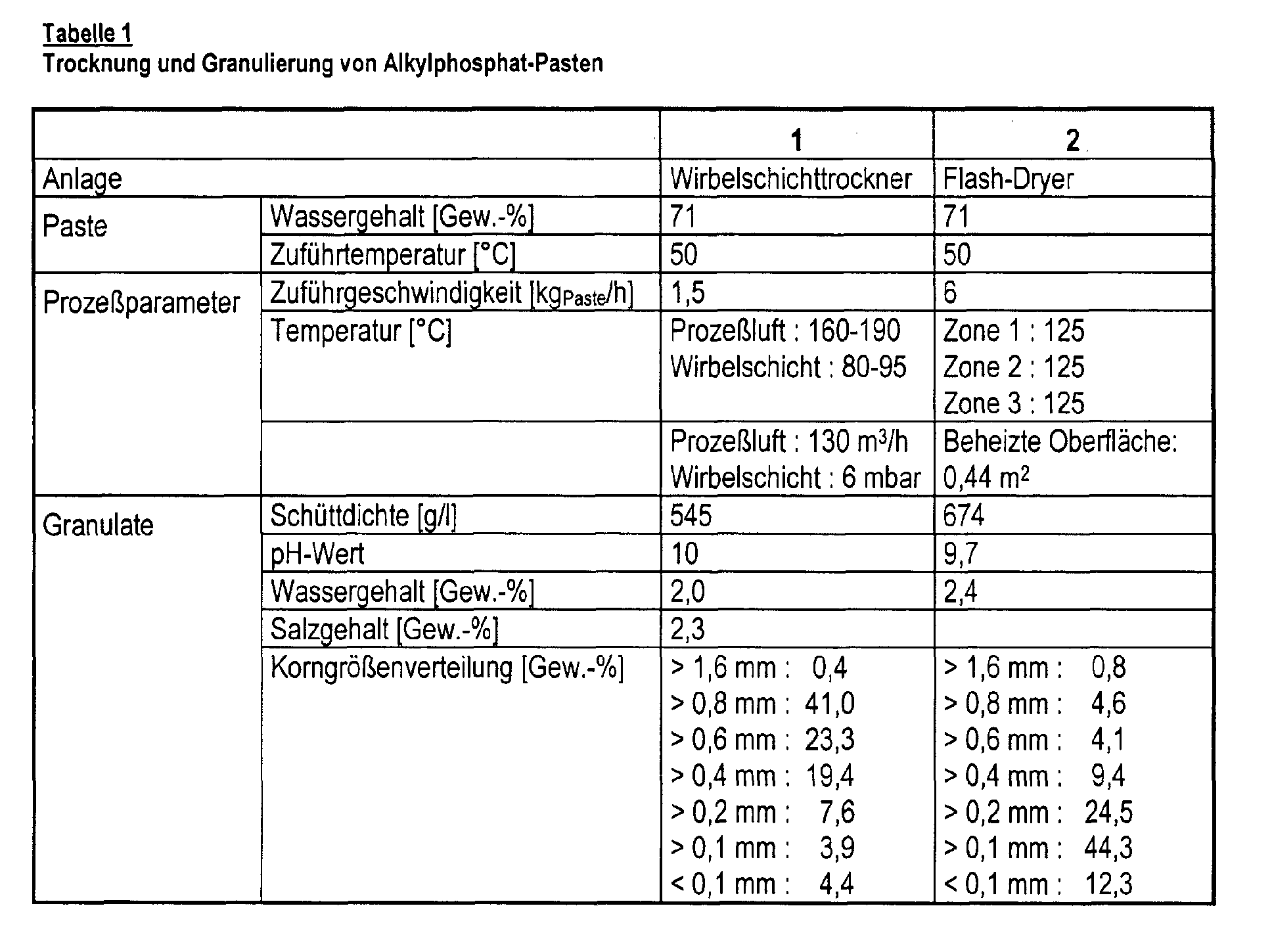
Eine wäßrige Paste von Cetylmonophosphat-Kaliumsalz wurde zum einen in einem Wirbelschichttrockner
der Firma Glatt (AGT 150) und zum anderen in einem Flash-Dryer der Firma VRV konfektioniert.
Die Ergebnisse sind in Tabelle 1 zusammengefaßt.
Claims (7)
- Verfahren zur Herstellung von wasser- und staubarmen Alkyl- und/oder Alkenylphosphatgranulaten mit hohem Schüttgewicht, bei dem man wäßrige Pasten von Alkyl- und/oder Alkenylphosphatsalzen mit einem Feststoffgehalt von mindestens 20 Gew.-% in der Wirbelschicht oder in der dünnen Schicht bis auf einen Restwassergehalt unterhalb von 2,5 Gew.-% gleichzeitig trocknet und in stückige Form bringt.
- Verfahren nach Anspruch 1, dadurch gekennzeichnet, daß man Granulate mit einem Schüttgewicht im Bereich von 500 bis 700 g/l herstellt.
- Verfahren nach den Ansprüchen 1 und/oder 2, dadurch gekennzeichnet, daß man wäßrige Pasten von Alkyl- und/oder Alkenylphosphaten der Formel (I) trocknet,in der R1 für einen linearen oder verzweigten Alkyl- und/oder Alkenylrest mit 6 bis 22 Kohlenstoffatomen und R2 und R3 unabhängig voneinander für Wasserstoff, Alkali, Erdalkali, Ammonium oder R1 stehen.

- Verfahren nach mindestens einem der Ansprüche 1 bis 3, dadurch gekennzeichnet, daß man wäßrige Pasten von Alkylphosphaten einsetzt, in der R1 für Alkylreste mit 12 bis 18 Kohlenstoffatomen und R2 und R3 für Alkali stehen.
- Verfahren nach mindestens einem der Ansprüche 1 bis 4, dadurch gekennzeichnet, daß man wäßrige Pasten von Alkyl- und/oder Alkenylphosphaten einsetzt, welche einen Aniontensidgehalt im Bereich von 20 bis 60 Gew.-% aufweisen.
- Verfahren nach mindestens einem der Ansprüche 1 bis 5, dadurch gekennzeichnet, daß man die Pasten in der Wirbelschicht bei Temperaturen im Bereich von 75 bis 100 °C trocknet.
- Verfahren nach mindestens einem der Ansprüche 1 bis 5, dadurch gekennzeichnet, daß man die Pasten in der dünnen Schicht bei Temperaturen im Bereich von 100 bis 200 °C trocknet.
Applications Claiming Priority (2)
| Application Number | Priority Date | Filing Date | Title |
|---|---|---|---|
| DE2000102709 DE10002709A1 (de) | 2000-01-22 | 2000-01-22 | Verfahren zur Herstellung von wasser- und staubarmen Alkyl- und/oder Alkenylphosphat-Granulaten |
| DE10002709 | 2000-01-22 |
Publications (1)
| Publication Number | Publication Date |
|---|---|
| EP1120456A1 true EP1120456A1 (de) | 2001-08-01 |
Family
ID=7628411
Family Applications (1)
| Application Number | Title | Priority Date | Filing Date |
|---|---|---|---|
| EP01100808A Withdrawn EP1120456A1 (de) | 2000-01-22 | 2001-01-15 | Verfahren zur Herstellung von Alkyl- und/oder Alkenylphosphat-Granulaten |
Country Status (2)
| Country | Link |
|---|---|
| EP (1) | EP1120456A1 (de) |
| DE (1) | DE10002709A1 (de) |
Cited By (2)
| Publication number | Priority date | Publication date | Assignee | Title |
|---|---|---|---|---|
| US7459578B2 (en) | 2004-09-24 | 2008-12-02 | Clariant Produkte (Deutschland) Gmbh | Process for the preparation of alk(en)ylphosphoric ester salts |
| US20240247012A1 (en) * | 2023-01-06 | 2024-07-25 | Galaxy Surfactants Ltd | Sustainable process for preparation of phosphoric monoesters and salts thereof |
Citations (4)
| Publication number | Priority date | Publication date | Assignee | Title |
|---|---|---|---|---|
| GB1311995A (en) * | 1970-04-23 | 1973-03-28 | Witco Chemical Corp | Process for preparing surface active phosphate esters |
| US4049558A (en) * | 1972-07-25 | 1977-09-20 | Colgate-Palmolive Co. | Free flowing phosphate ester compositions for post addition to detergents |
| WO1997003165A1 (de) * | 1995-07-10 | 1997-01-30 | Henkel Kommanditgesellschaft Auf Aktien | Verfahren zur herstellung von zuckertensidgranulaten |
| WO1998040461A1 (de) * | 1997-03-12 | 1998-09-17 | Cognis Deutschland Gmbh | Verfahren zur herstellung von aniontensidgranulaten |
-
2000
- 2000-01-22 DE DE2000102709 patent/DE10002709A1/de not_active Withdrawn
-
2001
- 2001-01-15 EP EP01100808A patent/EP1120456A1/de not_active Withdrawn
Patent Citations (4)
| Publication number | Priority date | Publication date | Assignee | Title |
|---|---|---|---|---|
| GB1311995A (en) * | 1970-04-23 | 1973-03-28 | Witco Chemical Corp | Process for preparing surface active phosphate esters |
| US4049558A (en) * | 1972-07-25 | 1977-09-20 | Colgate-Palmolive Co. | Free flowing phosphate ester compositions for post addition to detergents |
| WO1997003165A1 (de) * | 1995-07-10 | 1997-01-30 | Henkel Kommanditgesellschaft Auf Aktien | Verfahren zur herstellung von zuckertensidgranulaten |
| WO1998040461A1 (de) * | 1997-03-12 | 1998-09-17 | Cognis Deutschland Gmbh | Verfahren zur herstellung von aniontensidgranulaten |
Cited By (2)
| Publication number | Priority date | Publication date | Assignee | Title |
|---|---|---|---|---|
| US7459578B2 (en) | 2004-09-24 | 2008-12-02 | Clariant Produkte (Deutschland) Gmbh | Process for the preparation of alk(en)ylphosphoric ester salts |
| US20240247012A1 (en) * | 2023-01-06 | 2024-07-25 | Galaxy Surfactants Ltd | Sustainable process for preparation of phosphoric monoesters and salts thereof |
Also Published As
| Publication number | Publication date |
|---|---|
| DE10002709A1 (de) | 2001-07-26 |
Similar Documents
| Publication | Publication Date | Title |
|---|---|---|
| EP0603207B1 (de) | Verfahren zur herstellung von tensidgranulaten | |
| EP0632826B1 (de) | Verfahren zur herstellung rieselfähiger wasch- und reinigungsmittelgranulate und/oder -teilgranulate | |
| EP0150386A1 (de) | Zur Verwendung in tensidhaltigen Mitteln geeignetes Schaumregulierungsmittel | |
| DE2707280C2 (de) | Verfahren zur Herstellung freifließender Buildersalzteilchen sowie diese enthaltende Waschmittel | |
| DE19524464C2 (de) | Verfahren zur Herstellung von Zuckertensidgranulaten | |
| EP0863979B1 (de) | Verfahren zur herstellung wasser- und staubfreier zuckertensidgranulate | |
| EP0859048B1 (de) | Verfahren zur Herstellung von Tensidgranulaten | |
| EP1078029B1 (de) | Alkylsulfat-granulate | |
| DE10021113A1 (de) | Partikuläre Compounds, enthaltend nichtionische Tenside | |
| DE10002709A1 (de) | Verfahren zur Herstellung von wasser- und staubarmen Alkyl- und/oder Alkenylphosphat-Granulaten | |
| WO1995014519A1 (de) | Verfahren zur herstellung wasserfreier, rieselfähiger zuckertensidpulver | |
| EP1438383B1 (de) | Verfahren zur herstellung von wasch- und reinigungsmitteln | |
| DE19961333A1 (de) | Verfahren zur Herstellung von Zuckertensidgranulaten | |
| DE2138087B2 (de) | Kontinuierliches Verfahren zum Sprühtrocknen einer Detergens-Aufschlämmung und Vorrichtung zur Durchführung des Verfahrens | |
| DE10235942A1 (de) | Mittel und Vorrichtung sowie Verfahren zu seiner Herstellung | |
| EP0668905A1 (de) | Verfahren zur erleichterten reinigung von wertstoffen und/oder wertstoffgemischen aus dem bereich der netz-, wasch- und/oder reinigungsmittel sowie zugehöriger wertstoffe | |
| DE19641275C1 (de) | Verfahren zur Herstellung wasser- und staubfreier Aniontensidgranulate | |
| WO2000037593A2 (de) | Tensidgranulate | |
| DE19520105A1 (de) | Verfahren zur Herstellung wasserfreier, rieselfähiger Tensidpulver | |
| DE19853893A1 (de) | Verfahren zur Herstellung von Tensidgranulaten | |
| WO2025201605A1 (de) | Trocknungsverfahren | |
| WO1999036495A1 (de) | Homogene tensidgranulate für die herstellung von stückigen wasch- und reinigungsmitteln | |
| EP1007613A1 (de) | Verfahren zur herstellung wasser- und staubfreier aniontensidgranulate |
Legal Events
| Date | Code | Title | Description |
|---|---|---|---|
| PUAI | Public reference made under article 153(3) epc to a published international application that has entered the european phase |
Free format text: ORIGINAL CODE: 0009012 |
|
| 17P | Request for examination filed |
Effective date: 20010115 |
|
| AK | Designated contracting states |
Kind code of ref document: A1 Designated state(s): DE ES FR |
|
| AX | Request for extension of the european patent |
Free format text: AL;LT;LV;MK;RO;SI |
|
| AKX | Designation fees paid |
Free format text: DE ES FR |
|
| STAA | Information on the status of an ep patent application or granted ep patent |
Free format text: STATUS: THE APPLICATION IS DEEMED TO BE WITHDRAWN |
|
| 18D | Application deemed to be withdrawn |
Effective date: 20020202 |