EP1116484A2 - Verfahren zur Behandlung eines kosmetischen Mittels durch Bestrahlung mit NIR-Strahlung, sowie dessen Verwendung - Google Patents
Verfahren zur Behandlung eines kosmetischen Mittels durch Bestrahlung mit NIR-Strahlung, sowie dessen Verwendung Download PDFInfo
- Publication number
- EP1116484A2 EP1116484A2 EP00127655A EP00127655A EP1116484A2 EP 1116484 A2 EP1116484 A2 EP 1116484A2 EP 00127655 A EP00127655 A EP 00127655A EP 00127655 A EP00127655 A EP 00127655A EP 1116484 A2 EP1116484 A2 EP 1116484A2
- Authority
- EP
- European Patent Office
- Prior art keywords
- meth
- acrylate
- cosmetic agent
- hair
- cosmetic
- Prior art date
- Legal status (The legal status is an assumption and is not a legal conclusion. Google has not performed a legal analysis and makes no representation as to the accuracy of the status listed.)
- Withdrawn
Links
- 239000002537 cosmetic Substances 0.000 title claims abstract description 78
- 238000011282 treatment Methods 0.000 title claims abstract description 28
- -1 polysiloxane Polymers 0.000 claims description 111
- 230000005855 radiation Effects 0.000 claims description 52
- NIXOWILDQLNWCW-UHFFFAOYSA-M Acrylate Chemical compound [O-]C(=O)C=C NIXOWILDQLNWCW-UHFFFAOYSA-M 0.000 claims description 51
- 229920001577 copolymer Polymers 0.000 claims description 51
- 239000000203 mixture Substances 0.000 claims description 51
- 210000004209 hair Anatomy 0.000 claims description 48
- 229920000642 polymer Polymers 0.000 claims description 46
- 238000000034 method Methods 0.000 claims description 44
- WHNWPMSKXPGLAX-UHFFFAOYSA-N N-Vinyl-2-pyrrolidone Chemical compound C=CN1CCCC1=O WHNWPMSKXPGLAX-UHFFFAOYSA-N 0.000 claims description 29
- 150000001252 acrylic acid derivatives Chemical class 0.000 claims description 28
- 150000001875 compounds Chemical class 0.000 claims description 28
- 239000000839 emulsion Substances 0.000 claims description 26
- 239000003795 chemical substances by application Substances 0.000 claims description 22
- 239000006071 cream Substances 0.000 claims description 20
- 239000000654 additive Substances 0.000 claims description 19
- 229920000728 polyester Polymers 0.000 claims description 19
- CERQOIWHTDAKMF-UHFFFAOYSA-N Methacrylic acid Chemical compound CC(=C)C(O)=O CERQOIWHTDAKMF-UHFFFAOYSA-N 0.000 claims description 18
- SMZOUWXMTYCWNB-UHFFFAOYSA-N 2-(2-methoxy-5-methylphenyl)ethanamine Chemical compound COC1=CC=C(C)C=C1CCN SMZOUWXMTYCWNB-UHFFFAOYSA-N 0.000 claims description 17
- NIXOWILDQLNWCW-UHFFFAOYSA-N 2-Propenoic acid Natural products OC(=O)C=C NIXOWILDQLNWCW-UHFFFAOYSA-N 0.000 claims description 16
- 238000002360 preparation method Methods 0.000 claims description 16
- 239000004814 polyurethane Substances 0.000 claims description 14
- 238000006116 polymerization reaction Methods 0.000 claims description 13
- 229920002635 polyurethane Polymers 0.000 claims description 12
- 239000006210 lotion Substances 0.000 claims description 11
- 229920002554 vinyl polymer Polymers 0.000 claims description 11
- 229920001296 polysiloxane Polymers 0.000 claims description 9
- PPBRXRYQALVLMV-UHFFFAOYSA-N Styrene Chemical compound C=CC1=CC=CC=C1 PPBRXRYQALVLMV-UHFFFAOYSA-N 0.000 claims description 8
- LDHQCZJRKDOVOX-NSCUHMNNSA-N crotonic acid Chemical compound C\C=C\C(O)=O LDHQCZJRKDOVOX-NSCUHMNNSA-N 0.000 claims description 8
- 230000000694 effects Effects 0.000 claims description 8
- 229910052760 oxygen Inorganic materials 0.000 claims description 8
- MXRGSJAOLKBZLU-UHFFFAOYSA-N 3-ethenylazepan-2-one Chemical compound C=CC1CCCCNC1=O MXRGSJAOLKBZLU-UHFFFAOYSA-N 0.000 claims description 7
- 239000000975 dye Substances 0.000 claims description 7
- 229920000570 polyether Polymers 0.000 claims description 7
- OSSNTDFYBPYIEC-UHFFFAOYSA-N 1-ethenylimidazole Chemical compound C=CN1C=CN=C1 OSSNTDFYBPYIEC-UHFFFAOYSA-N 0.000 claims description 6
- 239000004593 Epoxy Substances 0.000 claims description 6
- BAPJBEWLBFYGME-UHFFFAOYSA-N Methyl acrylate Chemical compound COC(=O)C=C BAPJBEWLBFYGME-UHFFFAOYSA-N 0.000 claims description 6
- 239000004721 Polyphenylene oxide Substances 0.000 claims description 6
- 125000002091 cationic group Chemical group 0.000 claims description 6
- KWIUHFFTVRNATP-UHFFFAOYSA-N glycine betaine Chemical compound C[N+](C)(C)CC([O-])=O KWIUHFFTVRNATP-UHFFFAOYSA-N 0.000 claims description 6
- JDSHMPZPIAZGSV-UHFFFAOYSA-N melamine Chemical compound NC1=NC(N)=NC(N)=N1 JDSHMPZPIAZGSV-UHFFFAOYSA-N 0.000 claims description 6
- JOYRKODLDBILNP-UHFFFAOYSA-N Ethyl urethane Chemical compound CCOC(N)=O JOYRKODLDBILNP-UHFFFAOYSA-N 0.000 claims description 5
- 229920000877 Melamine resin Polymers 0.000 claims description 5
- XTXRWKRVRITETP-UHFFFAOYSA-N Vinyl acetate Chemical compound CC(=O)OC=C XTXRWKRVRITETP-UHFFFAOYSA-N 0.000 claims description 5
- 229910052739 hydrogen Inorganic materials 0.000 claims description 5
- 239000003999 initiator Substances 0.000 claims description 5
- 230000003020 moisturizing effect Effects 0.000 claims description 5
- 239000002884 skin cream Substances 0.000 claims description 5
- LDHQCZJRKDOVOX-UHFFFAOYSA-N trans-crotonic acid Natural products CC=CC(O)=O LDHQCZJRKDOVOX-UHFFFAOYSA-N 0.000 claims description 5
- 241000195940 Bryophyta Species 0.000 claims description 4
- 239000004952 Polyamide Substances 0.000 claims description 4
- 229960003237 betaine Drugs 0.000 claims description 4
- 239000012530 fluid Substances 0.000 claims description 4
- 235000011929 mousse Nutrition 0.000 claims description 4
- 229920002647 polyamide Polymers 0.000 claims description 4
- 230000008569 process Effects 0.000 claims description 4
- 229940088594 vitamin Drugs 0.000 claims description 4
- 235000013343 vitamin Nutrition 0.000 claims description 4
- 239000011782 vitamin Substances 0.000 claims description 4
- 229930003231 vitamin Natural products 0.000 claims description 4
- OMIGHNLMNHATMP-UHFFFAOYSA-N 2-hydroxyethyl prop-2-enoate Chemical compound OCCOC(=O)C=C OMIGHNLMNHATMP-UHFFFAOYSA-N 0.000 claims description 3
- JIGUQPWFLRLWPJ-UHFFFAOYSA-N Ethyl acrylate Chemical compound CCOC(=O)C=C JIGUQPWFLRLWPJ-UHFFFAOYSA-N 0.000 claims description 3
- VVQNEPGJFQJSBK-UHFFFAOYSA-N Methyl methacrylate Chemical compound COC(=O)C(C)=C VVQNEPGJFQJSBK-UHFFFAOYSA-N 0.000 claims description 3
- CQEYYJKEWSMYFG-UHFFFAOYSA-N butyl acrylate Chemical compound CCCCOC(=O)C=C CQEYYJKEWSMYFG-UHFFFAOYSA-N 0.000 claims description 3
- 239000003054 catalyst Substances 0.000 claims description 3
- UIWXSTHGICQLQT-UHFFFAOYSA-N ethenyl propanoate Chemical compound CCC(=O)OC=C UIWXSTHGICQLQT-UHFFFAOYSA-N 0.000 claims description 3
- 239000008266 hair spray Substances 0.000 claims description 3
- 239000001257 hydrogen Substances 0.000 claims description 3
- 230000002401 inhibitory effect Effects 0.000 claims description 3
- XFHJDMUEHUHAJW-UHFFFAOYSA-N n-tert-butylprop-2-enamide Chemical compound CC(C)(C)NC(=O)C=C XFHJDMUEHUHAJW-UHFFFAOYSA-N 0.000 claims description 3
- PNJWIWWMYCMZRO-UHFFFAOYSA-N pent‐4‐en‐2‐one Natural products CC(=O)CC=C PNJWIWWMYCMZRO-UHFFFAOYSA-N 0.000 claims description 3
- 125000002924 primary amino group Chemical group [H]N([H])* 0.000 claims description 3
- ISXSCDLOGDJUNJ-UHFFFAOYSA-N tert-butyl prop-2-enoate Chemical compound CC(C)(C)OC(=O)C=C ISXSCDLOGDJUNJ-UHFFFAOYSA-N 0.000 claims description 3
- 201000004384 Alopecia Diseases 0.000 claims description 2
- 208000001840 Dandruff Diseases 0.000 claims description 2
- 229920006243 acrylic copolymer Polymers 0.000 claims description 2
- 125000000129 anionic group Chemical group 0.000 claims description 2
- 230000001153 anti-wrinkle effect Effects 0.000 claims description 2
- 229920001222 biopolymer Polymers 0.000 claims description 2
- 238000004061 bleaching Methods 0.000 claims description 2
- 239000004088 foaming agent Substances 0.000 claims description 2
- 239000011521 glass Substances 0.000 claims description 2
- 239000000118 hair dye Substances 0.000 claims description 2
- 208000024963 hair loss Diseases 0.000 claims description 2
- 230000003676 hair loss Effects 0.000 claims description 2
- 230000007935 neutral effect Effects 0.000 claims description 2
- 238000006068 polycondensation reaction Methods 0.000 claims description 2
- 239000002453 shampoo Substances 0.000 claims description 2
- 229920006305 unsaturated polyester Polymers 0.000 claims description 2
- 150000003722 vitamin derivatives Chemical class 0.000 claims description 2
- LSAXGSQAWPCREP-UHFFFAOYSA-N 1-ethenyl-1-methyl-4,5-dihydroimidazol-1-ium Chemical class C=C[N+]1(C)CCN=C1 LSAXGSQAWPCREP-UHFFFAOYSA-N 0.000 claims 1
- 206010052428 Wound Diseases 0.000 claims 1
- 208000027418 Wounds and injury Diseases 0.000 claims 1
- VXTQKJXIZHSXBY-UHFFFAOYSA-N butan-2-yl 2-methylprop-2-enoate Chemical compound CCC(C)OC(=O)C(C)=C VXTQKJXIZHSXBY-UHFFFAOYSA-N 0.000 claims 1
- 239000003638 chemical reducing agent Substances 0.000 claims 1
- 125000003438 dodecyl group Chemical group [H]C([H])([H])C([H])([H])C([H])([H])C([H])([H])C([H])([H])C([H])([H])C([H])([H])C([H])([H])C([H])([H])C([H])([H])C([H])([H])C([H])([H])* 0.000 claims 1
- TVFJAZCVMOXQRK-UHFFFAOYSA-N ethenyl 7,7-dimethyloctanoate Chemical compound CC(C)(C)CCCCCC(=O)OC=C TVFJAZCVMOXQRK-UHFFFAOYSA-N 0.000 claims 1
- 125000004435 hydrogen atom Chemical group [H]* 0.000 claims 1
- 150000002484 inorganic compounds Chemical class 0.000 claims 1
- 229910010272 inorganic material Inorganic materials 0.000 claims 1
- 150000002605 large molecules Chemical class 0.000 claims 1
- 229920000867 polyelectrolyte Polymers 0.000 claims 1
- 229920000193 polymethacrylate Polymers 0.000 claims 1
- 229920000098 polyolefin Polymers 0.000 claims 1
- 229920001290 polyvinyl ester Polymers 0.000 claims 1
- 238000010526 radical polymerization reaction Methods 0.000 claims 1
- 150000003384 small molecules Chemical class 0.000 claims 1
- 125000004079 stearyl group Chemical group [H]C([*])([H])C([H])([H])C([H])([H])C([H])([H])C([H])([H])C([H])([H])C([H])([H])C([H])([H])C([H])([H])C([H])([H])C([H])([H])C([H])([H])C([H])([H])C([H])([H])C([H])([H])C([H])([H])C([H])([H])C([H])([H])[H] 0.000 claims 1
- LFQSCWFLJHTTHZ-UHFFFAOYSA-N Ethanol Chemical compound CCO LFQSCWFLJHTTHZ-UHFFFAOYSA-N 0.000 description 62
- XLYOFNOQVPJJNP-UHFFFAOYSA-N water Substances O XLYOFNOQVPJJNP-UHFFFAOYSA-N 0.000 description 45
- DNIAPMSPPWPWGF-UHFFFAOYSA-N Propylene glycol Chemical compound CC(O)CO DNIAPMSPPWPWGF-UHFFFAOYSA-N 0.000 description 36
- 239000003921 oil Substances 0.000 description 35
- 239000000178 monomer Substances 0.000 description 34
- 235000019198 oils Nutrition 0.000 description 33
- PEDCQBHIVMGVHV-UHFFFAOYSA-N Glycerine Chemical compound OCC(O)CO PEDCQBHIVMGVHV-UHFFFAOYSA-N 0.000 description 30
- 238000009472 formulation Methods 0.000 description 30
- 239000002304 perfume Substances 0.000 description 26
- 239000012071 phase Substances 0.000 description 23
- 239000000047 product Substances 0.000 description 20
- 150000002148 esters Chemical class 0.000 description 19
- 239000000126 substance Substances 0.000 description 19
- 229920000036 polyvinylpyrrolidone Polymers 0.000 description 17
- 235000014113 dietary fatty acids Nutrition 0.000 description 16
- 239000000194 fatty acid Substances 0.000 description 16
- 229930195729 fatty acid Natural products 0.000 description 16
- 235000013855 polyvinylpyrrolidone Nutrition 0.000 description 16
- 125000000217 alkyl group Chemical group 0.000 description 15
- 239000000344 soap Substances 0.000 description 15
- ATUOYWHBWRKTHZ-UHFFFAOYSA-N Propane Chemical compound CCC ATUOYWHBWRKTHZ-UHFFFAOYSA-N 0.000 description 14
- 239000002253 acid Substances 0.000 description 14
- 235000011187 glycerol Nutrition 0.000 description 14
- WSFSSNUMVMOOMR-UHFFFAOYSA-N Formaldehyde Chemical compound O=C WSFSSNUMVMOOMR-UHFFFAOYSA-N 0.000 description 13
- ZAKOWWREFLAJOT-CEFNRUSXSA-N D-alpha-tocopherylacetate Chemical compound CC(=O)OC1=C(C)C(C)=C2O[C@@](CCC[C@H](C)CCC[C@H](C)CCCC(C)C)(C)CCC2=C1C ZAKOWWREFLAJOT-CEFNRUSXSA-N 0.000 description 12
- LYCAIKOWRPUZTN-UHFFFAOYSA-N Ethylene glycol Chemical group OCCO LYCAIKOWRPUZTN-UHFFFAOYSA-N 0.000 description 12
- 239000000499 gel Substances 0.000 description 12
- 239000003755 preservative agent Substances 0.000 description 12
- CIHOLLKRGTVIJN-UHFFFAOYSA-N tert‐butyl hydroperoxide Chemical compound CC(C)(C)OO CIHOLLKRGTVIJN-UHFFFAOYSA-N 0.000 description 12
- 125000004432 carbon atom Chemical group C* 0.000 description 11
- 150000004665 fatty acids Chemical class 0.000 description 11
- 150000003839 salts Chemical class 0.000 description 11
- IAYPIBMASNFSPL-UHFFFAOYSA-N Ethylene oxide Chemical compound C1CO1 IAYPIBMASNFSPL-UHFFFAOYSA-N 0.000 description 10
- XSQUKJJJFZCRTK-UHFFFAOYSA-N Urea Chemical compound NC(N)=O XSQUKJJJFZCRTK-UHFFFAOYSA-N 0.000 description 10
- 230000000996 additive effect Effects 0.000 description 10
- 150000001298 alcohols Chemical class 0.000 description 10
- 210000000282 nail Anatomy 0.000 description 10
- GLDOVTGHNKAZLK-UHFFFAOYSA-N octadecan-1-ol Chemical compound CCCCCCCCCCCCCCCCCCO GLDOVTGHNKAZLK-UHFFFAOYSA-N 0.000 description 10
- VBICKXHEKHSIBG-UHFFFAOYSA-N 1-monostearoylglycerol Chemical compound CCCCCCCCCCCCCCCCCC(=O)OCC(O)CO VBICKXHEKHSIBG-UHFFFAOYSA-N 0.000 description 9
- SNPLKNRPJHDVJA-ZETCQYMHSA-N D-panthenol Chemical compound OCC(C)(C)[C@@H](O)C(=O)NCCCO SNPLKNRPJHDVJA-ZETCQYMHSA-N 0.000 description 9
- 239000004166 Lanolin Substances 0.000 description 9
- 229920004482 WACKER® Polymers 0.000 description 9
- 150000007513 acids Chemical class 0.000 description 9
- 238000006243 chemical reaction Methods 0.000 description 9
- KRKNYBCHXYNGOX-UHFFFAOYSA-N citric acid Chemical compound OC(=O)CC(O)(C(O)=O)CC(O)=O KRKNYBCHXYNGOX-UHFFFAOYSA-N 0.000 description 9
- 150000002191 fatty alcohols Chemical class 0.000 description 9
- 235000019388 lanolin Nutrition 0.000 description 9
- 229920002472 Starch Polymers 0.000 description 8
- 239000001273 butane Substances 0.000 description 8
- 239000001913 cellulose Substances 0.000 description 8
- 229920002678 cellulose Polymers 0.000 description 8
- 239000003995 emulsifying agent Substances 0.000 description 8
- 229940039717 lanolin Drugs 0.000 description 8
- 238000004519 manufacturing process Methods 0.000 description 8
- IJDNQMDRQITEOD-UHFFFAOYSA-N n-butane Chemical compound CCCC IJDNQMDRQITEOD-UHFFFAOYSA-N 0.000 description 8
- OFBQJSOFQDEBGM-UHFFFAOYSA-N n-pentane Natural products CCCCC OFBQJSOFQDEBGM-UHFFFAOYSA-N 0.000 description 8
- 230000002335 preservative effect Effects 0.000 description 8
- 235000013772 propylene glycol Nutrition 0.000 description 8
- 239000008107 starch Substances 0.000 description 8
- 235000019698 starch Nutrition 0.000 description 8
- 238000005406 washing Methods 0.000 description 8
- 239000004970 Chain extender Substances 0.000 description 7
- RTZKZFJDLAIYFH-UHFFFAOYSA-N Diethyl ether Chemical compound CCOCC RTZKZFJDLAIYFH-UHFFFAOYSA-N 0.000 description 7
- KFZMGEQAYNKOFK-UHFFFAOYSA-N Isopropanol Chemical compound CC(C)O KFZMGEQAYNKOFK-UHFFFAOYSA-N 0.000 description 7
- GOOHAUXETOMSMM-UHFFFAOYSA-N Propylene oxide Chemical compound CC1CO1 GOOHAUXETOMSMM-UHFFFAOYSA-N 0.000 description 7
- 150000001408 amides Chemical class 0.000 description 7
- WOWHHFRSBJGXCM-UHFFFAOYSA-M cetyltrimethylammonium chloride Chemical compound [Cl-].CCCCCCCCCCCCCCCC[N+](C)(C)C WOWHHFRSBJGXCM-UHFFFAOYSA-M 0.000 description 7
- 150000004985 diamines Chemical class 0.000 description 7
- 235000019197 fats Nutrition 0.000 description 7
- IQPQWNKOIGAROB-UHFFFAOYSA-N isocyanate group Chemical group [N-]=C=O IQPQWNKOIGAROB-UHFFFAOYSA-N 0.000 description 7
- 229920000191 poly(N-vinyl pyrrolidone) Polymers 0.000 description 7
- 229920000435 poly(dimethylsiloxane) Polymers 0.000 description 7
- 239000001294 propane Substances 0.000 description 7
- 150000003254 radicals Chemical class 0.000 description 7
- RFVNOJDQRGSOEL-UHFFFAOYSA-N 2-hydroxyethyl octadecanoate Chemical compound CCCCCCCCCCCCCCCCCC(=O)OCCO RFVNOJDQRGSOEL-UHFFFAOYSA-N 0.000 description 6
- LCGLNKUTAGEVQW-UHFFFAOYSA-N Dimethyl ether Chemical compound COC LCGLNKUTAGEVQW-UHFFFAOYSA-N 0.000 description 6
- VEXZGXHMUGYJMC-UHFFFAOYSA-N Hydrochloric acid Chemical compound Cl VEXZGXHMUGYJMC-UHFFFAOYSA-N 0.000 description 6
- 239000005662 Paraffin oil Substances 0.000 description 6
- HEMHJVSKTPXQMS-UHFFFAOYSA-M Sodium hydroxide Chemical compound [OH-].[Na+] HEMHJVSKTPXQMS-UHFFFAOYSA-M 0.000 description 6
- 229920000180 alkyd Polymers 0.000 description 6
- 150000001412 amines Chemical class 0.000 description 6
- 239000004205 dimethyl polysiloxane Substances 0.000 description 6
- 235000013870 dimethyl polysiloxane Nutrition 0.000 description 6
- UBHWBODXJBSFLH-UHFFFAOYSA-N hexadecan-1-ol;octadecan-1-ol Chemical compound CCCCCCCCCCCCCCCCO.CCCCCCCCCCCCCCCCCCO UBHWBODXJBSFLH-UHFFFAOYSA-N 0.000 description 6
- 125000002887 hydroxy group Chemical group [H]O* 0.000 description 6
- 229910052757 nitrogen Inorganic materials 0.000 description 6
- 229920001223 polyethylene glycol Polymers 0.000 description 6
- 229920000059 polyethylene glycol stearate Polymers 0.000 description 6
- 239000001267 polyvinylpyrrolidone Substances 0.000 description 6
- 238000003756 stirring Methods 0.000 description 6
- 239000001993 wax Substances 0.000 description 6
- ZKYCLDTVJCJYIB-UHFFFAOYSA-N 2-methylidenedecanamide Chemical compound CCCCCCCCC(=C)C(N)=O ZKYCLDTVJCJYIB-UHFFFAOYSA-N 0.000 description 5
- 235000004866 D-panthenol Nutrition 0.000 description 5
- 239000011703 D-panthenol Substances 0.000 description 5
- QYKIQEUNHZKYBP-UHFFFAOYSA-N Vinyl ether Chemical class C=COC=C QYKIQEUNHZKYBP-UHFFFAOYSA-N 0.000 description 5
- 239000002585 base Substances 0.000 description 5
- 235000013877 carbamide Nutrition 0.000 description 5
- 150000001735 carboxylic acids Chemical class 0.000 description 5
- 239000004359 castor oil Substances 0.000 description 5
- 235000019438 castor oil Nutrition 0.000 description 5
- 229940073639 ceteareth-6 Drugs 0.000 description 5
- 229940081733 cetearyl alcohol Drugs 0.000 description 5
- 229960003949 dexpanthenol Drugs 0.000 description 5
- DENRZWYUOJLTMF-UHFFFAOYSA-N diethyl sulfate Chemical compound CCOS(=O)(=O)OCC DENRZWYUOJLTMF-UHFFFAOYSA-N 0.000 description 5
- 229940008406 diethyl sulfate Drugs 0.000 description 5
- ZEMPKEQAKRGZGQ-XOQCFJPHSA-N glycerol triricinoleate Natural products CCCCCC[C@@H](O)CC=CCCCCCCCC(=O)OC[C@@H](COC(=O)CCCCCCCC=CC[C@@H](O)CCCCCC)OC(=O)CCCCCCCC=CC[C@H](O)CCCCCC ZEMPKEQAKRGZGQ-XOQCFJPHSA-N 0.000 description 5
- 239000004615 ingredient Substances 0.000 description 5
- 239000007788 liquid Substances 0.000 description 5
- 239000011777 magnesium Substances 0.000 description 5
- 125000002496 methyl group Chemical group [H]C([H])([H])* 0.000 description 5
- QYZFTMMPKCOTAN-UHFFFAOYSA-N n-[2-(2-hydroxyethylamino)ethyl]-2-[[1-[2-(2-hydroxyethylamino)ethylamino]-2-methyl-1-oxopropan-2-yl]diazenyl]-2-methylpropanamide Chemical compound OCCNCCNC(=O)C(C)(C)N=NC(C)(C)C(=O)NCCNCCO QYZFTMMPKCOTAN-UHFFFAOYSA-N 0.000 description 5
- GOQYKNQRPGWPLP-UHFFFAOYSA-N n-heptadecyl alcohol Natural products CCCCCCCCCCCCCCCCCO GOQYKNQRPGWPLP-UHFFFAOYSA-N 0.000 description 5
- 239000008389 polyethoxylated castor oil Substances 0.000 description 5
- 229920006395 saturated elastomer Polymers 0.000 description 5
- 239000011734 sodium Substances 0.000 description 5
- 239000007921 spray Substances 0.000 description 5
- OULAJFUGPPVRBK-UHFFFAOYSA-N tetratriacontan-1-ol Chemical compound CCCCCCCCCCCCCCCCCCCCCCCCCCCCCCCCCCO OULAJFUGPPVRBK-UHFFFAOYSA-N 0.000 description 5
- 239000002562 thickening agent Substances 0.000 description 5
- VZCYOOQTPOCHFL-UHFFFAOYSA-N trans-butenedioic acid Natural products OC(=O)C=CC(O)=O VZCYOOQTPOCHFL-UHFFFAOYSA-N 0.000 description 5
- 150000003626 triacylglycerols Chemical class 0.000 description 5
- 125000000391 vinyl group Chemical group [H]C([*])=C([H])[H] 0.000 description 5
- JKNCOURZONDCGV-UHFFFAOYSA-N 2-(dimethylamino)ethyl 2-methylprop-2-enoate Chemical compound CN(C)CCOC(=O)C(C)=C JKNCOURZONDCGV-UHFFFAOYSA-N 0.000 description 4
- QGZKDVFQNNGYKY-UHFFFAOYSA-N Ammonia Chemical compound N QGZKDVFQNNGYKY-UHFFFAOYSA-N 0.000 description 4
- CIWBSHSKHKDKBQ-JLAZNSOCSA-N Ascorbic acid Chemical compound OC[C@H](O)[C@H]1OC(=O)C(O)=C1O CIWBSHSKHKDKBQ-JLAZNSOCSA-N 0.000 description 4
- IJGRMHOSHXDMSA-UHFFFAOYSA-N Atomic nitrogen Chemical compound N#N IJGRMHOSHXDMSA-UHFFFAOYSA-N 0.000 description 4
- SOGAXMICEFXMKE-UHFFFAOYSA-N Butylmethacrylate Chemical compound CCCCOC(=O)C(C)=C SOGAXMICEFXMKE-UHFFFAOYSA-N 0.000 description 4
- VZCYOOQTPOCHFL-OWOJBTEDSA-N Fumaric acid Chemical compound OC(=O)\C=C\C(O)=O VZCYOOQTPOCHFL-OWOJBTEDSA-N 0.000 description 4
- DGAQECJNVWCQMB-PUAWFVPOSA-M Ilexoside XXIX Chemical compound C[C@@H]1CC[C@@]2(CC[C@@]3(C(=CC[C@H]4[C@]3(CC[C@@H]5[C@@]4(CC[C@@H](C5(C)C)OS(=O)(=O)[O-])C)C)[C@@H]2[C@]1(C)O)C)C(=O)O[C@H]6[C@@H]([C@H]([C@@H]([C@H](O6)CO)O)O)O.[Na+] DGAQECJNVWCQMB-PUAWFVPOSA-M 0.000 description 4
- LXEKPEMOWBOYRF-UHFFFAOYSA-N [2-[(1-azaniumyl-1-imino-2-methylpropan-2-yl)diazenyl]-2-methylpropanimidoyl]azanium;dichloride Chemical compound Cl.Cl.NC(=N)C(C)(C)N=NC(C)(C)C(N)=N LXEKPEMOWBOYRF-UHFFFAOYSA-N 0.000 description 4
- 229920006322 acrylamide copolymer Polymers 0.000 description 4
- 238000007792 addition Methods 0.000 description 4
- WNLRTRBMVRJNCN-UHFFFAOYSA-N adipic acid Chemical compound OC(=O)CCCCC(O)=O WNLRTRBMVRJNCN-UHFFFAOYSA-N 0.000 description 4
- CBTVGIZVANVGBH-UHFFFAOYSA-N aminomethyl propanol Chemical compound CC(C)(N)CO CBTVGIZVANVGBH-UHFFFAOYSA-N 0.000 description 4
- 230000008901 benefit Effects 0.000 description 4
- IISBACLAFKSPIT-UHFFFAOYSA-N bisphenol A Chemical compound C=1C=C(O)C=CC=1C(C)(C)C1=CC=C(O)C=C1 IISBACLAFKSPIT-UHFFFAOYSA-N 0.000 description 4
- 125000000484 butyl group Chemical group [H]C([*])([H])C([H])([H])C([H])([H])C([H])([H])[H] 0.000 description 4
- 239000011575 calcium Substances 0.000 description 4
- 239000004202 carbamide Substances 0.000 description 4
- 239000007795 chemical reaction product Substances 0.000 description 4
- 238000004132 cross linking Methods 0.000 description 4
- 239000003085 diluting agent Substances 0.000 description 4
- 239000000539 dimer Substances 0.000 description 4
- TVIDDXQYHWJXFK-UHFFFAOYSA-N dodecanedioic acid Chemical compound OC(=O)CCCCCCCCCCC(O)=O TVIDDXQYHWJXFK-UHFFFAOYSA-N 0.000 description 4
- 125000001495 ethyl group Chemical group [H]C([H])([H])C([H])([H])* 0.000 description 4
- 239000000834 fixative Substances 0.000 description 4
- BXWNKGSJHAJOGX-UHFFFAOYSA-N hexadecan-1-ol Chemical compound CCCCCCCCCCCCCCCCO BXWNKGSJHAJOGX-UHFFFAOYSA-N 0.000 description 4
- XJNUECKWDBNFJV-UHFFFAOYSA-N hexadecyl 2-ethylhexanoate Chemical compound CCCCCCCCCCCCCCCCOC(=O)C(CC)CCCC XJNUECKWDBNFJV-UHFFFAOYSA-N 0.000 description 4
- 229930195733 hydrocarbon Natural products 0.000 description 4
- 150000002430 hydrocarbons Chemical class 0.000 description 4
- 125000002768 hydroxyalkyl group Chemical group 0.000 description 4
- 239000012948 isocyanate Substances 0.000 description 4
- 150000002513 isocyanates Chemical class 0.000 description 4
- 229940119170 jojoba wax Drugs 0.000 description 4
- JVTAAEKCZFNVCJ-UHFFFAOYSA-N lactic acid Chemical compound CC(O)C(O)=O JVTAAEKCZFNVCJ-UHFFFAOYSA-N 0.000 description 4
- 229910052749 magnesium Inorganic materials 0.000 description 4
- VZCYOOQTPOCHFL-UPHRSURJSA-N maleic acid Chemical compound OC(=O)\C=C/C(O)=O VZCYOOQTPOCHFL-UPHRSURJSA-N 0.000 description 4
- QIQXTHQIDYTFRH-UHFFFAOYSA-N octadecanoic acid Chemical compound CCCCCCCCCCCCCCCCCC(O)=O QIQXTHQIDYTFRH-UHFFFAOYSA-N 0.000 description 4
- 229920000647 polyepoxide Polymers 0.000 description 4
- 229920005862 polyol Polymers 0.000 description 4
- 150000003077 polyols Chemical class 0.000 description 4
- CXMXRPHRNRROMY-UHFFFAOYSA-N sebacic acid Chemical compound OC(=O)CCCCCCCCC(O)=O CXMXRPHRNRROMY-UHFFFAOYSA-N 0.000 description 4
- 229910052708 sodium Inorganic materials 0.000 description 4
- 229940083542 sodium Drugs 0.000 description 4
- 239000002904 solvent Substances 0.000 description 4
- 239000000230 xanthan gum Substances 0.000 description 4
- 235000010493 xanthan gum Nutrition 0.000 description 4
- 229940082509 xanthan gum Drugs 0.000 description 4
- LAYAKLSFVAPMEL-UHFFFAOYSA-N 1-ethenoxydodecane Chemical compound CCCCCCCCCCCCOC=C LAYAKLSFVAPMEL-UHFFFAOYSA-N 0.000 description 3
- VILCJCGEZXAXTO-UHFFFAOYSA-N 2,2,2-tetramine Chemical class NCCNCCNCCN VILCJCGEZXAXTO-UHFFFAOYSA-N 0.000 description 3
- OSCJHTSDLYVCQC-UHFFFAOYSA-N 2-ethylhexyl 4-[[4-[4-(tert-butylcarbamoyl)anilino]-6-[4-(2-ethylhexoxycarbonyl)anilino]-1,3,5-triazin-2-yl]amino]benzoate Chemical compound C1=CC(C(=O)OCC(CC)CCCC)=CC=C1NC1=NC(NC=2C=CC(=CC=2)C(=O)NC(C)(C)C)=NC(NC=2C=CC(=CC=2)C(=O)OCC(CC)CCCC)=N1 OSCJHTSDLYVCQC-UHFFFAOYSA-N 0.000 description 3
- QCDWFXQBSFUVSP-UHFFFAOYSA-N 2-phenoxyethanol Chemical compound OCCOC1=CC=CC=C1 QCDWFXQBSFUVSP-UHFFFAOYSA-N 0.000 description 3
- HIQIXEFWDLTDED-UHFFFAOYSA-N 4-hydroxy-1-piperidin-4-ylpyrrolidin-2-one Chemical compound O=C1CC(O)CN1C1CCNCC1 HIQIXEFWDLTDED-UHFFFAOYSA-N 0.000 description 3
- QGZKDVFQNNGYKY-UHFFFAOYSA-O Ammonium Chemical compound [NH4+] QGZKDVFQNNGYKY-UHFFFAOYSA-O 0.000 description 3
- 229920001661 Chitosan Polymers 0.000 description 3
- 102000008186 Collagen Human genes 0.000 description 3
- 108010035532 Collagen Proteins 0.000 description 3
- FBPFZTCFMRRESA-FSIIMWSLSA-N D-Glucitol Natural products OC[C@H](O)[C@H](O)[C@@H](O)[C@H](O)CO FBPFZTCFMRRESA-FSIIMWSLSA-N 0.000 description 3
- FBPFZTCFMRRESA-JGWLITMVSA-N D-glucitol Chemical compound OC[C@H](O)[C@@H](O)[C@H](O)[C@H](O)CO FBPFZTCFMRRESA-JGWLITMVSA-N 0.000 description 3
- MQJKPEGWNLWLTK-UHFFFAOYSA-N Dapsone Chemical class C1=CC(N)=CC=C1S(=O)(=O)C1=CC=C(N)C=C1 MQJKPEGWNLWLTK-UHFFFAOYSA-N 0.000 description 3
- XMSXQFUHVRWGNA-UHFFFAOYSA-N Decamethylcyclopentasiloxane Chemical compound C[Si]1(C)O[Si](C)(C)O[Si](C)(C)O[Si](C)(C)O[Si](C)(C)O1 XMSXQFUHVRWGNA-UHFFFAOYSA-N 0.000 description 3
- RPNUMPOLZDHAAY-UHFFFAOYSA-N Diethylenetriamine Chemical class NCCNCCN RPNUMPOLZDHAAY-UHFFFAOYSA-N 0.000 description 3
- GDFCSMCGLZFNFY-UHFFFAOYSA-N Dimethylaminopropyl Methacrylamide Chemical compound CN(C)CCCNC(=O)C(C)=C GDFCSMCGLZFNFY-UHFFFAOYSA-N 0.000 description 3
- MHAJPDPJQMAIIY-UHFFFAOYSA-N Hydrogen peroxide Chemical compound OO MHAJPDPJQMAIIY-UHFFFAOYSA-N 0.000 description 3
- FYYHWMGAXLPEAU-UHFFFAOYSA-N Magnesium Chemical compound [Mg] FYYHWMGAXLPEAU-UHFFFAOYSA-N 0.000 description 3
- 229910019142 PO4 Inorganic materials 0.000 description 3
- OFOBLEOULBTSOW-UHFFFAOYSA-N Propanedioic acid Natural products OC(=O)CC(O)=O OFOBLEOULBTSOW-UHFFFAOYSA-N 0.000 description 3
- 235000021355 Stearic acid Nutrition 0.000 description 3
- WYURNTSHIVDZCO-UHFFFAOYSA-N Tetrahydrofuran Chemical compound C1CCOC1 WYURNTSHIVDZCO-UHFFFAOYSA-N 0.000 description 3
- GSEJCLTVZPLZKY-UHFFFAOYSA-N Triethanolamine Chemical compound OCCN(CCO)CCO GSEJCLTVZPLZKY-UHFFFAOYSA-N 0.000 description 3
- 235000010443 alginic acid Nutrition 0.000 description 3
- 229920000615 alginic acid Polymers 0.000 description 3
- 125000001931 aliphatic group Chemical group 0.000 description 3
- 125000002947 alkylene group Chemical group 0.000 description 3
- 239000002280 amphoteric surfactant Substances 0.000 description 3
- 239000008346 aqueous phase Substances 0.000 description 3
- 239000007864 aqueous solution Substances 0.000 description 3
- 125000003118 aryl group Chemical group 0.000 description 3
- 238000003287 bathing Methods 0.000 description 3
- 239000011230 binding agent Substances 0.000 description 3
- 229910052791 calcium Inorganic materials 0.000 description 3
- 229910052799 carbon Inorganic materials 0.000 description 3
- NEHMKBQYUWJMIP-NJFSPNSNSA-N chloro(114C)methane Chemical compound [14CH3]Cl NEHMKBQYUWJMIP-NJFSPNSNSA-N 0.000 description 3
- 229920001436 collagen Polymers 0.000 description 3
- ZAKOWWREFLAJOT-UHFFFAOYSA-N d-alpha-Tocopheryl acetate Natural products CC(=O)OC1=C(C)C(C)=C2OC(CCCC(C)CCCC(C)CCCC(C)C)(C)CCC2=C1C ZAKOWWREFLAJOT-UHFFFAOYSA-N 0.000 description 3
- 229940008099 dimethicone Drugs 0.000 description 3
- 150000002009 diols Chemical class 0.000 description 3
- 239000006185 dispersion Substances 0.000 description 3
- 239000003822 epoxy resin Substances 0.000 description 3
- 150000002170 ethers Chemical class 0.000 description 3
- 239000006260 foam Substances 0.000 description 3
- 150000004676 glycans Chemical class 0.000 description 3
- LNEPOXFFQSENCJ-UHFFFAOYSA-N haloperidol Chemical compound C1CC(O)(C=2C=CC(Cl)=CC=2)CCN1CCCC(=O)C1=CC=C(F)C=C1 LNEPOXFFQSENCJ-UHFFFAOYSA-N 0.000 description 3
- WGCNASOHLSPBMP-UHFFFAOYSA-N hydroxyacetaldehyde Natural products OCC=O WGCNASOHLSPBMP-UHFFFAOYSA-N 0.000 description 3
- 229910052500 inorganic mineral Inorganic materials 0.000 description 3
- 239000004611 light stabiliser Substances 0.000 description 3
- 239000011976 maleic acid Substances 0.000 description 3
- UOGMEBQRZBEZQT-UHFFFAOYSA-L manganese(2+);diacetate Chemical compound [Mn+2].CC([O-])=O.CC([O-])=O UOGMEBQRZBEZQT-UHFFFAOYSA-L 0.000 description 3
- ZQMHJBXHRFJKOT-UHFFFAOYSA-N methyl 2-[(1-methoxy-2-methyl-1-oxopropan-2-yl)diazenyl]-2-methylpropanoate Chemical compound COC(=O)C(C)(C)N=NC(C)(C)C(=O)OC ZQMHJBXHRFJKOT-UHFFFAOYSA-N 0.000 description 3
- 235000010755 mineral Nutrition 0.000 description 3
- 239000011707 mineral Substances 0.000 description 3
- 239000002480 mineral oil Substances 0.000 description 3
- OMNKZBIFPJNNIO-UHFFFAOYSA-N n-(2-methyl-4-oxopentan-2-yl)prop-2-enamide Chemical compound CC(=O)CC(C)(C)NC(=O)C=C OMNKZBIFPJNNIO-UHFFFAOYSA-N 0.000 description 3
- PNLUGRYDUHRLOF-UHFFFAOYSA-N n-ethenyl-n-methylacetamide Chemical compound C=CN(C)C(C)=O PNLUGRYDUHRLOF-UHFFFAOYSA-N 0.000 description 3
- ZQXSMRAEXCEDJD-UHFFFAOYSA-N n-ethenylformamide Chemical compound C=CNC=O ZQXSMRAEXCEDJD-UHFFFAOYSA-N 0.000 description 3
- 230000003472 neutralizing effect Effects 0.000 description 3
- OQCDKBAXFALNLD-UHFFFAOYSA-N octadecanoic acid Natural products CCCCCCCC(C)CCCCCCCCC(O)=O OQCDKBAXFALNLD-UHFFFAOYSA-N 0.000 description 3
- 239000004006 olive oil Substances 0.000 description 3
- 235000008390 olive oil Nutrition 0.000 description 3
- 239000001301 oxygen Substances 0.000 description 3
- 229940101267 panthenol Drugs 0.000 description 3
- 235000020957 pantothenol Nutrition 0.000 description 3
- 239000011619 pantothenol Substances 0.000 description 3
- 235000021317 phosphate Nutrition 0.000 description 3
- 229920001282 polysaccharide Polymers 0.000 description 3
- 239000005017 polysaccharide Substances 0.000 description 3
- 229920002451 polyvinyl alcohol Polymers 0.000 description 3
- 239000000843 powder Substances 0.000 description 3
- 238000005956 quaternization reaction Methods 0.000 description 3
- 239000005871 repellent Substances 0.000 description 3
- 230000002940 repellent Effects 0.000 description 3
- 238000007493 shaping process Methods 0.000 description 3
- 229920002545 silicone oil Polymers 0.000 description 3
- 239000000243 solution Substances 0.000 description 3
- 239000000600 sorbitol Substances 0.000 description 3
- 235000010356 sorbitol Nutrition 0.000 description 3
- 239000008117 stearic acid Substances 0.000 description 3
- 239000004094 surface-active agent Substances 0.000 description 3
- 125000000999 tert-butyl group Chemical group [H]C([H])([H])C(*)(C([H])([H])[H])C([H])([H])[H] 0.000 description 3
- UFTFJSFQGQCHQW-UHFFFAOYSA-N triformin Chemical compound O=COCC(OC=O)COC=O UFTFJSFQGQCHQW-UHFFFAOYSA-N 0.000 description 3
- 229940099259 vaseline Drugs 0.000 description 3
- 235000015112 vegetable and seed oil Nutrition 0.000 description 3
- PUPZLCDOIYMWBV-UHFFFAOYSA-N (+/-)-1,3-Butanediol Chemical compound CC(O)CCO PUPZLCDOIYMWBV-UHFFFAOYSA-N 0.000 description 2
- DSEKYWAQQVUQTP-XEWMWGOFSA-N (2r,4r,4as,6as,6as,6br,8ar,12ar,14as,14bs)-2-hydroxy-4,4a,6a,6b,8a,11,11,14a-octamethyl-2,4,5,6,6a,7,8,9,10,12,12a,13,14,14b-tetradecahydro-1h-picen-3-one Chemical compound C([C@H]1[C@]2(C)CC[C@@]34C)C(C)(C)CC[C@]1(C)CC[C@]2(C)[C@H]4CC[C@@]1(C)[C@H]3C[C@@H](O)C(=O)[C@@H]1C DSEKYWAQQVUQTP-XEWMWGOFSA-N 0.000 description 2
- KFYRJJBUHYILSO-YFKPBYRVSA-N (2s)-2-amino-3-dimethylarsanylsulfanyl-3-methylbutanoic acid Chemical compound C[As](C)SC(C)(C)[C@@H](N)C(O)=O KFYRJJBUHYILSO-YFKPBYRVSA-N 0.000 description 2
- PSGCQDPCAWOCSH-UHFFFAOYSA-N (4,7,7-trimethyl-3-bicyclo[2.2.1]heptanyl) prop-2-enoate Chemical compound C1CC2(C)C(OC(=O)C=C)CC1C2(C)C PSGCQDPCAWOCSH-UHFFFAOYSA-N 0.000 description 2
- UUGXDEDGRPYWHG-UHFFFAOYSA-N (dimethylamino)methyl 2-methylprop-2-enoate Chemical compound CN(C)COC(=O)C(C)=C UUGXDEDGRPYWHG-UHFFFAOYSA-N 0.000 description 2
- VSKCCZIUZNTICH-ZPYUXNTASA-N (e)-but-2-enoic acid;ethenyl acetate Chemical compound C\C=C\C(O)=O.CC(=O)OC=C VSKCCZIUZNTICH-ZPYUXNTASA-N 0.000 description 2
- GVJHHUAWPYXKBD-UHFFFAOYSA-N (±)-α-Tocopherol Chemical compound OC1=C(C)C(C)=C2OC(CCCC(C)CCCC(C)CCCC(C)C)(C)CCC2=C1C GVJHHUAWPYXKBD-UHFFFAOYSA-N 0.000 description 2
- MYRTYDVEIRVNKP-UHFFFAOYSA-N 1,2-Divinylbenzene Chemical compound C=CC1=CC=CC=C1C=C MYRTYDVEIRVNKP-UHFFFAOYSA-N 0.000 description 2
- IAUGBVWVWDTCJV-UHFFFAOYSA-N 1-(prop-2-enoylamino)propane-1-sulfonic acid Chemical compound CCC(S(O)(=O)=O)NC(=O)C=C IAUGBVWVWDTCJV-UHFFFAOYSA-N 0.000 description 2
- ZDQNWDNMNKSMHI-UHFFFAOYSA-N 1-[2-(2-prop-2-enoyloxypropoxy)propoxy]propan-2-yl prop-2-enoate Chemical compound C=CC(=O)OC(C)COC(C)COCC(C)OC(=O)C=C ZDQNWDNMNKSMHI-UHFFFAOYSA-N 0.000 description 2
- YAYNEUUHHLGGAH-UHFFFAOYSA-N 1-chlorododecane Chemical compound CCCCCCCCCCCCCl YAYNEUUHHLGGAH-UHFFFAOYSA-N 0.000 description 2
- BDHGFCVQWMDIQX-UHFFFAOYSA-N 1-ethenyl-2-methylimidazole Chemical compound CC1=NC=CN1C=C BDHGFCVQWMDIQX-UHFFFAOYSA-N 0.000 description 2
- OSSNTDFYBPYIEC-UHFFFAOYSA-O 1-ethenylimidazole;hydron Chemical class C=CN1C=C[NH+]=C1 OSSNTDFYBPYIEC-UHFFFAOYSA-O 0.000 description 2
- VOBUAPTXJKMNCT-UHFFFAOYSA-N 1-prop-2-enoyloxyhexyl prop-2-enoate Chemical compound CCCCCC(OC(=O)C=C)OC(=O)C=C VOBUAPTXJKMNCT-UHFFFAOYSA-N 0.000 description 2
- QRIMLDXJAPZHJE-UHFFFAOYSA-N 2,3-dihydroxypropyl 2-methylprop-2-enoate Chemical compound CC(=C)C(=O)OCC(O)CO QRIMLDXJAPZHJE-UHFFFAOYSA-N 0.000 description 2
- OWPUOLBODXJOKH-UHFFFAOYSA-N 2,3-dihydroxypropyl prop-2-enoate Chemical compound OCC(O)COC(=O)C=C OWPUOLBODXJOKH-UHFFFAOYSA-N 0.000 description 2
- AHDSRXYHVZECER-UHFFFAOYSA-N 2,4,6-tris[(dimethylamino)methyl]phenol Chemical compound CN(C)CC1=CC(CN(C)C)=C(O)C(CN(C)C)=C1 AHDSRXYHVZECER-UHFFFAOYSA-N 0.000 description 2
- GOXQRTZXKQZDDN-UHFFFAOYSA-N 2-Ethylhexyl acrylate Chemical compound CCCCC(CC)COC(=O)C=C GOXQRTZXKQZDDN-UHFFFAOYSA-N 0.000 description 2
- ZNQVEEAIQZEUHB-UHFFFAOYSA-N 2-ethoxyethanol Chemical compound CCOCCO ZNQVEEAIQZEUHB-UHFFFAOYSA-N 0.000 description 2
- WROUWQQRXUBECT-UHFFFAOYSA-N 2-ethylacrylic acid Chemical compound CCC(=C)C(O)=O WROUWQQRXUBECT-UHFFFAOYSA-N 0.000 description 2
- JGUMTYWKIBJSTN-UHFFFAOYSA-N 2-ethylhexyl 4-[[4,6-bis[4-(2-ethylhexoxycarbonyl)anilino]-1,3,5-triazin-2-yl]amino]benzoate Chemical compound C1=CC(C(=O)OCC(CC)CCCC)=CC=C1NC1=NC(NC=2C=CC(=CC=2)C(=O)OCC(CC)CCCC)=NC(NC=2C=CC(=CC=2)C(=O)OCC(CC)CCCC)=N1 JGUMTYWKIBJSTN-UHFFFAOYSA-N 0.000 description 2
- 125000000954 2-hydroxyethyl group Chemical group [H]C([*])([H])C([H])([H])O[H] 0.000 description 2
- 125000004200 2-methoxyethyl group Chemical group [H]C([H])([H])OC([H])([H])C([H])([H])* 0.000 description 2
- SVTBMSDMJJWYQN-UHFFFAOYSA-N 2-methylpentane-2,4-diol Chemical compound CC(O)CC(C)(C)O SVTBMSDMJJWYQN-UHFFFAOYSA-N 0.000 description 2
- RUMACXVDVNRZJZ-UHFFFAOYSA-N 2-methylpropyl 2-methylprop-2-enoate Chemical compound CC(C)COC(=O)C(C)=C RUMACXVDVNRZJZ-UHFFFAOYSA-N 0.000 description 2
- CFVWNXQPGQOHRJ-UHFFFAOYSA-N 2-methylpropyl prop-2-enoate Chemical compound CC(C)COC(=O)C=C CFVWNXQPGQOHRJ-UHFFFAOYSA-N 0.000 description 2
- 125000003903 2-propenyl group Chemical group [H]C([*])([H])C([H])=C([H])[H] 0.000 description 2
- KGIGUEBEKRSTEW-UHFFFAOYSA-N 2-vinylpyridine Chemical compound C=CC1=CC=CC=N1 KGIGUEBEKRSTEW-UHFFFAOYSA-N 0.000 description 2
- AVXWWBFBRTXBRM-UHFFFAOYSA-N 3-bromopyridine-4-carboxylic acid Chemical compound OC(=O)C1=CC=NC=C1Br AVXWWBFBRTXBRM-UHFFFAOYSA-N 0.000 description 2
- GNSFRPWPOGYVLO-UHFFFAOYSA-N 3-hydroxypropyl 2-methylprop-2-enoate Chemical compound CC(=C)C(=O)OCCCO GNSFRPWPOGYVLO-UHFFFAOYSA-N 0.000 description 2
- QZPSOSOOLFHYRR-UHFFFAOYSA-N 3-hydroxypropyl prop-2-enoate Chemical class OCCCOC(=O)C=C QZPSOSOOLFHYRR-UHFFFAOYSA-N 0.000 description 2
- ATVJXMYDOSMEPO-UHFFFAOYSA-N 3-prop-2-enoxyprop-1-ene Chemical compound C=CCOCC=C ATVJXMYDOSMEPO-UHFFFAOYSA-N 0.000 description 2
- DCQBZYNUSLHVJC-UHFFFAOYSA-N 3-triethoxysilylpropane-1-thiol Chemical compound CCO[Si](OCC)(OCC)CCCS DCQBZYNUSLHVJC-UHFFFAOYSA-N 0.000 description 2
- YBRVSVVVWCFQMG-UHFFFAOYSA-N 4,4'-diaminodiphenylmethane Chemical compound C1=CC(N)=CC=C1CC1=CC=C(N)C=C1 YBRVSVVVWCFQMG-UHFFFAOYSA-N 0.000 description 2
- FKAJZOZTZXQGTJ-UHFFFAOYSA-N 5,5-dimethyl-1,3-diazabicyclo[2.2.0]hex-3-ene Chemical compound C1N2C(C1(C)C)=NC2 FKAJZOZTZXQGTJ-UHFFFAOYSA-N 0.000 description 2
- HRPVXLWXLXDGHG-UHFFFAOYSA-N Acrylamide Chemical compound NC(=O)C=C HRPVXLWXLXDGHG-UHFFFAOYSA-N 0.000 description 2
- OMPJBNCRMGITSC-UHFFFAOYSA-N Benzoylperoxide Chemical compound C=1C=CC=CC=1C(=O)OOC(=O)C1=CC=CC=C1 OMPJBNCRMGITSC-UHFFFAOYSA-N 0.000 description 2
- WVDDGKGOMKODPV-UHFFFAOYSA-N Benzyl alcohol Chemical compound OCC1=CC=CC=C1 WVDDGKGOMKODPV-UHFFFAOYSA-N 0.000 description 2
- 239000004604 Blowing Agent Substances 0.000 description 2
- KAKZBPTYRLMSJV-UHFFFAOYSA-N Butadiene Chemical compound C=CC=C KAKZBPTYRLMSJV-UHFFFAOYSA-N 0.000 description 2
- OYPRJOBELJOOCE-UHFFFAOYSA-N Calcium Chemical compound [Ca] OYPRJOBELJOOCE-UHFFFAOYSA-N 0.000 description 2
- CURLTUGMZLYLDI-UHFFFAOYSA-N Carbon dioxide Chemical compound O=C=O CURLTUGMZLYLDI-UHFFFAOYSA-N 0.000 description 2
- 229920002134 Carboxymethyl cellulose Polymers 0.000 description 2
- 244000060011 Cocos nucifera Species 0.000 description 2
- 235000013162 Cocos nucifera Nutrition 0.000 description 2
- 239000004971 Cross linker Substances 0.000 description 2
- 244000303965 Cyamopsis psoralioides Species 0.000 description 2
- SJIXRGNQPBQWMK-UHFFFAOYSA-N DEAEMA Natural products CCN(CC)CCOC(=O)C(C)=C SJIXRGNQPBQWMK-UHFFFAOYSA-N 0.000 description 2
- FEWJPZIEWOKRBE-JCYAYHJZSA-N Dextrotartaric acid Chemical compound OC(=O)[C@H](O)[C@@H](O)C(O)=O FEWJPZIEWOKRBE-JCYAYHJZSA-N 0.000 description 2
- KCXVZYZYPLLWCC-UHFFFAOYSA-N EDTA Chemical compound OC(=O)CN(CC(O)=O)CCN(CC(O)=O)CC(O)=O KCXVZYZYPLLWCC-UHFFFAOYSA-N 0.000 description 2
- BRLQWZUYTZBJKN-UHFFFAOYSA-N Epichlorohydrin Chemical compound ClCC1CO1 BRLQWZUYTZBJKN-UHFFFAOYSA-N 0.000 description 2
- 241000192125 Firmicutes Species 0.000 description 2
- WOBHKFSMXKNTIM-UHFFFAOYSA-N Hydroxyethyl methacrylate Chemical compound CC(=C)C(=O)OCCO WOBHKFSMXKNTIM-UHFFFAOYSA-N 0.000 description 2
- RRHGJUQNOFWUDK-UHFFFAOYSA-N Isoprene Chemical compound CC(=C)C=C RRHGJUQNOFWUDK-UHFFFAOYSA-N 0.000 description 2
- KDXKERNSBIXSRK-UHFFFAOYSA-N Lysine Natural products NCCCCC(N)C(O)=O KDXKERNSBIXSRK-UHFFFAOYSA-N 0.000 description 2
- 239000004472 Lysine Substances 0.000 description 2
- CSNNHWWHGAXBCP-UHFFFAOYSA-L Magnesium sulfate Chemical compound [Mg+2].[O-][S+2]([O-])([O-])[O-] CSNNHWWHGAXBCP-UHFFFAOYSA-L 0.000 description 2
- 241001465754 Metazoa Species 0.000 description 2
- KWIUHFFTVRNATP-UHFFFAOYSA-O N,N,N-trimethylglycinium Chemical compound C[N+](C)(C)CC(O)=O KWIUHFFTVRNATP-UHFFFAOYSA-O 0.000 description 2
- YBGZDTIWKVFICR-JLHYYAGUSA-N Octyl 4-methoxycinnamic acid Chemical compound CCCCC(CC)COC(=O)\C=C\C1=CC=C(OC)C=C1 YBGZDTIWKVFICR-JLHYYAGUSA-N 0.000 description 2
- NBIIXXVUZAFLBC-UHFFFAOYSA-N Phosphoric acid Chemical compound OP(O)(O)=O NBIIXXVUZAFLBC-UHFFFAOYSA-N 0.000 description 2
- 239000002202 Polyethylene glycol Substances 0.000 description 2
- 239000004372 Polyvinyl alcohol Substances 0.000 description 2
- ZLMJMSJWJFRBEC-UHFFFAOYSA-N Potassium Chemical compound [K] ZLMJMSJWJFRBEC-UHFFFAOYSA-N 0.000 description 2
- CDBYLPFSWZWCQE-UHFFFAOYSA-L Sodium Carbonate Chemical compound [Na+].[Na+].[O-]C([O-])=O CDBYLPFSWZWCQE-UHFFFAOYSA-L 0.000 description 2
- FAPWRFPIFSIZLT-UHFFFAOYSA-M Sodium chloride Chemical compound [Na+].[Cl-] FAPWRFPIFSIZLT-UHFFFAOYSA-M 0.000 description 2
- 229920002125 Sokalan® Polymers 0.000 description 2
- QAOWNCQODCNURD-UHFFFAOYSA-N Sulfuric acid Chemical compound OS(O)(=O)=O QAOWNCQODCNURD-UHFFFAOYSA-N 0.000 description 2
- FEWJPZIEWOKRBE-UHFFFAOYSA-N Tartaric acid Natural products [H+].[H+].[O-]C(=O)C(O)C(O)C([O-])=O FEWJPZIEWOKRBE-UHFFFAOYSA-N 0.000 description 2
- XEFQLINVKFYRCS-UHFFFAOYSA-N Triclosan Chemical compound OC1=CC(Cl)=CC=C1OC1=CC=C(Cl)C=C1Cl XEFQLINVKFYRCS-UHFFFAOYSA-N 0.000 description 2
- ZJCCRDAZUWHFQH-UHFFFAOYSA-N Trimethylolpropane Chemical compound CCC(CO)(CO)CO ZJCCRDAZUWHFQH-UHFFFAOYSA-N 0.000 description 2
- 230000006750 UV protection Effects 0.000 description 2
- 240000006365 Vitis vinifera Species 0.000 description 2
- 235000014787 Vitis vinifera Nutrition 0.000 description 2
- XLOMVQKBTHCTTD-UHFFFAOYSA-N Zinc monoxide Chemical compound [Zn]=O XLOMVQKBTHCTTD-UHFFFAOYSA-N 0.000 description 2
- YIMQCDZDWXUDCA-UHFFFAOYSA-N [4-(hydroxymethyl)cyclohexyl]methanol Chemical compound OCC1CCC(CO)CC1 YIMQCDZDWXUDCA-UHFFFAOYSA-N 0.000 description 2
- 150000001253 acrylic acids Chemical class 0.000 description 2
- 239000001361 adipic acid Substances 0.000 description 2
- 235000011037 adipic acid Nutrition 0.000 description 2
- 150000001338 aliphatic hydrocarbons Chemical class 0.000 description 2
- 229910052784 alkaline earth metal Inorganic materials 0.000 description 2
- 125000003282 alkyl amino group Chemical group 0.000 description 2
- 125000005210 alkyl ammonium group Chemical group 0.000 description 2
- FPIPGXGPPPQFEQ-OVSJKPMPSA-N all-trans-retinol Chemical compound OC\C=C(/C)\C=C\C=C(/C)\C=C\C1=C(C)CCCC1(C)C FPIPGXGPPPQFEQ-OVSJKPMPSA-N 0.000 description 2
- XXROGKLTLUQVRX-UHFFFAOYSA-N allyl alcohol Chemical compound OCC=C XXROGKLTLUQVRX-UHFFFAOYSA-N 0.000 description 2
- 239000008168 almond oil Substances 0.000 description 2
- 229910052782 aluminium Inorganic materials 0.000 description 2
- 150000001414 amino alcohols Chemical class 0.000 description 2
- 229910021529 ammonia Inorganic materials 0.000 description 2
- 150000003863 ammonium salts Chemical class 0.000 description 2
- 239000010775 animal oil Substances 0.000 description 2
- 239000003945 anionic surfactant Substances 0.000 description 2
- 239000000058 anti acne agent Substances 0.000 description 2
- 230000000845 anti-microbial effect Effects 0.000 description 2
- 229940124340 antiacne agent Drugs 0.000 description 2
- 235000010323 ascorbic acid Nutrition 0.000 description 2
- 229960005070 ascorbic acid Drugs 0.000 description 2
- 239000011668 ascorbic acid Substances 0.000 description 2
- QVGXLLKOCUKJST-UHFFFAOYSA-N atomic oxygen Chemical compound [O] QVGXLLKOCUKJST-UHFFFAOYSA-N 0.000 description 2
- 235000021302 avocado oil Nutrition 0.000 description 2
- 239000008163 avocado oil Substances 0.000 description 2
- 239000003788 bath preparation Substances 0.000 description 2
- 235000013871 bee wax Nutrition 0.000 description 2
- 239000012166 beeswax Substances 0.000 description 2
- 235000019400 benzoyl peroxide Nutrition 0.000 description 2
- WPKWPKDNOPEODE-UHFFFAOYSA-N bis(2,4,4-trimethylpentan-2-yl)diazene Chemical compound CC(C)(C)CC(C)(C)N=NC(C)(C)CC(C)(C)C WPKWPKDNOPEODE-UHFFFAOYSA-N 0.000 description 2
- WTEOIRVLGSZEPR-UHFFFAOYSA-N boron trifluoride Chemical compound FB(F)F WTEOIRVLGSZEPR-UHFFFAOYSA-N 0.000 description 2
- GZUXJHMPEANEGY-UHFFFAOYSA-N bromomethane Chemical compound BrC GZUXJHMPEANEGY-UHFFFAOYSA-N 0.000 description 2
- IAQRGUVFOMOMEM-UHFFFAOYSA-N but-2-ene Chemical compound CC=CC IAQRGUVFOMOMEM-UHFFFAOYSA-N 0.000 description 2
- FUSUHKVFWTUUBE-UHFFFAOYSA-N buten-2-one Chemical compound CC(=O)C=C FUSUHKVFWTUUBE-UHFFFAOYSA-N 0.000 description 2
- 150000001718 carbodiimides Chemical class 0.000 description 2
- 239000011203 carbon fibre reinforced carbon Substances 0.000 description 2
- 239000001768 carboxy methyl cellulose Substances 0.000 description 2
- 235000010948 carboxy methyl cellulose Nutrition 0.000 description 2
- 239000008112 carboxymethyl-cellulose Substances 0.000 description 2
- 229920006317 cationic polymer Polymers 0.000 description 2
- 239000003093 cationic surfactant Substances 0.000 description 2
- 229960000541 cetyl alcohol Drugs 0.000 description 2
- 239000011248 coating agent Substances 0.000 description 2
- MRUAUOIMASANKQ-UHFFFAOYSA-N cocamidopropyl betaine Chemical compound CCCCCCCCCCCC(=O)NCCC[N+](C)(C)CC([O-])=O MRUAUOIMASANKQ-UHFFFAOYSA-N 0.000 description 2
- 229940073507 cocamidopropyl betaine Drugs 0.000 description 2
- 238000010276 construction Methods 0.000 description 2
- MGNZXYYWBUKAII-UHFFFAOYSA-N cyclohexa-1,3-diene Chemical compound C1CC=CC=C1 MGNZXYYWBUKAII-UHFFFAOYSA-N 0.000 description 2
- 239000002274 desiccant Substances 0.000 description 2
- ZQMIGQNCOMNODD-UHFFFAOYSA-N diacetyl peroxide Chemical compound CC(=O)OOC(C)=O ZQMIGQNCOMNODD-UHFFFAOYSA-N 0.000 description 2
- 125000004386 diacrylate group Chemical group 0.000 description 2
- 125000005131 dialkylammonium group Chemical group 0.000 description 2
- 150000001983 dialkylethers Chemical class 0.000 description 2
- MTHSVFCYNBDYFN-UHFFFAOYSA-N diethylene glycol Chemical compound OCCOCCO MTHSVFCYNBDYFN-UHFFFAOYSA-N 0.000 description 2
- VAYGXNSJCAHWJZ-UHFFFAOYSA-N dimethyl sulfate Chemical compound COS(=O)(=O)OC VAYGXNSJCAHWJZ-UHFFFAOYSA-N 0.000 description 2
- ROSDSFDQCJNGOL-UHFFFAOYSA-O dimethylaminium Chemical compound C[NH2+]C ROSDSFDQCJNGOL-UHFFFAOYSA-O 0.000 description 2
- 238000004821 distillation Methods 0.000 description 2
- 125000003700 epoxy group Chemical group 0.000 description 2
- JBKVHLHDHHXQEQ-UHFFFAOYSA-N epsilon-caprolactam Chemical compound O=C1CCCCCN1 JBKVHLHDHHXQEQ-UHFFFAOYSA-N 0.000 description 2
- 125000006232 ethoxy propyl group Chemical group [H]C([H])([H])C([H])([H])OC([H])([H])C([H])([H])C([H])([H])* 0.000 description 2
- SUPCQIBBMFXVTL-UHFFFAOYSA-N ethyl 2-methylprop-2-enoate Chemical compound CCOC(=O)C(C)=C SUPCQIBBMFXVTL-UHFFFAOYSA-N 0.000 description 2
- LIWAQLJGPBVORC-UHFFFAOYSA-N ethylmethylamine Chemical compound CCNC LIWAQLJGPBVORC-UHFFFAOYSA-N 0.000 description 2
- RRAFCDWBNXTKKO-UHFFFAOYSA-N eugenol Chemical compound COC1=CC(CC=C)=CC=C1O RRAFCDWBNXTKKO-UHFFFAOYSA-N 0.000 description 2
- 239000003205 fragrance Substances 0.000 description 2
- 239000001530 fumaric acid Substances 0.000 description 2
- FOYKKGHVWRFIBD-UHFFFAOYSA-N gamma-tocopherol acetate Natural products CC(=O)OC1=C(C)C(C)=C2OC(CCCC(C)CCCC(C)CCCC(C)C)(C)CCC2=C1 FOYKKGHVWRFIBD-UHFFFAOYSA-N 0.000 description 2
- 239000003349 gelling agent Substances 0.000 description 2
- YQEMORVAKMFKLG-UHFFFAOYSA-N glycerine monostearate Natural products CCCCCCCCCCCCCCCCCC(=O)OC(CO)CO YQEMORVAKMFKLG-UHFFFAOYSA-N 0.000 description 2
- SVUQHVRAGMNPLW-UHFFFAOYSA-N glycerol monostearate Natural products CCCCCCCCCCCCCCCCC(=O)OCC(O)CO SVUQHVRAGMNPLW-UHFFFAOYSA-N 0.000 description 2
- 229940075529 glyceryl stearate Drugs 0.000 description 2
- 229940049294 glyceryl stearate se Drugs 0.000 description 2
- 229940093915 gynecological organic acid Drugs 0.000 description 2
- 239000003676 hair preparation Substances 0.000 description 2
- 235000010299 hexamethylene tetramine Nutrition 0.000 description 2
- VKYKSIONXSXAKP-UHFFFAOYSA-N hexamethylenetetramine Chemical compound C1N(C2)CN3CN1CN2C3 VKYKSIONXSXAKP-UHFFFAOYSA-N 0.000 description 2
- 239000003906 humectant Substances 0.000 description 2
- 239000003112 inhibitor Substances 0.000 description 2
- 125000001449 isopropyl group Chemical group [H]C([H])([H])C([H])(*)C([H])([H])[H] 0.000 description 2
- 239000004310 lactic acid Substances 0.000 description 2
- 235000014655 lactic acid Nutrition 0.000 description 2
- 150000002596 lactones Chemical class 0.000 description 2
- 229920002521 macromolecule Polymers 0.000 description 2
- FPYJFEHAWHCUMM-UHFFFAOYSA-N maleic anhydride Chemical compound O=C1OC(=O)C=C1 FPYJFEHAWHCUMM-UHFFFAOYSA-N 0.000 description 2
- 239000000463 material Substances 0.000 description 2
- FQPSGWSUVKBHSU-UHFFFAOYSA-N methacrylamide Chemical class CC(=C)C(N)=O FQPSGWSUVKBHSU-UHFFFAOYSA-N 0.000 description 2
- BDAGIHXWWSANSR-UHFFFAOYSA-N methanoic acid Natural products OC=O BDAGIHXWWSANSR-UHFFFAOYSA-N 0.000 description 2
- LXCFILQKKLGQFO-UHFFFAOYSA-N methylparaben Chemical compound COC(=O)C1=CC=C(O)C=C1 LXCFILQKKLGQFO-UHFFFAOYSA-N 0.000 description 2
- AWGZKFQMWZYCHF-UHFFFAOYSA-N n-octylprop-2-enamide Chemical compound CCCCCCCCNC(=O)C=C AWGZKFQMWZYCHF-UHFFFAOYSA-N 0.000 description 2
- 239000002736 nonionic surfactant Substances 0.000 description 2
- HMMGMWAXVFQUOA-UHFFFAOYSA-N octamethylcyclotetrasiloxane Chemical compound C[Si]1(C)O[Si](C)(C)O[Si](C)(C)O[Si](C)(C)O1 HMMGMWAXVFQUOA-UHFFFAOYSA-N 0.000 description 2
- 150000007524 organic acids Chemical class 0.000 description 2
- 235000005985 organic acids Nutrition 0.000 description 2
- SSZBUIDZHHWXNJ-UHFFFAOYSA-N palmityl stearate Chemical compound CCCCCCCCCCCCCCCCCC(=O)OCCCCCCCCCCCCCCCC SSZBUIDZHHWXNJ-UHFFFAOYSA-N 0.000 description 2
- WXZMFSXDPGVJKK-UHFFFAOYSA-N pentaerythritol Chemical compound OCC(CO)(CO)CO WXZMFSXDPGVJKK-UHFFFAOYSA-N 0.000 description 2
- 150000002978 peroxides Chemical class 0.000 description 2
- 229960005323 phenoxyethanol Drugs 0.000 description 2
- 125000001997 phenyl group Chemical group [H]C1=C([H])C([H])=C(*)C([H])=C1[H] 0.000 description 2
- 229920000058 polyacrylate Polymers 0.000 description 2
- 229920000768 polyamine Polymers 0.000 description 2
- 229940068918 polyethylene glycol 400 Drugs 0.000 description 2
- 229920001228 polyisocyanate Polymers 0.000 description 2
- 239000005056 polyisocyanate Substances 0.000 description 2
- 239000011591 potassium Substances 0.000 description 2
- 229910052700 potassium Inorganic materials 0.000 description 2
- HJWLCRVIBGQPNF-UHFFFAOYSA-N prop-2-enylbenzene Chemical compound C=CCC1=CC=CC=C1 HJWLCRVIBGQPNF-UHFFFAOYSA-N 0.000 description 2
- ZPWFUIUNWDIYCJ-UHFFFAOYSA-N propan-2-yl octadecanoate Chemical compound CCCCCCCCCCCCCCCCCC(=O)OC(C)C ZPWFUIUNWDIYCJ-UHFFFAOYSA-N 0.000 description 2
- 108090000623 proteins and genes Proteins 0.000 description 2
- 102000004169 proteins and genes Human genes 0.000 description 2
- 150000003856 quaternary ammonium compounds Chemical class 0.000 description 2
- 230000001105 regulatory effect Effects 0.000 description 2
- 229920005989 resin Polymers 0.000 description 2
- 239000011347 resin Substances 0.000 description 2
- GHMLBKRAJCXXBS-UHFFFAOYSA-N resorcinol Chemical compound OC1=CC=CC(O)=C1 GHMLBKRAJCXXBS-UHFFFAOYSA-N 0.000 description 2
- 125000006413 ring segment Chemical group 0.000 description 2
- YGSDEFSMJLZEOE-UHFFFAOYSA-N salicylic acid Chemical compound OC(=O)C1=CC=CC=C1O YGSDEFSMJLZEOE-UHFFFAOYSA-N 0.000 description 2
- 150000003377 silicon compounds Chemical class 0.000 description 2
- PRAKJMSDJKAYCZ-UHFFFAOYSA-N squalane Chemical compound CC(C)CCCC(C)CCCC(C)CCCCC(C)CCCC(C)CCCC(C)C PRAKJMSDJKAYCZ-UHFFFAOYSA-N 0.000 description 2
- 238000005728 strengthening Methods 0.000 description 2
- 239000000758 substrate Substances 0.000 description 2
- 150000005846 sugar alcohols Polymers 0.000 description 2
- 125000001273 sulfonato group Chemical group [O-]S(*)(=O)=O 0.000 description 2
- 150000003460 sulfonic acids Chemical class 0.000 description 2
- 235000002906 tartaric acid Nutrition 0.000 description 2
- 239000011975 tartaric acid Substances 0.000 description 2
- SJMYWORNLPSJQO-UHFFFAOYSA-N tert-butyl 2-methylprop-2-enoate Chemical compound CC(=C)C(=O)OC(C)(C)C SJMYWORNLPSJQO-UHFFFAOYSA-N 0.000 description 2
- GJBRNHKUVLOCEB-UHFFFAOYSA-N tert-butyl benzenecarboperoxoate Chemical compound CC(C)(C)OOC(=O)C1=CC=CC=C1 GJBRNHKUVLOCEB-UHFFFAOYSA-N 0.000 description 2
- SWAXTRYEYUTSAP-UHFFFAOYSA-N tert-butyl ethaneperoxoate Chemical compound CC(=O)OOC(C)(C)C SWAXTRYEYUTSAP-UHFFFAOYSA-N 0.000 description 2
- 125000005207 tetraalkylammonium group Chemical group 0.000 description 2
- CWERGRDVMFNCDR-UHFFFAOYSA-N thioglycolic acid Chemical compound OC(=O)CS CWERGRDVMFNCDR-UHFFFAOYSA-N 0.000 description 2
- MGSRCZKZVOBKFT-UHFFFAOYSA-N thymol Chemical compound CC(C)C1=CC=C(C)C=C1O MGSRCZKZVOBKFT-UHFFFAOYSA-N 0.000 description 2
- 125000005208 trialkylammonium group Chemical group 0.000 description 2
- VPYJNCGUESNPMV-UHFFFAOYSA-N triallylamine Chemical compound C=CCN(CC=C)CC=C VPYJNCGUESNPMV-UHFFFAOYSA-N 0.000 description 2
- XFNJVJPLKCPIBV-UHFFFAOYSA-N trimethylenediamine Chemical compound NCCCN XFNJVJPLKCPIBV-UHFFFAOYSA-N 0.000 description 2
- RIOQSEWOXXDEQQ-UHFFFAOYSA-N triphenylphosphine Chemical compound C1=CC=CC=C1P(C=1C=CC=CC=1)C1=CC=CC=C1 RIOQSEWOXXDEQQ-UHFFFAOYSA-N 0.000 description 2
- 150000004670 unsaturated fatty acids Chemical class 0.000 description 2
- 235000021122 unsaturated fatty acids Nutrition 0.000 description 2
- 239000008158 vegetable oil Substances 0.000 description 2
- 235000019165 vitamin E Nutrition 0.000 description 2
- 239000011709 vitamin E Substances 0.000 description 2
- 229920001285 xanthan gum Polymers 0.000 description 2
- 239000011701 zinc Substances 0.000 description 2
- WTVHAMTYZJGJLJ-UHFFFAOYSA-N (+)-(4S,8R)-8-epi-beta-bisabolol Natural products CC(C)=CCCC(C)C1(O)CCC(C)=CC1 WTVHAMTYZJGJLJ-UHFFFAOYSA-N 0.000 description 1
- NOOLISFMXDJSKH-UTLUCORTSA-N (+)-Neomenthol Chemical compound CC(C)[C@@H]1CC[C@@H](C)C[C@@H]1O NOOLISFMXDJSKH-UTLUCORTSA-N 0.000 description 1
- DTGKSKDOIYIVQL-WEDXCCLWSA-N (+)-borneol Chemical group C1C[C@@]2(C)[C@@H](O)C[C@@H]1C2(C)C DTGKSKDOIYIVQL-WEDXCCLWSA-N 0.000 description 1
- RGZSQWQPBWRIAQ-CABCVRRESA-N (-)-alpha-Bisabolol Chemical compound CC(C)=CCC[C@](C)(O)[C@H]1CCC(C)=CC1 RGZSQWQPBWRIAQ-CABCVRRESA-N 0.000 description 1
- HEOCBCNFKCOKBX-RELGSGGGSA-N (1s,2e,4r)-4,7,7-trimethyl-2-[(4-methylphenyl)methylidene]bicyclo[2.2.1]heptan-3-one Chemical compound C1=CC(C)=CC=C1\C=C/1C(=O)[C@]2(C)CC[C@H]\1C2(C)C HEOCBCNFKCOKBX-RELGSGGGSA-N 0.000 description 1
- WRXCBRHBHGNNQA-UHFFFAOYSA-N (2,4-dichlorobenzoyl) 2,4-dichlorobenzenecarboperoxoate Chemical compound ClC1=CC(Cl)=CC=C1C(=O)OOC(=O)C1=CC=C(Cl)C=C1Cl WRXCBRHBHGNNQA-UHFFFAOYSA-N 0.000 description 1
- ZICNIEOYWVIEQJ-UHFFFAOYSA-N (2-methylbenzoyl) 2-methylbenzenecarboperoxoate Chemical compound CC1=CC=CC=C1C(=O)OOC(=O)C1=CC=CC=C1C ZICNIEOYWVIEQJ-UHFFFAOYSA-N 0.000 description 1
- KDGNCLDCOVTOCS-UHFFFAOYSA-N (2-methylpropan-2-yl)oxy propan-2-yl carbonate Chemical compound CC(C)OC(=O)OOC(C)(C)C KDGNCLDCOVTOCS-UHFFFAOYSA-N 0.000 description 1
- JNYAEWCLZODPBN-JGWLITMVSA-N (2r,3r,4s)-2-[(1r)-1,2-dihydroxyethyl]oxolane-3,4-diol Chemical class OC[C@@H](O)[C@H]1OC[C@H](O)[C@H]1O JNYAEWCLZODPBN-JGWLITMVSA-N 0.000 description 1
- WQJUBZMZVKITBU-UHFFFAOYSA-N (3,4-dimethyl-4-phenylhexan-3-yl)benzene Chemical compound C=1C=CC=CC=1C(C)(CC)C(C)(CC)C1=CC=CC=C1 WQJUBZMZVKITBU-UHFFFAOYSA-N 0.000 description 1
- VBHGWYJTOJBCPY-UHFFFAOYSA-N (3-methyl-2-phenylpentan-3-yl)benzene Chemical compound C=1C=CC=CC=1C(C)(CC)C(C)C1=CC=CC=C1 VBHGWYJTOJBCPY-UHFFFAOYSA-N 0.000 description 1
- MUTGBJKUEZFXGO-OLQVQODUSA-N (3as,7ar)-3a,4,5,6,7,7a-hexahydro-2-benzofuran-1,3-dione Chemical compound C1CCC[C@@H]2C(=O)OC(=O)[C@@H]21 MUTGBJKUEZFXGO-OLQVQODUSA-N 0.000 description 1
- OXYKVVLTXXXVRT-UHFFFAOYSA-N (4-chlorobenzoyl) 4-chlorobenzenecarboperoxoate Chemical compound C1=CC(Cl)=CC=C1C(=O)OOC(=O)C1=CC=C(Cl)C=C1 OXYKVVLTXXXVRT-UHFFFAOYSA-N 0.000 description 1
- NOBYOEQUFMGXBP-UHFFFAOYSA-N (4-tert-butylcyclohexyl) (4-tert-butylcyclohexyl)oxycarbonyloxy carbonate Chemical compound C1CC(C(C)(C)C)CCC1OC(=O)OOC(=O)OC1CCC(C(C)(C)C)CC1 NOBYOEQUFMGXBP-UHFFFAOYSA-N 0.000 description 1
- DNIAPMSPPWPWGF-GSVOUGTGSA-N (R)-(-)-Propylene glycol Chemical compound C[C@@H](O)CO DNIAPMSPPWPWGF-GSVOUGTGSA-N 0.000 description 1
- DSSYKIVIOFKYAU-XCBNKYQSSA-N (R)-camphor Chemical compound C1C[C@@]2(C)C(=O)C[C@@H]1C2(C)C DSSYKIVIOFKYAU-XCBNKYQSSA-N 0.000 description 1
- KAIHOCOWYAMXQY-OWOJBTEDSA-N (e)-3-cyanoprop-2-enoic acid Chemical compound OC(=O)\C=C\C#N KAIHOCOWYAMXQY-OWOJBTEDSA-N 0.000 description 1
- VVMKVFQYONGBPV-MKWAYWHRSA-N (z)-4-butoxy-4-oxobut-2-enoic acid;methoxyethene Chemical compound COC=C.CCCCOC(=O)\C=C/C(O)=O VVMKVFQYONGBPV-MKWAYWHRSA-N 0.000 description 1
- NALFRYPTRXKZPN-UHFFFAOYSA-N 1,1-bis(tert-butylperoxy)-3,3,5-trimethylcyclohexane Chemical compound CC1CC(C)(C)CC(OOC(C)(C)C)(OOC(C)(C)C)C1 NALFRYPTRXKZPN-UHFFFAOYSA-N 0.000 description 1
- HSLFISVKRDQEBY-UHFFFAOYSA-N 1,1-bis(tert-butylperoxy)cyclohexane Chemical compound CC(C)(C)OOC1(OOC(C)(C)C)CCCCC1 HSLFISVKRDQEBY-UHFFFAOYSA-N 0.000 description 1
- ZORQXIQZAOLNGE-UHFFFAOYSA-N 1,1-difluorocyclohexane Chemical compound FC1(F)CCCCC1 ZORQXIQZAOLNGE-UHFFFAOYSA-N 0.000 description 1
- BEQKKZICTDFVMG-UHFFFAOYSA-N 1,2,3,4,6-pentaoxepane-5,7-dione Chemical compound O=C1OOOOC(=O)O1 BEQKKZICTDFVMG-UHFFFAOYSA-N 0.000 description 1
- ZWVMLYRJXORSEP-UHFFFAOYSA-N 1,2,6-Hexanetriol Chemical compound OCCCCC(O)CO ZWVMLYRJXORSEP-UHFFFAOYSA-N 0.000 description 1
- OKIRBHVFJGXOIS-UHFFFAOYSA-N 1,2-di(propan-2-yl)benzene Chemical compound CC(C)C1=CC=CC=C1C(C)C OKIRBHVFJGXOIS-UHFFFAOYSA-N 0.000 description 1
- HMYBDZFSXBJDGL-UHFFFAOYSA-N 1,3-bis(ethenyl)imidazolidin-2-one Chemical compound C=CN1CCN(C=C)C1=O HMYBDZFSXBJDGL-UHFFFAOYSA-N 0.000 description 1
- MLRVZFYXUZQSRU-UHFFFAOYSA-N 1-chlorohexane Chemical compound CCCCCCCl MLRVZFYXUZQSRU-UHFFFAOYSA-N 0.000 description 1
- UHKIGXVNMXYBOP-UHFFFAOYSA-M 1-ethenyl-3-methylimidazol-3-ium;chloride Chemical compound [Cl-].C[N+]=1C=CN(C=C)C=1 UHKIGXVNMXYBOP-UHFFFAOYSA-M 0.000 description 1
- BZVFPIHTRLNAQA-UHFFFAOYSA-M 1-ethenyl-3-methylimidazol-3-ium;methyl sulfate Chemical compound COS([O-])(=O)=O.C[N+]=1C=CN(C=C)C=1 BZVFPIHTRLNAQA-UHFFFAOYSA-M 0.000 description 1
- JWYVGKFDLWWQJX-UHFFFAOYSA-N 1-ethenylazepan-2-one Chemical compound C=CN1CCCCCC1=O JWYVGKFDLWWQJX-UHFFFAOYSA-N 0.000 description 1
- BYEUGKXDVZGBLP-UHFFFAOYSA-M 1-ethenylazepan-2-one;1-ethenyl-3-methylimidazol-3-ium;1-ethenylpyrrolidin-2-one;methyl sulfate Chemical compound COS([O-])(=O)=O.C[N+]=1C=CN(C=C)C=1.C=CN1CCCC1=O.C=CN1CCCCCC1=O BYEUGKXDVZGBLP-UHFFFAOYSA-M 0.000 description 1
- QYLYCIMKTCNLGY-UHFFFAOYSA-N 11-methyldodecoxycarbonyloxy 11-methyldodecyl carbonate Chemical compound CC(C)CCCCCCCCCCOC(=O)OOC(=O)OCCCCCCCCCCC(C)C QYLYCIMKTCNLGY-UHFFFAOYSA-N 0.000 description 1
- ULQISTXYYBZJSJ-UHFFFAOYSA-N 12-hydroxyoctadecanoic acid Chemical compound CCCCCCC(O)CCCCCCCCCCC(O)=O ULQISTXYYBZJSJ-UHFFFAOYSA-N 0.000 description 1
- FPIPGXGPPPQFEQ-UHFFFAOYSA-N 13-cis retinol Natural products OCC=C(C)C=CC=C(C)C=CC1=C(C)CCCC1(C)C FPIPGXGPPPQFEQ-UHFFFAOYSA-N 0.000 description 1
- XDOFQFKRPWOURC-UHFFFAOYSA-N 16-methylheptadecanoic acid Chemical compound CC(C)CCCCCCCCCCCCCCC(O)=O XDOFQFKRPWOURC-UHFFFAOYSA-N 0.000 description 1
- GQEKAPMWKCXNCF-UHFFFAOYSA-N 2,2-bis(ethenyl)-1,4-dioxane Chemical compound C=CC1(C=C)COCCO1 GQEKAPMWKCXNCF-UHFFFAOYSA-N 0.000 description 1
- HQOVXPHOJANJBR-UHFFFAOYSA-N 2,2-bis(tert-butylperoxy)butane Chemical compound CC(C)(C)OOC(C)(CC)OOC(C)(C)C HQOVXPHOJANJBR-UHFFFAOYSA-N 0.000 description 1
- ODBCKCWTWALFKM-UHFFFAOYSA-N 2,5-bis(tert-butylperoxy)-2,5-dimethylhex-3-yne Chemical compound CC(C)(C)OOC(C)(C)C#CC(C)(C)OOC(C)(C)C ODBCKCWTWALFKM-UHFFFAOYSA-N 0.000 description 1
- AVTLBBWTUPQRAY-UHFFFAOYSA-N 2-(2-cyanobutan-2-yldiazenyl)-2-methylbutanenitrile Chemical compound CCC(C)(C#N)N=NC(C)(CC)C#N AVTLBBWTUPQRAY-UHFFFAOYSA-N 0.000 description 1
- OZAIFHULBGXAKX-UHFFFAOYSA-N 2-(2-cyanopropan-2-yldiazenyl)-2-methylpropanenitrile Chemical compound N#CC(C)(C)N=NC(C)(C)C#N OZAIFHULBGXAKX-UHFFFAOYSA-N 0.000 description 1
- FTALTLPZDVFJSS-UHFFFAOYSA-N 2-(2-ethoxyethoxy)ethyl prop-2-enoate Chemical compound CCOCCOCCOC(=O)C=C FTALTLPZDVFJSS-UHFFFAOYSA-N 0.000 description 1
- XMNIXWIUMCBBBL-UHFFFAOYSA-N 2-(2-phenylpropan-2-ylperoxy)propan-2-ylbenzene Chemical compound C=1C=CC=CC=1C(C)(C)OOC(C)(C)C1=CC=CC=C1 XMNIXWIUMCBBBL-UHFFFAOYSA-N 0.000 description 1
- QSFTWOJPCWPORR-UHFFFAOYSA-N 2-(2-tert-butylperoxypropan-2-ylperoxy)-2-methylpropane Chemical compound CC(C)(C)OOC(C)(C)OOC(C)(C)C QSFTWOJPCWPORR-UHFFFAOYSA-N 0.000 description 1
- JAHNSTQSQJOJLO-UHFFFAOYSA-N 2-(3-fluorophenyl)-1h-imidazole Chemical compound FC1=CC=CC(C=2NC=CN=2)=C1 JAHNSTQSQJOJLO-UHFFFAOYSA-N 0.000 description 1
- OEPOKWHJYJXUGD-UHFFFAOYSA-N 2-(3-phenylmethoxyphenyl)-1,3-thiazole-4-carbaldehyde Chemical compound O=CC1=CSC(C=2C=C(OCC=3C=CC=CC=3)C=CC=2)=N1 OEPOKWHJYJXUGD-UHFFFAOYSA-N 0.000 description 1
- NMGPHUOPSWFUEB-UHFFFAOYSA-N 2-(butylamino)ethyl 2-methylprop-2-enoate Chemical compound CCCCNCCOC(=O)C(C)=C NMGPHUOPSWFUEB-UHFFFAOYSA-N 0.000 description 1
- DPBJAVGHACCNRL-UHFFFAOYSA-N 2-(dimethylamino)ethyl prop-2-enoate Chemical compound CN(C)CCOC(=O)C=C DPBJAVGHACCNRL-UHFFFAOYSA-N 0.000 description 1
- HZAXFHJVJLSVMW-UHFFFAOYSA-N 2-Aminoethan-1-ol Chemical compound NCCO HZAXFHJVJLSVMW-UHFFFAOYSA-N 0.000 description 1
- KIHBGTRZFAVZRV-UHFFFAOYSA-N 2-Hydroxyoctadecanoic acid Natural products CCCCCCCCCCCCCCCCC(O)C(O)=O KIHBGTRZFAVZRV-UHFFFAOYSA-N 0.000 description 1
- XNWFRZJHXBZDAG-UHFFFAOYSA-N 2-METHOXYETHANOL Chemical compound COCCO XNWFRZJHXBZDAG-UHFFFAOYSA-N 0.000 description 1
- PFHOSZAOXCYAGJ-UHFFFAOYSA-N 2-[(2-cyano-4-methoxy-4-methylpentan-2-yl)diazenyl]-4-methoxy-2,4-dimethylpentanenitrile Chemical compound COC(C)(C)CC(C)(C#N)N=NC(C)(C#N)CC(C)(C)OC PFHOSZAOXCYAGJ-UHFFFAOYSA-N 0.000 description 1
- WYGWHHGCAGTUCH-UHFFFAOYSA-N 2-[(2-cyano-4-methylpentan-2-yl)diazenyl]-2,4-dimethylpentanenitrile Chemical compound CC(C)CC(C)(C#N)N=NC(C)(C#N)CC(C)C WYGWHHGCAGTUCH-UHFFFAOYSA-N 0.000 description 1
- LIZVXGBYTGTTTI-UHFFFAOYSA-N 2-[(4-methylphenyl)sulfonylamino]-2-phenylacetic acid Chemical compound C1=CC(C)=CC=C1S(=O)(=O)NC(C(O)=O)C1=CC=CC=C1 LIZVXGBYTGTTTI-UHFFFAOYSA-N 0.000 description 1
- FDSUVTROAWLVJA-UHFFFAOYSA-N 2-[[3-hydroxy-2,2-bis(hydroxymethyl)propoxy]methyl]-2-(hydroxymethyl)propane-1,3-diol;prop-2-enoic acid Chemical compound OC(=O)C=C.OC(=O)C=C.OC(=O)C=C.OC(=O)C=C.OC(=O)C=C.OCC(CO)(CO)COCC(CO)(CO)CO FDSUVTROAWLVJA-UHFFFAOYSA-N 0.000 description 1
- BTMZHHCFEOXAAN-UHFFFAOYSA-N 2-[bis(2-hydroxyethyl)amino]ethanol;2-dodecylbenzenesulfonic acid Chemical compound OCCN(CCO)CCO.CCCCCCCCCCCCC1=CC=CC=C1S(O)(=O)=O BTMZHHCFEOXAAN-UHFFFAOYSA-N 0.000 description 1
- 229940058020 2-amino-2-methyl-1-propanol Drugs 0.000 description 1
- UXFQFBNBSPQBJW-UHFFFAOYSA-N 2-amino-2-methylpropane-1,3-diol Chemical compound OCC(N)(C)CO UXFQFBNBSPQBJW-UHFFFAOYSA-N 0.000 description 1
- PTJDGKYFJYEAOK-UHFFFAOYSA-N 2-butoxyethyl prop-2-enoate Chemical compound CCCCOCCOC(=O)C=C PTJDGKYFJYEAOK-UHFFFAOYSA-N 0.000 description 1
- CKSAKVMRQYOFBC-UHFFFAOYSA-N 2-cyanopropan-2-yliminourea Chemical compound N#CC(C)(C)N=NC(N)=O CKSAKVMRQYOFBC-UHFFFAOYSA-N 0.000 description 1
- RVVXMAMQOLTAFM-UHFFFAOYSA-N 2-decyl-2-hexyloctadecanoic acid Chemical compound CCCCCCCCCCCCCCCCC(CCCCCC)(C(O)=O)CCCCCCCCCC RVVXMAMQOLTAFM-UHFFFAOYSA-N 0.000 description 1
- BQBSIHIZDSHADD-UHFFFAOYSA-N 2-ethenyl-4,5-dihydro-1,3-oxazole Chemical compound C=CC1=NCCO1 BQBSIHIZDSHADD-UHFFFAOYSA-N 0.000 description 1
- OGTFAJPMZBQIFO-UHFFFAOYSA-N 2-ethenyl-8,8-dimethylnonanoic acid Chemical compound CC(C)(C)CCCCCC(C=C)C(O)=O OGTFAJPMZBQIFO-UHFFFAOYSA-N 0.000 description 1
- QQBUHYQVKJQAOB-UHFFFAOYSA-N 2-ethenylfuran Chemical compound C=CC1=CC=CO1 QQBUHYQVKJQAOB-UHFFFAOYSA-N 0.000 description 1
- RSROEZYGRKHVMN-UHFFFAOYSA-N 2-ethyl-2-(hydroxymethyl)propane-1,3-diol;oxirane Chemical compound C1CO1.CCC(CO)(CO)CO RSROEZYGRKHVMN-UHFFFAOYSA-N 0.000 description 1
- WDQMWEYDKDCEHT-UHFFFAOYSA-N 2-ethylhexyl 2-methylprop-2-enoate Chemical compound CCCCC(CC)COC(=O)C(C)=C WDQMWEYDKDCEHT-UHFFFAOYSA-N 0.000 description 1
- OWHSTLLOZWTNTQ-UHFFFAOYSA-N 2-ethylhexyl 2-sulfanylacetate Chemical compound CCCCC(CC)COC(=O)CS OWHSTLLOZWTNTQ-UHFFFAOYSA-N 0.000 description 1
- MWKPHOIHTLQZIY-UHFFFAOYSA-N 2-hexyldecyl octadecanoate Chemical compound CCCCCCCCCCCCCCCCCC(=O)OCC(CCCCCC)CCCCCCCC MWKPHOIHTLQZIY-UHFFFAOYSA-N 0.000 description 1
- YXYJVFYWCLAXHO-UHFFFAOYSA-N 2-methoxyethyl 2-methylprop-2-enoate Chemical compound COCCOC(=O)C(C)=C YXYJVFYWCLAXHO-UHFFFAOYSA-N 0.000 description 1
- HFCUBKYHMMPGBY-UHFFFAOYSA-N 2-methoxyethyl prop-2-enoate Chemical compound COCCOC(=O)C=C HFCUBKYHMMPGBY-UHFFFAOYSA-N 0.000 description 1
- JJRDRFZYKKFYMO-UHFFFAOYSA-N 2-methyl-2-(2-methylbutan-2-ylperoxy)butane Chemical compound CCC(C)(C)OOC(C)(C)CC JJRDRFZYKKFYMO-UHFFFAOYSA-N 0.000 description 1
- 229940100555 2-methyl-4-isothiazolin-3-one Drugs 0.000 description 1
- GTJOHISYCKPIMT-UHFFFAOYSA-N 2-methylundecane Chemical compound CCCCCCCCCC(C)C GTJOHISYCKPIMT-UHFFFAOYSA-N 0.000 description 1
- LEACJMVNYZDSKR-UHFFFAOYSA-N 2-octyldodecan-1-ol Chemical compound CCCCCCCCCCC(CO)CCCCCCCC LEACJMVNYZDSKR-UHFFFAOYSA-N 0.000 description 1
- RZVINYQDSSQUKO-UHFFFAOYSA-N 2-phenoxyethyl prop-2-enoate Chemical compound C=CC(=O)OCCOC1=CC=CC=C1 RZVINYQDSSQUKO-UHFFFAOYSA-N 0.000 description 1
- AGBXYHCHUYARJY-UHFFFAOYSA-N 2-phenylethenesulfonic acid Chemical compound OS(=O)(=O)C=CC1=CC=CC=C1 AGBXYHCHUYARJY-UHFFFAOYSA-N 0.000 description 1
- QRIQYQXNFSXNGR-UHFFFAOYSA-N 3,3,6,6,9,9-hexamethyl-1,2,4,5-tetraoxonane Chemical compound CC1(C)CCC(C)(C)OOC(C)(C)OO1 QRIQYQXNFSXNGR-UHFFFAOYSA-N 0.000 description 1
- UQRNPFZKPRECOW-UHFFFAOYSA-N 3,3-dicyclopentylprop-2-enoic acid Chemical compound C1(CCCC1)C(=CC(=O)O)C1CCCC1 UQRNPFZKPRECOW-UHFFFAOYSA-N 0.000 description 1
- DXIJHCSGLOHNES-UHFFFAOYSA-N 3,3-dimethylbut-1-enylbenzene Chemical compound CC(C)(C)C=CC1=CC=CC=C1 DXIJHCSGLOHNES-UHFFFAOYSA-N 0.000 description 1
- FRIBMENBGGCKPD-UHFFFAOYSA-N 3-(2,3-dimethoxyphenyl)prop-2-enal Chemical compound COC1=CC=CC(C=CC=O)=C1OC FRIBMENBGGCKPD-UHFFFAOYSA-N 0.000 description 1
- RMTFNDVZYPHUEF-XZBKPIIZSA-N 3-O-methyl-D-glucose Chemical compound O=C[C@H](O)[C@@H](OC)[C@H](O)[C@H](O)CO RMTFNDVZYPHUEF-XZBKPIIZSA-N 0.000 description 1
- QLAVHMSZFMBGNY-UHFFFAOYSA-N 3-chloro-5-methyl-1,2-thiazol-4-one Chemical compound CC1SN=C(Cl)C1=O QLAVHMSZFMBGNY-UHFFFAOYSA-N 0.000 description 1
- YURJZKHBHRHYQN-UHFFFAOYSA-M 3-hydroxypropyl-dimethyl-(prop-2-enoyloxymethyl)azanium;chloride Chemical compound [Cl-].OCCC[N+](C)(C)COC(=O)C=C YURJZKHBHRHYQN-UHFFFAOYSA-M 0.000 description 1
- WHNPOQXWAMXPTA-UHFFFAOYSA-N 3-methylbut-2-enamide Chemical compound CC(C)=CC(N)=O WHNPOQXWAMXPTA-UHFFFAOYSA-N 0.000 description 1
- JJHHIGCUQPTUHO-UHFFFAOYSA-N 3-tert-butylperoxy-3-phenyl-2-benzofuran-1-one Chemical compound O1C(=O)C2=CC=CC=C2C1(OOC(C)(C)C)C1=CC=CC=C1 JJHHIGCUQPTUHO-UHFFFAOYSA-N 0.000 description 1
- VFXXTYGQYWRHJP-UHFFFAOYSA-N 4,4'-azobis(4-cyanopentanoic acid) Chemical compound OC(=O)CCC(C)(C#N)N=NC(C)(CCC(O)=O)C#N VFXXTYGQYWRHJP-UHFFFAOYSA-N 0.000 description 1
- JBLNCBDNFKLARF-UHFFFAOYSA-N 4,5-bis(ethenyl)-1h-imidazole Chemical compound C=CC=1N=CNC=1C=C JBLNCBDNFKLARF-UHFFFAOYSA-N 0.000 description 1
- KOGSPLLRMRSADR-UHFFFAOYSA-N 4-(2-aminopropan-2-yl)-1-methylcyclohexan-1-amine Chemical compound CC(C)(N)C1CCC(C)(N)CC1 KOGSPLLRMRSADR-UHFFFAOYSA-N 0.000 description 1
- MKTOIPPVFPJEQO-UHFFFAOYSA-N 4-(3-carboxypropanoylperoxy)-4-oxobutanoic acid Chemical compound OC(=O)CCC(=O)OOC(=O)CCC(O)=O MKTOIPPVFPJEQO-UHFFFAOYSA-N 0.000 description 1
- OSWFIVFLDKOXQC-UHFFFAOYSA-N 4-(3-methoxyphenyl)aniline Chemical compound COC1=CC=CC(C=2C=CC(N)=CC=2)=C1 OSWFIVFLDKOXQC-UHFFFAOYSA-N 0.000 description 1
- AXDJCCTWPBKUKL-UHFFFAOYSA-N 4-[(4-aminophenyl)-(4-imino-3-methylcyclohexa-2,5-dien-1-ylidene)methyl]aniline;hydron;chloride Chemical compound Cl.C1=CC(=N)C(C)=CC1=C(C=1C=CC(N)=CC=1)C1=CC=C(N)C=C1 AXDJCCTWPBKUKL-UHFFFAOYSA-N 0.000 description 1
- PGFZYOCLSPEKSN-UHFFFAOYSA-N 5,5-dimethyl-1,3-diazabicyclo[2.2.0]hex-3-ene dihydrochloride Chemical compound Cl.Cl.CC1(C)CN2CN=C12 PGFZYOCLSPEKSN-UHFFFAOYSA-N 0.000 description 1
- NUXLDNTZFXDNBA-UHFFFAOYSA-N 6-bromo-2-methyl-4h-1,4-benzoxazin-3-one Chemical compound C1=C(Br)C=C2NC(=O)C(C)OC2=C1 NUXLDNTZFXDNBA-UHFFFAOYSA-N 0.000 description 1
- KPSKFRBAZLLZTP-UHFFFAOYSA-N 6-methyl-4-oxatricyclo[5.2.1.02,6]dec-1-ene-3,5-dione Chemical compound C1C2CCC1=C1C2(C)C(=O)OC1=O KPSKFRBAZLLZTP-UHFFFAOYSA-N 0.000 description 1
- FHVDTGUDJYJELY-UHFFFAOYSA-N 6-{[2-carboxy-4,5-dihydroxy-6-(phosphanyloxy)oxan-3-yl]oxy}-4,5-dihydroxy-3-phosphanyloxane-2-carboxylic acid Chemical compound O1C(C(O)=O)C(P)C(O)C(O)C1OC1C(C(O)=O)OC(OP)C(O)C1O FHVDTGUDJYJELY-UHFFFAOYSA-N 0.000 description 1
- 229920001817 Agar Polymers 0.000 description 1
- 241001136792 Alle Species 0.000 description 1
- OSDWBNJEKMUWAV-UHFFFAOYSA-N Allyl chloride Chemical compound ClCC=C OSDWBNJEKMUWAV-UHFFFAOYSA-N 0.000 description 1
- 235000019489 Almond oil Nutrition 0.000 description 1
- 244000144725 Amygdalus communis Species 0.000 description 1
- 235000011437 Amygdalus communis Nutrition 0.000 description 1
- 229910015900 BF3 Inorganic materials 0.000 description 1
- 239000004342 Benzoyl peroxide Substances 0.000 description 1
- 239000004322 Butylated hydroxytoluene Substances 0.000 description 1
- NLZUEZXRPGMBCV-UHFFFAOYSA-N Butylhydroxytoluene Chemical compound CC1=CC(C(C)(C)C)=C(O)C(C(C)(C)C)=C1 NLZUEZXRPGMBCV-UHFFFAOYSA-N 0.000 description 1
- YDNKGFDKKRUKPY-JHOUSYSJSA-N C16 ceramide Natural products CCCCCCCCCCCCCCCC(=O)N[C@@H](CO)[C@H](O)C=CCCCCCCCCCCCCC YDNKGFDKKRUKPY-JHOUSYSJSA-N 0.000 description 1
- GAWIXWVDTYZWAW-UHFFFAOYSA-N C[CH]O Chemical group C[CH]O GAWIXWVDTYZWAW-UHFFFAOYSA-N 0.000 description 1
- BHPQYMZQTOCNFJ-UHFFFAOYSA-N Calcium cation Chemical compound [Ca+2] BHPQYMZQTOCNFJ-UHFFFAOYSA-N 0.000 description 1
- WWZKQHOCKIZLMA-UHFFFAOYSA-N Caprylic acid Natural products CCCCCCCC(O)=O WWZKQHOCKIZLMA-UHFFFAOYSA-N 0.000 description 1
- 239000004215 Carbon black (E152) Substances 0.000 description 1
- NPBVQXIMTZKSBA-UHFFFAOYSA-N Chavibetol Natural products COC1=CC=C(CC=C)C=C1O NPBVQXIMTZKSBA-UHFFFAOYSA-N 0.000 description 1
- 229920002101 Chitin Polymers 0.000 description 1
- GHXZTYHSJHQHIJ-UHFFFAOYSA-N Chlorhexidine Chemical compound C=1C=C(Cl)C=CC=1NC(N)=NC(N)=NCCCCCCN=C(N)N=C(N)NC1=CC=C(Cl)C=C1 GHXZTYHSJHQHIJ-UHFFFAOYSA-N 0.000 description 1
- 241000723346 Cinnamomum camphora Species 0.000 description 1
- MNQZXJOMYWMBOU-VKHMYHEASA-N D-glyceraldehyde Chemical compound OC[C@@H](O)C=O MNQZXJOMYWMBOU-VKHMYHEASA-N 0.000 description 1
- VVNCNSJFMMFHPL-VKHMYHEASA-N D-penicillamine Chemical group CC(C)(S)[C@@H](N)C(O)=O VVNCNSJFMMFHPL-VKHMYHEASA-N 0.000 description 1
- NOOLISFMXDJSKH-UHFFFAOYSA-N DL-menthol Natural products CC(C)C1CCC(C)CC1O NOOLISFMXDJSKH-UHFFFAOYSA-N 0.000 description 1
- GHVNFZFCNZKVNT-UHFFFAOYSA-N Decanoic acid Natural products CCCCCCCCCC(O)=O GHVNFZFCNZKVNT-UHFFFAOYSA-N 0.000 description 1
- JDRSMPFHFNXQRB-CMTNHCDUSA-N Decyl beta-D-threo-hexopyranoside Chemical compound CCCCCCCCCCO[C@@H]1O[C@H](CO)C(O)[C@H](O)C1O JDRSMPFHFNXQRB-CMTNHCDUSA-N 0.000 description 1
- MYMOFIZGZYHOMD-UHFFFAOYSA-N Dioxygen Chemical compound O=O MYMOFIZGZYHOMD-UHFFFAOYSA-N 0.000 description 1
- FPVVYTCTZKCSOJ-UHFFFAOYSA-N Ethylene glycol distearate Chemical compound CCCCCCCCCCCCCCCCCC(=O)OCCOC(=O)CCCCCCCCCCCCCCCCC FPVVYTCTZKCSOJ-UHFFFAOYSA-N 0.000 description 1
- PIICEJLVQHRZGT-UHFFFAOYSA-N Ethylenediamine Chemical compound NCCN PIICEJLVQHRZGT-UHFFFAOYSA-N 0.000 description 1
- 239000005770 Eugenol Substances 0.000 description 1
- YCKRFDGAMUMZLT-UHFFFAOYSA-N Fluorine atom Chemical compound [F] YCKRFDGAMUMZLT-UHFFFAOYSA-N 0.000 description 1
- 241000206672 Gelidium Species 0.000 description 1
- 241000384507 Hoplostethus Species 0.000 description 1
- UFHFLCQGNIYNRP-UHFFFAOYSA-N Hydrogen Chemical compound [H][H] UFHFLCQGNIYNRP-UHFFFAOYSA-N 0.000 description 1
- 239000004354 Hydroxyethyl cellulose Substances 0.000 description 1
- 229920000663 Hydroxyethyl cellulose Polymers 0.000 description 1
- VQTUBCCKSQIDNK-UHFFFAOYSA-N Isobutene Chemical group CC(C)=C VQTUBCCKSQIDNK-UHFFFAOYSA-N 0.000 description 1
- SGVYKUFIHHTIFL-UHFFFAOYSA-N Isobutylhexyl Natural products CCCCCCCC(C)C SGVYKUFIHHTIFL-UHFFFAOYSA-N 0.000 description 1
- OWIKHYCFFJSOEH-UHFFFAOYSA-N Isocyanic acid Chemical compound N=C=O OWIKHYCFFJSOEH-UHFFFAOYSA-N 0.000 description 1
- AXISYYRBXTVTFY-UHFFFAOYSA-N Isopropyl tetradecanoate Chemical compound CCCCCCCCCCCCCC(=O)OC(C)C AXISYYRBXTVTFY-UHFFFAOYSA-N 0.000 description 1
- QAQJMLQRFWZOBN-LAUBAEHRSA-N L-ascorbyl-6-palmitate Chemical compound CCCCCCCCCCCCCCCC(=O)OC[C@H](O)[C@H]1OC(=O)C(O)=C1O QAQJMLQRFWZOBN-LAUBAEHRSA-N 0.000 description 1
- 239000011786 L-ascorbyl-6-palmitate Substances 0.000 description 1
- YIVJZNGAASQVEM-UHFFFAOYSA-N Lauroyl peroxide Chemical compound CCCCCCCCCCCC(=O)OOC(=O)CCCCCCCCCCC YIVJZNGAASQVEM-UHFFFAOYSA-N 0.000 description 1
- 239000002841 Lewis acid Substances 0.000 description 1
- 239000002879 Lewis base Substances 0.000 description 1
- WHXSMMKQMYFTQS-UHFFFAOYSA-N Lithium Chemical compound [Li] WHXSMMKQMYFTQS-UHFFFAOYSA-N 0.000 description 1
- 235000018330 Macadamia integrifolia Nutrition 0.000 description 1
- 240000000912 Macadamia tetraphylla Species 0.000 description 1
- 235000003800 Macadamia tetraphylla Nutrition 0.000 description 1
- JLVVSXFLKOJNIY-UHFFFAOYSA-N Magnesium ion Chemical compound [Mg+2] JLVVSXFLKOJNIY-UHFFFAOYSA-N 0.000 description 1
- PEEHTFAAVSWFBL-UHFFFAOYSA-N Maleimide Chemical compound O=C1NC(=O)C=C1 PEEHTFAAVSWFBL-UHFFFAOYSA-N 0.000 description 1
- 235000006679 Mentha X verticillata Nutrition 0.000 description 1
- 235000002899 Mentha suaveolens Nutrition 0.000 description 1
- 235000001636 Mentha x rotundifolia Nutrition 0.000 description 1
- 239000004909 Moisturizer Substances 0.000 description 1
- CRJGESKKUOMBCT-VQTJNVASSA-N N-acetylsphinganine Chemical compound CCCCCCCCCCCCCCC[C@@H](O)[C@H](CO)NC(C)=O CRJGESKKUOMBCT-VQTJNVASSA-N 0.000 description 1
- 235000019482 Palm oil Nutrition 0.000 description 1
- ABLZXFCXXLZCGV-UHFFFAOYSA-N Phosphorous acid Chemical group OP(O)=O ABLZXFCXXLZCGV-UHFFFAOYSA-N 0.000 description 1
- LGRFSURHDFAFJT-UHFFFAOYSA-N Phthalic anhydride Natural products C1=CC=C2C(=O)OC(=O)C2=C1 LGRFSURHDFAFJT-UHFFFAOYSA-N 0.000 description 1
- 229920003171 Poly (ethylene oxide) Polymers 0.000 description 1
- 229920000688 Poly[(2-ethyldimethylammonioethyl methacrylate ethyl sulfate)-co-(1-vinylpyrrolidone)] Polymers 0.000 description 1
- 229920000805 Polyaspartic acid Polymers 0.000 description 1
- 229920002873 Polyethylenimine Polymers 0.000 description 1
- 108010039918 Polylysine Proteins 0.000 description 1
- 229920002690 Polyoxyl 40 HydrogenatedCastorOil Polymers 0.000 description 1
- 229920000289 Polyquaternium Polymers 0.000 description 1
- XBDQKXXYIPTUBI-UHFFFAOYSA-N Propionic acid Chemical class CCC(O)=O XBDQKXXYIPTUBI-UHFFFAOYSA-N 0.000 description 1
- UVMRYBDEERADNV-UHFFFAOYSA-N Pseudoeugenol Natural products COC1=CC(C(C)=C)=CC=C1O UVMRYBDEERADNV-UHFFFAOYSA-N 0.000 description 1
- 108010077895 Sarcosine Proteins 0.000 description 1
- 229910018540 Si C Inorganic materials 0.000 description 1
- 229910018557 Si O Inorganic materials 0.000 description 1
- BQCADISMDOOEFD-UHFFFAOYSA-N Silver Chemical compound [Ag] BQCADISMDOOEFD-UHFFFAOYSA-N 0.000 description 1
- 229910002808 Si–O–Si Inorganic materials 0.000 description 1
- 206010040880 Skin irritation Diseases 0.000 description 1
- 239000004280 Sodium formate Substances 0.000 description 1
- DBMJMQXJHONAFJ-UHFFFAOYSA-M Sodium laurylsulphate Chemical compound [Na+].CCCCCCCCCCCCOS([O-])(=O)=O DBMJMQXJHONAFJ-UHFFFAOYSA-M 0.000 description 1
- HVUMOYIDDBPOLL-XWVZOOPGSA-N Sorbitan monostearate Chemical compound CCCCCCCCCCCCCCCCCC(=O)OC[C@@H](O)[C@H]1OC[C@H](O)[C@H]1O HVUMOYIDDBPOLL-XWVZOOPGSA-N 0.000 description 1
- 229930182558 Sterol Natural products 0.000 description 1
- 235000019486 Sunflower oil Nutrition 0.000 description 1
- 239000005844 Thymol Substances 0.000 description 1
- GWEVSGVZZGPLCZ-UHFFFAOYSA-N Titan oxide Chemical compound O=[Ti]=O GWEVSGVZZGPLCZ-UHFFFAOYSA-N 0.000 description 1
- SLINHMUFWFWBMU-UHFFFAOYSA-N Triisopropanolamine Chemical compound CC(O)CN(CC(C)O)CC(C)O SLINHMUFWFWBMU-UHFFFAOYSA-N 0.000 description 1
- 235000021307 Triticum Nutrition 0.000 description 1
- 244000098338 Triticum aestivum Species 0.000 description 1
- 241000384110 Tylos Species 0.000 description 1
- 230000037338 UVA radiation Effects 0.000 description 1
- 229920001807 Urea-formaldehyde Polymers 0.000 description 1
- 239000007877 V-601 Substances 0.000 description 1
- BZHJMEDXRYGGRV-UHFFFAOYSA-N Vinyl chloride Chemical compound ClC=C BZHJMEDXRYGGRV-UHFFFAOYSA-N 0.000 description 1
- 229930003427 Vitamin E Natural products 0.000 description 1
- 235000009754 Vitis X bourquina Nutrition 0.000 description 1
- 235000012333 Vitis X labruscana Nutrition 0.000 description 1
- 239000004164 Wax ester Substances 0.000 description 1
- HCHKCACWOHOZIP-UHFFFAOYSA-N Zinc Chemical compound [Zn] HCHKCACWOHOZIP-UHFFFAOYSA-N 0.000 description 1
- PTFCDOFLOPIGGS-UHFFFAOYSA-N Zinc dication Chemical compound [Zn+2] PTFCDOFLOPIGGS-UHFFFAOYSA-N 0.000 description 1
- NJSSICCENMLTKO-HRCBOCMUSA-N [(1r,2s,4r,5r)-3-hydroxy-4-(4-methylphenyl)sulfonyloxy-6,8-dioxabicyclo[3.2.1]octan-2-yl] 4-methylbenzenesulfonate Chemical compound C1=CC(C)=CC=C1S(=O)(=O)O[C@H]1C(O)[C@@H](OS(=O)(=O)C=2C=CC(C)=CC=2)[C@@H]2OC[C@H]1O2 NJSSICCENMLTKO-HRCBOCMUSA-N 0.000 description 1
- BARWIPMJPCRCTP-XPWSMXQVSA-N [(e)-octadec-9-enyl] (e)-octadec-9-enoate Chemical compound CCCCCCCC\C=C\CCCCCCCCOC(=O)CCCCCCC\C=C\CCCCCCCC BARWIPMJPCRCTP-XPWSMXQVSA-N 0.000 description 1
- INXWLSDYDXPENO-UHFFFAOYSA-N [2-(hydroxymethyl)-3-prop-2-enoyloxy-2-[[3-prop-2-enoyloxy-2,2-bis(prop-2-enoyloxymethyl)propoxy]methyl]propyl] prop-2-enoate Chemical compound C=CC(=O)OCC(COC(=O)C=C)(CO)COCC(COC(=O)C=C)(COC(=O)C=C)COC(=O)C=C INXWLSDYDXPENO-UHFFFAOYSA-N 0.000 description 1
- CMPPYVDBIJWGCB-UHFFFAOYSA-N [8-[(4-amino-3-nitrophenyl)hydrazinylidene]-7-oxonaphthalen-2-yl]-trimethylazanium;chloride Chemical compound [Cl-].C12=CC([N+](C)(C)C)=CC=C2C=CC(=O)\C1=N\NC1=CC=C(N)C([N+]([O-])=O)=C1 CMPPYVDBIJWGCB-UHFFFAOYSA-N 0.000 description 1
- KYIKRXIYLAGAKQ-UHFFFAOYSA-N abcn Chemical compound C1CCCCC1(C#N)N=NC1(C#N)CCCCC1 KYIKRXIYLAGAKQ-UHFFFAOYSA-N 0.000 description 1
- 238000010521 absorption reaction Methods 0.000 description 1
- VJHCJDRQFCCTHL-UHFFFAOYSA-N acetic acid 2,3,4,5,6-pentahydroxyhexanal Chemical compound CC(O)=O.OCC(O)C(O)C(O)C(O)C=O VJHCJDRQFCCTHL-UHFFFAOYSA-N 0.000 description 1
- 125000005396 acrylic acid ester group Chemical group 0.000 description 1
- 230000009471 action Effects 0.000 description 1
- 230000004913 activation Effects 0.000 description 1
- 125000002252 acyl group Chemical group 0.000 description 1
- 235000010419 agar Nutrition 0.000 description 1
- 229940072056 alginate Drugs 0.000 description 1
- 150000001335 aliphatic alkanes Chemical class 0.000 description 1
- 239000003513 alkali Substances 0.000 description 1
- 229910001854 alkali hydroxide Inorganic materials 0.000 description 1
- 150000008044 alkali metal hydroxides Chemical class 0.000 description 1
- 150000001342 alkaline earth metals Chemical class 0.000 description 1
- 150000003973 alkyl amines Chemical class 0.000 description 1
- 150000008055 alkyl aryl sulfonates Chemical class 0.000 description 1
- 150000001350 alkyl halides Chemical class 0.000 description 1
- 150000008051 alkyl sulfates Chemical class 0.000 description 1
- 229940045714 alkyl sulfonate alkylating agent Drugs 0.000 description 1
- 150000008052 alkyl sulfonates Chemical class 0.000 description 1
- RGZSQWQPBWRIAQ-LSDHHAIUSA-N alpha-Bisabolol Natural products CC(C)=CCC[C@@](C)(O)[C@@H]1CCC(C)=CC1 RGZSQWQPBWRIAQ-LSDHHAIUSA-N 0.000 description 1
- XYLMUPLGERFSHI-UHFFFAOYSA-N alpha-Methylstyrene Chemical compound CC(=C)C1=CC=CC=C1 XYLMUPLGERFSHI-UHFFFAOYSA-N 0.000 description 1
- OBETXYAYXDNJHR-UHFFFAOYSA-N alpha-ethylcaproic acid Natural products CCCCC(CC)C(O)=O OBETXYAYXDNJHR-UHFFFAOYSA-N 0.000 description 1
- 229920005603 alternating copolymer Polymers 0.000 description 1
- XAGFODPZIPBFFR-UHFFFAOYSA-N aluminium Chemical compound [Al] XAGFODPZIPBFFR-UHFFFAOYSA-N 0.000 description 1
- 229910000147 aluminium phosphate Inorganic materials 0.000 description 1
- SNAAJJQQZSMGQD-UHFFFAOYSA-N aluminum magnesium Chemical compound [Mg].[Al] SNAAJJQQZSMGQD-UHFFFAOYSA-N 0.000 description 1
- 229920003180 amino resin Polymers 0.000 description 1
- BTBJBAZGXNKLQC-UHFFFAOYSA-N ammonium lauryl sulfate Chemical compound [NH4+].CCCCCCCCCCCCOS([O-])(=O)=O BTBJBAZGXNKLQC-UHFFFAOYSA-N 0.000 description 1
- 229940063953 ammonium lauryl sulfate Drugs 0.000 description 1
- ROOXNKNUYICQNP-UHFFFAOYSA-N ammonium persulfate Chemical compound [NH4+].[NH4+].[O-]S(=O)(=O)OOS([O-])(=O)=O ROOXNKNUYICQNP-UHFFFAOYSA-N 0.000 description 1
- 239000012935 ammoniumperoxodisulfate Substances 0.000 description 1
- 230000000844 anti-bacterial effect Effects 0.000 description 1
- 239000003963 antioxidant agent Substances 0.000 description 1
- 235000006708 antioxidants Nutrition 0.000 description 1
- BTFJIXJJCSYFAL-UHFFFAOYSA-N arachidyl alcohol Natural products CCCCCCCCCCCCCCCCCCCCO BTFJIXJJCSYFAL-UHFFFAOYSA-N 0.000 description 1
- 150000004984 aromatic diamines Chemical class 0.000 description 1
- 150000004945 aromatic hydrocarbons Chemical class 0.000 description 1
- 235000010385 ascorbyl palmitate Nutrition 0.000 description 1
- 238000006701 autoxidation reaction Methods 0.000 description 1
- OPVLOHUACNWTQT-UHFFFAOYSA-N azane;2-dodecoxyethyl hydrogen sulfate Chemical compound N.CCCCCCCCCCCCOCCOS(O)(=O)=O OPVLOHUACNWTQT-UHFFFAOYSA-N 0.000 description 1
- JPNZKPRONVOMLL-UHFFFAOYSA-N azane;octadecanoic acid Chemical class [NH4+].CCCCCCCCCCCCCCCCCC([O-])=O JPNZKPRONVOMLL-UHFFFAOYSA-N 0.000 description 1
- ZWXYEWJNBYQXLK-UHFFFAOYSA-N azanium;4-dodecoxy-4-oxo-3-sulfobutanoate Chemical compound [NH4+].CCCCCCCCCCCCOC(=O)C(S(O)(=O)=O)CC([O-])=O ZWXYEWJNBYQXLK-UHFFFAOYSA-N 0.000 description 1
- OGBUMNBNEWYMNJ-UHFFFAOYSA-N batilol Chemical class CCCCCCCCCCCCCCCCCCOCC(O)CO OGBUMNBNEWYMNJ-UHFFFAOYSA-N 0.000 description 1
- HXYXMFMYLNOYEI-UHFFFAOYSA-N benzene-1,3-diol;2,3-dihydroxypropanal Chemical compound OCC(O)C=O.OC1=CC=CC(O)=C1 HXYXMFMYLNOYEI-UHFFFAOYSA-N 0.000 description 1
- 150000001565 benzotriazoles Chemical class 0.000 description 1
- AGEZXYOZHKGVCM-UHFFFAOYSA-N benzyl bromide Chemical compound BrCC1=CC=CC=C1 AGEZXYOZHKGVCM-UHFFFAOYSA-N 0.000 description 1
- KCXMKQUNVWSEMD-UHFFFAOYSA-N benzyl chloride Chemical compound ClCC1=CC=CC=C1 KCXMKQUNVWSEMD-UHFFFAOYSA-N 0.000 description 1
- 229940073608 benzyl chloride Drugs 0.000 description 1
- 229940036350 bisabolol Drugs 0.000 description 1
- HHGZABIIYIWLGA-UHFFFAOYSA-N bisabolol Natural products CC1CCC(C(C)(O)CCC=C(C)C)CC1 HHGZABIIYIWLGA-UHFFFAOYSA-N 0.000 description 1
- 229920001400 block copolymer Polymers 0.000 description 1
- RDHPKYGYEGBMSE-UHFFFAOYSA-N bromoethane Chemical compound CCBr RDHPKYGYEGBMSE-UHFFFAOYSA-N 0.000 description 1
- ZGPBOPXFOJBLIV-UHFFFAOYSA-N butoxycarbonyloxy butyl carbonate Chemical compound CCCCOC(=O)OOC(=O)OCCCC ZGPBOPXFOJBLIV-UHFFFAOYSA-N 0.000 description 1
- UTOVMEACOLCUCK-PLNGDYQASA-N butyl maleate Chemical compound CCCCOC(=O)\C=C/C(O)=O UTOVMEACOLCUCK-PLNGDYQASA-N 0.000 description 1
- HFUFUJVRCNBZLX-UHFFFAOYSA-N butyl prop-2-enoate;dodecyl 2-methylprop-2-enoate Chemical compound CCCCOC(=O)C=C.CCCCCCCCCCCCOC(=O)C(C)=C HFUFUJVRCNBZLX-UHFFFAOYSA-N 0.000 description 1
- 235000010354 butylated hydroxytoluene Nutrition 0.000 description 1
- 229930008380 camphor Natural products 0.000 description 1
- 229960000846 camphor Drugs 0.000 description 1
- 125000002837 carbocyclic group Chemical group 0.000 description 1
- CREMABGTGYGIQB-UHFFFAOYSA-N carbon carbon Chemical compound C.C CREMABGTGYGIQB-UHFFFAOYSA-N 0.000 description 1
- 239000001569 carbon dioxide Substances 0.000 description 1
- 229910002092 carbon dioxide Inorganic materials 0.000 description 1
- 125000003178 carboxy group Chemical group [H]OC(*)=O 0.000 description 1
- 150000007942 carboxylates Chemical group 0.000 description 1
- 150000001244 carboxylic acid anhydrides Chemical class 0.000 description 1
- 239000004203 carnauba wax Substances 0.000 description 1
- 235000013869 carnauba wax Nutrition 0.000 description 1
- 150000001768 cations Chemical class 0.000 description 1
- UOCJDOLVGGIYIQ-PBFPGSCMSA-N cefatrizine Chemical group S([C@@H]1[C@@H](C(N1C=1C(O)=O)=O)NC(=O)[C@H](N)C=2C=CC(O)=CC=2)CC=1CSC=1C=NNN=1 UOCJDOLVGGIYIQ-PBFPGSCMSA-N 0.000 description 1
- 229940106189 ceramide Drugs 0.000 description 1
- ZVEQCJWYRWKARO-UHFFFAOYSA-N ceramide Natural products CCCCCCCCCCCCCCC(O)C(=O)NC(CO)C(O)C=CCCC=C(C)CCCCCCCCC ZVEQCJWYRWKARO-UHFFFAOYSA-N 0.000 description 1
- 229940048851 cetyl ricinoleate Drugs 0.000 description 1
- 230000008859 change Effects 0.000 description 1
- 238000007385 chemical modification Methods 0.000 description 1
- 239000003153 chemical reaction reagent Substances 0.000 description 1
- 238000006757 chemical reactions by type Methods 0.000 description 1
- 229960003260 chlorhexidine Drugs 0.000 description 1
- 150000001805 chlorine compounds Chemical class 0.000 description 1
- HRYZWHHZPQKTII-UHFFFAOYSA-N chloroethane Chemical compound CCCl HRYZWHHZPQKTII-UHFFFAOYSA-N 0.000 description 1
- 238000004140 cleaning Methods 0.000 description 1
- 239000012459 cleaning agent Substances 0.000 description 1
- 239000010634 clove oil Substances 0.000 description 1
- 239000008199 coating composition Substances 0.000 description 1
- 239000003240 coconut oil Substances 0.000 description 1
- 235000019864 coconut oil Nutrition 0.000 description 1
- 239000003086 colorant Substances 0.000 description 1
- 238000004040 coloring Methods 0.000 description 1
- 239000008139 complexing agent Substances 0.000 description 1
- 238000010411 cooking Methods 0.000 description 1
- 239000013256 coordination polymer Substances 0.000 description 1
- 239000008406 cosmetic ingredient Substances 0.000 description 1
- 239000004064 cosurfactant Substances 0.000 description 1
- 125000004093 cyano group Chemical group *C#N 0.000 description 1
- 150000007973 cyanuric acids Chemical class 0.000 description 1
- 125000004122 cyclic group Chemical class 0.000 description 1
- SSJXIUAHEKJCMH-UHFFFAOYSA-N cyclohexane-1,2-diamine Chemical compound NC1CCCCC1N SSJXIUAHEKJCMH-UHFFFAOYSA-N 0.000 description 1
- BLCKNMAZFRMCJJ-UHFFFAOYSA-N cyclohexyl cyclohexyloxycarbonyloxy carbonate Chemical compound C1CCCCC1OC(=O)OOC(=O)OC1CCCCC1 BLCKNMAZFRMCJJ-UHFFFAOYSA-N 0.000 description 1
- BSVQJWUUZCXSOL-UHFFFAOYSA-N cyclohexylsulfonyl ethaneperoxoate Chemical compound CC(=O)OOS(=O)(=O)C1CCCCC1 BSVQJWUUZCXSOL-UHFFFAOYSA-N 0.000 description 1
- 229940086555 cyclomethicone Drugs 0.000 description 1
- 229960000860 dapsone Drugs 0.000 description 1
- XJOBOFWTZOKMOH-UHFFFAOYSA-N decanoyl decaneperoxoate Chemical compound CCCCCCCCCC(=O)OOC(=O)CCCCCCCCC XJOBOFWTZOKMOH-UHFFFAOYSA-N 0.000 description 1
- GTBGXKPAKVYEKJ-UHFFFAOYSA-N decyl 2-methylprop-2-enoate Chemical compound CCCCCCCCCCOC(=O)C(C)=C GTBGXKPAKVYEKJ-UHFFFAOYSA-N 0.000 description 1
- 229940073499 decyl glucoside Drugs 0.000 description 1
- 125000002704 decyl group Chemical group [H]C([H])([H])C([H])([H])C([H])([H])C([H])([H])C([H])([H])C([H])([H])C([H])([H])C([H])([H])C([H])([H])C([H])([H])* 0.000 description 1
- FWLDHHJLVGRRHD-UHFFFAOYSA-N decyl prop-2-enoate Chemical compound CCCCCCCCCCOC(=O)C=C FWLDHHJLVGRRHD-UHFFFAOYSA-N 0.000 description 1
- 239000002781 deodorant agent Substances 0.000 description 1
- 239000003241 dermatological agent Substances 0.000 description 1
- 229940000033 dermatological agent Drugs 0.000 description 1
- 239000000645 desinfectant Substances 0.000 description 1
- LSXWFXONGKSEMY-UHFFFAOYSA-N di-tert-butyl peroxide Chemical compound CC(C)(C)OOC(C)(C)C LSXWFXONGKSEMY-UHFFFAOYSA-N 0.000 description 1
- 150000008050 dialkyl sulfates Chemical class 0.000 description 1
- QGBSISYHAICWAH-UHFFFAOYSA-N dicyandiamide Chemical compound NC(N)=NC#N QGBSISYHAICWAH-UHFFFAOYSA-N 0.000 description 1
- 150000005690 diesters Chemical class 0.000 description 1
- ZBCBWPMODOFKDW-UHFFFAOYSA-N diethanolamine Chemical compound OCCNCCO ZBCBWPMODOFKDW-UHFFFAOYSA-N 0.000 description 1
- APWVXEZPWMSCHL-UHFFFAOYSA-M diethyl-(3-hydroxypropyl)-(1-prop-2-enoyloxyethyl)azanium;chloride Chemical compound [Cl-].OCCC[N+](CC)(CC)C(C)OC(=O)C=C APWVXEZPWMSCHL-UHFFFAOYSA-M 0.000 description 1
- 125000005442 diisocyanate group Chemical group 0.000 description 1
- GQOKIYDTHHZSCJ-UHFFFAOYSA-M dimethyl-bis(prop-2-enyl)azanium;chloride Chemical compound [Cl-].C=CC[N+](C)(C)CC=C GQOKIYDTHHZSCJ-UHFFFAOYSA-M 0.000 description 1
- XNMQEEKYCVKGBD-UHFFFAOYSA-N dimethylacetylene Natural products CC#CC XNMQEEKYCVKGBD-UHFFFAOYSA-N 0.000 description 1
- XXBDWLFCJWSEKW-UHFFFAOYSA-N dimethylbenzylamine Chemical compound CN(C)CC1=CC=CC=C1 XXBDWLFCJWSEKW-UHFFFAOYSA-N 0.000 description 1
- SZXQTJUDPRGNJN-UHFFFAOYSA-N dipropylene glycol Chemical compound OCCCOCCCO SZXQTJUDPRGNJN-UHFFFAOYSA-N 0.000 description 1
- SMVRDGHCVNAOIN-UHFFFAOYSA-L disodium;1-dodecoxydodecane;sulfate Chemical compound [Na+].[Na+].[O-]S([O-])(=O)=O.CCCCCCCCCCCCOCCCCCCCCCCCC SMVRDGHCVNAOIN-UHFFFAOYSA-L 0.000 description 1
- 150000004662 dithiols Chemical class 0.000 description 1
- WNAHIZMDSQCWRP-UHFFFAOYSA-N dodecane-1-thiol Chemical compound CCCCCCCCCCCCS WNAHIZMDSQCWRP-UHFFFAOYSA-N 0.000 description 1
- GVGUFUZHNYFZLC-UHFFFAOYSA-N dodecyl benzenesulfonate;sodium Chemical compound [Na].CCCCCCCCCCCCOS(=O)(=O)C1=CC=CC=C1 GVGUFUZHNYFZLC-UHFFFAOYSA-N 0.000 description 1
- 229940079593 drug Drugs 0.000 description 1
- 239000003814 drug Substances 0.000 description 1
- 235000013399 edible fruits Nutrition 0.000 description 1
- 239000003623 enhancer Substances 0.000 description 1
- 150000002118 epoxides Chemical class 0.000 description 1
- UYMKPFRHYYNDTL-UHFFFAOYSA-N ethenamine Chemical compound NC=C UYMKPFRHYYNDTL-UHFFFAOYSA-N 0.000 description 1
- ZBVWCAOHSBLHRP-UHFFFAOYSA-N ethenyl 2-tert-butylbenzoate Chemical compound CC(C)(C)C1=CC=CC=C1C(=O)OC=C ZBVWCAOHSBLHRP-UHFFFAOYSA-N 0.000 description 1
- WBZPMFHFKXZDRZ-UHFFFAOYSA-N ethenyl 6,6-dimethylheptanoate Chemical compound CC(C)(C)CCCCC(=O)OC=C WBZPMFHFKXZDRZ-UHFFFAOYSA-N 0.000 description 1
- FYUWIEKAVLOHSE-UHFFFAOYSA-N ethenyl acetate;1-ethenylpyrrolidin-2-one Chemical compound CC(=O)OC=C.C=CN1CCCC1=O FYUWIEKAVLOHSE-UHFFFAOYSA-N 0.000 description 1
- FWDBOZPQNFPOLF-UHFFFAOYSA-N ethenyl(triethoxy)silane Chemical compound CCO[Si](OCC)(OCC)C=C FWDBOZPQNFPOLF-UHFFFAOYSA-N 0.000 description 1
- OUGJKAQEYOUGKG-UHFFFAOYSA-N ethyl 2-methylidenebutanoate Chemical compound CCOC(=O)C(=C)CC OUGJKAQEYOUGKG-UHFFFAOYSA-N 0.000 description 1
- UHESRSKEBRADOO-UHFFFAOYSA-N ethyl carbamate;prop-2-enoic acid Chemical compound OC(=O)C=C.CCOC(N)=O UHESRSKEBRADOO-UHFFFAOYSA-N 0.000 description 1
- 229960003750 ethyl chloride Drugs 0.000 description 1
- DNJIEGIFACGWOD-UHFFFAOYSA-N ethyl mercaptane Natural products CCS DNJIEGIFACGWOD-UHFFFAOYSA-N 0.000 description 1
- 229960002217 eugenol Drugs 0.000 description 1
- 210000004709 eyebrow Anatomy 0.000 description 1
- 210000004905 finger nail Anatomy 0.000 description 1
- 229910052731 fluorine Inorganic materials 0.000 description 1
- 239000011737 fluorine Substances 0.000 description 1
- SLGWESQGEUXWJQ-UHFFFAOYSA-N formaldehyde;phenol Chemical class O=C.OC1=CC=CC=C1 SLGWESQGEUXWJQ-UHFFFAOYSA-N 0.000 description 1
- 235000019253 formic acid Nutrition 0.000 description 1
- WIGCFUFOHFEKBI-UHFFFAOYSA-N gamma-tocopherol Natural products CC(C)CCCC(C)CCCC(C)CCCC1CCC2C(C)C(O)C(C)C(C)C2O1 WIGCFUFOHFEKBI-UHFFFAOYSA-N 0.000 description 1
- 125000005456 glyceride group Chemical group 0.000 description 1
- 229940074046 glyceryl laurate Drugs 0.000 description 1
- 229920000578 graft copolymer Polymers 0.000 description 1
- 235000002532 grape seed extract Nutrition 0.000 description 1
- 229910052736 halogen Inorganic materials 0.000 description 1
- 150000002367 halogens Chemical class 0.000 description 1
- QWVBGCWRHHXMRM-UHFFFAOYSA-N hexadecoxycarbonyloxy hexadecyl carbonate Chemical compound CCCCCCCCCCCCCCCCOC(=O)OOC(=O)OCCCCCCCCCCCCCCCC QWVBGCWRHHXMRM-UHFFFAOYSA-N 0.000 description 1
- XAMHKORMKJIEFW-AYTKPMRMSA-N hexadecyl (z,12r)-12-hydroxyoctadec-9-enoate Chemical compound CCCCCCCCCCCCCCCCOC(=O)CCCCCCC\C=C/C[C@H](O)CCCCCC XAMHKORMKJIEFW-AYTKPMRMSA-N 0.000 description 1
- ZUVCYFMOHFTGDM-UHFFFAOYSA-N hexadecyl dihydrogen phosphate Chemical compound CCCCCCCCCCCCCCCCOP(O)(O)=O ZUVCYFMOHFTGDM-UHFFFAOYSA-N 0.000 description 1
- QAKXLTNAJLFSQC-UHFFFAOYSA-N hexadecyl tetradecanoate Chemical compound CCCCCCCCCCCCCCCCOC(=O)CCCCCCCCCCCCC QAKXLTNAJLFSQC-UHFFFAOYSA-N 0.000 description 1
- WMIYKQLTONQJES-UHFFFAOYSA-N hexafluoroethane Chemical compound FC(F)(F)C(F)(F)F WMIYKQLTONQJES-UHFFFAOYSA-N 0.000 description 1
- MUTGBJKUEZFXGO-UHFFFAOYSA-N hexahydrophthalic anhydride Chemical compound C1CCCC2C(=O)OC(=O)C21 MUTGBJKUEZFXGO-UHFFFAOYSA-N 0.000 description 1
- ACCCMOQWYVYDOT-UHFFFAOYSA-N hexane-1,1-diol Chemical compound CCCCCC(O)O ACCCMOQWYVYDOT-UHFFFAOYSA-N 0.000 description 1
- 229940051250 hexylene glycol Drugs 0.000 description 1
- 239000000017 hydrogel Substances 0.000 description 1
- 150000002431 hydrogen Chemical class 0.000 description 1
- 150000002432 hydroperoxides Chemical class 0.000 description 1
- 235000019447 hydroxyethyl cellulose Nutrition 0.000 description 1
- 230000006872 improvement Effects 0.000 description 1
- INQOMBQAUSQDDS-UHFFFAOYSA-N iodomethane Chemical compound IC INQOMBQAUSQDDS-UHFFFAOYSA-N 0.000 description 1
- 230000007794 irritation Effects 0.000 description 1
- VKPSKYDESGTTFR-UHFFFAOYSA-N isododecane Natural products CC(C)(C)CC(C)CC(C)(C)C VKPSKYDESGTTFR-UHFFFAOYSA-N 0.000 description 1
- QQVIHTHCMHWDBS-UHFFFAOYSA-L isophthalate(2-) Chemical compound [O-]C(=O)C1=CC=CC(C([O-])=O)=C1 QQVIHTHCMHWDBS-UHFFFAOYSA-L 0.000 description 1
- QQVIHTHCMHWDBS-UHFFFAOYSA-N isophthalic acid Chemical class OC(=O)C1=CC=CC(C(O)=O)=C1 QQVIHTHCMHWDBS-UHFFFAOYSA-N 0.000 description 1
- 229940089456 isopropyl stearate Drugs 0.000 description 1
- 150000003951 lactams Chemical class 0.000 description 1
- 229940094506 lauryl betaine Drugs 0.000 description 1
- 150000007517 lewis acids Chemical class 0.000 description 1
- 150000007527 lewis bases Chemical class 0.000 description 1
- 230000000670 limiting effect Effects 0.000 description 1
- 150000002632 lipids Chemical class 0.000 description 1
- 229910052744 lithium Inorganic materials 0.000 description 1
- 229910052943 magnesium sulfate Inorganic materials 0.000 description 1
- 235000019341 magnesium sulphate Nutrition 0.000 description 1
- 230000014759 maintenance of location Effects 0.000 description 1
- 239000006224 matting agent Substances 0.000 description 1
- 229940056960 melamin Drugs 0.000 description 1
- 238000002844 melting Methods 0.000 description 1
- 230000008018 melting Effects 0.000 description 1
- 229940041616 menthol Drugs 0.000 description 1
- QSHDDOUJBYECFT-UHFFFAOYSA-N mercury Chemical compound [Hg] QSHDDOUJBYECFT-UHFFFAOYSA-N 0.000 description 1
- 150000002734 metacrylic acid derivatives Chemical class 0.000 description 1
- 229910052751 metal Inorganic materials 0.000 description 1
- 239000002184 metal Substances 0.000 description 1
- 125000005397 methacrylic acid ester group Chemical group 0.000 description 1
- 229940102396 methyl bromide Drugs 0.000 description 1
- JZMJDSHXVKJFKW-UHFFFAOYSA-M methyl sulfate(1-) Chemical compound COS([O-])(=O)=O JZMJDSHXVKJFKW-UHFFFAOYSA-M 0.000 description 1
- LVHBHZANLOWSRM-UHFFFAOYSA-N methylenebutanedioic acid Natural products OC(=O)CC(=C)C(O)=O LVHBHZANLOWSRM-UHFFFAOYSA-N 0.000 description 1
- BEGLCMHJXHIJLR-UHFFFAOYSA-N methylisothiazolinone Chemical compound CN1SC=CC1=O BEGLCMHJXHIJLR-UHFFFAOYSA-N 0.000 description 1
- 229940009674 methylparaben / propylparaben Drugs 0.000 description 1
- 239000010445 mica Substances 0.000 description 1
- 229910052618 mica group Inorganic materials 0.000 description 1
- 239000004200 microcrystalline wax Substances 0.000 description 1
- 235000019808 microcrystalline wax Nutrition 0.000 description 1
- 235000013336 milk Nutrition 0.000 description 1
- 239000008267 milk Substances 0.000 description 1
- 210000004080 milk Anatomy 0.000 description 1
- 235000010446 mineral oil Nutrition 0.000 description 1
- 239000012184 mineral wax Substances 0.000 description 1
- 230000001333 moisturizer Effects 0.000 description 1
- 125000000896 monocarboxylic acid group Chemical group 0.000 description 1
- WFKDPJRCBCBQNT-UHFFFAOYSA-N n,2-dimethylprop-2-enamide Chemical compound CNC(=O)C(C)=C WFKDPJRCBCBQNT-UHFFFAOYSA-N 0.000 description 1
- FTWUXYZHDFCGSV-UHFFFAOYSA-N n,n'-diphenyloxamide Chemical compound C=1C=CC=CC=1NC(=O)C(=O)NC1=CC=CC=C1 FTWUXYZHDFCGSV-UHFFFAOYSA-N 0.000 description 1
- ZIUHHBKFKCYYJD-UHFFFAOYSA-N n,n'-methylenebisacrylamide Chemical compound C=CC(=O)NCNC(=O)C=C ZIUHHBKFKCYYJD-UHFFFAOYSA-N 0.000 description 1
- 229940088644 n,n-dimethylacrylamide Drugs 0.000 description 1
- YLGYACDQVQQZSW-UHFFFAOYSA-N n,n-dimethylprop-2-enamide Chemical compound CN(C)C(=O)C=C YLGYACDQVQQZSW-UHFFFAOYSA-N 0.000 description 1
- YRDNVESFWXDNSI-UHFFFAOYSA-N n-(2,4,4-trimethylpentan-2-yl)prop-2-enamide Chemical compound CC(C)(C)CC(C)(C)NC(=O)C=C YRDNVESFWXDNSI-UHFFFAOYSA-N 0.000 description 1
- WVFLGSMUPMVNTQ-UHFFFAOYSA-N n-(2-hydroxyethyl)-2-[[1-(2-hydroxyethylamino)-2-methyl-1-oxopropan-2-yl]diazenyl]-2-methylpropanamide Chemical compound OCCNC(=O)C(C)(C)N=NC(C)(C)C(=O)NCCO WVFLGSMUPMVNTQ-UHFFFAOYSA-N 0.000 description 1
- MEYPYIROLGQIED-UHFFFAOYSA-N n-[12-(dimethylamino)dodecyl]-2-methylprop-2-enamide Chemical compound CN(C)CCCCCCCCCCCCNC(=O)C(C)=C MEYPYIROLGQIED-UHFFFAOYSA-N 0.000 description 1
- VNLHOYZHPQDOMS-UHFFFAOYSA-N n-[3-(diethylamino)propyl]-2-methylprop-2-enamide Chemical compound CCN(CC)CCCNC(=O)C(C)=C VNLHOYZHPQDOMS-UHFFFAOYSA-N 0.000 description 1
- GFOCCLOYMMHTIU-UHFFFAOYSA-N n-[3-(diethylamino)propyl]prop-2-enamide Chemical compound CCN(CC)CCCNC(=O)C=C GFOCCLOYMMHTIU-UHFFFAOYSA-N 0.000 description 1
- BPTMGBPQYPVHCN-UHFFFAOYSA-N n-[3-(dimethylamino)butyl]-2-methylprop-2-enamide Chemical compound CN(C)C(C)CCNC(=O)C(C)=C BPTMGBPQYPVHCN-UHFFFAOYSA-N 0.000 description 1
- ADTJPOBHAXXXFS-UHFFFAOYSA-N n-[3-(dimethylamino)propyl]prop-2-enamide Chemical compound CN(C)CCCNC(=O)C=C ADTJPOBHAXXXFS-UHFFFAOYSA-N 0.000 description 1
- NROHIGCQGQCHMX-UHFFFAOYSA-N n-[8-(dimethylamino)octyl]-2-methylprop-2-enamide Chemical compound CN(C)CCCCCCCCNC(=O)C(C)=C NROHIGCQGQCHMX-UHFFFAOYSA-N 0.000 description 1
- YRVUCYWJQFRCOB-UHFFFAOYSA-N n-butylprop-2-enamide Chemical compound CCCCNC(=O)C=C YRVUCYWJQFRCOB-UHFFFAOYSA-N 0.000 description 1
- HOZLHJIPBBRFGM-UHFFFAOYSA-N n-dodecyl-2-methylprop-2-enamide Chemical compound CCCCCCCCCCCCNC(=O)C(C)=C HOZLHJIPBBRFGM-UHFFFAOYSA-N 0.000 description 1
- DVEKCXOJTLDBFE-UHFFFAOYSA-N n-dodecyl-n,n-dimethylglycinate Chemical compound CCCCCCCCCCCC[N+](C)(C)CC([O-])=O DVEKCXOJTLDBFE-UHFFFAOYSA-N 0.000 description 1
- ZIWDVJPPVMGJGR-UHFFFAOYSA-N n-ethyl-2-methylprop-2-enamide Chemical compound CCNC(=O)C(C)=C ZIWDVJPPVMGJGR-UHFFFAOYSA-N 0.000 description 1
- SWPMNMYLORDLJE-UHFFFAOYSA-N n-ethylprop-2-enamide Chemical compound CCNC(=O)C=C SWPMNMYLORDLJE-UHFFFAOYSA-N 0.000 description 1
- YPHQUSNPXDGUHL-UHFFFAOYSA-N n-methylprop-2-enamide Chemical compound CNC(=O)C=C YPHQUSNPXDGUHL-UHFFFAOYSA-N 0.000 description 1
- CNWVYEGPPMQTKA-UHFFFAOYSA-N n-octadecylprop-2-enamide Chemical compound CCCCCCCCCCCCCCCCCCNC(=O)C=C CNWVYEGPPMQTKA-UHFFFAOYSA-N 0.000 description 1
- BPCNEKWROYSOLT-UHFFFAOYSA-N n-phenylprop-2-enamide Chemical compound C=CC(=O)NC1=CC=CC=C1 BPCNEKWROYSOLT-UHFFFAOYSA-N 0.000 description 1
- QNILTEGFHQSKFF-UHFFFAOYSA-N n-propan-2-ylprop-2-enamide Chemical compound CC(C)NC(=O)C=C QNILTEGFHQSKFF-UHFFFAOYSA-N 0.000 description 1
- SNMVRZFUUCLYTO-UHFFFAOYSA-N n-propyl chloride Chemical compound CCCCl SNMVRZFUUCLYTO-UHFFFAOYSA-N 0.000 description 1
- 125000004123 n-propyl group Chemical group [H]C([H])([H])C([H])([H])C([H])([H])* 0.000 description 1
- 239000005445 natural material Substances 0.000 description 1
- VVGIYYKRAMHVLU-UHFFFAOYSA-N newbouldiamide Natural products CCCCCCCCCCCCCCCCCCCC(O)C(O)C(O)C(CO)NC(=O)CCCCCCCCCCCCCCCCC VVGIYYKRAMHVLU-UHFFFAOYSA-N 0.000 description 1
- 125000004433 nitrogen atom Chemical group N* 0.000 description 1
- QJGQUHMNIGDVPM-UHFFFAOYSA-N nitrogen group Chemical group [N] QJGQUHMNIGDVPM-UHFFFAOYSA-N 0.000 description 1
- FBUKVWPVBMHYJY-UHFFFAOYSA-N nonanoic acid Chemical compound CCCCCCCCC(O)=O FBUKVWPVBMHYJY-UHFFFAOYSA-N 0.000 description 1
- 231100000252 nontoxic Toxicity 0.000 description 1
- 230000003000 nontoxic effect Effects 0.000 description 1
- 239000010466 nut oil Substances 0.000 description 1
- ACXGEQOZKSSXKV-UHFFFAOYSA-N octanoic acid Chemical compound CCCCCCCC(O)=O.CCCCCCCC(O)=O ACXGEQOZKSSXKV-UHFFFAOYSA-N 0.000 description 1
- SRSFOMHQIATOFV-UHFFFAOYSA-N octanoyl octaneperoxoate Chemical compound CCCCCCCC(=O)OOC(=O)CCCCCCC SRSFOMHQIATOFV-UHFFFAOYSA-N 0.000 description 1
- 229960001679 octinoxate Drugs 0.000 description 1
- 239000002674 ointment Substances 0.000 description 1
- 239000003883 ointment base Substances 0.000 description 1
- BARWIPMJPCRCTP-UHFFFAOYSA-N oleic acid oleyl ester Natural products CCCCCCCCC=CCCCCCCCCOC(=O)CCCCCCCC=CCCCCCCCC BARWIPMJPCRCTP-UHFFFAOYSA-N 0.000 description 1
- BARWIPMJPCRCTP-CLFAGFIQSA-N oleyl oleate Chemical compound CCCCCCCC\C=C/CCCCCCCCOC(=O)CCCCCCC\C=C/CCCCCCCC BARWIPMJPCRCTP-CLFAGFIQSA-N 0.000 description 1
- 150000007530 organic bases Chemical class 0.000 description 1
- 150000002894 organic compounds Chemical class 0.000 description 1
- 150000002895 organic esters Chemical class 0.000 description 1
- 150000003961 organosilicon compounds Chemical class 0.000 description 1
- 238000013021 overheating Methods 0.000 description 1
- RZFODFPMOHAYIR-UHFFFAOYSA-N oxepan-2-one;prop-2-enoic acid Chemical compound OC(=O)C=C.O=C1CCCCCO1 RZFODFPMOHAYIR-UHFFFAOYSA-N 0.000 description 1
- 239000007800 oxidant agent Substances 0.000 description 1
- DXGLGDHPHMLXJC-UHFFFAOYSA-N oxybenzone Chemical compound OC1=CC(OC)=CC=C1C(=O)C1=CC=CC=C1 DXGLGDHPHMLXJC-UHFFFAOYSA-N 0.000 description 1
- 239000003973 paint Substances 0.000 description 1
- 239000002540 palm oil Substances 0.000 description 1
- FJKROLUGYXJWQN-UHFFFAOYSA-N papa-hydroxy-benzoic acid Natural products OC(=O)C1=CC=C(O)C=C1 FJKROLUGYXJWQN-UHFFFAOYSA-N 0.000 description 1
- 235000011837 pasties Nutrition 0.000 description 1
- 230000000149 penetrating effect Effects 0.000 description 1
- 230000035515 penetration Effects 0.000 description 1
- 150000002976 peresters Chemical class 0.000 description 1
- 230000035699 permeability Effects 0.000 description 1
- 235000019271 petrolatum Nutrition 0.000 description 1
- ISWSIDIOOBJBQZ-UHFFFAOYSA-N phenol group Chemical group C1(=CC=CC=C1)O ISWSIDIOOBJBQZ-UHFFFAOYSA-N 0.000 description 1
- 150000002989 phenols Chemical class 0.000 description 1
- WVDDGKGOMKODPV-ZQBYOMGUSA-N phenyl(114C)methanol Chemical compound O[14CH2]C1=CC=CC=C1 WVDDGKGOMKODPV-ZQBYOMGUSA-N 0.000 description 1
- 239000011941 photocatalyst Substances 0.000 description 1
- CGIHFIDULQUVJG-VNTMZGSJSA-N phytantriol Natural products CC(C)CCC[C@H](C)CCC[C@H](C)CCC[C@@](C)(O)[C@H](O)CO CGIHFIDULQUVJG-VNTMZGSJSA-N 0.000 description 1
- CGIHFIDULQUVJG-UHFFFAOYSA-N phytantriol Chemical compound CC(C)CCCC(C)CCCC(C)CCCC(C)(O)C(O)CO CGIHFIDULQUVJG-UHFFFAOYSA-N 0.000 description 1
- 239000000049 pigment Substances 0.000 description 1
- 239000004014 plasticizer Substances 0.000 description 1
- 229920000233 poly(alkylene oxides) Polymers 0.000 description 1
- 229920001515 polyalkylene glycol Polymers 0.000 description 1
- 108010064470 polyaspartate Proteins 0.000 description 1
- 229920000223 polyglycerol Polymers 0.000 description 1
- 229920000656 polylysine Polymers 0.000 description 1
- 239000003505 polymerization initiator Substances 0.000 description 1
- 229920001451 polypropylene glycol Polymers 0.000 description 1
- 229920006295 polythiol Polymers 0.000 description 1
- 235000019422 polyvinyl alcohol Nutrition 0.000 description 1
- 239000011148 porous material Substances 0.000 description 1
- XAEFZNCEHLXOMS-UHFFFAOYSA-M potassium benzoate Chemical compound [K+].[O-]C(=O)C1=CC=CC=C1 XAEFZNCEHLXOMS-UHFFFAOYSA-M 0.000 description 1
- 229940096992 potassium oleate Drugs 0.000 description 1
- MLICVSDCCDDWMD-KVVVOXFISA-M potassium;(z)-octadec-9-enoate Chemical compound [K+].CCCCCCCC\C=C/CCCCCCCC([O-])=O MLICVSDCCDDWMD-KVVVOXFISA-M 0.000 description 1
- XPGAWFIWCWKDDL-UHFFFAOYSA-N propan-1-olate;zirconium(4+) Chemical compound [Zr+4].CCC[O-].CCC[O-].CCC[O-].CCC[O-] XPGAWFIWCWKDDL-UHFFFAOYSA-N 0.000 description 1
- BWJUFXUULUEGMA-UHFFFAOYSA-N propan-2-yl propan-2-yloxycarbonyloxy carbonate Chemical compound CC(C)OC(=O)OOC(=O)OC(C)C BWJUFXUULUEGMA-UHFFFAOYSA-N 0.000 description 1
- OJTDGPLHRSZIAV-UHFFFAOYSA-N propane-1,2-diol Chemical compound CC(O)CO.CC(O)CO OJTDGPLHRSZIAV-UHFFFAOYSA-N 0.000 description 1
- 239000003380 propellant Substances 0.000 description 1
- NHARPDSAXCBDDR-UHFFFAOYSA-N propyl 2-methylprop-2-enoate Chemical compound CCCOC(=O)C(C)=C NHARPDSAXCBDDR-UHFFFAOYSA-N 0.000 description 1
- PNXMTCDJUBJHQJ-UHFFFAOYSA-N propyl prop-2-enoate Chemical compound CCCOC(=O)C=C PNXMTCDJUBJHQJ-UHFFFAOYSA-N 0.000 description 1
- 230000004224 protection Effects 0.000 description 1
- 239000011814 protection agent Substances 0.000 description 1
- 239000003531 protein hydrolysate Substances 0.000 description 1
- JUJWROOIHBZHMG-UHFFFAOYSA-N pyridine Substances C1=CC=NC=C1 JUJWROOIHBZHMG-UHFFFAOYSA-N 0.000 description 1
- UMJSCPRVCHMLSP-UHFFFAOYSA-N pyridine Natural products COC1=CC=CN=C1 UMJSCPRVCHMLSP-UHFFFAOYSA-N 0.000 description 1
- ARIWANIATODDMH-UHFFFAOYSA-N rac-1-monolauroylglycerol Chemical compound CCCCCCCCCCCC(=O)OCC(O)CO ARIWANIATODDMH-UHFFFAOYSA-N 0.000 description 1
- 239000002994 raw material Substances 0.000 description 1
- 239000011541 reaction mixture Substances 0.000 description 1
- 239000012966 redox initiator Substances 0.000 description 1
- 230000002829 reductive effect Effects 0.000 description 1
- 230000008439 repair process Effects 0.000 description 1
- 235000020944 retinol Nutrition 0.000 description 1
- 239000011607 retinol Substances 0.000 description 1
- 229960003471 retinol Drugs 0.000 description 1
- 229960004889 salicylic acid Drugs 0.000 description 1
- 235000003441 saturated fatty acids Nutrition 0.000 description 1
- 150000004671 saturated fatty acids Chemical class 0.000 description 1
- 125000002914 sec-butyl group Chemical group [H]C([H])([H])C([H])([H])C([H])(*)C([H])([H])[H] 0.000 description 1
- 239000004065 semiconductor Substances 0.000 description 1
- 239000008159 sesame oil Substances 0.000 description 1
- 235000011803 sesame oil Nutrition 0.000 description 1
- 229910010271 silicon carbide Inorganic materials 0.000 description 1
- LIVNPJMFVYWSIS-UHFFFAOYSA-N silicon monoxide Inorganic materials [Si-]#[O+] LIVNPJMFVYWSIS-UHFFFAOYSA-N 0.000 description 1
- 229910052709 silver Inorganic materials 0.000 description 1
- 239000004332 silver Substances 0.000 description 1
- 210000003491 skin Anatomy 0.000 description 1
- 230000036559 skin health Effects 0.000 description 1
- 230000036556 skin irritation Effects 0.000 description 1
- 231100000475 skin irritation Toxicity 0.000 description 1
- WXMKPNITSTVMEF-UHFFFAOYSA-M sodium benzoate Chemical compound [Na+].[O-]C(=O)C1=CC=CC=C1 WXMKPNITSTVMEF-UHFFFAOYSA-M 0.000 description 1
- 235000010234 sodium benzoate Nutrition 0.000 description 1
- 239000004299 sodium benzoate Substances 0.000 description 1
- 229910000029 sodium carbonate Inorganic materials 0.000 description 1
- 239000011780 sodium chloride Substances 0.000 description 1
- 229940080264 sodium dodecylbenzenesulfonate Drugs 0.000 description 1
- HLBBKKJFGFRGMU-UHFFFAOYSA-M sodium formate Chemical compound [Na+].[O-]C=O HLBBKKJFGFRGMU-UHFFFAOYSA-M 0.000 description 1
- 235000019254 sodium formate Nutrition 0.000 description 1
- 229940057950 sodium laureth sulfate Drugs 0.000 description 1
- 229940079862 sodium lauryl sarcosinate Drugs 0.000 description 1
- 235000019333 sodium laurylsulphate Nutrition 0.000 description 1
- SXHLENDCVBIJFO-UHFFFAOYSA-M sodium;2-[2-(2-dodecoxyethoxy)ethoxy]ethyl sulfate Chemical compound [Na+].CCCCCCCCCCCCOCCOCCOCCOS([O-])(=O)=O SXHLENDCVBIJFO-UHFFFAOYSA-M 0.000 description 1
- ADWNFGORSPBALY-UHFFFAOYSA-M sodium;2-[dodecyl(methyl)amino]acetate Chemical compound [Na+].CCCCCCCCCCCCN(C)CC([O-])=O ADWNFGORSPBALY-UHFFFAOYSA-M 0.000 description 1
- 239000007909 solid dosage form Substances 0.000 description 1
- 239000001593 sorbitan monooleate Substances 0.000 description 1
- 235000011069 sorbitan monooleate Nutrition 0.000 description 1
- 229940035049 sorbitan monooleate Drugs 0.000 description 1
- 239000001587 sorbitan monostearate Substances 0.000 description 1
- 235000011076 sorbitan monostearate Nutrition 0.000 description 1
- 229940035048 sorbitan monostearate Drugs 0.000 description 1
- 238000005507 spraying Methods 0.000 description 1
- 239000003381 stabilizer Substances 0.000 description 1
- 229920006301 statistical copolymer Polymers 0.000 description 1
- 235000003702 sterols Nutrition 0.000 description 1
- 150000003432 sterols Chemical class 0.000 description 1
- 125000001424 substituent group Chemical group 0.000 description 1
- 150000003464 sulfur compounds Chemical class 0.000 description 1
- 239000002600 sunflower oil Substances 0.000 description 1
- 230000000475 sunscreen effect Effects 0.000 description 1
- 239000000516 sunscreening agent Substances 0.000 description 1
- 229940105956 tea-dodecylbenzenesulfonate Drugs 0.000 description 1
- 229920001897 terpolymer Polymers 0.000 description 1
- OPQYOFWUFGEMRZ-UHFFFAOYSA-N tert-butyl 2,2-dimethylpropaneperoxoate Chemical compound CC(C)(C)OOC(=O)C(C)(C)C OPQYOFWUFGEMRZ-UHFFFAOYSA-N 0.000 description 1
- PFBLRDXPNUJYJM-UHFFFAOYSA-N tert-butyl 2-methylpropaneperoxoate Chemical compound CC(C)C(=O)OOC(C)(C)C PFBLRDXPNUJYJM-UHFFFAOYSA-N 0.000 description 1
- TUNFSRHWOTWDNC-UHFFFAOYSA-N tetradecanoic acid Chemical class CCCCCCCCCCCCCC(O)=O TUNFSRHWOTWDNC-UHFFFAOYSA-N 0.000 description 1
- CSKKAINPUYTTRW-UHFFFAOYSA-N tetradecoxycarbonyloxy tetradecyl carbonate Chemical compound CCCCCCCCCCCCCCOC(=O)OOC(=O)OCCCCCCCCCCCCCC CSKKAINPUYTTRW-UHFFFAOYSA-N 0.000 description 1
- YLQBMQCUIZJEEH-UHFFFAOYSA-N tetrahydrofuran Natural products C=1C=COC=1 YLQBMQCUIZJEEH-UHFFFAOYSA-N 0.000 description 1
- UFHILTCGAOPTOV-UHFFFAOYSA-N tetrakis(ethenyl)silane Chemical compound C=C[Si](C=C)(C=C)C=C UFHILTCGAOPTOV-UHFFFAOYSA-N 0.000 description 1
- AKRQMTFHUVDMIL-UHFFFAOYSA-N tetrakis(prop-2-enyl)silane Chemical compound C=CC[Si](CC=C)(CC=C)CC=C AKRQMTFHUVDMIL-UHFFFAOYSA-N 0.000 description 1
- LFQCEHFDDXELDD-UHFFFAOYSA-N tetramethyl orthosilicate Chemical compound CO[Si](OC)(OC)OC LFQCEHFDDXELDD-UHFFFAOYSA-N 0.000 description 1
- 125000003396 thiol group Chemical group [H]S* 0.000 description 1
- 239000010678 thyme oil Substances 0.000 description 1
- 229960000790 thymol Drugs 0.000 description 1
- XOLBLPGZBRYERU-UHFFFAOYSA-N tin dioxide Chemical compound O=[Sn]=O XOLBLPGZBRYERU-UHFFFAOYSA-N 0.000 description 1
- 229910001887 tin oxide Inorganic materials 0.000 description 1
- OGIDPMRJRNCKJF-UHFFFAOYSA-N titanium oxide Inorganic materials [Ti]=O OGIDPMRJRNCKJF-UHFFFAOYSA-N 0.000 description 1
- 229940042585 tocopherol acetate Drugs 0.000 description 1
- GKXZMEXQUWZGJK-UHFFFAOYSA-N tribromo(chloro)methane Chemical compound ClC(Br)(Br)Br GKXZMEXQUWZGJK-UHFFFAOYSA-N 0.000 description 1
- MYWQGROTKMBNKN-UHFFFAOYSA-N tributoxyalumane Chemical compound [Al+3].CCCC[O-].CCCC[O-].CCCC[O-] MYWQGROTKMBNKN-UHFFFAOYSA-N 0.000 description 1
- ICUTUKXCWQYESQ-UHFFFAOYSA-N triclocarban Chemical compound C1=CC(Cl)=CC=C1NC(=O)NC1=CC=C(Cl)C(Cl)=C1 ICUTUKXCWQYESQ-UHFFFAOYSA-N 0.000 description 1
- 229960003500 triclosan Drugs 0.000 description 1
- BPSIOYPQMFLKFR-UHFFFAOYSA-N trimethoxy-[3-(oxiran-2-ylmethoxy)propyl]silane Chemical compound CO[Si](OC)(OC)CCCOCC1CO1 BPSIOYPQMFLKFR-UHFFFAOYSA-N 0.000 description 1
- LENZDBCJOHFCAS-UHFFFAOYSA-N tris Chemical compound OCC(N)(CO)CO LENZDBCJOHFCAS-UHFFFAOYSA-N 0.000 description 1
- 150000003672 ureas Chemical class 0.000 description 1
- 150000003673 urethanes Chemical class 0.000 description 1
- ROVRRJSRRSGUOL-UHFFFAOYSA-N victoria blue bo Chemical compound [Cl-].C12=CC=CC=C2C(NCC)=CC=C1C(C=1C=CC(=CC=1)N(CC)CC)=C1C=CC(=[N+](CC)CC)C=C1 ROVRRJSRRSGUOL-UHFFFAOYSA-N 0.000 description 1
- 235000019155 vitamin A Nutrition 0.000 description 1
- 239000011719 vitamin A Substances 0.000 description 1
- 235000019154 vitamin C Nutrition 0.000 description 1
- 239000011718 vitamin C Substances 0.000 description 1
- 229940046009 vitamin E Drugs 0.000 description 1
- 239000000341 volatile oil Substances 0.000 description 1
- 239000007762 w/o emulsion Substances 0.000 description 1
- 235000019386 wax ester Nutrition 0.000 description 1
- 229910052725 zinc Inorganic materials 0.000 description 1
- 239000011787 zinc oxide Substances 0.000 description 1
- 239000004711 α-olefin Substances 0.000 description 1
- DGVVWUTYPXICAM-UHFFFAOYSA-N β‐Mercaptoethanol Chemical compound OCCS DGVVWUTYPXICAM-UHFFFAOYSA-N 0.000 description 1
Classifications
-
- A—HUMAN NECESSITIES
- A61—MEDICAL OR VETERINARY SCIENCE; HYGIENE
- A61K—PREPARATIONS FOR MEDICAL, DENTAL OR TOILETRY PURPOSES
- A61K8/00—Cosmetics or similar toiletry preparations
-
- A—HUMAN NECESSITIES
- A61—MEDICAL OR VETERINARY SCIENCE; HYGIENE
- A61Q—SPECIFIC USE OF COSMETICS OR SIMILAR TOILETRY PREPARATIONS
- A61Q19/00—Preparations for care of the skin
-
- A—HUMAN NECESSITIES
- A61—MEDICAL OR VETERINARY SCIENCE; HYGIENE
- A61K—PREPARATIONS FOR MEDICAL, DENTAL OR TOILETRY PURPOSES
- A61K2800/00—Properties of cosmetic compositions or active ingredients thereof or formulation aids used therein and process related aspects
- A61K2800/80—Process related aspects concerning the preparation of the cosmetic composition or the storage or application thereof
- A61K2800/81—Preparation or application process involves irradiation
-
- A—HUMAN NECESSITIES
- A61—MEDICAL OR VETERINARY SCIENCE; HYGIENE
- A61K—PREPARATIONS FOR MEDICAL, DENTAL OR TOILETRY PURPOSES
- A61K2800/00—Properties of cosmetic compositions or active ingredients thereof or formulation aids used therein and process related aspects
- A61K2800/80—Process related aspects concerning the preparation of the cosmetic composition or the storage or application thereof
- A61K2800/95—Involves in-situ formation or cross-linking of polymers
-
- A—HUMAN NECESSITIES
- A61—MEDICAL OR VETERINARY SCIENCE; HYGIENE
- A61Q—SPECIFIC USE OF COSMETICS OR SIMILAR TOILETRY PREPARATIONS
- A61Q1/00—Make-up preparations; Body powders; Preparations for removing make-up
- A61Q1/02—Preparations containing skin colorants, e.g. pigments
-
- A—HUMAN NECESSITIES
- A61—MEDICAL OR VETERINARY SCIENCE; HYGIENE
- A61Q—SPECIFIC USE OF COSMETICS OR SIMILAR TOILETRY PREPARATIONS
- A61Q1/00—Make-up preparations; Body powders; Preparations for removing make-up
- A61Q1/02—Preparations containing skin colorants, e.g. pigments
- A61Q1/10—Preparations containing skin colorants, e.g. pigments for eyes, e.g. eyeliner, mascara
-
- A—HUMAN NECESSITIES
- A61—MEDICAL OR VETERINARY SCIENCE; HYGIENE
- A61Q—SPECIFIC USE OF COSMETICS OR SIMILAR TOILETRY PREPARATIONS
- A61Q17/00—Barrier preparations; Preparations brought into direct contact with the skin for affording protection against external influences, e.g. sunlight, X-rays or other harmful rays, corrosive materials, bacteria or insect stings
- A61Q17/04—Topical preparations for affording protection against sunlight or other radiation; Topical sun tanning preparations
-
- A—HUMAN NECESSITIES
- A61—MEDICAL OR VETERINARY SCIENCE; HYGIENE
- A61Q—SPECIFIC USE OF COSMETICS OR SIMILAR TOILETRY PREPARATIONS
- A61Q19/00—Preparations for care of the skin
- A61Q19/10—Washing or bathing preparations
-
- A—HUMAN NECESSITIES
- A61—MEDICAL OR VETERINARY SCIENCE; HYGIENE
- A61Q—SPECIFIC USE OF COSMETICS OR SIMILAR TOILETRY PREPARATIONS
- A61Q5/00—Preparations for care of the hair
-
- A—HUMAN NECESSITIES
- A61—MEDICAL OR VETERINARY SCIENCE; HYGIENE
- A61Q—SPECIFIC USE OF COSMETICS OR SIMILAR TOILETRY PREPARATIONS
- A61Q5/00—Preparations for care of the hair
- A61Q5/06—Preparations for styling the hair, e.g. by temporary shaping or colouring
Definitions
- the present invention relates to a method for treatment a cosmetic product before, during or after application by irradiation with NIR radiation, as well as the use of the so cosmetic product obtained for the treatment of the skin, hair or the nails.
- the cosmetic according to the invention is preferred Means for strengthening, structural improvement and shaping of the Hair used.
- Another object of the invention is a cosmetic Medium obtainable by NIR radiation.
- U.S. 3,820,550 describes the curing of N-substituted acrylamides, especially of diacetone acrylamides on the hair Heat, redox catalysts or autoxidation.
- U.S. 3,472,604 describes the treatment of hair when coloring with water-soluble polymerizable vinyl monomers, the Monomer is polymerized using an oxidizing agent.
- U.S. 3,634,022 and U.S. 3,676,550 describe one method for the application of perms, besides usual methods additionally olefinically unsaturated monomers or peroxide initiators be used.
- U.S. 4,278,659 describes hair treatment compositions containing an acid, glyceraldehyde, resorcinol and an oligomer Pre-condensate thereof, which are applied with heat.
- U.S. 4,682,612 describes a process for making artificial Nails hardened by UVA radiation (320 to 400 nm) become.
- the present invention was therefore based on the object To provide methods for the treatment of cosmetic formulations, that enables improved hair and skin care and that does not have the disadvantages mentioned above.
- NIR near infra red
- a first object of the invention is a method for Treatment of a cosmetic product, characterized in that that the cosmetic agent before, during or after application is treated with near infrared red radiation (NIR radiation).
- NIR radiation near infrared red radiation
- Another object of the invention is a cosmetic Medium, obtainable by exposure to NIR radiation as well the use of the skin treatment agent thus obtained, hair or nails.
- the cosmetic products are in particular: Agent with film-forming, permeation-inhibiting, setting or shaping effect, the effect of which by NIR radiation with an emission maximum in the range of wavelengths 600 nm up to 1500 nm, in particular 750 to 1100 nm during or after the application is activated, strengthened or accelerated.
- All compounds from the classes mentioned can be of low molecular weight or have a high molecular character. Decisive is their ability by chemical reaction alone Substances of higher molecular weight or higher mechanical Strength or lower permeability (for water or Oxygen) or by chemical reaction with the treated structure a corresponding change in properties effect the treated structure. Polymers that crosslink under suitable conditions are also considered Part of the cosmetic formulations suitable.
- the cosmetic agent used according to the invention is preferably used to treat skin, hair and nails, the treatment being of hair with a setting or fixing effect is preferred.
- NIR emitters emit predominantly, but at least more than usual Infrared emitter, in the wavelength range of 600 nm up to 1500 nm.
- NIR emitters can, for example, halogen lamps, Semiconductor lasers, light emitting diodes, mercury vapor lamps or Be sodium vapor lamps.
- halogen lamps Semiconductor lasers
- light emitting diodes mercury vapor lamps
- Be sodium vapor lamps Become commercially available NIR emitters for example from the companies IndustrieServis (Bruckmühl) and Ushio (Tokyo) offered.
- NIR radiation together with a formulation in hair cosmetics for Is used preferably with preparations such as hair setting formulations, Perming preparations, hair treatments, hair lotions, Hair rinses, hair emulsions, tip fluids, leveling agents for perms, hot oil treatment preparations, conditioners, setting lotions, shampoos, hair dyes, treatment agents of dandruff and hair loss as well as in hair restorer.
- the method is preferably used for setting the hair. Both the use in typical hair setting formulations is according to the invention as well as the combination with other methods and Means for shaping hair, especially with perms.
- the method according to the invention is applicable to the nails, especially in connection with the use of nail polishes.
- the method according to the invention can also be used for cosmetic and dermatological agents are used for the skin.
- skin preparations are used here permeation-inhibiting effect (permeation of water) and Wound care preparations.
- Such cosmetic Cleaning agents are selected from bar soaps, such as toilet soaps, Core soaps, transparent soaps, luxury soaps, deodorant soaps, Cream soaps, baby soaps, skin protection soaps, abrasive soaps and Syndets, liquid soaps such as pasty soaps, soft soaps and Washing pastes, and liquid washing, showering and bathing preparations, such as washing lotions, shower baths and gels, foam baths, oil baths and scrub preparations.
- bar soaps such as toilet soaps, Core soaps, transparent soaps, luxury soaps, deodorant soaps, Cream soaps, baby soaps, skin protection soaps, abrasive soaps and Syndets
- liquid soaps such as pasty soaps, soft soaps and Washing pastes
- liquid washing, showering and bathing preparations such as washing lotions, shower baths and gels, foam baths, oil baths and scrub preparations.
- the method can also be used for cosmetic care products and to protect the skin, in nail care products and in preparations for decorative cosmetics.
- Another application of the method is the use of Skin care products, intimate care products, foot care products, light stabilizers, Repellents, shaving products, hair removal products, Anti-acne agents, make-up, mascara, lipsticks, eye shadows, Eye pencils, eyeliners, blushes, powders and eyebrow pencils.
- the skin care products are in particular W / O or O / W skin creams, Day and night creams, eye creams, face creams, anti-wrinkle creams, Moisturizing creams, bleaching creams, vitamin creams, Skin lotions, care lotions and moisturizing lotions.
- nose strips for pore cleaning, Anti-acne agents, repellents, shaving agents, hair removal agents, Intimate hygiene products, foot care products as well in baby care.
- the method is also suitable for Application of auxiliaries in pharmacy and galenics, preferred for the use of coating agents and binders for solid dosage forms.
- the agents according to the invention in a form suitable for skin care, e.g. as a cream, Foam, gel, gel spray, stick, powder, mousse, milk or lotion be applied.
- compositions containing the following classes of monomers, prepolymers and polymers used:
- Ethylenically unsaturated monomers with a free one Radically initiated reaction can be polymerized prefers.
- ethylenically unsaturated means that the monomers have at least one polymerizable carbon-carbon Have double bond that is mono-, di-, tri-, or tetrasubstituted can be.
- R 7 and R 6 are independently selected from the group consisting of: -H, C 1 -C 8 linear or branched chain alkyl chains, methoxy, ethoxy, 2-hydroxyethoxy, 2-methoxyethoxy and 2-ethoxyethyl.
- Monomers are, for example, acrylic acid and its salts, esters and amides.
- the salts can be of any non-toxic Metal, ammonium or substituted ammonium counterions derived his.
- the esters can be derived from C 1 -C 40 linear, C 3 -C 40 branched chain, or C 3 -C 40 carbocyclic alcohols, from polyfunctional alcohols with 2 to about 8 hydroxyl groups such as ethylene glycol, hexylene glycol, glycerol, and 1,2, 6-hexanetriol, from amino alcohols or from alcohol ethers such as methoxyethanol and ethoxyethanol or polyethylene glycols.
- the amides can be unsubstituted, N-alkyl or N-alkylamino monosubstituted, or N, N-dialkyl-substituted or N, N-dialkylamino, where the alkyl or alkylamino groups of C 1 -C 40 linear, C 3 -C 40 branched, or C 3 -C 40 carbocyclic units are derived.
- the alkylamino groups can be quaternized.
- Preferred monomers of the formula II are N, N-dimethylaminomethyl (meth) acrylate, N, N-diethylaminomethyl (meth) acrylate, N, N-dimethylaminoethyl (meth) acrylate, N, N-diethylaminoethyl (meth) acrylate.
- Another monomer that can be used is diacetone acrylamide (CAS number 2873-97-4).
- Monomers which can also be used are substituted acrylic acids and salts, esters and amides thereof, where the substituents on the carbon atoms are in the two or three position of acrylic acid and are selected independently of one another from the group consisting of C 1 -C 4 alkyl, -CN, COOH particularly preferably methacrylic acid, ethacrylic acid and 3-cyanoacrylic acid.
- These salts, esters and amides of these substituted acrylic acids can be selected as described above for the salts, esters and amides of acrylic acid.
- Suitable monomers are vinyl and allyl esters of C 1 -C 40 linear, C 3 -C 40 branched-chain or C 3 -C 40 carbocyclic carboxylic acids (for example: vinyl acetate, vinyl propionate, vinyl neononanoate, vinyl neoundecanoic acid or t-butyl benzoic acid vinyl ester); Vinyl or allyl halides, preferably vinyl chloride and allyl chloride, vinyl ethers, preferably methyl, ethyl, butyl or dodecyl vinyl ether, vinylformamide, vinylmethylacetamide, vinylamine; Vinyl lactams, preferably vinyl pyrrolidone and vinyl caprolactam, vinyl or allyl-substituted heterocyclic compounds, preferably vinyl pyridine, vinyl oxazoline and allyl pyridine.
- N-vinylimidazoles of the general formula III in which R 14 to R 16 independently of one another are hydrogen, C 1 -C 4 -alkyl or phenyl:
- diallylamines of the general formula (IV) with R 17 C 1 -C 24 alkyl
- Suitable monomers are vinylidene chloride; and hydrocarbons with at least one carbon-carbon double bond, preferably styrene, alpha-methylstyrene, tert-butylstyrene, Butadiene, isoprene, cyclohexadiene, ethylene, propylene, 1-butene, 2-butene, isobutylene, vinyl toluene and mixtures of these monomers.
- Particularly suitable monomers are acrylic acid, methacrylic acid, Ethyl acrylic acid, methyl acrylate, ethyl acrylate, propyl acrylate, n-butyl acrylate, iso-butyl acrylate, t-butyl acrylate, 2-ethylhexyl acrylate, Decyl acrylate, methyl methacrylate, ethyl methacrylate, Propyl methacrylate, n-butyl methacrylate, iso-butyl methacrylate, t-butyl methacrylate, 2-ethylhexyl methacrylate, decyl methacrylate, Methylethacrylate, ethylethacrylate, n-butylethacrylate, iso-butylethacrylate, t-butylethacrylate, 2-ethylhexylethacrylate, decylethacrylate, 2,3-dihydroxypropyl acryl
- vinyl ether for example: methyl, ethyl, butyl or dodecyl vinyl ether
- Vinyl formamide vinyl methylacetamide
- vinyl amine Methyl vinyl ketone
- Maleimide vinylpyridine, vinylimidazole, vinylfuran, Styrene, styrene sulfonate, allyl alcohol, and mixtures thereof.
- Monomers with a basic nitrogen atom can be quartered in the following ways:
- alkyl halides are suitable with 1 to 24 carbon atoms in the alkyl group, e.g. Methyl chloride, methyl bromide, methyl iodide, ethyl chloride, ethyl bromide, Propyl chloride, hexyl chloride, dodecyl chloride, lauryl chloride and benzyl halides, especially benzyl chloride and Benzyl bromide.
- Other suitable quaternizing agents are Dialkyl sulfates, especially dimethyl sulfate or diethyl sulfate.
- the quaternization of the basic amines can also be carried out with alkylene oxides such as ethylene oxide or propylene oxide in the presence of acids be performed.
- alkylene oxides such as ethylene oxide or propylene oxide
- Preferred quaternizing agents are: Methyl chloride, dimethyl sulfate or diethyl sulfate.
- the quaternization can take place before the polymerization or after the Polymerization can be carried out.
- reaction products of unsaturated acids such as acrylic acid or methacrylic acid
- Examples include: (meth) acryloyloxyhydroxypropyltrimethylammonium chloride and (meth) acryloyloxyhydroxypropyltriethylammonium chloride.
- the monomers used can, provided they have ionizable groups contain, before or after the polymerization, partially or completely neutralized with acids or bases, e.g. the water solubility or dispersibility to a desired one Adjust dimension.
- prepolymers or polymers such as mineral bases Sodium carbonate, alkali hydroxides as well as ammonia, organic bases such as amino alcohols, especially 2-amino-2-methyl-1-propanol, monoethanolamine, Diethanolamine, triethanolamine, triisopropanolamine, Tri [(2-hydroxy) 1-propyl] amine, 2-amino-2-methyl-1,3-propanediol, 2-amino-2-hydroxymethyl-1,3-propanediol and diamines such as Example lysine can be used.
- Monomers, prepolymers or polymers can, for example, mineral acids such as hydrochloric acid, sulfuric acid or phosphoric acid, and organic acids such as carboxylic acids, lactic acid, citric acid or others are used.
- macromonomers such as silicone-containing macromonomers with one or more radically polymerizable Groups are used.
- macromonomers are, for example in in EP 0408311 (A2, B1) and EP 0412704 (A2, B1), to which reference is expressly made here.
- fluorine-containing monomers such as, for example are described in EP 558423 (A1, B1) or the molecular weight regulating compounds in combination or used alone.
- regulators such as sulfur compounds (e.g. mercaptoethanol, 2-ethylhexyl thioglycolate, thioglycolic acid or dodecyl mercaptan) as well as tribromochloromethane or other compounds regulating the molecular weight of the polymers obtained act, are used.
- sulfur compounds e.g. mercaptoethanol, 2-ethylhexyl thioglycolate, thioglycolic acid or dodecyl mercaptan
- tribromochloromethane or other compounds regulating the molecular weight of the polymers obtained act are used.
- Silicon compounds containing thiol groups may also be used be used.
- Crosslinking monomers include compounds with at least two ethylenically unsaturated double bonds can be used like for example esters of ethylenically unsaturated carboxylic acids, such as acrylic acid or methacrylic acid and polyhydric alcohols, Ethers of at least dihydric alcohols such as Vinyl ether or allyl ether.
- Straight-chain are also suitable or branched, linear or cyclic aliphatic or aromatic hydrocarbons that have at least two double bonds have which with the aliphatic hydrocarbons must not be conjugated.
- Amides of acrylic and methacrylic acid and N-allylamines of at least divalent amines such as (1,2-diaminoethane, 1,3-diaminopropane).
- triallylamine or equivalent Ammonium salts N-vinyl compounds of urea derivatives, at least divalent amides, cyanurates or urethanes.
- Further suitable crosslinkers are divinyldioxane, tetraallylsilane or Tetravinylsilane.
- crosslinkers are, for example, methylenebisacrylamide, Triallylamine and triallylammonium salts, divinylimidazole, N, N'-divinylethylene urea, reaction products more polyvalent Alcohols with acrylic acid or methacrylic acid, methacrylic acid ester and acrylic acid esters of polyalkylene oxides or polyvalent Alcohols with ethylene oxide and / or propylene oxide and / or epichlorohydrin have been implemented.
- Formulations contain ethylenically unsaturated prepolymers and additionally one or more reactive diluents if necessary.
- prepolymers are (meth) acrylate-functional ones (Meth) acrylic copolymers, polyether (meth) acrylates, polyester (meth) acrylates, unsaturated polyesters, epoxy (meth) acrylates, urethane (meth) acrylates, Amino (meth) acrylates, melamine (meth) acylates, Silicone (meth) acrylates are used.
- Urethane (meth) acrylates are preferred, Polyester (meth) acrylates and / or aliphatic Urethane acrylates used.
- the prepolymers usually have a number average molecular weight of 500 to 50,000, preferred from 500 to 5000.
- Prepolymers with at least one per molecule are preferably used Have 2, particularly preferably 3 to 6 double bonds.
- the binders used preferably also have a double bond equivalent weight from 400 to 2000, particularly preferred from 500 to 900.
- the binders are preferred a viscosity of 250 to 11000 mPas s.
- Polyester (meth) acrylates are known in principle to the person skilled in the art. They can be produced by various methods. For example can use acrylic acid and / or methacrylic acid directly as an acid component be used in the construction of the polyester. There is also the possibility of hydroxyalkyl esters of (meth) acrylic acid use as alcohol component directly in the construction of the polyester. However, the polyester (meth) acrylates are preferred by Acrylic made of polyesters. For example First, hydroxyl-containing polyesters are built up then reacted with acrylic or methacrylic acid. It can polyesters containing carboxyl groups are also initially built up, then with a hydroxyalkyl ester of acrylic or methacrylic acid be implemented. Unreacted (meth) acrylic acid can by washing out, distilling or preferably by reacting with an equivalent amount of a mono- or diepoxide compound using suitable catalysts, e.g. Triphenylphosphine, be removed from the reaction mixture.
- suitable catalysts e.g. Triphenylphosphin
- Polyether (meth) acrylates are also principally known to the person skilled in the art known. They can be produced by various methods. For example, polyethers containing hydroxyl groups are esterified with acrylic acid and / or methacrylic acid, by Implementation of di- and / or polyhydric alcohols with different Amounts of ethylene oxide and / or propylene oxide after good known methods (see e.g. Houben-Weyl, Volume XIV, 2, Macromolecular Substances II, (1963)) can be obtained. Can be used also polymerization products of tetrahydrofuran or butylene oxide.
- Flexibilization of the polyether (meth) acrylates and the polyester (meth) acrylates is possible, for example, in that corresponding OH-functional prepolymers or oligomers (polyether or polyester base) with longer-chain, aliphatic Dicarboxylic acids, especially aliphatic dicarboxylic acids at least 6 carbon atoms, such as adipic acid, sebacic acid, Dodecanedioic acid and / or dimer fatty acids are implemented.
- This flexibilization reaction can take place before or after the addition of acrylic or methacrylic acid to the oligomers or prepolymers are carried out.
- epoxy (meth) acrylates are also known to the person skilled in the art Coating agents are well known and therefore do not need to be explained in more detail. They are usually made by adding acrylic acid to epoxy resins, for example on epoxy resins based on bisphenol A or others commercial epoxy resins.
- Flexibility of the epoxy (meth) acrylates is, for example analogously possible in that corresponding epoxy-functional Prepolymers or oligomers with longer-chain, aliphatic Dicabonic acids, especially aliphatic dicarboxylic acids with at least 6 carbon atoms, such as adipic acid, sebacic acid, Dodecanedioic acid and / or dimer fatty acids are implemented.
- This The flexibility reaction can take place before or after the addition from acrylic or methacrylic acid to the oligomers or prepolymers be performed.
- Urethane (meth) acrylates are also well known to those skilled in the art and therefore do not need to be explained in more detail. You can are obtained by reacting a di- or polyisocyanate with a chain extender from the group of the diols / Polyols and / or diamines / polyamines and / or dithiols / polythiols and / or alkanolamines and subsequent implementation of the remaining free isocyanate groups with at least one hydroxyalkyl (meth) acrylate or hydroxyalkyl esters of other ethylenically unsaturated Carboxylic acids.
- the polyurethane acrylates by first part of the isocyanate groups of a di or Polyisocyantes implemented with at least one hydroxyalkyl ester and the remaining isocyanate groups with a Chain extenders are implemented.
- the amounts of chain extender, isocyanate and Hydroxyalkyl ester chosen so that the equivalent ratio of NCO groups to the reactive groups of the chain extender between 3: 1 and 1: 2, preferably 2: 1 and that Equivalent ratio of the remaining NCO groups to the OH groups of the hydroxyalkyl ester is 1: 1.
- all intermediate forms of these two processes are also possible.
- part of the isocyanate groups of a diisocyanate first reacted with a diol, then another part of the isocyanate groups with the hydroxyalkyl ester and then the remaining isocyanate groups be implemented with a diamine.
- a flexibility of the urethane (meth) acrylates is for example thereby possible that corresponding isocyanate-functional Prepolymers with longer-chain, aliphatic diols and / or Diamines, especially aliphatic diols and / or diamines at least 6 carbon atoms are implemented.
- This flexibilization reaction can be done before or after the addition of acrylic or
- Methacrylic acid carried out on the oligomers or prepolymer become.
- the prepolymers can optionally be used together with one or more Reactive thinners are used.
- the reactive thinners can be ethylenically unsaturated compounds.
- the reactive thinners can be mono-, di- or polyunsaturated. You serve usually to influence the rheological behavior and the material properties.
- the reactive diluent (s) are preferred in the prepolymers in an amount of 0 to 70 wt .-%, particularly preferred from 15 to 65% by weight, based in each case on the total weight of the Prepolymer.
- reactive diluents are (meth) acrylic acid and their esters, maleic acid and their esters or half esters, vinyl acetate, Vinyl ethers, vinyl ureas and the like used.
- Examples are alkylene glycol di (meth) acrylate, polyethylene glycol di (meth) acrylate, 1,3-butanediol di (meth) acrylate, vinyl (meth) acrylate, Allyl (meth) acrylate, glycerol tri (meth) acrylate, trimethylolpropane tri (meth) acrylate, Trimethylolpropane di (meth) acrylate, styrene, Vinyl toluene, divinylbenzene, pentaerythritol tri (meth) acrylate, Pentaerythritol tetra (meth) acrylate, dipropylene glycol di (meth) acrylate, Hexanediol di (meth
- the two acrylate groups can be replaced by one Polyoxibutylene structure to be separated.
- Preferred reactive diluents are mono- and / or diacrylates, such as. Isobornyl acrylate, hexanediol diacrylate, tripropylene glycol diacrylate and Laromer TM 8887 from BASF Aktiengesellschaft used. Isobornyl acrylate and hexanediol diacrylate are particularly preferred and tripropylene glycol diacrylate.
- Formulations contain unsaturated compounds that are derived from unsaturated fatty acids; for example triglycerides and alkyd resins (see DIN 53183).
- the alkyd resins can For example, be formulated as alkyd paints (see DIN 55945).
- the coating compositions according to the invention also contain where appropriate, conventional auxiliaries and / or additives, e.g. light stabilizers (e.g. HALS compounds, Benzotriazoles, oxalanilide, etc.), slip additives, polymerization inhibitors, Matting agents, defoamers, leveling agents and film-forming aids, e.g. Cellulose derivatives, or others Additives.
- light stabilizers e.g. HALS compounds, Benzotriazoles, oxalanilide, etc.
- slip additives e.g., polymerization inhibitors, Matting agents, defoamers, leveling agents and film-forming aids, e.g. Cellulose derivatives, or others Additives.
- the use is also cosmetic Formulations containing phenolic, melamine, and formaldehyde resins contain or contain the substances from which these resins arise under the influence of NIR radiation.
- crosslinking systems suitable as described in U.S. 4,588,760 and U.S. 4,278,659 and are expressly referred to here is taken.
- Other particularly suitable ingredients are the polymers and dispersions described in DE-A 198 165 27.
- the use is also cosmetic Formulations under the influence of NIR radiation macromolecules form with Si-O-Si groupings.
- cosmetic Formulations under the influence of NIR radiation macromolecules form with Si-O-Si groupings.
- the cosmetic formulations according to the invention can also Dyes included.
- dyes are the NIR radiation absorb, suitable.
- NIR absorbing dyes are known to the person skilled in the art and are described in the literature.
- U.S. 5,686,639, U.S. 5,858,604 and the literature mentioned there are described and expressly referred to here becomes.
- R stands for identical or dissimilar organic radicals or for hydrogen.
- R ' represents identical or dissimilar organic radicals.
- Hydrogen peroxide, hydroperoxides, peroxides, percarbonates and peresters are preferred.
- Inorganic per compounds such as sodium, potassium and ammonium peroxodisulfate can also be added.
- initiators are the redox initiator systems known to the person skilled in the art, for example Fe (II) / H 2 O 2 , tartaric acid / H 2 O 2 , t-butyl hydroperoxide / tartaric acid, ascorbic acid / H 2 O 2 or t-butyl hydroperoxide / ascorbic acid.
- Suitable compounds of the type R-O-O-R are, for example Acetylcyclohexanesulfonyl peroxide, dicetyl peroxydicarbonate, Diisopropyl peroxydicarbonate, t-amyl perneodecanoate, t-butyl permeodecanoate, Bis (2,4-dichlorobenzoyl) peroxide, t-butyl perpivalate, Bis (3,5,5-trimethylhexanoyl) peroxide, dioctanoyl peroxide, didecanoyl peroxide, Dilauroyl peroxide, bis (2-methylbenzoyl) peroxide, Succinyl peroxide, diacetyl peroxide, dibenzoyl peroxide, t-butyl per-2-ethylhexanoate, Bis (4-chlorobenzoyl) peroxide, t-butyl perisobutyrate
- the above monomers, prepolymers and polymers can to improve the effectiveness of the NIR radiation to the expert known desiccants can be added.
- drying agents especially for unsaturated compounds and their Derivatives (e.g. alkyd resins, triglycerides).
- An example for is manganese (II) acetate.
- Sikkatives are particularly suitable Effect is enhanced by NIR radiation.
- cyclohexane-1,2-diamine 4- (2-aminopropane-2-yl) -1-methylcyclohexan-1-amine, or menthandiamine
- aromatic diamines e.g. bis (4-aminophenyl) methane (MDA or methylene dianiline) and bis (4-aminophenyl) sulfones (DADS, DDS, or dapsone)
- carboxylic acid anhydrides for example methylbicyclo [2.2.1] heptene-2,3-dicarboxylic acid anhydride, 1,2-cyclohexanedicarboxylic acid anhydride, hexahydrophthalic anhydride or 3- phthalic anhydride , with identical or dissimilar organic residues (preferably alkyl residues), melamine, urea and phenol formaldehyde adducts (also aminoplasts, phenopla ste), polycarboxylic acid polyester, dicyandiamide,
- the above polymers, prepolymers and monomers are in the cosmetic agent to be used according to the invention at 0.05 up to 99% by weight, preferably 0.1 to 50% by weight and particularly preferably contain 0.2 to 20 wt .-%.
- the cosmetic products also contain more than 50 wt .-% fluids, for example as a solvent or blowing agents. Examples of these fluids are water, ethanol, isopropanol, propane, butane, dimethyl ether, Diethyl ether, carbon dioxide, compressed air, hexafluoroethane and decamethylcyclopentasiloxane.
- the cosmetic formulations used according to the invention can in addition to the above substances and their mixtures contain common auxiliaries in cosmetics, such as plasticizers, Film forming aids, pigments, perfumes, thickeners, surfactants, Preservatives, cosmetic ingredients such as phytantriol, Vitamins and provitamins, for example vitamins A, E and C, Retinol, bisabolol, panthenol, natural and synthetic light stabilizers Natural substances, blowing agents, solubilizers, Repellents, bleaches, colorants, tinting agents, tanning agents, Reflectors, proteins, ceramide, AH acids (alpha-hydroxycarboxylic acids such as.
- plasticizers Film forming aids, pigments, perfumes, thickeners, surfactants, Preservatives, cosmetic ingredients such as phytantriol, Vitamins and provitamins, for example vitamins A, E and C, Retinol, bisabolol, panthenol, natural and synthetic light stabilizers
- Lactic acid and salicylic acid and their Salts, fruit acids, collagen, protein hydrolyzates, stabilizers, pH regulators, emulsifiers, gelling agents, consistency enhancers, Silicones, humectants, moisturizers, UV protection agents or other conventional additives, added alone or in combination become.
- the auxiliaries can be present during the polymerization and / or added after the polymerization.
- fatty substances such as mineral and synthetic oils such as paraffins, silicone oils and aliphatic hydrocarbons with more than 8 carbon atoms, animal and vegetable oils such as sunflower oil, coconut oil, avocado oil, olive oil, lanolin or waxes, fatty acids , Fatty acid esters such as triglycerides of C 6 -C 30 fatty acids, wax esters such as jojoba oil, fatty alcohols, petroleum jelly, hydrogenated lanolin. Mixtures of the same can of course also be used.
- mineral and synthetic oils such as paraffins, silicone oils and aliphatic hydrocarbons with more than 8 carbon atoms
- animal and vegetable oils such as sunflower oil, coconut oil, avocado oil, olive oil, lanolin or waxes
- fatty acids Fatty acid esters such as triglycerides of C 6 -C 30 fatty acids
- wax esters such as jojoba oil
- fatty alcohols such as jojoba oil
- petroleum jelly hydrogenated lanolin
- Common thickeners in such formulations are cross-linked Polyacrylic acids and their derivatives, polysaccharides such as Xanthan gum, agar agar, alginates or tyloses, cellulose derivatives, e.g. Carboxymethyl cellulose or hydroxycarboxymethyl cellulose, Fatty alcohols, monoglycerides and fatty acids, polyvinyl alcohol and Polyvinyl pyrrolidone.
- Germ inhibitors can also be used. This generally includes all suitable preservatives with specific activity against gram-positive bacteria, e.g. Triclosan (2,4,4'-trichloro-2'-hydroxydiphenyl ether), chlorhexidine (1,1'-Hexamethylene bis [5- (4-chlorophenyl) biguanide) and TTC (3,4,4'-trichlorocarbanilide). Quaternary ammonium compounds are in principle also suitable, but are preferred for disinfectant soaps and washing lotions are used. Numerous too Fragrance substances have antimicrobial properties. Specific Combinations with particular effectiveness compared to gram-positive Bacteria are used for the composition of so-called deoparfums.
- Suitable solvents are water and lower monoalcohol or polyols having 1 to 6 carbon atoms and mixtures thereof; preferred mono alcohols or polyols are ethanol, i-propanol, propylene glycol, glycerin and sorbitol.
- Other preferred auxiliaries are solvents and propellants the group of dimethyl ether, propane, butane, fluorinated hydrocarbons, cyclic silkones, branched and unbranched alkanes, organic esters and ethers.
- the cosmetic formulations used according to the invention in addition to the above substances and their mixtures additional polymers such as polyamides, polyurethanes, Polyesters, homo- and copolymers of ethylenically unsaturated Monomers are present.
- Preferred homo- and copolymers are available from the above monomers. This can be done by Carboxylate groups, sulfonate groups, phosphonate groups and by functionalized nitrogenous cationic groups his.
- Silicones and alkoxylated silicones and compounds derived therefrom may also be present.
- Examples of such polymers, some of which are also used in cosmetics, are listed in the following list: INCI / CTFA name polymer Manufacturer Acrylate copolymer Amerhold Amerchol PVP / acrylate copolymer Luviflex VBM 35 BASF PVP / VA Luviskol VA BASF Polyvinyl caprolactam Luviskol Plus BASF VA / crotonate copolymer Luviset CA 66 BASF VA / crotonate / vinyl propionate copolymer Luviset CAP BASF Acrylate / acrylamide copolymer Ultrahold 8 BASF Acrylate / acrylamide copolymer Ultrahold Strong BASF Acrylate copolymer Luvimer MAE BASF Acrylate copolymer Luvimer 100P, 36D, 30E BASF Polyquatium 46 Luviquat Hold BASF Polyurethane-1 Luviset PUR BASF
- polyamides are in EP 0696607 (A1) and in EP 0787480 (A1).
- Suitable cationic polymers With the designation Polyquaternium according to INCI, e.g. Copolymers from vinyl pyrrolidone / N-vinylimidazolium salts (Luviquat TM FC, Luviquat TM HM, Luviquat TM MS, Luviquat TM Care), copolymers of N-vinylpyrrolidone / Dimethylaminoethyl methacrylate, quaternized with diethyl sulfate (Luviquat TM PQ 11), copolymers of N-vinylcaprolactam / N-vinylpyrrolidone / N-vinylimidazolium salts (Luviquat TM Hold); cationic Cellulose derivatives (Polyquaternium-4 and -10), acrylamide copolymers (Polyquaternium-), Styleeze TM CC-10, Aquaflex TM SF-40, chitosan derivatives as well as polyly
- betaine polymers For example Yukaformer TM (R205, SM) and Diaformer TM.
- biopolymers i.e. Polymers and Monomers obtained from naturally renewable raw materials and are made up of natural monomer components, e.g. Cellulose derivatives, chitin, chitosan, DNA, hyaloronic acid and RNA derivatives, alkyd resins and unsaturated triglycerides.
- natural monomer components e.g. Cellulose derivatives, chitin, chitosan, DNA, hyaloronic acid and RNA derivatives, alkyd resins and unsaturated triglycerides.
- Such formulations are advantageously in the form of Emulsions preferably as water-in-oil (W / O) or oil-in-water (O / W) emulsions in front.
- W / O water-in-oil
- O / W oil-in-water
- it is also possible according to the invention and possibly other types of formulation choose, for example hydrodispersions, gels, oils, oleogels, multiple emulsions, for example in the form of W / O / W or O / W / O emulsions, anhydrous ointments or ointment bases, etc.
- Emulsions which can be used according to the invention are produced according to known methods.
- the emulsions contain usual components, such as fatty alcohols, fatty acid esters and in particular Fatty acid triglycerides, fatty acids, lanolin and derivatives of which, natural or synthetic oils or waxes and Emulsifiers in the presence of water.
- a skin cream useful in accordance with the invention may e.g. as a W / O emulsion available.
- Such an emulsion contains an aqueous one Phase, which is carried out in an oil or fat phase is emulsified.
- the concentration of the emulsifier system in this type of emulsion is about 4 and 35% by weight, based on the total weight of the emulsion; the fat phase makes up about 20 and 60% by weight and the aqueous phases about 20 and 70% by weight, each based on the total weight of the emulsion.
- the emulsifiers are those which are usually used in this type of emulsion.
- C 12 -C 18 sorbitan fatty acid esters are selected from: C 12 -C 18 sorbitan fatty acid esters; Esters of hydroxystearic acid and C 12 -C 30 fatty alcohols; Mono- and diesters of C 12 -C 18 fatty acids and glycerin or polyglycerin; Condensates of ethylene oxide and propylene glycols; oxypropylenated / oxyethylenated C 12 -C 20 fatty alcohols; polycyclic alcohols such as sterols; high molecular weight aliphatic alcohols such as lanolin; Mixtures of oxypropylene / polyglycerolated alcohols and magnesium isostearate; Succinic esters of polyoxyethylenated or polyoxypropylenated fatty alcohols; and mixtures of magnesium, calcium, lithium, zinc or aluminum lanolate and hydrogenated lanolin or lanolin alcohol.
- Suitable fat components which are in the fat phase of the Emulsions that can be included include hydrocarbon oils, such as paraffin oil, purcellin oil, perhydrosqualene and microcrystalline solutions Wax in these oils; animal or vegetable Oils such as sweet almond oil, avocado oil, calophylum oil, lanolin and Derivatives thereof, castor oil, sesame oil, olive oil, jojoba oil, karite oil, Hoplostethus oil; mineral oils, the start of their distillation under atmospheric pressure at approx. 250 ° C and their distillation end point is at 410 ° C, e.g. Vaseline oil; Ester more saturated or unsaturated fatty acids such as alkyl myristates, e.g.
- the fat phase can also be silicone oils soluble in other oils, such as dimethylpolysiloxane, methylphenylpolysiloxane and the silicone glycol copolymer, Contain fatty acids and fatty alcohols.
- waxes can also be used use, such as Carnauba wax, candella wax, beeswax, microcrystalline wax, ozokerite wadhs and Ca, Mg and Al Oleates, myristates, linoleates and stearates.
- these water-in-oil emulsions are made that the fat phase and the emulsifier in the batch container are given. It is heated at a temperature from 70 to 75 ° C, then adds the oil-soluble ingredients and add water while stirring, which is previously on the same temperature was heated and in which the water-soluble Previously dissolved ingredients; you stir until you get one Has emulsion of the desired fineness, then leaves it at room temperature cool, stirring less if necessary.
- a care emulsion according to the invention can be used as an O / W emulsion available.
- Such an emulsion usually contains an oil phase, emulsifiers, the oil phase in the water phase stabilize, and an aqueous phase that usually thickens is present.
- Preferred emulsifiers are O / W emulsifiers, such as polyglycerol esters, Sorbitan esters or partially esterified glycerides, in Consideration.
- the production can be done by melting the oil phase at approx. 80 ° C respectively; the water-soluble components are in hot Dissolved water, added slowly and with stirring to the oil phase; homogenized and stirred cold.
- the method according to the invention is also suitable for use in Wash and shower gel formulations and in bath preparations.
- Such formulations contain, in addition to the listed polymers usually anionic surfactants as base surfactants and amphoteric and nonionic surfactants as cosurfactants, as well as lipids, perfume oils, Dyes, organic acids, preservatives and antioxidants as well as thickeners / gelling agents, skin conditioners and Humectant.
- the formulations contain 2 to 50% by weight of surfactants, preferably 5 to 40% by weight, particularly preferably 8 to 30% by weight.
- Suitable anionic surfactants are, for example, alkyl sulfates, Alkyl ether sulfates, alkyl sulfonates, alkyl aryl sulfonates, alkyl succinates, Alkyl sulfosuccinates, N-alkoyl sarcosinates, acyl taurates, Acyl isethionates, alkyl phosphates, alkyl ether phosphates, alkyl ether carboxylates, Alpha olefin sulfonates, especially the alkali and Alkaline earth metal salts, e.g. Sodium, potassium, magnesium, calcium, as well as ammonium and triethanolamine salts.
- the alkyl ether sulfates, Alkyl ether phosphates and alkyl ether carboxylates can be between 1 to 10 ethylene oxide or propylene oxide units, preferred Have 1 to 3 ethylene oxide units in the molecule.
- Suitable amphoteric surfactants are, for example, alkyl betaines, Alkylamidopropylbetaines, alkylsulfobetaines, alkylglycinates, Alkyl carboxyglycinates, alkyl amphoacetates or propionates, Alkyl amphodiacetates, or dipropionates.
- cocodimethylsulfopropyl betaine cocodimethylsulfopropyl betaine, lauryl betaine, Cocamidopropyl betaine or sodium cocamphopropionate be used.
- reaction products are suitable, for example, as nonionic surfactants of aliphatic alcohols or alkylphenols with 6 to 20 carbon atoms in the alkyl chain, which is linear or branched can be with ethylene oxide and / or propylene oxide.
- the amount of alkylene oxide is about 6 to 60 moles per mole of alcohol.
- alkylamine oxides, mono- or dialkylalkanolamides, fatty acid esters of polyethylene glycols, ethoxylated fatty acid amides, Alkyl polyglycosides or sorbitan ether esters are suitable.
- washing, showering and bathing preparations can be usual contain cationic surfactants, e.g. quaternary ammonium compounds, for example cetyltrimethylammonium chloride.
- cationic surfactants e.g. quaternary ammonium compounds, for example cetyltrimethylammonium chloride.
- cationic polymers can also be used become, e.g. Copolymers of acrylamide and dimethyldiallyl ammonium chloride (Polyquaternium-7), cationic cellulose derivatives (Polyquaternium-4, -10), guar-hydroxypropyltrimethylammonium chloride (INCI: Hydroxypropyl Guar Hydroxypropyltrimonium Chlorides), copolymers of N-vinylpyrrolidone and quaternized N-vinylimidazole (Polyquaternium-16, -44, -46), copolymers of N-vinypyrrolidone / dimethylaminoethyl methacrylate, quaternized with diethyl sulfate (polyquaternium-11) and others.
- Copolymers of acrylamide and dimethyldiallyl ammonium chloride Polyquaternium-7
- cationic cellulose derivatives Polyquaternium-4, -10
- washing and shower gel formulations and Bath preparations thickeners e.g. Cooking Salt, PEG-55, Propylene Glycol oleates, PEG-120 methyl glucose dioleates and others, as well Preservatives, other active and auxiliary substances and water contain.
- Polyester acrylate (Laromer LR 8895, from BASF, Ludwigs- port / Rh. 2.00 g Polyvinylpyrrolidone (Luviskol, BASF, Ludwigs- harbor / Rh.) 0.20 g Perfume 0.15 g Glycerin (85 percent) 0.10 g 2-hydroxy-4-methoxybenzophenone 0.01 g 2,2'-azobis [2-methyl-N- (2-hydroxyethyl) propionic acid amide] (VA-086 from Wako, Osaka, JP) 61.30 g water 35.25 g Ethanol
- Aromatic polyurethane acrylate (Laromer LR 8949, BASF, Ludwigshafen / Rh.) 1.00 g Aliphatic polyurethane acrylate (Laromer LR 8983, BASF, Ludwigshafen / Rh.) 1.00 g Vinyl pyrrolidone / methylaminoethyl methacrylate copolymer (Copolymer 958, from ISP, Wayne, NJ) 0.20 g 1,2-propylene glycol 0.17 g Perfume 0.10 g Cetyltrimethylammonium chloride 6.00 g Propane / butane (5.0 bar) 0.02 g 2,2'-azobis (N, N 'dimethyleneisobutyramidine) (VA-061 the Wako, Osaka, JP) 18.66 g Ethanol 70.87 g water
- Polyester acrylate (PE 55 W, from BASF, Ludwigshafen / Rh.) 0.30 g Perfume 0.10 g Dimethylsiloxane / ethylene glycol copolymer (Belsil DMC 6032, Wacker, Burghausen) 0.02 g tert-butyl hydroperoxide (in the form of the 70% aqueous solution, Trigonox A-W70, Akzo Nobel Chemicals, Amersfoort, NL) 11.53 g water 85.28 g Ethanol
- Aromatic polyurethane acrylate (Laromer LR 8983, BASF, Ludwigshafen / Rh.) 4.00 g Vinyl acetate / crotonic acid / vinyl propionate copolymer (Luviset CAP, BASF, Ludwigshafen / Rh.) 0.20 g Cyclopenta (dimethylsiloxane) 0.15 g Perfume 0.10 g Bis (3,5,5-trimethylhexanoyl) peroxide (in the form of 50% aqueous emulsion, Trigonox 36 W, Akzo Nobel Chemicals, Amersfoort, NL) 13.20 g water 40.00 g Ethanol 40.00 g Dimethyl ether
- Polyester acrylate (PE 55 W, from BASF, Ludwigshafen / Rh.) 0.30 g Perfume 0.20 g Dimethylsiloxane / ethylene glycol copolymer (Belsil DMC 6032, Wacker, Burghausen) 0.02 g NIR initiator (No. 1 ) 11.53 g water 85.28 g Ethanol
- Alkyd resin Alkydal F 300, Bayer, Leverkusen
- Caprolactone acrylate Sartomer SR 495, Sartomer, Exton, PA
- Polyethylene glycol diallyl ether from BASF, Ludwigs- harbor / Rh.
- Dipentaerythritol pentaacrylate Sartomer SR 399 Fa.
- Huile de Macadamio from Wacker 0.50% by weight Vitamin E Acetats TM (BASF) 1.00% by weight Cremophor RH 40 TM (BASF) 0.40% by weight Perfume oil Phase B 4.00% by weight Polymer according to example 14 0.46% by weight 2-amino-2-methylpropanol 0.10% by weight Euxyl K 100 TM (Schulke & Mayr) demineralized to 100.00 water
- Luviflex Silk TM (BASF) 0.69% 2-amino-2-methylpropanol 0.20% Hydrolized Wheat Protein (e.g. Cropesol W TM from Croda, Inc.) 0.50% D-Panthenol USP TM (BASF) 5.00% 1,2-Propylene GlycolUSP TM (BASF) 10.00% Ethanol. 77.61% Demineralized water
- a water / oil cream emulsion (skin cream A) was first prepared: additive % By weight Cremophor A 6 Ceteareth-6 and stearyl alcohol 2.0 Chremophore A 25 Ceteareth-25 2.0 Lanette O Cetearyl alcohol 2.0 Imwitor 960 K.
- Glyceryl stearate SE 3.0 Paraffin oil 5.0 Jojoba oil 4.0 Luvitol EHO Cetearyl octanoate 3.0 ABIL 350 Dimethicone 1.0 Amerchol L 101 Mineral oil and lanolin alcohol 3.0 Veegum Ultra Magnesium aluminum silicate 0.5 1,2-propylene glycol Propylene glycol 5.0 Abiol Imidazolinedinyl urea 0.3 Phenoxyethanol 0.5 D-panthenol USP 1.0 Polymer (Luviskol VA 63, BASF)) 0.5 water ad 100
- a shower gel formulation according to the invention (shower gel A) was first produced: additive % By weight Texapon NSO Sodium laureth sulfate 40.0 Tego Betain L7 Cocamidopropyl betaine 5.0 Plantacare 2000 Decylglucoside 5.0 Perfume 0.2 Polymer according to example 15 0.2 Euxyl K 100 Benzyl alcohol, methylchlorisothiazolinone, methylisothiazolinone 0.1 D-panthenol USP 0.5 Citric acid (pH 6-7) qs NaCl 2.0 water ad 100
- phase a) was stirred into b), homogenized and stirred cold and then with 10% aqueous NaOH solution adjusted to pH 6.
- the formulation had a pH of 6.8.
- the viscosity (Brookfield RVT, 23 ° C) was 32,000 mPas.
- Phenoxetol TM from Nipa-Hardwicke
- a 2.0 Cremophor A 6 (1) Ceteareth-6, stearyl alcohol 2.0 Cremophor A 25 (1) Ceteareth-25 4.0 Cetylstearyl alcohol Cetearyl alcohol 6.0 Luvitol EHO (1) Cetearyl octanoate B 4.0 1,2-propylene glycol USP (1) Propylene glycol 2.0 D-Panthenol 50 P. (1) Panthenol, propylene glycol 0.5 Drug concentration polymer q.s. Neutralizing agent (if necessary) q.s. Preservative ad 100 Water the. C. q.s. Vitamins q.s. Perfume oil
Landscapes
- Health & Medical Sciences (AREA)
- Life Sciences & Earth Sciences (AREA)
- Animal Behavior & Ethology (AREA)
- General Health & Medical Sciences (AREA)
- Public Health (AREA)
- Veterinary Medicine (AREA)
- Dermatology (AREA)
- Birds (AREA)
- Epidemiology (AREA)
- Cosmetics (AREA)
- Graft Or Block Polymers (AREA)
- Macromonomer-Based Addition Polymer (AREA)
Abstract
Die vorliegende Erfindung betrifft ein Verfahren zur Behandlung eines kosmetischen Mittels, dadurch gekennzeichnet, daß das kosmetische Mittel vor, während oder nach der Applikation mit NIR-Strahlung behandelt wird.
Description
Die vorliegende Erfindung betrifft ein Verfahren zur Behandlung
eines kosmetischen Mittels vor, während oder nach der Applikation
durch Bestrahlung mit NIR-Strahlung, sowie die Verwendung des so
erhaltenen kosmetischen Mittels zur Behandlung der Haut, Haare
oder der Nägel. Bevorzugt wird das erfindungsgemäße kosmetische
Mittel zur Festigung, Strukturverbesserung und Formgebung der
Haare verwendet.
Ein weiterer Gegenstand der Erfindung ist ein kosmetisches
Mittel, erhältlich durch NIR-Bestrahlung.
Verfahren zur Veränderung der Eigenschaften von Kosmetika
während der Applikation durch Einwirkung von Wärme, UV-Strahlung
oder reaktiven Chemikalien sind im Stand der Technik vielfach
beschrieben.
U.S. 3,820,550 beschreibt die Aushärtung N-substituierter Acrylamide,
insbesondere von Diacetonacrylamiden auf dem Haar durch
Hitze, Redox-Katalysatoren oder Autoxidation.
U.S. 3,472,604 beschreibt die Behandlung des Haares beim Färben
mit wasserlöslichen polymerisierbaren Vinylmonomeren, wobei das
Monomer mittels eines Oxidationsmittels polymerisiert wird.
U.S. 3,634,022 und U.S. 3,676,550 beschreiben ein Verfahren
zur Applikation von Dauerwellen, wobei neben üblichen Methoden
zusätzlich olefinisch ungesättigte Monomere oder Peroxid-Initiatoren
verwendet werden.
U.S. 4,278,659 beschreibt Haarbehandlungsmittel, enthaltend
eine Säure, Glyceraldehyd, Resorcinol sowie ein oligomeres
Präkondensat davon, welche mittels Hitze appliziert werden.
In U.S. 5,362,486 wird die Polymerisierung von Urethan-Acrylat
Oligomeren auf dem Haar beschrieben, wobei als Polymerisierungsreagentien
Benzoyl-Peroxid und andere eingesetzt werden.
U.S. 4,682,612 beschreibt ein Verfahren zur Herstellung künstlicher
Nägel, die durch UVA-Strahlung (320 bis 400 nm) ausgehärtet
werden.
Allen diesen Verfahren ist gemeinsam, daß sie mit Methoden
arbeiten, die für den Kontakt mit dem menschlichen Körper ungünstig
sind, weil sie zu Hautirritationen und zu gesundheitlichen
Schäden führen können. Ein weiterer Nachteil besteht bei
einigen der genannten Verfahren darin, daß die Aushärtung der
verwendeten Polymere oder Präpolymere hinsichtlich ihres Zeitpunktes
und ihrer Dauer nicht genau steuerbar ist. Ferner ist es
ein Nachteil der Behandlung mit UV-Licht und Wärmestrahlung, daß
diese nicht durch das Haar hindurchtritt, und somit keine durchdringende
und zeitlich optimierte Behandlung des auf dem Haar
vorliegenden kosmetischen Mittels möglich ist.
Die gezielte Beeinflussung kosmetischer Präparate durch Einwirkung
von NIR-Strahlung zu deren Herstellung oder Anwendung ist
bislang unbekannt. Insbesondere die Anwendung von kosmetischen
Formulierungen zusammen mit NIR-Strahlung, so daß bei der Anwendung
Polymere entstehen oder vernetzen oder die Eigenschaften
von Polymeren verändert werden, ist nicht bekannt.
Der vorliegenden Erfindung lag daher die Aufgabe zugrunde, ein
Verfahren zur Behandlung kosmetischer Formulierungen bereitzustellen,
das eine verbesserte Haar- und Hautpflege ermöglicht
und das die oben genannten Nachteile nicht aufweist.
Überraschenderweise wurde nun gefunden, daß es gelingt mit Hilfe
von Nah-Infra-Rot (NIR)-Strahlung praktisch jedes zur Polymerisation,
Härtung oder Vernetzung geeignete System wirksam zu
machen, also auch solche Systeme, die im allgemeinen nur mit
Hilfe von UV-Strahlung oder langwelliger Infrarotstrahlung
gehärtet werden. Dies ist umso überraschender, weil die unten
genannten Monomere, Präpolymere und Polymere UV-Strahlung und
langwellige Infrarot-Strahlung viel stärker absorbieren als NIR-Strahlung.
Der besondere Vorteil der Erfindung gegenüber der Aktivierung
oder Polymerisation kosmetischer Mittel durch Wärme, UV-Strahlung,
Behandlung mit Radikalbildnern, Säuren und Basen
besteht in der vereinfachten Handhabung und in der signifikant
verringerten Irritation der betroffenen Körperpartien. Gegenüber
IR-Strahlung besteht der Vorteil, daß NIR-Strahlung tiefer als
IR-Strahlung in das kosmetische Mittel eindringt und somit nicht
nur oberflächlich wirkt. Das ist insbesondere dann von Vorteil,
wenn das kosmetische Mittel erst nach dem Aufbringen oder Eindringen
in das Substrat (z.B. Haut oder Haar) aktiviert, gehärtet
oder polymerisiert werden soll. Im Gegensatz zu IR-Strahlung
tritt NIR-Strahlung außerdem durch das Haar mit wesentlich
schwächerer Absorption hindurch, so daß NIR-Strahlung gerade für
voluminöse Frisuren geeignet ist.
Ein erster Gegenstand der Erfindung ist ein Verfahren zur
Behandlung eines kosmetischen Mittels, dadurch gekennzeichnet,
daß das kosmetische Mittel vor, während oder nach der Applikation
mit Nah-Infra-Rot-Strahlung (NIR-Strahlung) behandelt wird.
Ein weiterer Gegenstand der Erfindung ist ein kosmetisches
Mittel, erhältlich durch die Bestrahlung mit NIR-Strahlung sowie
die Verwendung des so erhaltenen Mittels zur Behandlung der Haut,
der Haare oder der Nägel.
Bei den kosmetischen Mitteln handelt es sich insbesondere um
Mittel mit filmbildender, permeationshemmender, festigender
oder formgebender Wirkung, deren Wirkung durch NIR-Strahlung
mit einem Emissionsmaximum im Bereich der Wellenlängen 600 nm
bis 1500 nm, insbesondere 750 bis 1100 nm während oder nach
der Applikation, aktiviert, verstärkt oder beschleunigt wird.
Das kosmetische Mittel ist dadurch gekennzeichnet, daß unter Einwirkung
von NIR-Strahlung mindestens ein Polymer gebildet wird,
wobei das Polymer linear, verzweigt oder vernetzt sein kann; auch
die Bildung von statistischen und alternierenden Copolymeren sowie
von Pfropf- und Blockcopolymeren ist möglich. Die Bildung des
Polymers erfolgt aus beliebigen in dem kosmetischen Mittel enthaltenen
chemischen Verbindungen, wobei organische und siliciumorganische
Verbindungen bevorzugt sind. Besonders bevorzugt sind
Verbindungen, die zur chemischen Reaktion unter Polymerisation,
Polyaddition, Polykondensation oder Vernetzung befähigt sind oder
unter Kombination dieser Reaktionstypen reagieren. Die Reaktion
kann auch unter chemischer Modifikation der behandelten Struktur
(Haar, Nägel, keratinisches Material, Haut) ablaufen. Insbesondere
enthält das kosmetische Mittel Verbindungen aus den
folgenden Klassen:
- ungesättigte Verbindungen (insbesondere ethylenisch ungesättigte Verbindungen),
- Epoxide
- Siliciumverbindungen mit wenigstens einer Si-O-Bindung und gegebenenfalls wenigstens einer Si-C-Bindung
- Aromaten, die wenigstens eine C-O-Bindung unter Beteiligung eines Ringatoms aufweisen, beispielsweise Phenolabkömmlinge
- Formaldehyd und Verbindungen die Formaldehyd abspalten können
- Urotropin, Melamin, Harnstoff sowie Derivate oder strukturelle Abkömmlinge davon
- Stoffe, die unter geeigneten Bedingungen in Radikale zerfallen
- Ferner kann das kosmetische Mittel Isocyanate, Alkohole, Amine und ihre Derivate, Carbonsäuren und ihre Derivate, Lactame und Lactone, Carbodiimide enthalten.
Alle Verbindungen aus den genannten Klassen können niedermolekularen
oder hochmolekularen Charakter haben. Ausschlaggebend
ist alleine ihre Fähigkeit, durch chemische Reaktion
Substanzen höheren Molekulargewichts oder höherer mechanischer
Festigkeit oder niedrigerer Permeabilität (für Wasser oder
Sauerstoff) zu bilden, oder durch chemische Reaktion mit der
behandelten Struktur eine entsprechende Veränderung der Eigenschaften
der behandelten Struktur zu bewirken. Polymere, die
unter geeigneten Bedingungen vernetzen, sind ebenfalls als
Bestandteil der kosmetischen Formulierungen geeignet.
Das erfindungsgemäß verwendete kosmetische Mittel dient bevorzugt
zur Behandlung von Haut, Haar und Nägeln, wobei die Behandlung
des Haars mit festigender oder fixierender Wirkung bevorzugt ist.
Besonders geeignete Strahlungsquellen für NIR-Strahlung
emittieren überwiegend, wenigstens aber stärker als handelsübliche
Infrarot-Strahler, im Wellenlängenbereich von 600 nm
bis 1500 nm. NIR-Strahler können beispielsweise Halogen-Lampen,
Halbleiterlaser, Leuchtdioden, Quecksilberdampflampen oder
Natriumdampf-Lampen sein. Handelsübliche NIR-Strahler werden
beispielsweise von den Firmen IndustrieServis (Bruckmühl) und
Ushio (Tokyo) angeboten.
Erfindungsgemäß sind insbesondere Verfahren, bei denen NIR-Strahlung
zusammen mit einer Formulierung in der Haarkosmetik zum
Einsatz kommt, vorzugsweise mit Zubereitungen wie Haarfestiger-Formulierungen,
Dauerwellpräparaten, Haarkuren, Haarlotionen,
Haarspülungen, Haaremulsionen, Spitzenfluids, Egalisierungsmittel
für Dauerwellen, Hot-Oil-Treatment-Präparate, Conditioner, Festigerlotionen,
Shampoos, Haarfärbemittel, Mittel zur Behandlung
von Schuppen und Haarausfall sowie in Haarwuchsmitteln. Das
Verfahren wird bevorzugt zur Festigung der Haare eingesetzt.
Erfindungsgemäß ist sowohl der Einsatz in typischen Haarfestigerformulierungen
wie auch die Kombination mit anderen Methoden und
Mitteln zur Verformung der Haare, besonders mit Dauerwellen.
Ferner ist das erfindungsgemäße Verfahren auf die Nägel anwendbar,
insbesondere in Verbindung mit der Verwendung von Nagellacken.
Das erfindungsgemäße Verfahren kann außerdem für kosmetische
und dermatologische Mittel für die Haut eingesetzt werden.
Anwendungszweck sind hier insbesondere Hautpräparate mit
permeationshemmender Wirkung (Permeation von Wasser) und
Präparate zur Wundversorgung.
Außerdem wird das erfindungsgemäße Verfahren für kosmetische
Mittel zur Reinigung der Haut verwendet. Solche kosmetischen
Reinigungsmittel sind ausgewählt aus Stückseifen, wie Toilettenseifen,
Kernseifen, Transparentseifen, Luxusseifen, Deoseifen,
Cremeseifen, Babyseifen, Hautschutzseifen, Abrasiveseifen und
Syndets, flüssigen Seifen, wie pastöse Seifen, Schmierseifen und
Waschpasten, und flüssigen Wasch-, Dusch-, und Badepräparaten,
wie Waschlotionen, Duschbädern und -gelen, Schaumbädern, Ölbädern
und Scrub-Präparaten.
Weiterhin kann das Verfahren für kosmetische Mittel zur Pflege
und zum Schutz der Haut, in Nagelpflegemitteln sowie in Zubereitungen
für die dekorative Kosmetik angewendet werden.
Eine weitere Anwendung des Verfahrens ist die Verwendung bei
Hautpflegemitteln, Intimpflegemitteln, Fußpflegemitteln, Lichtschutzmitteln,
Repellents, Rasiermitteln, Haarentfernungsmitteln,
Antiaknemitteln, Make-up, Maskara, Lippenstifte, Lidschatten,
Kajalstiften, Eyelinern, Rouges, Pudern und Augenbrauenstiften.
Die Hautpflegemittel liegen insbesondere als W/O- oder O/W-Hautcremes,
Tag- und Nachtcremes, Augencremes, Gesichtscremes, Antifaltencremes,
Feuchthaltecremes, Bleichcremes, Vitamincremes,
Hautlotionen, Pflegelotionen und Feuchthaltelotionen vor.
Außerdem eignet sie das Verfahren für Nose-Strips zur Porenreinigung,
Antiaknemitteln, Repellents, Rasiermitteln, Haarentfernungsmitteln,
Intimpflegemitteln, Fußpflegemitteln sowie
in der Babypflege. Ebenso geeignet ist das Verfahren für die
Applikation von Hilfsmitteln in der Pharmazie und Galenik, bevorzugt
für die Verwendung von Beschichtungsmitteln und Bindemitteln
für feste Arzneiformen.
Je nach Anwendungsgebiet können die erfindungsgemäßen Mittel
in einer zur Hautpflege geeigneten Form, wie z.B. als Creme,
Schaum, Gel, Gelspray, Stift, Pulver, Mousse, Milch oder Lotion
appliziert werden.
Bevorzugt wird das Verfahren in kosmetischen Mitteln, enthaltend
die folgenden Klassen von Monomeren, Präpolymeren und Polymeren
eingesetzt:
Ethylenisch ungesättigte Monomere, die mit einer durch freie
Radikale initiierten Reaktion polymerisiert werden können, sind
bevorzugt. Der Begriff ethylenisch ungesättigt bedeutet, daß
die Monomere zumindest eine polymerisierbare Kohlenstoff-Kohlenstoff
Doppelbindung besitzen, die mono-, di-, tri-, oder tetrasubstituiert
sein kann.
Die bevorzugten ethylenisch ungesättigten Monomere können durch
die folgende allgemeine Formel beschrieben werden:
X-C (O)CR7=CHR6
wobei
R7 und R6 sind unabhängig voneinander ausgewählt aus der Gruppe
bestehend aus: -H, C1-C8 linear- oder verzweigtkettige Alkylketten,
Methoxy, Ethoxy, 2-Hydroxyethoxy, 2-Methoxyethoxy und
2-Ethoxyethyl.
Repräsentative aber nicht limitierende Beispiele von geeigneten
Monomeren sind zum Beispiel Acrylsäure und deren Salze, Ester
und Amide. Die Salze können von jedem beliebigen nicht toxischen
Metall, Ammonium oder substituierten Ammonium-Gegenionen abgeleitet
sein.
Die Ester können abgeleitet sein von C1-C40 linearen, C3-C40 verzweigtkettigen,
oder C3-C40 carbocyclischen Alkoholen, von mehrfachfunktionellen
Alkoholen mit 2 bis etwa 8 Hydroxylgruppen
wie Ethylenglycol, Hexylenglycol, Glycerin, and 1,2,6-Hexantriol,
von Aminoalkoholen oder von Alkoholethern wie Methoxyethanol und
Ethoxyethanol oder Polyethylenglykolen.
Ferner eignen sich N,N-Dialkylaminoalkylacrylate- und methacrylate
und N-Dialkylaminoalkylacryl- und -methacrylamide der
allgemeinen Formel (II)
- mit R9
- = H, Alkyl mit 1 bis 8 C-Atomen,
- R10
- = H, Methyl,
- R11
- = Alkylen mit 1 bis 24 C-Atomen, optional substituiert durch Alkyl,
- R12, R13
- = C1-C40 Alkylrest,
- Z
- = Stickstoff für x = 1 oder Sauerstoff für x = 0
Die Amide können unsubstituiert, N-Alkyl oder N-alkylamino monosubstituiert,
oder N,N-dialkylsubstituiert oder N,N-dialkylamino
disubstituiert, worin die Alkyl- oder Alkylaminogruppen von
C1-C40 linearen, C3-C40 verzweigtkettigen, oder C3-C40 carbocyclischen
Einheiten abgeleitet sind. Zusätzlich können die
Alkylaminogruppen quarternisiert werden.
Bevorzugte Monomere der Formel II sind N,N-Dimethylaminomethyl(meth)acrylat,
N,N-Diethylaminomethyl (meth)acrylat, N,N-Dimethylaminoethyl(meth)acrylat,
N,N-Diethylaminoethyl (meth)acrylat.
Ein ebenfalls verwendbares Monomer ist Diacetonacrylamid (CAS-Nummer
2873-97-4).
Ebenfalls verwendbare Monomere sind substituierte Acrylsäuren
sowie Salze, Ester und Amide davon, wobei die Substituenten an
den Kohlenstoffatomen in der zwei oder drei Position der Acrylsäure
stehen, und unabhängig voneinander ausgewählt sind aus der
Gruppe bestehend aus C1-C4 Alkyl, -CN, COOH besonders bevorzugt
Methacrylsäure, Ethacrylsäure und 3-Cyanoacrylsäure. Diese Salze,
Ester und Amide dieser substituierten Acrylsäuren können wie oben
für die Salze, Ester und Amide der Acrylsäure beschrieben ausgewählt
werden.
Andere geeignete Monomere sind Vinyl- und Allylester von C1-C40
linearen, C3-C40 verzweigtkettigen oder C3-C40 carbocyclische
Carbonsäuren (z.B.: Vinylacetat, Vinylpropionat, Vinylneononanoat,
Vinylneoundekansäure oder t-Butyl-benzoesäure-vinylester);
Vinyl- oder Allylhalogenide, bevorzugt Vinylchlorid und Allylchlorid,
Vinylether, bevorzugt Methyl-, Ethyl-, Butyl-, oder
Dodecylvinylether, Vinylformamid, Vinylmethylacetamid, Vinylamin;
Vinyllactame, bevorzugt Vinylpyrrolidon und Vinylcaprolactam,
Vinyl- oder Allyl-substituierte heterocyclische Verbindungen,
bevorzugt Vinylpyridin, Vinyloxazolin und Allylpyridin.
Weiterhin sind N-Vinylimidazole der allgemeinen Formel III
geeignet, worin R14 bis R16 unabhängig voneinander für Wasserstoff,
C1-C4-Alkyl oder Phenyl steht:

Weitere geeignete Monomere sind Diallylamine der allgemeinen
Formel (IV)
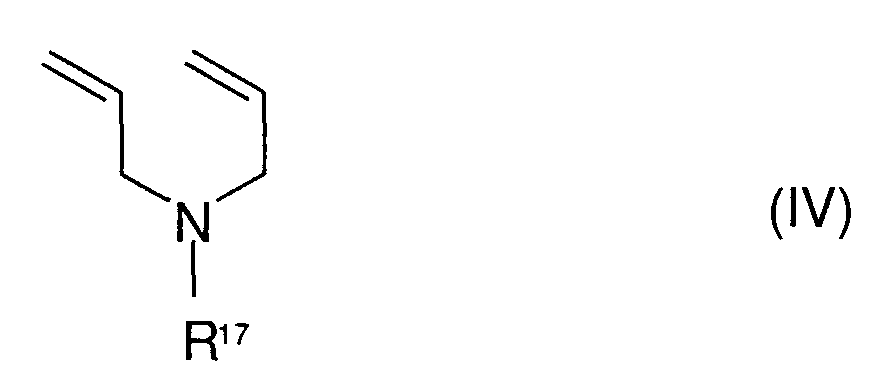 mit R17 = C1-C24 Alkyl
Weitere geeignete Monomere sind Vinylidenchlorid; und Kohlenwasserstoffe
mit mindestens einer Kohlenstoff-Kohlenstoff Doppelbindung,
bevorzugt Styrol, alpha-Methylstyrol, tert.-Butylstyrol,
Butadien, Isopren, Cyclohexadien, Ethylen, Propylen, 1-Buten,
2-Buten, Isobutylen, Vinyltoluol, sowie Mischungen dieser Monomere.
Besonders geeignete Monomere sind Acrylsäure, Methacrylsäure,
Ethylacrylsäure, Methylacrylat, Ethylacrylat, Propylacrylat,
n-Butylacrylat, iso-Butylacrylat, t-Butylacrylat, 2-Ethylhexylacrylat,
Decylacrylat, Methylmethacrylat, Ethylmethacrylat,
Propylmethacrylat, n-Butylmethacrylat, iso-Butylmethacrylat,
t-Butylmethacrylat, 2-Ethylhexylmethacrylat, Decylmethacrylat,
Methylethacrylat, Ethylethacrylat, n-Butylethacrylat, iso-Butylethacrylat,
t-Butylethacrylat, 2-Ethylhexylethacrylat, Decylethacrylat,
2,3-Dihydroxypropylacrylat, 2,3-Dihydroxypropylmethacrylat,
2-Hydroxyethylacrylat, Hydroxypropylacrylate, 2-Hydroxyethylmethacrylat,
2-Hydroxyethylethacrylat, 2-Methoxyethylacrylat,
2-Methoxyethylmethacrylat, 2-Methoxyethylethacrylat,
2-Ethoxyethylmethacrylat, 2-Ethoxyethylethacrylat, Hydroxypropylmethacrylate,
Glycerylmonoacrylat, Glycerylmonomethacrylat, Polyalkylenglykol
(meth) acrylate, ungesättigte Sulfonsäuren wie
zum Beispiel Acrylamidopropansulfonsäure;
Acrylamid, Methacrylamid, Ethacrylamid, N-Methylacrylamid,
N,N-Dimethylacrylamid, N-Ethylacrylamid, N-Isopropylacrylamid,
N-Butylacrylamid, N-t-Butylacrylamid, N-Octylacrylamid,
N-t-Octylacrylamid, N-Octadecylacrylamid, N-Phenylacrylamid,
N-Methylmethacrylamid, N-Ethylmethacrylamid, N-Dodecylmethacrylamid,
1-Vinylimidazol, 1-Vinyl-2-methylimidazol, N,N-Dimethylaminomethyl(meth)acrylat,
N,N-Diethylaminomethyl (meth) acrylat,
N,N-Dimethylaminoethyl (meth) acrylat, N,N-Diethylaminoethyl (meth)-acrylat,
N,N-Dimethylaminobutyl(meth)acrylat, N,N-Diethylaminobutyl(meth)
acrylat, N,N-Dimethylaminohexyl (meth) acrylat, N,N-Dimethylaminooctyl(meth)acrylat,
N,N-Dimethylaminododecyl (meth)-acrylat,
N-[3-(dimethylamino)propyl]methacrylamid, N-[3-(dimethylamino)propyl]acrylamid,
N-[3-(dimethylamino)butyl]methacrylamid,
N-[8-(dimethylamino)octyl]methacrylamid,N-[12-(dimethylamino)
dodecyl]methacrylamid, N-[3-(diethylamino)propyl]-methacrylamid,
N-[3-(diethylamino)propyl]acrylamid;
Maleinsäure, Fumarsäure, Maleinsäureanhydrid und seine Halbester,
Crotonsäure, Itaconsäure, Diallyldimethylammoniumchlorid, Vinylether
(zum Beispiel: Methyl-, Ethyl-, Butyl-, oder Dodecylvinylether),
Vinylformamid, Vinylmethylacetamid, Vinylamin; Methylvinylketon,
Maleimid, Vinylpyridin, Vinylimidazol, Vinylfuran,
Styrol, Styrolsulfonat, Allylalkohol, und Mischungen daraus.
Von diesen sind besonders bevorzugt Acrylsäure, Methacrylsäure,
Maleinsäure, Fumarsäure, Crotonsäure, Maleinsäureanhydrid sowie
dessen Halbester, Methylacrylat, Methylmethacrylat, Ethylacrylat,
Ethylmethacrylat, n-Butylacrylat, n-Butylmethacrylat, t-Butylacrylat,
t-Butylmethacrylat, Isobutylacrylat, Isobutylmethacrylat,
2-Ethylhexylacrylat, N-t-Butylacrylamid, N-Octylacrylamid,
2-Hydroxyethylacrylat, Hydroxypropylacrylat, 2-Hydroxyethylmethacrylat,
Hydroxypropylmethacrylat, Alkylenglykol(meth)-acrylate,
ungesättigte Sulfonsäuren wie zum Beispiel Acrylamidopropansulfonsäure,
Vinylpyrrolidon, Vinylcaprolactam, Vinylether
(z.B.: Methyl-, Ethyl-, Butyl-, oder Dodecylvinylether), Vinylformamid,
Vinylmethylacetamid, Vinylamin, 1-Vinylimidazol,
1-Vinyl-2-methylimidazol, N,N-Dimethylaminomethylmethacrylat und
N-[3-(dimethylamino)propyl]methacrylamid; 3-Methyl-1-vinylimidazoliumchlorid,
3-Methyl-1-vinylimidazoliummethylsulfat,
N,N-Dimethylaminoethylmethacrylat, N-[3-(dimethylamino)propyl]-methacrylamid
quaternisiert mit Methylchlorid, Methylsulfat oder
Diethylsulfat.
Monomere, mit einem basischen Stickstoffatom, können dabei auf
folgende Weise quarternisiert werden:
Zur Quaternisierung der Amine eignen sich beispielsweise Alkylhalogenide
mit 1 bis 24 C-Atomen in der Alkylgruppe, z.B.
Methylchlorid, Methylbromid, Methyliodid, Ethylchlorid, Ethylbromid,
Propylchlorid, Hexylchlorid, Dodecylchlorid, Laurylchlorid
und Benzylhalogenide, insbesondere Benzylchlorid und
Benzylbromid. Weitere geeignete Quaternisierungsmittel sind
Dialkylsulfate, insbesondere Dimethylsulfat oder Diethylsulfat.
Die Quaternisierung der basischen Amine kann auch mit Alkylenoxiden
wie Ethylenoxid oder Propylenoxid in Gegenwart von Säuren
durchgeführt werden. Bevorzugte Quaternisierungsmittel sind:
Methylchlorid, Dimethylsulfat oder Diethylsulfat.
Die Quaternisierung kann vor der Polymerisation oder nach der
Polymerisation durchgeführt werden.
Außerdem können die Umsetzungsprodukte von ungesättigten Säuren,
wie z.B. Acrylsäure oder Methacrylsäure, mit einem quaternisierten
Epichlorhydrin der allgemeinen Formel (V) eingesetzt werden
(R18 = C1-C40 Alkyl).

Beispiele hierfür sind zum Beispiel: (Meth)acryloyloxyhydroxypropyltrimethylammoniumchlorid
und (Meth) acryloyloxyhydroxypropyltriethylammoniumchlorid.
Die eingesetzten Monomere können, sofern sie ionisierbare Gruppen
enthalten, vor oder nach der Polymerisation, zum Teil oder vollständig
mit Säuren oder Basen neutralisiert werden, um so z.B.
die Wasserlöslichkeit oder -dispergierbarkeit auf ein gewünschtes
Maß einzustellen.
Als Neutralisationsmittel für Säuregruppen tragende Monomere,
Präpolymere oder Polymere können zum Beispiel Mineralbasen wie
Natriumcarbonat, Alkalihydroxide sowie Ammoniak, organische Basen
wie Aminoalkohole speziell 2-Amino-2-Methyl-1-Propanol, Monoethanolamin,
Diethanolamin, Triethanolamin, Triisopropanolamin,
Tri[(2-hydroxy)1-propyl] amin, 2-Amino-2-Methyl-1,3-Propandiol,
2-Amino-2-hydroxymethyl-1,3-Propandiol sowie Diamine wie zum
Beispiel Lysin verwendet werden.
Als Neutralisationsmittel für kationisierbare Gruppen tragende
Monomere, Präpolymere oder Polymere können zum Beispiel Mineralsäuren
wie Salzsäure, Schwefelsäure oder Phosphorsäure, sowie
organische Säuren wie Carbonsäuren, Milchsäure, Zitronensäure
oder andere eingesetzt werden.
Zusätzlich zu den oben genannten Monomeren können als Monomere
sogenannte Makromonomere wie zum Beispiel silikonhaltige Makromonomere
mit ein oder mehreren radikalisch polymerisierbaren
Gruppen eingesetzt werden. Derartige Makromonomere sind beispielsweise
in in EP 0408311 (A2, B1) und EP 0412704 (A2, B1),
auf die hier ausdrücklich Bezug genommen wird, beschrieben.
Des weiteren können fluorhaltige Monomere wie sie beispielsweise
in der EP 558423 (A1, B1) beschrieben sind, vernetzend wirkende
oder das Molekulargewicht regelnde Verbindungen in Kombination
oder alleine eingesetzt werden.
Als Regler können die üblichen dem Fachmann bekannten Verbindungen
wie zum Beispiel Schwefelverbindungen (z.B.: Mercaptoethanol,
2-Ethylhexylthioglykolat, Thioglykolsäure oder Dodecylmercaptan)
sowie Tribromchlormethan oder andere Verbindungen die
regelnd auf das Molekulargewicht der erhaltenen Polymerisate
wirken, verwendet werden.
Es können gegebenenfalls auch thiolgruppenhaltige Silikon-verbindungen
eingesetzt werden.
Als vernetzende Monomere können Verbindungen mit mindestens zwei
ethylenisch ungesättigten Doppelbindungen eingesetzt werden wie
zum Beispiel Ester von ethylenisch ungesättigten Carbonsäuren,
wie Acrylsäure oder Methacrylsäure und mehrwertigen Alkoholen,
Ether von mindestens zweiwertigen Alkoholen wie zum Beispiel
Vinylether oder Allylether. Außerdem geeignet sind geradkettige
oder verzweigte, lineare oder cyclische aliphatische oder
aromatische Kohlenwasserstoffe, die über mindestens zwei Doppelbindungen
verfügen, welche bei den aliphatischen Kohlenwasserstoffen
nicht konjugiert sein dürfen. Ferner geeignet sind
Amide der Acryl- und Methacrylsäure und N-Allylamine von mindestens
zweiwertigen Aminen wie zum Beispiel (1,2-Diaminoethan,
1,3-Diaminopropan). Ferner sind Triallylamin oder entsprechende
Ammoniumsalze, N-Vinylverbindungen von Harnstoffderivaten, mindestens
zweiwertigen Amiden, Cyanuraten oder Urethanen. Weitere
geeignete Vernetzer sind Divinyldioxan, Tetraallylsilan oder
Tetravinylsilan.
Besonders bevorzugte Vernetzer sind beispielsweise Methylenbisacrylamid,
Triallylamin und Triallylammoniumsalze, Divinylimidazol,
N,N'-Divinylethylenharnstoff, Umsetzungsprodukte mehrwertiger
Alkohole mit Acrylsäure oder Methacrylsäure, Methacrylsäureester
und Acrylsäureester von Polyalkylenoxiden oder mehrwertigen
Alkoholen die mit Ethylenoxid und/oder Propylenoxid
und/oder Epichlorhydrin umgesetzt worden sind.
Weitere für das Verfahren vorteilhaft einzusetzende kosmetische
Formulierungen enthalten ethylenisch ungesättigte Präpolymere und
zusätzlich ggf. einen oder mehrerer Reaktivverdünner.
Als Präpolymere kommen beispielsweise (meth)acrylatfunktionelle
(Meth) Acrylcopolymere, Polyether(meth) acrylate, Polyester(meth)acrylate,
ungesättigte Polyester, Epoxy(meth)acrylate, Urethan(meth)acrylate,
Amino (meth) acrylate, Melamin(meth) acylate,
Silikon(meth)acrylate zum Einsatz. Bevorzugt werden Urethan(meth)acrylate,
Polyester(meth)acrylate und/oder aliphatische
Urethanacrylate eingesetzt. Die Präpolymere weisen üblicherweise
ein zahlenmittleres Molakulargewicht von 500 bis 50000, bevorzugt
von 500 bis 5000, auf.
Bevorzugt werden Präpolymere eingesetzt, die pro Molekül mindestens
2, besonders bevorzugt 3 bis 6 Doppelbindungen aufweisen.
Bevorzugt weisen die verwendeten Bindemittel außerdem ein Doppelbindungsäquivalentgewicht
von 400 bis 2000, besonders bevorzugt
von 500 bis 900, auf. Außerdem weisen die Bindemittel bevorzugt
eine Viskosität von 250 bis 11000 mPas s auf.
Polyester(meth)acrylate sind dem Fachmann prinzipiell bekannt.
Sie sind durch verschiedene Methoden herstellbar. Beispielsweise
kann Acrylsäure und/oder Methacrylsäure direkt als Säurekomponente
beim Aufbau der Polyester eingesetzt werden. Daneben besteht
die Möglichkeit, Hydroxyalkylester der (Meth)Acrylsäure
als Alkoholkomponente direkt beim Aufbau der Polyester einzusetzen.
Bevorzugt werden die Polyester(meth)acrylate aber durch
Acrylierung von Polyestern hergestellt. Beispielsweise können
zunächst hydroxylgruppenhaltige Polyester aufgebaut werden, die
dann mit Acryl- oder Methacrylsäure umgesetzt werden. Es können
auch zunächst carboxylgruppenhaltige Polyester aufgebaut werden,
die dann mit einem Hydroxyalkylester der Acryl- oder Methacrylsäure
umgesetzt werden. Nicht umgesetzte (Meth)Acrylsäure kann
durch Auswaschen, Destillieren oder bevorzugt durch Umsetzten
mit einer äquivalenten Menge einer Mono- oder Diepoxidverbindung
unter Verwendung geeigneter Katalysatoren, wie z.B. Triphenylphosphin,
aus dem Reaktionsgemisch entfernt werden.
Polyether(meth)acrylate sind dem Fachmann ebenfalls prinzipiell
bekannt. Sie sind durch verschiedene Methoden herstellbar.
Beispielsweise können hydroxylgruppenhaltige Polyether, die
mit Acrylsäure und/oder Methacrylsäure verestert werden, durch
Umsetzung von zwei- und/oder mehrwertigen Alkoholen mit verschiedenen
Mengen an Ethylenoxid und/oder Propylenoxid nach gut
bekannten Methoden (vgl. z.B. Houben-Weyl, Band XIV, 2, Makromolekulare
Stoffe II, (1963)) erhalten werden. Einsetzbar sind
auch Polymerisationsprodukte des Tetrahydrofurans oder Butylenoxids.
Eine Flexibilisierung der Polyether(meth)acrylate und der Polyester(meth)acrylate
ist beispielsweise dadurch möglich, daß
entsprechende OH-funktionelle Präpolymere bzw. Oligomere (Polyether-
oder Polyester-Basis) mit längerkettigen, aliphatischen
Dicarbonsäuren, insbesondere aliphatischen Dicarbonsäuren mit
mindestens 6 C-Atomen, wie beispielsweise Adipinsäure, Sebacinsäure,
Dodecandisäure und/oder Dimerfettsäuren, umgesetzt werden.
Diese Flexibilisierungsreaktion kann dabei vor oder auch nach
der Addition von Acryl- bzw. Methacrylsäure an die Oligomere
bzw. Präpolymere durchgeführt werden.
Ferner sind auch Epoxy(meth)acrylate dem Fachmann als
Beschichtungsmittel wohl bekannt und brauchen daher nicht
näher erläutert zu werden. Sie werden üblicherweise hergestellt
durch Anlagerung von Acrylsäure an Epoxidharze, beispielsweise
an Epoxidharze auf Basis Bisphenol A oder anderer
handelsüblicher Epoxidharze.
Eine Flexibilisierung der Epoxy(meth)acrylate ist beispielsweise
analog dadurch möglich, daß entsprechende epoxy-funktionelle
Präpolymere bzw. Oligomere mit längerkettigen, aliphatischen
Dicabonsäuren, insbesondere aliphatischen Dicarbonsäuren mit mindestens
6 C-Atomen, wie beispielsweise Adipinsäure, Sebacinsäure,
Dodecandisäure und/oder Dimerfettsäuren, umgesetzt werden. Diese
Flexibilisierungsreaktion kann dabei vor oder nach der Addition
von Acryl- bzw. Methacrylsäure an die Oligomere bzw. Präpolymere
durchgeführt werden.
Urethan(meth)acrylate sind dem Fachmann ebenfalls wohl bekannt
und brauchen daher nicht näher erläutert zu werden. Sie können
erhalten werden durch Umsetzung eines Di- oder Polyisocyanates
mit einem Kettenverlängerunsmittel aus der Gruppe der Diole/
Polyole und/oder Diamine/Polyamine und/oder Dithiole/Polythiole
und/oder Alkanolamine und anschließende Umsetzung der restlichen
freien Isocyanatgruppen mit mindestens einem Hydroxyalkyl(meth)acrylat
oder Hydroxyalkylester anderer ethylenisch ungesättigter
Carbonsäuren.
Die Mengen an Kettenverlängerungsmittel, Di- bzw. Polyisocyanat
und Hydroxyalkylester werden dabei bevorzugt so gewählt, daß
Außerdem ist es möglich, die Polyurethanacrylate herzustellen,
indem zunächst ein Teil der Isocyanatgruppen eines Di- oder
Polyisocyantes mit mindestens einem Hydroxyalkylester umgesetzt
wird und die restlichen Isocyanatgruppen anschließend mit einem
Kettenverlängerungsmittel umgesetzt werden. Auch in diesem Fall
werden die Mengen an Kettenverlängerungsmittel, Isocyanat und
Hydroxyalkylester so gewählt, daß das Äquivalentverhältnis der
NCO-Gruppen zu den reaktiven Gruppen des Kettenverlängerungsmittels
zwischen 3:1 und 1:2, bevorzugt bei 2:1 liegt und das
Äquivalentverhältnis der restlichen NCO-Gruppen zu den OH-Gruppen
des Hydroxyalkylesters 1 : 1 beträgt. Selbstverständlich sind
auch sämtliche Zwischenformen dieser beiden Verfahren möglich.
Beispielsweise kann ein Teil der Isocyanatgruppen eines Diisocyanates
zunächst mit einem Diol umgesetzt werden, anschließend
kann ein weiterer Teil der Isocyanatgruppen mit dem Hydroxalkylester
und im Anschluß hieran können die restlichen Isocyanatgruppen
mit einem Diamin umgesetzt werden.
Diese verschiedenen Herstellverfahren der Polyurethanacrylate
sind bekannt (vgl. z.B. EP-A-203 161) und bedürfen daher keiner
genauen Beschreibung.
Eine Flexibilisierung der Urethan(meth)acrylate ist beispielsweise
dadurch möglich, daß entsprechende isocyanat-funktionelle
Präpolymere mit längerkettigen, aliphatischen Diolen und/oder
Diaminen, insbesondere aliphatischen Diolen und/oder Diaminen mit
mindestens 6 C-Atomen umgesetzt werden. Diese Flexibilisierungsreaktion
kann dabei vor oder nach der Addition von Acryl- bzw.
Methacrylsäure an die Oligomere bzw. Prepolymer durchgeführt
werden.
Die Präpolymere können ggf. zusammen mit einem oder mehreren
Reaktivverdünnern zum Einsatz kommen. Die Reaktivverdünner können
dabei ethylenisch ungesättigte Verbindungen sein. Die Reaktivverdünner
können mono-, di- oder polyungesättigt sein. Sie dienen
üblicherweise zur Beeinflussung des rheologischen Verhaltens und
der Materialeigenschaften.
Der bzw. die Reaktivverdünner werden in den Präpolymeren bevorzugt
in einer Menge von 0 bis 70 Gew.-%, besonders bevorzugt
von 15 bis 65 Gew.-%, jeweils bezogen auf das Gesamtgewicht des
Präpolymers, eingesetzt.
Als Reaktivverdünner werden beispielsweise (Meth)Acrylsäure und
deren Ester, Maleinsäure und deren Ester bzw. Halbester, Vinylacetat,
Vinylether, Vinylharnstoffe u.ä. eingesetzt. Beispiele
sind Alkylenglykoldi(meth) acrylat, Polyethylenglykoldi(meth)acrylat,
1,3-Butandioldi (meth) acrylat, Vinyl (meth) acrylat,
Allyl (meth) acrylat, Glycerin-tri (meth)acrylat, Trimethylolpropantri(meth)acrylat,
Trimethylolpropandi (meth) acrylat, Styrol,
Vinyltoluol, Divinylbenzol, Pentaerythrittri(meth)acrylat,
Pentaerythrittetra(meth) acrylat, Dipropylenglykoldi (meth)acrylat,
Hexandioldi(meth)acrylat, Ethoxyethoxyethylacrylat, N-Vinylpyrrolidon,
Phenoxyethylacrylat, Dimethylaminoethylacrylat,
Hydroxyethyl (meth) acrylat, Butoxyethylacrylat, Isobornyl(meth)acrylat,
Dimethylacrylamid und Dicyclopentylacrylat, die in der
EP-A-250 631 beschriebenen, langkettigen linearen Diacrylate mit
einem Molekulargewicht von 400 bis 4000, bevorzugt von 600 bis
2500. Beispielsweise können die beiden Acrylatgruppen durch eine
Polyoxibutylenstruktur getrennt sein. Einsetzbar sind außerdem
1,12-Dodecyldiacrylat und das Umsetzungsprodukt von 2 Molen
Acrylsäure mit einem Mol eines Dimerfettalkohols, der im allgemeinen
36 C-Atome aufweist. Geeignet sind auch Gemische der
genannten Monomeren.
Bevorzugt werden als Reaktivverdünner Mono- und/oder Diacrylate,
wie z.B. Isobornylacrylat, Hexandioldiacrylat, Tripropylenglykoldiacrylat
und Laromer™ 8887 der Firma BASF Aktiengesellschaft
eingesetzt. Besonders bevorzugt werden Isobornylacrylat, Hexandioldiacrylat
und Tripropylenglykoldiacrylat eingesetzt.
Weitere für das Verfahren vorteilhaft einzusetzende kosmetische
Formulierungen enthalten ungesättigte Verbindungen, die sich
von den ungesättigten Fettsäuren ableiten; beispielsweise Triglyceride
und Alkydharze (vgl. DIN 53183). Die Alkydharze können
beispielsweise als Alkydlacke (vgl. DIN 55945) formuliert werden.
Weiterhin enthalten die erfindungsgemäßen Beschichtungsmittel
gegebenenfalls noch übliche Hilfsmittel und/oder Additive,
beispielsweise Lichtschutzmittel (z.B. HALS-Verbindungen,
Benztriazole, Oxalanilid u.ä.), Slipadditive, Polymerisationsinhibitoren,
Mattierungsmittel, Entschäumer, Verlaufsmittel und
filmbildende Hilfsmittel, z.B. Cellulose-Derivate, oder andere
Additive.
Erfindungsgemäß ist außerdem die Verwendung kosmetischer
Formulierungen, die Phenol-, Melamin-, und Formaldehydharze
enthalten oder die Stoffe enthalten, aus denen diese Harze
unter Einwirkung von NIR-Strahlung entstehen. Insbesondere sind
vernetzende Systeme geeignet, wie sie in U.S. 4,588,760 und
U.S. 4,278,659 genannt werden und auf die hier ausdrücklich Bezug
genommen wird. Weitere besonders geeignete Inhaltsstoffe sind
die in DE-A 198 165 27 beschriebenen― Polymere und Dispersionen.
Erfindungsgemäß ist außerdem die Verwendung kosmetischer
Formulierungen, die unter Einwirkung von NIR-Strahlung Makromoleküle
mit Si-O-Si-Gruppierungen bilden. Hierbei sind insbesondere
die in DE-A 198 227 22 genannten Inhaltsstoffe und
Formulierungen geeignet, auf die hier ausdrücklich Bezug genommen
wird.
Die erfindungsgemäßen kosmetischen Formulierungen können weiterhin
Farbstoffe enthalten. Insbesondere sind Farbstoffe, die NIR-Strahlung
absorbieren, geeignet. NIR-absorbierende Farbstoffe
sind dem Fachmann bekannt und in der Literatur beschrieben. Besonders
bevorzugt sind hierbei NIR-Polymerisationsinitiatoren und
NIR-Photokatalysatoren, wie sie in EP-A 774 492, U.S. 5,607,814,
U.S. 5,686,639, U.S. 5,858,604 und der dort genannten Literatur
beschrieben sind und auf die hier ausdrücklich Bezug genommen
wird.
Beispielsweise sind kationische Farbstoffe, die wenigstens eine
der folgenden Gruppierungen enthalten,


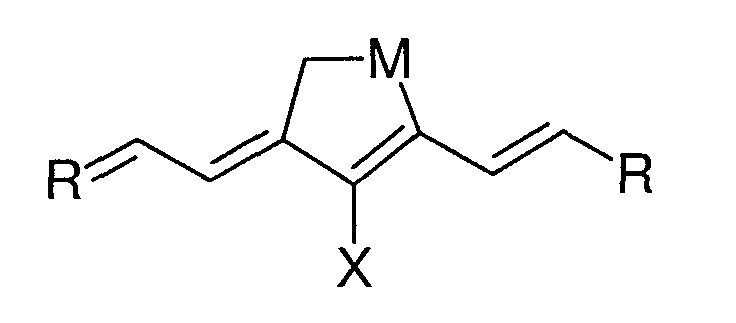 wobei
wobei
- R
- für gleiche oder ungleiche aromatische oder chinoide Reste steht,
- X
- für -Cl oder für -N(Phenyl)2 steht und
- M
- für -CH2- oder -CH2-CH2- steht

Den oben genannten Monomeren, Präpolymeren und Polymeren können
zur Verbesserung der Wirksamkeit der NIR-Strahlung Verbindungen
zugesetzt werden, die Gruppierungen R-O-O-R oder R'-N=N-R'
enthalten. Dies ist insbesondere von Interesse, wenn die Verbindungen
ethylenisch ungesättigte Gruppierungen enthalten. R
steht für gleiche oder ungleichartige organische Reste oder für
Wasserstoff. R' steht für gleiche oder ungleichartige organische
Reste. Bevorzugt sind Wasserstoffperoxid, Hydroperoxide, Peroxide,
Percarbonate und Perester. Ferner können anorganische
Perverbindungen wie Natrium-, Kalium- und Ammoniumperoxodisulfat
zugesetzt werden. Weitere geeignete Initiatoren sind die dem
Fachmann bekannten Redox-Initiatorsysteme, z.B. Fe(II)/H2O2, Weinsäure/H2O2,
t-Butylhydroperoxid/Weinsäure, Ascorbinsäure/H2O2 oder
t-Butylhydroperoxid/Ascorbinsäure.
Geeignete Verbindungen vom Typ R-O-O-R sind beispielsweise
Acetylcyclohexansulfonyl-peroxid, Dicetyl-peroxy-dicarbonat,
Diisopropyl-peroxydicarbonat, t-Amylperneodecanoat, t-Butylpermeodecanoat,
Bis-(2,4-dichlorbenzoyl)-peroxid, t-Butylperpivalat,
Bis-(3,5,5-trimethylhexanoyl)-peroxid, Dioctanoylperoxid, Didecanoylperoxid,
Dilauroylperoxid, Bis-(2-methylbenzoyl)-peroxid,
Succinylperoxid, Diacetylperoxid, Dibenzoylperoxid, t-Butylper-2-ethylhexanoat,
Bis-(4-chlorbenzoyl)-peroxid, t-Butylperisobutyrat,
t-Butylpermaleinat, 1,1 -Bis-(t-butylperoxy)-3,5,5-trimethyl-cyclohexan,
1,1 -Bis-(t-butylperoxy)-cyclohexan, t-Butylperoxy-isopropylcarbonat,
t-Butyl-per-3,5,5-trimethylhexanoat,
2,5-Dimethyihexan-2,5-diperbenzoat, t-Butylperacetat, t-Butylperbenzoat,
2,2-Bis-(t-butylperoxy)-butan, 2,2-Bis-(t-butylperoxy)-propan,
Dicumylperoxid, 2,5-Dimethylhexan-2,5-di-t-butylperoxid,
3-t-Butylperoxy-3-phenylphthalid, Di-t-amylperoxid, α-α'-Bis-(t-butylperoxy-isopropyl)-benzol,
3,5-Bis (t-butylperoxy)-3,5-dimethyldioxolan-1,2,
Di-t-butylperoxid 2,5-Dimethyl-hexin-3-2,5-di-t-butylperoxid,
3,3,6,6,9,9-Hexamethyl-1,2,4,5-tetraoxa-cyclononan,
p-Methanhydroperoxid, Pinanhydroperoxid, Diisopropylbenzol-mono-α-hydroperoxid,
Cumolhydroperoxid, t-Butylhydroperoxid,
Dimyristyl-peroxydicarbonat, Dicyclohexyl-peroxydicarbonat,
Bis-(4-t-butylcyclohexyl)-peroxydicarbonat, Di-n-butyl-peroxydicarbonat,
Di-2-ethylhexyl-peroxydicarbonat, Diisotridecyl-peroxydicarbonat.
Geeignete Verbindungen vom Typ R'-N=N-R' sind beispielsweise
2,2'-Azobis(4-methoxy-2,4-dimethylvaleronitnl), 2,2'-Azobis(2,4-dimethylvaleronitril),
2,2'-Azobis(isobutyronitril), Dimethyl-2,2'-azobis(isobutyrat),
2,2'-Azobis(2-methyl-butyronitril),
1,1'-Azobis(1-cyclo-hexancarbonitril), 2-(Carbamoylazo)-isobutyronitril,
2,2'-Azobis(2,4,4-trimethyl-pentan),
2,2'-Azobis(N,N' dimethyleneisobutyramidin)dihydrochlorid,
2,2'-Azobis(2-amidino-propan)dihydrochlorid, 2,2'-Azobis(N,N'
dimethylenisobutyramidin), 4,4'-Azobis(4-cyano-pentansäure),
2,2'-Azobis [2-methyl-N-(2-hydroxyethyl)propionsäureamid].
Anstelle von Verbindungen des Typs R-O-O-R und R'-N=N-R' sind
auch Verbindungen R-R geeignet, die unter für die Anwendung
typischen Bedingungen in Radikale zerfallen, beispielsweise
3,4-Dimethyl-3,4-diphenylhexan und 3,4-Dimethyl-3,4-diphenylbutan.
Den oben genannten Monomeren, Präpolymeren und Polymeren können
zur Verbesserung der Wirksamkeit der NIR-Strahlung die dem Fachmann
bekannten Sikkative zugesetzt werden. Das sind Trocknungsmittel,
insbesondere für ungesättigte Verbindungen und ihre
Derivate (z.B. Alkydharze, Triglyceride). Ein Beispiel dafür
ist Mangan(II)acetat. Besonders geeignet sind Sikkative, deren
Wirkung durch NIR-Strahlung verstärkt wird.
Die folgenden Zusätze werden insbesondere dann in den
kosmetischen Mitteln für das erfindungsgemäße Verfahren
eingesetzt, wenn die oben genannten Monomere, Präpolymere
und Polymere Epoxid-Gruppierungen enthalten:
Aliphatische Polyamine H2N(CH2CH2NH)nH, z.B Diethylentriamine
(DETA, n = 2) und Triethylentetramine (TETA, n = 3),
aliphatische Diamine auf Basis von Propylenoxid und Ammoniak
H2N(CH2CH(CH3)O)nCH2CH(CH3)NH2, z.B. Jeffamine D-230 (Texaco
Chemical Co.) mit n = 2 bis 3, Polyamiddiamine oder Amidopolyamine
(z.B. aus der Reaktion von Dimerfettsäuren mit DETA oder
TETA), cycloaliphatische Diamine, z.B. Cyclohexan-1,2-diamin,
4-(2-Aminopropane-2-yl)-1-methylcyclohexan-1-amin, oder Menthandiamin,
aromatische Diamine, z.B. Bis(4-aminophenyl)methan (MDA
or methylene dianiline) und Bis(4-aminophenyl)sulfone (DADS, DDS,
or dapsone), Carbonsäureanhydride, z.B. Methylbicyclo[2.2.1]hepten-2,3-dicarbonsäureanhydrid,
1,2-Cyclohexanedicarbonsäureanhydrid,
Hexahydrophthalsäureanhydrid oder Phthalsäureanhydrid,
tertiäre Amine NR3, wobei gleiche oder ungleichartige organische
Reste (bevozugt Alkylreste) sind, Melamin-, Harnstoff- und
Phenolformaldehyd-Addukte (auch Aminoplaste, Phenoplaste), Polycarbonsäurepolyester,
Dicyandiamid, Lewis-Säuren und -Basen, z.B.
Bortrifluorid komplexiert mit Methylethylamin, 2,4,6-Tris(N,N-dimethylaminomethyl)phenol
(Rohm & Haas DMP-30), N,N-Dimethylbenzylamine.
Die oben genannten Polymere, Präpolymere und Monomere sind in
dem erfindungsgemäß zu verwendenden kosmetischen Mittel zu 0,05
bis 99 Gew.-%, bevorzugt 0,1 bis 50 Gew.-% und besonders bevorzugt
zu 0,2 bis 20 Gew.-% enthalten. In einer besonders bevorzugten
Ausführung enthalten die kosmetischen Mittel zusätzlich mehr
als 50 Gew.-% Fluide, die beispielsweise als Lösungsmittel
oder Treibmittel wirken können. Beispiele für diese Fluide
sind Wasser, Ethanol, Isopropanol, Propan, Butan, Dimethylether,
Diethylether, Kohlendioxid, Druckluft, Hexafluorethan
und Decamethylcyclopentasiloxan.
Die erfindungsgemäß eingesetzten kosmetischen Formulierungen
können neben den oben genannten Stoffen und ihren Mischungen
in der Kosmetik übliche Hilfsstoffe enthalten, wie Weichmacher,
Filmbildehilfsmittel, Pigmente, Parfums, Verdicker, Tenside,
Konservierungsmittel, kosmetische Wirkstoffe wie Phytantriol,
Vitamine und Provitamine, beispielsweise Vitamin A, E und C,
Retinol, Bisabolol, Panthenol, natürliche und synthetische Lichtschutzmittel
Naturstoffe, Treibungsmittel, Lösungsvermittler,
Repellents, Bleichmittel, Färbemittel, Tönungsmittel, Bräununsmittel,
Reflektoren, Proteine, Ceramid, AH-Säuren (alpha-Hydroxycarbonsären
wie z.B. Milchsäure und Salicylsäure) sowie deren
Salze, Fruchtsäuren, Collagen, Eiweißhydrolysate, Stabilisatoren,
pH-Wert Regulatoren, Emulgatoren, Gelbildner, Konsistenzgeber,
Silikone, Feuchthaltemittel, Rückfetter, UV-Schutzmittel oder
andere übliche Additive, allein oder in Kombination zugefügt
werden.
Die Hilfsstoffe können bei der Polymerisation anwesend sein
und/oder nach der Polymerisation zugefügt werden.
Als weitere übliche Zusätze können enthalten sein Fettkörper, wie
mineralische und synthetische Öle, wie z.B. Paraffine, Siliconöle
und aliphatische Kohlenwasserstoffe mit mehr als 8 Kohlenstoffatomen,
tierische und pflanzliche Öle, wie z.B. Sonnenblumenöl,
kokosöl, Avocadoöl, Olivenöl, Lanolin, oder wachse, Fettsäuren,
Fettsäureester, wie z.B. Triglyceride von C6-C30-Fettsäuren,
Wachsester, wie z.B. Jojobaöl, Fettalkohole, Vaseline, hydriertes
Lanolin. Selbstverständlich können auch Mischungen derselben verwendet
werden.
Übliche Verdickungsmittel in derartigen Formulierungen sind vernetzte
Polyacrylsäuren und deren Derivate, Polysaccharide wie
Xanthan-gum, Agar-Agar, Alginate oder Tylosen, Cellulosederivate,
z.B. Carboxymethylcellulose oder Hydroxycarboxymethylcellulose,
Fettalkohole, Monoglyceride und Fettsäuren, Polyvinylalkohol und
Polyvinylpyrrolidon.
Weiterhin können auch keimhemmende Mittel eingesetzt werden.
Dazu gehören generell alle geeigneten Konservierungsmittel
mit spezifischer Wirkung gegen grampositive Bakterien, z.B. Triclosan
(2,4,4'-Trichlor-2'-hydroxydiphenylether), Chlorhexidin
(1,1'-Hexamethylenbis [5-(4-chlorphenyl)-biguanid) sowie TTC
(3,4,4'-Trichlorcarbanilid). Quartäre Ammonium-Verbindungen sind
prinzipiell ebenfalls geeignet, werden jedoch bevorzugt für
desinfizierende Seifen und Waschlotionen verwendet. Auch zahlreiche
Riechstoffe haben antimikrobielle Eigenschaften. Spezielle
Kombinationen mit besonderer Wirksamkeit gegenüber grampositiven
Bakterien werden für die Komposition sog. Deoparfums eingesetzt.
Auch eine große Anzahl etherischer Öle bzw. deren charakteristische
Inhaltsstoffe wie z.B. Nelkenöl (Eugenol), Minzöl (Menthol)
oder Thymianöl (Thymol), zeigen eine ausgeprägte antimikrobielle
Wirksamkeit. Die antibakteriell wirksamen Stoffe werden bevorzugt
in Konzentrationen von ca. 0,1 bis 0,3 Gew.-% eingesetzt.
Als geeignete Lösungsmittel sind insbesondere zu nennen Wasser
und niedrige Monoalkohol oder Polyole mit 1 bis 6 Kohlenstoffatomen
und Mischungen davon; bevorzugte Monoalkohole oder Polyole
sind Ethanol, i-Propanol, Propylenglycol, Glycerin und Sorbit.
Weitere bevorzugte Hilfsstoffe sind Lösemittel und Treibgase aus
der Gruppe Dimethylether, Propan, Butan, fluorierte Kohlenwasserstoffe,
cyclische Silkone, verzweigte und unverzweigte Alkane,
organische Ester und Ether.
Die erfindungsgemäß eingesetzten kosmetischen Formulierungen
können neben den oben genannten Stoffen und ihren Mischungen auch
zusätzliche Polymere wie zum Beispiel Polyamide, Polyurethane,
Polyester, Homo- und Copolymere von ethylenisch ungesättigten
Monomeren zugegen sein. Bevorzugte Homo- und Copolymere sind
aus den oben genannten Monomeren erhältlich. Diese können durch
Carboxylatgruppen, Sulfonatgruppen, Phosphonatgruppen sowie durch
stickstoffhaltige kationische Gruppierungen funktionalisiert
sein.
Ferner können Silikone und alkoxylierte Silikone und davon abgeleitete
Verbindungen zugegen sein. Beispiele für solche zum Teil
auch in der Kosmetik eingesetzten Polymeren sind in der folgenden
Liste aufgeführt:
| INCI/CTFA-Bezeichnung | Polymer | Hersteller |
| Acrylat-Copolymer | Amerhold | Amerchol |
| PVP / Acrylat-Copolymer | Luviflex VBM 35 | BASF |
| PVP / VA | Luviskol VA | BASF |
| Polyvinylcaprolactam | Luviskol Plus | BASF |
| VA / Crotonat Copolymer | Luviset CA 66 | BASF |
| VA / Crotonat/Vinylpropionat Copolymer | Luviset CAP | BASF |
| Acrylat / Acrylamid Copolymer | Ultrahold 8 | BASF |
| Acrylat / Acrylamid Copolymer | Ultrahold Strong | BASF |
| Acrylat Copolymer | Luvimer MAE | BASF |
| Acrylat Copolymer | Luvimer 100P, 36D, 30E | BASF |
| Polyquatemium 46 | Luviquat Hold | BASF |
| Polyurethan-1 | Luviset P.U.R. | BASF |
| Methacryloyl Ethylbetain/Acrylat Copolymer | Diaformer | Clariant |
| Diglycol / CHDM / Isophthalat/SIP Copolymer | Eastman AQ Polymer | Eastman |
| Acrylat/Diacetonacrylamid Copolymer | Plascise L53 | Goo Chemicals |
| Butylacrylat-Lauryl Methacrylat | Diahold EX-55/Plascise L 1210 | Goo Chemicals |
| PVP | PVP K | ISP |
| PVP/VA | PVP/PA | ISP |
| Vinyl Caprolactam / PVP / Dimethylamino-methyl Methacrylat Copolymer | Copolymer VC 713 (= Advantage HC) | ISP |
| Vinyl Caprolactam / PVP / Dimethylamino-methyl Methacrylat Copolymer | H2OLD EP-1 | ISP |
| PVM / MA Butylester Copolymer | Gantrez ES 425 | ISP |
| VA / Butylmaleat/Isobornyl Acrylat Copolymer | Advantage Plus (CP, V) | ISP |
| PVM / MA Ethylester Copolymer | Omnirez 2000 | ISP |
| PVP / DMAPA Acrylat Copolymer | Styleeze CC―10 | ISP |
| PVP / Vinylcaprolactam/DMAPA Acrylat Copolymer | Aquaflex SF―40 | ISP |
| N―Methylacryloyl oxethyl N,N―dimethylammonium―a―N―methyl carboxybetain alkyl methacrylat | Yukaformer R205 | Mitsubishi |
| N―Methylacryloyl oxethyl N,N―dimethylammonium―a―N―methyl carboxybetain alkyl methacrylat | Yukaformer SM | Mitsubishi |
| VA/Crotonat / Copolymer | Resyn 28―1310 | National Starch |
| VA/Crotonat / Neodecanoat Copolymer | Resyn 28―2930 | National Starch |
| Octylacrylamid / Acrylat/ Butylaminoethyl Methacrylat Copolymer | Amphomer 28―4910 | National Starch |
| Octylacrylamid/Acrylat/ Butylaminoethyl Methacrylat Copolymer | Amphomer LV―71 | National Starch |
| Acrylat/Octylacrylamid Copolymer | Amphomer HC 28―4942 (= Versatyl) | National Starch |
| Octylacrylamid / Acrylat Copolymer | Versatyl 90 | National Starch |
| Acrylat Copolymer | Balance 0/55 | National Starch |
| Octylacrylamid / Acrylat/Butylaminoethyl Methacrylat Copolymer | Balance 47 (= Lovocryl 47) | National Starch |
| /Acrylat/Hydroxyester Acrylat Copolymer | Acudyne | Rohm & Haas |
| Diglycol/CHDM / Isophthalates / SIP Copolymer | Eastman AQ | Eastman |
| Polyurethane―1 | Luviset P.U.R | BASF |
| PEG / PPG - 25/25 Dimethicone / Acrylates Copolymer | Luviflex Silk | BASF |
Die oben genannten Polyamide sind in EP 0696607 (A1) und in
EP 0787480 (A1) beschrieben.
Weitere geeignete kationische Polymere: Mit der Bezeichnung
Polyquaternium nach INCI, z.B. Copolymere aus Vinylpyrrolidon/
N-Vinylimidazoliumsalzen (Luviquat™ FC, Luviquat™ HM,
Luviquat™ MS, Luviquat™ Care), Copolymere aus N-Vinylpyrrolidon/
Dimethylaminoethylmethacrylat, quaternisiert mit Diethylsulfat
(Luviquat™ PQ 11), Copolymere aus N-Vinylcaprolactam/N-Vinylpyrrolidon/N-Vinylimidazoliumsalzen
(Luviquat™ Hold); kationische
Cellulosederivate (Polyquaternium-4 und -10), Acrylamidcopolymere
(Polyquaternium-), Styleeze™ CC-10, Aquaflex™ SF-40, Chitosanderivate
sowie Polylysin und Lysincopolymere.
Weitere geeignete betaine Polymere: Beispielsweise Yukaformer™
(R205, SM) und Diaformer™.
Weitere geeignete Copolymere aus N-Vinylpyrrolidon und Vinylpropionat,
Polysiloxane, Polyethylenimine und deren Salze, Polyvinylamine
und deren Salze, Cellulosederivate, Polyasparaginsäuresalze
und Derivate.
Außerdem geeignet sind auch Biopolymere, d.h. Polymere und
Monomere, die aus natürlich nachwachsenden Rohstoffen gewonnen
werden und aus natürlichen Monomerbausteinen aufgebaut sind, z.B.
Cellulosederivate, Chitin-, Chitosan-, DNA-, Hyaloronsäure- und
RNA-Derivate, Alkydharze- und ungesättigte Triglyceride.
Die Herstellung der kosmetischen oder dermatologischen Zubereitungen
erfolgt nach den üblichen dem Fachmann geläufigen Regeln.
Solche Formulierungen liegen vorteilhafterweise in Form von
Emulsionen bevorzugt als Wasser-in-Öl-(W/O)- oder Öl-in-Wasser-(O/W)-Emulsionen
vor. Es ist aber auch erfindungsgemäß möglich
und gegebenenfalls vorteilhaft andere Formulierungsarten zu
wählen, beispielsweise Hydrodispersionen, Gele, Öle, Oleogele,
multiple Emulsionen, beispielsweise in Form von W/O/W- oder
O/W/O-Emulsionen, wasserfreie Salben bzw. Salbengrundlagen usw.
Die Herstellung erfindungsgemäß brauchbarer Emulsionen erfolgt
nach bekannten Methoden.
Die Emulsionen enthalten neben dem erfindungsgemäßen Copolymer
übliche Bestandteile, wie Fettalkohole, Fettsäureester und insbesondere
Fettsäuretriglyceride, Fettsäuren, Lanolin und Derivate
davon, natürliche oder synthetische Öle oder Wachse und
Emulgatoren in Anwesenheit von Wasser.
Die Auswahl der Emulsionstyp-spezifischen Zusätze und die Herstellung
geeigneter Emulsionen ist beispielsweise beschrieben in
Schrader, Grundlagen und Rezepturen der Kosmetika, Hüthig Buch
Verlag, Heidelberg, 2. Auflage, 1989, Dritter Teil, worauf hiermit
ausdrücklich Bezug genommen wird.
So kann eine erfindungsgemäß brauchbare Hautcreme z.B. als W/O-Emulsion
vorliegen. Eine derartige Emulsion enthält eine wäßrige
Phase, die mittels eines geeigneten Emulgatorsystems in einer Öl-
oder Fettphase emulgiert ist.
Die Konzentration des Emulgatorsystems beträgt in diesem Emulsions-Typ
etwa 4 und 35 Gew.-%, bezogen auf das Gesamtgewicht der
Emulsion; die Fettphase macht etwa 20 und 60 Gew.-% aus und die
wäßrige Phasen etwa 20 und 70 Gew.-%, jeweils bezogen auf das
Gesamtgewicht der Emulsion. Bei den Emulgatoren handelt es sich
um diejenigen, welche in diesem Emulsionstyp üblicherweise verwendet
werden. Sie werden z.B. ausgewählt unter: C12-C18-Sorbitan-Fettsäureestern;
Estern von Hydroxystearinsäure und C12-C30-Fettalkoholen;
Mono- und Diestern von C12-C18-Fettsäuren und Glyzerin
oder Polyglyzerin; Kondensaten von Ethylenoxid und Propylenglycolen;
oxypropylenierten/oxyethylenierten C12-C20-Fettalkoholen;
polycyclischen Alkoholen, wie Sterolen; aliphatischen
Alkoholen mit einem hohen Molekulargewicht, wie Lanolin;
Mischungen von oxypropylenierten/polyglycerinierten Alkoholen
und Magnesiumisostearat; Succinestern von polyoxyethylenierten
oder polyoxypropylenierten Fettalkoholen; und Mischungen von
Magnesium-, Calcium-, Lithium-, Zink- oder Aluminiumlanolat
und hydriertem Lanolin oder Lanolin-alkohol.
Zu geeigneten Fettkomponenten, welche in der Fettphase der
Emulsionen enthalten sein können, zählen Kohlenwasserstofföle,
wie Paraffinöl, Purcellinöl, Perhydrosqualen und Lösungen mikrokristalliner
Wachse in diesen Ölen; tierische oder pflanzliche
Öle, wie Süßmandelöl, Avocadoöl, Calophylumöl, Lanolin und
Derivate davon, Ricinusöl, Sesamöl, Olivenöl, Jojobaöl, Karite-Öl,
Hoplostethus-Öl; mineralische Öle, deren Destillationsbeginn
unter Atmosphärendruck bei ca. 250°C und deren Destillationsendpunkt
bei 410°C liegt, wie z.B. Vaselinöl; Ester gesättigter
oder ungesättigter Fettsäuren, wie Alkylmyristate, z.B.
i-Propyl-, Butyl- oder Cetylmyristat, Hexadecylstearat, Ethyl-
oder i-Propylpalmitat, Octan- oder Decansäuretriglyceride und
Cetylricinoleat.
Die Fettphase kann auch in anderen Ölen lösliche Siliconöle,
wie Dimethylpolysiloxan, Methylphenylpolysiloxan und das Silicon-glycol-Copolymer,
Fettsäuren und Fettalkohole enthalten.
Um die Retention von Ölen zu begünstigen, kann man auch Wachse
verwenden, wie z.B. Carnauba-Wachs, Candellilawachs, Bienenwachs,
mikrokristallines Wachs, Ozokeritwadhs und Ca-, Mg- und Al-
Oleate, -Myristate, -Linoleate und -Stearate.
Im allgemeinen werden diese Wasser-in-Öl-Emulsionen so hergestellt,
daß die Fettphase und der Emulgator in den Ansatzbehälter
gegeben werden. Man erwärmt diesen bei einer Temperatur
von 70 bis 75°C, gibt dann die in Öl löslichen Ingredienzien zu
und fügt unter Rühren Wasser hinzu, welches vorher auf die
gleiche Temperatur erwärmt wurde und worin man die wasserlöslichen
Ingredienzien vorher gelöst hat; man rührt, bis man eine
Emulsion der gewünschten Feinheit hat, läßt sie dann auf Raumtemperatur
abkühlen, wobei gegebenenfalls weniger gerührt wird.
Weiterhin kann eine erfindungsgemäße Pflegeemulsion als O/W-Emulsion
vorliegen. Eine derartige Emulsion enthält üblicherweise
eine Ölphase, Emulgatoren, die die Ölphase in der Wasserphase
stabilisieren, und eine wäßrige Phase, die üblicherweise verdickt
vorliegt.
Die wäßrige Phase der O/W-Emulsion der erfindungsgemäßen Zubereitungen
enthält gegebenenfalls
- Alkohole, Diole oder Polyole sowie deren Ether, vorzugsweise Ethanol, Isopropanol, Propylenglycol, Glycerin, Ethylenglycolmonoethylether;
- übliche Verdickungsmittel bzw. Gelbildner, wie z.B. vernetzte Polyacrylsäuren und deren Derivate, Polysaccharide wie Xan-than Gum oder Alginate, Carboxymethylcellulose oder Hydroxycarboxymethylcellulose, Fettalkohole, Polyvinylalkohol und Polyvinylpyrrolidon.
Die Ölphase enthält in der Kosmetik übliche Ölkomponenten, wie
beispielsweise:
- Ester aus gesättigten und/oder ungesättigten, verzweigten und/oder unverzweigten C3-C30-Alkancarbonsäuren und gesättigten und/oder ungesättigten, verzweigten und/oder unverzweigten C3-C30-Alkoholen, aus aromatischen Carbonsäuren und gesättigten und/oder ungesättigten, verzweigten und/oder unverzweigten C3-C30-Alkoholen, beispielhaft Isopropylmyristat, Isopropylstearat, Hexyldecylstearat, Oleyloleat; außerdem synthetische, halbsynthetische und natürliche Gemische solcher Ester, wie Jojobaöl;
- verzweigte und/oder unverzweigte Kohlenwasserstoffe und -wachse;
- Silikonöle wie Cyclomethicon, Dimethylpolysiloxan, Diethylpolysiloxan, Octamethylcyclotetrasiloxan sowie Mischungen daraus;
- Dialkylether;
- Mineralöle und Mineralwachse;
- Triglyceride gesättigter und/oder ungesättigter, verzweigter und/oder unverzweigter C8-C24-Alkancarbonsäuren; sie können ausgewählt werden aus synthetischen, halbsynthetischen oder natürlichen Ölen, wie Olivenöl, Palmöl, Mandelöl oder Mischungen.
Als Emulgatoren kommen vorzugsweise O/W-Emulgatoren, wie Polyglycerinester,
Sorbitanester oder teilveresterte Glyceride, in
Betracht.
Die Herstellung kann durch Aufschmelzen der Ölphase bei ca. 80°C
erfolgen; die wasserlöslichen Bestandteile werden in heißem
Wasser gelöst, langsam und unter Rühren zur Ölphase zugegeben;
homogenisiert und kaltgerührt.
Das erfindungsgemäße Verfahren eignet sich auch zur Verwendung in
Wasch- und Duschgel-Formulierungen sowie in Badepräparaten.
Solche Formulierungen enthalten neben den aufgeführten Polymeren
üblicherweise anionische Tenside als Basistenside und amphotere
und nichtionische Tenside als Cotenside, sowie Lipide, Parfümöle,
Farbstoffe, organische Säuren, Konservierungsstoffe und Antioxidantien
sowie Verdicker/Gelbildner, Hautkonditioniermittel und
Feuchthaltemittel.
In den Wasch, Dusch- und Badepräparaten können alle in Körperreinigungsmitteln
üblicherweise eingesetzte anionische, neutrale,
amphotere oder kationische Tenside verwendet werden.
Die Formulierungen enthalten 2 bis 50 Gew.-% Tenside, bevorzugt
5 bis 40 Gew.-%, besonders bevorzugt 8 bis 30 Gew-%.
Geeignete anionische Tenside sind beispielsweise Alkylsulfate,
Alkylethersulfate, Alkylsulfonate, Alkylarylsulfonate, Alkylsuccinate,
Alkylsulfosuccinate, N-Alkoylsarkosinate, Acyltaurate,
Acylisethionate, Alkylphosphate, Alkyletherphosphate, Alkylethercarboxylate,
Alpha-Olefinsulfonate, insbesondere die Alkali- und
Erdalkalimetallsalze, z.B. Natrium, Kalium, Magnesium, Calcium,
sowie Ammonium- und Triethanolamin-Salze. Die Alkylethersulfate,
Alkyletherphosphate und Alkylethercarboxylate können zwischen
1 bis 10 Ethylenoxid oder Propylenoxid-Einheiten, bevorzugt
1 bis 3 Ethylenoxideinheiten im Molekül aufweisen.
Geeignet sind zum Beispiel Natriumlaurylsulfat, Ammoniumlaurylsulfat,
Natriumlaurylethersulfat, Ammoniumlaurylethersulfat,
Natriumlaurylsarkosinat, Natriumoleylsuccinat, Ammoniumlaurylsulfosuccinat,
Natriumdodecylbenzolsulfonat, Triethanolamindodecylbenzolsulfonat.
Geeignete amphotere Tenside sind zum Beispiel Alkylbetaine,
Alkylamidopropylbetaine, Alkylsulfobetaine, Alkylglycinate,
Alkylcarboxyglycinate, Alkylamphoacetate- oder -propionate,
Alkylamphodiacetate, oder -dipropionate.
Beispielsweise können Cocodimethylsulfopropylbetain, Laurylbetain,
Cocamidopropylbetain oder Natriumcocamphopropionat
eingesetzt werden.
Als nichtionische Tenside sind beispielsweise geeignet die Umsetzungsprodukte
von aliphatischen Alkoholen oder Alkylphenolen
mit 6 bis 20 C-Atomen in der Alkylkette, die linear oder verzweigt
sein kann, mit Ethylenoxid und/oder Propylenoxid. Die
Menge Alkylenoxid beträgt ca. 6 bis 60 Mole auf ein Mol Alkohol.
Ferner sind Alkylaminoxide, Mono- oder Dialkylalkanolamide, Fettsäureester
von Polyethylenglykolen, ethoxylierte Fettsäureamide,
Alkylpolyglykoside oder Sorbitanetherester geeignet.
Außerdem können die Wasch-, Dusch- und Badepräparate übliche
kationische Tenside enthalten, wie z.B. quaternäre Ammonium-verbindungen,
beispielsweise Cetyltrimethylammoniumchlorid.
Zusätzlich können auch weitere übliche kationische Polymere eingesetzt
werden, so z.B. Copolymere aus Acrylamid und Dimethyldiallylammoniumchlorid
(Polyquaternium-7), kationische Cellulosederivate
(Polyquaternium-4, -10), Guar-hydroxypropyltrimethylammoniumchlorid
(INCI: Hydroxypropyl Guar Hydroxypropyltrimonium
Chloride), Copolymere aus N-Vinylpyrrolidon und quaternisiertem
N-Vinylimidazol (Polyquaternium-16, -44, -46), Copolymere aus
N-Vinypyrrolidon/Dimethylaminoethyl-methacrylat, quaternisiert
mit Diethylsulfat (Polyquaternium-11) und andere.
Weiterhin können die Wasch- und Duschgel-Formulierungen und
Badepräparate Verdicker, wie z.B. Kochsalz, PEG-55, Propylene
Glycol Oleate, PEG-120 Methyl Glucose Dioleate und andere, sowie
Konservierungsmittel, weitere Wirk- und Hilfsstoffe und Wasser
enthalten.
Bei der erfindungsgemäßen Verwendung in der Haarkosmetik,
speziell bei der Verwendung als Festiger, ist es vorteilhaft
Formulierungen zu verwenden, aus denen nach Applikation eine
Glastemperatur größer 20°C resultiert.
Die unten aufgeführten Formulierungen werden
| 1,50 g | Polyurethanacrylat (Laromer LR 8987, Fa. BASF, Ludwigshafen/Rh.) |
| 1,50 g | Vinylpyrrolidon/Vinylacetat Copolymer (Luviskol VA 64, |
| Fa. BASF, Ludwigshafen/Rh.) | |
| 0,20 g | 1,2-Propylenglykol |
| 0,15 g | Parfüm |
| 0,03 g | Cetyltrimethylammoniumchlorid |
| 0,008 g | Cumylperoxyneodecanoat (als wäßr. Emulsion, Trigonox |
| 99-W40, Fa. Akzo Nobel Chemicals, Amersfoort, NL) | |
| 20,21 g | Wasser |
| 76,41 g | Ethanol |
| 0,88 g | Oligoetheracrylat (LR 8863, Fa. BASF, Ludwigshafen/Rh.) |
| 2,63 g | Vinylpyrrolidon/Vinylacetet Copolymer (Luviskol VA 73, |
| Fa. BASF, Ludwigshafen/Rh.) | |
| 0,20 g | 1,2-Propylenglykol |
| 0,15 g | Parfüm |
| 0,05 g | Cetyltrimethylammoniumchlorid |
| 0,005 g | 2,2'-Azobis(2,4,4-trimethyl-pentan), (VR-110 der |
| Fa. Wako, Osaka, JP) | |
| 0,05 g | Basic Brown 17 (C. I. 12 251) |
| 0,01 g | Basic Blue 7 (C. I. 42 595) |
| 0,002 g | Basic Violett 14 (C. I. 42 510) |
| 59,89 g | Wasser |
| 46,28 g | Ethanol |
| 1,50 g | anorganisch-organisches Hybridprepolysiloxan aus |
| Mercaptopropyltrieth-oxysilan, Vinyltriethoxysilan und | |
| wäßrige Salzsäure (1 N) (nach DE 19822722 A1, System 11.) | |
| 1,50 g | anorganisch-organisches Hybridprepolysiloxan aus |
| 3-Glycidoxypropyl-tri-methoxysilan, Tetramethoxysilan, | |
| Tributoxyaluminium, Tetrapropoxyzirko-nium und | |
| Triethanolamin (nach DE 19822722 A1, System 3.) | |
| 5,00 g | Vinylacetat/Crotonsäure/Polyethylenoxid Copolymer |
| 0,30 g | Parfüm |
| 11,70 g | Wasser |
| 80,00 g | Ethanol |
| 1,00 g | Polyesteracrylat (Laromer LR 8895, Fa. BASF, Ludwigs- |
| hafen/Rh. | |
| 2,00 g | Polyvinylpyrrolidon (Luviskol, Fa. BASF, Ludwigs- |
| hafen/Rh.) | |
| 0,20 g | Parfüm |
| 0,15 g | Glycerin (85prozentig) |
| 0,10 g | 2-Hydroxy-4-methoxybenzophenon |
| 0,01 g | 2,2'-Azobis [2-methyl-N-(2-hydroxyethyl)propionsäureamid] |
| (VA-086 der Fa. Wako, Osaka, JP) | |
| 61,30 g | Wasser |
| 35,25 g | Ethanol |
| 1,12 g | Glycerinaldehyd-Resorcin-Vorkondensat nach |
| U.S. 4,278,659, Formulierung 1 | |
| 1,00 g | Lackleinöl |
| 2,12 g | Polyvinylpyrrolidon (Luviskol, Fa. BASF, Ludwigs- |
| hafen/Rh.) | |
| 0,40 g | Hydriertes Rizinusöl, ethoxyliert mit 40 Mol Ethylenoxid |
| 0,10 g | tert-Butylhydroperoxid (in Form der 70% wäßrigen Lösung, |
| Trigonox A-W70, Fa. Akzo Nobel Chemicals, Amersfoort, NL) | |
| 0,03 g | Mangan(II)acetat |
| 0,20 g | Parfüm |
| 95,16 g | Wasser |
| 1,00 g | Trimethylolpropan-ethoxylat-20-triacrylat (Sartomer |
| SR 415, Fa. Sartomer, Exton, PA) | |
| 1,00 g | Bisphenol-A-ethoxylat-30-dimethacrylat (Sartomer SR 9036, |
| Fa. Sartomer, Exton, PA) | |
| 2,00 g | Vinylpyrrolidon/Methylaminoethylmethacrylat Copolymer |
| (Copolymer 845, Fa. ISP, Wayne, NJ) | |
| 0,45 g | Glyceryllaurat |
| 0,15 g | Parfüm |
| 0,16 g | Cetyltrimethylammoniumchlorid |
| 0,02 g | 2,2'-Azobis(2-amidino-propan)dihydrochlorid (V-50 der |
| Fa. Wako, Osaka, JP) | |
| 5,00 g | Propan/Butan (5,0 bar) |
| 14,95 g | Ethanol |
| 75,29 g | Wasser |
| 2,00 g | Aromatisches Polyurethanacrylat (Laromer LR 8949, |
| Fa. BASF, Ludwigshafen/Rh.) | |
| 1,00 g | Aliphatisches Polyurethanacrylat (Laromer LR 8983, |
| Fa. BASF, Ludwigshafen/Rh.) | |
| 1,00 g | Vinylpyrrolidon/Methylaminoethylmethacrylat Copolymer |
| (Copolymer 958, Fa. ISP, Wayne, NJ) | |
| 0,20 g | 1,2-Propylenglykol |
| 0,17 g | Parfüm |
| 0,10 g | Cetyltrimethylammoniumchlorid |
| 6,00 g | Propan/Butan (5,0 bar) |
| 0,02 g | 2,2'-Azobis(N,N' dimethylenisobutyramidin) (VA-061 der |
| Fa. Wako, Osaka, JP) | |
| 18,66 g | Ethanol |
| 70,87 g | Wasser |
| 2,00 g | Poly(ethylenglykol)-bis-(epoxypropylether) (Fa. Aldrich, |
| Deisenhofen) | |
| 2,00 g | Chitosan |
| 2,00 g | Polyvinylpyrrolidon (Luviskol K 30, Fa. BASF, Ludwigs- |
| hafen/Rh.) | |
| 0,20 g | 1,2-Propylenglykol |
| 0,17 g | Parfüm |
| 0,10 g | Cetyltrimethylammoniumchlorid |
| 6,00 g | Propan/Butan (5,0 bar) |
| 0,03 g | tert-Butylperoxybenzoat (in Form der 50%igen Lösung in |
| Isododecan, Trigonox F-C50, Fa. Akzo Nobel Chemicals, | |
| Amersfoort, NL) | |
| 69,04 g | Ethanol |
| 19,49 g | Wasser |
| 1,12 g | Polyurethanacrylatdispersion nach DE 19816527 A1, |
| Formulierung I.1 | |
| 1,12 g | Polyurethanacrylatdispersion nach DE 19816527 A1, |
| Formulierung II.1 | |
| 3,40 g | Vinylcaprolactam/Vinylpyrrolidon/Dimethylaminoethyl- |
| methacrylat Terpolymer (Copolymer VC 713, Fa. ISP, | |
| Wayne, NJ) | |
| 0,60 g | Ameisensäure |
| 0,60 g | Hydriertes Rizinusöl, ethoxyliert mit 40 Mol Ethylenoxid |
| 0,22 g | Decylpolyglucosid |
| 0,09 g | Cetyltrimethylammoniumchlorid |
| 0,20 g | Parfüm |
| 6,00 g | Propan/Butan (5,0 bar) |
| 87,77 g | Wasser |
| 1,14 g | Aminmodifiziertes Polyurethanacrylat (Laromer 8869, |
| Fa. BASF, Ludwigshafen/Rh.) | |
| 1,00 g | Oligoetheracrylat (Laromer 8967, Fa. BASF, Ludwigs- |
| hafen/Rh.) | |
| 1,00 g | Polyesteracrylat (PE 55 F, Fa. BASF, Ludwigshafen/Rh.) |
| 1,50 g | Octylacrylamid/Butylaminoethylmethacrylat/Methacrylat |
| Copolymer (Amphomer 28-4910, Fa. National Starch, | |
| Bridgewater, NJ) | |
| 0,15 g | Parfüm |
| 0,04 g | 2,5-Bis (tert-butylperoxy) -2,5-dimethyl-3-hexin (Trigonox |
| 145-E85, Fa. Akzo Nobel Chemicals, Amersfoort, NL) | |
| 0,02 g | Dimethyl-2,2'-azobis(isobutyrat) (V-601 der Fa. Wako, |
| Osaka, JP) | |
| 10,67 g | Butan (1,5 bar) |
| 33,33 g | Propan/Butan |
| 51,21 g | Ethanol |
| 2,79 g | Polyesteracrylat (PE 55 W, Fa. BASF, Ludwigshafen/Rh.) |
| 0,30 g | Parfüm |
| 0,10 g | Dimethylsiloxan/Ethylenglykol Copolymer (Belsil DMC 6032, |
| Fa. Wacker, Burghausen) | |
| 0,02 g | tert-Butylhydroperoxid (in Form der 70% wäßrigen Lösung, |
| Trigonox A-W70, Fa. Akzo Nobel Chemicals, Amersfoort, NL) | |
| 11,53 g | Wasser |
| 85,28 g | Ethanol |
| 2,45 g | Aromatisches Polyurethanacrylat (Laromer LR 8983, |
| Fa. BASF, Ludwigshafen/Rh.) | |
| 4,00 g | Vinylacetat/Crotonsäure/Vinylpropionat Copolymer |
| (Luviset CAP, Fa. BASF, Ludwigshafen/Rh.) | |
| 0,20 g | Cyclopenta(dimethylsiloxan) |
| 0,15 g | Parfüm |
| 0,10 g | Bis(3,5,5-trimethylhexanoyl)peroxid (in Form der 50 % |
| wäßrigen emulsion, Trigonox 36 W, Fa. Akzo Nobel | |
| Chemicals, Amersfoort, NL) | |
| 13,20 g | Wasser |
| 40,00 g | Ethanol |
| 40,00 g | Dimethylether |
| 2,79 g | Polyesteracrylat (PE 55 W, Fa. BASF, Ludwigshafen/Rh.) |
| 0,30 g | Parfüm |
| 0,20 g | Dimethylsiloxan/Ethylenglykol Copolymer (Belsil DMC 6032, |
| Fa. Wacker, Burghausen) | |
| 0,02 g | NIR-Initiator (Nr. 1 ) |
| 11,53 g | Wasser |
| 85,28 g | Ethanol |
| 0,50 g | Alkydharz (Alkydal F 300, Fa. Bayer, Leverkusen) |
| 1,00 g | Caprolactonacrylat (Sartomer SR 495, Fa. Sartomer, Exton, |
| PA) | |
| 0,80 g | Polyethylenglykoldiallylether (Fa. BASF, Ludwigs- |
| hafen/Rh.) | |
| 1,20 g | Dipentaerythritpentaacrylat (Sartomer SR 399 Fa. |
| Sartomer, Exton, PA) | |
| 0,30 g | Parfüm |
| 0,10 g | Dimethylsiloxan/Ethylenglykol Copolymer (Belsil DMC 6032, |
| Fa. Wacker, Burghausen) | |
| 0,1 g | tert-Butylhydroperoxid (in Form der 70% wäßrigen Lösung, |
| Trigonox A-W70, Fa. Akzo Nobel Chemicals, Amersfoort, NL) | |
| 0,05 g | Mangan(II)acetat |
| 11,53 g | Wasser |
| 85,28 g | Ethanol |
| 1,53 g | anorganisch-organisches Hybridprepolysiloxan aus |
| Mercaptopropyltriethoxysilan und Salzsaure (nach | |
| DE 19822722, System 9) | |
| 2,50 g | Polyvinylpyrrolidon |
| 2,10 g | Hydroxypropyl-Guar |
| 0,80 g | Hydriertes Rizinusöl, oxethyhert mit 45 Mol Ethylenoxid |
| 0,45 g | Natriumbenzoat |
| 0,30 g | Hydroxyethylcellulose |
| 0,20 g | Parfüm |
| 0,09 g | Natriumformiat |
| 0,05 g | Mica/Titanoxid/Zinnoxid-Pulver (Soloron® Silver Sparkle |
| der Firma Merck, Deutschland) | |
| 91,98 g | Wasser |
| Phase A | 3,00 Gew.-% | Luvigel EM™ (BASF) |
| 2,00 Gew.-% | Belsil DM 1000™ (Wacker) | |
| 3,00 Gew.-% | Belsil CM 1000™ (Wacker) | |
| 2,00 Gew.-% | Belsil PDM 200™ (Wacker) | |
| 2,00 Gew.-% | Belsil ADM 6057 E™ (Wacker) | |
| 0,50 Gew.-% | Belsil DMC 6031™ (Wacker) | |
| 1,00 Gew.-% | Macadamianußöl (Bsp. Huile de Macadamio von Wacker) | |
| 0,50 Gew.-% | Vitamin-E-Acetats™ (BASF) | |
| 1,00 Gew.-% | Cremophor RH 40™ (BASF) | |
| 0,40 Gew.-% | Parfümöl | |
| Phase B | 4,00 Gew.-% | Polymer gemäß Beispiel 14 |
| 0,46 Gew.-% | 2-Amino-2-methylpropanol | |
| 0,10 Gew.-% | Euxyl K 100™ (Schulke & Mayr) |
| 6,00 % | Luviflex Silk™ (BASF) |
| 0,69 % | 2-Amino-2-methylpropanol |
| 0,20 % | Hydrolized Wheat Protein (Bsp. Cropesol W™ von Croda, Inc.) |
| 0,50 % | D-Panthenol USP™ (BASF) |
| 5,00 % | 1,2-Propylen GlycolUSP™ (BASF) |
| 10,00 % | Ethanol. |
| 77,61 % | Wasser entmineralisiert |
Gemäß folgender Rezeptur wurde zunächst eine erfindungsgemäße
Wasser/Öl-Cremeemulsion (Hautcreme A) hergestellt:
| Zusatz | Gew.-% | |
| Cremophor A 6 | Ceteareth-6 und Stearylalkohol | 2,0 |
| Chremophor A 25 | Ceteareth-25 | 2,0 |
| Lanette O | Cetearylalkohol | 2,0 |
| Imwitor 960 K | Glycerylstearat SE | 3,0 |
| Paraffinöl | 5,0 | |
| Jojobaöl | 4,0 | |
| Luvitol EHO | Cetearyloctanoat | 3,0 |
| ABIL 350 | Dimethicone | 1,0 |
| Amerchol L 101 | Mineralöl und Lanolinalkohol | 3,0 |
| Veegum Ultra | Magnesiumaluminiumsilikat | 0,5 |
| 1,2-Propylenglykol | Propylenglykol | 5,0 |
| Abiol | Imidazolindinyl-Harnstoff | 0,3 |
| Phenoxyethanol | 0,5 | |
| D-Panthenol USP | 1,0 | |
| Polymer (Luviskol VA 63, BASF)) | 0,5 | |
| Wasser | ad 100 |
Gemäß folgender Rezeptur wurde zunächst eine erfindungsgemäße
Duschgel-Formulierung (Duschgel A) hergestellt:
| Zusatz | Gew.-% | |
| Texapon NSO | Natriumlaurethsulfat | 40,0 |
| Tego Betain L7 | Cocamidopropylbetain | 5,0 |
| Plantacare 2000 | Decylglucosid | 5,0 |
| Parfüm | 0,2 | |
| Polymer gemäß Beispiel 15 | 0,2 | |
| Euxyl K 100 | Benzylalkohol, Methylchlorisothiazolinon, Methylisothiazolinon | 0,1 |
| D-Panthenol USP | 0,5 | |
| Citronensäure (pH 6-7) | q.s. | |
| NaCl | 2,0 | |
| Wasser | ad 100 |
| Zusatz | Gew.-% | ||
| a) | Cremophor A6 | Ceteareth-6 und Stearylalkohol | 2,0 |
| Cremophor A25 | Ceteareth-25 | 2,0 | |
| Paraffinöl (dickflüssig) | 10,0 | ||
| Lannette O | Cetearylalkohol | 2,0 | |
| Stearinsäure | 3,0 | ||
| Nip-Nip | Methylparaben/Propylparaben 70:30 | 0,5 | |
| Abiol | Imidazoldinyl-Harnstoff | 0,5 | |
| b) | Polymer (Hypermer B 246, ICI)) | 3,0 | |
| Wasser | ad 100 |
Beide Phasen wurden auf 80°C erhitzt, Phase a) wurde in b) eingerührt,
homogenisiert und kaltgerührt und anschließend mit 10%iger
wässriger NaOH-Lösung auf pH 6 eingestellt.
| Zusatz | Gew.-% |
| Glycerinmonostearat | 2,0 |
| Cetylalkohol | 3,0 |
| Paraffinöl, subliquidum | 15,0 |
| Vaseline | 3,0 |
| Caprylcaprinsäuretriglycerid | 4,0 |
| Octyldodecanol | 2,0 |
| Hydriertes Kokosfett | 2,0 |
| Cetylphosphat | 0,4 |
| Polymer (Beispiel 18) | 3,0 |
| Glycerin | 3,0 |
| Natriumhydroxid | q.s. |
| Parfümöl | q.s. |
| Konservierungsmittel | q.s. |
| Wasser | ad 100 |
| Zusatz | Gew.-% |
| Stearinsäure | 1,5 |
| Sorbitanmonostearat | 1,0 |
| Sorbitanmonooleat | 1,0 |
| Paraffinöl, subliquidum | 7,0 |
| Cetylalkohol | 1,0 |
| Polydimethylsiloxan | 1,5 |
| Glycerin | 3,0 |
| Polymer (Beispiel 20) | 0,5 |
| Parfümöl | q.s. |
| Konservierungsmittel | q.s. |
| Wasser | ad 100 |
| Zusatz | Gew.-% |
| PEG-7-hydriertes Ricinusöl | 4,0 |
| Wollwachsalkohol | 1,5 |
| Bienenwachs | 3,0 |
| Triglycerid, flüssig | 5,0 |
| Vaseline | 9,0 |
| Ozokerite | 4,0 |
| Paraffinöl, subliquidum | 4,0 |
| Glycerin | 2,0 |
| Polymer (Beispiel 20) | 2,0 |
| Magnesiumsulfat*7H2O | 0,7 |
| Parfümöl | q.s. |
| Konservierungsmittel | q.s. |
| Wasser | ad 100 |
| Zusatz | Gew.-% |
| Polymer (Herstellungsbeispiel 19) | 3,0 |
| Sorbit | 2,0 |
| Glycerin | 3,0 |
| Polyethylenglycol 400 | 5,0 |
| Ethanol | 1,0 |
| Parfümöl | q.s. |
| Konservierungsmittel | q.s. |
| Wasser | ad 100 |
| Zusatz | Gew.-% |
| Polymer (Herstellungsbeispiel 19) | 3,0 |
| Sorbit | 2,0 |
| Glycerin | 3,0 |
| Polyethylenglycol 400 | 5,0 |
| Triglycerid, flüssig | 2,0 |
| Ethanol | 1,0 |
| Parfümöl | q.s. |
| Konservierungsmittel | q.s. |
| Wasser | ad 100 |
| Zusatz | Gew.-% |
| Kokosfettsäure, Kaliumsalz | 15 |
| Kaliumoleat | 3 |
| Glycerin | 5 |
| Polymer (Herstellungsbeispiel 14) | 2 |
| Glycerinstearat | 1 |
| Ethylenglycoldistearat | 2 |
| Spezifische Zusätze, Komplexierungsmittel, Duftstoffe | q.s. |
| Wasser | ad 100 |
| Zusatz | Gew.-% | |
| Cremophor A6 | Ceteareth-6 und Stearylalkohol | 2,0% |
| Cremophor A 25 | Ceteareth-25 | 2,0% |
| Grape (Vitis Vinifera) | Seed oil | 6,0% |
| Glycerylstearat SE | 3,0% | |
| Cetearylalkohol | 2,0% | |
| Dimethicon | 0,5% | |
| Luvitol EHO | Cetearyloctanoat | 8,0% |
| Oxynex 2004 | Propylenglycol, BHT, Ascorbylpalmitat, Glycerylstearat, Citronensäure | 0,1% |
| Konservierungsmittel | q.s. | |
| 1,2-Propylenglykol USP | 3,0% | |
| Glycerin | 2,0% | |
| EDTA BD | 0,1% | |
| D-Panthenol USP | 1,0% | |
| Wasser | ad 100 | |
| Polymer (Beispiel 20) | 1,5% | |
| Tocopherylacetat | 0,5% |
Die Formulierung wies einen pH-Wert von 6,8 auf. Die Viskosität
(Brookfield RVT, 23°C) betrug 32000 mPas.
| Phase A | 1,50 % | Cremophor A6™ (BASF) |
| 1,50 % | Cremophor A25™ (BASF) | |
| 2,00 % | Stearinsäure (Bsp. Emersol 120™ von Kenkel) | |
| 3,00 % | Imwitor 960 K™ (Hüls AG) | |
| 3,00 % | Softisan 100™ (Hüls AG) | |
| 1,50 % | Luvigel EM™ (BASF) | |
| 10,00 % | Dow Corning 345™ (Dow Corning) | |
| Phase B | 4,00 % | Luviflex Silk™ (BASF) |
| 0,46 % | 2-Amino-2-methylpropanol | |
| 0,30 % | Germal 115™ (Sutton) | |
| 72,24 % | Wasser entmineralisiert | |
| Phase C | 0,50 % | Phenoxyethanol (Bsp. Phenoxetol™ von Nipa-Hardwicke) |
| A | 2.0 | Cremophor A 6 | (1) | Ceteareth-6, Stearyl Alcohol |
| 2.0 | Cremophor A 25 | (1) | Ceteareth-25 | |
| 4.0 | Cetylstearylalkohol | Cetearyl Alcohol | ||
| 6.0 | Luvitol EHO | (1) | Cetearyl Octanoate | |
| B | 4.0 | 1,2-Propylenglykol USP | (1) | Propylene Glycol |
| 2.0 | D-Panthenol 50 P | (1) | Panthenol, Propylene Glycol | |
| 0.5 | Wirkstoffkonzentration Polymer | |||
| q.s. | Neutralisationsmittel (falls erforderlich) | |||
| q.s. | Konservierungsmittel | |||
| ad 100 | Wasser dem. | |||
| C | q.s. | Vitamine | ||
| q.s. | Parfümöl |
Die Phasen A und B getrennt auf ca. 80°C erwärmen, Phase A in
Phase B einrühren und homogenisieren. Unter Rühren auf ca. 40°C
abkühlen, Phase C einarbeiten und nochmals homogenisieren.
| 1.00 | Cremophor A 6 | (1) | Ceteareth-6, Stearyl Alcohol | |
| 2.00 | Cremophor A 25 | (1) | Ceteareth-25 | |
| 3.00 | Glycerinmonostearat | (44) | Glyceryl Stearate | |
| 2.00 | Cetylstearylalkohol | (27) | Cetearyl Alcohol | |
| 2.00 | Luvitol EHO | (1) | Cetearyl Octanoate | |
| 1.00 | Uvinul T 150 | (1) | Octyl Triazone | |
| 5.00 | Uvinul MC 80 | (1) | Octyl Methoxycinnamate | |
| 3.00 | Uvinul MBC 95 | (1) | 4-Methylbenzylidene Camphor | |
| 5.00 | Z-Cote | (1) | Zinc Oxide | |
| 7.00 | Isopropylmyristat | (27) | Isopropyl Myristate | |
| B | 0.20 | Edeta BD | (1) | EDTA |
| 0.50 | D-Panthenol USP | (1) | Panthenol | |
| 5.00 | 1,2-Propylenglykol USP | (1) | Propylene Glycol | |
| 7.50 | Luviquat Care | (1) | Polyquaternium-44 | |
| q.s. | Konservierungsmittel | |||
| 54.50 | Wasser dem. | Aqua dem. | ||
| C | 0.30 | Keltrol T | (66) | Xanthan Gum |
| D | 1.00 | Vitamin E-Acetat | (1) | Tocopheryl Acetate |
| q.s. | Parfümöl |
| Lieferanten | |
| (1) | BASF Aktiengesellschaft |
| (27) | Cognis Deutschland GmbH |
| (44) | Th. Goldschmidt AG |
| (66) | Kelco International GmbH |
Claims (32)
- Verfahren zur Behandlung eines kosmetischen Mittels, dadurch gekennzeichnet, daß das kosmetische Mittel vor, während oder nach der Applikation mit NIR-Strahlung behandelt wird.
- Verfahren gemäß Anspruch 1, dadurch gekennzeichnet, daß das Emissionsmaximum der NIR-Strahlung im Wellenlängenbereich von 600 bis 1500 nm liegt.
- Verfahren gemäß einem der Ansprüche 1 oder 2, dadurch gekennzeichnet, daß das kosmetische Mittel zur Behandlung der Haut, der Haare und/oder der Nägel eingesetzt wird.
- Verfahren gemäß einem der Ansprüche 1 bis 3, dadurch gekennzeichnet, daß das kosmetische Mittel filmbildende oder permeationshemmende Eigenschaften aufweist.
- Verfahren gemäß einem der Ansprüche 1 bis 4, dadurch gekennzeichnet, daß das kosmetische Mittel wenigstens ein Polymer enthält.
- Verfahren gemäß einem der Ansprüche 1 bis 5, dadurch gekennzeichnet, daß durch Wirkung der NIR-Strahlung wenigstens ein Polymer gebildet wird und/oder das Molekulargewicht wenigstens eines Polymers erhöht wird und/oder die Eigenschaften des Polymers verändert werden.
- Verfahren gemäß einem der Ansprüche 1 bis 6, dadurch gekennzeichnet, daß das Polymer ein Poly(meth)acrylat, Polyamid, Polyester, Polyether, Polyurethan, Poly-N-vinyllactam, Polyolefin, Polyvinylester, Polysiloxan oder ein Copolymer enthaltend Wiederholungseinheiten der vorgenannten Polymere ist.
- Verfahren nach einem der Ansprüche 1 bis 7, dadurch gekennzeichnet, daß das Polymer wenigstens eine Wiederholungseinheit aufweist, die aus Verbindungen der Gruppe Methylmethacrylat, tert.-Butylacrylat, 2-Butylmethacrylat, Styrol, N-tert.-Butylacrylamid, Vinylacetat, Vinylpropionat, Vinylcaprolactam, Vinylpyrrolidon, Vinylimidazol und N-Methylvinylimidazoliniumsalz, Ethylacrylat, Methylacrylat, Hydroxyethylacrylat, n-Butylacrylat, Lauryl (meth) acrylat, Stearyl(meth)acrylat, Vinylneodecanoat, Acrylsäure, Methacrylsäure, Crotonsäure hervorgeht.
- Verfahren nach einem der Ansprüche 1 bis 8, dadurch gekennzeichnet, daß das Polymer ein Polyelektrolyt ist.
- Verfahren nach einem der Ansprüche 1 bis 9, dadurch gekennzeichnet, daß das Polymer durch Polymerisation, Polyaddition oder Polykondensation oder eine Kombination dieser Verfahren gebildet wird.
- Verfahren nach einem der Ansprüche 1 bis 10, dadurch gekennzeichnet, daß die Intensität der Strahlung auf den Zweck der Behandlung abgestimmt werden kann.
- Verfahren nach einem der Ansprüche 1 bis 11, dadurch gekennzeichnet, daß die Strahlung von mehreren Strahlungsquellen erzeugt wird, wobei die Art und Intensität der Strahlungsquellen gleich oder unterschiedlich sein kann.
- Verfahren nach einem der Ansprüche 1 bis 12, dadurch gekennzeichnet, daß die Strahlungsquellen äquidistant zum Kopf positioniert sind.
- Verfahren nach einem der Ansprüche 1 bis 13, dadurch gekennzeichnet, daß die Strahlungsquellen äquidistant zueinander positioniert sind.
- Kosmetisches Mittel, erhältlich durch Bestrahlung mit NIR-Strahlung.
- Kosmetisches Mittel gemäß Anspruch 15, dadurch gekennzeichnet, daß das kosmetische Mittel wenigstens eine ethylenisch ungesättigte Verbindung, die sowohl niedermolekular wie auch hochmolekular sein kann, enthält.
- Kosmetisches Mittel gemäß Anspruche 15 oder 16, dadurch gekennzeichnet, daß das Emissionsmaximum der NIR-Strahlung im Wellenlängenbereich von 600 bis 1500 nm liegt.
- Kosmetisches Mittel, gemäß einem der Ansprüche 15 bis 17, dadurch gekennzeichnet, daß unter Einwirkung von NIR-Strahlung mindestens ein Polymer gebildet wird.
- Kosmetisches Mittel gemäß einem der Ansprüche 15 bis 18, dadurch gekennzeichnet, daß das kosmetische Mittel wenigstens einen Initiator, Farbstoff oder Katalysator, der die Wirkung der Strahlung ermöglicht, beschleunigt oder verstärkt, enthält.
- Kosmetisches Mittel gemäß einem der Ansprüche 15 bis 19, dadurch gekennzeichnet, daß das kosmetische Mittel wenigstens einen Initiator für eine radikalische Polymerisationen enthält.
- Kosmetisches Mittel gemäß einem der Ansprüche 15 bis 20, dadurch gekennzeichnet, daß das kosmetische Mittel wenigstens eine anorganische Verbindung mit einer O-O-Bindung, und optional Reduktionsmittel enthält.
- Kosmetisches Mittel gemäß einem der Ansprüche 15 bis 21, dadurch gekennzeichnet, daß das kosmetische Mittel wenigstens eine nieder- oder hochmolekulare Verbindung enthält, die wenigstens eine und bevorzugt zwei bis acht Funktionalitäten aus der Gruppe -OH, -NHR, -COOR, -C(H)=O, Epoxid, -NCO, aufweist, wobei R Wasserstoff oder ein beliebiger organischer Rest ist.
- Kosmetisches Mittel gemäß einem der Ansprüche 15 bis 22, dadurch gekennzeichnet, daß das kosmetische Mittel Verbindungen ausgewählt aus der Gruppe (meth)acrylatfunktionelle (Meth)acrylcopolymere, Polyether(meth) acrylate, Polyester(meth)acrylate, ungesättigte Polyester, Epoxy(meth)acrylate, Urethan(meth)acrylate, Amino(meth)acrylate, Melamin(meth)acrylate, Silikon(meth)acrylate neben üblichen Zusätzen enthält.
- Kosmetisches Mittel gemäß einem der Ansprüche 15 bis 23, enthaltend neben übliche Zusätzen ein weiteres anionisches, kationisches, neutrales oder betaines Polymer, ein Biopolymer oder ein Präpolymer.
- Verwendung eines kosmetischen Mittels, gemäß einem der Ansprüche 15 bis 24 zur Behandlung der Haut, der Haare oder der Nägel.
- Verwendung des kosmetischen Mittels gemäß Anspruch 25, zur Behandlung der Haare.
- Verwendung des kosmetischen Mittels gemäß einem der Ansprüche 25 oder 26, dadurch gekennzeichnet, daß das kosmetische Mittel ausgewählt ist aus der Gruppe der Dauerwellpräparate, der Haarkuren, Haarlotionen, Haarspülungen, Haaremulsionen, Spitzenfluids, Egalisierungsmittel für Dauerwellen, Hot-Oil-Treatment-Präparate, Conditioner, Festigerlotionen, Shampoos, Haarfärbemittel, Haarsprays, Schaumfestiger, Haarmousse, Haargel, Mittel zur Behandlung von Schuppen und Haarausfall sowie Haarwuchsmittel.
- Verwendung des kosmetischen Mittels gemäß Anspruch 25 zur Behandlung der Nägel.
- Verwendung des kosmetischen Mittels gemäß Anspruch 28, dadurch gekennzeichnet, daß das Mittel zur Behandlung der Nägel ausgewählt ist aus der Gruppe der Nagelpflegemittel sowie der Nagellacke.
- Verwendung des kosmetischen Mittels gemäß Anspruch 25, dadurch gekennzeichnet, daß das Mittel ausgewählt ist aus den kosmetischen Mitteln zur Behandlung der Haut und der Wundbehandlung.
- Verwendung des kosmetischen Mittels gemäß Anspruch 30, dadurch gekennzeichnet, daß das Mittel zur Behandlung der Haut ausgewählt ist aus der Gruppe der W/O- oder O/W-Hautcremes, Tag- und Nachtcremes, Augencremes, Gesichtscremes, Antifaltencremes, Feuchthaltecremes, Bleichcremes, Vitamincremes, Hautreinigungsmitteln, Babypflegemitteln sowie der dekorativen Kosmetik.
- Verwendung des kosmetischen Mittels gemäß einem der Ansprüche 25 bis 31, dadurch gekennzeichnet, daß nach Bestrahlung mit NIR-Strahlung eine Glastemperatur des Mittels größer 20°C resultiert.
Applications Claiming Priority (2)
| Application Number | Priority Date | Filing Date | Title |
|---|---|---|---|
| DE10000807 | 2000-01-12 | ||
| DE10000807A DE10000807A1 (de) | 2000-01-12 | 2000-01-12 | Verfahren zur Behandlung eines kosmetischen Mittels durch Bestrahlung mit NIR-Strahlung, sowie dessen Verwendung |
Publications (1)
| Publication Number | Publication Date |
|---|---|
| EP1116484A2 true EP1116484A2 (de) | 2001-07-18 |
Family
ID=7627164
Family Applications (1)
| Application Number | Title | Priority Date | Filing Date |
|---|---|---|---|
| EP00127655A Withdrawn EP1116484A2 (de) | 2000-01-12 | 2000-12-18 | Verfahren zur Behandlung eines kosmetischen Mittels durch Bestrahlung mit NIR-Strahlung, sowie dessen Verwendung |
Country Status (5)
| Country | Link |
|---|---|
| US (1) | US20030091602A1 (de) |
| EP (1) | EP1116484A2 (de) |
| JP (1) | JP2001240512A (de) |
| CN (1) | CN1307904A (de) |
| DE (1) | DE10000807A1 (de) |
Cited By (3)
| Publication number | Priority date | Publication date | Assignee | Title |
|---|---|---|---|---|
| DE102007038451A1 (de) * | 2007-08-14 | 2009-02-19 | Henkel Ag & Co. Kgaa | Vergrauungsinhibierendes Waschmittel |
| WO2009116006A1 (en) * | 2008-03-20 | 2009-09-24 | L'oreal | A cosmetic treatment method involving photo- polymerization of a composition |
| WO2011020646A3 (de) * | 2009-08-17 | 2011-04-28 | Henkel Ag & Co. Kgaa | Zusammensetzungen zur haarpflege enthaltend lanolinalkohol mit einem hohen gehalt langkettiger fettalkohole |
Families Citing this family (40)
| Publication number | Priority date | Publication date | Assignee | Title |
|---|---|---|---|---|
| WO2003032919A2 (en) * | 2001-10-17 | 2003-04-24 | Croda, Inc. | Esters of aromatic alkoxylated alcohols and fatty carboxylic acids |
| FR2832630B1 (fr) * | 2001-11-28 | 2005-01-14 | Oreal | Composition cosmetique et/ou dermatologique contenant au moins un actif hydrophile sensible a l'oxydation stabilise par au moins un copolymere de n-vinylimidazole |
| US20060140892A1 (en) * | 2002-04-10 | 2006-06-29 | Andreas Lendlein | Method for generation of memory effects on hair |
| DE20207329U1 (de) * | 2002-05-10 | 2002-10-24 | Schwan-Stabilo Cosmetics GmbH & Co., 90562 Heroldsberg | Zubereitung |
| US7550136B2 (en) * | 2002-12-20 | 2009-06-23 | University Of Massachusetts | Photo-reactive polymers and devices for use in hair treatments |
| US20060182706A1 (en) * | 2003-03-07 | 2006-08-17 | Basf Aktiengesellscaft Patents, Trademarkds And Licenses | Polymer products and their use in cosmetic preparations |
| DE10318526A1 (de) * | 2003-04-24 | 2004-11-11 | Beiersdorf Ag | Reinigungsemulsion mit hohem Fettgehalt |
| DE10331865A1 (de) * | 2003-07-14 | 2005-03-24 | Basf Ag | Wässrige Polymerdispersion und deren Verwendung in der Kosmetik |
| DE10355401A1 (de) * | 2003-11-25 | 2005-06-30 | Basf Ag | (Meth)acrylsäureester ungesättigter Aminoalkohole und deren Herstellung |
| JP4716877B2 (ja) * | 2004-02-03 | 2011-07-06 | 三菱鉛筆株式会社 | 染毛料 |
| FR2883173B1 (fr) * | 2005-03-17 | 2007-06-22 | Oreal | Utilisation cosmetique d'un copolymere particulier en tant qu'agent tenseur de la peau dans une composition cosmetique |
| DE202006004676U1 (de) * | 2005-09-28 | 2007-02-08 | Neubourg Skin Care Gmbh & Co. Kg | Hautpflegeprodukte |
| DE102005052140A1 (de) * | 2005-10-28 | 2007-05-03 | Henkel Kgaa | Haarbehandlungsverfahren mit verbesserter Pflegeleistung sowie Vorrichtung und Mittel zur Durchführung des Verfahrens |
| DE102005052139A1 (de) * | 2005-10-28 | 2007-05-03 | Henkel Kgaa | Haarfärbe- und/oder -aufhellverfahren mit verbesserter Wirksamkeit |
| US8147877B2 (en) * | 2006-06-01 | 2012-04-03 | Ohso Clean, Inc. | Essential oils based disinfecting compositions having tuberculocidal and fungicidal efficacies |
| WO2008032830A1 (fr) * | 2006-09-14 | 2008-03-20 | The Yokohama Rubber Co., Ltd. | Émulsion d'uréthane |
| US8883710B2 (en) * | 2008-05-16 | 2014-11-11 | The Procter & Gamble Company | Compositions and methods incorporating photocatalysts |
| JP5592354B2 (ja) * | 2008-05-16 | 2014-09-17 | ザ プロクター アンド ギャンブル カンパニー | 毛髪を改質するための方法 |
| FR2941600A1 (fr) * | 2009-01-30 | 2010-08-06 | Oreal | Dispositif de chauffage de fibres keratiniques, procede et kit correspondants |
| US8637489B2 (en) * | 2009-02-09 | 2014-01-28 | L'oreal | Clear carrier compositions for lipophilic compounds, and method of treating keratinous substrates using such compositions |
| US20100202995A1 (en) * | 2009-02-09 | 2010-08-12 | L'oreal | Clear carrier compositions for lipophilic compounds, and method of treating keratinous substrates using such compositions |
| US20100202988A1 (en) * | 2009-02-09 | 2010-08-12 | L'oreal | Clear carrier compositions containing an alkoxylated monoacid and an alkyl monoamine and method of treating keratinous substrates using such compositions |
| US8597668B2 (en) * | 2009-02-09 | 2013-12-03 | L'oreal | Clear carrier compositions for lipophilic compounds, and method of treating keratinous substrates using such compositions |
| WO2011060110A1 (en) | 2009-11-13 | 2011-05-19 | The Procter & Gamble Company | Compositions and methods incorporating photocatalysts |
| WO2011073279A2 (fr) * | 2009-12-18 | 2011-06-23 | L'oreal | Procédé de traitement cosmétique impliquant un composé apte à condenser in situ |
| CN101810548B (zh) * | 2010-04-30 | 2011-07-20 | 北京卡尔化工研究所 | 水基快干高光泽室温交联指甲漆树脂及其制备方法 |
| SG189870A1 (en) * | 2010-10-15 | 2013-06-28 | Maneworx Inc | Compositions and methods for treating keratin based fibers |
| WO2013190465A2 (en) * | 2012-06-19 | 2013-12-27 | L'oreal | Cosmetic process for forming a coating on the surface of a nail or false nail |
| FR3000673B1 (fr) * | 2013-01-09 | 2016-04-15 | Oreal | Procede cosmetique pour former un revetement en surface d'un ongle ou faux-ongle. |
| US20140161849A1 (en) * | 2012-12-11 | 2014-06-12 | Elc Management Llc | Cosmetic Compositions With Near Infra-Red (NIR) Light - Emitting Material And Methods Therefor |
| US8852616B2 (en) | 2012-12-11 | 2014-10-07 | Elc Management Llc | Cosmetic compositions with near infra-red (NIR) light-emitting material and methods therefor |
| US9408790B2 (en) * | 2012-12-11 | 2016-08-09 | Elc Management Llc | Cosmetic compositions with near infra-red (NIR) light-emitting material and methods therefor |
| US8840929B2 (en) | 2012-12-11 | 2014-09-23 | Elc Management Llc | Cosmetic compositions with near infra-red (NIR) light-emitting material and methods therefor |
| DE102015205758A1 (de) * | 2015-03-31 | 2016-10-06 | Henkel Ag & Co. Kgaa | Mittel für keratinhaltige Fasern, enthaltend mindestens ein Copolymer auf Basis von Acrylaten und mindestens ein vernetzten Polyurethan-Vinyl-Copolymer |
| JP6406791B2 (ja) * | 2017-01-18 | 2018-10-17 | 株式会社シマノ | 銀鏡膜層を備えた表面装飾構造及びその形成方法 |
| IL259785B (en) * | 2018-06-03 | 2021-01-31 | Easyfix Hair Design Ltd | Self-curing acrylic composition for hair styling |
| CN111920696B (zh) * | 2020-09-14 | 2021-07-16 | 四川大学 | 一种人造黑色素烫染发剂及其制备和烫染一体化使用方法 |
| US12263152B2 (en) | 2022-07-01 | 2025-04-01 | Jjr&D, Llc | Method of preventing and treating chemotherapy-induced alopecia |
| FR3156038A1 (fr) | 2023-12-04 | 2025-06-06 | L'oreal | Composition comprenant un copolymere alkyde-poly(alkyl)acrylate , procede de traitement des matieres keratiniques mettant en œuvre la composition |
| JP7539607B1 (ja) | 2024-03-29 | 2024-08-26 | 株式会社ricari | 外用剤、頭皮又は頭髪用の外用剤、頭皮又は頭髪用の外用剤を用いた毛髪育養方法、及び動物用の皮膚外用剤 |
-
2000
- 2000-01-12 DE DE10000807A patent/DE10000807A1/de not_active Withdrawn
- 2000-12-18 EP EP00127655A patent/EP1116484A2/de not_active Withdrawn
-
2001
- 2001-01-02 US US09/750,720 patent/US20030091602A1/en not_active Abandoned
- 2001-01-12 JP JP2001005577A patent/JP2001240512A/ja not_active Withdrawn
- 2001-01-12 CN CN01103375A patent/CN1307904A/zh active Pending
Cited By (4)
| Publication number | Priority date | Publication date | Assignee | Title |
|---|---|---|---|---|
| DE102007038451A1 (de) * | 2007-08-14 | 2009-02-19 | Henkel Ag & Co. Kgaa | Vergrauungsinhibierendes Waschmittel |
| WO2009116006A1 (en) * | 2008-03-20 | 2009-09-24 | L'oreal | A cosmetic treatment method involving photo- polymerization of a composition |
| FR2928834A1 (fr) * | 2008-03-20 | 2009-09-25 | Oreal | Procede de traitement cosmetique comportant la photopolymerisation, notamment bi-photonique d'une composition |
| WO2011020646A3 (de) * | 2009-08-17 | 2011-04-28 | Henkel Ag & Co. Kgaa | Zusammensetzungen zur haarpflege enthaltend lanolinalkohol mit einem hohen gehalt langkettiger fettalkohole |
Also Published As
| Publication number | Publication date |
|---|---|
| CN1307904A (zh) | 2001-08-15 |
| US20030091602A1 (en) | 2003-05-15 |
| DE10000807A1 (de) | 2001-07-19 |
| JP2001240512A (ja) | 2001-09-04 |
Similar Documents
| Publication | Publication Date | Title |
|---|---|---|
| EP1116484A2 (de) | Verfahren zur Behandlung eines kosmetischen Mittels durch Bestrahlung mit NIR-Strahlung, sowie dessen Verwendung | |
| EP1694725B1 (de) | Anionische ampholytische copolymere | |
| EP1313444B1 (de) | Hautkosmetische formulierungen mit copolymeren aus vinylcarboxylaten, polyetherhaltigen verbindungen und weiteren monomeren | |
| EP1646663B1 (de) | Wässrige polymerdispersion und deren verwendung in der kosmetik | |
| EP1578817B1 (de) | Wässrige polymerdispersion | |
| EP1503722A2 (de) | Kosmetisches mittel enthaltend wenigstens ein wasserlösliches copolymer mit (meth)acrylsäureamideinheiten | |
| EP1313432A1 (de) | Verwendung hydrophiler pfropfcopolymere mit n-vinylamin- und/oder offenkettigen n-vinylamideinheiten in kosmetischen formulierungen | |
| EP1455739B1 (de) | Kosmetisches mittel enthaltend wenigstens ein copolymer mit n-vinyllactameinheiten | |
| WO2004055088A1 (de) | Allylgruppen-haltiges polyetherurethan | |
| EP1709093A1 (de) | Acrylat-polymerisate auf basis von tert.-butylacrylat zur verwendung in sprayformulierungen | |
| EP1732961A1 (de) | Diallylamine enthaltende polymerisate | |
| WO2004030642A9 (de) | Verwendung von polymerisaten auf basis von n-vinylcaprolactam | |
| EP1083184A2 (de) | Silikonhaltige Polymerisate, deren Herstellung und Verwendung | |
| EP1804920A1 (de) | Kosmetische zubereitungen enthaltend copolymere von ethylmethacrylat und mindestens einer monoethylenisch ungesättigten carbonsäure | |
| EP1567115B1 (de) | Zusammensetzungen, die mindestens ein copolymer (a) und mindestens ein copolymer (b) enthalten, und deren verwendung in kosmetischen zubereitungen | |
| DE19951877A1 (de) | Silikonhaltige Polymerisate, deren Herstellung und Verwendung | |
| DE10163523A1 (de) | Verfahren zur Herstellung von Polymerisaten | |
| WO2004056885A1 (de) | Polymere enthaltend pyrrolidon-4-carbonsäuregruppen und deren verwendung | |
| DE10163118A1 (de) | Verfahren zur Herstellung von Polymerisaten | |
| EP1603960A2 (de) | Polymere produkte | |
| DE19942565A1 (de) | Silikonhaltige Polymerisate, deren Herstellung und Verwendung | |
| WO2005002532A2 (de) | Kosmetisches mittel enthaltend wenigstens ein wasserlösliches copolymer mit (meth)acrylsäureamideinheiten | |
| DE10226416A1 (de) | Polyoxyalkylen-substituierte Alkylendiamine und deren Verwendung in kosmetischen Formulierungen | |
| DE10219889A1 (de) | Kosmetisches Mittel enthaltend wenigstens ein wasserlösliches Copolymer mit (Meth)acrylsäureamideinheiten | |
| DE10260100A1 (de) | Kationische Makromonomere enthaltende Polymere und ihre Verwendung in kosmetischen Zubereitungen |
Legal Events
| Date | Code | Title | Description |
|---|---|---|---|
| PUAI | Public reference made under article 153(3) epc to a published international application that has entered the european phase |
Free format text: ORIGINAL CODE: 0009012 |
|
| AK | Designated contracting states |
Kind code of ref document: A2 Designated state(s): AT BE CH CY DE DK ES FI FR GB GR IE IT LI LU MC NL PT SE TR |
|
| AX | Request for extension of the european patent |
Free format text: AL;LT;LV;MK;RO;SI |
|
| STAA | Information on the status of an ep patent application or granted ep patent |
Free format text: STATUS: THE APPLICATION HAS BEEN WITHDRAWN |
|
| 18W | Application withdrawn |
Effective date: 20030530 |