EP1113059A2 - Sicherheitsklebeband zum Nachweis des unbefugten Öffnens einer Verpackung - Google Patents
Sicherheitsklebeband zum Nachweis des unbefugten Öffnens einer Verpackung Download PDFInfo
- Publication number
- EP1113059A2 EP1113059A2 EP00127134A EP00127134A EP1113059A2 EP 1113059 A2 EP1113059 A2 EP 1113059A2 EP 00127134 A EP00127134 A EP 00127134A EP 00127134 A EP00127134 A EP 00127134A EP 1113059 A2 EP1113059 A2 EP 1113059A2
- Authority
- EP
- European Patent Office
- Prior art keywords
- layer
- separating layer
- adhesive
- trennschicht
- adhesive tape
- Prior art date
- Legal status (The legal status is an assumption and is not a legal conclusion. Google has not performed a legal analysis and makes no representation as to the accuracy of the status listed.)
- Granted
Links
- 238000004806 packaging method and process Methods 0.000 title claims description 34
- 239000002390 adhesive tape Substances 0.000 claims abstract description 119
- 239000000853 adhesive Substances 0.000 claims abstract description 55
- 230000001070 adhesive effect Effects 0.000 claims abstract description 53
- 238000000576 coating method Methods 0.000 claims abstract description 38
- 239000011248 coating agent Substances 0.000 claims abstract description 34
- 229920001169 thermoplastic Polymers 0.000 claims abstract description 26
- 239000004416 thermosoftening plastic Substances 0.000 claims abstract description 26
- 239000004820 Pressure-sensitive adhesive Substances 0.000 claims abstract description 6
- 238000007639 printing Methods 0.000 claims description 24
- -1 polypropylene Polymers 0.000 claims description 19
- 238000000926 separation method Methods 0.000 claims description 17
- 239000002904 solvent Substances 0.000 claims description 17
- 239000000463 material Substances 0.000 claims description 15
- 239000004743 Polypropylene Substances 0.000 claims description 14
- 229920001155 polypropylene Polymers 0.000 claims description 14
- 239000006185 dispersion Substances 0.000 claims description 9
- 239000000976 ink Substances 0.000 claims description 8
- 229920000139 polyethylene terephthalate Polymers 0.000 claims description 7
- 229920000098 polyolefin Polymers 0.000 claims description 7
- XLYOFNOQVPJJNP-UHFFFAOYSA-N water Substances O XLYOFNOQVPJJNP-UHFFFAOYSA-N 0.000 claims description 7
- NIXOWILDQLNWCW-UHFFFAOYSA-M Acrylate Chemical compound [O-]C(=O)C=C NIXOWILDQLNWCW-UHFFFAOYSA-M 0.000 claims description 5
- 238000003848 UV Light-Curing Methods 0.000 claims description 5
- 239000012876 carrier material Substances 0.000 claims description 5
- 239000003086 colorant Substances 0.000 claims description 4
- 229920000728 polyester Polymers 0.000 claims description 4
- 238000003851 corona treatment Methods 0.000 claims description 3
- 229920000642 polymer Polymers 0.000 claims description 3
- 229920001903 high density polyethylene Polymers 0.000 claims description 2
- 239000004700 high-density polyethylene Substances 0.000 claims description 2
- 239000011347 resin Substances 0.000 claims description 2
- 229920005989 resin Polymers 0.000 claims description 2
- 238000011282 treatment Methods 0.000 claims description 2
- 239000010410 layer Substances 0.000 description 169
- 238000004519 manufacturing process Methods 0.000 description 14
- 229920001296 polysiloxane Polymers 0.000 description 12
- 239000004800 polyvinyl chloride Substances 0.000 description 12
- 239000002318 adhesion promoter Substances 0.000 description 11
- 239000011888 foil Substances 0.000 description 11
- 229920000915 polyvinyl chloride Polymers 0.000 description 11
- 230000000694 effects Effects 0.000 description 9
- 239000012790 adhesive layer Substances 0.000 description 8
- 238000004873 anchoring Methods 0.000 description 7
- 238000005516 engineering process Methods 0.000 description 6
- 238000000034 method Methods 0.000 description 6
- 239000000123 paper Substances 0.000 description 6
- 239000005020 polyethylene terephthalate Substances 0.000 description 6
- 244000043261 Hevea brasiliensis Species 0.000 description 5
- 238000001035 drying Methods 0.000 description 5
- 239000000203 mixture Substances 0.000 description 5
- 229920003052 natural elastomer Polymers 0.000 description 5
- 229920001194 natural rubber Polymers 0.000 description 5
- 238000003860 storage Methods 0.000 description 4
- 238000012546 transfer Methods 0.000 description 4
- 238000004026 adhesive bonding Methods 0.000 description 3
- 238000010276 construction Methods 0.000 description 3
- 229920003023 plastic Polymers 0.000 description 3
- 239000004033 plastic Substances 0.000 description 3
- 238000007789 sealing Methods 0.000 description 3
- CSCPPACGZOOCGX-UHFFFAOYSA-N Acetone Chemical compound CC(C)=O CSCPPACGZOOCGX-UHFFFAOYSA-N 0.000 description 2
- 239000004793 Polystyrene Substances 0.000 description 2
- 238000007774 anilox coating Methods 0.000 description 2
- 229920001577 copolymer Polymers 0.000 description 2
- 230000002427 irreversible effect Effects 0.000 description 2
- 230000003287 optical effect Effects 0.000 description 2
- 239000003973 paint Substances 0.000 description 2
- 239000010893 paper waste Substances 0.000 description 2
- 229920002223 polystyrene Polymers 0.000 description 2
- 238000003847 radiation curing Methods 0.000 description 2
- VSKJLJHPAFKHBX-UHFFFAOYSA-N 2-methylbuta-1,3-diene;styrene Chemical compound CC(=C)C=C.C=CC1=CC=CC=C1.C=CC1=CC=CC=C1 VSKJLJHPAFKHBX-UHFFFAOYSA-N 0.000 description 1
- KXDHJXZQYSOELW-UHFFFAOYSA-M Carbamate Chemical compound NC([O-])=O KXDHJXZQYSOELW-UHFFFAOYSA-M 0.000 description 1
- LFQSCWFLJHTTHZ-UHFFFAOYSA-N Ethanol Chemical compound CCO LFQSCWFLJHTTHZ-UHFFFAOYSA-N 0.000 description 1
- VGGSQFUCUMXWEO-UHFFFAOYSA-N Ethene Chemical compound C=C VGGSQFUCUMXWEO-UHFFFAOYSA-N 0.000 description 1
- 239000005977 Ethylene Substances 0.000 description 1
- 101100412856 Mus musculus Rhod gene Proteins 0.000 description 1
- 239000004698 Polyethylene Substances 0.000 description 1
- XUIMIQQOPSSXEZ-UHFFFAOYSA-N Silicon Chemical compound [Si] XUIMIQQOPSSXEZ-UHFFFAOYSA-N 0.000 description 1
- 229910000831 Steel Inorganic materials 0.000 description 1
- XTXRWKRVRITETP-UHFFFAOYSA-N Vinyl acetate Chemical compound CC(=O)OC=C XTXRWKRVRITETP-UHFFFAOYSA-N 0.000 description 1
- 238000005299 abrasion Methods 0.000 description 1
- 239000002253 acid Substances 0.000 description 1
- 150000007513 acids Chemical class 0.000 description 1
- 150000001252 acrylic acid derivatives Chemical class 0.000 description 1
- NIXOWILDQLNWCW-UHFFFAOYSA-N acrylic acid group Chemical group C(C=C)(=O)O NIXOWILDQLNWCW-UHFFFAOYSA-N 0.000 description 1
- 230000000181 anti-adherent effect Effects 0.000 description 1
- 235000013361 beverage Nutrition 0.000 description 1
- 230000005540 biological transmission Effects 0.000 description 1
- 238000012662 bulk polymerization Methods 0.000 description 1
- 239000000969 carrier Substances 0.000 description 1
- 239000002131 composite material Substances 0.000 description 1
- 238000007796 conventional method Methods 0.000 description 1
- 239000002537 cosmetic Substances 0.000 description 1
- 238000005336 cracking Methods 0.000 description 1
- 238000004132 cross linking Methods 0.000 description 1
- 230000032798 delamination Effects 0.000 description 1
- 238000001514 detection method Methods 0.000 description 1
- 238000011161 development Methods 0.000 description 1
- 230000018109 developmental process Effects 0.000 description 1
- 229920001971 elastomer Polymers 0.000 description 1
- 239000000839 emulsion Substances 0.000 description 1
- 238000007720 emulsion polymerization reaction Methods 0.000 description 1
- 238000001125 extrusion Methods 0.000 description 1
- 239000000835 fiber Substances 0.000 description 1
- 239000012943 hotmelt Substances 0.000 description 1
- 239000002655 kraft paper Substances 0.000 description 1
- 238000002372 labelling Methods 0.000 description 1
- 239000004922 lacquer Substances 0.000 description 1
- 229940127554 medical product Drugs 0.000 description 1
- 238000010327 methods by industry Methods 0.000 description 1
- 239000003921 oil Substances 0.000 description 1
- 238000005457 optimization Methods 0.000 description 1
- 230000035515 penetration Effects 0.000 description 1
- 239000000825 pharmaceutical preparation Substances 0.000 description 1
- 229940127557 pharmaceutical product Drugs 0.000 description 1
- 229920000573 polyethylene Polymers 0.000 description 1
- 229920002635 polyurethane Polymers 0.000 description 1
- 239000004814 polyurethane Substances 0.000 description 1
- 239000005060 rubber Substances 0.000 description 1
- 229910052710 silicon Inorganic materials 0.000 description 1
- 239000010703 silicon Substances 0.000 description 1
- 239000002356 single layer Substances 0.000 description 1
- 239000007787 solid Substances 0.000 description 1
- 238000010561 standard procedure Methods 0.000 description 1
- 239000010959 steel Substances 0.000 description 1
- 229920003048 styrene butadiene rubber Polymers 0.000 description 1
- 239000000126 substance Substances 0.000 description 1
- 239000000758 substrate Substances 0.000 description 1
- 239000002344 surface layer Substances 0.000 description 1
- 238000004381 surface treatment Methods 0.000 description 1
- 239000000725 suspension Substances 0.000 description 1
- 238000010557 suspension polymerization reaction Methods 0.000 description 1
- 229920006352 transparent thermoplastic Polymers 0.000 description 1
- 230000000007 visual effect Effects 0.000 description 1
- 239000011800 void material Substances 0.000 description 1
Images
Classifications
-
- G—PHYSICS
- G09—EDUCATION; CRYPTOGRAPHY; DISPLAY; ADVERTISING; SEALS
- G09F—DISPLAYING; ADVERTISING; SIGNS; LABELS OR NAME-PLATES; SEALS
- G09F3/00—Labels, tag tickets, or similar identification or indication means; Seals; Postage or like stamps
- G09F3/02—Forms or constructions
- G09F3/03—Forms or constructions of security seals
- G09F3/0305—Forms or constructions of security seals characterised by the type of seal used
- G09F3/0341—Forms or constructions of security seals characterised by the type of seal used having label sealing means
-
- B—PERFORMING OPERATIONS; TRANSPORTING
- B65—CONVEYING; PACKING; STORING; HANDLING THIN OR FILAMENTARY MATERIAL
- B65D—CONTAINERS FOR STORAGE OR TRANSPORT OF ARTICLES OR MATERIALS, e.g. BAGS, BARRELS, BOTTLES, BOXES, CANS, CARTONS, CRATES, DRUMS, JARS, TANKS, HOPPERS, FORWARDING CONTAINERS; ACCESSORIES, CLOSURES, OR FITTINGS THEREFOR; PACKAGING ELEMENTS; PACKAGES
- B65D5/00—Rigid or semi-rigid containers of polygonal cross-section, e.g. boxes, cartons or trays, formed by folding or erecting one or more blanks made of paper
- B65D5/02—Rigid or semi-rigid containers of polygonal cross-section, e.g. boxes, cartons or trays, formed by folding or erecting one or more blanks made of paper by folding or erecting a single blank to form a tubular body with or without subsequent folding operations, or the addition of separate elements, to close the ends of the body
- B65D5/0236—Rigid or semi-rigid containers of polygonal cross-section, e.g. boxes, cartons or trays, formed by folding or erecting one or more blanks made of paper by folding or erecting a single blank to form a tubular body with or without subsequent folding operations, or the addition of separate elements, to close the ends of the body with end closures formed by inward folding of flaps and securing them by adhesive tapes, labels or the like; for decoration purposes
-
- C—CHEMISTRY; METALLURGY
- C09—DYES; PAINTS; POLISHES; NATURAL RESINS; ADHESIVES; COMPOSITIONS NOT OTHERWISE PROVIDED FOR; APPLICATIONS OF MATERIALS NOT OTHERWISE PROVIDED FOR
- C09J—ADHESIVES; NON-MECHANICAL ASPECTS OF ADHESIVE PROCESSES IN GENERAL; ADHESIVE PROCESSES NOT PROVIDED FOR ELSEWHERE; USE OF MATERIALS AS ADHESIVES
- C09J7/00—Adhesives in the form of films or foils
- C09J7/20—Adhesives in the form of films or foils characterised by their carriers
-
- C—CHEMISTRY; METALLURGY
- C09—DYES; PAINTS; POLISHES; NATURAL RESINS; ADHESIVES; COMPOSITIONS NOT OTHERWISE PROVIDED FOR; APPLICATIONS OF MATERIALS NOT OTHERWISE PROVIDED FOR
- C09J—ADHESIVES; NON-MECHANICAL ASPECTS OF ADHESIVE PROCESSES IN GENERAL; ADHESIVE PROCESSES NOT PROVIDED FOR ELSEWHERE; USE OF MATERIALS AS ADHESIVES
- C09J7/00—Adhesives in the form of films or foils
- C09J7/20—Adhesives in the form of films or foils characterised by their carriers
- C09J7/22—Plastics; Metallised plastics
-
- G—PHYSICS
- G09—EDUCATION; CRYPTOGRAPHY; DISPLAY; ADVERTISING; SEALS
- G09F—DISPLAYING; ADVERTISING; SIGNS; LABELS OR NAME-PLATES; SEALS
- G09F3/00—Labels, tag tickets, or similar identification or indication means; Seals; Postage or like stamps
- G09F3/02—Forms or constructions
- G09F3/0291—Labels or tickets undergoing a change under particular conditions, e.g. heat, radiation, passage of time
- G09F3/0292—Labels or tickets undergoing a change under particular conditions, e.g. heat, radiation, passage of time tamper indicating labels
-
- C—CHEMISTRY; METALLURGY
- C09—DYES; PAINTS; POLISHES; NATURAL RESINS; ADHESIVES; COMPOSITIONS NOT OTHERWISE PROVIDED FOR; APPLICATIONS OF MATERIALS NOT OTHERWISE PROVIDED FOR
- C09J—ADHESIVES; NON-MECHANICAL ASPECTS OF ADHESIVE PROCESSES IN GENERAL; ADHESIVE PROCESSES NOT PROVIDED FOR ELSEWHERE; USE OF MATERIALS AS ADHESIVES
- C09J2203/00—Applications of adhesives in processes or use of adhesives in the form of films or foils
- C09J2203/338—Applications of adhesives in processes or use of adhesives in the form of films or foils as tamper-evident tape or label
-
- C—CHEMISTRY; METALLURGY
- C09—DYES; PAINTS; POLISHES; NATURAL RESINS; ADHESIVES; COMPOSITIONS NOT OTHERWISE PROVIDED FOR; APPLICATIONS OF MATERIALS NOT OTHERWISE PROVIDED FOR
- C09J—ADHESIVES; NON-MECHANICAL ASPECTS OF ADHESIVE PROCESSES IN GENERAL; ADHESIVE PROCESSES NOT PROVIDED FOR ELSEWHERE; USE OF MATERIALS AS ADHESIVES
- C09J2423/00—Presence of polyolefin
- C09J2423/006—Presence of polyolefin in the substrate
-
- C—CHEMISTRY; METALLURGY
- C09—DYES; PAINTS; POLISHES; NATURAL RESINS; ADHESIVES; COMPOSITIONS NOT OTHERWISE PROVIDED FOR; APPLICATIONS OF MATERIALS NOT OTHERWISE PROVIDED FOR
- C09J—ADHESIVES; NON-MECHANICAL ASPECTS OF ADHESIVE PROCESSES IN GENERAL; ADHESIVE PROCESSES NOT PROVIDED FOR ELSEWHERE; USE OF MATERIALS AS ADHESIVES
- C09J2427/00—Presence of halogenated polymer
- C09J2427/006—Presence of halogenated polymer in the substrate
-
- C—CHEMISTRY; METALLURGY
- C09—DYES; PAINTS; POLISHES; NATURAL RESINS; ADHESIVES; COMPOSITIONS NOT OTHERWISE PROVIDED FOR; APPLICATIONS OF MATERIALS NOT OTHERWISE PROVIDED FOR
- C09J—ADHESIVES; NON-MECHANICAL ASPECTS OF ADHESIVE PROCESSES IN GENERAL; ADHESIVE PROCESSES NOT PROVIDED FOR ELSEWHERE; USE OF MATERIALS AS ADHESIVES
- C09J2467/00—Presence of polyester
- C09J2467/006—Presence of polyester in the substrate
-
- Y—GENERAL TAGGING OF NEW TECHNOLOGICAL DEVELOPMENTS; GENERAL TAGGING OF CROSS-SECTIONAL TECHNOLOGIES SPANNING OVER SEVERAL SECTIONS OF THE IPC; TECHNICAL SUBJECTS COVERED BY FORMER USPC CROSS-REFERENCE ART COLLECTIONS [XRACs] AND DIGESTS
- Y10—TECHNICAL SUBJECTS COVERED BY FORMER USPC
- Y10T—TECHNICAL SUBJECTS COVERED BY FORMER US CLASSIFICATION
- Y10T428/00—Stock material or miscellaneous articles
- Y10T428/14—Layer or component removable to expose adhesive
-
- Y—GENERAL TAGGING OF NEW TECHNOLOGICAL DEVELOPMENTS; GENERAL TAGGING OF CROSS-SECTIONAL TECHNOLOGIES SPANNING OVER SEVERAL SECTIONS OF THE IPC; TECHNICAL SUBJECTS COVERED BY FORMER USPC CROSS-REFERENCE ART COLLECTIONS [XRACs] AND DIGESTS
- Y10—TECHNICAL SUBJECTS COVERED BY FORMER USPC
- Y10T—TECHNICAL SUBJECTS COVERED BY FORMER US CLASSIFICATION
- Y10T428/00—Stock material or miscellaneous articles
- Y10T428/14—Layer or component removable to expose adhesive
- Y10T428/1452—Polymer derived only from ethylenically unsaturated monomer
-
- Y—GENERAL TAGGING OF NEW TECHNOLOGICAL DEVELOPMENTS; GENERAL TAGGING OF CROSS-SECTIONAL TECHNOLOGIES SPANNING OVER SEVERAL SECTIONS OF THE IPC; TECHNICAL SUBJECTS COVERED BY FORMER USPC CROSS-REFERENCE ART COLLECTIONS [XRACs] AND DIGESTS
- Y10—TECHNICAL SUBJECTS COVERED BY FORMER USPC
- Y10T—TECHNICAL SUBJECTS COVERED BY FORMER US CLASSIFICATION
- Y10T428/00—Stock material or miscellaneous articles
- Y10T428/14—Layer or component removable to expose adhesive
- Y10T428/1462—Polymer derived from material having at least one acrylic or alkacrylic group or the nitrile or amide derivative thereof [e.g., acrylamide, acrylate ester, etc.]
-
- Y—GENERAL TAGGING OF NEW TECHNOLOGICAL DEVELOPMENTS; GENERAL TAGGING OF CROSS-SECTIONAL TECHNOLOGIES SPANNING OVER SEVERAL SECTIONS OF THE IPC; TECHNICAL SUBJECTS COVERED BY FORMER USPC CROSS-REFERENCE ART COLLECTIONS [XRACs] AND DIGESTS
- Y10—TECHNICAL SUBJECTS COVERED BY FORMER USPC
- Y10T—TECHNICAL SUBJECTS COVERED BY FORMER US CLASSIFICATION
- Y10T428/00—Stock material or miscellaneous articles
- Y10T428/14—Layer or component removable to expose adhesive
- Y10T428/1467—Coloring agent
-
- Y—GENERAL TAGGING OF NEW TECHNOLOGICAL DEVELOPMENTS; GENERAL TAGGING OF CROSS-SECTIONAL TECHNOLOGIES SPANNING OVER SEVERAL SECTIONS OF THE IPC; TECHNICAL SUBJECTS COVERED BY FORMER USPC CROSS-REFERENCE ART COLLECTIONS [XRACs] AND DIGESTS
- Y10—TECHNICAL SUBJECTS COVERED BY FORMER USPC
- Y10T—TECHNICAL SUBJECTS COVERED BY FORMER US CLASSIFICATION
- Y10T428/00—Stock material or miscellaneous articles
- Y10T428/14—Layer or component removable to expose adhesive
- Y10T428/1476—Release layer
-
- Y—GENERAL TAGGING OF NEW TECHNOLOGICAL DEVELOPMENTS; GENERAL TAGGING OF CROSS-SECTIONAL TECHNOLOGIES SPANNING OVER SEVERAL SECTIONS OF THE IPC; TECHNICAL SUBJECTS COVERED BY FORMER USPC CROSS-REFERENCE ART COLLECTIONS [XRACs] AND DIGESTS
- Y10—TECHNICAL SUBJECTS COVERED BY FORMER USPC
- Y10T—TECHNICAL SUBJECTS COVERED BY FORMER US CLASSIFICATION
- Y10T428/00—Stock material or miscellaneous articles
- Y10T428/14—Layer or component removable to expose adhesive
- Y10T428/1486—Ornamental, decorative, pattern, or indicia
-
- Y—GENERAL TAGGING OF NEW TECHNOLOGICAL DEVELOPMENTS; GENERAL TAGGING OF CROSS-SECTIONAL TECHNOLOGIES SPANNING OVER SEVERAL SECTIONS OF THE IPC; TECHNICAL SUBJECTS COVERED BY FORMER USPC CROSS-REFERENCE ART COLLECTIONS [XRACs] AND DIGESTS
- Y10—TECHNICAL SUBJECTS COVERED BY FORMER USPC
- Y10T—TECHNICAL SUBJECTS COVERED BY FORMER US CLASSIFICATION
- Y10T428/00—Stock material or miscellaneous articles
- Y10T428/14—Layer or component removable to expose adhesive
- Y10T428/149—Sectional layer removable
-
- Y—GENERAL TAGGING OF NEW TECHNOLOGICAL DEVELOPMENTS; GENERAL TAGGING OF CROSS-SECTIONAL TECHNOLOGIES SPANNING OVER SEVERAL SECTIONS OF THE IPC; TECHNICAL SUBJECTS COVERED BY FORMER USPC CROSS-REFERENCE ART COLLECTIONS [XRACs] AND DIGESTS
- Y10—TECHNICAL SUBJECTS COVERED BY FORMER USPC
- Y10T—TECHNICAL SUBJECTS COVERED BY FORMER US CLASSIFICATION
- Y10T428/00—Stock material or miscellaneous articles
- Y10T428/24—Structurally defined web or sheet [e.g., overall dimension, etc.]
- Y10T428/24802—Discontinuous or differential coating, impregnation or bond [e.g., artwork, printing, retouched photograph, etc.]
- Y10T428/24851—Intermediate layer is discontinuous or differential
-
- Y—GENERAL TAGGING OF NEW TECHNOLOGICAL DEVELOPMENTS; GENERAL TAGGING OF CROSS-SECTIONAL TECHNOLOGIES SPANNING OVER SEVERAL SECTIONS OF THE IPC; TECHNICAL SUBJECTS COVERED BY FORMER USPC CROSS-REFERENCE ART COLLECTIONS [XRACs] AND DIGESTS
- Y10—TECHNICAL SUBJECTS COVERED BY FORMER USPC
- Y10T—TECHNICAL SUBJECTS COVERED BY FORMER US CLASSIFICATION
- Y10T428/00—Stock material or miscellaneous articles
- Y10T428/28—Web or sheet containing structurally defined element or component and having an adhesive outermost layer
- Y10T428/2839—Web or sheet containing structurally defined element or component and having an adhesive outermost layer with release or antistick coating
-
- Y—GENERAL TAGGING OF NEW TECHNOLOGICAL DEVELOPMENTS; GENERAL TAGGING OF CROSS-SECTIONAL TECHNOLOGIES SPANNING OVER SEVERAL SECTIONS OF THE IPC; TECHNICAL SUBJECTS COVERED BY FORMER USPC CROSS-REFERENCE ART COLLECTIONS [XRACs] AND DIGESTS
- Y10—TECHNICAL SUBJECTS COVERED BY FORMER USPC
- Y10T—TECHNICAL SUBJECTS COVERED BY FORMER US CLASSIFICATION
- Y10T428/00—Stock material or miscellaneous articles
- Y10T428/28—Web or sheet containing structurally defined element or component and having an adhesive outermost layer
- Y10T428/2848—Three or more layers
Definitions
- the invention relates to a multi-layer adhesive tape with a carrier Basis of a stretched thermoplastic film which is coated on one side with adhesive.
- the Adhesive tape indicates the unauthorized opening of a package by removing areas of the Adhesive tape detached from the adhesive tape when peeling off the stuck surface and remain as a message on the surface, with the message above the detachment from the surface is not recognizable - the message remains recognizable, even if the adhesive tape is removed exactly at the original adhesive point after it has been removed is created.
- Security systems for detecting unauthorized opening are known and a large number are described in the prior art.
- Security labels are particularly important here.
- US Pat. No. 4,184,701 describes security labels which are made up of several layers of color or generally layers and therefore have little adhesion of the product layers to one another. In combination with a strongly adhesive adhesive, such layers separate irreversibly from each other, which indicates the opening of the packaging.
- DE 34 31 239 A1 describes the use of security labels consisting of a carrier material with low tear resistance. In combination with a strongly adhesive adhesive, the security label is irreversibly destroyed when removed and the attempt to open it is displayed.
- the security label has a lower, first adhesive layer to be removed from a carrier and applied to the packaging on the underside of a first label material, on the upper side of which a second label material is applied via a second adhesive layer.
- the strength of the adhesive strength of the first adhesive layer between the packaging and the first label material is different from the strength of the adhesive force of the second adhesive layer between the first label material and the second label material.
- Safety adhesive tapes are usually designed so that in the area of the lettering an anchoring weakness introduced below the colored structure of the adhesive tape becomes.
- anchoring is weakly anchored on the carrier film Transparent letter print described, with a full-surface, well-colored the carrier film and the first pressure anchoring layer is covered.
- the colored one Layer is covered with a self-adhesive. Becomes such a security tape peeled off a surface, the transparent letter print is released together with the color layer and the adhesive from the film surface and remains as lettering on the surface.
- EP 0 491 099 A1 describes a letter print consisting of a silicone material, which is also covered with a colored layer that adheres well to the film.
- the colored layer is covered with a self-adhesive. Will such a The adhesive tape peeled off a surface, the paint layer and the adhesive from the silicone surface and remain as lettering on the surface back.
- EP 0 404 402 A2 is based on a transparent cleavable layer that forms on the The interface becomes opaque and thus a previously unrecognizable lettering provides an optical contrast surface in front of which the lettering can then be read.
- Thermoplastic films based on polyethylene terephthalate (PET) or polyvinyl chloride (PVC) are used for the production of adhesive tapes by various manufacturers. Films based on PET are characterized by their high elongation at break and heat resistance from 130 ° C to 175 ° C and resistance to dilute alkalis and acids. Furthermore, films based on polyesters have a very high abrasion resistance and dielectric strength, but are less widespread in the field of packaging adhesive tapes due to the relatively high price compared to films based on polyolefins.
- Films based on PVC in combination with solvent-based adhesives based on natural rubber are offered by various manufacturers as packaging tapes. Due to the better heat resistance, films made of hard PVC are used, which can be up to max. 105 ° C have good heat resistance.
- the PVC can be obtained by emulsion, suspension or bulk polymerization. Copolymers based on PVC / vinyl acetate are also known.
- the films based on hard PVC are characterized by medium penetration and partial resistance to gasoline, oil and alcohol.
- the anchoring of primers on PVC films without corona treatment better than other thermoplastic films, such as films based on polyolefins. This is due to the high surface energy even without pretreatment [approx. 39 dynes / cm] and on the rough surface structure of PVC foils.
- Anchoring adhesives based on natural rubber is one with primer coated PVC film recommended.
- adhesion promoters In the production of adhesive tapes with adhesive compositions based on natural rubber are both water-based and solvent-based primers as adhesion promoters inserted between adhesive and carrier film. These used adhesion promoters some have an adhesive based on natural rubber applied to the solution cross-linking effect.
- the object of the present invention is to provide a security adhesive tape which when removing from the surface of a packaging a particularly colored Lettering on a layer of a different color, in particular, the latter with the entire adhesive remains fixed on the packaging surface. At the same time, the identical lettering inversely visible on the peeled backing.
- the adhesive tape according to the invention When the adhesive tape according to the invention is removed from the surface of a packaging, it leaves an in particular colored lettering on an in particular differently colored or generally layer on the packaging by the first in particular colored separating layer, which is partially anchored well on the carrier surface by means of primer, from the separates the second, in particular differently colored, separating layer irreversibly. Areas of the first separating layer that are not anchored to the carrier by means of primers and are therefore located directly on the carrier surface are detached from the carrier surface with the second separating layer. The full-surface second separating layer and the partially detached first separating layer remain on the packaging surface together with the entire adhesive. The area of the first separating layer which has been strongly anchored against the film surface with the primer layer remains on the carrier surface.
- the achieved safe separation within the adhesive tape and splitting the packaging surface especially in cardboard boxes due to the adhesive avoided.
- the lettering is especially for all commercially available paper qualities for Cardboard boxes can be transferred safely.
- the message cannot be seen before the tape is removed from the surface. After peeling off, the message remains recognizable, even when the tape is on again is placed exactly at the original bond point, so that the proof of a Manipulations of a quantitative or qualitative nature can be recognized on the packaged product remains.
- the security adhesive tape according to the invention is designed so that an economical individual printing for a minimum of one roll is possible.
- thermoplastic film made from stretched HDPE, PVC, PET, from monoaxially stretched polypropylene or from biaxially stretched polypropylene and is particularly transparent.
- Polyester-based films for example polyethylene terephthalate, can also be used to produce the adhesive tapes of the invention.
- the thicknesses of the films based on PET are between 20 and 100 ⁇ m, in particular between 30 and 50 ⁇ m.
- Films based on stretched polyolefins are state of the art. Monoaxial and biaxially stretched films based on polyolefins are used in large quantities for Packaging tapes, strapping tapes and other tapes are used. Also Containing films based on stretched polyethylene or stretched copolymers Ethylene and / or polypropylene units are known. All these listed slides can be used according to the invention as a carrier film.
- Monoaxially stretched polypropylene is characterized by its very high tear strength and low elongation in the longitudinal direction and is used, for example, for the production of strapping tapes.
- Monoaxially stretched films based on polypropylene are preferred for producing the adhesive tapes according to the invention for bundling and palletizing cardboard boxes and other goods.
- the thicknesses of the monoaxially stretched films based on polypropylene are preferably between 25 and 200 ⁇ m, in particular between 40 and 130 ⁇ m.
- Films made of monoaxially stretched polypropylene are particularly suitable for producing the adhesive tapes according to the invention.
- Monoaxially stretched films are predominantly single-layered, but in principle multilayered monoaxially stretched films can also be produced.
- One-, two- and three-layer foils are predominantly known, and the number of layers can also be chosen to be larger.
- Biaxially oriented films based on polypropylene with a stretch ratio in the longitudinal direction between 1: 4 and 1: 9, preferably between 1: 4.8 and 1: 6 and a stretch ratio in the transverse direction between 1: 4 and 1: 9, preferably between 1: 4.8 and 1: 8.5.
- the elasticity modules achieved in the longitudinal direction measured at 10% elongation according to ASTM D882, are usually between 1000 and 4000 N / mm 2 , preferably between 1500 and 3000 N / mm 2 .
- the thicknesses of the biaxially stretched films based on polypropylene are in particular between 15 and 100 ⁇ m, preferably between 20 and 50 ⁇ m.
- Biaxially stretched films based on polypropylene can be produced using blown film extrusion or using conventional flat film lines. Biaxially stretched films are produced in one or more layers. In the case of multilayer films, the thickness and composition of the different layers can also be the same here, but different thicknesses and compositions are also known.
- Single-layer, biaxial are particularly preferred for the adhesive tapes according to the invention or monoaxially stretched films and multilayer, biaxial or monoaxial films
- Base of polypropylene, which has a sufficiently strong bond between the layers have, since delamination of the layers during use is disadvantageous.
- Hard PVC-based films are also known and are used by various adhesive tape manufacturers for producing packaging adhesive tapes.
- Soft PVC films are also suitable for the production of packaging adhesive tapes, their inadequate heat resistance of max. 60 ° C must be taken into account.
- Foils based on rigid PVC are preferably used for the adhesive tapes according to the invention for a secure carton closure.
- the thicknesses of the foils are preferably between 30 and 100 ⁇ m, in particular between 35 and 50 ⁇ m.
- the adhesive tapes according to the invention are used as packaging tapes for sealing cartons.
- Release coatings such as those on the upper one, i.e. on the opposite side of the adhesive Foil surface are optionally coated in the adhesive tape industry widely used.
- An overview of release coating systems based on silicone and their use in the area of pressure sensitive adhesives can be found in "Silicone Release coating "(D. Jones, Y. A. Peters in Handbook of Pressure Sensitive Adhesive Technology, Third Edition, edited by Donatas Satas, Van Reinhold New York. Pp. 652-683).
- release coatings based on solvent-based carbamate systems and based on silicone-based systems are primarily used. Release coatings based on silicone systems are suitable as release coatings for the adhesive tapes of the invention. UV-curing silicone systems based on 100% are preferred as a release coating, but solvent-containing silicone systems can also be used as a release coating for the adhesive tapes according to the invention.
- the application amount of the release coating on the carrier material is preferably 0.1 to 3 g / m2. In a further particularly preferred embodiment, the layer application of the release coating is adjusted from 0.2 to 1.5 g / m 2.
- the first layer Adhesion promoter or primer used for very good anchoring of the first release layer of the adhesive tape according to the invention Reaching certain areas on the slide.
- the opposite of the release coating is Foil surface used.
- Adhesion promoters based on solvents and water are used as adhesion promoters between Film and adhesive or other layers used for the production of adhesive tapes. Layers with high affinity for supports or adhesion to supports Thermoplastic films are used for the production of adhesive tapes. The high affinity for surfaces of substrates based on thermoplastic foils the property of such components for use as suitable adhesion promoters.
- Various primer systems are known.
- aqueous adhesion promoters based on polyurethanes, low chlorinated polypropylenes, styrene butadiene Copolymers and acrylates can be used. Solvent-based adhesion promoters are also for the Anchoring of subsequent layers in the adhesive tapes according to the invention is suitable. These adhesion promoters are used as primers in the adhesive tape industry.
- the application amount of the primer layer on the carrier material is preferably 0.5 to 12 g / sqm.
- the layer application is the first adhesion promoter Layer set from 1.5 to 6 g / sqm.
- the adhesion of the primer layer on the thermoplastic film based on polyolefins by corona treatment or especially improved by flame pretreatment because the surfaces in particular The films based on stretched polyolefins can generally by this known methods, such as corona or flame treatment, are treated. Surface treatments by flame pretreatment are preferred.
- the primer layer is not applied over the entire surface to the surface of the support on the basis of thermoplastic films opposite the release coating.
- the primer layer is applied to the film surface in a specific, non-full-surface manner.
- the application of the primer layer is designed in such a way that special areas of the film surface remain free and these free areas form, for example, the words "OPENED" or "VOID". This type of application of the primer layer is made possible by suitable printing processes.
- the areas on the film surface that are not exposed by the primer layer that is not applied over the entire area preferably represent characteristic signs or symbols.
- a first separating layer is applied over the entire surface of the primer layer or onto the free surface areas of the film used to produce the inventive Adhesive tapes applied.
- a separating layer for the adhesive tapes according to the invention are suitable, for example, resin dispersions, acrylate dispersions or in general Polymer dispersions or solvent-containing polymer solutions, the one after drying has sufficient low adhesion to the carrier and is brittle.
- Suitable layers are particularly preferred as layers for the adhesive tapes according to the invention
- Printing inks for carriers based on thermoplastic films for example water-based, solvent-based or UV-curing flexographic printing inks used as a layer.
- Such color layers are strong in color and suitable by means of various technologies applied to the first layer or the film to become.
- the layer system of the Adhesive tapes according to the invention can be adjusted so that the layer is very good anchored to the primer layer, on the other hand, with those not with the primer layer coated areas of the film, poor adhesion or one has poor bond.
- the application amount of the first separating layer on the carrier material or Primer layer is preferably 2 to 18 g / qm. In a further preferred embodiment the layer application of the first layer is set from 5 to 11 g / m2.
- the second separating or, in particular, color layer is covered over the entire surface of the Production of the adhesive tapes according to the invention applied to the first separating layer.
- Adhesive tapes are the first and second release or color layers preferably different colors. Contrast colors increase the security effect regarding the unnoticed opening of the packaging.
- Aqueous are suitable as the second release layer for the adhesive tapes according to the invention or solvent-based printing inks that are sufficiently low after drying Adhesion on the first separation layer and have sufficient brittleness.
- Adhesive tapes described property profile By appropriate coordination of the chemical composition or Coordination and optimization of the different polarities, brittleness and compositions the first and second separating layers cause this in the case of the invention Adhesive tapes described property profile.
- the adhesive tapes according to the invention for example, water-based, solvent-based or UV radiation-curing flexographic printing inks are preferred for use as a second separating layer.
- Color layers of this type are strong in color and are suitable for being applied to the first separating layer using a wide variety of technologies.
- the application quantity of the second separating layer or color layer on the first Separating layer is preferably 8 to 50 g / m2.
- the layer application of the third layer or color layer from 15 to 30 g / qm set.
- the adhesive of the adhesive tape according to the invention can consist of an adhesive The basis of solvent-based natural rubber and acrylate adhesives. Prefers are adhesives based on acrylic dispersions. These adhesive technologies are used in the adhesive tape industry.
- the amount of adhesive applied to the backing material is preferably 15 to 60 g / sqm. In a further preferred embodiment, the layer application is from 20 to 30 g / qm set.
- the adhesive tapes according to the invention are produced in a multi-stage process.
- a first step one of the surfaces of the carrier is coated based on a thermoplastic film with the silicone-based release coating. This one-sided finishing of the carrier is realized with appropriate coating systems.
- the film surface opposite the release coating is optionally corona or flame pretreated.
- Printing using flexographic printing is used, among other things, in the adhesive tape industry for the individualization of adhesive tapes.
- Printing forms are used here, the raised portions of which transfer the first layer.
- the printing forms are flexible plates made of rubber or photopolymers.
- Flexographic printing components are thin, both solvent and water based. They dry quickly, especially in the area of radiation-curing systems.
- Aqueous flexographic printing components are preferably used in the production of the adhesive tapes according to the invention. The selection of the anilox roller depends on the printing material used and the associated flexographic printing component.
- the application of the first separating layer to the primer layer or to the Vacancies on the film surface is in the manufacture of the invention Adhesive tapes achieved using standard methods.
- the coating aqueous systems using a doctor blade or solvent-based systems using Screed bars, anilox rollers or printing processes should be mentioned in this context.
- the application of the second separation layer to the first separation layer is carried out during manufacture the adhesive tapes of the invention also by using conventional Methods achieved.
- Both the coating bars and the doctor blade technology are suitable for the subsequent coating of the adhesive on the layer. It is also possible to apply adhesive based on styrene-isoprene-styrene as a hotmelt pressure-sensitive adhesive to the second layer by means of known technology in the production of the adhesive tapes according to the invention.
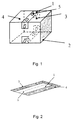
- the preferred embodiment of the invention is shown as an adhesive tape 1 for securing or used to close an object such as a box 2 becomes.
- the box 2 has upper lid flaps 3, 4, which are used to close the box 2 be folded down and meet on line 6.
- the adhesive tape is 1 glued on the top and bottom of the box 2 over the line 6 and each for Hold down the lid flaps 3, 4 glued down on the end faces of the carton 2 been.
- the adhesive tape 1 must be removed in the area of line 6 to the Lid flaps 3, 4 to be able to fold up. Is it the tape used? 1 around a commercially available adhesive tape, is off after removing the contents the box 2 and carefully re-gluing the tape 1 not recognizable that the adhesive tape 1 has been removed before.
- the adhesive tape 1 of the present invention is designed and manufactured that opening and closing in the manner described is not possible without being noticed.
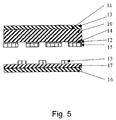
- the adhesive tape 1 consists of a preferably transparent thermoplastic Film 10 with a sufficient internal strength that the described Ensures use.
- non-full-surface transparent primer layer 14 applied on the lower surface 12 of this film 10 in a first step non-full-surface transparent primer layer 14 applied.
- Layer 14 is so on Foil surface 12 arranged so that it gives a lettering, which in the case of Detachment of the adhesive tape 1 on the cardboard surface can be seen.
- a first separating layer 15 is applied to the primer layer 14 and the remaining one Foil surface 12 applied.
- the separating layer 15 consists of a colored one Material.
- the colored separating layer 15 is between both on the film surface 12 the area of the primer layer 14 as well as on the primer layer 14 itself upset.
- a second separating layer 17 is applied to the separating layer 15.
- the separating layer 17 preferably has a different color than the separating layer 15.
- the primer layer 14 adheres relatively strongly to the film surface 12.
- the separating layer 15 adheres to the film surface 12 only relatively weakly, but relatively strongly the primer layer 14.
- the separating layer 17 adheres only weakly to the separating layer 15.
- the adhesion of the separating layer 15 to the film surface 12 is less than the adhesion the separating layer 17 on the separating layer 15.
- the adhesive layer 16 adheres to the Separating layer 17 is stronger than the separating layer 15 on the film surface 12.
- the adhesive layer 16 preferably adheres more strongly to the separating layer 17 than to the separating layer 15.
- a preferably transparent separation layer 13 applied, which adheres relatively strongly to the surface 11.
- the liability of Separating layer 13 to the adhesive layer 16 is small, so that the wound on the roll Adhesive tape 1 can be unwound without separation of the separating layer 15 from the film surface 12 occurs.
- the adhesive tape 1 separates in accordance with FIG. 5.
- the separation layer separates 15 in the area in which it is in direct contact with the film surface 12 from the film 10 and remains on the cardboard surface 3, 4.
- the separating layer 15 separates from the separating layer 17 and remains on the film 10.
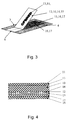
- the word "OPENED" can be read as a lettering on the separating layer 17 and as an inverse transparent lettering on the carrier 10.
- the adhesive tape according to the invention is suitable for use as a security closure for clearly recognizing an unauthorized attempt to open or an opening for a large number of valuable or sensitive goods.
- An important field of application is the protection of various consumer goods against theft, falsification of content and protection against pirated copies.
- the unnoticed opening, theft and falsification of sensitive goods is avoided by using the adhesive tapes according to the invention.
- the adhesive tapes according to the invention are particularly suitable for securing the opening or packaging of easily split paper packaging or the packaging of kraft liner cartons due to the slight internal separation over the entire surface when the adhesive tape is removed.
- the adhesive tapes of the invention are for a large number of adhesive tape applications suitable.
- Packaging applications are an important field of application.
- the Adhesive tapes are suitable as cardboard sealing tapes, general packaging adhesive tapes, Strapping tapes, adhesive tapes for sealing plastic packaging and plastic bags.
- the adhesive tapes are suitable for securing pallets. Further Applications are the bundling of loose goods and transport goods, such as Pipes, wooden strips and others.
- the adhesive tapes according to the invention can be used to secure transport for example refrigerators and other electrical and electronic Devices are used.
- Other applications are label protection, surface protection, for example in the construction sector and tear strips for packaging. Applications in the office area are also possible.
- a biaxially stretched, coextruded film based on polypropylene from Siliconature is used.
- Film thickness 28 um Labelling SILPROB B50 Company / manufacturer Siliconature
- the film is used without further pretreatment.
- the film has a release coating based on a solvent-based silicone.
- Two layers are applied on the side.
- the first layer adheres well to the Carrier surface. This layer is not applied over the entire surface and leaves the letters "OPENED" free on the film surface.
- a second layer is applied over the entire surface of the paint layer. This anchors poorly on the film surface, but good on the first primer layer that is not applied over the entire surface.
- the first primer layer is colorless, the full surface layer is white.
- a layer based on a solvent-based printing ink is used to produce the adhesive tapes according to the invention. Description: 15PAA printing ink from Michael Huber Ober GmbH, Germany
- the film a is coated with the layer b2 by means of a wire doctor.
- the wire doctor blade and the coating speed are set so that, after the coated film has dried, a mass application of layer b2 of approximately 18 to 20 g / m 2 is measured.
- Coating was carried out on a technical coater with a working width of 500 mm and a coating speed of 10 m / min.
- Behind the coating station with wire doctor applicator there is a drying tunnel that is operated with hot air (approx. 100 ° C).
- the coated film is immediately used without storage.
- the surface of the color layer b2 is treated with Corona adhesive before coating.
- the surface energy is 40 to 42 mN / m
- the film c1 is coated with the adhesive by means of a wire doctor.
- the Wire doctor and the coating speed are set so that after the Drying of the coated film a mass application of about 25 g / sqm is measured.
- the coating was carried out on a technical coater with a working width of 500 mm and a coating speed of 10 m / min. Behind the coating station with a wire knife applicator there is a drying tunnel with a hot one Air (approx. 100 ° C) is operated.
- the coated film was 19 mm wide assembled. The safety effect was determined after two days of storage at 23 ° C.
Landscapes
- Engineering & Computer Science (AREA)
- Chemical & Material Sciences (AREA)
- Organic Chemistry (AREA)
- Physics & Mathematics (AREA)
- General Physics & Mathematics (AREA)
- Theoretical Computer Science (AREA)
- Computer Security & Cryptography (AREA)
- Mechanical Engineering (AREA)
- Adhesive Tapes (AREA)
- Adhesives Or Adhesive Processes (AREA)
Abstract
Description
Weiterhin wird beispielsweise in DE 34 31 239 A1 die Verwendung von Sicherheitsetiketten beschrieben, bestehend aus einem Trägermaterial mit geringer Weiterreißfestigkeit. In Kombination mit einer stark haftenden Klebemasse wird das Sicherheitsetikett beim Entfernen irreversibel zerstört und somit der Öffnungsversuch angezeigt.
Das Sicherheitsetikett weist eine untere, von einem Träger abzulösende und auf die Verpackung aufzubringende erste Klebstoffschicht auf der Unterseite eines ersten Etikettenmaterials auf, auf dessen Oberseite über eine zweite Klebstoffschicht ein zweites Etikettenmaterial aufgebracht ist. Die Stärke der Klebkraft der ersten Klebstoffschicht zwischen der Verpackung und dem ersten Etikettenmaterial ist verschieden von der Stärke der Klebkraft der zweiten Klebstoffschicht zwischen dem ersten Etikettenmaterial und dem zweiten Etikettenmaterial.
Weiterhin besitzen Folien auf Basis von Polyestern eine sehr hohe Abriebfestigkeit und Durchschlagfestigkeit, sind aber aufgrund des relativ hohen Preises gegenüber Folien auf Basis von Polyolefinen weniger verbreitet im Bereich der Verpackungsklebebänder.
Die Gewinnung des PVC kann hierbei durch Emulsions-, Suspensions- oder Massepolymerisation erfolgen. Auch Copolymere auf Basis PVC/Vinylacetat sind bekannt.
Der Bereich der ersten Trennschicht, der gegen die Folienoberfläche mit der Primerschicht stark verankert wurde, verbleibt auf der Trägeroberfläche.
Die Dicken der Folien auf Basis von PET liegen zwischen 20 und 100 µm, insbesondere zwischen 30 und 50 µm.
Die Dicken der monoaxial gereckten Folien auf Basis von Polypropylen liegen bevorzugt zwischen 25 und 200 µm, insbesondere zwischen 40 und 130 µm.
Folien aus monoaxial gerecktem Polypropylen sind zur Herstellung der erfindungsgemäßen Klebebänder besonders geeignet. Monoaxial gereckte Folien sind überwiegend einschichtig, grundsätzlich können aber auch mehrschichtige monoaxial gereckte Folien hergestellt werden. Bekannt sind überwiegend ein-, zwei- und dreischichtige Folien, wobei die Anzahl der Schichten auch größer gewählt werden kann.
Die erzielten Elastizitätsmodule in Längsrichtung, gemessen bei 10 % Dehnung nach ASTM D882, liegen üblicherweise zwischen 1000 und 4000 N/mm2, vorzugsweise zwischen 1500 und 3000 N/mm2.
Die Dicken der biaxial gereckten Folien auf Basis von Polypropylen liegen besonders zwischen 15 und 100 µm, vorzugsweise zwischen 20 und 50 µm.
Biaxial gereckte Folien auf Basis von Polypropylen können mittels Blasfolienextrusion oder mittels üblicher Flachfolienanlagen hergestellt werden. Biaxial gereckte Folien werden sowohl ein- als auch mehrschichtig hergestellt. Im Falle der mehrschichtigen Folien können auch hier die Dicke und Zusammensetzung der verschiedenen Schichten gleich sein aber auch verschiedene Dicken und Zusammensetzungen sind bekannt.
Für die erfindungsgemäßen Klebebänder für einen sicheren Kartonverschluß werden vorzugsweise Folien verwendet auf Basis von Hart-PVC. Die Dicken der Folien liegen bevorzugt zwischen 30 und 100 µm, insbesondere zwischen 35 und 50 µm. Die erfindungsgemäßen Klebebänder werden als Verpackungsbänder zum Kartonverschluß verwendet.
Trennlackierungen auf Basis von Silikonsystemen eignen sich als Trennlackierungen der erfindungsgemäßen Klebebänder. Bevorzugt als Trennlackierung sind UV-härtende Silikonsysteme auf 100% Basis, aber ebenso lösemittelhaltige Silikonsysteme können als Trennlackierung für die erfindungsgemäßen Klebebänder eingesetzt werden.
Die Auftragsmenge der Trennlackierung auf das Trägermaterial beträgt bevorzugt 0,1 bis 3 g/qm. In einer weiteren besonders bevorzugten Ausführung wird der Schichtauftrag der Trennlackierung von 0,2 bis 1,5 g/qm eingestellt.
Die von der nicht vollflächig aufgetragenen Primerschicht freigelassenen Bereiche auf der Folienoberfläche stellen bevorzugt charakteristische Zeichen beziehungsweise Symbole dar.
Derartige Farbschichten sind farbstark und geeignet mittels verschiedenster Technologie auf die erste Trennschicht aufgebracht zu werden.
Hierbei werden Druckformen verwendet, deren erhabene Partien die erste Schicht übertragen. Die Druckformen sind flexible Platten aus Gummi oder Fotopolymeren. Flexodruckkomponenten sind dünnflüssig, sowohl lösemittel- als auch wasserbasierend. Sie sind schnell trocknend, insbesondere im Bereich der strahlungshärtenden Systeme. Bei der Herstellung der erfindungsgemäßen Klebbänder werden bevorzugt wäßrige Flexodruckkomponenten eingesetzt. Die Auswahl der Rasterwalze richtet sich nach dem verwendeten Bedruckstoff, der dazugehörenden Flexodruckkomponente.
Weiterhin ist das Aufbringen von Klebemasse auf Basis von Styrol-lsopren-Styrol als Schmelzhaftkleber auf die zweite Schicht mittels bekannter Technologie bei der Herstellung der erfindungsgemäßen Klebebänder möglich.
- Figur 1
- eine dreidimensionale Darstellung eines Kartons, auf den das erfindungsgemäße Klebeband aufgeklebt ist,
- Figur 2
- einen vergrößerten Ausschnitt der Darstellung in Figur 1 mit dem aufgeklebten Klebeband,
- Figur 3
- eine Darstellung ähnlich Figur 2, die das erfindungsgemäße Klebeband zeigt, wenn es teilweise von der Kartonoberfläche abgelöst ist,
- Figur 4
- eine Schnittzeichnung des erfindungsgemäßen Klebebandes in seiner ursprünglichen und verklebten Form, in der die Schichtdicken so dargestellt sind, daß sie optimal die Konstruktion und den Aufbau des Klebebandes erkennen lassen, und
- Figur 5
- eine Schnittzeichnung ähnlich Figur 4, die jedoch die Verhältnisse der einzelnen Schichten zeigen, wenn das Klebeband erstmalig vom Karton abgezogen wird.
Die erfindungsgemäßen Klebebänder sind auf Grund der leichten vollflächigen inneren Trennung beim Entfernen des Klebebandes besonders für die Öffnungssicherung beziehungsweise Verpackung von leicht spaltbaren Papierverpackungen beziehungsweise die Verpackung von Kraftlinerkartons geeignet.
| Foliendicke | 28 um |
| Kennzeichnung | SILPROB B50 |
| Firma/Hersteller | Siliconature |
Bezeichnung: 15PAA Druckfarbe der Michael Huber München GmbH, Germany
Bezeichnung: Primal PS83D der Fa. Rhom&Haas, Germany
Die Oberfläche der Farbschicht b2 wird vor der Beschichtung mit Klebemasse Corona behandelt. Die Oberflächenenergie beträgt 40 bis 42 mN/m
| Verklebung auf | Kraftliner Karton | Recyceltem Karton (Testliner Karton) |
| Kartonoberfläche | gut | kritisch |
| Buchstabenübertrag | Sehr gut | Sehr gut |
| Deutlicher Sicherheitseffekt | ja | ja |
| Unbemerktes Öffnen des Kartons | Nicht möglich | Nicht möglich |
| Verpackungssicherheit | Sehr gut | Sehr gut |
| Faserausriß | nein | nein |
Claims (12)
- Mehrschichtiges Klebeband mit einem Träger auf Basis einer gereckten Thermoplastfolie, dessen obere Seite gegebenenfalls mit einer Trennlackierung beschichtet ist und auf dessen untere Seite folgende Schichten aufgebracht sind:a) eine nicht vollflächig aufgetragene Primerschicht, wobei die Primerschicht sehr gut auf der Thermoplastfolie verankert,b) eine erste vollflächig über die aufgetragene Primerschicht und die freie Thermoplastfolienoberfläche aufgetragene Trennschicht, wobei die erste Trennschicht besser auf der Primerschicht verankert als auf der Thermoplastfolie,c) eine zweite vollflächig auf die erste Trennschicht aufgetragene Trennschicht, wobei die zweite Trennschicht besser auf der ersten Trennschicht haftet als die erste Trennschicht auf der Folienoberfläche und wobei die zweite Trennschicht schlechter auf der ersten Trennschicht haftet als Klebemasse auf dem Haftgrund,d) eine vollflächig auf die zweite Trennschicht aufgetragene Haftklebemasse, die auf der zweiten Trennschicht besser verankert ist als die zweite Trennschicht auf der ersten Trennschicht.
- Klebeband nach Anspruch 1, dadurch gekennzeichnet, daß die Thermoplastfolie aus gerecktem Polyolefinen oder aus Polyester besteht und insbesondere transparent ist.
- Klebeband nach den Ansprüchen 1 und 2, dadurch gekennzeichnet, daß die Thermoplastfolie aus gerecktem HDPE, aus PVC, aus PET, aus monoaxial gerecktem Polypropylen oder aus biaxial gerecktem Polypropylen besteht.
- Klebeband nach zumindest einem der vorhergehenden Ansprüche, dadurch gekennzeichnet, daß die Haftung der Primerschicht auf der Thermoplastfolie und weiterer Schichten untereinander durch Coronabehandlung oder Flammenbehandlung verbessert wird.
- Klebeband nach zumindest einem der vorhergehenden Ansprüche, dadurch gekennzeichnet, daß die von der nicht vollflächig aufgetragenen Primerschicht freigelassenen Bereiche auf der Folienoberfläche charakteristische Zeichen beziehungsweise Symbole darstellen.
- Klebeband nach zumindest einem der vorhergehenden Ansprüche, dadurch gekennzeichnet, daß die erste Trennschicht Harzdispersionen, Acrylatdispersionen, Polymerdispersionen oder insbesondere wasserbasierende, lösemittelbasierende oder durch UV-Strahlung härtende Flexodruckfarben umfaßt.
- Klebeband nach zumindest einem der vorhergehenden Ansprüche, dadurch gekennzeichnet, daß die zweite Trennschicht wasserbasierende, lösemittelbasierende oder durch UV-Strahlung härtende Flexodruckfarben umfaßt.
- Klebeband nach zumindest einem der vorhergehenden Ansprüche, dadurch gekennzeichnet, daß die erste Trennschicht und die zweite Trennschicht verschiedenfarbig sind.
- Klebeband nach zumindest einem der vorhergehenden Ansprüche, dadurch gekennzeichnet, daß die Klebemasse eine solche auf Basis einer wäßrigen Acrylatdispersion ist.
- Klebeband nach zumindest einem der vorhergehenden Ansprüche, dadurch gekennzeichnet, daß das Klebeband beliebig, durch Bedruckung mit Standardfarben in einer bevorzugten Version auf der Klebmassenseite individualisiert werden kann.
- Klebeband nach zumindest einem der vorhergehenden Ansprüche, dadurch gekennzeichnet, daß die Auftragsmenge der Primerschicht auf dem Trägermaterial 0,5 bis 12 g/qm, besonders bevorzugt 1,5 bis 6 g/qm beträgt,
die Auftragsmenge der ersten Trennschicht auf dem Trägermaterial beziehungsweise auf der Primerschicht 2 bis 18 g/qm, besonders bevorzugt 5 bis 11 g/qm, beträgt und die Auftragsmenge der zweiten Trennschicht auf der ersten Trennschicht 8 bis 50 g/qm, besonders bevorzugt 15 bis 30 g/qm, beträgt. - Verwendung des Klebebandes nach zumindest einem der vorhergehenden Ansprüche als Verpackungsklebeband mit gutem Kartonverschluß und mit gutem Anfaßvermögen zu Papier, insbesondere recyceltem Papier, mit ausreichender Kohäsion, mit guter Verpackungssicherheit und mit leichtem Abrollen.
Applications Claiming Priority (2)
| Application Number | Priority Date | Filing Date | Title |
|---|---|---|---|
| DE19963709A DE19963709A1 (de) | 1999-12-29 | 1999-12-29 | Sicherheitsklebeband zum Nachweis des unbefugten Öffnens einer Verpackung |
| DE19963709 | 1999-12-29 |
Publications (3)
| Publication Number | Publication Date |
|---|---|
| EP1113059A2 true EP1113059A2 (de) | 2001-07-04 |
| EP1113059A3 EP1113059A3 (de) | 2001-10-17 |
| EP1113059B1 EP1113059B1 (de) | 2003-08-13 |
Family
ID=7934948
Family Applications (1)
| Application Number | Title | Priority Date | Filing Date |
|---|---|---|---|
| EP00127134A Expired - Lifetime EP1113059B1 (de) | 1999-12-29 | 2000-12-12 | Sicherheitsklebeband zum Nachweis des unbefugten Öffnens einer Verpackung |
Country Status (4)
| Country | Link |
|---|---|
| US (1) | US6544615B2 (de) |
| EP (1) | EP1113059B1 (de) |
| DE (2) | DE19963709A1 (de) |
| ES (1) | ES2203393T3 (de) |
Cited By (10)
| Publication number | Priority date | Publication date | Assignee | Title |
|---|---|---|---|---|
| WO2001098424A3 (de) * | 2000-06-21 | 2002-04-04 | Tesa Ag | Sicherheitsklebeband zum nachweis des unbefugten öffnens einer verpackung |
| EP1666554A1 (de) * | 2004-12-04 | 2006-06-07 | Tesa AG | Sicherheitsklebeband zum Nachweis des unbefugten Öffnens einer Verpackung |
| WO2006111714A3 (en) * | 2005-04-16 | 2007-03-01 | Ko Pack Internat Europ Ltd | Method and apparatus for tamper-proofing |
| WO2007028700A1 (de) * | 2005-09-09 | 2007-03-15 | Tesa Ag | Selbstklebeband |
| EP1972674A1 (de) * | 2007-03-21 | 2008-09-24 | HUECK Folien Ges.m.b.H. | Sicherheitsfolie mit Manipulationsnachweis |
| DE102008011536A1 (de) * | 2008-02-28 | 2009-09-03 | Tesa Se | Mehrschichtiger Klebeartikel zur Verwendung als Erstöffnungsnachweis |
| WO2012019721A1 (de) | 2010-08-13 | 2012-02-16 | Hueck Folien Ges.M.B.H. | Sicherheitsetikett oder- klebeband mit manipulationsnachweis |
| WO2015082200A1 (de) * | 2013-12-05 | 2015-06-11 | Huhtamaki Films Germany Gmbh & Co. Kg | Vorläuferverbundmaterial, verbundmaterial, verfahren zur herstellung eines vorläuferverbundmaterials, verfahren zur herstellung eines verbundmaterials und verwendung eines vorläuferverbundmaterials und eines verbundmaterials |
| DE102016222642A1 (de) * | 2016-11-17 | 2018-05-17 | Bayerische Motoren Werke Aktiengesellschaft | Prüfband |
| US9996787B2 (en) | 2013-04-02 | 2018-06-12 | Heraeus Deutschland GmbH & Co. KG | Layered structure with conductive polymer for recognition of manipulation and process for the production thereof |
Families Citing this family (42)
| Publication number | Priority date | Publication date | Assignee | Title |
|---|---|---|---|---|
| DE10030555A1 (de) * | 2000-06-21 | 2002-03-14 | Tesa Ag | Sicherheitsklebeband zum Nachweis des unbefugten Öffnens einer Verpackung |
| DE10030556A1 (de) * | 2000-06-21 | 2002-04-04 | Tesa Ag | Sicherheitsklebeband zum Nachweis des unbefugten Öffnens einer Verpackung |
| DE10036708A1 (de) * | 2000-07-27 | 2002-04-11 | Tesa Ag | Klebeband zum Nachweis des unbefugten Öffnen einer Verpackung |
| US6416857B1 (en) | 2000-10-25 | 2002-07-09 | 3M Innovative Properties Company | Tamper indicating device |
| DE10146270A1 (de) * | 2001-09-19 | 2003-04-03 | Tesa Ag | Verwendung eines Sicherheitsklebebandes zum Anzeigen unautorisierter Öffnungsversuche an Versandpackungen |
| DE10217941B4 (de) * | 2002-04-22 | 2012-04-05 | Sig Combibloc Systems Gmbh | Verfahren zur Herstellung eines Verbundmaterials mit temperaturbeständigem Haftvermittler und danach hergestelltes Verbundmaterial |
| DE10223632A1 (de) * | 2002-05-28 | 2003-12-11 | Tesa Ag | Verwendung eines Klebebands zur Abdeckung bei Maler- und Lackieranwendungen |
| EP1616316A2 (de) * | 2003-04-21 | 2006-01-18 | 3M Innovative Properties Company | Manipulationsanzeigeeinrichtungen und verfahren zum sichern von informationen |
| CA2530609A1 (en) * | 2003-07-02 | 2005-01-20 | Sonoco Development, Inc. | Tamper evident flow wrap |
| US6960110B2 (en) * | 2003-09-18 | 2005-11-01 | Be Aerospace, Inc. | Secure life jacket container |
| KR100564999B1 (ko) * | 2003-09-25 | 2006-03-30 | 주식회사 바이오폴 | 의료용 점착 테이프 |
| IL158625A0 (en) * | 2003-10-27 | 2004-08-31 | Davik Self Adhesive Tapes Agri | Tamper evident tape |
| IL158892A (en) * | 2003-11-16 | 2008-11-26 | Bsecure Ltd | Tamper-evident adhesive tape |
| US20050275751A1 (en) * | 2004-06-11 | 2005-12-15 | Sony Ericsson Mobile Communications Ab | Security cover |
| DE102005057932A1 (de) * | 2005-12-02 | 2007-06-06 | Tesa Ag | Rolle einer Etikettenbahn in Form einer archimedischen Spirale aus hintereinander angeordneten Etiketten |
| DE102008030935A1 (de) * | 2008-02-28 | 2009-09-03 | Tesa Se | Mehrschichtiger Klebeartikel zur Verwendung als Erstöffnungsnachweis |
| DE102008033323A1 (de) | 2008-07-16 | 2010-01-21 | Tesa Se | Sicherheitsetikett |
| CA2738524C (en) | 2008-10-02 | 2013-11-26 | Mylan Inc. | Method for making a multilayer adhesive laminate |
| DE102009058261A1 (de) * | 2009-12-14 | 2011-07-07 | MULTIVAC Marking & Inspection GmbH & Co. KG, 32130 | Transportriemen für Etiketten und Verfahren zu dessen Herstellung |
| JP6001888B2 (ja) * | 2012-03-15 | 2016-10-05 | テルモ株式会社 | 収納容器、及びこの収納容器の使用方法 |
| DE202012003950U1 (de) | 2012-04-20 | 2013-07-22 | Trautwein Gmbh & Co. | Sicherheitssiegel |
| US9028963B2 (en) | 2012-09-05 | 2015-05-12 | Selig Sealing Products, Inc. | Tamper evident tabbed sealing member having a foamed polymer layer |
| DE102012218033B4 (de) | 2012-10-02 | 2019-02-21 | Tesa Se | Versiegelungsetikett und ein Herstellungsverfahren dafür |
| DE102012221796B3 (de) * | 2012-11-28 | 2014-03-13 | Tesa Se | Transparente Sicherheitsfolie |
| EP3102499B1 (de) * | 2014-02-05 | 2019-11-20 | Selig Sealing Products, Inc. | Fälschungssicheres dichtungselement aus zwei aluminiumschichten mit lasche |
| MX346259B (es) * | 2015-02-24 | 2017-03-10 | Validation Security Tech Identification S De R L De C V | Sistema de etiqueta inteligente. |
| MX391625B (es) | 2015-03-03 | 2025-03-21 | Selig Sealing Products Inc | Conceptos de sello con pestañas. |
| US9676533B2 (en) | 2015-03-27 | 2017-06-13 | Adcraft Products Co. Inc. | Tamper-evident package and method for making same |
| WO2016160050A1 (en) * | 2015-03-27 | 2016-10-06 | Adcraft Products Co. Inc. | Tamper-evident package and method for making same |
| DE102015015289A1 (de) | 2015-11-30 | 2017-06-01 | Tesa Scribos Gmbh | Sicherheitsklebeband |
| EP3532281B1 (de) | 2016-10-28 | 2023-04-12 | Selig Sealing Products, Inc. | Dichtungselement zur verwendung mit fetthaltigen zusammensetzungen |
| CN109863093B (zh) | 2016-10-28 | 2021-11-26 | 赛利格密封产品公司 | 单铝显窃启指示拉片式密封构件 |
| US11866242B2 (en) | 2016-10-31 | 2024-01-09 | Selig Sealing Products, Inc. | Tabbed inner seal |
| US11724863B2 (en) | 2018-07-09 | 2023-08-15 | Selig Sealing Products, Inc. | Tabbed seal with oversized tab |
| US11254481B2 (en) | 2018-09-11 | 2022-02-22 | Selig Sealing Products, Inc. | Enhancements for tabbed seal |
| MX2022006462A (es) | 2019-11-29 | 2022-07-13 | Selig Sealing Products Inc | Sello de pestaña sin papel aluminio. |
| EP4157736A4 (de) | 2020-05-29 | 2024-07-17 | Selig Sealing Products, Inc. | Ausgabeauskleidung |
| RU2743283C1 (ru) * | 2020-08-06 | 2021-02-16 | Акционерное Общество "Научно-Производственное Объединение "Криптен" | Голографический элемент для защитных этикеток и лент |
| CN112537100B (zh) * | 2020-12-23 | 2025-02-14 | 上海宏盾防伪材料有限公司 | 一种复合膜及制作复合膜的制作方法 |
| US20220228032A1 (en) * | 2021-01-20 | 2022-07-21 | McAuliffe Paper Inc. | Breakaway adhesive coating system |
| US12673808B2 (en) | 2021-03-19 | 2026-07-07 | Selig France | Compostable sealing member |
| IT202400005884A1 (it) * | 2024-03-18 | 2025-09-18 | Etipress S R L | Processo di realizzazione di un imballaggio con etichetta multistrato adesiva con codifica di sicurezza e modalità di utilizzo. |
Family Cites Families (17)
| Publication number | Priority date | Publication date | Assignee | Title |
|---|---|---|---|---|
| US4121003A (en) * | 1977-04-22 | 1978-10-17 | Monarch Marking Systems, Inc. | Tamper indicating labels |
| US4184701A (en) * | 1978-02-10 | 1980-01-22 | Monarch Marking Systems, Inc. | Tamper proof label |
| US5595803A (en) * | 1983-03-31 | 1997-01-21 | P. P. Payne Limited | Filmic packaging material and a tear adherent thereto |
| DE3431239A1 (de) * | 1984-01-25 | 1985-07-25 | Zweckform Werk Gmbh, 8150 Holzkirchen | Sicherheitsetikett zum nachweis des unbefugten oeffnens einer verpackung |
| US4630891A (en) * | 1984-09-14 | 1986-12-23 | Minnesota Mining And Manufacturing Company | Tamper resistant security film |
| GB2173150B (en) * | 1985-03-28 | 1989-06-21 | Daimatsu Kagaku Kogyo Kk | An easily breakable sticking material |
| US4876123A (en) * | 1988-06-27 | 1989-10-24 | Minnesota Mining And Manufacturing Company | Tamper indicating tape and delaminating film therefore |
| US4980222A (en) * | 1989-06-21 | 1990-12-25 | Minnesota Mining And Manufacturing Company | Tamper indicating tape |
| US5082702A (en) * | 1990-08-20 | 1992-01-21 | Minnesota Mining And Manufacturing Company | Tamper-indicating tape |
| DE69028309T2 (de) * | 1990-12-19 | 1997-01-23 | Kendall & Co | Sicherheitsverschluss und Verfahren zur Verwendung desselben |
| WO1994013474A1 (en) * | 1992-12-09 | 1994-06-23 | Hoechst Aktiengesellschaft | In-line silicone coated biaxially oriented copolyester film and a process for manufacturing the film |
| CA2134521A1 (en) * | 1993-11-02 | 1995-05-03 | Raymond R. Gosselin | Tamper-indicating label |
| US5510171A (en) * | 1995-01-19 | 1996-04-23 | Minnesota Mining And Manufacturing Company | Durable security laminate with hologram |
| US6218004B1 (en) * | 1995-04-06 | 2001-04-17 | David G. Shaw | Acrylate polymer coated sheet materials and method of production thereof |
| US5633058A (en) * | 1995-09-05 | 1997-05-27 | Hoffer; Erik | Message-indicating self-wound tape and method of making same |
| EP0900433A1 (de) * | 1996-05-20 | 1999-03-10 | Minnesota Mining And Manufacturing Company | Originalitätsgesicherte mehschihtbahn |
| US6372341B1 (en) * | 1998-04-27 | 2002-04-16 | 3M Innovative Properties Company | Tampa-indicating article for reusable substrates |
-
1999
- 1999-12-29 DE DE19963709A patent/DE19963709A1/de not_active Withdrawn
-
2000
- 2000-12-12 EP EP00127134A patent/EP1113059B1/de not_active Expired - Lifetime
- 2000-12-12 ES ES00127134T patent/ES2203393T3/es not_active Expired - Lifetime
- 2000-12-12 DE DE50003256T patent/DE50003256D1/de not_active Expired - Lifetime
- 2000-12-28 US US09/750,985 patent/US6544615B2/en not_active Expired - Lifetime
Cited By (12)
| Publication number | Priority date | Publication date | Assignee | Title |
|---|---|---|---|---|
| WO2001098424A3 (de) * | 2000-06-21 | 2002-04-04 | Tesa Ag | Sicherheitsklebeband zum nachweis des unbefugten öffnens einer verpackung |
| US7060353B2 (en) | 2000-06-21 | 2006-06-13 | Tesa Ag | Adhesive security tape for detecting unauthorized broaching of a package |
| EP1666554A1 (de) * | 2004-12-04 | 2006-06-07 | Tesa AG | Sicherheitsklebeband zum Nachweis des unbefugten Öffnens einer Verpackung |
| WO2006111714A3 (en) * | 2005-04-16 | 2007-03-01 | Ko Pack Internat Europ Ltd | Method and apparatus for tamper-proofing |
| WO2007028700A1 (de) * | 2005-09-09 | 2007-03-15 | Tesa Ag | Selbstklebeband |
| EP1972674A1 (de) * | 2007-03-21 | 2008-09-24 | HUECK Folien Ges.m.b.H. | Sicherheitsfolie mit Manipulationsnachweis |
| DE102008011536A1 (de) * | 2008-02-28 | 2009-09-03 | Tesa Se | Mehrschichtiger Klebeartikel zur Verwendung als Erstöffnungsnachweis |
| WO2012019721A1 (de) | 2010-08-13 | 2012-02-16 | Hueck Folien Ges.M.B.H. | Sicherheitsetikett oder- klebeband mit manipulationsnachweis |
| US9996787B2 (en) | 2013-04-02 | 2018-06-12 | Heraeus Deutschland GmbH & Co. KG | Layered structure with conductive polymer for recognition of manipulation and process for the production thereof |
| WO2015082200A1 (de) * | 2013-12-05 | 2015-06-11 | Huhtamaki Films Germany Gmbh & Co. Kg | Vorläuferverbundmaterial, verbundmaterial, verfahren zur herstellung eines vorläuferverbundmaterials, verfahren zur herstellung eines verbundmaterials und verwendung eines vorläuferverbundmaterials und eines verbundmaterials |
| US9982167B2 (en) | 2013-12-05 | 2018-05-29 | Infiana Germany Gmbh & Co. Kg | Precursor composite material, method for producing a precursor composite material, method for producing a composite material and use of a precursor composite material and of a composite material |
| DE102016222642A1 (de) * | 2016-11-17 | 2018-05-17 | Bayerische Motoren Werke Aktiengesellschaft | Prüfband |
Also Published As
| Publication number | Publication date |
|---|---|
| DE50003256D1 (de) | 2003-09-18 |
| US20010006713A1 (en) | 2001-07-05 |
| EP1113059A3 (de) | 2001-10-17 |
| EP1113059B1 (de) | 2003-08-13 |
| ES2203393T3 (es) | 2004-04-16 |
| DE19963709A1 (de) | 2002-12-05 |
| US6544615B2 (en) | 2003-04-08 |
Similar Documents
| Publication | Publication Date | Title |
|---|---|---|
| EP1113059B1 (de) | Sicherheitsklebeband zum Nachweis des unbefugten Öffnens einer Verpackung | |
| EP1113058B1 (de) | Sicherheitsklebeband zum Nachweis des unbefugten Öffnens einer Verpackung | |
| EP1297090B1 (de) | Sicherheitsklebeband zum nachweis des unbefugten öffnens einer verpackung | |
| EP1297089B1 (de) | Sicherheitsklebeband zum nachweis des unbefugten öffnens einer verpackung | |
| DE69408113T2 (de) | Klebeband zum Nachweis einer unerlaubten Manipulation | |
| EP1296306A2 (de) | Verwendung eines Sicherheitsklebebandes zum Anzeigen unautorisierter Öffnungsversuche an Versandpackungen | |
| EP1297087B1 (de) | Sicherheitsklebeband zum nachweis des unbefugten öffnens einer verpackung | |
| DE102012221796B3 (de) | Transparente Sicherheitsfolie | |
| EP1403190B1 (de) | Originalitätssiegel | |
| DE10022002A1 (de) | Sicherheitsklebeband zum Nachweis des unbefugten Öffnens einer Verpackung | |
| EP1666554B1 (de) | Sicherheitsklebeband zum Nachweis des unbefugten Öffnens einer Verpackung | |
| DE212013000198U1 (de) | Linerless-Etikettenbahn und Etikett | |
| WO2009106436A2 (de) | Mehrschichtiger klebeartikel zur verwendung als erstöffnungsnachweis | |
| EP1113061A2 (de) | Klebeband zum Nachweis des unbefugten Öffnens einer Verpackung | |
| DE10140491A1 (de) | Selbstklebendes Sicherheitsetikett | |
| EP1113060A2 (de) | Klebeband zum Nachweis des unbefugten Öffnens einer Verpackung | |
| EP1050484B1 (de) | Aufreisstreifen mit Sicherheitsmerkmal, ein Verfahren zu seiner Herstellung sowie dessen Verwendung in Verpackungsmaterial | |
| EP1311641A1 (de) | Klebeband zum nachweis des unbefugten öffnens einer verpackung |
Legal Events
| Date | Code | Title | Description |
|---|---|---|---|
| PUAI | Public reference made under article 153(3) epc to a published international application that has entered the european phase |
Free format text: ORIGINAL CODE: 0009012 |
|
| AK | Designated contracting states |
Kind code of ref document: A2 Designated state(s): AT BE CH CY DE DK ES FI FR GB GR IE IT LI LU MC NL PT SE TR Kind code of ref document: A2 Designated state(s): DE ES FR GB IT |
|
| AX | Request for extension of the european patent |
Free format text: AL;LT;LV;MK;RO;SI |
|
| PUAL | Search report despatched |
Free format text: ORIGINAL CODE: 0009013 |
|
| AK | Designated contracting states |
Kind code of ref document: A3 Designated state(s): AT BE CH CY DE DK ES FI FR GB GR IE IT LI LU MC NL PT SE TR |
|
| AX | Request for extension of the european patent |
Free format text: AL;LT;LV;MK;RO;SI |
|
| RIC1 | Information provided on ipc code assigned before grant |
Free format text: 7C 09J 7/02 A, 7B 65D 33/34 B, 7B 65D 55/02 B, 7G 09F 3/02 B |
|
| 17P | Request for examination filed |
Effective date: 20010920 |
|
| RAP1 | Party data changed (applicant data changed or rights of an application transferred) |
Owner name: TESA AG |
|
| 17Q | First examination report despatched |
Effective date: 20020118 |
|
| AKX | Designation fees paid |
Free format text: DE ES FR GB IT |
|
| GRAH | Despatch of communication of intention to grant a patent |
Free format text: ORIGINAL CODE: EPIDOS IGRA |
|
| GRAH | Despatch of communication of intention to grant a patent |
Free format text: ORIGINAL CODE: EPIDOS IGRA |
|
| GRAA | (expected) grant |
Free format text: ORIGINAL CODE: 0009210 |
|
| AK | Designated contracting states |
Designated state(s): DE ES FR GB IT |
|
| REG | Reference to a national code |
Ref country code: GB Ref legal event code: FG4D Free format text: NOT ENGLISH |
|
| REF | Corresponds to: |
Ref document number: 50003256 Country of ref document: DE Date of ref document: 20030918 Kind code of ref document: P |
|
| GBT | Gb: translation of ep patent filed (gb section 77(6)(a)/1977) |
Effective date: 20031022 |
|
| REG | Reference to a national code |
Ref country code: ES Ref legal event code: FG2A Ref document number: 2203393 Country of ref document: ES Kind code of ref document: T3 |
|
| ET | Fr: translation filed | ||
| PLBE | No opposition filed within time limit |
Free format text: ORIGINAL CODE: 0009261 |
|
| STAA | Information on the status of an ep patent application or granted ep patent |
Free format text: STATUS: NO OPPOSITION FILED WITHIN TIME LIMIT |
|
| 26N | No opposition filed |
Effective date: 20040514 |
|
| PGFP | Annual fee paid to national office [announced via postgrant information from national office to epo] |
Ref country code: ES Payment date: 20091222 Year of fee payment: 10 |
|
| REG | Reference to a national code |
Ref country code: FR Ref legal event code: CJ Ref country code: FR Ref legal event code: CD |
|
| PGFP | Annual fee paid to national office [announced via postgrant information from national office to epo] |
Ref country code: FR Payment date: 20100108 Year of fee payment: 10 Ref country code: GB Payment date: 20091218 Year of fee payment: 10 Ref country code: IT Payment date: 20091222 Year of fee payment: 10 |
|
| REG | Reference to a national code |
Ref country code: ES Ref legal event code: PC2A Owner name: TESA SE Effective date: 20110415 |
|
| GBPC | Gb: european patent ceased through non-payment of renewal fee |
Effective date: 20101212 |
|
| REG | Reference to a national code |
Ref country code: FR Ref legal event code: ST Effective date: 20110831 |
|
| PG25 | Lapsed in a contracting state [announced via postgrant information from national office to epo] |
Ref country code: FR Free format text: LAPSE BECAUSE OF NON-PAYMENT OF DUE FEES Effective date: 20110103 |
|
| PG25 | Lapsed in a contracting state [announced via postgrant information from national office to epo] |
Ref country code: GB Free format text: LAPSE BECAUSE OF NON-PAYMENT OF DUE FEES Effective date: 20101212 |
|
| PG25 | Lapsed in a contracting state [announced via postgrant information from national office to epo] |
Ref country code: IT Free format text: LAPSE BECAUSE OF NON-PAYMENT OF DUE FEES Effective date: 20101212 |
|
| REG | Reference to a national code |
Ref country code: ES Ref legal event code: FD2A Effective date: 20120206 |
|
| PG25 | Lapsed in a contracting state [announced via postgrant information from national office to epo] |
Ref country code: ES Free format text: LAPSE BECAUSE OF NON-PAYMENT OF DUE FEES Effective date: 20101213 |
|
| REG | Reference to a national code |
Ref country code: DE Ref legal event code: R081 Ref document number: 50003256 Country of ref document: DE Owner name: TESA SE, DE Free format text: FORMER OWNER: TESA SE, 20253 HAMBURG, DE |
|
| PGFP | Annual fee paid to national office [announced via postgrant information from national office to epo] |
Ref country code: DE Payment date: 20161213 Year of fee payment: 17 |
|
| REG | Reference to a national code |
Ref country code: DE Ref legal event code: R079 Ref document number: 50003256 Country of ref document: DE Free format text: PREVIOUS MAIN CLASS: C09J0007020000 Ipc: C09J0007200000 |
|
| REG | Reference to a national code |
Ref country code: DE Ref legal event code: R119 Ref document number: 50003256 Country of ref document: DE |
|
| PG25 | Lapsed in a contracting state [announced via postgrant information from national office to epo] |
Ref country code: DE Free format text: LAPSE BECAUSE OF NON-PAYMENT OF DUE FEES Effective date: 20180703 |