EP1111410A2 - Infrared absorption filter - Google Patents
Infrared absorption filter Download PDFInfo
- Publication number
- EP1111410A2 EP1111410A2 EP00127937A EP00127937A EP1111410A2 EP 1111410 A2 EP1111410 A2 EP 1111410A2 EP 00127937 A EP00127937 A EP 00127937A EP 00127937 A EP00127937 A EP 00127937A EP 1111410 A2 EP1111410 A2 EP 1111410A2
- Authority
- EP
- European Patent Office
- Prior art keywords
- infrared absorption
- absorption filter
- group
- film
- filter according
- Prior art date
- Legal status (The legal status is an assumption and is not a legal conclusion. Google has not performed a legal analysis and makes no representation as to the accuracy of the status listed.)
- Granted
Links
Images



Classifications
-
- G—PHYSICS
- G02—OPTICS
- G02B—OPTICAL ELEMENTS, SYSTEMS OR APPARATUS
- G02B5/00—Optical elements other than lenses
- G02B5/20—Filters
- G02B5/22—Absorbing filters
-
- G—PHYSICS
- G02—OPTICS
- G02B—OPTICAL ELEMENTS, SYSTEMS OR APPARATUS
- G02B5/00—Optical elements other than lenses
- G02B5/20—Filters
- G02B5/22—Absorbing filters
- G02B5/223—Absorbing filters containing organic substances, e.g. dyes, inks or pigments
-
- G—PHYSICS
- G02—OPTICS
- G02B—OPTICAL ELEMENTS, SYSTEMS OR APPARATUS
- G02B5/00—Optical elements other than lenses
- G02B5/20—Filters
- G02B5/208—Filters for use with infrared or ultraviolet radiation, e.g. for separating visible light from infrared and/or ultraviolet radiation
Definitions
- the present invention relates to an infrared absorption filter. More particularly, the present invention relates to an infrared absorption filter which contains few foreign materials causing optical defects, has high transmittance in the visible light region, and manifests wide absorption in the near infrared radiation region and intercepts infrared radiation.
- the following filters have been conventionally used as an infrared absorption filter such as a heat ray-absorbing filter or a filter for adjusting the visibility of a video camera:
- the filter (1) exhibits sharp absorption in the near-infrared region and can intercept infrared radiation at a very high ratio. However, the filter (1) pronouncedly absorbs part of red color in the visible light region so that the transmitted color looks blue. For display purpose, importance is laid on a color balance. In such purpose, it is unsuitable to use the filter (1). Another problem is raised about the processability of the filter (1) because it is made of glass.
- the optical properties of the filter (2) can be freely designed. Further a filter having properties almost equal to the designed properties can be produced.
- the filter (2) necessitates a plurality of layers differing in refractive index from each other for this purpose, consequently entailing a drawback of incurring high production costs.
- the filter (2) should have a uniform thickness of high precision over the entire area, resulting in a difficulty in producing the filter.
- the filter (3) has improved processability, a draw back of the filter (1).
- the filter (3) has low degree of freedom in designing optical properties as in the filter (1). Also there remains the problem of the filter (1) that it absorbs part of red color in the visible light region so that the transmitted color looks blue. Further, the absorption of copper ions is low and the amount of copper ions which can be contained in an acrylic resin is restricted, causing a problem that the thickness of the acrylic resin has to be increased.
- various infrared-absorbing materials can be used.
- useful materials are phthalocyanine, nickel complex, diimmonium salts, azo compounds, polymethines, diphenylmethane, triphenylmethane, quinone and the like.
- these materials pose problems of showing insufficient absorption or absorbing a visible light of specific wavelength in the visible light region. Therefore, a plurality of coloring matters are used together.
- the filter when a filter containing a plurality of coloring matters in an infrared absorption layer is left to stand at a high temperature or a high humidity for a long time, the filter causes problems of denaturing a coloring matter due to decomposition and oxidation there of, bringing about absorption in the visible light region, or ceasing absorption in the infrared region, and the like. Further, when these filters comprise a substrate film coated with an infrared absorption layer, there occurs also a problem of deteriorating beam transmission property due to transmittance and haze value of the substrate film.
- PDP developed recently as a thin display having a large screen may invite error movement of a remote controller and the like due to near-infrared radiation discharged from the front surface thereof, consequently necessitating setting of an infrared absorption filter which cuts this near-infrared radiation, in front of the screen.
- this infrared radiation shielding filter also does not attain sufficient requirement in the above-mentioned infrared absorption filters, under current condition.
- a filter when a diimmonium salt-based compound is used as an infrared absorption coloring matter, a filter can be obtained which surmounts the above-mentioned problems, provides high absorption in the near-infrared region, and manifests low absorption in the visible region. Further, it can provide an ability also suitable as an infrared absorption filter for PDP.
- a particle which is used for imparting slipperiness in a substrate film, or an amount of inclusion of a particle as low as possible is preferable.
- the content of a particle is smaller, transparency of a film tends to increase, and an optical defect due to a fine foreign material tends to more clear.
- the thickness of a substrate film of this infrared absorption filer is usually 50 ⁇ m or more, and the content of foreign material along the thickness direction per unit area of a film tends to be larger in such a thick film as compared with a thin film, consequently, further raising this problem.
- a first object of the present invention is to provide an infrared absorption filter which has absorption in the near-infrared region, manifests high light transmittance in the visible region, does not have large absorption of a specific wavelength in the visible region, and has little optical defect.
- an object of the present invention is to provide an infrared absorption filter excellent in environmental stability and durability.
- a second object of the present invention is to provide the above-mentioned infrared absorption filter revealing blue gray tone.
- the present invention has been completed in view of the above-mentioned conditions, and infrared absorption filters which can solve the above-mentioned problems are as follows.
- a first aspect of the present invention is an infrared absorption filter comprising an infrared absorption layer laminated at least on one surface of a transparent polymer film, wherein said transparent polymer film is a film comprising a polymer easy adhesion layer laminated at least on one surface, said transparent polymer film contains substantially no particle, and said transparent polymer film contains foreign materials having a size of 20 ⁇ m or more in an amount of 10/m 2 or less per unit area of the film.
- a second aspect of the present invention is an infrared absorption filter according to the first aspect, wherein said infrared absorption filter has a transmittance of at most 30% in the near-infrared region in the wavelength range of 800 to 1100 nm, a difference of 10% or less between a maximum value and a minimum value of transmittance in the visible light region in the wavelength range of 450 to 650 nm, and a transmittance of not lower than 50% at a wavelength of 550 nm.
- a third aspect of the present invention is an infrared absorption filter according to the first or second aspect, wherein said infrared absorption filter has a maximum transmittance of not higher than 30% in the near-infrared region in the wavelength range of 800 to 1100 nm, a difference of 10% or less between a maximum value and a minimum value of transmittance in the visible light region in the wavelength range of 450 to 650 nm, and a transmittance of not lower than 50% at a wavelength of 550 nm, even after being left to stand in the atmosphere at a temperature of 60°C and a humidity of 95% for 500 hours.
- a fourth aspect of the present invention is an infrared absorption filter according to Invention 1, wherein said infrared absorption filter has a transmittance of not higher than 10% in the near-infrared region in the wavelength range of 900 to 1100 nm, a minimum transmittance of not lower than 60% in the visible light regions in the wavelength range of 440 to 500 nm and the wavelength range of 640 to 700 nm, a maximum transmittance of not higher than 60% in the visible light region in the wavelength range of 550 to 600 nm, and a transmittance of not lower than 50% at a wavelength of 550 nm.
- a fifth aspect of the present invention is an infrared absorption filter according to any of the first to fourth aspect, wherein said infrared absorption layer comprises an infrared absorption coloring matter and a polymer resin as a main constituent component, and at least two or more selected from the group consisting of diimmonium salt-based compounds, phthalocyanine-based compounds and nickel complex-based compounds are contained as said infrared absorption coloring matter.
- a sixth aspect of the present invention is an infrared absorption filter according to the fifth aspect, wherein at least a diimmonium salt-based compound is contained and at least any one selected from fluorine-containing phthalocyanine-based compounds and nickel complex-based compounds is contained, as said infrared absorption coloring matter.
- a seventh aspect of the present invention is an infrared absorption filter according to the fifth or sixth aspect, wherein said diimmonium salt-based compound has a structure of the general formula (1): (wherein R 1 to R 8 may be the same or different and represent a hydrogen atom, alkyl group, aryl group, alkenyl group, aralkyl group or alkynyl group. R 9 to R 12 may be the same or different and represent a hydrogen atom, halogen atom, amino group, amide group, cyano group, nitro group, carboxyl group or alkyl group. Any of R 1 to R 12 may have a substituent providing it can be bonded to a substituent. X - represents an anion.).
- An eighth aspect of the present invention is an infrared absorption filter according to the fifth, sixth or seventh aspect, wherein said phthalocyanine-based compound is a fluorine-containing phthalocyanine-based compound.
- a ninth aspect of the present invention is an infrared absorption filter according to any of the fifth to eighth aspect, wherein said nickel complex-based compound has a structure of the general formula (2): (wherein R 13 to R 16 may be the same or different and represent a hydrogen atom, halogen atom, alkyl group, alkoxy group, aryl group, aralkyl group or amino group.).
- a tenth aspect of the present invention is an infrared absorption filter according to any of the fifth to nineth aspect, wherein regarding the amounts of infrared absorption coloring matters contained in said infrared absorption layer, the compounding ratio of a phthalocyanine-based compound is 0.01 to 1.2 parts by weight and the compounding ratio of a nickel complex-based compound is 0 to 1 part by weight based on 1 part by weight of a diimmonium salt-based compound.
- An eleventh aspect of the present invention is an infrared absorption filter according to any of the fifth to tenth aspect, wherein the glass transition temperature of the polymer resin, a constituent component of said infrared absorption layer is from 85 to 150°C.
- a twelfth aspect of the present invention is an infrared absorption filter according to any of the fifth to eleventh aspect, wherein said polymer resin contains a polyester resin as a main component.
- a thirteenth aspect of the present invention is an infrared absorption filter according to the twelfth aspect, wherein said polyester resin is a copolymerized polyester resin containing an alicyclic diol component of the general formula (3): (wherein R 17 and R 18 represent a hydroxyl group and/or a hydroxyalkylene group having 1 to 8 carbon atoms and/or a group obtained by adding 1 to 10 alkylene oxides to a hydroxyalkylene group having 1 to 4 carbon atoms.) in an amount of 60 mol% or more as a polyhydric alcohol component.
- a forteenth aspect of the present invention is an infrared absorption filter according to any of the first to thirteenth aspect, wherein the amount of a remaining solvent in said infrared absorption layer is 0.05 to 5% by weight.
- a fifteenth aspect of the present invention is an infrared absorption filter according to any of the first to forteenth aspect, wherein said infrared absorption layer is laminated on the transparent polymer film according to a coating method.
- a sixteenth aspect of the present invention is an infrared absorption filter according to any of the first to fifteenth aspect, wherein said transparent polymer film is a biaxially stretched polyester film.
- a seventeenth aspect of the present invention is an infrared absorption filter according to any of the first to sixteenth aspect, wherein said polymer easy adhesion layer contains a copolymerized polyester resin and a polyurethane-based resin.
- An eighteenth aspect of the present invention is an infrared absorption filter according to any of the first to seventeenth aspect, wherein the proportion of coarse materials having a maximum diameter of 100 ⁇ m or more present on the surface of and/or in said polymer easy adhesion layer is 3/m 2 or less.
- a ninetieth aspect of the present invention is an infrared absorption filter according to any of the first to eighteenth aspect, wherein said polymer easy adhesion layer contains a particle.
- a twentieth aspect of the present invention is an infrared absorption filter according to any of the first to nineteenth aspect, wherein said transparent polymer film has a haze value of 1% or less.
- a twenty first aspect of the present invention is an infrared absorption filter according to any of the first to twentieth aspect, wherein a reflection prevention layer is laminated on the outermost layer of said infrared absorption filter.
- a twenty second aspect of the present invention is an infrared absorption filter according to any of the first to twentieth aspect, wherein an anti-glare treatment layer is laminated on the outermost layer of said infrared absorption filter.
- a twenty third aspect of the present invention is an infrared absorption filter according to any of the first to twentysecond aspect, which is used as a member of a front plate of a plasma display.
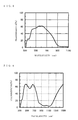
- FIG. 1 is an explanation view showing spectral properties of an infrared absorption filter in Example 1.
- FIG. 2 is an explanation view showing spectral properties of an infrared absorption filter in Example 1 after being left for 500 hours under an atmosphere of a temperature of 60°C and a humidity of 95%.
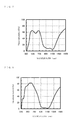
- FIG. 3 is an explanation view showing spectral properties of an infrared absorption filter in Example 2.
- FIG. 4 is an explanation view showing spectral properties of an infrared absorption filter in Comparative Example 1.
- FIG. 5 is an explanation view showing spectral properties of an infrared absorption filter in Comparative Example 2.
- FIG. 6 is an explanation view showing spectral properties of an infrared absorption filter in Example 3.
- FIG. 7 is an explanation view showing spectral properties of an infrared absorption filter in Example 4.
- FIG. 8 is an explanation view showing spectral properties of an infrared absorption filter in Reference Example 1.
- FIG. 9 is a view showing spectral properties of an infrared absorption filter obtained in Example 5.
- FIG. 10 is a view showing spectral properties of an infrared absorption filter obtained in Example 5 after being left for 500 hours under an atmosphere of a temperature of 60°C and a humidity of 95%.
- FIG. 11 is a view showing spectral properties of an infrared absorption filter obtained in Reference Example 2.
- FIG. 12 is a view showing spectral properties of an infrared absorption filter obtained in Reference Example 2 after being left for 500 hours under an atmosphere of a temperature of 60°C and a humidity of 95%.
- FIG. 13 is a view showing spectral properties of an infrared absorption filter obtained in Reference Example 3 after being left for 500 hours under an atmosphere of a temperature of 60°C and a humidity of 95%.
- An infrared absorption filter of the present invention has a constitution in which a transparent polymer film is used as a substrate, an infrared absorption layer is laminated at least on one surface of the substrate, and further, a polymer easy adhesion layer is laminated at least on one surface of the transparent polymer film.
- an infrared absorption layer comprises an infrared absorption coloring matter and a polymer resin as main constituent components.
- the infrared absorption coloring matter is dispersed in the polymer resin and the resin is coated at least on one surface of a transparent polymer film, from the standpoints of productivity, processability and cost.
- a polymer easy adhesion layer is placed between the above-mentioned transparent polymer film and the infrared absorption layer, for improving close adhesion of the substrate transparent polymer film with the infrared absorption layer.
- the infrared absorption coloring matter contained in the infrared absorption layer at least two or more selected from the group consisting of diimmonium salt-based compounds, phthalocyanine-based compounds and nickel complex-based compounds are preferably used together. Further, it is particularly preferable that at least a diimmonium salt-based compound is contained and at least one selected from fluorine-containing phthalocyanine-based compounds and nickel complex-based compounds is contained, as the infrared absorption coloring matter contained in the infrared absorption layer.
- the phthalocyanine-based compound and/or the thionickel-based complex compound used in the present invention preferable are those compensating absorption in the near-infrared region of the above-mentioned diimmonium salt compound.
- the compounding ratio of the infrared absorption coloring matters it is suitable that the amount of the phthalocyanine-based compound is 0.01 to 1.2 parts by weight (preferably, 0.01 to 0.5 parts by weight) and the amount of the nickel complex-based compound is 0 to 1 part by weight based on 1 part by weight of the diimmonium salt-based compound, for obtaining an infrared absorption filter which (1) manifests absorption in the near-infrared region, (2) has high light transmittance in the visible region, and (3) has no large absorption of specific wavelength in the visible region.
- the diimmonium salt compound is not particularly restricted providing it has large absorption in the near-infrared region and has high visible light transmittance, and particularly, those having a structure of the general formula (1):
- R 1 to R 8 may be the same or different and represent a hydrogen atom, alkyl group, aryl group, alkenyl group, aralkyl group or alkynyl group.
- R 9 to R 12 may be the same or different and represent a hydrogen atom, halogen atom, amino group, amide group, cyano group, nitro group, carboxyl group or alkyl group. Any of R 1 to R 12 may have a substituent providing it can be bonded to a substituent.
- X - represents an anion.
- examples of the alkyl group include a methyl group, ethyl group, n-propyl group, iso-propyl group, n-butyl group, iso-butyl group, t-butyl group, n-amyl group, n-hexyl group, n-octyl group, 2-hydroxyethyl group, 2-cyanoethyl group, 3-hydroxypropyl group, 3-cyanopropyl group, methoxyethyl group, ethoxyethyl group, butoxyethyl group and the like.
- Examples of the aryl group include a phenyl group, fluorophenyl group, chlorophenyl group, tolyl group, diethylaminophenyl group, naphthyl group and the like, and examples of the alkenyl group include a vinyl group, propenyl group, butenyl group, pentenyl group and the like.
- examples of the aralkyl group include a benzyl group, p-fluorobenzyl group, p-chlorophenyl group, phenylpropyl group, naphthylethyl group and the like.
- R 9 to R 12 in the general formula (1) hydrogen, fluorine, chlorine, bromine, diethylamino group, dimethylamino group, cyano group, nitro group, methyl group, ethyl group, trifluoromethyl group and the like are listed.
- X - a fluorine ion, chlorine ion, bromine ion, iodine ion, perchlorate ion, hexafluoroantimonate ion, hexafluorophosphate ion, tetrafluoroborate ion and the like.
- the scope of the present invention is not limited to the above-mentioned examples.
- a fluorine-containing phthalocyanine compound is preferable.
- a fluorine-containing phthalocyanine compound is preferable.
- the commercially available phthalocyanine compound Excolor IR1, IR2, IR3, IR4, TX-EX805K, TX-EX810K, TX-EX811K, TX-EX812K and the like manufactured by Nippon Shokubai Co., Ltd. are listed. Excolor IR1, TX-EX811K are particularly preferable.
- thionickel complex-based compound those having a structure of the general formula (2): (wherein, R 13 to R 16 may be the same or different and represent a hydrogen atom, halogen atom, alkyl group, alkoxy group, aryl group, aralkyl group or amino group.) are preferable.
- SIR-128, SIR-130, SIR-132, SIR-159 and the like manufactured by Mitsui Chemical K. K. are listed, and of them, SIR-128 and SIR-159 are particularly preferable.
- a polymer resin is preferably used as a constituent component of the above-mentioned infrared absorption layer, for dispersion of an infrared absorption coloring matter.
- the kind of the polymer resin is not particularly restricted, and examples thereof include polyester resins, acrylic resins, cellulose resins, polyethylene resins, polypropylene resins, polyolefin resins, polyvinyl chloride resins, polycarbonate resins, phenol resins, urethane resins and the like, and particularly, polyester resins are preferable from the standpoints of dispersion stability, environmental load and the like.
- the glass transition temperature of a polymer resin (particularly, polyester resin) which is used as a dispersing medium of an infrared absorption coloring matter is preferably a temperature not lower than the putative guaranteed temperature under environment of use of an infrared absorption filter, for improving weather-resistance from the standpoint of stability of a coloring matter. Since the putative guaranteed temperature of an electronic apparatus is usually 80°C, the glass transition temperature of the polymer resin is preferably 80°C or more, and more preferably in the range from 85 to 150°C. Further, it is preferably from 85 to 130°C, more preferably from 90 to 110°C.
- the glass transition temperature is in the above-mentioned range, coating suitability and durability can be satisfied simultaneously when an infrared absorption layer is laminated on a substrate, transparent polymer film, by a coating method.
- the durability herein referred to means low deterioration in optical property after storage for long time under high temperature and high humidity, for example, after a sample is left for 500 hours under atmosphere of a temperature of 60°C and a humidity of 95%. Further, there is also a merit that an infrared absorption coloring matter can be dispersed in a polymer resin at high concentration.
- a polyester resin preferably used as the above-mentioned polymer resin is synthesized from a polyvalent carboxylic acid component and a polyhydric alcohol component.
- polyvalent carboxylic acid component constituting a polyester resin examples include aromatic dicarboxylic acids such as terephthalic acid, isophthalic acid, orthophthalic acid, 1,5-naphthalenedicarboxylic acid, 2,6-naphthalenedicarboxylic acid, diphenic acid, sulfoterephthalic acid, 5-sulfoisophthalic acid, 4-sulfophthalic acid, 4-sulfonaphthalene-2,7-dicarboxylic acid, 5 [4-sulfophenoxy] isophthalic acid, sulfoterephthalic acid and the like and ester forming derivatives thereof; aromatic oxycarboxylic acids such as p-oxybenzoic acid, p-(hydroxyethoxy)benzoic acid and the like and ester forming derivatives thereof; aliphatic dicarboxylic acids such as succinic acid, adipic acid, azelaic acid, sebacic acid, dodecanedicarboxylic acid
- polyhydric alcohol component constituting a polyester rein
- aliphatic polyhydric alcohols aliphatic polyhydric alcohols, alicyclic polyhydric alcohols, aromatic polyhydric alcohols and the like are exemplified.
- aliphatic polyhydric alcohols examples include aliphatic diols such as ethylene glycol, propylene glycol, 1,3-propanediol, 2,3-butanediol, 1,4-butanediol, 1,5-pentanediol, 1,6-hexanediol, neopentyl glycol, diethylene glycol, dipropylene glycol, 2,2,4-trimethyl-1,3-pentanediol, polyethylene glycol, polypropylene glycol, polytetramethylene glycol and the like; triols and tetraols such as trimethylolethane, trimethylolpropane, glycerin, pentaerythritol and the like.
- aliphatic diols such as ethylene glycol, propylene glycol, 1,3-propanediol, 2,3-butanediol, 1,4-butanedio
- Examples of the aliphatic polyhydric alcohols include 1,4-cyclohexanediol, 1,4-cyclohexanedimethanol, spiro-glycol, hydrogenated bisphenol A; ethylene oxide adducts or propylene oxide adducts of hydrogenated bisphenol A and the like; tricyclodecanediol, tricyclodecanedimethanol, tricyclodecanediethanol, dimethyltricyclodecanedipropylol, tricyclodecanedibutylol, dimethyltricyclodecanedimethanol, diethyltricyclodecanedimethanol, tetramethylcyclodecanedimethanol, hexamethyltricyclodecanedimethanol, octamethyltricyclodecanedimethanol and the like.
- aromatic polyhydric alcohols examples include 9,9-bis-(4-(2-hydroxyethoxy)phenyl)-fluorene, 9,9-bis-(4-(2-hydroxyethoxy)-3-methylphenyl)-fluorene, 9,9-bis-(4-(2-hydroxyethoxy)-3,5-dimethylphenyl)-fluorene, 9,9-bis-(4-(2-hydroxyethoxy)-3-ethylphenyl)-fluorene, 9,9-bis-(4-(2-hydroxyethoxy)-3,5-diethylphenyl)-fluorene, 1, 1-bis-(4-(2-hydroxyethoxy)phenyl)-cyclohexane, 1,1 -bis-(4-(2-hydroxyethoxy)-3-methylphenyl)-cyclohexane, 1, 1-bis-(4-(2-hydroxyethoxy)-3,5-dimethylphenyl)-cyclohexane, 1, 1-bis-(4-
- lactone-based polyester polyols obtained by ring-opening-polymerizing lactones such as E -caprolactone and the like, as the polyester polyol.
- polyhydric alcohol it is preferable to copolymerize an alicyclic diol component of the general formula (3): (wherein, R 17 and R 18 represent a hydroxyl group and/or a hydroxyalkylene group having 1 to 8 carbon atoms and/or a group obtained by adding 1 to 10 alkylene oxides to a hydroxyalkylene group having 1 to 4 carbon atoms. ) as the polyhydric alcohol component in an amount of 60 mol% or more with a polyester resin.
- Examples of the alicyclic diol of the general formula (3) include tricyclodecanedimethylol, tricyclodecanediethylol, tricyclodecanedipropylol, tricyclodecanedibutanol, dimethyltricyclodecanedimethylol and the like. Of them, tricyclodecanedimethylol in which both R 17 and R 18 are a methylol group is particularly preferable.
- JP-A No. 9-838855 and JP-A No. 11-116826 exemplify a mixture of an infrared absorption coloring matter with a polyester resin obtained by copolymerizing a specific aromatic diol in an amount of 10 mol% or more.
- the glass transition temperature increases to the contrary, consequently, when the copolymerized polyester resin is mixed with an infrared absorption coloring matter and a solvent and coated on a substrate film, problems of a longer time required for drying, deterioration in environmental stability due to a remaining solvent because of insufficient drying, and curl of a film after coating and drying occur. Further, some of the above-mentioned copolymerized polyester resin manifest low solubility in a solvent, and can not provide coating suitability.
- the present invention has been found to be excellent extremely in solvent-solubility and coating suitability, by copolymerizing an alicyclic diol of the general formula (3) in an amount of 60 mol% or more with a polyester resin.
- the upper limit of the copolymerization amount of an alicyclic diol of the general formula (3) is preferably less than 95 mol%.
- the degree of polymerization of the copolymerized polyester resin does not increase easily, consequently entailing an undesirable tendency of extreme fragileness.
- a mono-functional monomer is introduced into a polyester resin for the purpose of blocking a polar group at the end of the polyester polymer.
- mono-carboxylic acids such as benzoic acid, chlorobenzoic acid, bromobenzoic acid, p-hydroxybenzoic acid, mono-ammonium sulfobenzoate, mono-sodium sulfofbenzoate, cyclohexylaminocarbonylbenzoic acid, n-dodecylaminocarbonylbenzoic acid, tertiary-butylbenzoic acid, naphthalenecarboxylic acid, 4-methylbenzoic acid, 3-methylbenzoic acid, salicylic acid, thiosalicylic acid, phenylacetic acid, acetic acid, propionic acid, butyric acid, isobutyric acid, octanecarboxylic acid, laurylic acid, stearylic acid, and lower alkyl esters thereof, and mono-alcohols such as aliphatic alcohol, aromatic alcohol, alicyclic alcohol and the
- unsaturated monomers among the above-mentioned compounds are used as essential components, and other components are appropriately selected depending on the glass transition temperature of a polyester resin, compatibility with the monomers, and the like.
- An infrared absorption filter of the present invention preferably has a remaining solvent amount in an infrared absorption layer of 5% by weight or less.
- the remaining solvent amount is over 5% by weight, the apparent glass transition temperature lowers remarkably even if the layer looks dry and no blocking is found in appearance.
- a diimmonium salt compound is used as an infrared absorption coloring matter, there is a problem that a diimmonium salt-based coloring matter is denatured and a filter is discolored into yellow-green color when left for a long period of time under high temperature and high humidity.
- the remaining solvent amount in an infrared absorption layer is from 0.05 to 3% by weight. If the remaining solvent amount is less than 0.05% by weight, though denaturation of an infrared absorption coloring matter when left for a long time under high temperature and high humidity decreases, the infrared absorption coloring matter tends to be denatured due to heat required for controlling the remaining solvent amount to less than 0.05% by weight.
- a remaining solvent amount in an infrared absorption layer of 5% by weight or less can be attained by satisfying drying conditions of the following formulae (4) to (6) simultaneously.
- the unit of wind velocity is m/second
- the unit of hot air temperature is °C
- the unit of drying time is minute
- the unit of coating thickness is ⁇ m. Wind velocity ⁇ (hot air temperature-20) ⁇ drying time/coating thickness>48 Hot air temperature : ⁇ 80°C Drying time : ⁇ 60 seconds
- a UV absorber may be added to an infrared absorption layer for improving light resistance.
- a polymer resin dispersing an infrared absorption coloring matter may be crosslinked to an infrared absorption layer by using a crosslinking agent, for imparting weather resistance and solvent resistance to an infrared absorption filter of the present invention.
- Examples of the resin constituting a transparent polymer film which is a substrate of an infrared absorption layer of the present invention include, but not particularly restricted to, polyester resins, acrylic resins, cellulose resins, polyethylene resins, polypropylene resins, polyolefin resins, polyvinylchloride resins, polycarbonate resins, phenol resins, urethane resins and the like.
- polyester resins such as polyethylene terephthalate, polybutylene terephthalate, polyethylene-2,6-naphthalate and the like are preferable from the standpoints of environmental load, cost performance and the like.
- PET polyethylene terephthalate
- PET polyethylene terephthalate
- any of a known direct polymerization method in which terephthalic acid and ethylene glycol are used as starting materials and polycondensed via an esterification reaction and a known transesterification method in which dimethyl terephthalate and ethylene glycol are used as starting materials and polycondensed via a transesterification reaction, can be used.
- examples of compounds to be contained in a PET resin include polycondensation catalysts (Sb 2 O 3 , Sb glycolate and the like), heat stabilizers (P-based compounds such as trimethylphosphate and the like), and close adherence improving agents (glycol-soluble alkali metal salts, alkaline earth metal salts and the like)used in producing an un-drawn film using a static electricity application method.
- polycondensation catalysts Sb 2 O 3 , Sb glycolate and the like
- P-based compounds such as trimethylphosphate and the like
- close adherence improving agents glycol-soluble alkali metal salts, alkaline earth metal salts and the like
- transesterification reaction catalysts acetates and the like of Mg, Ca, Zn, Mn and so on
- Sb 2 O 3 is reduced into metal Sb which tends to be deposited as a coagulated material on the surface of a film, in polymerization and/or production of an un-drawn PET film. Since this is one cause of optical defects in the film, it is preferable that the content of Sb 2 O 3 is reduced to as low level as possible within the range wherein the polycondensation time is not remarkably delayed.
- the content of Sb 2 O 3 in the PET resin is preferably from 50 to 250 ppm, further preferably from 50 to 200 ppm, particularly preferably from 70 to 150 ppm, in terms of an Sb element.
- an inert particle and internal deposition particle are contained in the PET resin for the purpose of imparting slipperiness and the like in general, it is necessary these particles are not substantially contained from the standpoints of improvement of transparency and decrease of the above-mentioned foreign materials.
- Substantially no inclusion of particles means that the content of particles in a film is smaller than the detection limit in analyzing the particles by fluorescent X ray.
- a PET resin through a NASLON (metal fiber, manufactured by Nippon Seisen Stainless Steelwire) filter having a pore size (95% cut) of 7 ⁇ m or less after completion of polycondensation, or in extruding a molten resin in the form of a strand into cooling water, to filtrate the cooling water (pore size 1 ⁇ m or less) and to reduce the amount of foreign materials having a size of 1 ⁇ m or more in a HEPA filter by conducting the filtration in a sealed room, for attaining a content of foreign materials having a size of 20 ⁇ m or more in a PET resin, raw material of a substrate film, of 10/m 2 or less per unit area of the film.
- NASLON metal fiber, manufactured by Nippon Seisen Stainless Steelwire
- the intrinsic viscosity of a PET resin is preferably in the range from 0.45 to 0.70 dl/g. It is further preferably from 0.50 to 0.67 dl/g, particularly preferably from 0.55 to 0.65 dl/g. If the intrinsic viscosity is less than 0.45 dl/g, breaking frequently occurs in producing a film and strength and elongation property becomes insufficient. On the other hand, when it is over 0.70 dl/g, filtration pressure rise becomes large and high precision filtration for removing foreign materials becomes difficult, undesirably.
- a PET resin containing substantially no inert particle and internal deposition particle is dried under vacuum sufficiently, then, fed to an extruder, melt-extruded in the form of a sheet at 280°C, and cooled and solidified to give an un-drawn PET sheet.
- the above-mentioned high precision filtration is conducted at any place wherein the molten resin is kept at about 280°C to remove foreign materials contained in the resin.
- a filtration material used in the high precision filtration of a molten resin is not particularly restricted, a filtration material made of a stainless sintered body is suitable for rendering the content of foreign materials having a size of 20 ⁇ m or more such as catalysts and additives in a raw material PET resin, fallen materials from the reaction vessel wall, coarse foreign materials ascribed to outer contaminated substances, and organic substances having high melting point, and the like, to 10/m 2 or less. It is preferable that the filtration particle size (initial filtration efficiency: 95%) of a filtration material used for the high precision filtration of a molten resin is 15 ⁇ m or less.
- This minute difference in thickness can be observed as a difference between the height of a convex part and the depth of a concave part, and when the height of a convex part is 1 ⁇ m or more and the height of a concave part adjacent to the convex part is 0.5 ⁇ m or more, even a material having a size of 20 ⁇ m is recognized by naked eyes as a material having a size of 50 ⁇ m or more, further in some cases, recognized as an optical defect having a size of 100 ⁇ m or more.
- a substrate film contains substantially no particle for imparting slipperiness, however, when transparency is higher, an optical defect due to minute unevenness tends to become more clear. Further, a thick film is not quenched and tends to manifest development of crystallization as compared with a thin film, therefore, it is necessary to quench the whole film in producing an un-drawn film.
- a molten resin is extruded in the form of a sheet via a die onto a rotation cooling drum, and the sheet form molten material is quenched to give a sheet while contacting closely with the rotation cooling drum, according to a static electricity applying close contact method.
- a method for quenching the air surface (opposite surface to the surface contacting with a quenching drum) of this sheet a method of quenching by blowing a high speed airflow.
- a transparent polymer film which is used as a substrate of an infrared absorption filter of the present invention is preferably a film drawn at least along one axial direction, and particularly preferably a biaxially drawn film.
- a biaxially drawn film is produced under the following conditions.
- the resulted un-drawn film is drawn at a magnification of 2.5 to 5.0 along the longitudinal direction by rolls heated to 80 to 120°C, to obtain a monoaxially oriented PET film. Further, the end of the film was grasped with a clip, introduced into a hot air zone heated to 80 to 180°C, dried, then drawn at a magnification of 2.5 to 5.0 along the cross direction. Subsequently, it is introduced into a heat treatment zone at 200 to 240°C, and heat-treated for 1 to 60 seconds, to complete crystal orientation. In this heat treatment process, relaxation treatment of 3 to 10% along cross direction and/or longitudinal direction may be performed, if necessary.
- a polymer easy adhesion layer is laminated at least on one surface of a transparent polymer film.
- a coating solution of a polymer easy adhesion resin comprising a water-soluble or water-dispersible resin is coated and dried for lamination at least on one surface of a PET film, in any stage of the above-mentioned film production process.
- a process of coating the above-mentioned aqueous coating solution may be a usual coating process, namely, a process in which the solution is coated on a substrate film which has been biaxially drawn and heat-fixed, however, an inline coating method in which coating is conducted in the production process of the film is preferable. More preferably, the solution is coated on a substrate film before completion of crystal orientation. It is effective, for reducing foreign materials adhering to the surface of a film, to control the degree of cleanness in air (number of particles of 0.5 ⁇ m or more/ft 3 ) from manufacturing of an un-drawn film to a coating process to class 100,000 by a HEPA filter.
- the drying temperature is preferably conducted at 70 to 140°C
- the drying time is controlled depending on a coating solution and the coating amount
- the product of the temperature (°C) and the time (sec.) is preferably 3000 or less.
- the solid concentration in an aqueous coating solution is preferably 30% by weight or less, particularly preferably 10% by weight or less.
- a film on which the aqueous coating solution has been coated and dried is introduced into a tenter for drawing and heat-fixing, heated therein, and a stable film is formed by a thermal crosslinking reaction to give a polyester-based laminated film.
- the solution is heated at 100°C or more for 1 minute or more in a heat treatment process and the coating amount of a easy adhesion layer after the heat treatment is 0.05 g/m 2 or more.
- Coating of the above-mentioned aqueous coating solution can be conducted by a known method.
- a reverse roll coating method gravure coating method, kiss coating method, roll brushing method, spray coating method, air knife coating method, wire bar coating method, pipe doctor method, impregnation coating method, curtain coating method and the like, and these may be used alone or in combination.
- the polymer easy adhesion resin laminated on a transparent polymer film of the present invention is not particularly restricted, and for example, aqueous polyester resins, aqueous polyurethane resins, aqueous acrylic resins, acrylic acid graft type polyester resins, maleic acid graft type polyester resins and the like are listed.
- a polymer resin comprising the above-mentioned copolymerized polyester-based resin (A) and polyurethane resin (B) as main constituent components is excellent in adhesion with a substrate PET film and an infrared absorption layer, and also excellent in adhesion with a reflection preventing layer and an anti-glare treatment layer laminated on the outermost layer of an infrared absorption filter, further, has high transparency, suitably.
- the above-mentioned polymer easy adhesion layer particularly a easy adhesion layer composed of a polymer resin comprising the copolymerized polyester-based resin and polyurethane resin as main constituent components, on the surface of a substrate PET film on which an infrared absorption layer is laminated, and on the surface of a substrate PET film on which a reflection prevention layer and an anti-glare treatment layer are laminated.
- the copolymerized polyester-based resin, constituent component of the above-mentioned polymer easy adhesion layer contains a branched glycol component as a constituent component.
- the branched glycol component include 2,2-dimethyl-1,3-propanediol, 2-methyl-2-ethyl-1,3-propanediol, 2-methyl-2-butyl-1,3-propanediol, 2-methyl-2-propyl-1,3-propanediol, 2-methyl-2-isopropyl-1,3-propanediol, 2-methyl-2-n-hexyl-1,3-propanediol, 2,2-diethyl-1,3-propanediol, 2-ethyl-2-n-butyl-1,3-propaneidol, 2-ethyl-2-n-hexyl-1,3-propanediol, 2,2-di-n-butyl-1,3-propan
- the above-described branched glycol components is contained in a proportion of 10 mol% or more, further preferably of 20 mol% or more in the whole glycol component.
- the glycol component other than the above-mentioned compounds ethylene glycol is most preferable. If used in small amount, diethylene glycol, propylene glycol, butanediol, hexanediol, or 1,4-cyclohexanedimethanol and the like may be also be used.
- dicarboxylic acid component constituent component of the above-mentioned copolymerized polyester-based resin, terephthalic acid and isophthalic acid are most preferable. If used in small amount, other dicarboxylic acids, for example, aromatic dicarboxylic acids such as diphenylcarboxylic acid, 2,6-naphthalenedicarboxylic acid and the like may also be added and copolymerized.
- the other acid components than the above-mentioned dicarboxylic acid component for example,5-sulfoisophthalic acid, 4- sulfoisonaphthalene-2,7-dicarboxylic acid 5-(4-sulfophenoxy) isophthalic acid, is usable to provide a water dispersibility.
- the above components are preferably contained in a proportion of 1 to 10 mol% in the whole glycol component.
- the urethane resin, the other components of easy adhesion layer, for example, are heat reaction type water-soluble urethane and the like which contain a blocked isocyanate group and in which the end isocyanate group has been blocked with a hydrophilic group.
- the blocking agent for the isocyanate group there are listed bisulfites, and phenols, alcohols, lactams, oximes and active methylene compounds containing a sulfonic group, and the like.
- the blocked isocyante group hydrophilizates or water-solubilizes a urethane prepolymer.
- the urethane prepolymer used in the above-mentioned resin is a compound having an end isocyanate group, obtained by reacting (a) a compound having a molecular weight of 200 to 20,000 and containing two or more active hydrogen atoms in the molecule and (2) an organic polyisocyanate containing two or more isocyanate groups in the molecule, or if necessary, (3) a compound (chain extender) containing at least two active hydrogen atoms in the molecule in addition to (1) and (2).
- the compound generally known as the compound (1) is a compound containing two or more hydroxyl groups, carboxyl groups, amino groups or mercapto groups at the end or in the molecule, and as the preferable compounds, polyether polyol, polyether ester polyol and the like are listed.
- polyether polyol there are listed, for example, compounds obtained by polymerizing alkylene oxides such as ethylene oxide, propylene oxide and the like, or styrene oxide and epichlorohydrin and the like, or compounds obtained by conducting random polymerization or block polymerization thereof or addition polymerization to polyhydric alcohol.
- alkylene oxides such as ethylene oxide, propylene oxide and the like, or styrene oxide and epichlorohydrin and the like
- polyester polyol and polyether ester polyol linear or branched compounds are mainly listed.
- polyols can be obtained by condensing saturated or unsaturated polyvalent carboxylic acids such as succinic acid, adipic acid, phthalic acid, maleic anhydride and the like or carboxylic anhydrides thereof, with saturated and unsaturated polyhydric alcohols such as ethylene glycol, diethylene glycol, 1,4-butanediol, neopentyl glycol, 1,6-hexanediol, trimethylolpropane and the like, polyalkylene ether glycols such as polyethylene glycol and polypropylene glycol and the like having relatively lower molecular weight, or mixtures of these alcohols.
- saturated or unsaturated polyvalent carboxylic acids such as succinic acid, adipic acid, phthalic acid, maleic anhydride and the like or carboxylic anhydrides thereof
- saturated and unsaturated polyhydric alcohols such as ethylene glycol, diethylene glycol, 1,4-butanediol, neopenty
- polyesters obtained from lactone and hydroxy acid can be used
- polyether ester polyol polyether esters obtained by adding ethylene oxide or propylene oxide to polyesters previously produced can also be used.
- organic polyisocyanate (2) there are listed, isomers of toluene diisocyanate, aromatic diisocyanates such as 4,4-diphenylmethane diisocyanate and the like, aromatic aliphatic diisocyanates such as xylylene diisocyanate and the like, alicyclic diisocyanates such as isophorone diisocyanate, 4,4-dicyclohexylmethane diisocyanate and the like, aliphatic diisocyanates such as hexamethylene diisocyanate, 2,2,4-trimethylhexamethylene diisocyanate and the like, or polyisocyanates obtained by using these compounds alone or in combination and by previously adding trimethylolpropane and the like.
- aromatic diisocyanates such as 4,4-diphenylmethane diisocyanate and the like
- aromatic aliphatic diisocyanates such as xylylene diisocyanate and the like
- glycols such as ethylene glycol, diethylene glycol, 1,4-butanediol, 1,6-hexanediol and the like
- polyhydric alcohols such as glycerin, trimethylolpropane, pentaerythritol, and the like
- diamines such as ethylenediamine, hexamethylenediamine and piperazine and the like
- amino alcohols such as monoethanolamine, diethanolamine and the like
- thiodiglycols such as thiodiethylene glycol and the like, or water.
- urethane polymer (3) materials are reacted at a temperature of 150°C or less, preferably from 70 to 120°C for 5 minutes to several hours, usually by a one-stage or multi-stage isocyanate polyaddition method.
- the ratio of an isocyanate group to an active hydrogen atom can be freely selected providing it is within 1, and it is necessary that a free isocyanate group remains in the resulting urethane prepolymer.
- the content of a free isocyanate group may advantageously be 10% by weight or less, and it is preferably 7% by weight or less in view of stability of a urethane polymer aqueous solution after being blocked.
- the above-mentioned resulted urethane prepolymer is blocked preferably using a bisulfite salt.
- the prepolymer is mixed with an aqueous solution of a bisulfite salt, and the reaction is progressed for 5 minutes to 1 hour while stirring.
- the reaction temperature is preferably 60°C or less.
- the reaction solution is diluted with water to a suitable concentration, to give a heat-reaction type water-soluble urethane composition.
- the composition is controlled to a suitable concentration and viscosity in use, however, when it is heated around 80 to 200°C, usually, a blocking agent, bisulfite is dissociated, and an active isocyanate group is reproduced, consequently, a polyurethane polymer is produced by a polyaddition reaction occurring in the molecule or between molecules of a prepolymer, or, a nature occurs which causes addition to other functional group.
- Elastron trade name, manufactures by Dai-ichi Kogyo Seiyaku Co., Ltd. is exemplified.
- Elastron is a compound in which an isocyanate group has been blocked by a sodium bisulfite, and is water-soluble because of the presence of a carbamolyl sulfonate group having strong hydrophilicity at the end of the molecule.
- the weight ratio of the resin (A) to the resin (B) is preferably from 90:10 to 10:90, further preferably from 80:20 to 20:80.
- the weight ratio of the above-mentioned resin (A) to the total solid weight in an easy adhesion layer is less than 10%, coatability to a substrate film tends to become insufficient, and adhesion between a polymer easy adhesion layer and a substrate film tends to become insufficient.
- the weight ratio of the above-mentioned resin (B) to the total solid weight in an easy adhesion layer is less than 10%, practical adhesion is not obtained easily in a hard coat of UV curing type.
- a catalyst may advantageously be added for promoting a thermal crosslinking reaction, and for example, various chemical substances such as inorganic substances, salts, organic substances, alkaline substances, acidic substances, metal-containing organic compounds and the like can be used. Further, for controlling pH of an aqueous solution, an alkaline substance or acidic substance may also be added.
- a known anionic active agent and nonionic surfactant can be used in necessary amount, for improving wetting to the substrate film and coating the coating solution uniformly.
- alcohols such as ethanol, isopropyl alcohol, benzyl alcohol and the like can be mixed in a proportion of up to 50% by weight based on the total amount of the coating solution, in addition to water. Further, when the proportion is less than 10% by weight, organic solvents other than alcohols may be mixed in an amount at which solution thereof is possible. However, the total amount of alcohols and other organic solvents should be less than 50% by weight, in the coating solution.
- the above-mentioned aqueous coating solution contains a particle to form a suitable projection on the surface of an easy adhesion layer from the standpoints of handling properties (slipperiness, winding property, blocking resistance), abrasion resistance, scratch resistance and the like.
- Examples of such a particle include inorganic particles such as calcium carbonate, calcium phosphate, silica, kaolin, talc, titanium dioxide, alumina, barium sulfate, calcium fluoride, lithium fluoride, zeolite, molybdenum sulfide and the like, organic particles such as crosslinked polymer particles, calcium oxalate and the like.
- inorganic particles such as calcium carbonate, calcium phosphate, silica, kaolin, talc, titanium dioxide, alumina, barium sulfate, calcium fluoride, lithium fluoride, zeolite, molybdenum sulfide and the like
- organic particles such as crosslinked polymer particles, calcium oxalate and the like.
- a silica particle is most suitable since it has relatively similar refractive index to that of a polyester resin and can provide a film having high transparency.
- the average particle size of the above-mentioned particle contained in an aqueous coating solution is preferably from 0.01 to 1.0 ⁇ m, particularly preferably from 0.03 to 0.5 ⁇ m.
- the average particle size is over 1.0 ⁇ m, the film surface tends to be roughened and transparency of a film tends to decrease.
- the average particle size is less than 0.01 ⁇ m, slipperiness, winding property, blocking property and the like of a film tend to become insufficient.
- the content of the above-mentioned particle in an easy adhesion layer is preferably from 0.01 to 60% by weight, more preferably, from 0.05 to 30% by weight, further preferably from 0.1 to 10% by weight.
- the content of the particle in an easy adhesion layer is over 60% by weight, transparency of a film tends to deteriorate, further, easy adhesion may be lost.
- the content of the particle in an easy adhesion layer is less than 0.01% by weight, slipperiness, winding property, blocking property and the like of a film tend to become insufficient.
- Two or more of the above-mentioned particles may be compounded in an easy adhesion layer, or particles of the same kind having different particle sizes may also be used together. In any case, it is preferable that the average particle size of the whole particles, and the total content thereof satisfy the above-mentioned ranges.
- a filtration material is so placed as to provide precise filtration of a coating solution directly before coating, to remove a coarse coagulated material of particles in a coating solution.
- a filtration particle size of a filtration material used for precision filtration of a coating solution used in the present invention of 25 ⁇ m or less is suitable for rendering the proportion of coarse materials having a maximum diameter of 100 ⁇ m or more present on the surface of and/or in a polymer easy adhesion layer to 3/m 2 or less per unit area of the polymer easy adhesion layer.
- the filtration particle size of a filtration materials is 25 ⁇ m or more, coarse coagulated materials can not be removed sufficiently, and a lot of coarse coagulated materials which can not be removed is coated and dried, then, spread by drawing stress in conducting mono-axial drawing or biaxial drawing of an easy adhesion layer, and recognized as a coagulated material having a sized of 100 ⁇ m or more, and resultantly, a lot of optical defects tend to occur.
- the type of a filtration material used for precision filtration of a coating solution is not particularly restricted providing it has the above-mentioned abilities, and for example, filament type, felt type and mesh type are suitable.
- the material of a filtration material used for precision filtration of a coating solution is not particularly restricted provided it has an ability to remove the above-mentioned coarse coagulated materials and it does not exert a reverse influence on the coating solution, and for example, materials such as stainless material, polyethylene, polypropylene, nylon and the like are suitable.
- various additives such as an antistatic agent, ultraviolet absorption preventing agent, plasticizer, antibacterial agent, pigment, lubricant and the like may also be mixed in addition to particles, in an amount within the range wherein easy adhesion and transparency are not disturbed.
- the thickness of the resultant transparent polymer film having an easy adhesion layer is preferably from 50 to 300 ⁇ m, particularly preferably from 100 to 250 ⁇ m.
- the thickness of the film is less than 50 ⁇ m, rigidity becomes insufficient, undesirably.
- the film thickness is over 300 ⁇ m, foreign materials causing an optical defect present in the film increase and reduce the total beam transparency, undesirably.
- the amount of foreign materials having a size of 20 ⁇ m or more in the above-mentioned transparent polymer film having an easy adhesion layer is required to be 10/m 2 or less, preferably 8/m 2 or less, particularly preferably 6/m 2 or less, per unit area.
- the amount of foreign materials having a size of 20 ⁇ m or more is over 10/m 2 , haze value of the whole film increases, and reduction in the total beam transparency occurs. Further, an optical defect also occurs, therefore, an infrared absorption film containing such amount of foreign materials is not preferable.
- the following methods are suitable when a PET resin is used for example as a film raw material, as described above.
- a transparent polymer film which is used as a substrate filter of an infrared absorption filter of the present invention has a haze value preferably of 1% or less. It is further preferably 0.8% or less, particularly preferably 0.6% or less. When the haze value is over 1%, the distinction of a screen of a display using an infrared absorption filter using this transparent polymer film as a substrate decreases, undesirably.
- the above-mentioned film contains substantially no inert particle and internal deposition particle, and the above-mentioned means for removing coarse foreign materials is adopted, further, a polymer resin containing a copolymerized polyester-based resin and a polyurethane as main constituent components is used as a resin constituting a polymer easy adhesion layer.
- An infrared absorption layer is laminated on a film prepared by laminating a polymer easy adhesion layer at least on one surface of a transparent polymer film obtained in the above-mentioned process.
- Lamination of an infrared absorption layer may be effected on an easy adhesion surface of a transparent polymer film, or on a surface carrying no easy adhesion layer.
- the filter in which an infrared absorption layer is laminated on both surfaces of a transparent polymer film, the filter can not be wound easily in the form of a roll in mass production since the both sides of the film are smooth due to the infrared absorption layer. Therefore, it is preferable to improve handling properties such as slipperiness, winding, blocking property and the like by allowing at least one surface of the above-mentioned infrared absorption layer to contain an inert particle and forming unevenness on the surface of the infrared absorption layer.
- the inert particle is preferably mixed in a polymer resin in which an infrared absorption coloring matter is dispersed.
- inert particle fine particles of metal oxides such as silica, alumina and the like, and fluorine-based resins, acrylic resins and polyester-based resins having an average particle size of 0.01 to 0.1 ⁇ m which is shorter than the wavelength of visible light can be used from the standpoint of transparency.
- an infrared absorption layer is laminated at least on one surface of a substrate, transparent polymer film
- a polymer resin is dissolved by a solvent such as methyl ethyl ketone, tetrahydrofuran, toluene and the like, then, a coating solution containing a dispersed infrared absorption coloring matter is coated and dried on at least one surface of the substrate film.
- An infrared absorption filter of the present invention has an infrared absorption layer comprising an infrared absorption coloring matter and a polymer resin as main constituent components.
- the infrared absorption filter may be one using an infrared absorption layer singly, or may be one obtained by laminating an infrared absorption layer by a co-extrusion method or a coating method on a transparent substrate.
- a coating method is preferable in which an infrared absorption coloring matter is dispersed in a polymer resin and a solvent, and this coating solution is coated and dried on a transparent substrate.
- the method is not particularly restricted, and one example thereof is as follows. For example, there are listed a method in which, by providing a plurality of coater heads on one coating line, both surfaces are coated simultaneously and dried simultaneously, a method in which one surface is first coated and dried, then, the rear surface is coated and dried.
- an infrared absorption filter of the present invention it is preferable to laminate a metal mesh conductive layer on the same side as an infrared absorption layer or the opposite side thereof.
- a metal mesh conductive layer By lamination of a metal mesh conductive layer, a harmful magnetic wave discharged from a display can be removed.
- the metal mesh conductive layer a mesh layer obtained by performing etching treatment on a metal foil having high electric conductivity, a mesh layer in the form of a knitted substance using metal fiber, and fiber obtained by adhering a metal on the surface of polymer fiber by using means such as plating and the like, may also be used.
- the hole area ratio of a metal mesh used in the above-mentioned magnetic wave absorption layer is preferably 50% or more in view of display use.
- the metal used in the above-mentioned magnetic wave absorption layer may be any metal and is not particularly restricted provid ed it has high electric conductivity and has excellent stability.
- copper, nickel, tungsten and the like are recommendable from the standpoints of processability, cost and the like.
- a hard coat treatment layer may be provided on the outermost layer for improving scratch resistance.
- this hard coat treatment layer crosslinkable resin curing substance layers composed of curing resins such as polyester resins, urethane resins, acrylic resins, melamine resins, epoxy resins, silicone resins, polyimide resins and the like alone, or mixture thereof, are preferable.
- the thickness of this hard coat treatment layer (HC) is preferably from 1 to 50 ⁇ m, further preferably from 2 to 30 ⁇ m.
- the thickness is smaller than 1 ⁇ m, scratch resistance becomes insufficient, and when over 50 ⁇ m, the coating velocity of a resin for a hard coat remarkably decreases, leading to undesirable productivity.
- a method for laminating a hard coat treatment layer is preferable in which the above-mentioned resin is coated by a gravure method, reverse method, die method and the like on the opposite surface to a surface of a transparent polymer film on which an infrared absorption layer has been provided, then, the resin is cured by applying energy such as heat, ultraviolet radiation, electron beam and the like.
- an anti-glare treatment layer may also be provided on the outermost layer for improving visibility when applied to a plasma display and the like.
- the anti-glare treatment layer (AG) can be produced by coating and drying a curing resin, then, forming unevenness on the surface thereof by an emboss roll, thereafter, curing the resin by applying energy such as heat, ultraviolet radiation, electron beam and the like.
- a curing resin polyester resins, urethane resins, acrylic resins, melamine resins, epoxy resins, silicon resins, polyimide resins and the like alone or mixtures thereof are preferable.
- a reflection preventing treatment layer may also be provided on the outermost layer.
- materials having a refractive index differing from that of a plastic film are preferably laminated as a single layer or two or more layers.
- a material having a refractive index smaller than that of a plastic film may advantageously be used.
- a material having a refractive index larger than that of a plastic film is used in a layer adjacent to the plastic film, and a material having a refractive index smaller than this is selected in a layer placed on the above-mentioned layer.
- the material constituting such a reflection preventing treatment layer (AR) is not particularly restricted provided it satisfies the above-mentioned relation of refractive index even if it is an organic material or an inorganic material, and for example, dielectric substances composed of CaF 2 , MgF 2 , NaAlF4, SiO 2 , ThF 4 , ZrO 2 , Nd 2 O 3 , SnO 2 , TiO 2 , CeO 2 , ZnS, In 2 O 3 and the like are preferably used.
- the method of lamination of this reflection preventing treatment layer (AR) may be a dry coating process such as a vacuum deposition method, sputtering method, CVD method, ion plating method and the like, or a wet coating process such as a gravure method, reverse method, die method and the like.
- HC hard coat treatment layer
- AG anti-glare treatment layer
- AR reflection preventing treatment layer
- known treatments such as corona discharge treatment, plasma treatment, sputtering etching method, electron beam irradiation treatment, ultraviolet irradiation treatment, primer treatment, easy adhesion treatment and the like may also be performed as a previous treatment.
- An infrared absorption filter of the present invention contains little foreign materials in a substrate film and has little optical defect.
- An infrared absorption filter of the present invention has a maximum value of a transmittance in the near-infrared region in the wavelength range of 800 nm to 1100 nm of 30% or less, and has a difference between a maximum value and a minimum value of a transmittance in the visible region in the wavelength range of 450 nm to 650 nm of 10% or less, further, can satisfy a transmittance at a wavelength of 550 nm of 50% or more, manifest absorption in the near-infrared region, has high beam transmittance in the visible region, and does not have large absorption of specific wavelength in the visible region and shows dark gray tone.
- an infrared absorption filter of the present invention has a transmittance in the near-infrared region in the wavelength range of 900 to 1100 nm of 10% or less. Owing to such low transmittance in the near-infrared region, when applied to a plasma display and the like, the filter can absorb unnecessary infrared radiation radiated from the display, and can prevent malfunction of a remote controller using infrared radiation.
- an infrared absorption filter of the present invention can have a minimum transmittance in the visible regions of the wavelength range of 440 to 500 nm and 640 to 700 nm of 60% or more, and a maximum transmittance in the visible region in the wavelength range of 550 to 600 nm of 60% or less.
- tone is blue-gray, and when plated in front of the display, matching with color generated from the display is excellent.
- the transmittance in the visible region in the wavelength range of 540 to 600 nm has to be decreased, for correcting the emission strength.
- the transmittance at a wavelength of 550 nm is preferably 50% or more. When this transmittance at this wavelength is 50% or less, when a filter having the above-mentioned spectral property is placed in front of the display, the display becomes very dark, undesirably.
- Such an infrared absorption filter of the present invention is suitable for a filter for preventing malfunction of a remote controller of a plasma display panel (PDP), liquid crystal display (LCD), car navigation system and the like, and for a filter for correcting luminosity of a video camera, heat ray absorption filter and the like, since it has blue-gray tone.
- PDP plasma display panel
- LCD liquid crystal display
- car navigation system and the like
- a filter for correcting luminosity of a video camera, heat ray absorption filter and the like since it has blue-gray tone.
- a coating solution used in a polymer easy adhesion layer laminated on a transparent polymer film in the present invention was prepared according to the following method.
- An esterification reaction vessel was heated, and when reached to 200°C, slurry comprising 86.4 parts by weight of terephthalic acid and 64.4 parts by weight of ethylene glycol was charged, and 0.017 parts by weight of antimony trioxide and 0.16 parts by weight of triethylamine were added as a catalyst while stirring. Then, the mixture was heated under pressure, and a pressure esterification reaction was conducted under conditions of a gage pressure of 3.5 kg/cm 2 and a temperature of 240°C. Then, the pressure in the esterification reaction vessel was returned to normal pressure, and to this was added 0.071 parts by weight of magnesium acetate tetrahydrate, then, 0.014 parts by weight of trimethyl phosphate.
- the mixture was heated to 260°C over 15 minutes, and to this was added 0.012 parts by weight of trimethyl phosphate, then, 0.0036 parts by weight of sodium acetate. 15 minutes later, the resulted esterified reaction product was transported to a polycondensation reaction vessel, the temperature was raised from 260°C to 280°C gradually under reduced pressure, and a polycondensation reaction was conducted at 285°C. After completion of the polycondensation reaction, filtration treatment was conducted by a NASLON filter having a 95% cut diameter of 5 ⁇ m.
- PET chip (A) had an intrinsic viscosity of 0.616 dl/g, an Sb content of 144 ppm, a Mg content of 58 ppm, a P content of 40 ppm, a color L value of 56.2, and a color b value of 1.6, and contained substantially no inert particle and internal deposition particle.
- the above-mentioned PET chip (A) was used as a raw material of a film, and dried at 135°C for 6 hours under reduced pressure (1.33 hPa), then, fed to an extruder.
- the molten resin was filtrated using a stainless sintered filtration material having a filtration particle size (initial filtration efficiency: 95%) of 15 ⁇ m.
- the molten resin having a temperature of about 280°C was melt-extruded through a die into a sheet form, and quenched and solidified on a metal cooling roll (chill roll) kept at a surface temperature of 20°C while applying static electricity, to obtain an undrawn film having thickness of 1400 ⁇ m.
- a metal cooling roll chill roll
- this undrawn film was heated to 100°C using heated rolls and an infrared heater, then, stretched 3.5-fold along the longitudinal direction by rolls having different peripheral speeds, to obtain a monoaxially oriented PET film.
- the above-mentioned coating solution was precisely filtrated through a felt type polypropylene filtration material having a filtration particle size (initial filtration efficiency: 95%) of 25 ⁇ m, and coated and dried on one surface of the above-mentioned monoaxially oriented PET film by a reverse roll method.
- the degree of cleanness (number of particles of 0.5 ⁇ m or more/ft 3 ) in air from production of the undrawn cast film to the coating process was controlled by a HEPA filter so that it reached class 100,000.
- the end of the film was grasped and the coated layer was dried at 80°C for 20 seconds in a pre-heat zone in a tenter, then, stretched 4.0-fold at 130°C along cross direction in a cross stretching zone. Then, heat fixing treatment was conducted at 240°C, further, cross relaxation treatment of 3% was conducted at 200°C, to obtain a biaxially oriented PET film having an easy adhesion layer having a thickness of 100 ⁇ m.
- the coated amount was 0.10 g/m 2 in terms of solid content.
- the resulted biaxially oriented PET film having an easy adhesion layer contained substantially no particle in the film, and the amount of foreign materials having a maximum diameter of 20 ⁇ m or more present in the film was 6/m 2 , and the amount of foreign materials having a maximum diameter of 100 ⁇ m or more present on the surface of and in the easy adhesion layer was 3/m 2 .
- a base polyester used as a dispersing medium was produced by the following method.
- composition ratio of constituent components of the copolymerized polyester resin (A1) according to NMR analysis is as follows. Acid component Terephthalic acid 71 mol% Isophthalic acid 29 mol% Alcohol component Ethylene glycol 28 mol% Tricyclodecanedimethanol 72 mol%
- the infrared absorption layer coating solution was coated on the easy adhesion layer surface of the above-mentioned easy adhesion PET film substrate by using an applicator having a gap of 50 ⁇ m, and dried for 1 hour at a drying temperature of 90°C, to obtain an infrared absorption filter.
- the thickness of the coated layer after drying was 12 ⁇ m and the remaining solvent amount was 1 wt%.
- the resulted infrared absorption filter looked dark gray with eyes.
- the optical properties thereof are shown in FIG. 1.
- the infrared absorption filter has flat absorption in the visible region in the wavelength range of 400 nm to 650 nm, and has a difference in transmittance between 450 nm and 650 nm of 10% or less.
- the maximum transmittance from 800 nm to 1100 nm is 30% or less.
- the transmittance at a wavelength of 550 nm is 50% or more.
- the above-mentioned easy adhesion PET film substrate had a haze value of as extremely low as 0.5% and was highly transparent.
- the resulted infrared absorption filter was left for 500 hours under an atmosphere of a temperature of 60°C and a humidity of 95%, and the spectral properties were measured again to give results as shown in FIG. 2, wherein, infrared absorption property is maintained though slight color change is observed. Further, when the resulted filter was placed in front of a plasma display, no change of color was found, contrast was improved, and radiation of infrared ray decreased.
- the infrared absorption filter produced in Example 1 was used, and a hard coat treatment layer (HC) was provided on the surface of a transparent polyester film on the opposite side to the infrared absorption layer of the infrared absorption filter.
- a hard coat treatment layer As the hard coat layer, an ultraviolet ray curing type resin composition prepared by adding 4 parts of benzophenone to 100 parts of an epoxyacrylic resin was used, it was formed into a film by a bar coating method, dried previously for 5 minutes at 80°C, and cured by irradiation of ultraviolet ray of 500 mJ/cm 2 .
- the thickness of the hard coat treatment layer (HC) after curing was 5 ⁇ m.
- a copper foil having a thickness of 9 ⁇ m was pasted on the infrared absorption layer via a UV curing type adhesive, the pasted copper foil was patterned using a photoresist, and an electromagnetic wave shield layer was formed by performing etching treatment.
- the line width of the copper foil was 15 ⁇ m, the pitch was 115 ⁇ m, and the aperture ratio was 75%.
- the spectral properties of the infrared absorption filter obtained by laminating the hard coat layer and electromagnetic wave shield layer together with the infrared absorption layer as described above are shown in FIG. 3.
- the above-mentioned infrared absorption filter had a difference in transmittance between 450 nm and 650 nm of 10% or less, a maximum transmittance from 800 nm to 1100 nm of 30% or less, and a transmittance at a wavelength of 550 nm of 50% or more, absorbs infrared ray, manifests gray tone, and absorbs electromagnetic waves, while maintaining high visual light transmittance.
- a PET resin was obtained in the same manner as in Example 1, as the PET resin (B) for a film, except that ethylene glycol slurry (11 wt%) of silica particles having an average particle size (centrifugal precipitation mode light transmission type particle size distribution measuring method; SA-CP3, manufacture by Shimadzu Corp.) of 1.0 ⁇ m was added to the PET resin produced after the second addition of the trimethyl phosphate, as an amount of 2000 ppm in terms of the silica particle, and filtration treatment was conducted by a NASLON filter having a 95% cut diameter of 28 ⁇ m after completion of the polycondensation reaction.
- ethylene glycol slurry 11 wt%) of silica particles having an average particle size (centrifugal precipitation mode light transmission type particle size distribution measuring method; SA-CP3, manufacture by Shimadzu Corp.) of 1.0 ⁇ m was added to the PET resin produced after the second addition of the trimethyl phosphate, as an amount of 2000 ppm in terms of the silica particle,
- the resulted PET chip (B) had an intrinsic viscosity of 0.616 dl/g, an Sb content of 144 ppm, a Mg content of 58 ppm, a P content of 40 ppm, a color L value of 57.6, and a color b value of 1.2; and contained 2000 ppm of the silica particle based on the PET.
- a biaxially oriented PET film having an easy adhesion layer on one surface was obtained in the same manner as in Example 1 except that the above-mentioned PET resin (A) containing no particle and the above-mentioned silica particle-containing PET resin (B) were mixed in a ratio by weight of 90:10, and a stainless sintered filtration material having a filtration particle size (initial filtration efficiency: 95%) of 20 ⁇ m was used in filtrating the molten resin in the melt extrusion process of the PET resin.
- the number of foreign materials in the resulted biaxially oriented PET film having the easy adhesion layer and foreign materials having a maximum diameter of 100 ⁇ m or more present on the surface and in the easy adhesion layer are shown in Table 3.
- An infrared absorption layer coating solution was prepared in the same manner as in Example 1 except that the polymer resin which is the constituent component of the infrared absorption layer was changed to a copolymerized polyester resin (Vyron RV 200, manufactured by Toyobo Co., Ltd.) having a specific gravity of 1.26 and a glass transition temperature of 67°C as shown in Table 2, and a diimmonium salt-based compound was singly used as the infrared absorption coloring matter, in Example 1.
- the above-mentioned infrared absorption layer coating solution was coated on the surface of the easy adhesion layer of the above-mentioned biaxially oriented PET film by using an applicator having a gap of 100 ⁇ m, dried at a drying temperature of 90°C for 1 hour, to obtain an infrared absorption filter.
- the thickness of the infrared absorption layer after drying was 25 ⁇ m and the remaining solvent amount was 1% by weight.
- the color observed with eyes of the resulted infrared absorption filter was changed to brown completely.
- the optical properties thereof are shown in FIG. 4.
- an infrared absorption filter was obtained revealing having a mountain like peak at about 550 nm in the visible region in the wavelength of 400 nm to 650 nm.
- the maximum transmittance from 800 nm to 1100 nm was 30% or less and the transmittance at a wavelength of 550 nm was 50% or more, however, the difference in transmittance between 450 nm and 650 nm was over 10%.
- the haze value of the above-mentioned easy adhesion PET film substrate was as high as 2.6%.
- Example 1 Comparative Example 1 Particle in polyester film kind Content (ppm) Substantially none Silica (1.0 ⁇ m) 200 Foreign material having a size of 20 ⁇ m or more in film (number/m 2 ) (number/m 2 ) 6 95 Coagulated material having a size of 100 ⁇ m or more in easy adhesion layer (number/m 2 ) 3 3 Adhesion with photocuring type acrylic coat layer (%) 100 100 Film haze (%) 0.5 2.6
- the infrared absorption filter produced in Comparative Example 1 was used, and a hard coat treatment layer (HC) was provided on the surface of a transparent polyester film on the opposite side to the infrared absorption layer of the infrared absorption filter.
- a hard coat treatment layer As the hard coat agent, an ultraviolet ray curing type resin composition prepared by adding 4 parts of benzophenone to 100 parts of an epoxyacrylic resin was used, it was formed into a film by a bar coating method, dried previously for 5 minutes at 80°C, and cured by irradiation of ultraviolet ray of 500 mJ/cm 2 .
- the thickness of the hard coat treatment layer (HC) after curing was 5 ⁇ m.
- a copper foil having a thickness of 9 ⁇ m was pasted on the infrared absorption layer via a UV curing type adhesive, the pasted copper foil was patterned using a photoresist, and an electromagnetic wave shield layer was formed by performing etching treatment.
- the line width of the copper foil was 15 ⁇ m, the pitch was 115 ⁇ m, and the aperture ratio was 75%.
- the spectral properties of the infrared absorption filter obtained by laminating the hard coat layer and electromagnetic wave shield layer together with the infrared absorption layer as described above are shown in FIG. 5.
- the above-mentioned infrared absorption filter absorbs infrared ray and electromagnetic wave, however, the tone was greening color.
- An infrared absorption layer coating solution was prepared in the same manner as in example 1 except that a coating solution having a composition as shown in Table 4 was used as the infrared absorption layer coating solution, in Example 1.
- the above-mentioned infrared absorption layer coating solution was coated and dried on the surface of the easy adhesion layer of the above-mentioned biaxially oriented PET film, to obtain an infrared absorption filter.
- the thickness of the infrared absorption layer after drying was 25 ⁇ m and the remaining solvent amount was 1 wt%.
- the color of the infrared absorption filter observed with eyes was blue-gray.
- the optical properties thereof are shown in FIG. 6.
- the resulted filter has a minimum transmittance from 440 nm to 500 nm of 65.0%, a minimum transmittance from 640 nm to 700 nm of 61.5%, a maximum transmittance from 550 nm to 600 nm of 56.9%, and a maximum transmittance in the near-infrared region from 900 nm to 1100 nm of 7.9%.
- An infrared absorption layer coating solution was prepared in the same manner as in example 1 except that a coating solution having a composition as shown in Table 5 was used as the infrared absorption layer coating solution, in Example 1.
- the above-mentioned infrared absorption layer coating solution was coated and dried on the surface of the easy adhesion layer of the above-mentioned biaxially oriented PET film, to obtain an infrared absorption filter.
- the thickness of the infrared absorption layer after drying was 25 ⁇ m and the remaining solvent amount was 1 wt%.
- the color of the infrared absorption filter observed with eyes was blue-gray.
- the optical properties thereof are shown in FIG. 7.
- the resulted filter has a minimum transmittance from 440 nm to 500 nm of 62.0%, a minimum transmittance from 640 nm to 700 nm of 62.8%, a maximum transmittance from 550 nm to 600 nm of 59.2%, and a maximum transmittance in the near-infrared region from 900 nm to 1100 nm of 9.9%.
- An infrared absorption layer coating solution was prepared in the same manner as in example 1 except that a coating solution having a composition as shown in Table 2 (used in Comparative Example 1) was used as the infrared absorption layer coating solution, in Example 1.
- the above-mentioned infrared absorption layer coating solution was coated and dried on the surface of the easy adhesion layer of the above-mentioned biaxially oriented PET film, likewise.
- the thickness of the infrared absorption layer after drying was 25 ⁇ m and the remaining solvent amount was 1 wt%.
- an infrared absorption filter was obtained revealing having a mountain like peak at about 550 nm in the visible region in the wavelength of 400 nm to 650 nm.
- the resulted filter has a minimum transmittance from 440 nm to 500 nm of 70.6%, a minimum transmittance from 640 nm to 700 nm of 68.3%, a maximum transmittance from 550 nm to 600 nm of 82.7%, and a maximum transmittance in the near-infrared region from 900 nm to 1100 nm of 8.1%.
- An infrared absorption layer coating solution was prepared in the same manner as in example 1 except that a coating solution having a composition as shown in Table 6 was used as the infrared absorption layer coating solution, in Example 1.
- the above-mentioned infrared absorption layer coating solution was coated and dried on the surface of the easy adhesion layer of the above-mentioned biaxially oriented PET film, likewise.
- the thickness of the infrared absorption layer after drying was 25 ⁇ m and the remaining solvent amount was 1 wt%.
- the infrared absorption filter was obtained which manifested flat absorption in the visible region in the wavelength range of 400 nm to 650 nm, and had steep absorption at wavelengths of 700 nm or more, and the difference in transmittance between 450 nm and 650 nm was 10% or less, the maximum transmittance from 800 nm to 1100 nm was 30% or less, and the transmittance at a wavelength of 550 nm was 50% or more.
- the resulted infrared absorption filter was left for 500 hours under an atmosphere of a temperature of 60°C and a relative humidity of 95%, and the spectral properties were measured again to give results as shown in FIG. 10, wherein, the difference in transmittance between 450 nm and 650 nm was 10% or less, the maximum transmittance from 800 nm to 1100 nm was 30% or less, and the transmittance at a wavelength of 550 nm was 50% or more, though slight color change was observed. Further, when the resulted filter was placed in front of a plasma display, no change of color was found, contrast was improved, and radiation of infrared ray decreased.
- An infrared absorption filter was prepared in the same manner as in example 5 except that a copolymerized polyester resin (Vyron RV 200, manufactured by Toyobo Co., Ltd, specific gravity: 1.255, glass transition temperature: 67°C) was used as the infrared absorption layer polymer resin in the composition of the infrared absorption layer coating solution shown in Table 6, in Example 5.
- the thickness of the infrared absorption layer after drying was 25 ⁇ m and the remaining solvent amount was 1 wt%.
- the color of the resulted infrared absorption filter observed with eyes was dark-gray.
- the optical properties thereof are shown in FIG. 11.
- the infrared absorption filter was obtained which manifested flat absorption in the visible region in the wavelength range of 400 nm to 650 nm, and had steep absorption at wavelengths of 700 nm or more, as shown in FIG. 11.
- the difference in transmittance between 450 nm and 650 nm was 10% or less
- the maximum transmittance from 800 nm to 1100 nm was 30% or less
- the transmittance at a wavelength of 550 nm was 50% or more.
- a copolymerized polyester used as a dispersing medium of an infrared absorption coloring matter was produced by the following method.
- composition ratio of constituent components of the above-mentioned copolymerized polyester resin (A2) according to NMR analysis is as follows. Acid component Terephthalic acid 71 mol% Isophthalic acid 29 mol% Alcohol component Ethylene glycol 49 mol% Tricyclodecanedimethanol 51 mol%
- An infrared absorption filter was prepared in the same manner as in Example 5 except that the above-mentioned copolymerized polyester resin (A2) was used as the infrared absorption layer polymer resin in the composition of the infrared absorption layer coating solution shown in Table 6, in Example 5.
- the thickness of the infrared absorption layer after drying was 25 ⁇ m and the remaining solvent amount was 1 wt%.
- the difference in transmittance between 450 nm and 650 nm was 10% or less, the maximum transmittance from 800 nm to 1100 nm was 30% or less, and the transmittance at a wavelength of 550 nm was 50% or more.
- the color of the resulted infrared absorption filter observed with eyes was dark-gray.
- the optical properties thereof were approximately the same as those in Example 5 (FIG. 9).
- a copolymerized polyester (A3; glass transition temperature: 140°C, intrinsic viscosity: 0.42, molecular weight Mw: 45000) described in Example 1 of JP-A No. 9-838855 was used as the infrared absorption layer polymer resin.
- An infrared absorption filter was prepared in the same manner as in Example 5 except that the above-mentioned copolymerized polyester resin (A3) was used as the infrared absorption layer polymer resin in the composition of the infrared absorption layer coating solution shown in Table 6, in Example 5.
- the thickness of the infrared absorption layer after drying was 25 ⁇ m and the remaining solvent amount was 1 wt%.
- the difference in transmittance between 450 nm and 650 nm was 10% or less, the maximum transmittance from 800 nm to 1100 nm was 30% or less, and the transmittance at a wavelength of 550 nm was 50% or more.
- the color of the resulted infrared absorption filter observed with eyes was dark-gray.
- the optical properties thereof were approximately the same as those in Example 5 (FIG. 9).
- An infrared absorption filter of the present invention has large and wide absorption in the near-infrared region, and manifests high light transmission in the visible region, and has no optical defect. Also, this filter does not absorb significantly specific wavelength in the visible region. Further, the environmental stability is excellent (no change in spectral property and tone, even if use for a long period of time under high temperature and high humidity). This filter further has merits that processability and productivity are excellent, and it is not curled even after stand still. Therefore, it is particularly suitable as an infrared absorption filter for optical apparatuses such as a video camera, display and the like, particularly for a plasma display.
Landscapes
- Physics & Mathematics (AREA)
- General Physics & Mathematics (AREA)
- Optics & Photonics (AREA)
- Health & Medical Sciences (AREA)
- Toxicology (AREA)
- Optical Filters (AREA)
- Laminated Bodies (AREA)
Abstract
Description
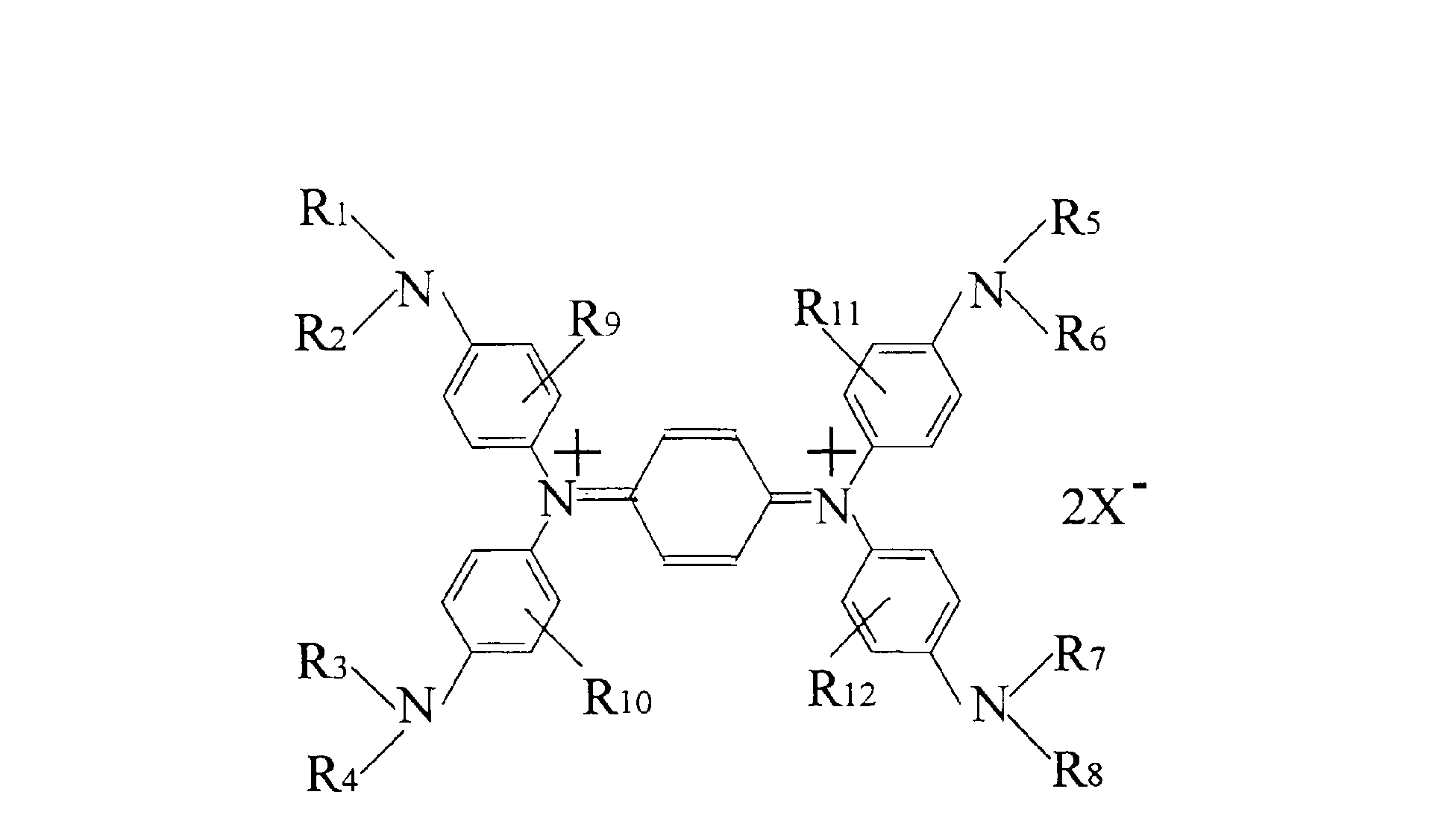

wherein the glass transition temperature of the polymer resin, a constituent component of said infrared absorption layer is from 85 to 150°C.

wherein said polymer easy adhesion layer contains a copolymerized polyester resin and a polyurethane-based resin.
wherein the proportion of coarse materials having a maximum diameter of 100 µm or more present on the surface of and/or in said polymer easy adhesion layer is 3/m2 or less.
wherein a reflection prevention layer is laminated on the outermost layer of said infrared absorption filter.
wherein an anti-glare treatment layer is laminated on the outermost layer of said infrared absorption filter.
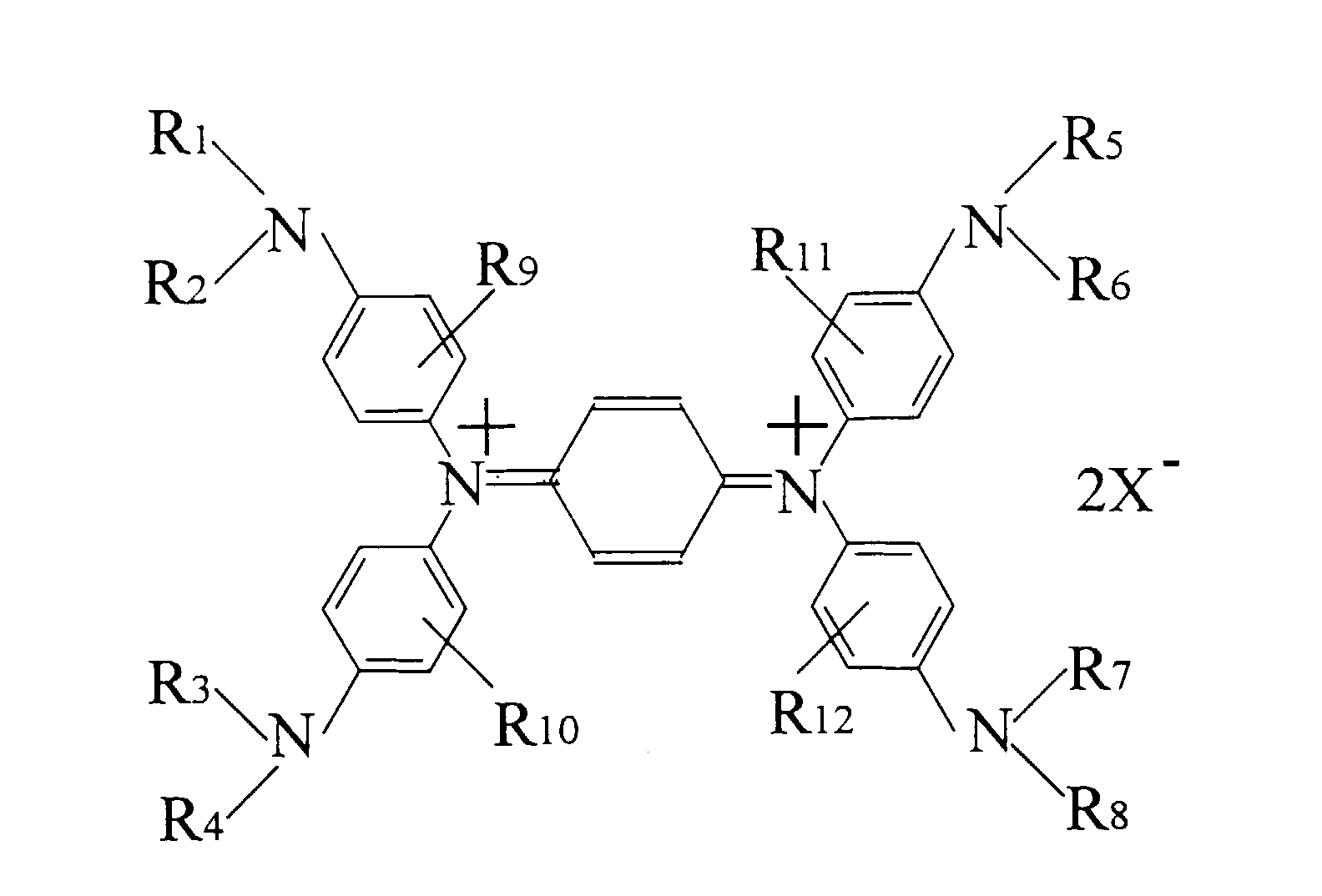

are preferable.

16 film pieces of 250 mm × 250 mm were applied to an optical defect detecting apparatus described below, to detect optical defects optically recognized to have a size of 50 µm or more.
(Detection theory of optical defect) A fluorescent lamp of 20 W × 2 is placed as a projector 400 mm under an XY table, and a mask having a slit width of 10 mm was provided. When light is directed at an angle of 12 formed between a line connecting the projector and a light receiver and a line vertical to the surface of a film to be measured, if an optical defect is present there, the part glares, and light quantity thereof was converted into an electric signal by a CCD image
| Dimethyl terephthalate | 136 parts by weight |
| Dimethyl isophthalate | 58 parts by weight |
| Ethylene glycol | 96 parts by weight |
| Tricyclodecanedimethanol | 137 parts by weight |
| Antimony trioxide | 0.09 parts by weight |
| Acid component | |
| Terephthalic acid | 71 mol% |
| Isophthalic acid | 29 mol% |
| Alcohol component | |
| Ethylene glycol | 28 mol% |
| Tricyclodecanedimethanol | 72 mol% |
| Material | Compounding amount (parts by weight) | |
| Infrared absorption coloring matter | Diimmonium salt-based compound Kayasorb IRG-022, manufactured by Nippon Kayaku Co., Ltd. | 6.6 |
| Fluorine-containing phthalocyanine compound Excolor IR-1, manufactured by Nippon Shokubai Co., Ltd.by | 1.1 | |
| Nickel complex-based compound SIR-159, manufactured by Mitsui Chemical K. K. | 3.3 | |
| Polymer resin | Copolymerized polyester resin (A1) | 440 |
| Solvent | Methyl ethyl ketone | 490 |
| Tetrahydrofuran | 490 | |
| Toluene | 490 |
| Material | Compounding amount (parts by weight) | |
| Infrared absorption coloring matter | Diimmonium salt-based compound Kayasorb IRG-022, manufactured by Nippon Kayaku Co., Ltd. | 3.2 |
| Polymer resin | Copolymerized polyester resin Vyron RV200, manufactured by Toyobo Co., Ltd. | 440 |
| Solvent | Methyl ethyl ketone | 490 |
| Tetrahydrofuran | 490 | |
| Toluene | 490 |
| Example 1 | Comparative Example 1 | ||
| Particle in polyester film | Kind Content (ppm) | Substantially none | Silica (1.0 µm) 200 |
| Foreign material having a size of 20 µ m or more in film (number/m2) | (number/m2) | 6 | 95 |
| Coagulated material having a size of 100 µ m or more in easy adhesion layer | (number/m2) | 3 | 3 |
| Adhesion with photocuring type acrylic coat layer | (%) | 100 | 100 |
| Film haze | (%) | 0.5 | 2.6 |
| Material | Compounding amount (parts by weight) | |
| Infrared absorption coloring matter and visible ray coloring matter | Diimmonium salt-based compound Kayasorb IRG-022, manufactured by Nippon Kayaku Co., Ltd. | 4.8 |
| Fluorine-containing phthalocyanine compound Kayaset Blue A-2R, manufactured by Nippon Kayaku Co., Ltd. | 2.2 | |
| Nickel complex-based compound SIR-128, manufactured by Mitsui Chemical K. K. | 1.3 | |
| Polymer resin Polymer resin | Copolymerized polyester resin (A1) | 440 |
| Solvent | Methyl ethyl ketone | 490 |
| Tetrahydrofuran | 490 | |
| Toluene | 490 |
| Material | Compounding amount (parts by weight) | |
| Infrared absorption coloring matter | Diimmonium salt based compound Kayasorb IRG-022, manufactured by Nippon Kayaku Co., Ltd. | 4.8 |
| Phthalocyanine compound Kayaset Blue A-2R, manufactured by Nippon Kayaku Co., Ltd. | 1.5 | |
| Nickel complex-based compound SIR-159, manufactured by Mitsui Chemical K. K. | 2.1 | |
| SIR-128, manufactured by Mitsui Chemical K. K. | 0.6 | |
| Polymer resin | Copolymerized polyester resin (A1) | 440 |
| Solvent | Methyl ethyl ketone | 490 |
| Tetrahydrofuran | 490 | |
| Toluene | 490 |
| Material | Compounding amount (parts by weight) | |
| Infrared absorption coloring matter | Diimmonium salt-based compound Kayasorb IRG-022, manufactured by Nippon Kayaku Co., Ltd. | 3.2 |
| Fluorine-containing phthalocyanine compound Excolor IR-1, manufactured by Nippon Shokubai Co., Ltd. | 0.5 | |
| Nickel complex-based compound SIR-159, manufactured by Mitsui Chemical K. K. | 1.6 | |
| Polymer resin | Copolymerized polyester resin (A1) | 440 |
| Solvent | Methyl ethyl ketone | 490 |
| Tetrahydrofuran | 490 | |
| Toluene | 490 |
| Dimethyl terephthalate | 136 parts by weight |
| Dimethyl isophthalate | 58 parts by weight |
| Ethylene glycol | 105 parts by weight |
| Tricyclodecanedimethanol | 98 parts by weight |
| Antimony trioxide | 0.09 parts by weight |
| Acid component | |
| Terephthalic acid | 71 mol% |
| Isophthalic acid | 29 mol% |
| Alcohol component | |
| Ethylene glycol | 49 mol% |
| Tricyclodecanedimethanol | 51 mol% |
Claims (23)
- An infrared absorption filter comprising an infrared absorption layer laminated at least on one surface of a transparent polymer film, wherein said transparent polymer film is a film comprising a polymer easy adhesion layer laminated at least on one surface, said transparent polymer film contains substantially no particle, and said transparent polymer film contains foreign materials having a size of 20 µm or more in an amount of 10/m2 or less per unit area of the film.
- The infrared absorption filter according to Claim 1 ,wherein said infrared absorption filter has a transmittance of at most 30% in the near-infrared region in the wavelength range of 800 to 1100 nm, a difference of 10% or less between a maximum value and a minimum value of transmittance in the visible light region in the wavelength range of 450 to 650 nm, and a transmittance of not lower than 50% at a wavelength of 550 nm.
- The infrared absorption filter according to Claim 2 ,wherein said infrared absorption filter has a maximum transmittance of not higher than 30% in the near-infrared region in the wavelength range of 800 to 1100 nm, a difference of 10% or less between a maximum value and a minimum value of transmittance in the visible light region in the wavelength range of 450 to 650 nm, and a transmittance of not lower than 50% at a wavelength of 550 nm, even after being left to stand in the atmosphere at a temperature of 60°C and a humidity of 95% for 500 hours.
- The infrared absorption filter according to Claim 1 ,wherein said infrared absorption filter has a transmittance of not higher than 10% in the near-infrared region in the wavelength range of 900 to 1100 nm, a minimum transmittance of not lower than 60% in the visible light regions in the wavelength range of 440 to 500 nm and the wavelength range of 640 to 700 nm, a maximum transmittance of not higher than 60% in the visible light region in the wavelength range of 550 to 600 nm, and a transmittance of not lower than 50% at a wavelength of 550 nm.
- The infrared absorption filter according to any of Claims 1 to 4 ,wherein said infrared absorption layer comprises an infrared absorption coloring matter and a polymer resin as a main constituent component, and at least two or more selected from the group consisting of diimmonium salt-based compounds, phthalocyanine-based compounds and nickel complex-based compounds are contained as said infrared absorption coloring matter.
- The infrared absorption filter according to Claim 5 ,wherein at least a diimmonium salt-based compound is contained and at least any one selected from fluorine-containing phthalocyanine-based compounds and nickel complex-based compounds is contained, as said infrared absorption coloring matter.
- The infrared absorption filter according to Claim 5 or 6 ,wherein said diimmonium salt-based compound has a structure of the general formula (1):wherein R1 to R8 may be the same or different and represent a hydrogen atom, alkyl group, aryl group, alkenyl group, aralkyl group or alkynyl group, R9 to R12 may be the same or different and represent a hydrogen atom, halogen atom, amino group, amide group, cyano group, nitro group, carboxyl group or alkyl groups a ny of R1 to R12 may have a substituent provided it can be bonded to a substituent, and X- represents an anion.
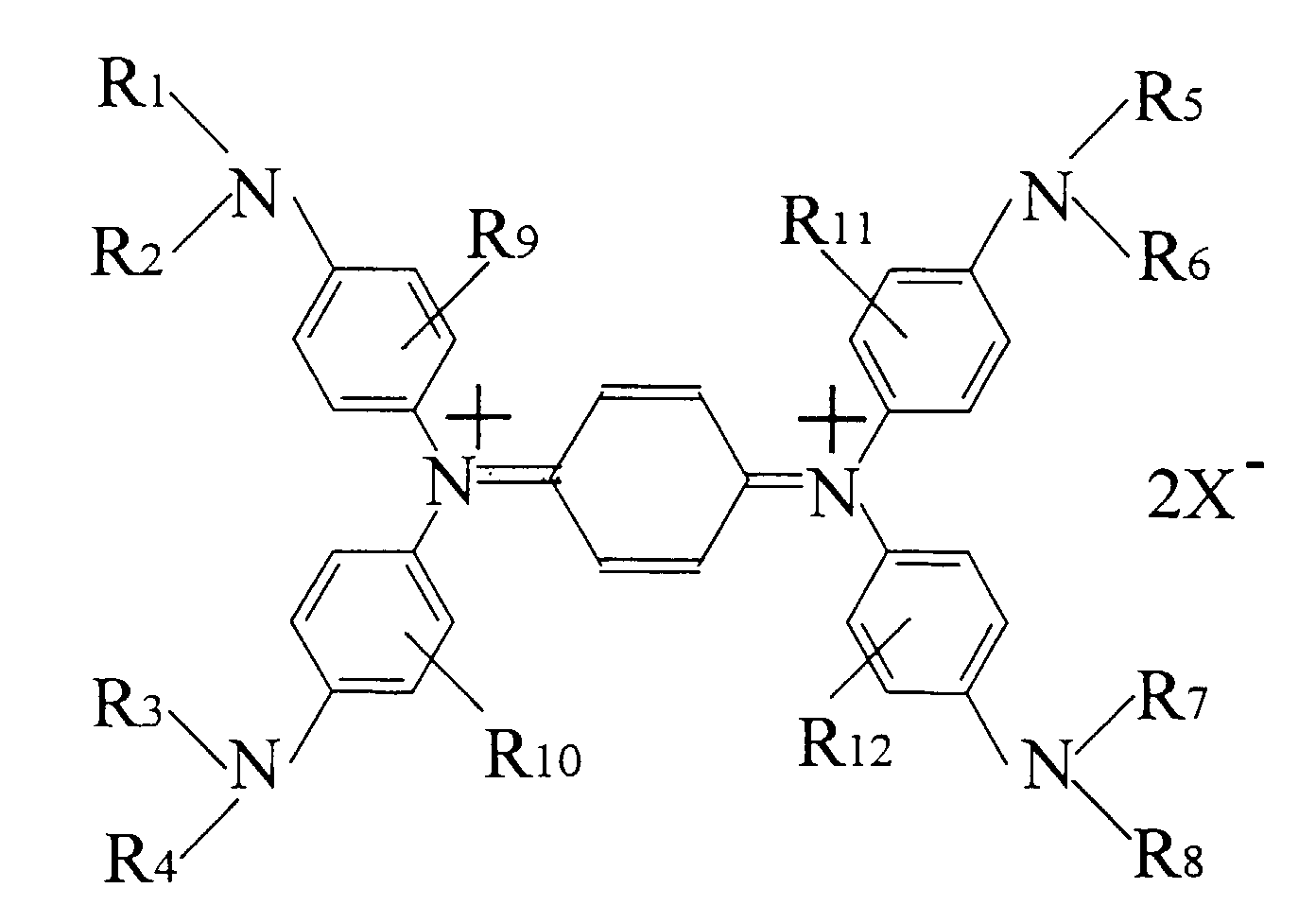
- The infrared absorption filter according to Claim 5, 6 or 7 ,wherein said phthalocyanine-based compound is a fluorine-containing phthalocyanine-based compound.
- The infrared absorption filter according to any of Claims 5 to 8, wherein said nickel complex-based compound has a structure of the general formula (2):wherein R13 to R16 may be the same or different and represent a hydrogen atom, halogen atom, alkyl group, alkoxy group, aryl group, aralkyl group or amino group.

- The infrared absorption filter according to any of Claims 5 to 9 ,wherein, regarding the amounts of infrared absorption coloring matters contained in said infrared absorption layer, the compounding ratio of a phthalocyanine-based compound is 0.01 to 1.2 parts by weight and the compounding ratio of a nickel complex-based compound is 0 to 1 part by weight based on 1 part by weight of a diimmonium salt-based compound.
- The infrared absorption filter according to any of Claims 5 to 10, wherein the glass transition temperature of the polymer resin, a constituent component of said infrared absorption layer, is from 85 to 150°C.
- The infrared absorption filter according to any of Claims 5 to 11 ,wherein said polymer resin contains a polyester resin as a main component.
- The infrared absorption filter according to Claim 12 ,wherein said polyester resin is a copolymerized polyester resin containing an alicyclic diol component of the general formula (3):wherein R17 and R18 represent a hydroxyl group and/or a hydroxyalkylene group having 1 to 8 carbon atoms and/or a group obtained by adding 1 to 10 alkylene oxides to a hydroxyalkylene group having 1 to 4 carbon atoms, in an amount of 60 mol% or more as a polyhydric alcohol component.
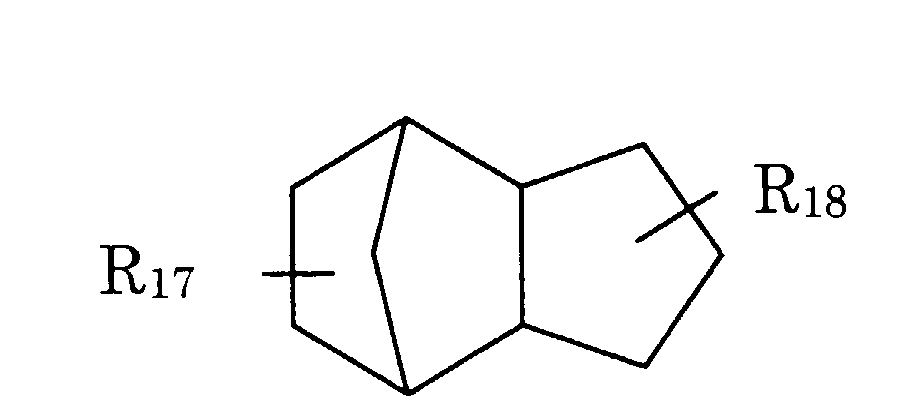
- The infrared absorption filter according to any of Claims 1 to 13, wherein the amount of a remaining solvent in said infrared absorption layer is 0.05 to 5% by weight.
- The infrared absorption filter according to any of Claims 1 to 14 ,wherein said infrared absorption layer is laminated on the transparent polymer film according to a coating method.
- The infrared absorption filter according to any of Claims 1 to 15 ,wherein said transparent polymer film is a biaxially stretched polyester film.
- The infrared absorption filter according to any of Claims 1 to 16 ,wherein said polymer easy adhesion layer contains a copolymerized polyester resin and a polyurethane-based resin.
- The infrared absorption filter according to any of Claims 1 to 17, wherein the proportion of coarse materials having a maximum diameter of 100 µm or more present on the surface of and/or in said polymer easy adhesion layer is 3/m2 or less.
- The infrared absorption filter according to any of Claims 1 to 18 ,wherein said polymer easy adhesion layer contains a particle.
- The infrared absorption filter according to any of Claims 1 to 19, wherein said transparent polymer film has a haze value of 1% or less.
- The infrared absorption filter according to any of Claims 1 to 20 ,wherein a reflection prevention layer is laminated on the outermost layer of said infrared absorption filter.
- The infrared absorption filter according to any of Claims 1 to 20, wherein an anti-glare treatment layer is laminated on the outermost layer of said infrared absorption filter.
- Use of the infrared absorption filter according to any of Claims 1 to 22, as a member of a front plate of a plasma display.
Applications Claiming Priority (6)
| Application Number | Priority Date | Filing Date | Title |
|---|---|---|---|
| JP36150099A JP2001174627A (en) | 1999-12-20 | 1999-12-20 | Infrared absorption filter |
| JP36150099 | 1999-12-20 | ||
| JP37055999 | 1999-12-27 | ||
| JP37055999A JP2001183523A (en) | 1999-12-27 | 1999-12-27 | Near infrared absorption filter |
| JP2000072273 | 2000-03-15 | ||
| JP2000072273A JP2001264532A (en) | 2000-03-15 | 2000-03-15 | Infrared absorption filter |
Publications (3)
| Publication Number | Publication Date |
|---|---|
| EP1111410A2 true EP1111410A2 (en) | 2001-06-27 |
| EP1111410A3 EP1111410A3 (en) | 2001-12-05 |
| EP1111410B1 EP1111410B1 (en) | 2004-04-14 |
Family
ID=27341650
Family Applications (1)
| Application Number | Title | Priority Date | Filing Date |
|---|---|---|---|
| EP00127937A Expired - Lifetime EP1111410B1 (en) | 1999-12-20 | 2000-12-20 | Infrared absorption filter |
Country Status (6)
| Country | Link |
|---|---|
| US (1) | US6542292B2 (en) |
| EP (1) | EP1111410B1 (en) |
| KR (1) | KR100444332B1 (en) |
| CN (1) | CN1178075C (en) |
| DE (1) | DE60009848T2 (en) |
| TW (1) | TW472158B (en) |
Cited By (11)
| Publication number | Priority date | Publication date | Assignee | Title |
|---|---|---|---|---|
| WO2003005076A1 (en) * | 2001-07-04 | 2003-01-16 | Nippon Kayaku Kabushiki Kaisha | Diimonium salt compound, and near-infrared ray absorbing filter and optical information recording medium |
| EP1275985A3 (en) * | 2001-06-25 | 2003-10-22 | Asahi Glass Company, Limited | Optical film |
| WO2005005140A1 (en) * | 2003-07-11 | 2005-01-20 | Lg Chem, Ltd. | Near infrared absorbing film and plasma display filter comprising the same |
| WO2005080453A1 (en) | 2004-02-23 | 2005-09-01 | Lg Chem, Ltd. | Adhesive film functionalizing color compensation and near infrared ray (nir) blocking and plasma display panel filter using the same |
| EP1656572A1 (en) * | 2003-08-19 | 2006-05-17 | LG Chem, Ltd. | Film for plasma display filter and plasma display filter comprising the same |
| KR100738311B1 (en) * | 2005-06-24 | 2007-07-12 | 주식회사 에이스 디지텍 | Manufacturing method of neon shielding filter and neon shielding filter using same |
| KR100738313B1 (en) * | 2005-06-24 | 2007-07-12 | 주식회사 에이스 디지텍 | Manufacturing method of near infrared ray and neon shielding filter and near infrared ray and neon shielding filter using same |
| WO2008078171A3 (en) * | 2006-12-26 | 2008-08-21 | Eaton Corp | Method of filtering spectral energy |
| EP1804093A4 (en) * | 2004-10-21 | 2012-01-18 | Teijin Chemicals Ltd | FILTER ABSORBING INFRARED RADIATION |
| EP3330750A1 (en) * | 2016-11-30 | 2018-06-06 | Samsung Electronics Co., Ltd. | Optical filter and camera module and electronic device |
| US11181673B2 (en) | 2017-11-01 | 2021-11-23 | Samsung Electronics Co., Ltd. | Optical filter, and camera module and electronic device comprising the same |
Families Citing this family (49)
| Publication number | Priority date | Publication date | Assignee | Title |
|---|---|---|---|---|
| DE69942918D1 (en) * | 1998-05-15 | 2010-12-16 | Toyo Boseki | Infrared absorbing filter |
| US6344534B2 (en) * | 2000-02-29 | 2002-02-05 | Daicel Chemical Industries, Ltd. | Functional polyester polymer and production process thereof |
| JP4795542B2 (en) * | 2000-04-10 | 2011-10-19 | 株式会社クレハ | Near infrared light absorbing composition and optical material |
| JP3517210B2 (en) * | 2000-12-28 | 2004-04-12 | 日清紡績株式会社 | Near infrared absorbing material |
| JP5052716B2 (en) * | 2001-03-27 | 2012-10-17 | 三菱樹脂株式会社 | Infrared filter |
| JP2003114323A (en) * | 2001-10-04 | 2003-04-18 | Bridgestone Corp | Near infarared ray absorbing film |
| DE60232603D1 (en) * | 2001-06-21 | 2009-07-23 | Teijin Ltd | Near-PROTECTION |
| US6870687B2 (en) * | 2001-12-12 | 2005-03-22 | Nikon Corporation | Optical system with wavelength selecting device |
| US6983104B2 (en) * | 2002-03-20 | 2006-01-03 | Guardian Industries Corp. | Apparatus and method for bending and/or tempering glass |
| US7231787B2 (en) * | 2002-03-20 | 2007-06-19 | Guardian Industries Corp. | Apparatus and method for bending and/or tempering glass |
| JP2003303949A (en) * | 2002-04-11 | 2003-10-24 | Canon Inc | Imaging device |
| US20040145701A1 (en) * | 2003-01-29 | 2004-07-29 | Robert Miniutti | Solid color eyewear lenses |
| US7004583B2 (en) * | 2003-01-29 | 2006-02-28 | East Bay Technologies | Eyewear lenses and methods of manufacturing |
| US20040145802A1 (en) * | 2003-01-29 | 2004-07-29 | Robert Miniutti | Infrared filtering optical lenses and methods of manufacturing |
| US20060257760A1 (en) * | 2003-08-11 | 2006-11-16 | Kenichi Mori | Near-infrared absorbing film, and process for production the same, near-infrared absorbing film roll, process for producing the same and near-infrared absorbing filter |
| CN100551942C (en) * | 2004-02-23 | 2009-10-21 | Lg化学株式会社 | Adhesive film having color compensation and Near Infrared Ray (NIR) blocking functions and plasma display panel filter using the same |
| US20070264499A1 (en) * | 2004-02-23 | 2007-11-15 | Lg Chem, Ltd. | Adhesive film functionalizing color compensation and near infrared ray (NIR) blocking and plasma display panel filter using the same |
| WO2006035684A1 (en) * | 2004-09-29 | 2006-04-06 | Toray Industries, Inc. | Layered film |
| US20090009899A1 (en) * | 2005-02-16 | 2009-01-08 | Mitsubishi Polyester Film Corporation | Near Infrared Ray Absorbing Filter, Optical Filter for Plasma Display and Plasma Display Panel |
| TW200717016A (en) * | 2005-07-25 | 2007-05-01 | Hitachi Maxell | Optical film and image display apparatus panel using the same |
| US20120075577A1 (en) | 2006-03-20 | 2012-03-29 | Ishak Andrew W | High performance selective light wavelength filtering providing improved contrast sensitivity |
| US8882267B2 (en) | 2006-03-20 | 2014-11-11 | High Performance Optics, Inc. | High energy visible light filter systems with yellowness index values |
| US20080048156A1 (en) * | 2006-08-02 | 2008-02-28 | Samsung Corning Co. Ltd. | Functional film composition for display |
| KR100761435B1 (en) * | 2006-12-19 | 2007-09-27 | 구자은 | Electromagnetic wave shielding layer for vacuum deposition using waterborne polyurethane |
| KR100953556B1 (en) * | 2007-02-08 | 2010-04-21 | 주식회사 엘지화학 | Near infrared absorption PD filter |
| KR100909167B1 (en) * | 2007-07-05 | 2009-07-23 | 제일모직주식회사 | Optical film and display device comprising same |
| US20090208865A1 (en) * | 2008-02-19 | 2009-08-20 | International Business Machines Corporation | Photolithography focus improvement by reduction of autofocus radiation transmission into substrate |
| US8865293B2 (en) * | 2008-12-15 | 2014-10-21 | 3M Innovative Properties Company | Optically active materials and articles and systems in which they may be used |
| KR20110000179A (en) * | 2009-06-26 | 2011-01-03 | 삼성코닝정밀소재 주식회사 | Display filter |
| US8772376B2 (en) | 2009-08-18 | 2014-07-08 | International Business Machines Corporation | Near-infrared absorbing film compositions |
| JP6256335B2 (en) * | 2012-06-25 | 2018-01-10 | Jsr株式会社 | Optical filter for solid-state imaging device and use thereof |
| KR102056613B1 (en) * | 2012-08-23 | 2019-12-17 | 에이지씨 가부시키가이샤 | Near-infrared cut filter and solid-state imaging device |
| JP5849899B2 (en) * | 2012-08-27 | 2016-02-03 | 旭硝子株式会社 | Near-infrared absorption filter and solid-state imaging device |
| TWI455956B (en) | 2012-11-21 | 2014-10-11 | Ind Tech Res Inst | Amorphous copolyester, substrate, and optical film |
| TWI597242B (en) * | 2012-11-30 | 2017-09-01 | 住友金屬礦山股份有限公司 | Near-infrared absorption filter material and imaging element |
| CN104838294B (en) * | 2012-12-06 | 2017-03-08 | 旭硝子株式会社 | Near Infrared Cut Filter |
| CN104903759B (en) * | 2013-02-19 | 2017-09-22 | 富士胶片株式会社 | Near infrared ray absorbing composition, near infrared ray cut-off filter and its manufacture method and camera module and its manufacture method |
| TWI629517B (en) | 2013-12-20 | 2018-07-11 | 德商首德公司 | Optical filter |
| JP6277283B2 (en) * | 2014-10-03 | 2018-02-07 | 富士フイルム株式会社 | Near-infrared absorbing composition, curable composition, cured film, near-infrared cut filter, solid-state imaging device, infrared sensor, camera module, processing dye, and processing dye manufacturing method |
| KR102153205B1 (en) | 2015-09-24 | 2020-09-07 | 니혼 이타가라스 가부시키가이샤 | Composition for infrared absorbing layer, infrared cut filter, and imaging device |
| WO2018163766A1 (en) * | 2017-03-09 | 2018-09-13 | 富士フイルム株式会社 | Structure, kit, and optical sensor |
| KR102619325B1 (en) * | 2017-05-29 | 2024-01-02 | 제이에스알 가부시끼가이샤 | Optical filter for ambient light sensor |
| KR102673362B1 (en) * | 2018-03-27 | 2024-06-05 | 삼성전자주식회사 | Near-Infrared Absorbing Film, OPTICAL FILTER COMPRING THE SAME AND ECTRONIC DEVICE |
| CN108983341A (en) * | 2018-08-31 | 2018-12-11 | 苏州讯能光电科技有限公司 | A kind of wear-resisting anti-dazzle night viewing compatible filter coating and preparation method thereof |
| EP3854821A4 (en) * | 2018-09-20 | 2021-11-17 | FUJIFILM Corporation | HARDENABLE COMPOSITION, HARDENED FILM, INFRARED TRANSMISSION FILTER, LAMINATE, SOLID IMAGING ELEMENT, SENSOR, AND PATTERN MANUFACTURING METHOD |
| KR102764012B1 (en) * | 2019-03-21 | 2025-02-05 | 삼성전자주식회사 | Optical structure, camera module and ectronic device |
| KR102486738B1 (en) * | 2020-04-14 | 2023-01-10 | 한국광기술원 | High Heat Resistant Infrared Absorption Filter and Method for Manufacturing Thereof |
| US12669636B2 (en) * | 2022-07-19 | 2026-06-30 | Lms Co., Ltd. | Basic layer for an optical filter |
| CN117003493A (en) * | 2023-08-04 | 2023-11-07 | 天府兴隆湖实验室 | Passive heating film and preparation method thereof |
Family Cites Families (38)
| Publication number | Priority date | Publication date | Assignee | Title |
|---|---|---|---|---|
| GB1201066A (en) * | 1966-09-02 | 1970-08-05 | Polaroid Corp | Plastics optical elements |
| DK126720B (en) | 1968-05-11 | 1973-08-13 | Leybold Heraeus Verwaltung | Apparatus for continuous freeze-drying. |
| US4223974A (en) | 1978-08-02 | 1980-09-23 | American Optical Corporation | Enhanced bonding of silicon oxides and silver by intermediate coating of metal |
| JPS5721458A (en) | 1980-07-11 | 1982-02-04 | Mitsubishi Electric Corp | Near infrared absorbing plastic film |
| JPS57198413A (en) | 1981-05-30 | 1982-12-06 | Mitsui Toatsu Chem Inc | Optical filter having spectral characteristic close to visibility |
| JPS58142956A (en) * | 1982-02-18 | 1983-08-25 | Takeda Chem Ind Ltd | Primer for bonding polyester resin |
| US4590118A (en) | 1983-02-17 | 1986-05-20 | Teijin Limited | Selective light transmission sheet |
| ZA842139B (en) | 1983-03-25 | 1984-10-31 | Flachglas Ag | Process for coating a transparent substrate |
| JPH0638124B2 (en) | 1983-08-22 | 1994-05-18 | 日本化薬株式会社 | Near infrared absorption filter |
| DE3414682C2 (en) | 1984-04-18 | 1986-04-24 | Schott Glaswerke, 6500 Mainz | Alkali and alkaline earth rich phosphate glass with CuO as a coloring component for optical colored and filter glass |
| US4767571A (en) | 1984-06-27 | 1988-08-30 | Fuji Photo Film Co., Ltd. | Infrared absorbent |
| JPS62153144A (en) | 1985-12-25 | 1987-07-08 | Toshiba Glass Co Ltd | Near infrared cutting filter glass and production thereof |
| US5215799A (en) * | 1989-01-25 | 1993-06-01 | Idemitsu Petrochemical Co., Ltd. | Optical disk substrate and optical information-storage medium |
| JPH0517560A (en) * | 1991-07-10 | 1993-01-26 | Arakawa Chem Ind Co Ltd | New polyester resin |
| DE69230121T2 (en) * | 1991-07-15 | 2000-04-20 | Nippon Shokubai Co. Ltd. | New phthalocyanine compounds, their manufacturing processes and the near infrared absorbing materials they contain |
| JPH0634813A (en) | 1992-07-15 | 1994-02-10 | Sekisui Chem Co Ltd | Infrared absorption filter |
| US5466755A (en) | 1992-08-20 | 1995-11-14 | Kureha, Kagaku Kogyo Kabushiki Kaisha | Optical filter |
| JPH06324213A (en) | 1993-04-28 | 1994-11-25 | Kureha Chem Ind Co Ltd | Composite optical filter |
| KR100214428B1 (en) | 1993-06-30 | 1999-08-02 | 후지무라 마사지카, 아키모토 유미 | Infrared ray shielding material and infrared ray shielding powder |
| JPH07134206A (en) | 1993-09-17 | 1995-05-23 | Hitachi Chem Co Ltd | Photosensitive film for color filter |
| JPH07314626A (en) | 1994-05-24 | 1995-12-05 | Diafoil Co Ltd | Composite polyester film |
| US5691838A (en) | 1994-06-16 | 1997-11-25 | Kureha Kagaku Kogyo Kabushiki Kaisha | Infrared-blocking optical fiber |
| JP3746824B2 (en) | 1996-01-30 | 2006-02-15 | 株式会社クレハ | Visible light absorber |
| JPH09324144A (en) * | 1996-04-03 | 1997-12-16 | Dainippon Toryo Co Ltd | Composition for forming near-infrared cut filter and near-infrared cut filter |
| CA2251909C (en) | 1996-04-18 | 2003-12-23 | Kenji Yao | Near-infrared absorbing film, and multi-layered panel comprising the film |
| JP3674146B2 (en) | 1996-05-07 | 2005-07-20 | 株式会社富士通ゼネラル | Optical filter device |
| JPH1078509A (en) | 1996-07-12 | 1998-03-24 | Mitsui Petrochem Ind Ltd | Filters for plasma displays |
| JP3689998B2 (en) | 1996-09-26 | 2005-08-31 | 日本油脂株式会社 | Near-infrared shielding filter for plasma display |
| TW445380B (en) | 1996-10-23 | 2001-07-11 | Sumitomo Chemical Co | Plasma display front panel |
| JP4232062B2 (en) | 1997-11-18 | 2009-03-04 | 東洋紡績株式会社 | Infrared absorption filter |
| JP3228898B2 (en) | 1997-12-04 | 2001-11-12 | 兵庫県 | Method and apparatus for indicating and measuring arbitrary height of a trunk and method and apparatus for remotely measuring the diameter of a trunk |
| JPH11302308A (en) | 1998-02-20 | 1999-11-02 | Mitsubishi Rayon Co Ltd | Method for producing copper compound-containing resin composition |
| DE69942918D1 (en) * | 1998-05-15 | 2010-12-16 | Toyo Boseki | Infrared absorbing filter |
| DE69939236D1 (en) * | 1998-05-18 | 2008-09-18 | Toyo Boseki | Adhesive film for optical applications |
| JP2000007870A (en) | 1998-06-23 | 2000-01-11 | Kureha Chem Ind Co Ltd | Resin composition and method for producing the same, optical filter and device having the same, heat ray absorption filter, optical fiber, and spectacle lens |
| JP3898357B2 (en) * | 1998-09-28 | 2007-03-28 | 日東電工株式会社 | Filter for plasma display panel |
| KR20000035395A (en) | 1998-11-11 | 2000-06-26 | 모치즈키 아키히로 | Near infrared absorption filter |
| US6217796B1 (en) * | 1998-11-17 | 2001-04-17 | Nisshinbo Industries, Inc. | Near infrared absorption composition |
-
2000
- 2000-12-18 KR KR10-2000-0077619A patent/KR100444332B1/en not_active Expired - Fee Related
- 2000-12-19 US US09/740,519 patent/US6542292B2/en not_active Expired - Fee Related
- 2000-12-19 TW TW089127202A patent/TW472158B/en not_active IP Right Cessation
- 2000-12-20 DE DE60009848T patent/DE60009848T2/en not_active Expired - Lifetime
- 2000-12-20 EP EP00127937A patent/EP1111410B1/en not_active Expired - Lifetime
- 2000-12-20 CN CNB00135776XA patent/CN1178075C/en not_active Expired - Fee Related
Cited By (15)
| Publication number | Priority date | Publication date | Assignee | Title |
|---|---|---|---|---|
| EP1275985A3 (en) * | 2001-06-25 | 2003-10-22 | Asahi Glass Company, Limited | Optical film |
| US6902791B2 (en) | 2001-06-25 | 2005-06-07 | Asahi Glass Company, Limited | Optical film |
| EP1403666A4 (en) * | 2001-07-04 | 2008-04-16 | Nippon Kayaku Kk | Diimonium salt compound, near-infrared absorbing filter and optical information recording medium using the same |
| WO2003005076A1 (en) * | 2001-07-04 | 2003-01-16 | Nippon Kayaku Kabushiki Kaisha | Diimonium salt compound, and near-infrared ray absorbing filter and optical information recording medium |
| WO2005005140A1 (en) * | 2003-07-11 | 2005-01-20 | Lg Chem, Ltd. | Near infrared absorbing film and plasma display filter comprising the same |
| EP1656572A1 (en) * | 2003-08-19 | 2006-05-17 | LG Chem, Ltd. | Film for plasma display filter and plasma display filter comprising the same |
| WO2005080453A1 (en) | 2004-02-23 | 2005-09-01 | Lg Chem, Ltd. | Adhesive film functionalizing color compensation and near infrared ray (nir) blocking and plasma display panel filter using the same |
| EP1804093A4 (en) * | 2004-10-21 | 2012-01-18 | Teijin Chemicals Ltd | FILTER ABSORBING INFRARED RADIATION |
| KR100738311B1 (en) * | 2005-06-24 | 2007-07-12 | 주식회사 에이스 디지텍 | Manufacturing method of neon shielding filter and neon shielding filter using same |
| KR100738313B1 (en) * | 2005-06-24 | 2007-07-12 | 주식회사 에이스 디지텍 | Manufacturing method of near infrared ray and neon shielding filter and near infrared ray and neon shielding filter using same |
| WO2008078171A3 (en) * | 2006-12-26 | 2008-08-21 | Eaton Corp | Method of filtering spectral energy |
| EP3330750A1 (en) * | 2016-11-30 | 2018-06-06 | Samsung Electronics Co., Ltd. | Optical filter and camera module and electronic device |
| US10539725B2 (en) | 2016-11-30 | 2020-01-21 | Samsung Electronics Co., Ltd. | Optical filter and camera module and electronic device |
| US11181673B2 (en) | 2017-11-01 | 2021-11-23 | Samsung Electronics Co., Ltd. | Optical filter, and camera module and electronic device comprising the same |
| US11719867B2 (en) | 2017-11-01 | 2023-08-08 | Samsung Electronics Co., Ltd. | Optical filter, and camera module and electronic device comprising the same |
Also Published As
| Publication number | Publication date |
|---|---|
| EP1111410A3 (en) | 2001-12-05 |
| DE60009848T2 (en) | 2005-04-21 |
| TW472158B (en) | 2002-01-11 |
| US20010005278A1 (en) | 2001-06-28 |
| EP1111410B1 (en) | 2004-04-14 |
| CN1300948A (en) | 2001-06-27 |
| KR20010082587A (en) | 2001-08-30 |
| KR100444332B1 (en) | 2004-08-16 |
| US6542292B2 (en) | 2003-04-01 |
| CN1178075C (en) | 2004-12-01 |
| DE60009848D1 (en) | 2004-05-19 |
| HK1037235A1 (en) | 2002-02-01 |
Similar Documents
| Publication | Publication Date | Title |
|---|---|---|
| EP1111410B1 (en) | Infrared absorption filter | |
| KR100992515B1 (en) | Polyester film for display | |
| US20060257760A1 (en) | Near-infrared absorbing film, and process for production the same, near-infrared absorbing film roll, process for producing the same and near-infrared absorbing filter | |
| US6649260B2 (en) | Optical coating film | |
| JP4253895B2 (en) | Method for producing optically easy-adhesive film | |
| JP4174739B2 (en) | Hard coat film, optical functional film, and adhesion modified substrate film for obtaining the same | |
| JP2000246855A (en) | Optical easy-to-adhere film | |
| JP2001071439A (en) | Optical easily adhesive film | |
| KR20140015346A (en) | Highly adhesive polyester film for protection of polarizers | |
| WO2000079544A1 (en) | Transparent conductive film and electroluminescence panel comprising the same | |
| JP2001174627A (en) | Infrared absorption filter | |
| JP4556119B2 (en) | Biaxially oriented laminated polyester film for optics | |
| KR20060024314A (en) | Near-infrared absorption film and its manufacturing method, Near-infrared absorption film roll and its manufacturing method, and near-infrared absorption filter | |
| JP4967479B2 (en) | Optically easy-adhesive polyester film roll and hard coat film | |
| JP2001264532A (en) | Infrared absorption filter | |
| JP4604718B2 (en) | Biaxially oriented laminated polyester film for optics | |
| JP2000296595A (en) | Optical easily adhesive film and manufacture thereof | |
| JP5380897B2 (en) | Adhesive modified base film and hard coat film | |
| JP4117572B2 (en) | Optical laminated polyester film, hard coat film using the same, and plasma display panel filter using the same | |
| JP2000246856A (en) | Easy adhesion film for optical | |
| JP4320763B2 (en) | Easy adhesive film for optics | |
| JP3809830B2 (en) | Near infrared absorption filter | |
| JP4792614B2 (en) | Easy adhesive film for optics | |
| JP4320762B2 (en) | Easy adhesive film for optics | |
| JP2007047517A (en) | Polyester film for antireflection film and antireflection film |
Legal Events
| Date | Code | Title | Description |
|---|---|---|---|
| PUAI | Public reference made under article 153(3) epc to a published international application that has entered the european phase |
Free format text: ORIGINAL CODE: 0009012 |
|
| AK | Designated contracting states |
Kind code of ref document: A2 Designated state(s): AT BE CH CY DE DK ES FI FR GB GR IE IT LI LU MC NL PT SE TR Kind code of ref document: A2 Designated state(s): DE FR GB |
|
| AX | Request for extension of the european patent |
Free format text: AL;LT;LV;MK;RO;SI |
|
| PUAL | Search report despatched |
Free format text: ORIGINAL CODE: 0009013 |
|
| AK | Designated contracting states |
Kind code of ref document: A3 Designated state(s): AT BE CH CY DE DK ES FI FR GB GR IE IT LI LU MC NL PT SE TR |
|
| AX | Request for extension of the european patent |
Free format text: AL;LT;LV;MK;RO;SI |
|
| 17P | Request for examination filed |
Effective date: 20020131 |
|
| AKX | Designation fees paid |
Free format text: DE FR GB |
|
| 17Q | First examination report despatched |
Effective date: 20030324 |
|
| GRAP | Despatch of communication of intention to grant a patent |
Free format text: ORIGINAL CODE: EPIDOSNIGR1 |
|
| GRAS | Grant fee paid |
Free format text: ORIGINAL CODE: EPIDOSNIGR3 |
|
| GRAA | (expected) grant |
Free format text: ORIGINAL CODE: 0009210 |
|
| AK | Designated contracting states |
Kind code of ref document: B1 Designated state(s): DE FR GB |
|
| REG | Reference to a national code |
Ref country code: GB Ref legal event code: FG4D |
|
| REF | Corresponds to: |
Ref document number: 60009848 Country of ref document: DE Date of ref document: 20040519 Kind code of ref document: P |
|
| REG | Reference to a national code |
Ref country code: IE Ref legal event code: FG4D |
|
| ET | Fr: translation filed | ||
| PLBE | No opposition filed within time limit |
Free format text: ORIGINAL CODE: 0009261 |
|
| STAA | Information on the status of an ep patent application or granted ep patent |
Free format text: STATUS: NO OPPOSITION FILED WITHIN TIME LIMIT |
|
| 26N | No opposition filed |
Effective date: 20050117 |
|
| PGFP | Annual fee paid to national office [announced via postgrant information from national office to epo] |
Ref country code: FR Payment date: 20101224 Year of fee payment: 11 |
|
| PGFP | Annual fee paid to national office [announced via postgrant information from national office to epo] |
Ref country code: GB Payment date: 20101215 Year of fee payment: 11 |
|
| PGFP | Annual fee paid to national office [announced via postgrant information from national office to epo] |
Ref country code: DE Payment date: 20101215 Year of fee payment: 11 |
|
| GBPC | Gb: european patent ceased through non-payment of renewal fee |
Effective date: 20111220 |
|
| REG | Reference to a national code |
Ref country code: FR Ref legal event code: ST Effective date: 20120831 |
|
| REG | Reference to a national code |
Ref country code: DE Ref legal event code: R119 Ref document number: 60009848 Country of ref document: DE Effective date: 20120703 |
|
| PG25 | Lapsed in a contracting state [announced via postgrant information from national office to epo] |
Ref country code: DE Free format text: LAPSE BECAUSE OF NON-PAYMENT OF DUE FEES Effective date: 20120703 Ref country code: GB Free format text: LAPSE BECAUSE OF NON-PAYMENT OF DUE FEES Effective date: 20111220 |
|
| PG25 | Lapsed in a contracting state [announced via postgrant information from national office to epo] |
Ref country code: FR Free format text: LAPSE BECAUSE OF NON-PAYMENT OF DUE FEES Effective date: 20120102 |