EP1111403A2 - Funkortungsverfahren und Handapparat dafür - Google Patents
Funkortungsverfahren und Handapparat dafür Download PDFInfo
- Publication number
- EP1111403A2 EP1111403A2 EP00115077A EP00115077A EP1111403A2 EP 1111403 A2 EP1111403 A2 EP 1111403A2 EP 00115077 A EP00115077 A EP 00115077A EP 00115077 A EP00115077 A EP 00115077A EP 1111403 A2 EP1111403 A2 EP 1111403A2
- Authority
- EP
- European Patent Office
- Prior art keywords
- estimated
- base stations
- estimated positions
- wireless terminal
- averaging
- Prior art date
- Legal status (The legal status is an assumption and is not a legal conclusion. Google has not performed a legal analysis and makes no representation as to the accuracy of the status listed.)
- Withdrawn
Links
Images


Classifications
-
- H—ELECTRICITY
- H04—ELECTRIC COMMUNICATION TECHNIQUE
- H04W—WIRELESS COMMUNICATION NETWORKS
- H04W64/00—Locating users or terminals or network equipment for network management purposes, e.g. mobility management
-
- G—PHYSICS
- G01—MEASURING; TESTING
- G01S—RADIO DIRECTION-FINDING; RADIO NAVIGATION; DETERMINING DISTANCE OR VELOCITY BY USE OF RADIO WAVES; LOCATING OR PRESENCE-DETECTING BY USE OF THE REFLECTION OR RERADIATION OF RADIO WAVES; ANALOGOUS ARRANGEMENTS USING OTHER WAVES
- G01S5/00—Position-fixing by co-ordinating two or more direction or position line determinations; Position-fixing by co-ordinating two or more distance determinations
- G01S5/02—Position-fixing by co-ordinating two or more direction or position line determinations; Position-fixing by co-ordinating two or more distance determinations using radio waves
- G01S5/14—Determining absolute distances from a plurality of spaced points of known location
Definitions
- the present invention relates to a system for measuring the position of a terminal through cellular communication.
- Japan laid-open Patent 7-181242 has disclosed a technology for measuring the position of a terminal by observing the timing of receiving pilot signals from base stations accommodated by a cellular communication system having the code division multiple access (CDMA) method implemented therein.
- the base stations operate synchronously with satellites included in the global positioning system (GPS).
- GPS global positioning system
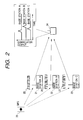
- FIG. 2 and FIG. 3 are concerned with the technology described in the Japan laid-open Patent 7-181242.
- FIG. 2 shows a terminal 24 for receiving reference signals 25, 26, and 27 sent from base stations 21, 22, and 23 synchronized with a satellite 20 included in the GPS.
- FIG. 3 shows an example of the results of correlation.
- the terminal 24 correlates the received signals with the patterns of specific codes so as to detect the timings of receiving the reference signals sent from the base stations.
- common pilot signals sent from the base stations have specific patterns.
- the terminal correlates the received signals with the patterns of the pilot signals so as to detect the reception timings.
- Each of the base stations adjusts a reference time i by the GPS synchronization and transmits a pilot signal according to a specific transmission timing determined according to the adjusted system time.
- the specific transmission timing corresponds to an offset time.
- Information of the offset time is transmitted on a sync channel, and a terminal can acquire the information freely.
- the terminal calculates a difference between a measured reception timing and the known transmission timing so as to work out a delay time or a time required for propagation of a radio wave.
- FIG. 3 shows examples of the results of correlation.
- the graphs of FIG. 3 are referred to as delay profiles indicating a path along which a signal is propagated with a delay.
- the axis of abscesses indicates the reception timing corrected based on the transmission timing, that is, the delay time.
- the unit of delay time corresponds to each of chips in a spreading code.
- the axis of ordinates indicates the output or results of correlation operation. A larger correlation value indicates that a signal is received with an indicated delay time spent, that is, a path is determined.
- a relative delay time required for a radio wave to reach a terminal after transmitted from a base station can be calculated.
- the delay time is a relative value because a terminal is unaware of an absolute time instant.
- a product of an obtained relative delay time by a light velocity indicates a difference between relative propagated distances.
- base stations and a terminal are located on the same plane. Precision in a measured position varies depending on the positional relationships among the base stations and terminal.
- FIG. 4 shows the distribution of errors of a measured position when the position to be measured is shifted as 90, 91, and 92 relative to base stations 50, 51, and 52.
- a signal transmitted from each of the base stations includes an estimation error of a delay time having a uniform distribution in a range of ⁇ 0.2 ⁇ sec or less.
- a black area indicates the spread of errors of each measured position deriving from the intentionally appended error of the delay time.
- the intentionally appended error of the delay time is the same, the spread of errors of the measured position varies depending on the positional relationships among the terminal and base stations. This means that the precision in the estimated position of a terminal varies depending on selected base stations.
- An object of the present invention is to improve precision in estimation.
- the triangulation method is used to calculate a plurality of estimated positions relative to various combinations of three base stations selected from among three or more base stations.
- the estimated positions are averaged in order to reduce an error of an estimated position.
- an error of an estimated position becomes minimal when the length of the resultant composite vector is zero.
- precision in an estimated position of a terminal deteriorates.
- an estimated position contains a small error.
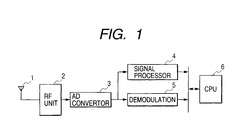
- a signal received by an antenna 1 is converted into a baseband by a radio-frequency unit 2.
- the converted signal is digitized by an A/D converter 3.
- a signal processor 4 measures the reception timings of reference signals sent from base stations. The reception timings are obtained through calculation of correlation between the received signals and the reference signals.
- a demodulator 5 is a unit for receiving information of the base stations.
- the timing of transmitting a reference signal from each of the base stations is drawn out from an offset value in the timing of transmitting a PN code which is transmitted on a sync channel.
- the transmission timing can be calculated.
- a terminal subtracts the transmission timing from the reception timing so as to work out a propagation delay.
- a CPU 6 estimates a propagated distance from the calculated transmission and reception timings, and then estimates the position of the terminal.
- Estimation of a position is carried out by making the following features of cellular communication. That is, a terminal monitors signals sent from a plurality of base stations while the terminal stays at the same position. The propagated distances of signals sent from at least three base stations are measured, whereby the position of the terminal can be estimated according to the triangular method.
- n base stations where n denotes 4 or more
- three base stations are selected from among the n base stations and the estimated positions n C 3 are calculated.
- a spatial average of the estimated positions is then calculated in order to reduce an error of an estimated position.
- the spatial average corresponds to the barycenter of a plurality of calculated coordinates. For example, when two estimated positions (X1 , Y1) and (X2, Y2) are calculated, (X1+X2, Y2+Y2)/2 is calculated.
- a problem to be overcome is that precision in estimation varies depending on the positional relationships among a terminal and base stations. A substantial improvement of the precision may be achieved by avoiding the selection of base stations that may cause a large error and by averaging estimated positions of the terminal.
- FIG. 6 shows a processing implemented as software in the CPU.
- a difference between the timings of transmitting signals from base stations which are calculated by the demodulator 5 shown in FIG. 1 and the timings of receiving the signals from the base stations which are calculated by the signal processor 4 so that relative delays are calculated.
- the position of a terminal is calculated, according to the triangular method, using position information 66 of the base stations, which is prepared in advance, and the calculated relative delays, thereby to obtain estimated positions n C 3 .
- a spatial average of the plurality of estimated positions is calculated and regarded as a tentative position.
- a reliability estimating step 64 a combination of three base stations defining a triangle within which the tentative position is included is selected, and estimated positions are calculated relative to the selected three base stations. Data of an estimated position containing a large error is discarded and only the selected estimated positions are averaged at a spatial averaging step 65.
- a selecting step 63 if it is found that one of the plurality of estimated positions is separated by 200 m or more from an average position of the other estimated positions, the one estimated position is not regarded as a tentative position.
- the selecting step 63 therefore contributes to a further reduction in an error of an estimated position.
- the adoption of the selecting step 63 alone would prove effective in reducing an error.
- the preliminary position locating step 62 may be omitted.
- the reliability estimating step 64 it is judged whether each of estimated positions calculated at the position locating step 66 resides within a triangle defined by three base stations relative to which the estimated position is calculated. An estimated position that does not resides within the triangle is discarded. Even in this way, an estimated position containing a large error can be discarded successfully.
- estimated positions selected at the reliability estimating step 64 are used to calculate a spatial average, whereby the final estimated position of the terminal is calculated.
- the one estimated position may be displayed for shortening a calculation time, depending on the tolerance of the error designated by a position measuring person.
- a unit vector is originated from a tentative position (X0, Y0) towards base stations (XA, YA), (XB, YB), and (XC, YC).
- the vectors are expressed as follows: (XA-X0, YA-Y0) /
- the sum of the vectors is calculated.
- the length of the resultant vector is 1 or more, the tentative position is judged to lie outside a triangle defined by the base stations.
- the length of the resultant vector is less than 1, the tentative position is judged to lie within the triangle.
- the foregoing processing employed in the present embodiment may be implemented in the form of not only software in the CPU but also hardware.
- the processing time must be shortened.
- FIG. 7 describes an overall processing flow.
- the steps 60 to 65 indicate the processing performed by the CPU as described in FIG. 6. According to this sequence, it is able to overcome the aforementioned problem.
- precision in an estimated position is judged by employing the reliability estimation in which it is checked if the sum of unit vectors originated from a tentative position towards base stations is equal to or smaller than 1.
- the gist of the present invention is to select an estimated position containing a small error for exerting the advantages of the present invention.
- a procedure of selecting an estimated position according to whether the sum of vectors is equal to or smaller than a certain value is therefore included in the present invention. If a threshold value for selecting the estimated position is made small, precision can be improved. However, since the number of selected estimated positions decreases in this case, the advantage of averaging is degraded.
- the number of base stations that can be observed increases, the number n C 3 of estimated positions increases, suddenly. This leads to a drastic increase in the amount of data to be calculated at the position locating step 61. Therefore, it is advantageous to provide in the signal processor 4 shown in FIG. 1, a means for notifying the delay finding step 60 shown in FIG. 6 of not only the timings of receiving signals but also the intensities of the received signals.
- the amount of data to be calculated can be reduced effectively by discarding low-grade received signals whose levels are equal to or lower than a certain level.
- k base stations may be selected according to whether signals received from the base stations have the first to k-th highest levels.
- such a base station may be implemented that is segmented into a plurality of sectors by a directional antenna and each of the sectors can transmit a signal as if they were serving as independent base stations.
- a plurality of signals sent from the sectors cannot be regarded as a plurality of signals to be handled according to the triangulation method.
- One of the received signals is therefore selected.
- a terminal is informed in advance of position information of base stations, and can therefore identify a plurality of base stations located at the same place as a sector type of base station. By estimating delays of the signals sent from the sectors and selecting one of the sectors sending a signal with the smallest delay, the selected signal may be expected as a signal that has propagated along a straight line leading to the terminal.
- a combination of base stations employed for utilizing the triangulation method can be selected optimally. Consequently, the position of the terminal can be estimated highly precisely.
Landscapes
- Engineering & Computer Science (AREA)
- Physics & Mathematics (AREA)
- General Physics & Mathematics (AREA)
- Radar, Positioning & Navigation (AREA)
- Remote Sensing (AREA)
- Computer Networks & Wireless Communication (AREA)
- Signal Processing (AREA)
- Mobile Radio Communication Systems (AREA)
- Position Fixing By Use Of Radio Waves (AREA)
Applications Claiming Priority (2)
| Application Number | Priority Date | Filing Date | Title |
|---|---|---|---|
| JP36222299 | 1999-12-21 | ||
| JP36222299A JP2001174537A (ja) | 1999-12-21 | 1999-12-21 | 無線端末位置測定方法およびそれを用いた端末装置 |
Publications (2)
| Publication Number | Publication Date |
|---|---|
| EP1111403A2 true EP1111403A2 (de) | 2001-06-27 |
| EP1111403A3 EP1111403A3 (de) | 2003-10-29 |
Family
ID=18476305
Family Applications (1)
| Application Number | Title | Priority Date | Filing Date |
|---|---|---|---|
| EP00115077A Withdrawn EP1111403A3 (de) | 1999-12-21 | 2000-07-27 | Funkortungsverfahren und Handapparat dafür |
Country Status (4)
| Country | Link |
|---|---|
| US (1) | US6694142B1 (de) |
| EP (1) | EP1111403A3 (de) |
| JP (1) | JP2001174537A (de) |
| KR (1) | KR20010067044A (de) |
Cited By (5)
| Publication number | Priority date | Publication date | Assignee | Title |
|---|---|---|---|---|
| EP1229346A1 (de) * | 2001-01-31 | 2002-08-07 | Hitachi, Ltd. | Methode und System zur Verringerung des Positionierungsfehlers |
| EP1315393A1 (de) * | 2001-11-27 | 2003-05-28 | Alcatel | Verfahren zur Positionsbestimmung einer Mobilstation auf der Basis von Ausbreitungsmodellen |
| US6865394B2 (en) | 2001-01-31 | 2005-03-08 | Hitachi, Ltd | Location detection method, location detection system and location detection program |
| CN104640134A (zh) * | 2013-11-15 | 2015-05-20 | 中国电信股份有限公司 | 检查基站天馈方向的方法与装置 |
| CN111541985A (zh) * | 2019-01-21 | 2020-08-14 | 海信集团有限公司 | 一种物联网终端定位方法、物联网终端和存储介质 |
Families Citing this family (47)
| Publication number | Priority date | Publication date | Assignee | Title |
|---|---|---|---|---|
| US20040143392A1 (en) * | 1999-07-12 | 2004-07-22 | Skybitz, Inc. | System and method for fast acquisition reporting using communication satellite range measurement |
| US8255149B2 (en) | 1999-07-12 | 2012-08-28 | Skybitz, Inc. | System and method for dual-mode location determination |
| JP3549100B2 (ja) * | 2000-05-25 | 2004-08-04 | インターナショナル・ビジネス・マシーンズ・コーポレーション | 情報伝送方法、情報伝送システム、情報端末および情報記録媒体 |
| JP3673700B2 (ja) | 2000-06-27 | 2005-07-20 | 株式会社日立製作所 | スペクトル拡散信号を用いた測距及び位置測定方法、その方法を行う装置 |
| JP3543769B2 (ja) * | 2001-02-19 | 2004-07-21 | 株式会社日立製作所 | 移動端末の位置測定を行う装置 |
| ITTO20010296A1 (it) * | 2001-03-30 | 2002-09-30 | Telecom Italia Lab Spa | Metodo per la trasmissione di dati di localizzazione di apparati mobli per telefonia cellulare. |
| US7139820B1 (en) * | 2002-02-26 | 2006-11-21 | Cisco Technology, Inc. | Methods and apparatus for obtaining location information in relation to a target device |
| US6973320B2 (en) * | 2002-04-29 | 2005-12-06 | Motorola, Inc. | Method and apparatus for locating a remote unit within a communication system |
| JP3972755B2 (ja) * | 2002-07-11 | 2007-09-05 | 株式会社日立製作所 | 位置測定方法、およびそれに用いる端末装置およびサーバー |
| KR100876800B1 (ko) * | 2002-08-14 | 2009-01-07 | 삼성전자주식회사 | 이동 단말기의 위치 추정 장치 및 방법 |
| US7224983B2 (en) * | 2003-01-08 | 2007-05-29 | Lucent Technologies Inc. | Method and apparatus for geolocation estimates in wireless networks |
| US6943729B2 (en) * | 2003-10-01 | 2005-09-13 | S5 Wireless, Inc. | Method and system for time difference of arrival (TDOA) location services |
| EP1721186A1 (de) * | 2004-02-17 | 2006-11-15 | Jadi, Inc. | Ultrabreitband-navigationssystem mit mobil-basisstationen |
| WO2005108924A1 (en) * | 2004-04-29 | 2005-11-17 | Jadi, Inc. | Artificial horizon device and method |
| US7991362B2 (en) | 2005-07-20 | 2011-08-02 | Qualcomm Incorporated | Methods and apparatus for supporting timing and/or frequency corrections in a wireless communications system |
| US8798638B2 (en) | 2005-07-20 | 2014-08-05 | Qualcomm Incorporated | Methods and apparatus for providing base station position information and using position information to support timing and/or frequency corrections |
| WO2007087351A2 (en) * | 2006-01-24 | 2007-08-02 | Carnegie Mellon University | Method, apparatus, and system for computer-aided tracking, navigation, and motion teaching |
| US20080262669A1 (en) * | 2006-09-22 | 2008-10-23 | Jadi, Inc. | Autonomous vehicle controller |
| WO2008073347A1 (en) | 2006-12-07 | 2008-06-19 | Venture Ad Astra, Llc | Space-time calibration system and method |
| US8451763B2 (en) * | 2006-12-07 | 2013-05-28 | Digimarc Corporation | Wireless local area network-based position locating systems and methods |
| WO2008116168A1 (en) * | 2007-03-21 | 2008-09-25 | Jadi, Inc. | Navigation unit and base station |
| KR100868498B1 (ko) * | 2007-06-11 | 2008-11-12 | (재)대구경북과학기술연구원 | 측위용 기지국 결정 방법, 및 이를 이용한 측위 방법 |
| EP2056532A1 (de) * | 2007-11-05 | 2009-05-06 | Spotigo GmbH | Bestimmung von Positionen in einem drahtlosen Funksystem |
| JP5345423B2 (ja) * | 2009-03-13 | 2013-11-20 | 富士通株式会社 | 測位システムおよび測位方法 |
| US8054226B2 (en) * | 2009-03-31 | 2011-11-08 | Mitsubishi Electric Research Laboratories, Inc. | Method for estimating location of nodes in wireless networks |
| KR101048366B1 (ko) * | 2009-09-22 | 2011-07-11 | 삼성에스디에스 주식회사 | 위치 측정 장치 및 방법과 이를 이용한 위치 측정 시스템 |
| CN101672655B (zh) * | 2009-09-25 | 2011-06-08 | 北京航空航天大学 | 基于双轴光电测量系统的地面车位置、姿态及航向测量方法 |
| JP5667356B2 (ja) * | 2009-11-27 | 2015-02-12 | 京セラ株式会社 | 携帯通信端末 |
| KR101301979B1 (ko) * | 2010-12-21 | 2013-08-30 | 주식회사 케이티 | 근거리 통신을 위한 액세스 포인트를 이용한 위치 측정 방법 및 장치와 액세스 포인트의 위치 추정 방법 |
| US8862154B2 (en) | 2011-09-12 | 2014-10-14 | Kt Corporation | Location measuring method and apparatus using access point for wireless local area network service |
| WO2013054955A1 (ko) * | 2011-10-11 | 2013-04-18 | 주식회사 케이티 | Wireless LAN 서비스를 위한 액세스 포인트를 이용한 위치 측정 방법 및 장치 |
| US8644794B1 (en) | 2012-02-02 | 2014-02-04 | Google Inc. | Luggage locator |
| KR101294284B1 (ko) * | 2012-02-08 | 2013-08-07 | 전자부품연구원 | 무선통신을 이용한 위치 산출 방법 및 장치 |
| JP2013195083A (ja) * | 2012-03-15 | 2013-09-30 | Pasuko:Kk | 位置計測システム |
| US9282471B2 (en) | 2012-03-21 | 2016-03-08 | Digimarc Corporation | Positioning systems for wireless networks |
| KR101422720B1 (ko) * | 2012-10-31 | 2014-07-24 | (주)휴빌론 | 와이파이 기반 실내측위 방법 및 시스템 |
| US20140333481A1 (en) * | 2013-05-09 | 2014-11-13 | Dataspeed Inc. | Method for locating the position of a vehicle |
| KR102263185B1 (ko) * | 2013-11-05 | 2021-06-10 | 현대모비스 주식회사 | 차량의 위치 결정 방법 |
| JP6358006B2 (ja) * | 2014-09-19 | 2018-07-18 | 三菱電機株式会社 | 目標追尾装置 |
| JP6510988B2 (ja) * | 2016-01-20 | 2019-05-08 | 日本電信電話株式会社 | 位置特定システム、および、位置特定方法 |
| US10455350B2 (en) | 2016-07-10 | 2019-10-22 | ZaiNar, Inc. | Method and system for radiolocation asset tracking via a mesh network |
| JP7095707B2 (ja) * | 2017-12-25 | 2022-07-05 | 日本電気株式会社 | 測位装置、方法およびプログラム |
| CN111093264A (zh) * | 2018-10-23 | 2020-05-01 | 中国电信股份有限公司 | 基站定位方法和系统 |
| US10551479B1 (en) * | 2018-12-26 | 2020-02-04 | Locix, Inc. | Systems and methods for using ranging to determine locations of wireless sensor nodes based on radio frequency communications between the nodes and various RF-enabled devices |
| DE102019219644A1 (de) * | 2019-12-14 | 2021-06-17 | Robert Bosch Gmbh | Verfahren, Programmanweisungen, Speichermedium und Vorrichtung |
| US11800484B2 (en) * | 2020-11-24 | 2023-10-24 | Telefonaktiebolaget Lm Ericsson (Publ) | User equipment (UE) positioning |
| CN120908746B (zh) * | 2025-10-11 | 2026-01-23 | 中国电子科技集团公司第二十九研究所 | 一种星载干涉仪系统误差标校方法、电子设备及存储介质 |
Family Cites Families (18)
| Publication number | Priority date | Publication date | Assignee | Title |
|---|---|---|---|---|
| JPH0833769B2 (ja) * | 1988-10-18 | 1996-03-29 | 本田技研工業株式会社 | 自走車の操向位置検出装置 |
| US5012424A (en) * | 1989-02-22 | 1991-04-30 | Honeywell Inc. | Multiple sensor system and method |
| US5490073A (en) * | 1993-04-05 | 1996-02-06 | Caterpillar Inc. | Differential system and method for a satellite based navigation |
| JP3393417B2 (ja) | 1993-12-22 | 2003-04-07 | ソニー株式会社 | 測位システム |
| GB9519087D0 (en) * | 1995-09-19 | 1995-11-22 | Cursor Positioning Sys Ltd | Navigation and tracking system |
| FI101445B (fi) * | 1995-10-03 | 1998-06-15 | Nokia Mobile Phones Ltd | Matkaviestimen paikannusjärjestelmä |
| GB2309320B (en) * | 1996-01-18 | 1999-09-08 | Heckett Multiserv Plc | Manufacturing installation and processing operations |
| US5945948A (en) * | 1996-09-03 | 1999-08-31 | Motorola, Inc. | Method and apparatus for location finding in a communication system |
| US6249252B1 (en) * | 1996-09-09 | 2001-06-19 | Tracbeam Llc | Wireless location using multiple location estimators |
| US6167274A (en) * | 1997-06-03 | 2000-12-26 | At&T Wireless Svcs. Inc. | Method for locating a mobile station |
| US6029121A (en) * | 1997-08-22 | 2000-02-22 | Stashko; Stephen O. | Golf pin distance measuring system |
| FI110658B (fi) * | 1998-01-15 | 2003-02-28 | Nokia Corp | Parannettu paikannusgeometria ja solupohjainen paikannusjärjestelmä |
| US6097959A (en) * | 1998-01-29 | 2000-08-01 | Ericsson Inc. | System and method for accurate positioning of mobile terminals |
| US6252543B1 (en) * | 1998-05-28 | 2001-06-26 | Ericsson Inc. | Location system combining ranging measurements from GPS and cellular networks |
| FR2782226B1 (fr) * | 1998-08-04 | 2000-09-08 | Sagem | Procede de localisation d'un telephone mobile |
| US6144918A (en) * | 1998-12-15 | 2000-11-07 | Stanford University | Navigation data processing with filtering for refined position determination |
| US6393292B1 (en) * | 1999-04-13 | 2002-05-21 | Ching-Fang Lin | Method of transmitting positions data via cellular communication system |
| US6295444B1 (en) * | 1999-11-01 | 2001-09-25 | Motorola Inc. | Non-predictive tone-coded-squelch frequency determination method |
-
1999
- 1999-12-21 JP JP36222299A patent/JP2001174537A/ja active Pending
-
2000
- 2000-07-21 US US09/621,418 patent/US6694142B1/en not_active Expired - Fee Related
- 2000-07-27 EP EP00115077A patent/EP1111403A3/de not_active Withdrawn
- 2000-07-31 KR KR1020000044219A patent/KR20010067044A/ko not_active Withdrawn
Cited By (6)
| Publication number | Priority date | Publication date | Assignee | Title |
|---|---|---|---|---|
| EP1229346A1 (de) * | 2001-01-31 | 2002-08-07 | Hitachi, Ltd. | Methode und System zur Verringerung des Positionierungsfehlers |
| US6865394B2 (en) | 2001-01-31 | 2005-03-08 | Hitachi, Ltd | Location detection method, location detection system and location detection program |
| EP1315393A1 (de) * | 2001-11-27 | 2003-05-28 | Alcatel | Verfahren zur Positionsbestimmung einer Mobilstation auf der Basis von Ausbreitungsmodellen |
| CN104640134A (zh) * | 2013-11-15 | 2015-05-20 | 中国电信股份有限公司 | 检查基站天馈方向的方法与装置 |
| CN111541985A (zh) * | 2019-01-21 | 2020-08-14 | 海信集团有限公司 | 一种物联网终端定位方法、物联网终端和存储介质 |
| CN111541985B (zh) * | 2019-01-21 | 2021-05-11 | 海信集团有限公司 | 一种物联网终端定位方法、物联网终端和存储介质 |
Also Published As
| Publication number | Publication date |
|---|---|
| US6694142B1 (en) | 2004-02-17 |
| KR20010067044A (ko) | 2001-07-12 |
| JP2001174537A (ja) | 2001-06-29 |
| EP1111403A3 (de) | 2003-10-29 |
Similar Documents
| Publication | Publication Date | Title |
|---|---|---|
| US6694142B1 (en) | Wireless terminal positioning method and apparatus | |
| US7006834B2 (en) | Base station time calibration using position measurement data sent by mobile stations during regular position location sessions | |
| US8144682B2 (en) | Method and apparatus for enhancing signal-to-noise ratio of position location measurements | |
| US6999778B2 (en) | Multipath assistance for pilot phase measurement processes | |
| US7650155B2 (en) | Transmission time difference measurement method and system | |
| US7203501B2 (en) | Apparatus and method for determining position information of a mobile station | |
| US6658258B1 (en) | Method and apparatus for estimating the location of a mobile terminal | |
| US7400890B2 (en) | Method for decision of time delay by repeater in mobile communication network | |
| KR100767550B1 (ko) | 무선 단말 장치 및 측위 시스템 | |
| US6459903B1 (en) | Method and system for locating mobile station in mobile telecommunication system | |
| US20060267841A1 (en) | Position determination with peer-to-peer communication | |
| EP1030531A1 (de) | Verfahren zum Kombinieren mehrerer Messungen zur Ortsbestimmung eines mobilen Sendeempfängers | |
| US7224983B2 (en) | Method and apparatus for geolocation estimates in wireless networks | |
| AU2002356872A1 (en) | Base station time calibration using position measurement data sent by mobile stations during regular position location sessions | |
| KR20010112053A (ko) | 무선 위치 측정 단말 및 무선 위치 측정 시스템 | |
| US7446701B2 (en) | Method and apparatus for tracking location of user equipment by using integrated GPS and TDOA scheme | |
| EP2172786B1 (de) | Funkkommunikationssystem und vorrichtung zur lieferung von positionsinformationen | |
| KR20190018139A (ko) | 턴-어라운드 교정 팩터를 추정하기 위한 결합된 ftm(fine timing measurement) 및 비-ftm 메시징 | |
| KR102287266B1 (ko) | 협력 단말을 이용한 단말간 무선측위 레인징 방법 및 시스템 | |
| KR19990075135A (ko) | 코드 분할 다원 접속 방식 이동 무선 통신 시스템에서 단말기의위치 탐색 방법 |
Legal Events
| Date | Code | Title | Description |
|---|---|---|---|
| PUAI | Public reference made under article 153(3) epc to a published international application that has entered the european phase |
Free format text: ORIGINAL CODE: 0009012 |
|
| AK | Designated contracting states |
Kind code of ref document: A2 Designated state(s): AT BE CH CY DE DK ES FI FR GB GR IE IT LI LU MC NL PT SE |
|
| AX | Request for extension of the european patent |
Free format text: AL;LT;LV;MK;RO;SI |
|
| PUAL | Search report despatched |
Free format text: ORIGINAL CODE: 0009013 |
|
| AK | Designated contracting states |
Kind code of ref document: A3 Designated state(s): AT BE CH CY DE DK ES FI FR GB GR IE IT LI LU MC NL PT SE |
|
| AX | Request for extension of the european patent |
Extension state: AL LT LV MK RO SI |
|
| RIC1 | Information provided on ipc code assigned before grant |
Ipc: 7H 04Q 7/38 B Ipc: 7G 01S 5/10 B Ipc: 7G 01S 5/02 A |
|
| 17P | Request for examination filed |
Effective date: 20031210 |
|
| 17Q | First examination report despatched |
Effective date: 20040121 |
|
| STAA | Information on the status of an ep patent application or granted ep patent |
Free format text: STATUS: THE APPLICATION HAS BEEN WITHDRAWN |
|
| AKX | Designation fees paid |
Designated state(s): DE FR GB IT NL SE |
|
| 18W | Application withdrawn |
Effective date: 20040608 |