EP1109354A2 - Method for switch fabric testing - Google Patents
Method for switch fabric testing Download PDFInfo
- Publication number
- EP1109354A2 EP1109354A2 EP00310912A EP00310912A EP1109354A2 EP 1109354 A2 EP1109354 A2 EP 1109354A2 EP 00310912 A EP00310912 A EP 00310912A EP 00310912 A EP00310912 A EP 00310912A EP 1109354 A2 EP1109354 A2 EP 1109354A2
- Authority
- EP
- European Patent Office
- Prior art keywords
- test cell
- switch fabric
- cell
- port
- header
- Prior art date
- Legal status (The legal status is an assumption and is not a legal conclusion. Google has not performed a legal analysis and makes no representation as to the accuracy of the status listed.)
- Withdrawn
Links
- 238000012360 testing method Methods 0.000 title claims abstract description 102
- 239000004744 fabric Substances 0.000 title claims abstract description 94
- 238000000034 method Methods 0.000 title claims abstract description 30
- 230000000977 initiatory effect Effects 0.000 claims 12
- 238000012795 verification Methods 0.000 abstract description 2
- 238000012545 processing Methods 0.000 description 5
- 238000010586 diagram Methods 0.000 description 4
- 230000001419 dependent effect Effects 0.000 description 1
- 238000012986 modification Methods 0.000 description 1
- 230000004048 modification Effects 0.000 description 1
Images


Classifications
-
- H—ELECTRICITY
- H04—ELECTRIC COMMUNICATION TECHNIQUE
- H04L—TRANSMISSION OF DIGITAL INFORMATION, e.g. TELEGRAPHIC COMMUNICATION
- H04L43/00—Arrangements for monitoring or testing data switching networks
- H04L43/50—Testing arrangements
-
- H—ELECTRICITY
- H04—ELECTRIC COMMUNICATION TECHNIQUE
- H04L—TRANSMISSION OF DIGITAL INFORMATION, e.g. TELEGRAPHIC COMMUNICATION
- H04L49/00—Packet switching elements
- H04L49/55—Prevention, detection or correction of errors
- H04L49/555—Error detection
-
- H—ELECTRICITY
- H04—ELECTRIC COMMUNICATION TECHNIQUE
- H04L—TRANSMISSION OF DIGITAL INFORMATION, e.g. TELEGRAPHIC COMMUNICATION
- H04L49/00—Packet switching elements
- H04L49/55—Prevention, detection or correction of errors
- H04L49/552—Prevention, detection or correction of errors by ensuring the integrity of packets received through redundant connections
Definitions
- packet and cell switches In order to provide a high level of availability, packet and cell switches often employ redundant switch fabrics to increase their availability.
- the redundant or off-line switch fabric is not used until it is needed, and thus if the off-line switch fabric is not functional, the unavailability of the off-line switch fabric is not determined until the need for the off-line switch fabric to be utilized. It would be desirable to provide a method for determining that the off-line switch fabric is functional before the need arises for the off-line switch fabric has been established. It would also be desirable to test the functionality of the off-line switch fabric without special test reconfiguration.
- a method is presented which allows for the testing and verification of an off-line switch fabric used in a network switch having redundant switch fabrics.
- a special test cell is directed to the off-line switch fabric, loops through a portion of the switching core of the off-line switch fabric, and is returned from the off-line switch fabric.
- a plurality of test cells can be used to provide full mesh connectivity checking of the off-line switch fabric. Testing is accomplished without need for reconfiguration of the off-line switch fabric, and the off-line switch fabric is available for use immediately upon determination of the need therefor.
- High reliability packet and cell network switches incorporate redundant switch fabrics in order to increase the availability of the network switch.
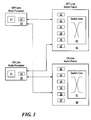
- one of the switch fabrics is referred to as the "on-line” switch fabric 50, and a redundant switch fabric is referred to as the "off-line” switch fabric 40. While the off-line switch fabric 40 is not being utilized, it is desirable to ascertain that this off-line switch fabric 40 is functional.
- the off-line switch fabric 40 is tested by way of a special test cell.
- the test cell enables the network switch 10 to perform the required cell switching and loopback operations within the off-line switch fabric 40.
- the test cell is initiated typically by the on-line node processor 30 and is directed by the on-line node processor 30 to the off-line switch fabric 40.
- the test cell includes a Connection Identifier (CID) and two "hopping" addresses. Full mesh testing of the off-line switch fabric 40 is accomplished by using multiple test cells having different hopping addresses.
- CID Connection Identifier
- the network switch includes an off-line node processing element 23 and an online node processing element 30.
- Each node processing element 23 and 30 includes a node processor 21 and 31 respectively, and an interface 22 and 32 respectively.
- the network switch further includes an off-line switch fabric 40 and an on-line switch fabric 50.
- the off-line switch fabric 40 comprises a plurality of interface chips 42-47 and a switch core 41.
- the switch core 41 comprises an input stage, a center stage, and an output stage. A total of 40 input threads can be simultaneously switched to any of the 40 output threads within the switch fabric.
- As a cell arrives into the switching core 41 the cell header is examined by the input stage to determine which threads on the output stage the cell should be directed to.
- the center stage of the switch core is responsible for arbiting the output stage based on the requests from the input stage.
- the test cell includes a regular cell header in the first 16 bytes. This header is examined by the interface to determine if this cell is a test cell or a normal data cell.
- the next 12 bytes of the test cell contain two hopping addresses, which are used by the off-line switch fabric 40 to hop the cell around the switch fabric.
- the hopping address comprises a six bit Queue Number R (QNR) which identifies the output thread of the incoming cell.
- QNR Queue Number R
- the input stage of the switch core 41 will make the appropriate request to the center stage to have the cell sent out on the appropriate outputs thread. For example if the QNR field of the test cell was set to 15, the test cell would be switched to output thread 15 and come out of the output stage for thread 15.
- the hopping address further comprises a two bit Delay Priority (DLP) field.
- the switch fabric 40 utilizes the DLP field to link the cell to one of four priority queues (not shown) associated with each output queue of the switch fabric.
- the hopping address also includes a 40 bit port map (BPM).
- BPM is used to indicate the destination or destinations of the test cell. If the cell is a unicast cell than only one of the 40 bits is set to a 1. If the cell is a multicast cell, them multiple bits are set, a bit for each destination.
- the header includes a Switch Bit (SWB).
- SWB Switch Bit
- the SWB is used by the interface of the switch fabric 40.
- the switch bit is extracted. If the bit is a "1”, the test cell is sent to interface 22, if the bit is a "0", the cell is sent to interface 32. This determines whether the cell is returned to the off-line node processor 23 or the on-line node processor 30. Since the SWB is preserved while the test cell is looped around the switch fabric 40, the SWB must be properly set when the test cell is composed.
- connection ID is used by a node processor interface to differentiate the test cells from the normal data cells.
- a node processor interface to differentiate the test cells from the normal data cells.
- the 16-bit connection tag in the cell header is extracted and compared against a programmable connection ID register from the processor interface. If there is not a match, the cell is considered a normal data cell and forwarded as usual. If there is a match, then the cell is treated as a test cell and is subjected to further processing.
- the interface 22 to the node processor 21 and the off-line switch fabric must be enabled in order to perform Connection ID checking. If the enables are not set, then all cells are treated as normal cells.
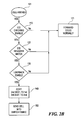
- a test cell is traversed through the off-line switch fabric 40 in the following manner.
- a test cell is composed by the on-line node processor chip 31 and sent to the node processor interface 32, as shown in step 101.
- the format of the test cell at this time is shown in Fig. 3.
- the interface 32 compares the connection ID in the cell header against the connection ID from the processor, as recited at steps 110 and 120. If connection ID checking is not enabled (step 110), if there is not a match (step 120), if loopback is not enabled (step 130) or if the test cell switching mode is not enabled (step 160); interface 32 forwards the cell to interface 52 on the on-line switch fabric 50 (step 170). If there is a match and test cell switching mode is enabled interface 32 forwards the cell to interface 42 on the off-line switch fabric 40 (step 180).
- the cell upon receipt of the test cell by the interface 42, the cell is forwarded into the switch core 41 of the off-line switch fabric 40 without modification.
- the test cell emerges from the off-line switch fabric core and arrives at one of the interfaces 42-47, dependent on the switching information within the cell header. For this example the test cell arrives at interface 44. It should be noted that a test cell arriving at interface 42 will be sent directly back to a node processor.
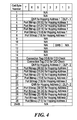
- Interface 44 compares the connection ID in the cell header against the connection ID from the processor interface, as shown in step 120. If there is a match and the interface is enabled for test cell loop-back operations, as shown in steps 120 and 130, interface 44 will then copy the first hopping address into the cell header, and the second hopping address to the first hopping address location within the test cell as recited at step 140. The format of the cell at this time is shown in Fig. 4. The cell is then sent back into the switch fabric as shown in step 150.
- the test cell emerges from the switch fabric core and arrives at one of interfaces 42-47. In this example, the test cell arrives at interface 47.
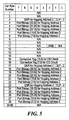
- Interface 47 compares the connection ID in the cell header against the connection ID from the processor interface. If there is a match and if the interface is enabled for loop-back operation, interface 47 will copy the second hopping address (from the original location of the first hopping address) into the cell header. The format of the test cell at this time is shown in Fig. 5. The test cell is then sent into the off-line switch fabric core.
- the second hopping address which is now in the test cell header, is the node processor address.
- the test cell emerges from the switch fabric core and arrives at interface 42.
- Interface 42 sends the test cell back to interface 32 of the node processor 30 based on the switch bit.
- Interface 32 merges the test cell from the off-line switch fabric into the cell stream from the on-line switch fabric. While this embodiment described the process with a test cell generated by the on-line node processor, a similar process would also take place with a test cell generated by the off-line node processor.
- the on-line node processor continuously receives cell streams from both the on-line switch fabric and the off-line switch fabric.
- the test cells are coming back to the on-line node processor from the off-line switch fabric.
- the test cells coming back from the off-line switch fabric must be processed to determine the state of the off-line switch fabric.
- the test cells must be combined or merged into the cell stream with the data cells from the on-line switch fabric.
- the test cell from the off-line switch fabric is written into the interface input FIFO.
- the test cell is held in the FIFO until an idle cell slot is detected in the cell stream from the on-line switch fabric.
- a plurality of test cells may be generated to provide full mesh connectivity testing of the off-line switch fabric.
Landscapes
- Engineering & Computer Science (AREA)
- Computer Networks & Wireless Communication (AREA)
- Signal Processing (AREA)
- Data Exchanges In Wide-Area Networks (AREA)
- Monitoring And Testing Of Exchanges (AREA)
Applications Claiming Priority (2)
| Application Number | Priority Date | Filing Date | Title |
|---|---|---|---|
| US459434 | 1999-12-13 | ||
| US09/459,434 US6667959B1 (en) | 1999-12-13 | 1999-12-13 | Switch fabric testing |
Publications (1)
| Publication Number | Publication Date |
|---|---|
| EP1109354A2 true EP1109354A2 (en) | 2001-06-20 |
Family
ID=23824755
Family Applications (1)
| Application Number | Title | Priority Date | Filing Date |
|---|---|---|---|
| EP00310912A Withdrawn EP1109354A2 (en) | 1999-12-13 | 2000-12-08 | Method for switch fabric testing |
Country Status (4)
| Country | Link |
|---|---|
| US (1) | US6667959B1 (enExample) |
| EP (1) | EP1109354A2 (enExample) |
| JP (1) | JP2001197087A (enExample) |
| CA (1) | CA2327461C (enExample) |
Cited By (1)
| Publication number | Priority date | Publication date | Assignee | Title |
|---|---|---|---|---|
| US7251244B2 (en) | 2001-07-04 | 2007-07-31 | Juniper Networks, Inc. | PPP terminating equipment, network equipment and method of responding to LCP echo requirement |
Families Citing this family (8)
| Publication number | Priority date | Publication date | Assignee | Title |
|---|---|---|---|---|
| JP2001292164A (ja) * | 2000-04-06 | 2001-10-19 | Nec Corp | パケット・スイッチおよびその切替方法 |
| US6914878B1 (en) * | 2000-10-16 | 2005-07-05 | Telefonaktiebolaget Lm Ericsson (Publ) | Fault detection in multi-plane switch |
| US7000149B1 (en) | 2002-10-18 | 2006-02-14 | Advanced Micro Devices, Inc. | External loopback test mode |
| US7609705B2 (en) * | 2004-05-20 | 2009-10-27 | Hewlett-Packard Development Company, L.P. | Determination of a plurality of paths before selection of one path of the plurality of paths for transmission of one or more packets |
| US7382734B2 (en) * | 2004-05-20 | 2008-06-03 | Hewlett-Packard Development Company, L.P. | Directing a path verification request along a specific path to a mesh network switch to test operability of the specific path |
| US8270308B2 (en) * | 2009-12-14 | 2012-09-18 | Juniper Networks Inc. | Protocol free testing of a fabric switch |
| CN110177082B (zh) * | 2019-04-25 | 2022-03-01 | 创新先进技术有限公司 | 一种数据处理方法、设备、介质以及装置 |
| CN115297070B (zh) * | 2022-07-15 | 2024-02-27 | 中国航空无线电电子研究所 | 一种多元数据激励的arinc664交换机缓存溢出测试方法 |
Family Cites Families (7)
| Publication number | Priority date | Publication date | Assignee | Title |
|---|---|---|---|---|
| JP3025068B2 (ja) * | 1991-09-12 | 2000-03-27 | 富士通株式会社 | Atmスイッチのパス試験方式 |
| JPH0774749A (ja) * | 1993-09-01 | 1995-03-17 | Hitachi Ltd | スイッチングシステム |
| US6067286A (en) * | 1995-04-11 | 2000-05-23 | General Datacomm, Inc. | Data network switch with fault tolerance |
| JP3302578B2 (ja) * | 1996-10-21 | 2002-07-15 | 富士通株式会社 | Oam処理装置 |
| US6147972A (en) * | 1997-06-20 | 2000-11-14 | Fujitsu Limited | Method and system for achieving cell diagnosis of continuity in cell exchange |
| US6310875B1 (en) * | 1998-03-30 | 2001-10-30 | Nortel Networks Limited | Method and apparatus for port memory multicast common memory switches |
| US6396811B1 (en) * | 1998-12-17 | 2002-05-28 | Telefonaktiebolaget Lm Ericsson | Segmented performance monitoring of multi-stage ATM node |
-
1999
- 1999-12-13 US US09/459,434 patent/US6667959B1/en not_active Expired - Fee Related
-
2000
- 2000-12-04 CA CA002327461A patent/CA2327461C/en not_active Expired - Fee Related
- 2000-12-08 EP EP00310912A patent/EP1109354A2/en not_active Withdrawn
- 2000-12-13 JP JP2000378534A patent/JP2001197087A/ja active Pending
Cited By (3)
| Publication number | Priority date | Publication date | Assignee | Title |
|---|---|---|---|---|
| US7251244B2 (en) | 2001-07-04 | 2007-07-31 | Juniper Networks, Inc. | PPP terminating equipment, network equipment and method of responding to LCP echo requirement |
| US7664104B2 (en) | 2001-07-04 | 2010-02-16 | Juniper Networks, Inc. | PPP terminating equipment, network equipment and method of responding to LCP echo requirement |
| US8031700B2 (en) | 2001-07-04 | 2011-10-04 | Juniper Networks, Inc. | PPP terminating equipment, network equipment and method of responding to LCP echo requirement |
Also Published As
| Publication number | Publication date |
|---|---|
| US6667959B1 (en) | 2003-12-23 |
| JP2001197087A (ja) | 2001-07-19 |
| CA2327461A1 (en) | 2001-06-13 |
| CA2327461C (en) | 2006-05-30 |
Similar Documents
| Publication | Publication Date | Title |
|---|---|---|
| US9647912B2 (en) | LSP ping and traceroute for bypass tunnels | |
| US5436893A (en) | ATM cell switch suitable for multicast switching | |
| US5764624A (en) | Aim switching system and path changing method | |
| US7616562B1 (en) | Systems and methods for handling packet fragmentation | |
| JP3515263B2 (ja) | ルータ装置、データ通信ネットワークシステム、ノード装置、データ転送方法及びネットワーク接続方法 | |
| US7283528B1 (en) | On the fly header checksum processing using dedicated logic | |
| US7936758B2 (en) | Logical separation and accessing of descriptor memories | |
| US6148004A (en) | Method and apparatus for establishment of dynamic ESCON connections from fibre channel frames | |
| JPH08195745A (ja) | パス切替装置およびパス切替方法 | |
| US6499061B1 (en) | Method and system for assigning labels to data flows over a packet switched network | |
| US6667959B1 (en) | Switch fabric testing | |
| JPH0774749A (ja) | スイッチングシステム | |
| US5398235A (en) | Cell exchanging apparatus | |
| AU685426B2 (en) | A method for handling redundant switching planes in packet switches and a switch for carrying out the method | |
| JPH0691554B2 (ja) | 情報通信装置 | |
| JP3574425B2 (ja) | 耐多重障害ネットワーク構造を利用したパケット処理方法 | |
| US6493315B1 (en) | ATM switch for routing different cell types | |
| US6005863A (en) | Frame switch with serial data processing | |
| AU666186B2 (en) | A connectionless server for switching network | |
| US8155118B2 (en) | Mirroring of a random subset of network traffic | |
| US7002979B1 (en) | Voice data packet processing system | |
| US7113518B2 (en) | Processor with reduced memory requirements for high-speed routing and switching of packets | |
| US7061870B2 (en) | Method and system of transmitting loopback cells through a switching node of an asynchronous transfer mode (ATM) network | |
| US7940762B2 (en) | Content driven packet switch | |
| JPH11266261A (ja) | 回線交換方法及び、これを用いた非同期モード交換機 |
Legal Events
| Date | Code | Title | Description |
|---|---|---|---|
| PUAI | Public reference made under article 153(3) epc to a published international application that has entered the european phase |
Free format text: ORIGINAL CODE: 0009012 |
|
| AK | Designated contracting states |
Kind code of ref document: A2 Designated state(s): AT BE CH CY DE DK ES FI FR GB GR IE IT LI LU MC NL PT SE TR |
|
| AX | Request for extension of the european patent |
Free format text: AL;LT;LV;MK;RO;SI |
|
| STAA | Information on the status of an ep patent application or granted ep patent |
Free format text: STATUS: THE APPLICATION HAS BEEN WITHDRAWN |
|
| 18W | Application withdrawn |
Effective date: 20030904 |