EP1108779A2 - Raumform und Kristallform von Polypeptiden, die eine Sub-Domäne des Calpains enthalten - Google Patents
Raumform und Kristallform von Polypeptiden, die eine Sub-Domäne des Calpains enthalten Download PDFInfo
- Publication number
- EP1108779A2 EP1108779A2 EP00127369A EP00127369A EP1108779A2 EP 1108779 A2 EP1108779 A2 EP 1108779A2 EP 00127369 A EP00127369 A EP 00127369A EP 00127369 A EP00127369 A EP 00127369A EP 1108779 A2 EP1108779 A2 EP 1108779A2
- Authority
- EP
- European Patent Office
- Prior art keywords
- polypeptide
- crystal form
- calpain
- spatial
- crystal
- Prior art date
- Legal status (The legal status is an assumption and is not a legal conclusion. Google has not performed a legal analysis and makes no representation as to the accuracy of the status listed.)
- Withdrawn
Links
Images























































Classifications
-
- C—CHEMISTRY; METALLURGY
- C12—BIOCHEMISTRY; BEER; SPIRITS; WINE; VINEGAR; MICROBIOLOGY; ENZYMOLOGY; MUTATION OR GENETIC ENGINEERING
- C12N—MICROORGANISMS OR ENZYMES; COMPOSITIONS THEREOF; PROPAGATING, PRESERVING, OR MAINTAINING MICROORGANISMS; MUTATION OR GENETIC ENGINEERING; CULTURE MEDIA
- C12N9/00—Enzymes; Proenzymes; Compositions thereof; Processes for preparing, activating, inhibiting, separating or purifying enzymes
- C12N9/14—Hydrolases (3)
- C12N9/48—Hydrolases (3) acting on peptide bonds (3.4)
- C12N9/50—Proteinases, e.g. Endopeptidases (3.4.21-3.4.25)
- C12N9/64—Proteinases, e.g. Endopeptidases (3.4.21-3.4.25) derived from animal tissue
- C12N9/6421—Proteinases, e.g. Endopeptidases (3.4.21-3.4.25) derived from animal tissue from mammals
- C12N9/6472—Cysteine endopeptidases (3.4.22)
Definitions
- the present invention relates to spatial structures and Crystal form of at least one polypeptide per asymmetric Unit, wherein at least one polypeptide in the asymmetric unit at least one in catalysis involved (sub) domain of a family protein the neutral Ca-activated cysteine proteinases (Calpaine).
- the present concerns Invention compounds, in particular ligands, with the Property as a substrate, pseudosubstrate, activator or Inhibitor of a neutral Ca-activated cysteine proteinase (Calpaine) to act and identification methods such a connection or such Ligands for a neutral Ca-activated cysteine proteinase.
- ligands or compounds which act as inhibitors and / or activators of catalytic Activity of a neutral Ca-activated cysteine proteinase act as an active ingredient in drugs or disclosed for the manufacture of a medicament.
- Another object of the present invention Invention are methods that involve modeling of calpaines of unknown structure using Structural coordinates of a spatial structure according to the invention or allow crystal shape.
- Calpain belongs to the enzyme class EC 3.4.22.17, which is an enzyme called a heterodimer exists, built up from a large catalytic and a small regulatory subunit (Ono et al., Biochem. Biophys. Res. Com. 245, 289-294, 1998). Corresponding studies have shown that the large subunit has a molecular weight of approximately 80,000, the small subunit of approximately 30,000 Dal-ton Has.
- Domain II of the large subunit which in turn breaks down into two (sub) domains (IIa and IIb), reveals sequence similarities to catalytically active domains of other cysteine proteinases, such as papain and cathepsins. Nevertheless, apart from three amino acid residues in the active center of the catalytic (sub) domains of calpaines, there is no pronounced sequence homology to other cysteine proteinases, which is why the calpains are regarded as an evolutionarily separated, independent family within the large family of cysteine proteinases (Berti and Stora, J. Mol. Biol. 246, 273-283, 1995).
- the proteolytic function of calpaines is for the Cell physiology of paramount importance.
- seem tissue-specific Calpain homologues e.g. n-calpaine
- Lin et al. (Nature Structural Biology, Vol. 4, No. 7, 539-547, 1997) also describe crystallization domain VI, i.e. the calcium binding domain of small subunit of pig calpain, at one Structure resolution of 1.9 ⁇ . This investigation is also limited thus on the structural elucidation of the calcium binding domain and leaves no statement about the structure the catalytic subunit or its effect the regulatory mechanism of the catalytic subunit yourself too. Lin et al. have their crystal structures under the designations 1ALV and 1ALW in the PDB database (Brookhaven, USA).
- rat m-calpain can be crystallized in two crystal forms, P1 and P2 1 (Hosfield et al., Acta Crystallographica Section D, Bio-logical Crystallography, D55, 1484-1486, 1999).
- the recombinant rat m-calpain used differs slightly from the natural enzyme.
- the native amino acid residue Cys105 residing in the active center was mutated to a serine in the recombinant protein, whereby the activity of the enzyme was switched off and autodegradation was avoided.
- the large subunit was provided with 14 amino acid residues at the C-terminus, including a histidine tag. Hosfield et al.
- the object of the present invention is therefore space and preferably crystal forms of calpaines are available to make a structural / functional investigation make possible. This requires a 3D structure elucidation a polypeptide or a complex, that at least one in the catalysis of the native Calpains involved (sub) -domain, possibly also further catalytic and / or regulatory (sub) domains one or both subunits.
- Another The object of the present invention is to provide such compounds to make available as substrates, pseudo-substrates, Activators, or inhibitors of a neutral one Ca-activated cysteine proteinase can act.
- the present invention also has the object Method of identifying a connection as a Agonist or antagonist or substrate, pseudosubstrate, Activator or inhibitor for one or more calpain (s) can act to provide.
- the present invention is also based on the object Process for producing a crystal form with at least a polypeptide that has at least one in catalysis involved (sub) domain of a family protein which has calpaine to provide.
- the present invention has crystallization processes also the task of making crystals available represent the above-mentioned polypeptides in symmetrical Have arrangement.
- spatial forms are made available the three-dimensional structure of at least one Represent polypeptide per asymmetric unit, where at least one of these polypeptides per asymmetric Unit at least one on catalysis of proteolytic Calpain reaction of a protein from the family of neutral Ca-activated cysteine proteinases (Calpaine) involved (sub) domain.
- a spatial shape becomes the three-dimensional structure of a molecule or molecular complex, i.e. the atomic spatial arrangement of the atoms of the molecule, the three-dimensional appearance of a molecule in the present case understood at least one polypeptide of the aforementioned type, just like they do after a structural analysis the relevant methods of structure elucidation.
- the methods of X-ray structure analysis would be particularly important here of crystals and structure elucidation by nuclear magnetic resonance spectroscopy (NMR spectroscopy) to call.
- the spatial form thus corresponds the three-dimensional appearance of the examined Molecule / molecular complex, i.e. its through the structural coordinates each atom of the molecule / molecular complex reproduced spatial form.
- the spatial form of the crystal form of at least one correspond to polypeptide.
- the crystal form is so far also the specific appearance of the crystallized at least one polypeptide in a crystal, so as they are the result of an X-ray structure analysis on corresponding Crystals is obtained.
- Structural coordinates for the atoms of the at least one polypeptide with at least one involved in the catalysis of a calpain reaction (Sub) domains give the spatial form of such a by NMR spectroscopy or X-ray crystallography structure-elucidated molecule / molecular complex again.
- a spatial shape according to the invention at least one such polypeptide by means of NMR structure analysis in solution can be clarified, it is for the method of X-ray structure analysis a requirement that the subjects to be examined Molecules are present in crystallized form.
- Such one Crystal is characterized by unit cells, which are the molecules / molecule complexes to be examined present in a characteristic arrangement. On Because of the laws of symmetry, there is a limited one Number of such arrangements, as room groups be designated.
- these are catalytic Calpain (sub) domains around the two (sub) domains IIa and IIb, from the large subunit of the physiological Calpains composed of two subunits.
- the spatial shape can accordingly or preferably the crystal form represent a polypeptide that is exclusive one of the (sub) -domain IIa or exclusively an amino acid sequence corresponding to the (sub) domain IIb have or one or both of the aforementioned (Sub) domains in combination with any amino acid sequence at the respective terms of the catalytic (Sub) domains, i.e. as a recombinant protein, for example with Domains can contain other proteins.
- such spatial forms are preferred or preferred Crystal forms of polypeptides that have at least one Catalytic (sub) domain of a calpain with its native Amino acid sequence included, preferred, but will according to the invention also such spatial or preferably crystal forms disclosed on non-native calpain amino acid sequences based, i.e. derivatives of the native Sequences.
- This will make it special derivatives of the catalytic (sub) domains IIa and / or IIb act, in particular the conservative substitution (s) compared to the native sequences.
- conservative substitutions are called substitutions, where at least one amino acid is replaced by a other amino acid from the same class is replaced.
- Amino acids are classified according to their chemical or physical Properties divided into classes. Something like that For example, amino acids with positively or negatively charged Side chains, with aromatic side chains, aliphatic Side chains, side chains with hydroxyl or Amino group groups in corresponding, respective classes grouped.
- a polypeptide in a crystal form according to the invention can also have amino acids that are not native or at least not typically occur natively.
- the present invention includes derivatives that at least one insertion and / or deletion in so-called Loop structures of the catalytic (sub) domain (s) exhibit.
- the spatial forms claimed are preferably preferably as crystal forms to three-dimensional Structures of polypeptides, the ones contained therein catalytic (sub) domain (s) from isozymes from the Family of ubiquitously expressed calpains or from isozymes the family of tissue-specific expressed calpains (n-Calpaine) originated.
- catalytic (sub) domain (s) from isozymes from the Family of ubiquitously expressed calpains or from isozymes the family of tissue-specific expressed calpains (n-Calpaine) originated are particularly preferred again space / crystal forms for polypeptides or complexes made up of two or more polypeptides that make up the two subunits with a selection, very particularly preferred but with all catalytic and regulatory domains contain.
- Such three-dimensional ones are very particularly preferred Spatial forms, especially crystal forms, as Result of crystallographic studies if they at least one catalytic (sub) domain of proteins from the group of m- or ⁇ -calpains.
- a very particularly preferred embodiment corresponds to Amino acid sequence of the one in the spatial or crystal form at least one catalytic calpain (sub) domain a corresponding native amino acid sequence from eukaryotic cells, in particular from cells of vertebrates, mostly from mammalian cells, and here again in particular from human cells, or derivatives, e.g. Substitution, deletion and / or insertion derivatives, the same.
- a spatial or crystal form is preferred of such a polypeptide be the amino acid sequence according to FIGS. 3, 4, 5 X and / or FIG. 6, in particular those in FIGS. 4 and 6 contained sub-domains IIa (from T93 to G209) and / or IIb (from G210 to N342) or derivatives of one or both of the aforementioned (sub) domain amino acid sequences, contains. It also becomes a preferred one Spatial or crystal form a three-dimensional structure a polypeptide or a complex with at least one Reflect polypeptide, which is an amino acid sequence 9 or a derivative thereof.
- such spatial forms, preferably as crystal forms, disclosed next to the at least one polypeptide with one of the previously invented amino acid sequences described at least have another component.
- this further Component can be one or more the same or act different metal ion (s), preferably alkali and / or alkaline earth metal ions, especially calcium ions.
- the additional component is also a or more identical or different heavy metal ion (s) act, typically in close proximity to three-dimensional cysteine or histidine residues unfolded at least one polypeptide sequence are located.
- the heavy metal ions preferably gold and / or mercury ions
- interactions with one or more of the following amino acids according to the nomenclature according to FIG. 9 for human m-calpain
- amino acids according to the nomenclature according to FIG. 9 for human m-calpain
- Crystal forms are also very particularly preferred, where at least one gold and / or at least a mercury ion through the amino acid C105, by attachment to the spatially adjacent amino acids C98 / H169, C191 / R420, C240 / H334 and / or C696 / H908 complexed will (will) (for the nomenclature see above).
- the Spatial shape or preferably crystal shape at least one Ligands that are typically non-covalent, but possibly also covalent, to the polypeptide (s) in the asymmetric Unity is (are) bound.
- this ligand can be agonists or antagonists of Calpain act, ie substrate, pseudo-substrate, activator or Inhibitor molecules.
- a spatial form, preferably in Crystal form, is particularly preferred when the ligand to the catalytic domain, especially the active one Center of this Calpain domain, or on or in the Furrow formed by subdomains IIa and IIb - for the case of the catalytically inactive conformation - the binds at least one polypeptide.
- three-dimensional form can also have two or more ligands, e.g. B. one to a regulatory domain (Domains III and / or IV) binding inhibitory ligands and at least one further ligand that attaches to a or both catalytic subdomain (s) of the large Subunit (IIa and / or IIb) docks.
- ligands e.g. B. one to a regulatory domain (Domains III and / or IV) binding inhibitory ligands and at least one further ligand that attaches to a or both catalytic subdomain (s) of the large Subunit (IIa and / or IIb) docks.
- These functional ligands can be any especially organic chemical molecules act through their steric and / or chemical Can bind properties to the calpain complex.
- peptidomimetics that cannot be proteolyzed at the center of the following peptides (in the one-letter code) or such non-proteolyzable peptide sequences included: YCTGVSAQVQK, RARELGLGRHE, AERELRRGQIL, PRDETDSKTAS, KYLATASTMDH, DHARHGPLPRH, STSRTP, SCPIKE, DTPLPV, STPDSP, PNGIPK, PPGGDRGAPKR, WFRGLNRIQTQ and / or RGSGKDSHHPA.
- Macroscopic crystals are also the subject of the present Invention. Accordingly, according to the invention - as Basis for the X-ray structure analysis serving crystalline Arrangements disclosed that have at least one polypeptide per asymmetrical unit, at least such a polypeptide is at least one catalytic Sub-domain of a calpain, i.e. either the sub-domain IIa and / or the subdomain IIb contains. Prefers are crystals in the asymmetrical unit contain at least one polypeptide that at least a catalytic subdomain of human calpain, in particular human m-calpain.
- Crystals according to the invention can be symmetrical Properties in all conceivable 65 enantio-morphs Space groups are available.
- Crystals which contain both calpain subunits, namely the 30 kDa and the 80 kDa subunit, are very particularly preferred.
- at least one polypeptide in the asymmetrical unit with the amino acid sequence shown in FIG. 4 can be present in a crystal form according to the invention or contain it.
- Monoclinic space groups are particularly preferred, in particular space group P2 1 .
- Crystals according to the invention with unit cells whose asymmetrical unit has crystal forms with at least one polypeptide heterodimer are further preferred, the one polypeptide (1) preferably comprising an amino acid sequence corresponding to FIG. 3 and the other polypeptide (2) preferably comprising an amino acid sequence according to FIG. 4.
- the heterodimer which is preferably present microscopically as a crystal form in the asymmetrical unit, corresponds to the functional physiological calpain-protein complex with the large and the small subunit.
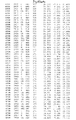
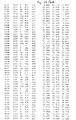
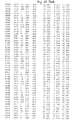
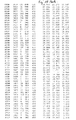
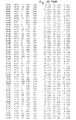
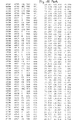
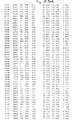
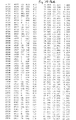
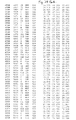
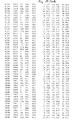
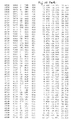
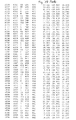
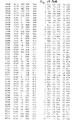
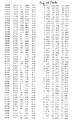
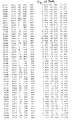
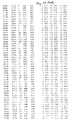
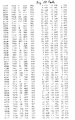
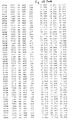
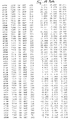
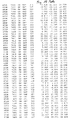
- Figure 10 gives the structure coordinates for the crystal form of subdomain IIa and IIb of human m-calpain again. It is even more preferred a crystal form of a heterodimer made of large and small Calpain subunit, the polypeptides (1) and (2) which correspond to the small or large subunit, through a crystal shape according to the structural coordinates 10 can be reproduced.
- Crystal forms of the type according to the invention are in particular then preferred if it has a resolution of less than 3.5 ⁇ , preferably less than 3.0 ⁇ and very particularly preferably less than 2.5 ⁇ .
- the present invention furthermore relates to compounds which can bind as ligands to a spatial or preferred crystal form according to the invention or crystals according to the invention which have such microscopic spatial or crystal forms.
- These ligands will typically have a property as a pseudo-substrate, substrate, activator or inhibitor and are distinguished by the fact that they have steric properties and / or functional groups which interact with the main and / or side chains of the catalytic sub- Domain (s) or a sequence section relevant for the regulation of the catalytic subdomain (s) can occur.
- the interactions of at least one ligand with sections of the small and / or large subunit of calpain may cause conformational changes which can (can) influence the proteolytic activity of calpain, in particular can (can) inhibit their catalytic activity.
- the ligand must therefore have steric properties or an interaction potential that is complementary to the main and / or side chains of calpain in its spatial or crystal form or its steric conditions (e.g. for furrows or non-compactly filled areas inside the protein), as given by the spatial shape or preferably the crystal shape, according to the invention.
- ligands which bind to the domain III of calpain and which interact above all with the extremely acidic loop (“loop”) ⁇ 2III / ⁇ 3III and / or amino acids structurally adjacent to the acid loop are particularly preferred.
- this concerns (a) the region with amino acids 392 to 403, which comprises a total of ten negatively charged amino acids, that is to say aspartates or glutamates; (b) the amino acids of the amphipatic helix a7II towards this region; by (c) the sequence section formed by amino acids K354 to K357; and / or (d) around the amino acids K505 and K506.
- a ligand binding to this “loop” would be typical designed so that it has at least one positive Charge and / or at least one positive partial charge has and with this charge structure to the negative loaded acidic "loop" docks.
- a structured ligand is the interaction of the acid loop ⁇ 2III / ß3III with the amphipatic helix ⁇ 7II, which is the basic amino acids K226, K230 and K234 of the large subunit.
- At least partially positively charged ligand could match that on the aforementioned Compensate for the negative excess charge present in the loop and as a result the catalytic activator Calpain activity.
- the positively charged helix of the catalytic subdomain IIb not from the negatively charged acid "loop” of the domain III through the formation of salt bridges from their compact Folding solved, which is why the catalytic activity is maintained.
- a compound according to the invention that in this structural area of calpain as a ligand, with their chemical, geometrically and / or physically accordingly the structural requirements of an inventive To design crystal form. It can also be covalent or non-covalently in a crystal form according to the invention with the at least one polypeptide.
- one or more boundary conditions which are mentioned below for certain functional groups of amino acid side chains or main chains, also taking into account specific distances to or between these functional groups, for the design of compounds according to the invention.
- a distance of 3.32 or 3.8 ⁇ between the functional group of K226, namely the NZ atom, and the functional group of D400, that is to say the two oxygen atoms.
- the lysine K230 of the amphipathic helix and D397 namely between the NZ atom of K230 and the two oxygen atoms of aspartate D397 at a distance of 3.73 and 3.66 ⁇ , respectively.
- a compound according to the invention which binds to domain III of calpain according to the crystal form according to the invention or to a crystal according to the invention which has such crystal forms according to the invention preferably has the character of a Ca 2+ analog.
- Connections that bind to the active center of Calpain as is the case after association of the two subdomains IIa and IIb is present, and possibly there as inhibitors of the catalytic Reaction typically occur with at least one of the following amino acids Gln99, Cys105, Ser241, Asp243, Asn286, Gly261, His262 and / or Trp288 in Interaction.
- the inactive conformation of the two subdomains IIa and IIb conserved and thus between those two sub-domains Fills all or part of the existing furrow, Providing them becomes more chemical-physical and / or geometric character preferably one or more of the following through the three-dimensional Structure of a calpain given boundary conditions fulfill.
- Contacts with a are particularly preferred or more of the following amino acids (side or Main chain): Gln99, Cys105, Ser241, Asp243, Gly261, His262, Trp288, Arg94, Asp96, Cys98, Trp106, Ala109, Thr200, Ile244, Lys260, Asn286, Glu290, Leu108, Thr201, Phe204, Trp214, Asp249, Lys257, Ala263, Tyr264, Glu292, Ser336 and / or L338 (according to the counting method for human m-calpain) or corresponding amino acids for other forms of cal pain.
- amino acids side or Main chain
- Inhibitory compounds are very particularly preferred the inactive calpain form with furrow when it e.g. interactions with Q99 with their two functional ones Groups at the atom NE2 or at the atom OE1. Both atoms can be involved in hydrogen bonding with the inhibitor which is then typically the length of the hydrogen bond greater than 2.0 ⁇ , preferably greater than 2.2 ⁇ , with the geometric conditions at Hydrogen bonds (e.g. directionality) are. Furthermore, such an inhibitor preferably, for example, in interaction with the amino acid C105 to step.
- the corresponding functional groups of the inhibitor are from the aforementioned areas of the Cys105 at a distance greater than 2 ⁇ and typically arranged smaller than 3.5 ⁇ .
- inhibitory ligand with the side chain of the amino acid S241, preferably with the hydroxyl group on it Serine residue interact.
- This too Hydroxyl group can, for example, at least one hydrogen bond to inhibitor in one for hydrogen bonds typical, directional way with a Form a distance between 2.0 and 3 ⁇ . More preferred are, for example, interactions of the inhibitor via salt bridges with the carboxyl group on the side chain of the Amino acid D243.
- the inhibitor is in one Distance greater than 2 ⁇ at least one positive charge and / or partial charge to this carboxyl group.
- the carbonyl group of amino acid G261, for example. preferably a contact by a corresponding chemical Group of inhibitor typically exist as a hydrogen bond with a distance of at least 2.0 ⁇ should be designed. Typically will interact with an inhibitory ligand the side chain of the amino acid W288 is also involved his.
- Both the person sitting on the indole nitrogen Hydrogen is a hydrogen bond at a distance of typically more than 2.0 ⁇ with the inhibitor as well as the inhibitor with one typically in this regard ring-shaped, preferably aromatic, Structure or such a structural element with the aromatic indole group, for example via a so-called "stacking" interact. This is a stacked parallel arrangement of aromatic Ring systems.
- the inhibitor is preferably, for example, hydrogen bonds to the hydrogen on one of the nitrogen atoms of the hi-stidine ring incoming from H262. Even with the histidine ring is a hydrophobic interaction above that already mentioned "stacking" with ring-shaped fragments of the inhibitor possible. In this case, the ring-shaped Systems typically parallel to each other.
- the amino acid R94 with the positive Charge on the nitrogen of arginine at interaction be involved with the inhibitor.
- a Hydrogen and / or salt bridge with the corresponding one functional group of the inhibitor in a typical Distance between 2.0 and 3.8 ⁇ may be preferred.
- the carbonyl function of T95 can be directional Hydrogen bridge interact with the inhibitor or the carboxyl function of the side chain of D96 preferably at least one salt bridge with the inhibitor come in.
- C98 is also preferred to interact with the functional groups of the inhibitor involved.
- Either the hydrogen on the sulfur atom as well as the lone pairs of electrons on sulfur can be used for such interactions be considered. More preferably, for example. W106 interactions with the inhibitor. Possible Forms of interaction correspond to those previously for W288 have been described, in particular exists here too the possibility of an interaction between Aromatics, especially by means of "stacking".
- Two other interactions, based on which the inhibitor bind to the furrow between the two subdomains can, for example, on contacts with the carbonyl groups of the two amino acids L108 and A109, e.g. also in the form of directional hydrogen bonds, are based.
- Hydrophobic interaction of the inhibitor with amino acids in the area of the furrow of a crystal form according to the invention are to be specified for the side chains of A109 and A263. Furthermore, in the furrow between the two Subdomains IIa and IIb a hydrophobic cluster through the Side chains of the amino acids F204, L338 and the hydrophobic Part of the side chain formed by T201.
- An inhibitor will preferably be designed such that it over a hydrophobic section with the aforementioned hydrophobic Groups can interact.
- From the subdomain IIb can the side chain of the amino acid K260 in the protrude between the two subdomains, so that, for example, a salt bridge of the Inhibitors with the positive charge on the NZ atom of K260 will be present. So here the inhibitor would be at the position complementary to the NZ atom a negative charge and / or partial charge preferably.
- a particularly preferred target of the inhibitor for interactions would be an interaction with the side chain of the amino acid residue N286 involved in the catalytic reaction.
- this would give the possibility of forming direct hydrogen bonds at distances between 2.0 and 3.0 ⁇ with both the carbonyl and / or the NH 2 group of N286.
- the side chain of the amino acid E290 protrudes into the column of the inactive calpain between the two subdomains, with negative charges, which can preferably be compensated by corresponding positive charges of an inhibitor according to the invention which are located in spatial proximity.
- Another preferred boundary condition for the design of an inhibitor according to the invention can advantageously represent the hydrophobic side chain of amino acid L108.
- an inhibitor also hydrophobic fragments exhibit.
- the inhibitor can interact with the tryptophan residue of W214, for example by hydrogen bonds on indole nitrogen or the aforementioned Aromatics interaction.
- contact of the inhibitor with the Carboxyl group of D249 are present, preferably in the form a salt bridge between, for example, a positive charge of the inhibitor and the carboxyl group.
- a salt bridge can also be advantageous from the positive Charge on the NZ atom from K257 to a corresponding one negative charge and / or partial charge of the inhibitor available.
- area of the complex located near the complex surface Dock furrow would be an interaction of functional ones Groups of the inhibitor with the negative charges of E292 desirable.
- the inhibitor would become a complementary positive charge and / or partial charge in the form a salt bridge with E292.
- an inhibitory ligand can also be in contact, for example with the amino acid Y264.
- the tyrosine residue Y264 can typically interact with the inhibitor both over at least one Hydrogen bond that is characteristic of the Hydroxyl group attaches, as well as its aromatic Character or its hydrophobicity with corresponding Enter functions on the inhibitor.
- the Inhibitor protruding deep into the furrow would be an interaction with amino acid residue S236 of subdomain IIb, especially a hydrogen bond with the same, especially desirable.
- the present invention includes such ligands to a spatial or crystal shape, which through the structural coordinates shown in Figure 10 bind can.
- Crystal shapes according to the invention are also distinguished by this from being characterized as a three-dimensional structure through structural coordinates for each one, the structure-building atom, part of a symmetric Arrangement in a crystal. It is preferred that a crystal form according to the invention, the at least a polypeptide with at least one catalytic Sub-domain contains, after superposition with those in Fig. 10 listed structural coordinates for the at least one subdomain involved in the catalytic reaction Standard deviation (rms) of less than 2.5 ⁇ , preferably less than 2 ⁇ .
- rms catalytic reaction Standard deviation
- Crystals the crystal forms as defined in claims 1 claimed to 23, according to symmetrical laws arranged, have. This includes crystals of all of them Crystal forms disclosed according to the present invention become. These can be native crystals, Trade derivative crystals or cocrystals. According to the invention native crystals are essentially symmetrical Arrangement of at least one polypeptide that at least one involved in the catalysis of the calpain reaction Subdomain contains, possibly in combination with Calcium ions as part of a crystal form. This can be in the crystallized polypeptide contained, catalytic subdomain both active as well as inactive mutants of the same. Inactive Mutants are particularly preferred if the structure of one or both of the subdomains of Maintain Calpain in the go.
- Another object of the present invention are Method of identifying a connection that the Possesses property, as substrate, pseudosubstrate, activator, Calpain inhibitor or allosteric effector or a mutant of calpain, especially human calpain, especially human m-calpain.
- a method is preferred if the connection with ligand function to a structural region one of the two catalytic subdomains, in particular in the area of the active reaction center.
- Such a process is characterized in that (a) obtain a crystal form according to claims 1 to 23 , the crystal form in the form of its structural coordinates is present, (b) the structural coordinates of the crystal form are represented in three dimensions, (c) and the steric properties and / or functional groups a compound with a ligand function can be selected that interactions between the connection and the Main and / or side chains of the polypeptide that the active Center forms, become possible. According to this Interactions become ligands suitable according to the invention, particularly suitable inhibitory ligands which the inactive calpain structure with a furrow between conserve the subdomains.
- the representation of the structural coordinates of an inventive Crystal form is preferably done by graphic Representation with the help of appropriate computer programs on a computer screen. Based on the, related on potential ligands, complementary arrangement of the Main and side chains of the crystal form, for example in the active center of a Calpain, can not be automated suitable ligands in the operator's experience with appropriate chemical and / or steric Properties identified, constructed on the screen and finally their binding behavior are simulated.
- suitable ligands are preferably selected but automated by the fact that computer databases, that contain a multitude of connections become.
- the search is based on the previous characterization of geometric, chemical and / or physical Properties for the desired calpain ligands supported. Contain databases to be screened naturally occurring as well as synthetic compounds. For example, those in the CCDC (Cambridge Crystal Data Center, 12 Union Road, Cambridge, UK) Connections used for such a search become. But also at Tripos (see quote a.a.O.) available databases, namely Aldrich, May-bridge, Derwent World Drug Index, NCI and / or Chapman & Hall can be searched.
- the Desired binding region of a ligand in an inventive Crystal shape can be defined.
- a Activator or inhibitor act on a regulatory Region binds or around a ligand for the active Center, typically with inhibitory properties.
- the bond area is indicated by appropriate Parameters, for example atomic distances, hydrogen bond potentials, hydrophobic areas and / or charges, characterized and on this basis boundary conditions for chemical, physical and / or geometric Properties of the ligand defined.
- the bond area is a region in the area of the acidic "loop" in domain III one Calpains or to bind a ligand to or in the furrow between subdomain IIa and subdomain IIb.
- At least one bond is very particularly preferred one of the previously specified amino acids, in particular with the aforementioned side chains of the same. Therefore, also for a present invention Connection identification procedure to the previous disclosure of the subject matter of the invention "Connection" according to claims 24 to 34 in full Referred. Identify computer programs in corresponding databases then those connections that meet the conditions previously introduced. Here is it particularly preferred the Sybil Base program package (Tripos, 1699 South Hanley Road, St. Louis, Missouri, USA) to use.
- the database to be searched stating connections their respective three-dimensional structures poses. If this is not the case, a The inventive method preferably in one process step (c1) a computer program is used, that before checking whether the specified boundary conditions are met by a ligand, initially its three-dimensional one Structure calculated (e.g. the program "CONCORD" from the Sybyl environment from Tripos Inc.).
- a process step (d1) Interaction potential between an identified Connection, for example as part of an automated Search for a connection from a computer database, and the desired bond area in a crystal form determined.
- a method according to the invention is very particularly preferred Procedure when it is used to identify Compounds attached to a crystal shape with the structural coordinates 10 are intended to dock.
- a scaffold connection as a starting point
- the identification is made in the by the to be identified Connection to be filled in inside or at the surface of the crystal form, e.g. B. in the catalytic Center of an inventive crystal form, manually inserted.
- the scaffolding structure remaining space is searched for fragments that are in Interact with the surrounding crystal form can and can be attached to the scaffolding structure.
- This search for suitable fragments therefore takes place according to According to the geometrical and / or physicochemical conditions the three-dimensional structure.
- the search suitable fragments can be, for example, automated Computer search under the specification of appropriate boundary conditions be performed.
- steps (c), (c1), (d) and (d1) can be repeated cyclically until a connection or a class of compounds in terms of their attachment behavior, calculated according to an interaction potential, that the respective computer program as an algorithm underlying, is optimized.
- the through a relative rough characterization of the bond area of the Crystal form initially obtained large number of potentially binding connections can be made by further Specifications of physical-chemical or steric characteristics increasingly reduced to the desired target connection become.
- connections obtained via automated computer search to synthesize or, if already synthesized and accessible from a chemical library and in a suitable biological test system for their biological To examine effectiveness.
- a ligand binding assay or an enzyme activity test can then act further chemical Modifications of the previously determined connection or the Connection class can be made. This can then in particular the use of program packages for Identification of suitable fragments against existing ones Fragments exchanged on the previously identified connection or be added to the same might prove useful.
- Another object of the present invention are likewise a method for identifying a connection with the property as a substrate, pseudo-substrate, Activator or inhibitor, d. H. as a ligand of Calpain to be able to act, in such according to the invention
- a biological Test system is preceded on the basis of which So-called “screening” carried out for suitable target compounds becomes.
- a binding as-say can also be preferred here or an enzyme activity test as a biological test system serve.
- connections for example from a library of chemical compounds, which is a positive result in the biological test have shown.
- Inserting the compound into the crystal form can be done manually based on the operator's experience or also automated, with the help of appropriate Computer programs ("Dock” Kuntz et al., 1982, J. Mol. Biol. 161, 269-288, Sybyl / Base “FLEX-X", s. Quote loc.) positioning of the ligand with the strongest possible interaction between ligand and the Target structure area is determined (process step (el)).
- Biological test systems in vitro or in vivo can make statements about the quality of the Connection, e.g. as an inhibitor of the biological response, for example as an inhibitor of the protease reaction, or via the binding constant, toxicity or metabolic properties or if necessary via the membrane permeability the connection, etc.
- the present invention furthermore relates to processes for the production of a spatial or crystal form with at least one polypeptide according to one of Claims 1 to 23, wherein in a process step (a) the polypeptide is first overexpressed, synthesized or isolated in an expression system, (b) the polypeptide obtained according to (a) is dissolved in a suitable buffer system and (c) the crystallization is initiated, for example by steam diffusion processes. Typically, according to process step (b), a concentrated or highly concentrated solution of the polypeptide (s) will be present.
- crystallization of the at least one polypeptide to give crystals according to the invention which have crystal forms according to the invention is carried out with the aim of subsequently using the crystals for X-ray structure analysis, the collection of X-ray diffraction data, the determination of the unit cell constants and the symmetry and the calculation of the electron density maps follow after the crystallization, into which the polype-tid / s are modeled.
- Another object of the present invention are Method for three-dimensional representation of a crystal shape unknown structure with at least one polypeptide, the at least one involved in the catalysis Sub-domain of a protein from the Calpaine family contains.
- Such a process is characterized in that that the crystal form with unknown structure the basis of a crystal form according to the invention with known Structure, for example based on that in FIG. 10 recorded structural coordinates is determined.
- phase information derived from known starting structure coordinates for example the structural coordinates 10
- the phase information which in the case of a known 3D structure of a crystal form according to the invention is present or can be used to calculate an unknown Structure that is preferred over the known Structure only through non-essential conformational Differences differ (to be mentioned as examples Target structures to which a ligand or another is attached for the first time Ligand than is bound in the starting structure, or Derivatives, e.g. Target structures, the mutants of the initial structure are to be solved.
- phase information all or part of the known Structure with the structure unknown to the crystal form combined intensities of the reflexes combined and from this combination an electron density map for the Crystal form of unknown structure calculated.
- This method is called "molecular replace-ment” designated.
- Molecular replacement is preferred with the program package X-PLORE (Brünger, Nature 355, 472-475, 1992).
- Crystal forms for structural elucidation of structurally related sequences or when comparing the primary structures at least tw. use homologous polypeptide chains, according to the invention is that (a) the primary sequence of a polypeptide of unknown 3D structure with a Primary sequence of a polypeptide that contains at least one of the has two catalytic subdomains of a calpain (but especially a calpain), is compared and im Under this comparison, homologous sections between the Polypeptide of unknown structure and the primary sequence of a Calpains, its spatial or preferably crystal form is known to be identified (b) the homologous Sections modeled based on the well-known 3D structure and finally according to process step (c) with the help of suitable computer programs 3D structure of the polypeptide in terms of its steric Ratios is optimized.
- a method according to the invention is particularly preferred for the elucidation of crystal forms of unknown structure then if it is the crystal form of known structure is an m- or ⁇ -calpain and the crystal form an n-calpain e.g. by "molecular replacement” or to be clarified by "homology modeling". But the reverse procedure is also possible or else also the determination of a ⁇ -calpain structure on the basis a known m-calpain crystal form or vice versa. Likewise, based on an inventive known calpain crystal form of a host organism Crystal form for another calpain complex Host organism can be determined.
- inhibitors and / or activators the catalytic activity of calpain, especially of human calpain, especially human m-calpain, according to one of claims 24 to 34 or obtained from one Method according to one of claims 35 to 42 for the production a medicine, for use as a medicine or as an active ingredient in a pharmaceutical Composition is disclosed.
- a pharmaceutical Composition will be according to the invention Calpain activator or inhibitor with at least one a further active ingredient and / or the pharmaceutical composition is used as a drug in a specialist familiar wording incorporated. The wording will depend in particular on the route of administration.
- composition containing a contain such inhibitor and / or activator the administration form of a powder, a suspension, a solution, a spray, an emulsion or one Have cream.
- An inhibitor and / or activator according to the invention can with a pharmaceutically acceptable carrier neutral character (such as aqueous or non-aqueous Solvents, stabilizers, emulsifiers, detergents and / or additives and possibly further color or Flavors can be combined.
- a pharmaceutically acceptable carrier neutral character such as aqueous or non-aqueous Solvents, stabilizers, emulsifiers, detergents and / or additives and possibly further color or Flavors can be combined.
- concentration of an inhibitor and / or activator according to the invention in a pharmaceutical composition can be between 0.1% and 100% vary depending in particular on the route of administration.
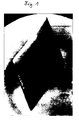
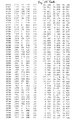
- the crystal shown has a size of approx. 1mm x 1mm x 0.1mm.
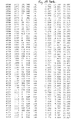
- the crystal shown in Fig. 2 shows a size of approx. 1mm x 0.2mm x 0.1mm.
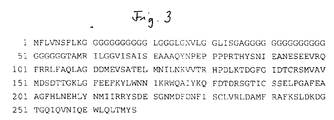
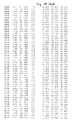
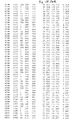
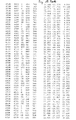
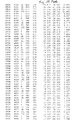
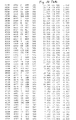
- Figure 3 represents the amino acid sequence of the small subunit of human m-calpain (30 kDa subunit) Amino acid sequence is given in the one-letter code.
- Figure 4 represents the amino acid sequence of the large subunit (80 kDa subunit) of human m-calpain. Again, the amino acid sequence is in the one-letter code specified.
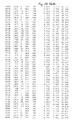
- Fig. 5 represents the amino acid sequence (one-letter code) the small subunit of the rat m-calpain (Species: Rattus Norvegicus).
- Figure 6 shows the amino acid sequence of the large subunit from the rat m-calpain (80 kDa subunit) (Species: Rattus Norvegicus) in the one-letter code.
- Figure 7 compares the amino acid sequences between the small subunits of m-Calpain the Rat or the human form.
- the sequences used correspond to those in FIG. 3 and 5 sequences shown, the upper row with the human and the bottom row with the rat sequence corresponds.
- This comparison revealed a sequence identity of 91.85% and a sequence similarity of 94.57%. Sequence gaps in one of the two comparison sequences do not occur.
- There are no identities and / or similarities between amino acids in the following corresponding positions (only the human sequence position V98, A106, A176 and C190.
- FIG. 8 is a comparison of the amino acid sequences of the large subunit of m-calpain of humans or the Depicted rat.
- the top line corresponds to the human sequence, as also shown in FIG. 4, the lower line of the rat sequence, as shown in Fig. 6 can be seen.
- the explanations for FIG. 7 apply here Case analog.
- Sequence differences between the human and the rat sequence are at the positions (in following only indicate the position in the human Sequence): A6, A34, T54, R74, E311, E313, R314, R317, H319, S350, S403, N456, A511, F523, I525, D531, V534, S586, T671 and C696.
- the percentage more identical Amino acids is 93%, and the percentage is similar Amino acids as a result of this comparison, 96.86%. Sequence gaps in one of the two sequences could be found in the sequence comparison are not observed.
- Figure 9 forms the amino acid sequences of the large subunit of human m-calpain (80 kDa subunit) and the amino acid sequence of the small subunit of human m-Calpain (30 kDa), each in the one-letter code, in combination with structural information.
- the below characters specified in the respective amino acids represent those marked in this way Amino acids each occupied secondary structure.
- the cylinders represent amino acids, which have a helical structure and arrows for them Amino acids that are part of strands with a so-called ⁇ conformation are.
- the large subunit (80 kDa subunit) a helical structure between amino acids 4 and 15 (Helix ⁇ 1I) in domain I (in green).
- Amino acid 17 marks the beginning of Domain II (secondary structures of the Domain IIa in yellow), the first being the amino acids 31 to 44 are in an ⁇ -helical confirmation ( ⁇ 1II).
- the next secondary structure, also an ⁇ helix, starts with amino acid D104 and runs up to the amino acid N118 (a2II). It is immediately followed by one another ⁇ -helix ( ⁇ 3II), starting with amino acid E118 - V125.
- the large subunit starts at amino acid I138 several times the conformation of ⁇ -sheet carriers, namely ⁇ 1II (I138 - Q145, E148 - D156, P159 to K161 and E164 - L166 ( ⁇ 4II)).
- a helix can be between amino acids F176 and G190 ( ⁇ 4II) and Y192 - S196 ( ⁇ 5II) observed become.
- ⁇ 4II amino acids F176 and G190
- Y192 - S196 ⁇ 5II
- domain IIb The following secondary structures of domain IIb are marked red.
- G210 marks the beginning of the domain IIb defines, from I211 to L217 a ⁇ -sheet strand ( ⁇ 5II) runs. After that, amino acid decreases N223 the polypeptide helical structure up to Q233 ( ⁇ 7II). From L237 to I242 the conformation is one ⁇ strand ( ⁇ 6II).
- Further secondary structures in the Domain IIb are two ⁇ -sheet strands from H262 to S274 and S277 to N286.
- Domain IV a calcium binding domain, is characterized in that it has only ⁇ -helical secondary structures.
- the following ⁇ -helices (marked in yellow) are to be mentioned in corresponding order: I530 to A542 ( ⁇ 1 IV), S549 to L561 ( ⁇ 2 IV), E575 to D585 ( ⁇ 3 IV), G593 to V616 ( ⁇ 4 IV ), N623 to G535 ( ⁇ 5 IV), P639 to F650 ( ⁇ 6 IV), D658 to D680 ( ⁇ 7 IV) and finally D690 to L700 ( ⁇ 8 IV).
- domain VI In the small subunit, the first 84 amino acids from domain V are not defined in the electron density map due to their great flexibility, which is why the corresponding structural data are not available.
- domain VI starting with S95, which is also a calcium binding domain, only ⁇ -helical structural elements can also be found. Specifically, these are the following ⁇ -helical sequence sections: S95 to L108 ( ⁇ 1 VI), S116 to R130 ( ⁇ 2 VI), G140 to D152 ( ⁇ 3 VI), G160 to D182 ( ⁇ 4 VI), C190 to G202 ( ⁇ 5 VI), L209 to S218 ( ⁇ 6 VI), D225 to D247 ( ⁇ 7 VI) and finally N257 to Y267 ( ⁇ 8 VI).
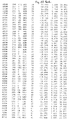
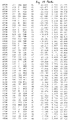
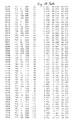
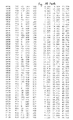
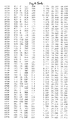
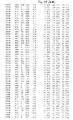
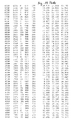
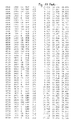
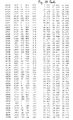
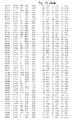
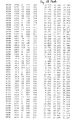
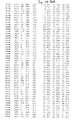
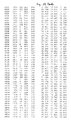
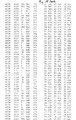
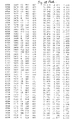
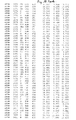
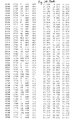
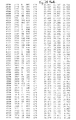
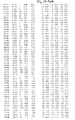
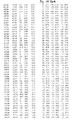
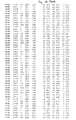
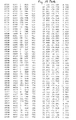
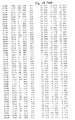
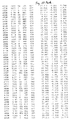
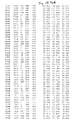
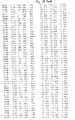
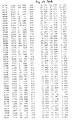
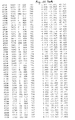
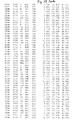
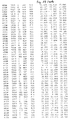
- Figure 10 lists the coordinates of the individual atoms of the two subunits of human m-calpain.
- the coordinates give the structure of the two subunits in an x, y, z coordinate system again.
- the chronological order of the atoms in Figure 10 becomes due to their affiliation Amino acids of a certain sequence position defined.
- the amino acids are listed from N to C-terminus first for the large, then for the small Subunit of human m-calpain. Since the position 1 amino acid of the N-terminus of the long subunit Methionine M1 typically due to the termini too observing strong conformational flexibility none Detect electron density in the electron density map 10, amino acid A2 is initially listed in FIG.
- FIG 11 there is a schematic and the expert in this form common representation of the three-dimensional Structure of the two subunits of human m-Calpain, the structural conformation of the complex is shown in the absence of calcium.
- “Ribbon” representation the only the backbone of the polypeptide chains is taken into account and the side chains respectively attached to the C ⁇ atom or their Does not reflect conformation.
- the positions of the Backbone of the two polypeptide chains with the structure determining free torsion angles around the C ⁇ atoms each amino acid recorded in the electron density map of human m-calpain are shown by the band course in the "Ribbon" diagram traced.
- the m-calpain complex has the shape of a flat oval Disc.
- the upper and lower poles (according to the reference orientation of Figure 11) are catalytic from the two Subdomains IIa and IIb or the calmodulin-like Domain pair from the large or small subunit educated.
- Domain III and the N-terminal domains I (large subunit) and V (small subunit) connect the two calmodulin-like domains with the two catalytic subdomains.
- the amino acid chain of the large subunit begins with a so-called “anchor helix” ( ⁇ 1I) of domain I (in green), the positioned in a semicircular cavity of domain VI is. From there, the amino acid chain runs straight to Domain IIa.
- the anchor helix works as a result of their interactions with the domain VI among other things that both subunits of the m-calpain complex are held together.
- the amino acids are the long ones Polypeptide chain at the structural area of the catalytic domain involved topologically with the catalytic domain the protease is related to papain.
- the catalytic domain of Papain already in that the two characteristically at Calpain separated sub-domains both regarding the length as well as their conformation considerably the corresponding structure in the protease papain differ.
- Figure 11 From the perspective chosen in Figure 11 (Reference position of the complex) forms the domain IIa the left half of the catalytic groove, which is on the Interspace of subdomains IIa and IIb (in red) from amino acids of both subdomains.
- the figure 11 are essentially those of the catalytic, i.e. proteolytic, involved amino acids with the reaction Position of their side chains, but not shown of the hydrogen atoms. This is what it is about are the amino acids Cys105 and Trp106 of the subdomain IIa and His262, Asn286, Trp288 and Pro287 of the subdomain IIb.
- the polypeptide chain passes into the barrel-like structured subdomain IIb, where it forms a typical 6-stranded ⁇ -sheet (strands ⁇ 5 II to ⁇ 10 II).
- the complex structure is achieved through the super-secondary structure, ie the arrangement of the secondary structure elements.
- the sequence of the amino acids Asn286, Pro287 and Trp288 with their special conformations, with Asn286 participating in the catalytic reaction.
- the polypeptide chain initially runs in the direction of subdomain IIa before it becomes part of domain III (in blue) via an open loop structure (a so-called linker region).
- Domain III essentially consists of two counter-rotating ⁇ -sheets, each ⁇ -sheet having four antiparallel strands. This leads to a compact tertiary structure that is ⁇ -sandwich-like. The topology of this domain is reminiscent of the TNF ⁇ monomer or some virus surface proteins. The basic amino acids His415 to His427 in domain III are remarkable, forming a loop in the center of the calpain complex. Also striking is the solvent-exposed and negatively charged ⁇ 2 III / ⁇ 3 III loop, which has ten acidic amino acids within the eleven amino acid section Glu392 to Glu402. This loop is well understood crystallographically. It is spatially close to the helix ⁇ 7 II of subdomain IIb and the open loop from subdomain IIb and interacts electrostatically with the numerous positive charges of these two sections of subdomain IIb.
- the amino acid chain runs from domain III the calmodulin-like domain IV in an extended ("extended") conformation, causing multiple acidic amino acids be in direct contact with the solvent. This is another long one Left area (in magenta) without characteristic secondary structure, to the bottom of the domain IV (in yellow) according to the reference perspective chosen here enough.
- the tertiary structure begins with the amino acid Ile530 the domain IV, largely with the folding the structures known from the prior art isolated domains VI of rat and calpain Pigs are known. Both domains IV and VI show Similarity to other calcium binding domains, namely "Calmodulin" domains, with EF hand motif.
- the domain IV (in yellow) has eight ⁇ -helices as secondary structure elements on that through characteristic linker areas are connected, whereby five of the well-known superse-secondary structural elements, called EF hands, be formed (Tooze & Branden, Introduction into Protein Structure, Garland Publishing Inc., Dec. 1998, 2nd Edition).
- the N-terminal part of the polypeptide which is the small calpain subunit is rich in glycine residues and leaves no electron density usable for structure elucidation detect. From amino acid Thr85 of domain V the small subunit can be three-dimensional Structure can be assigned (according to Figure 11 in red), however here the polypeptide chain is not in one of the two typical secondary structures. On the opposite Solvent exposed surface of the crystal form the polypeptide chain folds back and leaves there with the a-Helix alVI is the first secondary structure element of the Recognize domain VI (in orange).
- Domain VI also has five EF-hand motifs (like Domain IV) and, together with Domain IV of the large subunit, forms a quasi-symmetrical heterodimer, since Domain VI is structurally adjacent to Domain IV, namely on the left side of the perspective of the small subunit chosen in FIG.
- the helices ⁇ 6 VI, ⁇ 7 VI and ⁇ 8 VI and the linker region between ⁇ 7 VI and ⁇ 8 VI ( ⁇ 7 VIt ⁇ 8 VI) are involved in the symmetrical interdimer contacts.
- the two domains IV and VI are not primarily regulators involved in the catalytic activity of calpain, since the binding of calcium ions is not structural Causes changes, as by comparison with the crystal forms known from the prior art the domain VI of rat calpain with bound Calcium becomes recognizable.
- the Calmodulin-like domains can therefore primarily take on structural tasks.
- the available studies also suggest that the Calcium binding to domains IV and VI for dissociation of the two subunits of a calpain, in particular of an m-calpain.
- the catalytic domain is defined by the two sub-domains IIa and IIb formed.
- the calcium-free crystal form As shown in Figure 11, there is no catalytically active Conformation before, rather is a distinct furrow recognizable between the two aforementioned sub-domains.
- the three-dimensional structure shown in FIG. 11 are therefore the two catalytically active side chains of Cys105 (SG) and ND1 of His262 8.5 ° apart, however, the imidazole side chain for catalysis brought to Cys105 by His262 and at the same time the hydrogen bond be closed between His262 NE2 and Asn286 ND2 got to.
- Calpain's proteolytic activity becomes physiological only guaranteed in the presence of calcium.
- the binding of calcium remains domains IV and VI of the calpain complex but without regulatory Impact on the structure of the catalytic Domain. Rather, an attachment of appears Calcium ions on the acidic residues of the acidic "loop" of the Domain III for an assembly of the sub-domains IIa and IIb to form an active reaction center as a crucial calcium binding site. This will a change of conformation triggered, which then also regulatory Has an impact.
- the acidic “loop” ( ⁇ 2 IIIt ⁇ 3 III), as already mentioned, has ten negatively charged side chains, which separate from each other due to the electrostatic repulsion.
- This acidic “loop” is in direct contact with the amphipatic ⁇ 7 II helix of subdomain IIb and the open loop (“loop”) of subdomain IIb, with the lysine residues K226, K230, K234, K354, K355 and K357.
- Direct salt bridges form across the domain boundaries between some of the aforementioned acidic and basic amino acid side chains, since the negative and positive electrostatic potentials carried by the corresponding side chains attract each other.
- the acidic amino acids of the acidic “loop” preferably bind more than one calcium ion, for example two or three calcium ions.
- Basic amino acids at positions 226 and 357 of the large subunit occur only in m-calpaines on, so that a smaller number of ⁇ -calpains a lower amount of acidic amino acids in the acidic "loop" Number of structurally adjacent basic amino acids faces.
- FIG. 12 also shows a schematic “ribbon” representation of a crystal shape according to the invention with its three-dimensional structure, specifically focusing on a section of the large subunit of human m-calpain in the absence of Ca ions.
- Domain III (in blue) is characterized by ⁇ -sheet structures, each with oppositely oriented ⁇ -sheet strands, with the focus in the present illustration on the contact area of domain III with the structural elements of sub-domains IIa and IIb.
- Parts of the helices ⁇ 5 II and ⁇ 6 II or the helix ⁇ 7 II of domain IIb (in red) with the positioning of side chains of selected amino acids are therefore shown in yellow in FIG. 12.
- the present invention is accomplished by the following Embodiment explained in more detail.
- the protein was concentrated to a concentration of approximately 14 mg / ml and the buffer was changed to 10 mM Tris / HCl pH 7.5, 50 mM NaCl, 1 mM EDTA and 1 mM DTE.
- PEG polyethylene glycol
- He-pes / NaOH pH 7.5
- cryo protection buffer for this purpose, the crystals from the drops were included With the help of a "loop", referred to as a "cryo loop" and transferred to 20 ⁇ l of the reservoir buffer. 10th ⁇ l of 88% glycerol was slowly added to to get the crystal used to the cryo buffer conditions.
- the equilibrated crystals were placed in tubes and with a gas flow from a cryostat with liquid Nitrogen cooled in a flash (Oxford Cryo Systems).
- the X-ray diffraction patterns were at 100 K on one MARCCD detector on a BW6 "beamline" of the German Using electron synchrotrons in Hamburg (DESY) of monochromatic X-ray light using standard methods collected.
- DESY electron synchrotrons in Hamburg
- a corresponding description of the standard procedures is located at Helliwell (Macromolecular Crystallography with Synchrotron Radiation, Cambridge University Press, Cambridge 1992), which is an integral part of the present disclosure.
- Crystal types could have a divergent resolution be determined. While for the crystal type 1 reflexes observed up to a resolution of 2.8 ⁇ , there was a resolution for crystal type II by Max. 2.1 ⁇ . After collecting the data of the diffraction pattern could the cell constants of the unit cell, namely the dimensions of the unit cell and the Angle in the unit cell, as well as the orientation of the Crystals can be determined. This also resulted in the Symmetry of the unit cell.
- the crystals grow up to a maximum size of 1.0 mm x 1.0 mm x 0.1 mm.
- the V m value is 3.4 ⁇ 3 / Da.
- the crystals grow up to a maximum size of 1.0 mm x 0.2 mm x 0.1 mm and show a resolution up to 2.1 ⁇ . Further Information on crystal type 2 is shown in Table 1 and follow under 5 ..
- the crystal forms with embedded Heavy metal ions were gold and Mercury derivatives by so-called “soaking" of native Crystals with 5 mM gold triethylphosphine or with Phenylmercury made.
- the structure factor amplitudes were used to build the structure model of the gold derivative with the phases of the phenyl-mercury derivative provided, creating an electron density map could be calculated for the gold derivative, which has good contouring up to a resolution of 2.4 ⁇ showed. It became the La Fortelle and Bri-cogne method [Methods Enzymol. 276, 472-494 (1997), (SHARP)] used. In this way, 90% of the amino acids of the crystallized protein in the electron density map be modeled. Here are the first 84 amino acids the small subunit is not taken into account, because sufficient electron density is not observed could. Modeling the two amino acid chains, i.e. Polypetide, the large and the small subunit in the electron density map was carried out on a silicon graphic "Workstation” (Indigo) using the software package TurboFRODO (Roussel and Cambileau, Silicon Graphics, Mountainview, California, USA (1998)).
Landscapes
- Health & Medical Sciences (AREA)
- Engineering & Computer Science (AREA)
- Life Sciences & Earth Sciences (AREA)
- Chemical & Material Sciences (AREA)
- Biomedical Technology (AREA)
- Organic Chemistry (AREA)
- Zoology (AREA)
- Bioinformatics & Cheminformatics (AREA)
- Wood Science & Technology (AREA)
- Genetics & Genomics (AREA)
- Microbiology (AREA)
- Biotechnology (AREA)
- Molecular Biology (AREA)
- Biochemistry (AREA)
- General Engineering & Computer Science (AREA)
- General Health & Medical Sciences (AREA)
- Medicinal Chemistry (AREA)
- Peptides Or Proteins (AREA)
- Enzymes And Modification Thereof (AREA)
- Measuring Or Testing Involving Enzymes Or Micro-Organisms (AREA)
- Medicines That Contain Protein Lipid Enzymes And Other Medicines (AREA)
Abstract
Description
Besonders bevorzugt sind hierbei aber solche Liganden, die an die Domäne III von Calpain binden und vor allem mit der extrem sauren Schleife ("Loop") β2III/β3III und/oder strukturell der sauren Schleife benachbarten Aminosäuren in Wechselwirkung treten. Hierbei handelt es sich insbesondere um (a) die Region mit den Aminosäuren 392 bis 403, die insgesamt zehn negativ geladene Aminosäuren, also Aspartate oder Glutamate, umfaßt; (b) dieser Region gegenüber die Aminosäuren der amphipatischen Helix a7II; um (c) den Sequenzabschnitt, der durch die Aminosäuren K354 bis K357 gebildet wird; und/oder (d) um die die Aminosäuren K505 und K506.
| Konstante | Kristalltyp I | Kristalltyp II |
| (Gold-Derivat) | ||
| Raumgruppe | P21 | P21 |
| Kristallmorphologie | Plättchen | Stab/rechtwinklige Würfel |
| Einheitszellkonstanten | a = 64,78 Å | a = 51,88 Å |
| b = 133,25 Å | b = 169,84 Å | |
| c = 77,53 Å | c = 64,44 Å | |
| β = 102,07° | β = 95,12° | |
| Vm(Å3Da-1) | 3,14 | 2,61 |
| Heterodimere pro asymmetrischer Einh. | 1 | 1 |
| Geschätzter Lösungsmittelanteil (%) | 61 | 53 |
| Beugungsgrenze (Ä) | 3,0 | 2,3 |
| Rotationswinkel zwischenden Expositions stellungen | 0,5 | 0,4 |
| Expositionszeit pro Stellung | 50 s | 50 s |
| Gesamtrotation des Kristalls bei der Datensammlung | 180° | 132° |
| Zahl der gemessenen Reflexe | 223726 | 400680 |
| Zahl der Individual reflexe | 25010 | 47236 |
| Rmergea | 0,056 | 0,045 |
| Vollständigkeit des Datensatzes | 96,9% | 94,8% |
| Vollständigkeit des Datensatzes in der äußersten Kalotte des inversen Raums | 95,2% | 92,2% |
Claims (50)
- Raumform mindestens eines Polypeptids, dadurch gekennzeichnet, daß mindestens ein Polypeptid in der Raumform mindestens eine an der Katalyse beteiligte (Sub)-Domäne eines Proteins aus der Familie der neutralen Ca-aktivierten Cystein-Proteinasen (Calpaine) enthält.
- Raumform mindestens eines Polypeptids nach Anspruch 1, dadurch gekennzeichnet, daß die neutrale Ca-aktivierte Cystein-Proteinase ausgewählt ist aus der Gruppe, bestehend aus Isozymen aus der Familie der ubiqitär exprimierten Calpaine und aus Isozymen aus der Familie der Gewebe-spezifisch exprimierten Calpaine (n-Calpaine).
- Raumform mindestens eines Polypeptids nach Anspruch 1 oder 2, dadurch gekennzeichnet, daß die neutrale Ca-aktivierte Cystein-Proteinase ein Isozym aus der Gruppe der m- oder µ-Calpaine ist.
- Raumform mindestens eines Polypeptids nach einem der vorgenannten Ansprüche, dadurch gekennzeichnet, daß das Calpain humanen Ursprungs ist.
- Raumform mindestens eines Polypeptids nach einem der vorgenannten Ansprüche, dadurch gekennzeichnet, daß mindestens ein Polypeptid der Raumform die Aminosäuresequenz der Sub-Domäne IIa und/oder die Aminosäuresequenz der Sub-Domäne IIb eines m-Calpains enthält.
- Raumform mindestens eines Polypeptids nach einem der vorgenannten Ansprüche, dadurch gekennzeichnet, daß mindestens ein Polypeptid der Raumform die Aminosäuresequenz der (Sub)-Domänen IIa oder IIb, III und/oder IV eines Calpains enthält.
- Raumform nach einem der vorgenannten Ansprüche, dadurch gekennzeichnet, daß die Raumform eine Kristallform ist, wobei die Kristallform mindestens ein Polypeptid, enthaltend mindestens eine an der Katalyse beteiligte (Sub)-Domäne eines Proteins aus der Familie der neutralen Ca-aktivierten Cystein-Proteinasen (Calpaine), pro asymetrischer Einheit aufweist.
- Kristallform mindestens eines Polypeptids pro asymmetrischer Einheit nach Anspruch 7, dadurch gekennzeichnet, daß die Kristallform Metall-Ionen enthält.
- Kristallform mindestens eines Polypeptids pro asymmetrischer Einheit nach einem Ansprüche 7 oder 8, dadurch gekennzeichnet, daß die Kristallform Ca- und/oder Schwermetall-Ionen enthält.
- Kristallform mindestens eines Polypeptids pro asymmetrischer Einheit nach einem der vorgenannten Ansprüche 7 bis 9, dadurch gekennzeichnet, daß die Metall-Ionen in der räumlichen Nachbarschaft von Cystein- oder Histidinresten mindestens eines Polypeptids angelagert sind.
- Kristallform mindestens eines Polypeptids pro asymmetrischer Einheit nach einem der vorgenannten Ansprüche 7 bis 10, dadurch gekennzeichnet, daß die Kristallform mindestens eine Verbindung, ausgewählt aus der Gruppe, bestehend aus Substrat-, Pseudosubstrat-, Aktivator- und Inhibitor-Molekülen, enthält.
- Kristallform mindestens eines Polypeptids pro asymmetrischer Einheit nach Anspruch 11, dadurch gekennzeichnet, daß die Verbindung ein Di- oder Oligopeptid ist.
- Kristallform mindestens eines Polypeptids pro asymmetrischer Einheit nach Anspruch 11 oder 12, dadurch gekennzeichnet, daß die Verbindung ein chemisch modifiziertes Di- oder Oligopeptid ist.
- Kristallform mindestens eines Polypeptids pro asymmetrischer Einheit nach einem der vorgenannten Ansprüche 7 bis 13, dadurch gekennzeichnet, daß die Kristallform zwei verschiedene Polypeptide als Heterodimer in der asymmetrischer Einheit aufweist.
- Kristallform mindestens eines Polypeptids pro asymmetrischer Einheit nach einem der vorgenannten Ansprüche 7 bis 14, dadurch gekennzeichnet, daß mindestens ein Polypeptid eine Aminosäuresequenz, wie in Figur 3, 4, 5 oder 6 dargestellt, enthält.
- Kristallform mindestens eines Polypeptids pro asymmetrischer Einheit nach einem der vorgenannten Ansprüche 7 bis 15, dadurch gekennzeichnet, daß die asymmetrische Einheit ein Heterodimer aufweist, das ein Polypeptid (1) mit einer Aminosäuresequenz, wie in Figur 3 dargestellt, und ein Polypeptid (2) mit einer Aminosäuresequenz, wie in Figur 4 dargestellt, enthält.
- Kristallform mindestens eines Polypeptids pro asymmetrischer Einheit nach einem der vorgenannten Ansprüche 7 bis 16, dadurch gekennzeichnet, daß die Raumgruppe des die Kristallform aufweisenden Kristalls monoklin, tetragonal, orthorhombisch, kubisch, triklin, hexagonal oder trigonal/rhombo-hedral ist.
- Kristallform mindestens eines Polypeptids pro asymmetrischer Einheit nach einem der vorgenannten Ansprüche 7 bis 17, dadurch gekennzeichnet, daß die Raumgruppe des die Kristallform aufweisenden Kristalls P21 ist.
- Kristallform mindestens eines Polypeptids pro asymmetrischer Einheit nach einem der vorgenannten Ansprüche 7 bis 18, dadurch gekennzeichnet, daß die Einheitszelle des die Kristallform enthaltenden Kristalls Zellkonstanten von ungefähr a = 64,9 Å, b = 134,0 Å, c = 78,0 Å und β = 102,4° oder a = 51,8 Å, b = 171,4 Å, c = = 64,7 Å und β = 94,8° (innerhalb der aufweist.
- Kristallform mindestens eines Polypeptids pro asymmetrischer Einheit nach einem der vorgenannten Ansprüche 7 bis 19, dadurch gekennzeichnet, daß die an der Katalyse beteiligte Calpain-Sub-Domäne IIa (Sequenzabschnitt T93 bis G209) und/oder IIb (Sequenzabschnitt G210 bis N342) des mindestens einen Polypeptids pro asymmetrischer Einheit die Strukturkoordinaten nach Figur 10 für die vorgenannten Aminosäuren aufweist.
- Kristallform mindestens eines Polypeptids pro asymmetrischer Einheit nach einem der vorgenannten Ansprüche 7 bis 20, dadurch gekennzeichnet, daß mindestens ein Polypeptid pro asymmetrischer Einheit die Strukturkoordinaten nach Figur 10 für die große Untereinheit (A2 bis L700) aufweist.
- Kristallform mindestens eines Polypetids pro asymmetrischer Einheit nach einem der vorgenannten Ansprüche 7 bis 21, dadurch gekennzeichnet, daß mindestens ein Polypeptid pro asymmetrischer Einheit die Strukturkoordinaten nach Figur 10 für die große Untereinheit (A2 bis L700) und mindestens ein anderes Polypeptid die Strukturkoordinaten nach Figur 10 für die kleine Untereinheit (T85 bis S268) aufweist.
- Kristallform mindestens eines Polypetids pro asymmetrischer Einheit nach einem der vorgenannten Ansprüche 7 bis 22, dadurch gekennzeichnet, daß der Kristall mit der Kristallform durch Röntgenstrukturanalyse Reflexe bis zu einem Bragg-Index von mindestens d = 3,0 Å streut.
- Verbindung, mit der Eigenschaft, als Substrat, Pseu-do-Substrat, Aktivator oder Inhibitor einer neutralen Ca-aktivierten Cystein-Proteinase (Calpain) zu wirken, dadurch gekennzeichnet, daß die Verbindung in Wechselwirkung mit den Haupt- und/oder Seitenketten von Aminosäuren der katalytischen Domäne oder von Aminosäuren eines für die Regulation des aktiven Zentrum relevanten Abschnitts mindestens eines Polypeptids der Kristallform treten.
- Verbindung nach Anspruch 24, dadurch gekennzeichnet, daß die Verbindung mit der Struktur der Haupt-und/oder Seitenketten der katalytischen Domäne oder eines für die Regulation des aktiven Zentrum relevanten Abschnitts mindestens eines Polypeptids in einer Raum- oder Kristallform, wie gemäß einem der Ansprüche 1 bis 23 erhalten, in Wechselwirkung treten.
- Verbindung nach Anspruch 24 oder 25, dadurch gekennzeichnet, daß die Verbindung mit mindestens einer Aminosäure des Sequenzabschnitts β2tβ3, des sauren Loops", des mindestens einen Polypeptids in einer Raum- oder Kristallform, wie gemäß einem der Ansprüche 1 bis 23 erhalten, in Wechselwirkung tritt.
- Verbindung nach Anspruch 26, dadurch gekennzeichnet, daß die Verbindung mindestens eine positive Ladung und/oder mindestens eine positive Teilladung aufweist und eine Interaktion zwischen der α7II-Helix und dem Sequenzabschnitts β2tβ3 im wesentlichen verhindert.
- Verbindung nach Anspruch 26 oder 27, dadurch gekennzeichnet, daß die Verbindung ein Aktivator der katalytischen Aktivität eines Calpains ist.
- Verbindung nach Anspruch 24 oder 25, dadurch gekennzeichnet, daß die Verbindung die Wechselwirkung zwischen dem Abschnitt α7II-Helix und dem Sequenzabschnitt β2tβ3 des mindestens einen Polypeptids in einer Raum- oder Kristallform, wie gemäß einem der Ansprüche 1 bis 23 erhalten, im wesentlichen verstärkt.
- Verbindung nach Anspruch 29, dadurch gekennzeichnet, daß die Verbindung mit mindestens einer der Aminosäuren 226L, 230L, 234L, 354L, 355L und/oder 357L in Wechselwirkung tritt.
- Verbindung nach Anspruch 29 oder 30, dadurch gekennzeichnet, daß die Verbindung ein Inhibitor der katalytischen Aktivität des Polypeptids ist.
- Verbindung nach Anspruch 24 oder 25, dadurch gekennzeichnet, daß die Verbindung mit mindestens einer der Aminosäuren der Sub-Domäne(n) IIa und/oder IIb interagiert.
- Verbindung nach Anspruch 32, dadurch gekennzeichnet, daß der Inhibitor die Rotations- und/oder Translationsbewegung Sub-Domäne IIb gegenüber der Sub-Domäne IIa blockiert, indem er sich in die Furche zwischen den beiden Sub-Domänen einlagert.
- Verfahren zur Identifizierung einer Verbindung mit der Eigenschaft, als Substrat, Pseudo-Substrat, Aktivator oder Inhibitor einer neutralen Ca-aktivierten Cystein-Proteinase (Calpain) zu wirken, dadurch gekennzeichnet, daß die(a) eine Raum- oder Kristallform nach einem der Ansprüche 1 bis 23 erhalten wird,(b)die Strukturkoordinaten der Raum- oder Kristallform dreidimensional dargestellt werden,(c) sterische Eigenschaften und/oder funktio nelle Gruppen einer Verbindung so gewählt werden, daß Wechselwirkungen zwischen der Verbindung und den Haupt- und/oder Seitenketten des Polypeptids in dem Bin dungsbereich entstehen und(d) die gemäß (c) erhaltene Verbindung in das aktive Zentrum der katalytischen Sub-Domäne(n) oder in einen für die Regulation des aktiven Zentrum relevanten Abschnitt des Polypeptids eingefügt wird.
- Verfahren nach Anspruch 34, dadurch gekennzeichnet, daß in einem Verfahrensschritt (c1) die dreidimensionale Struktur der Verbindung ermittelt wird.
- Verfahren nach Anspruch 34 oder 35, dadurch gekennzeichnet, daß in einem Verfahrensschritt (d1) die Stärke der Wechselwirkung zwischen der Verbindung und mindestens einem Polypeptid, wie gemäß einer Raum- oder Kristallform nach einem der Ansprüche 1 bis 23 erhalten, bestimmt wird.
- Verfahren nach einem der Ansprüche 34 bis 36, dadurch gekennzeichnet, daß gemäß Verfahrensschritt (b) alle oder ein Teil der Strukturkoordinaten aus Figur 10 dargestellt werden.
- Verfahren nach einem der Ansprüche 34 bis 37, dadurch gekennzeichnet, daß die Verfahrensschritte (c), (c1), (d) und (d1) zyklisch so lange wiederholt werden, bis die gemäß (d1) erhaltene Stärke der Wechselwirkung zwischen Verbindung und der Haupt-und/oder Seitenkette des mindestens einen Polypeptids in einer Raum- oder Kristallform, wie gemäß einem der Ansprüche 1 bis 23 erhalten, optimiert wird.
- Verfahren nach einem der Ansprüche 34 bis 38, dadurch gekennzeichnet, daß in einem Verfahrensschritt (d2) die Eigenschaften der Verbindung in einem biologischen Testsystem ermittelt werden.
- Verfahren zur Identifizierung einer Verbindung, mit der Eigenschaft als Substrat, Pseudosubstrat, Aktivator oder Inhibitor einer neutralen Ca-aktivierten Cystein-Proteinase (Calpaine) zu wirken, dadurch gekennzeichnet, daß(a) ein biologische Testsystem für ein Substrat, Pseudosubstrat, Aktivator und/oder Inhibitor von Calpain etabliert wird,(b) eine als Substrat, Pseudosubstrat, Aktivator und/oder Inhibitor von Calpain wirkende Verbindung durch ein biologisches Testsystem gemäß (a) ermittelt wird,(c) die Konformation der Verbindung bestimmt wird,(d) die Strukturkoordinaten mindestens eines Polypeptids aus einer Raum- oder Kristallform nach einem der Ansprüche 1 bis 23 dargestellt werden und(e) die gemäß (b) und (c) erhaltene Struktur der Verbindung in die gemäß (d) erhaltene Struktur des aktiven Zentrums der katalytischen Sub-Domäne(n) oder eines für die Regulation des aktiven Zentrum relevanten Abschnitts des Polypeptids eingefügt wird.
- Verfahren nach Anspruch 40, dadurch gekennzeichnet, daß in einem Verfahrensschritt (e1) Art und/oder Stärke der Wechselwirkung zwischen der Verbindung und der Raum- oder Kristallform mindestens eines Polypeptids bestimmt werden.
- Verbindung als Substrat, Pseudosubstrat, Aktivator oder Inhibitor, dadurch gekennzeichnet, daß sie aus einem Verfahren nach einem der Ansprüche 34 bis 41 erhalten wird.
- Verfahren zur Herstellung einer Kristallform mindestens eines Polypeptids nach einem der Ansprüche 1 bis 23, dadurch gekennzeichnet, daß(a) das Polypeptid in einem Expressionssystem überexprimiert wird,(b) das gemäß (a) erhaltene Polypeptid in einem geeigneten Puffersystem gelöst wird und(c) die Kristallisierung durch bspw. Dampfdiffusi-onsverfahren eingeleitet wird.
- Verfahren zur Darstellung einer 3-dimensionalen Struktur eines Polypeptids oder eines Komplexes unbekannter Struktur, enthaltend mindestens ein Polypeptid, das mindestens eine an der Katalyse beteiligte Domäne eines Proteins aus der Familie der neutralen Ca-aktivierten Cystein-Proteinasen (Calpaine) enthält, dadurch gekennzeichnet, daß die unbekannte Struktur des Polypeptids oder Komplexes auf der Basis einer bekannten Raum- oder Kristallform nach einem der Ansprüche 1 bis 23 ermittelt wird.
- Verfahren nach Anspruch 44, dadurch gekennzeichnet, daß die Strukturkoordinaten, wie in Figur 10 dargestellt, eingesetzt werden.
- Verfahren nach Anspruch 44 oder 45, dadurch gekennzeichnet, daß(a) die Primärsequenz eines Polypeptid unbekannter 3D-Struktur mit der Primärsequenz eines Polypeptids bekannter Kristallform verglichen wird,(b) die 3D-Struktur des Polypeptids unbekannter Struktur in Anlehnung an die Kristallform homologer Abschnitte modelliert wird, und(c) mit Hilfe entsprechender Computer-Programme energetische Optimierungen der gemäß (b) modellierten Struktur durchgeführt werden.
- Verfahren nach einem der Ansprüche 44 bis 46, dadurch gekennzeichnet, daß das Polypeptid unbekannter Struktur ein Isozym aus der Familie der n-Calpaine oder ein Isozym eines m- oder µ-Calpains ist.
- Verfahren zur Identifizierung eines Substrats, Pseu-dosubstrats, Aktivators oder Inhibitors einer neutralen Ca-aktivierten Cystein-Proteinase (Calpain) unbekannter 3D-Struktur, dadurch gekennzeichnet, daß(a) die unbekannte 3D-Struktur des Polypeptids nach einem Verfahren nach einem der Ansprüche 44 bis 47 ermittelt wird und(b) mit Hilfe eines Verfahrens nach einem der Ansprüche 34 bis 41 eine Verbindung, mit der Eigenschaft als Inhibitor, Pseudosubstrat, Aktivator oder Substrat des Polypeptids unbekannter 3DStruktur zu wirken, ermittelt wird.
- Verwendung von Inhibitoren und/oder Aktivatoren der katalytischen Aktivität einer neutralen Ca-aktivierten Cystein-Proteinase (Calpain) nach einem der Ansprüche 24 bis 33, Anspruch 42 oder erhalten aus einem Verfahren nach Anspruch 48 zur Verwendung als Arzneimittel.
- Verwendung von Verbindungen nach Anspruch 49 zur Behandlung von ischämischen Zuständen, Muskeldystrophie und/oder Tumorerkrankungen.
Applications Claiming Priority (2)
| Application Number | Priority Date | Filing Date | Title |
|---|---|---|---|
| DE1999160225 DE19960225B4 (de) | 1999-12-14 | 1999-12-14 | Kristallines, in der asymmetrischen Einheit mindestens eine an der Katalyse beteiligte (Sub)-Domaine eines humanen m-Calpains aufweisendes Polypeptid, Verfahren zur Identifizierung von Verbindungen unter dessen Verwendung, Verfahren zu dessen Kristallisation und Verfahren zur Darstellung einer 3-dimensionalen Struktur dieses Peptids |
| DE19960225 | 1999-12-14 |
Publications (2)
| Publication Number | Publication Date |
|---|---|
| EP1108779A2 true EP1108779A2 (de) | 2001-06-20 |
| EP1108779A3 EP1108779A3 (de) | 2002-07-31 |
Family
ID=7932599
Family Applications (1)
| Application Number | Title | Priority Date | Filing Date |
|---|---|---|---|
| EP00127369A Withdrawn EP1108779A3 (de) | 1999-12-14 | 2000-12-13 | Raumform und Kristallform von Polypeptiden, die eine Sub-Domäne des Calpains enthalten |
Country Status (2)
| Country | Link |
|---|---|
| EP (1) | EP1108779A3 (de) |
| DE (1) | DE19960225B4 (de) |
Families Citing this family (1)
| Publication number | Priority date | Publication date | Assignee | Title |
|---|---|---|---|---|
| BR9305075A (pt) * | 1993-12-16 | 1995-08-08 | Fundacao Oswaldo Cruz | Antígeno para conferir imunidade protetora contra infecções helmínticas em humanos e animais,e processo de vacinação para aplicação na imunoprofilaxia de doenças helmintológicas de interesse veterinário e médico |
Family Cites Families (2)
| Publication number | Priority date | Publication date | Assignee | Title |
|---|---|---|---|---|
| US5817476A (en) * | 1995-06-07 | 1998-10-06 | Genetics Institute, Inc. | Polynucleotides encoding interleukin-1 receptor intracellular ligand proteins |
| AU1450900A (en) * | 1998-10-21 | 2000-05-08 | Arch Development Corporation | Methods of treatment of type 2 diabetes |
-
1999
- 1999-12-14 DE DE1999160225 patent/DE19960225B4/de not_active Expired - Fee Related
-
2000
- 2000-12-13 EP EP00127369A patent/EP1108779A3/de not_active Withdrawn
Non-Patent Citations (5)
| Title |
|---|
| BLANCHARD ET AL: "Structure of a calpain Ca2+-binding domain reveals a novel EF-hand and Ca2+-induced conformational changes" NATURE STRUCTURAL BIOLOGY, Bd. 4, Nr. 7, Juli 1997 (1997-07), Seiten 532-538, XP008002121 * |
| HOSFIELD ET AL: "Crystal structure of calpain reveals the structural basis for Ca2+-dependent protease activity and a novel mode of enzyme activation" THE EMBO JOURNAL, Bd. 18, Nr. 24, 15. Dezember 1999 (1999-12-15), Seiten 6880-6889, XP002198561 * |
| MASUMOTO ET AL: "Crystallization and preliminary X-ray analysis of recombinant full-length human m-calpain" ACTA CRYSTALLOGRAPHICA SECTION D: BIOLOGICAL CRYSTALLOGRAPHY, Nr. D56, Januar 2000 (2000-01), Seiten 73-75, XP008002117 ISSN: 0907-4449 * |
| MASUMOTO ET AL: "Overexpression, purification, and characterization of human m-calpain and its active site mutant, m-C105S-calpain, using a baculovirus expression system." JOURNAL OF BIOCHEMISTRY, Bd. 124, 1998, Seiten 957-961, XP002198560 * |
| STROBL ET AL: "The crystal structure of calcium-free human m-calpain suggests an electrostatic switch mechanism for activation by calcium" PROCEEDINGS OF THE NATIONAL ACADEMY OF SCIENCES USA, Bd. 97, Nr. 2, 18. Januar 2000 (2000-01-18), Seiten 588-592, XP002198562 * |
Also Published As
| Publication number | Publication date |
|---|---|
| DE19960225A1 (de) | 2001-07-26 |
| EP1108779A3 (de) | 2002-07-31 |
| DE19960225B4 (de) | 2007-03-01 |
Similar Documents
| Publication | Publication Date | Title |
|---|---|---|
| DE60034688T2 (de) | Kristallstruktur einer deacetylase und deren inhibitoren | |
| Moldoveanu et al. | Crystal structures of calpain–E64 and–leupeptin inhibitor complexes reveal mobile loops gating the active site | |
| Cheng et al. | The crystal structure of the human polo‐like kinase‐1 polo box domain and its phospho‐peptide complex | |
| DE60126970T2 (de) | Kristallstruktur von bace und verwendungen dafür | |
| Unwin | An overview of the pterosaur assemblage from the Cambridge Greensand (Cretaceous) of Eastern England | |
| Wiegand et al. | The crystal structure of porcine pancreatic α-amylase in complex with the microbial inhibitor Tendamistat | |
| Gorman et al. | Alternate aggregation pathways of the Alzheimer β-amyloid peptide: Aβ association kinetics at endosomal pH | |
| Simister et al. | The crystal structure of PEBP-2, a homologue of the PEBP/RKIP family | |
| Yoshida et al. | Abscisic acid derivatives with different alkyl chain lengths activate distinct abscisic acid receptor subfamilies | |
| Wang et al. | Compromise of clathrin function and membrane association by clathrin light chain deletion | |
| Ahmad et al. | Insight into the structural basis of the dual inhibitory mode of Lima bean (Phaseolus lunatus) serine protease inhibitor | |
| Roland et al. | A serendipitous survey of prediction algorithms for amyloidogenicity | |
| EP1280901A1 (de) | Raumform von tpr-strukturmotiv enthaltenden polypeptiden mit chaperon-bindungsfunktion, deren kristalle und verbindungen zur inhibierung derartiger polypeptide | |
| EP1108779A2 (de) | Raumform und Kristallform von Polypeptiden, die eine Sub-Domäne des Calpains enthalten | |
| Müller-Scheeßel et al. | New burial rites at the end of the Linearbandkeramik in south-west Slovakia | |
| Pires et al. | Structural basis for APPTPPPLPP peptide recognition by the FBP11WW1 domain | |
| DE69936445T2 (de) | Kristallines tnf-alpha-konvertierendes enzym und verwendung davon | |
| Brown et al. | MinD proteins regulate CetZ1 localization in Haloferax volcanii | |
| Olden | Biotic homogenization | |
| DE60120410T2 (de) | Modulation der tetraspanin funktion | |
| DE60222115T2 (de) | Kristallstruktur der 2c-methyl-d-erythritol-2,4-cyclodiphosphat-synthase | |
| Vergara et al. | A novel interdomain interface in crystallins: structural characterization of the βγ-crystallin from Geodia cydonium at 0.99 Å resolution | |
| US8309340B2 (en) | Insulin degrading enzyme crystals | |
| Hyman et al. | Radiocarbon analyses of rock painting: Hueco Tanks, Texas | |
| DE60031096T2 (de) | Auf der dreidimensionalen struktur von lta4 hydrolase basierender entwurf von arzneimitteln |
Legal Events
| Date | Code | Title | Description |
|---|---|---|---|
| PUAI | Public reference made under article 153(3) epc to a published international application that has entered the european phase |
Free format text: ORIGINAL CODE: 0009012 |
|
| AK | Designated contracting states |
Kind code of ref document: A2 Designated state(s): AT BE CH CY DE DK ES FI FR GB GR IE IT LI LU MC NL PT SE TR |
|
| AX | Request for extension of the european patent |
Free format text: AL;LT;LV;MK;RO;SI |
|
| PUAL | Search report despatched |
Free format text: ORIGINAL CODE: 0009013 |
|
| 17P | Request for examination filed |
Effective date: 20020320 |
|
| AK | Designated contracting states |
Kind code of ref document: A3 Designated state(s): AT BE CH CY DE DK ES FI FR GB GR IE IT LI LU MC NL PT SE TR |
|
| AX | Request for extension of the european patent |
Free format text: AL;LT;LV;MK;RO;SI |
|
| AKX | Designation fees paid |
Designated state(s): AT BE CH CY DE DK ES FI FR GB GR IE IT LI LU MC NL PT SE TR |
|
| RAP3 | Party data changed (applicant data changed or rights of an application transferred) |
Owner name: PROTEROS BIOSTRUCTURES GMBH Owner name: MAX-PLANCK-GESELLSCHAFT ZUR FOERDERUNGDER WISSENSC |
|
| 17Q | First examination report despatched |
Effective date: 20040729 |
|
| STAA | Information on the status of an ep patent application or granted ep patent |
Free format text: STATUS: THE APPLICATION HAS BEEN WITHDRAWN |
|
| 18W | Application withdrawn |
Effective date: 20041026 |