EP1107232B1 - Kombinierte Stereokodierung von Audiosignalen - Google Patents
Kombinierte Stereokodierung von Audiosignalen Download PDFInfo
- Publication number
- EP1107232B1 EP1107232B1 EP00310510A EP00310510A EP1107232B1 EP 1107232 B1 EP1107232 B1 EP 1107232B1 EP 00310510 A EP00310510 A EP 00310510A EP 00310510 A EP00310510 A EP 00310510A EP 1107232 B1 EP1107232 B1 EP 1107232B1
- Authority
- EP
- European Patent Office
- Prior art keywords
- signal
- information
- representation
- coefficients
- composite
- Prior art date
- Legal status (The legal status is an assumption and is not a legal conclusion. Google has not performed a legal analysis and makes no representation as to the accuracy of the status listed.)
- Expired - Lifetime
Links
- 230000005236 sound signal Effects 0.000 title description 25
- 239000002131 composite material Substances 0.000 claims description 13
- 230000004807 localization Effects 0.000 claims description 10
- 230000003044 adaptive effect Effects 0.000 claims description 5
- 230000003595 spectral effect Effects 0.000 claims 3
- 238000004806 packaging method and process Methods 0.000 claims 1
- 238000000034 method Methods 0.000 description 23
- 230000005540 biological transmission Effects 0.000 description 16
- 238000004891 communication Methods 0.000 description 9
- 230000006870 function Effects 0.000 description 6
- 238000001228 spectrum Methods 0.000 description 5
- 238000013139 quantization Methods 0.000 description 4
- 230000015572 biosynthetic process Effects 0.000 description 3
- 230000006978 adaptation Effects 0.000 description 2
- 230000001364 causal effect Effects 0.000 description 2
- 239000011159 matrix material Substances 0.000 description 2
- 238000011084 recovery Methods 0.000 description 2
- 238000000926 separation method Methods 0.000 description 2
- 238000004458 analytical method Methods 0.000 description 1
- 238000010420 art technique Methods 0.000 description 1
- 230000015556 catabolic process Effects 0.000 description 1
- 238000012512 characterization method Methods 0.000 description 1
- 238000007906 compression Methods 0.000 description 1
- 230000001143 conditioned effect Effects 0.000 description 1
- 230000007423 decrease Effects 0.000 description 1
- 238000006731 degradation reaction Methods 0.000 description 1
- 230000000593 degrading effect Effects 0.000 description 1
- 230000003111 delayed effect Effects 0.000 description 1
- 238000010586 diagram Methods 0.000 description 1
- 230000000694 effects Effects 0.000 description 1
- 239000000284 extract Substances 0.000 description 1
- 238000000605 extraction Methods 0.000 description 1
- 238000012804 iterative process Methods 0.000 description 1
- 230000000873 masking effect Effects 0.000 description 1
- 230000004044 response Effects 0.000 description 1
- 230000017105 transposition Effects 0.000 description 1
- 239000013598 vector Substances 0.000 description 1
Images
Classifications
-
- H—ELECTRICITY
- H04—ELECTRIC COMMUNICATION TECHNIQUE
- H04S—STEREOPHONIC SYSTEMS
- H04S1/00—Two-channel systems
- H04S1/007—Two-channel systems in which the audio signals are in digital form
-
- G—PHYSICS
- G10—MUSICAL INSTRUMENTS; ACOUSTICS
- G10L—SPEECH ANALYSIS TECHNIQUES OR SPEECH SYNTHESIS; SPEECH RECOGNITION; SPEECH OR VOICE PROCESSING TECHNIQUES; SPEECH OR AUDIO CODING OR DECODING
- G10L19/00—Speech or audio signals analysis-synthesis techniques for redundancy reduction, e.g. in vocoders; Coding or decoding of speech or audio signals, using source filter models or psychoacoustic analysis
- G10L19/008—Multichannel audio signal coding or decoding using interchannel correlation to reduce redundancy, e.g. joint-stereo, intensity-coding or matrixing
-
- G—PHYSICS
- G10—MUSICAL INSTRUMENTS; ACOUSTICS
- G10L—SPEECH ANALYSIS TECHNIQUES OR SPEECH SYNTHESIS; SPEECH RECOGNITION; SPEECH OR VOICE PROCESSING TECHNIQUES; SPEECH OR AUDIO CODING OR DECODING
- G10L19/00—Speech or audio signals analysis-synthesis techniques for redundancy reduction, e.g. in vocoders; Coding or decoding of speech or audio signals, using source filter models or psychoacoustic analysis
- G10L19/02—Speech or audio signals analysis-synthesis techniques for redundancy reduction, e.g. in vocoders; Coding or decoding of speech or audio signals, using source filter models or psychoacoustic analysis using spectral analysis, e.g. transform vocoders or subband vocoders
-
- H—ELECTRICITY
- H04—ELECTRIC COMMUNICATION TECHNIQUE
- H04S—STEREOPHONIC SYSTEMS
- H04S2420/00—Techniques used stereophonic systems covered by H04S but not provided for in its groups
- H04S2420/03—Application of parametric coding in stereophonic audio systems
Definitions
- the invention relates to systems and methods for communications of a signal containing information, and more particularly to systems and methods for coding a signal containing, e.g., stereo audio information, to efficiently utilize limited transmission bandwidth.
- each block is divided into coder bands, each.of which is individually coded, based on psycho-acoustic criteria, in such a way that the audio information is significantly compressed, thereby requiring a smaller number of bits to represent the audio information than would be the case if the audio information were represented in a more simplistic digital format, such as the PCM format.
- a stereo audio signal including a left channel signal (L) and a right channel signal (R) may be further encoded to realize additional savings in transmission bandwidth.
- M (L + R)/2
- S (L - R)/2.
- M provides a monophonic effect of the stereo signal while S adds thereto a stereo separation based on the difference between L and R.
- L and R the more bits are required to represent S.
- an M-S encoded stereo audio signal is undesirably susceptible to aliasing distortion attributed to the limited transmission bandwidth.
- mode distortion is introduced to the received signal, thereby significantly degrading its stereo quality.
- the intensity stereo coding was developed based on the recognition that the ability of a human auditory system to resolve the exact locations of audio sources of L and R decreases towards high frequencies. Typically, it is used to encode the intensity or magnitude of high frequency components of only one of L and R. However, the resulting encoded information facilitates recovery of the high frequency components of both L and R.
- apparatus according to claim 1 Further in accordance with the invention there is provided apparatus according to claim 7. Still further in accordance with the invention there is provided apparatus according to claim 10.
- the representation of a composite signal for transmission, which includes a first signal and a second signal (e.g., L and R), contains first information derived from at least the first signal, and second information concerning one or more coefficients resulting from parametric coding of the second signal.
- the first signal may be recovered based on the first information
- the second signal may be recovered based on the first information and the second information.
- the transmission bandwidth is efficiently utilised for communicating the composite signal.
- such coefficients describe not only an intensity relation between the first signal and the second signal, but also phase relations therebetween.
- the signal quality afforded by the inventive parametric coding is superior to that afforded, e.g., by the intensity stereo coding described above.
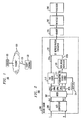
- Fig. 1 illustrates arrangement 100 embodying the principles of the invention for communicating information, e.g., stereo audio information.
- server 105 in arrangement 100 provides a music-on-demand service to client terminals through Internet 120.
- client terminals is numerically denoted 130 which may be a personal computer (PC).
- Internet 120 is a packet switched network for transporting information in packets in accordance with the standard transmission control protocol/Internet protocol (TCP/IP).
- TCP/IP transmission control protocol/Internet protocol
- client terminal 130 for communicating information with server 105, which is identified by a predetermined uniform resource locator (URL) on Internet 120.
- server 105 For example, to request the music-on-demand service provided by server 105, a modem (not shown) in client terminal 130 is used to establish communication connection 125 with Internet 120.
- connection 125 affords a 28.8 kb/sec communication rate, which is common.
- client terminal 130 is assigned an IP address for its identification.
- the user at client terminal 130 may then access the music-on-demand service at the predetermined URL identifying server 105, and request a selected musical piece from the service.
- a request includes the IP address identifying client terminal 130, and information concerning the selected musical piece and communication rate of terminal 130, i.e., 28.8 kb/s in this instance, which affords narrow bandwidth for communication of the musical piece.
- a stereo audio signal can be characterized using localization cues, which define the location or tilt of the underlying stereo sounds in an auditory space. Of course, some sounds may not be localized, which are perceived as diffuse across a left-to-right span.
- the localization cues include (a) low frequency phase cues, (b) intensity cues, and (c) group delay or envelope cues.
- the low frequency phase cues may be derived from the relative phase of L and R at low frequencies of the signals. Specifically, the phase relationship between their frequency components below 1200 Hz was found to be of particular importance.
- the intensity cues may be derived from the relative power of L and R at high frequencies of the signals, e.g., above 1200 Hz.
- the envelope cues may be derived from the relative phase of L and R signal envelopes, and may be determined based on the group delay between the two signals. It should be noted that cues (b) and (c) may be collectively referred to as the "phase cues.”
- a representation of the stereo audio signal contains (i) information concerning only one of L and R, e.g., L here, and (ii) parametric information concerning the other signal, e.g., R, resulting from parametric coding of R with respect to L.
- Such a stereo audio signal representation is hereinafter referred to as the "ST representation.”
- parametric information concerning R is hereinafter referred to as "param-R.”
- param-R is obtained by quantizing a set of parameters describing the aforementioned localization cues of the stereo audio signal.
- the stereo audio signal recovered based on the ST representation includes L and a prediction of R, affording an acceptable stereo audio quality, where L is derived from the L information in the ST representation, and the prediction of R is derived from both the param-R and L information therein.
- R f i ⁇ i ⁇ L i f , where i represents an index for an i th prediction frequency band in the frequency range.
- each i th prediction frequency band may coincide with a different one of the coder bands which approximate the well known critical bands of the human auditory system, in accordance with the PAC technique.
- PAC perceptual audio coding
- L i f real-causal (or R i f real-causal ) is realized by appending "zeros" to a block of N samples representing L to lengthen the block to (2N-1) samples long, followed by a frequency transform of the zero-padded block and extraction of the real part of the resulting transform, where N is a predetermined number.
- a multi-tap predictor may be utilized whereby ⁇ i represents a set of predictor coefficients for an i th prediction frequency band.
- param-R in the ST representation comprises information concerning predictor coefficients ⁇ i 0 and ⁇ i 1 describing the localization cues, i.e., the low frequency phase cues, intensity cues and envelope cues, of the underlying stereo audio signal.
- param-R together with the L information in the ST representation is used for predicting R.
- the communication rate 28.8 kb/sec affordable by connection 125 in this instance, about 22 kb/sec may be allocated to the transmission of the L information and about 2 kb/sec to the transmission of param-R.
- Equation (6) it can be shown that if L is weak, and thus det G (i.e, determinant of G) has a small value, equation (6) for solving ⁇ i 0 and ⁇ i 1 would be numerically ill conditioned. As a consequence, use of the resulting ⁇ i 0 and ⁇ i 1 , and thus param-R, to predict R based on L is not viable.
- the disclosure hereupon is based on the generalized, second parametric coding technique involving L*.
- the generalized parametric coding technique may be more advantageous to employ the generalized parametric coding technique especially when the stereo audio signal to be coded includes an extremely strong stereo tilt (i.e., almost completely dominated by either L or R).
- the pair L* and R in accordance with the generalized technique exhibits a reduced stereo separation, thereby increasing the "naturalness" of the parametric coding.
- Fig. 2 illustrates server 105 wherein audio coder 203 is used to process a stereo audio signal representing a musical piece, which consists of L and R.
- analog-to-digital (A/D) convertor 205 in coder 203 digitizes L and R, thereby providing PCM samples of L and R denoted L(n) and R(n), respectively, where n represents an index for an n th sample interval.
- mixer 207 Based on L (n) and R(n), mixer 207 generates L*(n) on lead 209a in accordance with expression (7) above, where values of a and b are adaptively selected by adapter 211 described below.
- R(n) and L(n) bypass mixer 207 onto leads 209b and 209c, respectively. Leads 209a-209c extend, and thereby provide the respective L*(n), R(n) and L(n), to parametric stereo coder 215 described below.
- L*(n) is also provided to PAC coder 217.
- PAC coder 217 divides the PCM samples L*(n) into time domain blocks, and performs a modified discrete cosine transform (MDCT) on each block to provide a frequency domain representation therefor.
- MDCT modified discrete cosine transform
- the resulting MDCT coefficients are grouped according to coder bands for quantization. As mentioned before, these coder bands approximate the well known critical bands of the human auditory system.
- PAC coder 217 also analyzes the audio signal samples, L*(n), to determine the appropriate level of quantization (i.e., quantization stepsize) for each coder band. This level of quantization is determined based on an assessment of how well the audio signal in a given coder band masks noise.
- the quantized MDCT coefficients then undergo a conventional Huffman compression process, resulting in a bit stream representing L* on lead 222a.
- parametric stereo coder 215 Based on received L*(n) and R(n), parametric stereo coder 215 generates a parametric signal P* R .
- P* R contains information concerning param-R[w.r.t. L*] which comprises predictor coefficients ⁇ i 0 and ⁇ i 1 in accordance with equation (6) above, although "l" and “l'” therein are derived from L* here, rather than L, pursuant to the generalized parametric coding technique.
- P* R is quantized by conventional nonlinear quantizer 225, thereby providing a bit stream representing P* R on lead 222b.
- Leads 222a and 222b extend to ST representation formatter 231 where for each time domain block, the bit stream representing P* R on lead 222b corresponding to the time domain block is appended to that representing L* on lead 222a corresponding to the same time domain block, resulting in the ST representation of the musical piece being processed.
- the latter is stored in memory 270, along with the ST representations of other musical pieces processed in a similar manner.
- a + b 1 as mentioned before, the value selected by adapter 211 for b simply equals 1 - a. It should be noted that alternatively, a and b may be predetermined constant values, thereby obviating the need of adapter 211.
- processor 280 In response to the aforementioned request from client terminal 130 for transmission of the selected musical piece thereto, processor 280 causes packetizer 285 to retrieve from memory 270 the ST representation of the selected musical piece and generate a sequence of packets in accordance with the standard TCP/IP. These packets have information fields jointly containing the ST representation of the selected musical piece. Each packet in the sequence is destined for client terminal 130 as it contains in its header, as a destination address, the IP address of terminal 130 requesting the music-on-demand service.
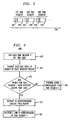
- Fig. 3 illustrates one such packet sequence.
- the header of each packet contains synchronization information.
- the synchronization information in each packet includes a sequence index indicating a time segment i, 1 ⁇ i ⁇ N, to which the packet corresponds, where N is the total number of time segments which the selected musical piece comprises.
- each time segment has the same predetermined length.
- field 301 in the header of packet 310 contains a sequence index "1" indicating that packet 310 corresponds to the first time segment;
- field 303 in the header of packet 320 contains a sequence index "2" indicating that packet 320 corresponds to the second time segment;
- field 305 in the header of packet 430 contains a sequence index "3" indicating that packet 330 corresponds to the third time segment; and so on and so forth.
- Client terminal 130 processes the packet sequence from server 105 on a time segment by time segment basis, in accordance with a routine which may be realized using software and/or hardware installed in terminal 130.
- Fig. 4 illustrates such a routine denoted 400.
- terminal 130 sets a predetermined time limit within which any packet corresponding to the time segment is received for processing.
- Terminal 130 at step 411 examines the aforementioned sequence index in the header of each received packet. Based on the sequence index values of the received packets, terminal 130 at step 414 determines whether the packet for time segment i has been received before the time limit expires. If the expected packet has been received, routine 400 proceeds to step 417 where terminal 130 extracts the ST representation content from the packet.
- terminal 130 performs on the extracted content the inverse function to audio coder 203 described above to recover the L and R corresponding to time segment i.
- terminal 130 performs well known error concealment for time segment i, e.g., interpolation based on the results of audio recovery in neighboring time segments, as indicated at step 424.
- an alternative scheme may be applied to capture the localization cues of a stereo audio signal and effectively represent the signal.
- This alternative scheme is also based on a prediction in the frequency domain, but works with "real" MDCT representations of the signal, as opposed to the complex DFT representations thereof as before.
- the MDCT may be viewed as a block transform with a 50% overlap between two consecutive analysis blocks. That is, for a transform block length B, there is a B/2 overlap between the two consecutive blocks. Furthermore, the transform produces B/2 real transform (frequency) outputs.
- H. Malavar "Lapped Orthogonal Transforms," Prentice Hall, Englewood Cliffs, New Jersey.
- the alternative scheme stems from my recognition that the phase cue information of each frequency content, which is not apparent in the real representation, is embedded in the evolution of MDCT coefficients, i.e., the inter-block correlation of a frequency bin in the MDCT representation.
- the alternative scheme in which the prediction of, say, a right MDCT coefficient is based on left MDCT coefficients in the same frequency bin for the current as well as previous transform block captures intensity and phase cues for stationary signals.
- the alternative scheme can be effectively integrated into a PAC codec with a low computational overhead because the required MDCT representation is made available in the codec anyway, and the alternative scheme performs well especially when the stereo audio signal to be coded is relatively stationary.
- the parametric coding schemes disclosed above are illustratively predicated upon a prediction of R based on L.
- the parametric coding schemes may be predicated upon a prediction of L based on R. In that case, the above discussion still follows, with R and L interchanged.
- the parametric coding technique is illustratively applied to a packet switched communications system.
- inventive technique is equally applicable to broadcasting systems including hybrid in-band on channel (IBOC) AM systems, hybrid IBOC FM systems, satellite broadcasting systems, Internet radio systems, TV broadcasting systems, etc.
- IBOC in-band on channel
- server 105 is disclosed herein in a form in which various server functions are performed by discrete functional blocks. However, any one or more of these functions could equally well be embodied in an arrangement in which the functions of any one or more of those blocks or indeed, all of the functions thereof, are realized, for example, by one or more appropriately programmed processors.
Landscapes
- Engineering & Computer Science (AREA)
- Physics & Mathematics (AREA)
- Multimedia (AREA)
- Acoustics & Sound (AREA)
- Signal Processing (AREA)
- Computational Linguistics (AREA)
- Health & Medical Sciences (AREA)
- Audiology, Speech & Language Pathology (AREA)
- Human Computer Interaction (AREA)
- Spectroscopy & Molecular Physics (AREA)
- Mathematical Physics (AREA)
- Compression, Expansion, Code Conversion, And Decoders (AREA)
- Stereophonic System (AREA)
Claims (10)
- Vorrichtung zur Verarbeitung eines zusammengesetzten Signals, welches ein erstes Signal (L) und ein zweites Signal (R) beinhaltet, wobei die Vorrichtung aufweist:einen Prozessor (215) zum Ableiten von einem oder mehreren Koeffizienten (αi 0, αi 1), die Ortsbestimmungsmarkierungen beschreiben, die durch eine Beziehung zwischen dem ersten Signal und dem zweiten Signal definiert sind; undeine Steuereinrichtung (231) zur Generierung einer Darstellung des zusammengesetzten Signals, wobei die Darstellung eine erste Information (L*), abgeleitet von wenigstens dem ersten Signal, und eine zweite Information (P*R) enthält, die wenigstens den einen oder die mehreren Koeffizienten betrifft, wobei ein Wert des zweiten Signals in dem spektralen Bereich basierend auf der ersten Information und der zweiten Information vorherberechenbar ist.
- Vorrichtung nach Anspruch 1, wobei die einen oder mehreren Koeffizienten eine Phase von wenigstens einem Teil des ersten Signals relativ zu einer Phase von wenigstens einem Teil des zweiten Signals definieren.
- Vorrichtung nach Anspruch 1, wobei die einen oder mehreren Koeffizienten außerdem eine Intensität von wenigstens einem Teil des ersten Signals relativ zu einer Intensität von wenigstens einem Teil des zweiten Signals beschreiben.
- Vorrichtung nach Anspruch 1, wobei der eine oder die mehreren Koeffizienten abgeleitet werden, indem das erste Signal und das zweite Signal Kausalitätsbedingungen unterworfen werden.
- Vorrichtung nach Anspruch 1, wobei die erste Information aus einer Kombination des ersten Signals und des zweiten Signals abgeleitet wird.
- Vorrichtung nach Anspruch 5, wobei die Kombination des ersten Signals und des zweiten Signals in adaptiver Weise bestimmt wird.
- Vorrichtung zur Verarbeitung eines zusammengesetzten Signals, welches ein erstes Signal (L) und ein zweites Signal (R) beinhaltet, wobei die Vorrichtung aufweist:eine Mischeinrichtung (207) zur Erzeugung eines gemischten Signals (L*) basierend auf dem ersten Signal und dem zweiten Signal;einen ersten Codierer (217) zur Codierung des gemischten Signals, um eine Darstellung des gemischten Signals zu generieren;einen zweiten Codierer (215), der auf das gemischte Signal und das zweite Signal anspricht, um Information (P*R) betreffend einen oder mehrere Koeffizienten (αi 0, αi 1) bereitzustellen, um das zweite Signal in dem spektralen Bereich vorauszuberechnen; undeinen Prozessor (231) zur Generierung einer Darstellung des zusammengesetzten Signals, wobei die Darstellung des zusammengesetzten Signals die Darstellung des gemischten Signals und die Information betreffend den einen oder die mehreren Koeffizienten beinhaltet;wobei der eine oder die mehreren Koeffizienten Ortsbestimmungsmarkierungen beschreiben, die durch eine Beziehung zwischen dem ersten Signal und dem zweiten Signal definiert werden.
- Vorrichtung nach Anspruch 7, wobei das gemischte Signal in einer adaptiven Weise generiert wird.
- Vorrichtung nach Anspruch 7, weiterhin umfassend eine Steuereinrichtung zur packenden Verarbeitung der Darstellung des zusammengesetzten Signals in eine Sequenz von Paketen, wobei jedes Paket einen Indikator beinhaltet, der eine Sequenzordnung des Pakets mit Bezug auf andere Pakete anzeigt.
- Vorrichtung zum Zurückgewinnen eines zusammengesetzten Signals, welches ein erstes Signal (L) und ein zweites Signal (R) beinhaltet, wobei die Vorrichtung umfasst:eine Schnittstelle (125) zum Empfang einer Darstellung des zusammengesetzten Signals, wobei die Darstellung eine erste Information (L*) beinhaltet, die von wenigstens dem ersten Signal abgeleitet ist, sowie eine zweite Information (P*R) betreffend einen oder mehrere Koeffizienten (αi 0, αi 1), die Ortsbestimmungsmarkierungen beschreiben, die durch eine Relation zwischen dem ersten Signal und dem zweiten Signal definiert sind; undeinen Prozessor (130) zum Zurückgewinnen des zusammengesetzten Signals basierend auf der Darstellung, wobei der Prozessor einen Wert des zweiten Signals in dem spektralen Bereich basierend auf der ersten Information und der zweiten Information in der Darstellung beim Zurückgewinnen des zusammengesetzten Signals vorausberechnet.
Applications Claiming Priority (2)
| Application Number | Priority Date | Filing Date | Title |
|---|---|---|---|
| US09/454,026 US6539357B1 (en) | 1999-04-29 | 1999-12-03 | Technique for parametric coding of a signal containing information |
| US454026 | 1999-12-03 |
Publications (3)
| Publication Number | Publication Date |
|---|---|
| EP1107232A2 EP1107232A2 (de) | 2001-06-13 |
| EP1107232A3 EP1107232A3 (de) | 2002-10-16 |
| EP1107232B1 true EP1107232B1 (de) | 2008-06-25 |
Family
ID=23802983
Family Applications (1)
| Application Number | Title | Priority Date | Filing Date |
|---|---|---|---|
| EP00310510A Expired - Lifetime EP1107232B1 (de) | 1999-12-03 | 2000-11-27 | Kombinierte Stereokodierung von Audiosignalen |
Country Status (5)
| Country | Link |
|---|---|
| US (1) | US6539357B1 (de) |
| EP (1) | EP1107232B1 (de) |
| JP (2) | JP2001209399A (de) |
| CA (1) | CA2326495C (de) |
| DE (1) | DE60039278D1 (de) |
Families Citing this family (76)
| Publication number | Priority date | Publication date | Assignee | Title |
|---|---|---|---|---|
| US6961432B1 (en) * | 1999-04-29 | 2005-11-01 | Agere Systems Inc. | Multidescriptive coding technique for multistream communication of signals |
| JP3507743B2 (ja) * | 1999-12-22 | 2004-03-15 | インターナショナル・ビジネス・マシーンズ・コーポレーション | 圧縮オーディオデータへの電子透かし方法およびそのシステム |
| US7644003B2 (en) * | 2001-05-04 | 2010-01-05 | Agere Systems Inc. | Cue-based audio coding/decoding |
| US20030035553A1 (en) * | 2001-08-10 | 2003-02-20 | Frank Baumgarte | Backwards-compatible perceptual coding of spatial cues |
| US7116787B2 (en) * | 2001-05-04 | 2006-10-03 | Agere Systems Inc. | Perceptual synthesis of auditory scenes |
| US7292901B2 (en) * | 2002-06-24 | 2007-11-06 | Agere Systems Inc. | Hybrid multi-channel/cue coding/decoding of audio signals |
| US7583805B2 (en) * | 2004-02-12 | 2009-09-01 | Agere Systems Inc. | Late reverberation-based synthesis of auditory scenes |
| US7451006B2 (en) * | 2001-05-07 | 2008-11-11 | Harman International Industries, Incorporated | Sound processing system using distortion limiting techniques |
| US7447321B2 (en) | 2001-05-07 | 2008-11-04 | Harman International Industries, Incorporated | Sound processing system for configuration of audio signals in a vehicle |
| US6804565B2 (en) * | 2001-05-07 | 2004-10-12 | Harman International Industries, Incorporated | Data-driven software architecture for digital sound processing and equalization |
| US8605911B2 (en) | 2001-07-10 | 2013-12-10 | Dolby International Ab | Efficient and scalable parametric stereo coding for low bitrate audio coding applications |
| SE0202159D0 (sv) | 2001-07-10 | 2002-07-09 | Coding Technologies Sweden Ab | Efficientand scalable parametric stereo coding for low bitrate applications |
| DE10154932B4 (de) * | 2001-11-08 | 2008-01-03 | Grundig Multimedia B.V. | Verfahren zur Audiocodierung |
| DE60202881T2 (de) | 2001-11-29 | 2006-01-19 | Coding Technologies Ab | Wiederherstellung von hochfrequenzkomponenten |
| JP4805541B2 (ja) * | 2002-04-10 | 2011-11-02 | コーニンクレッカ フィリップス エレクトロニクス エヌ ヴィ | ステレオ信号の符号化 |
| RU2316154C2 (ru) * | 2002-04-10 | 2008-01-27 | Конинклейке Филипс Электроникс Н.В. | Кодирование стереофонических сигналов |
| ES2300567T3 (es) * | 2002-04-22 | 2008-06-16 | Koninklijke Philips Electronics N.V. | Representacion parametrica de audio espacial. |
| CN1647156B (zh) * | 2002-04-22 | 2010-05-26 | 皇家飞利浦电子股份有限公司 | 参数编码方法、参数编码器、用于提供音频信号的设备、解码方法、解码器、用于提供解码后的多声道音频信号的设备 |
| AU2003265935A1 (en) * | 2002-05-03 | 2003-11-17 | Harman International Industries, Incorporated | Sound detection and localization system |
| CN100539742C (zh) * | 2002-07-12 | 2009-09-09 | 皇家飞利浦电子股份有限公司 | 多声道音频信号编解码方法和装置 |
| WO2004008806A1 (en) | 2002-07-16 | 2004-01-22 | Koninklijke Philips Electronics N.V. | Audio coding |
| SE0202770D0 (sv) | 2002-09-18 | 2002-09-18 | Coding Technologies Sweden Ab | Method for reduction of aliasing introduces by spectral envelope adjustment in real-valued filterbanks |
| US7644001B2 (en) | 2002-11-28 | 2010-01-05 | Koninklijke Philips Electronics N.V. | Differentially coding an audio signal |
| EP1595247B1 (de) * | 2003-02-11 | 2006-09-13 | Koninklijke Philips Electronics N.V. | Audiocodierung |
| EP1606797B1 (de) | 2003-03-17 | 2010-11-03 | Koninklijke Philips Electronics N.V. | Verarbeitung von mehrkanalsignalen |
| JP2006521577A (ja) * | 2003-03-24 | 2006-09-21 | コーニンクレッカ フィリップス エレクトロニクス エヌ ヴィ | マルチチャネル信号を表す主信号と副信号の符号化 |
| US20040264713A1 (en) * | 2003-06-27 | 2004-12-30 | Robert Grzesek | Adaptive audio communication code |
| US7792670B2 (en) * | 2003-12-19 | 2010-09-07 | Motorola, Inc. | Method and apparatus for speech coding |
| US7805313B2 (en) * | 2004-03-04 | 2010-09-28 | Agere Systems Inc. | Frequency-based coding of channels in parametric multi-channel coding systems |
| KR101135726B1 (ko) * | 2004-04-05 | 2012-04-16 | 코닌클리케 필립스 일렉트로닉스 엔.브이. | 인코더, 디코더, 인코딩 방법, 디코딩 방법 및 기록 매체 |
| WO2005098821A2 (en) * | 2004-04-05 | 2005-10-20 | Koninklijke Philips Electronics N.V. | Multi-channel encoder |
| CN1938760B (zh) * | 2004-04-05 | 2012-05-23 | 皇家飞利浦电子股份有限公司 | 多通道编码器 |
| EP1914723B1 (de) * | 2004-05-19 | 2010-07-07 | Panasonic Corporation | Audiosignalkodierer und Audiosignaldekodierer |
| EP1761915B1 (de) * | 2004-06-21 | 2008-12-03 | Koninklijke Philips Electronics N.V. | Verfahren und vorrichtung zum kodieren und dekodieren von mehrkanaltonsignalen |
| US8793125B2 (en) * | 2004-07-14 | 2014-07-29 | Koninklijke Philips Electronics N.V. | Method and device for decorrelation and upmixing of audio channels |
| JP4898673B2 (ja) * | 2004-07-14 | 2012-03-21 | コーニンクレッカ フィリップス エレクトロニクス エヌ ヴィ | 方法、装置、エンコーダ装置、デコーダ装置及びオーディオシステム |
| KR100658222B1 (ko) * | 2004-08-09 | 2006-12-15 | 한국전자통신연구원 | 3차원 디지털 멀티미디어 방송 시스템 |
| JP4936894B2 (ja) * | 2004-08-27 | 2012-05-23 | パナソニック株式会社 | オーディオデコーダ、方法及びプログラム |
| DE102004042819A1 (de) * | 2004-09-03 | 2006-03-23 | Fraunhofer-Gesellschaft zur Förderung der angewandten Forschung e.V. | Vorrichtung und Verfahren zum Erzeugen eines codierten Multikanalsignals und Vorrichtung und Verfahren zum Decodieren eines codierten Multikanalsignals |
| WO2006027717A1 (en) | 2004-09-06 | 2006-03-16 | Koninklijke Philips Electronics N.V. | Audio signal enhancement |
| DE102004043521A1 (de) * | 2004-09-08 | 2006-03-23 | Fraunhofer-Gesellschaft zur Förderung der angewandten Forschung e.V. | Vorrichtung und Verfahren zum Erzeugen eines Multikanalsignals oder eines Parameterdatensatzes |
| US7720230B2 (en) * | 2004-10-20 | 2010-05-18 | Agere Systems, Inc. | Individual channel shaping for BCC schemes and the like |
| US8204261B2 (en) | 2004-10-20 | 2012-06-19 | Fraunhofer-Gesellschaft Zur Foerderung Der Angewandten Forschung E.V. | Diffuse sound shaping for BCC schemes and the like |
| EP1810279B1 (de) * | 2004-11-04 | 2013-12-11 | Koninklijke Philips N.V. | Kodierung und dekodierung von mehrkanaltonsignalen |
| EP1817767B1 (de) | 2004-11-30 | 2015-11-11 | Agere Systems Inc. | Parametrische raumtonkodierung mit objektbasierten nebeninformationen |
| JP5017121B2 (ja) * | 2004-11-30 | 2012-09-05 | アギア システムズ インコーポレーテッド | 外部的に供給されるダウンミックスとの空間オーディオのパラメトリック・コーディングの同期化 |
| US7787631B2 (en) * | 2004-11-30 | 2010-08-31 | Agere Systems Inc. | Parametric coding of spatial audio with cues based on transmitted channels |
| US7903824B2 (en) * | 2005-01-10 | 2011-03-08 | Agere Systems Inc. | Compact side information for parametric coding of spatial audio |
| EP1691348A1 (de) * | 2005-02-14 | 2006-08-16 | Ecole Polytechnique Federale De Lausanne | Parametrische kombinierte Kodierung von Audio-Quellen |
| EP1866913B1 (de) * | 2005-03-30 | 2008-08-27 | Koninklijke Philips Electronics N.V. | Audiokodierung und audiodekodierung |
| US7991610B2 (en) * | 2005-04-13 | 2011-08-02 | Fraunhofer-Gesellschaft Zur Foerderung Der Angewandten Forschung E.V. | Adaptive grouping of parameters for enhanced coding efficiency |
| US7961890B2 (en) * | 2005-04-15 | 2011-06-14 | Fraunhofer-Gesellschaft Zur Foerderung Der Angewandten Forschung, E.V. | Multi-channel hierarchical audio coding with compact side information |
| RU2376655C2 (ru) * | 2005-04-19 | 2009-12-20 | Коудинг Текнолоджиз Аб | Зависящее от энергии квантование для эффективного кодирования пространственных параметров звука |
| EP1876585B1 (de) * | 2005-04-28 | 2010-06-16 | Panasonic Corporation | Audiocodierungseinrichtung und audiocodierungsverfahren |
| DE602006011600D1 (de) * | 2005-04-28 | 2010-02-25 | Panasonic Corp | Audiocodierungseinrichtung und audiocodierungsverfahren |
| US7966191B2 (en) * | 2005-07-14 | 2011-06-21 | Koninklijke Philips Electronics N.V. | Method and apparatus for generating a number of output audio channels |
| US8626503B2 (en) * | 2005-07-14 | 2014-01-07 | Erik Gosuinus Petrus Schuijers | Audio encoding and decoding |
| WO2007029412A1 (ja) * | 2005-09-01 | 2007-03-15 | Matsushita Electric Industrial Co., Ltd. | マルチチャンネル音響信号処理装置 |
| JP5587551B2 (ja) * | 2005-09-13 | 2014-09-10 | コーニンクレッカ フィリップス エヌ ヴェ | オーディオ符号化 |
| US7974713B2 (en) * | 2005-10-12 | 2011-07-05 | Fraunhofer-Gesellschaft Zur Foerderung Der Angewandten Forschung E.V. | Temporal and spatial shaping of multi-channel audio signals |
| BRPI0713236B1 (pt) * | 2006-07-07 | 2020-03-10 | Fraunhofer-Gesellschaft zur Förderung der angewandten Forschung e.V. | Conceito para combinação de múltiplas fontes de áudio parametricamente codificadas |
| USRE50857E1 (en) | 2006-07-07 | 2026-04-07 | Fraunhofer-Gesellschaft Zur Foerderung Der Angewandten Forschung E.V. | Concept for combining multiple parametrically coded audio sources |
| RU2417459C2 (ru) * | 2006-11-15 | 2011-04-27 | ЭлДжи ЭЛЕКТРОНИКС ИНК. | Способ и устройство для декодирования аудиосигнала |
| EP2102856A4 (de) | 2006-12-07 | 2010-01-13 | Lg Electronics Inc | Verfahren und vorrichtung zum verarbeiten eines audiosignals |
| RU2417549C2 (ru) * | 2006-12-07 | 2011-04-27 | ЭлДжи ЭЛЕКТРОНИКС ИНК. | Способ и устройство для обработки аудиосигнала |
| US8265941B2 (en) | 2006-12-07 | 2012-09-11 | Lg Electronics Inc. | Method and an apparatus for decoding an audio signal |
| CN101071570B (zh) * | 2007-06-21 | 2011-02-16 | 北京中星微电子有限公司 | 耦合声道的编、解码处理方法、音频编码装置及解码装置 |
| KR100922897B1 (ko) * | 2007-12-11 | 2009-10-20 | 한국전자통신연구원 | Mdct 영역에서 음질 향상을 위한 후처리 필터장치 및필터방법 |
| CN102160113B (zh) * | 2008-08-11 | 2013-05-08 | 诺基亚公司 | 多声道音频编码器和解码器 |
| BR122019023947B1 (pt) | 2009-03-17 | 2021-04-06 | Dolby International Ab | Sistema codificador, sistema decodificador, método para codificar um sinal estéreo para um sinal de fluxo de bits e método para decodificar um sinal de fluxo de bits para um sinal estéreo |
| TWI433137B (zh) | 2009-09-10 | 2014-04-01 | Dolby Int Ab | 藉由使用參數立體聲改良調頻立體聲收音機之聲頻信號之設備與方法 |
| CA2992917C (en) | 2010-04-09 | 2020-05-26 | Dolby International Ab | Mdct-based complex prediction stereo coding |
| JP5820464B2 (ja) * | 2010-04-13 | 2015-11-24 | フラウンホーファー−ゲゼルシャフト・ツール・フェルデルング・デル・アンゲヴァンテン・フォルシュング・アインゲトラーゲネル・フェライン | オーディオまたはビデオエンコーダ、オーディオまたはビデオデコーダ、及び予測方向可変の予測を使用したマルチチャンネルオーディオまたはビデオ信号処理方法 |
| UA107771C2 (en) * | 2011-09-29 | 2015-02-10 | Dolby Int Ab | Prediction-based fm stereo radio noise reduction |
| CN108877815B (zh) | 2017-05-16 | 2021-02-23 | 华为技术有限公司 | 一种立体声信号处理方法及装置 |
| US10891960B2 (en) * | 2017-09-11 | 2021-01-12 | Qualcomm Incorproated | Temporal offset estimation |
Family Cites Families (11)
| Publication number | Priority date | Publication date | Assignee | Title |
|---|---|---|---|---|
| NL8601182A (nl) * | 1986-05-12 | 1987-12-01 | Philips Nv | Werkwijze en inrichting voor het opnemen en/of weergeven van een beeldsignaal en een bijbehorend audiosignaal in respektievelijk van een registratiedrager, en een registratiedrager verkregen volgens de werkwijze. |
| NL9000338A (nl) * | 1989-06-02 | 1991-01-02 | Koninkl Philips Electronics Nv | Digitaal transmissiesysteem, zender en ontvanger te gebruiken in het transmissiesysteem en registratiedrager verkregen met de zender in de vorm van een optekeninrichting. |
| US5632005A (en) * | 1991-01-08 | 1997-05-20 | Ray Milton Dolby | Encoder/decoder for multidimensional sound fields |
| JPH04324727A (ja) * | 1991-04-24 | 1992-11-13 | Fujitsu Ltd | ステレオ符号化伝送方式 |
| DE4202140A1 (de) * | 1992-01-27 | 1993-07-29 | Thomson Brandt Gmbh | Verfahren zur uebertragung digitaler audio-signale |
| US5285498A (en) * | 1992-03-02 | 1994-02-08 | At&T Bell Laboratories | Method and apparatus for coding audio signals based on perceptual model |
| DE69428939T2 (de) * | 1993-06-22 | 2002-04-04 | Deutsche Thomson-Brandt Gmbh | Verfahren zur Erhaltung einer Mehrkanaldekodiermatrix |
| US5438623A (en) * | 1993-10-04 | 1995-08-01 | The United States Of America As Represented By The Administrator Of National Aeronautics And Space Administration | Multi-channel spatialization system for audio signals |
| US5703877A (en) | 1995-11-22 | 1997-12-30 | General Instrument Corporation Of Delaware | Acquisition and error recovery of audio data carried in a packetized data stream |
| DE19628292B4 (de) * | 1996-07-12 | 2007-08-02 | Fraunhofer-Gesellschaft zur Förderung der angewandten Forschung e.V. | Verfahren zum Codieren und Decodieren von Stereoaudiospektralwerten |
| US5796844A (en) * | 1996-07-19 | 1998-08-18 | Lexicon | Multichannel active matrix sound reproduction with maximum lateral separation |
-
1999
- 1999-12-03 US US09/454,026 patent/US6539357B1/en not_active Expired - Lifetime
-
2000
- 2000-11-22 CA CA002326495A patent/CA2326495C/en not_active Expired - Fee Related
- 2000-11-27 DE DE60039278T patent/DE60039278D1/de not_active Expired - Lifetime
- 2000-11-27 EP EP00310510A patent/EP1107232B1/de not_active Expired - Lifetime
- 2000-12-04 JP JP2000368899A patent/JP2001209399A/ja active Pending
-
2009
- 2009-06-17 JP JP2009143798A patent/JP4865010B2/ja not_active Expired - Fee Related
Also Published As
| Publication number | Publication date |
|---|---|
| JP4865010B2 (ja) | 2012-02-01 |
| EP1107232A3 (de) | 2002-10-16 |
| JP2009205185A (ja) | 2009-09-10 |
| CA2326495C (en) | 2004-02-03 |
| US6539357B1 (en) | 2003-03-25 |
| CA2326495A1 (en) | 2001-06-03 |
| DE60039278D1 (de) | 2008-08-07 |
| EP1107232A2 (de) | 2001-06-13 |
| JP2001209399A (ja) | 2001-08-03 |
Similar Documents
| Publication | Publication Date | Title |
|---|---|---|
| EP1107232B1 (de) | Kombinierte Stereokodierung von Audiosignalen | |
| EP2207169B1 (de) | Audiodekodierung mit Füllung von spektralen Lücken | |
| JP3263168B2 (ja) | 可聴音信号を符号化する方法及びデコーダ | |
| KR100299528B1 (ko) | 인텐서티-스테레오 프로세스와 예측 프로세스를 이용한 오디오신호의 부호화/복호화 장치 및 그 방법 | |
| US9736607B2 (en) | Method and apparatus for compressing and decompressing a Higher Order Ambisonics representation | |
| US6366888B1 (en) | Technique for multi-rate coding of a signal containing information | |
| EP1514263B1 (de) | Audiocodierungssystem, das eigenschaften eines decodierten signals zur anpassung synthetisierter spektralkomponenten verwendet | |
| JP2008146081A (ja) | 冗長性低減方法 | |
| US6012025A (en) | Audio coding method and apparatus using backward adaptive prediction | |
| JP3336619B2 (ja) | 信号処理装置 | |
| JP3099876B2 (ja) | 多チャネル音声信号符号化方法及びその復号方法及びそれを使った符号化装置及び復号化装置 | |
| WO1998035447A2 (en) | Audio coding method and apparatus | |
| HK40110211A (zh) | 包括编码hoa表示的位流的解码方法和装置、以及介质 | |
| HK40107858A (zh) | 包括编码hoa表示的位流的解码方法和装置、以及介质 | |
| HK40018256B (zh) | 包括编码hoa表示的位流的解码方法和装置、以及介质 | |
| HK40020236B (zh) | 包括编码hoa表示的位流的解码方法和装置、以及介质 | |
| HK40019652B (zh) | 包括编码hoa表示的位流的解码方法和装置、以及介质 | |
| IL165648A (en) | Audio coding system using characteristics of a decoded signal to adapt synthesized spectral components | |
| HK1146146B (en) | System for audio decoding with filling of spectral holes | |
| IL216068A (en) | An audio broadcast system that uses decoded signal properties to coordinate synthesized spectral components | |
| HK1146145B (en) | Audio decoding with filling of spectral holes |
Legal Events
| Date | Code | Title | Description |
|---|---|---|---|
| PUAI | Public reference made under article 153(3) epc to a published international application that has entered the european phase |
Free format text: ORIGINAL CODE: 0009012 |
|
| AK | Designated contracting states |
Kind code of ref document: A2 Designated state(s): AT BE CH CY DE DK ES FI FR GB GR IE IT LI LU MC NL PT SE TR |
|
| AX | Request for extension of the european patent |
Free format text: AL;LT;LV;MK;RO;SI |
|
| PUAL | Search report despatched |
Free format text: ORIGINAL CODE: 0009013 |
|
| AK | Designated contracting states |
Kind code of ref document: A3 Designated state(s): AT BE CH CY DE DK ES FI FR GB GR IE IT LI LU MC NL PT SE TR |
|
| AX | Request for extension of the european patent |
Free format text: AL;LT;LV;MK;RO;SI |
|
| 17P | Request for examination filed |
Effective date: 20030210 |
|
| AKX | Designation fees paid |
Designated state(s): DE FR GB |
|
| GRAP | Despatch of communication of intention to grant a patent |
Free format text: ORIGINAL CODE: EPIDOSNIGR1 |
|
| GRAS | Grant fee paid |
Free format text: ORIGINAL CODE: EPIDOSNIGR3 |
|
| GRAA | (expected) grant |
Free format text: ORIGINAL CODE: 0009210 |
|
| AK | Designated contracting states |
Kind code of ref document: B1 Designated state(s): DE FR GB |
|
| REG | Reference to a national code |
Ref country code: GB Ref legal event code: FG4D |
|
| REF | Corresponds to: |
Ref document number: 60039278 Country of ref document: DE Date of ref document: 20080807 Kind code of ref document: P |
|
| PLBE | No opposition filed within time limit |
Free format text: ORIGINAL CODE: 0009261 |
|
| STAA | Information on the status of an ep patent application or granted ep patent |
Free format text: STATUS: NO OPPOSITION FILED WITHIN TIME LIMIT |
|
| 26N | No opposition filed |
Effective date: 20090326 |
|
| PGFP | Annual fee paid to national office [announced via postgrant information from national office to epo] |
Ref country code: FR Payment date: 20131108 Year of fee payment: 14 |
|
| REG | Reference to a national code |
Ref country code: DE Ref legal event code: R082 Ref document number: 60039278 Country of ref document: DE Representative=s name: DILG HAEUSLER SCHINDELMANN PATENTANWALTSGESELL, DE |
|
| REG | Reference to a national code |
Ref country code: FR Ref legal event code: ST Effective date: 20150731 |
|
| PG25 | Lapsed in a contracting state [announced via postgrant information from national office to epo] |
Ref country code: FR Free format text: LAPSE BECAUSE OF NON-PAYMENT OF DUE FEES Effective date: 20141201 |
|
| PGFP | Annual fee paid to national office [announced via postgrant information from national office to epo] |
Ref country code: GB Payment date: 20151027 Year of fee payment: 16 |
|
| REG | Reference to a national code |
Ref country code: DE Ref legal event code: R082 Ref document number: 60039278 Country of ref document: DE Representative=s name: DILG, HAEUSLER, SCHINDELMANN PATENTANWALTSGESE, DE Ref country code: DE Ref legal event code: R082 Ref document number: 60039278 Country of ref document: DE Representative=s name: DILG HAEUSLER SCHINDELMANN PATENTANWALTSGESELL, DE Ref country code: DE Ref legal event code: R081 Ref document number: 60039278 Country of ref document: DE Owner name: AVAGO TECHNOLOGIES GENERAL IP (SINGAPORE) PTE., SG Free format text: FORMER OWNER: LUCENT TECHNOLOGIES INC., MURRAY HILL, N.J., US Ref country code: DE Ref legal event code: R081 Ref document number: 60039278 Country of ref document: DE Owner name: AVAGO TECHNOLOGIES INTERNATIONAL SALES PTE. LI, SG Free format text: FORMER OWNER: LUCENT TECHNOLOGIES INC., MURRAY HILL, N.J., US |
|
| GBPC | Gb: european patent ceased through non-payment of renewal fee |
Effective date: 20161127 |
|
| PG25 | Lapsed in a contracting state [announced via postgrant information from national office to epo] |
Ref country code: GB Free format text: LAPSE BECAUSE OF NON-PAYMENT OF DUE FEES Effective date: 20161127 |
|
| REG | Reference to a national code |
Ref country code: DE Ref legal event code: R081 Ref document number: 60039278 Country of ref document: DE Owner name: AVAGO TECHNOLOGIES INTERNATIONAL SALES PTE. LI, SG Free format text: FORMER OWNER: AVAGO TECHNOLOGIES GENERAL IP (SINGAPORE) PTE. LTD., SINGAPORE, SG Ref country code: DE Ref legal event code: R082 Ref document number: 60039278 Country of ref document: DE Representative=s name: DILG, HAEUSLER, SCHINDELMANN PATENTANWALTSGESE, DE Ref country code: DE Ref legal event code: R082 Ref document number: 60039278 Country of ref document: DE Representative=s name: DILG HAEUSLER SCHINDELMANN PATENTANWALTSGESELL, DE |
|
| PGFP | Annual fee paid to national office [announced via postgrant information from national office to epo] |
Ref country code: DE Payment date: 20191127 Year of fee payment: 20 |
|
| REG | Reference to a national code |
Ref country code: DE Ref legal event code: R071 Ref document number: 60039278 Country of ref document: DE |