EP1106814A2 - Evaporated fuel treating apparatus and method - Google Patents
Evaporated fuel treating apparatus and method Download PDFInfo
- Publication number
- EP1106814A2 EP1106814A2 EP00310424A EP00310424A EP1106814A2 EP 1106814 A2 EP1106814 A2 EP 1106814A2 EP 00310424 A EP00310424 A EP 00310424A EP 00310424 A EP00310424 A EP 00310424A EP 1106814 A2 EP1106814 A2 EP 1106814A2
- Authority
- EP
- European Patent Office
- Prior art keywords
- air
- passage
- separator
- drain passage
- canister
- Prior art date
- Legal status (The legal status is an assumption and is not a legal conclusion. Google has not performed a legal analysis and makes no representation as to the accuracy of the status listed.)
- Granted
Links
- 239000000446 fuel Substances 0.000 title claims abstract description 74
- 238000000034 method Methods 0.000 title claims description 7
- XLYOFNOQVPJJNP-UHFFFAOYSA-N water Substances O XLYOFNOQVPJJNP-UHFFFAOYSA-N 0.000 claims abstract description 28
- 238000002485 combustion reaction Methods 0.000 claims abstract description 27
- 239000002828 fuel tank Substances 0.000 claims abstract description 26
- 239000003463 adsorbent Substances 0.000 claims abstract description 11
- 238000010926 purge Methods 0.000 description 8
- 230000008020 evaporation Effects 0.000 description 6
- 238000001704 evaporation Methods 0.000 description 6
- OKTJSMMVPCPJKN-UHFFFAOYSA-N Carbon Chemical compound [C] OKTJSMMVPCPJKN-UHFFFAOYSA-N 0.000 description 4
- 238000010586 diagram Methods 0.000 description 2
- 230000007613 environmental effect Effects 0.000 description 2
- 238000007599 discharging Methods 0.000 description 1
- 230000000694 effects Effects 0.000 description 1
- 238000012986 modification Methods 0.000 description 1
- 230000004048 modification Effects 0.000 description 1
Images

Classifications
-
- F—MECHANICAL ENGINEERING; LIGHTING; HEATING; WEAPONS; BLASTING
- F02—COMBUSTION ENGINES; HOT-GAS OR COMBUSTION-PRODUCT ENGINE PLANTS
- F02M—SUPPLYING COMBUSTION ENGINES IN GENERAL WITH COMBUSTIBLE MIXTURES OR CONSTITUENTS THEREOF
- F02M25/00—Engine-pertinent apparatus for adding non-fuel substances or small quantities of secondary fuel to combustion-air, main fuel or fuel-air mixture
- F02M25/08—Engine-pertinent apparatus for adding non-fuel substances or small quantities of secondary fuel to combustion-air, main fuel or fuel-air mixture adding fuel vapours drawn from engine fuel reservoir
- F02M25/0854—Details of the absorption canister
-
- F—MECHANICAL ENGINEERING; LIGHTING; HEATING; WEAPONS; BLASTING
- F02—COMBUSTION ENGINES; HOT-GAS OR COMBUSTION-PRODUCT ENGINE PLANTS
- F02M—SUPPLYING COMBUSTION ENGINES IN GENERAL WITH COMBUSTIBLE MIXTURES OR CONSTITUENTS THEREOF
- F02M25/00—Engine-pertinent apparatus for adding non-fuel substances or small quantities of secondary fuel to combustion-air, main fuel or fuel-air mixture
- F02M25/08—Engine-pertinent apparatus for adding non-fuel substances or small quantities of secondary fuel to combustion-air, main fuel or fuel-air mixture adding fuel vapours drawn from engine fuel reservoir
- F02M2025/0863—Engine-pertinent apparatus for adding non-fuel substances or small quantities of secondary fuel to combustion-air, main fuel or fuel-air mixture adding fuel vapours drawn from engine fuel reservoir with means dealing with condensed fuel or water, e.g. having a liquid trap
Definitions
- the present invention relates to an evaporated fuel treating apparatus and an evaporated fuel treating method both of which prevent evaporated fuel generated within a fuel tank from being discharged to atmospheric air with employing a canister filled with adsorbent for temporarily adsorbing or occluding the evaporated fuel, and more particularly to a structure of a drain passage causing the canister to communicate with atmospheric air thereof.
- an evaporated fuel treating apparatus structured such that a canister filled with adsorbent (activated carbon or the like) for temporarily adsorbing a fuel component of evaporated fuel is provided in order to prevent the evaporated fuel generated within a fuel tank from diffusing in atmospheric air, whereby the evaporated fuel is temporarily adsorbed by the adsorbent during stop of an internal combustion engine and the evaporated fuel is introduced to an intake system (an intake passage or the like) during operation of the internal combustion engine.
- adsorbent activated carbon or the like
- an evaporation passage communicating with a fuel tank, a purge passage communicating with the intake system in the internal combustion engine, and a drain passage communicating with atmospheric air are connected to the canister of the evaporated fuel treating apparatus mentioned above.
- the evaporated fuel is fed to the canister via the evaporation passage, and a fuel component of the evaporated fuel is adsorbed in the adsorbent of the canister. Then, only air from which the fuel component is removed is released to atmospheric air from a port opened to atmospheric air provided in an end portion of the drain passage.
- the fuel component of the evaporated fuel adsorbed in the canister is sucked together with atmospheric air (so-called clean air) sucked from the drain passage due to a negative pressure of the intake passage in the internal combustion engine, and also is fed within cylinders in the internal combustion engine via the intake passage from the purge passage as purge gas.
- the port opened to atmospheric air is provided in the lower position of the vehicle, the port opened to atmospheric air is positioned near a road surface, so that there is a drawback that water may enter into the canister via the drain passage due to splash of water at a raining time or the like.
- the canister may be influenced regarding the evaporated fuel adsorbing performance.
- an object of the present invention is to provide an evaporated fuel treating apparatus and an evaporated fuel treating method both of which can effectively prevent water from entering into a canister via a drain passage so as to improve evaporated fuel adsorbing performance of the canister.
- an evaporated fuel treating apparatus comprising a canister filled with adsorbent temporarily adsorbing a fuel component in an evaporated fuel generated within a fuel tank for an internal combustion engine, a drain passage causing the canister to communicate with atmospheric air, and a separator arranged in an atmospheric air side end portion of the drain passage to separate and remove water in air introduced into the separator.
- the separator is provided with a connector portion communicating with the drain passage, a side wall portion having a port opened to the atmospheric air and a bottom wall portion having a drain hole.
- an evaporated fuel treating apparatus of the present invention comprises a canister filled with adsorbent temporarily adsorbing a fuel component in an evaporated fuel generated within a fuel tank for an internal combustion engine, a drain passage causing the canister to communicate with atmospheric air, and a separator arranged in an atmospheric air side end portion of the drain passage to separate and remove water in air introduced into the separator.
- the separator is provided with first communicating means for communicating with the drain passage, second communicating means for communicating with the atmospheric air and draining means for draining water.
- an evaporated fuel treating method of the present invention comprises, temporarily adsorbing a fuel component in an evaporated fuel generated within a fuel tank for an internal combustion engine, introducing air in correspondence with a negative pressure generated in the internal combustion engine or a negative pressure generated in the fuel tank, separating and removing water of the introduced air, and sending the temporarily adsorbed fuel component to the internal combustion engine or the fuel tank together with the introduced air in which the water is separated and removed.
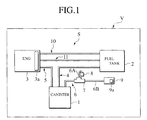
- Fig. 1 is a system diagram of an evaporated fuel treating apparatus S in accordance with the present embodiment in the case of being applied to the internal combustion engine of the vehicle V.
- reference numeral 1 denotes a canister filled with adsorbent (activated carbon or the like) for temporarily adsorbing a fuel component of an evaporated fuel generated within a fuel tank 2.
- adsorbent activated carbon or the like
- An evaporation passage 4 communicating with the fuel tank 2, a purge passage 5 communicating with an intake passage 3a of an intake system in an internal combustion engine 3, and a drain passage 6 communicating with an external portion (atmospheric air) are connected to the canister 1.
- the drain passage 6 is branched into a first drain passage 6A and a second drain passage 6B arranged toward a lower portion of the vehicle relative to the first drain passage 6A so that anatmospheric-air-side end portion thereof is positioned at the lower portion of the vehicle by providing a trifurcate connector 7 in the middle of the drain passage 6.
- a separator 8 mentioned below, is connected to an atmospheric-air-side end portion of the first drain passage 6A, and an atmospheric-air-side end portion of the second drain passage 6B is arranged in the lower position of the vehicle and is connected with a drain box 9.
- the drain box 9 is positioned to be lower than the separator 8.
- a one-way valve 9a for discharging the component other than the fuel component of the evaporated fuel to atmospheric air and restricting intake of atmospheric air to the second drain passage 6B is provided in the drain box 9.
- reference numeral 10 denotes a feed passage for supplying fuel to the internal combustion engine 3 from the fuel tank 2
- reference numeral 11 denotes a return passage for returning surplus fuel to the fuel tank 2 from the internal combustion engine 3.
- Fig. 2 is a perspective view showing a structure around the canister 1 of the evaporated fuel treating apparatus S in accordance with the present embodiment
- Fig. 3 is a cross-sectional view particularly showing a separator 8.
- an arrow UPR in Fig. 2 indicates an upward direction of the vehicle.
- the evaporation passage 4 and the purge passage 5 are connected to the canister 1 by an evaporation connector 4a and a purge connector 5a, respectively, and one end of the drain passage 6 is connected to a drain connector 6a provided on an upper surface of the canister 1.
- Reference numeral 7 denotes the above-mentioned trifurcate connector provided in the middle of the drain passage 6.
- the trifurcate connector 7 has connector portions 7a, 7b, and 7c.
- the trifurcate connector 7 is mounted to a side wall portion of the canister 1, and the connector portions 7a, 7b,and 7c are respectively connected to one end of the first drain passage 6A, one end of the second drain passage 6B, and the other end of the drain passage 6.
- Reference numeral 11 denotes a bracket for fixing the canister 1 to a vehicle body 12.
- the bracket 11 is fixed to the vehicle body 12 by clips 14, or the like.
- the separator 8 has the function to separate and remove the introduced water thereinto and is mounted to the bracket 11 via a leg portion 15 integrally provided in an outer side wall thereof.
- the separator 8 is positioned near the bracket with keeping a predetermined gap between the lower surface of the separator 8 and the upper surface of the bracket 11.
- the separator 8 is provided with a connector portion 8a connected with the first drain passage 6A so as to communicate therewith, a side wall portion 8b having an area greater than that of the drain passage 6A, and a bottom wall portion 8c closing a lower end thereof, as shown in Fig. 3.
- a plurality of ports 16 opened to atmospheric air and a plurality of drain holes 17 are respectively formed in the side wall portion 8b and the bottom wall portion 8c.
- the connector portion 8a is set above the ports 16 opened to atmospheric air.
- the bracket 11 positioned below the bottom wall portion 8c is entirely overlapped with the bottom wall portion 8c as seen from an upper portion, and thus the drain holes 17 of the bottom wall portion 8c are not directly exposed downward. Further, the drain holes 17 are positioned above a lower end portion 8d of the side wall portion 8b.
- the evaporated fuel is fed to the canister 1 via the evaporation passage 4, the fuel component of the evaporated fuel is adsorbed in the adsorbent filled in the canister 1, and only the component obtained such that the fuel component is removed from the evaporated fuel, that is, substantial air is released to the outside via the drain passage 6, that is, via the path passing through the trifurcate connector 7, the first drain passage 6A, and the separator 8, and the path passing through the trifurcate connector 7, the second drain passage 6B, and the drain box 9, respectively.
- the fuel component of the evaporated fuel adsorbed in the canister 1 is sucked from the drain passage 6, that is, sucked together with atmospheric air (so-called clean air) sucked from the first drain passage 6A via the separator 8 due to the negative pressure of the intake passage 3a of the internal combustion engine 3, and is fed within the cylinders of the internal combustion engine 3 via the intake passage 3a from the purge passage 5 as purge gas.
- the fuel component of the evaporated fuel adsorbed in the canister 1 is returned to the fuel tank 1 from the drain passage 6, that is, returned together with atmospheric air (so-called clean air) sucked from the first drain passage 6A via the separator 8.
- the separator 8 for separating and removing the water in the introduced air is provided in atmospheric-air-side end portion of the first drain passage 6A, the separator 8 is provided with the connector portion 8a communicated and connected with the first drain passage 6A to communicate therewith, the side wall portion 8b larger than the first drain passage 6A and the bottom wall portion 8c closing the lower end, a plurality of ports 16 opened to atmospheric air are provided in the side wall portion 8b of the separator 8, and the drain holes 17 are provided in the bottom wall portion 8c, it is possible to effectively remove water, as a component in the introduced air, by the separator 8 mentioned above.
- the connector portion 8a is positioned at least above the ports 16 opened to atmospheric air, it is possible to effectively prevent water from directly entering to the first drain passage 6A even if water enters from the ports 16 opened to atmospheric air.
- the separator 8 is mounted to the bracket 11 in an approximate manner with keeping a predetermined gap between the lower surface of the separator 8 and the upper surface of the bracket 11, it is possible to effectively prevent water from entering from the drain holes 17 provided in the bottom wall portion 8c even if the lower portion of the separator 8 is subjected to water splashing or the like.
- drain passage 6 is branched into the first drain passage 6A and the second drain passage 6B arranged downward from the first drain passage 6A by the trifurcate connector 7, it is possible to securely keep communication with atmospheric air by the first drain passage 6A even if the second drain passage 6B is closed by dirt, ice, or the like.
- the one-way valve 9a for restricting intake of atmospheric air is provided in the drain box 9 provided in atmospheric air side end portion of the second drain passage 6B arranged in the lower portion of the vehicle, the second drain passage 6B communicates with atmospheric air only at an exhaust time, so that it is possible to keep exhaust gas away from the inside of the occupant compartment in the vehicle and it is possible to effectively prevent water from entering from the second drain passage 6B, which is arranged in the lower portion of the vehicle and may be easily affected by water splashing or the like.
- the separator 8 is fixed to the vehicle body 12 via the bracket 11, but the present invention is, of course, not limited to such a structure.
- the separator 8 may be directly mounted to the vehicle body member or the like by an integrally formed clip or the like.
- the structure in which a plurality of atmospheric air releasing holes 16 and drain holes 17 are provided is shown, but the number, the size, the shape and the like thereof may be suitably set, and only one hole may be provided for each if the holes 16 and 17 as occasion demands.
Landscapes
- Engineering & Computer Science (AREA)
- Chemical & Material Sciences (AREA)
- Combustion & Propulsion (AREA)
- Mechanical Engineering (AREA)
- General Engineering & Computer Science (AREA)
- Supplying Secondary Fuel Or The Like To Fuel, Air Or Fuel-Air Mixtures (AREA)
- Separation Of Gases By Adsorption (AREA)
Abstract
Description
- The present invention relates to an evaporated fuel treating apparatus and an evaporated fuel treating method both of which prevent evaporated fuel generated within a fuel tank from being discharged to atmospheric air with employing a canister filled with adsorbent for temporarily adsorbing or occluding the evaporated fuel, and more particularly to a structure of a drain passage causing the canister to communicate with atmospheric air thereof.
- There is an evaporated fuel treating apparatus structured such that a canister filled with adsorbent (activated carbon or the like) for temporarily adsorbing a fuel component of evaporated fuel is provided in order to prevent the evaporated fuel generated within a fuel tank from diffusing in atmospheric air, whereby the evaporated fuel is temporarily adsorbed by the adsorbent during stop of an internal combustion engine and the evaporated fuel is introduced to an intake system (an intake passage or the like) during operation of the internal combustion engine.
- In particular, an evaporation passage communicating with a fuel tank, a purge passage communicating with the intake system in the internal combustion engine, and a drain passage communicating with atmospheric air are connected to the canister of the evaporated fuel treating apparatus mentioned above.
- In the structure mentioned above, when a pressure within the fuel tank becomes equal to a predetermined pressure or more due to generation of the evaporated fuel at a time when the internal combustion engine is stopped, the evaporated fuel is fed to the canister via the evaporation passage, and a fuel component of the evaporated fuel is adsorbed in the adsorbent of the canister. Then, only air from which the fuel component is removed is released to atmospheric air from a port opened to atmospheric air provided in an end portion of the drain passage.
- On the contrary, when the internal combustion engine is operated, the fuel component of the evaporated fuel adsorbed in the canister is sucked together with atmospheric air (so-called clean air) sucked from the drain passage due to a negative pressure of the intake passage in the internal combustion engine, and also is fed within cylinders in the internal combustion engine via the intake passage from the purge passage as purge gas.
- Further, when the fuel tank is cooled due to the influence of environmental temperature or the like and the inside of the fuel tank becomes a negative pressure, the fuel component of the evaporated fuel adsorbed in the canister is returned to the fuel tank together with atmospheric air (so-called clean air) sucked from the drain passage.
- In recent years, there has been proposed a structure in which adsorbing performance of the canister is increased and the port opened to atmospheric air provided in the end portion of the drain passage is arranged in a lower position of a vehicle so as to be apart from an occupant compartment as far as possible, thereby preventing the evaporated fuel from entering within the occupant compartment (refer to Japanese Patent Application Laid-Open Publication No. 6-99748).
- However, in the case that the port opened to atmospheric air is provided in the lower position of the vehicle, the port opened to atmospheric air is positioned near a road surface, so that there is a drawback that water may enter into the canister via the drain passage due to splash of water at a raining time or the like.
- As mentioned above, if water should enter into the canister, it is considered that the canister may be influenced regarding the evaporated fuel adsorbing performance.
- Particularly, in recent years, in order to thoroughly prevent the evaporated fuel from being diffused into atmospheric air, there is employed a so-called bottom close type canister in which a lower side of the canister is closed so as to lengthen an adsorbing passage and improve adsorbing performance, so that it is required to thoroughly prevent water from entering into the canister.
- Accordingly, an object of the present invention is to provide an evaporated fuel treating apparatus and an evaporated fuel treating method both of which can effectively prevent water from entering into a canister via a drain passage so as to improve evaporated fuel adsorbing performance of the canister.
- In accordance with the present invention, there is provided an evaporated fuel treating apparatus comprising a canister filled with adsorbent temporarily adsorbing a fuel component in an evaporated fuel generated within a fuel tank for an internal combustion engine, a drain passage causing the canister to communicate with atmospheric air, and a separator arranged in an atmospheric air side end portion of the drain passage to separate and remove water in air introduced into the separator. The separator is provided with a connector portion communicating with the drain passage, a side wall portion having a port opened to the atmospheric air and a bottom wall portion having a drain hole.
- In other words, an evaporated fuel treating apparatus of the present invention comprises a canister filled with adsorbent temporarily adsorbing a fuel component in an evaporated fuel generated within a fuel tank for an internal combustion engine, a drain passage causing the canister to communicate with atmospheric air, and a separator arranged in an atmospheric air side end portion of the drain passage to separate and remove water in air introduced into the separator. The separator is provided with first communicating means for communicating with the drain passage, second communicating means for communicating with the atmospheric air and draining means for draining water.
- Beside, an evaporated fuel treating method of the present invention comprises, temporarily adsorbing a fuel component in an evaporated fuel generated within a fuel tank for an internal combustion engine, introducing air in correspondence with a negative pressure generated in the internal combustion engine or a negative pressure generated in the fuel tank, separating and removing water of the introduced air, and sending the temporarily adsorbed fuel component to the internal combustion engine or the fuel tank together with the introduced air in which the water is separated and removed.
-
- Fig. 1 is a diagram showing a structure of an evaporated fuel treating apparatus in accordance with an embodiment of the present invention;
- Fig. 2 is a perspective view showing a structure around a canister in accordance with the embodiment; and
- Fig. 3 is a cross-sectional view of a separator in accordance with the embodiment.
-
- A description will be in detail given below of an evaporated fuel treating apparatus and an evaporated fuel treating method in accordance with an embodiment of the present invention suitably with reference to the accompanying drawings by exemplifying a structure applied to an evaporated fuel treating apparatus and an evaporated fuel treating method of an internal combustion engine of a vehicle.
- Fig. 1 is a system diagram of an evaporated fuel treating apparatus S in accordance with the present embodiment in the case of being applied to the internal combustion engine of the vehicle V.
- In Fig. 1,
reference numeral 1 denotes a canister filled with adsorbent (activated carbon or the like) for temporarily adsorbing a fuel component of an evaporated fuel generated within afuel tank 2. - An
evaporation passage 4 communicating with thefuel tank 2, apurge passage 5 communicating with anintake passage 3a of an intake system in aninternal combustion engine 3, and adrain passage 6 communicating with an external portion (atmospheric air) are connected to thecanister 1. - The
drain passage 6 is branched into afirst drain passage 6A and asecond drain passage 6B arranged toward a lower portion of the vehicle relative to thefirst drain passage 6A so that anatmospheric-air-side end portion thereof is positioned at the lower portion of the vehicle by providing atrifurcate connector 7 in the middle of thedrain passage 6. - A
separator 8, mentioned below, is connected to an atmospheric-air-side end portion of thefirst drain passage 6A, and an atmospheric-air-side end portion of thesecond drain passage 6B is arranged in the lower position of the vehicle and is connected with adrain box 9. Thedrain box 9 is positioned to be lower than theseparator 8. - Further, a one-
way valve 9a for discharging the component other than the fuel component of the evaporated fuel to atmospheric air and restricting intake of atmospheric air to thesecond drain passage 6B is provided in thedrain box 9. - Incidentally, in Fig. 1,
reference numeral 10 denotes a feed passage for supplying fuel to theinternal combustion engine 3 from thefuel tank 2, andreference numeral 11 denotes a return passage for returning surplus fuel to thefuel tank 2 from theinternal combustion engine 3. - A description will be in more detail given below of a structure of the
drain passage 6 for causing thecanister 1 to communicate with the external portion (atmospheric air) further with reference to Figs. 2 and 3. - Fig. 2 is a perspective view showing a structure around the
canister 1 of the evaporated fuel treating apparatus S in accordance with the present embodiment, and Fig. 3 is a cross-sectional view particularly showing aseparator 8. Incidentally, an arrow UPR in Fig. 2 indicates an upward direction of the vehicle. - In this case, the
evaporation passage 4 and thepurge passage 5 are connected to thecanister 1 by anevaporation connector 4a and apurge connector 5a, respectively, and one end of thedrain passage 6 is connected to adrain connector 6a provided on an upper surface of thecanister 1. -
Reference numeral 7 denotes the above-mentioned trifurcate connector provided in the middle of thedrain passage 6. Thetrifurcate connector 7 hasconnector portions - In particular, the
trifurcate connector 7 is mounted to a side wall portion of thecanister 1, and theconnector portions first drain passage 6A, one end of thesecond drain passage 6B, and the other end of thedrain passage 6. - Then, the other end of the
first drain passage 6A and the other end of thesecond drain passage 6B are respectively connected to aconnector portion 8a of theseparator 8 and thedrain box 9 shown in Fig. 1. -
Reference numeral 11 denotes a bracket for fixing thecanister 1 to avehicle body 12. Thebracket 11 is fixed to thevehicle body 12 byclips 14, or the like. - The
separator 8 has the function to separate and remove the introduced water thereinto and is mounted to thebracket 11 via aleg portion 15 integrally provided in an outer side wall thereof. In particular, theseparator 8 is positioned near the bracket with keeping a predetermined gap between the lower surface of theseparator 8 and the upper surface of thebracket 11. - The
separator 8 is provided with aconnector portion 8a connected with thefirst drain passage 6A so as to communicate therewith, aside wall portion 8b having an area greater than that of thedrain passage 6A, and abottom wall portion 8c closing a lower end thereof, as shown in Fig. 3. A plurality ofports 16 opened to atmospheric air and a plurality ofdrain holes 17 are respectively formed in theside wall portion 8b and thebottom wall portion 8c. - Further, in particular, the
connector portion 8a is set above theports 16 opened to atmospheric air. Thebracket 11 positioned below thebottom wall portion 8c is entirely overlapped with thebottom wall portion 8c as seen from an upper portion, and thus thedrain holes 17 of thebottom wall portion 8c are not directly exposed downward. Further, thedrain holes 17 are positioned above alower end portion 8d of theside wall portion 8b. - Next, in the structure mentioned above, a description will be given of the operation of the evaporated fuel treating apparatus S in accordance with the present embodiment.
- At first, when a pressure within the
fuel tank 2 becomes equal to or more than a predetermined pressure due to generation of an evaporated fuel during stop of theinternal combustion engine 3, the evaporated fuel is fed to thecanister 1 via theevaporation passage 4, the fuel component of the evaporated fuel is adsorbed in the adsorbent filled in thecanister 1, and only the component obtained such that the fuel component is removed from the evaporated fuel, that is, substantial air is released to the outside via thedrain passage 6, that is, via the path passing through thetrifurcate connector 7, thefirst drain passage 6A, and theseparator 8, and the path passing through thetrifurcate connector 7, thesecond drain passage 6B, and thedrain box 9, respectively. - On the contrary, during operation of the
internal combustion engine 3 the fuel component of the evaporated fuel adsorbed in thecanister 1 is sucked from thedrain passage 6, that is, sucked together with atmospheric air (so-called clean air) sucked from thefirst drain passage 6A via theseparator 8 due to the negative pressure of theintake passage 3a of theinternal combustion engine 3, and is fed within the cylinders of theinternal combustion engine 3 via theintake passage 3a from thepurge passage 5 as purge gas. - Further, when the
fuel tank 2 is cooled due to the influence of an environmental temperature or the like and the inside of thefuel tank 2 becomes negative pressure, the fuel component of the evaporated fuel adsorbed in thecanister 1 is returned to thefuel tank 1 from thedrain passage 6, that is, returned together with atmospheric air (so-called clean air) sucked from thefirst drain passage 6A via theseparator 8. - In accordance with the embodiment mentioned above, since the
separator 8 for separating and removing the water in the introduced air is provided in atmospheric-air-side end portion of thefirst drain passage 6A, theseparator 8 is provided with theconnector portion 8a communicated and connected with thefirst drain passage 6A to communicate therewith, theside wall portion 8b larger than thefirst drain passage 6A and thebottom wall portion 8c closing the lower end, a plurality ofports 16 opened to atmospheric air are provided in theside wall portion 8b of theseparator 8, and thedrain holes 17 are provided in thebottom wall portion 8c, it is possible to effectively remove water, as a component in the introduced air, by theseparator 8 mentioned above. - Accordingly, it is possible to prevent water from accidentally entering into the
canister 1 via thedrain passage 6, and it is possible to effectively prevent the adsorbing performance of the evaporated fuel by thecanister 1 from being influenced. - Further, since such a structure is employed such that the separated and removed water is discharged out of the
separator 8 by thedrain holes 17 provided in thebottom wall portion 8c in the manner mentioned above, it is possible to effectively prevent the separated and removed water from entering in thedrain passage 6. - In particular, in addition to the effects mentioned above, since the
connector portion 8a is positioned at least above theports 16 opened to atmospheric air, it is possible to effectively prevent water from directly entering to thefirst drain passage 6A even if water enters from theports 16 opened to atmospheric air. - Further, since the
separator 8 is mounted to thebracket 11 in an approximate manner with keeping a predetermined gap between the lower surface of theseparator 8 and the upper surface of thebracket 11, it is possible to effectively prevent water from entering from thedrain holes 17 provided in thebottom wall portion 8c even if the lower portion of theseparator 8 is subjected to water splashing or the like. - Further, since the
drain passage 6 is branched into thefirst drain passage 6A and thesecond drain passage 6B arranged downward from thefirst drain passage 6A by thetrifurcate connector 7, it is possible to securely keep communication with atmospheric air by thefirst drain passage 6A even if thesecond drain passage 6B is closed by dirt, ice, or the like. - Further, since the one-
way valve 9a for restricting intake of atmospheric air is provided in thedrain box 9 provided in atmospheric air side end portion of thesecond drain passage 6B arranged in the lower portion of the vehicle, thesecond drain passage 6B communicates with atmospheric air only at an exhaust time, so that it is possible to keep exhaust gas away from the inside of the occupant compartment in the vehicle and it is possible to effectively prevent water from entering from thesecond drain passage 6B, which is arranged in the lower portion of the vehicle and may be easily affected by water splashing or the like. - In the embodiment mentioned above, the
separator 8 is fixed to thevehicle body 12 via thebracket 11, but the present invention is, of course, not limited to such a structure. For example, theseparator 8 may be directly mounted to the vehicle body member or the like by an integrally formed clip or the like. - Further, the structure in which a plurality of atmospheric
air releasing holes 16 anddrain holes 17 are provided is shown, but the number, the size, the shape and the like thereof may be suitably set, and only one hole may be provided for each if theholes - The entire contents of Patent Application No. TOKUGANHEI 11-340618 with a filing date of Nov. 30, 1999 in Japan are hereby incorporated by reference.
- Although the invention has been described above by reference to a certain embodiment of the invention, the invention is not limited to the embodiment described above. Modifications and variations of the embodiment described above will occur to those skilled in the art, in light of the teachings. The scope of the invention is defined with reference to the following claims.
Claims (9)
- Apparatus for treating evaporated fuel, comprising:a canister (1) containing adsorbent temporarily adsorbing a fuel component in an evaporated fuel which is generated within a fuel tank for an internal combustion engine;a drain passage (6) causing the canister (1) to communicate with atmospheric air; anda separator (8) arranged in an atmospheric-air-side end portion of the drain passage (6) to separate and remove water from air introduced thereinto, the separator (8) being provided with a connector portion (8a) communicating with the drain passage (6), a side wall portion (8b) having a port (16) opened to the atmospheric air, and a bottom wall portion (8c) having a drain hole (17).
- Apparatus as claimed in claim 1, wherein the connector portion (8a) is arranged above the port (16) opened to atmospheric air.
- Apparatus as claimed in claim 1 or 2, including a member (11) for mounting the separator (8) to a vehicle body side, the mounting member (11) being arranged near and at a lower position than the bottom wall portion (8c), and overlapping with the drain hole (17).
- Apparatus as claimed in claim 3, wherein the mounting member (11) also mounts the canister (1) to the vehicle body side.
- Apparatus as claimed in any preceding claim, wherein the drain passage (6) is branched into a first passage (6A) and a second passage (6B) arranged at a lower position than the first passage (6A), and the separator (8) is provided in an atmospheric-air-side end portion of the first passage (6A).
- Apparatus as claimed in claim 5, wherein the drain passage (6) is branched into the first passage (6A) and the second passage (6B) by a trifurcate connector (7).
- Apparatus as claimed in claim 5 or 6, wherein an atmospheric-air-side end portion of the second passage (6B) is arranged at a lower position than the separator (8) and has a one-way valve (9a) restricting intake of atmospheric air.
- Apparatus for treating evaporated fuel, comprising:a canister (1) containing adsorbent temporarily adsorbing a fuel component in an evaporated fuel which is generate within a fuel tank for an internal combustion engine;a drain passage (6) causing the canister (1) to communicate with atmospheric air; anda separator (8) arranged in an atmospheric-air-side end portion of the drain passage (6) to separate and remove water from air introduced thereinto, the separator (8) being provided with means for communicating with the drain passage (6), means for communicating with the atmospheric air, and means for draining water.
- A method of treating evaporated fuel, comprising:temporarily adsorbing a fuel component in an evaporated fuel which is generated within a fuel tank for an internal combustion engine;introducing air in correspondence with a negative pressure generated in the internal combustion engine or a negative pressure generated in the fuel tank;separating and removing water from the introduced air; andsending the temporarily adsorbed fuel component to the internal combustion engine or the fuel tank together with the introduced air from which the water has been separated and removed.
Applications Claiming Priority (2)
| Application Number | Priority Date | Filing Date | Title |
|---|---|---|---|
| JP34061899A JP3675263B2 (en) | 1999-11-30 | 1999-11-30 | Evaporative fuel processing equipment |
| JP34061899 | 1999-11-30 |
Publications (3)
| Publication Number | Publication Date |
|---|---|
| EP1106814A2 true EP1106814A2 (en) | 2001-06-13 |
| EP1106814A3 EP1106814A3 (en) | 2002-03-27 |
| EP1106814B1 EP1106814B1 (en) | 2003-10-08 |
Family
ID=18338706
Family Applications (1)
| Application Number | Title | Priority Date | Filing Date |
|---|---|---|---|
| EP20000310424 Expired - Lifetime EP1106814B1 (en) | 1999-11-30 | 2000-11-23 | Evaporated fuel treating apparatus and method |
Country Status (3)
| Country | Link |
|---|---|
| EP (1) | EP1106814B1 (en) |
| JP (1) | JP3675263B2 (en) |
| DE (1) | DE60005771T2 (en) |
Families Citing this family (3)
| Publication number | Priority date | Publication date | Assignee | Title |
|---|---|---|---|---|
| JP4935456B2 (en) * | 2007-03-27 | 2012-05-23 | 日産自動車株式会社 | Canister intake / exhaust device and canister intake / exhaust drain container |
| JP5045425B2 (en) | 2007-12-25 | 2012-10-10 | マツダ株式会社 | Canister structure |
| JP7473874B2 (en) * | 2020-05-14 | 2024-04-24 | 三菱自動車工業株式会社 | Vehicle canister device |
Citations (2)
| Publication number | Priority date | Publication date | Assignee | Title |
|---|---|---|---|---|
| JPH0699748A (en) | 1992-09-18 | 1994-04-12 | Mazda Motor Corp | Vaporized fuel disposing device for vehicle |
| JPH11340618A (en) | 1998-05-25 | 1999-12-10 | Fujitsu Ten Ltd | Oxygen concentration controller for soldering equipment |
Family Cites Families (5)
| Publication number | Priority date | Publication date | Assignee | Title |
|---|---|---|---|---|
| JPH05223023A (en) * | 1992-02-07 | 1993-08-31 | Toyota Motor Corp | Canister protector |
| JP3500865B2 (en) * | 1995-12-19 | 2004-02-23 | 日産自動車株式会社 | Car canister structure |
| JPH09296755A (en) * | 1996-05-07 | 1997-11-18 | Honda Motor Co Ltd | Canister intake and exhaust structure |
| JP3330048B2 (en) * | 1997-03-04 | 2002-09-30 | 本田技研工業株式会社 | Canister drain pipe |
| JPH10281020A (en) * | 1997-04-01 | 1998-10-20 | Suzuki Motor Corp | Canister mounting bracket |
-
1999
- 1999-11-30 JP JP34061899A patent/JP3675263B2/en not_active Expired - Fee Related
-
2000
- 2000-11-23 EP EP20000310424 patent/EP1106814B1/en not_active Expired - Lifetime
- 2000-11-23 DE DE2000605771 patent/DE60005771T2/en not_active Expired - Fee Related
Patent Citations (2)
| Publication number | Priority date | Publication date | Assignee | Title |
|---|---|---|---|---|
| JPH0699748A (en) | 1992-09-18 | 1994-04-12 | Mazda Motor Corp | Vaporized fuel disposing device for vehicle |
| JPH11340618A (en) | 1998-05-25 | 1999-12-10 | Fujitsu Ten Ltd | Oxygen concentration controller for soldering equipment |
Also Published As
| Publication number | Publication date |
|---|---|
| JP3675263B2 (en) | 2005-07-27 |
| EP1106814B1 (en) | 2003-10-08 |
| JP2001152972A (en) | 2001-06-05 |
| DE60005771D1 (en) | 2003-11-13 |
| DE60005771T2 (en) | 2004-08-12 |
| EP1106814A3 (en) | 2002-03-27 |
Similar Documents
| Publication | Publication Date | Title |
|---|---|---|
| US6875258B2 (en) | Fuel tank assembly | |
| US4727955A (en) | Carbon canister drained vapor diffusing device | |
| US9022008B2 (en) | Evaporative emissions system with canister having improved venting structure, and vehicle including same | |
| US6868843B2 (en) | Engine blowby gas processing system | |
| US5855198A (en) | Canister system | |
| US7407179B2 (en) | Saddle-ride type vehicle | |
| US5803054A (en) | Evaporative fuel-processing system for internal combustion engines for vehicles | |
| JP2002213311A (en) | Air cleaner structure for vehicles | |
| JP2009068350A (en) | Structure of air introduction part | |
| EP1106814A2 (en) | Evaporated fuel treating apparatus and method | |
| GB2227215A (en) | Motor vehicle front engine air intake arrangement | |
| US20030089323A1 (en) | Internal combustion engine with at least two cylinder bank rows | |
| US6161526A (en) | Solenoid valve fixing structure | |
| EP3184408B1 (en) | Motorcycle | |
| JP2000008951A (en) | Direct injection diesel engine | |
| JP3788706B2 (en) | Vehicle fuel tank system | |
| JPH0699748A (en) | Vaporized fuel disposing device for vehicle | |
| JP2022153890A (en) | Intake manifold of engine for automobile | |
| JPH0914060A (en) | Engine canister device | |
| US10563627B2 (en) | Air cleaner unit and engine having the same | |
| JPH0534989Y2 (en) | ||
| JP4359835B2 (en) | Canister mounting structure | |
| JPH0640894Y2 (en) | Engine breather device | |
| JP2001003819A (en) | Canister mounting structure | |
| JP2008522073A (en) | Automotive internal combustion engine including continuous diesel fuel recovery surface |
Legal Events
| Date | Code | Title | Description |
|---|---|---|---|
| PUAI | Public reference made under article 153(3) epc to a published international application that has entered the european phase |
Free format text: ORIGINAL CODE: 0009012 |
|
| 17P | Request for examination filed |
Effective date: 20001204 |
|
| AK | Designated contracting states |
Kind code of ref document: A2 Designated state(s): AT BE CH CY DE DK ES FI FR GB GR IE IT LI LU MC NL PT SE TR Kind code of ref document: A2 Designated state(s): DE GB |
|
| AX | Request for extension of the european patent |
Free format text: AL;LT;LV;MK;RO;SI |
|
| PUAL | Search report despatched |
Free format text: ORIGINAL CODE: 0009013 |
|
| AK | Designated contracting states |
Kind code of ref document: A3 Designated state(s): AT BE CH CY DE DK ES FI FR GB GR IE IT LI LU MC NL PT SE TR |
|
| AX | Request for extension of the european patent |
Free format text: AL;LT;LV;MK;RO;SI |
|
| 17Q | First examination report despatched |
Effective date: 20020813 |
|
| AKX | Designation fees paid |
Free format text: DE GB |
|
| GRAH | Despatch of communication of intention to grant a patent |
Free format text: ORIGINAL CODE: EPIDOS IGRA |
|
| GRAS | Grant fee paid |
Free format text: ORIGINAL CODE: EPIDOSNIGR3 |
|
| GRAA | (expected) grant |
Free format text: ORIGINAL CODE: 0009210 |
|
| AK | Designated contracting states |
Kind code of ref document: B1 Designated state(s): DE GB |
|
| REG | Reference to a national code |
Ref country code: GB Ref legal event code: FG4D |
|
| REG | Reference to a national code |
Ref country code: IE Ref legal event code: FG4D |
|
| REF | Corresponds to: |
Ref document number: 60005771 Country of ref document: DE Date of ref document: 20031113 Kind code of ref document: P |
|
| PLBE | No opposition filed within time limit |
Free format text: ORIGINAL CODE: 0009261 |
|
| STAA | Information on the status of an ep patent application or granted ep patent |
Free format text: STATUS: NO OPPOSITION FILED WITHIN TIME LIMIT |
|
| REG | Reference to a national code |
Ref country code: IE Ref legal event code: MM4A |
|
| 26N | No opposition filed |
Effective date: 20040709 |
|
| PGFP | Annual fee paid to national office [announced via postgrant information from national office to epo] |
Ref country code: DE Payment date: 20081120 Year of fee payment: 9 |
|
| PGFP | Annual fee paid to national office [announced via postgrant information from national office to epo] |
Ref country code: GB Payment date: 20091118 Year of fee payment: 10 |
|
| PG25 | Lapsed in a contracting state [announced via postgrant information from national office to epo] |
Ref country code: DE Free format text: LAPSE BECAUSE OF NON-PAYMENT OF DUE FEES Effective date: 20100601 |
|
| GBPC | Gb: european patent ceased through non-payment of renewal fee |
Effective date: 20101123 |
|
| PG25 | Lapsed in a contracting state [announced via postgrant information from national office to epo] |
Ref country code: GB Free format text: LAPSE BECAUSE OF NON-PAYMENT OF DUE FEES Effective date: 20101123 |