EP1101802B1 - Granulatförmige Organosilan-Präparation, Verfahren zu ihrer Herstellung und ihrer Verwendung - Google Patents
Granulatförmige Organosilan-Präparation, Verfahren zu ihrer Herstellung und ihrer Verwendung Download PDFInfo
- Publication number
- EP1101802B1 EP1101802B1 EP00124045A EP00124045A EP1101802B1 EP 1101802 B1 EP1101802 B1 EP 1101802B1 EP 00124045 A EP00124045 A EP 00124045A EP 00124045 A EP00124045 A EP 00124045A EP 1101802 B1 EP1101802 B1 EP 1101802B1
- Authority
- EP
- European Patent Office
- Prior art keywords
- organosilane
- filler
- printex
- producing
- corax
- Prior art date
- Legal status (The legal status is an assumption and is not a legal conclusion. Google has not performed a legal analysis and makes no representation as to the accuracy of the status listed.)
- Expired - Lifetime
Links
- 150000001282 organosilanes Chemical class 0.000 title claims abstract description 53
- 238000002360 preparation method Methods 0.000 title claims description 35
- 238000000034 method Methods 0.000 title claims description 10
- 230000008569 process Effects 0.000 title claims description 9
- 238000004519 manufacturing process Methods 0.000 title abstract description 4
- 239000000945 filler Substances 0.000 claims abstract description 33
- 238000002156 mixing Methods 0.000 claims description 21
- 239000006229 carbon black Substances 0.000 claims description 19
- 239000000203 mixture Substances 0.000 claims description 9
- BLRPTPMANUNPDV-UHFFFAOYSA-N Silane Chemical compound [SiH4] BLRPTPMANUNPDV-UHFFFAOYSA-N 0.000 claims description 8
- 229910000077 silane Inorganic materials 0.000 claims description 8
- 239000000843 powder Substances 0.000 claims description 6
- 150000001875 compounds Chemical class 0.000 claims 1
- 239000008187 granular material Substances 0.000 abstract description 3
- OKTJSMMVPCPJKN-UHFFFAOYSA-N Carbon Chemical compound [C] OKTJSMMVPCPJKN-UHFFFAOYSA-N 0.000 description 32
- 235000019241 carbon black Nutrition 0.000 description 18
- 239000013590 bulk material Substances 0.000 description 15
- 239000007789 gas Substances 0.000 description 15
- 230000000052 comparative effect Effects 0.000 description 11
- 239000007787 solid Substances 0.000 description 11
- 239000000463 material Substances 0.000 description 10
- 239000000047 product Substances 0.000 description 9
- 238000003860 storage Methods 0.000 description 9
- 238000012360 testing method Methods 0.000 description 7
- IJGRMHOSHXDMSA-UHFFFAOYSA-N Atomic nitrogen Chemical compound N#N IJGRMHOSHXDMSA-UHFFFAOYSA-N 0.000 description 6
- 239000011324 bead Substances 0.000 description 6
- 238000005469 granulation Methods 0.000 description 6
- 230000003179 granulation Effects 0.000 description 6
- 239000007788 liquid Substances 0.000 description 6
- 230000015572 biosynthetic process Effects 0.000 description 5
- 238000009826 distribution Methods 0.000 description 5
- 239000004071 soot Substances 0.000 description 5
- 239000007858 starting material Substances 0.000 description 5
- VYPSYNLAJGMNEJ-UHFFFAOYSA-N Silicium dioxide Chemical compound O=[Si]=O VYPSYNLAJGMNEJ-UHFFFAOYSA-N 0.000 description 4
- 238000004873 anchoring Methods 0.000 description 4
- 238000007711 solidification Methods 0.000 description 4
- 230000008023 solidification Effects 0.000 description 4
- 238000005303 weighing Methods 0.000 description 4
- NINIDFKCEFEMDL-UHFFFAOYSA-N Sulfur Chemical compound [S] NINIDFKCEFEMDL-UHFFFAOYSA-N 0.000 description 3
- 238000000889 atomisation Methods 0.000 description 3
- 125000004432 carbon atom Chemical group C* 0.000 description 3
- 229910052757 nitrogen Inorganic materials 0.000 description 3
- 239000011049 pearl Substances 0.000 description 3
- 239000000126 substance Substances 0.000 description 3
- 229910052717 sulfur Inorganic materials 0.000 description 3
- 239000011593 sulfur Substances 0.000 description 3
- ZCYVEMRRCGMTRW-UHFFFAOYSA-N 7553-56-2 Chemical compound [I] ZCYVEMRRCGMTRW-UHFFFAOYSA-N 0.000 description 2
- LZZYPRNAOMGNLH-UHFFFAOYSA-M Cetrimonium bromide Chemical compound [Br-].CCCCCCCCCCCCCCCC[N+](C)(C)C LZZYPRNAOMGNLH-UHFFFAOYSA-M 0.000 description 2
- BPQQTUXANYXVAA-UHFFFAOYSA-N Orthosilicate Chemical compound [O-][Si]([O-])([O-])[O-] BPQQTUXANYXVAA-UHFFFAOYSA-N 0.000 description 2
- 238000005299 abrasion Methods 0.000 description 2
- 239000003795 chemical substances by application Substances 0.000 description 2
- 230000006872 improvement Effects 0.000 description 2
- 238000010348 incorporation Methods 0.000 description 2
- 229910052740 iodine Inorganic materials 0.000 description 2
- 239000011630 iodine Substances 0.000 description 2
- 230000033001 locomotion Effects 0.000 description 2
- 230000003287 optical effect Effects 0.000 description 2
- JTJMJGYZQZDUJJ-UHFFFAOYSA-N phencyclidine Chemical class C1CCCCN1C1(C=2C=CC=CC=2)CCCCC1 JTJMJGYZQZDUJJ-UHFFFAOYSA-N 0.000 description 2
- 239000000049 pigment Substances 0.000 description 2
- 239000012758 reinforcing additive Substances 0.000 description 2
- 239000007921 spray Substances 0.000 description 2
- XDLMVUHYZWKMMD-UHFFFAOYSA-N 3-trimethoxysilylpropyl 2-methylprop-2-enoate Chemical compound CO[Si](OC)(OC)CCCOC(=O)C(C)=C XDLMVUHYZWKMMD-UHFFFAOYSA-N 0.000 description 1
- LFQSCWFLJHTTHZ-UHFFFAOYSA-N Ethanol Chemical compound CCO LFQSCWFLJHTTHZ-UHFFFAOYSA-N 0.000 description 1
- AFCARXCZXQIEQB-UHFFFAOYSA-N N-[3-oxo-3-(2,4,6,7-tetrahydrotriazolo[4,5-c]pyridin-5-yl)propyl]-2-[[3-(trifluoromethoxy)phenyl]methylamino]pyrimidine-5-carboxamide Chemical compound O=C(CCNC(=O)C=1C=NC(=NC=1)NCC1=CC(=CC=C1)OC(F)(F)F)N1CC2=C(CC1)NN=N2 AFCARXCZXQIEQB-UHFFFAOYSA-N 0.000 description 1
- 101001077374 Oryza sativa subsp. japonica UMP-CMP kinase 3 Proteins 0.000 description 1
- 235000014443 Pyrus communis Nutrition 0.000 description 1
- 230000009471 action Effects 0.000 description 1
- 239000002318 adhesion promoter Substances 0.000 description 1
- 238000005054 agglomeration Methods 0.000 description 1
- 230000002776 aggregation Effects 0.000 description 1
- 125000000217 alkyl group Chemical group 0.000 description 1
- 238000004458 analytical method Methods 0.000 description 1
- 238000010009 beating Methods 0.000 description 1
- 238000007596 consolidation process Methods 0.000 description 1
- 238000011109 contamination Methods 0.000 description 1
- 239000007799 cork Substances 0.000 description 1
- 238000004132 cross linking Methods 0.000 description 1
- 230000001186 cumulative effect Effects 0.000 description 1
- 230000003247 decreasing effect Effects 0.000 description 1
- 238000013461 design Methods 0.000 description 1
- 239000000428 dust Substances 0.000 description 1
- 238000010410 dusting Methods 0.000 description 1
- 230000008030 elimination Effects 0.000 description 1
- 238000003379 elimination reaction Methods 0.000 description 1
- 238000005516 engineering process Methods 0.000 description 1
- 239000003623 enhancer Substances 0.000 description 1
- 239000012467 final product Substances 0.000 description 1
- 230000007062 hydrolysis Effects 0.000 description 1
- 238000006460 hydrolysis reaction Methods 0.000 description 1
- 238000005259 measurement Methods 0.000 description 1
- 238000010327 methods by industry Methods 0.000 description 1
- 150000003961 organosilicon compounds Chemical class 0.000 description 1
- 239000002245 particle Substances 0.000 description 1
- 230000002093 peripheral effect Effects 0.000 description 1
- 229920001296 polysiloxane Polymers 0.000 description 1
- -1 polysiloxanes Polymers 0.000 description 1
- 238000005096 rolling process Methods 0.000 description 1
- 238000010057 rubber processing Methods 0.000 description 1
- 238000013040 rubber vulcanization Methods 0.000 description 1
- 238000012216 screening Methods 0.000 description 1
- 230000035945 sensitivity Effects 0.000 description 1
- 238000000926 separation method Methods 0.000 description 1
- 238000010008 shearing Methods 0.000 description 1
- 239000004460 silage Substances 0.000 description 1
- 150000004756 silanes Chemical class 0.000 description 1
- 150000004760 silicates Chemical class 0.000 description 1
- 238000005496 tempering Methods 0.000 description 1
- 238000012546 transfer Methods 0.000 description 1
- XLYOFNOQVPJJNP-UHFFFAOYSA-N water Substances O XLYOFNOQVPJJNP-UHFFFAOYSA-N 0.000 description 1
Images


Classifications
-
- C—CHEMISTRY; METALLURGY
- C07—ORGANIC CHEMISTRY
- C07F—ACYCLIC, CARBOCYCLIC OR HETEROCYCLIC COMPOUNDS CONTAINING ELEMENTS OTHER THAN CARBON, HYDROGEN, HALOGEN, OXYGEN, NITROGEN, SULFUR, SELENIUM OR TELLURIUM
- C07F7/00—Compounds containing elements of Groups 4 or 14 of the Periodic Table
- C07F7/02—Silicon compounds
- C07F7/08—Compounds having one or more C—Si linkages
- C07F7/18—Compounds having one or more C—Si linkages as well as one or more C—O—Si linkages
-
- C—CHEMISTRY; METALLURGY
- C09—DYES; PAINTS; POLISHES; NATURAL RESINS; ADHESIVES; COMPOSITIONS NOT OTHERWISE PROVIDED FOR; APPLICATIONS OF MATERIALS NOT OTHERWISE PROVIDED FOR
- C09C—TREATMENT OF INORGANIC MATERIALS, OTHER THAN FIBROUS FILLERS, TO ENHANCE THEIR PIGMENTING OR FILLING PROPERTIES ; PREPARATION OF CARBON BLACK ; PREPARATION OF INORGANIC MATERIALS WHICH ARE NO SINGLE CHEMICAL COMPOUNDS AND WHICH ARE MAINLY USED AS PIGMENTS OR FILLERS
- C09C1/00—Treatment of specific inorganic materials other than fibrous fillers; Preparation of carbon black
- C09C1/44—Carbon
- C09C1/48—Carbon black
- C09C1/56—Treatment of carbon black ; Purification
-
- C—CHEMISTRY; METALLURGY
- C08—ORGANIC MACROMOLECULAR COMPOUNDS; THEIR PREPARATION OR CHEMICAL WORKING-UP; COMPOSITIONS BASED THEREON
- C08K—Use of inorganic or non-macromolecular organic substances as compounding ingredients
- C08K9/00—Use of pretreated ingredients
- C08K9/04—Ingredients treated with organic substances
- C08K9/06—Ingredients treated with organic substances with silicon-containing compounds
-
- C—CHEMISTRY; METALLURGY
- C08—ORGANIC MACROMOLECULAR COMPOUNDS; THEIR PREPARATION OR CHEMICAL WORKING-UP; COMPOSITIONS BASED THEREON
- C08K—Use of inorganic or non-macromolecular organic substances as compounding ingredients
- C08K9/00—Use of pretreated ingredients
- C08K9/12—Adsorbed ingredients, e.g. ingredients on carriers
-
- C—CHEMISTRY; METALLURGY
- C09—DYES; PAINTS; POLISHES; NATURAL RESINS; ADHESIVES; COMPOSITIONS NOT OTHERWISE PROVIDED FOR; APPLICATIONS OF MATERIALS NOT OTHERWISE PROVIDED FOR
- C09C—TREATMENT OF INORGANIC MATERIALS, OTHER THAN FIBROUS FILLERS, TO ENHANCE THEIR PIGMENTING OR FILLING PROPERTIES ; PREPARATION OF CARBON BLACK ; PREPARATION OF INORGANIC MATERIALS WHICH ARE NO SINGLE CHEMICAL COMPOUNDS AND WHICH ARE MAINLY USED AS PIGMENTS OR FILLERS
- C09C1/00—Treatment of specific inorganic materials other than fibrous fillers; Preparation of carbon black
- C09C1/28—Compounds of silicon
- C09C1/30—Silicic acid
- C09C1/3081—Treatment with organo-silicon compounds
-
- C—CHEMISTRY; METALLURGY
- C01—INORGANIC CHEMISTRY
- C01P—INDEXING SCHEME RELATING TO STRUCTURAL AND PHYSICAL ASPECTS OF SOLID INORGANIC COMPOUNDS
- C01P2004/00—Particle morphology
- C01P2004/01—Particle morphology depicted by an image
- C01P2004/02—Particle morphology depicted by an image obtained by optical microscopy
-
- C—CHEMISTRY; METALLURGY
- C01—INORGANIC CHEMISTRY
- C01P—INDEXING SCHEME RELATING TO STRUCTURAL AND PHYSICAL ASPECTS OF SOLID INORGANIC COMPOUNDS
- C01P2004/00—Particle morphology
- C01P2004/51—Particles with a specific particle size distribution
-
- C—CHEMISTRY; METALLURGY
- C01—INORGANIC CHEMISTRY
- C01P—INDEXING SCHEME RELATING TO STRUCTURAL AND PHYSICAL ASPECTS OF SOLID INORGANIC COMPOUNDS
- C01P2006/00—Physical properties of inorganic compounds
- C01P2006/10—Solid density
Definitions
- the invention relates to an organosilane preparation, a process for their preparation, and their use.
- Organosilicon compounds are used in rubber technology.
- sulfur-containing alkoxysilanes which are outstandingly suitable as adhesion promoters and enhancers for vulcanizates of rubber mixtures containing silicate fillers, is known.
- These include in particular the organosilanes according to US-PS 38 42 111 ,
- EP 0735579 (A1) describes silane-modified silicate fillers.
- organosilanes which have hitherto been used in the art for the stated purpose are hydrolyzable liquids which condense on contact with gaseous or liquid water with elimination of alcohol to high molecular weight polysiloxanes and thereby at least partially lose their effectiveness as reinforcing additives.
- auxiliary auxiliary chemicals at room temperature as well as the liquid organosilanes, have serious disadvantages compared to solid powdery auxiliary chemicals. They require more effort in storage in silos, in the weighing and dosing. Above all, they show in the preparation of the mixtures on roll mixers a poor miscibility.
- liquid organosilanes are mixed with pulverulent fillers in order to obtain them
- pulverulent fillers In order to compensate for these disadvantages, liquid organosilanes are mixed with pulverulent fillers in order to obtain them
- powdery products While this brings some progress, it is not an optimal solution; because even powdery products are relatively difficult to incorporate in rubber mixtures. So longer mixing times are needed. Dusting causes annoyance and contamination of the environment and machinery.
- the hydrolysis sensitivity of the silanes is not eliminated.
- they experience a significant loss of efficacy during storage of the product. This is expressed, for example, in a decrease in the crosslinking end values in the case of rubber vulcanization.
- the object of the present invention is to provide an organosilane preparation which does not have these disadvantages.
- the invention relates to a granular organosilane preparation consisting of a mixture of one or more organosilanes and one or more fillers, which is characterized in that it has a fines content of less than 2%, preferably less than 0.5%, measured according to ASTM D1508 ,
- the organosilane preparation may have a bead fraction of less than 0.125 mm of less than 2%, preferably less than 0.5%.
- the silane content of the organosilane preparation according to the invention can be from 1 to 70% by weight, preferably from 40 to 55% by weight, based on the organosilane preparation.
- organosilane all known organosilanes, preferably Si 69, Si 264, Si 230, Si 116, Si 216, Si 203, Si 108, Si 118, Si 208, Si 255, Si 270, Si 275, Si 75, Dynasilan MTMO or Dynasilan MEMO from Degussa-Hüls AG.
- the filler content may be from 30 to 99% by weight, preferably from 45 to 60% by weight, based on the organosilane preparation according to the invention.
- Suitable fillers are rubber or pigment blacks, preferably Corax N 121, Corax N 110, Corax N 242, Corax N 234, Corax N 220, Corax N 375, Corax N 356, Corax 347, Corax N 339, Corax N 332, Corax N 330 Corax N 326, Corax N 550, Corax N 539, Corax N 683, Corax N 660, Corax N 774, Corax N 765, Corax N 650, Corax N 762, Durex 0, Corax 3, Corax 4, Corax 9, Corax P, Printex P, Corax S 315, CK 3, Corax XE-1, Printex L, Printex L 6, Corax L 29, Printex XE2, carbon black FW 200, carbon black FW 2, Carbon black FW 2 V, carbon black FW 1, carbon black FW 18, special carbon black 6, carbon black
- carbon blacks having DBP values greater than 100 ml / 100 g are particularly preferred.
- the carbon blacks can be wet-beaded, dry-beaded or used as a powder.
- silicas preferably Ultrasil VN3, Ultrasil VN2, Ultrasil 3370 or Ultrasil 7000 from Degussa-Huls AG, can be used as fillers.
- Another object of the invention is a process for preparing the granular organosilane preparation which is characterized in that at least one organosilane is mixed with a filler and used as a mixing device, a mixing granulator.
- the filler can be added to the mixing granulator by means of a gravimetric powder dosing. By a spiked shaft, the mix can be transported to the exit ( Figure 1).
- the silane can be added volumetrically or gravimetrically.
- the silane can be injected by means of one or more nozzles at one or more positions.
- the mixing temperature may be 40 ° to 140 ° C, preferably 60 ° to 120 ° C.
- the speed may vary in the range of 100 to 1500 rpm, preferably 100 to 1000 rpm.
- the filler throughput can be from 10 to 150 kg / h, preferably 20 to 80 kg / h, vary.
- the current consumption can be from 10 to 30 A.
- the filler throughput for a production plant can vary from 0.5 to 1.5 t / h.
- the peripheral speed of the spiked tips can be between 1 and 30 m / s, preferably between 10 and 20 m / s.
- the residence time of the filler in the mixing granulator may be between 20 and 600 seconds.
- the mixing granulator consists of a horizontally arranged, fixed tube (stator) with a rotating spiked shaft.
- the mixing granulator usually has an inlet region in which the starting filler is fed to the mixing granulator. In this area there is a screw conveyor, which imparts a component of movement in the axial direction to the supplied filler.
- the actual granulation region adjoins the inlet region, in which the filler agglomerates on the inner wall of the stator by mechanical action of the rotating spikes and by rolling off. After leaving the granulation area, the already bead-shaped filler enters the outlet area and is continuously discharged from the mixing granulator.
- the individual areas of the mixing granulator may have different sizes.
- the inlet and outlet area should be kept as small as possible in favor of the granulation area.
- the agglomeration of the filler begins and is completed at the end of this range.
- the organosilane in the first third of the Granulation range over the filler to atomize.
- the incorporation of the organosilane in a later stage of bead formation leads to an inhomogeneous structure of the filler beads and thus to a reduced pearl hardness.
- a further improvement in the homogeneity of the incorporation of the organosilane in the filler can be obtained if several spray nozzles are used for atomization, which are distributed in a plane perpendicular to the spiked shaft on the circumference of the stator.
- the number of nozzles may be conveniently limited to two to five.
- the nozzles are arranged in a plane perpendicular to the spiked shaft to ensure a good homogeneity of the interference.
- the granular organosilane preparation according to the invention advantageously shows a better pneumatic delivery, better ensiling and better incorporability in rubber compared to known organosilane preparations.
- the mixing granulator consists of a horizontally arranged fixed tube, the stator 1, and an axially arranged therein rotating spiked shaft 2 with the spirally arranged spines 3. Between the spiked shaft 2 and the stator 1 is the pearl room of the mixing granulator.
- the filler is fed to the granulator at the inlet 5.
- a screw conveyor 6 which promotes the filler in the axial direction to the outlet 7.
- Stator 1 is double-walled and allows the tempering of the stator by means of a liquid 8.
- In the first third of the granulation of the stator are on its upper side through holes, are introduced through the spray nozzles 9 for the addition of the organosilane.
- the granular organosilane preparations are used in vulcanizable rubber mixtures.
- the filler used is the carbon black N 330 powder. Its physico-chemical characteristics are listed in Table 1. Table 1 Bulk density [g / l] DBP [ml / 100g] CTAB [m 2 / g] Iodine number [mg / g] Humidity [%] N 330 77 122 86 93 0.5
- an organosilane preparation according to Example 1 DE 27 47 277 made as follows:
- Example 2 As in Example 1 Example 3 Uniform beating with some agglomerates Color: dark gray Very good flow behavior Example 4 Even microbubble with some agglomerates. Color: dark gray Very good flow behavior Example 5 Very coarse material with some agglomerates. Color: dark gray Very good flow behavior
- organosilane preparations according to the invention show in comparison to the comparative example according to FIG DE 27 47 277 a significantly lower fines content and a lower percentage for pearls smaller than 0.125 mm. A blockage of the pipes in pneumatic conveying is therefore not expected.
- FIG. 2 a shows the organosilane preparation according to FIG DE 27 47 277
- Example 1 and Figure 2 b shows the organosilane preparation according to the invention according to Example 4.
- organosilane preparations caked
- organosilane preparations according to the invention show significant advantages in the optical assessment.
- the bead size distribution is determined as follows:
- the sieves (standard sieves US height 25 mm, diameter 200 mm, opening width 0.125 mm, 0.25 mm, 0.50 mm, 0.71 mm, 1.0 mm, 1.5 mm) and the collecting container are in the order provided , that is, with decreasing opening width from top to bottom, put together. Weigh out 100 g of the soot to be examined, using a suitable blade. In no case may the soot be poured out of the container, as a preselection of the beads would then occur. After transferring the weighed soot on the top sieve, the lid is placed and the stack is inserted into the screening machine (Ro-tap no. 704) that a game of about 1.5 mm remains and the screens can thus rotate freely.
- the screening machine Ro-tap no. 704
- the cover plate should be provided with a cork stopper.
- the sieves are fixed in the machine and then for 1 minute - with the hammer in operation - shaken. Thereafter, the sieves are separated one after the other and the amount of soot contained therein is weighed to the nearest 0.1 g.
- the geometry of the discharge funnel must be known. This can be determined by measuring the flow properties of bulk solids and their solidification behavior during the silo storage time with a Jenike shear device.
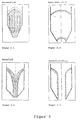
- a procedural silo dimensioning provides the angle of inclination ⁇ of the hopper wall of an axially symmetric (round base) or a flat (rectangular base) silos against the vertical and the minimum diameter Dmin or the minimum width Bmin of the discharge, in compliance with a trouble-free operation of the silo is guaranteed. If the predetermined Trichterne Whileswinkel is maintained or fallen below, arises in the product discharge mass flow ( Figure 3.1) as a flow profile in the bulk material container, that is, the entire container contents is evenly in motion.
- the material discharge can only be interrupted by the formation of stable bulk material bridges ( Figure 3.2). If the diameter of the discharge opening is sufficiently large, no stable bulk material bridge can form during product discharge. If a bulk material solidifies during storage, the minimum diameter of the discharge opening to prevent bridge formation increases in proportion to bulk material consolidation. If mass flow can not be realized as a flow profile, the core flow (FIG. 3.3) is established as a flow profile. If core flow prevails in a bulk material container, the formation of a stable bulk material shaft (FIG. 3.4) can make the emptying of a silo impossible. The inclination of the funnel wall then has no influence on the discharge behavior of the bulk material, the dimensioning of the discharge opening is then made in terms of avoiding a stable shaft.
- the fluidity index according to Jenike is common.
- the bulk material strength fc alone is not sufficient for assessing the flowability of a bulk material, since it depends on the solidification stress ⁇ 1.
- the parameters required for process engineering silo dimensioning and the flowability index ffc can be determined by shear tests on a Jenike shearing apparatus (measurement of the shear path / shear force characteristic at different normal stresses and the determination of the friction conditions between container wall material and Bulk material) ( Peter Mertens: Silo Manual, Ernst + Sohn Verlag, Berlin 1988, pp. 50 - 52 ) determine.
- the assessment of the conveying and abrasion behavior in pneumatic conveying systems was carried out by means of conveying tests in a thin and dense phase conveying system. For this purpose, the conveyed material is transported several times in the conveyor systems described below with the specified settings. The comparison of the abrasion behavior was based on particle size distributions of the task and the promoted good and an accounting of the resulting fine material.
- the aerial transport system consists of a feed container with a blow-through lock for material feed, a collecting container arranged above it, a nitrogen network connection for generating pressure, two cyclones for separating the product and a downstream filter.
- the delivery line has a length of 44 m, of which 6.3 m as a vertical riser and has seven 90 ° bends.
- the cable internal diameter is 56.3 mm.
- the plant is operated with nitrogen. For better fine material separation, only one of the two cyclones is used.
- the conveyor length is 39 m, of which 5.7 m run as a vertical riser.
- the cable has four 90 ° bends and a 180 ° bend.
- the conveying gas nitrogen is fed in two partial streams (upper and lower air) via Laval nozzles.
- Tables 11-13 list the delivery conditions / settings. Table 11 Flight Promotion Example 5 Trial 1 Trial 2 Gas mass flow [kg / h] 200 300 Flow rate [m 3 / h] 166.7 250.0 Pressure loss [mbar] 225 315 Weighing [kg] 49.6 50.8 Time [min] 3.58 2.5 Mass flow [kg / h] 831 1219 Loading ⁇ [kg solid / kg conveying gas] 4.2 4.1 v conveying gas [m / s] 18.8 28.2 Dense gas [kg / m 3 ] 1.2 1.2 Temperature gas [° C] 20 20 Total distance [m] 132 132 Dense phase conveying test 1 upper air in air Jet: 10 jet 45 Form stat: 1 bar Form stat: 3 bar Form dyn .: 1 bar Form dyn .: 2.5 bar Counter beginning 821.7 Counter beginning 1,683.53 Counter end: 821.7 Counter end: 1,684.1 Time: 3 min 2.3 flow 0.0 m 3 / h flow 11.4 m 3
- Tables 14 through 17 list the values for Run D 90%, D 50%, and D 10% of the throughput cumulative distribution of the material being conveyed and the starting material.
- the product according to the invention can be conveyed easily and reliably in the dense and thin stream within the stated limits. Flying and dense phase conveying up to a conveying gas velocity of 28m / s cause no relevant increase in the fine grain content.
- the material is after flight promotion over a path length 132m or dense phase conveying over a path length of 195 m as dust-free granules before.
- the conveyed material still has good bulk material properties after pneumatic transport.
Landscapes
- Chemical & Material Sciences (AREA)
- Organic Chemistry (AREA)
- Health & Medical Sciences (AREA)
- Chemical Kinetics & Catalysis (AREA)
- Medicinal Chemistry (AREA)
- Polymers & Plastics (AREA)
- Compositions Of Macromolecular Compounds (AREA)
- Silicon Polymers (AREA)
- Silicon Compounds (AREA)
- Pigments, Carbon Blacks, Or Wood Stains (AREA)
- Processes Of Treating Macromolecular Substances (AREA)
- Paper (AREA)
- Silicates, Zeolites, And Molecular Sieves (AREA)
Applications Claiming Priority (2)
| Application Number | Priority Date | Filing Date | Title |
|---|---|---|---|
| DE19955850 | 1999-11-20 | ||
| DE19955850A DE19955850A1 (de) | 1999-11-20 | 1999-11-20 | Granulatförmige Organosilan-Präparation, Verfahren zu ihrer Herstellung und ihre Verwendung |
Publications (3)
| Publication Number | Publication Date |
|---|---|
| EP1101802A2 EP1101802A2 (de) | 2001-05-23 |
| EP1101802A3 EP1101802A3 (de) | 2002-07-31 |
| EP1101802B1 true EP1101802B1 (de) | 2007-09-26 |
Family
ID=7929710
Family Applications (1)
| Application Number | Title | Priority Date | Filing Date |
|---|---|---|---|
| EP00124045A Expired - Lifetime EP1101802B1 (de) | 1999-11-20 | 2000-11-04 | Granulatförmige Organosilan-Präparation, Verfahren zu ihrer Herstellung und ihrer Verwendung |
Country Status (15)
| Country | Link |
|---|---|
| US (1) | US6410769B1 (pl) |
| EP (1) | EP1101802B1 (pl) |
| JP (1) | JP2001192507A (pl) |
| KR (1) | KR100730905B1 (pl) |
| CN (1) | CN1183191C (pl) |
| AT (1) | ATE374229T1 (pl) |
| BR (1) | BR0005498B1 (pl) |
| CA (1) | CA2326544A1 (pl) |
| DE (2) | DE19955850A1 (pl) |
| ES (1) | ES2292399T3 (pl) |
| ID (1) | ID28422A (pl) |
| PL (1) | PL207925B1 (pl) |
| TR (1) | TR200003413A3 (pl) |
| TW (1) | TW538102B (pl) |
| ZA (1) | ZA200006695B (pl) |
Families Citing this family (3)
| Publication number | Priority date | Publication date | Assignee | Title |
|---|---|---|---|---|
| DE60306779T3 (de) * | 2003-05-02 | 2010-07-29 | Evermore Trading Corp. | Organosilankonzentrat |
| DE102013203651A1 (de) | 2013-03-04 | 2014-09-04 | Evonik Degussa Gmbh | Mercaptosilan-Polymer-Abmischung |
| JP6820002B2 (ja) * | 2016-12-09 | 2021-01-27 | 精工化学株式会社 | シランカップリング剤組成物及びゴム用配合剤 |
Family Cites Families (12)
| Publication number | Priority date | Publication date | Assignee | Title |
|---|---|---|---|---|
| DE1592861C3 (de) | 1966-09-28 | 1980-01-10 | Deutsche Gold- Und Silber-Scheideanstalt Vormals Roessler, 6000 Frankfurt | Verfahren zum Naßverperlen von Ruß mit weißen Füllstoffen und/oder Flüssigkeiten |
| US3997356A (en) * | 1971-08-17 | 1976-12-14 | Deutsche Gold- Und Silber-Scheideanstalt Vormals Roessler | Reinforcing additive |
| BE787691A (fr) * | 1971-08-17 | 1973-02-19 | Degussa | Composes organosiliciques contenant du soufre |
| DE2747277C2 (de) * | 1977-10-21 | 1982-06-09 | Degussa Ag, 6000 Frankfurt | Granulatförmige Organosilan-Präparation, deren Herstellung und Verwendung |
| DE4435311A1 (de) | 1994-10-01 | 1996-04-04 | Huels Silicone Gmbh | Verstärkungsadditive |
| JP3534464B2 (ja) * | 1994-12-22 | 2004-06-07 | 東ソー・シリカ株式会社 | 部分疎水性化沈降ケイ酸 |
| US5653794A (en) * | 1995-12-01 | 1997-08-05 | Scm Chemicals, Inc. | Silane treated inorganic pigments |
| DE19609619A1 (de) * | 1996-03-12 | 1997-09-18 | Degussa | Staubarme, gut dispergierbare Granulate auf der Basis von mit Organosiliciumverbindungen modifizierten silikatischen Füllstoffen |
| DE19613796A1 (de) * | 1996-04-04 | 1997-10-09 | Degussa | Ruß und Verfahren zu seiner Herstellung |
| DE19621462A1 (de) * | 1996-05-29 | 1997-12-04 | Degussa | Mischungen, bestehend aus feinteiligem Feldspat und Organosiliciumverbindungen, ihre Herstellung und Verwendung |
| DE19623198A1 (de) * | 1996-06-11 | 1997-12-18 | Degussa | Verfahren zur kontinuierlichen Trockengranulation von Pulverruß |
| US6962952B2 (en) * | 1997-04-30 | 2005-11-08 | The Yokohama Rubber Co., Ltd. | Process for production of modified carbon black for rubber reinforcement and process of production of rubber composition containing modified carbon black |
-
1999
- 1999-11-20 DE DE19955850A patent/DE19955850A1/de not_active Ceased
-
2000
- 2000-11-04 AT AT00124045T patent/ATE374229T1/de not_active IP Right Cessation
- 2000-11-04 EP EP00124045A patent/EP1101802B1/de not_active Expired - Lifetime
- 2000-11-04 DE DE50014675T patent/DE50014675D1/de not_active Expired - Lifetime
- 2000-11-04 ES ES00124045T patent/ES2292399T3/es not_active Expired - Lifetime
- 2000-11-13 TW TW089123994A patent/TW538102B/zh not_active IP Right Cessation
- 2000-11-14 ID IDP20000982D patent/ID28422A/id unknown
- 2000-11-16 CA CA002326544A patent/CA2326544A1/en not_active Abandoned
- 2000-11-16 ZA ZA200006695A patent/ZA200006695B/xx unknown
- 2000-11-17 PL PL343953A patent/PL207925B1/pl unknown
- 2000-11-17 TR TR2000/03413A patent/TR200003413A3/tr unknown
- 2000-11-18 KR KR1020000068706A patent/KR100730905B1/ko not_active Expired - Fee Related
- 2000-11-20 JP JP2000353583A patent/JP2001192507A/ja active Pending
- 2000-11-20 CN CNB001325175A patent/CN1183191C/zh not_active Expired - Lifetime
- 2000-11-20 US US09/715,038 patent/US6410769B1/en not_active Expired - Lifetime
- 2000-11-21 BR BRPI0005498-4A patent/BR0005498B1/pt not_active IP Right Cessation
Also Published As
| Publication number | Publication date |
|---|---|
| PL207925B1 (pl) | 2011-02-28 |
| PL343953A1 (en) | 2001-05-21 |
| BR0005498A (pt) | 2001-07-24 |
| ATE374229T1 (de) | 2007-10-15 |
| TW538102B (en) | 2003-06-21 |
| KR100730905B1 (ko) | 2007-06-22 |
| ZA200006695B (en) | 2001-08-10 |
| TR200003413A2 (tr) | 2001-06-21 |
| JP2001192507A (ja) | 2001-07-17 |
| ID28422A (id) | 2001-05-24 |
| DE19955850A1 (de) | 2001-06-07 |
| EP1101802A3 (de) | 2002-07-31 |
| DE50014675D1 (de) | 2007-11-08 |
| US6410769B1 (en) | 2002-06-25 |
| CN1183191C (zh) | 2005-01-05 |
| CN1296987A (zh) | 2001-05-30 |
| TR200003413A3 (tr) | 2001-06-21 |
| ES2292399T3 (es) | 2008-03-16 |
| EP1101802A2 (de) | 2001-05-23 |
| KR20010051796A (ko) | 2001-06-25 |
| CA2326544A1 (en) | 2001-05-20 |
| BR0005498B1 (pt) | 2011-05-17 |
Similar Documents
| Publication | Publication Date | Title |
|---|---|---|
| EP0802242B1 (de) | Verfahren zur Herstellung von Brikettier- und Pressgranulaten | |
| DE2747277C2 (de) | Granulatförmige Organosilan-Präparation, deren Herstellung und Verwendung | |
| DE69203643T2 (de) | Trockenzermahlung. | |
| DE60026859T2 (de) | Formulierungen zur elektrostatischen auftragung | |
| EP1464681B1 (de) | Russperlen | |
| EP0373426A2 (de) | Anorganische Pigmente mit Polyorganosiloxanbeschichtung | |
| EP2362885B1 (de) | Russgranulat, verfahren zur herstellung von russgranulat und dessen verwendung | |
| DE60225057T2 (de) | Verfahren und vorrichtung zur kontinuierlichen herstellung einer elastomeren zusammensetzung | |
| DE2910991A1 (de) | Verfahren zur herstellung von mischgranulat aus russ und hellem fuellstoff | |
| EP0814133A1 (de) | Verfahren zur kontinuierlichen Trockengranulation von Pulverruss | |
| DE2828506B1 (de) | Verfahren und Vorrichtung zum Herstellen eines schaeumfaehigen Gemisches aus mindestens zwei fliessfaehigen,schaumstoffbildenden Reaktionskomponenten und Zuschlagstoffen | |
| DE19816972A1 (de) | Pulverförmige, modifizierte Füllstoffe enthaltende Kautschukpulver, Verfahren zu ihrer Herstellung und Verwendung | |
| EP0924268B1 (de) | Perlruss und Verfahren zu seiner Herstellung | |
| EP0445593A1 (de) | Verfahren zum Herstellen von granuliertem Dicalciumphosphatdihydrat | |
| EP0475046A2 (de) | Verfahren zur Herstellung von aus Zinkoxid und Kieselsäure bestehenden Granulaten, diese Granulate und ihre Verwendung | |
| EP1101802A2 (de) | Granulatförmige Organosilan-Präparation, Verfahren zu ihrer Herstellung und ihrer Verwendung | |
| EP1215249B1 (de) | Perlruss | |
| DE10062598B4 (de) | Verfahren zur gezielten Agglomeration von Düngemitteln | |
| DE102014010036A1 (de) | Verfahren zur Herstellung eines Gummi-Werkstoffes | |
| DE19639856C2 (de) | Verfahren und Vorrichtung zum Fördern von Feinstoffen als Zuschlag in körnigen Produkten | |
| DE4339984A1 (de) | Kautschukchemikalienzubereitung | |
| DE4014229A1 (de) | Dosierung und transport fluidisierbarer gueter | |
| EP1153862A1 (de) | Vorrichtung und Verfahren zur Feststoffdosierung und pneumatischen Förderung | |
| DE3404313C2 (de) | Verfahren zum Mischen disperser Feststoffe nach dem Schwerkraftprinzip |
Legal Events
| Date | Code | Title | Description |
|---|---|---|---|
| PUAI | Public reference made under article 153(3) epc to a published international application that has entered the european phase |
Free format text: ORIGINAL CODE: 0009012 |
|
| 17P | Request for examination filed |
Effective date: 20001104 |
|
| AK | Designated contracting states |
Kind code of ref document: A2 Designated state(s): AT BE CH CY DE DK ES FI FR GB GR IE IT LI LU MC NL PT SE TR |
|
| AX | Request for extension of the european patent |
Free format text: AL;LT;LV;MK;RO;SI |
|
| RIN1 | Information on inventor provided before grant (corrected) |
Inventor name: PITSCH, HOLGER Inventor name: EICHENAUER, KURT Inventor name: KOPIET, JAN Inventor name: KRIESCH, HELMUT Inventor name: VOGLER, CONNY, DR. Inventor name: KLOSE, MICHAEL |
|
| PUAL | Search report despatched |
Free format text: ORIGINAL CODE: 0009013 |
|
| RIC1 | Information provided on ipc code assigned before grant |
Free format text: 7C 09C 1/30 A, 7C 07F 7/18 B, 7C 08K 9/06 B, 7C 08K 9/12 B, 7C 08L 21/00 B, 7C 09C 1/56 B |
|
| AK | Designated contracting states |
Kind code of ref document: A3 Designated state(s): AT BE CH CY DE DK ES FI FR GB GR IE IT LI LU MC NL PT SE TR |
|
| AX | Request for extension of the european patent |
Free format text: AL;LT;LV;MK;RO;SI |
|
| AKX | Designation fees paid |
Designated state(s): AT BE CH CY DE DK ES FI FR GB GR IE IT LI LU MC NL PT SE TR |
|
| RAP1 | Party data changed (applicant data changed or rights of an application transferred) |
Owner name: DEGUSSA GMBH |
|
| GRAP | Despatch of communication of intention to grant a patent |
Free format text: ORIGINAL CODE: EPIDOSNIGR1 |
|
| GRAS | Grant fee paid |
Free format text: ORIGINAL CODE: EPIDOSNIGR3 |
|
| GRAA | (expected) grant |
Free format text: ORIGINAL CODE: 0009210 |
|
| AK | Designated contracting states |
Kind code of ref document: B1 Designated state(s): AT BE CH CY DE DK ES FI FR GB GR IE IT LI LU MC NL PT SE TR |
|
| REG | Reference to a national code |
Ref country code: GB Ref legal event code: FG4D Free format text: NOT ENGLISH |
|
| REG | Reference to a national code |
Ref country code: CH Ref legal event code: EP |
|
| RAP2 | Party data changed (patent owner data changed or rights of a patent transferred) |
Owner name: EVONIK DEGUSSA GMBH |
|
| REF | Corresponds to: |
Ref document number: 50014675 Country of ref document: DE Date of ref document: 20071108 Kind code of ref document: P |
|
| REG | Reference to a national code |
Ref country code: IE Ref legal event code: FG4D Free format text: LANGUAGE OF EP DOCUMENT: GERMAN |
|
| BECN | Be: change of holder's name |
Owner name: EVONIK DEGUSSA G.M.B.H. Effective date: 20070926 |
|
| GBT | Gb: translation of ep patent filed (gb section 77(6)(a)/1977) |
Effective date: 20071211 |
|
| NLT2 | Nl: modifications (of names), taken from the european patent patent bulletin |
Owner name: EVONIK DEGUSSA GMBH Effective date: 20071107 |
|
| PG25 | Lapsed in a contracting state [announced via postgrant information from national office to epo] |
Ref country code: FI Free format text: LAPSE BECAUSE OF FAILURE TO SUBMIT A TRANSLATION OF THE DESCRIPTION OR TO PAY THE FEE WITHIN THE PRESCRIBED TIME-LIMIT Effective date: 20070926 |
|
| REG | Reference to a national code |
Ref country code: ES Ref legal event code: FG2A Ref document number: 2292399 Country of ref document: ES Kind code of ref document: T3 |
|
| ET | Fr: translation filed | ||
| PG25 | Lapsed in a contracting state [announced via postgrant information from national office to epo] |
Ref country code: GR Free format text: LAPSE BECAUSE OF FAILURE TO SUBMIT A TRANSLATION OF THE DESCRIPTION OR TO PAY THE FEE WITHIN THE PRESCRIBED TIME-LIMIT Effective date: 20071227 |
|
| REG | Reference to a national code |
Ref country code: IE Ref legal event code: FD4D |
|
| PG25 | Lapsed in a contracting state [announced via postgrant information from national office to epo] |
Ref country code: PT Free format text: LAPSE BECAUSE OF FAILURE TO SUBMIT A TRANSLATION OF THE DESCRIPTION OR TO PAY THE FEE WITHIN THE PRESCRIBED TIME-LIMIT Effective date: 20080226 |
|
| PG25 | Lapsed in a contracting state [announced via postgrant information from national office to epo] |
Ref country code: MC Free format text: LAPSE BECAUSE OF NON-PAYMENT OF DUE FEES Effective date: 20071130 Ref country code: SE Free format text: LAPSE BECAUSE OF FAILURE TO SUBMIT A TRANSLATION OF THE DESCRIPTION OR TO PAY THE FEE WITHIN THE PRESCRIBED TIME-LIMIT Effective date: 20071226 |
|
| PG25 | Lapsed in a contracting state [announced via postgrant information from national office to epo] |
Ref country code: CH Free format text: LAPSE BECAUSE OF NON-PAYMENT OF DUE FEES Effective date: 20071130 Ref country code: DK Free format text: LAPSE BECAUSE OF FAILURE TO SUBMIT A TRANSLATION OF THE DESCRIPTION OR TO PAY THE FEE WITHIN THE PRESCRIBED TIME-LIMIT Effective date: 20070926 Ref country code: LI Free format text: LAPSE BECAUSE OF NON-PAYMENT OF DUE FEES Effective date: 20071130 |
|
| REG | Reference to a national code |
Ref country code: CH Ref legal event code: PL |
|
| PLBE | No opposition filed within time limit |
Free format text: ORIGINAL CODE: 0009261 |
|
| STAA | Information on the status of an ep patent application or granted ep patent |
Free format text: STATUS: NO OPPOSITION FILED WITHIN TIME LIMIT |
|
| RAP2 | Party data changed (patent owner data changed or rights of a patent transferred) |
Owner name: EVONIK DEGUSSA GMBH |
|
| 26N | No opposition filed |
Effective date: 20080627 |
|
| NLT1 | Nl: modifications of names registered in virtue of documents presented to the patent office pursuant to art. 16 a, paragraph 1 |
Owner name: EVONIK DEGUSSA GMBH |
|
| NLT2 | Nl: modifications (of names), taken from the european patent patent bulletin |
Owner name: EVONIK DEGUSSA GMBH Effective date: 20080806 |
|
| PG25 | Lapsed in a contracting state [announced via postgrant information from national office to epo] |
Ref country code: IE Free format text: LAPSE BECAUSE OF FAILURE TO SUBMIT A TRANSLATION OF THE DESCRIPTION OR TO PAY THE FEE WITHIN THE PRESCRIBED TIME-LIMIT Effective date: 20070926 |
|
| PG25 | Lapsed in a contracting state [announced via postgrant information from national office to epo] |
Ref country code: AT Free format text: LAPSE BECAUSE OF NON-PAYMENT OF DUE FEES Effective date: 20071104 |
|
| PG25 | Lapsed in a contracting state [announced via postgrant information from national office to epo] |
Ref country code: CY Free format text: LAPSE BECAUSE OF FAILURE TO SUBMIT A TRANSLATION OF THE DESCRIPTION OR TO PAY THE FEE WITHIN THE PRESCRIBED TIME-LIMIT Effective date: 20070926 |
|
| PG25 | Lapsed in a contracting state [announced via postgrant information from national office to epo] |
Ref country code: LU Free format text: LAPSE BECAUSE OF NON-PAYMENT OF DUE FEES Effective date: 20071104 |
|
| PG25 | Lapsed in a contracting state [announced via postgrant information from national office to epo] |
Ref country code: TR Free format text: LAPSE BECAUSE OF FAILURE TO SUBMIT A TRANSLATION OF THE DESCRIPTION OR TO PAY THE FEE WITHIN THE PRESCRIBED TIME-LIMIT Effective date: 20070926 |
|
| REG | Reference to a national code |
Ref country code: FR Ref legal event code: CA |
|
| PG25 | Lapsed in a contracting state [announced via postgrant information from national office to epo] |
Ref country code: IT Free format text: LAPSE BECAUSE OF NON-PAYMENT OF DUE FEES Effective date: 20071130 |
|
| PGFP | Annual fee paid to national office [announced via postgrant information from national office to epo] |
Ref country code: NL Payment date: 20111124 Year of fee payment: 12 |
|
| PGFP | Annual fee paid to national office [announced via postgrant information from national office to epo] |
Ref country code: BE Payment date: 20111110 Year of fee payment: 12 |
|
| BERE | Be: lapsed |
Owner name: EVONIK DEGUSSA G.M.B.H. Effective date: 20121130 |
|
| REG | Reference to a national code |
Ref country code: NL Ref legal event code: V1 Effective date: 20130601 |
|
| PG25 | Lapsed in a contracting state [announced via postgrant information from national office to epo] |
Ref country code: NL Free format text: LAPSE BECAUSE OF NON-PAYMENT OF DUE FEES Effective date: 20130601 Ref country code: BE Free format text: LAPSE BECAUSE OF NON-PAYMENT OF DUE FEES Effective date: 20121130 |
|
| PGFP | Annual fee paid to national office [announced via postgrant information from national office to epo] |
Ref country code: GB Payment date: 20131120 Year of fee payment: 14 |
|
| PGFP | Annual fee paid to national office [announced via postgrant information from national office to epo] |
Ref country code: ES Payment date: 20131128 Year of fee payment: 14 |
|
| GBPC | Gb: european patent ceased through non-payment of renewal fee |
Effective date: 20141104 |
|
| PG25 | Lapsed in a contracting state [announced via postgrant information from national office to epo] |
Ref country code: GB Free format text: LAPSE BECAUSE OF NON-PAYMENT OF DUE FEES Effective date: 20141104 |
|
| REG | Reference to a national code |
Ref country code: FR Ref legal event code: PLFP Year of fee payment: 16 |
|
| REG | Reference to a national code |
Ref country code: ES Ref legal event code: FD2A Effective date: 20151229 |
|
| PG25 | Lapsed in a contracting state [announced via postgrant information from national office to epo] |
Ref country code: ES Free format text: LAPSE BECAUSE OF NON-PAYMENT OF DUE FEES Effective date: 20141105 |
|
| REG | Reference to a national code |
Ref country code: FR Ref legal event code: PLFP Year of fee payment: 17 |
|
| REG | Reference to a national code |
Ref country code: FR Ref legal event code: PLFP Year of fee payment: 18 |
|
| REG | Reference to a national code |
Ref country code: DE Ref legal event code: R081 Ref document number: 50014675 Country of ref document: DE Owner name: EVONIK OPERATIONS GMBH, DE Free format text: FORMER OWNER: EVONIK DEGUSSA GMBH, 40474 DUESSELDORF, DE |
|
| PGFP | Annual fee paid to national office [announced via postgrant information from national office to epo] |
Ref country code: DE Payment date: 20191121 Year of fee payment: 20 |
|
| PGFP | Annual fee paid to national office [announced via postgrant information from national office to epo] |
Ref country code: FR Payment date: 20191120 Year of fee payment: 20 |