EP1095063B1 - Alpha-amylase resistente polysaccharide, verfahren zu deren herstellung, verwendung, und lebensmittel enthaltend diese polysaccharide - Google Patents
Alpha-amylase resistente polysaccharide, verfahren zu deren herstellung, verwendung, und lebensmittel enthaltend diese polysaccharide Download PDFInfo
- Publication number
- EP1095063B1 EP1095063B1 EP99929219A EP99929219A EP1095063B1 EP 1095063 B1 EP1095063 B1 EP 1095063B1 EP 99929219 A EP99929219 A EP 99929219A EP 99929219 A EP99929219 A EP 99929219A EP 1095063 B1 EP1095063 B1 EP 1095063B1
- Authority
- EP
- European Patent Office
- Prior art keywords
- accordance
- poly
- amylase
- procedure
- water
- Prior art date
- Legal status (The legal status is an assumption and is not a legal conclusion. Google has not performed a legal analysis and makes no representation as to the accuracy of the status listed.)
- Expired - Lifetime
Links
Images
Classifications
-
- C—CHEMISTRY; METALLURGY
- C12—BIOCHEMISTRY; BEER; SPIRITS; WINE; VINEGAR; MICROBIOLOGY; ENZYMOLOGY; MUTATION OR GENETIC ENGINEERING
- C12P—FERMENTATION OR ENZYME-USING PROCESSES TO SYNTHESISE A DESIRED CHEMICAL COMPOUND OR COMPOSITION OR TO SEPARATE OPTICAL ISOMERS FROM A RACEMIC MIXTURE
- C12P19/00—Preparation of compounds containing saccharide radicals
- C12P19/18—Preparation of compounds containing saccharide radicals produced by the action of a glycosyl transferase, e.g. alpha-, beta- or gamma-cyclodextrins
-
- A—HUMAN NECESSITIES
- A23—FOODS OR FOODSTUFFS; TREATMENT THEREOF, NOT COVERED BY OTHER CLASSES
- A23L—FOODS, FOODSTUFFS OR NON-ALCOHOLIC BEVERAGES, NOT OTHERWISE PROVIDED FOR; PREPARATION OR TREATMENT THEREOF
- A23L29/00—Foods or foodstuffs containing additives; Preparation or treatment thereof
- A23L29/30—Foods or foodstuffs containing additives; Preparation or treatment thereof containing carbohydrate syrups; containing sugars; containing sugar alcohols, e.g. xylitol; containing starch hydrolysates, e.g. dextrin
- A23L29/35—Degradation products of starch, e.g. hydrolysates, dextrins; Enzymatically modified starches
-
- C—CHEMISTRY; METALLURGY
- C08—ORGANIC MACROMOLECULAR COMPOUNDS; THEIR PREPARATION OR CHEMICAL WORKING-UP; COMPOSITIONS BASED THEREON
- C08B—POLYSACCHARIDES; DERIVATIVES THEREOF
- C08B30/00—Preparation of starch, degraded or non-chemically modified starch, amylose, or amylopectin
- C08B30/12—Degraded, destructured or non-chemically modified starch, e.g. mechanically, enzymatically or by irradiation; Bleaching of starch
-
- C—CHEMISTRY; METALLURGY
- C08—ORGANIC MACROMOLECULAR COMPOUNDS; THEIR PREPARATION OR CHEMICAL WORKING-UP; COMPOSITIONS BASED THEREON
- C08B—POLYSACCHARIDES; DERIVATIVES THEREOF
- C08B37/00—Preparation of polysaccharides not provided for in groups C08B1/00 - C08B35/00; Derivatives thereof
- C08B37/0006—Homoglycans, i.e. polysaccharides having a main chain consisting of one single sugar, e.g. colominic acid
- C08B37/0009—Homoglycans, i.e. polysaccharides having a main chain consisting of one single sugar, e.g. colominic acid alpha-D-Glucans, e.g. polydextrose, alternan, glycogen; (alpha-1,4)(alpha-1,6)-D-Glucans; (alpha-1,3)(alpha-1,4)-D-Glucans, e.g. isolichenan or nigeran; (alpha-1,4)-D-Glucans; (alpha-1,3)-D-Glucans, e.g. pseudonigeran; Derivatives thereof
Definitions
- RS resistant starches
- Organism only a small amount of energy.
- This energy supply relates exclusively for the oxidative breakdown of absorbed short-chain fatty acids the colon.
- These short chain fatty acids are end products of Carbohydrate metabolism of the intestinal microflora.
- substrate provision for the Energy metabolism of the intestinal microflora and that of the colon epithelial cells. The latter are designed to maintain their structure and function on a luminal Instruction of short-chain fatty acids and especially of butyrate.
- EP 0 564 893 A1 describes and claims a process for the production of an RS product that contains up to 15% RS.
- This process is through characterized in that the aqueous suspension of a starch which is at least 40% Amylose contains, gelatinizes and enzymatically by treatment with an enzyme, that opens the ⁇ -1, 6-glycosidic bonds, branches and then that resulting intermediate is retrograded.
- optimal starch concentration in the suspension at 15% and the examples of this EP patent applications illustrate the process when the starch concentrations either reduced to 14% or increased to 17%.
- the starting material contains at least 40% amylose and is a corn starch. It will continue shown that with an amylose content of 25% none by this process resistant starch (RS) is formed. It is also demonstrated that at Increasing the amylose content over 40% up to 100% can produce a product is that contains up to 50.3% RS.
- EP 0 688 872 A1 describes and claims a process for the production of an RS-containing product that contains 25 to 50% by weight of RS.
- Corresponding EP 0 688 872 A1 describes and claims a process for the said Production of an RS-containing product in which an aqueous suspension of a partially degraded, gelatinized starch enzymatically branched and that Intermediate is retrograded.
- a “partially degraded starch” is a polymer understood that the molecular weight was reduced by suitable treatment, the shortening of the chain length both the amylose and the Amylopectin affects.
- the degradation includes both hydrolysis processes (acid or enzyme-catalyzed) as well as extrusion, oxidation or pyrolysis.)
- Acid-degraded root or tuber starches are particularly emphasized and maltodextrins of root or tuber starch.
- Maltodextrins are through characterized a DE value (DE: dextrose equivalent) in the range from 1 to 19.
- the maltodextrins are made from potato or tapioca starch containing up to 25% amylose.
- the aqueous suspension of such maltodextrins contains a solids content of 20% by weight or more for the process.
- the maltodextrins are further characterized in that they contain high levels of oligomers with degrees of polymerization less than 10 (DP ⁇ 10) of up to 22% by weight and an average molecular weight of 1.3680 x 10 4 g / mol.
- the debranching enzymes used for the known process are pullulanase and isoamylase.
- a retrogradation is carried out in a temperature range of 0 to 30 ° C in a time interval of 1 to 3 days, in which the aqueous reaction product is allowed to stand.
- the product is then dried by spray drying.
- a powdery product with an RS content of up to a maximum of 60% by weight is produced.
- the description of the invention serves the goal of carbohydrate polymers with a high Proportion of resistant, relatively thermostable structures to manufacture them economically to be able to use in food production.
- One embodiment of the invention relates to ⁇ -amylase-resistant Polysaccharides that are poly- (1,4- ⁇ -D-glucans), characterized in that they have an RS content of at least 65% by weight and after in the methods described in claims 1 and 9 are obtainable.
- an RS content is understood the content of ⁇ -amylase-resistant polysaccharides, as according to the Englyst et al. (Classification and measurement of nutritionally important starch Fractions, European Journal of Clinical Nutrition, 46 (Suppl. 23) (1992) 33-50) can be determined; s. also example 3.
- the ⁇ -amylase-resistant polysaccharides according to the invention can be characterized by an RS content of at least 75 and in particular at least 95% by weight.
- ⁇ -amylase-resistant polysaccharides according to the invention characterized in that the poly (1,4- ⁇ -D-glucans) chemically in itself are known to be modified.
- ⁇ -amylase-resistant polysaccharides according to the invention characterized in that they have a degree of branching of 6 in the position have a maximum of 0.5%.
- ⁇ -amylase-resistant polysaccharides according to the invention characterized in that they have a 2- and / or 3-position Degree of branching of at most 1.0% and in particular at most 0.5% exhibit.
- the ⁇ -amylase-resistant polysaccharides can be characterized in that the poly- (1,4- ⁇ -D-glucans) have a molecular weight of 0.75 ⁇ 10 2 to 10 7 , preferably 10 3 to 10 6 and preferably of 10 3 to 5 x 10 5 g / mol and / or are water-insoluble.
- the ⁇ -amylase-resistant polysaccharides according to the invention characterized in that the poly- (1,4- ⁇ -D-glucans) neither branches, in particular neither enzymatically branched, nor with regard to their chain length (and thus in terms of their molecular weight) have been reduced, especially not by enzyme catalysis, acid catalysis, extrusion, oxidation or Pyrolysis.
- water-insoluble means compounds that according to the Definition of the German Pharmaceutical Book (Scientific Publishing company / Stuttgart & Gori-Verlag / Frankfurt, 9th edition, 1987; s. also Examples 22 to 23) under the category “poorly soluble” compounds, "very much poorly soluble "or” practically insoluble "compounds fall.
- the advantage of the method according to the invention can be that from the described above, an aqueous hot paste can be produced which contains up to, for example, 30% by weight or more solids, without for example a branching or a partial degradation or one Chain length reduction of the raw materials used can be made got to. This leads to a simplification of the process management and thus to one Reduction in the cost of the procedure because of the time and costly The use of branching enzymes or degrading chemicals is eliminated.
- Step (b) a paste with a polysaccharide content of at least 5 and produces up to 30, 35, 40, 45 or 50% by weight.
- step (c) the method according to the invention can be characterized in that in step (c) the paste is brought to a temperature in the range of Room temperature, 50, 60 or 70 to 100 ° C warmed or heated.
- the inventive method can be characterized in that the mass thawed in accordance with step (c) one or more times in steps (e) bis (e) before finally thawing, drying or draining.
- step (c) the suspension or dispersion obtained is brought to a temperature cools in the range 0 ° C to -80 ° C.
- step (d) for a time interval of 1 to 72 h, preferably 1 to 36 h and especially retrograded for 15 to 30 h.
- amylosucrase is an enzyme that catalyzes the following reaction: Sucrose + ( ⁇ -1,4-glucan) n ⁇ fructose + ( ⁇ -1,4-glucan) n + 1
- linear oligomeric or polymeric ⁇ -1,4-glucans can serve as acceptors for a chain-extending reaction that leads to water-insoluble poly- (1,4- ⁇ -D-glucans) whose glucose residue is substituted by ⁇ -1,4 glycosidic bonds are linked and have a molecular weight in the range from 0.75 x 10 2 g / mol to 10 7 g / mol.
- linear oligomeric or polymeric acceptors can either be from can be added externally, but they can also, as described in Example 1, be produced from sucrose by the amylosucrase itself.
- These products are also used in the context of the present invention as poly (1,4- ⁇ -D-glucans) referred to, the just described Have properties, but can be created in another way Starting materials for the process according to the invention.
- the embodiments of the method according to the invention can be characterized in that the water-insoluble poly- (1,4- ⁇ -D-glucans) are chemically modified in a manner known per se. Furthermore, the embodiments of the method according to the invention can be characterized in that the water-insoluble poly- (1,4- ⁇ -D-glucans) in the 6-position have a degree of branching of at most 0.5%.
- the embodiments of the method according to the invention can thereby be characterized in that the water-insoluble poly (1,4- ⁇ -D-glucans) in 2- or 3-position a degree of branching of at most 1% each and in particular have a maximum of 0.5%.
- the embodiments of the method according to the invention can be characterized in that the water-insoluble poly- (1,4- ⁇ -D-glucans) have a molecular weight of 0.75 x 10 2 to 10 7 , preferably 10 3 to 10 6 g / mol and preferably have from 10 3 to 5 x 10 5 .
- the embodiments of the method according to the invention can thereby be characterized in that the water-insoluble poly (1,4- ⁇ -D-glucans) neither branched, in particular neither enzymatically branched, nor with regard to their Chain length (and thus in terms of their molecular weight) have been reduced, especially not by enzyme catalysis, acid catalysis, extrusion, oxidation or Pyrolysis.
- high RS content means an RS content of at least 65 to 75, 75 to 88, 88 to 90, 90 to 95 and in particular 95 up to 99 or more% by weight.
- the embodiments of the method according to the invention can thereby be characterized in that the drying steps (f) and (e) retrograded product dries by spray or freeze drying.
- Another embodiment of the invention relates to the use of a ⁇ -Amylase-resistant polysaccharide according to the invention for food precursors or food.
- Another embodiment of the invention relates to the use of a ⁇ -Amylase-resistant polysaccharide according to the invention as a food additive or food additive.
- one embodiment of the invention relates to a pre-food product or food characterized by a content of one ⁇ -Amylase-resistant polysaccharide according to the invention.
- the biotransformation supernatant is denatured at 95 ° C. After cooling down The room temperature was centrifuged again. The clear supernatant was at -70 ° C frozen and thawed at 4 ° C for 3 days. The precipitation generated in this way was frozen at -70 ° C and freeze-dried.
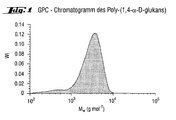
- the measurement gives a number average molecular weight (M n ) of 2,326 g / mol and a weight average molecular weight (M w ) of 3,367 g / mol.
- M n number average molecular weight
- M w weight average molecular weight
- a linear, nature-identical poly- (1,4- ⁇ -D-glucan) (see Example 1) was used in heated aqueous solution and formed a paste. This paste was made on 10 % By weight solids content adjusted and portioned. The servings were at 4 and 25 ° C (example 5 or 6) or with the help of a step program (example 7) retrograded. Furthermore, the linear carbohydrate polymer from the Reaction batch frozen out (Example 4). The retrograded patterns were dried and the determination of the RS content as described above carried out.
- Table 2 illustrates the influence of the retrogradation temperature and conditions on the RS content in the product, made from a 10 percent.
- the DSC measurement provides an endothermic for the swelling of native starch Peak. The same applies to retrograded starches and poly- (1,4- ⁇ -D-glucans). The processes of melting the Crystallites, the change in conformation and the hydration and swelling of Characterize starch polymers.
- the measurements were carried out using a high-resolution device (DSC120, Seiko, Japan).
- the glucan / water ratio was 1: 5, the heating rate 4 K / min.
- the measurement was carried out in a temperature range from 10 to 220 ° C.
- the device works on the heat flux measuring principle. For each measurement, 5 mg of polyglucan was weighed into a 70 ⁇ l silver crucible using an ultra-microbalance and then hermetically sealed after adding distilled water. Distilled water with a conductivity of 0.15 ⁇ S was used as a reference sample.
- Example 22 The test is carried out as in Example 22. The only difference is one Cooling process after the autoclave treatment and cooling Room temperature is connected. The mixture of substances is at for 3 hours Store at 5 ° C.
Landscapes
- Chemical & Material Sciences (AREA)
- Life Sciences & Earth Sciences (AREA)
- Health & Medical Sciences (AREA)
- Organic Chemistry (AREA)
- Engineering & Computer Science (AREA)
- Biochemistry (AREA)
- Chemical Kinetics & Catalysis (AREA)
- Polymers & Plastics (AREA)
- Wood Science & Technology (AREA)
- General Health & Medical Sciences (AREA)
- Materials Engineering (AREA)
- Zoology (AREA)
- Medicinal Chemistry (AREA)
- Molecular Biology (AREA)
- Microbiology (AREA)
- Biotechnology (AREA)
- General Chemical & Material Sciences (AREA)
- Crystallography & Structural Chemistry (AREA)
- Nutrition Science (AREA)
- Food Science & Technology (AREA)
- Bioinformatics & Cheminformatics (AREA)
- General Engineering & Computer Science (AREA)
- Genetics & Genomics (AREA)
- Polysaccharides And Polysaccharide Derivatives (AREA)
- Preparation Of Compounds By Using Micro-Organisms (AREA)
- Coloring Foods And Improving Nutritive Qualities (AREA)
Description
| Temperatur-Zeit-Programm | |
| Temperatur (°C) | Zeitintervall |
| 90 ± 10 | 5 min ± 5 min |
| 80 ± 10 | 10min ± 10min |
| 70 ± 10 | (30 bis 180 min) ± 30 |
| 40 ± 10 | (60 bis 180 min) ± 60 min |
| 25 ± 10 | 22 h ± 15 h |
| 4 ± 10 | 20 h ± 15 h |
Ferner können die Ausführungsformen des erfindungsgemäßen Verfahrens dadurch gekennzeichnet sein, daß die wasserunlöslichen Poly-(1,4-α-D-glukane) in 6-Position einen Verzweigungsgrad von höchstens 0,5 % aufweisen.
| Beispiel | Retrogradationstemperatur | RS [Gewicht-%] |
| 4 | -70 °C | 78 ± 4 |
| 5 | 4 °C | 70 ± 2 |
| 6 | 25 °C | 87 ± 1 |
| 7 | Stufenprogramm | 74 ± 3 |
| Beispiel | Retrogradationstemperatur | Feststoffanteil | |
| 10 % RS [Gewicht-%] | 30 % RS [Gewicht-%] | ||
| 8 | 4 °C | 70 ± 2 | |
| 9 | 4 °C | 94 ± 2 | |
| 10 | 25 °C | 87 ± 1 | |
| 11 | 25 °C | 93 ± 1 | |
| 12 | Stufenprogramm | 74 ± 3 |
| Bezeichnung Poly-(1,4-α-D-glukan) | Retrogradations-bedingungen Temperatur/Feststoffanteil im Kleister | DSC-Parameter | |||
| T0 [°C] | Tp [°C] | Tc [°C] | dH [J/g] | ||
| Beispiel | |||||
| 13 | Tieftemperatur-rekristallisation | 85,1 | 102,0 | 111,3 | 21,8 |
| 14 | 4 °C, 10 % | 81,8 | 96,7 | 108,0 | 16,3 |
| 15 | 4 °C, 30 % | 86,2 | 98,2 | 103,7 | 1,8 |
| 16 | 109,3 | 124,5 | 136,8 | 13,3 | |
| 17 | 142,7 | 154,1 | 165,6 | 2,9 | |
| 18 | 25 °C, 10 % | 88,6 | 101,0 | 109,8 | 15,0 |
| 19 | 25 °C, 30 % | 85,9 | 97,9 | 101,1 | 1,7 |
| 20 | 111,8 | 126,1 | 133,9 | 4,0 | |
| 20 | 138,1 | 157,6 | 172,5 | 23,0 |
Claims (27)
- α-Amylase-resistente Polysaccharide, dadurch gekennzeichnet, dass sie einen nach der Methode von Englyst et al. ermittelten RS-Gehalt von mindestens 65 Gew.-% aufweisen, erhältlich nach einem Verfahren, das folgende Schritte umfasst:a) Bereitstellung von wasserunlöslichem Poly-(1,4-α-D-glukan) durch die Umsetzung von Saccharose mit einem Amylosucrase-Aktivität aufweisenden Enzym,b) Herstellung einer Suspension oder Dispersion aus dem Poly-(1,4-α-D-glukan) und Wasser,c) Erwärmung der Suspension oder Dispersion, um einen Kleister zu erhalten;d) Abkühlung des erhaltenen Kleisters und Retrogradation des Kleisters bei einer gegenüber der Temperatur des erhitzten Kleisters erniedrigten Temperatur; unde) ggf. Trocknung oder Entwässerung des erhaltenen Produktes.
- α-Amylase-resistente Polysaccharide nach Anspruch 1, gekennzeichnet durch einen RS-Gehalt von mindestens 75%.
- α-Amylase-resistente Polysaccharide nach Anspruch 1 oder 2, dadurch gekennzeichnet, dass die Poly-(1,4-α-D-glukane) chemisch in an sich bekannter Weise modifiziert sind.
- α-Amylase-resistente Polysaccharide nach einem der vorhergehenden Ansprüche, dadurch gekennzeichnet, dass sie in 6-Position einen Verzweigungsgrad von höchstens 0,5 % aufweisen.
- α-Amylase-resistente Polysaccharide nach einem der vorhergehenden Ansprüche, dadurch gekennzeichnet, dass sie in 2- und/oder 3-Position einen Verzweigungsgrad von jeweils höchstens 0,5 % aufweisen.
- α-Amylase-resistente Polysaccharide nach einem der vorhergehenden Ansprüche, dadurch gekennzeichnet, dass die Poly-(1,4-α-D-glukane) ein Molekulargewicht von 0,75 x 10² bis 107 g/mol aufweisen.
- α-Amylase-resistente Polysaccharide nach einem der vorhergehenden Ansprüche, dadurch gekennzeichnet, dass die Poly-(1,4-α-D-glukane) ein Molekulargewicht von 103 bis 5 x 10⁵ g/mol aufweisen.
- α-Amylase-resistente Polysaccharide nach einem der vorhergehenden Ansprüche, dadurch gekennzeichnet, dass die Poly(1,4-α-D-glukane) weder entzweigt, insbesondere weder enzymatisch entzweigt, noch hinsichtlich ihrer Kettenlänge (und damit hinsichtlich ihres Molekulargewichtes) reduziert worden sind.
- α-Amylase-resistente Polysaccharide, dadurch gekennzeichnet, dass sie einen nach der Methode von Englyst et al. ermittelten RS-Gehalt von mindestens 65 Gew.-% aufweisen, erhältlich nach einem Verfahren, das folgende Schritte umfasst:a) Bereitstellung von wasserunlöslichem Poly-(1,4-α-D-glukan) durch die Umsetzung von Saccharose mit einem Amylosucrase-Aktivität aufweisenden Enzym,b) Herstellung einer Suspension oder Dispersion aus dem Poly-(1,4-α-Dglukan) und Wasserc) Einfrieren der erhaltenen Suspension oder Dispersion;d) Retrogradation;e) Auftauen der nach Schritt d) erhaltenen Masse; undf) ggf. Trocknung oder Entwässerung der nach Schritt d) erhaltenen Masse.
- Verfahren zur Herstellung von α-Amylase-resistenten Polysacchariden, die einen nach der Methode von Englyst et al. ermittelten RS-Gehalt von mindestens 65 Gew.-% aufweisen, umfassend folgende Schritte:a) Bereitstellung von wasserunlöslichem Poly-(1,4-α-D-glukan) durch die Umsetzung von Saccharose mit einem Amylosucrase-Aktivität aufweisenden Enzym,b) Herstellung einer Suspension oder Dispersion aus wasserunlöslichen Poly-(1,4-α-D-glukanen) und Wasser;c) Erwärmung der Suspension oder Dispersion;d) Abkühlung des erhaltenen Kleisters und Retrogradation des Kleisters bei einer gegenüber der Temperatur des erhitzten Kleisters erniedrigten Temperatur; unde) ggf. Trocknung oder Entwässerung des erhaltenen Produktes.
- Verfahren nach Anspruch 10, dadurch gekennzeichnet, dass man bei Schritt (b) gemäß Anspruch 10 einen Kleister mit einem Polysaccharid-Gehalt von mindestens 5 und bis 50 Gew.-% herstellt.
- Verfahren nach einem der Ansprüche 10 oder 11, dadurch gekennzeichnet, dass man bei Schritt (c) gemäß Anspruch 10 den Kleister auf eine Temperatur im Bereich von Raumtemperatur bis 100 °C erwärmt oder erhitzt.
- Verfahren nach einem der Ansprüche 10 bis 12, dadurch gekennzeichnet, dass man bei Schritt (d) gemäß Anspruch 10retrogradiert.(i) bei einer Temperatur im Bereich von 50 °C bis an den Gefrierpunkt, und/oder(ii) für ein Zeitintervall von 1 bis 72 h
- Verfahren nach einem der Ansprüche 10 bis 13, dadurch gekennzeichnet, dass man bei Schritt (d) gemäß Anspruch 10 nach einem Temperaturstufenprogramm(i) in einem Temperaturbereich von 100 bis 0 °C(ii) für ein Gesamtzeitintervall von 8 bis 36 h gemäß dem folgenden Temperatur-Zeit-Programm stufenweise und gegebenenfalls unter Einwirkung von Scherkräften abkühlt und retrogradiert, wobei sich die gewählten Zeitintervalle zu einem vorstehend angegebenen Gesamt-Zeitintervall ergänzen:
Temperatur-Zeit-Programm Temperatur (°C) Zeitintervall 90 ± 10 5 min ±5 min 80 ± 10 10 min ± 10 min 70 ± 10 (30 bis 180 min) ± 30 40 ± 10 (60 bis 180 min) ± 60 min 25 ± 10 22 h ± 15 h 4 ± 10 20 h ± 15 h - Verfahren zur Herstellung von α-Amylase-resistenten Polysacchariden, die einen nach der Methode von Englyst et al. ermittelten RS-Gehalt von mindestens 65 Gew.-% aufweisen, umfassend folgende Schritte:a) Bereitstellung von wasserunlöslichem Poly-(1,4-α-D-glukan) durch die Umsetzung von Saccharose mit einem Amylosucrase-Aktivität aufweisenden Enzym,b) Herstellung einer Suspension oder Dispersion aus dem Poly-(1,4-α-D-glukan) und Wasser;c) Einfrieren der erhaltenen Suspension oder Dispersion;d) Retrogradation;e) Auftauen der nach Schritt (d) erhaltenen Masse; undf) ggf. Trocknung oder Entwässerung der nach Schritt (e) erhaltenen Masse.
- Verfahren nach Anspruch 15, dadurch gekennzeichnet, dass man die gemäß Schritt (e) aufgetaute Masse noch einmal oder mehrmals den Schritten (c) bis (e) unterwirft, bevor man endgültig auftaut, trocknet oder entwässert.
- Verfahren nach einem der Ansprüche 15 oder 16, dadurch gekennzeichnet, dass man bei Schritt (c) gemäß Anspruch 15 die erhaltene Suspension oder Dispersion auf eine Temperatur im Bereich 0 °C bis -80 °C abkühlt.
- Verfahren nach einem der Ansprüche 15 bis 17, dadurch gekennzeichnet, dass man bei Schritt (d) gemäß Anspruch 15 für ein Zeitintervall von 1 bis 72 h retrogradiert.
- Verfahren nach einem der Ansprüche 10 bis 18, dadurch gekennzeichnet, dass die wasserunlöslichen Poly-(1,4-α-D-glukane) chemisch in an sich bekannter Weise modifiziert sind.
- Verfahren nach einem der Ansprüche 10 bis 19, dadurch gekennzeichnet, dass die wasserunlöslichen Poly-(1,4-α-D-glukane) in 6-Position einen Verzweigungsgrad von höchstens 0,5 % aufweisen.
- Verfahren nach einem der Ansprüche 10 bis 20, dadurch gekennzeichnet, dass die wasserunlöslichen Poly-(1,4-α-D-glukane) in 2- oder 3-Position einen Verzweigungsgrad von jeweils höchstens 0,5 % aufweisen.
- Verfahren nach einem der Ansprüche 10 bis 21, dadurch gekennzeichnet, dass die wasserunlöslichen Poly-(1,4-α-D-glukane) ein Molekulargewicht von 0,75 x bis 102 bis 107 aufweisen.
- Verfahren nach einem der Ansprüche 10 bis 22, dadurch gekennzeichnet, dass die wasserunlöslichen Poly-(1,4-α-D-glukane) weder entzweigt, noch hinsichtlich ihrer Kettenlänge (und damit hinsichtlich ihres Molekulargewichts) reduziert worden sind.
- Verfahren nach einem der Ansprüche 10 bis 23, dadurch gekennzeichnet, dass man bei Schritt (e) gemäß Anspruch 10 oder bei Schritt (f) gemäß Anspruch 15 das retrogradierte Produkt durch Sprüh- oder Gefriertrocknung trocknet.
- Verwendung eines α-Amylase-resistenten Polysaccharids gemäß einem der Ansprüche 1 bis 9 für Lebensmittel-Vorprodukte oder Lebensmittel.
- Verwendung eines α-Amylase-resistenten Polysaccharids gemäß einem der Ansprüche 1 bis 9 als Lebensmitteladditiv oder Lebensmittelzusatzstoff.
- Lebensmittel-Vorprodukt oder Lebensmittel, gekennzeichnet durch einen Gehalt an einem α-Amylase-resistenten Polysaccharid gemäß einem der Ansprüche 1 bis 9.
Applications Claiming Priority (3)
| Application Number | Priority Date | Filing Date | Title |
|---|---|---|---|
| DE19830618 | 1998-07-09 | ||
| DE19830618A DE19830618A1 (de) | 1998-07-09 | 1998-07-09 | alpha-Amylase resistente Polysaccharide, Herstellungsverfahren, Verwendung und Lebensmittel mit diesen Polysacchariden |
| PCT/EP1999/004129 WO2000002926A1 (de) | 1998-07-09 | 1999-06-15 | α-AMYLASE RESISTENTE POLYSACCHARIDE, HERSTELLUNGSVERFAHREN, VERWENDUNG UND LEBENSMITTEL MIT DIESEN POLYSACCHARIDEN |
Publications (2)
| Publication Number | Publication Date |
|---|---|
| EP1095063A1 EP1095063A1 (de) | 2001-05-02 |
| EP1095063B1 true EP1095063B1 (de) | 2003-11-05 |
Family
ID=7873410
Family Applications (1)
| Application Number | Title | Priority Date | Filing Date |
|---|---|---|---|
| EP99929219A Expired - Lifetime EP1095063B1 (de) | 1998-07-09 | 1999-06-15 | Alpha-amylase resistente polysaccharide, verfahren zu deren herstellung, verwendung, und lebensmittel enthaltend diese polysaccharide |
Country Status (9)
| Country | Link |
|---|---|
| US (1) | US6696563B2 (de) |
| EP (1) | EP1095063B1 (de) |
| JP (1) | JP2002520425A (de) |
| CN (1) | CN1225482C (de) |
| AT (1) | ATE253595T1 (de) |
| AU (1) | AU763977B2 (de) |
| CA (1) | CA2333383A1 (de) |
| DE (2) | DE19830618A1 (de) |
| WO (1) | WO2000002926A1 (de) |
Families Citing this family (18)
| Publication number | Priority date | Publication date | Assignee | Title |
|---|---|---|---|---|
| DE19860371A1 (de) | 1998-12-28 | 2000-06-29 | Aventis Res & Tech Gmbh & Co | Kosmetische oder medizinische Zubereitung für die topische Anwendung |
| DE19860374A1 (de) * | 1998-12-28 | 2000-07-06 | Aventis Res & Tech Gmbh & Co | Verwendung von resistenter Stärke als Mehlersatzstoff für Nahrungsmittel und Nahrungsmittelinhaltsstoffe |
| DE19860375A1 (de) | 1998-12-28 | 2000-07-06 | Aventis Res & Tech Gmbh & Co | Alpha Amylase-resistente Stärke zur Herstellung von Nahrungs- und Arzneimittel |
| DE19911001C2 (de) * | 1999-03-12 | 2002-06-20 | Aventis Cropscience Gmbh | Verfahren zur Herstellung resistenter Stärke, resistente Stärke und deren Verwendung |
| DE19959863A1 (de) * | 1999-12-10 | 2001-06-13 | Axiva Gmbh | Verfahren zur Erhöhung des Gehaltes an a-amylase-resistenter Stärke (RS-Gehalt) eines Polysaccharids, Polysaccharide, deren Verwendung und Lebensmittel mit diesen Polysacchariden |
| WO2005001098A1 (en) | 2003-06-30 | 2005-01-06 | Commonwealth Scientific And Industrial Research Organisation | Wheat with altered branching enzyme activity and starch and starch containing products derived thereform |
| US20080249297A1 (en) * | 2003-10-24 | 2008-10-09 | Claus Frohberg | Use of Linear Poly-Alpha-1,4-Glucans as Resistant Starch |
| US7189288B2 (en) * | 2004-10-08 | 2007-03-13 | Tate & Lyle Ingredients Americas, Inc. | Enzyme-resistant starch and method for its production |
| EP1679374A1 (de) | 2005-01-10 | 2006-07-12 | Bayer CropScience GmbH | Transformierte Pflanzen, die Mutansucrase exprimieren und eine veränderte Stärke synthetisieren |
| US7674897B2 (en) * | 2005-09-09 | 2010-03-09 | Tate & Lyle Ingredients Americas, Inc. | Production of crystalline short chain amylose |
| US7608436B2 (en) * | 2006-01-25 | 2009-10-27 | Tate & Lyle Ingredients Americas, Inc. | Process for producing saccharide oligomers |
| US8993039B2 (en) | 2006-01-25 | 2015-03-31 | Tate & Lyle Ingredients Americas Llc | Fiber-containing carbohydrate composition |
| US8057840B2 (en) * | 2006-01-25 | 2011-11-15 | Tate & Lyle Ingredients Americas Llc | Food products comprising a slowly digestible or digestion resistant carbohydrate composition |
| GB2446199A (en) * | 2006-12-01 | 2008-08-06 | David Irvine | Secure, decentralised and anonymous peer-to-peer network |
| CN101298482B (zh) * | 2008-06-23 | 2011-05-11 | 广州康采恩医药有限公司 | 一种葡聚糖 |
| CN102605023A (zh) * | 2012-03-19 | 2012-07-25 | 江南大学 | 酶法支链延长修饰制备3型抗性淀粉的方法 |
| CN109180824B (zh) * | 2018-07-24 | 2020-01-17 | 江南大学 | 一种抗性淀粉的制备方法 |
| US11540549B2 (en) | 2019-11-28 | 2023-01-03 | Tate & Lyle Solutions Usa Llc | High-fiber, low-sugar soluble dietary fibers, products including them and methods for using them |
Citations (1)
| Publication number | Priority date | Publication date | Assignee | Title |
|---|---|---|---|---|
| WO1999022606A1 (en) * | 1997-11-04 | 1999-05-14 | Nabisco, Inc. | Process for making enzyme-resistant starch for reduced-calorie flour replacer |
Family Cites Families (7)
| Publication number | Priority date | Publication date | Assignee | Title |
|---|---|---|---|---|
| WO1990015147A1 (en) * | 1989-06-06 | 1990-12-13 | Washington State University Research Foundation, Inc. | Purified resistant starch products and their preparation |
| JPH0463574A (ja) * | 1990-07-03 | 1992-02-28 | Terumo Corp | 食品用材料およびその製造方法 |
| US5409542A (en) * | 1992-03-25 | 1995-04-25 | National Starch And Chemical Investment Holding Corporation | Amylase resistant starch product form debranched high amylose starch |
| FI111088B (fi) * | 1994-04-15 | 2003-05-30 | Cerestar Holding Bv | Menetelmä tärkkelyspitoisten tuotteiden valmistamiseksi |
| CA2190149C (en) * | 1994-05-18 | 2011-01-04 | Jens Kossmann | Dna sequences coding for enzymes capable of facilitating the synthesis of linear .alpha.-1,4 glucans in plants, fungi and microorganisms |
| GB9625129D0 (en) * | 1996-12-03 | 1997-01-22 | Cerestar Holding Bv | Highly fermentable resistant starch |
| US5855946A (en) * | 1997-06-06 | 1999-01-05 | Kansas State University Research Foundation | Food grade starch resistant to α-amylase and method of preparing the same |
-
1998
- 1998-07-09 DE DE19830618A patent/DE19830618A1/de not_active Withdrawn
-
1999
- 1999-06-15 JP JP2000559155A patent/JP2002520425A/ja active Pending
- 1999-06-15 CN CNB998078875A patent/CN1225482C/zh not_active Expired - Fee Related
- 1999-06-15 WO PCT/EP1999/004129 patent/WO2000002926A1/de not_active Ceased
- 1999-06-15 DE DE59907641T patent/DE59907641D1/de not_active Expired - Lifetime
- 1999-06-15 AU AU46105/99A patent/AU763977B2/en not_active Ceased
- 1999-06-15 AT AT99929219T patent/ATE253595T1/de not_active IP Right Cessation
- 1999-06-15 CA CA002333383A patent/CA2333383A1/en not_active Abandoned
- 1999-06-15 EP EP99929219A patent/EP1095063B1/de not_active Expired - Lifetime
-
2000
- 2000-12-21 US US09/741,143 patent/US6696563B2/en not_active Expired - Fee Related
Patent Citations (1)
| Publication number | Priority date | Publication date | Assignee | Title |
|---|---|---|---|---|
| WO1999022606A1 (en) * | 1997-11-04 | 1999-05-14 | Nabisco, Inc. | Process for making enzyme-resistant starch for reduced-calorie flour replacer |
Also Published As
| Publication number | Publication date |
|---|---|
| EP1095063A1 (de) | 2001-05-02 |
| DE59907641D1 (de) | 2003-12-11 |
| DE19830618A1 (de) | 2000-01-13 |
| AU4610599A (en) | 2000-02-01 |
| WO2000002926A1 (de) | 2000-01-20 |
| CN1307591A (zh) | 2001-08-08 |
| CN1225482C (zh) | 2005-11-02 |
| ATE253595T1 (de) | 2003-11-15 |
| JP2002520425A (ja) | 2002-07-09 |
| AU763977B2 (en) | 2003-08-07 |
| CA2333383A1 (en) | 2000-01-20 |
| US6696563B2 (en) | 2004-02-24 |
| US20030004332A1 (en) | 2003-01-02 |
Similar Documents
| Publication | Publication Date | Title |
|---|---|---|
| EP1095063A1 (de) | $g(a)-AMYLASE RESISTENTE POLYSACCHARIDE, HERSTELLUNGSVERFAHREN, VERWENDUNG UND LEBENSMITTEL MIT DIESEN POLYSACCHARIDEN | |
| DE19911001C2 (de) | Verfahren zur Herstellung resistenter Stärke, resistente Stärke und deren Verwendung | |
| WO2001042309A2 (de) | VERFAHREN ZUR ERHÖHUNG DES GEHALTES AN α-AMYLASE-RESISTENTER STÄRKE EINES POLYSACCHARIDS | |
| DE68913921T2 (de) | Partiell entzweigte Stärken und enzymatisches Verfahren zu ihrer Herstellung. | |
| DE69711002T2 (de) | Hoch fermentierbare resistente Stärke | |
| DE68904291T2 (de) | Verfahren zur herstellung von geliermittel-suesswaren. | |
| EP1282663B1 (de) | Gel aus einem Poly-a-1,4-Glucan und Stärke | |
| DE69508307T2 (de) | Verfahren zur Herstellung von stärkehaltigen Produkten | |
| DE68929281T2 (de) | Verfahren zur Herstellung einer modifizierten Stärke mit verbesserten emulgierenden Eigenschaften | |
| Majdoub et al. | Polysaccharides from prickly pear peel and nopals of Opuntia ficus‐indica: extraction, characterization and polyelectrolyte behaviour | |
| DE60319178T2 (de) | Langsamverdauliches Stärkeprodukt | |
| DE60310161T2 (de) | Herstellung von resistenter Stärke durch Isoamylasespaltung von Stärke mit niedrigem Gehalt an Amylose | |
| DE60013271T2 (de) | Verfahren zur herstellung von verzweigten, löslichen glukose-polymerisaten | |
| EP1123342B1 (de) | Verfahren zur herstellung von sphärischen mikropartikeln, die ganz oder teilweise aus mindestens einem wasserunlöslichen verzweigungen enthaltenden polyglucan bestehen, sowie mit diesem verfahren erhältliche mikropartikel | |
| DE69808792T2 (de) | Verwendung von flüssigem kohlenhydrat-fermentationsprodukt | |
| WO2001060867A1 (de) | Verfahren zur herstellung thermochemisch modifizierter stärke | |
| WO2000039321A1 (de) | α-1,4-GLUCANKETTEN ENTHALTENDE POLYSACCHARIDE SOWIE VERFAHREN ZU IHRER HERSTELLUNG | |
| DE19839212C2 (de) | Verfahren zur Herstellung von sphärischen Nanopartikeln, die ganz oder teilweise aus mindestens einem wasserunlöslichen linearen Polysaccharid bestehen | |
| DE69521450T2 (de) | Glukane mit cyclischer Struktur und Verfahren zu deren Herstellung | |
| EP1712568A1 (de) | Langkettiges Inulin | |
| EP4352151B1 (de) | Formstabile klebemasse enthaltend enzymatisch modifizierte stärke | |
| DE1955392B2 (de) | Verfahren zur Herstellung eines Stärkehydrolysate mit einem Dextroseäquivalentwert von nicht wesentlich über 18 | |
| DE10102160A1 (de) | Verfahren zur Herstellung von Stärkeerzeugnissen, die einen hohen Gehalt an resistenter Stärke aufweisen | |
| EP3222779A1 (de) | Beschichtungsmasse auf stärkebasis | |
| Åman | Rapeseed (Brassica_napus L.) grown in Sweden contains about 45% oil |
Legal Events
| Date | Code | Title | Description |
|---|---|---|---|
| PUAI | Public reference made under article 153(3) epc to a published international application that has entered the european phase |
Free format text: ORIGINAL CODE: 0009012 |
|
| 17P | Request for examination filed |
Effective date: 20001128 |
|
| AK | Designated contracting states |
Kind code of ref document: A1 Designated state(s): AT BE CH CY DE DK ES FI FR GB GR IE IT LI LU MC NL PT SE |
|
| RBV | Designated contracting states (corrected) |
Designated state(s): AT BE CH CY DE DK ES FI FR GB GR IE IT LI LU MC NL PT SE |
|
| 17Q | First examination report despatched |
Effective date: 20020409 |
|
| GRAH | Despatch of communication of intention to grant a patent |
Free format text: ORIGINAL CODE: EPIDOS IGRA |
|
| RTI1 | Title (correction) |
Free format text: ALPHA-AMYLASE RESISTANT POLYSACCHARIDES, PRODUCTION METHOD AND USE THEREOF AND FOOD PRODUCTS CONTAINING SAID POLYSACCHARI |
|
| RTI1 | Title (correction) |
Free format text: ALPHA-AMYLASE RESISTANT POLYSACCHARIDES, PRODUCTION METHOD AND USE THEREOF AND FOOD PRODUCTS CONTAINING SAID POLYSACCHARI |
|
| GRAS | Grant fee paid |
Free format text: ORIGINAL CODE: EPIDOSNIGR3 |
|
| GRAA | (expected) grant |
Free format text: ORIGINAL CODE: 0009210 |
|
| AK | Designated contracting states |
Kind code of ref document: B1 Designated state(s): AT BE CH CY DE DK ES FI FR GB GR IE IT LI LU MC NL PT SE |
|
| PG25 | Lapsed in a contracting state [announced via postgrant information from national office to epo] |
Ref country code: IT Free format text: LAPSE BECAUSE OF FAILURE TO SUBMIT A TRANSLATION OF THE DESCRIPTION OR TO PAY THE FEE WITHIN THE PRESCRIBED TIME-LIMIT;WARNING: LAPSES OF ITALIAN PATENTS WITH EFFECTIVE DATE BEFORE 2007 MAY HAVE OCCURRED AT ANY TIME BEFORE 2007. THE CORRECT EFFECTIVE DATE MAY BE DIFFERENT FROM THE ONE RECORDED. Effective date: 20031105 Ref country code: IE Free format text: LAPSE BECAUSE OF FAILURE TO SUBMIT A TRANSLATION OF THE DESCRIPTION OR TO PAY THE FEE WITHIN THE PRESCRIBED TIME-LIMIT Effective date: 20031105 Ref country code: FI Free format text: LAPSE BECAUSE OF FAILURE TO SUBMIT A TRANSLATION OF THE DESCRIPTION OR TO PAY THE FEE WITHIN THE PRESCRIBED TIME-LIMIT Effective date: 20031105 Ref country code: CY Free format text: LAPSE BECAUSE OF FAILURE TO SUBMIT A TRANSLATION OF THE DESCRIPTION OR TO PAY THE FEE WITHIN THE PRESCRIBED TIME-LIMIT Effective date: 20031105 |
|
| REG | Reference to a national code |
Ref country code: GB Ref legal event code: FG4D Free format text: NOT ENGLISH |
|
| REG | Reference to a national code |
Ref country code: CH Ref legal event code: EP |
|
| REF | Corresponds to: |
Ref document number: 59907641 Country of ref document: DE Date of ref document: 20031211 Kind code of ref document: P |
|
| REG | Reference to a national code |
Ref country code: IE Ref legal event code: FG4D Free format text: GERMAN |
|
| PG25 | Lapsed in a contracting state [announced via postgrant information from national office to epo] |
Ref country code: SE Free format text: LAPSE BECAUSE OF FAILURE TO SUBMIT A TRANSLATION OF THE DESCRIPTION OR TO PAY THE FEE WITHIN THE PRESCRIBED TIME-LIMIT Effective date: 20040205 Ref country code: GR Free format text: LAPSE BECAUSE OF FAILURE TO SUBMIT A TRANSLATION OF THE DESCRIPTION OR TO PAY THE FEE WITHIN THE PRESCRIBED TIME-LIMIT Effective date: 20040205 Ref country code: DK Free format text: LAPSE BECAUSE OF FAILURE TO SUBMIT A TRANSLATION OF THE DESCRIPTION OR TO PAY THE FEE WITHIN THE PRESCRIBED TIME-LIMIT Effective date: 20040205 |
|
| PG25 | Lapsed in a contracting state [announced via postgrant information from national office to epo] |
Ref country code: ES Free format text: LAPSE BECAUSE OF FAILURE TO SUBMIT A TRANSLATION OF THE DESCRIPTION OR TO PAY THE FEE WITHIN THE PRESCRIBED TIME-LIMIT Effective date: 20040216 |
|
| GBT | Gb: translation of ep patent filed (gb section 77(6)(a)/1977) |
Effective date: 20040202 |
|
| PG25 | Lapsed in a contracting state [announced via postgrant information from national office to epo] |
Ref country code: LU Free format text: LAPSE BECAUSE OF NON-PAYMENT OF DUE FEES Effective date: 20040615 Ref country code: AT Free format text: LAPSE BECAUSE OF NON-PAYMENT OF DUE FEES Effective date: 20040615 |
|
| PG25 | Lapsed in a contracting state [announced via postgrant information from national office to epo] |
Ref country code: MC Free format text: LAPSE BECAUSE OF NON-PAYMENT OF DUE FEES Effective date: 20040630 Ref country code: LI Free format text: LAPSE BECAUSE OF NON-PAYMENT OF DUE FEES Effective date: 20040630 Ref country code: CH Free format text: LAPSE BECAUSE OF NON-PAYMENT OF DUE FEES Effective date: 20040630 |
|
| REG | Reference to a national code |
Ref country code: IE Ref legal event code: FD4D |
|
| ET | Fr: translation filed | ||
| PLBE | No opposition filed within time limit |
Free format text: ORIGINAL CODE: 0009261 |
|
| STAA | Information on the status of an ep patent application or granted ep patent |
Free format text: STATUS: NO OPPOSITION FILED WITHIN TIME LIMIT |
|
| 26N | No opposition filed |
Effective date: 20040806 |
|
| REG | Reference to a national code |
Ref country code: CH Ref legal event code: PL |
|
| PG25 | Lapsed in a contracting state [announced via postgrant information from national office to epo] |
Ref country code: PT Free format text: LAPSE BECAUSE OF NON-PAYMENT OF DUE FEES Effective date: 20040405 |
|
| REG | Reference to a national code |
Ref country code: GB Ref legal event code: 732E |
|
| NLS | Nl: assignments of ep-patents |
Owner name: SUEDZUCKER AKTIENGESELLSCHAFT MANNHEIM/OCHSENFURT Effective date: 20080626 Owner name: CELANESE HOLDING GMBH Effective date: 20080626 |
|
| REG | Reference to a national code |
Ref country code: FR Ref legal event code: TP |
|
| BECA | Be: change of holder's address |
Owner name: SUEDZUCKER A.G. MANNHEIM/OCHSENFURTMAXIMILIANSTRAS Effective date: 20090219 |
|
| BECN | Be: change of holder's name |
Owner name: SUEDZUCKER A.G. MANNHEIM/OCHSENFURT Effective date: 20090219 |
|
| REG | Reference to a national code |
Ref country code: DE Ref legal event code: R082 Ref document number: 59907641 Country of ref document: DE Representative=s name: MAI DOERR BESIER PATENTANWAELTE, DE |
|
| PGFP | Annual fee paid to national office [announced via postgrant information from national office to epo] |
Ref country code: GB Payment date: 20140620 Year of fee payment: 16 |
|
| PGFP | Annual fee paid to national office [announced via postgrant information from national office to epo] |
Ref country code: NL Payment date: 20140618 Year of fee payment: 16 |
|
| PGFP | Annual fee paid to national office [announced via postgrant information from national office to epo] |
Ref country code: BE Payment date: 20140618 Year of fee payment: 16 Ref country code: DE Payment date: 20140702 Year of fee payment: 16 |
|
| PGFP | Annual fee paid to national office [announced via postgrant information from national office to epo] |
Ref country code: FR Payment date: 20140617 Year of fee payment: 16 |
|
| REG | Reference to a national code |
Ref country code: DE Ref legal event code: R119 Ref document number: 59907641 Country of ref document: DE |
|
| GBPC | Gb: european patent ceased through non-payment of renewal fee |
Effective date: 20150615 |
|
| REG | Reference to a national code |
Ref country code: NL Ref legal event code: MM Effective date: 20150701 |
|
| REG | Reference to a national code |
Ref country code: FR Ref legal event code: ST Effective date: 20160229 |
|
| PG25 | Lapsed in a contracting state [announced via postgrant information from national office to epo] |
Ref country code: DE Free format text: LAPSE BECAUSE OF NON-PAYMENT OF DUE FEES Effective date: 20160101 Ref country code: NL Free format text: LAPSE BECAUSE OF NON-PAYMENT OF DUE FEES Effective date: 20150701 Ref country code: GB Free format text: LAPSE BECAUSE OF NON-PAYMENT OF DUE FEES Effective date: 20150615 |
|
| PG25 | Lapsed in a contracting state [announced via postgrant information from national office to epo] |
Ref country code: FR Free format text: LAPSE BECAUSE OF NON-PAYMENT OF DUE FEES Effective date: 20150630 |
|
| PG25 | Lapsed in a contracting state [announced via postgrant information from national office to epo] |
Ref country code: BE Free format text: LAPSE BECAUSE OF NON-PAYMENT OF DUE FEES Effective date: 20150630 |