EP1092684A2 - Method and apparatus for the treatment of wiping solution - Google Patents
Method and apparatus for the treatment of wiping solution Download PDFInfo
- Publication number
- EP1092684A2 EP1092684A2 EP00121380A EP00121380A EP1092684A2 EP 1092684 A2 EP1092684 A2 EP 1092684A2 EP 00121380 A EP00121380 A EP 00121380A EP 00121380 A EP00121380 A EP 00121380A EP 1092684 A2 EP1092684 A2 EP 1092684A2
- Authority
- EP
- European Patent Office
- Prior art keywords
- solution
- wiping
- wiping solution
- distilled water
- tank
- Prior art date
- Legal status (The legal status is an assumption and is not a legal conclusion. Google has not performed a legal analysis and makes no representation as to the accuracy of the status listed.)
- Granted
Links
Images

Classifications
-
- C—CHEMISTRY; METALLURGY
- C02—TREATMENT OF WATER, WASTE WATER, SEWAGE, OR SLUDGE
- C02F—TREATMENT OF WATER, WASTE WATER, SEWAGE, OR SLUDGE
- C02F9/00—Multistage treatment of water, waste water or sewage
-
- C—CHEMISTRY; METALLURGY
- C02—TREATMENT OF WATER, WASTE WATER, SEWAGE, OR SLUDGE
- C02F—TREATMENT OF WATER, WASTE WATER, SEWAGE, OR SLUDGE
- C02F1/00—Treatment of water, waste water, or sewage
- C02F1/02—Treatment of water, waste water, or sewage by heating
-
- C—CHEMISTRY; METALLURGY
- C02—TREATMENT OF WATER, WASTE WATER, SEWAGE, OR SLUDGE
- C02F—TREATMENT OF WATER, WASTE WATER, SEWAGE, OR SLUDGE
- C02F1/00—Treatment of water, waste water, or sewage
- C02F1/02—Treatment of water, waste water, or sewage by heating
- C02F1/04—Treatment of water, waste water, or sewage by heating by distillation or evaporation
-
- C—CHEMISTRY; METALLURGY
- C02—TREATMENT OF WATER, WASTE WATER, SEWAGE, OR SLUDGE
- C02F—TREATMENT OF WATER, WASTE WATER, SEWAGE, OR SLUDGE
- C02F1/00—Treatment of water, waste water, or sewage
- C02F1/44—Treatment of water, waste water, or sewage by dialysis, osmosis or reverse osmosis
-
- C—CHEMISTRY; METALLURGY
- C02—TREATMENT OF WATER, WASTE WATER, SEWAGE, OR SLUDGE
- C02F—TREATMENT OF WATER, WASTE WATER, SEWAGE, OR SLUDGE
- C02F1/00—Treatment of water, waste water, or sewage
- C02F1/52—Treatment of water, waste water, or sewage by flocculation or precipitation of suspended impurities
- C02F1/5236—Treatment of water, waste water, or sewage by flocculation or precipitation of suspended impurities using inorganic agents
-
- C—CHEMISTRY; METALLURGY
- C02—TREATMENT OF WATER, WASTE WATER, SEWAGE, OR SLUDGE
- C02F—TREATMENT OF WATER, WASTE WATER, SEWAGE, OR SLUDGE
- C02F2103/00—Nature of the water, waste water, sewage or sludge to be treated
- C02F2103/12—Nature of the water, waste water, sewage or sludge to be treated from the silicate or ceramic industries, e.g. waste waters from cement or glass factories
Definitions
- the present invention relates to a method and apparatus for the treatment of a wiping solution which is employed for cleaning a wiping roller used for wiping off ink.
- a wiping roller for wiping off excess ink that adheres to intaglios placed around an intaglio cylinder of an intaglio printing press is partially immersed in a wiping solution contained in a wiping-solution tank, so that the ink adhering to the immersed portion is dispersed into the solution; and operation can continue for removal of excess ink from the intaglio cylinder.
- a wiping solution containing dispersed ink is disposed of without being subjected to any treatment, the solution may cause environmental problems. Therefore, a variety of means for the treatment of such a used wiping solution to enable recycling of the solution have already been proposed.
- Japanese Patent Application Laid-Open ( kokai ) No. 10-85789 discloses a method for the treatment of a used wiping solution.
- a used wiping solution is separated into a transparent solution and a residual solution by use of an ultrafiltration membrane (UF membrane), and the transparent solution is recycled as a raw material of a wiping solution;
- a flocculant an alkali salt
- the resultant solution is subjected to filtration to thereby produce a solid product and a filtrate;
- the solid product is disposed of as waste, and the filtrate is neutralized and then separated into a distilled water and a concentrated salt solution through distillation; and the distilled water is recycled as a raw material of the wiping solution, and a portion of the concentrated salt solution is recycled as the flocculant.
- an object of the present invention is to provide a method and apparatus for the treatment of a wiping solution, which facilitate the treatment of a used wiping solution and enable the production of a wiping solution having consistent properties.
- the present invention provides a method for the treatment of a wiping solution, which comprises adding a flocculant to a used wiping solution for flocculation of ink contained in the used wiping solution; filtering the used wiping solution for separation of the used wiping solution into sludge and a filtrate; heating the filtrate to produce distilled water and a concentrated solution; returning the distilled water for recycling to serve as a raw material of a wiping solution; and heating the concentrated solution for separation of the concentrated solution into steam and a solid residue.
- the present invention also provides an apparatus for the treatment of a wiping solution, which comprises ink flocculation means for flocculating ink contained in a used wiping solution by the addition of a flocculant to the used wiping solution; solid-liquid separation means for separating, into sludge and a filtrate, the used wiping solution containing the ink which is flocculated by the ink flocculation means through filtration of the used wiping solution; distilled water production means for producing distilled water and a concentrated solution through heating of the filtrate which is separated by the solid-liquid separation means; water recycling means for recycling the distilled water which is produced by the distilled water production means as a raw material of a wiping solution; and post treatment means for separating the concentrated solution into steam and a solid residue through heating of the concentrated solution which is produced by the distilled water production means.
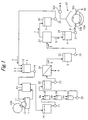
- FIG. 1 is a schematic representation showing the apparatus for the treatment of a wiping solution.
- a wiping roller 11 which abuts an intaglio cylinder 100 of an intaglio printing press is immersed in wiping solution 1 in a wiping-solution tank 12.
- the wiping solution 1 contains water 2 and a surfactant 3 predominantly containing sodium hydroxide (NaOH) and sulfonated castor oil (S.C.O), so as to facilitate dispersion of ink into the solution in accordance with the composition or amount of the ink.
- the wiping-solution tank 12 is connected to an inlet port of an adjustment/circulation apparatus 13.
- An outlet port of the adjustment/circulation apparatus 13 is connected to the wiping-solution tank 12.
- a supply port of the adjustment/circulation apparatus 13 is connected, via a feed pump 14, to a production tank 15 in which the water 2 and the surfactant 3 are mixed at a predetermined ratio, and stirred, to thereby produce the wiping solution 1.
- a discharge port of the adjustment/circulation apparatus 13 is connected to a used-solution tank 16.
- the adjustment/circulation apparatus 13 maintains the temperature of the wiping solution 1 supplied from the wiping-solution tank 12 at 45-55°C, and measures the amount of the solution 1 and the concentration of a detergent or ink components contained in the solution 1.
- the feed pump 14 is operated, and then a fresh wiping solution 1 is supplied from the production tank 15 to the apparatus 13.
- the used wiping solution 1 circulating in the apparatus 13 is fed to the used-solution tank 16, and a fresh wiping solution 1 is supplied from the production tank 15 to the apparatus 13.
- the used-solution tank 16 is connected, via a feed pump 17, to a first flocculation tank 18 into which a first flocculant 4a such as calcium chloride (CaCl 2 ) is supplied.
- the first flocculation tank 18 is connected to a second flocculation tank 19 into which a second flocculant 4b such as ferric chloride (FeCl 3 ) is supplied.
- the second flocculation tank 19 is connected to a third flocculation tank 20 into which a filtration accelerator 4c is supplied.
- the third flocculation tank 20 is connected to a flocculated-solution tank 22 via a feed pump 21.
- the thus-described feed pumps 17 and 21, the first through third flocculation tanks 18-20, and the flocculated-solution tank 22 constitutes the ink flocculation means.
- the flocculated-solution tank 22 is connected, via a feed pump 23, to a dehydration filter 24 of a pressure-type or a vacuum-type, which is employed for separating the wiping solution 1 which has undergone the flocculation treatment into sludge 5 and a filtrate 6.
- a filtrate discharge port of the dehydration filter 24 is connected to a filtrate tank 25.
- the thus-described feed pump 23, the dehydration filter 24, and the filtrate tank 25 constitutes the solid-liquid separation means.
- the filtrate tank 25 is connected to a condenser (evaporator) 27 via a feed pump 26.
- the condenser 27 the filtrate 6 which is supplied from the filtrate tank 25 is sprayed onto a heat-exchange tube through which a heating medium passes, and is then evaporated and cooled, to thereby produce distilled water 7.
- a non-evaporated residue is repeatedly sprayed onto the heat-exchange tube, to thereby produce a concentrated solution (salt solution) 8.
- a distilled water outlet port of the condenser 27 is connected to a distilled water tank 28.
- a concentrated solution outlet port is connected to a concentrated-solution tank 29.
- the distilled water production means comprises the thus-described feed pump 26, the condenser 27, the distilled water tank 28, and the concentrated-solution tank 29.
- the distilled water tank 28 is connected to the production tank 15 via a feed pump 30.
- the concentrated-solution tank 29 is connected to a dryer (drum dryer) 32 via a feed pump 31.
- the concentrated solution 8 which is supplied from the concentrated-solution tank 29 is blown through a sprayer 32b onto the surface of a drum 32a, the inside of which is heated by steam, to thereby evaporate a liquid component and discharge steam 9 through an exhaust fan 32d.
- a solid salt 10, a solid residue which adheres to the surface of the drum 32a, is scraped off the surface by use of a scraper 32c and is recovered.
- the water-recycling means includes the feed pump 30, and the post treatment means includes the feed pump 31 and the dryer 32.
- Excess ink adhered to an intaglio on the intaglio cylinder 100 is wiped off by the wiping roller 11, and then dispersed into the wiping solution 1 in the wiping-solution tank 12.
- the wiping solution 1 containing the dispersed ink in the wiping-solution tank 12 is supplied to the adjustment/circulation apparatus 13.
- the solution In the apparatus 13, the solution is maintained at a constant temperature, and the amount of the solution and the concentrations of the surfactant 3 and ink components are measured.
- the feed pump 14 is operated and a fresh wiping solution 1 in the production tank 15 is supplied to the apparatus 13 for replenishment.
- the wiping solution 1 in the wiping-solution tank 12 is fed to the used-solution tank 16, and a fresh wiping solution 1 is supplied from the production tank 15 to the apparatus 13, such that the concentrations of the surfactant 3 and the ink components contained in the wiping solution in the tank 12 fall within a predetermined range.
- the wiping solution 1 which is fed to the used-solution tank 16 is supplied from the tank 16 to the first flocculation tank 18 through the feed pump 17, and a first flocculant 4a such as calcium chloride (CaCl 2 ) is added thereto. Subsequently, the resultant solution is fed to the second flocculation tank 19, and a second flocculant 4b such as ferric chloride (FeCl 3 ) is added. Thereafter, the mixture solution is fed to the third flocculation tank 20, and a filtration accelerator 4c is added to the solution, and then the solution is fed to the flocculated-solution tank 22 through the feed pump 23. Through the above procedure, the ink components contained in the wiping solution 1 is flocculated.
- the filtration accelerator 4c is added to the wiping solution 1 when an oily substance which is difficult to filter is produced through flocculation by the addition of the flocculants 4a and 4b. Whether the filtration accelerator is added or not, or the amount of the accelerator added, is determined in accordance with the type of ink contained in the solution 1.
- the wiping solution 1 which has undergone the flocculation treatment is supplied from the flocculated-solution tank 22 to the dehydration filter 24 through the feed pump 23, and then separated into the sludge 5 and the filtrate 6.
- the sludge 5 is charged into drums or similar containers, and then disposed of.
- the filtrate 6 is fed to the filtrate tank 25, and then fed to the condenser 27 through the feed pump 26.
- the filtrate 6 fed to the condenser 27 is sprayed onto the heat-exchange tube through which a heating medium passes, and then evaporated and cooled.
- the resultant water is recovered as the distilled water 7 (recovery ratio: about 80%).
- the non-evaporated residue is repeatedly sprayed onto the heat-exchange tube, to thereby produce a concentrated solution (salt solution) 8.
- the thus-produced distilled water 7 is stored temporarily in the distilled water tank 28, and then fed as required to the production tank 15 through the feed pump 30.
- the distilled water 7 is used as a raw material of a fresh wiping solution 1 after being mixed with water 2 and the surfactant 3 and stirred in the production tank.
- the concentrated solution 8 is fed to the concentrated-solution tank 29, and then fed to the dryer 32 through the feed pump 31.
- the concentrated solution 8 fed to the dryer 32 is blown through the sprayer 32b onto the surface of the drum 32a, the inside of which is heated by steam.
- liquid components are evaporated and the steam 9 is discharged through the exhaust fan 32d.
- the components of the steam 9 are similar to those of exhaust from a seawater evaporation system, and thus the steam rarely affects the environment detrimentally.
- the residual solid salt 10 which is adhered to the surface of the drum 32a is scraped off by use of the scraper 32c, and then recovered into drums or similar containers.
- the used wiping solution 1 is subjected to filtration after flocculation of ink components, and the resultant filtrate is heated and evaporated, to thereby produce distilled water 7. Only the distilled water is recycled as a raw material of the fresh wiping solution 1.
- the used wiping solution 1 can be easily treated, and even when water contained in the used wiping solution is recycled, a wiping solution having consistent properties can be easily produced.
- FIG. 2 is a quantity-balance flowchart of the method for the treatment of a wiping solution of the Example of the present invention.
- ink is dispersed in a wiping solution in an amount of 2,400 kg/day.
- a wiping solution is employed in an amount of 21,600 kg/day, the concentration of ink contained in the wiping solution is 10 wt.%, and the amount of used wiping solution is 24,000 kg/day.
- a flocculant is added to the used wiping solution to flocculate the ink, and then the resultant solution is subjected to filtration and separation into sludge (water content: 50%) (4,800 kg/day) and a filtrate (salt content: 2%) (19,200 kg/day).
- the filtrate is concentrated to 1/10, to thereby produce distilled water (17,280 kg/day) and a concentrated solution (salt content: 20%) (1,920 kg/day).
- the percentages of sodium hydroxide and sulfonated castor oil in a fresh wiping solution are set at 0.8 wt.% and the above-produced distilled water is recycled as a raw material of the wiping solution
- the amounts of sodium hydroxide (30% aqueous solution) and sulfonated castor oil (50% aqueous solution), which are employed for producing the wiping solution are 576 kg/day and 346 kg/day, respectively.
- the amount of water employed for replenishment is 3,398 kg/day. Therefore, water can be recycled at a recovery ratio of 80%.
- the used wiping solution is subjected to filtration after flocculation of the ink components contained in the solution; the resultant filtrate is heated and evaporated to thereby produce distilled water; and only the distilled water is recycled as a raw material of a fresh wiping solution. Therefore, clogging does not occur during filtration, and a wiping solution having consistent properties can be easily produced. Consequently, the used wiping solution can be easily treated, and even when water contained in the used wiping solution is recycled, a wiping solution having consistent properties can be easily produced.
Landscapes
- Life Sciences & Earth Sciences (AREA)
- Hydrology & Water Resources (AREA)
- Engineering & Computer Science (AREA)
- Environmental & Geological Engineering (AREA)
- Water Supply & Treatment (AREA)
- Chemical & Material Sciences (AREA)
- Organic Chemistry (AREA)
- Separation Of Suspended Particles By Flocculating Agents (AREA)
- Heat Treatment Of Water, Waste Water Or Sewage (AREA)
- Inking, Control Or Cleaning Of Printing Machines (AREA)
- Treatment Of Fiber Materials (AREA)
- Rotary Presses (AREA)
Abstract
Description
Claims (2)
- A method for the treatment of a wiping solution, characterized by comprising: adding a flocculant (4a, 4b) to a used wiping solution (1) for flocculation of ink contained in said used wiping solution; filtering said used wiping solution for separation of said used wiping solution into sludge (5) and a filtrate (6); heating said filtrate to produce distilled water (7) and a concentrated solution (8); returning said distilled water for recycling to serve as a raw material of a wiping solution; and heating said concentrated solution for separation of said concentrated solution into steam (9) and a solid residue.
- An apparatus for the treatment of a wiping solution, characterized by comprising: ink flocculation means for flocculating ink contained in a used wiping solution (1) by the addition of a flocculant (4a, 4b) to said used wiping solution; solid-liquid separation means for separating, into sludge (5) and a filtrate (6), said used wiping solution containing said ink which is flocculated by said ink flocculation means through filtration of said used wiping solution; distilled water production means for producing distilled water (7) and a concentrated solution (8) through heating of said filtrate which is separated by said solid-liquid separation means; water recycling means for recycling said distilled water which is produced by said distilled water production means as a raw material of a wiping solution; and post treatment means for separating said concentrated solution into steam (9) and a solid residue through heating of said concentrated solution which is produced by said distilled water production means.
Applications Claiming Priority (2)
| Application Number | Priority Date | Filing Date | Title |
|---|---|---|---|
| JP29058999A JP4212735B2 (en) | 1999-10-13 | 1999-10-13 | Wiping liquid processing method and apparatus |
| JP29058999 | 1999-10-13 |
Publications (3)
| Publication Number | Publication Date |
|---|---|
| EP1092684A2 true EP1092684A2 (en) | 2001-04-18 |
| EP1092684A3 EP1092684A3 (en) | 2001-11-28 |
| EP1092684B1 EP1092684B1 (en) | 2007-02-07 |
Family
ID=17757981
Family Applications (1)
| Application Number | Title | Priority Date | Filing Date |
|---|---|---|---|
| EP00121380A Expired - Lifetime EP1092684B1 (en) | 1999-10-13 | 2000-10-12 | Method and apparatus for the treatment of wiping solution |
Country Status (6)
| Country | Link |
|---|---|
| US (2) | US6547970B1 (en) |
| EP (1) | EP1092684B1 (en) |
| JP (1) | JP4212735B2 (en) |
| AT (1) | ATE353314T1 (en) |
| DE (1) | DE60033253T2 (en) |
| ES (1) | ES2283265T3 (en) |
Cited By (6)
| Publication number | Priority date | Publication date | Assignee | Title |
|---|---|---|---|---|
| EP2363290A1 (en) | 2010-03-05 | 2011-09-07 | KBA-NotaSys SA | Installation and process for recycling wiping solution of one or more intaglio printing presses |
| EP2559555A1 (en) * | 2011-08-15 | 2013-02-20 | Komori Corporation | Wiping device |
| AT513090A1 (en) * | 2012-07-09 | 2014-01-15 | Oebs Gmbh | processing plant |
| AT518390A4 (en) * | 2016-06-10 | 2017-10-15 | Wtg Water Treat Gmbh | Multi-stage process for the treatment of contaminated cleaning solutions and for the drying of the residues |
| AT518388A4 (en) * | 2016-06-10 | 2017-10-15 | Wtg Water Treat Gmbh | Process for the treatment of contaminated cleaning solutions from printing and varnishing processes by means of cross-flow ultrafiltration and rotary filtration |
| AT518434A4 (en) * | 2016-06-10 | 2017-10-15 | Wtg Water Treat Gmbh | Process for the treatment of contaminated cleaning solutions from printing and coating processes by ultrafiltration |
Families Citing this family (6)
| Publication number | Priority date | Publication date | Assignee | Title |
|---|---|---|---|---|
| US8441258B2 (en) * | 2009-12-30 | 2013-05-14 | General Electric Company | Quadrature and linear RF coil array for MRI of human spine and torso |
| US8893616B2 (en) * | 2011-07-27 | 2014-11-25 | Xerox Corporation | Ghost-free inking methods, apparatus, and systems with reduced fountain solution contamination |
| AR090178A1 (en) | 2012-03-23 | 2014-10-22 | Sicpa Holding Sa | PRINTING METHOD WITH OXIDATION DRY CALCOGRAPHIC INK AND UV-VIS CURABLE CALCOGRAPHIC INKS |
| CN102730861B (en) * | 2012-08-02 | 2013-12-11 | 华夏新资源有限公司 | Recycling system for surface treatment of phosphorus-containing electroless nickel plating solution composition by wet process |
| DE102018005943A1 (en) * | 2018-07-19 | 2020-01-23 | ERAGON R&D GmbH | Device and method for cleaning waste water contaminated with electrolytes and dyes |
| AT523844B1 (en) * | 2020-12-17 | 2021-12-15 | Gwt Membraflow Gmbh | Process for processing a wiping solution loaded with foreign substances |
Family Cites Families (12)
| Publication number | Priority date | Publication date | Assignee | Title |
|---|---|---|---|---|
| BE531811A (en) * | 1953-09-17 | 1900-01-01 | ||
| US3907506A (en) * | 1972-03-17 | 1975-09-23 | Air Liquide | Apparatus for the preparation of alkaline hyperoxide |
| CA1162472A (en) * | 1980-03-18 | 1984-02-21 | T. Sampat Sridhar | Method and apparatus for evaporating radioactive liquid and calcinating the residue |
| CH686001A5 (en) * | 1990-04-18 | 1995-11-30 | Andre Robert Louis Monnerat | Process for regeneration inks for printing security documents by printing technique intaglio. |
| KR100243441B1 (en) * | 1991-06-25 | 2000-03-02 | 바우만-쉴프, 루시아 | Process and device for sludge dewatering |
| US5454939A (en) * | 1994-01-18 | 1995-10-03 | Monitrol, Inc. | Wastewater evaporator with rotatable drum |
| AT408544B (en) * | 1996-02-12 | 2001-12-27 | Oebs Gmbh | METHOD FOR TREATING POLLUTED ALKALINE AQUEOUS CLEANING SOLUTIONS |
| US6086722A (en) * | 1996-07-17 | 2000-07-11 | Texaco Inc. | Minimizing evaporator scaling and recovery of salts during gasification |
| GB2315743A (en) * | 1996-07-31 | 1998-02-11 | Ecc Int Ltd | Treating paper plant effluent |
| UA28061C2 (en) | 1996-09-02 | 2000-10-16 | Де Ля Рю Жіорі С.А. | method and device for obtaining FRESH washing solution and treating spent solution |
| IT1297042B1 (en) * | 1997-12-31 | 1999-08-03 | De La Rue Giori Sa | PROCESS OF PRODUCTION OF FRESH DRYING SOLUTION AND TREATMENT OF USED DRYING SOLUTION AND DEVICE OF |
| DE19857108A1 (en) * | 1998-12-10 | 2000-06-15 | Baldwin Grafotec Gmbh | Temperature control device for printing press, with fluid circuit including pump and two lines |
-
1999
- 1999-10-13 JP JP29058999A patent/JP4212735B2/en not_active Expired - Fee Related
-
2000
- 2000-10-12 DE DE60033253T patent/DE60033253T2/en not_active Expired - Fee Related
- 2000-10-12 ES ES00121380T patent/ES2283265T3/en not_active Expired - Lifetime
- 2000-10-12 EP EP00121380A patent/EP1092684B1/en not_active Expired - Lifetime
- 2000-10-12 AT AT00121380T patent/ATE353314T1/en not_active IP Right Cessation
- 2000-10-13 US US09/689,609 patent/US6547970B1/en not_active Expired - Fee Related
-
2003
- 2003-03-10 US US10/383,540 patent/US6767454B2/en not_active Expired - Fee Related
Cited By (13)
| Publication number | Priority date | Publication date | Assignee | Title |
|---|---|---|---|---|
| WO2011107950A1 (en) | 2010-03-05 | 2011-09-09 | Kba-Notasys Sa | Installation and process for recycling wiping solution of one or more intaglio printing presses |
| EP2363290A1 (en) | 2010-03-05 | 2011-09-07 | KBA-NotaSys SA | Installation and process for recycling wiping solution of one or more intaglio printing presses |
| EP2559555B1 (en) | 2011-08-15 | 2016-09-07 | Komori Corporation | Wiping device |
| EP2559555A1 (en) * | 2011-08-15 | 2013-02-20 | Komori Corporation | Wiping device |
| AT513090A1 (en) * | 2012-07-09 | 2014-01-15 | Oebs Gmbh | processing plant |
| AT513090B1 (en) * | 2012-07-09 | 2014-03-15 | Oebs Gmbh | processing plant |
| EP2684697A1 (en) * | 2012-07-09 | 2014-01-15 | Oesterreichische Banknoten- und Sicherheitsdruck GmbH | Treatment plant |
| AT518390A4 (en) * | 2016-06-10 | 2017-10-15 | Wtg Water Treat Gmbh | Multi-stage process for the treatment of contaminated cleaning solutions and for the drying of the residues |
| AT518390B1 (en) * | 2016-06-10 | 2017-10-15 | Wtg Water Treat Gmbh | Multi-stage process for the treatment of contaminated cleaning solutions and for the drying of the residues |
| AT518388A4 (en) * | 2016-06-10 | 2017-10-15 | Wtg Water Treat Gmbh | Process for the treatment of contaminated cleaning solutions from printing and varnishing processes by means of cross-flow ultrafiltration and rotary filtration |
| AT518434A4 (en) * | 2016-06-10 | 2017-10-15 | Wtg Water Treat Gmbh | Process for the treatment of contaminated cleaning solutions from printing and coating processes by ultrafiltration |
| AT518388B1 (en) * | 2016-06-10 | 2017-10-15 | Wtg Water Treat Gmbh | Process for the treatment of contaminated cleaning solutions from printing and varnishing processes by means of cross-flow ultrafiltration and rotary filtration |
| AT518434B1 (en) * | 2016-06-10 | 2017-10-15 | Wtg Water Treat Gmbh | Process for the treatment of contaminated cleaning solutions from printing and coating processes by ultrafiltration |
Also Published As
| Publication number | Publication date |
|---|---|
| DE60033253T2 (en) | 2007-10-25 |
| EP1092684A3 (en) | 2001-11-28 |
| ATE353314T1 (en) | 2007-02-15 |
| US20030146168A1 (en) | 2003-08-07 |
| US6767454B2 (en) | 2004-07-27 |
| JP4212735B2 (en) | 2009-01-21 |
| EP1092684B1 (en) | 2007-02-07 |
| ES2283265T3 (en) | 2007-11-01 |
| JP2001104994A (en) | 2001-04-17 |
| DE60033253D1 (en) | 2007-03-22 |
| US6547970B1 (en) | 2003-04-15 |
Similar Documents
| Publication | Publication Date | Title |
|---|---|---|
| US6547970B1 (en) | Method for the treatment of wiping solution | |
| US10603896B2 (en) | Installation and process for recycling wiping solution of one or more intaglio printing presses | |
| CN106587476A (en) | Method for treatment of mixed wastewater produced during production of rubber accelerator NS\CZ\DZ | |
| CN107151076A (en) | A kind of processing of high-concentration waste emulsion, recovery process | |
| EP0826502B1 (en) | Method and means for realising a fresh cleaning solution and for treating the used solution | |
| CN110204117A (en) | A kind of wastewater treatment method cleaning ink plastic packaging containers | |
| CN108774110A (en) | Desalination serialization recycles technique after a kind of waste liquid of Lei Baifa production BDO devices steams | |
| JPH1085789A5 (en) | ||
| AU754542B2 (en) | Process for producing a fresh wiping solution and for treating a used solution and apparatus for carrying out the process | |
| JPH0114836B2 (en) | ||
| US20210238076A1 (en) | Hybrid system for contaminants control of industrial process | |
| RU2173266C2 (en) | Method of preparation of fresh washing solution and treatment of used solution and device for realization of this method | |
| CA1087330A (en) | Waste treatment process | |
| JPH11114598A (en) | Treatment method for aluminum-containing sludge | |
| JPH04298741A (en) | Processing method and processing device for waste processing liquid of non-silver salt photosensitive material | |
| JPS62166877A (en) | Disposition of waste after 'shouchu' distillation | |
| JPH05156476A (en) | Surface treatment of aluminum base for printing plate |
Legal Events
| Date | Code | Title | Description |
|---|---|---|---|
| PUAI | Public reference made under article 153(3) epc to a published international application that has entered the european phase |
Free format text: ORIGINAL CODE: 0009012 |
|
| AK | Designated contracting states |
Kind code of ref document: A2 Designated state(s): AT BE CH CY DE DK ES FI FR GB GR IE IT LI LU MC NL PT SE |
|
| AX | Request for extension of the european patent |
Free format text: AL;LT;LV;MK;RO;SI |
|
| PUAL | Search report despatched |
Free format text: ORIGINAL CODE: 0009013 |
|
| AK | Designated contracting states |
Kind code of ref document: A3 Designated state(s): AT BE CH CY DE DK ES FI FR GB GR IE IT LI LU MC NL PT SE |
|
| AX | Request for extension of the european patent |
Free format text: AL;LT;LV;MK;RO;SI |
|
| 17P | Request for examination filed |
Effective date: 20020430 |
|
| AKX | Designation fees paid |
Free format text: AT BE CH CY DE DK ES FI FR GB GR IE IT LI LU MC NL PT SE |
|
| 17Q | First examination report despatched |
Effective date: 20020722 |
|
| GRAP | Despatch of communication of intention to grant a patent |
Free format text: ORIGINAL CODE: EPIDOSNIGR1 |
|
| GRAS | Grant fee paid |
Free format text: ORIGINAL CODE: EPIDOSNIGR3 |
|
| GRAA | (expected) grant |
Free format text: ORIGINAL CODE: 0009210 |
|
| AK | Designated contracting states |
Kind code of ref document: B1 Designated state(s): AT BE CH CY DE DK ES FI FR GB GR IE IT LI LU MC NL PT SE |
|
| PG25 | Lapsed in a contracting state [announced via postgrant information from national office to epo] |
Ref country code: FI Free format text: LAPSE BECAUSE OF FAILURE TO SUBMIT A TRANSLATION OF THE DESCRIPTION OR TO PAY THE FEE WITHIN THE PRESCRIBED TIME-LIMIT Effective date: 20070207 Ref country code: AT Free format text: LAPSE BECAUSE OF FAILURE TO SUBMIT A TRANSLATION OF THE DESCRIPTION OR TO PAY THE FEE WITHIN THE PRESCRIBED TIME-LIMIT Effective date: 20070207 Ref country code: DK Free format text: LAPSE BECAUSE OF FAILURE TO SUBMIT A TRANSLATION OF THE DESCRIPTION OR TO PAY THE FEE WITHIN THE PRESCRIBED TIME-LIMIT Effective date: 20070207 Ref country code: BE Free format text: LAPSE BECAUSE OF FAILURE TO SUBMIT A TRANSLATION OF THE DESCRIPTION OR TO PAY THE FEE WITHIN THE PRESCRIBED TIME-LIMIT Effective date: 20070207 |
|
| REG | Reference to a national code |
Ref country code: GB Ref legal event code: FG4D |
|
| REG | Reference to a national code |
Ref country code: SE Ref legal event code: TRGR |
|
| REG | Reference to a national code |
Ref country code: CH Ref legal event code: EP |
|
| REG | Reference to a national code |
Ref country code: IE Ref legal event code: FG4D |
|
| REF | Corresponds to: |
Ref document number: 60033253 Country of ref document: DE Date of ref document: 20070322 Kind code of ref document: P |
|
| REG | Reference to a national code |
Ref country code: CH Ref legal event code: NV Representative=s name: R. A. EGLI & CO. PATENTANWAELTE |
|
| ET | Fr: translation filed | ||
| PG25 | Lapsed in a contracting state [announced via postgrant information from national office to epo] |
Ref country code: PT Free format text: LAPSE BECAUSE OF FAILURE TO SUBMIT A TRANSLATION OF THE DESCRIPTION OR TO PAY THE FEE WITHIN THE PRESCRIBED TIME-LIMIT Effective date: 20070709 |
|
| REG | Reference to a national code |
Ref country code: ES Ref legal event code: FG2A Ref document number: 2283265 Country of ref document: ES Kind code of ref document: T3 |
|
| PLBE | No opposition filed within time limit |
Free format text: ORIGINAL CODE: 0009261 |
|
| STAA | Information on the status of an ep patent application or granted ep patent |
Free format text: STATUS: NO OPPOSITION FILED WITHIN TIME LIMIT |
|
| 26N | No opposition filed |
Effective date: 20071108 |
|
| PG25 | Lapsed in a contracting state [announced via postgrant information from national office to epo] |
Ref country code: GR Free format text: LAPSE BECAUSE OF FAILURE TO SUBMIT A TRANSLATION OF THE DESCRIPTION OR TO PAY THE FEE WITHIN THE PRESCRIBED TIME-LIMIT Effective date: 20070508 |
|
| PG25 | Lapsed in a contracting state [announced via postgrant information from national office to epo] |
Ref country code: MC Free format text: LAPSE BECAUSE OF NON-PAYMENT OF DUE FEES Effective date: 20071031 |
|
| PG25 | Lapsed in a contracting state [announced via postgrant information from national office to epo] |
Ref country code: IE Free format text: LAPSE BECAUSE OF NON-PAYMENT OF DUE FEES Effective date: 20071012 |
|
| PGFP | Annual fee paid to national office [announced via postgrant information from national office to epo] |
Ref country code: CH Payment date: 20081016 Year of fee payment: 9 Ref country code: DE Payment date: 20081014 Year of fee payment: 9 Ref country code: NL Payment date: 20081015 Year of fee payment: 9 |
|
| PGFP | Annual fee paid to national office [announced via postgrant information from national office to epo] |
Ref country code: ES Payment date: 20081030 Year of fee payment: 9 |
|
| PGFP | Annual fee paid to national office [announced via postgrant information from national office to epo] |
Ref country code: IT Payment date: 20081029 Year of fee payment: 9 Ref country code: SE Payment date: 20081022 Year of fee payment: 9 |
|
| PGFP | Annual fee paid to national office [announced via postgrant information from national office to epo] |
Ref country code: FR Payment date: 20081014 Year of fee payment: 9 |
|
| PGFP | Annual fee paid to national office [announced via postgrant information from national office to epo] |
Ref country code: GB Payment date: 20081008 Year of fee payment: 9 |
|
| PG25 | Lapsed in a contracting state [announced via postgrant information from national office to epo] |
Ref country code: CY Free format text: LAPSE BECAUSE OF FAILURE TO SUBMIT A TRANSLATION OF THE DESCRIPTION OR TO PAY THE FEE WITHIN THE PRESCRIBED TIME-LIMIT Effective date: 20070207 |
|
| PG25 | Lapsed in a contracting state [announced via postgrant information from national office to epo] |
Ref country code: LU Free format text: LAPSE BECAUSE OF NON-PAYMENT OF DUE FEES Effective date: 20071012 |
|
| REG | Reference to a national code |
Ref country code: NL Ref legal event code: V1 Effective date: 20100501 |
|
| REG | Reference to a national code |
Ref country code: CH Ref legal event code: PL |
|
| EUG | Se: european patent has lapsed | ||
| REG | Reference to a national code |
Ref country code: FR Ref legal event code: ST Effective date: 20100630 |
|
| PG25 | Lapsed in a contracting state [announced via postgrant information from national office to epo] |
Ref country code: NL Free format text: LAPSE BECAUSE OF NON-PAYMENT OF DUE FEES Effective date: 20100501 Ref country code: DE Free format text: LAPSE BECAUSE OF NON-PAYMENT OF DUE FEES Effective date: 20100501 Ref country code: FR Free format text: LAPSE BECAUSE OF NON-PAYMENT OF DUE FEES Effective date: 20091102 |
|
| PG25 | Lapsed in a contracting state [announced via postgrant information from national office to epo] |
Ref country code: CH Free format text: LAPSE BECAUSE OF NON-PAYMENT OF DUE FEES Effective date: 20091031 Ref country code: LI Free format text: LAPSE BECAUSE OF NON-PAYMENT OF DUE FEES Effective date: 20091031 |
|
| PG25 | Lapsed in a contracting state [announced via postgrant information from national office to epo] |
Ref country code: GB Free format text: LAPSE BECAUSE OF NON-PAYMENT OF DUE FEES Effective date: 20091012 |
|
| PG25 | Lapsed in a contracting state [announced via postgrant information from national office to epo] |
Ref country code: IT Free format text: LAPSE BECAUSE OF NON-PAYMENT OF DUE FEES Effective date: 20091012 |
|
| REG | Reference to a national code |
Ref country code: ES Ref legal event code: FD2A Effective date: 20110406 |
|
| PG25 | Lapsed in a contracting state [announced via postgrant information from national office to epo] |
Ref country code: SE Free format text: LAPSE BECAUSE OF NON-PAYMENT OF DUE FEES Effective date: 20091013 |
|
| PG25 | Lapsed in a contracting state [announced via postgrant information from national office to epo] |
Ref country code: ES Free format text: LAPSE BECAUSE OF NON-PAYMENT OF DUE FEES Effective date: 20110324 |
|
| PG25 | Lapsed in a contracting state [announced via postgrant information from national office to epo] |
Ref country code: ES Free format text: LAPSE BECAUSE OF NON-PAYMENT OF DUE FEES Effective date: 20091013 |