EP1092356A1 - Disposable wearing article - Google Patents
Disposable wearing article Download PDFInfo
- Publication number
- EP1092356A1 EP1092356A1 EP99959706A EP99959706A EP1092356A1 EP 1092356 A1 EP1092356 A1 EP 1092356A1 EP 99959706 A EP99959706 A EP 99959706A EP 99959706 A EP99959706 A EP 99959706A EP 1092356 A1 EP1092356 A1 EP 1092356A1
- Authority
- EP
- European Patent Office
- Prior art keywords
- garment
- spacer members
- nonwoven fabric
- wearer
- skin
- Prior art date
- Legal status (The legal status is an assumption and is not a legal conclusion. Google has not performed a legal analysis and makes no representation as to the accuracy of the status listed.)
- Withdrawn
Links
- 125000006850 spacer group Chemical group 0.000 claims abstract description 32
- 239000004745 nonwoven fabric Substances 0.000 claims description 20
- 239000012209 synthetic fiber Substances 0.000 claims description 8
- 229920002994 synthetic fiber Polymers 0.000 claims description 8
- 239000002651 laminated plastic film Substances 0.000 claims description 3
- 239000000463 material Substances 0.000 description 8
- 230000035699 permeability Effects 0.000 description 7
- 238000007789 sealing Methods 0.000 description 4
- 229920001169 thermoplastic Polymers 0.000 description 3
- 239000004416 thermosoftening plastic Substances 0.000 description 3
- 238000009423 ventilation Methods 0.000 description 3
- 239000004831 Hot glue Substances 0.000 description 2
- 239000003795 chemical substances by application Substances 0.000 description 2
- 238000000034 method Methods 0.000 description 2
- 239000002985 plastic film Substances 0.000 description 2
- 229920006255 plastic film Polymers 0.000 description 2
- 210000001015 abdomen Anatomy 0.000 description 1
- 239000000853 adhesive Substances 0.000 description 1
- 230000002411 adverse Effects 0.000 description 1
- 238000013459 approach Methods 0.000 description 1
- 239000000835 fiber Substances 0.000 description 1
- 238000010438 heat treatment Methods 0.000 description 1
- 238000010348 incorporation Methods 0.000 description 1
- 239000002759 woven fabric Substances 0.000 description 1
Images

Classifications
-
- A—HUMAN NECESSITIES
- A41—WEARING APPAREL
- A41D—OUTERWEAR; PROTECTIVE GARMENTS; ACCESSORIES
- A41D13/00—Professional, industrial or sporting protective garments, e.g. surgeons' gowns or garments protecting against blows or punches
- A41D13/12—Surgeons' or patients' gowns or dresses
- A41D13/1236—Patients' garments
- A41D13/1245—Patients' garments for the upper part of the body
-
- A—HUMAN NECESSITIES
- A41—WEARING APPAREL
- A41D—OUTERWEAR; PROTECTIVE GARMENTS; ACCESSORIES
- A41D13/00—Professional, industrial or sporting protective garments, e.g. surgeons' gowns or garments protecting against blows or punches
- A41D13/12—Surgeons' or patients' gowns or dresses
-
- A—HUMAN NECESSITIES
- A41—WEARING APPAREL
- A41D—OUTERWEAR; PROTECTIVE GARMENTS; ACCESSORIES
- A41D13/00—Professional, industrial or sporting protective garments, e.g. surgeons' gowns or garments protecting against blows or punches
- A41D13/12—Surgeons' or patients' gowns or dresses
- A41D13/1209—Surgeons' gowns or dresses
-
- A—HUMAN NECESSITIES
- A41—WEARING APPAREL
- A41D—OUTERWEAR; PROTECTIVE GARMENTS; ACCESSORIES
- A41D27/00—Details of garments or of their making
- A41D27/02—Linings
-
- A—HUMAN NECESSITIES
- A41—WEARING APPAREL
- A41D—OUTERWEAR; PROTECTIVE GARMENTS; ACCESSORIES
- A41D31/00—Materials specially adapted for outerwear
- A41D31/04—Materials specially adapted for outerwear characterised by special function or use
- A41D31/10—Impermeable to liquids, e.g. waterproof; Liquid-repellent
- A41D31/102—Waterproof and breathable
-
- A—HUMAN NECESSITIES
- A41—WEARING APPAREL
- A41D—OUTERWEAR; PROTECTIVE GARMENTS; ACCESSORIES
- A41D2300/00—Details of garments
- A41D2300/30—Closures
- A41D2300/32—Closures using hook and loop-type fasteners
-
- A—HUMAN NECESSITIES
- A41—WEARING APPAREL
- A41D—OUTERWEAR; PROTECTIVE GARMENTS; ACCESSORIES
- A41D2300/00—Details of garments
- A41D2300/50—Seams
- A41D2300/52—Seams made by welding or gluing
-
- A—HUMAN NECESSITIES
- A41—WEARING APPAREL
- A41D—OUTERWEAR; PROTECTIVE GARMENTS; ACCESSORIES
- A41D2400/00—Functions or special features of garments
- A41D2400/52—Disposable
-
- A—HUMAN NECESSITIES
- A41—WEARING APPAREL
- A41D—OUTERWEAR; PROTECTIVE GARMENTS; ACCESSORIES
- A41D2500/00—Materials for garments
- A41D2500/30—Non-woven
-
- D—TEXTILES; PAPER
- D10—INDEXING SCHEME ASSOCIATED WITH SUBLASSES OF SECTION D, RELATING TO TEXTILES
- D10B—INDEXING SCHEME ASSOCIATED WITH SUBLASSES OF SECTION D, RELATING TO TEXTILES
- D10B2501/00—Wearing apparel
- D10B2501/04—Outerwear; Protective garments
Definitions
- This invention relates to a disposable garment such as a disposable upper garment and more particularly to such a garment having its air permeability improved.
- disposable garments have been widely used in hospitals and similar facilities.
- Such disposable garments include operating gown, shirts and shorts for patients and, in many cases, a nonwoven fabric, particularly, made of thermoplastic synthetic fibers is used as stock material for such disposable garments.
- the respective pieces of a nonwoven fabric have been bonded together by using hot melt adhesive agent or heat- or ultrasonic sealing technique instead of stitching them together in order to improve an attempt to improve a productivity of such garments. It has also been attempted to improve the productivity by assembling a plurality of pieces of a nonwoven fabric along bonding lines as simple as possible.
- these approaches have often resulted in a flat configuration of the garment with which, for example, the front body and the rear body do not uniformly fit around a wearer's torso but tightly fit only to the wearer's belly and back.
- the nonwoven fabric of synthetic fiber is generally poor in a sweat-absorbency, the garment made of such stock material necessarily apt to cause undesirable stuffiness and may give the user uncomfortable feeling to wear.
- a disposable garment comprising at least front and rear bodies, the disposable garment being characterized by that spacer members formed separately of the garment and attached to the inner surface of the garment extend from the inner surface of the garment toward a wearer's skin so as to describe circular arcs, respectively, and being elastically deformable between the inner surface and said wearer's skin.
- the front and rear bodies are made of a nonwoven fabric or a nonwoven fabric/plastic film laminate sheet.
- the spacer members are made of crimped synthetic fibers.
- the garment has a pair of sleeves and the spacer members attached to the inner surface of the sleeves.
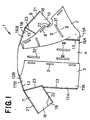
- An upper garment 1 shown by Fig. 1 in a front view as partially broken away is made from a nonwoven fabric of thermoplastic synthetic fibers and configurationally comprises left-half and right-half front bodies 2, 3, a rear body, and left and right sleeves 6, 7.
- the left-half and right-half front bodies 2, 3 are respectively provided with a hook member 8 and a loop member 9 making cooperating parts of a mechanical fastener which has been known by the various trade names such as Velcro and Magic Tape.
- These hook and loop members 8, 9 may be engaged with or disengaged from each other to close or open the front body.
- the left-half and right-half front bodies 2, 3 respectively have their side edges 11A, 12A and shoulder edges 11B, 12B which are respective heat-sealed with the associated side edges 16A, 17A and the associated shoulder edges 16B, 17B of the rear body 4.
- Each of the left and right sleeves 6, 7 comprises two nonwoven fabric sheets 18, 19 placed one upon another in a direction orthogonal to the plane of Fig. 1 and heat-sealed with each other along lines 21, 22.
- the nonwoven fabric sheet 18 is sealed with any one of the left-half and the right-half front bodies 2, 3 along the associated line 23 while the nonwoven fabric sheet 19 is heat-sealed with the rear body 4 along a line (now shown).
- the upper garment 1 is provided on the inner surface of the left-half and right half front bodies 2, 3 with first spacer members 31 and on the inner surface of the rear body 4 with second spacer members 32.
- the first spacer members 31 extend circumferentially of the upper garment 1 and the second spacer members 32 extend vertically of the upper garment 1.
- Fig. 2 is a sectional view taken along a line II-II in Fig. 1.
- Each of the first spacer members 31 is provided separately of the upper garment 1 and formed by curving a nonwoven fabric made of thermoplastic synthetic fibers under heating into an inverse U- or V-shape. The member 31 is bonded at its region 33 onto the inner surface of the upper garment 1 so as to describe a circular arc from the inner surface toward a wearer's skin.
- These first spacer members 31 function to keep the upper garment 1 spaced from the wearer's skin and thereby to improve an air permeability of the garment, i.e., a ventilation between the wearer's skin.
- the member 31 is elastically deformed to take a position indicated by an imaginary line as the garment is worn and brought in contact with the wearer's skin so as to be thereby forced in a direction as indicated by an arrow X.
- the member 31 can be flattened as further pressure is exerted thereon so that the wearer substantially does not feel a thickness of the member 31. Accordingly, the presence of these first spacer members 31 do not adversely affect a feeling to wear the upper garment 1 although they really protrude from the inner surface of the garment 1 toward the wearer's skin.
- a nonwoven fabric made from crimped synthetic fibers, more preferably, of crimped synthetic conjugated fibers may be used as stock material for the member 31. It is particularly preferred to use a nonwoven fabric in which the individual synthetic fibers are crimped to describe loops as stock material for the member 31 for the reason that such a nonwoven fabric provides both a high elasticity and a comfortable touch.
- a length of the member 31 as measured circumferentially of the upper garment 1 is not critical, it is generally preferred for the member 31 to have a length in a range from 10 to 300 mm.
- Fig. 3 is a sectional view taken along a line III-III in Fig. 1.
- Each of the second spacer members 32 is made of a nonwoven fabric similar to that of the first spacer member 31 and has its laterally opposite edges bonded together at its region 36 so as to present an annular cross-section. The member 32 having its opposite edges bonded together in this manner is then bonded to the inner surface of the rear body 4 at a region 37.
- the second spacer member 32 is also elastically deformed to take a position indicated by an imaginary line as the garment is worn and brought in contact with the wearer's skin so as to be forced in the direction as indicated by the arrow X.
- the second spacer members 32 function, similarly to the first spacer members 31, to ensure a desired ventilation between the garment 1 and the wearer's skin.
- a length of this member it is generally preferred, similarly to the first spacer member 31, to have a length in a range from 10 to 300 mm.
- the garment with the first and/or the second spacer members 31, 32 at regions other than those in the illustrated embodiment, for example, on the inner surface of the respective sleeves 6, 7. It is also possible to use only the first spacer members 31 or second spacer members 32. In view of the fact that the first spacer members 31 as well as the second spacer members 32 are provided separately of the upper garment 1, it is allowed to make the upper garment 1 itself and the spacer members 31, 32 by use of rationally selected stock materials which are most appropriate for the respective components.
- the upper garment 1 itself may be made of relatively inexpensive stock material such as an inelastic nonwoven fabric or a plastic film, or a nonwoven fabric/plastic film laminate sheet while the first and second spacer members may be made of a relatively expensive but sufficiently elastic nonwoven fabric.
- the upper garment 1 inclusive of the first and second spacer members can be made at a cost as limited as possibly while its function can be improved.
- an appropriate woven fabric as stock material for the upper garment 1. While bonding of the respective members constituting the upper garment 1 may be preferably carried out by heat-sealing or ultrasonic sealing, such sealing techniques may be replaced by adhesion using various adhesive agents such as hot melt adhesive agent.
- This invention is applicable also not only to the upper garment as has been described above with reference to the accompanying drawings but also to the other various types of disposable garment such as a sleeveless upper garment or disposable shorts. Even with the garment made of the sheet material being poor in its air permeability such as plastic film, incorporation of the first and second spacer members 31, 32 can significantly improve the air permeability of the garment as a whole.
- the disposable garment according to this invention is provided on its inner surface with the elastically deformable spacer members extending from the inner surface toward the wearer's skin so as to describe the circular arcs and thereby can achieve a desired air permeability of the garment, i.e., a good ventilation ensured between the garment and the wearer's skin.
Landscapes
- Engineering & Computer Science (AREA)
- Textile Engineering (AREA)
- Health & Medical Sciences (AREA)
- General Health & Medical Sciences (AREA)
- Physical Education & Sports Medicine (AREA)
- Professional, Industrial, Or Sporting Protective Garments (AREA)
- Details Of Garments (AREA)
- Undergarments, Swaddling Clothes, Handkerchiefs Or Underwear Materials (AREA)
- Outer Garments And Coats (AREA)
- Orthopedics, Nursing, And Contraception (AREA)
Applications Claiming Priority (3)
| Application Number | Priority Date | Filing Date | Title |
|---|---|---|---|
| JP35041298 | 1998-12-09 | ||
| JP35041298A JP3597715B2 (ja) | 1998-12-09 | 1998-12-09 | 使い捨ての着用物品 |
| PCT/JP1999/006886 WO2000033685A1 (en) | 1998-12-09 | 1999-12-08 | Disposable wearing article |
Publications (1)
| Publication Number | Publication Date |
|---|---|
| EP1092356A1 true EP1092356A1 (en) | 2001-04-18 |
Family
ID=18410329
Family Applications (1)
| Application Number | Title | Priority Date | Filing Date |
|---|---|---|---|
| EP99959706A Withdrawn EP1092356A1 (en) | 1998-12-09 | 1999-12-08 | Disposable wearing article |
Country Status (10)
| Country | Link |
|---|---|
| EP (1) | EP1092356A1 (enExample) |
| JP (1) | JP3597715B2 (enExample) |
| KR (1) | KR20010034489A (enExample) |
| CN (1) | CN1290134A (enExample) |
| AU (1) | AU1681600A (enExample) |
| BR (1) | BR9907972A (enExample) |
| CA (1) | CA2319499A1 (enExample) |
| ID (1) | ID26808A (enExample) |
| TW (1) | TW432934U (enExample) |
| WO (1) | WO2000033685A1 (enExample) |
Families Citing this family (4)
| Publication number | Priority date | Publication date | Assignee | Title |
|---|---|---|---|---|
| WO2016189669A1 (ja) * | 2015-05-26 | 2016-12-01 | 建作 三宅 | 保温具、保温キット、保温キットの製造方法および保温方法 |
| IT201700056188A1 (it) * | 2017-05-24 | 2018-11-24 | Geox Spa | Capo di abbigliamento traspirante e inserto traspirante per capi di abbigliamento |
| KR200489311Y1 (ko) * | 2018-07-23 | 2019-05-30 | 이준호 | 통기성 천과 비닐을 이용한 일회용 감염방지 가운 |
| US12433357B1 (en) * | 2024-07-03 | 2025-10-07 | Standard Textile Co., Inc. | Reusable, rear-opening protective garment with fastening elements configured to facilitate doffing-type removal |
Family Cites Families (8)
| Publication number | Priority date | Publication date | Assignee | Title |
|---|---|---|---|---|
| US490347A (en) * | 1893-01-24 | greeves | ||
| US3950789A (en) * | 1975-07-22 | 1976-04-20 | Kansas State University Research Foundation | Dry ice cooling jacket |
| US4504978A (en) * | 1983-04-29 | 1985-03-19 | Gregory Jr Paul E | Disposable surgical gown sleeve |
| JPH01147212U (enExample) * | 1988-03-30 | 1989-10-11 | ||
| KR910005328Y1 (ko) * | 1988-12-27 | 1991-07-22 | 삼성전자 주식회사 | 에어크리너의 집진 감지 장치 |
| JPH04185702A (ja) * | 1990-11-20 | 1992-07-02 | Noboru Kato | 簡易寝巻 |
| JPH0585817U (ja) * | 1992-04-27 | 1993-11-19 | 日出夫 坪倉 | 滑り止め付き通風排気パツチ |
| JPH08226018A (ja) * | 1995-02-16 | 1996-09-03 | Kanebo Ltd | 複合繊維 |
-
1998
- 1998-12-09 JP JP35041298A patent/JP3597715B2/ja not_active Expired - Fee Related
-
1999
- 1999-12-06 TW TW088220771U patent/TW432934U/zh unknown
- 1999-12-08 KR KR1020007008663A patent/KR20010034489A/ko not_active Abandoned
- 1999-12-08 CA CA002319499A patent/CA2319499A1/en not_active Abandoned
- 1999-12-08 CN CN99802828A patent/CN1290134A/zh active Pending
- 1999-12-08 AU AU16816/00A patent/AU1681600A/en not_active Abandoned
- 1999-12-08 EP EP99959706A patent/EP1092356A1/en not_active Withdrawn
- 1999-12-08 ID IDW20001516A patent/ID26808A/id unknown
- 1999-12-08 WO PCT/JP1999/006886 patent/WO2000033685A1/ja not_active Ceased
- 1999-12-08 BR BR9907972-0A patent/BR9907972A/pt unknown
Non-Patent Citations (1)
| Title |
|---|
| See references of WO0033685A1 * |
Also Published As
| Publication number | Publication date |
|---|---|
| JP3597715B2 (ja) | 2004-12-08 |
| TW432934U (en) | 2001-05-01 |
| AU1681600A (en) | 2000-06-26 |
| JP2000170019A (ja) | 2000-06-20 |
| WO2000033685A1 (en) | 2000-06-15 |
| CN1290134A (zh) | 2001-04-04 |
| KR20010034489A (ko) | 2001-04-25 |
| BR9907972A (pt) | 2002-01-08 |
| ID26808A (id) | 2001-02-08 |
| CA2319499A1 (en) | 2000-06-15 |
Similar Documents
| Publication | Publication Date | Title |
|---|---|---|
| US8141176B2 (en) | Pants having body-shaping function | |
| US11839241B2 (en) | Article of clothing and manufacturing method thereof | |
| US6289519B1 (en) | Throwaway trunks type underpants | |
| US6817037B1 (en) | Stretchable athletic pants having an overlapping bonded seam | |
| JP2001172801A (ja) | トランクス型の使い捨てパンツ | |
| JP3652533B2 (ja) | トランクス型着用物品 | |
| WO2006077658A1 (ja) | ブラジャーなどのバック部を有する衣類 | |
| EP0762838B1 (en) | Improved hand covering | |
| KR101970441B1 (ko) | 무봉제 방식의 남성용 기능성 팬티 | |
| CN1976604B (zh) | 具有裆部的衣服 | |
| US20220160053A1 (en) | Women's top with detachable pad | |
| AU1681600A (en) | Disposable wearing article | |
| CA2320310A1 (en) | Disposable upper garment and process for making the same | |
| KR101752356B1 (ko) | 허리가 늘어나는 바지 | |
| JPH08158109A (ja) | 股部を有するフィットタイプの衣類 | |
| US20230134607A1 (en) | Garment with dual closure configuration | |
| JPH11197179A (ja) | 生理用品 | |
| JP2001032120A5 (enExample) | ||
| JP3052845U (ja) | 運動着 | |
| JP3227495U (ja) | ブラジャーのカップ構造 | |
| JP2001032107A (ja) | 使い捨て上着 | |
| JP3040449U (ja) | 合成樹脂製スナップ付きバイアステープ | |
| JP3006200U (ja) | 蒸れにくい下着 | |
| CN209436274U (zh) | 一种男士内裤 | |
| JP3213033U (ja) | 防護衣 |
Legal Events
| Date | Code | Title | Description |
|---|---|---|---|
| PUAI | Public reference made under article 153(3) epc to a published international application that has entered the european phase |
Free format text: ORIGINAL CODE: 0009012 |
|
| 17P | Request for examination filed |
Effective date: 20001124 |
|
| AK | Designated contracting states |
Kind code of ref document: A1 Designated state(s): AT BE CH CY DE DK ES FI FR GB GR IE IT LI LU MC NL PT SE |
|
| 18W | Application withdrawn |
Withdrawal date: 20010921 |
|
| STAA | Information on the status of an ep patent application or granted ep patent |
Free format text: STATUS: THE APPLICATION HAS BEEN WITHDRAWN |
|
| R18W | Application withdrawn (corrected) |
Effective date: 20010920 |