EP1086904A1 - Dispositif de conditionnement et d'application - Google Patents
Dispositif de conditionnement et d'application Download PDFInfo
- Publication number
- EP1086904A1 EP1086904A1 EP00402587A EP00402587A EP1086904A1 EP 1086904 A1 EP1086904 A1 EP 1086904A1 EP 00402587 A EP00402587 A EP 00402587A EP 00402587 A EP00402587 A EP 00402587A EP 1086904 A1 EP1086904 A1 EP 1086904A1
- Authority
- EP
- European Patent Office
- Prior art keywords
- product
- application element
- permeable wall
- container
- housing
- Prior art date
- Legal status (The legal status is an assumption and is not a legal conclusion. Google has not performed a legal analysis and makes no representation as to the accuracy of the status listed.)
- Granted
Links
Images



Classifications
-
- A—HUMAN NECESSITIES
- A45—HAND OR TRAVELLING ARTICLES
- A45D—HAIRDRESSING OR SHAVING EQUIPMENT; EQUIPMENT FOR COSMETICS OR COSMETIC TREATMENTS, e.g. FOR MANICURING OR PEDICURING
- A45D33/00—Containers or accessories specially adapted for handling powdery toiletry or cosmetic substances
-
- A—HUMAN NECESSITIES
- A45—HAND OR TRAVELLING ARTICLES
- A45D—HAIRDRESSING OR SHAVING EQUIPMENT; EQUIPMENT FOR COSMETICS OR COSMETIC TREATMENTS, e.g. FOR MANICURING OR PEDICURING
- A45D33/00—Containers or accessories specially adapted for handling powdery toiletry or cosmetic substances
- A45D33/006—Vanity boxes or cases, compacts, i.e. containing a powder receptacle and a puff or applicator
-
- A—HUMAN NECESSITIES
- A45—HAND OR TRAVELLING ARTICLES
- A45D—HAIRDRESSING OR SHAVING EQUIPMENT; EQUIPMENT FOR COSMETICS OR COSMETIC TREATMENTS, e.g. FOR MANICURING OR PEDICURING
- A45D33/00—Containers or accessories specially adapted for handling powdery toiletry or cosmetic substances
- A45D33/02—Containers or accessories specially adapted for handling powdery toiletry or cosmetic substances with dispensing means, e.g. sprinkling means
-
- A—HUMAN NECESSITIES
- A45—HAND OR TRAVELLING ARTICLES
- A45D—HAIRDRESSING OR SHAVING EQUIPMENT; EQUIPMENT FOR COSMETICS OR COSMETIC TREATMENTS, e.g. FOR MANICURING OR PEDICURING
- A45D34/00—Containers or accessories specially adapted for handling liquid toiletry or cosmetic substances, e.g. perfumes
- A45D34/04—Appliances specially adapted for applying liquid, e.g. using roller or ball
- A45D34/042—Appliances specially adapted for applying liquid, e.g. using roller or ball using a brush or the like
- A45D34/045—Appliances specially adapted for applying liquid, e.g. using roller or ball using a brush or the like connected to the cap of the container
-
- A—HUMAN NECESSITIES
- A45—HAND OR TRAVELLING ARTICLES
- A45D—HAIRDRESSING OR SHAVING EQUIPMENT; EQUIPMENT FOR COSMETICS OR COSMETIC TREATMENTS, e.g. FOR MANICURING OR PEDICURING
- A45D40/00—Casings or accessories specially adapted for storing or handling solid or pasty toiletry or cosmetic substances, e.g. shaving soaps or lipsticks
- A45D40/26—Appliances specially adapted for applying pasty paint, e.g. using roller, using a ball
- A45D40/262—Appliances specially adapted for applying pasty paint, e.g. using roller, using a ball using a brush or the like
-
- B—PERFORMING OPERATIONS; TRANSPORTING
- B65—CONVEYING; PACKING; STORING; HANDLING THIN OR FILAMENTARY MATERIAL
- B65D—CONTAINERS FOR STORAGE OR TRANSPORT OF ARTICLES OR MATERIALS, e.g. BAGS, BARRELS, BOTTLES, BOXES, CANS, CARTONS, CRATES, DRUMS, JARS, TANKS, HOPPERS, FORWARDING CONTAINERS; ACCESSORIES, CLOSURES, OR FITTINGS THEREFOR; PACKAGING ELEMENTS; PACKAGES
- B65D51/00—Closures not otherwise provided for
- B65D51/24—Closures not otherwise provided for combined or co-operating with auxiliary devices for non-closing purposes
- B65D51/32—Closures not otherwise provided for combined or co-operating with auxiliary devices for non-closing purposes with brushes or rods for applying or stirring contents
-
- A—HUMAN NECESSITIES
- A45—HAND OR TRAVELLING ARTICLES
- A45D—HAIRDRESSING OR SHAVING EQUIPMENT; EQUIPMENT FOR COSMETICS OR COSMETIC TREATMENTS, e.g. FOR MANICURING OR PEDICURING
- A45D2200/00—Details not otherwise provided for in A45D
- A45D2200/05—Details of containers
- A45D2200/054—Means for supplying liquid to the outlet of the container
- A45D2200/056—Reciprocating pumps, i.e. with variable volume chamber wherein pressure and vacuum are alternately generated
-
- A—HUMAN NECESSITIES
- A45—HAND OR TRAVELLING ARTICLES
- A45D—HAIRDRESSING OR SHAVING EQUIPMENT; EQUIPMENT FOR COSMETICS OR COSMETIC TREATMENTS, e.g. FOR MANICURING OR PEDICURING
- A45D2200/00—Details not otherwise provided for in A45D
- A45D2200/10—Details of applicators
- A45D2200/1009—Applicators comprising a pad, tissue, sponge, or the like
- A45D2200/1018—Applicators comprising a pad, tissue, sponge, or the like comprising a pad, i.e. a cushion-like mass of soft material, with or without gripping means
Definitions
- the present invention relates to a packaging device and for applying a product, in particular a cosmetic or care product, comprising a container having an interior space in which the product is contained, an application element, a housing for receiving the application element and a permeable wall arranged between said housing and the interior space containing the product.
- British device GB 403 219 discloses a device of this type, in which the product is a powder, which is contained inside the container between the permeable wall and a perforated bottom. During use, the user infuses the air under the powder thanks to the perforated bottom. This is projected into the interior space and reaches the application element through the permeable wall.
- Such a device can only be used with a powder and has a structure relatively complex.
- EP-A-0 612 488 a device in which the application element is deformable and the housing has a tip capillary pierced with at least one orifice, against which the application element is applied and deformed when the container is closed.
- the element application returns to its original shape and creates a suction cup effect which sucks in product.
- EP-A-0 688 516 a device application with a perforated piston, comprising an elastic means for ensuring pressure of the application element on the piston.
- GB 1 158 412 and DE 938 658 disclose devices comprising a malleable tube without shape memory, defining an interior space whose volume corresponds to that of the product and decreases with each use.
- this product can be a powder, liquid, gel or cream.
- the packaging and application device is of the type comprising a container having an interior space in which the product is content, an application element, a housing for receiving the application element and a permeable wall disposed between said housing and the interior space containing the product.
- This device is characterized by the fact that the application element and the housing are arranged so that the applicator element presents, when it is in said housing, at least a portion of surface located, without axial compression sensitive, compared to an opening of the permeable wall and by the fact that the space interior is of variable volume, compression means being provided to make selectively switching said interior volume from a first volume, greater than the volume of product, at a second volume, less than the first, this reduction in volume accompanied by an overpressure, which is capable of promoting the transfer of product to through said permeable wall towards the application element.
- the compression means are arranged so that let the interior space resume its first volume under the action of a restoring force elastic.
- the elastic restoring force can be obtained thanks to the fact that the container is shape memory, preferably being made of plastic.
- the elastic restoring force can also be obtained by means of a spring, in particular a helical spring.
- the device according to the invention has many advantages.
- the presence of air in the container avoids the compaction of the product reserve when the interior space occupies its second volume, unlike the device described in application EP-A-0 416 185 by example.
- the device according to the invention can be of more construction simple than that described in the aforementioned British patent GB 403,219, because the product can be contained in the interior space of the container without having to provide a bottom perforated for blowing air.
- the device comprises means for retaining on and / or adjacent to the permeable wall, on the side of the interior space containing the product, these retaining means being able to favor, in particular by capillarity or by attraction electrostatic, the retention of product in said opening or in its vicinity, in view of its transfer into said housing during compression of a volume of air present in the interior space, between the permeable wall and the product reserve.
- the device can be placed head up when the overpressure is created and / or one where the application element is extracted from its housing, which goes in the direction of easy use.
- the retaining means so as to control the distribution of the product, in particular by avoiding excess product does not reach the housing of the application element during use.
- the container has a movable wall allowing to generate said overpressure.
- This movable wall may include a flexible wall of the container, by example a flexible wall in the form of a bellows, relatively inexpensive to produce.
- the movable wall may include a rigid wall of a piston.
- the compression means for creating the overpressure can be arranged to assist in the distribution of a predetermined quantity of product to each use, allowing the user to exert an overpressure each time predetermined in the interior space of the container.
- the permeable wall has a plurality through holes.
- the aforementioned retaining means may include partitions between which of the product can be retained.
- the retaining means may also include a retaining member disposed opposite the permeable wall, this retaining member having openings lateral allowing the product to gain a period of retention of spared product between the retaining member and the permeable wall.
- This retaining member can also constitute a deflector arranged to channel a stream of air and / or product when the overpressure is created, in order to favor the transfer of the product through the permeable wall.
- the retaining means can be produced by molding or alternatively be constituted by an insert, such as a block of foam for example.
- the application element and the housing are arranged in such a way that the surface of the application element used for applying the product is moved away from the permeable wall, when the applicator element is in place in said accommodation.
- the permeable wall can have at least one rib on the side of the application element, against which the application element is capable of coming to bear.
- the permeable wall can also be connected to the container by a recess forming a bowl on the side of the application element.
- the application element and the housing are arranged in such a way the surface of the application element used for applying the product is in contact of the permeable wall, when the application element is in place in said housing.
- the applicator element can be arranged in such a way that the surface of the application element located, when the application element is in place in said housing, opposite the permeable wall, can retreat under the effect of overpressure in the container.
- this surface can be easily loaded with product.
- the housing is delimited by a wall lateral, preferably full, against which the application element is applied by its periphery.
- the application element is applied in a sealed manner to said side wall.
- the applicator element can behave like a piston during its shrinkage, for example over a 4 mm stroke, creating a depression in its housing.
- the container is arranged in such a way so that when the interior space occupies its second volume, the level of the product in the container does not reach the permeable wall.
- the permeable wall defines the bottom of the housing receiving the application element, the latter being introduced into said housing by an opening located in the axis of the container, opposite said permeable wall.
- the permeable wall includes channels whose cross-section and length are chosen so as to accommodate and / or to pass a predetermined quantity of product.
- the application element can advantageously be integral with an element of grip also constituting a closure cap of the container.
- the gripping element may include sealing means for ensure a tight closure of the housing receiving the application element.
- the permeable wall can be produced by molding with the container or a element of it.
- the permeable wall may be constituted by an insert on the container.
- the permeable wall may include a grid or foam.
- the permeable wall is substantially planar.
- it can be concave towards the opening of the housing, for example.
- the permeable wall has a shape complementary to that of the application element.
- the permeable wall has substantially radial or axial orifices.
- the permeable wall may consist in particular of a woven fabric, a film perforated plastic, a welded or molded screen.
- the permeable wall is fixed so motionless at its periphery on the container.
- the application element is absorbent, being made of a material such as foam, felt or material sintered.
- the application element is elastic compressible.
- the application element can be substantially non-compressible.
- the application element can be internally non-porous.
- the application element is flocked or has a textile on its surface.
- the housing receiving the application element can be movable relative to the interior space of the container containing the product.
- the device may include a second application element, a second housing and a second permeable wall.
- the second application element can be of the same nature as the first, but of different size.
- the first and second application elements may also not be of the same nature.
- the container may have a neck closed by a removable cap at a end opposite the applicator element.
- the product may be formed at least in part of particles containing at least minus a fluid, this denier being enclosed for example in microcapsules.
- compositions containing such particles exhibit excellent cosmetic properties, being able to adhere enough to the skin but not too much, being very soft and easy to apply.
- the pressure exerted by the element of application on the skin causes the release of the liquid, which provides a pleasant feeling of freshness and softness.
- compositions may include a pulverulent phase comprising pigments and / or nacres and / or fillers and / or glitter and / or their mixtures.
- the abovementioned pigments are advantageously chosen from dioxides of titanium, zirconium or cerium, zinc, iron or chromium oxides, nanotitanes, nanozincs, ferric blue, carbon black, lacquers such as salts calcium, barium, aluminum or zirconium, acid dyes such as haloacid, azo or anthraquinone dyes, pigments coated with silicone compounds such as polydimethylsiloxanes and / or by polymers, especially polyethylenes.
- the aforementioned fillers are advantageously chosen from talc, mica, silica, kaolin, powders of nylon, poly- ⁇ -alanine and polyethylene, Teflon, lauroyl-lysine, starch, boron nitride, bismuth oxychloride, powders of tetrafluoroethylene polymers, polymethylmethacrylate powders, polyurethane powders, polystyrene powders, polyester powders, synthetic hollow microspheres, micro sponges and resin microbeads silicone, zinc and titanium oxides, zirconium or cerium oxides, precipitated calcium carbonate, carbonate and magnesium hydrocarbonate, hydroxyapatite, hollow silica microspheres, glass or glass microcapsules ceramic, metal soaps derived from organic carboxylic acids having 8 to 22 carbon atoms, preferably from 12 to 18 carbon atoms, for example the zinc, magnesium or lithium stearate, zinc laurate, and myristate magnesium.
- the fluid contained in said particles is for example in the form aqueous, oily, in particular in the form of essential oils, gel, water emulsion in oil, or oil in water.
- the fluid can be contained in porous waxes, vesicles or micro-capsules, the walls of which are in particular made of epoxy, polyethylene, gelatin or polyester, or in micro-sponges or microspheres.
- the product may contain at least one active ingredient, in particular agents antioxidants or anti-free radicals, moisturizers or humectants, filters UV, keratolytics, tanning accelerators, depigmentants, dyes natural, self-tanners, liporegulators, anti-aging agents and anti-wrinkle, anti-inflammatory and healing agents, antibacterials and antifungals, insect repellents, or skin conditioners
- active ingredient in particular agents antioxidants or anti-free radicals, moisturizers or humectants, filters UV, keratolytics, tanning accelerators, depigmentants, dyes natural, self-tanners, liporegulators, anti-aging agents and anti-wrinkle, anti-inflammatory and healing agents, antibacterials and antifungals, insect repellents, or skin conditioners
- the device may include a one-way air return valve allowing air to enter the container in the event of depression in the latter.
- the interior space when the volume of the interior space is equal to first volume, the interior space is at atmospheric pressure.
- the interior of the container is at atmospheric pressure before the creation of said overpressure.
- Another subject of the invention is the use of a device as mentioned above. for applying a product to the body or the face, the application element and the permeable wall being dimensioned accordingly.
- Another subject of the invention is the use of a device as mentioned above. in the hair, dermatology or cosmetic fields.
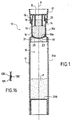
- the packaging and application device 10 shown in the figure 1 comprises a container 11 having a flexible tubular body 24a with shape memory, of axis X, defining an interior space 12 containing a reserve of product P.
- the product P is for example a powder such as a foundation, composed of pigment particles coated with binder.
- the product P can also consist of a composition comprising particles containing at least one fluid.
- the product P may for example be a "liquid powder", including: a) a “dry” or “pulverulent” phase, optionally comprising a binder and generally made up of pigments and / or nacres and / or fillers and / or flakes, and / or mixtures thereof and b) a "liquid” phase, which can in particular make office binding phase and containing, inside micro-capsules, vesicles, micro-sponges, porous waxes, or any other structure capable of storing a fluid and release, in particular in response to pressure, a liquid such as water, propylene glycol, oil, gel, or an oil-in-water or water-in-oil emulsion.
- a liquid such as water, propylene glycol, oil, gel, or an oil-in-water or water-in-oil emulsion.
- Product P may include a pulverulent phase mixed with the "liquid" phase, which may be formed of pigments and / or nacres and / or fillers and / or of flakes usually used in cosmetic compositions, and / or their mixtures.
- the particles forming the pulverulent phase can also be coated of a binder.
- pigments it is necessary to understand white or colored particles, mineral or organic, insoluble in the medium, intended to color and / or opacify the composition.
- the pigments can be of usual size or nanometric.
- the pigments can in particular be coated with silicone compounds such as polydimethylsiloxanes and / or by polymers, in particular polyethylenes.
- silicone compounds such as polydimethylsiloxanes and / or by polymers, in particular polyethylenes.
- the fillers can be mineral or synthetic, lamellar or non lamellar. Mention may be made of talc, mica, silica, kaolin, nylon powders, poly- ⁇ -alanine and polyethylene, Teflon, lauroyl-lysine, starch, nitride of boron, bismuth oxychloride, powders of tetrafluoroethylene polymers, polymethylmethacrylate powders, polyurethane powders, powders polystyrene, polyester powders, synthetic hollow microspheres such as EXPANCEL (NOBEL INDUSTRIES), micro sponges like POLYTRAP (DOW CORNING) and the TOSPEARLS (TOSHIBA) silicone resin microbeads, zinc and titanium oxides, zirconium or cerium oxides, carbonate of precipitated calcium, magnesium carbonate and hydrocarbon, hydroxyapatite, SILICA BEADS (MAPRECOS) hollow silica microspheres, the microcapsules of glass or
- compositions according to the invention can also comprise glitter.
- the powder of the invention can also comprise any additive usually used in the field concerned, antioxidants, essential oils, preservatives, neutralizers, water-in-oil and oil-in-water surfactants, vitamins, anti-wrinkle active ingredients.
- the fluid contained in the "liquid” phase can be in aqueous form or oily, especially in the form of essential oils, gel, especially particles cubic gel, water in oil emulsion (W / O), or oil in water (O / W).
- the fluid can be contained in vesicles or microcapsules, the walls are in particular of epoxy, polyethylene, gelatin or polyester, or in micro sponges or microspheres.
- the fluid can also be contained in porous waxes such as polyacrylates.
- the fluid especially in the case of water, can be contained in a anhydrous structure of the type described in patent application EP-A-0 855 177.
- the "liquid" phase comprises a dispersion aqueous vesicles constituted by a lipid phase membrane encapsulating a aqueous phase.
- the usable vesicles can also be provided with a coating lamellar liquid crystal.
- the composition contains at least one active ingredient.
- an asset can be hydrophilic, lipophilic, or a mixture of both.
- the "liquid" phase can represent from 1 to 50%, from preferably from 2 to 30%, and more preferably from 5 to 20% by weight of the composition.
- the body 24a is closed at the bottom by a solid bottom wall 24b.
- the container 11 has a neck 13 of axis X, consisting of a part added, the neck 13 defining a housing 14 intended to receive an applicator 15 comprising an application element 16 and a gripping member 17, which constitutes also a collar closure cap 13.
- the cap 17 comprises a sealing skirt 18 which applies so waterproof on the inside surface of the neck 13.
- the cap 17 also includes an outer skirt 19, provided with a clean thread to engage on a complementary thread 20 made on the surface outside of the neck 13, at its upper part.
- a permeable wall 23 separates the housing 14 from the interior space 12 containing the product P.
- the quantity of product contained in the container 11 is chosen so that a substantial amount of air is present in the container, above the product.
- the interior space of the container containing the product is thus filled initially half for example, or three-quarters.
- the permeable wall 23 is made of a in one piece by plastic molding with the neck 13.
- the permeable wall 23 has an interior face 30 facing towards space inside 32 and an outside face 31 defining the bottom of the housing 14.
- the application element 16 consists of a foam.
- the lateral surface 16b of the application element 16 rests against the wall lateral of the neck 13 while being compressed radially.
- the surface 16a is capable of moving back and away from the wall 23 under the effect an overpressure created in the container 11.
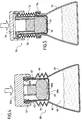
- the user turns the container 11 over and compresses the flexible wall of the body 24a, as illustrated in FIG. 13, passing the interior space 12 containing the produced, initially at atmospheric pressure, from a first volume to a second, lower than the first, thus creating an overpressure in this interior space 12.
- the interior space When the user releases his pressure, the interior space returns to his initial volume, i.e. the first volume, due to the shape memory of the container.
- the product retained by capillarity and / or electrostatic attraction on the side of the inner face 30 of the permeable wall 23, as well as in the openings 25, is located driven into the housing 14 in contact with the application element 16, under the effect of the overpressure in the interior space 12, as illustrated by the arrows in FIG. 15.
- the applicator element 16 is thus loaded with product, and can be removed then for the application, as illustrated in FIG. 14, the product being present on its front face 16a.
- the user can bring product in contact with the inner face 30 of the permeable wall by stirring the container.
- Product is then deposited on the permeable wall 23, which is able to retain a certain amount by capillary action and / or by electrostatic attraction.
- the overpressure which is created then makes it possible to favor the transfer of the product from the inside 30 to the outside 31, to load the element of application 16.
- the overpressure can be created in the interior space containing the product, in various ways.
- FIG. 2 shows a device 40 in which the product is contained in a container 41.
- the latter comprises a deformable portion 42 in the form of a bellows, which connects the upper part 43 and the lower part 44 of the container.
- the user presses on the upper part 43 while the device rests upside down by the gripping element 45 of the applicator on a bearing surface, as illustrated.
- FIG. 3 shows a device 50 in which the container 51 comprises a substantially non-deformable body 52, provided in the upper part with a pusher 54 connected to the body 52 by a bellows 53.
- This bellows can be made in one piece with the body 52 or be constituted by an added piece.
- the user presses the pusher 54 while the container 51 rests upside down by the gripping element 45 of the applicator, which folds the bellows 53.
- the device 60 shown in Figure 4 includes a container 61 comprising a body 62 and a neck 63 connected to the body 62 by a deformable part 64 in bellows shape.
- An insert 66 having the general shape of a thimble is mounted in the neck 63 to define a housing 67 for receiving an applicator 69.
- This applicator comprises an application element 69a and a protective cap. closure 69b also constituting a gripping element.
- the cap 69b has an inner sealing skirt 69c suitable for apply tightly to the inner surface of the insert 66 to ensure a tight closure of the container, the insert 66 being itself hermetically engaged in the upper part of the collar 63.
- a permeable wall 65 is produced in the bottom of insert 66 in the form of a grid.
- the front face 69d of the application element 69a may not be at contact of the permeable wall 65, as shown.
- the front face 69d may retreat under the effect of an overpressure in the container 61, which promotes good distribution of the product on the surface of the element of application.
- the user presses on the cap 69b, which folds in on itself the part 64 in bellows shape.
- the device 70 shown in Figure 5 has a container 72 on the neck 74 of which is mounted a reception head for the applicator, this reception head comprising an external bellows 75 and an internal part 76 which can receive a application element 77.
- the user presses on the closing cap 78, which causes the bellows 75 to compress and the interior part to descend 76 in container 72.
- insert 66 is advantageous because it can easily mount on the same type of container different inserts, depending on the nature of the product to distribute and that of the application element.
- the insert can be produced in various ways, the permeable wall being able to consist, among other things, of a woven fabric, a perforated plastic film, a welded sieve or molded.
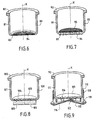
- FIG. 6 shows an insert 80 comprising a cylindrical side wall 81 of revolution, of axis X, provided at its end upper of a rim 82 directed outwards, used for fixing to the container, and at its lower end of an annular rim 83, directed inwards, used for the fixing a screen 84, fixed on the underside of the rim 83.
- the insert 90 has a side wall 91 symmetrical of revolution, of axis X, provided at its upper end with a flange ring 92 directed outwards, used for fixing to the neck of the container, and for lower end of a perforated bottom 93, this bottom being traversed by a plurality 94 openings.
- a screen 95 is attached to the bottom wall 93.
- the mesh of the sieve 95 has a smaller cross section than that of the openings 94 in wall 93.
- the wall 93 serves both as a mechanical support for the screen 95 and promotes the accumulation of product in contact with this sieve 95 or in its vicinity, so that when the overpressure is created in the interior space containing the product, the product present in the openings 94 is expelled through the screen 95.
- the insert 100 shown in Figure 8 has a side wall 101 symmetric in X-axis revolution, extended outward at its upper end by an annular rim 102 used for fixing to the container and closed at its lower end by a bottom wall 103 having openings 104.
- an element such as a layer of foam 106 to large open cells is attached to the insert 100 under the wall of background 103.
- the insert 110 has a side wall 111 symmetrical of revolution around the X axis, comprising an annular flange 112 in upper part and a perforated bottom wall 113.
- a retaining member 115 is subject to the insert, this retaining member comprising a solid wall 116 disposed under the bottom wall 113 and providing a interval 117 therewith, in which product can be retained.
- the retaining member 115 has a side wall 118 fixed to the wall side 111 of the insert, provided with side openings 119 allowing product to gain the aforementioned interval 117.
- the wall 116 has a substantially conical shape, so that the height of interval 117 decreases as one approaches the X axis.
- the retainer also plays a deflector role by guiding the air circulation in the interval 117.
- the two application elements 140, 141 may be of the same nature but of different size.
- the reduction in volume of the container can be carried out by means of a bellows 142, located between the two housings receiving the two application elements 140 and 141.
- a device which comprises a part identical to that of the device shown in Figure 1, a container comprising a body 151 widening downwards, comprising in the lower part a permeable wall 152 overlooking a housing containing a second element of application 153.
- the latter is mounted on the container 151 in a similar manner to the first application element 16.
- the reduction of the interior volume is carried out by exerting a lateral pressure on the container 151, the latter being shape memory.
- the permeable wall may include a step 160 as illustrated in Figure 17.
- the permeable wall may also include, as illustrated in FIG. 18, one or more ribs on its outer face, capable of coming into contact with the face front of the application element.
- FIG. 18 shows a permeable wall 23 "which differs from the wall 23 previously described by the presence on the outer face 31 of a rib annular 165 surrounding a perforated central region.
- the application element 16 comes to bear on this rib 165, which creates a space 166 between the permeable wall 23 "and the application element 16, in which product can accumulate.
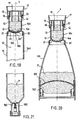
- the container can be made with a bottom provided with a neck 170, as shown in figure 19.
- This neck 170 can be threaded or not and it is closed by a removable cap 171.
- the user can remove the plug 171 to access the product directly P contained inside the container if necessary, the product then being removed by example using a finger, or an applicator such as a brush or the like, not represented.
- the device can have two application elements as already mentioned. has been described with reference to FIGS. 11 and 20.
- FIG. 21 a container which comprises in the lower part a permeable wall 180 overlooking a housing containing a applicator element 190 such as a brush.
- the device may include a one-way air return valve allowing air to be taken back into the container, when the application element is in square.
- FIG. 16 shows a air return valve 130 mounted on a wall 131 of the container, so as to close off rests an orifice 132 through which air can re-enter the container in the event of depression in this last.
Landscapes
- Engineering & Computer Science (AREA)
- Mechanical Engineering (AREA)
- Cosmetics (AREA)
- Containers And Packaging Bodies Having A Special Means To Remove Contents (AREA)
- Coating Apparatus (AREA)
- Closures For Containers (AREA)
Abstract
Description
- disposer l'élément d'application dans un logement délimité au moins partiellement par une première face d'une paroi perméable,
- amener du produit au contact d'une deuxième face de la paroi perméable, opposée à la première, en remuant le récipient ou en le disposant à l'envers,
- créer temporairement une surpression dans ledit espace intérieur, la paroi perméable et le récipient étant agencés de telle sorte que ladite surpression déplace du produit présent au contact de la deuxième face, ou dans son voisinage, vers la première face, et
- retirer l'élément d'application du logement.
- la figure 1 est une vue schématique en coupe axiale d'un dispositif conforme à un premier exemple de mise en oeuvre de l'invention,
- les figures 2 à 5 illustrent des variantes de réalisation du récipient,
- les figures 6 à 9 illustrent des variantes de réalisation de la paroi perméable,
- la figure 10 illustre une variante de réalisation des moyens permettant de créer la surpression dans le récipient,
- la figure 11 représente un dispositif à deux éléments d'application,
- les figures 12 à 15 illustrent l'utilisation du dispositif de la figure 1,
- la figure 16 représente schématiquement une valve de reprise d'air,
- la figure 17 représente une variante de réalisation de la paroi perméable,
- la figure 18 illustre la réalisation de nervures sur la paroi perméable,
- la figure 19 illustre la réalisation d'une deuxième ouverture sur le récipient,
- la figure 20 représente un dispositif comprenant deux éléments d'application, constituant une variante de réalisation du dispositif de la figure 11, et
- la figure 21 illustre l'utilisation de deux éléments d'application de nature différente.
- les agents antioxydants ou anti-radicaux libres tels que les protéines et les enzymes, la lactoperoxydase et la lactoferrine, les peptides et leurs dérivés, les séquestrants, les flavonoïdes, la chlorophylline, l'éthoxyquine, la guanosine, les tocophérols et leurs dérivés, le palmitate d'ascorbyle, et le β-carotène, la vitamine E et ses dérivés, la vitamine C et ses dérivés, la vitamine A et ses dérivés,
- les agents hydratants ou humectants tels que l'acide hyaluronique et son sel de sodium, le β-glycérophosphate, le glycérol, le sorbitol, le panthénol,
- les filtres UV tels que les produits commercialisés sous les dénominations "EUSOLEX 232"® par la société MERCK, "PARSOL 1789"® et "PARSOL MCX"® par la société GIVAUDAN-ROURE, "MEXORYL SX"® par la société CHIMEX et "UNIVUL T150"® par la société BASF,
- les kératolitiques tels que les enzymes protéolytiques, l'acide salicylique et ses dérivés tels que l'acide n-dodécanoyl-5 salicylique, et l'acide rétinoïque et ses dérivés,
- les accélérateurs de bronzage tels que la caféine, et les dérivés de tyrosine tels que le tyrosinate de glucose et le sel disodique de la N-L-malyl tyrosine,
- les dépigmentants tels que l'acide kojique, l'acide glycolique, la vitamine C et notamment l'ascorbyle phosphate de magnésium, et l'arbutine et ses dérivés,
- les colorants naturels tels que les matières colorantes extraites de végétaux comme la chlorophylline et le β-carotène ou extraites d'animaux comme le carmin de cochenille, et le caramel,
- les auto-bronzants tels que la dihydroxyacétone, et les indoles,
- les liporégulateurs tels que le γ-octanoyl, l'extrait de Centelle asiatica contenant de la génine et de l'acide asiatique, la caféine, et la théophylline,
- les agents anti-vieillissement et antirides tels que les hydroxyacides comme l'acide glycolique, l'acide n-octanoyl salicylique, le rétinol et ses dérivés comme l'acétate, la palmitate et le propionate de rétinol, et les rétinoïdes,
- les agents anti-inflammatoires et cicatrisants tels que l'acide 18 β-glycyrrhétinique et ses sels comme notamment son sel d'ammonium, l'α-bisabolol, les corticoïdes, l'extrait de Centella asiatica, l'aloe vera,
- les antibactériens et antifongiques tels que le chlorure de benzalkonium, la chlorhexidine, l'hexetidine, l'hexamidine,
- les insectifuges tels que les diéthyl et diméthyltoluamides,
- les déodorants tels que l'hexachlorophène et le triclosan produit et commercialisé sous la dénomination "IRGASAN DP 300"® par la société CIBA GEIGY,
- les agents conditionneurs pour la peau tels que les polymères cationiques et les cations.
Claims (61)
- Dispositif de conditionnement et d'application comportant un récipient ayant un espace intérieur (12 ; 68) dans lequel le produit (P) est contenu, un élément d'application (16 ; 69a ; 77), un logement (14 ; 67) pour recevoir l'élément d'application et une paroi perméable (23 ; 65 ; 84 ; 95 ; 103 ; 113) disposée entre ledit logement et l'espace intérieur contenant le produit, l'élément d'application et le logement étant agencés de telle sorte que l'élément d'application présente, lorsqu'il est dans ledit logement, au moins une portion de surface (16a ; 69d) située, sans compression axiale sensible, en regard d'une ouverture (25) de la paroi perméable, ledit espace intérieur étant à volume variable, caractérisé par le fait que des moyens de compression sont prévus pour faire passer sélectivement ledit volume intérieur d'un premier volume supérieur au volume de produit, à un second volume, inférieur au premier, cette réduction de volume s'accompagnant d'une surpression, laquelle est apte à favoriser le transfert de produit à travers ladite paroi perméable vers l'élément d'application.
- Dispositif selon la revendication précédente, caractérisé par le fait que les moyens de compression sont agencés de manière à ce que l'espace intérieur reprenne son premier volume sous l'action d'une force de rappel élastique.
- Dispositif selon la revendication 2, caractérisé par le fait que la force de rappel élastique est obtenue grâce au fait que le récipient est à mémoire de forme.
- Dispositif selon la revendication 2, caractérisé par le fait que la force de rappel élastique est obtenue au moyen d'un ressort.
- Dispositif selon l'une des revendications précédentes, caractérisé par le fait qu'il comporte des moyens de retenue sur et/ou adjacents à la paroi perméable, du côté de l'espace intérieur contenant le produit, ces moyens de retenue étant propres à favoriser, notamment par capillarité ou par attraction électrostatique, la rétention de produit dans ladite ouverture ou dans son voisinage, en vue de son transfert dans ledit logement lors de la compression d'un volume d'air présent dans l'espace intérieur, entre la paroi perméable et la réserve de produit.
- Dispositif selon la revendication précédente, caractérisé par le fait que les moyens de retenue comportent des cloisons (93) entres lesquelles du produit peut être retenu.
- Dispositif selon l'une des deux revendications précédentes, caractérisé par le fait que les moyens de retenue comportent un organe de retenue (115) disposé en regard de la paroi perméable (113), cet organe de retenue présentant des ouvertures latérales (119) permettant au produit de gagner un intervalle (117) de rétention de produit, ménagé entre l'organe de retenue et la paroi perméable.
- Dispositif selon l'une des trois revendications précédentes, caractérisé par le fait que les moyens de retenue (93) sont réalisés par moulage.
- Dispositif selon la revendication 5, caractérisé par le fait que les moyens de retenue sont constitués par une pièce rapportée, telle qu'un bloc de mousse (106).
- Dispositif selon l'une quelconque des revendications précédentes, caractérisé par le fait que le récipient comporte une paroi mobile (11 ; 42 ; 53 ; 64 ; 75 ; 120) permettant de générer ladite surpression.
- Dispositif selon la revendication précédente, caractérisé par le fait que ladite paroi mobile comprend une paroi flexible du récipient.
- Dispositif selon la revendication précédente, caractérisé par le fait que la paroi flexible est en forme de soufflet.
- Dispositif selon la revendication 10, caractérisé par le fait que la paroi mobile comprend une paroi rigide d'un piston (120).
- Dispositif selon l'une quelconque des revendications précédentes, caractérisé par le fait que la paroi perméable présente une pluralité d'orifices traversants (25 ; 104 ; 114).
- Dispositif selon l'une quelconque des revendications précédentes, caractérisé par le fait que l'élément d'application et le logement sont agencés de telle sorte que la surface (69d) de l'élément d'application servant à l'application du produit, lorsque l'élément d'application est en place dans le logement, soit maintenue à distance de la paroi perméable.
- Dispositif selon la revendication 15, caractérisé par le fait que la paroi perméable comporte au moins une nervure (165) du côté de l'élément d'application, contre laquelle l'élément d'application est apte à venir en appui.
- Dispositif selon la revendication 15, caractérisé par le fait que la paroi perméable se raccorde au récipient par un décrochement (160) formant une cuvette du côté de l'élément d'application.
- Dispositif selon l'une quelconque des revendications 1 à 14, caractérisé par le fait que l'élément d'application et le logement sont agencés de telle sorte que la surface (16a) de l'élément d'application servant à l'application du produit soit au contact de la paroi perméable, lorsque l'élément d'application est en place dans le logement.
- Dispositif selon l'une quelconque des revendications précédentes, caractérisé par le fait que l'élément d'application est agencé de telle sorte que la surface (69d) de l'élément d'application située, lorsque l'élément d'application est en place dans ledit logement, en regard de la paroi perméable, puisse reculer sous l'effet de la surpression dans le récipient.
- Dispositif selon l'une quelconque des revendications précédentes, caractérisé par le fait que le logement (14) est délimité par une paroi latérale (13) contre laquelle s'applique l'élément d'application par sa périphérie.
- Dispositif selon la revendication précédente, caractérisé par le fait que l'élément d'application s'applique de manière étanche sur ladite paroi latérale.
- Dispositif selon l'un quelconque des revendications précédentes, caractérisé par le fait que l'élément d'application se comporte comme un piston lors de son retrait.
- Dispositif selon l'une quelconque des revendications précédentes, caractérisé par le fait que le récipient est agencé de telle sorte que lorsque l'espace intérieur occupe son second volume, le niveau du produit dans le récipient n'atteigne pas la paroi perméable.
- Dispositif selon l'une quelconque des revendications précédentes, caractérisé par le fait que la paroi perméable définit le fond du logement recevant l'élément d'application, ce dernier étant introduit dans ledit logement par une ouverture située dans l'axe (X) du récipient, à l'opposé de ladite paroi perméable.
- Dispositif selon l'une quelconque des revendications précédentes, caractérisé par le fait la paroi perméable comporte des canaux dont la section et la longueur sont choisies de manière à permettre de loger et/ou de laisser passer une quantité prédéterminée de produit.
- Dispositif selon l'une quelconque des revendications précédentes, caractérisé par le fait que l'élément d'application est solidaire d'un élément de préhension (17) constituant également un capuchon de fermeture du récipient.
- Dispositif selon la revendication précédente, caractérisé par le fait que l'élément de préhension comporte des moyens d'étanchéité (18) pour assurer une fermeture étanche du logement recevant l'élément d'application.
- Dispositif selon l'une quelconque des revendications précédentes, caractérisé par le fait que le produit (P) est une poudre.
- Dispositif selon l'une quelconque des revendications 1 à 27, caractérisé par le fait que le produit est un liquide.
- Dispositif selon l'une quelconque des revendications 1 à 27, caractérisé par le fait que le produit est un gel ou une crème.
- Dispositif selon l'une quelconque des revendications précédentes, caractérisé par le fait que la paroi perméable est réalisée par moulage avec le récipient.
- Dispositif selon l'une quelconque des revendications 1 à 30, caractérisé par le fait que la paroi perméable est constituée par une pièce rapportée sur le récipient.
- Dispositif selon l'une quelconque des revendications précédentes, caractérisé par le fait que la paroi perméable comprend une grille.
- Dispositif selon l'une quelconque des revendications 1 à 30, caractérisé par le fait que la paroi perméable comprend une mousse.
- Dispositif selon l'une des revendications précédentes, caractérisé par le fait que la paroi perméable est sensiblement plane ou concave vers l'ouverture du logement.
- Dispositif selon l'une quelconque des revendications précédentes, caractérisé par le fait que la paroi perméable présente une forme complémentaire de celle de l'élément d'application.
- Dispositif selon l'une quelconque des revendications précédentes, caractérisé par le fait que la paroi perméable présente des orifices sensiblement radiaux ou axiaux.
- Dispositif selon l'une quelconque des revendications 1 à 30, caractérisé par le fait que la paroi perméable est constituée par un tissé, un film plastique perforé, un tamis soudé ou surmoulé.
- Dispositif selon l'une quelconque des revendications précédentes, caractérisé par le fait que l'élément d'application (16) est absorbant, étant réalisé dans un matériau tel qu'une mousse, un feutre ou un matériau fritté.
- Dispositif selon l'une quelconque des revendications précédentes, caractérisé par le fait que l'élément d'application est compressible de manière élastique.
- Dispositif selon l'une quelconque des revendications précédentes, caractérisé par le fait que l'élément d'application est intérieurement non poreux.
- Dispositif selon l'une quelconque des revendications 1 à 39, caractérisé par le fait que l'élément d'application est sensiblement non compressible.
- Dispositif selon l'une quelconque des revendications précédentes, caractérisé par le fait que l'élément d'application est floqué ou comporte un textile à sa surface.
- Dispositif selon l'une quelconque des revendications précédentes, caractérisé par le fait que le logement recevant l'élément d'application (77) est mobile par rapport à l'espace intérieur du récipient contenant le produit.
- Dispositif selon l'une quelconque des revendications précédentes, caractérisé par le fait qu'il comporte un deuxième élément d'application (141 ; 190), un deuxième logement et une deuxième paroi perméable.
- Dispositif selon la revendication 45, caractérisé par le fait que le deuxième élément d'application (141) est de même nature que le premier (140) mais de taille différente.
- Dispositif selon la revendication 45, caractérisé par le fait que les premier (16) et deuxième (190) éléments d'application ne sont pas de même nature.
- Dispositif selon l'une quelconque des revendications 1 à 44, caractérisé par le fait que le récipient comporte un col (170) obturé par un bouchon amovible (171) à une extrémité située à l'opposé de l'élément d'application.
- Dispositif selon l'une quelconque des revendications précédentes, caractérisé par le fait qu'il comporte une valve unidirectionnelle (130) de reprise d'air permettant une entrée d'air dans le récipient en cas de dépression dans ce dernier.
- Dispositif selon l'une quelconque des revendications précédentes, caractérisé par le fait que la paroi perméable est fixée de manière immobile à sa périphérie sur le récipient.
- Dispositif selon l'une quelconque des revendications précédentes, caractérisé par le fait que le produit est formé au moins en partie par des particules contenant au moins un fluide.
- Dispositif selon la revendication précédente, caractérisé par le fait que le produit contient en outre une phase pulvérulente en mélange avec lesdites particules contenant un fluide.
- Dispositif selon l'une des revendications 51 et 52, caractérisé par le fait que la phase pulvérulente comprend des pigments et/ou des nacres et/ou des charges et/ou des paillettes et/ou leurs mélanges.
- Dispositif selon la revendication précédente, caractérisé par le fait que les pigments sont choisis parmi les dioxydes de titane, de zirconium ou de cérium, les oxydes de zinc, de fer ou de chrome, les nanotitanes, les nanozincs, le bleu ferrique, le noir de carbone, les laques comme les sels de calcium, de baryum, d'aluminium ou de zirconium, de colorants acides tels que les colorants halogéno-acides, azoïques ou anthraquinoniques, les pigments enrobés par des composés siliconés tels que des polydiméthylsiloxanes et/ou par des polymères, notamment des polyéthylènes.
- Dispositif selon l'une des revendications 53 et 54, caractérisé par le fait que les charges sont choisies parmi le talc, le mica, la silice, le kaolin, les poudres de Nylon, de poly-β-alanine et de polyéthylène, le Téflon, la lauroyl-lysine, l'amidon, le nitrure de bore, l'oxychlorure de bismuth, les poudres de polymères de tétrafluoroéthylène, les poudres de polyméthylméthacrylate, les poudres de polyuréthanne, les poudres de polystyrène, les poudres de polyester, les microsphères creuses synthétiques, les microéponges et les microbilles de résine de silicone, les oxydes de zinc et de titane, les oxydes de zirconium ou de cérium, le carbonate de calcium précipité, le carbonate et l'hydrocarbonate de magnésium, l'hydroxyapatite, les microsphères de silice creuses, les microcapsules de verre ou de céramique, les savons métalliques dérivés d'acides organiques carboxyliques ayant de 8 à 22 atomes de carbone, de préférence de 12 à 18 atomes de carbone.
- Dispositif selon l'une quelconque des revendications 51 à 55, caractérisé par le fait que le fluide contenu dans lesdites particules est notamment sous forme aqueuse, ou huileuse, notamment sous forme d'huiles essentielles, de gel, d'émulsion eau dans l'huile, ou huile dans eau.
- Dispositif selon l'une quelconque des revendications 51 à 56, caractérisé par le fait que le fluide est contenu dans des cires poreuses, dans des vésicules ou micro-capsules, dont les parois sont notamment en époxy, en polyéthylène, en gélatine ou en polyester, ou dans des microéponges ou microsphères.
- Dispositif selon l'une quelconque des revendications 51 à 57, caractérisé par le fait la phase formée des particules contenant le fluide représente de 1 à 50 %, de préférence de 2 à 30 %, et de préférence encore de 5 à 20 % en poids de la composition.
- Dispositif selon l'une des revendications précédentes, caractérisé par le fait que le produit contient au moins un actif, notamment des agents antioxydants ou anti-radicaux libres, des agents hydratants ou humectants, des filtres UV, des kératolytiques, des accélérateurs de bronzage, des dépigmentants, des colorants naturels, des auto-bronzants, des liporégulateurs, des agents anti-vieillissement et antirides, des agents anti-inflammatoires et cicatrisants, des antibactériens et antifongiques, des insectifuges, ou des agents conditionneurs pour la peau
- Procédé pour charger un élément d'application en produit, ce produit étant constitué par une poudre, un liquide, un gel ou une crème, ce produit étant contenu dans un espace intérieur d'un récipient, cet espace intérieur comportant une quantité substantielle d'air au-dessus du produit, caractérisé par le fait qu'il comporte les étapes consistant à :disposer l'élément d'application dans un logement délimité au moins partiellement par une première face (31) d'une paroi perméable (23),amener du produit au contact d'une deuxième face (30) de la paroi perméable, opposée à la première, en remuant le récipient ou en le disposant à l'envers,créer temporairement une surpression dans ledit espace intérieur, la paroi perméable et le récipient étant agencés de telle sorte que ladite surpression déplace du produit présent au contact de la deuxième face (30), ou dans son voisinage, vers la première face (31) et ainsi vers l'élément d'application, etretirer l'élément d'application du logement (14).
- Procédé selon la revendication 60, caractérisé par le fait que l'intérieur du récipient est à la pression atmosphérique avant la création de ladite surpression.
Applications Claiming Priority (2)
| Application Number | Priority Date | Filing Date | Title |
|---|---|---|---|
| FR9911771 | 1999-09-21 | ||
| FR9911771A FR2798646B1 (fr) | 1999-09-21 | 1999-09-21 | Dispositif de conditionnement et d'application |
Publications (2)
| Publication Number | Publication Date |
|---|---|
| EP1086904A1 true EP1086904A1 (fr) | 2001-03-28 |
| EP1086904B1 EP1086904B1 (fr) | 2004-11-17 |
Family
ID=9550066
Family Applications (1)
| Application Number | Title | Priority Date | Filing Date |
|---|---|---|---|
| EP00402587A Expired - Lifetime EP1086904B1 (fr) | 1999-09-21 | 2000-09-19 | Dispositif de conditionnement et d'application |
Country Status (11)
| Country | Link |
|---|---|
| EP (1) | EP1086904B1 (fr) |
| JP (2) | JP3870016B2 (fr) |
| CN (1) | CN1234576C (fr) |
| AR (1) | AR025720A1 (fr) |
| AT (1) | ATE282564T1 (fr) |
| BR (1) | BR0004148B1 (fr) |
| CA (1) | CA2319844C (fr) |
| DE (1) | DE60015889T2 (fr) |
| ES (1) | ES2230042T3 (fr) |
| FR (1) | FR2798646B1 (fr) |
| MX (1) | MXPA00008928A (fr) |
Cited By (22)
| Publication number | Priority date | Publication date | Assignee | Title |
|---|---|---|---|---|
| EP1176103A1 (fr) * | 2000-07-27 | 2002-01-30 | L'oreal | Dispositif pour le conditionnement et l'application d'un produit, notamment cosmétique |
| FR2812276A1 (fr) * | 2000-07-27 | 2002-02-01 | Oreal | Dispositif pour le conditionnement et l'application d'un produit, notamment cosmetique |
| FR2814651A1 (fr) * | 2000-10-03 | 2002-04-05 | Oreal | Dispositif de conditionnement et d'application comportant un element d'application compressible servant a l' application du produit et un logement pour recevoir l' element d'application charge en produit |
| FR2823726A1 (fr) * | 2001-04-20 | 2002-10-25 | Oreal | Ensemble pour le conditionnement et l'application d'un produit notamment cosmetique ou de soin |
| FR2824241A1 (fr) * | 2001-05-04 | 2002-11-08 | Samsung Corp | Boite a poudre pour maquillage |
| WO2002102348A1 (fr) * | 2002-05-02 | 2002-12-27 | Priscilla S.R.L. Unipersonale | Produit anti-vergeture et procede correspondant |
| FR2836344A1 (fr) * | 2002-02-25 | 2003-08-29 | Young Gu Lee | Applicateur de poudre cosmetique et procede pour sa fabrication et son utilisation |
| WO2003105626A1 (fr) * | 2002-06-17 | 2003-12-24 | Schwan-Stabilo Cosmetics Gmbh 8 & Co. Kg | Etui pour loger au moins partiellement un applicateur de produits cosmetiques |
| EP1514492A1 (fr) * | 2003-09-12 | 2005-03-16 | L'oreal | Dispositif de conditionnement et de distribution d'un produit cosmétique. |
| EP1520798A1 (fr) | 2003-10-02 | 2005-04-06 | L'oreal | Dispositif de conditionnement et d'application d'un produit cosmétique |
| FR2871139A1 (fr) * | 2004-06-08 | 2005-12-09 | Oreal | Dispositif d'application d'un produit, notamment cosmetique |
| FR2885778A1 (fr) * | 2005-05-17 | 2006-11-24 | Techpack Int Sa | Distributeur applicateur etanche d'un produit en poudre |
| EP2199226A1 (fr) * | 2008-12-17 | 2010-06-23 | Jürgen Schmidt | Dispositif d'émission pour liquides |
| WO2010106235A1 (fr) * | 2009-03-16 | 2010-09-23 | L'oreal | Ensemble comprenant un systeme de conditionnement d'un produit a fermeture etanche. |
| WO2011101239A2 (fr) | 2010-02-19 | 2011-08-25 | L'oreal | Utilisations cosmétiques ou dermatologiques d'une poudre comprenant une charge, une huile essentielle et un ester hydroxylé de polyol et d'un ou plusieurs acides carboxyliques en c4 à c16 |
| WO2012059343A1 (fr) | 2010-11-05 | 2012-05-10 | L'oreal | Composition sous forme de poudre comprenant au moins une huile essentielle et une fécule de manioc modifiée |
| WO2012066102A1 (fr) * | 2010-11-17 | 2012-05-24 | Geka Gmbh | Unité cosmétique équipée d'un réservoir comprimable |
| WO2015040348A1 (fr) * | 2013-09-23 | 2015-03-26 | Sephora | Dispositif de démaquillage des ongles à l'aide d'un produit démaquillant et utilisation d'un tel dispositif |
| EP2238858B1 (fr) * | 2009-03-19 | 2015-10-28 | Aptar Radolfzell GmbH | Dispositif pour délivrer une poudre cosmétique sur une éponge |
| FR3048339A1 (fr) * | 2016-03-07 | 2017-09-08 | Oreal | Dispositif de conditionnement et d'application |
| US10555592B2 (en) | 2017-08-31 | 2020-02-11 | Symbiotec Pharma Lab Pvt. Ltd. | Application for topical composition |
| CN112607161A (zh) * | 2020-12-28 | 2021-04-06 | 江苏双星彩塑新材料股份有限公司 | 一种用于热收缩膜标签合掌胶水涂抹的装置 |
Families Citing this family (20)
| Publication number | Priority date | Publication date | Assignee | Title |
|---|---|---|---|---|
| FR2829115B1 (fr) | 2001-08-29 | 2004-11-05 | Oreal | Ensemble pour le conditionnement et l'application d'un produit, notamment cosmetique |
| DE102008014955B4 (de) * | 2008-03-19 | 2010-02-11 | Schwan-Stabilo Cosmetics Gmbh & Co. Kg | Auftraggerät für lose Substanzen mit automatischer Dosiereinrichtung |
| KR101431440B1 (ko) | 2008-06-27 | 2014-08-21 | 동부대우전자 주식회사 | 건조기 및 그 제어방법 |
| FR2939287B1 (fr) | 2008-12-09 | 2011-02-11 | Oreal | Dispositif de conditionnement et d'application d'un produit cosmetique. |
| JP5328395B2 (ja) * | 2009-02-03 | 2013-10-30 | 三菱鉛筆株式会社 | 液体塗布具のキャップ |
| KR101364689B1 (ko) * | 2013-09-24 | 2014-02-19 | 김진우 | 캡슐 화장품 및 그 제조방법 |
| CN103505805A (zh) * | 2013-10-22 | 2014-01-15 | 山东赛克赛斯药业科技有限公司 | 喷粉瓶 |
| CN104783479B (zh) * | 2014-01-21 | 2017-09-22 | 株式会社常盘 | 涂布材料压出式容器 |
| FR3018672B1 (fr) * | 2014-03-20 | 2017-04-28 | Oreal | Dispositif de conditionnement et d'application. |
| CN104528114B (zh) * | 2014-12-05 | 2016-12-28 | 顾玉奎 | 一种胶水瓶的应用方法 |
| KR101736322B1 (ko) * | 2016-07-04 | 2017-05-16 | 주식회사 리치코스 | 액상화장품 용기 |
| CN106419035A (zh) * | 2016-09-12 | 2017-02-22 | 御田二工业(深圳)有限公司 | 一种千色气垫胭脂、口红包装容器 |
| KR101859572B1 (ko) | 2016-09-30 | 2018-06-27 | (주)아모레퍼시픽 | 위생성이 향상된 화장용구 |
| JP6383052B1 (ja) * | 2017-05-30 | 2018-08-29 | 株式会社新和製作所 | 化粧料容器 |
| CN109018727A (zh) * | 2017-06-08 | 2018-12-18 | 深圳市法宝商贸有限公司 | 喷粉器 |
| US11357307B2 (en) | 2017-08-21 | 2022-06-14 | Sinwa Corporation | Cosmetic applicator |
| CN108819672A (zh) * | 2018-06-13 | 2018-11-16 | 贵州大学 | 一种车辆用便于平稳固定的车载香水座 |
| CN110839656A (zh) * | 2019-12-05 | 2020-02-28 | 东莞市普惠森日用品有限公司 | 一种防霉驱虫方法 |
| FR3109284B1 (fr) * | 2020-04-17 | 2023-03-24 | Albea Services | Mécanisme pour un réceptacle d’application d’un produit cosmétique, réceptacle comportant un tel mécanisme et procédé d’obtention d’un tel mécanisme |
| CN121295735B (zh) * | 2025-12-10 | 2026-03-24 | 四川省综合地质调查研究所 | 一种矿山生态修复系统 |
Citations (8)
| Publication number | Priority date | Publication date | Assignee | Title |
|---|---|---|---|---|
| BE570597A (fr) * | ||||
| GB403219A (en) | 1932-01-04 | 1933-12-21 | Paul Wurzburger | Improved powder box |
| DE938658C (de) | 1952-09-18 | 1956-02-02 | Paul Fr Schmidt | Verschluss, insbesondere fuer Tuben |
| GB1158412A (en) | 1965-10-27 | 1969-07-16 | Etablissements F Pfirter And C | Stopper with Spreader Pad for Tubes of Polish or other Pasty Products |
| EP0416185A1 (fr) | 1988-05-24 | 1991-03-13 | Spiveco Inc. | Distributeur de bâton de rouge à lèvres |
| EP0612488A1 (fr) | 1993-02-22 | 1994-08-31 | L'oreal | Applicateur |
| EP0688516A1 (fr) | 1994-05-24 | 1995-12-27 | L'oreal | Dispositif d'application à piston perforé d'un produit notamment de maquillage et/ou de soin |
| EP0855177A2 (fr) | 1997-01-24 | 1998-07-29 | Kose Corporation | Poudre de blanchissement |
-
1999
- 1999-09-21 FR FR9911771A patent/FR2798646B1/fr not_active Expired - Fee Related
-
2000
- 2000-09-12 MX MXPA00008928A patent/MXPA00008928A/es active IP Right Grant
- 2000-09-13 BR BRPI0004148-3A patent/BR0004148B1/pt not_active IP Right Cessation
- 2000-09-19 AT AT00402587T patent/ATE282564T1/de not_active IP Right Cessation
- 2000-09-19 EP EP00402587A patent/EP1086904B1/fr not_active Expired - Lifetime
- 2000-09-19 DE DE60015889T patent/DE60015889T2/de not_active Expired - Lifetime
- 2000-09-19 ES ES00402587T patent/ES2230042T3/es not_active Expired - Lifetime
- 2000-09-20 AR ARP000104920A patent/AR025720A1/es unknown
- 2000-09-21 JP JP2000287405A patent/JP3870016B2/ja not_active Expired - Fee Related
- 2000-09-21 CA CA002319844A patent/CA2319844C/fr not_active Expired - Fee Related
- 2000-09-21 CN CN00129044.4A patent/CN1234576C/zh not_active Expired - Fee Related
-
2004
- 2004-02-25 JP JP2004049273A patent/JP2004209265A/ja active Pending
Patent Citations (9)
| Publication number | Priority date | Publication date | Assignee | Title |
|---|---|---|---|---|
| BE570597A (fr) * | ||||
| GB403219A (en) | 1932-01-04 | 1933-12-21 | Paul Wurzburger | Improved powder box |
| DE938658C (de) | 1952-09-18 | 1956-02-02 | Paul Fr Schmidt | Verschluss, insbesondere fuer Tuben |
| GB1158412A (en) | 1965-10-27 | 1969-07-16 | Etablissements F Pfirter And C | Stopper with Spreader Pad for Tubes of Polish or other Pasty Products |
| EP0416185A1 (fr) | 1988-05-24 | 1991-03-13 | Spiveco Inc. | Distributeur de bâton de rouge à lèvres |
| EP0612488A1 (fr) | 1993-02-22 | 1994-08-31 | L'oreal | Applicateur |
| US5492426A (en) * | 1993-02-22 | 1996-02-20 | L'oreal | Deformable applicator with capillary feed |
| EP0688516A1 (fr) | 1994-05-24 | 1995-12-27 | L'oreal | Dispositif d'application à piston perforé d'un produit notamment de maquillage et/ou de soin |
| EP0855177A2 (fr) | 1997-01-24 | 1998-07-29 | Kose Corporation | Poudre de blanchissement |
Cited By (42)
| Publication number | Priority date | Publication date | Assignee | Title |
|---|---|---|---|---|
| US6648538B2 (en) | 2000-07-27 | 2003-11-18 | L'oreal | Dispensing device and method, and refill for a dispensing device |
| FR2812276A1 (fr) * | 2000-07-27 | 2002-02-01 | Oreal | Dispositif pour le conditionnement et l'application d'un produit, notamment cosmetique |
| EP1176103A1 (fr) * | 2000-07-27 | 2002-01-30 | L'oreal | Dispositif pour le conditionnement et l'application d'un produit, notamment cosmétique |
| FR2814651A1 (fr) * | 2000-10-03 | 2002-04-05 | Oreal | Dispositif de conditionnement et d'application comportant un element d'application compressible servant a l' application du produit et un logement pour recevoir l' element d'application charge en produit |
| EP1195105A1 (fr) * | 2000-10-03 | 2002-04-10 | L'oreal | Dispositif de conditionnement et d'application comportant un élément d'application |
| US7156572B2 (en) | 2000-10-03 | 2007-01-02 | L'oreal S.A. | Device and method for packaging and applying a substance |
| US6773187B2 (en) | 2000-10-03 | 2004-08-10 | L'oreal S.A. | Device and method for packaging and applying a substance |
| FR2823726A1 (fr) * | 2001-04-20 | 2002-10-25 | Oreal | Ensemble pour le conditionnement et l'application d'un produit notamment cosmetique ou de soin |
| US6715951B2 (en) | 2001-04-20 | 2004-04-06 | L'oreal S.A. | Unit for applying at least one product |
| US7611301B2 (en) | 2001-04-20 | 2009-11-03 | L'oreal | Applicator device |
| EP1253089A1 (fr) * | 2001-04-20 | 2002-10-30 | L'oreal | Ensemble pour le conditionnement et l'application d'un produit notamment cosmetique ou de soin |
| FR2824241A1 (fr) * | 2001-05-04 | 2002-11-08 | Samsung Corp | Boite a poudre pour maquillage |
| FR2836344A1 (fr) * | 2002-02-25 | 2003-08-29 | Young Gu Lee | Applicateur de poudre cosmetique et procede pour sa fabrication et son utilisation |
| US6805510B2 (en) | 2002-02-25 | 2004-10-19 | Young-gu Lee | Cosmetic powder applicator and method for making and using the same |
| WO2002102348A1 (fr) * | 2002-05-02 | 2002-12-27 | Priscilla S.R.L. Unipersonale | Produit anti-vergeture et procede correspondant |
| WO2003105626A1 (fr) * | 2002-06-17 | 2003-12-24 | Schwan-Stabilo Cosmetics Gmbh 8 & Co. Kg | Etui pour loger au moins partiellement un applicateur de produits cosmetiques |
| KR100826385B1 (ko) * | 2002-06-17 | 2008-05-02 | 슈반-스타빌로 코스메틱스 게엠베하 운트 콤파니 카게 | 화장품용 어플리케이터를 적어도 일부 수용하는 케이싱 |
| EP1514492A1 (fr) * | 2003-09-12 | 2005-03-16 | L'oreal | Dispositif de conditionnement et de distribution d'un produit cosmétique. |
| US7377296B2 (en) | 2003-09-12 | 2008-05-27 | L'oreal | Device for packaging and dispensing a cosmetic or another care product |
| US7325993B2 (en) | 2003-10-02 | 2008-02-05 | L'ORéAL S.A. | Device for packaging and applying substance, and method of manufacturing device |
| EP1520798A1 (fr) | 2003-10-02 | 2005-04-06 | L'oreal | Dispositif de conditionnement et d'application d'un produit cosmétique |
| EP1604586A1 (fr) * | 2004-06-08 | 2005-12-14 | L'oreal | Dispositif d'application d'un produit, notamment cosmétique |
| FR2871139A1 (fr) * | 2004-06-08 | 2005-12-09 | Oreal | Dispositif d'application d'un produit, notamment cosmetique |
| US7597495B2 (en) | 2004-06-08 | 2009-10-06 | L'ORéAL S.A. | Device for applying a substance |
| FR2885778A1 (fr) * | 2005-05-17 | 2006-11-24 | Techpack Int Sa | Distributeur applicateur etanche d'un produit en poudre |
| EP2199226A1 (fr) * | 2008-12-17 | 2010-06-23 | Jürgen Schmidt | Dispositif d'émission pour liquides |
| WO2010106235A1 (fr) * | 2009-03-16 | 2010-09-23 | L'oreal | Ensemble comprenant un systeme de conditionnement d'un produit a fermeture etanche. |
| WO2010106065A1 (fr) * | 2009-03-16 | 2010-09-23 | L'oreal | Ensemble comprenant un système d'emballage de produits avec fermeture étanche |
| US8783988B2 (en) | 2009-03-16 | 2014-07-22 | L'oreal | Assembly comprising a product-packaging system with sealed closure |
| EP2238858B1 (fr) * | 2009-03-19 | 2015-10-28 | Aptar Radolfzell GmbH | Dispositif pour délivrer une poudre cosmétique sur une éponge |
| WO2011101239A2 (fr) | 2010-02-19 | 2011-08-25 | L'oreal | Utilisations cosmétiques ou dermatologiques d'une poudre comprenant une charge, une huile essentielle et un ester hydroxylé de polyol et d'un ou plusieurs acides carboxyliques en c4 à c16 |
| WO2012059343A1 (fr) | 2010-11-05 | 2012-05-10 | L'oreal | Composition sous forme de poudre comprenant au moins une huile essentielle et une fécule de manioc modifiée |
| WO2012066102A1 (fr) * | 2010-11-17 | 2012-05-24 | Geka Gmbh | Unité cosmétique équipée d'un réservoir comprimable |
| US9282805B2 (en) | 2010-11-17 | 2016-03-15 | Geka Gmbh | Cosmetic unit with squeezable container |
| FR3010873A1 (fr) * | 2013-09-23 | 2015-03-27 | Sephora | Dispositif de demaquillage des ongles a l'aide d'un produit demaquillant et utilisation d'un tel dispositif |
| WO2015040348A1 (fr) * | 2013-09-23 | 2015-03-26 | Sephora | Dispositif de démaquillage des ongles à l'aide d'un produit démaquillant et utilisation d'un tel dispositif |
| CN105682507A (zh) * | 2013-09-23 | 2016-06-15 | 丝芙兰公司 | 借助于卸妆产品从指甲卸妆的机构以及这种机构的用法 |
| CN105682507B (zh) * | 2013-09-23 | 2019-06-11 | 丝芙兰公司 | 借助于卸妆产品从指甲卸妆的机构以及这种机构的用法 |
| FR3048339A1 (fr) * | 2016-03-07 | 2017-09-08 | Oreal | Dispositif de conditionnement et d'application |
| WO2017153282A1 (fr) | 2016-03-07 | 2017-09-14 | L'oreal | Dispositif d'emballage et d'application |
| US10555592B2 (en) | 2017-08-31 | 2020-02-11 | Symbiotec Pharma Lab Pvt. Ltd. | Application for topical composition |
| CN112607161A (zh) * | 2020-12-28 | 2021-04-06 | 江苏双星彩塑新材料股份有限公司 | 一种用于热收缩膜标签合掌胶水涂抹的装置 |
Also Published As
| Publication number | Publication date |
|---|---|
| MXPA00008928A (es) | 2005-02-03 |
| CA2319844A1 (fr) | 2001-03-21 |
| ES2230042T3 (es) | 2005-05-01 |
| AR025720A1 (es) | 2002-12-11 |
| BR0004148A (pt) | 2001-04-17 |
| DE60015889T2 (de) | 2005-11-24 |
| JP3870016B2 (ja) | 2007-01-17 |
| ATE282564T1 (de) | 2004-12-15 |
| CA2319844C (fr) | 2007-01-30 |
| CN1290641A (zh) | 2001-04-11 |
| BR0004148B1 (pt) | 2008-11-18 |
| CN1234576C (zh) | 2006-01-04 |
| JP2001151285A (ja) | 2001-06-05 |
| FR2798646B1 (fr) | 2001-12-28 |
| EP1086904B1 (fr) | 2004-11-17 |
| DE60015889D1 (de) | 2004-12-23 |
| JP2004209265A (ja) | 2004-07-29 |
| FR2798646A1 (fr) | 2001-03-23 |
Similar Documents
| Publication | Publication Date | Title |
|---|---|---|
| EP1086904B1 (fr) | Dispositif de conditionnement et d'application | |
| US6945723B1 (en) | Packaging and application device | |
| EP1155635B1 (fr) | Ensemble pour le conditionnement et l'application d'une poudre liquide | |
| EP1312280B1 (fr) | Ensemble de conditionnement et d'application d'un produit | |
| CA2371117C (fr) | Ensemble applicateur, notamment d'un produit de maquillage, et kit d'application | |
| CA2360884C (fr) | Ensemble de conditionnement et d'application d'un produit, notamment cosmetique | |
| EP1151693B1 (fr) | Dispositif de conditionnement et d'application | |
| CA2233402C (fr) | Ensemble de conditionnement et d'application d'un produit fluide | |
| EP1176103B1 (fr) | Dispositif pour le conditionnement et l'application d'un produit, notamment cosmétique | |
| EP1044625B1 (fr) | Capsule applicatrice et ensemble d'application équipé d'une telle capsule applicatrice | |
| EP0836862B1 (fr) | Ensemble de conditionnement et d'application | |
| FR2773959A1 (fr) | Ensemble de conditionnement et d'application d'un produit pulverulent, liquide ou pateux comportant un piston | |
| EP1205400A1 (fr) | Récipient équipé d'un tube plongeur et d'un élément d'application | |
| FR2754985A1 (fr) | Applicateur de produit delitable et ensemble d'application comportant un tel applicateur | |
| EP0688516A1 (fr) | Dispositif d'application à piston perforé d'un produit notamment de maquillage et/ou de soin | |
| EP1593319A1 (fr) | Procédé de maquillage et d'application d'un produit de soin, et dispositifs utilisés dans la mise en oeuvre de tels procédés | |
| EP2156763A1 (fr) | Dispositif de conditionnement et d'application d'un produit | |
| FR2845069A1 (fr) | Applicateur comportant au moins deux produits stockes separement | |
| FR2875110A1 (fr) | Dispositif d'application d'un produit muni d'un organe d'application amovible | |
| FR2842509A1 (fr) | Dispositif de conditionnement et de distribution d'un produit, notamment un produit cosmetique | |
| US5895162A (en) | Application unit for a lipstick-type product | |
| WO2021094678A1 (fr) | Ensemble d'application comprenant un applicateur et un dispositif de conditionnement | |
| FR2812276A1 (fr) | Dispositif pour le conditionnement et l'application d'un produit, notamment cosmetique | |
| FR2844973A1 (fr) | Ensemble d'application comportant un produit et un applicateur contenant un liquide | |
| FR3070581A1 (fr) | Dispositif de conditionnement et d’application d’un produit liquide, notamment un produit cosmetique |
Legal Events
| Date | Code | Title | Description |
|---|---|---|---|
| PUAI | Public reference made under article 153(3) epc to a published international application that has entered the european phase |
Free format text: ORIGINAL CODE: 0009012 |
|
| 17P | Request for examination filed |
Effective date: 20001009 |
|
| AK | Designated contracting states |
Kind code of ref document: A1 Designated state(s): AT BE CH CY DE DK ES FI FR GB GR IE IT LI LU MC NL PT SE |
|
| AX | Request for extension of the european patent |
Free format text: AL;LT;LV;MK;RO;SI |
|
| AKX | Designation fees paid |
Free format text: AT BE CH CY DE DK ES FI FR GB GR IE IT LI LU MC NL PT SE |
|
| 17Q | First examination report despatched |
Effective date: 20031027 |
|
| GRAP | Despatch of communication of intention to grant a patent |
Free format text: ORIGINAL CODE: EPIDOSNIGR1 |
|
| RIN1 | Information on inventor provided before grant (corrected) |
Inventor name: GUERET, JEAN-LOUIS |
|
| GRAS | Grant fee paid |
Free format text: ORIGINAL CODE: EPIDOSNIGR3 |
|
| GRAA | (expected) grant |
Free format text: ORIGINAL CODE: 0009210 |
|
| AK | Designated contracting states |
Kind code of ref document: B1 Designated state(s): AT BE CH CY DE DK ES FI FR GB GR IE IT LI LU MC NL PT SE |
|
| PG25 | Lapsed in a contracting state [announced via postgrant information from national office to epo] |
Ref country code: NL Free format text: LAPSE BECAUSE OF FAILURE TO SUBMIT A TRANSLATION OF THE DESCRIPTION OR TO PAY THE FEE WITHIN THE PRESCRIBED TIME-LIMIT Effective date: 20041117 Ref country code: IE Free format text: LAPSE BECAUSE OF FAILURE TO SUBMIT A TRANSLATION OF THE DESCRIPTION OR TO PAY THE FEE WITHIN THE PRESCRIBED TIME-LIMIT Effective date: 20041117 Ref country code: FI Free format text: LAPSE BECAUSE OF FAILURE TO SUBMIT A TRANSLATION OF THE DESCRIPTION OR TO PAY THE FEE WITHIN THE PRESCRIBED TIME-LIMIT Effective date: 20041117 Ref country code: AT Free format text: LAPSE BECAUSE OF FAILURE TO SUBMIT A TRANSLATION OF THE DESCRIPTION OR TO PAY THE FEE WITHIN THE PRESCRIBED TIME-LIMIT Effective date: 20041117 |
|
| REG | Reference to a national code |
Ref country code: GB Ref legal event code: FG4D Free format text: NOT ENGLISH |
|
| REG | Reference to a national code |
Ref country code: CH Ref legal event code: EP |
|
| REG | Reference to a national code |
Ref country code: IE Ref legal event code: FG4D Free format text: FRENCH |
|
| REF | Corresponds to: |
Ref document number: 60015889 Country of ref document: DE Date of ref document: 20041223 Kind code of ref document: P |
|
| PG25 | Lapsed in a contracting state [announced via postgrant information from national office to epo] |
Ref country code: GR Free format text: LAPSE BECAUSE OF FAILURE TO SUBMIT A TRANSLATION OF THE DESCRIPTION OR TO PAY THE FEE WITHIN THE PRESCRIBED TIME-LIMIT Effective date: 20050217 Ref country code: SE Free format text: LAPSE BECAUSE OF FAILURE TO SUBMIT A TRANSLATION OF THE DESCRIPTION OR TO PAY THE FEE WITHIN THE PRESCRIBED TIME-LIMIT Effective date: 20050217 Ref country code: DK Free format text: LAPSE BECAUSE OF FAILURE TO SUBMIT A TRANSLATION OF THE DESCRIPTION OR TO PAY THE FEE WITHIN THE PRESCRIBED TIME-LIMIT Effective date: 20050217 |
|
| GBT | Gb: translation of ep patent filed (gb section 77(6)(a)/1977) |
Effective date: 20050214 |
|
| REG | Reference to a national code |
Ref country code: ES Ref legal event code: FG2A Ref document number: 2230042 Country of ref document: ES Kind code of ref document: T3 |
|
| NLV1 | Nl: lapsed or annulled due to failure to fulfill the requirements of art. 29p and 29m of the patents act | ||
| REG | Reference to a national code |
Ref country code: IE Ref legal event code: FD4D |
|
| PG25 | Lapsed in a contracting state [announced via postgrant information from national office to epo] |
Ref country code: CY Free format text: LAPSE BECAUSE OF FAILURE TO SUBMIT A TRANSLATION OF THE DESCRIPTION OR TO PAY THE FEE WITHIN THE PRESCRIBED TIME-LIMIT Effective date: 20050919 |
|
| PLBE | No opposition filed within time limit |
Free format text: ORIGINAL CODE: 0009261 |
|
| STAA | Information on the status of an ep patent application or granted ep patent |
Free format text: STATUS: NO OPPOSITION FILED WITHIN TIME LIMIT |
|
| PG25 | Lapsed in a contracting state [announced via postgrant information from national office to epo] |
Ref country code: LI Free format text: LAPSE BECAUSE OF NON-PAYMENT OF DUE FEES Effective date: 20050930 Ref country code: CH Free format text: LAPSE BECAUSE OF NON-PAYMENT OF DUE FEES Effective date: 20050930 Ref country code: MC Free format text: LAPSE BECAUSE OF NON-PAYMENT OF DUE FEES Effective date: 20050930 Ref country code: BE Free format text: LAPSE BECAUSE OF NON-PAYMENT OF DUE FEES Effective date: 20050930 Ref country code: LU Free format text: LAPSE BECAUSE OF NON-PAYMENT OF DUE FEES Effective date: 20050930 |
|
| 26N | No opposition filed |
Effective date: 20050818 |
|
| REG | Reference to a national code |
Ref country code: CH Ref legal event code: PL |
|
| BERE | Be: lapsed |
Owner name: L'*OREAL Effective date: 20050930 |
|
| PG25 | Lapsed in a contracting state [announced via postgrant information from national office to epo] |
Ref country code: PT Free format text: LAPSE BECAUSE OF NON-PAYMENT OF DUE FEES Effective date: 20050417 |
|
| REG | Reference to a national code |
Ref country code: FR Ref legal event code: PLFP Year of fee payment: 17 |
|
| REG | Reference to a national code |
Ref country code: FR Ref legal event code: PLFP Year of fee payment: 18 |
|
| PGFP | Annual fee paid to national office [announced via postgrant information from national office to epo] |
Ref country code: IT Payment date: 20170925 Year of fee payment: 18 Ref country code: FR Payment date: 20170810 Year of fee payment: 18 Ref country code: GB Payment date: 20170913 Year of fee payment: 18 Ref country code: DE Payment date: 20170912 Year of fee payment: 18 |
|
| PGFP | Annual fee paid to national office [announced via postgrant information from national office to epo] |
Ref country code: ES Payment date: 20171002 Year of fee payment: 18 |
|
| REG | Reference to a national code |
Ref country code: DE Ref legal event code: R119 Ref document number: 60015889 Country of ref document: DE |
|
| GBPC | Gb: european patent ceased through non-payment of renewal fee |
Effective date: 20180919 |
|
| PG25 | Lapsed in a contracting state [announced via postgrant information from national office to epo] |
Ref country code: IT Free format text: LAPSE BECAUSE OF NON-PAYMENT OF DUE FEES Effective date: 20180919 Ref country code: DE Free format text: LAPSE BECAUSE OF NON-PAYMENT OF DUE FEES Effective date: 20190402 |
|
| PG25 | Lapsed in a contracting state [announced via postgrant information from national office to epo] |
Ref country code: FR Free format text: LAPSE BECAUSE OF NON-PAYMENT OF DUE FEES Effective date: 20180930 |
|
| REG | Reference to a national code |
Ref country code: ES Ref legal event code: FD2A Effective date: 20191030 |
|
| PG25 | Lapsed in a contracting state [announced via postgrant information from national office to epo] |
Ref country code: GB Free format text: LAPSE BECAUSE OF NON-PAYMENT OF DUE FEES Effective date: 20180919 |
|
| PG25 | Lapsed in a contracting state [announced via postgrant information from national office to epo] |
Ref country code: ES Free format text: LAPSE BECAUSE OF NON-PAYMENT OF DUE FEES Effective date: 20180920 |