EP1083573A1 - Variable width content addressable memory device for searching variable with data - Google Patents
Variable width content addressable memory device for searching variable with data Download PDFInfo
- Publication number
- EP1083573A1 EP1083573A1 EP00307759A EP00307759A EP1083573A1 EP 1083573 A1 EP1083573 A1 EP 1083573A1 EP 00307759 A EP00307759 A EP 00307759A EP 00307759 A EP00307759 A EP 00307759A EP 1083573 A1 EP1083573 A1 EP 1083573A1
- Authority
- EP
- European Patent Office
- Prior art keywords
- data
- cam
- search
- width
- entry
- Prior art date
- Legal status (The legal status is an assumption and is not a legal conclusion. Google has not performed a legal analysis and makes no representation as to the accuracy of the status listed.)
- Withdrawn
Links
Images


Classifications
-
- G—PHYSICS
- G06—COMPUTING OR CALCULATING; COUNTING
- G06F—ELECTRIC DIGITAL DATA PROCESSING
- G06F7/00—Methods or arrangements for processing data by operating upon the order or content of the data handled
- G06F7/74—Selecting or encoding within a word the position of one or more bits having a specified value, e.g. most or least significant one or zero detection, priority encoders
-
- G—PHYSICS
- G11—INFORMATION STORAGE
- G11C—STATIC STORES
- G11C15/00—Digital stores in which information comprising one or more characteristic parts is written into the store and in which information is read-out by searching for one or more of these characteristic parts, i.e. associative or content-addressed stores
-
- G—PHYSICS
- G11—INFORMATION STORAGE
- G11C—STATIC STORES
- G11C15/00—Digital stores in which information comprising one or more characteristic parts is written into the store and in which information is read-out by searching for one or more of these characteristic parts, i.e. associative or content-addressed stores
- G11C15/04—Digital stores in which information comprising one or more characteristic parts is written into the store and in which information is read-out by searching for one or more of these characteristic parts, i.e. associative or content-addressed stores using semiconductor elements
-
- G—PHYSICS
- G11—INFORMATION STORAGE
- G11C—STATIC STORES
- G11C29/00—Checking stores for correct operation ; Subsequent repair; Testing stores during standby or offline operation
- G11C29/04—Detection or location of defective memory elements, e.g. cell constructio details, timing of test signals
- G11C29/08—Functional testing, e.g. testing during refresh, power-on self testing [POST] or distributed testing
- G11C29/12—Built-in arrangements for testing, e.g. built-in self testing [BIST] or interconnection details
- G11C29/14—Implementation of control logic, e.g. test mode decoders
-
- G—PHYSICS
- G11—INFORMATION STORAGE
- G11C—STATIC STORES
- G11C29/00—Checking stores for correct operation ; Subsequent repair; Testing stores during standby or offline operation
- G11C29/04—Detection or location of defective memory elements, e.g. cell constructio details, timing of test signals
- G11C29/08—Functional testing, e.g. testing during refresh, power-on self testing [POST] or distributed testing
- G11C29/12—Built-in arrangements for testing, e.g. built-in self testing [BIST] or interconnection details
- G11C29/18—Address generation devices; Devices for accessing memories, e.g. details of addressing circuits
- G11C29/26—Accessing multiple arrays
-
- G—PHYSICS
- G11—INFORMATION STORAGE
- G11C—STATIC STORES
- G11C29/00—Checking stores for correct operation ; Subsequent repair; Testing stores during standby or offline operation
- G11C29/70—Masking faults in memories by using spares or by reconfiguring
- G11C29/78—Masking faults in memories by using spares or by reconfiguring using programmable devices
- G11C29/80—Masking faults in memories by using spares or by reconfiguring using programmable devices with improved layout
- G11C29/816—Masking faults in memories by using spares or by reconfiguring using programmable devices with improved layout for an application-specific layout
-
- G—PHYSICS
- G11—INFORMATION STORAGE
- G11C—STATIC STORES
- G11C29/00—Checking stores for correct operation ; Subsequent repair; Testing stores during standby or offline operation
- G11C29/04—Detection or location of defective memory elements, e.g. cell constructio details, timing of test signals
- G11C29/08—Functional testing, e.g. testing during refresh, power-on self testing [POST] or distributed testing
- G11C29/12—Built-in arrangements for testing, e.g. built-in self testing [BIST] or interconnection details
- G11C29/18—Address generation devices; Devices for accessing memories, e.g. details of addressing circuits
- G11C29/26—Accessing multiple arrays
- G11C2029/2602—Concurrent test
Definitions
- the present invention relates generally to memory devices, and more particularly to content addressable memory devices that can be searched in variable data width.
- CAM Content addressable memory
- Internet routers often include a CAM for searching the address of specified data.
- the use of CAMs allows the routers to perform fast searches to allow computer systems to communicate data with one another over networks.
- CAMs are also utilized in numerous other areas such as database searches, image processing, and voice recognition applications, where fast search performance is desired.
- CAMs typically include a two-dimensional row and column content address memory array of core cells, such that each row contains an address, pointer, or bit pattern entry.
- a CAM may perform "read “and “write” operations at specific addresses like a conventional random access memory (RAM).
- RAM random access memory
- it is also used to perform fast search operations that simultaneously compare a bit pattern of data against an entire list (e.g., column) of pre-stored entries (e.g., rows) of bit patterns in the CAM array. Based on these comparisons, the CAM typically outputs a result in the form of an address, pointer, or bit pattern corresponding to an entry that matches the input data.
- CAMs are often used in various applications having different data size requirements.
- a CAM may be used in medium access control (MAC) level switching, asynchronous transfer mode (ATM), and various network layer protocols such as Internet protocol (IP) versions 4, 6, and the like.
- MAC medium access control
- ATM asynchronous transfer mode
- IP Internet protocol
- the ATM often uses 32-bit data fields while the MAC level 2 addressing typically uses 48 to 64-bit data sizes.
- the data sizes may vary further depending on specific applications. For example, the 64-bit data size for the MAC level addressing may be increased to 128 bits when both the source and destination addresses are used in switching.
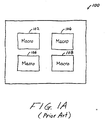
- FIG. 1A shows a block diagram of a conventional CAM chip 100 having four macros 102, 104, 106, and 108. Each of the macros 102, 104, 106, and 108 is configurable by a user to specified widths for various applications.
- the macro 102 is configured as a 4Kx64 block (i.e., 4K entries of 64 bit data width); the macros 104 and 108 are configured as an 8Kx32 block (i.e., 8K entries of 32 bit data width); and the macro 106 is configured as a 2Kx128 block (i.e., 2K entries of 128 bit data width).
- the macro 102 is configured as a 4Kx64 block (i.e., 4K entries of 64 bit data width);
- the macros 104 and 108 are configured as an 8Kx32 block (i.e., 8K entries of 32 bit data width); and the macro 106 is configured as a 2Kx128 block (i.e., 2K entries of 128 bit data width).
- all entries in a single macro have the same width.
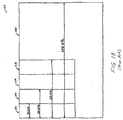
- Figure 1B illustrates a block diagram of a macro 120 depicting various widths into which it can be configured.
- the macro 120 includes a plurality of blocks 122, 124, 126, 128, and 130, which can be configured into 32-bit width, 64-bit width, 128-bit width, or 256-bit width.
- each of the blocks 122, 124, 126, and 128 may be used to provide 32-bit width.
- blocks 122 and 124 may be used to provide data width size of 64 bits.
- the width of conventional macros 102, 104, 106, 108, and 120 is typically configurable on the block level only using associated registers that specify data size for each of the macros. This means that each of the macros 102, 104, 106, 108, and 120 cannot accommodate more than one data size at the same time.
- the configuration of macros at the block level often results in wasting of valuable memory space. For example, if the macro 120 can accommodate 128 bit data width but is actually configured into 64 bit data width, half of the memory space will not be used, thus resulting effectively in the waste of 50% of memory space. Likewise, if the macro 120 can support up to 64-bit data width but is configured into 32-bit data size, half of the memory space will be lost.
- macros generally requires the users or customers to be intimately knowledgeable about the macros and their data sizes to avoid overflow of the macros. Furthermore, if the macros are reprogrammed to different data sizes, valuable data (e.g., search statistics) could be lost in the process.
- a CAM device that can store variable data size widths for searching variable width data without wasting valuable memory space, thereby maximizing the usage of CAM space with attendant savings in cost.
- the present invention fills these needs by providing variable width CAM devices for searching data of variable widths. It should be appreciated that the present invention can be implemented in numerous ways, including as a process, an apparatus, a system, a device, or a method. Several embodiments of the present invention are described below.
- the present invention provides a variable width CAM device for searching data of variable widths.
- the CAM device includes a plurality of CAM blocks and a plurality of first encoders.
- the plurality of CAM blocks is configured to store a plurality of data of variable widths with each data having one or more data portions of one or more predetermined widths.
- Each CAM block is configured to store a predetermined width portion of the data such that each data is stored in one or more CAM blocks.
- the CAM blocks receive a search data having a specified number of search data portions with each search data portion having the one or more predetermined widths.
- Each CAM block receives a search data portion of the search data for searching the search data in the CAM blocks.
- the plurality of dual mode first encoders is configured for concatenating the specified number of the CAM blocks to generate one or more search results.
- a set of the dual mode first encoders concatenates the specified number of CAM blocks to match the width of the search data.
- the remaining dual mode first encoders generate one or more search results when the concatenated CAM blocks contain data that matches the search data.
- the present invention provides a variable width CAM device including a plurality of CAM blocks and a plurality of first encoders.
- the plurality of CAM blocks is configured for storing a plurality of data having a plurality of widths.
- Each CAM block has a plurality of entries with each entry being configured to store a predetermined width data portion of one of the plurality of data.
- Each of the plurality of data is stored in one or more entries that are located in different CAM blocks.
- the CAM blocks are arranged to receive a search data having a specified number of search data portions such that each CAM block receives one search data portion having the predetermined width.
- Each entry in the CAM blocks is capable of generating a match result when the predetermined width data portion in each entry matches the search data portion of the predetermined width.
- the plurality of first encoders is configured to sequentially couple the plurality of CAM blocks in the specified number to match the width of the search data.
- Each first encoder is associated with one CAM block for receiving the match results from the entries in the associated CAM block.
- a set of the first encoders transmits the match results from the associated CAM blocks to next sequentially coupled CAM blocks as inputs.
- Each of the remaining first encoders generates a search result when the sequentially coupled CAM blocks contain data that matches the search data.
- variable width CAM includes a plurality of CAM blocks, a plurality of first encoders, and a second encoder.
- the plurality of CAM blocks is arranged for storing data of variable widths with each CAM block having a plurality of entries. Each entry is configured to store data of a first width.
- Each CAM block is arranged to receive a first width search data portion of a search data for input to each entry in each CAM block.
- Each entry in the CAM blocks is capable of generating a match result when the data in each entry matches the search data portion of the first width.
- the plurality of first encoders is configured to concatenate the entries of the plurality of CAM blocks.
- Each first encoder is associated with one CAM block for receiving the match results from the entries in the associated CAM block. Each first encoder is arranged to transmit the match results to a next sequentially coupled CAM block as inputs to the entries in the next CAM block. A set of the first encoders is adapted to transmit the match results for concatenating the entries in one or more CAM blocks to match the width of the concatenated entries and the search data. Each of the remaining first encoders generates a search result in response to match results of the concatenated entries.
- the second encoder is coupled to the plurality of first encoders to receive one or more search results. The second encoder selects one of said received search results for output.
- variable width storage and searching of the data provides substantial flexibility to users by allowing the tag bits, which identify the width of an entry, to be programmed on an entry basis instead of block basis.
- the storage and searching of variable width data on individual entry basis saves valuable CAM space by eliminating unused or unusable CAM spaces associated with conventional CAM macros.
- the CAM devices with the variable width storage and searching capabilities are particularly beneficial in multi-protocol applications such as IPv4, IPv6, ATM, MAC level switching, etc.
- Figure 1A shows a block diagram of a conventional CAM chip having four macros.
- Figure 1B illustrates a block diagram of a macro depicting various widths into which it can be configured.
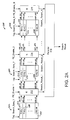
- Figure 2A shows a schematic block diagram of an exemplary CAM device for implementing variable data widths in accordance with one embodiment of the present invention.
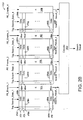
- Figure 2B shows an exemplary CAM device having four CAM blocks in accordance with one embodiment of the present invention.
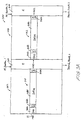
- Figure 3A shows a more detailed schematic block diagram of a pair of entries provided in a pair of CAM blocks of an exemplary CAM device in accordance with one embodiment of the present invention.
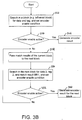
- Figure 3B is a flowchart of an exemplary method for providing variable search data widths in a CAM device in accordance with one embodiment of the present invention.
- Figure 3C shows a CAM device configured to store larger width entries using two or more adjacent rows within blocks in accordance with one embodiment of the present invention.
- Figure 4A shows a schematic diagram of an exemplary entry for implementing variable data widths in accordance with one embodiment of the present invention.
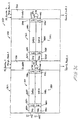
- Figure 4B illustrates a schematic diagram of an exemplary entry for saving power in accordance with one embodiment of the invention.
- Figure 5 is a logical block diagram of the CAM device illustrating variable widths of data that can be stored and searched for in its CAM blocks in accordance with one embodiment of the present invention.
- Figure 6A shows a pair of rows and encoders PE1, PE2, and PE3 in accordance with one embodiment of the present invention.
- Figure 6B illustrates an interleaved row that includes entries E1 to E6 in accordance with one embodiment of the present invention.
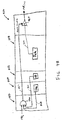
- Figure 6C shows a schematic diagram of input and output signals of entries E1 and E4 and associated encoder portions PE 1 and PE 4 .
- variable width CAM device for searching variable width data
- numerous specific details are set forth in order to provide a thorough understanding of the present invention.
- the present invention may be practiced without some or all of these specific details.
- well known process operations have not been described in detail in order not to unnecessarily obscure the present invention.
- FIG. 2A shows a schematic block diagram of an exemplary CAM device 200 for implementing variable data widths in accordance with one embodiment of the present invention.
- the CAM device 200 includes a plurality of CAM blocks 202, 204, and 206.
- Each of the CAM blocks 202, 204, and 206 includes M entries from Entry 1 to Entry M.
- each entry includes a tag field for storing a tag value and a data field for storing data of a predetermined width.
- the entries are arranged in rows so that one entry is provided for each row.
- the data field for the entries in the CAM blocks 202, 204, and 206 is a uniform size such as 32-bit width.
- the CAM device 200 is illustrated using three CAM blocks 202, 204, and 206, it may employ any number of CAM blocks to implement variable data widths.
- the CAM blocks 202, 204, and 206 are configured to receive a tag and a search data as inputs.
- the tag specifies the width of the search data while the search data is the data to be searched.
- the tag is preferably the same for all CAM blocks 202, 204, and 206.
- the search data may be different for each CAM block.
- the CAM blocks 202, 204, and 206 all receive a single tag of same value while receiving search data Search_Data_1 Search_Data_2, and Search_Data_N, respectively.
- the tag encodes the width of the data to be searched for implementing variable width data storage and search.
- a 2-bit tag may be encoded to implement variable data widths from 32-bits to 256-bits as shown in the following Table 1.
- the width of data varies according to the tag value.
- tag values of "00,”"01,” “10,” and “11” indicate data widths of 32-bits, 64-bits, 128-bits, and 256-bits, respectively.
- the present invention is illustrated by using such a tag_ scheme, it may implement any number of tag bits to encode any suitable data widths.
- each entry in the CAM blocks 202, 204, and 206 includes a tag field and a data field.
- a tag value indicating the width (i.e., size) of the data is stored in the tag field along with the associated portion of the data in the data field.
- each of the entries in the CAM blocks 202, 204, and 206 includes a data field of 32-bits and a tag field of 2-bits.
- a tag value of "00" is also stored in the tag field of the Entry 1.
- two entries are needed.
- the 64-bit data can be stored in entries 222 and 224 of the CAM blocks 202 and 204, respectively.
- the first 32 data bits are stored in the entry 222 while the second 32 data bits are stored in the entry 224.
- a tag value of "01" is stored into the tag fields of both entries 222 and 224 to indicate that these entries contain a 64-bit data.
- the CAM device 200 includes a plurality of encoders 212, 214, and 216, which are associated with CAM blocks 202, 204, and 206, respectively, for use in search operations.
- the encoders 212, 214, and 216 receive enable signals PE_Enable_1, PE_Enable_2, and PE_Enable_N, respectively, for either enabling or disabling the encoders. For example, when the enable signals PE_Enable_1, PE_Enable_2, and PE_Enable_N are enabled (e.g., asserted), then the encoders 212, 214, and 216 function to encode match results into search results and select one of the search results, using a predefined algorithm, for output.
- the encoders 212, 214, and 216 do not function as conventional encoders. Instead, they transmit match results from one CAM block to the next CAM block. For example, if the enable signal PE_Enable_1 is not asserted, the encoder 212 is disabled. In this case, the encoder 212 transmits or passes the match results MR1_B1, MR2_B1, and MRM_B1 to the corresponding entries in the next CAM block 204.
- the CAM blocks 202 and 204 are concatenated for searching a data word of greater than 32-bit width. If a 64-bit word is to be searched, the encoder 212 will be disabled to concatenate CAM blocks 202 and 204 while the encoder 214 is enabled to output Search_Result_2 and prevent transmission of match results to the next CAM block. For a 32-bit data search, all the encoders 212, 214, and 216 are enabled to output search results Search_Result_1, Search_Result_2, and Search_Result_N. At the same time, the CAM blocks 202, 204, and 206 are disconnected from each other to prevent the transmission of match results.
- a search data and a tag value are provided to each of the CAM blocks 202, 204, and 206 for concurrently comparing the entries.
- a 32-bit data search for example, a 32-bit data and a tag of " 00" is provided to each of the entries in the CAM blocks 202, 204, and 206.
- Each entry then generates a match result (MR) in response to the provided tag and data bits.
- MR match result
- entries 222, 228, and 234 generate match results MR1_B1, MR2_B1, and MRM_B1, respectively, which indicate that the stored data and tag matched the input data and tag.
- the enable signals to the encoders 212, 214, and 216 are asserted to enable all the encoders in the CAM device 200.
- the enabling of the encoders serves to disconnect the associated CAM block from the next CAM block.
- each of the encoders 212, 214, and 216 encodes the generated match results into search results and selects one of the search results as Search_Result_1, Search_Result_2, and Search_Result_N, respectively, for output according to a predefined algorithm. It should be noted that a CAM block may not have an entry that matches the input data and tag so that the associated encoder may not generate a search result.
- a tag of "01" and two 32-bit data making up the 64-bit data are provided to a pair of consecutive CAM blocks.
- the first and second 32 data bits are provided to the CAM blocks 202 and 204 as Search_Data_1 and Search_Data_2, respectively along with the tag value of "01.”
- the encoder 212 is disabled to allow transmission of match results from CAM block 202 to CAM block 204.
- the encoder 214 is enabled to generate a search result Search_Result_2 for output. All remaining pairs of CAM blocks in the CAM device will function in a similar manner to implement the 64-bit width search.
- the search results from the encoders 212, 214, and 216 are provided to an encoder 218.
- the encoder 218 selects one of the search results according to a predefined algorithm and outputs the selected search result.
- the selected search result is thus an encoded address to the search data according to the predefined algorithm.
- the CAM device 200 may employ any number of CAM blocks to implement variable data widths.
- Figure 2B shows an exemplary CAM device 250 having four CAM blocks 252, 254, 256, and 258 in accordance with one embodiment of the present invention.
- the CAM device 250 functions in a manner similar to the CAM device 200 described in Figure 2A.
- Each entry in the CAM device 250 is shown to include a tag field (T) and a data field.
- entry 270 includes a tag field 276a and a data field 276b.
- Each of the CAM blocks 252, 254, 256, and 258 includes CAM entries having data fields of a specified data width.
- each of the CAM blocks 252, 254, 256, and 258 is a CAM block having 32-bit data width. That is the entries have 32-bit wide data fields. It should be appreciated, however, that the blocks 252 to 258 may implement any data width (e.g., 16-bit, 32-bit, 64-bit, etc.) to provide desired data size granularity and that the data width need not be the same for each block. In this arrangement, the four CAM blocks 252, 254, 256, and 258 can be used to provide access to data widths in the increment of 32-bits up to 128 bits.
- a pair of entries 276 and 282 in row 270 may be used for storing and searching a 64-bit data with a tag value of, for example, "01" while entries 286 and 290 can be used for searching another 64-bit data with the same tag value of " 01.”
- all four entries 278, 284, 288, and 292 may be used for storing and searching a single 128-bit data with a tag value of, for example, " 10" for the entries.
- FIG. 3A shows a more detailed schematic block diagram of a pair of entries 310 and 312 in CAM blocks 302 and 304, respectively, of an exemplary CAM device 300 in accordance with one embodiment of the present invention.
- the CAM device 300 may have any number of CAM blocks in addition to those shown in Figure 3A to provide desired variable data with.
- Each entry in the CAM blocks 302 and 304 includes a tag field 314, a valid bit field 316, a data field 318, and a sense amplifier (SA) 320.
- SA sense amplifier
- the entry 310 includes a tag field 314a, a valid bit field 316a, a data field 318a, and a sense amplifier 320a.
- the entry 312 includes a tag field 314b, a valid bit field 316b, a data field 318b, and a sense amplifier 320b.
- the data field 318 stores data of specified width.
- the tag field 314 stores tag bits indicating the width of the overall data of which the data in the data field 318 may form a portion thereof.
- the valid bit field 316 is used to store a valid bit indicating whether the associated entry contains valid data. For example, if the valid bit in the valid bit field 316a is asserted, the entry 310 contains valid data in data field 318a. Conversely, if the valid bit is not asserted, the data in the data field 318a is invalid data.
- the sense amplifier 320 is used to amplify the match result signal for output. For instance, the sense amplifiers 320a and 320b amplify the match result signals MR1 and MR2, respectively, for output to a pair of encoders 306 and 308, respectively.
- the encoders 306 and 308 receive encoder enable signals PE_Enable_1 and PE_Enable_2, respectively, for enabling or disabling the encoder functions.
- an encoder enable signal When an encoder enable signal is asserted, for example, the associated encoder functions in its conventional encoder mode to encode match results into associated search addresses and select one of the search results as output.
- the encoder enable signal When the encoder enable signal is disabled, however, the conventional function of the encoder is disabled and instead, the encoder transmits the received match result signal onto an entry that is preferably located on the same row in the next CAM block.
- the data fields 318a and 318b may store 32-bit data each with a tag value of "01" in both tag fields 314a and 314b to indicate that the entries 310 and 312 are to be concatenated to form a 64-bit entry.
- the match result (MR0) input is tied to a high supply voltage V+.
- the PE_Enable_1 When performing a 64-bit data search, the PE_Enable_1 will be disabled. This allows the encoder 306 to pass the match result MR1 onto the next entry 312.
- the PE_Enable_2 signal will be enabled so that the encoder 308 may encode the match result MR2 into a search result. In this manner, the entries 310 and 312 may be effectively concatenated to provide storage and search capability of a single 64-bit entry.
- the data fields 318a and 318b may each store a 32-bit data with a tag value of "00" in the associated tag: fields 314a and 314b, respectively.
- both PE_Enable_1 and PE_Enable_2 signals will be enabled so that the encoders 306 and 308 may encode the match results MR1 and MR2, respectively, into search addresses independently.
- the CAM device 300 thus provides variable data width storage and search capabilities.
- the data, valid bit, and tag fields may also implement ternary equality by allowing the storage of any one of three states: "0,” “1,” and "X.”
- the search operation is sequentially pipelined, one block after another.
- the search in the CAM blocks 302 and 304 may be performed in two cycles: one search cycle for each CAM block and another cycle for each of the encoders 306 and 308 to generate a search result.
- a 64-bit data search is performed in three cycles: two search cycles for the CAM blocks 302 and 304 and another cycle for the encoder 308 to produce a search result.
- a 128-bit data search may be performed in five clock cycles.
- the pipelined search operation uses one cycle for each CAM block search and a cycle for the last encoder to produce a search result.
- the search operations in the CAM blocks may be performed in parallel within a single cycle in a multi-block search mode. In this case, the input search data and the tag values are provided to the CAM blocks in parallel.
- Figure 3B is a flowchart of an exemplary method for providing variable search data widths in the CAM device 200, 250, or 300 in accordance with one embodiment of the present invention.
- the method assumes that data have been stored with associated tags to indicate the proper width of the data.
- a left-most CAM block is searched for data and a tag while providing an encoder enable signal in operation 322.
- the encoder enable signal may be either active (e.g., asserted) or inactive (e.g., de-asserted).
- the method proceeds to operation 326 to generate a search result from match results, if any, in operation 326.
- the encoder enable signal is inactive
- the match results, if any, from the current CAM block are transmitted to the associated entries in the next CAM block in operation 328.
- an entry in the CAM block generates a match result for transmission to the next block when both the tag and data in the entry match the input tag and search data.
- the current block is now referred to as the previous block while the next block becomes the current block.
- the new current CAM block is searched, in operation 330, for an input data with the same tag used in the previous block.
- the encoder signal for the current CAM block is set and provided to an encoder associated with the current CAM block.
- Figure 3C shows a CAM device configured to store larger width entries using two or more adjacent rows within blocks in accordance with one embodiment of the present invention.
- the CAM device 350 shown in Figure 3C is similar to the CAM device 300 shown in Figure 3A except the dual mode encoders 306 and 308 in Figure 3A are replaced by multi-mode encoders 356 and 358.
- the multi mode encoders 356 and 358 may be operated in the same disabled mode (with PE_Enable_1 and Merge_Rows_1 both low for example) or enabled mode (with PE_Enable_1 high and Merge_Rows_1 low for example) as the dual mode encoders 306 and 308.
- the multi mode encoders 356 and 358 include a multi row encode mode (when PE_Enable_1 and Merge_Rows_1 are both high for example) and a multi row capture mode (when PE_Enable_1 is low and Merge_Rows_1 is high for example).
- the four modes for the multi mode encoder are summarized in Table 2 below.
- a 128-bit value may be stored in the CAM device 350 assuming 32-bit portions are stored in each entry 360, 362, 380 and 382.
- the data portions for the 128-bit entry are stored in the data fields 368a, 368b, 368c and 368d, the valid bit for each data portion 366a, 366b, 366c and 366d are all set to the valid state and the tag values are stored in the tag fields 364a, 364b, 364c and 364d.
- CAM block 352 is the first block, the MR0 and MR4 match result inputs are tied high, and the MR1 and MR4 match result outputs are connected to the match result inputs of the CAM block 354.
- a 32-bit entry uses a tag value of 00 and a 64-bit entry uses a tag value of 01 and are searched using the same procedure as if they were being searched for in CAM device 300 with appropriate control of the PE_Enable control signals and applied tag; the Merge_Rows encoder control signals are held low in this case.
- the search for a 128-bit entry since it is stored across two adjacent rows in each block, requires two tag values: the tag 10 is stored with the upper row entries 360 and 362 while the tag 11 is stored with the lower row entries 380 and 382.
- two 32-bit search data portions may be applied to the CAM blocks 352 and 354 along with the tag 10 to generate search results MR1 and MR2 in one search cycle.
- the encoder controls are set to allow match result MR1 to flow from CAM block 352 to CAM block 354 by disabling encoder 356 (PE_Enable_1 and Merge_Rows_1 are both set low).
- the MR1 match result is combined with the search result from entry 362 to generate match result MR2 which is captured and stored in the encoder 358 (PE_Enable_2 is low and Merge_Rows_2 is high).
- the remaining two 32-bit search data portions are applied to the CAM blocks 352 and 354 along with the tag 11 and the encoder 356 is disabled to allow match result MR4 to pass to CAM block 354 where it is combined with the search result from entry 382 to generate match result MR5.
- the encoder 358 is configured in multi row encode mode with encoder control inputs PE_Enable_2 and Merge_Rows_2 both set high.
- Match result MR5 is logically ANDed with the stored match result MR2 by AND gate 392 to generate a single match result MR25 for the 128-bit entry.
- the match result MR25 is then encoded by the encoder 358 to generate Search_Result_2.
- FIG. 4A shows a schematic block diagram of an exemplary entry 400 for implementing variable data widths in accordance with one embodiment of the present invention.
- the entry 400 includes a match result interface portion 402, a tag field 416, a valid bit field 418, a data field 420, and a sense amplifier 422.
- the match result interface portion 402 includes an inverter 412 and a transistor 414.
- the inverter 412 receives a match result MR i , which may be either high or low. For example, a high MR i signal may indicate a hit in the previous block entry while a low MR i signal may indicate a miss.
- the MR i signal is coupled to supply voltage V+ so that the MR i is high.
- the inverter 412 inverts the input MR i signal, which is provided to the transistor 414.
- the transistor 414 turns off when the inverted input signal is low (e.g., MR i high) so as not to pull down the voltage at the output node 310.
- the inverted input signal is high (e.g., MR i low)
- the transistor pulls down the voltage at the output node 310.
- the output node 310 is coupled to the tag field 416, the valid bit field 418, and the data field 420.
- the voltage at the node 310 is pulled down. This indicates that match has not been found in the entry 400.
- the voltage at the output node is pulled high, which indicates that a match has been found in the entry 400.
- the voltage at node 310 is provided as an input to the sense amplifier 422, which amplifies the input voltage for output as match result, MR i+1 , which may be encoded into an address or transmitted to the next entry in the block as an input.
- the amplification of the search result 310 by the sense amplifier 422 to generate MRi+1 requires reasonably significant current consumption to obtain high speed operation.
- the power consumption from this match amplification may be a significant portion of overall power consumption for large capacity CAMs with thousands of stored entries.
- the match sense amplifiers 422 may be selectively enabled on an entry by entry basis as shown in Figure 4B.
- the MRi input, the tag comparison result 468 and the valid bit comparison result 466 are logically ANDed by the AND gate 460 to generate a local sense amplifier enable signal 462 to control the match sense amplifier 464.
- each match sense amplifier to be enabled for only the entries which have MRi, tag and valid bit states which match the applied search inputs.
- Power savings result for CAM arrays which store entries of a number of widths (with different tag values) or invalid entries.
- the power saving technique shown in Figure 4B demonstrates an example using a combination of the MRi input, tag and valid bit comparison results to enable the local match sense amplifier 464. It should be obvious that any combination of one or more of these inputs may be used to achieve a partial reduction in sense power consumption without altering the intent.
- FIG. 5 is a logical block diagram of the CAM device 250 illustrating variable widths of data that can be stored and searched for in the CAM blocks 252, 254, 256, and 258 in accordance with one embodiment of the present invention.
- the CAM device 500 stores data of variable sizes in 32-bit increments from 32-bit width to 128-bit width. For example, in rows 502 and 516, data of 32-bit width is stored in entries 518, 520, 522, 524, 550, 552, 554, and 556: On the other hand, in rows 504 and 512, data of 128 bits are stored for searching.
- a row 508 stores a single 64-bit data in entry 534.
- rows 506, 510, and 514 are used to store varying data widths.
- the row 506 stores a 64-bit data in entry 528 along with a pair of entries 530 and 532 storing a 32-bit data each.
- the row 510 stores 32-bit data in a pair of entries 536 and 538 along with a 64-bit data in entry 540.
- the row 514 stores data of 96-bit width in entry 544 and data of 32 bits in entry 548.
- Other rows and entries in the CAM device 500 may be similarly configured so that all spaces may be used for storing data without wasting valuable CAM spaces. Data may also be stored across multiple rows when multi-mode encoders are used. For example, rows 560 and 562 of Figure 5 are used to store a single 256-bit wide entry 564.
- the CAM devices of the present invention provide savings in CAM space and enhanced flexibility.
- the variable width storage and searching of the data provides substantial flexibility to users by allowing the tag bits to be programmed on an entry basis instead of block basis.
- valuable CAM space is saved by eliminating unused or unusable CAM spaces associated with conventional CAM macros.
- the CAM device with the variable width storage and searching capabilities is particularly beneficial in multi-protocol applications such as IPv4, IPv6, ATM, MAC level switching, etc.
- entries in a set of rows may be arranged in a single interleaved row.
- Figure 6A shows a pair of rows 602 and 604 and encoders PE1, PE2, and PE3 in accordance with one embodiment of the present invention.
- Each of the encoders PE1, PE2, and PE3 includes a pair of encoder portions.
- the encoder PE1 includes encoder portions PE 1 and PE 4 ;
- the encoder PE2 includes encoder portions PE 2 and PE 5 ;
- the encoder PE3 includes encoder portions PE 3 and PE 6 .
- Row 602 includes entries E1, E2, E3, and associated encoder portions PE 1 , PE 2 , and PE 3 , respectively.
- row 604 includes entries E4, E5, and E6 with associated encoder portions PE 4 , PE 5 , and PE 6 , respectively.
- FIG. 6B illustrates an interleaved row 606 that includes the entries E1 to E6 in accordance with one embodiment of the present invention.
- entries E1 and E4 are provided in contiguous locations followed by associated encoder portions PE 1 and PE 4 of the encoder PE1.
- entries E2 and E5 are provided followed by respective encoder portions PE 2 and PE 5 .
- Entries E3 and E6 are then provided followed by associated encoder portions PE 3 and PE 6 .
- Figure 6C shows a schematic diagram of input and output signals of entries E1 and E4 and associated encoder portions PE 1 and PE 4 .
- Sense amplifiers SA 1 and SA 2 are provided to amplify output signals from the entries E1 and E4, respectively.
- the entries E1 and E4 receive input match result signals MR i1 and MR i4 , respectively.
- the sense amplifiers SA 1 and SA 4 amplifies output signals from the entries E1 and E4, respectively, and provide the amplified output signals to encoder portions PE 1 and PE 4 , respectively.
- the encoder portions PE 1 and PE 4 outputs match result output signals MR o1 and MR o4 , respectively, which may be provided to next entries E1 and E5 in the interleaved row 606.
Landscapes
- Engineering & Computer Science (AREA)
- Theoretical Computer Science (AREA)
- Physics & Mathematics (AREA)
- General Engineering & Computer Science (AREA)
- General Physics & Mathematics (AREA)
- Information Retrieval, Db Structures And Fs Structures Therefor (AREA)
- Static Random-Access Memory (AREA)
- Tests Of Electronic Circuits (AREA)
- For Increasing The Reliability Of Semiconductor Memories (AREA)
- Transmission And Conversion Of Sensor Element Output (AREA)
Applications Claiming Priority (2)
| Application Number | Priority Date | Filing Date | Title |
|---|---|---|---|
| US15338899P | 1999-09-10 | 1999-09-10 | |
| US153388P | 1999-09-10 |
Publications (1)
| Publication Number | Publication Date |
|---|---|
| EP1083573A1 true EP1083573A1 (en) | 2001-03-14 |
Family
ID=22547011
Family Applications (1)
| Application Number | Title | Priority Date | Filing Date |
|---|---|---|---|
| EP00307759A Withdrawn EP1083573A1 (en) | 1999-09-10 | 2000-09-08 | Variable width content addressable memory device for searching variable with data |
Country Status (3)
| Country | Link |
|---|---|
| US (4) | US6392910B1 (enExample) |
| EP (1) | EP1083573A1 (enExample) |
| JP (3) | JP4927247B2 (enExample) |
Cited By (1)
| Publication number | Priority date | Publication date | Assignee | Title |
|---|---|---|---|---|
| EP2048009A1 (de) | 2007-10-12 | 2009-04-15 | Behr GmbH & Co. KG | Kraftfahrzeug-Klimaanlagenanordnung |
Families Citing this family (55)
| Publication number | Priority date | Publication date | Assignee | Title |
|---|---|---|---|---|
| US6392910B1 (en) | 1999-09-10 | 2002-05-21 | Sibercore Technologies, Inc. | Priority encoder with multiple match function for content addressable memories and methods for implementing the same |
| CA2310295C (en) * | 2000-05-31 | 2010-10-05 | Mosaid Technologies Incorporated | Multiple match detection circuit and method |
| CA2321466C (en) * | 2000-09-29 | 2006-06-06 | Mosaid Technologies Incorporated | Priority encoder circuit and method |
| US6707694B2 (en) * | 2001-07-06 | 2004-03-16 | Micron Technology, Inc. | Multi-match detection circuit for use with content-addressable memories |
| TW569090B (en) * | 2001-07-17 | 2004-01-01 | Taiwan Semiconductor Mfg | Priority address encoder and method of the same |
| US6538911B1 (en) * | 2001-08-24 | 2003-03-25 | Sibercore Technologies, Inc. | Content addressable memory with block select for power management |
| US6577519B1 (en) | 2001-08-30 | 2003-06-10 | Sibercore Technologies, Inc. | System and method for low power searching in content addressable memories using sample search words |
| US7055075B2 (en) * | 2001-12-05 | 2006-05-30 | Avago Techologies General Ip Pte. Ltd. | Apparatus for random access memory array self-test |
| US7301961B1 (en) | 2001-12-27 | 2007-11-27 | Cypress Semiconductor Corportion | Method and apparatus for configuring signal lines according to idle codes |
| US20030145178A1 (en) * | 2002-01-31 | 2003-07-31 | Charles Jiang | Circuit and method for detecting multiple matches in a content addressable memory |
| JP2003257185A (ja) * | 2002-02-27 | 2003-09-12 | Kawasaki Microelectronics Kk | 信号検出回路 |
| JP2003303495A (ja) * | 2002-04-09 | 2003-10-24 | Fujitsu Ltd | 半導体記憶装置 |
| US7274690B1 (en) | 2002-05-09 | 2007-09-25 | Silicon Image, Inc. | Age selection switching scheme for data traffic in a crossbar switch |
| US7519066B1 (en) | 2002-05-09 | 2009-04-14 | Silicon Image, Inc. | Method for switching data in a crossbar switch |
| US6862655B1 (en) | 2002-10-01 | 2005-03-01 | Sibercore Technologies, Inc. | Wide word search using serial match line computation in content addressable memory |
| JP2004164395A (ja) * | 2002-11-14 | 2004-06-10 | Renesas Technology Corp | アドレス変換装置 |
| US7461167B1 (en) | 2002-11-22 | 2008-12-02 | Silicon Image, Inc. | Method for multicast service in a crossbar switch |
| US7505422B1 (en) | 2002-11-22 | 2009-03-17 | Silicon Image, Inc. | Preference programmable first-one detector and quadrature based random grant generator |
| US6924994B1 (en) | 2003-03-10 | 2005-08-02 | Integrated Device Technology, Inc. | Content addressable memory (CAM) devices having scalable multiple match detection circuits therein |
| JP3828502B2 (ja) * | 2003-03-26 | 2006-10-04 | 株式会社東芝 | 集積回路 |
| US7352764B1 (en) * | 2003-05-08 | 2008-04-01 | Silicon Image, Inc. | Content addressable merged queue architecture for switching data |
| US6831587B1 (en) * | 2003-07-31 | 2004-12-14 | Micron Technology, Inc. | Priority encoding |
| US7130230B2 (en) * | 2003-08-21 | 2006-10-31 | Stmicroelectronics Pvt. Ltd. | Systems for built-in-self-test for content addressable memories and methods of operating the same |
| DE10344877B3 (de) * | 2003-09-26 | 2004-12-30 | Infineon Technologies Ag | Vorrichtung zum Testen eines Speichermoduls |
| KR100518599B1 (ko) * | 2003-11-03 | 2005-10-04 | 삼성전자주식회사 | 우선 순위 엔코더의 결함 여부 테스트가 가능한 캠 및우선 순위 엔코더의 결함 여부 테스트 방법 |
| US7464308B2 (en) * | 2004-01-13 | 2008-12-09 | Micron Technology, Inc. | CAM expected address search testmode |
| US7652903B2 (en) * | 2004-03-04 | 2010-01-26 | Xiaohua Huang | Hit ahead hierarchical scalable priority encoding logic and circuits |
| US7519875B2 (en) * | 2004-08-20 | 2009-04-14 | Avago Technologies General Ip (Singapore) Pte. Ltd. | Method and apparatus for enabling a user to determine whether a defective location in a memory device has been remapped to a redundant memory portion |
| US7321999B2 (en) * | 2004-10-05 | 2008-01-22 | Verigy (Singapore) Pte. Ltd. | Methods and apparatus for programming and operating automated test equipment |
| US20060080583A1 (en) * | 2004-10-07 | 2006-04-13 | International Business Machines Corporation | Store scan data in trace arrays for on-board software access |
| US7627798B2 (en) * | 2004-10-08 | 2009-12-01 | Kabushiki Kaisha Toshiba | Systems and methods for circuit testing using LBIST |
| US7565481B1 (en) * | 2004-10-29 | 2009-07-21 | Netlogic Microsystems, Inc. | Content addressable memory (CAM) device and method for flexible suppression of hit indications |
| US7240255B2 (en) * | 2005-03-22 | 2007-07-03 | Cisco Technology, Inc. | Area efficient BIST system for memories |
| US7436688B1 (en) * | 2005-05-06 | 2008-10-14 | Netlogic Microsystems, Inc. | Priority encoder circuit and method |
| US7193877B1 (en) * | 2005-10-04 | 2007-03-20 | Netlogic Microsystems, Inc. | Content addressable memory with reduced test time |
| US7945823B2 (en) * | 2006-03-02 | 2011-05-17 | Netlogic Microsystems, Inc. | Programmable address space built-in self test (BIST) device and method for fault detection |
| US20080016421A1 (en) * | 2006-07-13 | 2008-01-17 | International Business Machines Corporation | Method and apparatus for providing programmable control of built-in self test |
| US7822916B1 (en) * | 2006-10-31 | 2010-10-26 | Netlogic Microsystems, Inc. | Integrated circuit search engine devices having priority sequencer circuits therein that sequentially encode multiple match signals |
| TWI306951B (en) * | 2006-12-19 | 2009-03-01 | Via Tech Inc | Chipset and chipset testing method |
| US20090141530A1 (en) * | 2007-12-03 | 2009-06-04 | International Business Machines Corporation | Structure for implementing enhanced content addressable memory performance capability |
| US7646648B2 (en) | 2007-12-03 | 2010-01-12 | International Business Machines Corporation | Apparatus and method for implementing memory array device with built in computational capability |
| US7848128B2 (en) * | 2007-12-03 | 2010-12-07 | International Business Machines Corporation | Apparatus and method for implementing matrix-based search capability in content addressable memory devices |
| US8117567B2 (en) * | 2007-12-03 | 2012-02-14 | International Business Machines Corporation | Structure for implementing memory array device with built in computation capability |
| US7924588B2 (en) * | 2007-12-03 | 2011-04-12 | International Business Machines Corporation | Content addressable memory with concurrent two-dimensional search capability in both row and column directions |
| US7859878B2 (en) * | 2007-12-03 | 2010-12-28 | International Business Machines Corporation | Design structure for implementing matrix-based search capability in content addressable memory devices |
| JP5584895B2 (ja) * | 2009-10-08 | 2014-09-10 | ルネサスエレクトロニクス株式会社 | 半導体信号処理装置 |
| JP2013511223A (ja) * | 2009-11-16 | 2013-03-28 | マーベル ワールド トレード リミテッド | 反復解析及び分類 |
| TWI405993B (zh) * | 2010-07-28 | 2013-08-21 | Novatek Microelectronics Corp | 系統晶片測試系統及方法 |
| US20120140541A1 (en) * | 2010-12-02 | 2012-06-07 | Advanced Micro Devices, Inc. | Memory built-in self test scheme for content addressable memory array |
| US8990631B1 (en) * | 2011-03-03 | 2015-03-24 | Netlogic Microsystems, Inc. | Packet format for error reporting in a content addressable memory |
| US8843861B2 (en) | 2012-02-16 | 2014-09-23 | Mentor Graphics Corporation | Third party component debugging for integrated circuit design |
| US9703579B2 (en) | 2012-04-27 | 2017-07-11 | Mentor Graphics Corporation | Debug environment for a multi user hardware assisted verification system |
| US9165650B2 (en) * | 2013-02-07 | 2015-10-20 | Qualcomm Incorporated | Hybrid dynamic-static encoder with optional hit and/or multi-hit detection |
| JP2019102108A (ja) * | 2017-11-29 | 2019-06-24 | ルネサスエレクトロニクス株式会社 | 半導体装置 |
| US10628275B2 (en) * | 2018-03-07 | 2020-04-21 | Nxp B.V. | Runtime software-based self-test with mutual inter-core checking |
Citations (4)
| Publication number | Priority date | Publication date | Assignee | Title |
|---|---|---|---|---|
| EP0491498A2 (en) * | 1990-12-18 | 1992-06-24 | Sun Microsystems, Inc. | Apparatus and method for a space saving translation lookaside buffer for content addressable memory |
| US5185888A (en) * | 1984-08-22 | 1993-02-09 | Hitachi, Ltd. | Method and apparatus for data merging/sorting and searching using a plurality of bit-sliced processing units |
| US5818786A (en) * | 1995-05-24 | 1998-10-06 | Kawasaki Steel Corporation | Layout method of semiconductor memory and content-addressable memory |
| EP0899668A2 (en) * | 1997-08-29 | 1999-03-03 | Hewlett-Packard Company | Match and match address signal prioritization in a content addressable memory encoder |
Family Cites Families (62)
| Publication number | Priority date | Publication date | Assignee | Title |
|---|---|---|---|---|
| US4376974A (en) | 1980-03-31 | 1983-03-15 | Ncr Corporation | Associative memory system |
| US4475194A (en) | 1982-03-30 | 1984-10-02 | International Business Machines Corporation | Dynamic replacement of defective memory words |
| US4559618A (en) | 1982-09-13 | 1985-12-17 | Data General Corp. | Content-addressable memory module with associative clear |
| US4670858A (en) | 1983-06-07 | 1987-06-02 | Tektronix, Inc. | High storage capacity associative memory |
| US4532606A (en) | 1983-07-14 | 1985-07-30 | Burroughs Corporation | Content addressable memory cell with shift capability |
| JPS60136097A (ja) | 1983-12-23 | 1985-07-19 | Hitachi Ltd | 連想メモリ装置 |
| US4794559A (en) | 1984-07-05 | 1988-12-27 | American Telephone And Telegraph Company, At&T Bell Laboratories | Content addressable semiconductor memory arrays |
| JPH0795324B2 (ja) * | 1984-08-22 | 1995-10-11 | 株式会社日立製作所 | サーチ方法および装置 |
| US4622653A (en) | 1984-10-29 | 1986-11-11 | Texas Instruments Incorporated | Block associative memory |
| US4723224A (en) | 1986-01-02 | 1988-02-02 | Motorola, Inc. | Content addressable memory having field masking |
| US4758982A (en) | 1986-01-08 | 1988-07-19 | Advanced Micro Devices, Inc. | Quasi content addressable memory |
| US4845668A (en) | 1987-12-10 | 1989-07-04 | Raytheon Company | Variable field content addressable memory |
| US4996666A (en) | 1988-08-12 | 1991-02-26 | Duluk Jr Jerome F | Content-addressable memory system capable of fully parallel magnitude comparisons |
| JPH02174000A (ja) * | 1988-12-26 | 1990-07-05 | Nippon Telegr & Teleph Corp <Ntt> | 連想メモリセル |
| US5053991A (en) | 1989-10-06 | 1991-10-01 | Sanders Associates, Inc. | Content-addressable memory with soft-match capability |
| US5051949A (en) | 1989-11-15 | 1991-09-24 | Harris Corporation | Content addressable memory device |
| US5107501A (en) * | 1990-04-02 | 1992-04-21 | At&T Bell Laboratories | Built-in self-test technique for content-addressable memories |
| JP3152424B2 (ja) * | 1990-07-13 | 2001-04-03 | 株式会社日立製作所 | 波長可変半導体レーザ |
| US5226005A (en) * | 1990-11-19 | 1993-07-06 | Unisys Corporation | Dual ported content addressable memory cell and array |
| US5619446A (en) * | 1992-01-10 | 1997-04-08 | Kawasaki Steel Corporation | Hierarchical encoder including timing and data detection devices for a content addressable memory |
| US5555397A (en) * | 1992-01-10 | 1996-09-10 | Kawasaki Steel Corporation | Priority encoder applicable to large capacity content addressable memory |
| JP2728824B2 (ja) * | 1992-01-13 | 1998-03-18 | 川崎製鉄株式会社 | 連想メモリ装置 |
| US5327372A (en) | 1992-01-17 | 1994-07-05 | Matsushita Electric Industrial Co., Ltd. | Semiconductor memory device |
| JP2777034B2 (ja) * | 1992-01-17 | 1998-07-16 | 松下電器産業株式会社 | 半導体記憶装置 |
| US5257220A (en) | 1992-03-13 | 1993-10-26 | Research Foundation Of The State Univ. Of N.Y. | Digital data memory unit and memory unit array |
| JP2966638B2 (ja) | 1992-04-17 | 1999-10-25 | 三菱電機株式会社 | ダイナミック型連想メモリ装置 |
| US5351208A (en) | 1992-04-27 | 1994-09-27 | Integrated Information Technology, Inc. | Content addressable memory |
| US5319590A (en) | 1992-12-04 | 1994-06-07 | Hal Computer Systems, Inc. | Apparatus for storing "Don't Care" in a content addressable memory cell |
| US5568415A (en) | 1993-02-19 | 1996-10-22 | Digital Equipment Corporation | Content addressable memory having a pair of memory cells storing don't care states for address translation |
| US6000008A (en) | 1993-03-11 | 1999-12-07 | Cabletron Systems, Inc. | Method and apparatus for matching data items of variable length in a content addressable memory |
| SG44604A1 (en) * | 1993-09-20 | 1997-12-19 | Codex Corp | Circuit and method of interconnecting content addressable memory |
| US5592407A (en) | 1994-02-25 | 1997-01-07 | Kawasaki Steel Corporation | Associative memory |
| US5608662A (en) | 1995-01-12 | 1997-03-04 | Television Computer, Inc. | Packet filter engine |
| US5535164A (en) * | 1995-03-03 | 1996-07-09 | International Business Machines Corporation | BIST tester for multiple memories |
| JP2812262B2 (ja) * | 1995-08-31 | 1998-10-22 | 日本電気株式会社 | 連想記憶装置 |
| JP3816560B2 (ja) * | 1995-12-25 | 2006-08-30 | 株式会社ルネサステクノロジ | 連想メモリ回路のテスト方法及び連想メモリ回路のテスト回路 |
| US5752260A (en) | 1996-04-29 | 1998-05-12 | International Business Machines Corporation | High-speed, multiple-port, interleaved cache with arbitration of multiple access addresses |
| GB9609075D0 (en) * | 1996-05-01 | 1996-07-03 | Plessey Semiconductors Ltd | Contents addressable memories |
| US5828324A (en) * | 1996-06-17 | 1998-10-27 | Hewlett-Packard Company | Match and match address signal generation in a content addressable memory encoder |
| US5828593A (en) | 1996-07-11 | 1998-10-27 | Northern Telecom Limited | Large-capacity content addressable memory |
| US5699288A (en) | 1996-07-18 | 1997-12-16 | International Business Machines Corporation | Compare circuit for content-addressable memories |
| US5859791A (en) | 1997-01-09 | 1999-01-12 | Northern Telecom Limited | Content addressable memory |
| CA2227500C (en) * | 1997-02-06 | 2001-08-14 | Northern Telecom Limited | Content addressable memory |
| US6272588B1 (en) * | 1997-05-30 | 2001-08-07 | Motorola Inc. | Method and apparatus for verifying and characterizing data retention time in a DRAM using built-in test circuitry |
| US6006306A (en) | 1997-07-02 | 1999-12-21 | Xylan Corporation | Integrated circuit with stage-implemented content-addressable memory cell |
| US6230236B1 (en) * | 1997-08-28 | 2001-05-08 | Nortel Networks Corporation | Content addressable memory system with cascaded memories and self timed signals |
| US5943252A (en) * | 1997-09-04 | 1999-08-24 | Northern Telecom Limited | Content addressable memory |
| US6199140B1 (en) | 1997-10-30 | 2001-03-06 | Netlogic Microsystems, Inc. | Multiport content addressable memory device and timing signals |
| US6199149B1 (en) | 1998-01-30 | 2001-03-06 | Intel Corporation | Overlay counter for accelerated graphics port |
| JP3196720B2 (ja) * | 1998-03-20 | 2001-08-06 | 日本電気株式会社 | 連想メモリ制御回路及び制御方法 |
| US6081440A (en) | 1998-11-05 | 2000-06-27 | Lara Technology, Inc. | Ternary content addressable memory (CAM) having fast insertion and deletion of data values |
| US6044005A (en) | 1999-02-03 | 2000-03-28 | Sibercore Technologies Incorporated | Content addressable memory storage device |
| US6253280B1 (en) | 1999-03-19 | 2001-06-26 | Lara Technology, Inc. | Programmable multiple word width CAM architecture |
| US6286116B1 (en) * | 1999-03-26 | 2001-09-04 | Compaq Computer Corporation | Built-in test method for content addressable memories |
| US6496950B1 (en) * | 1999-08-11 | 2002-12-17 | Lsi Logic Corporation | Testing content addressable static memories |
| US6275406B1 (en) | 1999-09-10 | 2001-08-14 | Sibercore Technologies, Inc. | Content address memory circuit with redundant array and method for implementing the same |
| US6362990B1 (en) | 1999-09-10 | 2002-03-26 | Sibercore Technologies | Three port content addressable memory device and methods for implementing the same |
| US6339539B1 (en) | 1999-09-10 | 2002-01-15 | Sibercore Technologies, Inc. | Content addressable memory having read/write capabilities that do not interrupt continuous search cycles |
| US6553453B1 (en) | 1999-09-10 | 2003-04-22 | Sibercore Technologies, Inc. | Variable width content addressable memory device for searching variable width data |
| US6392910B1 (en) | 1999-09-10 | 2002-05-21 | Sibercore Technologies, Inc. | Priority encoder with multiple match function for content addressable memories and methods for implementing the same |
| US6591331B1 (en) | 1999-12-06 | 2003-07-08 | Netlogic Microsystems, Inc. | Method and apparatus for determining the address of the highest priority matching entry in a segmented content addressable memory device |
| US6243281B1 (en) | 2000-06-14 | 2001-06-05 | Netlogic Microsystems, Inc. | Method and apparatus for accessing a segment of CAM cells in an intra-row configurable CAM system |
-
2000
- 2000-08-17 US US09/642,253 patent/US6392910B1/en not_active Expired - Lifetime
- 2000-09-01 US US09/654,197 patent/US6609222B1/en not_active Ceased
- 2000-09-08 JP JP2000273259A patent/JP4927247B2/ja not_active Expired - Fee Related
- 2000-09-08 EP EP00307759A patent/EP1083573A1/en not_active Withdrawn
- 2000-09-08 JP JP2000273235A patent/JP2001148195A/ja active Pending
-
2005
- 2005-08-19 US US11/208,134 patent/USRE41659E1/en not_active Expired - Lifetime
-
2006
- 2006-08-30 US US11/514,286 patent/USRE41992E1/en not_active Expired - Lifetime
-
2011
- 2011-11-29 JP JP2011260527A patent/JP5634386B2/ja not_active Expired - Fee Related
Patent Citations (4)
| Publication number | Priority date | Publication date | Assignee | Title |
|---|---|---|---|---|
| US5185888A (en) * | 1984-08-22 | 1993-02-09 | Hitachi, Ltd. | Method and apparatus for data merging/sorting and searching using a plurality of bit-sliced processing units |
| EP0491498A2 (en) * | 1990-12-18 | 1992-06-24 | Sun Microsystems, Inc. | Apparatus and method for a space saving translation lookaside buffer for content addressable memory |
| US5818786A (en) * | 1995-05-24 | 1998-10-06 | Kawasaki Steel Corporation | Layout method of semiconductor memory and content-addressable memory |
| EP0899668A2 (en) * | 1997-08-29 | 1999-03-03 | Hewlett-Packard Company | Match and match address signal prioritization in a content addressable memory encoder |
Non-Patent Citations (2)
| Title |
|---|
| KANAD GHOSE: "THE ARCHITECTURE OF RESPONSE-PIPELINED CONTENT ADDRESSABLE MEMORIES", MICROPROCESSING AND MICROPROGRAMMING,NL,ELSEVIER SCIENCE PUBLISHERS, BV., AMSTERDAM, vol. 40, no. 6, 1 July 1994 (1994-07-01), pages 387 - 410, XP000457402, ISSN: 0165-6074 * |
| TADATO YAMAGATA ET AL: "A 288-KB FULLY PARALLEL CONTENT ADDRESSABLE MEMORY USING A STACKED-CAPACITOR CELL STRUCTURE", IEEE JOURNAL OF SOLID-STATE CIRCUITS,US,IEEE INC. NEW YORK, vol. 27, no. 12, 1 December 1992 (1992-12-01), pages 1927 - 1933, XP000329045, ISSN: 0018-9200 * |
Cited By (2)
| Publication number | Priority date | Publication date | Assignee | Title |
|---|---|---|---|---|
| EP2048009A1 (de) | 2007-10-12 | 2009-04-15 | Behr GmbH & Co. KG | Kraftfahrzeug-Klimaanlagenanordnung |
| DE102007049340A1 (de) | 2007-10-12 | 2009-04-16 | Behr Gmbh & Co. Kg | Kraftfahrzeug-Klimaanlagenanordnung |
Also Published As
| Publication number | Publication date |
|---|---|
| US6392910B1 (en) | 2002-05-21 |
| JP5634386B2 (ja) | 2014-12-03 |
| USRE41659E1 (en) | 2010-09-07 |
| JP2001148195A (ja) | 2001-05-29 |
| JP2012074131A (ja) | 2012-04-12 |
| JP4927247B2 (ja) | 2012-05-09 |
| US6609222B1 (en) | 2003-08-19 |
| JP2001160292A (ja) | 2001-06-12 |
| USRE41992E1 (en) | 2010-12-07 |
Similar Documents
| Publication | Publication Date | Title |
|---|---|---|
| EP1083573A1 (en) | Variable width content addressable memory device for searching variable with data | |
| US6553453B1 (en) | Variable width content addressable memory device for searching variable width data | |
| US20040003170A1 (en) | Variable width content addressable memory device for searching variable width data | |
| US6538911B1 (en) | Content addressable memory with block select for power management | |
| US6629099B2 (en) | Paralleled content addressable memory search engine | |
| US6526474B1 (en) | Content addressable memory (CAM) with accesses to multiple CAM arrays used to generate result for various matching sizes | |
| US8949574B2 (en) | Low power, hash-content addressable memory architecture | |
| US6137707A (en) | Method and apparatus for simultaneously performing a plurality of compare operations in content addressable memory device | |
| JP2011175563A (ja) | データ処理システム及びその制御方法 | |
| JP5951357B2 (ja) | フル・スイング・メモリ・アレイを読み出すための方法及び装置 | |
| US6856529B1 (en) | Cutting CAM peak power by clock regioning | |
| US7003625B2 (en) | Searching small entities in a wide CAM | |
| US20030005210A1 (en) | Intelligent CAM cell for CIDR processor | |
| US7409526B1 (en) | Partial key hashing memory | |
| US6639819B2 (en) | Associative memory apparatus and routing apparatus | |
| US7694068B1 (en) | Re-entrant processing in a content addressable memory | |
| USRE42684E1 (en) | Word search in content addressable memory | |
| US7136960B2 (en) | Hardware hashing of an input of a content addressable memory (CAM) to emulate a wider CAM | |
| US20040010657A1 (en) | Associative memory device returning search results of a plurality of memory groups successively upon one search instruction | |
| JP2002543642A (ja) | データ記憶および検索 | |
| US20020156964A1 (en) | Reduction of bank switching instructions in main memory of data processing apparatus having main memory and plural memory | |
| US20060155926A1 (en) | Efficient content addressable memory array for classless inter-domain routing | |
| US20190004966A1 (en) | Semiconductor device | |
| JP2001160291A (ja) | 連想メモリ | |
| JPH1063608A (ja) | データ転送制御回路 |
Legal Events
| Date | Code | Title | Description |
|---|---|---|---|
| PUAI | Public reference made under article 153(3) epc to a published international application that has entered the european phase |
Free format text: ORIGINAL CODE: 0009012 |
|
| AK | Designated contracting states |
Kind code of ref document: A1 Designated state(s): AT BE CH CY DE DK ES FI FR GB GR IE IT LI LU MC NL PT SE |
|
| AX | Request for extension of the european patent |
Free format text: AL;LT;LV;MK;RO;SI |
|
| RAP3 | Party data changed (applicant data changed or rights of an application transferred) |
Owner name: SIBERCORE TECHNOLOGIES, INC. |
|
| 17P | Request for examination filed |
Effective date: 20010613 |
|
| AKX | Designation fees paid |
Free format text: AT BE CH CY DE DK ES FI FR GB GR IE IT LI LU MC NL PT SE |
|
| STAA | Information on the status of an ep patent application or granted ep patent |
Free format text: STATUS: THE APPLICATION IS DEEMED TO BE WITHDRAWN |
|
| 18D | Application deemed to be withdrawn |
Effective date: 20030401 |