EP1081486B1 - Method and device for measuring internal characteristic distribution of scattering/absorbing body - Google Patents
Method and device for measuring internal characteristic distribution of scattering/absorbing body Download PDFInfo
- Publication number
- EP1081486B1 EP1081486B1 EP99921231A EP99921231A EP1081486B1 EP 1081486 B1 EP1081486 B1 EP 1081486B1 EP 99921231 A EP99921231 A EP 99921231A EP 99921231 A EP99921231 A EP 99921231A EP 1081486 B1 EP1081486 B1 EP 1081486B1
- Authority
- EP
- European Patent Office
- Prior art keywords
- absorption coefficient
- medium
- measured
- reference value
- weight function
- Prior art date
- Legal status (The legal status is an assumption and is not a legal conclusion. Google has not performed a legal analysis and makes no representation as to the accuracy of the status listed.)
- Expired - Lifetime
Links
- 0 C*=NCCC* Chemical compound C*=NCCC* 0.000 description 3
- AIGOAHIDIXDVAT-UHFFFAOYSA-N C1C2C3C2C3C1 Chemical compound C1C2C3C2C3C1 AIGOAHIDIXDVAT-UHFFFAOYSA-N 0.000 description 1
Images



Classifications
-
- G—PHYSICS
- G01—MEASURING; TESTING
- G01N—INVESTIGATING OR ANALYSING MATERIALS BY DETERMINING THEIR CHEMICAL OR PHYSICAL PROPERTIES
- G01N21/00—Investigating or analysing materials by the use of optical means, i.e. using sub-millimetre waves, infrared, visible or ultraviolet light
- G01N21/17—Systems in which incident light is modified in accordance with the properties of the material investigated
- G01N21/47—Scattering, i.e. diffuse reflection
- G01N21/4795—Scattering, i.e. diffuse reflection spatially resolved investigating of object in scattering medium
Definitions
- the present invention relates to a method for measuring an internal property distribution in a scattering medium and an apparatus therefor. More specifically, the present invention concerns a measuring method of internal property distribution and is applicable to equipment for obtaining internal information while moving a light injection position and a light detection position along a surface of a measured object, and an apparatus therefor.
- Optical CT computer tomography
- Optical CT means a technique or apparatus of measuring an optical property distribution or a concentration distribution of an absorptive constituent in an organism, and makes use of light (signal light) detected after injection of light into a living tissue and migration therethrough.
- the practical optical CT needs to utilize the scattered light because of the limitations including maximum permissible incidence power to organisms, measurement sensitivity, required measurement time, and so on, but the above optical CT does not have been put into practical use yet because of the following technological problems.
- the first problem is that no method has been developed for describing the behavior of light or a photon in a scattering medium with sufficient accuracy.
- the diffusion approximation holds only in sufficiently larger media than the mean free path length of photons therein and is thus incapable of handling relatively small media, tissues having complicated internal shapes, and media having complicated shapes.
- the diffusion approximation is predicated on isotropic scattering; therefore, when applied to measurement of actual living tissues having anisotropic scattering characteristics, it gives rise to unignorable errors due to the anisotropic scattering.
- the diffusion equation does not allow us to find its solution by either of analytical or numerical techniques (such as the finite element method or the like) unless boundary conditions are preliminarily set. Namely, it is necessary to set the boundary conditions at each of the light injection and detection positions, i.e., the shape of the medium and reflection characteristics at interfaces, prior to measurement. If these conditions vary depending upon individual differences etc., computation must be redone under boundary conditions modified according to the variation. Therefore, the optical CT making use of the relation between signal light and optical properties of a scattering medium derived from the approximate expression of the transport equation or the photon diffusion equation still has a significant problem in accuracy and operability.
- the second problem is that the conventional optical CT makes use of a weight function in a narrow sense, i.e., a mean path length or a phase lag equivalent thereto. For this reason, it becomes extremely complicated to handle the mean path length of detected light varying depending upon absorption coefficients. It is thus usual practice to employ approximation, but use of approximation poses a significant problem of increase in errors.
- Such methods making use of the weight function in a narrow sense are described, for example, in references listed below.
- the conventional optical CT techniques do not allow us to obtain a reconstructed image with sufficient accuracy and still have significant issues in terms of spatial resolution, image distortion, quantitation, measurement sensitivity, required measurement time, and so on.
- the important points for realizing optical CT are to clarify the behavior of light migrating in living tissues of strong scattering media, to clarify the relation between signal light detected and optical properties of scattering media (scattering absorbers) containing absorptive constituents, and to develop an algorithm for reconstructing an optical CT image by making use of the signal light and the relation.
- MLL Microscopic Beer-Lambert Law
- analytic expressions to indicate the relation between optical properties of scattering media and signal light, and reported them in the following references, for example.
- Y. Tsuchiya and Urakami Optics Communications, 144, 269-280 (1997); (16) H. Zhang, M. Miwa, Y.
- this MBL-based method has a significant feature of being free of influence of the medium shape, boundary conditions, and scattering and thus is also applicable to anisotropic scattering media and small media.
- the method clarified the photon migration in scattering media and made it possible to measure absorption coefficients of scattering media or concentrations of absorbers, based on this theory.
- the inside structure of the nonuniform object using the deviation of the absorption coefficient from the average value can be described. Since it is difficult to prepare a phantom of which exterior shape and inside structure are identical to that of the real objects, conventional methods cannot be free from the significant errors.
- the averages of the absorption and scattering coefficients are obtained by measurements such as time-resolved spectroscopy.
- the weight function and remissions can be calculated using the average values by a Monte Carlo simulation or a finite difference method.
- the absolute absorption coefficient is obtained as the sum of the average and the deviation. The validity of our algorithm was confirmed by measuring a tissue-like phantom which contains three different absorbers. Reconstructed images were evaluated and confirmed that the new method gives better accuracy in the quantitation of the concentration of absorbing substance and a smaller image distortion. The results have significant implications for optical CT which quantifies the concentration of absorbing substances accurately without measuring the reference phantom.
- EP-A2-0692708 there is described an imaging method for spatial distributions of concentrations of absorbers distributed in an object, comprising: a radiation step of applying pulsating or continuous lights radiated from predetermined incident positions with predetermined wavelengths to the object comprising a scattering medium containing absorbers; and a detection step of detecting intensities of lights passing through the object at predetermined detection positions.
- the imaging method further comprises the steps of: assuming an imaginary object having a shape identical with or similar to that of the object and containing no absorbers and, for each of a plurality of pairs of incident and detection positions set on the imaginary object, finding a plurality of photon paths traced by photons starting at the incident position and ending at the detection position; finding averaged photon-path lengths of the photon paths starting at the incident positions and ending at the detection positions in the imaginary object; finding spatial distributions of absorber concentrations from the averaged photon-path lengths, radiated intensities of the radiated lights applied to the object, detected intensities of lights detected at the detection positions and optical constants of the absorbers for the radiated lights applied to the object; and displaying the spatial distributions of the concentrations of the absorbers.
- the present invention has been accomplished in view of the above conventional issues and an object of the invention is to provide a method and an apparatus that permit measurement of an absorptive constituent with higher accuracy even when applied to the scattering media of inhomogeneous systems such as organisms or the like.
- the inventors further developed the above knowledge found by the inventor, and discovered that the above object was accomplished by 3 ⁇ applying the aforementioned MBL to the inhomogeneous systems, 4 ⁇ deriving analytic expressions to indicate the relation between optical properties of inhomogeneous scattering media and signal light, 5 ⁇ deriving a weight function according to a different definition from the conventional one from the relation between signal light and optical properties of inhomogeneous scattering media, and 6 ⁇ providing an algorithm and an apparatus for reconstructing an optical CT image by use of this weight function, whereby the inventors reached the invention.
- the invention provides a method of and an apparatus for measuring an internal property distribution of a scattering medium as set out in the independent claims.
- the weight function in each voxel which is first disclosed by the present invention, is directly gained based on the MBL, and the deviation of the absorption coefficient in each voxel is computed based on the weight function, the measurement value of the predetermined parameter, and the estimate of the parameter.
- the weight function is expressed by an equation of one kind regardless of the measurement circumstances. Since in the present invention the deviation of the absorption coefficient is computed based on the appropriate weight function even with variations in the individual measurement circumstances as described above, the invention prevents errors from being caused by employment of the approximation.
- a preferred weight function adopted in the above method and apparatus of the present invention is a function of the mean path length in each voxel and the variance of the distribution of path lengths, on the assumption that the medium to be measured has the homogeneous reference value of the absorption coefficient as a whole.
- Another preferred weight function adopted in the above method and apparatus of the present invention is a function of the mean path length in a predetermined time domain in each voxel and a variance of a distribution of path lengths, on the assumption that the medium to be measured has the homogeneous reference value of the absorption coefficient as a whole.
- still another preferred weight function adopted in the above method and apparatus of the present invention is a function of a group delay in each voxel and a variance of a distribution thereof, on the assumption that the medium to be measured has the homogeneous reference value of the absorption coefficient as a whole.
- the method further comprise a group delay acquisition step (or group delay acquisition means) of acquiring a group delay in each voxel, based on the reference value of the absorption coefficient, on the assumption that the medium to be measured has the homogeneous reference value of the absorption coefficient as a whole, and that the aforementioned weight function operation step comprise (or the weight function operation means perform) a step of gaining the weight function, based on the following equation: [where W i is the weight function, is c (speed of light in the medium) times the group delay, ⁇ ai the deviation of the absorption coefficient, and ⁇ f 2 the variance of a distribution].
- the weight functions are computed in consideration of not only the mean path length or the group delay varying depending upon the absorption coefficient, but also the variance of distribution thereof, there is a tendency to attain further improvement in the measurement accuracy of the internal property distribution obtained by use of such weight functions.
- the method and apparatus of the present invention may further comprise a concentration computation step (or concentration computation means) of computing a concentration of an absorptive constituent in each voxel by using the absolute value of the absorption coefficient, and thus obtaining a concentration distribution of the absorption constituent in the medium to be measured. Since concentrations of the absorptive constituent can be obtained based on the absorption coefficient deviations determined accurately as described above by such method and apparatus, the concentration distribution can be obtained with high accuracy.
- the rays injected into the measured medium in the light injection step have at least two wavelengths at which said absorptive constituents demonstrate their respective absorption coefficients different from each other.
- each of the rays having the at least two wavelengths is detected in the light detection step (or by the light detection means), the measurement value is acquired as to each of the rays having the at least two wavelengths in the measurement value acquisition step (or by the measurement value acquisition means), the reference value is set as to each of the rays having the at least two wavelengths in the reference value setting step (or by the reference value setting means), the estimate is computed as to each of the rays having the at least two wavelengths in the estimate computation step (or by the estimate computation means), the weight function is gained as to each of the rays having the at least two wavelengths in the weight function operation step (or by the weight function operation means), the deviation of the absorption coefficient is computed as to each of the rays having the at least two wavelengths in the absorption coefficient deviation computation step (or by the absorption coefficient deviation computation means), the absolute value of the absorption coefficient is computed as to each of the rays having the at least two wavelengths in the absorption coefficient absolute value computation step (or by the absorption
- the method and apparatus of the present invention described above may further comprise an image display step (or image display means) of displaying an optical CT image to indicate the distribution in the measured medium, based on the aforementioned distribution obtained.
- the method and apparatus of the present invention in this structure can display the optical CT image with high accuracy by imaging of the internal property distribution obtained with accuracy as described above.
- the present invention employs novel weight functions derived based on the Microscopic Beer-Lambert Law.
- the weight functions according to the present invention are different from the conventional weight functions, i.e., from photon path lengths and the mean path length in each voxel (volume element), photon residence time, phase delays corresponding thereto, and so on.
- the weight functions adopted in the present invention are expressed in the from involving the medium shape, the boundary conditions, the light incidence and detection positions, the distance between them, the scattering coefficient of the medium, and so on. These weight functions are uniquely determined against a scattering medium. Since in the present invention the optical CT image is reconstructed using the weight functions as described above, the errors, which were the problem heretofore, are reduced greatly as described hereinafter, whereby the optical CT image can be obtained with high accuracy.
- the whole three-dimensional inhomogeneous medium having the inhomogeneous distribution of absorption (or an absorptive constituent) is divided into N voxels, a number i is assigned to each voxel, and an anisotropic scattering coefficient ⁇ s , a mean cosine of scattering angles g, and an absorption coefficient ⁇ ai are defined for each voxel i (reference is made to Fig. 1).
- the photon injection-detection positions are p(u, v).
- ⁇ s and ⁇ ai are values inherent in the inhomogeneous medium, ⁇ s is a constant, and ⁇ ai is a function of position.
- the voxel i may have arbitrary size and shape and a voxel of a large volume can be handled noting an average absorption coefficient or the mean path length in that voxel. Further, two or more voxels spatially apart from each other may also be considered together as one voxel.
- l im is determined uniquely.
- the absorption coefficient ⁇ ai of that voxel i is determined uniquely. In this case, because the absorption coefficient is under optional selection, the photon path length and absorption coefficient of voxel are independent of each other.
- the attenuation (which is also called an extinction amount) B m of the m-th photon detected at the time t is given by the following equation.
- This relation represents connection of MBL at the positions of change in the absorption coefficients during the photon migration. This relation also holds when the zigzag photon path makes intersections (where the photon passes the same place two or more times).
- An impulse response includes photons having various path lengths.
- the weight functions W i are dependent upon absorption.
- the MBL for the inhomogeneous system will be derived by obtaining various responses in the inhomogeneous system.
- the light injection-detection positions are set as p(u, v) for the inhomogeneous medium.
- the impulse response h(t) of the inhomogeneous system is comprised of a lot of detected photons having various path lengths.
- the impulse response h(t) of the inhomogeneous system is given as follows.
- the impulse response under ⁇ a 0, i.e., the term s( ⁇ s , t) to indicate the effects of the medium shape and scattering, is separated from the term B h to indicate the attenuation dependent upon absorption, as stated previously.
- analytic equations will be first derived for the time-resolved gate integration signal of the impulse response of the inhomogeneous system and then the weight functions will be derived taking account of absorption dependency of attenuation and mean path length.
- the integration range of time domain [t 1 , t 2 ] is set to [0, ⁇ ]
- the response represents one to stationary (CW) light.
- the time-resolved gate integration signal I T of the impulse response is expressed below as a result of integration of Eq. (3.1.8).
- L i ( ⁇ a ) of the voxel i of interest is determined roughly by an average of the absorption coefficients of all the voxels and a change of L i ( ⁇ a ) dependent upon the deviations of the absorption coefficients of the other portions from the average absorption coefficient is negligibly small. Therefore, L i ( ⁇ a ) can be regarded as a function of only the absorption coefficient ⁇ ai of the voxel i.
- L i ( ⁇ a ) is a function of only the absorption coefficient ⁇ ai of the voxel i. Namely, where the mean path length L i ( ⁇ a ) of the voxel i is of interest, it is assumed that the parameters other than the absorption coefficient ⁇ ai of the voxel i are constant (invariant).
- Eq. (3.2.5) needs to be used instead of Eq. (3.2.6) where the aforementioned dependency of L i ( ⁇ a ) on the absorption of all the voxels is significant.
- the above can also be applied to the ordinary time-resolved integration signal, i.e., the response to the stationary (CW) light by setting the integration range [t 1 , t 2 ] to [0, ⁇ ].
- the mean path length of each voxel is dependent on absorption of the voxel.
- the weight function is also dependent on the absorption of the voxel.
- the attenuation B iT of the voxel i indicated by Eq. (3.2.7.2) can be expressed as follows in the form of Taylor series with respect to ⁇ ai .
- B iT ( ⁇ ai + h ) B iT ( ⁇ ai ) + h 1! B iT (1) ( ⁇ ai )+ h 2 2! B iT (2) ( ⁇ ai ) + ............
- B iT (n) ( ⁇ a ) is the n-th order derivative of B iT ( ⁇ a ) with respect to ⁇ a . From the relation of Eq. (3.2.6), the following is obtained.
- B iT ( ⁇ ai + h ) B iT ( ⁇ ai ) + hL i ( ⁇ ai ) - h 2 2 ⁇ i 2 i ( l iT ) + ..........
- a difference ⁇ B iT between attenuations before and after change of the absorption coefficient from ⁇ ai to + h) is obtained as follows from Eq. (3.2.7.2).
- This ⁇ x is different from aforementioned ⁇ x0 and is an appropriate value to satisfy the condition of min( ⁇ ai , ⁇ ai + h) ⁇ ⁇ x ⁇ max ( ⁇ ai , ⁇ ai + h).
- This L i ( ⁇ x ) is the weight function W i against the difference ⁇ B iT of attenuation.
- L i ( ⁇ ai ) can be written as follows in the form of Taylor series with respect to ⁇ ai .
- L i ( ⁇ ai + h ) L i ( ⁇ ai ) + h 1! L i (1) ( ⁇ ai ) + h 2 2! L i (2) ( ⁇ ai ) + ............
- L i (n) ( ⁇ a ) is the n-th order derivative of L i ( ⁇ a ) with respect to ⁇ a . Therefore, the following is gained from Eq. (3.2.13) and Eq. (3.2.14).
- the absorption coefficient change h ⁇ ai of the voxel i can be gained from the difference ⁇ I between time-resolved gate integration signals lnI T of impulse response and the weight function W i under the absorption coefficient of ⁇ ai .
- the accuracy is improved when the absorption coefficients ⁇ ai are selected so as to be equal or close to the average absorption coefficient of the medium to be measured. Namely, the problem of dependency of L i ( ⁇ a ) on the absorption of all voxels as stated previously is relaxed greatly.
- the above can be applied to the ordinary time-resolved integration signal, i.e., to the response to the stationary (CW) light by setting the integration range [t 1 , t 2 ] to [0, ⁇ ].
- the optical CT is an approach to measurement of concentration distribution of absorptive constituents in the inhomogeneous media.
- problems are made complex by the aforementioned two types of absorption dependency of the mean path length, i.e., the dependency of L i ( ⁇ a ) on absorption of all voxels and the dependency of L i ( ⁇ a ) on absorption of the voxel i itself.
- the inventors developed the Average Value Method (hereinafter referred to as "AVM”) as a method for reducing errors based on these absorption dependencies.
- AVM Average Value Method
- This AVM is a method of estimating or measuring an approximate average absorption coefficient for an inhomogeneous medium to be measured and quantitating a deviation of the absorption coefficient in each part of the medium, with respect to this average value.
- the average absorption coefficient estimated or measured above does not have to be equal to a true value.
- This method greatly relaxes the problem of the absorption coefficient dependency of the mean path length and improves the accuracy of reconstructed optical CT image more and more as the average absorption coefficient estimated or measured above becomes closer and closer to the true value.
- the mean path length and variance of the voxel i of the medium (imaginary medium) demonstrating the uniform absorption as described above can be computed by Monte Carlo simulations and the like.
- Eq. (3.2.18) can be expressed in the form of a matrix representation as follows.
- the weight functions W i herein are given as follows.
- Eq. (3.3.6.1) to Eq. (3.3.6.4) above are similar to the equations for time-resolved gate integration signal described in the previous section, these equations can be modified in a fashion similar to those in the previous section.
- the case of Eq. (3.3.6.3) will be discussed below as an example.
- the weight functions for the response in the frequency domain as in the previous section.
- the attenuation term of Eq. (3.3.6.3) (the second term in the right side) can be written as follows by use of the mean value theorem. In these equations, is the weight function (c ⁇ group delay) of the voxel i for detected light, i.e., the weight function of the response in the frequency domain.
- ⁇ x is an appropriate value to satisfy 0 ⁇ ⁇ x ⁇ ⁇ ai .
- absorption coefficient dependencies of the attenuation B if and average group delay (3.3.7.4) of the voxel i are similar to those of the attenuation B iT and mean path length L i ( ⁇ x ) stated in the previous section. Namely, as to the absorption dependency of the group delay (3.3.7.4), it is derived as follows from Eq. (3.3.3.4) and Eq. (3.3.5.2). It is, however, noted that the following is assumed between different voxels (where i ⁇ j).
- the average group delay (3.3.7.4) is assumed to be independent of the group delays of the voxels other than the voxel i, i.e., independent of the following.
- ⁇ j ⁇ ( j ⁇ i ) These are similar to the assumption in the previous section. It is noted that: ⁇ 2 lnA ⁇ 2 in the above equation can be measured using three types of modulation frequencies.
- Eq. (3.3.3.3) to indicate the attenuation B f of the amplitude A detected in measurement in the frequency domain, etc. are expressed in the differential form and those equations are similar.
- Eq. (4.1) represents the general expression of MBL for the inhomogeneous systems. Namely, this Eq. (4.1) indicates that the attenuation in the inhomogeneous media is determined by only the absorption coefficient and the mean path length of each voxel. Therefore, the MBL for the inhomogeneous systems may be considered to be the description of this fact.
- the mean path length and variance of the voxel i of the medium (imaginary medium) demonstrating the uniform absorption can be computed by Monte Carlo simulations or the like.
- Z i ( ⁇ ai ) the dependency of Z i ( ⁇ ai ) on the absorption of all voxels as discussed previously poses a problem, it is necessary to perform such iterative computations as to return to Eq. (4.7) below and execute recalculation.
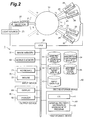
- Fig. 2 shows an internal property distribution measuring system (optical CT image measuring device) 1 for measuring a concentration distribution of an absorptive constituent distributed inside a medium 10 to be measured, which is a scattering medium.
- a medium 10 to be measured which is a scattering medium.
- the light source 23 can be one selected from various sources including light emitting diodes, laser diodes, He-Ne lasers, and so on.
- the light source 23 may be one of those generating pulsed rays, rectangular rays, or modulated rays thereof.
- the light source 23 used in the present embodiment may be one generating rays of a single wavelength or one capable of generating rays of two or more wavelengths.
- Each of the light detection fibers 25 is optically connected to a photodetector 26 and rays traveling through while being scattered in the measured medium 10 are guided through the light detection fibers 25 to the photodetectors 26.
- the photodetectors 26 convert their respective, received light signals into detection signals (electrical signals) and amplify the detection signals to output their respectively corresponding detection signals.
- the photodetectors 26 can be selected from all types of photodetectors including photomultiplier tubes, phototubes, photodiodes, avalanche photodiodes, PIN photodiodes, and so on.
- the point necessary for the selection of the photodetectors 26 is that the photodetectors have spectral sensitivity characteristics enough to detect light of the wavelength of the measurement light (measurement rays) used. When light signals are weak, it is preferable to use the photodetectors with high sensitivity or with high gain.
- a wavelength selecting filter may also be properly placed between each pair of photodetector 26 and light detection fiber 25 if the rays having diffused and propagated inside the measured medium 10 include rays of plural wavelengths.
- a CPU (control and processing unit) 30 is electrically connected to the light source 23 and to the photodetectors 26.
- the CPU 30 controls timing of light detection in synchronism with light injection, and other operations, and the detection signals outputted from the photodetectors 26 are guided to the CPU 30.
- the CPU 30 also controls the wavelengths of injected rays.
- Specific control techniques include a technique of injecting and using rays of the different wavelengths in time-shared manner, and a technique of using light simultaneously including the rays of the different wavelengths.
- Specific wavelength selecting means include a beam switch using a mirror, a wavelength switch using a filter, a light switch using an optical switch, and so on.
- the above light injection fiber 21, wavelength selector 22, light source 23, and CPU 30 constitute the light injection means according to the present invention
- the above light detection fibers 25, photodetectors 26, and CPU 30 constitute the light detection means according to the present invention.
- the internal property distribution measuring system 1 illustrated in Fig. 2 further has a first storage device 40 storing an operating system (OS) 41 and an internal property distribution measurement program 42 detailed hereinafter, a second memory device 50 storing various files, an image memory 61 for storing optical CT image data to indicate the internal property distribution obtained, a working memory 62 for temporarily saving working data, an input device 70 equipped with a keyboard 71 and a mouse 72 for entry of data, and an output device 80 equipped with a display 81 and a printer 82 for output of resultant data, which are also controlled by the CPU 30 electrically connected thereto.
- the above storage devices and memories may be an internal memory (hard disk) of a computer or a flexible disk.
- the second storage device 50 includes a basic path length distribution data file 51, a measurement data file 52, an input data file 53, an absorption coefficient data file 54, and an absorber concentration data file 55.
- the basic path length distribution data file 51 stores a basic path length distribution preliminarily prepared (which is a common path length distribution as a basis for the operation of various weight functions used in various measurements).
- This basic path length distribution can be computed by making use of the known techniques, for example, by using the Monte Carlo simulations and the photon diffusion equation, which are described, for example, in the following references: (17) J. Haselgrove, J. Leigh, C. Yee, N-G, Wang, M. Maris and B. Chance: Proc. SPIE, Vol. 1431, 30-41 (1991); (18) J. C. Schotland, J. C. Haselgrove and J. S. Leigh: Appl. Opt.
- Preset measurement conditions and known values are entered through the input device 70 and such input data is stored in the input data file 53.
- Such input data includes the arbitrarily preset number, shape, and size of voxels (volume elements), the shape of the measured medium, the light injection positions, the light detection positions, the scattering coefficient, the average absorption coefficient, the wavelength of rays used in measurement, the type of measurement (time-resolved integration measurement, time-resolved gate integration measurement, phase modulation measurement, etc.), an extinction ratio of an absorber as a measured object at a predetermined wavelength, and so on.
- the measurement data file 52 stores measurement values of the predetermined parameter obtained, based on the detection signals from the photodetectors 26, in an execution process of the internal property distribution measurement program 42, in correspondence to combinations of the light injection positions with light detection positions.
- the absorption coefficient data file 54 and the absorber concentration data file 55 store the absorption coefficient data and absorber concentration data obtained by execution of the internal property distribution measurement program 42.
- the above CPU 30, first storage device 40, and second storage device 50 constitute the measurement acquisition means, the reference value setting means, the estimate computation means, the weight function operation means, the absorption coefficient deviation computation means, the absorption coefficient absolute value computation means, and the concentration computation means according to the present invention, and the above output device 80 does the image display means.
- These various means according to the present invention will be detailed below, based on a flowchart of an embodiment of the method of the present invention illustrated in Fig. 3 and Fig. 4 (which is a flowchart to indicate processing of the internal property distribution measurement program 42 illustrated in Fig. 2).
- the combinations P n of the light injection-detection positions to the n sets of data are different from each other.
- the measurement values Y n of the predetermined parameter according to the present invention are preferably measurement values of a predetermined parameter related to scattering and absorption of the measurement rays inside the measured object, and, for example, suitably applicable measurement values are those of such parameters as the light quantity, phase difference (or phase lag), amplitude, time-resolved waveform, etc. of the detected rays.
- the CPU 30 can perform the time-resolved gate integration measurement if the integration operation of the light detection signals is carried out in a predetermined time range (t 1 ⁇ t 2 ) by making use of signals timed with generation of the rays from the light source 23.
- the CPU 30 may also be arranged to perform correction for the measurement values by making use of the averaging filtering, the least square fitting, or the like.
- the next step is to set a reference value ⁇ av of the absorption coefficient and a reference value ⁇ ' s of the transport scattering coefficient of the measured medium 10 (S104).
- an average absorption coefficient (approximate value) from a macroscopic aspect of the measured medium 10, i.e., that on the assumption that the measured medium 10 has the homogeneous absorption coefficient as a whole.
- an average transport scattering coefficient (approximate value) on the assumption that the measured medium 10 has the homogeneous scattering coefficient as a whole.
- Such absorption coefficient ⁇ av and transport scattering coefficient ⁇ ' s can be obtained from the light detection signals (or the measurement values Y n of the predetermined parameter) detected at the aforementioned plurality of light detection positions v k .
- the light detection signals are impulse responses (light detection signals against injection of pulsed light assumed to be sufficiently short relative to temporal waveforms of the light detection signals)
- the absorption coefficient ⁇ av and transport scattering coefficient ⁇ ' s of the interior of the medium corresponding to a predetermined light injection-detection position combination P n can be obtained by fitting the temporal waveforms to the photon diffusion equation.
- another average optical constant may also be obtained further from the macroscopic aspect of the measured medium 10, and examples of such an optical constant include the refractive index n e of the measured medium, the scattering coefficient ⁇ s , and the average cosine g of scattered angles.
- the refractive index n e of the measured medium can be normally approximated to that of water.
- the estimate of the predetermined parameter (of the light detection signal) in each light injection-detection position combination P n can be yielded, for example, by solving the photon diffusion equation with provision of the above average optical constants (the reference value ⁇ av of the absorption coefficient, the reference value ⁇ ' s of the transport scattering coefficient, etc.).
- the result with change of an optical constant from the result of Monte Carlo calculation with provision of any given optical constant (for example, absorption coefficient) (for example, as described in A. Kienle and M. S. Patterson: Phys. Med. Biol. 41, 2221-2227 (1996)).
- the mean path length Z i ( ⁇ av ) in each voxel i of the measured medium 10 divided into a plurality of voxels is acquired, based on the reference value ⁇ av of the absorption coefficient, on the assumption that the measured medium 10 has the homogeneous reference value ⁇ av of the absorption coefficient as a whole (S106).
- the basic path length distribution preliminarily determined by the Monte Carlo calculation or the like is read out of the basic path length distribution data file 51 and, based on the reference value ⁇ av of the absorption coefficient and the reference value ⁇ ' s of the transport scattering coefficient, the path length distribution of detected rays can be determined for the imaginary medium having these reference values.
- This is conversion of the basic path length distribution, which can be carried out using the method described in (24) A. Kienle and M. Patterson: Phys. Med. Biol. 41, 2221-2227 (1996), for example.
- the estimate Y avn of the predetermined parameter (of the light detection signal) in each light injection-detection position combination P n can also be computed based on the path length distribution Z i ( ⁇ av ) of detected rays for the imaginary medium, obtained herein.
- a flow of processing in this case is indicated by a chain line A in Fig. 3.
- the weight function W i in each voxel i is computed according to Eq. (4.6) in conformity with the Microscopic Beer-Lambert Law (S107), and then, based on the measurement values Y n and estimates Y avn of the predetermined parameter in the respective light injection-detection position combinations P n and the weight functions W i , the deviation ⁇ ai of the absorption coefficient from the reference value ⁇ av of the absorption coefficient in each voxel i is computed according to Eq. (4.5) (S108).
- the weight functions W i to be gained here are those indicated by Eq. (4.6) which is the following equation.
- W i Z i ( ⁇ av ) - ( ⁇ ai /2) ⁇ iv 2
- Fig. 4 is a flowchart to show a preferred embodiment of the processing for obtaining the weight functions W i and absorption coefficient deviations ⁇ ai by such iterative operations. The flowchart illustrated in Fig. 4 will be detailed below.
- the weight function W iK is determined according to Eq. (4.6), based on the mean path length Z i ( ⁇ av ) and absorption coefficient deviation ⁇ aiK in each voxel i (S202).
- ⁇ iv 2 in Eq. (4.6) represents the variance and is obtained, for example, by computation of Eq. (3.2.10) or Eq. (3.3.8).
- the deviation ⁇ ai(K+1) of the absorption coefficient in each voxel i is computed according to Eq. (4.5), based on the measurement values Y n and estimates Y avn of the predetermined parameter and the weight functions W iK (S203).
- a residual E is computed between the deviation ⁇ ai(K+1) of the absorption coefficient obtained in S203 and the absorption coefficient deviation ⁇ aiK used in S202 (S204), and it is determined whether the value thereof is not more than a predetermined value (err) (S205).
- the weight functions W iK at that time are outputted as the weight functions W i and the absorption coefficient deviations ⁇ ai(K+1) at that time as the absorption coefficient deviations ⁇ ai (S206).
- the absorption coefficient deviations ⁇ aiK used in S202 are replaced by the absorption coefficient deviations ⁇ ai(K+1) gained in aforementioned S203 (an increment of 1 is given to the order K: S207), and the operation of the weight functions W iK (S202), the operation of the absorption coefficient deviations ⁇ ai(K+1) (S203), and the operation of the aforementioned residual E (S204) are carried out again. It is then determined whether the residual E is not more than the predetermined value (err) (S205), and the above processing of S207 ⁇ S202 ⁇ S203 ⁇ S204 ⁇ S205 is repeated until the residual E becomes not more than the predetermined value.
- Each of the above steps may be performed as follows: S201 by an initial value setting means; S202 by a weight function operation means; S203 by an absorption coefficient deviation operation means; S204, S205, and S206 by an evaluation means; and S207 by an absorption coefficient deviation correction means.
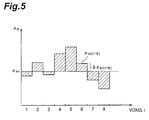
- Fig. 5 shows the relationship among the reference value ⁇ av , the deviations ⁇ ai , and the absolute values ⁇ ai of absorption coefficients.
- Deviations and absolute values of concentrations of two or more kinds of absorbers can also be measured using rays of two or more wavelengths in the above method of the first embodiment.
- the present embodiment illustrates a two-wavelength spectroscopic measurement method for measurement with two types of rays of the wavelengths ⁇ 1 and ⁇ 2 . Namely, if absorption coefficients (or extinction coefficients) ⁇ 1 and ⁇ 2 per unit concentration of each absorber corresponding to the rays of the wavelengths ⁇ 1 and ⁇ 2 are known, two equations hold as to aforementioned Eq. (C.2) and Eq. (C.3). With the simultaneous system of these equations, it is thus possible to measure the deviations and absolute values of concentrations of the two types of absorbers.
- the distribution of concentrations C i of each absorptive constituent can be obtained by using the measurement rays having at least two wavelengths at which the absorptive constituents demonstrate their respective absorption coefficients different from each other, gaining the measurement values Y n , estimates Y avn , reference value ⁇ av , and weight functions W i for each of the measurement rays having the respective wavelengths, and computing the absorption coefficient deviations ⁇ ai and absorption coefficient absolute values ⁇ ai for each of the measurement rays having the respective wavelengths, based thereon.
- absorptive constituents for example, oxygenated and deoxygenated hemoglobins
- the principal absorptive constituents in mammalian brain are water, cytochrome, and oxygenated and deoxygenated hemoglobins. Absorption of water and cytochrome in the near-infrared region is as little as almost negligible with respect to that of oxygenated and deoxygenated hemoglobins.
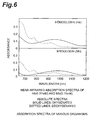
- the oxygenated and deoxygenated hemoglobins demonstrate different absorption spectra, as illustrated in Fig. 6. Further, the cranial bones can be considered to be scattering media against near-infrared rays.
- the molar concentration [Hb] of deoxygenated hemoglobin and the molar concentration [HbO] of oxygenated hemoglobin can be acquired from the known parameters ⁇ Hb,1 , ⁇ HbO,1 , ⁇ Hb,2 , ⁇ HbO,2 and the values ⁇ a1 and ⁇ a2 computed from the measurement values.
- rays of three or more wavelengths can be used for quantitation of concentrations of the three components whose absorption spectra are known.
- quantitation of concentrations of n components whose absorption spectra are known can be implemented in similar fashion to the above, from measurement values of absorption coefficients at n or (n + 1) wavelengths.
- the saturation degree Y can be computed readily from the known parameters ⁇ Hb,1 , ⁇ HbO,1 , ⁇ Hb,2 , ⁇ HbO,2 and the values ⁇ a1 and ⁇ a2 computed from measurement values, using the following equation.
- ⁇ a1 / ⁇ a2 [ ⁇ Hb,1 + Y ( ⁇ HbO,1 - ⁇ Hb,1 )] ⁇ [ ⁇ Hb,2 + Y ( ⁇ HbO,2 - ⁇ Hb,2 )]
- each of the concentrations can also be gained with high accuracy. It is also noted that the above equation will be simplified further by use of the wavelength (800 nm isosbestic wavelength) at which the oxygenated and deoxygenated hemoglobins demonstrate an equal absorption value.
- the present embodiment illustrates an example of application of the present invention to the phase modulation measurement.
- the measurement values Y n , estimates Y avn , reference value ⁇ av , and weight functions W i are obtained in the same manner as in the first embodiment except that the incident rays in the first embodiment are replaced by amplitude-modulated rays, the predetermined parameter by the amplitude A and phase lag ⁇ of detected rays, the path length distribution Z i ( ⁇ av ) of detected rays by a distribution of c (the speed of light in the medium) times group delay defined below: and ⁇ iv 2 by the variance, and the absorption coefficient deviations ⁇ ai and absolute values ⁇ ai of absorption coefficients are determined based thereon, thereby obtaining the distribution of concentrations C i of the absorptive constituent.
- the weight functions W i to be obtained were those represented by the following equation: and ⁇ f 2 indicates the variance of the distribution. Further, the basic path length distribution in the first embodiment is replaced by the c times group delay distribution.
- the reference value of absorption coefficient and the reference value of transport scattering coefficient were determined from the data acquired by the optical CT system itself in the above embodiments, but these reference values may also be acquired by another device.
- An advantage in this case is a simpler system configuration of the optical CT apparatus, because it permits the data acquired by the optical CT apparatus to be measured with CW (continuous rays) and also permits the pulsed rays or modulated rays to be used only in the device for acquiring the above reference values.
- Techniques for attaining the above reference values by another device may be the phase modulation method and the time-resolved spectroscopy.
- the apparatus was arranged to move the light injection position, but the apparatus may also be modified so as to move the light detection position in synchronism with the light injection position.
- the apparatus may also be modified in such structure that a plurality of light injection fibers and a plurality of light detection fibers are arranged around the measured medium and that the light injection position is moved by successively selecting the fibers used for injection of light.
- apparatus and methods of the present invention described above can also be applied to apparatus and methods for three-dimensionally measuring an absorptive constituent inside a three-dimensional medium, without having to be limited to the optical CT for obtaining ordinary tomographic images. It is also obvious that the apparatus and methods of the present invention can be applied to measurement of media having laminar structure of many layers, such as the head skin, cranial bones, gray matter, and white matter. In this case, the layers can be considered in correspondence to the respective voxels.
- the present invention allows the weight functions in the respective voxels to be gained directly based on the Microscopic Beer-Lambert Law in each of individual measurements by use of the new weight functions and thus allows the deviations of absorption coefficients to be computed based on the proper weight functions according to the measurement circumstances, thereby preventing the rise of errors due to employment of approximation. For that reason, the present invention enables the deviations of absorption coefficients in the voxels to be gained accurately even when applied to the scattering media of such inhomogeneous systems as organisms and also enables the highly accurate internal property distribution to be gained based on such absorption coefficient deviations and to be imaged as an optical CT image.
- the present invention enables the distribution of an absorber or absorbers in the interior of various scattering media having various contours permitting no reentry of light to be measured with high accuracy and quickly, and can also be applied, for example, to photo-mammography, optical CT of head, optical CT for the entire body, clinical monitors, diagnosis and analysis, and operations and cures.
Landscapes
- Physics & Mathematics (AREA)
- Optics & Photonics (AREA)
- Health & Medical Sciences (AREA)
- Life Sciences & Earth Sciences (AREA)
- Chemical & Material Sciences (AREA)
- Analytical Chemistry (AREA)
- Biochemistry (AREA)
- General Health & Medical Sciences (AREA)
- General Physics & Mathematics (AREA)
- Immunology (AREA)
- Pathology (AREA)
- Investigating Or Analysing Materials By Optical Means (AREA)
- Length Measuring Devices By Optical Means (AREA)
- Photometry And Measurement Of Optical Pulse Characteristics (AREA)
Applications Claiming Priority (3)
| Application Number | Priority Date | Filing Date | Title |
|---|---|---|---|
| JP14430098A JP3887486B2 (ja) | 1998-05-26 | 1998-05-26 | 散乱吸収体の内部特性分布の計測方法及び装置 |
| JP14430098 | 1998-05-26 | ||
| PCT/JP1999/002696 WO1999061893A1 (fr) | 1998-05-26 | 1999-05-24 | Procede et appareil permettant de mesurer la repartition de caracteristique d'un corps d'absorption/diffusion |
Publications (3)
| Publication Number | Publication Date |
|---|---|
| EP1081486A1 EP1081486A1 (en) | 2001-03-07 |
| EP1081486A4 EP1081486A4 (en) | 2002-07-31 |
| EP1081486B1 true EP1081486B1 (en) | 2005-11-16 |
Family
ID=15358876
Family Applications (1)
| Application Number | Title | Priority Date | Filing Date |
|---|---|---|---|
| EP99921231A Expired - Lifetime EP1081486B1 (en) | 1998-05-26 | 1999-05-24 | Method and device for measuring internal characteristic distribution of scattering/absorbing body |
Country Status (6)
| Country | Link |
|---|---|
| US (1) | US6335792B1 (https=) |
| EP (1) | EP1081486B1 (https=) |
| JP (1) | JP3887486B2 (https=) |
| AU (1) | AU3850999A (https=) |
| DE (1) | DE69928392T2 (https=) |
| WO (1) | WO1999061893A1 (https=) |
Families Citing this family (47)
| Publication number | Priority date | Publication date | Assignee | Title |
|---|---|---|---|---|
| JP3950243B2 (ja) * | 1998-11-05 | 2007-07-25 | 浜松ホトニクス株式会社 | 散乱吸収体の内部情報の計測方法及び装置 |
| AU4208600A (en) * | 1999-04-09 | 2000-11-14 | Sony Electronics Inc. | Method for switching signal input based on device capability |
| WO2000065330A1 (fr) * | 1999-04-21 | 2000-11-02 | Hamamatsu Photonics K.K. | Procede d'analyse optique de milieu non homogene |
| US6937884B1 (en) * | 1999-09-14 | 2005-08-30 | The Research Foundation Of State University Of New York | Method and system for imaging the dynamics of scattering medium |
| JP4364995B2 (ja) * | 2000-03-21 | 2009-11-18 | 浜松ホトニクス株式会社 | 散乱吸収体内部の光路分布計算方法 |
| GB2371358A (en) * | 2001-01-22 | 2002-07-24 | Optokem Ltd | Light scattering particle characterisation apparatus and detection means |
| JP3623743B2 (ja) * | 2001-02-26 | 2005-02-23 | 株式会社スペクトラテック | 生体情報測定装置 |
| AU2002330963A1 (en) * | 2001-08-02 | 2003-02-17 | The Research Foundation Of State University Of Ne W York | Method and system for enhancing solutions to a system of linear equations |
| US6963399B2 (en) | 2001-10-18 | 2005-11-08 | Cargill Robert L | Method and apparatus for quantifying an “integrated index” of a material medium |
| AU2002361113A1 (en) * | 2001-12-26 | 2003-07-15 | Hamamatsu Photonics K.K. | Optical analysis method for heterogeneous medium |
| JP2003202287A (ja) * | 2002-01-08 | 2003-07-18 | Hamamatsu Photonics Kk | 散乱吸収体測定方法及び装置 |
| JP4592245B2 (ja) * | 2002-03-25 | 2010-12-01 | 株式会社日立製作所 | 輻射計算方法及びそれを用いた熱吸収分布図作成方法 |
| US6890155B2 (en) | 2002-04-29 | 2005-05-10 | Thomas Cartwright | Fan blade |
| US6850314B2 (en) * | 2002-08-08 | 2005-02-01 | Board Of Reagents University Of Houston | Method for optical sensing |
| US6992762B2 (en) * | 2002-11-11 | 2006-01-31 | Art Advanced Research Technologies Inc. | Method and apparatus for time resolved optical imaging of biological tissues as part of animals |
| US7720525B2 (en) * | 2003-03-12 | 2010-05-18 | New Art Advanced Research Technologies Inc. | Method and apparatus for combining continuous wave and time domain optical imaging |
| DE102004047417B4 (de) * | 2003-09-29 | 2007-01-04 | Gebauer, Gerd, Dr. | Makromolekül- und Aerosoldiagnostik in gasförmiger und flüssiger Umgebung |
| US7920908B2 (en) * | 2003-10-16 | 2011-04-05 | David Hattery | Multispectral imaging for quantitative contrast of functional and structural features of layers inside optically dense media such as tissue |
| US7197404B2 (en) * | 2004-03-01 | 2007-03-27 | Richard Andrew Holland | Computation of radiating particle and wave distributions using a generalized discrete field constructed from representative ray sets |
| GB2429058B (en) * | 2004-03-06 | 2008-12-03 | Michael Trainer | Method and apparatus for determining the size and shape of particles |
| JP4517111B2 (ja) * | 2004-06-07 | 2010-08-04 | 独立行政法人情報通信研究機構 | 脳機能測定装置、脳機能測定方法及び脳機能測定プログラム |
| WO2008075252A1 (en) * | 2006-12-19 | 2008-06-26 | Koninklijke Philips Electronics N.V. | Imaging of a turbid medium |
| US20080218727A1 (en) * | 2006-12-22 | 2008-09-11 | Art, Advanced Research Technologies Inc. | Method and apparatus for optical image reconstruction using contour determination |
| US20080177163A1 (en) * | 2007-01-19 | 2008-07-24 | O2 Medtech, Inc. | Volumetric image formation from optical scans of biological tissue with multiple applications including deep brain oxygenation level monitoring |
| US8292809B2 (en) | 2008-03-31 | 2012-10-23 | Nellcor Puritan Bennett Llc | Detecting chemical components from spectroscopic observations |
| EP2355708B1 (en) * | 2008-10-20 | 2015-01-21 | Vanderbilt University | System and methods for accelerating simulations of radiation treatment |
| JP5283525B2 (ja) | 2009-01-30 | 2013-09-04 | 富士フイルム株式会社 | 光断層情報の生成方法、光断層情報生成装置及び光断層情報の生成プログラム |
| US8401608B2 (en) * | 2009-09-30 | 2013-03-19 | Covidien Lp | Method of analyzing photon density waves in a medical monitor |
| CN102883658B (zh) * | 2009-11-19 | 2016-06-22 | 调节成像公司 | 用于使用结构化照明经由单元件检测来分析浑浊介质的方法和设备 |
| US8391943B2 (en) | 2010-03-31 | 2013-03-05 | Covidien Lp | Multi-wavelength photon density wave system using an optical switch |
| WO2012050847A2 (en) | 2010-09-28 | 2012-04-19 | Masimo Corporation | Depth of consciousness monitor including oximeter |
| US9775545B2 (en) | 2010-09-28 | 2017-10-03 | Masimo Corporation | Magnetic electrical connector for patient monitors |
| JP2012237595A (ja) * | 2011-05-10 | 2012-12-06 | Sumitomo Electric Ind Ltd | 光トモグラフィ装置 |
| WO2013165888A2 (en) * | 2012-04-30 | 2013-11-07 | Mayo Foundation For Medical Education And Research | Spectrometric systems and methods for improved focus localization of time-and space-varying measurements |
| BR112015010459B1 (pt) | 2012-11-07 | 2021-01-26 | Modulated Imaging, Inc. | método para a medição de uma amostra turva |
| JP6154613B2 (ja) * | 2013-01-18 | 2017-06-28 | 浜松ホトニクス株式会社 | 断面画像計測装置及び計測方法 |
| RU2533538C1 (ru) * | 2013-08-19 | 2014-11-20 | Федеральное государственное бюджетное образовательное учреждение высшего профессионального образования "Тверской государственный университет" | Способ раздельного определения вероятностей поглощения и рассеяния фотонов на единицу пути в твердых оптических материалах |
| US9924778B2 (en) * | 2013-09-19 | 2018-03-27 | L'oreal | Systems and methods for measuring spectra of skin and other objects and materials and making predictions based thereon |
| US9750413B2 (en) * | 2013-10-03 | 2017-09-05 | National Technology & Engineering Solutions Of Sandia, Llc | Massively parallel diffuse optical tomography |
| USD763938S1 (en) | 2014-04-02 | 2016-08-16 | Cephalogics, LLC | Optical sensor array |
| USD763939S1 (en) | 2014-04-02 | 2016-08-16 | Cephalogics, LLC | Optical sensor array liner with optical sensor array pad |
| US10154815B2 (en) | 2014-10-07 | 2018-12-18 | Masimo Corporation | Modular physiological sensors |
| US10753862B2 (en) * | 2016-02-16 | 2020-08-25 | Stichting Het Nederlands Kanker Instituut-Antoni van Leeuwenhoek Ziekenhuis | Method, apparatus and software for detection and localization of hidden defects in optically diffuse media |
| DE102017111957B4 (de) * | 2017-05-31 | 2019-05-16 | Bundesrepublik Deutschland, Vertreten Durch Das Bundesministerium Für Wirtschaft Und Energie, Dieses Vertreten Durch Den Präsidenten Der Physikalisch-Technischen Bundesanstalt | Phantom zum Prüfen eines Messgerätes zur zeitaufgelösten diffusen optischen Spektroskopie, insbesondere eines Gewebe-Oximeters und Verfahren zum Prüfen eines Messgerätes zur zeitaufgelösten diffusen optischen Spektroskopie an Gewebe |
| CN108648246A (zh) * | 2018-05-04 | 2018-10-12 | 中国科学院高能物理研究所 | 基于透射成像的多层结构体图像处理方法及装置 |
| US11654635B2 (en) | 2019-04-18 | 2023-05-23 | The Research Foundation For Suny | Enhanced non-destructive testing in directed energy material processing |
| WO2022170168A1 (en) * | 2021-02-08 | 2022-08-11 | Trustees Of Tufts College | Method and apparatus for spectrophotometry of turbid media |
Family Cites Families (10)
| Publication number | Priority date | Publication date | Assignee | Title |
|---|---|---|---|---|
| JP3107914B2 (ja) * | 1992-07-20 | 2000-11-13 | 浜松ホトニクス株式会社 | 散乱吸収体内部の吸収情報計測装置及び方法 |
| JP3107927B2 (ja) * | 1992-10-06 | 2000-11-13 | 浜松ホトニクス株式会社 | 散乱吸収体の光学情報計測装置及び方法 |
| JP3433508B2 (ja) * | 1993-12-01 | 2003-08-04 | 浜松ホトニクス株式会社 | 散乱吸収体計測方法及び散乱吸収体計測装置 |
| JP3310782B2 (ja) * | 1994-07-14 | 2002-08-05 | 株式会社日立製作所 | 吸収物質濃度の空間分布画像化装置 |
| JP2780935B2 (ja) * | 1994-09-22 | 1998-07-30 | 浜松ホトニクス株式会社 | 散乱吸収体の吸収成分の濃度計測方法及び装置 |
| JP3433534B2 (ja) * | 1994-11-07 | 2003-08-04 | 浜松ホトニクス株式会社 | 散乱吸収体内の散乱特性・吸収特性の測定方法及び装置 |
| DE69633890T2 (de) * | 1995-08-08 | 2005-03-31 | Technology Research Association Of Medical And Welfare Apparatus | Vorrichtung zur Messung interner Information in streuenden Medien |
| JPH0961359A (ja) * | 1995-08-29 | 1997-03-07 | Hamamatsu Photonics Kk | 濃度測定装置 |
| JP3662376B2 (ja) * | 1996-05-10 | 2005-06-22 | 浜松ホトニクス株式会社 | 内部特性分布の計測方法および装置 |
| JP3844815B2 (ja) * | 1996-08-30 | 2006-11-15 | 浜松ホトニクス株式会社 | 散乱体の吸収情報計測方法及び装置 |
-
1998
- 1998-05-26 JP JP14430098A patent/JP3887486B2/ja not_active Expired - Fee Related
-
1999
- 1999-05-24 AU AU38509/99A patent/AU3850999A/en not_active Abandoned
- 1999-05-24 EP EP99921231A patent/EP1081486B1/en not_active Expired - Lifetime
- 1999-05-24 DE DE69928392T patent/DE69928392T2/de not_active Expired - Lifetime
- 1999-05-24 WO PCT/JP1999/002696 patent/WO1999061893A1/ja not_active Ceased
-
2000
- 2000-11-21 US US09/716,264 patent/US6335792B1/en not_active Expired - Lifetime
Also Published As
| Publication number | Publication date |
|---|---|
| DE69928392T2 (de) | 2006-08-03 |
| JPH11337476A (ja) | 1999-12-10 |
| WO1999061893A1 (fr) | 1999-12-02 |
| JP3887486B2 (ja) | 2007-02-28 |
| DE69928392D1 (de) | 2005-12-22 |
| EP1081486A4 (en) | 2002-07-31 |
| EP1081486A1 (en) | 2001-03-07 |
| AU3850999A (en) | 1999-12-13 |
| US6335792B1 (en) | 2002-01-01 |
Similar Documents
| Publication | Publication Date | Title |
|---|---|---|
| EP1081486B1 (en) | Method and device for measuring internal characteristic distribution of scattering/absorbing body | |
| EP0826958B1 (en) | Method and apparatus for obtaining information on the optical absorption of a scattering medium | |
| US6956650B2 (en) | System and method for enabling simultaneous calibration and imaging of a medium | |
| EP2888994B1 (en) | Speckle contrast optical tomography | |
| US6549284B1 (en) | Calibration methods and systems for diffuse optical tomography and spectroscopy | |
| Barnett et al. | Robust inference of baseline optical properties of the human head with three-dimensional segmentation from magnetic resonance imaging | |
| US7920252B2 (en) | Method and apparatus for spectrophotometric characterization of turbid materials | |
| EP1303832B1 (en) | Imaging of scattering media using relative detector values | |
| Naglič et al. | Estimation of optical properties by spatially resolved reflectance spectroscopy in the subdiffusive regime | |
| EP2730231A1 (en) | Biometric apparatus and image-generating method | |
| Ren | Recent developments in numerical techniques for transport-based medical imaging methods | |
| CN101501464A (zh) | 用于分析物的无创伤性确定的方法及设备 | |
| EP1136811B1 (en) | Method and device for measuring internal information of scattering absorber | |
| Hebden et al. | Assessment of an in situ temporal calibration method for time-resolved optical tomography | |
| US6975401B2 (en) | Method of calculating optical path distribution inside scattering absorber | |
| Maheswari et al. | Soft tissue optical property extraction for carcinoma cell detection in diffuse optical tomography system under boundary element condition | |
| Giacometti et al. | Diffuse optical tomography for brain imaging: continuous wave instrumentation and linear analysis methods | |
| Wang et al. | A sequential method for estimating the optical properties of two-layer agro-products from spatially-resolved diffuse reflectance: Simulation | |
| Hawrysz et al. | Measurement and model error assessment of a single-pixel frequency-domain photon migration apparatus and diffusion model for imaging applications | |
| Beck et al. | Estimation of the parameters of dye distributions by optical probing | |
| Chance et al. | Photon dynamics in tissue imaging | |
| Balaji et al. | A Multisensory Approach to Probing Scattering Media | |
| Barker | Estimation of cerebral physiology and hemodynamics via near-infrared spectroscopy | |
| Aggrawal | Studies and validation of solutions to the forward problem of fluorescence diffuse optical tomography | |
| Guevara et al. | Comparison of the performance of two depth-resolved optical imaging systems: laminar optical tomography and spatially modulated imaging |
Legal Events
| Date | Code | Title | Description |
|---|---|---|---|
| PUAI | Public reference made under article 153(3) epc to a published international application that has entered the european phase |
Free format text: ORIGINAL CODE: 0009012 |
|
| 17P | Request for examination filed |
Effective date: 20001221 |
|
| AK | Designated contracting states |
Kind code of ref document: A1 Designated state(s): DE FR GB |
|
| A4 | Supplementary search report drawn up and despatched |
Effective date: 20020613 |
|
| AK | Designated contracting states |
Kind code of ref document: A4 Designated state(s): DE FR GB |
|
| RIC1 | Information provided on ipc code assigned before grant |
Free format text: 7G 01N 21/17 A, 7G 01N 21/47 B, 7A 61B 5/00 B, 7G 06T 11/00 B, 7G 01N 23/04 B, 7G 01T 1/29 B |
|
| 17Q | First examination report despatched |
Effective date: 20040318 |
|
| GRAP | Despatch of communication of intention to grant a patent |
Free format text: ORIGINAL CODE: EPIDOSNIGR1 |
|
| GRAS | Grant fee paid |
Free format text: ORIGINAL CODE: EPIDOSNIGR3 |
|
| GRAA | (expected) grant |
Free format text: ORIGINAL CODE: 0009210 |
|
| AK | Designated contracting states |
Kind code of ref document: B1 Designated state(s): DE FR GB |
|
| REG | Reference to a national code |
Ref country code: GB Ref legal event code: FG4D |
|
| REF | Corresponds to: |
Ref document number: 69928392 Country of ref document: DE Date of ref document: 20051222 Kind code of ref document: P |
|
| ET | Fr: translation filed | ||
| PLBE | No opposition filed within time limit |
Free format text: ORIGINAL CODE: 0009261 |
|
| STAA | Information on the status of an ep patent application or granted ep patent |
Free format text: STATUS: NO OPPOSITION FILED WITHIN TIME LIMIT |
|
| 26N | No opposition filed |
Effective date: 20060817 |
|
| REG | Reference to a national code |
Ref country code: FR Ref legal event code: PLFP Year of fee payment: 18 |
|
| REG | Reference to a national code |
Ref country code: FR Ref legal event code: PLFP Year of fee payment: 19 |
|
| REG | Reference to a national code |
Ref country code: FR Ref legal event code: PLFP Year of fee payment: 20 |
|
| PGFP | Annual fee paid to national office [announced via postgrant information from national office to epo] |
Ref country code: GB Payment date: 20180329 Year of fee payment: 20 |
|
| PGFP | Annual fee paid to national office [announced via postgrant information from national office to epo] |
Ref country code: DE Payment date: 20180508 Year of fee payment: 20 |
|
| PGFP | Annual fee paid to national office [announced via postgrant information from national office to epo] |
Ref country code: FR Payment date: 20180412 Year of fee payment: 20 |
|
| REG | Reference to a national code |
Ref country code: DE Ref legal event code: R071 Ref document number: 69928392 Country of ref document: DE |
|
| REG | Reference to a national code |
Ref country code: GB Ref legal event code: PE20 Expiry date: 20190523 |
|
| PG25 | Lapsed in a contracting state [announced via postgrant information from national office to epo] |
Ref country code: GB Free format text: LAPSE BECAUSE OF EXPIRATION OF PROTECTION Effective date: 20190523 |