EP1069785A2 - Transmission de données et système de gestion des services pour les transports publics - Google Patents
Transmission de données et système de gestion des services pour les transports publics Download PDFInfo
- Publication number
- EP1069785A2 EP1069785A2 EP00113478A EP00113478A EP1069785A2 EP 1069785 A2 EP1069785 A2 EP 1069785A2 EP 00113478 A EP00113478 A EP 00113478A EP 00113478 A EP00113478 A EP 00113478A EP 1069785 A2 EP1069785 A2 EP 1069785A2
- Authority
- EP
- European Patent Office
- Prior art keywords
- network
- terminals
- radio
- management
- optionally
- Prior art date
- Legal status (The legal status is an assumption and is not a legal conclusion. Google has not performed a legal analysis and makes no representation as to the accuracy of the status listed.)
- Withdrawn
Links
- 230000005540 biological transmission Effects 0.000 title claims abstract description 21
- 230000032258 transport Effects 0.000 title claims abstract description 21
- 238000012545 processing Methods 0.000 claims abstract description 23
- 230000002093 peripheral effect Effects 0.000 claims abstract description 22
- 238000013480 data collection Methods 0.000 claims abstract description 12
- 230000015572 biosynthetic process Effects 0.000 claims abstract description 4
- 239000013307 optical fiber Substances 0.000 claims abstract description 3
- 238000004891 communication Methods 0.000 claims description 20
- 230000006870 function Effects 0.000 claims description 12
- 230000015654 memory Effects 0.000 claims description 9
- 230000004807 localization Effects 0.000 claims description 7
- 239000003550 marker Substances 0.000 claims description 7
- 238000012544 monitoring process Methods 0.000 claims description 6
- 238000012423 maintenance Methods 0.000 claims description 5
- 230000037361 pathway Effects 0.000 claims description 4
- 238000012800 visualization Methods 0.000 claims description 4
- 230000003287 optical effect Effects 0.000 claims description 3
- 239000000969 carrier Substances 0.000 claims description 2
- 238000012546 transfer Methods 0.000 claims description 2
- 230000011664 signaling Effects 0.000 claims 1
- 238000000034 method Methods 0.000 abstract description 9
- 230000008569 process Effects 0.000 abstract description 3
- 238000007726 management method Methods 0.000 description 28
- 238000010586 diagram Methods 0.000 description 5
- 230000010354 integration Effects 0.000 description 5
- 230000008901 benefit Effects 0.000 description 3
- 238000009434 installation Methods 0.000 description 3
- 230000029305 taxis Effects 0.000 description 3
- 230000008859 change Effects 0.000 description 2
- 230000001955 cumulated effect Effects 0.000 description 2
- 238000012795 verification Methods 0.000 description 2
- 230000004913 activation Effects 0.000 description 1
- 238000012790 confirmation Methods 0.000 description 1
- 230000000694 effects Effects 0.000 description 1
- 230000007613 environmental effect Effects 0.000 description 1
- 238000003780 insertion Methods 0.000 description 1
- 230000037431 insertion Effects 0.000 description 1
- 230000007257 malfunction Effects 0.000 description 1
- 230000007246 mechanism Effects 0.000 description 1
- 230000000644 propagated effect Effects 0.000 description 1
- 238000001228 spectrum Methods 0.000 description 1
- 230000001360 synchronised effect Effects 0.000 description 1
Images

Classifications
-
- H—ELECTRICITY
- H04—ELECTRIC COMMUNICATION TECHNIQUE
- H04Q—SELECTING
- H04Q3/00—Selecting arrangements
- H04Q3/0016—Arrangements providing connection between exchanges
- H04Q3/0062—Provisions for network management
-
- B—PERFORMING OPERATIONS; TRANSPORTING
- B61—RAILWAYS
- B61L—GUIDING RAILWAY TRAFFIC; ENSURING THE SAFETY OF RAILWAY TRAFFIC
- B61L27/00—Central railway traffic control systems; Trackside control; Communication systems specially adapted therefor
- B61L27/70—Details of trackside communication
-
- G—PHYSICS
- G08—SIGNALLING
- G08G—TRAFFIC CONTROL SYSTEMS
- G08G1/00—Traffic control systems for road vehicles
- G08G1/123—Traffic control systems for road vehicles indicating the position of vehicles, e.g. scheduled vehicles; Managing passenger vehicles circulating according to a fixed timetable, e.g. buses, trains, trams
- G08G1/127—Traffic control systems for road vehicles indicating the position of vehicles, e.g. scheduled vehicles; Managing passenger vehicles circulating according to a fixed timetable, e.g. buses, trains, trams to a central station ; Indicators in a central station
-
- H—ELECTRICITY
- H04—ELECTRIC COMMUNICATION TECHNIQUE
- H04L—TRANSMISSION OF DIGITAL INFORMATION, e.g. TELEGRAPHIC COMMUNICATION
- H04L67/00—Network arrangements or protocols for supporting network services or applications
- H04L67/01—Protocols
- H04L67/04—Protocols specially adapted for terminals or networks with limited capabilities; specially adapted for terminal portability
-
- H—ELECTRICITY
- H04—ELECTRIC COMMUNICATION TECHNIQUE
- H04L—TRANSMISSION OF DIGITAL INFORMATION, e.g. TELEGRAPHIC COMMUNICATION
- H04L67/00—Network arrangements or protocols for supporting network services or applications
- H04L67/01—Protocols
- H04L67/12—Protocols specially adapted for proprietary or special-purpose networking environments, e.g. medical networks, sensor networks, networks in vehicles or remote metering networks
-
- H—ELECTRICITY
- H04—ELECTRIC COMMUNICATION TECHNIQUE
- H04Q—SELECTING
- H04Q3/00—Selecting arrangements
- H04Q3/0016—Arrangements providing connection between exchanges
- H04Q3/0029—Provisions for intelligent networking
-
- B—PERFORMING OPERATIONS; TRANSPORTING
- B61—RAILWAYS
- B61L—GUIDING RAILWAY TRAFFIC; ENSURING THE SAFETY OF RAILWAY TRAFFIC
- B61L2205/00—Communication or navigation systems for railway traffic
- B61L2205/02—Global system for mobile communication - railways [GSM-R]
-
- B—PERFORMING OPERATIONS; TRANSPORTING
- B61—RAILWAYS
- B61L—GUIDING RAILWAY TRAFFIC; ENSURING THE SAFETY OF RAILWAY TRAFFIC
- B61L2205/00—Communication or navigation systems for railway traffic
- B61L2205/04—Satellite based navigation systems, e.g. global positioning system [GPS]
-
- H—ELECTRICITY
- H04—ELECTRIC COMMUNICATION TECHNIQUE
- H04W—WIRELESS COMMUNICATION NETWORKS
- H04W4/00—Services specially adapted for wireless communication networks; Facilities therefor
-
- H—ELECTRICITY
- H04—ELECTRIC COMMUNICATION TECHNIQUE
- H04W—WIRELESS COMMUNICATION NETWORKS
- H04W84/00—Network topologies
- H04W84/02—Hierarchically pre-organised networks, e.g. paging networks, cellular networks, WLAN [Wireless Local Area Network] or WLL [Wireless Local Loop]
- H04W84/04—Large scale networks; Deep hierarchical networks
- H04W84/042—Public Land Mobile systems, e.g. cellular systems
-
- H—ELECTRICITY
- H04—ELECTRIC COMMUNICATION TECHNIQUE
- H04W—WIRELESS COMMUNICATION NETWORKS
- H04W84/00—Network topologies
- H04W84/02—Hierarchically pre-organised networks, e.g. paging networks, cellular networks, WLAN [Wireless Local Area Network] or WLL [Wireless Local Loop]
- H04W84/04—Large scale networks; Deep hierarchical networks
- H04W84/06—Airborne or Satellite Networks
-
- H—ELECTRICITY
- H04—ELECTRIC COMMUNICATION TECHNIQUE
- H04W—WIRELESS COMMUNICATION NETWORKS
- H04W88/00—Devices specially adapted for wireless communication networks, e.g. terminals, base stations or access point devices
- H04W88/02—Terminal devices
- H04W88/04—Terminal devices adapted for relaying to or from another terminal or user
-
- H—ELECTRICITY
- H04—ELECTRIC COMMUNICATION TECHNIQUE
- H04W—WIRELESS COMMUNICATION NETWORKS
- H04W88/00—Devices specially adapted for wireless communication networks, e.g. terminals, base stations or access point devices
- H04W88/08—Access point devices
Definitions
- the present invention relates to a data transmission and service management system for public transports.
- the present invention relates to a data transmission and service management system suitable for buses, taxis, trains, ferryboats and like mobility associated services.
- the system of the present invention comprises ⁇ intelligent ⁇ peripheral stations and/or stakes (or generation, processing, management and/or remote re-loading and/or transmission and/or re-transmission of data) and possible intermediate connecting devices or repeaters that, together with the fixed peripheral stations and/or the stakes, form an ⁇ intelligent ⁇ radio network wherein each component acts as a point of access, formation and processing of the data and possible direct and/or indirect distribution of the same.
- the network can be connected through commonly used transport means (radio, PSTDN, ISDN, optical fibres, GSM, satellite link or UMTS and the like), with a data collection, control, processing and display center and/or fixed terminals and/or mobile terminals that can be localised also through the access points.
- transport means radio, PSTDN, ISDN, optical fibres, GSM, satellite link or UMTS and the like
- Said systems are connected with a central station through a radio link or other communication systems such as: telephone, PSTN, GSM, ETACS, or satellite link, and may be optionally provided with a direct connection between the central stations and the stops, to inform also users about the state of the service.
- a radio link or other communication systems such as: telephone, PSTN, GSM, ETACS, or satellite link
- the data or information is often managed and transmitted in centralised form.
- Object of the present invention is to eliminate the above drawbacks.
- the present invention solves the above drawbacks by means of a data transmission and management system of services associated to mobility in public transports, and public services in general, which utilises an "intelligence" (or capacity of generation, processing, management and/or remote re-loading and/or transmission and/or re-transmission of data) distributed across all the service network instead of being concentrated in one only central station.
- an "intelligence" or capacity of generation, processing, management and/or remote re-loading and/or transmission and/or re-transmission of data
- the subject matter of the present invention is, therefore, a data transmission and service management system for public transports comprising ⁇ intelligent ⁇ fixed peripheral stations and/or stakes and optional intermediate connecting devices or repeaters forming with the fixed peripheral stations and/or stakes an ⁇ intelligent ⁇ radio network, wherein each component acts as a point of access, formation and processing of the information and optional direct and/or indirect distribution of the same; said network (1) being connected through commonly used transport means with a data collection, control, processing and display center and/or with fixed and/or mobile terminals localised also through the access points
- Another advantage lies in that any access point can autonomously interact with any other point of the network.
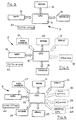
- the illustrated system has the main functions of generating, processing, management, transmission and/or re-transmission of data, called network (1).
- network (1) comprises a whole of devices or nodes (fixed peripheral stations and/or stakes (2), repeaters (3)), each of them being able to be connected temporarily by radio with adjoining devices.
- the passage of data from one to another point of the network (1) takes place by transferring the messages through several adjoining nodes (2, 3) that form possible logic pathways between the sender and the addressee.
- the connection between the two elements of the network (1) occurs only for the time necessary for the transit of the data, after which the radio channel is freed.
- the structure of the system is such as to allow the transfer of the messages arrived at or created by the transmitting or addressed nodes, not only along pre-defined pathways but also along alternative pathways to reach their destination.
- Several terminals may be hooked on to the network (1), subdivided into two classes:
- the access to the network (1) by the fixed terminals does not change and said fixed terminals may be reached by any other component of the system at any moment.
- the access node changes in the time; as a consequence, they can reach easily any other component of the network connected in a permanent manner, but they can receive messages from the network only through the node (2, 3) to which they are connected at that time, which is caused to be temporarily fixed. Such condition is signalled each time to the network.
- the access points to the network are fixed and have known co-ordinates, so that, once the verification of the proximity of a mobile terminal to a given access node to the network has been checked, it is possible to ascertain the exact position of said terminal and thus to localise it indirectly.
- Figure 4 illustrates the fixed station or stack (2); it comprises a radio (14) for the node-to-node communication and to allow the access to the terminals: one or more microprocessors (15); one or more memories (16) for the management of the communications and the re-addressing of the messages; optionally a display (17) with an optional printer for visualising and/or sending the information to users (7); optionally a keyboard (18) for receiving inputs from users requiring different visualisations on the display or for sending communications to other devices connected to the network (1); optionally a radio marker (10), and optionally sensors (20), which can be, for instance, temperature, pressure, humidity, proximity sensors and the like.
- a radio marker (10) for the node-to-node communication and to allow the access to the terminals: one or more microprocessors (15); one or more memories (16) for the management of the communications and the re-addressing of the messages; optionally a display (17) with an optional printer for visualising and/or sending the information to users (7); optionally a keyboard (18
- the power of each fixed station is supplied by high-capacity batteries, by batteries which can be re-charged through sun cells, or by connection to the electric network (40).
- an application level is provided which sees to the local management of the specific functionality of the system.
- the management of the public transport network for instance of the buses, it adjusts the theoretical timetable according to the real line space covered by the expected vehicles, manages the re-routing of the data along the line, manages the data or information to be visualised to users (7), manages the sending and the addressing of the communication requests generated by the users (7) through the keyboard (18), implements the additional application levels, such as for instance the messages for the traffic-lights or the information to users through tables or optical boards concerning road conditions, parking availability, coincidences with other public means, and so on.
- Figure 3 illustrates the repeater (3); it comprises a radio (10) for the communication from a node to the adjoining one and that of access to terminals; one or more microprocessors (11); one or more memories (12) for the management of communications and the re-addressing of messages; and optionally sensors (20), such as for instance temperature, pressure, humidity, proximity sensors and the like.
- the power of each repeater is supplied by high-capacity batteries, by batteries which can be re-charged through sun cells, or by connection to the electric network (40).
- connection means between different networks (gateways) (5) may be performed by various devices such as:
- a fixed structure of a sole network composed by various peripheral fixed stations and/or stacks (2) or repeaters (3), can be implemented with one or more virtual or logic networks.
- lines 1 and 2 are conceptually associated to different virtual networks.
- a network for the management of another service for instance that of taxi or other means, may be utilised on the same structure.
- the gateway function is performed by the common structures between different virtual networks, for instance, simple repeaters.
- this group comprises the accesses that are permanently connected with a node (2, 3) of the network (1).
- the connection may be of the serial (also USB) or parallel type, directed towards the internal memory of one of the two connected devices, or of the type with Hardware coding of messages (keyboard).
- a data collection, control, processing and display center (6) consisting of one or more computers, optionally connected in LAN provided with a special Software, is connected to the network by wiring harness.
- This center (6) performs the function of system control and manages both network maintenance and service monitoring. Beside the management of the network architecture, it is possible to monitor the service progress, or to send messages to the various terminals or nodes (2, 3) of the network (1).
- the presence of at least an operator is necessary for the control of the center (6), even though some data, such as for instance the state of service, is automatically updated with the information coming from the network.
- the access point of users (7) usually comprises a keyboard and a display, optionally with a printer, located near the fixed stations and/or stakes (2). Through the keyboard, the user can browse through all the messages available for the visualisation on the display and possibly print them, or send requests to the network (1) through suitable function buttons, such as for instance service upon request and the like.
- the mobile accesses comprises those terminals that are not permanently connected to the network, adopting instead a temporary radio connection.
- These devices can shift within the network (1) and connect each time to a different node (2, 3) or they can stop, causing the connection to the network to be temporarily fixed, becoming the equivalent of a fixed terminal.
- the mobile terminals include:
- the main carrier utilised for the connection within the network can be, by way of non-limiting example, a low-power radio, operating in the field of frequencies comprised between 2400 and 2483,5 MHz of the ⁇ Spread Spectrum ⁇ type, in order to be able to utilise devices complying with the ETS 300-328 standards in force, or operating at different frequencies, according to the standards in force in the various countries where the system of the present invention will be used.
- a low-power radio operating in the field of frequencies comprised between 2400 and 2483,5 MHz of the ⁇ Spread Spectrum ⁇ type, in order to be able to utilise devices complying with the ETS 300-328 standards in force, or operating at different frequencies, according to the standards in force in the various countries where the system of the present invention will be used.
- radios having different characteristics, adequate for the new provisions, may be adopted.
- the following may be utilised: 433 MHz (ETS 300-220) or 868 MHz AM or FM radios, or other frequencies used in the countries where the system will be adopted.
- Satellite transceivers, terminals for the connection to GSM network, dedicated or commuted telephone lines can be, instead, utilised in gateway (5) devices.
- a whole set of services can be implemented on this network, such as, for instance and in particular, the system of data transmission and survey of the state of service, applied to public transports, such as buses, taxis, trains, ferryboats and the like.
- public transports such as buses, taxis, trains, ferryboats and the like.
- the management of public transport means (4) is one of the applications that may be supported by the radio network of the system of the invention.
Landscapes
- Engineering & Computer Science (AREA)
- Computer Networks & Wireless Communication (AREA)
- Signal Processing (AREA)
- General Physics & Mathematics (AREA)
- Remote Sensing (AREA)
- Physics & Mathematics (AREA)
- Radar, Positioning & Navigation (AREA)
- Mechanical Engineering (AREA)
- Health & Medical Sciences (AREA)
- Computing Systems (AREA)
- General Health & Medical Sciences (AREA)
- Medical Informatics (AREA)
- Mobile Radio Communication Systems (AREA)
- Radio Relay Systems (AREA)
- Data Exchanges In Wide-Area Networks (AREA)
Applications Claiming Priority (2)
| Application Number | Priority Date | Filing Date | Title |
|---|---|---|---|
| ITCO990021 | 1999-07-15 | ||
| IT1999CO000021A ITCO990021A1 (it) | 1999-07-15 | 1999-07-15 | Sistema di trasmissione informazioni e gestione servizi relativi allamobilita' nel trasporto pubblico. |
Publications (2)
| Publication Number | Publication Date |
|---|---|
| EP1069785A2 true EP1069785A2 (fr) | 2001-01-17 |
| EP1069785A3 EP1069785A3 (fr) | 2001-09-19 |
Family
ID=11348062
Family Applications (1)
| Application Number | Title | Priority Date | Filing Date |
|---|---|---|---|
| EP00113478A Withdrawn EP1069785A3 (fr) | 1999-07-15 | 2000-06-26 | Transmission de données et système de gestion des services pour les transports publics |
Country Status (2)
| Country | Link |
|---|---|
| EP (1) | EP1069785A3 (fr) |
| IT (1) | ITCO990021A1 (fr) |
Family Cites Families (3)
| Publication number | Priority date | Publication date | Assignee | Title |
|---|---|---|---|---|
| US5771459A (en) * | 1994-06-21 | 1998-06-23 | U.S. Philips Corporation | Communication system for use with stationary and second entities, via a wireless intermediate network with gateway devices, a gateway device for use with such system, and a mobile entity provided with such gateway device |
| FI105746B (fi) * | 1995-09-29 | 2000-09-29 | Nokia Mobile Phones Ltd | Integroitu radioviestintäjärjestelmä |
| FI973327A7 (fi) * | 1997-08-14 | 1999-02-15 | Nokia Telecommunications Oy | Tietoliikennelaitteiden keskitetty hallinta |
-
1999
- 1999-07-15 IT IT1999CO000021A patent/ITCO990021A1/it unknown
-
2000
- 2000-06-26 EP EP00113478A patent/EP1069785A3/fr not_active Withdrawn
Also Published As
| Publication number | Publication date |
|---|---|
| EP1069785A3 (fr) | 2001-09-19 |
| ITCO990021A1 (it) | 2001-01-15 |
Similar Documents
| Publication | Publication Date | Title |
|---|---|---|
| US20130344802A1 (en) | System and method for multi-tier automatic transit system updating | |
| US7253729B2 (en) | Wireless vending communication systems | |
| GB2378560A (en) | Planning and optimising a passenger journey in a mass transit system | |
| ATE393433T1 (de) | Verfahren und vorrichtung für die aktivitäts- basierte zusammenarbeit eines rechnersystems, ausgestattet mit einem kommunikations-manager | |
| US20080194274A1 (en) | Location information management system, location information management server, and location information management method | |
| CN103971538A (zh) | 基于车载通信的智能泊车管理系统 | |
| EP1321722B1 (fr) | Réseau de communication et procédé de communication des données par ce même réseau | |
| JP2004227262A (ja) | 即応型車両乗降システム、方法およびプログラム | |
| JP2004078639A (ja) | タクシー呼び出しシステム | |
| JP4120953B2 (ja) | 自動車の駐車場総合サービスを行う方法、及び装置 | |
| JP2001222796A (ja) | 交通機関の乗り換えデマンドシステム | |
| CN1529527A (zh) | 智能公交系统 | |
| CN110022582A (zh) | 一种车载监测信息综合传输平台及方法 | |
| JP2002002486A (ja) | 列車運行管理システム | |
| KR20020045793A (ko) | 차량 운행정보 안내 장치 | |
| CN115257869A (zh) | 车载设备的整合方法和系统 | |
| KR102070397B1 (ko) | 철도 시스템의 패킷 기반 통신 네트워크 작동 방법 | |
| JP2003272085A (ja) | 路線バスの運行方法および運行システム | |
| CN101166649A (zh) | 车辆通信系统 | |
| JP3529357B2 (ja) | 最適車両配車方法および最適車両配車システム | |
| KR100374932B1 (ko) | 통신망을 이용한 전동차 내의 정보 표시 시스템 | |
| KR101749573B1 (ko) | 지능형 버스간에 이루어지는 전광판 데이터의 양방향 전송방법 및 시스템 | |
| KR20060030349A (ko) | 아이티에스 단말기를 이용한 이동 차량의 원격 서비스방법 및 시스템 | |
| JP3529348B2 (ja) | 車両内情報提供システム | |
| US20190228655A1 (en) | Method for providing information to information representation units |
Legal Events
| Date | Code | Title | Description |
|---|---|---|---|
| PUAI | Public reference made under article 153(3) epc to a published international application that has entered the european phase |
Free format text: ORIGINAL CODE: 0009012 |
|
| AK | Designated contracting states |
Kind code of ref document: A2 Designated state(s): AT BE CH CY DE DK ES FI FR GB GR IE IT LI LU MC NL PT SE |
|
| AX | Request for extension of the european patent |
Free format text: AL;LT;LV;MK;RO;SI |
|
| PUAL | Search report despatched |
Free format text: ORIGINAL CODE: 0009013 |
|
| AK | Designated contracting states |
Kind code of ref document: A3 Designated state(s): AT BE CH CY DE DK ES FI FR GB GR IE IT LI LU MC NL PT SE |
|
| AX | Request for extension of the european patent |
Free format text: AL;LT;LV;MK;RO;SI |
|
| 17P | Request for examination filed |
Effective date: 20020124 |
|
| AKX | Designation fees paid |
Free format text: AT BE CH CY DE DK ES FI FR GB GR IE IT LI LU MC NL PT SE |
|
| STAA | Information on the status of an ep patent application or granted ep patent |
Free format text: STATUS: THE APPLICATION IS DEEMED TO BE WITHDRAWN |
|
| 18D | Application deemed to be withdrawn |
Effective date: 20050103 |