EP1068166B1 - Verfahren und vorrichtung zur herstellung von p-xylen - Google Patents
Verfahren und vorrichtung zur herstellung von p-xylen Download PDFInfo
- Publication number
- EP1068166B1 EP1068166B1 EP97954271A EP97954271A EP1068166B1 EP 1068166 B1 EP1068166 B1 EP 1068166B1 EP 97954271 A EP97954271 A EP 97954271A EP 97954271 A EP97954271 A EP 97954271A EP 1068166 B1 EP1068166 B1 EP 1068166B1
- Authority
- EP
- European Patent Office
- Prior art keywords
- xylene
- process according
- isomerization
- para
- selective adsorption
- Prior art date
- Legal status (The legal status is an assumption and is not a legal conclusion. Google has not performed a legal analysis and makes no representation as to the accuracy of the status listed.)
- Expired - Lifetime
Links
- URLKBWYHVLBVBO-UHFFFAOYSA-N Para-Xylene Chemical group CC1=CC=C(C)C=C1 URLKBWYHVLBVBO-UHFFFAOYSA-N 0.000 title claims abstract description 76
- 238000000034 method Methods 0.000 title claims description 32
- 238000004519 manufacturing process Methods 0.000 title claims description 7
- 238000011084 recovery Methods 0.000 title claims description 6
- 238000004821 distillation Methods 0.000 claims abstract description 38
- 239000000463 material Substances 0.000 claims abstract description 31
- 238000006317 isomerization reaction Methods 0.000 claims abstract description 27
- 238000001179 sorption measurement Methods 0.000 claims abstract description 25
- 150000001336 alkenes Chemical class 0.000 claims abstract description 24
- 239000003054 catalyst Substances 0.000 claims description 43
- UFHFLCQGNIYNRP-UHFFFAOYSA-N Hydrogen Chemical compound [H][H] UFHFLCQGNIYNRP-UHFFFAOYSA-N 0.000 claims description 28
- 229910052739 hydrogen Inorganic materials 0.000 claims description 28
- 239000001257 hydrogen Substances 0.000 claims description 28
- 230000003197 catalytic effect Effects 0.000 claims description 19
- CTQNGGLPUBDAKN-UHFFFAOYSA-N O-Xylene Chemical group CC1=CC=CC=C1C CTQNGGLPUBDAKN-UHFFFAOYSA-N 0.000 claims description 18
- 125000003118 aryl group Chemical group 0.000 claims description 18
- IVSZLXZYQVIEFR-UHFFFAOYSA-N m-xylene Chemical group CC1=CC=CC(C)=C1 IVSZLXZYQVIEFR-UHFFFAOYSA-N 0.000 claims description 14
- 238000006243 chemical reaction Methods 0.000 claims description 13
- YNQLUTRBYVCPMQ-UHFFFAOYSA-N Ethylbenzene Chemical compound CCC1=CC=CC=C1 YNQLUTRBYVCPMQ-UHFFFAOYSA-N 0.000 claims description 12
- 239000010457 zeolite Substances 0.000 claims description 11
- 229910052751 metal Inorganic materials 0.000 claims description 10
- 239000002184 metal Substances 0.000 claims description 10
- 230000002378 acidificating effect Effects 0.000 claims description 9
- HNPSIPDUKPIQMN-UHFFFAOYSA-N dioxosilane;oxo(oxoalumanyloxy)alumane Chemical compound O=[Si]=O.O=[Al]O[Al]=O HNPSIPDUKPIQMN-UHFFFAOYSA-N 0.000 claims description 8
- PNEYBMLMFCGWSK-UHFFFAOYSA-N aluminium oxide Inorganic materials [O-2].[O-2].[O-2].[Al+3].[Al+3] PNEYBMLMFCGWSK-UHFFFAOYSA-N 0.000 claims description 7
- 239000008096 xylene Substances 0.000 claims description 7
- 229910021536 Zeolite Inorganic materials 0.000 claims description 6
- 238000009835 boiling Methods 0.000 claims description 4
- 229940078552 o-xylene Drugs 0.000 claims description 4
- 239000003463 adsorbent Substances 0.000 claims description 3
- 238000005984 hydrogenation reaction Methods 0.000 abstract description 30
- 150000002430 hydrocarbons Chemical class 0.000 abstract description 8
- 229930195733 hydrocarbon Natural products 0.000 abstract description 7
- 239000004215 Carbon black (E152) Substances 0.000 abstract description 6
- JRZJOMJEPLMPRA-UHFFFAOYSA-N olefin Natural products CCCCCCCC=C JRZJOMJEPLMPRA-UHFFFAOYSA-N 0.000 abstract description 3
- 238000000926 separation method Methods 0.000 description 12
- YXFVVABEGXRONW-UHFFFAOYSA-N Toluene Chemical compound CC1=CC=CC=C1 YXFVVABEGXRONW-UHFFFAOYSA-N 0.000 description 9
- KDLHZDBZIXYQEI-UHFFFAOYSA-N Palladium Chemical compound [Pd] KDLHZDBZIXYQEI-UHFFFAOYSA-N 0.000 description 7
- 239000002808 molecular sieve Substances 0.000 description 6
- URGAHOPLAPQHLN-UHFFFAOYSA-N sodium aluminosilicate Chemical compound [Na+].[Al+3].[O-][Si]([O-])=O.[O-][Si]([O-])=O URGAHOPLAPQHLN-UHFFFAOYSA-N 0.000 description 6
- 150000001993 dienes Chemical class 0.000 description 5
- PXHVJJICTQNCMI-UHFFFAOYSA-N Nickel Chemical compound [Ni] PXHVJJICTQNCMI-UHFFFAOYSA-N 0.000 description 4
- VYPSYNLAJGMNEJ-UHFFFAOYSA-N Silicium dioxide Chemical compound O=[Si]=O VYPSYNLAJGMNEJ-UHFFFAOYSA-N 0.000 description 4
- 150000001875 compounds Chemical class 0.000 description 4
- 239000012535 impurity Substances 0.000 description 4
- 239000007791 liquid phase Substances 0.000 description 4
- 150000002739 metals Chemical class 0.000 description 4
- 238000012856 packing Methods 0.000 description 4
- 229910001220 stainless steel Inorganic materials 0.000 description 4
- UHOVQNZJYSORNB-UHFFFAOYSA-N Benzene Chemical compound C1=CC=CC=C1 UHOVQNZJYSORNB-UHFFFAOYSA-N 0.000 description 3
- 239000000203 mixture Substances 0.000 description 3
- 229910052763 palladium Inorganic materials 0.000 description 3
- ZLMJMSJWJFRBEC-UHFFFAOYSA-N Potassium Chemical compound [K] ZLMJMSJWJFRBEC-UHFFFAOYSA-N 0.000 description 2
- KKEYFWRCBNTPAC-UHFFFAOYSA-N Terephthalic acid Chemical compound OC(=O)C1=CC=C(C(O)=O)C=C1 KKEYFWRCBNTPAC-UHFFFAOYSA-N 0.000 description 2
- 229910000323 aluminium silicate Inorganic materials 0.000 description 2
- 229910052788 barium Inorganic materials 0.000 description 2
- DSAJWYNOEDNPEQ-UHFFFAOYSA-N barium atom Chemical compound [Ba] DSAJWYNOEDNPEQ-UHFFFAOYSA-N 0.000 description 2
- GDTBXPJZTBHREO-UHFFFAOYSA-N bromine Chemical compound BrBr GDTBXPJZTBHREO-UHFFFAOYSA-N 0.000 description 2
- 150000001768 cations Chemical class 0.000 description 2
- 239000004927 clay Substances 0.000 description 2
- 239000012141 concentrate Substances 0.000 description 2
- RWGFKTVRMDUZSP-UHFFFAOYSA-N cumene Chemical compound CC(C)C1=CC=CC=C1 RWGFKTVRMDUZSP-UHFFFAOYSA-N 0.000 description 2
- 238000003795 desorption Methods 0.000 description 2
- 238000004508 fractional distillation Methods 0.000 description 2
- 229910052759 nickel Inorganic materials 0.000 description 2
- 229910000510 noble metal Inorganic materials 0.000 description 2
- 239000003208 petroleum Substances 0.000 description 2
- BASFCYQUMIYNBI-UHFFFAOYSA-N platinum Chemical compound [Pt] BASFCYQUMIYNBI-UHFFFAOYSA-N 0.000 description 2
- 229910052700 potassium Inorganic materials 0.000 description 2
- 239000011591 potassium Substances 0.000 description 2
- 239000000047 product Substances 0.000 description 2
- 238000000197 pyrolysis Methods 0.000 description 2
- 229920006395 saturated elastomer Polymers 0.000 description 2
- 239000000377 silicon dioxide Substances 0.000 description 2
- 239000000126 substance Substances 0.000 description 2
- ZGEGCLOFRBLKSE-UHFFFAOYSA-N 1-Heptene Chemical class CCCCCC=C ZGEGCLOFRBLKSE-UHFFFAOYSA-N 0.000 description 1
- CZTQZXZIADLWOZ-UHFFFAOYSA-O 8-oxo-3-(pyridin-1-ium-1-ylmethyl)-7-[(2-thiophen-2-ylacetyl)amino]-5-thia-1-azabicyclo[4.2.0]oct-2-ene-2-carboxylic acid Chemical compound C1SC2C(NC(=O)CC=3SC=CC=3)C(=O)N2C(C(=O)O)=C1C[N+]1=CC=CC=C1 CZTQZXZIADLWOZ-UHFFFAOYSA-O 0.000 description 1
- OYPRJOBELJOOCE-UHFFFAOYSA-N Calcium Chemical compound [Ca] OYPRJOBELJOOCE-UHFFFAOYSA-N 0.000 description 1
- RYGMFSIKBFXOCR-UHFFFAOYSA-N Copper Chemical compound [Cu] RYGMFSIKBFXOCR-UHFFFAOYSA-N 0.000 description 1
- RWSOTUBLDIXVET-UHFFFAOYSA-N Dihydrogen sulfide Chemical class S RWSOTUBLDIXVET-UHFFFAOYSA-N 0.000 description 1
- WHXSMMKQMYFTQS-UHFFFAOYSA-N Lithium Chemical compound [Li] WHXSMMKQMYFTQS-UHFFFAOYSA-N 0.000 description 1
- FYYHWMGAXLPEAU-UHFFFAOYSA-N Magnesium Chemical compound [Mg] FYYHWMGAXLPEAU-UHFFFAOYSA-N 0.000 description 1
- PWHULOQIROXLJO-UHFFFAOYSA-N Manganese Chemical compound [Mn] PWHULOQIROXLJO-UHFFFAOYSA-N 0.000 description 1
- ZOKXTWBITQBERF-UHFFFAOYSA-N Molybdenum Chemical compound [Mo] ZOKXTWBITQBERF-UHFFFAOYSA-N 0.000 description 1
- BQCADISMDOOEFD-UHFFFAOYSA-N Silver Chemical compound [Ag] BQCADISMDOOEFD-UHFFFAOYSA-N 0.000 description 1
- 239000002253 acid Substances 0.000 description 1
- 230000004913 activation Effects 0.000 description 1
- 230000000274 adsorptive effect Effects 0.000 description 1
- 230000002411 adverse Effects 0.000 description 1
- 150000001335 aliphatic alkanes Chemical class 0.000 description 1
- 150000001338 aliphatic hydrocarbons Chemical class 0.000 description 1
- IXWIAFSBWGYQOE-UHFFFAOYSA-M aluminum;magnesium;oxygen(2-);silicon(4+);hydroxide;tetrahydrate Chemical compound O.O.O.O.[OH-].[O-2].[O-2].[O-2].[O-2].[O-2].[O-2].[O-2].[O-2].[O-2].[O-2].[Mg+2].[Al+3].[Si+4].[Si+4].[Si+4].[Si+4] IXWIAFSBWGYQOE-UHFFFAOYSA-M 0.000 description 1
- 239000011324 bead Substances 0.000 description 1
- SVPXDRXYRYOSEX-UHFFFAOYSA-N bentoquatam Chemical class O.O=[Si]=O.O=[Al]O[Al]=O SVPXDRXYRYOSEX-UHFFFAOYSA-N 0.000 description 1
- 229910052790 beryllium Inorganic materials 0.000 description 1
- ATBAMAFKBVZNFJ-UHFFFAOYSA-N beryllium atom Chemical compound [Be] ATBAMAFKBVZNFJ-UHFFFAOYSA-N 0.000 description 1
- 229910052794 bromium Inorganic materials 0.000 description 1
- KAKZBPTYRLMSJV-UHFFFAOYSA-N butadiene group Chemical group C=CC=C KAKZBPTYRLMSJV-UHFFFAOYSA-N 0.000 description 1
- 239000006227 byproduct Substances 0.000 description 1
- 229910052793 cadmium Inorganic materials 0.000 description 1
- BDOSMKKIYDKNTQ-UHFFFAOYSA-N cadmium atom Chemical compound [Cd] BDOSMKKIYDKNTQ-UHFFFAOYSA-N 0.000 description 1
- 229910052791 calcium Inorganic materials 0.000 description 1
- 239000011575 calcium Substances 0.000 description 1
- CREMABGTGYGIQB-UHFFFAOYSA-N carbon carbon Chemical compound C.C CREMABGTGYGIQB-UHFFFAOYSA-N 0.000 description 1
- 239000011203 carbon fibre reinforced carbon Substances 0.000 description 1
- 125000002091 cationic group Chemical group 0.000 description 1
- 239000003638 chemical reducing agent Substances 0.000 description 1
- 229910017052 cobalt Inorganic materials 0.000 description 1
- 239000010941 cobalt Substances 0.000 description 1
- GUTLYIVDDKVIGB-UHFFFAOYSA-N cobalt atom Chemical compound [Co] GUTLYIVDDKVIGB-UHFFFAOYSA-N 0.000 description 1
- 239000002131 composite material Substances 0.000 description 1
- 229910052802 copper Inorganic materials 0.000 description 1
- 239000010949 copper Substances 0.000 description 1
- 238000006356 dehydrogenation reaction Methods 0.000 description 1
- 238000010586 diagram Methods 0.000 description 1
- 239000000539 dimer Substances 0.000 description 1
- 230000000694 effects Effects 0.000 description 1
- 238000006266 etherification reaction Methods 0.000 description 1
- 239000004744 fabric Substances 0.000 description 1
- 239000011152 fibreglass Substances 0.000 description 1
- 238000004231 fluid catalytic cracking Methods 0.000 description 1
- 238000001640 fractional crystallisation Methods 0.000 description 1
- 238000005194 fractionation Methods 0.000 description 1
- 239000012634 fragment Substances 0.000 description 1
- 229910052736 halogen Inorganic materials 0.000 description 1
- 150000002367 halogens Chemical class 0.000 description 1
- 125000004836 hexamethylene group Chemical class [H]C([H])([*:2])C([H])([H])C([H])([H])C([H])([H])C([H])([H])C([H])([H])[*:1] 0.000 description 1
- 238000005342 ion exchange Methods 0.000 description 1
- 230000001788 irregular Effects 0.000 description 1
- 239000007788 liquid Substances 0.000 description 1
- 229910052744 lithium Inorganic materials 0.000 description 1
- 229910052749 magnesium Inorganic materials 0.000 description 1
- 239000011777 magnesium Substances 0.000 description 1
- 229910052748 manganese Inorganic materials 0.000 description 1
- 239000011572 manganese Substances 0.000 description 1
- 229910052750 molybdenum Inorganic materials 0.000 description 1
- 239000011733 molybdenum Substances 0.000 description 1
- HBEQXAKJSGXAIQ-UHFFFAOYSA-N oxopalladium Chemical compound [Pd]=O HBEQXAKJSGXAIQ-UHFFFAOYSA-N 0.000 description 1
- 150000002938 p-xylenes Chemical class 0.000 description 1
- 229910003445 palladium oxide Inorganic materials 0.000 description 1
- 239000002245 particle Substances 0.000 description 1
- 229910052697 platinum Inorganic materials 0.000 description 1
- 239000000843 powder Substances 0.000 description 1
- QQONPFPTGQHPMA-UHFFFAOYSA-N propylene Natural products CC=C QQONPFPTGQHPMA-UHFFFAOYSA-N 0.000 description 1
- 125000004805 propylene group Chemical group [H]C([H])([H])C([H])([*:1])C([H])([H])[*:2] 0.000 description 1
- 239000000376 reactant Substances 0.000 description 1
- 238000010992 reflux Methods 0.000 description 1
- 238000002407 reforming Methods 0.000 description 1
- 229910052702 rhenium Inorganic materials 0.000 description 1
- WUAPFZMCVAUBPE-UHFFFAOYSA-N rhenium atom Chemical compound [Re] WUAPFZMCVAUBPE-UHFFFAOYSA-N 0.000 description 1
- 229910052709 silver Inorganic materials 0.000 description 1
- 239000004332 silver Substances 0.000 description 1
- 238000004513 sizing Methods 0.000 description 1
- 239000002904 solvent Substances 0.000 description 1
- 238000000638 solvent extraction Methods 0.000 description 1
- 238000004230 steam cracking Methods 0.000 description 1
- 229910052712 strontium Inorganic materials 0.000 description 1
- CIOAGBVUUVVLOB-UHFFFAOYSA-N strontium atom Chemical compound [Sr] CIOAGBVUUVVLOB-UHFFFAOYSA-N 0.000 description 1
- 238000003786 synthesis reaction Methods 0.000 description 1
- 239000012209 synthetic fiber Substances 0.000 description 1
- 229920002994 synthetic fiber Polymers 0.000 description 1
- 229920003002 synthetic resin Polymers 0.000 description 1
- 239000000057 synthetic resin Substances 0.000 description 1
- 125000000383 tetramethylene group Chemical group [H]C([H])([*:1])C([H])([H])C([H])([H])C([H])([H])[*:2] 0.000 description 1
- WFKWXMTUELFFGS-UHFFFAOYSA-N tungsten Chemical compound [W] WFKWXMTUELFFGS-UHFFFAOYSA-N 0.000 description 1
- 229910052721 tungsten Inorganic materials 0.000 description 1
- 239000010937 tungsten Substances 0.000 description 1
- 239000012808 vapor phase Substances 0.000 description 1
- 239000011782 vitamin Substances 0.000 description 1
- 229940088594 vitamin Drugs 0.000 description 1
- 229930003231 vitamin Natural products 0.000 description 1
- 235000013343 vitamin Nutrition 0.000 description 1
Images
Classifications
-
- C—CHEMISTRY; METALLURGY
- C07—ORGANIC CHEMISTRY
- C07C—ACYCLIC OR CARBOCYCLIC COMPOUNDS
- C07C15/00—Cyclic hydrocarbons containing only six-membered aromatic rings as cyclic parts
- C07C15/02—Monocyclic hydrocarbons
- C07C15/067—C8H10 hydrocarbons
- C07C15/08—Xylenes
-
- C—CHEMISTRY; METALLURGY
- C07—ORGANIC CHEMISTRY
- C07C—ACYCLIC OR CARBOCYCLIC COMPOUNDS
- C07C5/00—Preparation of hydrocarbons from hydrocarbons containing the same number of carbon atoms
- C07C5/22—Preparation of hydrocarbons from hydrocarbons containing the same number of carbon atoms by isomerisation
-
- B—PERFORMING OPERATIONS; TRANSPORTING
- B01—PHYSICAL OR CHEMICAL PROCESSES OR APPARATUS IN GENERAL
- B01D—SEPARATION
- B01D3/00—Distillation or related exchange processes in which liquids are contacted with gaseous media, e.g. stripping
- B01D3/009—Distillation or related exchange processes in which liquids are contacted with gaseous media, e.g. stripping in combination with chemical reactions
-
- C—CHEMISTRY; METALLURGY
- C07—ORGANIC CHEMISTRY
- C07C—ACYCLIC OR CARBOCYCLIC COMPOUNDS
- C07C7/00—Purification; Separation; Use of additives
- C07C7/005—Processes comprising at least two steps in series
-
- C—CHEMISTRY; METALLURGY
- C07—ORGANIC CHEMISTRY
- C07C—ACYCLIC OR CARBOCYCLIC COMPOUNDS
- C07C2521/00—Catalysts comprising the elements, oxides or hydroxides of magnesium, boron, aluminium, carbon, silicon, titanium, zirconium or hafnium
- C07C2521/02—Boron or aluminium; Oxides or hydroxides thereof
- C07C2521/04—Alumina
-
- C—CHEMISTRY; METALLURGY
- C07—ORGANIC CHEMISTRY
- C07C—ACYCLIC OR CARBOCYCLIC COMPOUNDS
- C07C2523/00—Catalysts comprising metals or metal oxides or hydroxides, not provided for in group C07C2521/00
- C07C2523/38—Catalysts comprising metals or metal oxides or hydroxides, not provided for in group C07C2521/00 of noble metals
- C07C2523/40—Catalysts comprising metals or metal oxides or hydroxides, not provided for in group C07C2521/00 of noble metals of the platinum group metals
-
- C—CHEMISTRY; METALLURGY
- C07—ORGANIC CHEMISTRY
- C07C—ACYCLIC OR CARBOCYCLIC COMPOUNDS
- C07C2523/00—Catalysts comprising metals or metal oxides or hydroxides, not provided for in group C07C2521/00
- C07C2523/70—Catalysts comprising metals or metal oxides or hydroxides, not provided for in group C07C2521/00 of the iron group metals or copper
- C07C2523/74—Iron group metals
-
- C—CHEMISTRY; METALLURGY
- C07—ORGANIC CHEMISTRY
- C07C—ACYCLIC OR CARBOCYCLIC COMPOUNDS
- C07C2529/00—Catalysts comprising molecular sieves
- C07C2529/04—Catalysts comprising molecular sieves having base-exchange properties, e.g. crystalline zeolites, pillared clays
- C07C2529/06—Crystalline aluminosilicate zeolites; Isomorphous compounds thereof
- C07C2529/064—Crystalline aluminosilicate zeolites; Isomorphous compounds thereof containing iron group metals, noble metals or copper
-
- Y—GENERAL TAGGING OF NEW TECHNOLOGICAL DEVELOPMENTS; GENERAL TAGGING OF CROSS-SECTIONAL TECHNOLOGIES SPANNING OVER SEVERAL SECTIONS OF THE IPC; TECHNICAL SUBJECTS COVERED BY FORMER USPC CROSS-REFERENCE ART COLLECTIONS [XRACs] AND DIGESTS
- Y02—TECHNOLOGIES OR APPLICATIONS FOR MITIGATION OR ADAPTATION AGAINST CLIMATE CHANGE
- Y02P—CLIMATE CHANGE MITIGATION TECHNOLOGIES IN THE PRODUCTION OR PROCESSING OF GOODS
- Y02P20/00—Technologies relating to chemical industry
- Y02P20/10—Process efficiency
-
- Y—GENERAL TAGGING OF NEW TECHNOLOGICAL DEVELOPMENTS; GENERAL TAGGING OF CROSS-SECTIONAL TECHNOLOGIES SPANNING OVER SEVERAL SECTIONS OF THE IPC; TECHNICAL SUBJECTS COVERED BY FORMER USPC CROSS-REFERENCE ART COLLECTIONS [XRACs] AND DIGESTS
- Y10—TECHNICAL SUBJECTS COVERED BY FORMER USPC
- Y10S—TECHNICAL SUBJECTS COVERED BY FORMER USPC CROSS-REFERENCE ART COLLECTIONS [XRACs] AND DIGESTS
- Y10S203/00—Distillation: processes, separatory
- Y10S203/06—Reactor-distillation
Definitions
- the present invention relates to the recovery of p-xylene from mixed aromatic streams. More particularly the invention relates to a process wherein p-xylene is recovered from a mixed aromatic stream by selective hydrogenation to remove olefins followed by selective adsorption of the p-xylene.
- Para-xylene is an important chemical because of its usage in the production of terephthalic acid which in turn has many uses in the production of synthetic resins and fibers, vitamins and other pharmaceutical syntheses.
- Para-xylene is generally contained in a mixed aromatic stream which has been separated from petroleum naphthas, primarily reformates or pyrolysis distillates, by solvent extraction. Regardless of the method by which the p-xylene is produced, the product effluent is a mixture of ortho-xylene (o-xylene), meta-xylene (m-xylene), p-xylene and ethylbenzene. Generally the proportions approximate 50.0% m-xylene, 20.0% p-xylene, 20.0% o-xylene and 10.0% ethylbenzene.
- the ethylbenzene may be separated by fractional distillation, although this may be costly.
- the p-xylene has been separated by fractional crystallization but the most common method now is by selective adsorption in a molecular sieve as more particularly described below.
- Such a process and earlier background is disclosed in U.S. Pat. No. 3,895,080. Further disclosure of adsorbent separation of p-xylene is contained in U.S. Pat. No. 3,943,184.
- U.S. Pat. No. 5,431,888 discloses a multi-purpose distillation column reactor wherein a hydrogenation catalyst for hydrotreating an isoolefin containing light naphtha from a fluid catalytic cracking unit to remove diolefins and mercaptans is stacked below an etherification catalyst.
- U.S. Pat No. 5,087,780 to Arganbright disclosed a process for the hydroisomerization of butenes using an alumina supported palladium oxide catalyst arranged in a structure for use as both the catalyst and distillation in a catalytic distillation reactor. The hydrogenation of dienes was also observed.
- PCT application WO 95/15934 discloses a process for the selective hydrogenation of the diolefins and acetylenic compounds in olefin rich aliphatic hydrocarbon streams is disclosed wherein the selective hydrogenation is carried out at 40 to 300 °F under low hydrogen partial pressure in the range of about 0.1 psi to less than 70 psia at 0 to 350 psig in a distillation column reactor containing a hydrogenation catalyst which serves as a component of a distillation structure, such as supported PdO encased in tubular wire mesh.
- Olefinic hydrocarbon impurities are commonly found in the aromatic containing hydrocarbon process streams such as those originating from reforming or steam cracking of naphthas.
- olefins can also be formed as byproducts in a number of petrochemical processes, including the aforementioned isomerization. Removal of these olefins is important when the stream is to be separated by molecular sieves because the olefins will occupy sieve capacity and thereby adversely affect separation performance.
- One current practice for removing olefins involves the use of the clay treating process using selective adsorption wherein the hydrocarbon stream is contacted with a clay such as, activated bentonite, Attapulgus clay, fuller's earth, Superfiltrol, Floridin, and the like. These clays are composed primarily of amorphous and crystalline mixtures of silica and alumina, but are readily distinguishable from the structure and crystallinity of the crystalline aluminosilicate zeolites.
- the C 8 aromatics have been isomerized to produce p-xylene using zeolites as in the Octafining process.
- the Octafining process and improvements thereon are discussed at length in U.S. Pat. No. 3,856,872.
- U.S. Pat. No. 4,118,429 discloses a combined process for the production and recovery of p-xylene.
- the mixed aromatic stream is fed to a hydrotreater (if olefins are present) or straight to a distillation column to remove both the C 7 and lighter and C 9 and heavier material.
- the C 8 's are then fed to a mole sieve separation unit.
- the p-xylene depleted effluent from the separation unit is fed to an isomerization reactor wherein an equilibrium xylene mixture is produced.
- the effluent from the isomerization unit is then fed to the hydrotreater (along with the feed if it contains olefins) to remove the olefins.
- the effluent from the hydrotreater is then combined with the fresh feed to the mole sieve separation unit.
- Overall the reference presents a complicated integrated process.
- the present invention is a process for recovering high purity p-xylene from mixed aromatic streams containing olefinic impurities comprising combining fractionation, hydrotreating in a single distillation column reactor wherein the C 9 's and heavies are removed as bottoms and the hydrotreated C 8 aromatics are removed as overheads for feed to a molecular sieve separation unit where the p-xylene is selectively adsorbed.
- the p-xylene depleted raffinate from the molecular sieve separation unit may be fed back into an isomerization reactor
- the adsorptive separation may be selected from any in the art but typically will utilize a type X and/or Y sieve to selectively adsorb the p-xylenes.
- the sieve is then contacted with a desorbent, such as toluene to displace the selectively adsorbed p-xylene.
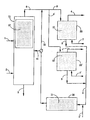
- the figure is a flow diagram in schematic form of a preferred embodiment of the invention using catalytic distillation hydrogenation and fixed bed straight pass isomerization.
- the aromatic streams useful in the present invention may derive from any source. Generally the proportions are 50.0% m-xylene, 20.0% p-xylene, 20.0% o-xylene and 10.0% ethylbenzene.
- the olefinic impurities are usually present in amounts of less than 10,000 wppm, e.g. 5,000 to 7,000 wppm.
- the olefinic impurities are materials that boil in the range of aromatic fraction being processed for p-xylene recovery. These are for the most part hydrocarbons, and may include mono and poly unsaturations, such as butadienes, hexenes, heptenes, octenes, nonenes and the like.
- the separation of p-xylene from mixed C 8 aromatic streams may be achieved by the selective adsorption utilizing either type X or type Y crystalline aluminosilicate zeolites as is well known in the art.
- These molecular sieve zeolites contain exchangeable cationic sites which, by way of ion-exchange, will be prepared to contain one or more metal cations from the group lithium, potassium, beryllium, magnesium, calcium, strontium, barium, nickel, copper, silver, manganese and cadmium.
- the cations of the metals from the Groups I-A and II-A have been preferred; a type X or type Y zeolite containing both potassium and barium is especially preferred.
- Liquid phase requires somewhat lower temperature levels which enhance the selectivity of the zeolite with respect to p-xylene.
- Typical adsorption-separation conditions include temperatures in the range of from about 38° to 205°C (100°F to about 400°F) and pressures in the range of from atmospheric to about 3450 kPa above atmospheric (500 psig).
- Suitable desorbents constitute those readily separated from the C 8 aromatic components, i.e., those having a different boiling range such that fractional distillation is feasible.
- the adsorptions generally remove from 95 to 98 wt.% of the p-xylene, thus the stream returned to the isomerization reactor is predominately o- and m-xylene.
- the olefins were essentially completely saturated to alkanes from the feed to the adsorption unit, the isomerization may produce some olefins which are subsequently removed in the hydrogenation zone along with the olefins in the make-up feed.
- the isomerization of the raffinate may be achieved with any number of currently available catalysts.
- the catalysts used are also zeolites, but having a Group VIII noble metal component.
- the support may be an acidic alumina.
- Conditions for the isomerization include temperatures in the range of 343-538°C (650-1000°F) and pressures of about 690 kPa (100 psig). Hydrogen is necessary to insure that the catalyst is active and is usually added in the range of about a 6.0:1 mole ratio of hydrogen to hydrocarbon.
- the isomerization can be carried out in a standard downflow fixed bed straight pass reactor.
- the isomerization may be carried out in a standard downflow reactor the hydrogenation is carried out in a distillation column reactor.
- the preferred catalyst is a "non-acidic" catalyst composite comprising a Group VIII noble metal component.
- the term “non-acidic” is used to connote that no intentional steps have been taken to provide an acid function such as the inclusion of silica or a halogen component.
- Typical catalysts contain from about 0.1 to 1.5 % of the metal.
- the conditions within the hydrogenation zone are preferably between about 240 and 690 kPa above atmospheric (35 and 100 psig) and between about 38 and 205°C (100°F to 400°F) with an equivalent liquid hourly space velocity (volume of feed per volume of catalyst per hour) of between 2.5 and 10.
- the distillation column reactor is advantageously operated to separate the C 9 + heavier material from the feed stream before feeding to the selective adsorption separation unit.
- Hydrogen is added to keep the hydrogen to olefin mole ratio in the 1-10:1 range. Under these conditions the hydrogen partial pressure is less than 517 kPa (75 psia), more preferably less than 345 kPa (50 psia) and generally in the range of 35 to 0.7 kPa (5 to 0.1 psia).
- the catalytic material is a component of a distillation system functioning as both a catalyst and distillation packing, i.e., a packing for a distillation column having both a distillation function and a catalytic function.
- reaction system can be described as heterogenous since the catalyst remains a distinct entity.
- a preferred catalyst structure for the present hydrogenation or isomerization reactions comprises flexible, semi-rigid open mesh tubular material, such as stainless steel wire mesh, filled with a particulate catalytic material in one of several embodiments recently developed in conjunction with the present process.
- the new catalyst structure is a catalytic distillation structure comprising flexible, semi-rigid open mesh tubular material, such as stainless steel wire mesh, filled with a particulate catalytic material said tubular material having two ends and having a length in the range of from about one-half to twice the diameter of said tubular material, a first end being sealed together along a first axis to form a first seam and a second end being sealed together along a second axis to form a second seam wherein the plane of the first seam along the axis of said tubular material and the plane of the second seam along the axis of said tubular material bisect each other at an angle of about 15 to 90°.
- a catalytic distillation structure comprising flexible, semi-rigid open mesh tubular material, such as stainless steel wire mesh, filled with a particulate catalytic material said tubular material having two ends and having a length in the range of from about one-half to twice the diameter of said tubular material, a first end being sealed together along a first
- U.S. Pat. No. 4,242,530 and U.S. Pat. No. 4,443,559 disclose supported catalyst in a plurality of pockets in a cloth belt or wire mesh tubular structures, which is supported in the distillation column reactor by open mesh knitted stainless steel wire by twisting the two together into a helix.
- U.S. Pat. No. 5,348,710 describes several other suitable structures in the prior art and discloses new structures suitable for this process.
- Other catalytic distillation structures useful for this purpose are disclosed in U.S. Pat. Nos. 4,731,229 and 5,073,236.
- the particulate catalyst material may be a powder, small irregular chunks or fragments, small beads and the like.
- the particular form of the catalytic material in the structure is not critical, so long as sufficient surface area is provided to allow a reasonable reaction rate.
- the sizing of catalyst particles can be best determined for each catalytic material (since the porosity or available internal surface area will vary for different material and of course affect the activity of the catalytic material).
- the preferred catalyst structures for the packing are those employing the more open structure of permeable plates or screen wire.
- Hydrogenation is the reaction of hydrogen with a carbon-carbon multiple bond to "saturate" the compound. This reaction has long been known and is usually done at super atmospheric pressures and moderate temperatures using a large excess of hydrogen over a metal catalyst.
- metals known to catalyze the hydrogenation reaction are platinum, rhenium, cobalt, molybdenum, nickel, tungsten and palladium.
- commercial forms of catalyst use supported oxides of these metals. The oxide is reduced to the active form either prior to use with a reducing agent or during use by the hydrogen in the feed.
- These metals also catalyze other reactions, most notably dehydrogenation at elevated temperatures. Additionally they can promote the reaction of olefinic compounds with themselves or other olefins to produce dimers or oligomers as residence time is increased.
- the preferred hydrogenation catalyst is an alumina supported palladium catalyst having a palladium content of about 0.5 wt%.
- the hydrogenation catalyst is generally supplied in the form of small spheres or extrudates of from 0.8 to 6.35 mm (1/32 to 1/4 inches in diameter).
- a preferred catalyst structure for the present hydrogenation reaction comprises flexible, semi-rigid open mesh tubular material, such as stainless steel wire mesh, filed with a particulate catalytic material in one of several embodiments recently developed in conjunction with the present process. Most particularly the structure described in U.S. Patent 5,431,890 is preferred for the hydrogenation catalyst structure.
- a bale shaped catalytic distillation structure formed by placing multiple link or continuous tube shaped structures on top of a wire mesh screen, such as demister wire, arrayed at an angle to the longitudinal axis of the bale, such that when the wire mesh screen is rolled up, the rolled structure provides a new and improved catalytic distillation structure.
- the tube comprises flexible, semi-rigid open mesh tubular element filled with a particulate catalytic material, the tube shaped structure having a fastener every 25 to 305 mm (1-12 inches) in length to form a multiple link.
- the hydrogen stream at an effectuating hydrogen partial pressure of at least about 0.7 kPa (0.1 psia) to less than 48 kPa (70 psia) preferably less than 345 kPa (50 psia) is conveniently fed to the reaction distillation column along with the other reactants.
- no more hydrogen than necessary to hydrogenate the highly unsaturated compounds (olefins and/or dienes) is employed, since the excess hydrogen is usually vented.
- This preferably is a hydrogen partial pressure in the range of about 0.7 to 69 kPa (0.1 to 10 psia) and even more preferably no more than 48 kPa (7 psia). Optimal results have been obtained in the range between 3.45 to 34.5 kPa (0.5 and 5 psig) hydrogen partial pressure.
- the hydrogen rates to the distillation column reactor are preferably maintained at between 5 and 40 SCFH.
- the hydrotreating zone 12 contains the non-acidic hydrotreating catalyst in the form of a catalytic distillation structure.
- the mixed aromatic feed is introduced via flow line 1 and some enters the hydrotreating zone 12.
- Hydrogen is fed below the hydrotreating zone 12 via flow line 2.
- the C 9 and heavier material is taken as bottoms via flow line 3.
- the feed is boiled up into the hydrotreating zone where substantially all of the olefins contained in the feed or produced in the isomerization reactor 11 are saturated.
- the catalysts in the hydrogenation zone is prepared as distillation structures.
- All of the C 8 and lighter products are taken as overheads 6 from which the hydrogen and any C 7 lighter may be separated (not shown) with the hydrogen recycled to the reactor.
- the now hydrotreated mixed aromatic stream is then fed via flow line 8 or 8' to the selective adsorption units 20 or 20' where it is contacted with a molecular sieve 13 or 13' and the p-xylene depleted raffinate is removed via flow line 5 or 5', from whence it may be recovered or recycled back to the isomerization reactor for further p-xylene production.
- the adsorption section comprises two adsorption units 20 and 20' are employed in parallel so that one unit may be in the desorption mode while the other is in the adsorption mode.
- the desorption solvent e.g. toluene
- the off-line reactor via line 7 or 7' to desorb the p-xylene, which is recovered via line 4 or 4'.
- the isomerization reactor is operated as a separate conventional fixed bed straight pass unit 30.
- the catalyst may be in a continuous bed, tubes or even in the distillation packing, which provide a good flow structure, which is easy to handle and load into a continuous bed reactor.
- the isomerate from unit 30 may be passed back to the column 10 via line 14 or to the adsorption section via line 15.
- a xylene concentrate feed, contaminated with olefins was treated in a catalytic distillation column containing 450 grams of an alumina supported Pd hydrogenation catalyst deposited in pockets on a fiber glass wrapped into a bale with demister wire and disposed along a 6 meter 2.54 cm (20 foot 1") column.
- the xylene concentrate was feed to the mid point of the column at 0.9 kg (2 pounds) per hour.
- Hydrogen was fed to the bottom of the column at 0.5 to 1 SCFH over the run.
Landscapes
- Chemical & Material Sciences (AREA)
- Organic Chemistry (AREA)
- Engineering & Computer Science (AREA)
- Analytical Chemistry (AREA)
- Oil, Petroleum & Natural Gas (AREA)
- Water Supply & Treatment (AREA)
- Chemical Kinetics & Catalysis (AREA)
- Organic Low-Molecular-Weight Compounds And Preparation Thereof (AREA)
- Vaporization, Distillation, Condensation, Sublimation, And Cold Traps (AREA)
Claims (13)
- Verfahren für die Herstellung und Gewinnung von p-Xylol umfassend die Schritte:(a) Zuführen von Wasserstoff und einem gemischten Aromatenstrom, der p-, m- und o-Xylole und Olefine enthält, zu einem Destillationssäulenreaktor, der über eine Reaktionsdestillationszone verfügt, die einen nichtsauren Katalysator für die Hydrobehandlung in Form einer katalytischen Destillationsstruktur enthält;(b) gleichzeitig in der ersten Reaktionsdestillationszone(i) den gemischten Aromatenstrom mit dem Wasserstoff in Gegenwart des nichtsauren Katalysators zur Hydrobehandlung kontaktieren, um selektiv im Wesentlichen alle darin enthaltenen Olefine zu hydrieren, und(ii) Abtrennen von C8- und niedriger siedendem Material von dem C9- und schwereren Material;(c) Zuführen des C8- und leichteren Materials zu einer selektiven Adsorptionseinheit, worin das p-Xylol von dem Rest des C8- und leichteren Material abgetrennt wird.
- Verfahren nach Anspruch 1, umfassend:(d) Zuführen eines an p-Xylol abgereicherten Materials aus der selektiven Adsorptionseinheit zu einer Isomerisierungseinheit, worin zusätzliches p-Xylol erzeugt wird; und(e) Zuführen des Abganges von der Isomerisierungseinheit zu der selektiven Adsorptionseinheit.
- Verfahren nach Anspruch 2, bei welchem ein Teil des Abganges von der Isomerisierung dem Destillationssäulenreaktor zugeführt wird, bevor er der selektiven Adsorptionseinheit zugeführt wird.
- Verfahren nach Anspruch 1, bei welchem der nichtsaure Katalysator zur Hydrobehandlung ein Metall der Gruppe VIII auf einem Träger auf Aluminiumoxid-Basis aufweist.
- Verfahren nach Anspruch 1, bei welchem die selektive Adsorptionseinheit ein Adsorptionsmittel enthält, das ausgewählt ist aus der Gruppe von strukturiertem Zeolith vom Typ X und Typ Y.
- Verfahren nach Anspruch 2, bei welchem der Isomerisierungseinheit Wasserstoff zugeführt wird.
- Verfahren nach Anspruch 2, bei welchem der nichtsaure Katalysator zur Hydrobehandlung ein Metall der Gruppe VIII auf einem Träger auf Aluminiumoxid-Basis aufweist.
- Verfahren nach Anspruch 7, bei welchem der Katalysator zur Isomerisierung, der ein Metall der Gruppe VIII aufweist, Zeolith enthält.
- Verfahren nach Anspruch 8, bei welchem die selektive Adsorptionseinheit ein Adsorptionsmittel enthält, das ausgewählt ist aus der Gruppe von strukturiertem Zeolith vom Typ X und Typ Y.
- Verfahren nach Anspruch 1, bei welchem der Aromatenstrom enthält: 50,0% m-Xylol, 20,0% p-Xylol, 20,0% o-Xylol und 10,0% Ethylbenzol.
- Verfahren nach Anspruch 1, bei welchem der Aromatenstrom weniger als 1,0 wppm Olefine enthält.
- Verfahren nach Anspruch 2, bei welchem die Isomerisierungseinheit eine Festbetteinheit mit direktem Durchlauf aufweist.
- Apparat für die Herstellung und Gewinnung von p-Xylol, aufweisend:(a) Destillationsreaktionssäule;(b) Rohrleitung zur Zuführung von Wasserstoff zu der Säule;(c) Rohrleitung zur Zuführung eines gemischten Aromatenstroms, der C8und leichter siedendes Material sowie C9- und schwerer siedendes Material enthält, das p-, m- und o-Xylole aufweist, sowie von Olefinen zu der Destillationsreaktionssäule;(d) eine Reaktionsdestillationszone in der Säule, die einen nichtsauren Katalysator zur Hydrobehandlung in Form einer katalytischen Destillationsstruktur enthält;(e) Rohrleitung zur Zuführung eines C8- und leichteren Materials von der Reaktionsdestillationssäule zu der selektiven Adsorptionseinheit;(f) eine selektive Adsorptionseinheit zur Abtrennung von p-Xylol von dem Rest des C8- und leichteren Materials;(g) Rohrleitung zur Zuführung eines an p-Xylol abgereicherten Stroms aus der selektiven Adsorptionseinheit zu einem Festbett-Isomerisierungsreaktor; und(h) ein Festbett-Isomerisierungsreaktor, der einen aromatischen Kata-lysator zur Isomerisierung enthält.
Applications Claiming Priority (3)
| Application Number | Priority Date | Filing Date | Title |
|---|---|---|---|
| US780254 | 1997-01-08 | ||
| US08/780,254 US5763714A (en) | 1997-01-08 | 1997-01-08 | Process and apparatus for the production and recovery of p-xylene |
| PCT/US1997/024050 WO1998030523A1 (en) | 1997-01-08 | 1997-12-29 | Process and apparatus for the production and recovery of p-xylene |
Publications (3)
| Publication Number | Publication Date |
|---|---|
| EP1068166A1 EP1068166A1 (de) | 2001-01-17 |
| EP1068166A4 EP1068166A4 (de) | 2001-11-07 |
| EP1068166B1 true EP1068166B1 (de) | 2004-03-10 |
Family
ID=25119063
Family Applications (1)
| Application Number | Title | Priority Date | Filing Date |
|---|---|---|---|
| EP97954271A Expired - Lifetime EP1068166B1 (de) | 1997-01-08 | 1997-12-29 | Verfahren und vorrichtung zur herstellung von p-xylen |
Country Status (9)
| Country | Link |
|---|---|
| US (1) | US5763714A (de) |
| EP (1) | EP1068166B1 (de) |
| JP (1) | JP4074669B2 (de) |
| KR (1) | KR100492858B1 (de) |
| AU (1) | AU5809298A (de) |
| CA (1) | CA2275868A1 (de) |
| DE (1) | DE69728072T2 (de) |
| ES (1) | ES2216186T3 (de) |
| WO (1) | WO1998030523A1 (de) |
Cited By (1)
| Publication number | Priority date | Publication date | Assignee | Title |
|---|---|---|---|---|
| WO2013169462A1 (en) * | 2012-05-07 | 2013-11-14 | Exxonmobil Chemical Patents Inc. | Process for the production of xylenes and light olefins |
Families Citing this family (23)
| Publication number | Priority date | Publication date | Assignee | Title |
|---|---|---|---|---|
| US6251227B1 (en) * | 1991-11-13 | 2001-06-26 | Jacques Raphael Benzaria | Catalytic and adsorptive-processes using containers for solid granular materials |
| FR2730728B1 (fr) * | 1995-02-21 | 1997-05-23 | Inst Francais Du Petrole | Procede de separation du p-xylene comportant un pretraitement par hydrogenation selective et par de la terre activee |
| US7722832B2 (en) * | 2003-03-25 | 2010-05-25 | Crystaphase International, Inc. | Separation method and assembly for process streams in component separation units |
| US6944006B2 (en) * | 2003-04-03 | 2005-09-13 | Applied Materials, Inc. | Guard for electrostatic chuck |
| FR2862638B1 (fr) * | 2003-11-26 | 2005-12-30 | Inst Francais Du Petrole | Procede de production de paraxylene comprenant une etape d'adsorption et deux etapes d'isomerisation |
| CN101300213B (zh) * | 2005-11-10 | 2011-05-11 | 环球油品公司 | 烯烃的选择性加氢方法 |
| US7687674B2 (en) * | 2006-12-28 | 2010-03-30 | Uop Llc | Low temperature process for recovering and producing para-xylene and heat exchange network therefore |
| US7776283B2 (en) * | 2007-07-30 | 2010-08-17 | Uop Llc | Xylene production apparatus with integrated feedstock treatment |
| KR20100040936A (ko) * | 2007-07-30 | 2010-04-21 | 유오피 엘엘씨 | 공급 원료 처리를 통합한 크실렌 제조 방법 및 장치 |
| CN101980991B (zh) * | 2008-03-27 | 2014-01-01 | 吉坤日矿日石能源株式会社 | 对-取代芳香族碳化氢的制造方法 |
| US9181146B2 (en) | 2010-12-10 | 2015-11-10 | Exxonmobil Chemical Patents Inc. | Process for the production of xylenes and light olefins |
| US20120160742A1 (en) * | 2010-12-22 | 2012-06-28 | Uop Llc | High Purity Heavy Normal Paraffins Utilizing Integrated Systems |
| US8802914B2 (en) | 2011-12-15 | 2014-08-12 | Uop Llc | Process and apparatus for para-xylene production using multiple adsorptive separation units and a split fractionating column |
| US8937209B2 (en) * | 2011-12-15 | 2015-01-20 | Uop Llc | Process and apparatus for para-xylene production using multiple adsorptive separation units with shared raffinate processing |
| US8558049B2 (en) * | 2011-12-15 | 2013-10-15 | Uop Llc | Process and apparatus for para-xylene production using multiple adsorptive separation units and multiple adsorptive bed feed points |
| US8921633B2 (en) | 2012-05-07 | 2014-12-30 | Exxonmobil Chemical Patents Inc. | Process for the production of xylenes and light olefins |
| US8937205B2 (en) | 2012-05-07 | 2015-01-20 | Exxonmobil Chemical Patents Inc. | Process for the production of xylenes |
| US9181147B2 (en) | 2012-05-07 | 2015-11-10 | Exxonmobil Chemical Patents Inc. | Process for the production of xylenes and light olefins |
| US9950972B2 (en) | 2013-09-27 | 2018-04-24 | Uop Llc | Apparatuses and methods for forming C8 aromatic streams with selected amounts of C9 aromatics |
| US9302955B2 (en) | 2013-09-27 | 2016-04-05 | Uop Llc | Systems and methods for separating xylene isomers using selective adsorption |
| US20150307418A1 (en) * | 2014-04-23 | 2015-10-29 | Uop Llc | Methods and apparatuses for producing xylene from lignin |
| CN109748768A (zh) * | 2017-11-02 | 2019-05-14 | 南京知博工业科技有限公司 | 一种冷凝剂的制备方法 |
| CN113461472B (zh) * | 2020-03-30 | 2023-10-10 | 中国石油化工股份有限公司 | 对二甲苯的生产装置及生产工艺 |
Family Cites Families (22)
| Publication number | Priority date | Publication date | Assignee | Title |
|---|---|---|---|---|
| US3715406A (en) * | 1968-08-02 | 1973-02-06 | Sun Oil Co | Process for producing sym-octahydroanthracene from sym-octahydrophenanthren |
| US3856871A (en) * | 1973-09-13 | 1974-12-24 | Mobil Oil Corp | Xylene isomerization |
| US3948758A (en) * | 1974-06-17 | 1976-04-06 | Mobil Oil Corporation | Production of alkyl aromatic hydrocarbons |
| US3957621A (en) * | 1974-06-17 | 1976-05-18 | Mobil Oil Corporation | Production of alkyl aromatic hydrocarbons |
| US4007231A (en) * | 1975-11-24 | 1977-02-08 | Mobil Oil Corporation | Selective production of para-xylene |
| US4038334A (en) * | 1976-06-24 | 1977-07-26 | Uop Inc. | Fractional distillation pressure control for separation of aromatic alkylation product |
| US4101595A (en) * | 1977-05-02 | 1978-07-18 | Mobil Oil Corporation | Conversion of ethyl benzene to para xylene |
| US4127471A (en) * | 1977-07-28 | 1978-11-28 | Texaco Inc. | Hydrocracking alkylaromatic-containing hydrocarbons at mild cracking conditions and then subjecting the alkylaromatic hydrocarbon to alkyl transfer |
| US4118429A (en) * | 1977-09-26 | 1978-10-03 | Uop Inc. | Production and recovery of para-xylene |
| US4171290A (en) * | 1978-04-24 | 1979-10-16 | Standard Oil Company (Indiana) | Catalyst for selective hydrocracking of alkylbenzenes |
| US4319067A (en) * | 1980-07-31 | 1982-03-09 | Union Carbide Corporation | Method for increasing the activity of Friedel-Crafts catalyst |
| US4361713A (en) * | 1981-06-26 | 1982-11-30 | Mobil Oil Corporation | Para-selective zeolite catalysts treated with halogen compounds |
| US4443559A (en) * | 1981-09-30 | 1984-04-17 | Chemical Research & Licensing Company | Catalytic distillation structure |
| US4439350A (en) * | 1982-06-21 | 1984-03-27 | Chemical Research & Licensing Company | Contact structure for use in catalytic distillation |
| US4721827A (en) * | 1985-02-20 | 1988-01-26 | Aristech Chemical Corportion | Crystalline magnesia-silica composites and process for producing same |
| US4761514A (en) * | 1987-05-18 | 1988-08-02 | Cosden Technology, Inc. | Toluene disproportionation process |
| US5240892A (en) * | 1987-09-02 | 1993-08-31 | Mobil Oil Corporation | Small crystal ZSM-5, as a catalyst |
| US4849569A (en) * | 1987-11-16 | 1989-07-18 | Chemical Research & Licensing Company | Alkylation of organic aromatic compounds |
| US4891458A (en) * | 1987-12-17 | 1990-01-02 | Innes Robert A | Liquid phase alkylation or transalkylation process using zeolite beta |
| US5030786A (en) * | 1989-06-23 | 1991-07-09 | Fina Technology, Inc. | Liquid phase aromatic conversion process |
| US5476978A (en) * | 1989-09-05 | 1995-12-19 | Chemical Research & Licensing Company | Process for the preparation of ethyl benzene |
| GB9013859D0 (en) * | 1990-06-21 | 1990-08-15 | Ici Plc | Zeolites |
-
1997
- 1997-01-08 US US08/780,254 patent/US5763714A/en not_active Expired - Lifetime
- 1997-12-29 EP EP97954271A patent/EP1068166B1/de not_active Expired - Lifetime
- 1997-12-29 AU AU58092/98A patent/AU5809298A/en not_active Abandoned
- 1997-12-29 CA CA002275868A patent/CA2275868A1/en not_active Abandoned
- 1997-12-29 DE DE69728072T patent/DE69728072T2/de not_active Expired - Fee Related
- 1997-12-29 WO PCT/US1997/024050 patent/WO1998030523A1/en not_active Ceased
- 1997-12-29 KR KR10-1999-7006143A patent/KR100492858B1/ko not_active Expired - Lifetime
- 1997-12-29 JP JP53094098A patent/JP4074669B2/ja not_active Expired - Lifetime
- 1997-12-29 ES ES97954271T patent/ES2216186T3/es not_active Expired - Lifetime
Cited By (1)
| Publication number | Priority date | Publication date | Assignee | Title |
|---|---|---|---|---|
| WO2013169462A1 (en) * | 2012-05-07 | 2013-11-14 | Exxonmobil Chemical Patents Inc. | Process for the production of xylenes and light olefins |
Also Published As
| Publication number | Publication date |
|---|---|
| JP4074669B2 (ja) | 2008-04-09 |
| US5763714A (en) | 1998-06-09 |
| KR100492858B1 (ko) | 2005-06-01 |
| EP1068166A1 (de) | 2001-01-17 |
| JP2002515054A (ja) | 2002-05-21 |
| WO1998030523A1 (en) | 1998-07-16 |
| AU5809298A (en) | 1998-08-03 |
| EP1068166A4 (de) | 2001-11-07 |
| DE69728072D1 (de) | 2004-04-15 |
| DE69728072T2 (de) | 2005-01-27 |
| CA2275868A1 (en) | 1998-07-16 |
| KR20000069930A (ko) | 2000-11-25 |
| ES2216186T3 (es) | 2004-10-16 |
Similar Documents
| Publication | Publication Date | Title |
|---|---|---|
| EP1068166B1 (de) | Verfahren und vorrichtung zur herstellung von p-xylen | |
| AU743095B2 (en) | Alkylation process using zeolite beta | |
| US5276231A (en) | Alkylaromatic process with removal of aromatic by-products | |
| US4039599A (en) | Xylene isomerization process | |
| EP0230655B1 (de) | Verfahren zur Dehydrocyclodimerisierung | |
| US4642406A (en) | High severity process for xylene production employing a transalkylation zone for xylene isomerization | |
| US5300715A (en) | Olefin process with removal of aromatic by-products | |
| WO2006049671A2 (en) | Olefin metathesis | |
| US4128593A (en) | Production and recovery of para-cymene | |
| US5756872A (en) | Process for the treatment of FCCU off gas | |
| US5004853A (en) | Continuous process for the production of 2,6-dimethylnaphthalene | |
| US6177604B1 (en) | Process for co-production and separation of ethylbenzene and paraxylene | |
| WO2010104822A2 (en) | Use of catalytic distillation for benzene separation and purification | |
| US6512154B1 (en) | Production of a xylene isomer in three stages: separation, isomerization with a catalyst with an EUO zeolite base and transalkylation with recycling of C10-aromatic compounds | |
| JPS63196528A (ja) | 異性化/トランスアルキル化兼用帯域を用いたキシレンの製造法 | |
| US5510564A (en) | N-paraffin purification process with removal of aromatics | |
| KR100408211B1 (ko) | 선택적수소화반응및활성화점토를사용하여예비처리하는파라크실렌분리방법 | |
| MXPA99006355A (es) | Proceso y aparato para la produccion y recuperacion de p-xileno | |
| EP0158503B1 (de) | Verfahren mit hoher Selektivität zur Dehydrierung von paraffinischen Kohlenwasserstoffen | |
| KR100683509B1 (ko) | 고형 알킬화 촉매를 사용한 알킬 방향족 화합물의 제조 방법 | |
| EP0276524A1 (de) | Herstellung von Xylol mittels Isomerisation und Transalkylierung | |
| KR100329888B1 (ko) | 파라-크실렌생성물의순도를개선시키는방법 | |
| JP2809821B2 (ja) | 2,6‐ジメチルナフタレンの製造法 | |
| CA2368607A1 (en) | Process for preparing 2,6-dialkylnaphtalene | |
| CN111943797A (zh) | 纯化烃物流的方法 |
Legal Events
| Date | Code | Title | Description |
|---|---|---|---|
| PUAI | Public reference made under article 153(3) epc to a published international application that has entered the european phase |
Free format text: ORIGINAL CODE: 0009012 |
|
| 17P | Request for examination filed |
Effective date: 19990802 |
|
| AK | Designated contracting states |
Kind code of ref document: A1 Designated state(s): BE DE ES FR GB IT NL |
|
| A4 | Supplementary search report drawn up and despatched |
Effective date: 20010920 |
|
| AK | Designated contracting states |
Kind code of ref document: A4 Designated state(s): BE DE ES FR GB IT NL |
|
| RIC1 | Information provided on ipc code assigned before grant |
Free format text: 7C 07C 5/22 A, 7C 07C 5/13 B, 7C 07C 7/04 B, 7C 07C 7/12 B, 7C 07C 7/13 B, 7B 01D 3/16 B, 7B 01D 3/34 B, 7C 07C 15/08 B |
|
| 17Q | First examination report despatched |
Effective date: 20021112 |
|
| REG | Reference to a national code |
Ref country code: GB Ref legal event code: FG4D |
|
| GRAH | Despatch of communication of intention to grant a patent |
Free format text: ORIGINAL CODE: EPIDOS IGRA |
|
| GRAS | Grant fee paid |
Free format text: ORIGINAL CODE: EPIDOSNIGR3 |
|
| GRAA | (expected) grant |
Free format text: ORIGINAL CODE: 0009210 |
|
| AK | Designated contracting states |
Kind code of ref document: B1 Designated state(s): BE DE ES FR GB IT NL |
|
| REF | Corresponds to: |
Ref document number: 69728072 Country of ref document: DE Date of ref document: 20040415 Kind code of ref document: P |
|
| REG | Reference to a national code |
Ref country code: ES Ref legal event code: FG2A Ref document number: 2216186 Country of ref document: ES Kind code of ref document: T3 |
|
| PGFP | Annual fee paid to national office [announced via postgrant information from national office to epo] |
Ref country code: NL Payment date: 20041129 Year of fee payment: 8 |
|
| ET | Fr: translation filed | ||
| PGFP | Annual fee paid to national office [announced via postgrant information from national office to epo] |
Ref country code: FR Payment date: 20041217 Year of fee payment: 8 |
|
| PGFP | Annual fee paid to national office [announced via postgrant information from national office to epo] |
Ref country code: GB Payment date: 20041222 Year of fee payment: 8 |
|
| PGFP | Annual fee paid to national office [announced via postgrant information from national office to epo] |
Ref country code: ES Payment date: 20050110 Year of fee payment: 8 |
|
| PLBE | No opposition filed within time limit |
Free format text: ORIGINAL CODE: 0009261 |
|
| STAA | Information on the status of an ep patent application or granted ep patent |
Free format text: STATUS: NO OPPOSITION FILED WITHIN TIME LIMIT |
|
| PGFP | Annual fee paid to national office [announced via postgrant information from national office to epo] |
Ref country code: BE Payment date: 20050119 Year of fee payment: 8 |
|
| PGFP | Annual fee paid to national office [announced via postgrant information from national office to epo] |
Ref country code: DE Payment date: 20050131 Year of fee payment: 8 |
|
| 26N | No opposition filed |
Effective date: 20041213 |
|
| PG25 | Lapsed in a contracting state [announced via postgrant information from national office to epo] |
Ref country code: IT Free format text: LAPSE BECAUSE OF NON-PAYMENT OF DUE FEES Effective date: 20051229 Ref country code: GB Free format text: LAPSE BECAUSE OF NON-PAYMENT OF DUE FEES Effective date: 20051229 |
|
| PG25 | Lapsed in a contracting state [announced via postgrant information from national office to epo] |
Ref country code: ES Free format text: LAPSE BECAUSE OF NON-PAYMENT OF DUE FEES Effective date: 20051230 |
|
| PG25 | Lapsed in a contracting state [announced via postgrant information from national office to epo] |
Ref country code: BE Free format text: LAPSE BECAUSE OF NON-PAYMENT OF DUE FEES Effective date: 20051231 |
|
| PG25 | Lapsed in a contracting state [announced via postgrant information from national office to epo] |
Ref country code: NL Free format text: LAPSE BECAUSE OF NON-PAYMENT OF DUE FEES Effective date: 20060701 Ref country code: DE Free format text: LAPSE BECAUSE OF NON-PAYMENT OF DUE FEES Effective date: 20060701 |
|
| GBPC | Gb: european patent ceased through non-payment of renewal fee |
Effective date: 20051229 |
|
| PG25 | Lapsed in a contracting state [announced via postgrant information from national office to epo] |
Ref country code: FR Free format text: LAPSE BECAUSE OF NON-PAYMENT OF DUE FEES Effective date: 20060831 |
|
| NLV4 | Nl: lapsed or anulled due to non-payment of the annual fee |
Effective date: 20060701 |
|
| REG | Reference to a national code |
Ref country code: FR Ref legal event code: ST Effective date: 20060831 |
|
| REG | Reference to a national code |
Ref country code: ES Ref legal event code: FD2A Effective date: 20051230 |
|
| BERE | Be: lapsed |
Owner name: *CATALYTIC DISTILLATION TECHNOLOGIES Effective date: 20051231 |