EP1055242B1 - Edelmetall-geschützte, antikorrosive magnetische nanokolloide - Google Patents
Edelmetall-geschützte, antikorrosive magnetische nanokolloide Download PDFInfo
- Publication number
- EP1055242B1 EP1055242B1 EP99904872A EP99904872A EP1055242B1 EP 1055242 B1 EP1055242 B1 EP 1055242B1 EP 99904872 A EP99904872 A EP 99904872A EP 99904872 A EP99904872 A EP 99904872A EP 1055242 B1 EP1055242 B1 EP 1055242B1
- Authority
- EP
- European Patent Office
- Prior art keywords
- magnetic
- nanocolloids
- metal
- precious
- protected
- Prior art date
- Legal status (The legal status is an assumption and is not a legal conclusion. Google has not performed a legal analysis and makes no representation as to the accuracy of the status listed.)
- Expired - Lifetime
Links
Images


Classifications
-
- B—PERFORMING OPERATIONS; TRANSPORTING
- B01—PHYSICAL OR CHEMICAL PROCESSES OR APPARATUS IN GENERAL
- B01J—CHEMICAL OR PHYSICAL PROCESSES, e.g. CATALYSIS OR COLLOID CHEMISTRY; THEIR RELEVANT APPARATUS
- B01J13/00—Colloid chemistry, e.g. the production of colloidal materials or their solutions, not otherwise provided for; Making microcapsules or microballoons
- B01J13/0004—Preparation of sols
- B01J13/0008—Sols of inorganic materials in water
-
- B—PERFORMING OPERATIONS; TRANSPORTING
- B03—SEPARATION OF SOLID MATERIALS USING LIQUIDS OR USING PNEUMATIC TABLES OR JIGS; MAGNETIC OR ELECTROSTATIC SEPARATION OF SOLID MATERIALS FROM SOLID MATERIALS OR FLUIDS; SEPARATION BY HIGH-VOLTAGE ELECTRIC FIELDS
- B03C—MAGNETIC OR ELECTROSTATIC SEPARATION OF SOLID MATERIALS FROM SOLID MATERIALS OR FLUIDS; SEPARATION BY HIGH-VOLTAGE ELECTRIC FIELDS
- B03C1/00—Magnetic separation
- B03C1/005—Pretreatment specially adapted for magnetic separation
- B03C1/01—Pretreatment specially adapted for magnetic separation by addition of magnetic adjuvants
-
- B—PERFORMING OPERATIONS; TRANSPORTING
- B82—NANOTECHNOLOGY
- B82Y—SPECIFIC USES OR APPLICATIONS OF NANOSTRUCTURES; MEASUREMENT OR ANALYSIS OF NANOSTRUCTURES; MANUFACTURE OR TREATMENT OF NANOSTRUCTURES
- B82Y25/00—Nanomagnetism, e.g. magnetoimpedance, anisotropic magnetoresistance, giant magnetoresistance or tunneling magnetoresistance
-
- H—ELECTRICITY
- H01—ELECTRIC ELEMENTS
- H01F—MAGNETS; INDUCTANCES; TRANSFORMERS; SELECTION OF MATERIALS FOR THEIR MAGNETIC PROPERTIES
- H01F1/00—Magnets or magnetic bodies characterised by the magnetic materials therefor; Selection of materials for their magnetic properties
- H01F1/0036—Magnets or magnetic bodies characterised by the magnetic materials therefor; Selection of materials for their magnetic properties showing low dimensional magnetism, i.e. spin rearrangements due to a restriction of dimensions, e.g. showing giant magnetoresistivity
- H01F1/0045—Zero dimensional, e.g. nanoparticles, soft nanoparticles for medical/biological use
- H01F1/0054—Coated nanoparticles, e.g. nanoparticles coated with organic surfactant
-
- H—ELECTRICITY
- H01—ELECTRIC ELEMENTS
- H01F—MAGNETS; INDUCTANCES; TRANSFORMERS; SELECTION OF MATERIALS FOR THEIR MAGNETIC PROPERTIES
- H01F1/00—Magnets or magnetic bodies characterised by the magnetic materials therefor; Selection of materials for their magnetic properties
- H01F1/44—Magnets or magnetic bodies characterised by the magnetic materials therefor; Selection of materials for their magnetic properties of magnetic liquids, e.g. ferrofluids
- H01F1/442—Magnets or magnetic bodies characterised by the magnetic materials therefor; Selection of materials for their magnetic properties of magnetic liquids, e.g. ferrofluids the magnetic component being a metal or alloy, e.g. Fe
Definitions
- the present invention relates to new, single and multi-metallic, magnetic Colloid particles (e.g. Fe, Co, Ni, Fe / Co) of size up to 20nm, their Surface with precious metals e.g. B. Pd, Ag, Pt or Au, protected from oxidation is as well as a
- the aim of the present invention is therefore to provide a method for Manufacture of oxidation-stable, colloidal magnetic nanometals of size up to 20nm by protecting the particle surface against corrosive attack Precious metal coating.
- Japanese patent JP 0727 2922 AZ describes the production of anticorrosive, resin-bonded Fe magnets which are protected by a triple coating, inter alia with precious metals. However, these are exclusively coated, magnetic bulk materials that are not suitable in nanotechnology and for magnetic fluids. A method for producing precious metal-protected magnetic nanocolloid particles up to 20 nm is not known.
- Toshima et al. describe the representation of Pd-Pt bimetal colloids (1.5-5.5 nm) with a controllable core-shell structure (Y. Wang and N. Toshima, J. Phys Chem. B, 1997, 101, 5301). Schmid et al.
- corrosion-resistant, magnetic Nanocolloids are available by e.g. B. Fe, Co, Ni or alloyed Fe / Co colloids, manufactured according to known processes (see above) or "in-situ" generated, with the strictest exclusion of atmospheric oxygen in organic Solvents treated with strong reducing agents, e.g. B. hydrides of Elements of main groups 1 to 3 of the Periodic Table of the Elements, complex hydrides of the same elements or of tetraalkylammonium or reducing organometallic compounds of main groups 1 to 4 of the periodic table of the elements, and to this mixture precious metal salts, e.g. B.
- Nanocolloids up to 20nm in size are long-term stable, e.g. B. is in the eye protection Fe colloid until the measurement was stopped after 100 hours Decrease in magnetization J due to corrosion.
- the materials can be used in isolated form or in solution without restricting their use wanting to B. as a sealing medium against dust and gases Magnetic fluid seals (liquid O-ring), for lubrication and storage rotating waves (magnetic levitation bearing), for magneto-optical Information storage, e.g. B. in compact and mini discs, and further, after Application of another cell-compatible coating, for magnetic Marking of cells and their magnetic separation in biological Samples or for local application of medication.
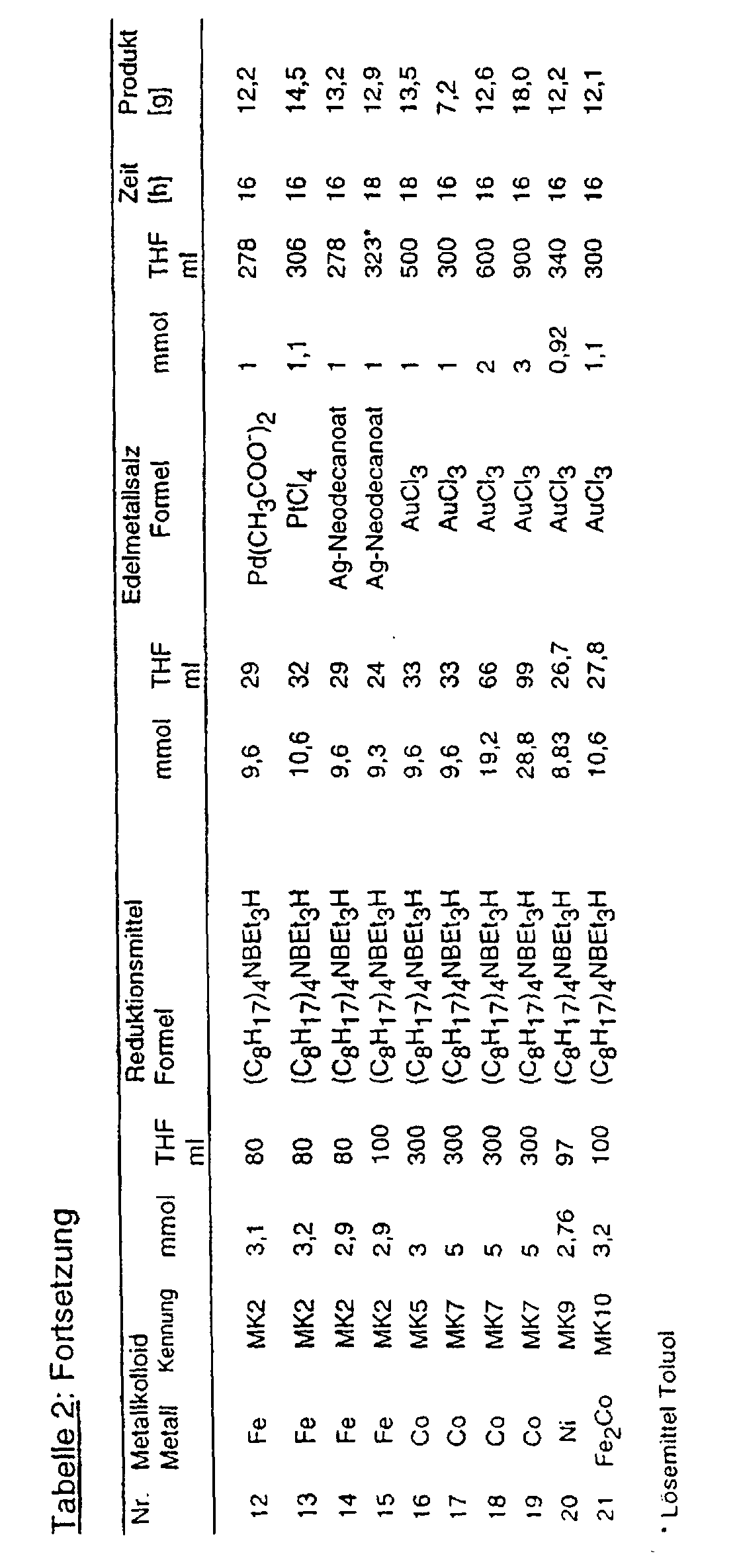
- the superior corrosion stability of the new materials compared to not Protected magnetic nanocolloids of the same size can be determined from the The following examples are shown (Examples 1 to 7, Table 2, illustrations 1a, 1b, 3 and 5).
- Example 2 The procedure is as in Example 1, but 0.9 g (1 mmol Fe) Fe colloid (identifier: MK2) in 40 ml THF, mixed with 0.55 g (1.5 mmol) Al (octyl) 3 and 0.1 g (0 , 33mmol) AuCl 3 dissolved in 94ml THF within 16h and receives 2.2g brown-black, Au-protected Fe colloid. (Table 2, No. 7)
- Example 2 The procedure is as in Example 1, but using 2.9 g (3.2 mmol Fe) colloid (identifier: MK2) in 80 ml THF, 6.0 g (10.6 mmol) (C 8 H 17 ) 4 NBEt 3 H dissolved in 32ml THF and dropwise 0.37g (1.1mmol) PtCl 4 dissolved in 306ml THF within 16h. 14.5 g of Pt-protected Fe colloid are obtained. (Table 2, No. 13)
- Example 8 (Comparative Example Gold Plating of Co-Colloid)
Landscapes
- Chemical & Material Sciences (AREA)
- Engineering & Computer Science (AREA)
- Nanotechnology (AREA)
- Inorganic Chemistry (AREA)
- Power Engineering (AREA)
- Organic Chemistry (AREA)
- Biomedical Technology (AREA)
- Dispersion Chemistry (AREA)
- Health & Medical Sciences (AREA)
- Life Sciences & Earth Sciences (AREA)
- Chemical Kinetics & Catalysis (AREA)
- General Health & Medical Sciences (AREA)
- Molecular Biology (AREA)
- Crystallography & Structural Chemistry (AREA)
- Soft Magnetic Materials (AREA)
- Manufacture Of Metal Powder And Suspensions Thereof (AREA)
- Colloid Chemistry (AREA)
- Shielding Devices Or Components To Electric Or Magnetic Fields (AREA)
- Preventing Corrosion Or Incrustation Of Metals (AREA)
- Sealing Using Fluids, Sealing Without Contact, And Removal Of Oil (AREA)
Description
Zur Bestimmung der Magnetisierung wird 1g eines getrockneten Metallkolloides in 2ml Lösungsmittel (Toluol, THF) redispergiert und in einem offenen zylindrischen Glasgefäß mit einem Durchmesser von 2cm auf der Magnetwaage plaziert. Bei der Verwendung eines NdFeB-Magneten mit einer hohen Magnetfeldstärke von BR = 1.1T und einem geringen Abstand Magnet zu Metallkolloid von 5mm, kann davon ausgegangen werden, daß die Kolloidpartikel in der Flüssigkeit magnetisch gesättigt sind. Daher ist das zur Zeit t gemessene Gewichtsverhältnis G0/G(t) gleich dem Verhältnis der Magnetisierung zur Zeit t zur Anfangsmagnetisierung: J(t)/J0.
| Eingesetzte Magnetmetallkolloide | ||||
| Nr. | Metallkolloid | mittlere Partikelgröße [nm] | Kennung | |
| Metall | Stabilisator | |||
| 1 | Fe | (C8H17)4NCl | 2-3 | MK1 |
| 2 | Fe | (C8H17)4NBr | 3-4 | MK2 |
| 3 | Fe | N-Lauroylsarkosin Na-Salz | 5-6 | MK3 |
| 4 | Fe | 2-(Dimethyldodecylammonio)acetat | - | MK4 |
| Rewoteric AM DML, | ||||
| 5 | Co | (C8H17)4NCl | 2-3 | MK5 |
| 6 | Co | (C8H17)4NBr | 2-3 | MK6 |
| 7 | Co | Korantin SH (BASF) | 7-11 | MK7 |
| 8 | Ni | (C8H17)4NCl | 2-3 | MK8 |
| 9 | Fe2Co | (C8H17)4NBr | 2-3 | MK9 |

Claims (9)
- Verfahren zur Herstellung von Edelmetall-geschützten, antikorrosiven Metallund Legierungskolloiden, dadurch gekennzeichnet, dass zuvor oder in-situ hergestellte magnetische Nanokolloide in Lösung mit starken Reduktionsmitteln behandelt werden, die ausgewählt sind aus der Gruppe bestehend aus Hydriden der Elemente der Hauptgruppen 1 bis 3 des Periodensystems der Elemente, komplexen Hydriden derselben Elemente und des Tetraalkylammoniums und reduzierend wirkenden metallorganischen Verbindungen der Elemente der Hauptgruppen 1 bis 4, und die resultierenden Mischungen mit Edelmetallsalzen versetzt werden.
- Verfahren nach Anspruch 1, wobei als zuvor oder in-situ hergestellte magnetische Nanokolloide Fe-, Co-, Ni- oder Fe/Co-Kolloide eingesetzt werden.
- Magnetische Nanokolloide mit einer Partikelgröße von kleiner 20nm, dadurch gekennzeichnet, dass die magnetischen Partikel mit einer Edelmetallhülle versehen sind und ausweislich ihres Magnetogramms sowie ihrer UV/Vis-Spektren länger als 3 Stunden gegen Oxidation stabil sind.
- Magnetische Nanokolloide nach Anspruch 3, wobei als Edelmetall Au und als magnetische Partikel Fe eingesetzt werden und die länger als 100 Stunden gegen Oxidation stabil sind.
- Magnetische Nanokolloide nach Anspruch 3, wobei als Edelmetall Au und als magnetische Partikel Co eingesetzt werden und die länger als 20 Stunden gegen Oxidation stabil sind.
- Verwendung der magnetischen Nanokolloide entsprechend den Ansprüchen 3 bis 5 als magnetische Flüssigkeit mit hoher Sättigungsmagnetisierung bei gleichzeitig niedrigem Füllgehalt in einer Magnetfluiddichtung.
- Verwendung der magnetischen Nanokolloide entsprechend den Ansprüchen 3 bis 5 durch Aufbringung einer weiteren, zellverträglichen Beschichtung als magnetische Zellmarkierung.
- Verwendung der magnetischen Nanokolloide entsprechend den Ansprüchen 3 bis 5 zur magnetischen Zellseparation.
- Verwendung der magnetischen Nanokolloide entsprechend den Ansprüchen 3 bis 5 zur magnetooptischen Informationsspeicherung.
Applications Claiming Priority (3)
| Application Number | Priority Date | Filing Date | Title |
|---|---|---|---|
| DE19806167A DE19806167A1 (de) | 1998-02-14 | 1998-02-14 | Edelmetall-geschützte, antikorrosive magnetische Nanokolloide |
| DE19806167 | 1998-02-14 | ||
| PCT/EP1999/000835 WO1999041758A1 (de) | 1998-02-14 | 1999-02-09 | Edelmetall-geschützte, antikorrosive magnetische nanokolloide |
Publications (2)
| Publication Number | Publication Date |
|---|---|
| EP1055242A1 EP1055242A1 (de) | 2000-11-29 |
| EP1055242B1 true EP1055242B1 (de) | 2002-09-11 |
Family
ID=7857782
Family Applications (1)
| Application Number | Title | Priority Date | Filing Date |
|---|---|---|---|
| EP99904872A Expired - Lifetime EP1055242B1 (de) | 1998-02-14 | 1999-02-09 | Edelmetall-geschützte, antikorrosive magnetische nanokolloide |
Country Status (7)
| Country | Link |
|---|---|
| US (2) | US6491842B1 (de) |
| EP (1) | EP1055242B1 (de) |
| JP (1) | JP2002503882A (de) |
| AT (1) | ATE224094T1 (de) |
| CA (1) | CA2320940A1 (de) |
| DE (2) | DE19806167A1 (de) |
| WO (1) | WO1999041758A1 (de) |
Families Citing this family (8)
| Publication number | Priority date | Publication date | Assignee | Title |
|---|---|---|---|---|
| DE10131173C2 (de) * | 2001-06-29 | 2003-12-04 | Itn Nanovation Gmbh | Verfahren zur Herstellung von Kern-Hülle-Teilchen und deren Verwendung |
| US7001402B2 (en) * | 2002-09-04 | 2006-02-21 | Cardica, Inc. | Medical device having magnetic properties |
| JP4207754B2 (ja) * | 2003-10-31 | 2009-01-14 | 和光純薬工業株式会社 | 磁性体を用いた免疫学的測定方法 |
| JPWO2009031714A1 (ja) * | 2007-09-07 | 2010-12-16 | Hoya株式会社 | 溶媒分散性粒子 |
| US10100414B2 (en) | 2012-01-30 | 2018-10-16 | General Electric Company | Surface modified magnetic material |
| US9409148B2 (en) | 2013-08-08 | 2016-08-09 | Uchicago Argonne, Llc | Compositions and methods for direct capture of organic materials from process streams |
| CN109967757B (zh) * | 2018-12-04 | 2022-04-29 | 沈阳工业大学 | 一种利用化学法结合脉冲磁场制备Nd-Fe-B纳米粉末的方法 |
| CN115452647A (zh) * | 2022-08-29 | 2022-12-09 | 中国电子科技集团公司第十四研究所 | 一种测试磁流体密封气-液两相介质适配性的装置和方法 |
Family Cites Families (16)
| Publication number | Priority date | Publication date | Assignee | Title |
|---|---|---|---|---|
| US3284358A (en) * | 1963-06-10 | 1966-11-08 | Chevron Res | Process for improving the magnetic properties of colloidal dispersion of magnetic particles |
| US3650601A (en) * | 1970-11-19 | 1972-03-21 | Du Pont | Magneto-optic device having alternate layer film structure |
| US3764540A (en) * | 1971-05-28 | 1973-10-09 | Us Interior | Magnetofluids and their manufacture |
| US4092459A (en) * | 1975-01-13 | 1978-05-30 | Graham Magnetics Incorporated | Powder products |
| US4101311A (en) * | 1977-08-01 | 1978-07-18 | Fuji Photo Film Co., Ltd. | Process for producing ferromagnetic metal powder |
| SE8201972L (sv) * | 1982-03-29 | 1983-09-30 | Gambro Lundia Ab | Magnetiskt paverkbara kristalliserade kolhydrat sferer eller partiklar att anvendas tillsammans med bioadsorberande material |
| JPS5927505A (ja) * | 1982-08-09 | 1984-02-14 | Hitachi Maxell Ltd | 強磁性金属粉末 |
| ATE117829T1 (de) * | 1988-05-24 | 1995-02-15 | Anagen Uk Ltd | Magnetisch anziehbare teilchen und herstellungsverfahren. |
| WO1990015423A1 (en) * | 1989-06-05 | 1990-12-13 | Omni Quest Corporation | Superparamagnetic liquid colloids |
| DE69029720T2 (de) * | 1989-07-21 | 1997-08-14 | Tdk Corp | Medium für magnetische aufzeichnungen |
| DE3934351A1 (de) * | 1989-10-14 | 1991-04-18 | Studiengesellschaft Kohle Mbh | Verfahren zur herstellung von mikrokristallinen bis amorphen metall- bzw. legierungspulvern und ohne schutzkolloid in organischen solventien geloesten metallen bzw. legierungen |
| US5007513A (en) * | 1990-04-03 | 1991-04-16 | Lord Corporation | Electroactive fluid torque transmission apparatus with ferrofluid seal |
| JPH07226316A (ja) * | 1994-02-14 | 1995-08-22 | Toyohisa Fujita | 磁性エレクトロレオロジー流体及びその製造方法 |
| DE4419173A1 (de) * | 1994-06-01 | 1995-12-07 | Basf Ag | Magnetisierbare mehrfach beschichtete metallische Glanzpigmente |
| JP3436760B2 (ja) * | 1994-07-27 | 2003-08-18 | ハーバート ピルグリム | 超常磁性粒子 |
| DE19654864A1 (de) * | 1996-02-27 | 1997-08-28 | Thomas Dipl Ing Haehndel | Magnetofluid mit einer Sättigungsmagnetisierung von 150 bis 450 mT |
-
1998
- 1998-02-14 DE DE19806167A patent/DE19806167A1/de not_active Withdrawn
-
1999
- 1999-02-09 AT AT99904872T patent/ATE224094T1/de not_active IP Right Cessation
- 1999-02-09 WO PCT/EP1999/000835 patent/WO1999041758A1/de not_active Ceased
- 1999-02-09 CA CA002320940A patent/CA2320940A1/en not_active Abandoned
- 1999-02-09 DE DE59902648T patent/DE59902648D1/de not_active Expired - Fee Related
- 1999-02-09 EP EP99904872A patent/EP1055242B1/de not_active Expired - Lifetime
- 1999-02-09 JP JP2000531855A patent/JP2002503882A/ja active Pending
- 1999-02-09 US US09/622,081 patent/US6491842B1/en not_active Expired - Fee Related
-
2002
- 2002-06-17 US US10/173,085 patent/US20030098437A1/en not_active Abandoned
Also Published As
| Publication number | Publication date |
|---|---|
| EP1055242A1 (de) | 2000-11-29 |
| DE19806167A1 (de) | 1999-08-19 |
| ATE224094T1 (de) | 2002-09-15 |
| CA2320940A1 (en) | 1999-08-19 |
| US20030098437A1 (en) | 2003-05-29 |
| DE59902648D1 (de) | 2002-10-17 |
| JP2002503882A (ja) | 2002-02-05 |
| US6491842B1 (en) | 2002-12-10 |
| WO1999041758A1 (de) | 1999-08-19 |
Similar Documents
| Publication | Publication Date | Title |
|---|---|---|
| US6531304B1 (en) | Method for modifying the dispersion characteristics of metal organic-prestabilized or pre-treated nanometal colloids | |
| Han et al. | Photochemical synthesis in formamide and room-temperature coulomb staircase behavior of size-controlled gold nanoparticles | |
| Mayer et al. | Colloidal gold nanoparticles protected by water-soluble homopolymers and random copolymers | |
| Donkers et al. | Synthesis and isolation of the molecule-like cluster Au38 (PhCH2CH2S) 24 | |
| EP0888545B1 (de) | Superparamagnetische teilchen mit vergrösserter r 1-relaxivität, verfahren zur herstellung und deren verwendung | |
| Corain et al. | Metal nanoclusters in catalysis and materials science: the issue of size control | |
| US9421610B2 (en) | Stable atomic quantum clusters, production method thereof and use of same | |
| Shon et al. | Monolayer-protected bimetal cluster synthesis by core metal galvanic exchange reaction | |
| Mondini et al. | Colloidal stability of iron oxide nanocrystals coated with a PEG-based tetra-catechol surfactant | |
| Li et al. | Spherical and planar gold (0) nanoparticles with a rigid gold (I)− anion or a fluid gold (0)− acetone surface | |
| EP1055242A1 (de) | Edelmetall-geschützte, antikorrosive magnetische nanokolloide | |
| DE19852547A1 (de) | Wasserlösliche nanostrukturierte Metalloxid-Kolloide und Verfahren zu ihrer Herstellung | |
| Ravichandran et al. | Solid state–Green construction of starch-beaded Fe3O4@ Ag nanocomposite as superior redox catalyst | |
| Bastús et al. | The reactivity of colloidal inorganic nanoparticles | |
| Ngcobo et al. | Bentonite nanoclay optoelectrochemical property improvement through bimetallic silver and gold nanoparticles | |
| US4721524A (en) | Non-pyrophoric submicron alloy powders of Group VIII metals | |
| Zhai et al. | Temperature-dependent synthesis of CoPt hollow nanoparticles: from “nanochain” to “nanoring” | |
| Dilsiz et al. | Silver coating of spindle-and filament-type magnetic particles for conductive adhesive applications | |
| EP1516345A1 (de) | Monodisperse, magnetische nanokolloide einstellbarer grösse und verfahren zu deren herstellung | |
| Seshadri et al. | Preparation of monodispersed, submicron gold particles | |
| EP0331054B1 (de) | Verfahren zur Herstellung von nadelförmigem alpha-Eisen-III-oxid | |
| Wang et al. | The fragmentation of gold nanoparticles induced by small biomolecules | |
| EP1448815B1 (de) | Nanodrähte und verfahren zu ihrer herstellung | |
| RU2118923C1 (ru) | Способ получения высокодисперсного магнитного порошка | |
| Ngcobo et al. | Research Article Bentonite Nanoclay Optoelectrochemical Property Improvement through Bimetallic Silver and Gold Nanoparticles |
Legal Events
| Date | Code | Title | Description |
|---|---|---|---|
| PUAI | Public reference made under article 153(3) epc to a published international application that has entered the european phase |
Free format text: ORIGINAL CODE: 0009012 |
|
| 17P | Request for examination filed |
Effective date: 20000722 |
|
| AK | Designated contracting states |
Kind code of ref document: A1 Designated state(s): AT BE CH DE DK ES FR GB IE IT LI LU NL SE |
|
| 17Q | First examination report despatched |
Effective date: 20010412 |
|
| GRAG | Despatch of communication of intention to grant |
Free format text: ORIGINAL CODE: EPIDOS AGRA |
|
| GRAG | Despatch of communication of intention to grant |
Free format text: ORIGINAL CODE: EPIDOS AGRA |
|
| GRAH | Despatch of communication of intention to grant a patent |
Free format text: ORIGINAL CODE: EPIDOS IGRA |
|
| GRAH | Despatch of communication of intention to grant a patent |
Free format text: ORIGINAL CODE: EPIDOS IGRA |
|
| GRAA | (expected) grant |
Free format text: ORIGINAL CODE: 0009210 |
|
| AK | Designated contracting states |
Kind code of ref document: B1 Designated state(s): AT BE CH DE DK ES FR GB IE IT LI LU NL SE |
|
| REF | Corresponds to: |
Ref document number: 224094 Country of ref document: AT Date of ref document: 20020915 Kind code of ref document: T |
|
| REG | Reference to a national code |
Ref country code: GB Ref legal event code: FG4D Free format text: NOT ENGLISH |
|
| REG | Reference to a national code |
Ref country code: CH Ref legal event code: EP |
|
| BECA | Be: change of holder's address |
Owner name: STUDIENG.- *KOHLE M.B.H.KAISER-WILHELM-PLATZ 1, D- |
|
| BECH | Be: change of holder |
Owner name: STUDIENG.- *KOHLE M.B.H. |
|
| REG | Reference to a national code |
Ref country code: IE Ref legal event code: FG4D Free format text: GERMAN |
|
| REF | Corresponds to: |
Ref document number: 59902648 Country of ref document: DE Date of ref document: 20021017 |
|
| REG | Reference to a national code |
Ref country code: CH Ref legal event code: PUE Owner name: STUDIENGESELLSCHAFT KOHLE MBH;FRAUNHOFER-GESELLSCH Ref country code: CH Ref legal event code: NV Representative=s name: A. BRAUN, BRAUN, HERITIER, ESCHMANN AG PATENTANWAE |
|
| RAP2 | Party data changed (patent owner data changed or rights of a patent transferred) |
Owner name: STUDIENGESELLSCHAFT KOHLE MBH |
|
| GBT | Gb: translation of ep patent filed (gb section 77(6)(a)/1977) |
Effective date: 20021030 |
|
| PG25 | Lapsed in a contracting state [announced via postgrant information from national office to epo] |
Ref country code: SE Free format text: LAPSE BECAUSE OF FAILURE TO SUBMIT A TRANSLATION OF THE DESCRIPTION OR TO PAY THE FEE WITHIN THE PRESCRIBED TIME-LIMIT Effective date: 20021211 Ref country code: DK Free format text: LAPSE BECAUSE OF FAILURE TO SUBMIT A TRANSLATION OF THE DESCRIPTION OR TO PAY THE FEE WITHIN THE PRESCRIBED TIME-LIMIT Effective date: 20021211 |
|
| NLT2 | Nl: modifications (of names), taken from the european patent patent bulletin |
Owner name: STUDIENGESELLSCHAFT KOHLE MBH |
|
| PG25 | Lapsed in a contracting state [announced via postgrant information from national office to epo] |
Ref country code: LU Free format text: LAPSE BECAUSE OF NON-PAYMENT OF DUE FEES Effective date: 20030209 Ref country code: GB Free format text: LAPSE BECAUSE OF NON-PAYMENT OF DUE FEES Effective date: 20030209 Ref country code: AT Free format text: LAPSE BECAUSE OF NON-PAYMENT OF DUE FEES Effective date: 20030209 |
|
| PG25 | Lapsed in a contracting state [announced via postgrant information from national office to epo] |
Ref country code: IE Free format text: LAPSE BECAUSE OF NON-PAYMENT OF DUE FEES Effective date: 20030210 |
|
| PG25 | Lapsed in a contracting state [announced via postgrant information from national office to epo] |
Ref country code: LI Free format text: LAPSE BECAUSE OF NON-PAYMENT OF DUE FEES Effective date: 20030228 Ref country code: CH Free format text: LAPSE BECAUSE OF NON-PAYMENT OF DUE FEES Effective date: 20030228 Ref country code: BE Free format text: LAPSE BECAUSE OF NON-PAYMENT OF DUE FEES Effective date: 20030228 |
|
| NLS | Nl: assignments of ep-patents |
Owner name: STUDIENGESELLSCHAFT KOHLE MBH |
|
| ET | Fr: translation filed | ||
| PG25 | Lapsed in a contracting state [announced via postgrant information from national office to epo] |
Ref country code: ES Free format text: LAPSE BECAUSE OF FAILURE TO SUBMIT A TRANSLATION OF THE DESCRIPTION OR TO PAY THE FEE WITHIN THE PRESCRIBED TIME-LIMIT Effective date: 20030328 |
|
| PLBE | No opposition filed within time limit |
Free format text: ORIGINAL CODE: 0009261 |
|
| STAA | Information on the status of an ep patent application or granted ep patent |
Free format text: STATUS: NO OPPOSITION FILED WITHIN TIME LIMIT |
|
| PG25 | Lapsed in a contracting state [announced via postgrant information from national office to epo] |
Ref country code: NL Free format text: LAPSE BECAUSE OF NON-PAYMENT OF DUE FEES Effective date: 20030901 |
|
| PG25 | Lapsed in a contracting state [announced via postgrant information from national office to epo] |
Ref country code: DE Free format text: LAPSE BECAUSE OF NON-PAYMENT OF DUE FEES Effective date: 20030902 |
|
| 26N | No opposition filed |
Effective date: 20030612 |
|
| GBPC | Gb: european patent ceased through non-payment of renewal fee | ||
| REG | Reference to a national code |
Ref country code: CH Ref legal event code: PL |
|
| PG25 | Lapsed in a contracting state [announced via postgrant information from national office to epo] |
Ref country code: FR Free format text: LAPSE BECAUSE OF NON-PAYMENT OF DUE FEES Effective date: 20031031 |
|
| NLV4 | Nl: lapsed or anulled due to non-payment of the annual fee |
Effective date: 20030901 |
|
| REG | Reference to a national code |
Ref country code: FR Ref legal event code: ST |
|
| REG | Reference to a national code |
Ref country code: IE Ref legal event code: MM4A |
|
| PG25 | Lapsed in a contracting state [announced via postgrant information from national office to epo] |
Ref country code: IT Free format text: LAPSE BECAUSE OF NON-PAYMENT OF DUE FEES Effective date: 20050209 |