EP1052113A1 - Heat-sensitive imaging element for providing a lithographic printing plate - Google Patents
Heat-sensitive imaging element for providing a lithographic printing plate Download PDFInfo
- Publication number
- EP1052113A1 EP1052113A1 EP00109173A EP00109173A EP1052113A1 EP 1052113 A1 EP1052113 A1 EP 1052113A1 EP 00109173 A EP00109173 A EP 00109173A EP 00109173 A EP00109173 A EP 00109173A EP 1052113 A1 EP1052113 A1 EP 1052113A1
- Authority
- EP
- European Patent Office
- Prior art keywords
- hydrophilic
- heat
- groups
- polymer
- lithographic printing
- Prior art date
- Legal status (The legal status is an assumption and is not a legal conclusion. Google has not performed a legal analysis and makes no representation as to the accuracy of the status listed.)
- Granted
Links
- 238000007639 printing Methods 0.000 title claims abstract description 90
- 238000003384 imaging method Methods 0.000 title 1
- 229920000642 polymer Polymers 0.000 claims abstract description 88
- XLYOFNOQVPJJNP-UHFFFAOYSA-N water Substances O XLYOFNOQVPJJNP-UHFFFAOYSA-N 0.000 claims abstract description 30
- 125000000217 alkyl group Chemical group 0.000 claims description 33
- 125000003118 aryl group Chemical group 0.000 claims description 32
- 229920001477 hydrophilic polymer Polymers 0.000 claims description 20
- 125000000524 functional group Chemical group 0.000 claims description 18
- 239000000126 substance Substances 0.000 claims description 16
- 239000002243 precursor Substances 0.000 claims description 15
- 125000004435 hydrogen atom Chemical group [H]* 0.000 claims description 7
- 125000004429 atom Chemical group 0.000 claims description 6
- 125000004122 cyclic group Chemical group 0.000 claims description 6
- 230000002209 hydrophobic effect Effects 0.000 claims description 3
- 125000000962 organic group Chemical group 0.000 claims description 2
- 239000010410 layer Substances 0.000 description 115
- -1 hydroxypropyl Chemical group 0.000 description 50
- 229910052782 aluminium Inorganic materials 0.000 description 40
- 239000000049 pigment Substances 0.000 description 39
- 239000000243 solution Substances 0.000 description 38
- XAGFODPZIPBFFR-UHFFFAOYSA-N aluminium Chemical compound [Al] XAGFODPZIPBFFR-UHFFFAOYSA-N 0.000 description 35
- 239000000975 dye Substances 0.000 description 30
- 239000011248 coating agent Substances 0.000 description 29
- 238000000576 coating method Methods 0.000 description 29
- 229910052751 metal Inorganic materials 0.000 description 27
- 239000002184 metal Substances 0.000 description 27
- 238000000034 method Methods 0.000 description 24
- 239000000843 powder Substances 0.000 description 20
- 239000003795 chemical substances by application Substances 0.000 description 19
- 239000000178 monomer Substances 0.000 description 19
- LYCAIKOWRPUZTN-UHFFFAOYSA-N Ethylene glycol Chemical compound OCCO LYCAIKOWRPUZTN-UHFFFAOYSA-N 0.000 description 18
- OKKJLVBELUTLKV-UHFFFAOYSA-N Methanol Chemical compound OC OKKJLVBELUTLKV-UHFFFAOYSA-N 0.000 description 18
- 125000004432 carbon atom Chemical group C* 0.000 description 18
- HEMHJVSKTPXQMS-UHFFFAOYSA-M Sodium hydroxide Chemical compound [OH-].[Na+] HEMHJVSKTPXQMS-UHFFFAOYSA-M 0.000 description 15
- 239000000463 material Substances 0.000 description 15
- 125000003178 carboxy group Chemical group [H]OC(*)=O 0.000 description 14
- 150000003839 salts Chemical class 0.000 description 14
- 239000011230 binding agent Substances 0.000 description 12
- 125000002887 hydroxy group Chemical group [H]O* 0.000 description 12
- 229920001577 copolymer Polymers 0.000 description 11
- 239000010408 film Substances 0.000 description 11
- XEEYBQQBJWHFJM-UHFFFAOYSA-N iron Substances [Fe] XEEYBQQBJWHFJM-UHFFFAOYSA-N 0.000 description 11
- 239000000758 substrate Substances 0.000 description 11
- 239000002253 acid Substances 0.000 description 10
- 239000000084 colloidal system Substances 0.000 description 10
- 238000011161 development Methods 0.000 description 10
- 238000002360 preparation method Methods 0.000 description 10
- 125000001424 substituent group Chemical group 0.000 description 10
- ZWEHNKRNPOVVGH-UHFFFAOYSA-N 2-Butanone Chemical compound CCC(C)=O ZWEHNKRNPOVVGH-UHFFFAOYSA-N 0.000 description 9
- NIXOWILDQLNWCW-UHFFFAOYSA-M Acrylate Chemical compound [O-]C(=O)C=C NIXOWILDQLNWCW-UHFFFAOYSA-M 0.000 description 9
- VYPSYNLAJGMNEJ-UHFFFAOYSA-N Silicium dioxide Chemical compound O=[Si]=O VYPSYNLAJGMNEJ-UHFFFAOYSA-N 0.000 description 9
- 150000001875 compounds Chemical class 0.000 description 9
- 239000003999 initiator Substances 0.000 description 9
- 239000003921 oil Substances 0.000 description 9
- 239000002245 particle Substances 0.000 description 9
- 238000012545 processing Methods 0.000 description 9
- 150000001447 alkali salts Chemical class 0.000 description 8
- 125000004093 cyano group Chemical group *C#N 0.000 description 8
- 239000000203 mixture Substances 0.000 description 8
- 125000003277 amino group Chemical class 0.000 description 7
- 239000007864 aqueous solution Substances 0.000 description 7
- 230000015572 biosynthetic process Effects 0.000 description 7
- PXHVJJICTQNCMI-UHFFFAOYSA-N nickel Substances [Ni] PXHVJJICTQNCMI-UHFFFAOYSA-N 0.000 description 7
- 125000000449 nitro group Chemical group [O-][N+](*)=O 0.000 description 7
- 125000001997 phenyl group Chemical group [H]C1=C([H])C([H])=C(*)C([H])=C1[H] 0.000 description 7
- 239000007787 solid Substances 0.000 description 7
- 239000004094 surface-active agent Substances 0.000 description 7
- WEVYAHXRMPXWCK-UHFFFAOYSA-N Acetonitrile Chemical compound CC#N WEVYAHXRMPXWCK-UHFFFAOYSA-N 0.000 description 6
- HRPVXLWXLXDGHG-UHFFFAOYSA-N Acrylamide Chemical compound NC(=O)C=C HRPVXLWXLXDGHG-UHFFFAOYSA-N 0.000 description 6
- 229920002134 Carboxymethyl cellulose Polymers 0.000 description 6
- CERQOIWHTDAKMF-UHFFFAOYSA-N Methacrylic acid Chemical compound CC(=C)C(O)=O CERQOIWHTDAKMF-UHFFFAOYSA-N 0.000 description 6
- QAOWNCQODCNURD-UHFFFAOYSA-N Sulfuric acid Chemical compound OS(O)(=O)=O QAOWNCQODCNURD-UHFFFAOYSA-N 0.000 description 6
- 125000003368 amide group Chemical group 0.000 description 6
- 239000006229 carbon black Substances 0.000 description 6
- 235000010948 carboxy methyl cellulose Nutrition 0.000 description 6
- 239000003431 cross linking reagent Substances 0.000 description 6
- 238000001035 drying Methods 0.000 description 6
- 150000002739 metals Chemical class 0.000 description 6
- 125000002496 methyl group Chemical group [H]C([H])([H])* 0.000 description 6
- 229910052759 nickel Inorganic materials 0.000 description 6
- 229920000620 organic polymer Polymers 0.000 description 6
- 239000002904 solvent Substances 0.000 description 6
- 229910052719 titanium Inorganic materials 0.000 description 6
- 239000010936 titanium Substances 0.000 description 6
- 125000000391 vinyl group Chemical group [H]C([*])=C([H])[H] 0.000 description 6
- QGKMIGUHVLGJBR-UHFFFAOYSA-M (4z)-1-(3-methylbutyl)-4-[[1-(3-methylbutyl)quinolin-1-ium-4-yl]methylidene]quinoline;iodide Chemical compound [I-].C12=CC=CC=C2N(CCC(C)C)C=CC1=CC1=CC=[N+](CCC(C)C)C2=CC=CC=C12 QGKMIGUHVLGJBR-UHFFFAOYSA-M 0.000 description 5
- JYEUMXHLPRZUAT-UHFFFAOYSA-N 1,2,3-triazine Chemical compound C1=CN=NN=C1 JYEUMXHLPRZUAT-UHFFFAOYSA-N 0.000 description 5
- LFQSCWFLJHTTHZ-UHFFFAOYSA-N Ethanol Chemical compound CCO LFQSCWFLJHTTHZ-UHFFFAOYSA-N 0.000 description 5
- YCKRFDGAMUMZLT-UHFFFAOYSA-N Fluorine atom Chemical compound [F] YCKRFDGAMUMZLT-UHFFFAOYSA-N 0.000 description 5
- 239000006087 Silane Coupling Agent Substances 0.000 description 5
- 238000006243 chemical reaction Methods 0.000 description 5
- 229910052804 chromium Inorganic materials 0.000 description 5
- 239000011651 chromium Substances 0.000 description 5
- 229910052802 copper Inorganic materials 0.000 description 5
- 239000010949 copper Substances 0.000 description 5
- 125000001495 ethyl group Chemical group [H]C([H])([H])C([H])([H])* 0.000 description 5
- 238000011156 evaluation Methods 0.000 description 5
- 229910052731 fluorine Inorganic materials 0.000 description 5
- 239000011737 fluorine Substances 0.000 description 5
- 229910052736 halogen Inorganic materials 0.000 description 5
- 150000002367 halogens Chemical group 0.000 description 5
- WGCNASOHLSPBMP-UHFFFAOYSA-N hydroxyacetaldehyde Natural products OCC=O WGCNASOHLSPBMP-UHFFFAOYSA-N 0.000 description 5
- 229910052742 iron Inorganic materials 0.000 description 5
- 238000004519 manufacturing process Methods 0.000 description 5
- 125000001624 naphthyl group Chemical group 0.000 description 5
- 229920001223 polyethylene glycol Polymers 0.000 description 5
- 229920002451 polyvinyl alcohol Polymers 0.000 description 5
- 235000019422 polyvinyl alcohol Nutrition 0.000 description 5
- 229910052710 silicon Inorganic materials 0.000 description 5
- 125000003107 substituted aryl group Chemical group 0.000 description 5
- 229920002554 vinyl polymer Polymers 0.000 description 5
- 229910052727 yttrium Inorganic materials 0.000 description 5
- 229910052725 zinc Inorganic materials 0.000 description 5
- 239000011701 zinc Substances 0.000 description 5
- YEJRWHAVMIAJKC-UHFFFAOYSA-N 4-Butyrolactone Chemical compound O=C1CCCO1 YEJRWHAVMIAJKC-UHFFFAOYSA-N 0.000 description 4
- UJOBWOGCFQCDNV-UHFFFAOYSA-N 9H-carbazole Chemical compound C1=CC=C2C3=CC=CC=C3NC2=C1 UJOBWOGCFQCDNV-UHFFFAOYSA-N 0.000 description 4
- CSCPPACGZOOCGX-UHFFFAOYSA-N Acetone Chemical compound CC(C)=O CSCPPACGZOOCGX-UHFFFAOYSA-N 0.000 description 4
- VVJKKWFAADXIJK-UHFFFAOYSA-N Allylamine Chemical compound NCC=C VVJKKWFAADXIJK-UHFFFAOYSA-N 0.000 description 4
- 235000011960 Brassica ruvo Nutrition 0.000 description 4
- 239000004593 Epoxy Substances 0.000 description 4
- KFZMGEQAYNKOFK-UHFFFAOYSA-N Isopropanol Chemical compound CC(C)O KFZMGEQAYNKOFK-UHFFFAOYSA-N 0.000 description 4
- FXHOOIRPVKKKFG-UHFFFAOYSA-N N,N-Dimethylacetamide Chemical compound CN(C)C(C)=O FXHOOIRPVKKKFG-UHFFFAOYSA-N 0.000 description 4
- NBIIXXVUZAFLBC-UHFFFAOYSA-N Phosphoric acid Chemical group OP(O)(O)=O NBIIXXVUZAFLBC-UHFFFAOYSA-N 0.000 description 4
- 239000002202 Polyethylene glycol Substances 0.000 description 4
- 239000004372 Polyvinyl alcohol Substances 0.000 description 4
- 229920002125 Sokalan® Polymers 0.000 description 4
- 238000010521 absorption reaction Methods 0.000 description 4
- 150000007513 acids Chemical class 0.000 description 4
- 150000003926 acrylamides Chemical class 0.000 description 4
- NIXOWILDQLNWCW-UHFFFAOYSA-N acrylic acid group Chemical group C(C=C)(=O)O NIXOWILDQLNWCW-UHFFFAOYSA-N 0.000 description 4
- 125000003545 alkoxy group Chemical group 0.000 description 4
- 125000004453 alkoxycarbonyl group Chemical group 0.000 description 4
- 125000002837 carbocyclic group Chemical group 0.000 description 4
- 125000002843 carboxylic acid group Chemical group 0.000 description 4
- 239000008119 colloidal silica Substances 0.000 description 4
- MTHSVFCYNBDYFN-UHFFFAOYSA-N diethylene glycol Chemical compound OCCOCCO MTHSVFCYNBDYFN-UHFFFAOYSA-N 0.000 description 4
- 239000006185 dispersion Substances 0.000 description 4
- 230000000694 effects Effects 0.000 description 4
- 125000001033 ether group Chemical group 0.000 description 4
- 125000002485 formyl group Chemical class [H]C(*)=O 0.000 description 4
- 125000005843 halogen group Chemical group 0.000 description 4
- 238000010438 heat treatment Methods 0.000 description 4
- 125000001072 heteroaryl group Chemical group 0.000 description 4
- 125000000623 heterocyclic group Chemical group 0.000 description 4
- 229920001519 homopolymer Polymers 0.000 description 4
- 125000001449 isopropyl group Chemical group [H]C([H])([H])C([H])(*)C([H])([H])[H] 0.000 description 4
- 150000002736 metal compounds Chemical class 0.000 description 4
- FQPSGWSUVKBHSU-UHFFFAOYSA-N methacrylamide Chemical class CC(=C)C(N)=O FQPSGWSUVKBHSU-UHFFFAOYSA-N 0.000 description 4
- 125000000956 methoxy group Chemical group [H]C([H])([H])O* 0.000 description 4
- 238000007254 oxidation reaction Methods 0.000 description 4
- 125000004076 pyridyl group Chemical group 0.000 description 4
- 229910052709 silver Inorganic materials 0.000 description 4
- 238000003786 synthesis reaction Methods 0.000 description 4
- SMZOUWXMTYCWNB-UHFFFAOYSA-N 2-(2-methoxy-5-methylphenyl)ethanamine Chemical compound COC1=CC=C(C)C=C1CCN SMZOUWXMTYCWNB-UHFFFAOYSA-N 0.000 description 3
- WKBOTKDWSSQWDR-UHFFFAOYSA-N Bromine atom Chemical compound [Br] WKBOTKDWSSQWDR-UHFFFAOYSA-N 0.000 description 3
- ZAMOUSCENKQFHK-UHFFFAOYSA-N Chlorine atom Chemical compound [Cl] ZAMOUSCENKQFHK-UHFFFAOYSA-N 0.000 description 3
- XEKOWRVHYACXOJ-UHFFFAOYSA-N Ethyl acetate Chemical compound CCOC(C)=O XEKOWRVHYACXOJ-UHFFFAOYSA-N 0.000 description 3
- 229910000640 Fe alloy Inorganic materials 0.000 description 3
- PEDCQBHIVMGVHV-UHFFFAOYSA-N Glycerine Chemical compound OCC(O)CO PEDCQBHIVMGVHV-UHFFFAOYSA-N 0.000 description 3
- ZMXDDKWLCZADIW-UHFFFAOYSA-N N,N-Dimethylformamide Chemical compound CN(C)C=O ZMXDDKWLCZADIW-UHFFFAOYSA-N 0.000 description 3
- GRYLNZFGIOXLOG-UHFFFAOYSA-N Nitric acid Chemical compound O[N+]([O-])=O GRYLNZFGIOXLOG-UHFFFAOYSA-N 0.000 description 3
- 229920003171 Poly (ethylene oxide) Polymers 0.000 description 3
- 239000004698 Polyethylene Substances 0.000 description 3
- DNIAPMSPPWPWGF-UHFFFAOYSA-N Propylene glycol Chemical compound CC(O)CO DNIAPMSPPWPWGF-UHFFFAOYSA-N 0.000 description 3
- 206010057040 Temperature intolerance Diseases 0.000 description 3
- BOTDANWDWHJENH-UHFFFAOYSA-N Tetraethyl orthosilicate Chemical compound CCO[Si](OCC)(OCC)OCC BOTDANWDWHJENH-UHFFFAOYSA-N 0.000 description 3
- RTAQQCXQSZGOHL-UHFFFAOYSA-N Titanium Chemical compound [Ti] RTAQQCXQSZGOHL-UHFFFAOYSA-N 0.000 description 3
- YXFVVABEGXRONW-UHFFFAOYSA-N Toluene Chemical compound CC1=CC=CC=C1 YXFVVABEGXRONW-UHFFFAOYSA-N 0.000 description 3
- ZMANZCXQSJIPKH-UHFFFAOYSA-N Triethylamine Chemical compound CCN(CC)CC ZMANZCXQSJIPKH-UHFFFAOYSA-N 0.000 description 3
- UKLDJPRMSDWDSL-UHFFFAOYSA-L [dibutyl(dodecanoyloxy)stannyl] dodecanoate Chemical compound CCCCCCCCCCCC(=O)O[Sn](CCCC)(CCCC)OC(=O)CCCCCCCCCCC UKLDJPRMSDWDSL-UHFFFAOYSA-L 0.000 description 3
- 150000001252 acrylic acid derivatives Chemical class 0.000 description 3
- 125000004423 acyloxy group Chemical group 0.000 description 3
- 229910052783 alkali metal Inorganic materials 0.000 description 3
- 239000002280 amphoteric surfactant Substances 0.000 description 3
- GDTBXPJZTBHREO-UHFFFAOYSA-N bromine Substances BrBr GDTBXPJZTBHREO-UHFFFAOYSA-N 0.000 description 3
- 229910052794 bromium Inorganic materials 0.000 description 3
- 125000005587 carbonate group Chemical group 0.000 description 3
- 239000000460 chlorine Substances 0.000 description 3
- 229910052801 chlorine Inorganic materials 0.000 description 3
- 229920006037 cross link polymer Polymers 0.000 description 3
- 125000000113 cyclohexyl group Chemical group [H]C1([H])C([H])([H])C([H])([H])C([H])(*)C([H])([H])C1([H])[H] 0.000 description 3
- 239000012975 dibutyltin dilaurate Substances 0.000 description 3
- 238000005530 etching Methods 0.000 description 3
- 125000001301 ethoxy group Chemical group [H]C([H])([H])C([H])([H])O* 0.000 description 3
- 125000003754 ethoxycarbonyl group Chemical group C(=O)(OCC)* 0.000 description 3
- 125000003055 glycidyl group Chemical group C(C1CO1)* 0.000 description 3
- 230000008543 heat sensitivity Effects 0.000 description 3
- 125000005842 heteroatom Chemical group 0.000 description 3
- 229910052739 hydrogen Inorganic materials 0.000 description 3
- 239000001257 hydrogen Substances 0.000 description 3
- 230000005660 hydrophilic surface Effects 0.000 description 3
- 229910052748 manganese Inorganic materials 0.000 description 3
- 239000011572 manganese Substances 0.000 description 3
- 150000002734 metacrylic acid derivatives Chemical class 0.000 description 3
- RBQRWNWVPQDTJJ-UHFFFAOYSA-N methacryloyloxyethyl isocyanate Chemical compound CC(=C)C(=O)OCCN=C=O RBQRWNWVPQDTJJ-UHFFFAOYSA-N 0.000 description 3
- 125000001434 methanylylidene group Chemical group [H]C#[*] 0.000 description 3
- 125000001160 methoxycarbonyl group Chemical group [H]C([H])([H])OC(*)=O 0.000 description 3
- 229910052750 molybdenum Inorganic materials 0.000 description 3
- 229910017604 nitric acid Inorganic materials 0.000 description 3
- 150000004767 nitrides Chemical class 0.000 description 3
- 239000002736 nonionic surfactant Substances 0.000 description 3
- 230000003647 oxidation Effects 0.000 description 3
- 239000005022 packaging material Substances 0.000 description 3
- 239000004584 polyacrylic acid Substances 0.000 description 3
- 229920000139 polyethylene terephthalate Polymers 0.000 description 3
- 239000005020 polyethylene terephthalate Substances 0.000 description 3
- WVIICGIFSIBFOG-UHFFFAOYSA-N pyrylium Chemical class C1=CC=[O+]C=C1 WVIICGIFSIBFOG-UHFFFAOYSA-N 0.000 description 3
- 239000011541 reaction mixture Substances 0.000 description 3
- 238000007142 ring opening reaction Methods 0.000 description 3
- 230000035945 sensitivity Effects 0.000 description 3
- 150000003440 styrenes Chemical class 0.000 description 3
- 125000000547 substituted alkyl group Chemical group 0.000 description 3
- 125000000542 sulfonic acid group Chemical group 0.000 description 3
- 239000002344 surface layer Substances 0.000 description 3
- 238000004381 surface treatment Methods 0.000 description 3
- 229920001187 thermosetting polymer Polymers 0.000 description 3
- 229910052718 tin Inorganic materials 0.000 description 3
- OGIDPMRJRNCKJF-UHFFFAOYSA-N titanium oxide Inorganic materials [Ti]=O OGIDPMRJRNCKJF-UHFFFAOYSA-N 0.000 description 3
- 229910052721 tungsten Inorganic materials 0.000 description 3
- 229910052720 vanadium Inorganic materials 0.000 description 3
- 229920001567 vinyl ester resin Polymers 0.000 description 3
- 229910052726 zirconium Inorganic materials 0.000 description 3
- WSLDOOZREJYCGB-UHFFFAOYSA-N 1,2-Dichloroethane Chemical compound ClCCCl WSLDOOZREJYCGB-UHFFFAOYSA-N 0.000 description 2
- DZSVIVLGBJKQAP-UHFFFAOYSA-N 1-(2-methyl-5-propan-2-ylcyclohex-2-en-1-yl)propan-1-one Chemical compound CCC(=O)C1CC(C(C)C)CC=C1C DZSVIVLGBJKQAP-UHFFFAOYSA-N 0.000 description 2
- ARXJGSRGQADJSQ-UHFFFAOYSA-N 1-methoxypropan-2-ol Chemical compound COCC(C)O ARXJGSRGQADJSQ-UHFFFAOYSA-N 0.000 description 2
- JAHNSTQSQJOJLO-UHFFFAOYSA-N 2-(3-fluorophenyl)-1h-imidazole Chemical compound FC1=CC=CC(C=2NC=CN=2)=C1 JAHNSTQSQJOJLO-UHFFFAOYSA-N 0.000 description 2
- 125000000954 2-hydroxyethyl group Chemical group [H]C([*])([H])C([H])([H])O[H] 0.000 description 2
- XLLIQLLCWZCATF-UHFFFAOYSA-N 2-methoxyethyl acetate Chemical compound COCCOC(C)=O XLLIQLLCWZCATF-UHFFFAOYSA-N 0.000 description 2
- XDLMVUHYZWKMMD-UHFFFAOYSA-N 3-trimethoxysilylpropyl 2-methylprop-2-enoate Chemical compound CO[Si](OC)(OC)CCCOC(=O)C(C)=C XDLMVUHYZWKMMD-UHFFFAOYSA-N 0.000 description 2
- 244000215068 Acacia senegal Species 0.000 description 2
- NLHHRLWOUZZQLW-UHFFFAOYSA-N Acrylonitrile Chemical compound C=CC#N NLHHRLWOUZZQLW-UHFFFAOYSA-N 0.000 description 2
- IJGRMHOSHXDMSA-UHFFFAOYSA-N Atomic nitrogen Chemical compound N#N IJGRMHOSHXDMSA-UHFFFAOYSA-N 0.000 description 2
- LSNNMFCWUKXFEE-UHFFFAOYSA-M Bisulfite Chemical group OS([O-])=O LSNNMFCWUKXFEE-UHFFFAOYSA-M 0.000 description 2
- OKTJSMMVPCPJKN-UHFFFAOYSA-N Carbon Chemical compound [C] OKTJSMMVPCPJKN-UHFFFAOYSA-N 0.000 description 2
- RYGMFSIKBFXOCR-UHFFFAOYSA-N Copper Chemical compound [Cu] RYGMFSIKBFXOCR-UHFFFAOYSA-N 0.000 description 2
- KCXZNSGUUQJJTR-UHFFFAOYSA-N Di-n-hexyl phthalate Chemical compound CCCCCCOC(=O)C1=CC=CC=C1C(=O)OCCCCCC KCXZNSGUUQJJTR-UHFFFAOYSA-N 0.000 description 2
- IAZDPXIOMUYVGZ-UHFFFAOYSA-N Dimethylsulphoxide Chemical compound CS(C)=O IAZDPXIOMUYVGZ-UHFFFAOYSA-N 0.000 description 2
- 229920000084 Gum arabic Polymers 0.000 description 2
- VEXZGXHMUGYJMC-UHFFFAOYSA-N Hydrochloric acid Chemical compound Cl VEXZGXHMUGYJMC-UHFFFAOYSA-N 0.000 description 2
- UFHFLCQGNIYNRP-UHFFFAOYSA-N Hydrogen Chemical compound [H][H] UFHFLCQGNIYNRP-UHFFFAOYSA-N 0.000 description 2
- QIGBRXMKCJKVMJ-UHFFFAOYSA-N Hydroquinone Chemical compound OC1=CC=C(O)C=C1 QIGBRXMKCJKVMJ-UHFFFAOYSA-N 0.000 description 2
- BAPJBEWLBFYGME-UHFFFAOYSA-N Methyl acrylate Chemical compound COC(=O)C=C BAPJBEWLBFYGME-UHFFFAOYSA-N 0.000 description 2
- 229920000881 Modified starch Polymers 0.000 description 2
- 229910052779 Neodymium Inorganic materials 0.000 description 2
- 239000004677 Nylon Substances 0.000 description 2
- JZTPOMIFAFKKSK-UHFFFAOYSA-N O-phosphonohydroxylamine Chemical group NOP(O)(O)=O JZTPOMIFAFKKSK-UHFFFAOYSA-N 0.000 description 2
- GLUUGHFHXGJENI-UHFFFAOYSA-N Piperazine Chemical compound C1CNCCN1 GLUUGHFHXGJENI-UHFFFAOYSA-N 0.000 description 2
- 229920002845 Poly(methacrylic acid) Polymers 0.000 description 2
- 239000004743 Polypropylene Substances 0.000 description 2
- 239000004793 Polystyrene Substances 0.000 description 2
- PPBRXRYQALVLMV-UHFFFAOYSA-N Styrene Chemical compound C=CC1=CC=CC=C1 PPBRXRYQALVLMV-UHFFFAOYSA-N 0.000 description 2
- WYURNTSHIVDZCO-UHFFFAOYSA-N Tetrahydrofuran Chemical compound C1CCOC1 WYURNTSHIVDZCO-UHFFFAOYSA-N 0.000 description 2
- GWEVSGVZZGPLCZ-UHFFFAOYSA-N Titan oxide Chemical compound O=[Ti]=O GWEVSGVZZGPLCZ-UHFFFAOYSA-N 0.000 description 2
- ZFOZVQLOBQUTQQ-UHFFFAOYSA-N Tributyl citrate Chemical compound CCCCOC(=O)CC(O)(C(=O)OCCCC)CC(=O)OCCCC ZFOZVQLOBQUTQQ-UHFFFAOYSA-N 0.000 description 2
- HCHKCACWOHOZIP-UHFFFAOYSA-N Zinc Chemical compound [Zn] HCHKCACWOHOZIP-UHFFFAOYSA-N 0.000 description 2
- XQAXGZLFSSPBMK-UHFFFAOYSA-M [7-(dimethylamino)phenothiazin-3-ylidene]-dimethylazanium;chloride;trihydrate Chemical compound O.O.O.[Cl-].C1=CC(=[N+](C)C)C=C2SC3=CC(N(C)C)=CC=C3N=C21 XQAXGZLFSSPBMK-UHFFFAOYSA-M 0.000 description 2
- 235000010489 acacia gum Nutrition 0.000 description 2
- 239000000205 acacia gum Substances 0.000 description 2
- 125000000738 acetamido group Chemical group [H]C([H])([H])C(=O)N([H])[*] 0.000 description 2
- 125000002777 acetyl group Chemical group [H]C([H])([H])C(*)=O 0.000 description 2
- 125000002252 acyl group Chemical group 0.000 description 2
- WNLRTRBMVRJNCN-UHFFFAOYSA-N adipic acid Chemical compound OC(=O)CCCCC(O)=O WNLRTRBMVRJNCN-UHFFFAOYSA-N 0.000 description 2
- 229910052784 alkaline earth metal Inorganic materials 0.000 description 2
- 125000003342 alkenyl group Chemical group 0.000 description 2
- 229910045601 alloy Inorganic materials 0.000 description 2
- 239000000956 alloy Substances 0.000 description 2
- 150000001412 amines Chemical class 0.000 description 2
- 125000002178 anthracenyl group Chemical group C1(=CC=CC2=CC3=CC=CC=C3C=C12)* 0.000 description 2
- 229910052787 antimony Inorganic materials 0.000 description 2
- 239000007900 aqueous suspension Substances 0.000 description 2
- 125000005161 aryl oxy carbonyl group Chemical group 0.000 description 2
- 239000000987 azo dye Substances 0.000 description 2
- 239000011324 bead Substances 0.000 description 2
- 125000004618 benzofuryl group Chemical group O1C(=CC2=C1C=CC=C2)* 0.000 description 2
- 125000003236 benzoyl group Chemical group [H]C1=C([H])C([H])=C(C([H])=C1[H])C(*)=O 0.000 description 2
- 229910052797 bismuth Inorganic materials 0.000 description 2
- 229910052796 boron Inorganic materials 0.000 description 2
- 229910052799 carbon Inorganic materials 0.000 description 2
- 150000007942 carboxylates Chemical group 0.000 description 2
- 239000002131 composite material Substances 0.000 description 2
- ZXJXZNDDNMQXFV-UHFFFAOYSA-M crystal violet Chemical compound [Cl-].C1=CC(N(C)C)=CC=C1[C+](C=1C=CC(=CC=1)N(C)C)C1=CC=C(N(C)C)C=C1 ZXJXZNDDNMQXFV-UHFFFAOYSA-M 0.000 description 2
- 125000006165 cyclic alkyl group Chemical group 0.000 description 2
- JHIVVAPYMSGYDF-UHFFFAOYSA-N cyclohexanone Chemical compound O=C1CCCCC1 JHIVVAPYMSGYDF-UHFFFAOYSA-N 0.000 description 2
- 238000006114 decarboxylation reaction Methods 0.000 description 2
- DOIRQSBPFJWKBE-UHFFFAOYSA-N dibutyl phthalate Chemical compound CCCCOC(=O)C1=CC=CC=C1C(=O)OCCCC DOIRQSBPFJWKBE-UHFFFAOYSA-N 0.000 description 2
- FLKPEMZONWLCSK-UHFFFAOYSA-N diethyl phthalate Chemical compound CCOC(=O)C1=CC=CC=C1C(=O)OCC FLKPEMZONWLCSK-UHFFFAOYSA-N 0.000 description 2
- 239000012153 distilled water Substances 0.000 description 2
- LZCLXQDLBQLTDK-UHFFFAOYSA-N ethyl 2-hydroxypropanoate Chemical compound CCOC(=O)C(C)O LZCLXQDLBQLTDK-UHFFFAOYSA-N 0.000 description 2
- 125000002541 furyl group Chemical group 0.000 description 2
- 239000011521 glass Substances 0.000 description 2
- 150000004676 glycans Chemical class 0.000 description 2
- 229910052737 gold Inorganic materials 0.000 description 2
- 229910052738 indium Inorganic materials 0.000 description 2
- NLYAJNPCOHFWQQ-UHFFFAOYSA-N kaolin Chemical compound O.O.O=[Al]O[Si](=O)O[Si](=O)O[Al]=O NLYAJNPCOHFWQQ-UHFFFAOYSA-N 0.000 description 2
- 229910052746 lanthanum Inorganic materials 0.000 description 2
- 229910052745 lead Inorganic materials 0.000 description 2
- 239000007788 liquid Substances 0.000 description 2
- 229910052749 magnesium Inorganic materials 0.000 description 2
- 239000011777 magnesium Substances 0.000 description 2
- FDZZZRQASAIRJF-UHFFFAOYSA-M malachite green Chemical compound [Cl-].C1=CC(N(C)C)=CC=C1C(C=1C=CC=CC=1)=C1C=CC(=[N+](C)C)C=C1 FDZZZRQASAIRJF-UHFFFAOYSA-M 0.000 description 2
- 150000001247 metal acetylides Chemical class 0.000 description 2
- 229910044991 metal oxide Inorganic materials 0.000 description 2
- 150000004706 metal oxides Chemical class 0.000 description 2
- 229910052976 metal sulfide Inorganic materials 0.000 description 2
- LVHBHZANLOWSRM-UHFFFAOYSA-N methylenebutanedioic acid Natural products OC(=O)CC(=C)C(O)=O LVHBHZANLOWSRM-UHFFFAOYSA-N 0.000 description 2
- 125000002816 methylsulfanyl group Chemical group [H]C([H])([H])S[*] 0.000 description 2
- 235000019426 modified starch Nutrition 0.000 description 2
- 125000004123 n-propyl group Chemical group [H]C([H])([H])C([H])([H])C([H])([H])* 0.000 description 2
- 229920001778 nylon Polymers 0.000 description 2
- 238000007645 offset printing Methods 0.000 description 2
- 230000003287 optical effect Effects 0.000 description 2
- 229910052763 palladium Inorganic materials 0.000 description 2
- HVAMZGADVCBITI-UHFFFAOYSA-N pent-4-enoic acid Chemical compound OC(=O)CCC=C HVAMZGADVCBITI-UHFFFAOYSA-N 0.000 description 2
- 150000002989 phenols Chemical class 0.000 description 2
- 125000003356 phenylsulfanyl group Chemical group [*]SC1=C([H])C([H])=C([H])C([H])=C1[H] 0.000 description 2
- IEQIEDJGQAUEQZ-UHFFFAOYSA-N phthalocyanine Chemical compound N1C(N=C2C3=CC=CC=C3C(N=C3C4=CC=CC=C4C(=N4)N3)=N2)=C(C=CC=C2)C2=C1N=C1C2=CC=CC=C2C4=N1 IEQIEDJGQAUEQZ-UHFFFAOYSA-N 0.000 description 2
- 229920003023 plastic Polymers 0.000 description 2
- 239000004033 plastic Substances 0.000 description 2
- 239000002985 plastic film Substances 0.000 description 2
- 229920006255 plastic film Polymers 0.000 description 2
- 239000004014 plasticizer Substances 0.000 description 2
- 229920000768 polyamine Polymers 0.000 description 2
- 229920000573 polyethylene Polymers 0.000 description 2
- 229920001228 polyisocyanate Polymers 0.000 description 2
- 239000005056 polyisocyanate Substances 0.000 description 2
- 229920001155 polypropylene Polymers 0.000 description 2
- 229920001282 polysaccharide Polymers 0.000 description 2
- 239000005017 polysaccharide Substances 0.000 description 2
- 229920002223 polystyrene Polymers 0.000 description 2
- 229920002689 polyvinyl acetate Polymers 0.000 description 2
- 239000011118 polyvinyl acetate Substances 0.000 description 2
- 125000001725 pyrenyl group Chemical group 0.000 description 2
- 125000005493 quinolyl group Chemical group 0.000 description 2
- 238000010526 radical polymerization reaction Methods 0.000 description 2
- 229920005604 random copolymer Polymers 0.000 description 2
- 229910052702 rhenium Inorganic materials 0.000 description 2
- 238000007363 ring formation reaction Methods 0.000 description 2
- 239000004065 semiconductor Substances 0.000 description 2
- 239000000377 silicon dioxide Substances 0.000 description 2
- 238000010186 staining Methods 0.000 description 2
- 238000003860 storage Methods 0.000 description 2
- 125000005504 styryl group Chemical group 0.000 description 2
- 229910052717 sulfur Inorganic materials 0.000 description 2
- 229910052715 tantalum Inorganic materials 0.000 description 2
- 125000000999 tert-butyl group Chemical group [H]C([H])([H])C(*)(C([H])([H])[H])C([H])([H])[H] 0.000 description 2
- 125000000101 thioether group Chemical group 0.000 description 2
- 150000003568 thioethers Chemical class 0.000 description 2
- YRHRIQCWCFGUEQ-UHFFFAOYSA-N thioxanthen-9-one Chemical compound C1=CC=C2C(=O)C3=CC=CC=C3SC2=C1 YRHRIQCWCFGUEQ-UHFFFAOYSA-N 0.000 description 2
- 125000003866 trichloromethyl group Chemical group ClC(Cl)(Cl)* 0.000 description 2
- 125000002023 trifluoromethyl group Chemical group FC(F)(F)* 0.000 description 2
- ARCGXLSVLAOJQL-UHFFFAOYSA-N trimellitic acid Chemical compound OC(=O)C1=CC=C(C(O)=O)C(C(O)=O)=C1 ARCGXLSVLAOJQL-UHFFFAOYSA-N 0.000 description 2
- NLVXSWCKKBEXTG-UHFFFAOYSA-N vinylsulfonic acid Chemical compound OS(=O)(=O)C=C NLVXSWCKKBEXTG-UHFFFAOYSA-N 0.000 description 2
- 229910000859 α-Fe Inorganic materials 0.000 description 2
- GQYQBIVGRVCCGG-UHFFFAOYSA-N (2,2-dihydroxy-2-phenylethyl) 2-methylprop-2-enoate Chemical compound CC(=C)C(=O)OCC(O)(O)C1=CC=CC=C1 GQYQBIVGRVCCGG-UHFFFAOYSA-N 0.000 description 1
- YCGKGGDGSZYZEV-UHFFFAOYSA-N (2,2-dihydroxy-2-phenylethyl) prop-2-enoate Chemical compound C=CC(=O)OCC(O)(O)C1=CC=CC=C1 YCGKGGDGSZYZEV-UHFFFAOYSA-N 0.000 description 1
- YKZMWXJHPKWFLS-UHFFFAOYSA-N (2-chlorophenyl) 2-methylprop-2-enoate Chemical compound CC(=C)C(=O)OC1=CC=CC=C1Cl YKZMWXJHPKWFLS-UHFFFAOYSA-N 0.000 description 1
- GOUZWCLULXUQSR-UHFFFAOYSA-N (2-chlorophenyl) prop-2-enoate Chemical compound ClC1=CC=CC=C1OC(=O)C=C GOUZWCLULXUQSR-UHFFFAOYSA-N 0.000 description 1
- KVVOEGSKSBXLOB-UHFFFAOYSA-N (2-hydroxy-2-phenylethyl) 2-methylprop-2-enoate Chemical compound CC(=C)C(=O)OCC(O)C1=CC=CC=C1 KVVOEGSKSBXLOB-UHFFFAOYSA-N 0.000 description 1
- NSIHCJDYMGWYKW-UHFFFAOYSA-N (2-hydroxy-2-phenylethyl) prop-2-enoate Chemical compound C=CC(=O)OCC(O)C1=CC=CC=C1 NSIHCJDYMGWYKW-UHFFFAOYSA-N 0.000 description 1
- HZBSQYSUONRRMW-UHFFFAOYSA-N (2-hydroxyphenyl) 2-methylprop-2-enoate Chemical compound CC(=C)C(=O)OC1=CC=CC=C1O HZBSQYSUONRRMW-UHFFFAOYSA-N 0.000 description 1
- IUSXXDHQFMPZQX-UHFFFAOYSA-N (2-hydroxyphenyl) prop-2-enoate Chemical compound OC1=CC=CC=C1OC(=O)C=C IUSXXDHQFMPZQX-UHFFFAOYSA-N 0.000 description 1
- RDJHJYJHQKPTKS-UHFFFAOYSA-N (2-sulfamoylphenyl) 2-methylprop-2-enoate Chemical compound CC(=C)C(=O)OC1=CC=CC=C1S(N)(=O)=O RDJHJYJHQKPTKS-UHFFFAOYSA-N 0.000 description 1
- RPCKQZVEAKXDED-UHFFFAOYSA-N (2-sulfamoylphenyl) prop-2-enoate Chemical compound NS(=O)(=O)C1=CC=CC=C1OC(=O)C=C RPCKQZVEAKXDED-UHFFFAOYSA-N 0.000 description 1
- WYTZZXDRDKSJID-UHFFFAOYSA-N (3-aminopropyl)triethoxysilane Chemical compound CCO[Si](OCC)(OCC)CCCN WYTZZXDRDKSJID-UHFFFAOYSA-N 0.000 description 1
- JMMVHMOAIMOMOF-UHFFFAOYSA-N (4-prop-2-enoyloxyphenyl) prop-2-enoate Chemical group C=CC(=O)OC1=CC=C(OC(=O)C=C)C=C1 JMMVHMOAIMOMOF-UHFFFAOYSA-N 0.000 description 1
- AVQQQNCBBIEMEU-UHFFFAOYSA-N 1,1,3,3-tetramethylurea Chemical compound CN(C)C(=O)N(C)C AVQQQNCBBIEMEU-UHFFFAOYSA-N 0.000 description 1
- LMAUULKNZLEMGN-UHFFFAOYSA-N 1-ethyl-3,5-dimethylbenzene Chemical compound CCC1=CC(C)=CC(C)=C1 LMAUULKNZLEMGN-UHFFFAOYSA-N 0.000 description 1
- IXPNQXFRVYWDDI-UHFFFAOYSA-N 1-methyl-2,4-dioxo-1,3-diazinane-5-carboximidamide Chemical compound CN1CC(C(N)=N)C(=O)NC1=O IXPNQXFRVYWDDI-UHFFFAOYSA-N 0.000 description 1
- VBICKXHEKHSIBG-UHFFFAOYSA-N 1-monostearoylglycerol Chemical compound CCCCCCCCCCCCCCCCCC(=O)OCC(O)CO VBICKXHEKHSIBG-UHFFFAOYSA-N 0.000 description 1
- HGOUNPXIJSDIKV-UHFFFAOYSA-N 2,2-bis(hydroxymethyl)butyl 2-methylprop-2-enoate Chemical compound CCC(CO)(CO)COC(=O)C(C)=C HGOUNPXIJSDIKV-UHFFFAOYSA-N 0.000 description 1
- SYENVBKSVVOOPS-UHFFFAOYSA-N 2,2-bis(hydroxymethyl)butyl prop-2-enoate Chemical compound CCC(CO)(CO)COC(=O)C=C SYENVBKSVVOOPS-UHFFFAOYSA-N 0.000 description 1
- CISIJYCKDJSTMX-UHFFFAOYSA-N 2,2-dichloroethenylbenzene Chemical compound ClC(Cl)=CC1=CC=CC=C1 CISIJYCKDJSTMX-UHFFFAOYSA-N 0.000 description 1
- PWESSVUYESFKBH-UHFFFAOYSA-N 2,2-dimethoxyethenylbenzene Chemical compound COC(OC)=CC1=CC=CC=C1 PWESSVUYESFKBH-UHFFFAOYSA-N 0.000 description 1
- MHISRJALZKKCNN-UHFFFAOYSA-N 2-(2-methylprop-2-enoyloxy)ethyl 2-hydroxybenzoate Chemical compound CC(=C)C(=O)OCCOC(=O)C1=CC=CC=C1O MHISRJALZKKCNN-UHFFFAOYSA-N 0.000 description 1
- YEVQZPWSVWZAOB-UHFFFAOYSA-N 2-(bromomethyl)-1-iodo-4-(trifluoromethyl)benzene Chemical compound FC(F)(F)C1=CC=C(I)C(CBr)=C1 YEVQZPWSVWZAOB-UHFFFAOYSA-N 0.000 description 1
- GOXQRTZXKQZDDN-UHFFFAOYSA-N 2-Ethylhexyl acrylate Chemical compound CCCCC(CC)COC(=O)C=C GOXQRTZXKQZDDN-UHFFFAOYSA-N 0.000 description 1
- XNWFRZJHXBZDAG-UHFFFAOYSA-N 2-METHOXYETHANOL Chemical compound COCCO XNWFRZJHXBZDAG-UHFFFAOYSA-N 0.000 description 1
- HDPLHDGYGLENEI-UHFFFAOYSA-N 2-[1-(oxiran-2-ylmethoxy)propan-2-yloxymethyl]oxirane Chemical compound C1OC1COC(C)COCC1CO1 HDPLHDGYGLENEI-UHFFFAOYSA-N 0.000 description 1
- AOBIOSPNXBMOAT-UHFFFAOYSA-N 2-[2-(oxiran-2-ylmethoxy)ethoxymethyl]oxirane Chemical compound C1OC1COCCOCC1CO1 AOBIOSPNXBMOAT-UHFFFAOYSA-N 0.000 description 1
- WTYYGFLRBWMFRY-UHFFFAOYSA-N 2-[6-(oxiran-2-ylmethoxy)hexoxymethyl]oxirane Chemical compound C1OC1COCCCCCCOCC1CO1 WTYYGFLRBWMFRY-UHFFFAOYSA-N 0.000 description 1
- KUAUJXBLDYVELT-UHFFFAOYSA-N 2-[[2,2-dimethyl-3-(oxiran-2-ylmethoxy)propoxy]methyl]oxirane Chemical compound C1OC1COCC(C)(C)COCC1CO1 KUAUJXBLDYVELT-UHFFFAOYSA-N 0.000 description 1
- SBYMUDUGTIKLCR-UHFFFAOYSA-N 2-chloroethenylbenzene Chemical compound ClC=CC1=CC=CC=C1 SBYMUDUGTIKLCR-UHFFFAOYSA-N 0.000 description 1
- GPOGMJLHWQHEGF-UHFFFAOYSA-N 2-chloroethyl 2-methylprop-2-enoate Chemical compound CC(=C)C(=O)OCCCl GPOGMJLHWQHEGF-UHFFFAOYSA-N 0.000 description 1
- WHBAYNMEIXUTJV-UHFFFAOYSA-N 2-chloroethyl prop-2-enoate Chemical compound ClCCOC(=O)C=C WHBAYNMEIXUTJV-UHFFFAOYSA-N 0.000 description 1
- MENUHMSZHZBYMK-UHFFFAOYSA-N 2-cyclohexylethenylbenzene Chemical compound C1CCCCC1C=CC1=CC=CC=C1 MENUHMSZHZBYMK-UHFFFAOYSA-N 0.000 description 1
- WDQMWEYDKDCEHT-UHFFFAOYSA-N 2-ethylhexyl 2-methylprop-2-enoate Chemical compound CCCCC(CC)COC(=O)C(C)=C WDQMWEYDKDCEHT-UHFFFAOYSA-N 0.000 description 1
- KBKNKFIRGXQLDB-UHFFFAOYSA-N 2-fluoroethenylbenzene Chemical compound FC=CC1=CC=CC=C1 KBKNKFIRGXQLDB-UHFFFAOYSA-N 0.000 description 1
- OMIGHNLMNHATMP-UHFFFAOYSA-N 2-hydroxyethyl prop-2-enoate Chemical compound OCCOC(=O)C=C OMIGHNLMNHATMP-UHFFFAOYSA-N 0.000 description 1
- VHSHLMUCYSAUQU-UHFFFAOYSA-N 2-hydroxypropyl methacrylate Chemical compound CC(O)COC(=O)C(C)=C VHSHLMUCYSAUQU-UHFFFAOYSA-N 0.000 description 1
- GWZMWHWAWHPNHN-UHFFFAOYSA-N 2-hydroxypropyl prop-2-enoate Chemical compound CC(O)COC(=O)C=C GWZMWHWAWHPNHN-UHFFFAOYSA-N 0.000 description 1
- OZPOYKXYJOHGCW-UHFFFAOYSA-N 2-iodoethenylbenzene Chemical compound IC=CC1=CC=CC=C1 OZPOYKXYJOHGCW-UHFFFAOYSA-N 0.000 description 1
- CTHJQRHPNQEPAB-UHFFFAOYSA-N 2-methoxyethenylbenzene Chemical compound COC=CC1=CC=CC=C1 CTHJQRHPNQEPAB-UHFFFAOYSA-N 0.000 description 1
- BGPDQWZQYUDVCY-UHFFFAOYSA-N 2-methyl-n-(2-methylphenyl)prop-2-enamide Chemical compound CC(=C)C(=O)NC1=CC=CC=C1C BGPDQWZQYUDVCY-UHFFFAOYSA-N 0.000 description 1
- VXPNHCXCUJEOKI-UHFFFAOYSA-N 2-methyl-n-(2-methylphenyl)sulfonylprop-2-enamide Chemical compound CC(=C)C(=O)NS(=O)(=O)C1=CC=CC=C1C VXPNHCXCUJEOKI-UHFFFAOYSA-N 0.000 description 1
- NGYXHOXRNFKMRL-UHFFFAOYSA-N 2-methyl-n-(2-sulfamoylphenyl)prop-2-enamide Chemical compound CC(=C)C(=O)NC1=CC=CC=C1S(N)(=O)=O NGYXHOXRNFKMRL-UHFFFAOYSA-N 0.000 description 1
- IJSVVICYGLOZHA-UHFFFAOYSA-N 2-methyl-n-phenylprop-2-enamide Chemical compound CC(=C)C(=O)NC1=CC=CC=C1 IJSVVICYGLOZHA-UHFFFAOYSA-N 0.000 description 1
- CCIDRBFZPRURMU-UHFFFAOYSA-N 2-methyl-n-propylprop-2-enamide Chemical compound CCCNC(=O)C(C)=C CCIDRBFZPRURMU-UHFFFAOYSA-N 0.000 description 1
- BTOVVHWKPVSLBI-UHFFFAOYSA-N 2-methylprop-1-enylbenzene Chemical compound CC(C)=CC1=CC=CC=C1 BTOVVHWKPVSLBI-UHFFFAOYSA-N 0.000 description 1
- RUMACXVDVNRZJZ-UHFFFAOYSA-N 2-methylpropyl 2-methylprop-2-enoate Chemical compound CC(C)COC(=O)C(C)=C RUMACXVDVNRZJZ-UHFFFAOYSA-N 0.000 description 1
- CFVWNXQPGQOHRJ-UHFFFAOYSA-N 2-methylpropyl prop-2-enoate Chemical compound CC(C)COC(=O)C=C CFVWNXQPGQOHRJ-UHFFFAOYSA-N 0.000 description 1
- PHYRSPFFFIPRNC-UHFFFAOYSA-N 2-prop-2-enoyloxyethyl 2-hydroxybenzoate Chemical compound OC1=CC=CC=C1C(=O)OCCOC(=O)C=C PHYRSPFFFIPRNC-UHFFFAOYSA-N 0.000 description 1
- 125000003903 2-propenyl group Chemical group [H]C([*])([H])C([H])=C([H])[H] 0.000 description 1
- HKADMMFLLPJEAG-UHFFFAOYSA-N 3,3,3-trifluoroprop-1-enylbenzene Chemical compound FC(F)(F)C=CC1=CC=CC=C1 HKADMMFLLPJEAG-UHFFFAOYSA-N 0.000 description 1
- IWTYTFSSTWXZFU-UHFFFAOYSA-N 3-chloroprop-1-enylbenzene Chemical compound ClCC=CC1=CC=CC=C1 IWTYTFSSTWXZFU-UHFFFAOYSA-N 0.000 description 1
- VCYDIDJFXXIUCY-UHFFFAOYSA-N 3-ethoxyprop-1-enylbenzene Chemical compound CCOCC=CC1=CC=CC=C1 VCYDIDJFXXIUCY-UHFFFAOYSA-N 0.000 description 1
- AHYFYQKMYMKPKD-UHFFFAOYSA-N 3-ethoxysilylpropan-1-amine Chemical group CCO[SiH2]CCCN AHYFYQKMYMKPKD-UHFFFAOYSA-N 0.000 description 1
- ZTHJQCDAHYOPIK-UHFFFAOYSA-N 3-methylbut-2-en-2-ylbenzene Chemical compound CC(C)=C(C)C1=CC=CC=C1 ZTHJQCDAHYOPIK-UHFFFAOYSA-N 0.000 description 1
- MECNWXGGNCJFQJ-UHFFFAOYSA-N 3-piperidin-1-ylpropane-1,2-diol Chemical compound OCC(O)CN1CCCCC1 MECNWXGGNCJFQJ-UHFFFAOYSA-N 0.000 description 1
- JLBJTVDPSNHSKJ-UHFFFAOYSA-N 4-Methylstyrene Chemical compound CC1=CC=C(C=C)C=C1 JLBJTVDPSNHSKJ-UHFFFAOYSA-N 0.000 description 1
- YGTVWCBFJAVSMS-UHFFFAOYSA-N 5-hydroxypentyl 2-methylprop-2-enoate Chemical compound CC(=C)C(=O)OCCCCCO YGTVWCBFJAVSMS-UHFFFAOYSA-N 0.000 description 1
- INRQKLGGIVSJRR-UHFFFAOYSA-N 5-hydroxypentyl prop-2-enoate Chemical compound OCCCCCOC(=O)C=C INRQKLGGIVSJRR-UHFFFAOYSA-N 0.000 description 1
- LPEKGGXMPWTOCB-UHFFFAOYSA-N 8beta-(2,3-epoxy-2-methylbutyryloxy)-14-acetoxytithifolin Natural products COC(=O)C(C)O LPEKGGXMPWTOCB-UHFFFAOYSA-N 0.000 description 1
- QTBSBXVTEAMEQO-UHFFFAOYSA-M Acetate Chemical compound CC([O-])=O QTBSBXVTEAMEQO-UHFFFAOYSA-M 0.000 description 1
- 229910000838 Al alloy Inorganic materials 0.000 description 1
- SOGAXMICEFXMKE-UHFFFAOYSA-N Butylmethacrylate Chemical compound CCCCOC(=O)C(C)=C SOGAXMICEFXMKE-UHFFFAOYSA-N 0.000 description 1
- GAWIXWVDTYZWAW-UHFFFAOYSA-N C[CH]O Chemical group C[CH]O GAWIXWVDTYZWAW-UHFFFAOYSA-N 0.000 description 1
- 229920001747 Cellulose diacetate Polymers 0.000 description 1
- DQEFEBPAPFSJLV-UHFFFAOYSA-N Cellulose propionate Chemical compound CCC(=O)OCC1OC(OC(=O)CC)C(OC(=O)CC)C(OC(=O)CC)C1OC1C(OC(=O)CC)C(OC(=O)CC)C(OC(=O)CC)C(COC(=O)CC)O1 DQEFEBPAPFSJLV-UHFFFAOYSA-N 0.000 description 1
- 229920002284 Cellulose triacetate Polymers 0.000 description 1
- 229910052684 Cerium Inorganic materials 0.000 description 1
- VYZAMTAEIAYCRO-UHFFFAOYSA-N Chromium Chemical compound [Cr] VYZAMTAEIAYCRO-UHFFFAOYSA-N 0.000 description 1
- FBPFZTCFMRRESA-FSIIMWSLSA-N D-Glucitol Natural products OC[C@H](O)[C@H](O)[C@@H](O)[C@H](O)CO FBPFZTCFMRRESA-FSIIMWSLSA-N 0.000 description 1
- FBPFZTCFMRRESA-JGWLITMVSA-N D-glucitol Chemical compound OC[C@H](O)[C@@H](O)[C@H](O)[C@H](O)CO FBPFZTCFMRRESA-JGWLITMVSA-N 0.000 description 1
- MQIUGAXCHLFZKX-UHFFFAOYSA-N Di-n-octyl phthalate Natural products CCCCCCCCOC(=O)C1=CC=CC=C1C(=O)OCCCCCCCC MQIUGAXCHLFZKX-UHFFFAOYSA-N 0.000 description 1
- RPNUMPOLZDHAAY-UHFFFAOYSA-N Diethylenetriamine Chemical compound NCCNCCN RPNUMPOLZDHAAY-UHFFFAOYSA-N 0.000 description 1
- XTHFKEDIFFGKHM-UHFFFAOYSA-N Dimethoxyethane Chemical compound COCCOC XTHFKEDIFFGKHM-UHFFFAOYSA-N 0.000 description 1
- VGGSQFUCUMXWEO-UHFFFAOYSA-N Ethene Chemical compound C=C VGGSQFUCUMXWEO-UHFFFAOYSA-N 0.000 description 1
- IMROMDMJAWUWLK-UHFFFAOYSA-N Ethenol Chemical group OC=C IMROMDMJAWUWLK-UHFFFAOYSA-N 0.000 description 1
- JIGUQPWFLRLWPJ-UHFFFAOYSA-N Ethyl acrylate Chemical compound CCOC(=O)C=C JIGUQPWFLRLWPJ-UHFFFAOYSA-N 0.000 description 1
- PIICEJLVQHRZGT-UHFFFAOYSA-N Ethylenediamine Chemical compound NCCN PIICEJLVQHRZGT-UHFFFAOYSA-N 0.000 description 1
- 229910001111 Fine metal Inorganic materials 0.000 description 1
- 108010010803 Gelatin Proteins 0.000 description 1
- CTKINSOISVBQLD-UHFFFAOYSA-N Glycidol Chemical compound OCC1CO1 CTKINSOISVBQLD-UHFFFAOYSA-N 0.000 description 1
- WOBHKFSMXKNTIM-UHFFFAOYSA-N Hydroxyethyl methacrylate Chemical compound CC(=C)C(=O)OCCO WOBHKFSMXKNTIM-UHFFFAOYSA-N 0.000 description 1
- FYYHWMGAXLPEAU-UHFFFAOYSA-N Magnesium Chemical compound [Mg] FYYHWMGAXLPEAU-UHFFFAOYSA-N 0.000 description 1
- PEEHTFAAVSWFBL-UHFFFAOYSA-N Maleimide Chemical compound O=C1NC(=O)C=C1 PEEHTFAAVSWFBL-UHFFFAOYSA-N 0.000 description 1
- 229920000877 Melamine resin Polymers 0.000 description 1
- VVQNEPGJFQJSBK-UHFFFAOYSA-N Methyl methacrylate Chemical compound COC(=O)C(C)=C VVQNEPGJFQJSBK-UHFFFAOYSA-N 0.000 description 1
- SECXISVLQFMRJM-UHFFFAOYSA-N N-Methylpyrrolidone Chemical compound CN1CCCC1=O SECXISVLQFMRJM-UHFFFAOYSA-N 0.000 description 1
- 229930192627 Naphthoquinone Natural products 0.000 description 1
- 239000000020 Nitrocellulose Substances 0.000 description 1
- BPQQTUXANYXVAA-UHFFFAOYSA-N Orthosilicate Chemical compound [O-][Si]([O-])([O-])[O-] BPQQTUXANYXVAA-UHFFFAOYSA-N 0.000 description 1
- 239000004952 Polyamide Substances 0.000 description 1
- 229910052777 Praseodymium Inorganic materials 0.000 description 1
- JUJWROOIHBZHMG-UHFFFAOYSA-N Pyridine Chemical compound C1=CC=NC=C1 JUJWROOIHBZHMG-UHFFFAOYSA-N 0.000 description 1
- NRCMAYZCPIVABH-UHFFFAOYSA-N Quinacridone Chemical compound N1C2=CC=CC=C2C(=O)C2=C1C=C1C(=O)C3=CC=CC=C3NC1=C2 NRCMAYZCPIVABH-UHFFFAOYSA-N 0.000 description 1
- 240000004274 Sarcandra glabra Species 0.000 description 1
- 235000010842 Sarcandra glabra Nutrition 0.000 description 1
- XUIMIQQOPSSXEZ-UHFFFAOYSA-N Silicon Chemical compound [Si] XUIMIQQOPSSXEZ-UHFFFAOYSA-N 0.000 description 1
- IYFATESGLOUGBX-YVNJGZBMSA-N Sorbitan monopalmitate Chemical compound CCCCCCCCCCCCCCCC(=O)OC[C@@H](O)[C@H]1OC[C@H](O)[C@H]1O IYFATESGLOUGBX-YVNJGZBMSA-N 0.000 description 1
- 239000004147 Sorbitan trioleate Substances 0.000 description 1
- PRXRUNOAOLTIEF-ADSICKODSA-N Sorbitan trioleate Chemical compound CCCCCCCC\C=C/CCCCCCCC(=O)OC[C@@H](OC(=O)CCCCCCC\C=C/CCCCCCCC)[C@H]1OC[C@H](O)[C@H]1OC(=O)CCCCCCC\C=C/CCCCCCCC PRXRUNOAOLTIEF-ADSICKODSA-N 0.000 description 1
- NINIDFKCEFEMDL-UHFFFAOYSA-N Sulfur Chemical compound [S] NINIDFKCEFEMDL-UHFFFAOYSA-N 0.000 description 1
- YSMRWXYRXBRSND-UHFFFAOYSA-N TOTP Chemical compound CC1=CC=CC=C1OP(=O)(OC=1C(=CC=CC=1)C)OC1=CC=CC=C1C YSMRWXYRXBRSND-UHFFFAOYSA-N 0.000 description 1
- UWHCKJMYHZGTIT-UHFFFAOYSA-N Tetraethylene glycol, Natural products OCCOCCOCCOCCO UWHCKJMYHZGTIT-UHFFFAOYSA-N 0.000 description 1
- LCXXNKZQVOXMEH-UHFFFAOYSA-N Tetrahydrofurfuryl methacrylate Chemical compound CC(=C)C(=O)OCC1CCCO1 LCXXNKZQVOXMEH-UHFFFAOYSA-N 0.000 description 1
- HEDRZPFGACZZDS-MICDWDOJSA-N Trichloro(2H)methane Chemical compound [2H]C(Cl)(Cl)Cl HEDRZPFGACZZDS-MICDWDOJSA-N 0.000 description 1
- XSTXAVWGXDQKEL-UHFFFAOYSA-N Trichloroethylene Chemical group ClC=C(Cl)Cl XSTXAVWGXDQKEL-UHFFFAOYSA-N 0.000 description 1
- ZJCCRDAZUWHFQH-UHFFFAOYSA-N Trimethylolpropane Chemical compound CCC(CO)(CO)CO ZJCCRDAZUWHFQH-UHFFFAOYSA-N 0.000 description 1
- XTXRWKRVRITETP-UHFFFAOYSA-N Vinyl acetate Chemical compound CC(=O)OC=C XTXRWKRVRITETP-UHFFFAOYSA-N 0.000 description 1
- QYKIQEUNHZKYBP-UHFFFAOYSA-N Vinyl ether Chemical class C=COC=C QYKIQEUNHZKYBP-UHFFFAOYSA-N 0.000 description 1
- IJCWFDPJFXGQBN-RYNSOKOISA-N [(2R)-2-[(2R,3R,4S)-4-hydroxy-3-octadecanoyloxyoxolan-2-yl]-2-octadecanoyloxyethyl] octadecanoate Chemical compound CCCCCCCCCCCCCCCCCC(=O)OC[C@@H](OC(=O)CCCCCCCCCCCCCCCCC)[C@H]1OC[C@H](O)[C@H]1OC(=O)CCCCCCCCCCCCCCCCC IJCWFDPJFXGQBN-RYNSOKOISA-N 0.000 description 1
- NNLVGZFZQQXQNW-ADJNRHBOSA-N [(2r,3r,4s,5r,6s)-4,5-diacetyloxy-3-[(2s,3r,4s,5r,6r)-3,4,5-triacetyloxy-6-(acetyloxymethyl)oxan-2-yl]oxy-6-[(2r,3r,4s,5r,6s)-4,5,6-triacetyloxy-2-(acetyloxymethyl)oxan-3-yl]oxyoxan-2-yl]methyl acetate Chemical compound O([C@@H]1O[C@@H]([C@H]([C@H](OC(C)=O)[C@H]1OC(C)=O)O[C@H]1[C@@H]([C@@H](OC(C)=O)[C@H](OC(C)=O)[C@@H](COC(C)=O)O1)OC(C)=O)COC(=O)C)[C@@H]1[C@@H](COC(C)=O)O[C@@H](OC(C)=O)[C@H](OC(C)=O)[C@H]1OC(C)=O NNLVGZFZQQXQNW-ADJNRHBOSA-N 0.000 description 1
- FJWGYAHXMCUOOM-QHOUIDNNSA-N [(2s,3r,4s,5r,6r)-2-[(2r,3r,4s,5r,6s)-4,5-dinitrooxy-2-(nitrooxymethyl)-6-[(2r,3r,4s,5r,6s)-4,5,6-trinitrooxy-2-(nitrooxymethyl)oxan-3-yl]oxyoxan-3-yl]oxy-3,5-dinitrooxy-6-(nitrooxymethyl)oxan-4-yl] nitrate Chemical compound O([C@@H]1O[C@@H]([C@H]([C@H](O[N+]([O-])=O)[C@H]1O[N+]([O-])=O)O[C@H]1[C@@H]([C@@H](O[N+]([O-])=O)[C@H](O[N+]([O-])=O)[C@@H](CO[N+]([O-])=O)O1)O[N+]([O-])=O)CO[N+](=O)[O-])[C@@H]1[C@@H](CO[N+]([O-])=O)O[C@@H](O[N+]([O-])=O)[C@H](O[N+]([O-])=O)[C@H]1O[N+]([O-])=O FJWGYAHXMCUOOM-QHOUIDNNSA-N 0.000 description 1
- YMOONIIMQBGTDU-VOTSOKGWSA-N [(e)-2-bromoethenyl]benzene Chemical compound Br\C=C\C1=CC=CC=C1 YMOONIIMQBGTDU-VOTSOKGWSA-N 0.000 description 1
- APZPSKFMSWZPKL-UHFFFAOYSA-N [3-hydroxy-2,2-bis(hydroxymethyl)propyl] 2-methylprop-2-enoate Chemical compound CC(=C)C(=O)OCC(CO)(CO)CO APZPSKFMSWZPKL-UHFFFAOYSA-N 0.000 description 1
- ZCZFEIZSYJAXKS-UHFFFAOYSA-N [3-hydroxy-2,2-bis(hydroxymethyl)propyl] prop-2-enoate Chemical compound OCC(CO)(CO)COC(=O)C=C ZCZFEIZSYJAXKS-UHFFFAOYSA-N 0.000 description 1
- RKFMOTBTFHXWCM-UHFFFAOYSA-M [AlH2]O Chemical compound [AlH2]O RKFMOTBTFHXWCM-UHFFFAOYSA-M 0.000 description 1
- QFJPQEKQIKSNBU-UHFFFAOYSA-M [Ti]O Chemical compound [Ti]O QFJPQEKQIKSNBU-UHFFFAOYSA-M 0.000 description 1
- DOEDEOQXJFKNFA-UHFFFAOYSA-M [Zr]O Chemical compound [Zr]O DOEDEOQXJFKNFA-UHFFFAOYSA-M 0.000 description 1
- DQVUUGHMHQPVSI-UHFFFAOYSA-N [chloro(phenyl)methyl] 2-methylprop-2-enoate Chemical compound CC(=C)C(=O)OC(Cl)C1=CC=CC=C1 DQVUUGHMHQPVSI-UHFFFAOYSA-N 0.000 description 1
- IXJPGVLRLBAGGW-UHFFFAOYSA-N [chloro(phenyl)methyl] prop-2-enoate Chemical compound C=CC(=O)OC(Cl)C1=CC=CC=C1 IXJPGVLRLBAGGW-UHFFFAOYSA-N 0.000 description 1
- HOZQTWFWBVTMHC-UHFFFAOYSA-N [hydroxy(phenyl)methyl] 2-methylprop-2-enoate Chemical compound CC(=C)C(=O)OC(O)C1=CC=CC=C1 HOZQTWFWBVTMHC-UHFFFAOYSA-N 0.000 description 1
- PGRNFDOACBCSDX-UHFFFAOYSA-N [hydroxy(phenyl)methyl] prop-2-enoate Chemical compound C=CC(=O)OC(O)C1=CC=CC=C1 PGRNFDOACBCSDX-UHFFFAOYSA-N 0.000 description 1
- CQKFNTMINDWGKB-UHFFFAOYSA-N [methoxy(phenyl)methyl] 2-methylprop-2-enoate Chemical compound CC(=C)C(=O)OC(OC)C1=CC=CC=C1 CQKFNTMINDWGKB-UHFFFAOYSA-N 0.000 description 1
- CXSXCWXUCMJUGI-UHFFFAOYSA-N [methoxy(phenyl)methyl] prop-2-enoate Chemical compound C=CC(=O)OC(OC)C1=CC=CC=C1 CXSXCWXUCMJUGI-UHFFFAOYSA-N 0.000 description 1
- DHKHKXVYLBGOIT-UHFFFAOYSA-N acetaldehyde Diethyl Acetal Natural products CCOC(C)OCC DHKHKXVYLBGOIT-UHFFFAOYSA-N 0.000 description 1
- 150000001241 acetals Chemical class 0.000 description 1
- 125000003668 acetyloxy group Chemical group [H]C([H])([H])C(=O)O[*] 0.000 description 1
- 239000000654 additive Substances 0.000 description 1
- 239000001361 adipic acid Substances 0.000 description 1
- 235000011037 adipic acid Nutrition 0.000 description 1
- 238000007754 air knife coating Methods 0.000 description 1
- 150000001340 alkali metals Chemical class 0.000 description 1
- 150000001342 alkaline earth metals Chemical class 0.000 description 1
- 125000004849 alkoxymethyl group Chemical group 0.000 description 1
- 150000004645 aluminates Chemical class 0.000 description 1
- 229910000147 aluminium phosphate Inorganic materials 0.000 description 1
- PYKYMHQGRFAEBM-UHFFFAOYSA-N anthraquinone Natural products CCC(=O)c1c(O)c2C(=O)C3C(C=CC=C3O)C(=O)c2cc1CC(=O)OC PYKYMHQGRFAEBM-UHFFFAOYSA-N 0.000 description 1
- 239000001000 anthraquinone dye Substances 0.000 description 1
- 150000004056 anthraquinones Chemical class 0.000 description 1
- QVGXLLKOCUKJST-UHFFFAOYSA-N atomic oxygen Chemical compound [O] QVGXLLKOCUKJST-UHFFFAOYSA-N 0.000 description 1
- 229910052788 barium Inorganic materials 0.000 description 1
- AOJOEFVRHOZDFN-UHFFFAOYSA-N benzyl 2-methylprop-2-enoate Chemical compound CC(=C)C(=O)OCC1=CC=CC=C1 AOJOEFVRHOZDFN-UHFFFAOYSA-N 0.000 description 1
- GCTPMLUUWLLESL-UHFFFAOYSA-N benzyl prop-2-enoate Chemical compound C=CC(=O)OCC1=CC=CC=C1 GCTPMLUUWLLESL-UHFFFAOYSA-N 0.000 description 1
- 229960003237 betaine Drugs 0.000 description 1
- 230000005540 biological transmission Effects 0.000 description 1
- BJQHLKABXJIVAM-UHFFFAOYSA-N bis(2-ethylhexyl) phthalate Chemical compound CCCCC(CC)COC(=O)C1=CC=CC=C1C(=O)OCC(CC)CCCC BJQHLKABXJIVAM-UHFFFAOYSA-N 0.000 description 1
- JCXGWMGPZLAOME-UHFFFAOYSA-N bismuth atom Chemical compound [Bi] JCXGWMGPZLAOME-UHFFFAOYSA-N 0.000 description 1
- 229920001400 block copolymer Polymers 0.000 description 1
- 239000001055 blue pigment Substances 0.000 description 1
- 239000001058 brown pigment Substances 0.000 description 1
- MPMBRWOOISTHJV-UHFFFAOYSA-N but-1-enylbenzene Chemical compound CCC=CC1=CC=CC=C1 MPMBRWOOISTHJV-UHFFFAOYSA-N 0.000 description 1
- CQEYYJKEWSMYFG-UHFFFAOYSA-N butyl acrylate Chemical compound CCCCOC(=O)C=C CQEYYJKEWSMYFG-UHFFFAOYSA-N 0.000 description 1
- 229910052793 cadmium Inorganic materials 0.000 description 1
- 229910052791 calcium Inorganic materials 0.000 description 1
- 239000004202 carbamide Substances 0.000 description 1
- 150000001721 carbon Chemical group 0.000 description 1
- 239000011203 carbon fibre reinforced carbon Substances 0.000 description 1
- 125000005626 carbonium group Chemical group 0.000 description 1
- 125000002915 carbonyl group Chemical group [*:2]C([*:1])=O 0.000 description 1
- 239000001768 carboxy methyl cellulose Substances 0.000 description 1
- 150000001732 carboxylic acid derivatives Chemical class 0.000 description 1
- 125000002057 carboxymethyl group Chemical group [H]OC(=O)C([H])([H])[*] 0.000 description 1
- 239000008112 carboxymethyl-cellulose Substances 0.000 description 1
- 239000005018 casein Substances 0.000 description 1
- BECPQYXYKAMYBN-UHFFFAOYSA-N casein, tech. Chemical compound NCCCCC(C(O)=O)N=C(O)C(CC(O)=O)N=C(O)C(CCC(O)=N)N=C(O)C(CC(C)C)N=C(O)C(CCC(O)=O)N=C(O)C(CC(O)=O)N=C(O)C(CCC(O)=O)N=C(O)C(C(C)O)N=C(O)C(CCC(O)=N)N=C(O)C(CCC(O)=N)N=C(O)C(CCC(O)=N)N=C(O)C(CCC(O)=O)N=C(O)C(CCC(O)=O)N=C(O)C(COP(O)(O)=O)N=C(O)C(CCC(O)=N)N=C(O)C(N)CC1=CC=CC=C1 BECPQYXYKAMYBN-UHFFFAOYSA-N 0.000 description 1
- 235000021240 caseins Nutrition 0.000 description 1
- 239000003054 catalyst Substances 0.000 description 1
- 229920002678 cellulose Polymers 0.000 description 1
- 239000001913 cellulose Substances 0.000 description 1
- 229920002301 cellulose acetate Polymers 0.000 description 1
- 229920006217 cellulose acetate butyrate Polymers 0.000 description 1
- 229920001727 cellulose butyrate Polymers 0.000 description 1
- 229920006218 cellulose propionate Polymers 0.000 description 1
- 239000013522 chelant Substances 0.000 description 1
- 239000007795 chemical reaction product Substances 0.000 description 1
- 239000003153 chemical reaction reagent Substances 0.000 description 1
- WBYWAXJHAXSJNI-UHFFFAOYSA-N cinnamic acid Chemical compound OC(=O)C=CC1=CC=CC=C1 WBYWAXJHAXSJNI-UHFFFAOYSA-N 0.000 description 1
- WJSDHUCWMSHDCR-UHFFFAOYSA-N cinnamyl acetate Chemical compound CC(=O)OCC=CC1=CC=CC=C1 WJSDHUCWMSHDCR-UHFFFAOYSA-N 0.000 description 1
- FCSHDIVRCWTZOX-DVTGEIKXSA-N clobetasol Chemical compound C1CC2=CC(=O)C=C[C@]2(C)[C@]2(F)[C@@H]1[C@@H]1C[C@H](C)[C@@](C(=O)CCl)(O)[C@@]1(C)C[C@@H]2O FCSHDIVRCWTZOX-DVTGEIKXSA-N 0.000 description 1
- 239000003086 colorant Substances 0.000 description 1
- 230000000052 comparative effect Effects 0.000 description 1
- 238000007796 conventional method Methods 0.000 description 1
- 238000007334 copolymerization reaction Methods 0.000 description 1
- 239000013078 crystal Substances 0.000 description 1
- 238000007766 curtain coating Methods 0.000 description 1
- OIWOHHBRDFKZNC-UHFFFAOYSA-N cyclohexyl 2-methylprop-2-enoate Chemical compound CC(=C)C(=O)OC1CCCCC1 OIWOHHBRDFKZNC-UHFFFAOYSA-N 0.000 description 1
- 125000006639 cyclohexyl carbonyl group Chemical group 0.000 description 1
- KBLWLMPSVYBVDK-UHFFFAOYSA-N cyclohexyl prop-2-enoate Chemical compound C=CC(=O)OC1CCCCC1 KBLWLMPSVYBVDK-UHFFFAOYSA-N 0.000 description 1
- 238000000354 decomposition reaction Methods 0.000 description 1
- 230000006866 deterioration Effects 0.000 description 1
- PPSZHCXTGRHULJ-UHFFFAOYSA-N dioxazine Chemical compound O1ON=CC=C1 PPSZHCXTGRHULJ-UHFFFAOYSA-N 0.000 description 1
- 238000003618 dip coating Methods 0.000 description 1
- 238000004090 dissolution Methods 0.000 description 1
- GMSCBRSQMRDRCD-UHFFFAOYSA-N dodecyl 2-methylprop-2-enoate Chemical compound CCCCCCCCCCCCOC(=O)C(C)=C GMSCBRSQMRDRCD-UHFFFAOYSA-N 0.000 description 1
- ODQWQRRAPPTVAG-GZTJUZNOSA-N doxepin Chemical compound C1OC2=CC=CC=C2C(=C/CCN(C)C)/C2=CC=CC=C21 ODQWQRRAPPTVAG-GZTJUZNOSA-N 0.000 description 1
- 230000005611 electricity Effects 0.000 description 1
- 239000003792 electrolyte Substances 0.000 description 1
- 238000005516 engineering process Methods 0.000 description 1
- 125000003700 epoxy group Chemical group 0.000 description 1
- MEGHWIAOTJPCHQ-UHFFFAOYSA-N ethenyl butanoate Chemical compound CCCC(=O)OC=C MEGHWIAOTJPCHQ-UHFFFAOYSA-N 0.000 description 1
- SUPCQIBBMFXVTL-UHFFFAOYSA-N ethyl 2-methylprop-2-enoate Chemical compound CCOC(=O)C(C)=C SUPCQIBBMFXVTL-UHFFFAOYSA-N 0.000 description 1
- FKIRSCKRJJUCNI-UHFFFAOYSA-N ethyl 7-bromo-1h-indole-2-carboxylate Chemical compound C1=CC(Br)=C2NC(C(=O)OCC)=CC2=C1 FKIRSCKRJJUCNI-UHFFFAOYSA-N 0.000 description 1
- 229940116333 ethyl lactate Drugs 0.000 description 1
- JVICFMRAVNKDOE-UHFFFAOYSA-M ethyl violet Chemical compound [Cl-].C1=CC(N(CC)CC)=CC=C1C(C=1C=CC(=CC=1)N(CC)CC)=C1C=CC(=[N+](CC)CC)C=C1 JVICFMRAVNKDOE-UHFFFAOYSA-M 0.000 description 1
- 238000001914 filtration Methods 0.000 description 1
- 239000010419 fine particle Substances 0.000 description 1
- DWXAVNJYFLGAEF-UHFFFAOYSA-N furan-2-ylmethyl 2-methylprop-2-enoate Chemical compound CC(=C)C(=O)OCC1=CC=CO1 DWXAVNJYFLGAEF-UHFFFAOYSA-N 0.000 description 1
- 229910052733 gallium Inorganic materials 0.000 description 1
- 239000008273 gelatin Substances 0.000 description 1
- 229920000159 gelatin Polymers 0.000 description 1
- 235000019322 gelatine Nutrition 0.000 description 1
- 235000011852 gelatine desserts Nutrition 0.000 description 1
- 229910052732 germanium Inorganic materials 0.000 description 1
- VOZRXNHHFUQHIL-UHFFFAOYSA-N glycidyl methacrylate Chemical compound CC(=C)C(=O)OCC1CO1 VOZRXNHHFUQHIL-UHFFFAOYSA-N 0.000 description 1
- 150000002333 glycines Chemical class 0.000 description 1
- 150000002334 glycols Chemical class 0.000 description 1
- 229920000578 graft copolymer Polymers 0.000 description 1
- 239000008187 granular material Substances 0.000 description 1
- 239000010439 graphite Substances 0.000 description 1
- 229910002804 graphite Inorganic materials 0.000 description 1
- 239000001056 green pigment Substances 0.000 description 1
- 229910052735 hafnium Inorganic materials 0.000 description 1
- 150000004820 halides Chemical class 0.000 description 1
- 150000003840 hydrochlorides Chemical class 0.000 description 1
- 239000012433 hydrogen halide Chemical class 0.000 description 1
- 229910000039 hydrogen halide Chemical class 0.000 description 1
- 230000007062 hydrolysis Effects 0.000 description 1
- 238000006460 hydrolysis reaction Methods 0.000 description 1
- 229920001600 hydrophobic polymer Polymers 0.000 description 1
- 150000004679 hydroxides Chemical class 0.000 description 1
- 125000004029 hydroxymethyl group Chemical group [H]OC([H])([H])* 0.000 description 1
- 230000001771 impaired effect Effects 0.000 description 1
- 229910052500 inorganic mineral Inorganic materials 0.000 description 1
- 239000001023 inorganic pigment Substances 0.000 description 1
- 238000009413 insulation Methods 0.000 description 1
- 239000000543 intermediate Substances 0.000 description 1
- 229910052741 iridium Inorganic materials 0.000 description 1
- 239000012948 isocyanate Substances 0.000 description 1
- PXZQEOJJUGGUIB-UHFFFAOYSA-N isoindolin-1-one Chemical compound C1=CC=C2C(=O)NCC2=C1 PXZQEOJJUGGUIB-UHFFFAOYSA-N 0.000 description 1
- PBOSTUDLECTMNL-UHFFFAOYSA-N lauryl acrylate Chemical compound CCCCCCCCCCCCOC(=O)C=C PBOSTUDLECTMNL-UHFFFAOYSA-N 0.000 description 1
- 125000005647 linker group Chemical group 0.000 description 1
- 229940107698 malachite green Drugs 0.000 description 1
- FPYJFEHAWHCUMM-UHFFFAOYSA-N maleic anhydride Chemical compound O=C1OC(=O)C=C1 FPYJFEHAWHCUMM-UHFFFAOYSA-N 0.000 description 1
- WPBNNNQJVZRUHP-UHFFFAOYSA-L manganese(2+);methyl n-[[2-(methoxycarbonylcarbamothioylamino)phenyl]carbamothioyl]carbamate;n-[2-(sulfidocarbothioylamino)ethyl]carbamodithioate Chemical compound [Mn+2].[S-]C(=S)NCCNC([S-])=S.COC(=O)NC(=S)NC1=CC=CC=C1NC(=S)NC(=O)OC WPBNNNQJVZRUHP-UHFFFAOYSA-L 0.000 description 1
- JDSHMPZPIAZGSV-UHFFFAOYSA-N melamine Chemical compound NC1=NC(N)=NC(N)=N1 JDSHMPZPIAZGSV-UHFFFAOYSA-N 0.000 description 1
- 229910052753 mercury Inorganic materials 0.000 description 1
- 239000000434 metal complex dye Substances 0.000 description 1
- 229940057867 methyl lactate Drugs 0.000 description 1
- 229960000907 methylthioninium chloride Drugs 0.000 description 1
- 239000011707 mineral Substances 0.000 description 1
- 238000012986 modification Methods 0.000 description 1
- 230000004048 modification Effects 0.000 description 1
- 239000003607 modifier Substances 0.000 description 1
- LGCYBCHJTSUDRE-UHFFFAOYSA-N n,2-dimethyl-n-phenylprop-2-enamide Chemical compound CC(=C)C(=O)N(C)C1=CC=CC=C1 LGCYBCHJTSUDRE-UHFFFAOYSA-N 0.000 description 1
- WFKDPJRCBCBQNT-UHFFFAOYSA-N n,2-dimethylprop-2-enamide Chemical compound CNC(=O)C(C)=C WFKDPJRCBCBQNT-UHFFFAOYSA-N 0.000 description 1
- QRWZCJXEAOZAAW-UHFFFAOYSA-N n,n,2-trimethylprop-2-enamide Chemical compound CN(C)C(=O)C(C)=C QRWZCJXEAOZAAW-UHFFFAOYSA-N 0.000 description 1
- 229940088644 n,n-dimethylacrylamide Drugs 0.000 description 1
- YLGYACDQVQQZSW-UHFFFAOYSA-N n,n-dimethylprop-2-enamide Chemical compound CN(C)C(=O)C=C YLGYACDQVQQZSW-UHFFFAOYSA-N 0.000 description 1
- BSCJIBOZTKGXQP-UHFFFAOYSA-N n-(2-hydroxyethyl)-2-methylprop-2-enamide Chemical compound CC(=C)C(=O)NCCO BSCJIBOZTKGXQP-UHFFFAOYSA-N 0.000 description 1
- KJWDFJXMZXZWTC-UHFFFAOYSA-N n-(2-hydroxyethyl)-n,2-dimethylprop-2-enamide Chemical compound OCCN(C)C(=O)C(C)=C KJWDFJXMZXZWTC-UHFFFAOYSA-N 0.000 description 1
- VYHUMZYFJVMWRC-UHFFFAOYSA-N n-(2-hydroxyethyl)-n-methylprop-2-enamide Chemical compound OCCN(C)C(=O)C=C VYHUMZYFJVMWRC-UHFFFAOYSA-N 0.000 description 1
- UUORTJUPDJJXST-UHFFFAOYSA-N n-(2-hydroxyethyl)prop-2-enamide Chemical compound OCCNC(=O)C=C UUORTJUPDJJXST-UHFFFAOYSA-N 0.000 description 1
- ICWPRFNZEBFLPT-UHFFFAOYSA-N n-(2-hydroxyphenyl)-2-methylprop-2-enamide Chemical compound CC(=C)C(=O)NC1=CC=CC=C1O ICWPRFNZEBFLPT-UHFFFAOYSA-N 0.000 description 1
- KIQBVKPQYARZTK-UHFFFAOYSA-N n-(2-hydroxyphenyl)prop-2-enamide Chemical compound OC1=CC=CC=C1NC(=O)C=C KIQBVKPQYARZTK-UHFFFAOYSA-N 0.000 description 1
- RULNGIPWAOXQFQ-UHFFFAOYSA-N n-(2-methylphenyl)prop-2-enamide Chemical compound CC1=CC=CC=C1NC(=O)C=C RULNGIPWAOXQFQ-UHFFFAOYSA-N 0.000 description 1
- HRYBIIIEFYMJOM-UHFFFAOYSA-N n-(2-methylphenyl)sulfonylprop-2-enamide Chemical compound CC1=CC=CC=C1S(=O)(=O)NC(=O)C=C HRYBIIIEFYMJOM-UHFFFAOYSA-N 0.000 description 1
- KFAUOAKHHDYZPL-UHFFFAOYSA-N n-(2-sulfamoylphenyl)prop-2-enamide Chemical compound NS(=O)(=O)C1=CC=CC=C1NC(=O)C=C KFAUOAKHHDYZPL-UHFFFAOYSA-N 0.000 description 1
- NQAWGTOHYUGFGZ-UHFFFAOYSA-N n-(benzenesulfonyl)-2-methylprop-2-enamide Chemical compound CC(=C)C(=O)NS(=O)(=O)C1=CC=CC=C1 NQAWGTOHYUGFGZ-UHFFFAOYSA-N 0.000 description 1
- RFXLKFXZQNHLFW-UHFFFAOYSA-N n-(benzenesulfonyl)prop-2-enamide Chemical compound C=CC(=O)NS(=O)(=O)C1=CC=CC=C1 RFXLKFXZQNHLFW-UHFFFAOYSA-N 0.000 description 1
- CEBFLGHPYLIZSC-UHFFFAOYSA-N n-benzyl-2-methylprop-2-enamide Chemical compound CC(=C)C(=O)NCC1=CC=CC=C1 CEBFLGHPYLIZSC-UHFFFAOYSA-N 0.000 description 1
- OHLHOLGYGRKZMU-UHFFFAOYSA-N n-benzylprop-2-enamide Chemical compound C=CC(=O)NCC1=CC=CC=C1 OHLHOLGYGRKZMU-UHFFFAOYSA-N 0.000 description 1
- VQGWOOIHSXNRPW-UHFFFAOYSA-N n-butyl-2-methylprop-2-enamide Chemical compound CCCCNC(=O)C(C)=C VQGWOOIHSXNRPW-UHFFFAOYSA-N 0.000 description 1
- YRVUCYWJQFRCOB-UHFFFAOYSA-N n-butylprop-2-enamide Chemical compound CCCCNC(=O)C=C YRVUCYWJQFRCOB-UHFFFAOYSA-N 0.000 description 1
- ZIWDVJPPVMGJGR-UHFFFAOYSA-N n-ethyl-2-methylprop-2-enamide Chemical compound CCNC(=O)C(C)=C ZIWDVJPPVMGJGR-UHFFFAOYSA-N 0.000 description 1
- SWPMNMYLORDLJE-UHFFFAOYSA-N n-ethylprop-2-enamide Chemical compound CCNC(=O)C=C SWPMNMYLORDLJE-UHFFFAOYSA-N 0.000 description 1
- IZXGMKHVTNJFAA-UHFFFAOYSA-N n-methyl-n-phenylprop-2-enamide Chemical compound C=CC(=O)N(C)C1=CC=CC=C1 IZXGMKHVTNJFAA-UHFFFAOYSA-N 0.000 description 1
- YPHQUSNPXDGUHL-UHFFFAOYSA-N n-methylprop-2-enamide Chemical compound CNC(=O)C=C YPHQUSNPXDGUHL-UHFFFAOYSA-N 0.000 description 1
- BPCNEKWROYSOLT-UHFFFAOYSA-N n-phenylprop-2-enamide Chemical compound C=CC(=O)NC1=CC=CC=C1 BPCNEKWROYSOLT-UHFFFAOYSA-N 0.000 description 1
- WDFKEEALECCKTJ-UHFFFAOYSA-N n-propylprop-2-enamide Chemical compound CCCNC(=O)C=C WDFKEEALECCKTJ-UHFFFAOYSA-N 0.000 description 1
- 150000002791 naphthoquinones Chemical class 0.000 description 1
- 229910052605 nesosilicate Inorganic materials 0.000 description 1
- 229910052758 niobium Inorganic materials 0.000 description 1
- 229920001220 nitrocellulos Polymers 0.000 description 1
- 229910052757 nitrogen Inorganic materials 0.000 description 1
- 125000004433 nitrogen atom Chemical group N* 0.000 description 1
- 125000000018 nitroso group Chemical group N(=O)* 0.000 description 1
- 239000001053 orange pigment Substances 0.000 description 1
- 239000011368 organic material Substances 0.000 description 1
- 239000003960 organic solvent Substances 0.000 description 1
- 150000004762 orthosilicates Chemical class 0.000 description 1
- 229910052762 osmium Inorganic materials 0.000 description 1
- GIPDEPRRXIBGNF-KTKRTIGZSA-N oxolan-2-ylmethyl (z)-octadec-9-enoate Chemical compound CCCCCCCC\C=C/CCCCCCCC(=O)OCC1CCCO1 GIPDEPRRXIBGNF-KTKRTIGZSA-N 0.000 description 1
- 229910052760 oxygen Inorganic materials 0.000 description 1
- 239000001301 oxygen Substances 0.000 description 1
- 125000004430 oxygen atom Chemical group O* 0.000 description 1
- QUBQYFYWUJJAAK-UHFFFAOYSA-N oxymethurea Chemical compound OCNC(=O)NCO QUBQYFYWUJJAAK-UHFFFAOYSA-N 0.000 description 1
- 229950005308 oxymethurea Drugs 0.000 description 1
- 239000003973 paint Substances 0.000 description 1
- KHMYONNPZWOTKW-UHFFFAOYSA-N pent-1-enylbenzene Chemical compound CCCC=CC1=CC=CC=C1 KHMYONNPZWOTKW-UHFFFAOYSA-N 0.000 description 1
- WXZMFSXDPGVJKK-UHFFFAOYSA-N pentaerythritol Chemical compound OCC(CO)(CO)CO WXZMFSXDPGVJKK-UHFFFAOYSA-N 0.000 description 1
- GYDSPAVLTMAXHT-UHFFFAOYSA-N pentyl 2-methylprop-2-enoate Chemical compound CCCCCOC(=O)C(C)=C GYDSPAVLTMAXHT-UHFFFAOYSA-N 0.000 description 1
- ULDDEWDFUNBUCM-UHFFFAOYSA-N pentyl prop-2-enoate Chemical compound CCCCCOC(=O)C=C ULDDEWDFUNBUCM-UHFFFAOYSA-N 0.000 description 1
- PNJWIWWMYCMZRO-UHFFFAOYSA-N pent‐4‐en‐2‐one Natural products CC(=O)CC=C PNJWIWWMYCMZRO-UHFFFAOYSA-N 0.000 description 1
- 150000002978 peroxides Chemical class 0.000 description 1
- 125000002080 perylenyl group Chemical group C1(=CC=C2C=CC=C3C4=CC=CC5=CC=CC(C1=C23)=C45)* 0.000 description 1
- CSHWQDPOILHKBI-UHFFFAOYSA-N peryrene Natural products C1=CC(C2=CC=CC=3C2=C2C=CC=3)=C3C2=CC=CC3=C1 CSHWQDPOILHKBI-UHFFFAOYSA-N 0.000 description 1
- QIWKUEJZZCOPFV-UHFFFAOYSA-N phenyl 2-methylprop-2-enoate Chemical compound CC(=C)C(=O)OC1=CC=CC=C1 QIWKUEJZZCOPFV-UHFFFAOYSA-N 0.000 description 1
- WRAQQYDMVSCOTE-UHFFFAOYSA-N phenyl prop-2-enoate Chemical compound C=CC(=O)OC1=CC=CC=C1 WRAQQYDMVSCOTE-UHFFFAOYSA-N 0.000 description 1
- 125000004437 phosphorous atom Chemical group 0.000 description 1
- 229910052698 phosphorus Inorganic materials 0.000 description 1
- 239000001007 phthalocyanine dye Substances 0.000 description 1
- 229910052697 platinum Inorganic materials 0.000 description 1
- 229920001515 polyalkylene glycol Polymers 0.000 description 1
- 229920002647 polyamide Polymers 0.000 description 1
- 229920000515 polycarbonate Polymers 0.000 description 1
- 239000004417 polycarbonate Substances 0.000 description 1
- 229920000728 polyester Polymers 0.000 description 1
- 229920006267 polyester film Polymers 0.000 description 1
- 239000003505 polymerization initiator Substances 0.000 description 1
- 229920000193 polymethacrylate Polymers 0.000 description 1
- 229920006324 polyoxymethylene Polymers 0.000 description 1
- 229920001451 polypropylene glycol Polymers 0.000 description 1
- 229920002635 polyurethane Polymers 0.000 description 1
- 239000004814 polyurethane Substances 0.000 description 1
- 125000002924 primary amino group Chemical group [H]N([H])* 0.000 description 1
- 239000000047 product Substances 0.000 description 1
- DOKHEARVIDLSFF-UHFFFAOYSA-N prop-1-en-1-ol Chemical group CC=CO DOKHEARVIDLSFF-UHFFFAOYSA-N 0.000 description 1
- FBCQUCJYYPMKRO-UHFFFAOYSA-N prop-2-enyl 2-methylprop-2-enoate Chemical compound CC(=C)C(=O)OCC=C FBCQUCJYYPMKRO-UHFFFAOYSA-N 0.000 description 1
- QTECDUFMBMSHKR-UHFFFAOYSA-N prop-2-enyl prop-2-enoate Chemical compound C=CCOC(=O)C=C QTECDUFMBMSHKR-UHFFFAOYSA-N 0.000 description 1
- BDERNNFJNOPAEC-UHFFFAOYSA-N propan-1-ol Chemical compound CCCO BDERNNFJNOPAEC-UHFFFAOYSA-N 0.000 description 1
- WGYKZJWCGVVSQN-UHFFFAOYSA-N propylamine Chemical group CCCN WGYKZJWCGVVSQN-UHFFFAOYSA-N 0.000 description 1
- LLHKCFNBLRBOGN-UHFFFAOYSA-N propylene glycol methyl ether acetate Chemical compound COCC(C)OC(C)=O LLHKCFNBLRBOGN-UHFFFAOYSA-N 0.000 description 1
- 238000000425 proton nuclear magnetic resonance spectrum Methods 0.000 description 1
- 239000001057 purple pigment Substances 0.000 description 1
- JEXVQSWXXUJEMA-UHFFFAOYSA-N pyrazol-3-one Chemical compound O=C1C=CN=N1 JEXVQSWXXUJEMA-UHFFFAOYSA-N 0.000 description 1
- IZMJMCDDWKSTTK-UHFFFAOYSA-N quinoline yellow Chemical compound C1=CC=CC2=NC(C3C(C4=CC=CC=C4C3=O)=O)=CC=C21 IZMJMCDDWKSTTK-UHFFFAOYSA-N 0.000 description 1
- 239000001008 quinone-imine dye Substances 0.000 description 1
- 239000007870 radical polymerization initiator Substances 0.000 description 1
- 239000001054 red pigment Substances 0.000 description 1
- 238000007670 refining Methods 0.000 description 1
- 238000003303 reheating Methods 0.000 description 1
- 229920005989 resin Polymers 0.000 description 1
- 239000011347 resin Substances 0.000 description 1
- PYWVYCXTNDRMGF-UHFFFAOYSA-N rhodamine B Chemical compound [Cl-].C=12C=CC(=[N+](CC)CC)C=C2OC2=CC(N(CC)CC)=CC=C2C=1C1=CC=CC=C1C(O)=O PYWVYCXTNDRMGF-UHFFFAOYSA-N 0.000 description 1
- 229940043267 rhodamine b Drugs 0.000 description 1
- 229910052703 rhodium Inorganic materials 0.000 description 1
- 239000012487 rinsing solution Substances 0.000 description 1
- 238000007788 roughening Methods 0.000 description 1
- 229910052707 ruthenium Inorganic materials 0.000 description 1
- 239000004576 sand Substances 0.000 description 1
- 229940065287 selenium compound Drugs 0.000 description 1
- 150000003343 selenium compounds Chemical class 0.000 description 1
- 238000000926 separation method Methods 0.000 description 1
- SCPYDCQAZCOKTP-UHFFFAOYSA-N silanol Chemical compound [SiH3]O SCPYDCQAZCOKTP-UHFFFAOYSA-N 0.000 description 1
- 239000010703 silicon Substances 0.000 description 1
- 239000004332 silver Substances 0.000 description 1
- 235000010413 sodium alginate Nutrition 0.000 description 1
- 239000000661 sodium alginate Substances 0.000 description 1
- 229940005550 sodium alginate Drugs 0.000 description 1
- 159000000000 sodium salts Chemical class 0.000 description 1
- 238000003980 solgel method Methods 0.000 description 1
- 239000001570 sorbitan monopalmitate Substances 0.000 description 1
- 235000011071 sorbitan monopalmitate Nutrition 0.000 description 1
- 229940031953 sorbitan monopalmitate Drugs 0.000 description 1
- 235000019337 sorbitan trioleate Nutrition 0.000 description 1
- 229960000391 sorbitan trioleate Drugs 0.000 description 1
- 239000001589 sorbitan tristearate Substances 0.000 description 1
- 235000011078 sorbitan tristearate Nutrition 0.000 description 1
- 229960004129 sorbitan tristearate Drugs 0.000 description 1
- 239000000600 sorbitol Substances 0.000 description 1
- 230000002269 spontaneous effect Effects 0.000 description 1
- 238000005507 spraying Methods 0.000 description 1
- KDYFGRWQOYBRFD-UHFFFAOYSA-N succinic acid Chemical compound OC(=O)CCC(O)=O KDYFGRWQOYBRFD-UHFFFAOYSA-N 0.000 description 1
- 125000000446 sulfanediyl group Chemical group *S* 0.000 description 1
- HXJUTPCZVOIRIF-UHFFFAOYSA-N sulfolane Chemical compound O=S1(=O)CCCC1 HXJUTPCZVOIRIF-UHFFFAOYSA-N 0.000 description 1
- 125000005420 sulfonamido group Chemical group S(=O)(=O)(N*)* 0.000 description 1
- 239000011593 sulfur Substances 0.000 description 1
- 125000004434 sulfur atom Chemical group 0.000 description 1
- 230000003746 surface roughness Effects 0.000 description 1
- 230000002194 synthesizing effect Effects 0.000 description 1
- MUTNCGKQJGXKEM-UHFFFAOYSA-N tamibarotene Chemical compound C=1C=C2C(C)(C)CCC(C)(C)C2=CC=1NC(=O)C1=CC=C(C(O)=O)C=C1 MUTNCGKQJGXKEM-UHFFFAOYSA-N 0.000 description 1
- 229910052713 technetium Inorganic materials 0.000 description 1
- 150000003498 tellurium compounds Chemical class 0.000 description 1
- SJMYWORNLPSJQO-UHFFFAOYSA-N tert-butyl 2-methylprop-2-enoate Chemical compound CC(=C)C(=O)OC(C)(C)C SJMYWORNLPSJQO-UHFFFAOYSA-N 0.000 description 1
- XKXIQBVKMABYQJ-UHFFFAOYSA-M tert-butyl carbonate Chemical group CC(C)(C)OC([O-])=O XKXIQBVKMABYQJ-UHFFFAOYSA-M 0.000 description 1
- ISXSCDLOGDJUNJ-UHFFFAOYSA-N tert-butyl prop-2-enoate Chemical compound CC(C)(C)OC(=O)C=C ISXSCDLOGDJUNJ-UHFFFAOYSA-N 0.000 description 1
- YLQBMQCUIZJEEH-UHFFFAOYSA-N tetrahydrofuran Natural products C=1C=COC=1 YLQBMQCUIZJEEH-UHFFFAOYSA-N 0.000 description 1
- 229940072958 tetrahydrofurfuryl oleate Drugs 0.000 description 1
- LFQCEHFDDXELDD-UHFFFAOYSA-N tetramethyl orthosilicate Chemical compound CO[Si](OC)(OC)OC LFQCEHFDDXELDD-UHFFFAOYSA-N 0.000 description 1
- 238000005979 thermal decomposition reaction Methods 0.000 description 1
- 239000010409 thin film Substances 0.000 description 1
- JOUDBUYBGJYFFP-FOCLMDBBSA-N thioindigo Chemical compound S\1C2=CC=CC=C2C(=O)C/1=C1/C(=O)C2=CC=CC=C2S1 JOUDBUYBGJYFFP-FOCLMDBBSA-N 0.000 description 1
- 150000007944 thiolates Chemical class 0.000 description 1
- STCOOQWBFONSKY-UHFFFAOYSA-N tributyl phosphate Chemical compound CCCCOP(=O)(OCCCC)OCCCC STCOOQWBFONSKY-UHFFFAOYSA-N 0.000 description 1
- UBOXGVDOUJQMTN-UHFFFAOYSA-N trichloroethylene Natural products ClCC(Cl)Cl UBOXGVDOUJQMTN-UHFFFAOYSA-N 0.000 description 1
- ROVRRJSRRSGUOL-UHFFFAOYSA-N victoria blue bo Chemical compound [Cl-].C12=CC=CC=C2C(NCC)=CC=C1C(C=1C=CC(=CC=1)N(CC)CC)=C1C=CC(=[N+](CC)CC)C=C1 ROVRRJSRRSGUOL-UHFFFAOYSA-N 0.000 description 1
- KOZCZZVUFDCZGG-UHFFFAOYSA-N vinyl benzoate Chemical compound C=COC(=O)C1=CC=CC=C1 KOZCZZVUFDCZGG-UHFFFAOYSA-N 0.000 description 1
- 238000005406 washing Methods 0.000 description 1
- 239000002699 waste material Substances 0.000 description 1
- 239000001052 yellow pigment Substances 0.000 description 1
Classifications
-
- B—PERFORMING OPERATIONS; TRANSPORTING
- B41—PRINTING; LINING MACHINES; TYPEWRITERS; STAMPS
- B41C—PROCESSES FOR THE MANUFACTURE OR REPRODUCTION OF PRINTING SURFACES
- B41C1/00—Forme preparation
- B41C1/10—Forme preparation for lithographic printing; Master sheets for transferring a lithographic image to the forme
- B41C1/1008—Forme preparation for lithographic printing; Master sheets for transferring a lithographic image to the forme by removal or destruction of lithographic material on the lithographic support, e.g. by laser or spark ablation; by the use of materials rendered soluble or insoluble by heat exposure, e.g. by heat produced from a light to heat transforming system; by on-the-press exposure or on-the-press development, e.g. by the fountain of photolithographic materials
- B41C1/1016—Forme preparation for lithographic printing; Master sheets for transferring a lithographic image to the forme by removal or destruction of lithographic material on the lithographic support, e.g. by laser or spark ablation; by the use of materials rendered soluble or insoluble by heat exposure, e.g. by heat produced from a light to heat transforming system; by on-the-press exposure or on-the-press development, e.g. by the fountain of photolithographic materials characterised by structural details, e.g. protective layers, backcoat layers or several imaging layers
-
- B—PERFORMING OPERATIONS; TRANSPORTING
- B41—PRINTING; LINING MACHINES; TYPEWRITERS; STAMPS
- B41C—PROCESSES FOR THE MANUFACTURE OR REPRODUCTION OF PRINTING SURFACES
- B41C2201/00—Location, type or constituents of the non-imaging layers in lithographic printing formes
- B41C2201/04—Intermediate layers
-
- B—PERFORMING OPERATIONS; TRANSPORTING
- B41—PRINTING; LINING MACHINES; TYPEWRITERS; STAMPS
- B41C—PROCESSES FOR THE MANUFACTURE OR REPRODUCTION OF PRINTING SURFACES
- B41C2210/00—Preparation or type or constituents of the imaging layers, in relation to lithographic printing forme preparation
- B41C2210/02—Positive working, i.e. the exposed (imaged) areas are removed
-
- B—PERFORMING OPERATIONS; TRANSPORTING
- B41—PRINTING; LINING MACHINES; TYPEWRITERS; STAMPS
- B41C—PROCESSES FOR THE MANUFACTURE OR REPRODUCTION OF PRINTING SURFACES
- B41C2210/00—Preparation or type or constituents of the imaging layers, in relation to lithographic printing forme preparation
- B41C2210/06—Developable by an alkaline solution
-
- B—PERFORMING OPERATIONS; TRANSPORTING
- B41—PRINTING; LINING MACHINES; TYPEWRITERS; STAMPS
- B41C—PROCESSES FOR THE MANUFACTURE OR REPRODUCTION OF PRINTING SURFACES
- B41C2210/00—Preparation or type or constituents of the imaging layers, in relation to lithographic printing forme preparation
- B41C2210/08—Developable by water or the fountain solution
-
- B—PERFORMING OPERATIONS; TRANSPORTING
- B41—PRINTING; LINING MACHINES; TYPEWRITERS; STAMPS
- B41C—PROCESSES FOR THE MANUFACTURE OR REPRODUCTION OF PRINTING SURFACES
- B41C2210/00—Preparation or type or constituents of the imaging layers, in relation to lithographic printing forme preparation
- B41C2210/20—Preparation or type or constituents of the imaging layers, in relation to lithographic printing forme preparation characterised by inorganic additives, e.g. pigments, salts
-
- B—PERFORMING OPERATIONS; TRANSPORTING
- B41—PRINTING; LINING MACHINES; TYPEWRITERS; STAMPS
- B41C—PROCESSES FOR THE MANUFACTURE OR REPRODUCTION OF PRINTING SURFACES
- B41C2210/00—Preparation or type or constituents of the imaging layers, in relation to lithographic printing forme preparation
- B41C2210/22—Preparation or type or constituents of the imaging layers, in relation to lithographic printing forme preparation characterised by organic non-macromolecular additives, e.g. dyes, UV-absorbers, plasticisers
-
- B—PERFORMING OPERATIONS; TRANSPORTING
- B41—PRINTING; LINING MACHINES; TYPEWRITERS; STAMPS
- B41C—PROCESSES FOR THE MANUFACTURE OR REPRODUCTION OF PRINTING SURFACES
- B41C2210/00—Preparation or type or constituents of the imaging layers, in relation to lithographic printing forme preparation
- B41C2210/24—Preparation or type or constituents of the imaging layers, in relation to lithographic printing forme preparation characterised by a macromolecular compound or binder obtained by reactions involving carbon-to-carbon unsaturated bonds, e.g. acrylics, vinyl polymers
-
- Y—GENERAL TAGGING OF NEW TECHNOLOGICAL DEVELOPMENTS; GENERAL TAGGING OF CROSS-SECTIONAL TECHNOLOGIES SPANNING OVER SEVERAL SECTIONS OF THE IPC; TECHNICAL SUBJECTS COVERED BY FORMER USPC CROSS-REFERENCE ART COLLECTIONS [XRACs] AND DIGESTS
- Y10—TECHNICAL SUBJECTS COVERED BY FORMER USPC
- Y10S—TECHNICAL SUBJECTS COVERED BY FORMER USPC CROSS-REFERENCE ART COLLECTIONS [XRACs] AND DIGESTS
- Y10S430/00—Radiation imagery chemistry: process, composition, or product thereof
- Y10S430/145—Infrared
-
- Y—GENERAL TAGGING OF NEW TECHNOLOGICAL DEVELOPMENTS; GENERAL TAGGING OF CROSS-SECTIONAL TECHNOLOGIES SPANNING OVER SEVERAL SECTIONS OF THE IPC; TECHNICAL SUBJECTS COVERED BY FORMER USPC CROSS-REFERENCE ART COLLECTIONS [XRACs] AND DIGESTS
- Y10—TECHNICAL SUBJECTS COVERED BY FORMER USPC
- Y10S—TECHNICAL SUBJECTS COVERED BY FORMER USPC CROSS-REFERENCE ART COLLECTIONS [XRACs] AND DIGESTS
- Y10S430/00—Radiation imagery chemistry: process, composition, or product thereof
- Y10S430/146—Laser beam
Definitions
- the present invention relates to a heat-sensitive lithographic printing plate, and particularly to a heat-sensitive lithographic printing plate requiring no development processing after image recording and good in resistance to staining.
- thermoset images Conventional methods for directly plate-making printing plates from digitized image data without using lithographic films include (1) electrophotographic methods, (2) methods using high-sensitive photopolymers writable with relatively low-output lasers emitting blue or green light, (3) methods using silver salts, or composite systems of silver salts and other systems and (4) methods of generating acids by heat mode laser exposure, and conducting after-heating using the acids as catalysts, thereby obtaining thermoset images.
- the production of these printing plates contains the wet development stage for imagewise removing recording layers provided on surfaces of supports, and the after processing stage that developed printing plates are washed with water or processed with rinsing solutions containing surfactants and desensitizing solutions containing gum arabic and starch derivatives, after the exposure stage.
- JP-A-10-282672 discloses heat-sensitive lithographic printing plate precursor having layers containing hydrophobic polymers which necessitate no processing and in which side chains are turned hydrophilic by heat.
- the printing plate precursor is characterized by that the polymer turned hydrophilic by exposure is developed with a fountain solution on a printing machine, which causes no particular need to conduct development processing.
- high heat-conductive aluminum is used as a substrate, so that heat generated by exposure and the action of a light-heat converting agent is diffused in the aluminum substrate.
- the printing plate precursor therefore has the characteristic that the temperature in the vicinity of a surface of the substrate is hard to increase.
- the heat reaction of the polymer does not sufficiently proceed in the vicinity of the substrate, and the polymer is not turned hydrophilic. Therefore, the polymer is not completely removed in the on-press development and remains as a residual film, which sometimes causes stains in printing. For completely removing the polymer, therefore, it is necessary to increase the exposure of a laser.
- the present inventors have made various studies for improving the resistance to staining of the printing plates. As a result, the inventors have discovered that the temperature of recording layers is prevented from being lowered and the solubility of polymers contained in the recording layers in water can be completely converted by providing materials lower in heat sensitivity than aluminum as crosslinked hydrophilic layers on supports, thus completing the invention. That is, the embodiments and preferred embodiments are shown below.
- the crosslinked hydrophilic layer formed of the material lower in heat sensitivity than aluminum is provided between the support and the recording layer, thereby preventing the temperature of the recording layer from being lowered, and making it possible to completely convert the solubility of the polymer contained in the recording layer in water.
- the combination of the polymer having on a side chain the group in which the solubility in water of the polymer can be increased by heat and a light-heat converting agent prevents a stain due to a residual film even by low-energy IR laser beam irradiation, that is to say, it provides the effect of increasing sensitivity.
- the hydrophilic layer having the crosslinked structure contained in the heat-sensitive lithographic printing plate of the invention, as long as it is extremely lower in heat conductivity than aluminum, and one mainly composed of silica or an organic polymer is preferably used.
- Silica and the organic polymer used in the crosslinked hydrophilic layer of the heat-sensitive lithographic printing plate of the present invention are each about 180 times lower and 1100 to 1600 times lower, respectively, in heat conductivity than aluminum.
- any of the known crosslinked hydrophilic layers can be used.
- hydrophilic layers comprising metal colloid-containing crosslinked polymers described in PCT International Publication No. WO98/40212
- hydrophilic layers comprising condensates of organic hydrophilic polymers and silane coupling agents described in Japanese Patent No. 2,592,225
- hydrophilic layers comprising crosslinked organic polymers described in JP-A-10-6468 and JP-A-10-58636 can be used.
- hydrophilic layers comprising metal colloid-containing crosslinked polymers are described.
- the metal colloids include colloids of hydroxysilane, hydroxyaluminum, hydroxytitanium and hydroxyzirconium. These metal colloids can be crosslinked with crosslinking agents, for example, tri or tetraalkoxysilane, titanates or aluminates.
- the metal colloids can be produced according to methods described in U.S. Patents 2,244,325 and 2,574,902. Of these, the particularly useful metal colloid is colloidal silica, and the crosslinking agent is aminopropylethoxy-silane.
- the amount of the metal colloid used ranges from 100% to 5000%, particularly preferably from 500% to 1500%, based on the amount of the crosslinking agent.
- hydrophilic layers comprising the condensates of the organic hydrophilic polymers and the silane coupling agents are described.
- the hydrophilic layers are preferably cast from aqueous compositions containing, for example, hydrophilic polymers having free reactive groups such as hydroxyl, carboxyl, hydroxyethyl, hydroxypropyl, amino, aminoethyl, aminopropyl and carboxymethyl, together with suitable crosslinking agents or modifiers including, for example, hydrophilic organic titanium reagents, aluminoformyl acetate, dimethylolurea, melamine, aldehydes and hydrolyzed tetraalkyl orthosilicates.
- hydrophilic organic titanium reagents aluminoformyl acetate, dimethylolurea, melamine, aldehydes and hydrolyzed tetraalkyl orthosilicates.
- the polymers suitable for the hydrophilic layers can be selected from the group consisting of gum arabic, casein, gelatin, starch derivatives, carboxymethyl cellulose and the sodium salt thereof, cellulose acetate, sodium alginate, vinyl acetate-maleic acid copolymers, styrene-maleic acid copolymers, polyacrylic acids and salts thereof, polymethacrylic acids and salts thereof, hydroxyethylene polymers, polyethylene glycol derivatives, hydroxypropylene polymers, polyvinyl alcohols and hydrolyzed polyvinyl acetate having a degree of hydrolysis of at least 60% by weight, preferably at least 80% by weight.
- a hydrophilic layer containing polyvinyl alcohol as described in U.S. Patent 3,476,937 or polyvinyl acetate hydrolyzed to a degree of at least about 60% by weight and hardened with a tetraalkyl orthosilicate such as tetraethyl orthosilicate or tetramethyl orthosilicate is particularly preferred, because the use of the hydrophilic layer in the heat-sensitive lithographic printing plate of the invention gives excellent lithographic printability.
- the hydrophilic layer disclosed in the EP application contains a hardened reaction product of a copolymer containing an amine or amido functional group having at least one free hydrogen atom (for example, amino-modified dextran) and an aldehyde.
- the hardened hydrophilic surface layers can contain additional materials such as plasticizers, pigments and dyes.
- the hardened hydrophilic surface layers can also contain granular materials such as TiO and colloidal silica for increasing the strength and/or hydrophilicity of the hydrophilic layers.
- the crosslinked organic polymers as used in the invention are network polymers each having one or more kinds and a plurality of hydrophilic functional groups such as carboxyl, amino, phosphoric acid, sulfonic acid or salts of them, hydroxyl, amido and polyoxyethylene groups as side chains on polymers composed of carbon-carbon bonds, or network polymers each having one or more kinds and a plurality of hydrophilic functional groups such as carboxyl, amino, phosphoric acid, sulfonic acid or salts of them, hydroxyl, amido and polyoxyethylene groups on polymers formed by the connection of heteroatoms comprising at least one kind of atom selected from oxygen, nitrogen, sulfur and phosphorus atoms, or on side chains thereof.
- poly(meth)acrylate polyoxyalkylenes, polyurethanes, epoxy ring-opening addition polymers
- poly(meth)acrylic acids poly(meth)acrylamides
- polyesters polyamides
- polyamines polyvinyl compounds
- the polymers repeatedly having any of hydroxyl groups, carboxyl groups or alkali metal salts thereof, amino groups or hydrogen halide salts thereof, sulfonic acid groups or amines, alkali metal salts or alkaline earth metal salts thereof, amido groups and combinations thereof on side chains of segments, or the polymers further having polyoxyethylene groups, as well as these hydrophilic functional groups, on parts of main segments are preferred because of their high hydrophilicity.
- hydrophilic binder polymers having urethane bonds or urea bonds in main chains or side chains thereof are more preferred, because not only the hydrophilicity, but also the printing durability of non-image areas is improved.
- the binder polymers may contain other various components described later, as needed.
- Specific examples of the three-dimensionally crosslinked hydrophilic binder polymers include hydrophilic homopolymers and copolymers synthesized using at least one kind of monomer selected from hydrophilic monomers having hydrophilic groups such as hydroxyl groups, carboxyl groups or salts thereof, sulfonic acid groups or salts thereof, phosphoric acid groups or salts thereof, amido groups, amino groups and ether groups, such as (meth)acrylic acid or alkali salts and amine salts thereof, itaconic acid or alkali salts and amine salts thereof, 2-hydroxyethyl (meth)acrylate, (meth)acrylamide, N-monomethylol(meth)acrylamide, N-dimethylol(meth)acrylamide, 3-vinylpropionic acid or alkali salts and amine salts thereof, vinylsulfonic acid or alkali salts and amine salts thereof, 2-sulfoe
- Addition polymerizable double bonds such as vinyl, allyl and (meth)acrylic groups or ring forming groups such as cinnamoyl, cinnamylidene, cyanocinnamylidene and p-phenylene diacrylate groups are introduced into the hydrophilic binder polymers having functional groups such as hydroxyl groups, carboxyl groups, amino groups or salts thereof and epoxy groups to obtain unsaturated group-containing polymers, utilizing these functional groups.
- Monofunctional or multifunctional monomers copolymerizable with the unsaturated groups, polymerization initiators described later and other components described later are added thereto as needed, and dissolved in appropriate solvents to prepare dopes.
- the dopes are applied onto supports, and three-dimensionally crosslinked after drying or together with drying.
- hydrophilic binder polymers having active hydrogen-containing groups such as hydroxyl, amino and carboxyl groups are added to organic solvents containing no active hydrogen, together with isocyanate compounds or block polyisocyanate compounds and other components described later, to prepare dopes.
- the dopes are applied onto supports, and three-dimensionally crosslinked after drying or together with drying.
- copolymerization components of the hydrophilic binder polymers monomers having glycidyl groups such as glycidyl (meth)acrylate or monomers having carboxyl groups such as (meth)acrylic acid can be used in combination.
- the hydrophilic binder polymers having glycidyl groups can be thee-dimensionally crosslinked, using ⁇ , ⁇ -alkane or alkenedicarboxylic acids such as 1,2-ethanedicarboxylic acid and adipic acid, polycarboxylic acids such as 1,2,3-propanetricarboxyxlic acid and trimellitic acid, polyamines such as 1,2-ethanediamine, diethylenediamine, diethylenetriamine and ⁇ , ⁇ -bis(3-aminopropyl) polyethylene glycol ether, oligoalkylenes or polyalkylene glycols such as ethylene glycol, propylene glycol, diethylene glycol and tetraethylene glycol, and polyhydroxy compounds such as trimethylolpropane, glycerol, pentaerythritol and sorbitol as crosslinking agents, and utilizing the ring opening reaction with them.
- ⁇ , ⁇ -alkane or alkenedicarboxylic acids such as
- the hydrophilic binder polymers having carboxyl groups or amino groups can be thee-dimensionally crosslinked, utilizing the epoxy ring opening reaction using polyepoxy compounds such as ethylene or propylene glycol diglycidyl ether, polyethylene or polypropylene glycol diglycidyl ether, neopentyl glycol diglycidyl ether, 1,6-hexanediol diglycidyl ether and trimethylolpropane triglycidyl ether as crosslinking agents.
- polyepoxy compounds such as ethylene or propylene glycol diglycidyl ether, polyethylene or polypropylene glycol diglycidyl ether, neopentyl glycol diglycidyl ether, 1,6-hexanediol diglycidyl ether and trimethylolpropane triglycidyl ether as crosslinking agents.
- hydrophilic binder polymers are polysaccharides such as cellulose derivatives, polyvinyl alcohol or partially saponified products thereof, glycidol homopolymer or copolymers, or hydrophilic binder polymers based on them
- the above-mentioned crosslinkable functional groups are introduced into the hydrophilic binder polymers, utilizing hydroxyl groups contained therein, to be able to provide the three-dimensional crosslinked structure by the above-mentioned method.
- the film thickness of the crosslinked hydrophilic layers of the heat-sensitive lithographic printing plates of the invention is preferably from 0.05 ⁇ m to 50 ⁇ m, and more preferably from 0.1 ⁇ m to 10 ⁇ m. Less than 0.05 ⁇ m does not give the heat insulation effect of the hydrophilic layers, whereas exceeding 50 ⁇ m results in brittle films to cause deterioration of the printing durability (i.e., press life).
- the crosslinked hydrophilic layer is preferably bonded to the support by covalent bonding.
- the unsaturated group on the support should be bonded to the unsaturated group contained in the crosslinked hydrophilic layer by light.
- the recording layers provided on the crosslinked hydrophilic layers and containing the polymers having on their side chains groups increasing solubility in water by heat are described below.
- the polymer contained in the recording layer of the heat-sensitive lithographic printing plate of the invention and changeable in solubility in water by heat (hereinafter also briefly referred to as a polarity converting polymer).
- the polymers include polymers having on their side chains at least one of functional groups represented by the following formulas (1) to (5): wherein L represents an organic group comprising a multivalent nonmetallic atom connected to a main chain of a polymer; R 1 represents an aryl group, an alkyl group or a cyclic imido group; R 2 and R 3 each represents an aryl group or an alkyl group; R 4 represents an aryl group, an alkyl group or -SO 2 R 5 ; R 5 represents an aryl group or an alkyl group; R 6 , R 7 and R 8 each independently represents an aryl group or an alkyl group; any two or three of R 6 , R 7 and R 8 may form a ring; one of R 9 and R 10 represents a
- L is a multivalent connecting group comprising a nonmetallic atom, and composed of 1 to 60 carbon atoms, 0 to 10 nitrogen atoms, 0 to 50 oxygen atoms, 1 to 100 hydrogen atoms and 0 to 20 sulfur atoms. More specifically, L is constituted by a combination of the following structure units:
- the substituents which can be used include alkyl groups each having 1 to 20 carbon atoms such as methyl and ethyl, aryl groups each having 6 to 16 carbon atoms such as phenyl and naphthyl, hydroxyl, carboxyl, sulfonamido, N-sulfonylamido, acyloxy groups each having 1 to 6 carbon atoms such as acetoxy, alkoxyl groups each having 1 to 6 carbon atoms such as methoxy and ethoxy, halogen atoms such as chlorine and bromine, alkoxycarbonyl groups each having 2 to 7 carbon atoms such as methoxycarbonyl, ethoxycarbonyl and cyclohexylcarbonyl, cyano, and carbonate groups such as t-butyl carbonate.
- the aryl groups include carbocyclic aryl groups and heterocyclic aryl groups.
- carbocyclic aryl groups ones each having 6 to 19 carbon atoms, such as phenyl, naphthyl, anthracenyl and pyrenyl, are used.
- heterocyclic aryl groups ones each having 3 to 20 carbon atoms and 1 to 5 heteroatoms, such as pyridyl, furyl, quinolyl obtained by cyclocondensation of a benzene ring, benzofuryl, thioxanthone and carbazole, are used.
- R 1 to R 5 represent alkyl groups or substituted alkyl groups
- the alkyl groups which are used include straight-chain, branched or cyclic ones each having 1 to 25 carbon atoms, such as methyl, ethyl, isopropyl, t-butyl and cyclohexyl.
- R 1 to R 5 are substituted aryl groups, substituted heteroaryl groups or substituted alkyl groups
- the substituents include alkoxyl groups each having 1 to 10 carbon atoms such as methoxy and ethoxy; halogen atoms such as fluorine, chlorine and bromine; halogen-substituted alkyl groups such as trifluoromethyl and trichloromethyl; alkoxycarbonyl or aryloxycarbonyl groups each having 2 to 15 carbon atoms such as methoxycarbonyl, ethoxycarbonyl, t-butyloxycarbonyl and p-chlorophenyloxycarbonyl; hydroxyl; acyloxy groups such as acetyloxy, benzoyloxy and p-diphenylaminobenzoyloxy; carbonate groups such as t-butyloxycarbonyloxy; ether groups such as t-butyloxycarbonylmethyloxy and 2-pyranyloxy; substituted or unsub
- R 1 represents a cyclic imido group
- the cyclic imido groups which can be used include ones each having 4 to 20 carbon atoms such as succinimido, phthalimido, cyclohexanedicarboximido and norbornendicarboximido.
- R 1 particularly preferred as R 1 are the aryl groups substituted by electron attractive groups such as halogen, cyano and nitro, the alkyl groups substituted by electron attractive groups such as halogen, cyano and nitro, the secondary or tertiary branched alkyl groups, the cyclic alkyl groups and the cyclic imido groups.
- R 2 to R 5 are the aryl groups substituted by electron attractive groups such as halogen, cyano and nitro, the alkyl groups substituted by electron attractive groups such as halogen, cyano and nitro, and the secondary or tertiary branched alkyl groups.
- R 6 to R 11 are preferably the alkyl groups or the aryl groups, and it is preferred that any two or three of R 6 , R 7 and R 8 form a ring, and that R 9 and R 11 or R 10 and R 11 form a ring.
- the alkyl group and the aryl groups may have substituents. Preferred examples of the substituents include methyl, methoxy and halogen atoms.
- the polymers having the functional groups represented by formulas (1), (4) and (5) are preferred.
- polymers having secondary alkyl groups represented by the following general formula (6) are particularly preferred. wherein R 6 and R 7 each represents a substituted or unsubstituted alkyl group or a substituted or unsubstituted aryl group, and R 6 and R 7 may form a ring together with a secondary carbon atom (CH) with which they are combined.
- the alkyl groups include straight-chain, branched or cyclic alkyl groups such as methyl, ethyl, isopropyl, t-butyl and cyclohexyl, and ones each having 1 to 25 carbon atoms are suitably used.
- the aryl groups include carbocyclic aryl groups and heterocyclic aryl groups.
- carbocyclic aryl groups ones each having 6 to 19 carbon atoms, such as phenyl, naphthyl, anthracenyl and pyrenyl, are used.
- heterocyclic aryl groups ones each having 3 to 20 carbon atoms and 1 to 5 heteroatoms, such as pyridyl, furyl, quinolyl obtained by cyclocondensation of a benzene ring, benzofuryl, thioxanthone and carbazole, are used.
- R 6 and R 7 are substituted alkyl groups or substituted aryl groups
- the substituents include alkoxyl groups each having 1 to 10 carbon atoms such as methoxy and ethoxy; halogen atoms such as fluorine, chlorine and bromine; halogen-substituted alkyl groups such as trifluoromethyl and trichloromethyl; alkoxycarbonyl or aryloxycarbonyl groups each having 2 to 15 carbon atoms such as methoxycarbonyl, ethoxycarbonyl, t-butyloxycarbonyl and p-chlorophenyloxycarbonyl; hydroxyl; acyloxy groups such as acetyloxy, benzoyloxy and p-diphenylaminobenzoyloxy; carbonate groups such as t-butyloxycarbonyloxy; ether groups such as t-butyloxycarbonylmethyloxy and 2-pyranyloxy; substituted or unsubstituted amino groups such
- R 6 and R 7 are substituted aryl groups
- alkyl groups such as methyl and ethyl can be used as the substituents, in addition to the above-mentioned substituents.
- substituted or unsubstituted alkyl groups are preferred in terms of excellent storage stability of the printing plates, and secondary alkyl groups substituted by electron attractive groups such as alkoxyl, carbonyl, alkoxycarbonyl, cyano and halogen, or secondary alkyl groups such as cyclohexyl and norbonyl are particularly preferred in terms of storage stability.
- Compounds in which the chemical shift of the secondary methine hydrogen in the proton NMR in deuterio chloroform appears in a magnetic field lower than 4.4 ppm, and compounds in which the chemical shift appears in a magnetic field lower than 4.6 ppm are more preferred.
- -CHR 6 R 7 has structures represented by the following formulas:
- L has the same meaning as given for formulas (1) to (5).
- the polarity converting polymers are used which are obtained by radical polymerization using at least one selected from the monomers having the functional groups represented by formulas (1) to (5).
- homopolymers may be used in which only one kind of monomer selected from the monomers having the functional groups represented by formulas (1) to (5) is used, but copolymers using two or more of them or copolymers of these monomers with other monomers may also be used.
- the polarity converting polymers more preferably used are copolymers obtained by radical polymerization of the above-mentioned monomers with other known monomers.
- the other monomers used in the copolymers include, for example, known monomers such as acrylates, methacrylates, acrylamide derivatives, methacrylamide derivatives, vinyl esters, styrene derivatives, acrylic acid, methacrylic acid, acrylonitrile, maleic anhydride and maleimide.
- the acrylates include methyl acrylate, ethyl acrylate, n- or i-propyl acrylate, n-, i-, sec-or t-butyl acrylate, amyl acrylate, 2-ethylhexyl acrylate, dodecyl acrylate, chloroethyl acrylate, 2-hydroxyethyl acrylate, 2-hydroxypropyl acrylate, 5-hydroxypentyl acrylate, cyclohexyl acrylate, allyl acrylate, trimethylolpropane monoacrylate, pentaerythritol monoacrylate, benzyl acrylate, methoxybenzyl acrylate, chlorobenzyl acrylate, hydroxybenzyl acrylate, hydroxyphenethyl acrylate, dihydroxyphenethyl acrylate, furfuryl acrylate, tetrahydrofurfuryl acrylate, phenyl acrylate,
- methacrylates include methyl methacrylate, ethyl methacrylate, n- or i-propyl methacrylate, n-, i-, sec- or t-butyl methacrylate, amyl methacrylate, 2-ethylhexyl methacrylate, dodecyl methacrylate, chloroethyl methacrylate, 2-hydroxyethyl methacrylate, 2-hydroxypropyl methacrylate, 5-hydroxypentyl methacrylate, cyclohexyl methacrylate, allyl methacrylate, trimethylolpropane monomethacrylate, pentaerythritol monomethacrylate, glycidyl methacrylate, benzyl methacrylate, methoxybenzyl methacrylate, chlorobenzyl methacrylate, hydroxybenzyl methacrylate, hydroxyphenethyl methacrylate, dihydroxyphenethy
- acrylamide derivatives include acrylamide, N-methylacrylamide, N-ethylacrylamide, N-propylacrylamide, N-butylacrylamide, N-benzylacrylamide, N-hydroxyethylacrylamide, N-phenylacrylamide, N-tolylacrylamide, N-(hydroxyphenyl)acrylamide, N-(sulfamoylphenyl)acrylamide, N-(phenylsulfonyl)acrylamide, N-(tolylsulfonyl)acrylamide, N,N-dimethylacrylamide, N-methyl-N-phenylacrylamide and N-hydroxyethyl-N-methylacrylamide.
- methacrylamide derivatives include methacrylamide, N-methylmethacrylamide, N-ethylmethacrylamide, N-propylmethacrylamide, N-butylmethacrylamide, N-benzylmethacrylamide, N-hydroxyethylmethacrylamide, N-phenylmethacrylamide, N-tolylmethacrylamide, N-(hydroxyphenyl)methacrylamide, N-(sulfamoylphenyl)methacrylamide, N-(phenylsulfonyl)methacrylamide, N-(tolylsulfonyl)methacrylamide, N,N-dimethylmethacrylamide, N-methyl-N-phenylmethacrylamide and N-hydroxyethyl-N-methylmethacrylamide.
- vinyl esters include vinyl acetate, vinyl butyrate and vinyl benzoate.
- styrene derivatives include styrene, methylstyrene, dimethylstyrene, trimethylstyrene, ethylstyrene, propylstyrene, cyclohexylstyrene, chloromethylstyrene, trifluoromethylstyrene, ethoxymethylstyrene, acetoxymethylstyrene, methoxystyrene, dimethoxystyrene, chlorostyrene, dichlorostyrene, bromostyrene, iodostyrene, fluorostyrene and carboxystyrene.
- acrylates particularly preferably used are the acrylates, the methacrylates, the acrylamide derivatives, the methacrylamide derivatives, the vinyl esters, the styrene derivatives, acrylic acid, methacrylic acid and acrylonitrile, each having 20 or less carbon atoms.
- the ratio of the monomers having the functional groups represented by formulas (1) to (5) used in the synthesis of the copolymers is preferably from 5% to 99% by weight, and more preferably from 10% to 95% by weight.
- the numerals and n indicate the molar number of composition unit in polymers.
- the weight average molecular weight of the polarity converting polymers having at least one of the functional groups represented by formulas (1) to (5), which are used in the invention is preferably 2000 or more, and more preferably within the range of 5,000 to 300,000.
- the number average molecular weight thereof is preferably 800 or more, and more preferably within the range of 1,000 to 250,000.
- the polydisperse degree (weight average molecular weight/ number average molecular weight) is preferably 1 or more, and more preferably within the range of 1.1 to 10. Although these polymers may be any of random copolymers, block copolymers and graft copolymers, they are preferably random copolymers.
- the image-forming layer containing a hydrophilic polymer in which a side chain changes to hydrophobic by heat provided on the hydrophilic insulating layer or the hydrophilic crosslinked insulating layer of the lithographic printing plate precursor according to the present invention will be described below.
- the hydrophilic polymers for use in the image-forming layer according to the present invention are not particularly limited so long as they are polymers having any group selected from the group consisting of carboxylic acid groups or carboxylate groups which cause decarboxylation by heat, but is preferably at least any selected from those represented by the following formula (2) or (3): wherein X is selected from the group consisting of elements of group IV to group VI, oxides of the above elements, sulfides of the above elements, selenium compounds of the above elements, and tellurium compounds of the above elements; P represents a polymer main chain; -L- represents a divalent linking group; R 4 and R 5 , which may be the same or different, each represents a monovalent group; and M is selected from the group consisting of alkali metal, alkaline earth metal and onium.
- polymers having any group selected from the group consisting of carboxylic acid groups or carboxylate groups which cause decarboxylation by heat according to the present invention are shown below.
- solvents such as tetrahydrofuran and ethylene dichloride can be used alone or as a mixture of two or more of them.
- the radical polymerization initiators used in synthesizing the polarity converting polymers include known compounds such as azo initiators and peroxide initiators.
- the recording layers may be composed of either the polarity converting polymers alone or the polymers and other components as needed, within the range that the effects of the invention are not impaired.
- the polymer in the recording layer, can be used in an amount of 50% to 90% by weight, preferably 70% to 90% by weight, based on the total solid content of the recording layer. An amount added of less than 50% by weight results in unclear printed images, whereas exceeding 90% by weight results in insufficient image formation by laser exposure.
- dyes having high absorption in the visible light region can be used as coloring agents for images.
- the dyes include Oil Yellow #101, Oil Yellow #103, Oil Pink #312, Oil Green BG, Oil Blue BOS, Oil Blue #603, Oil Black BY, Oil Black BS, Oil Black T-505 (the above dyes are manufactured by Orient Kagaku Kogyo Co., Ltd.); Victoria Pure Blue, Crystal Violet (CI 42555), Methyl Violet (CI 42535), Ethyl Violet, Rhodamine B (CI 145170B), Malachite Green (CI 42000), Methylene Blue (CI 52015) and dyes described in JP-A-62-293247.
- These dyes discolor after laser exposure, so that image areas are easily distinguished from non-image areas. Accordingly, they are preferably added.
- the amount thereof added is from 0.01% to 10% by weight, based on the total solid content of materials for the recording layer.
- the recording layers used in the invention can contain nonionic surfactants as described in JP-A-62-251740 and JP-A-3-208514, or amphoteric surfactants as described in JP-A-59-121044 and JP-A-4-13149, for widening stability to printing conditions.
- nonionic surfactants include sorbitan tristearate, sorbitan monopalmitate, sorbitan trioleate, stearic monoglyceride and polyoxyethylene nonyl phenyl ether.
- amphoteric surfactants include alkyldi(aminoethyl)glycines, alkylpolyaminoethylglycine hydrochlorides, 2-alkyl-N-carboxyethyl-N-hydroxyethyl-imidazoliumbetaines and N-tetradecyl-N,N-betaine (for example, trade name "Amorgen K” manufactured by Dai-ich Kogyo K.K.).
- the amount of the nonionic surfactants and the amphoteric surfactants contained in the materials for the recording layers is preferably from 0.05% to 15% by weight, and more preferably from 0.1% to 5% by weight.
- the recording layers used in the invention may contain plasticizers for imparting flexibility to coating films.
- plasticizers for imparting flexibility to coating films.
- polyethylene glycol, tributyl citrate, diethyl phthalate, dibutyl phthalate, dihexyl phthalate, dioctyl phthalate, tricresyl phosphate, tributyl phosphate, trioctyl phosphate, tetrahydrofurfuryl oleate, and oligomers and polymers of acrylic acid or methacrylic acid are used.
- epoxy compounds vinyl ethers, hydroxymethyl group-containing phenol compounds described in JP-A-8-276558 and alkoxymethyl group-containing phenol compounds may be added. Further, for improving the strength of coating films, other polymers may be added.
- the recording layers of the heat-sensitive lithographic printing plates of the invention can usually be provided by applying solutions of the above-mentioned respective components in solvents onto the crosslinked hydrophilic layers described above.
- the solvents used herein include but are not limited to ethylene dichloride, cyclohexanone, methyl ethyl ketone, methanol, ethanol, propanol, ethylene glycol monomethyl ether, 1-methoxy-2-propanol, 2-methoxyethyl acetate, 1-methoxy-2-propyl acetate, dimethoxyethane, methyl lactate, ethyl lactate, N,N-dimethylacetamide, N,N-dimethylformamide, tetramethylurea, N-methylpyrrolidone, dimethyl sulfoxide, sulfolane, ⁇ -butyrolactone, toluene and water.
- the concentration of the components (the total solids including additives) dissolved in the solvents is preferably from 1% to 50% by weight.
- the amount of the components (solids) on the supports after coating and drying is preferably from 0.5 g/m to 5.0 g/m 2 for the heat-sensitive lithographic printing plates, although it varies depending on the application thereof.
- the solutions can be applied by various methods, and examples thereof include bar coater coating, rotational coating, spray coating, curtain coating, dip coating, air knife coating blade coating and roll coating.
- the recording layers of the heat-sensitive lithographic printing plates of the invention can contain surfactants for improving coating properties, for example, fluorine surfactants as described in JP-A-62-170950.
- the amount of the surfactant added is preferably from 0.01% to 1% by weight, and more preferably from 0.05% to 0.5% by weight, based on the total solid content of the materials for the recording layer.
- the heat-sensitive lithographic printing plate of the invention When the heat-sensitive lithographic printing plate of the invention are subjected to image formation by laser exposure, at least one of the crosslinked hydrophilic layer and recording layer thereof is allowed to contain a light-heat converting agent.
- the light-heat converting agents all materials can be used, as long as they can absorb light rays such as ultraviolet rays, visible light rays, infrared rays and white light rays to convert them to heat. Examples thereof include carbon black, carbon graphite, pigments, phthalocyanine pigments, metal powders and metal compound powders. Particularly preferred are dyes and pigments effectively absorbing infrared rays having a wavelength of 760 nm to 1,200 nm, or metal powders and metal compound powders.
- dyes commercial dyes and known dyes described in literatures (for example, Senryo Binran , edited by Yuki Gosei Kagaku Kyokai, 1970) can be utilized. Specific examples thereof include azo dyes, metal complex dyes, pyrazolone azo dyes, anthraquinone dyes, phthalocyanine dyes, carbonium dyes, quinoneimine dyes, methine dyes, cyanine dyes and metal thiolate complexes.
- Preferred examples of the dyes include cyanine dyes described in JP-A-58-125246, JP-A-59-84356, JP-A-59-202829 and JP-A-60-78787, methine dyes described in JP-A-58-173696, JP-A-58-181690 and JP-A-58-194595, naphthoquinone dyes described in JP-A-58-112793, JP-A-58-224793, JP-A-59-48187, JP-A-59-73996, JP-A-60-52940 and JP-A-60-63744, squarylium dyes described in JP-A-58-112792 and cyanine dyes described in British Patent 434,875.
- near infrared absorption sensitizers described in U.S. Patent 5,156,938 are also preferably used.
- Patent 4,327,169 pyrylium compounds described in JP-A-58-181051, JP-A-58-220143, JP-A-59-41363, JP-A-59-84248, JP-A-59-84249, JP-A-59-146063 and JP-A-59-146061, cyanine dyes described in JP-A-59-216149, pentamethinethiopyrylium salts described in U.S. Patent 4,283,475 and pyrylium compounds described in JP-B-5-13514 (the term "JP-B" as used herein means an "examined Japanese patent publication") and JP-B-5-19702 are also preferably used.
- dyes include near infrared absorption dyes represented by formulas (I) and (II) in U.S. Patent 4,756,993.
- dyes particularly preferred are cyanine dyes, squarylium dyes, pyrylium dyes and nickel thiolate complexes.
- the pigments used in the invention are commercial pigments and pigments described in Color Index (C. I) Binran , Saishin Ganryo Binran (edited by Nippon Ganryo Gijutsu Kyokai, 1977), Saishin Ganryo Oyo Gijutsu (CMC Shuppan, 1986) and Insatsu Ink Gijutsu (CMC Shuppan, 1984).
- pigments there are black pigments, yellow pigments, orange pigments, brown pigments, red pigments, purple pigments, blue pigments, green pigments, fluorescent pigments, metal powder pigments and polymer binding dyes.
- the dyes which can be used include insoluble azo pigments, azo lake pigments, condensed azo pigments, chelate azo pigments, phthalocyanine pigments, anthraquinone pigments, perylene and perynone pigments, thioindigo pigments, quinacridone pigments, dioxazine pigments, isoindolinone pigments, quinophthalone pigments, dying lake pigments, azine pigments, nitroso pigments, nitro pigments, natural pigments, fluorescent pigments, inorganic pigments and carbon black. Of these pigments, preferred is carbon black.
- These pigments may be surface treated to use them, or used without surface treatment.
- Possible surface treatment methods include methods of coating surfaces of the pigments with resins or wax, methods of adhering surfactants to surfaces of the pigments, and methods of combining reactive substances (for example, silane coupling agents, epoxy compounds and polyisocyanates) with surfaces of the pigments.
- reactive substances for example, silane coupling agents, epoxy compounds and polyisocyanates
- the particle size of the pigments is preferably within the range of 0.01 ⁇ m 10 ⁇ m, more preferably within the range of 0.05 ⁇ m to 1 ⁇ m, and particularly preferably within the range of 0.1 ⁇ m to 1 ⁇ m.
- the particle size of the pigments is less than 0.01 ⁇ m, the stability of dispersed particles in coating solutions for the recording layers becomes unfavorable. On the other hand, exceeding 10 ⁇ m results in unfavorable uniformity of the recording layers.
- Dispersing apparatus include ultrasonic dispersers, sand mills, attriters, pearl mills, super mills, ball mills, impellers, dispersers, KD mills, colloid mills, dynatrons, three-roll mills and pressure kneaders. Details thereof are described in Saishin Ganryo Oyo Gijutsu (CMC Shuppan, 1986).
- the metal powders and the metal compound powders are described below.
- the metal compounds include specifically metal oxides, metal nitrides, metal sulfides and metal carbides.
- the metals include Mg, Al, Si, Ti, V, Cr, Mn, Fe, Co, Ni, Cu, Zn, Ga, Ge, Y, Zr, Nb, Mo, Tc, Ru, Pd, Ag, Cd, In, Sn, Sb, Hf, Ta, W, Re, Os, Ir, Pt, Au and Pb.
- the metals which particularly easily bring about the exothermic reaction such as the oxidation reaction by heat energy are preferred, and preferred examples thereof include Al, Si, Ti, V, Cr, Mn, Fe, Co, Ni, Cu, Zn, Y, Zr, Mo, Ag, In, Sn and W.
- Fe, Co, Ni, Cr, Ti and Zr are preferred.
- the powder may be composed of not only one kind of metal simple substance selected from these metals, but also two or more kinds of them. Further, the powder may be composed of a combination of the metal and the metal oxide, the metal nitride, the metal sulfide or the metal carbide.
- the metal simple substances are higher in heat energy of the self-exothermic reaction such as oxidation. However, handling thereof in air is complicated, and the contact thereof with air results in danger of spontaneous ignition. It is therefore preferred that the metal simple substances are coated with the oxides, the nitrides, the sulfides or the carbides to a thickness of several nanometers from surfaces thereof.
- the size of the particles is 10 ⁇ m or less, preferably from 0.005 ⁇ m to 5 ⁇ m, and more preferably, from 0.01 ⁇ m to 3 ⁇ m. Less than 0.01 ⁇ m causes difficulty in dispersing the particles, whereas exceeding 10 ⁇ m results in poor resolution of printed matter.
- iron powders are preferred. Although the iron powders are all preferred, iron alloy powders mainly composed of ⁇ -Fe are particularly preferred among others. These powders may contain atoms such as Al, Si, S, Sc, Ca, Ti, V, Cr, Cu, Y, Mo, Rh, Pd, Ag, Sn, Sb, Te, Ba, Ta, W, Re, Au, Hg, Pb, Bi, La, Ce, Pr, Nd, P, Co, Mn, Zn, Ni, Sr and B, in addition to the specified atoms.
- atoms such as Al, Si, S, Sc, Ca, Ti, V, Cr, Cu, Y, Mo, Rh, Pd, Ag, Sn, Sb, Te, Ba, Ta, W, Re, Au, Hg, Pb, Bi, La, Ce, Pr, Nd, P, Co, Mn, Zn, Ni, Sr and B, in addition to the specified atoms.
- the powders contain at least one of Al, Si, Ca, Y, Ba, La, Nd, Co, Ni and B, in addition to ⁇ -Fe, and it is more preferred that the powders contain at least one of Co, Y and Al.
- the Co content is preferably from 0 atomic percent to 40 atomic percent, more preferably from 15 atomic percent to 35 atomic percent, and still more preferably from 20 atomic percent to 35 atomic percent, based on Fe.
- the Y content is preferably from 1.5 atomic percent to 12 atomic percent, more preferably from 3 atomic percent to 10 atomic percent, and still more preferably from 4 atomic percent to 9 atomic percent.
- the Al content is preferably from 1.5 atomic percent to 12 atomic percent, more preferably from 3 atomic percent to 10 atomic percent, and still more preferably from 4 atomic percent to 9 atomic percent.
- the fine iron alloy powders may contain small amounts of hydroxides or oxides.
- JP-B-44-14090 JP-B-45-18372, JP-B-47-22062, JP-B-47-22513, JP-B-46-28466, JP-B-46-38755, JP-B-47-4286, JP-B-47-12422, JP-B-47-17284, JP-B-47-18509, JP-B-47-18573, JP-B-39-10307, JP-B-46-39639, U.S. Patents 3,026215, 3,031,341, 3,100,194, 3,242,005 and 3,389,014.
- These light-heat converting materials can be used in an amount of 0.01% to 50% by weight, preferably 0.1% to 10% by weight, based on the crosslinked hydrophilic layer or the total solid content of the recording layer.
- the dyes can be used particularly preferably in an amount of 0.5% to 10% by weight, and the pigments can be particularly preferably used in an amount of 3.1% to 10% by weight.
- the amount of the pigments or dyes added is less than 0.01% by weight, the sensitivity is lowered. On the other hand, exceeding 50% by weight results in occurrence of stains in non-image areas in printing.
- the density of materials for the crosslinked hydrophilic layers or the recording layers is required to be at least 0.3, preferably 0.5 or more, and more preferably 1.0 or more, in the optical density (OD) at an exposure wavelength.
- the optical density as used herein shall be a value obtained when compositions of the materials for the crosslinked hydrophilic layers or the recording layers are applied onto transparent supports and measured by transmission.
- the supports used in the heat-sensitive lithographic printing plates of the invention are dimensionally stable tabular materials.
- examples thereof include paper, paper laminated with plastics (for example, polyethylene, polypropylene and polystyrene), plates of metals (for example, aluminum, zinc and copper), films of plastics (for example, cellulose diacetate, cellulose triacetate, cellulose propionate, cellulose butyrate, cellulose acetate butyrate, cellulose nitrate, polyethylene terephthalate, polyethylene, polystyrene, polypropylene, polycarbonates and polyvinyl acetal), and paper or plastic films laminated or vapor deposited with the metals as described above.
- plastics for example, polyethylene, polypropylene and polystyrene
- plates of metals for example, aluminum, zinc and copper
- films of plastics for example, cellulose diacetate, cellulose triacetate, cellulose propionate, cellulose butyrate, cellulose acetate butyrate, cellulose
- polyester films or aluminum plates are preferred. of these, the aluminum plates, which are good in dimensional stability and relatively inexpensive, are particularly preferred.
- Preferred examples of the aluminum plates include pure aluminum plates and alloy plates mainly composed of aluminum and containing trace amounts of foreign elements. Further, plastic films laminated or vapor deposited with aluminum are also preferred.
- the foreign elements contained in the aluminum alloys include silicon, iron, manganese, copper, magnesium, chromium, zinc, bismuth, nickel and titanium. The amount of the foreign elements contained in the alloys is 10% by weight or less.
- Aluminum particularly preferred in the invention is pure aluminum. However, it is foreign to produce pure aluminum in terms of refining technology, so that aluminum containing the foreign elements in trace amounts is also allowed.
- the aluminum plates used in the invention are not specified in their composition, and aluminum plates made of previously known materials can be appropriately utilized.
- the thickness of the aluminum plates used in the invention is from about 0.1 mm to about 0.6 mm, preferably from 0.15 mm to 0.4 mm, and particularly preferably from 0.2 mm to 0.3 mm.
- the heat-sensitive lithographic printing plates of the invention can be prepared.
- the heat-sensitive lithographic printing plates are exposed imagewise with a solid laser or a semiconductor laser emitting an infrared ray having a wavelength of 760 nm to 1,200 nm, or heated imagewise with a thermal (heat-sensitive) head to form images.
- a thermal (heat-sensitive) head to form images.
- it is unnecessary to conduct the dissolution treatment and it becomes possible to mount the printing plates on a printing machine immediately after the laser irradiation or the thermal head heating, and to perform printing. It becomes therefore unnecessary to conduct the reheating treatment between the stage such as the laser irradiation or the thermal head heating and the printing stage.
- Such heat-sensitive lithographic printing plates on which images are recorded are placed on an offset printing machine (i.e., an offset printing press), and used for printing of many sheets.
- Respective crosslinked hydrophilic layers were formed on respective supports as follows.
- Hydrophilic Layer A Hydrophilic Layer Composed of Crosslinked Polymer Containing Metal Colloid
- colloidal silica Snowtex R503, a 20-wt% aqueous dispersion, manufactured by Nissan Chemical Industries, Ltd.
- Hydrophilic Layer B Hydrophilic Layer Composed of Condensate of Organic Hydrophilic Polymer and Silane Coupling Agent
- titanium oxide having a particle size of 0.3 ⁇ m manufactured by Titan Kogyo K.K.
- 113 g of a 10% aqueous solution of polyvinyl alcohol (PVA 117, manufactured by kurarey Co., Ltd.) and 240 g of water were dispersed together with glass beads in a paint shaker (manufactured by Toyo Seiki Co., Ltd.) for 30 minutes.
- Hydrophilic Layer C Hydrophilic Layer Composed of Condensate of Organic Hydrophilic Polymer and Silane Coupling Agent
- a crosslinked hydrophilic layer was prepared in the same manner as with the above-mentioned hydrophilic layer B with the exception that an iron alloy fine particle powder having a Fe:Co:Al:Y ratio of 100:20:5:5, a length in the long axis of 0.1 ⁇ m and a length in the short axis of 0.02 ⁇ m for the particle size, and a specific surface area of 60 m/g was used in place of titanium oxide.
- Polymers changed in solubility in water by heat and light-heat converting agents were varied as shown in Table 1 to prepare 10 kinds of coating solutions p-1 to p-10 for recording layers.
- the coating solutions were each applied onto hydrophilic layers A to D described above, respectively, as shown in Table 1, and dried at 80°C for 3 minutes to obtain heat-sensitive lithographic printing plates 1 to 12. The weight thereof after drying was 1.0 g/m.
- the heat-sensitive lithographic printing plates obtained in Examples I-1 to I-12 were exposed imagewise with an LD laser emitting an infrared ray having a wavelength of 830 nm. After exposure, the resulting plates were each mounted on a Hidel SOR-M printing machine as such without development to conduct printing. When 2,000 sheets were printed, all printed sheets were clear, and no stains were observed in non-image areas.
- the hydrophilic layers composed of the materials lower in heat sensitivity than aluminum are provided between the supports and the recording layers, which makes it possible to prevent a decrease in the temperature of the recording layers due to the infrared laser exposure and to completely convert the solubility of the polymers contained in the recording layers in water, and which causes the occurrence of stains in printing to be prevented without increasing the exposure amount of a laser. That is to say, the effect of increasing sensitivity is obtained.
- Polyacrylic acid (molecular weight: 25,000, manufactured by Wako Pure Chemical Industries Ltd.) (18.0 g) was dissolved in dimethylacetamide, 5.5 g of 2-methacryloyloxyethylisocyanate (hereinafter abbreviated to MOI) and 0.1 g of dibutyltin dilaurate were added to the above solution and the reaction mixture was allowed to react for 3 hours. Subsequently, 80 equivalent % of the carboxyl group was partially neutralized with sodium hydroxide, acetone was added thereto to precipitate the polymer, the polymer was thoroughly washed and purified, thus hydrophilic Polymer (P-3) was obtained.
- MOI 2-methacryloyloxyethylisocyanate
- An aluminum plate (material 1050) having a thickness of 0.30 mm was washed with trichloroethylene and degreased, the surface of the aluminum plate was grained with a nylon brush and an aqueous suspension of 400 mesh pumicestone powder, and thoroughly washed with water.
- the aluminum plate was immersed in a 25% aqueous solution of sodium hydroxide at 45°C for 9 seconds to perform etching. After washing with water, the aluminum plate was again immersed in 2% nitric acid for 20 seconds and then washed with water.
- the amount of aluminum removed from the grained surface by this etching was about 3 g/m.
- the plate was then anodized in a 7% sulfuric acid electrolyte at a current density of 15 A/dm to provide a direct current anodic oxidation film in an amount of 3 g/m, and the anodized plate was washed with water and dried.
- the following solution (A-4) was coated on the above-treated aluminum plate, dried at 100°C for 2 minutes, and the entire surface of the plate was exposed to UV ray of 700 count (Eye rotary printer, manufactured by Eye Graphic Co., Ltd.), thus crosslinked hydrophilic layer (A-4) was obtained.
- the dry coating weight was 1.0 g/m 2 .
- Hydrophilic Polymer (P-3) 1.0 g Water-Soluble Triazine Initiator A 0.1 g Methyl Alcohol 10.0 g Pure Water 10.0 g
- a coating solution for an image-forming layer was prepared by changing the kinds of a polymer having a carboxylic acid group and a light-heat converting agent respectively shown in Table 2.
- the coating solution was applied onto the surface of the above hydrophilic insulating layer or hydrophilic crosslinked insulating layer (A-4) as shown in Table 2, and dried at 80°C for 3 minutes, thereby heat-sensitive lithographic printing plate (B-5) was obtained. Dry weight of the coating solution was 1.0 g/m 2 .
- Lithographic printing plate precursor (B-5) obtained was exposed with an infrared semiconductor laser emitting an infrared ray having a wavelength of 830 nm at plate surface laser power of 400 mW and scanning rate of 3.0 m/s. After exposure, the resulting plate was mounted on a Hidel KOR-D printing machine as such without development to conduct printing.
- the conditions of the fountain solution at this time are shown below.
- Fountain Solution pH: 8.8 (water: 84.7%, isopropanol (IPA): 10%, triethylamine: 5%, concentrated hydrochloric acid: 0.3%)
- Adhesion of ink on the image part of the printed matters was evaluated. Adhesion of ink at printing was observed when 1,000 sheets were printed and 2,000 sheets were printed, respectively. Good results were obtained in any case.
- Polyacrylic acid (average molecular weight: 25,000) (18 g) was dissolved in 300 g of DMAc, and 0.41 g of hydroquinone, 19.4 g of 2-methacryloyloxyethylisocyanate and 0.25 g of dibutyltin dilaurate were added to the above solution and the reaction mixture was allowed to react for 4 hours at 65°C.
- the acid value of the obtained polymer was 7.02 meq/g.
- the carboxyl group was neutralized with an aqueous solution of 1N sodium hydroxide. The polymer was added to ethyl acetate to be precipitated, and thoroughly washed, thus a hydrophilic polymer was obtained.
- the surface of an aluminum plate having a thickness of 0.30 mm was grained with a nylon brush and an aqueous suspension of a 400 mesh pumicestone powder, then the aluminum plate was thoroughly washed with water.
- the aluminum plate was immersed in a 10 wt% aqueous solution of sodium hydroxide at 70°C for 60 seconds to perform etching, washed with flowing water, neutralized with 20 wt% nitric acid, and then washed with water.
- the substrate obtained had a surface roughness of 0.6 ⁇ m (indication in Ra).
- the aluminum plate was immersed in a 30 wt% aqueous solution of sulfuric acid at 55°C for 2 minutes to be desmutted, and then anodized in a 20 wt% aqueous solution of sulfuric acid at a current density of 2 A/dm 2 for 2 minutes to form an anodic oxidation film in an amount of 2.7 g/m 2 .
- a liquid composition of a sol-gel method (a sol solution) was prepared according to the following procedure.
- the above composition of a sol solution was mixed and stirred. Exothermic heat was observed after about 5 minutes.
- the reaction mixture was allowed to react for 60 minutes, then the content was poured into other vessel and 3,000 g of methanol was added thereto, thus a sol solution was obtained.
- the sol solution was diluted with methanol/ethylene glycol (9/1, weight ratio), coated on the above-prepared substrate so that the amount of Si on the substrate reached 3 mg/m and dried at 100°C for 1 minute, thus an aluminum support was obtained.
- the following composition was coated on the aluminum support, dried at 100°C for 2 minutes, and subjected to UV exposure. Thus, a hydrophilic layer having a thickness of 1.55 ⁇ m was obtained.
- Hydrophilic Polymer 1 or 2 (the structure is shown above) 1.0 g Photopolymerization Initiator PM 844 (the structure is shown below) 0.1 g Light-Heat Converting Agent (Dye A) (the structure is shown below) 0.14 g Distilled Water 11.0 g Acetonitrile 5.5 g
- Hydrophilic Polymer 1 (the structure is shown above) 1.0 g Photopolymerization Initiator PM 844 (the structure is shown above) 0.1 g Distilled Water 9.8 g Acetonitrile 4.8 g
- Each of the coating solution for a recording layer was prepared by changing the kinds of the polymer the solubility in water of which was changed by heat and a light-heat converting agent as shown in Table III-1.
- the prepared coating solution was coated on Hydrophilic Layer A or B, dried at 80°C for 3 minutes, thus a lithographic printing plate precursor was obtained. Dry coating amount of the coating solution was 1.0 g/m 2 .
- Example No. Lithographic Printing Plate Precursor Hydrophilic Layer Recording Layer Polymer (specific example No.) Light-Heat Converting Agent Ex. III-1 (1) (A) (1) Dye A (Note) CB: Carbon black (MHI Black, #5257M, manufactured by Mikuni Sikiso Co., Ltd.)
- Substrates were prepared in the same manner as in the above production of substrate except that the coating solution was prepared by excluding 3-methacryloxypropyltrimethoxysilane in the sol solution of Example III-1, and the obtained solution was coated on the substrate to prepare each support.
- Each lithographic printing plate precursor was prepared according to the same procedure as in Example III-1. Evaluation of printing was performed in the same manner as in Example III-1 as described below. Any of the printing plates provided about 3000 sheets of prints. Evaluation of press life was inferior.
- Example III-1 The lithographic printing plates obtained in Example III-1 were exposed imaegwise with an LD laser emitting an infrared ray having a wavelength of 830 nm. after exposure, the resulting plates were each mounted on a Hidel KOR-D printing machine as such without development to conduct printing. When 5,000 sheets were printed, all printed sheets were clear, and no stains were observed in non-image areas.
Landscapes
- Physics & Mathematics (AREA)
- Optics & Photonics (AREA)
- Thermal Sciences (AREA)
- Engineering & Computer Science (AREA)
- Manufacturing & Machinery (AREA)
- Materials For Photolithography (AREA)
- Photosensitive Polymer And Photoresist Processing (AREA)
- Printing Plates And Materials Therefor (AREA)
- Photoreceptors In Electrophotography (AREA)
Abstract
Description
- The present invention relates to a heat-sensitive lithographic printing plate, and particularly to a heat-sensitive lithographic printing plate requiring no development processing after image recording and good in resistance to staining.
- Conventional methods for directly plate-making printing plates from digitized image data without using lithographic films include (1) electrophotographic methods, (2) methods using high-sensitive photopolymers writable with relatively low-output lasers emitting blue or green light, (3) methods using silver salts, or composite systems of silver salts and other systems and (4) methods of generating acids by heat mode laser exposure, and conducting after-heating using the acids as catalysts, thereby obtaining thermoset images.
- These methods are very useful in respect to rationalization of the printing processes, but they are not necessarily satisfactory in the present circumstances. For example, in the electrophotographic methods of (1), processes of image formation such as electrification, exposure and development are complicated to cause complicated and large-scale apparatus. In the methods using photopolymers of (2), high-sensitive printing plates are used, so that illuminated room processing becomes difficult. The methods using silver salts of (3) have the disadvantages that processing becomes complicated, and that silver is contained in waste liquid. The methods of (4) also necessitate after heating and subsequent development processing, resulting in complicated processing.
- Further, the production of these printing plates contains the wet development stage for imagewise removing recording layers provided on surfaces of supports, and the after processing stage that developed printing plates are washed with water or processed with rinsing solutions containing surfactants and desensitizing solutions containing gum arabic and starch derivatives, after the exposure stage.
- On the other hand, in the fields of platemaking and printing, plate-making operations have recently been rationalized, and printing plate precursors which necessitate no complicated wet development processing as described above and can be used for printing as such after exposure have been desired.
- For example, JP-A-10-282672 (the term "JP-A" as used herein means an unexamined published Japanese patent application") discloses heat-sensitive lithographic printing plate precursor having layers containing hydrophobic polymers which necessitate no processing and in which side chains are turned hydrophilic by heat. The printing plate precursor is characterized by that the polymer turned hydrophilic by exposure is developed with a fountain solution on a printing machine, which causes no particular need to conduct development processing. However, high heat-conductive aluminum is used as a substrate, so that heat generated by exposure and the action of a light-heat converting agent is diffused in the aluminum substrate. The printing plate precursor therefore has the characteristic that the temperature in the vicinity of a surface of the substrate is hard to increase. Accordingly, the heat reaction of the polymer does not sufficiently proceed in the vicinity of the substrate, and the polymer is not turned hydrophilic. Therefore, the polymer is not completely removed in the on-press development and remains as a residual film, which sometimes causes stains in printing. For completely removing the polymer, therefore, it is necessary to increase the exposure of a laser.
- It is therefore an object of the invention to overcome the above-mentioned disadvantages of the prior art and to provide a heat-sensitive lithographic printing plate in which the occurrence of stains in printing can be prevented without increasing the exposure amount of a laser.
- The present inventors have made various studies for improving the resistance to staining of the printing plates. As a result, the inventors have discovered that the temperature of recording layers is prevented from being lowered and the solubility of polymers contained in the recording layers in water can be completely converted by providing materials lower in heat sensitivity than aluminum as crosslinked hydrophilic layers on supports, thus completing the invention. That is, the embodiments and preferred embodiments are shown below.
- (1) A heat-sensitive lithographic printing plate comprising a support having provided thereon a hydrophilic layer having a crosslinked structure, and a layer containing a polymer having on a side chain a group in which the solubility in water of the polymer can be changed by heat (hereinafter sometimes referred to as simply "a recording layer"), said layer being provided on the hydrophilic layer.
- (2) The heat-sensitive lithographic printing plate as described in the above item (1), which comprises a support having provided thereon a hydrophilic layer having a crosslinked structure, and a layer containing a polymer having on a side chain a group in which the solubility in water of the polymer can be increased by heat, said layer being provided on the hydrophilic layer.
- (3) A lithographic printing plate precursor comprising a support having provided thereon in order of a hydrophilic insulating layer and a layer containing a hydrophilic polymer in which a side chain changes to hydrophobic by heat.
- (4) The lithographic printing plate precursor as described in the above item (3), wherein said hydrophilic insulating layer contains a hydrophilic polymer having a crosslinked structure.
- (5) The heat-sensitive lithographic printing plate as described in the above item (1), wherein said hydrophilic layer is bonded to the support via a chemical bond by light.
- (6) The lithographic printing plate precursor as described in the above item (3), wherein said hydrophilic insulating layer is bonded to the support via a chemical bond by light.
-
- In the heat-sensitive lithographic printing plate of the invention, the crosslinked hydrophilic layer formed of the material lower in heat sensitivity than aluminum is provided between the support and the recording layer, thereby preventing the temperature of the recording layer from being lowered, and making it possible to completely convert the solubility of the polymer contained in the recording layer in water. Further, the combination of the polymer having on a side chain the group in which the solubility in water of the polymer can be increased by heat and a light-heat converting agent prevents a stain due to a residual film even by low-energy IR laser beam irradiation, that is to say, it provides the effect of increasing sensitivity.
- The heat-sensitive lithographic printing plates of the invention will be illustrated in detail below.
- There is no particular limitation on the hydrophilic layer having the crosslinked structure (hereinafter also briefly referred to as the crosslinked hydrophilic layer) contained in the heat-sensitive lithographic printing plate of the invention, as long as it is extremely lower in heat conductivity than aluminum, and one mainly composed of silica or an organic polymer is preferably used. Silica and the organic polymer used in the crosslinked hydrophilic layer of the heat-sensitive lithographic printing plate of the present invention are each about 180 times lower and 1100 to 1600 times lower, respectively, in heat conductivity than aluminum.
- As the crosslinked hydrophilic layer of the heat-sensitive lithographic printing plate of the invention, any of the known crosslinked hydrophilic layers can be used. For example, (1) hydrophilic layers comprising metal colloid-containing crosslinked polymers described in PCT International Publication No. WO98/40212, (2) hydrophilic layers comprising condensates of organic hydrophilic polymers and silane coupling agents described in Japanese Patent No. 2,592,225, and (3) hydrophilic layers comprising crosslinked organic polymers described in JP-A-10-6468 and JP-A-10-58636 can be used.
- The respective crosslinked hydrophilic layers are described below.
- First, (1) the hydrophilic layers comprising metal colloid-containing crosslinked polymers are described.
- Examples of the metal colloids include colloids of hydroxysilane, hydroxyaluminum, hydroxytitanium and hydroxyzirconium. These metal colloids can be crosslinked with crosslinking agents, for example, tri or tetraalkoxysilane, titanates or aluminates. The metal colloids can be produced according to methods described in U.S. Patents 2,244,325 and 2,574,902. Of these, the particularly useful metal colloid is colloidal silica, and the crosslinking agent is aminopropylethoxy-silane. The amount of the metal colloid used ranges from 100% to 5000%, particularly preferably from 500% to 1500%, based on the amount of the crosslinking agent.
- Next, (2) the hydrophilic layers comprising the condensates of the organic hydrophilic polymers and the silane coupling agents are described.
- The hydrophilic layers are preferably cast from aqueous compositions containing, for example, hydrophilic polymers having free reactive groups such as hydroxyl, carboxyl, hydroxyethyl, hydroxypropyl, amino, aminoethyl, aminopropyl and carboxymethyl, together with suitable crosslinking agents or modifiers including, for example, hydrophilic organic titanium reagents, aluminoformyl acetate, dimethylolurea, melamine, aldehydes and hydrolyzed tetraalkyl orthosilicates.
- The polymers suitable for the hydrophilic layers can be selected from the group consisting of gum arabic, casein, gelatin, starch derivatives, carboxymethyl cellulose and the sodium salt thereof, cellulose acetate, sodium alginate, vinyl acetate-maleic acid copolymers, styrene-maleic acid copolymers, polyacrylic acids and salts thereof, polymethacrylic acids and salts thereof, hydroxyethylene polymers, polyethylene glycol derivatives, hydroxypropylene polymers, polyvinyl alcohols and hydrolyzed polyvinyl acetate having a degree of hydrolysis of at least 60% by weight, preferably at least 80% by weight.
- For example, a hydrophilic layer containing polyvinyl alcohol as described in U.S. Patent 3,476,937 or polyvinyl acetate hydrolyzed to a degree of at least about 60% by weight and hardened with a tetraalkyl orthosilicate such as tetraethyl orthosilicate or tetramethyl orthosilicate is particularly preferred, because the use of the hydrophilic layer in the heat-sensitive lithographic printing plate of the invention gives excellent lithographic printability.
- Another suitable hardened hydrophilic surface layer is disclosed in EP-A-91201227.5. The hydrophilic layer disclosed in the EP application contains a hardened reaction product of a copolymer containing an amine or amido functional group having at least one free hydrogen atom (for example, amino-modified dextran) and an aldehyde.
- According to the heat-sensitive lithographic printing plates of the invention, the hardened hydrophilic surface layers can contain additional materials such as plasticizers, pigments and dyes. The hardened hydrophilic surface layers can also contain granular materials such as TiO and colloidal silica for increasing the strength and/or hydrophilicity of the hydrophilic layers.
- Then, (3) the hydrophilic layers formed of crosslinked organic polymers are described.
- The crosslinked organic polymers as used in the invention are network polymers each having one or more kinds and a plurality of hydrophilic functional groups such as carboxyl, amino, phosphoric acid, sulfonic acid or salts of them, hydroxyl, amido and polyoxyethylene groups as side chains on polymers composed of carbon-carbon bonds, or network polymers each having one or more kinds and a plurality of hydrophilic functional groups such as carboxyl, amino, phosphoric acid, sulfonic acid or salts of them, hydroxyl, amido and polyoxyethylene groups on polymers formed by the connection of heteroatoms comprising at least one kind of atom selected from oxygen, nitrogen, sulfur and phosphorus atoms, or on side chains thereof. Specific examples thereof include poly(meth)acrylate, polyoxyalkylenes, polyurethanes, epoxy ring-opening addition polymers, poly(meth)acrylic acids, poly(meth)acrylamides, polyesters, polyamides, polyamines, polyvinyl compounds, polysaccharides and composite polymers thereof.
- In particular, the polymers repeatedly having any of hydroxyl groups, carboxyl groups or alkali metal salts thereof, amino groups or hydrogen halide salts thereof, sulfonic acid groups or amines, alkali metal salts or alkaline earth metal salts thereof, amido groups and combinations thereof on side chains of segments, or the polymers further having polyoxyethylene groups, as well as these hydrophilic functional groups, on parts of main segments are preferred because of their high hydrophilicity. In addition to these, hydrophilic binder polymers having urethane bonds or urea bonds in main chains or side chains thereof are more preferred, because not only the hydrophilicity, but also the printing durability of non-image areas is improved.
- The binder polymers may contain other various components described later, as needed. Specific examples of the three-dimensionally crosslinked hydrophilic binder polymers include hydrophilic homopolymers and copolymers synthesized using at least one kind of monomer selected from hydrophilic monomers having hydrophilic groups such as hydroxyl groups, carboxyl groups or salts thereof, sulfonic acid groups or salts thereof, phosphoric acid groups or salts thereof, amido groups, amino groups and ether groups, such as (meth)acrylic acid or alkali salts and amine salts thereof, itaconic acid or alkali salts and amine salts thereof, 2-hydroxyethyl (meth)acrylate, (meth)acrylamide, N-monomethylol(meth)acrylamide, N-dimethylol(meth)acrylamide, 3-vinylpropionic acid or alkali salts and amine salts thereof, vinylsulfonic acid or alkali salts and amine salts thereof, 2-sulfoethyl (meth)acrylate, polyoxyethylene glycol (meth)acrylate, 2-acrylamide-2-methylpropanesulfonic acid, acid phosphoxypolyoxyethylene glycol mono((meth)acrylate, and allylamine or mineral acid salts thereof.
- Addition polymerizable double bonds such as vinyl, allyl and (meth)acrylic groups or ring forming groups such as cinnamoyl, cinnamylidene, cyanocinnamylidene and p-phenylene diacrylate groups are introduced into the hydrophilic binder polymers having functional groups such as hydroxyl groups, carboxyl groups, amino groups or salts thereof and epoxy groups to obtain unsaturated group-containing polymers, utilizing these functional groups. Monofunctional or multifunctional monomers copolymerizable with the unsaturated groups, polymerization initiators described later and other components described later are added thereto as needed, and dissolved in appropriate solvents to prepare dopes. The dopes are applied onto supports, and three-dimensionally crosslinked after drying or together with drying.
- The hydrophilic binder polymers having active hydrogen-containing groups such as hydroxyl, amino and carboxyl groups are added to organic solvents containing no active hydrogen, together with isocyanate compounds or block polyisocyanate compounds and other components described later, to prepare dopes. The dopes are applied onto supports, and three-dimensionally crosslinked after drying or together with drying. As copolymerization components of the hydrophilic binder polymers, monomers having glycidyl groups such as glycidyl (meth)acrylate or monomers having carboxyl groups such as (meth)acrylic acid can be used in combination. The hydrophilic binder polymers having glycidyl groups can be thee-dimensionally crosslinked, using α,ω-alkane or alkenedicarboxylic acids such as 1,2-ethanedicarboxylic acid and adipic acid, polycarboxylic acids such as 1,2,3-propanetricarboxyxlic acid and trimellitic acid, polyamines such as 1,2-ethanediamine, diethylenediamine, diethylenetriamine and α,ω-bis(3-aminopropyl) polyethylene glycol ether, oligoalkylenes or polyalkylene glycols such as ethylene glycol, propylene glycol, diethylene glycol and tetraethylene glycol, and polyhydroxy compounds such as trimethylolpropane, glycerol, pentaerythritol and sorbitol as crosslinking agents, and utilizing the ring opening reaction with them.
- The hydrophilic binder polymers having carboxyl groups or amino groups can be thee-dimensionally crosslinked, utilizing the epoxy ring opening reaction using polyepoxy compounds such as ethylene or propylene glycol diglycidyl ether, polyethylene or polypropylene glycol diglycidyl ether, neopentyl glycol diglycidyl ether, 1,6-hexanediol diglycidyl ether and trimethylolpropane triglycidyl ether as crosslinking agents.
- When the hydrophilic binder polymers are polysaccharides such as cellulose derivatives, polyvinyl alcohol or partially saponified products thereof, glycidol homopolymer or copolymers, or hydrophilic binder polymers based on them, the above-mentioned crosslinkable functional groups are introduced into the hydrophilic binder polymers, utilizing hydroxyl groups contained therein, to be able to provide the three-dimensional crosslinked structure by the above-mentioned method.
- Of the above, the hydrophilic homopolymers and copolymers synthesized using at least one kind of monomer selected from the hydrophilic monomers having hydrophilic groups such as carboxyl groups, sulfonic acid groups, phosphoric acid groups, amino groups, salts of them, hydroxyl groups, amido groups and ether groups, such as (meth)acrylic acid or alkali salts and amine salts thereof, itaconic acid or alkali salts and amine salts thereof, 2-hydroxyethyl (meth)acrylate, (meth)acrylamide, N-monomethylol(meth)-acrylamide, N-dimethylol(meth)acrylamide, allylamine or halide acid salts thereof, 3-vinylpropionic acid or alkali salts and amine salts thereof, vinylsulfonic acid or alkali salts and amine salts thereof, 2-sulfoethylene(meth)acrylate, polyoxyethylene glycol (meth)acrylate, 2-acrylamide-2-methylpropanesulfonic acid and acid phosphoxypolyoxyethylene glycol mono((meth)acrylate, or the hydrophilic binder polymers composed of polyoxymethylene glycol or polyoxyethylene glycol are preferably three-dimensionally crosslinked by the above-mentioned method.
- The film thickness of the crosslinked hydrophilic layers of the heat-sensitive lithographic printing plates of the invention is preferably from 0.05 µm to 50 µm, and more preferably from 0.1 µm to 10 µm. Less than 0.05 µm does not give the heat insulation effect of the hydrophilic layers, whereas exceeding 50 µm results in brittle films to cause deterioration of the printing durability (i.e., press life).
- The crosslinked hydrophilic layer is preferably bonded to the support by covalent bonding.
- Specifically, it is preferred that the unsaturated group on the support should be bonded to the unsaturated group contained in the crosslinked hydrophilic layer by light.
- In the heat-sensitive lithographic printing plates of the invention, the recording layers provided on the crosslinked hydrophilic layers and containing the polymers having on their side chains groups increasing solubility in water by heat are described below.
- There is no particular limitation of the polymer contained in the recording layer of the heat-sensitive lithographic printing plate of the invention and changeable in solubility in water by heat (hereinafter also briefly referred to as a polarity converting polymer). Examples of the polymers include polymers having on their side chains at least one of functional groups represented by the following formulas (1) to (5):wherein L represents an organic group comprising a multivalent nonmetallic atom connected to a main chain of a polymer; R1 represents an aryl group, an alkyl group or a cyclic imido group; R2 and R3 each represents an aryl group or an alkyl group; R4 represents an aryl group, an alkyl group or -SO2R5; R5 represents an aryl group or an alkyl group; R6, R7 and R8 each independently represents an aryl group or an alkyl group; any two or three of R6, R7 and R8 may form a ring; one of R9 and R10 represents a hydrogen atom, and the other represents a hydrogen atom, an aryl group or an alkyl group; R11 represents an alkyl group; and R9 and R11 or R10 and R11 may form a ring.

- L is a multivalent connecting group comprising a nonmetallic atom, and composed of 1 to 60 carbon atoms, 0 to 10 nitrogen atoms, 0 to 50 oxygen atoms, 1 to 100 hydrogen atoms and 0 to 20 sulfur atoms. More specifically, L is constituted by a combination of the following structure units:
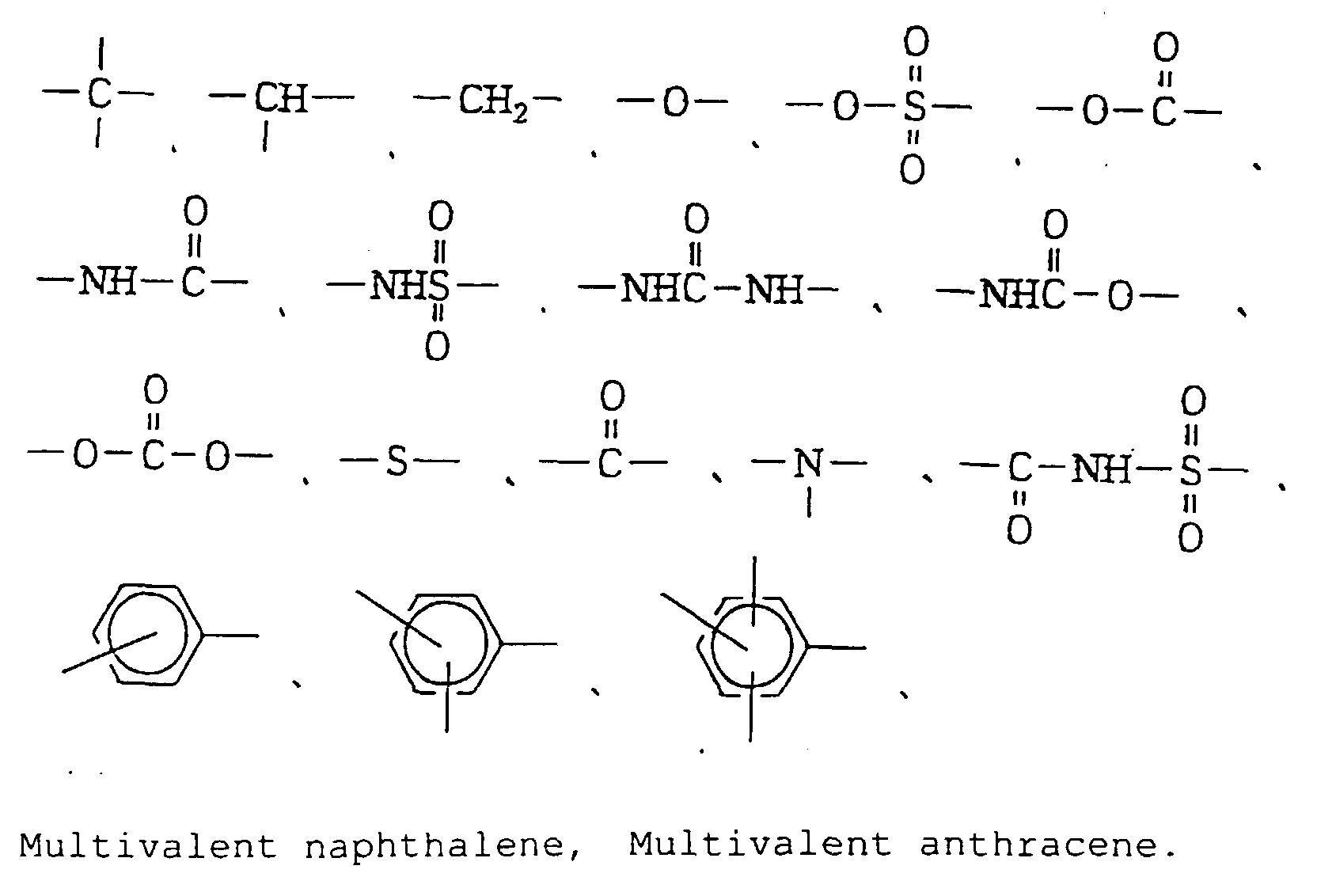
- When the multivalent connecting groups have substituents, the substituents which can be used include alkyl groups each having 1 to 20 carbon atoms such as methyl and ethyl, aryl groups each having 6 to 16 carbon atoms such as phenyl and naphthyl, hydroxyl, carboxyl, sulfonamido, N-sulfonylamido, acyloxy groups each having 1 to 6 carbon atoms such as acetoxy, alkoxyl groups each having 1 to 6 carbon atoms such as methoxy and ethoxy, halogen atoms such as chlorine and bromine, alkoxycarbonyl groups each having 2 to 7 carbon atoms such as methoxycarbonyl, ethoxycarbonyl and cyclohexylcarbonyl, cyano, and carbonate groups such as t-butyl carbonate.
- When R1 to R5 represent aryl groups or substituted aryl groups, the aryl groups include carbocyclic aryl groups and heterocyclic aryl groups. As the carbocyclic aryl groups, ones each having 6 to 19 carbon atoms, such as phenyl, naphthyl, anthracenyl and pyrenyl, are used. As the heterocyclic aryl groups, ones each having 3 to 20 carbon atoms and 1 to 5 heteroatoms, such as pyridyl, furyl, quinolyl obtained by cyclocondensation of a benzene ring, benzofuryl, thioxanthone and carbazole, are used. When R1 to R5 represent alkyl groups or substituted alkyl groups, the alkyl groups which are used include straight-chain, branched or cyclic ones each having 1 to 25 carbon atoms, such as methyl, ethyl, isopropyl, t-butyl and cyclohexyl.
- When R1 to R5 are substituted aryl groups, substituted heteroaryl groups or substituted alkyl groups, the substituents include alkoxyl groups each having 1 to 10 carbon atoms such as methoxy and ethoxy; halogen atoms such as fluorine, chlorine and bromine; halogen-substituted alkyl groups such as trifluoromethyl and trichloromethyl; alkoxycarbonyl or aryloxycarbonyl groups each having 2 to 15 carbon atoms such as methoxycarbonyl, ethoxycarbonyl, t-butyloxycarbonyl and p-chlorophenyloxycarbonyl; hydroxyl; acyloxy groups such as acetyloxy, benzoyloxy and p-diphenylaminobenzoyloxy; carbonate groups such as t-butyloxycarbonyloxy; ether groups such as t-butyloxycarbonylmethyloxy and 2-pyranyloxy; substituted or unsubstituted amino groups such as amino, dimethylamino, diphenylamino, morpholino and acetylamino; thioether groups such as methylthio and phenylthio; alkenyl groups such as vinyl and styryl; nitro; cyano; acyl groups such as formyl, acetyl and benzoyl; aryl groups such as phenyl and naphthyl; and heteroaryl such as pyridyl. Further, when R1 to R5 are substituted aryl or substituted heteroaryl groups, alkyl groups such as methyl and ethyl can be used as the substituents, in addition to the above-mentioned substituents.
- When R1 represents a cyclic imido group, the cyclic imido groups which can be used include ones each having 4 to 20 carbon atoms such as succinimido, phthalimido, cyclohexanedicarboximido and norbornendicarboximido.
- Of the above, particularly preferred as R1 are the aryl groups substituted by electron attractive groups such as halogen, cyano and nitro, the alkyl groups substituted by electron attractive groups such as halogen, cyano and nitro, the secondary or tertiary branched alkyl groups, the cyclic alkyl groups and the cyclic imido groups.
- Further, of the above, particularly preferred as R2 to R5 are the aryl groups substituted by electron attractive groups such as halogen, cyano and nitro, the alkyl groups substituted by electron attractive groups such as halogen, cyano and nitro, and the secondary or tertiary branched alkyl groups.
- Of the above, R6 to R11 are preferably the alkyl groups or the aryl groups, and it is preferred that any two or three of R6, R7 and R8 form a ring, and that R9 and R11 or R10 and R11 form a ring. In this case, the alkyl group and the aryl groups may have substituents. Preferred examples of the substituents include methyl, methoxy and halogen atoms.
- Of the polarity converting polymers having the functional groups represented by general formulas (1) to (5), the polymers having the functional groups represented by formulas (1), (4) and (5) are preferred. Of the polymers having the functional groups represented by general formula (1), polymers having secondary alkyl groups represented by the following general formula (6) are particularly preferred.wherein R6 and R7 each represents a substituted or unsubstituted alkyl group or a substituted or unsubstituted aryl group, and R6 and R7 may form a ring together with a secondary carbon atom (CH) with which they are combined.
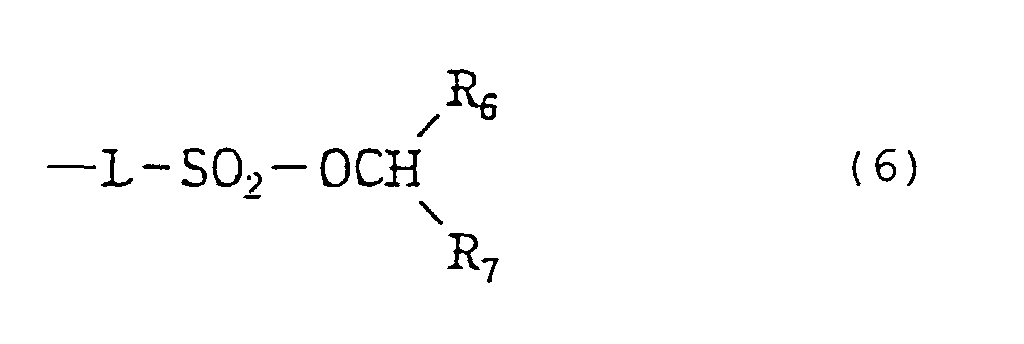
- When R6 and R7 represent substituted or unsubstituted alkyl groups, the alkyl groups include straight-chain, branched or cyclic alkyl groups such as methyl, ethyl, isopropyl, t-butyl and cyclohexyl, and ones each having 1 to 25 carbon atoms are suitably used.
- When R6 and R7 represent substituted or unsubstituted aryl groups, the aryl groups include carbocyclic aryl groups and heterocyclic aryl groups. As the carbocyclic aryl groups, ones each having 6 to 19 carbon atoms, such as phenyl, naphthyl, anthracenyl and pyrenyl, are used. As the heterocyclic aryl groups, ones each having 3 to 20 carbon atoms and 1 to 5 heteroatoms, such as pyridyl, furyl, quinolyl obtained by cyclocondensation of a benzene ring, benzofuryl, thioxanthone and carbazole, are used.
- When R6 and R7 are substituted alkyl groups or substituted aryl groups, the substituents include alkoxyl groups each having 1 to 10 carbon atoms such as methoxy and ethoxy; halogen atoms such as fluorine, chlorine and bromine; halogen-substituted alkyl groups such as trifluoromethyl and trichloromethyl; alkoxycarbonyl or aryloxycarbonyl groups each having 2 to 15 carbon atoms such as methoxycarbonyl, ethoxycarbonyl, t-butyloxycarbonyl and p-chlorophenyloxycarbonyl; hydroxyl; acyloxy groups such as acetyloxy, benzoyloxy and p-diphenylaminobenzoyloxy; carbonate groups such as t-butyloxycarbonyloxy; ether groups such as t-butyloxycarbonylmethyloxy and 2-pyranyloxy; substituted or unsubstituted amino groups such as amino, dimethylamino, diphenylamino, morpholino and acetylamino; thioether groups such as methylthio and phenylthio; alkenyl groups such as vinyl and styryl; nitro; cyano; acyl groups such as formyl, acetyl and benzoyl; aryl groups such as phenyl and naphthyl; and heteroaryl such as pyridyl.
- Further, when R6 and R7 are substituted aryl groups, alkyl groups such as methyl and ethyl can be used as the substituents, in addition to the above-mentioned substituents.
- As R6 and R7, described above, substituted or unsubstituted alkyl groups are preferred in terms of excellent storage stability of the printing plates, and secondary alkyl groups substituted by electron attractive groups such as alkoxyl, carbonyl, alkoxycarbonyl, cyano and halogen, or secondary alkyl groups such as cyclohexyl and norbonyl are particularly preferred in terms of storage stability. Compounds in which the chemical shift of the secondary methine hydrogen in the proton NMR in deuterio chloroform appears in a magnetic field lower than 4.4 ppm, and compounds in which the chemical shift appears in a magnetic field lower than 4.6 ppm are more preferred.
- The reason why the secondary alkyl groups substituted by electron attractive groups are thus particularly preferred is considered that carbocations which seem to be produced as intermediates in the thermal decomposition reaction are unstabilized by the electron attractive groups to inhibit the decomposition.
- Specifically, it is particularly preferred that -CHR6R7 has structures represented by the following formulas:

- In formula (6), L has the same meaning as given for formulas (1) to (5).
- Specific examples of monomers having the functional groups represented by formulas (1) to (5) and used in synthesis of the polarity converting polymers contained in the recording layers of the heat-sensitive lithographic printing plates of the invention are shown below:
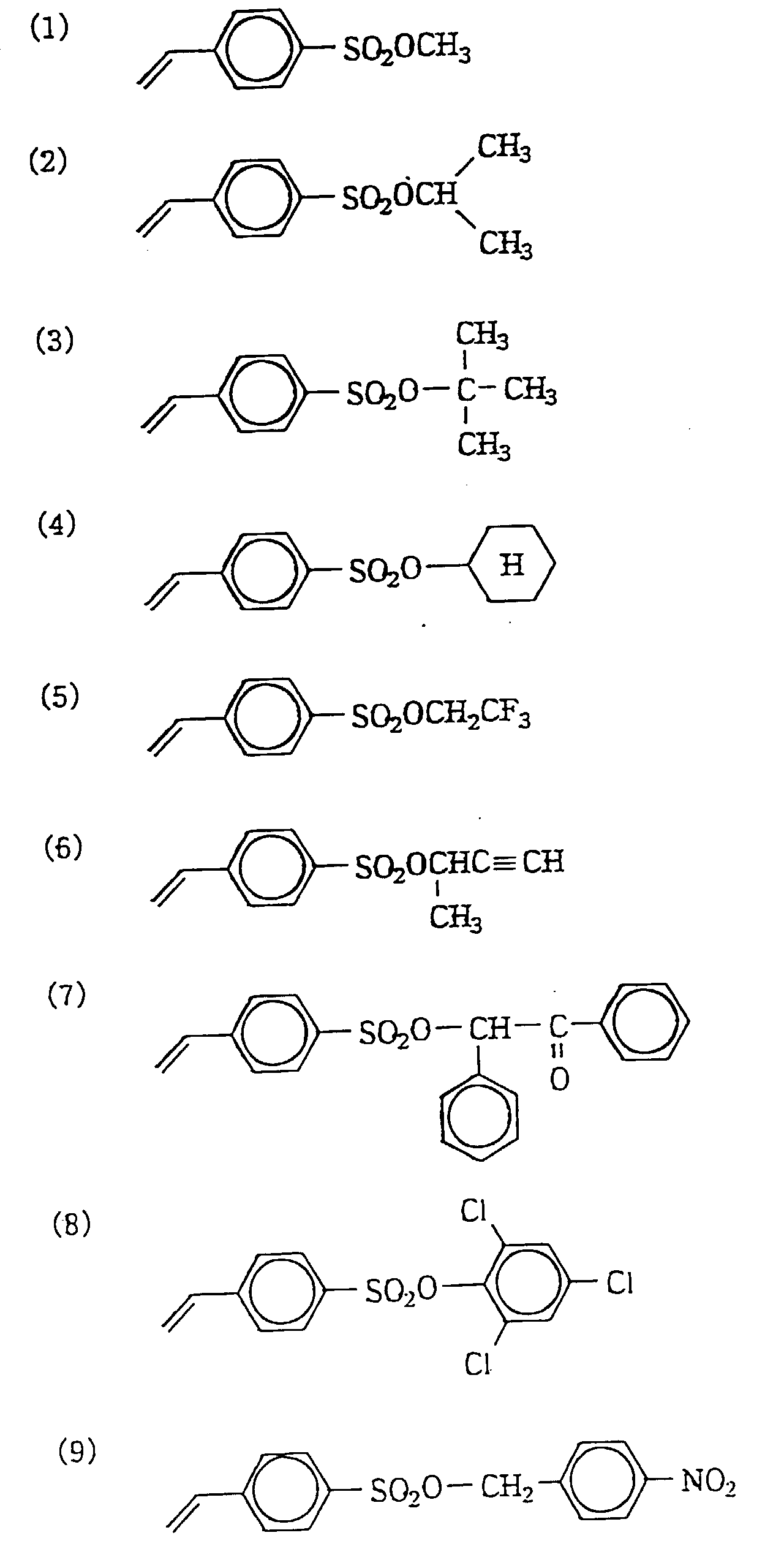
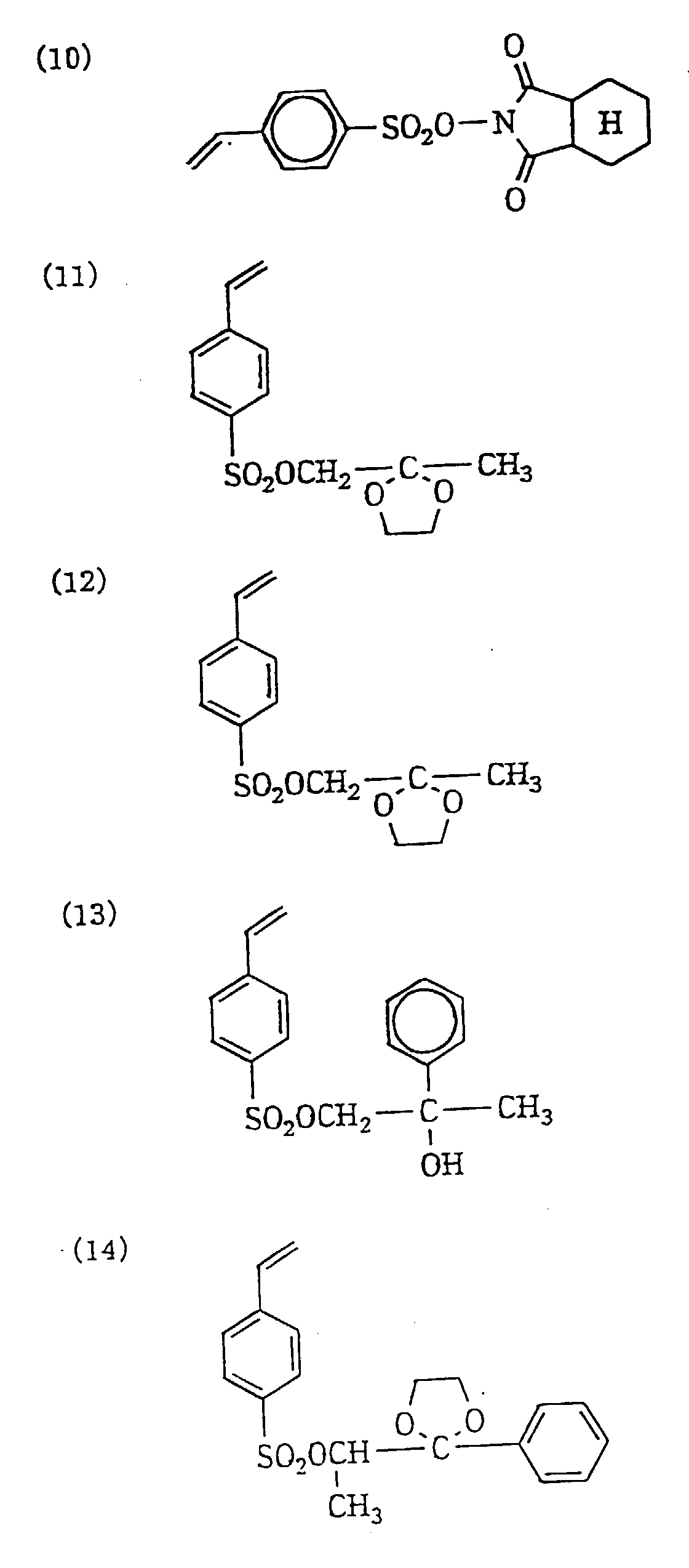
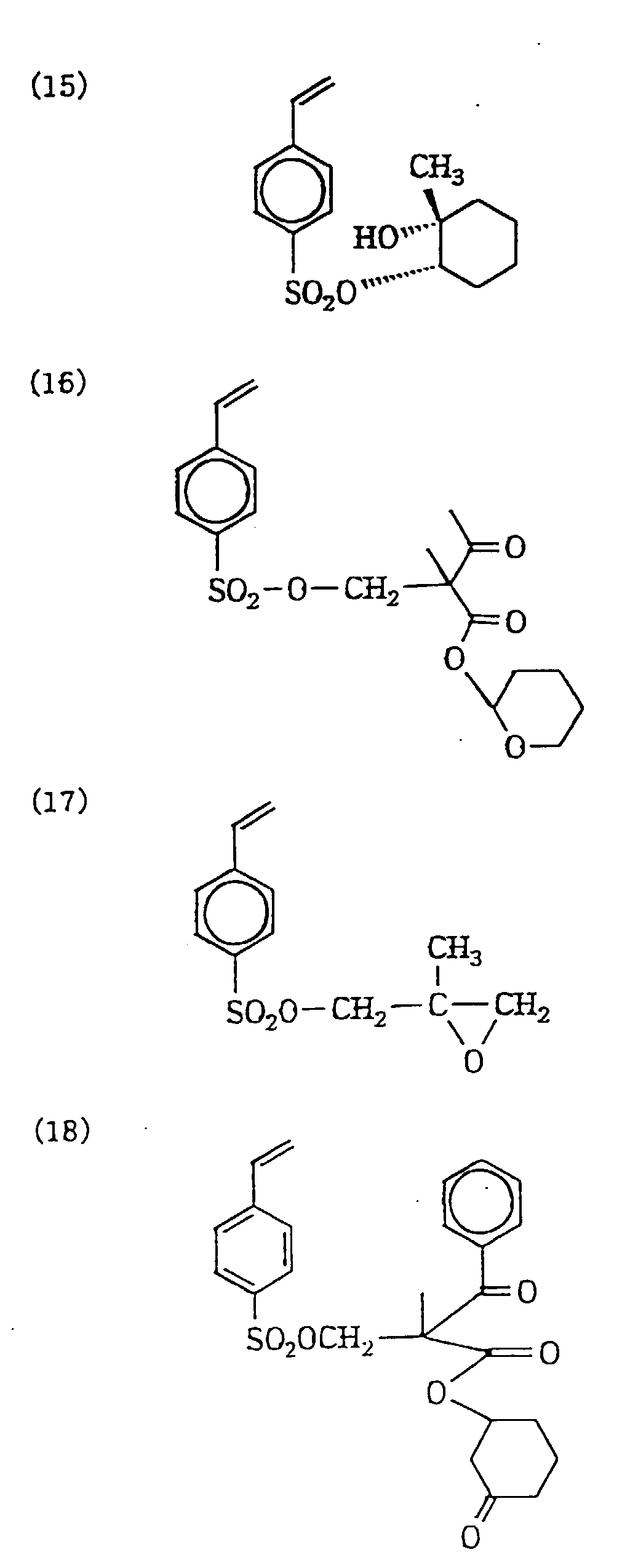
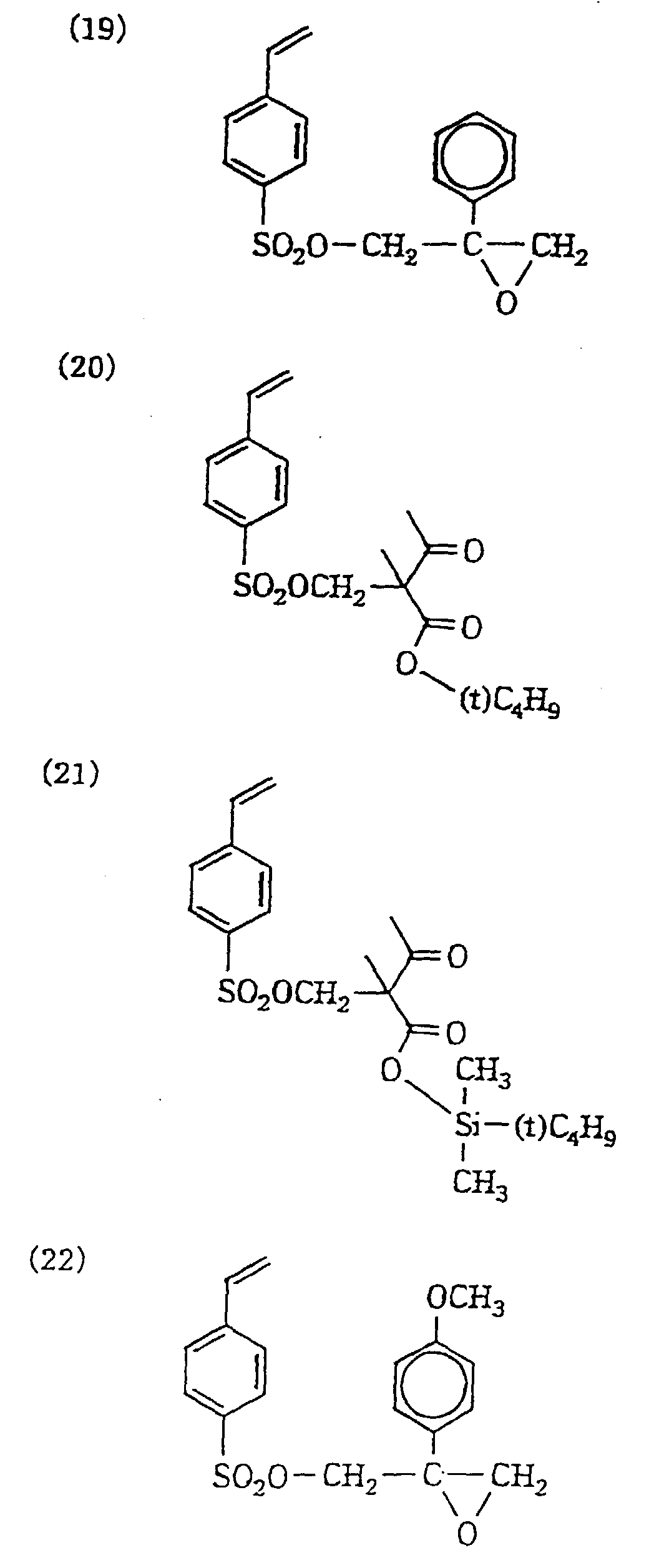

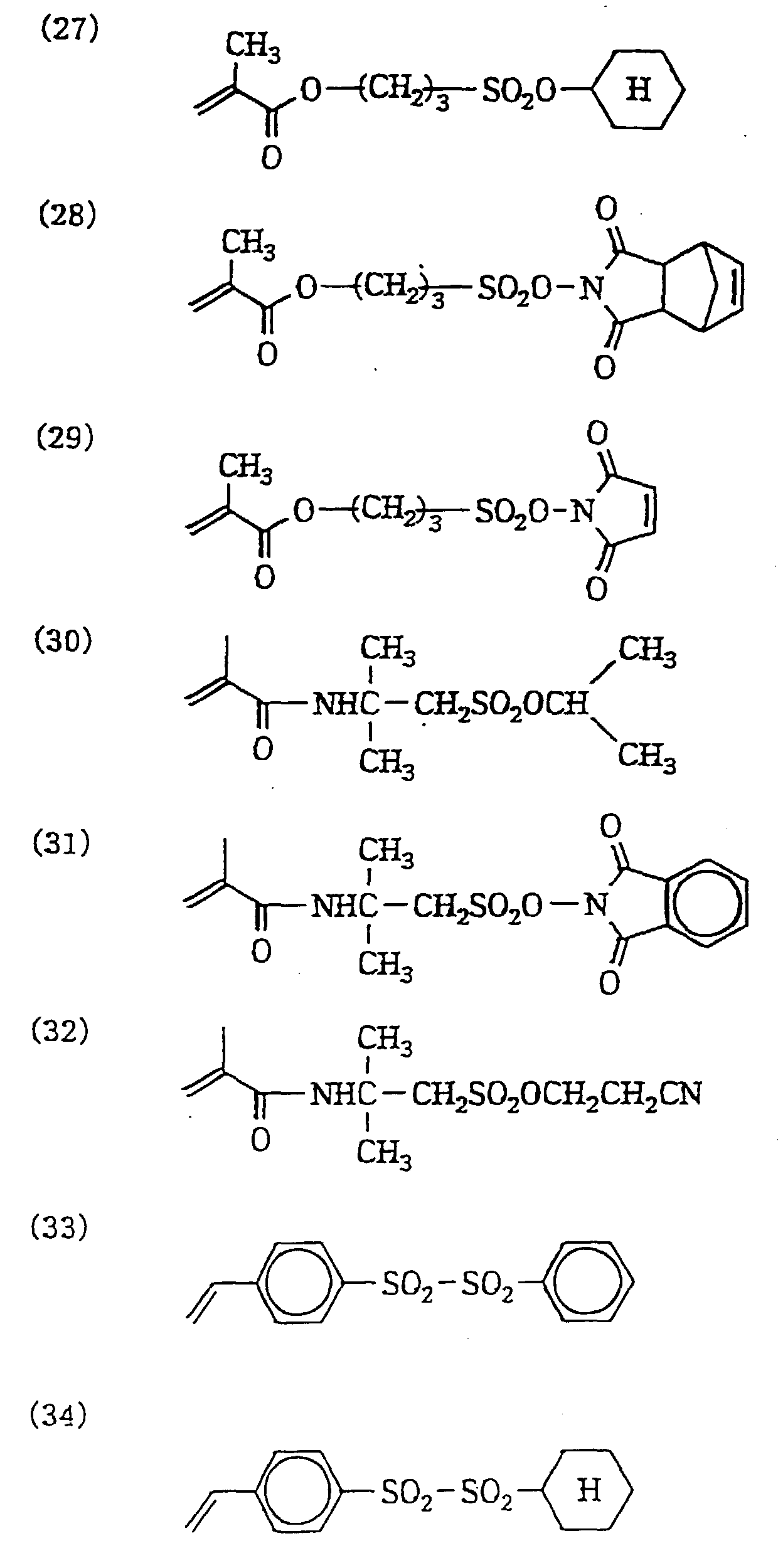
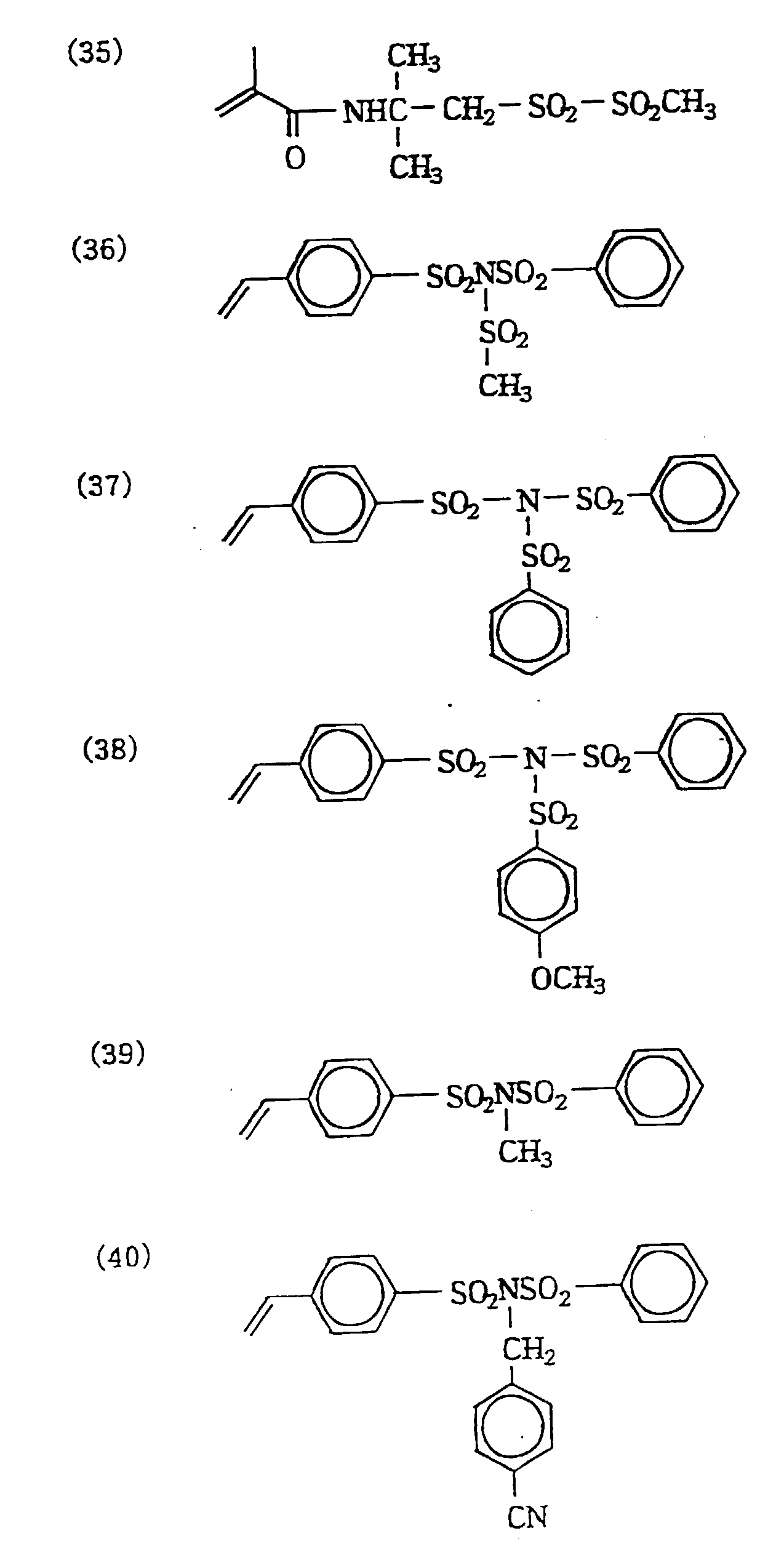
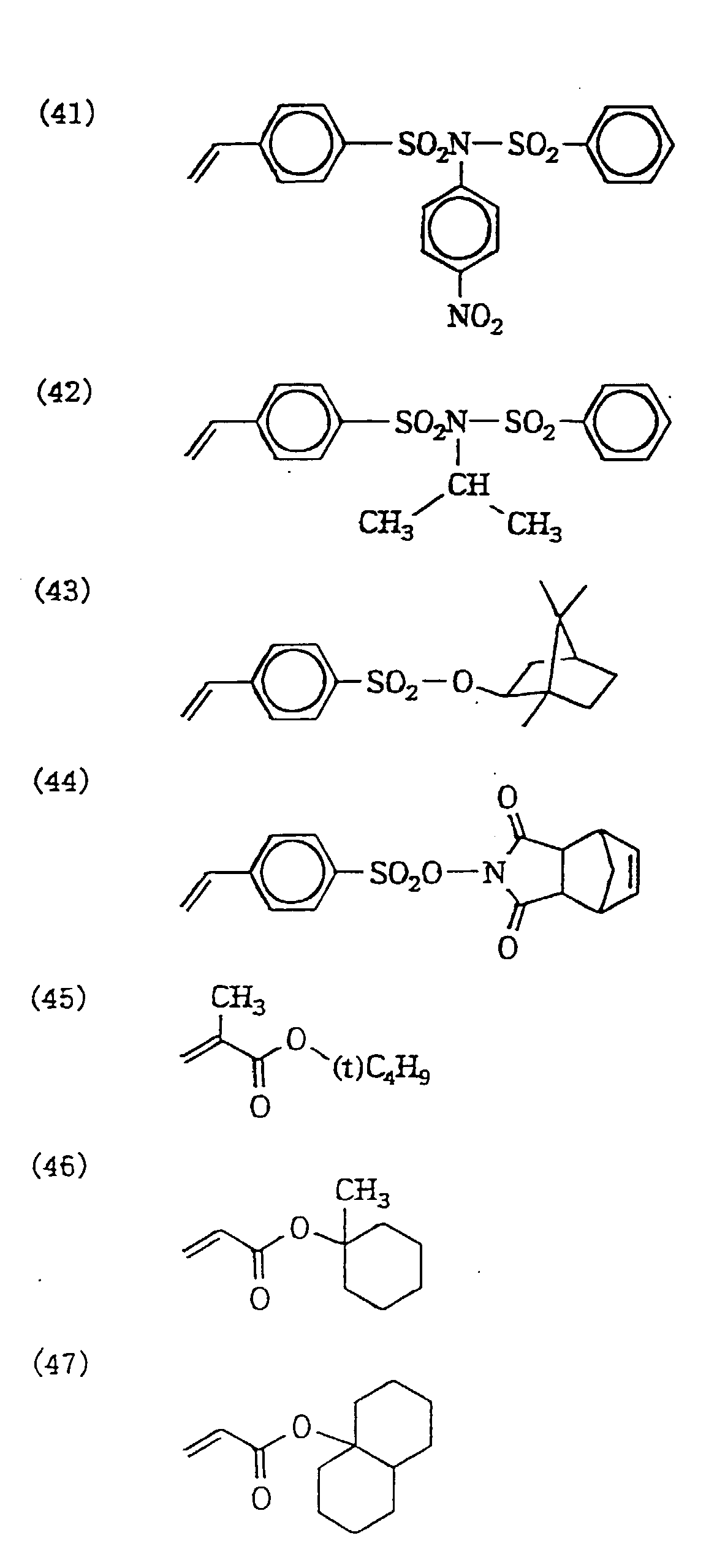

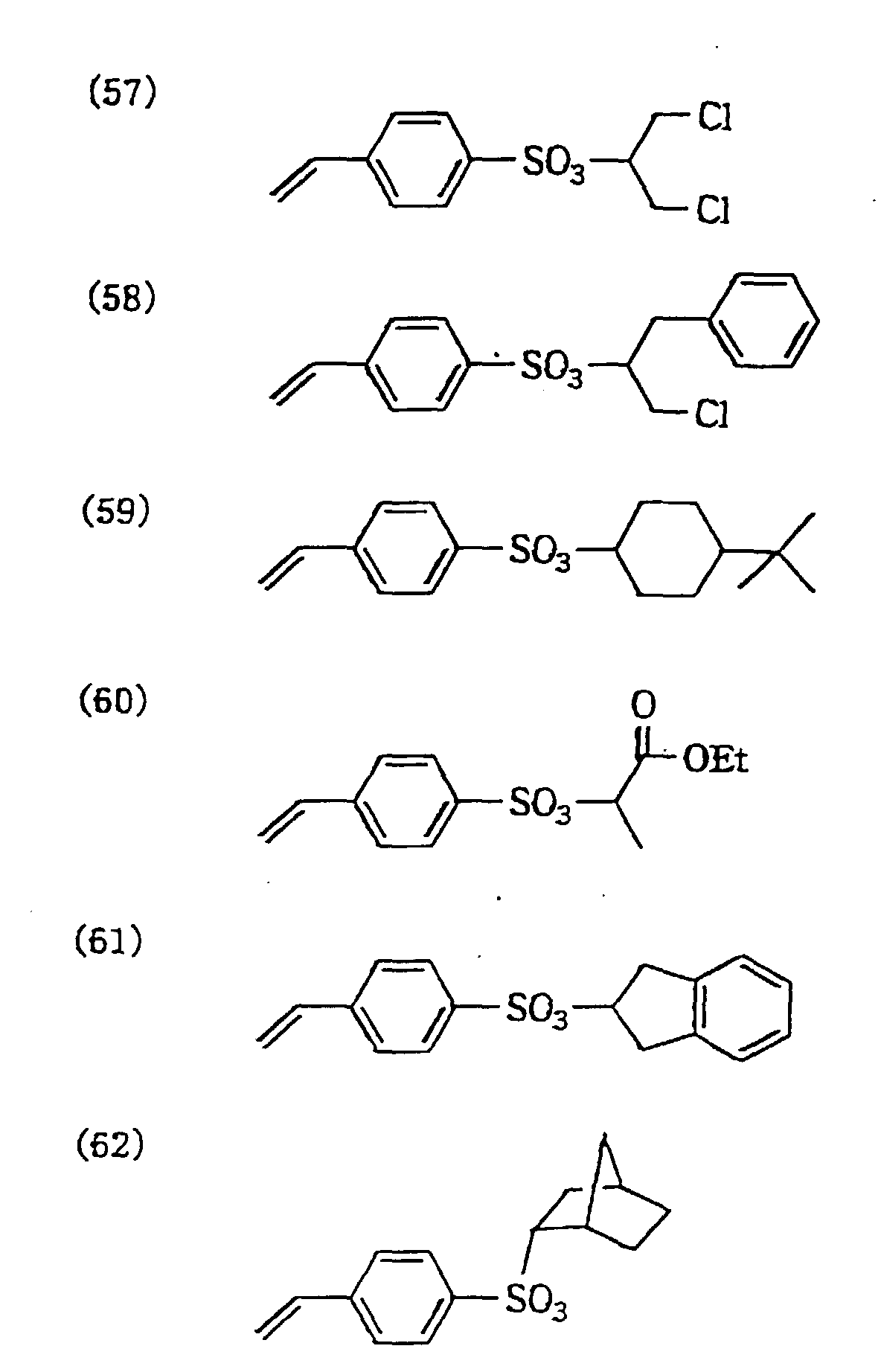
- In the invention, the polarity converting polymers are used which are obtained by radical polymerization using at least one selected from the monomers having the functional groups represented by formulas (1) to (5). As such polymers, homopolymers may be used in which only one kind of monomer selected from the monomers having the functional groups represented by formulas (1) to (5) is used, but copolymers using two or more of them or copolymers of these monomers with other monomers may also be used.
- In the invention, the polarity converting polymers more preferably used are copolymers obtained by radical polymerization of the above-mentioned monomers with other known monomers.
- The other monomers used in the copolymers include, for example, known monomers such as acrylates, methacrylates, acrylamide derivatives, methacrylamide derivatives, vinyl esters, styrene derivatives, acrylic acid, methacrylic acid, acrylonitrile, maleic anhydride and maleimide.
- Specific examples of the acrylates include methyl acrylate, ethyl acrylate, n- or i-propyl acrylate, n-, i-, sec-or t-butyl acrylate, amyl acrylate, 2-ethylhexyl acrylate, dodecyl acrylate, chloroethyl acrylate, 2-hydroxyethyl acrylate, 2-hydroxypropyl acrylate, 5-hydroxypentyl acrylate, cyclohexyl acrylate, allyl acrylate, trimethylolpropane monoacrylate, pentaerythritol monoacrylate, benzyl acrylate, methoxybenzyl acrylate, chlorobenzyl acrylate, hydroxybenzyl acrylate, hydroxyphenethyl acrylate, dihydroxyphenethyl acrylate, furfuryl acrylate, tetrahydrofurfuryl acrylate, phenyl acrylate, hydroxyphenyl acrylate, chlorophenyl acrylate, sulfamoylphenyl acrylate and 2-(hydroxyphenyl-carbonyloxy)ethyl acrylate.
- Specific examples of the methacrylates include methyl methacrylate, ethyl methacrylate, n- or i-propyl methacrylate, n-, i-, sec- or t-butyl methacrylate, amyl methacrylate, 2-ethylhexyl methacrylate, dodecyl methacrylate, chloroethyl methacrylate, 2-hydroxyethyl methacrylate, 2-hydroxypropyl methacrylate, 5-hydroxypentyl methacrylate, cyclohexyl methacrylate, allyl methacrylate, trimethylolpropane monomethacrylate, pentaerythritol monomethacrylate, glycidyl methacrylate, benzyl methacrylate, methoxybenzyl methacrylate, chlorobenzyl methacrylate, hydroxybenzyl methacrylate, hydroxyphenethyl methacrylate, dihydroxyphenethyl methacrylate, furfuryl methacrylate, tetrahydrofurfuryl methacrylate, phenyl methacrylate, hydroxyphenyl methacrylate, chlorophenyl methacrylate, sulfamoylphenyl methacrylate and 2-(hydroxyphenylcarbonyloxy)ethyl methacrylate.
- Specific examples of the acrylamide derivatives include acrylamide, N-methylacrylamide, N-ethylacrylamide, N-propylacrylamide, N-butylacrylamide, N-benzylacrylamide, N-hydroxyethylacrylamide, N-phenylacrylamide, N-tolylacrylamide, N-(hydroxyphenyl)acrylamide, N-(sulfamoylphenyl)acrylamide, N-(phenylsulfonyl)acrylamide, N-(tolylsulfonyl)acrylamide, N,N-dimethylacrylamide, N-methyl-N-phenylacrylamide and N-hydroxyethyl-N-methylacrylamide.
- Specific examples of the methacrylamide derivatives include methacrylamide, N-methylmethacrylamide, N-ethylmethacrylamide, N-propylmethacrylamide, N-butylmethacrylamide, N-benzylmethacrylamide, N-hydroxyethylmethacrylamide, N-phenylmethacrylamide, N-tolylmethacrylamide, N-(hydroxyphenyl)methacrylamide, N-(sulfamoylphenyl)methacrylamide, N-(phenylsulfonyl)methacrylamide, N-(tolylsulfonyl)methacrylamide, N,N-dimethylmethacrylamide, N-methyl-N-phenylmethacrylamide and N-hydroxyethyl-N-methylmethacrylamide.
- Specific examples of the vinyl esters include vinyl acetate, vinyl butyrate and vinyl benzoate.
- Specific examples of the styrene derivatives include styrene, methylstyrene, dimethylstyrene, trimethylstyrene, ethylstyrene, propylstyrene, cyclohexylstyrene, chloromethylstyrene, trifluoromethylstyrene, ethoxymethylstyrene, acetoxymethylstyrene, methoxystyrene, dimethoxystyrene, chlorostyrene, dichlorostyrene, bromostyrene, iodostyrene, fluorostyrene and carboxystyrene.
- Of these other monomers, particularly preferably used are the acrylates, the methacrylates, the acrylamide derivatives, the methacrylamide derivatives, the vinyl esters, the styrene derivatives, acrylic acid, methacrylic acid and acrylonitrile, each having 20 or less carbon atoms.
- The ratio of the monomers having the functional groups represented by formulas (1) to (5) used in the synthesis of the copolymers is preferably from 5% to 99% by weight, and more preferably from 10% to 95% by weight.
- Specific examples of the polarity converting polymers having the functional groups represented by formulas (1) to (5) are shown below:
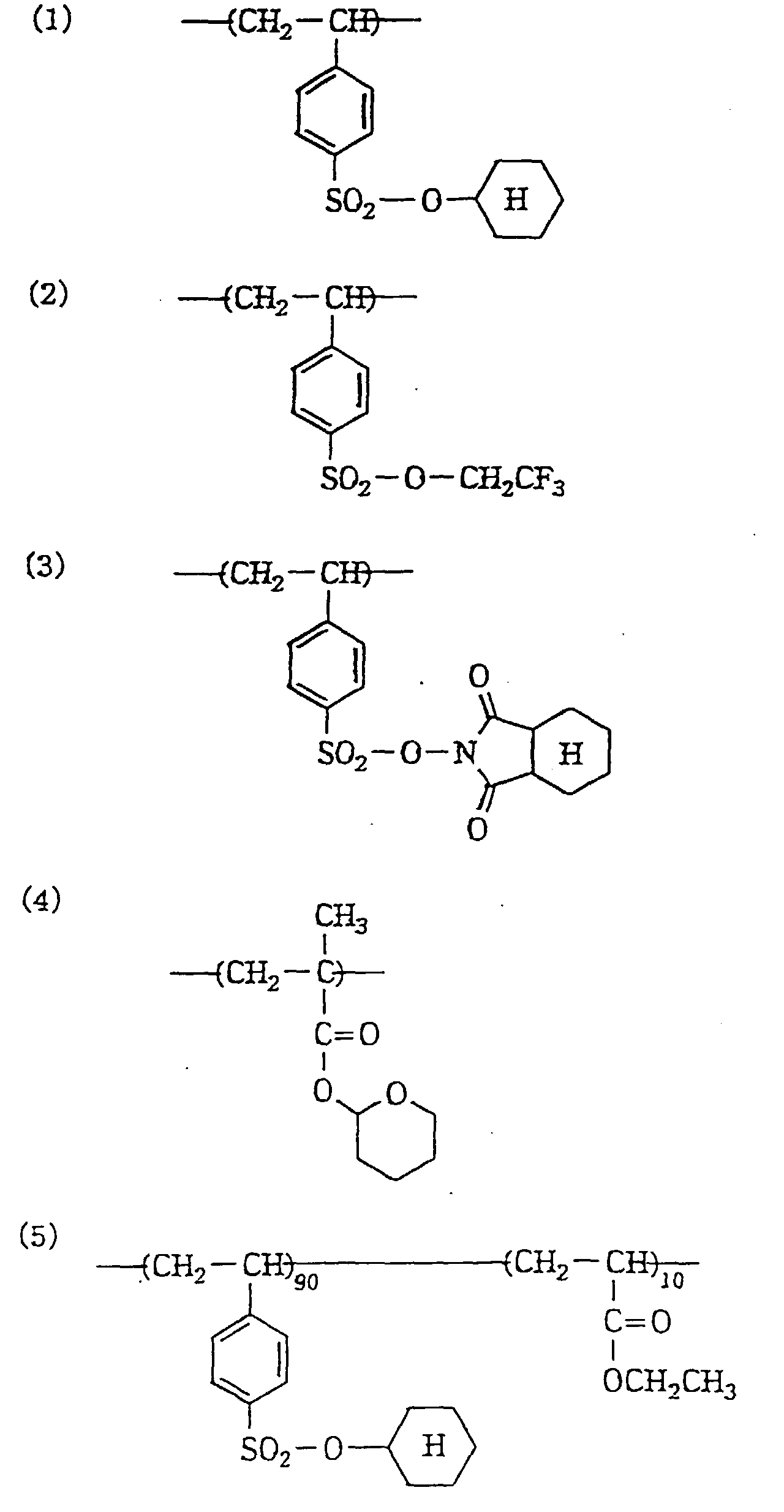

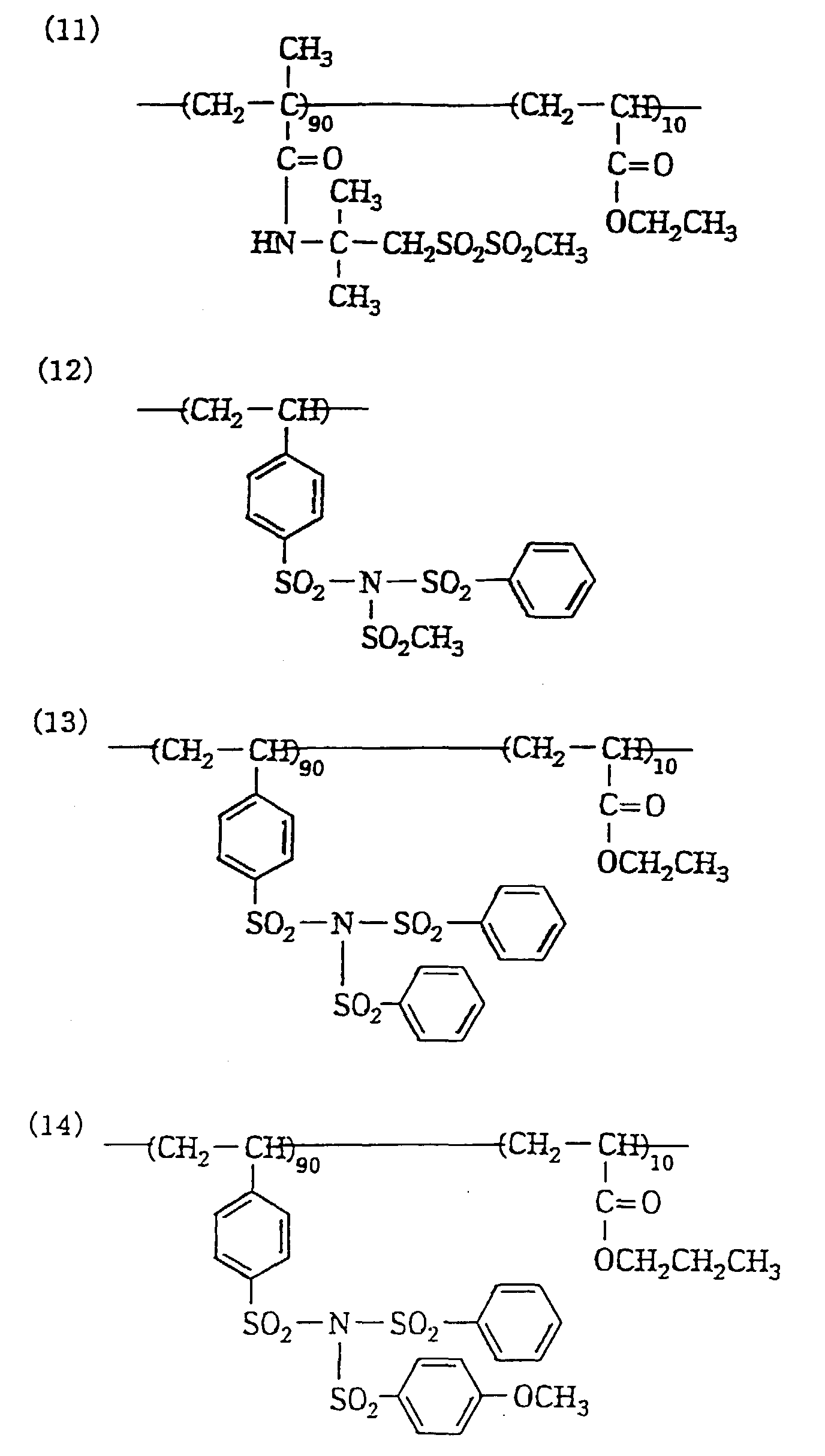


- In the formulas, the numerals and n indicate the molar number of composition unit in polymers.
- The weight average molecular weight of the polarity converting polymers having at least one of the functional groups represented by formulas (1) to (5), which are used in the invention, is preferably 2000 or more, and more preferably within the range of 5,000 to 300,000. The number average molecular weight thereof is preferably 800 or more, and more preferably within the range of 1,000 to 250,000. The polydisperse degree (weight average molecular weight/ number average molecular weight) is preferably 1 or more, and more preferably within the range of 1.1 to 10. Although these polymers may be any of random copolymers, block copolymers and graft copolymers, they are preferably random copolymers.
- In the next place, the image-forming layer containing a hydrophilic polymer in which a side chain changes to hydrophobic by heat provided on the hydrophilic insulating layer or the hydrophilic crosslinked insulating layer of the lithographic printing plate precursor according to the present invention will be described below.
- The hydrophilic polymers for use in the image-forming layer according to the present invention are not particularly limited so long as they are polymers having any group selected from the group consisting of carboxylic acid groups or carboxylate groups which cause decarboxylation by heat, but is preferably at least any selected from those represented by the following formula (2) or (3):wherein X is selected from the group consisting of elements of group IV to group VI, oxides of the above elements, sulfides of the above elements, selenium compounds of the above elements, and tellurium compounds of the above elements; P represents a polymer main chain; -L- represents a divalent linking group; R4 and R5, which may be the same or different, each represents a monovalent group; and M is selected from the group consisting of alkali metal, alkaline earth metal and onium.

- Specific examples of the polymers having any group selected from the group consisting of carboxylic acid groups or carboxylate groups which cause decarboxylation by heat according to the present invention are shown below.
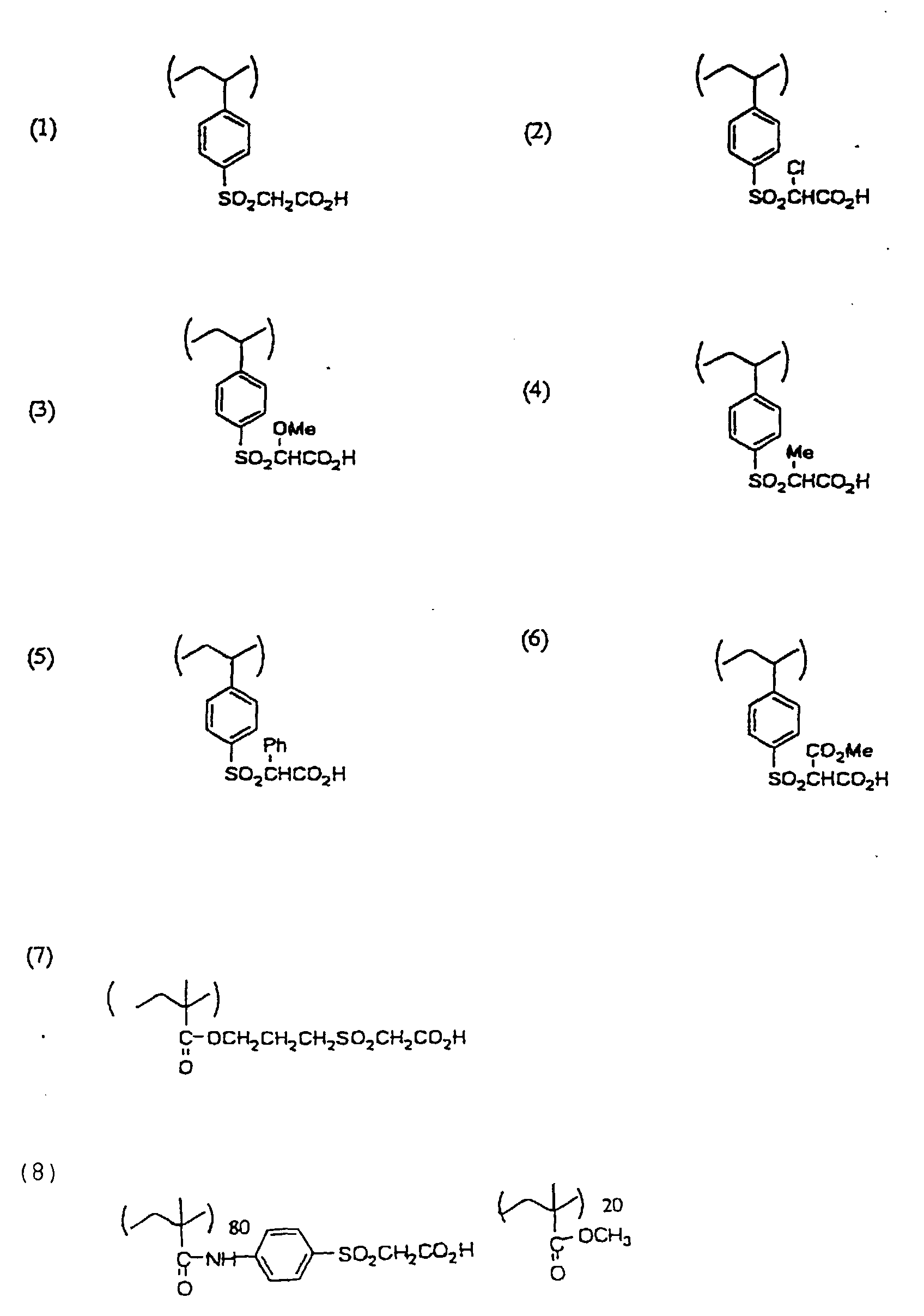
- When the polarity converting polymers contained in the recording layers of the heat-sensitive lithographic printing plates of the invention are synthesized, solvents such as tetrahydrofuran and ethylene dichloride can be used alone or as a mixture of two or more of them.
- The radical polymerization initiators used in synthesizing the polarity converting polymers include known compounds such as azo initiators and peroxide initiators.
- In the heat-sensitive lithographic printing plates of the invention, the recording layers may be composed of either the polarity converting polymers alone or the polymers and other components as needed, within the range that the effects of the invention are not impaired. In the recording layer, the polymer can be used in an amount of 50% to 90% by weight, preferably 70% to 90% by weight, based on the total solid content of the recording layer. An amount added of less than 50% by weight results in unclear printed images, whereas exceeding 90% by weight results in insufficient image formation by laser exposure.
- Other various components may be added to the recording layers. For example, dyes having high absorption in the visible light region can be used as coloring agents for images.
- Specific examples of the dyes include Oil Yellow #101, Oil Yellow #103, Oil Pink #312, Oil Green BG, Oil Blue BOS, Oil Blue #603, Oil Black BY, Oil Black BS, Oil Black T-505 (the above dyes are manufactured by Orient Kagaku Kogyo Co., Ltd.); Victoria Pure Blue, Crystal Violet (CI 42555), Methyl Violet (CI 42535), Ethyl Violet, Rhodamine B (CI 145170B), Malachite Green (CI 42000), Methylene Blue (CI 52015) and dyes described in JP-A-62-293247.
- These dyes discolor after laser exposure, so that image areas are easily distinguished from non-image areas. Accordingly, they are preferably added. The amount thereof added is from 0.01% to 10% by weight, based on the total solid content of materials for the recording layer.
- Further, the recording layers used in the invention can contain nonionic surfactants as described in JP-A-62-251740 and JP-A-3-208514, or amphoteric surfactants as described in JP-A-59-121044 and JP-A-4-13149, for widening stability to printing conditions.
- Specific examples of the nonionic surfactants include sorbitan tristearate, sorbitan monopalmitate, sorbitan trioleate, stearic monoglyceride and polyoxyethylene nonyl phenyl ether.
- Specific examples of the amphoteric surfactants include alkyldi(aminoethyl)glycines, alkylpolyaminoethylglycine hydrochlorides, 2-alkyl-N-carboxyethyl-N-hydroxyethyl-imidazoliumbetaines and N-tetradecyl-N,N-betaine (for example, trade name "Amorgen K" manufactured by Dai-ich Kogyo K.K.).
- The amount of the nonionic surfactants and the amphoteric surfactants contained in the materials for the recording layers is preferably from 0.05% to 15% by weight, and more preferably from 0.1% to 5% by weight.
- Further, the recording layers used in the invention may contain plasticizers for imparting flexibility to coating films. For example, polyethylene glycol, tributyl citrate, diethyl phthalate, dibutyl phthalate, dihexyl phthalate, dioctyl phthalate, tricresyl phosphate, tributyl phosphate, trioctyl phosphate, tetrahydrofurfuryl oleate, and oligomers and polymers of acrylic acid or methacrylic acid are used.
- In addition to these, epoxy compounds, vinyl ethers, hydroxymethyl group-containing phenol compounds described in JP-A-8-276558 and alkoxymethyl group-containing phenol compounds may be added. Further, for improving the strength of coating films, other polymers may be added.
- The recording layers of the heat-sensitive lithographic printing plates of the invention can usually be provided by applying solutions of the above-mentioned respective components in solvents onto the crosslinked hydrophilic layers described above. Examples of the solvents used herein include but are not limited to ethylene dichloride, cyclohexanone, methyl ethyl ketone, methanol, ethanol, propanol, ethylene glycol monomethyl ether, 1-methoxy-2-propanol, 2-methoxyethyl acetate, 1-methoxy-2-propyl acetate, dimethoxyethane, methyl lactate, ethyl lactate, N,N-dimethylacetamide, N,N-dimethylformamide, tetramethylurea, N-methylpyrrolidone, dimethyl sulfoxide, sulfolane, γ-butyrolactone, toluene and water.
- These solvents may be used alone or in combination. The concentration of the components (the total solids including additives) dissolved in the solvents is preferably from 1% to 50% by weight. In general, the amount of the components (solids) on the supports after coating and drying is preferably from 0.5 g/m to 5.0 g/m2 for the heat-sensitive lithographic printing plates, although it varies depending on the application thereof. The solutions can be applied by various methods, and examples thereof include bar coater coating, rotational coating, spray coating, curtain coating, dip coating, air knife coating blade coating and roll coating.
- The recording layers of the heat-sensitive lithographic printing plates of the invention can contain surfactants for improving coating properties, for example, fluorine surfactants as described in JP-A-62-170950. The amount of the surfactant added is preferably from 0.01% to 1% by weight, and more preferably from 0.05% to 0.5% by weight, based on the total solid content of the materials for the recording layer.
- When the heat-sensitive lithographic printing plate of the invention are subjected to image formation by laser exposure, at least one of the crosslinked hydrophilic layer and recording layer thereof is allowed to contain a light-heat converting agent. As the light-heat converting agents, all materials can be used, as long as they can absorb light rays such as ultraviolet rays, visible light rays, infrared rays and white light rays to convert them to heat. Examples thereof include carbon black, carbon graphite, pigments, phthalocyanine pigments, metal powders and metal compound powders. Particularly preferred are dyes and pigments effectively absorbing infrared rays having a wavelength of 760 nm to 1,200 nm, or metal powders and metal compound powders.
- As the dyes, commercial dyes and known dyes described in literatures (for example, Senryo Binran, edited by Yuki Gosei Kagaku Kyokai, 1970) can be utilized. Specific examples thereof include azo dyes, metal complex dyes, pyrazolone azo dyes, anthraquinone dyes, phthalocyanine dyes, carbonium dyes, quinoneimine dyes, methine dyes, cyanine dyes and metal thiolate complexes.
- Preferred examples of the dyes include cyanine dyes described in JP-A-58-125246, JP-A-59-84356, JP-A-59-202829 and JP-A-60-78787, methine dyes described in JP-A-58-173696, JP-A-58-181690 and JP-A-58-194595, naphthoquinone dyes described in JP-A-58-112793, JP-A-58-224793, JP-A-59-48187, JP-A-59-73996, JP-A-60-52940 and JP-A-60-63744, squarylium dyes described in JP-A-58-112792 and cyanine dyes described in British Patent 434,875.
- Further, near infrared absorption sensitizers described in U.S. Patent 5,156,938 are also preferably used. In addition, substituted arylbenzo(thio)pyrylium salts described in U.S. Patent 3,881,924, trimethinethiapyrylium salts described in JP-A-57-142645 (U.S. Patent 4,327,169), pyrylium compounds described in JP-A-58-181051, JP-A-58-220143, JP-A-59-41363, JP-A-59-84248, JP-A-59-84249, JP-A-59-146063 and JP-A-59-146061, cyanine dyes described in JP-A-59-216149, pentamethinethiopyrylium salts described in U.S. Patent 4,283,475 and pyrylium compounds described in JP-B-5-13514 (the term "JP-B" as used herein means an "examined Japanese patent publication") and JP-B-5-19702 are also preferably used.
- Other preferred examples of the dyes include near infrared absorption dyes represented by formulas (I) and (II) in U.S. Patent 4,756,993.
- Of these dyes, particularly preferred are cyanine dyes, squarylium dyes, pyrylium dyes and nickel thiolate complexes.
- The pigments used in the invention are commercial pigments and pigments described in Color Index (C. I) Binran, Saishin Ganryo Binran (edited by Nippon Ganryo Gijutsu Kyokai, 1977), Saishin Ganryo Oyo Gijutsu (CMC Shuppan, 1986) and Insatsu Ink Gijutsu (CMC Shuppan, 1984).
- As the kind of pigment, there are black pigments, yellow pigments, orange pigments, brown pigments, red pigments, purple pigments, blue pigments, green pigments, fluorescent pigments, metal powder pigments and polymer binding dyes. Specifically, examples of the dyes which can be used include insoluble azo pigments, azo lake pigments, condensed azo pigments, chelate azo pigments, phthalocyanine pigments, anthraquinone pigments, perylene and perynone pigments, thioindigo pigments, quinacridone pigments, dioxazine pigments, isoindolinone pigments, quinophthalone pigments, dying lake pigments, azine pigments, nitroso pigments, nitro pigments, natural pigments, fluorescent pigments, inorganic pigments and carbon black. Of these pigments, preferred is carbon black.
- These pigments may be surface treated to use them, or used without surface treatment. Possible surface treatment methods include methods of coating surfaces of the pigments with resins or wax, methods of adhering surfactants to surfaces of the pigments, and methods of combining reactive substances (for example, silane coupling agents, epoxy compounds and polyisocyanates) with surfaces of the pigments. The above-mentioned surface treatment methods are described in Kinzoku Sekken no Seishitsu to Oyo (Saiwai Shobo), Insatsu Ink Gijutsu (CMC Shuppan, 1984) and Saishin Ganryo Oyo Gijutsu (CMC Shuppan, 1986).
- The particle size of the pigments is preferably within the range of 0.01 µm 10 µm, more preferably within the range of 0.05 µm to 1µm, and particularly preferably within the range of 0.1 µm to 1 µm. When the particle size of the pigments is less than 0.01 µm, the stability of dispersed particles in coating solutions for the recording layers becomes unfavorable. On the other hand, exceeding 10 µm results in unfavorable uniformity of the recording layers.
- As methods for dispersing the pigments, known dispersing techniques used in the production of ink or toner can be used. Dispersing apparatus include ultrasonic dispersers, sand mills, attriters, pearl mills, super mills, ball mills, impellers, dispersers, KD mills, colloid mills, dynatrons, three-roll mills and pressure kneaders. Details thereof are described in Saishin Ganryo Oyo Gijutsu (CMC Shuppan, 1986).
- The metal powders and the metal compound powders are described below. The metal compounds include specifically metal oxides, metal nitrides, metal sulfides and metal carbides.
- The metals include Mg, Al, Si, Ti, V, Cr, Mn, Fe, Co, Ni, Cu, Zn, Ga, Ge, Y, Zr, Nb, Mo, Tc, Ru, Pd, Ag, Cd, In, Sn, Sb, Hf, Ta, W, Re, Os, Ir, Pt, Au and Pb. Of these, the metals which particularly easily bring about the exothermic reaction such as the oxidation reaction by heat energy are preferred, and preferred examples thereof include Al, Si, Ti, V, Cr, Mn, Fe, Co, Ni, Cu, Zn, Y, Zr, Mo, Ag, In, Sn and W. Further, as the metals high in the absorption efficiency of radiant rays and high in heat energy of the self-exothermic reaction, Fe, Co, Ni, Cr, Ti and Zr are preferred.
- The powder may be composed of not only one kind of metal simple substance selected from these metals, but also two or more kinds of them. Further, the powder may be composed of a combination of the metal and the metal oxide, the metal nitride, the metal sulfide or the metal carbide. The metal simple substances are higher in heat energy of the self-exothermic reaction such as oxidation. However, handling thereof in air is complicated, and the contact thereof with air results in danger of spontaneous ignition. It is therefore preferred that the metal simple substances are coated with the oxides, the nitrides, the sulfides or the carbides to a thickness of several nanometers from surfaces thereof.
- Further, they may be used either in the particle form, or in the thin film form such as vapor-deposited films. When they are used in combination with organic materials, it is better to use them in the particle form. The size of the particles is 10 µm or less, preferably from 0.005 µm to 5 µm, and more preferably, from 0.01 µm to 3 µm. Less than 0.01 µm causes difficulty in dispersing the particles, whereas exceeding 10 µm results in poor resolution of printed matter.
- Of the above-mentioned fine metal powders used in the invention, iron powders are preferred. Although the iron powders are all preferred, iron alloy powders mainly composed of α-Fe are particularly preferred among others. These powders may contain atoms such as Al, Si, S, Sc, Ca, Ti, V, Cr, Cu, Y, Mo, Rh, Pd, Ag, Sn, Sb, Te, Ba, Ta, W, Re, Au, Hg, Pb, Bi, La, Ce, Pr, Nd, P, Co, Mn, Zn, Ni, Sr and B, in addition to the specified atoms. In particular, it is preferred that the powders contain at least one of Al, Si, Ca, Y, Ba, La, Nd, Co, Ni and B, in addition to α-Fe, and it is more preferred that the powders contain at least one of Co, Y and Al. The Co content is preferably from 0 atomic percent to 40 atomic percent, more preferably from 15 atomic percent to 35 atomic percent, and still more preferably from 20 atomic percent to 35 atomic percent, based on Fe. The Y content is preferably from 1.5 atomic percent to 12 atomic percent, more preferably from 3 atomic percent to 10 atomic percent, and still more preferably from 4 atomic percent to 9 atomic percent. The Al content is preferably from 1.5 atomic percent to 12 atomic percent, more preferably from 3 atomic percent to 10 atomic percent, and still more preferably from 4 atomic percent to 9 atomic percent. The fine iron alloy powders may contain small amounts of hydroxides or oxides. Details thereof are described in JP-B-44-14090, JP-B-45-18372, JP-B-47-22062, JP-B-47-22513, JP-B-46-28466, JP-B-46-38755, JP-B-47-4286, JP-B-47-12422, JP-B-47-17284, JP-B-47-18509, JP-B-47-18573, JP-B-39-10307, JP-B-46-39639, U.S. Patents 3,026215, 3,031,341, 3,100,194, 3,242,005 and 3,389,014.
- These light-heat converting materials can be used in an amount of 0.01% to 50% by weight, preferably 0.1% to 10% by weight, based on the crosslinked hydrophilic layer or the total solid content of the recording layer. The dyes can be used particularly preferably in an amount of 0.5% to 10% by weight, and the pigments can be particularly preferably used in an amount of 3.1% to 10% by weight. When the amount of the pigments or dyes added is less than 0.01% by weight, the sensitivity is lowered. On the other hand, exceeding 50% by weight results in occurrence of stains in non-image areas in printing.
- When the light-heat converting materials are used, the density of materials for the crosslinked hydrophilic layers or the recording layers is required to be at least 0.3, preferably 0.5 or more, and more preferably 1.0 or more, in the optical density (OD) at an exposure wavelength. The optical density as used herein shall be a value obtained when compositions of the materials for the crosslinked hydrophilic layers or the recording layers are applied onto transparent supports and measured by transmission.
- There is no particular limitation on the supports used in the heat-sensitive lithographic printing plates of the invention, as long as they are dimensionally stable tabular materials. Examples thereof include paper, paper laminated with plastics (for example, polyethylene, polypropylene and polystyrene), plates of metals (for example, aluminum, zinc and copper), films of plastics (for example, cellulose diacetate, cellulose triacetate, cellulose propionate, cellulose butyrate, cellulose acetate butyrate, cellulose nitrate, polyethylene terephthalate, polyethylene, polystyrene, polypropylene, polycarbonates and polyvinyl acetal), and paper or plastic films laminated or vapor deposited with the metals as described above.
- As the supports used in the invention, polyester films or aluminum plates are preferred. of these, the aluminum plates, which are good in dimensional stability and relatively inexpensive, are particularly preferred. Preferred examples of the aluminum plates include pure aluminum plates and alloy plates mainly composed of aluminum and containing trace amounts of foreign elements. Further, plastic films laminated or vapor deposited with aluminum are also preferred. The foreign elements contained in the aluminum alloys include silicon, iron, manganese, copper, magnesium, chromium, zinc, bismuth, nickel and titanium. The amount of the foreign elements contained in the alloys is 10% by weight or less. Aluminum particularly preferred in the invention is pure aluminum. However, it is foreign to produce pure aluminum in terms of refining technology, so that aluminum containing the foreign elements in trace amounts is also allowed. As described above, the aluminum plates used in the invention are not specified in their composition, and aluminum plates made of previously known materials can be appropriately utilized. The thickness of the aluminum plates used in the invention is from about 0.1 mm to about 0.6 mm, preferably from 0.15 mm to 0.4 mm, and particularly preferably from 0.2 mm to 0.3 mm.
- As described above, the heat-sensitive lithographic printing plates of the invention can be prepared. The heat-sensitive lithographic printing plates are exposed imagewise with a solid laser or a semiconductor laser emitting an infrared ray having a wavelength of 760 nm to 1,200 nm, or heated imagewise with a thermal (heat-sensitive) head to form images. In the invention, it is unnecessary to conduct the dissolution treatment, and it becomes possible to mount the printing plates on a printing machine immediately after the laser irradiation or the thermal head heating, and to perform printing. It becomes therefore unnecessary to conduct the reheating treatment between the stage such as the laser irradiation or the thermal head heating and the printing stage. Such heat-sensitive lithographic printing plates on which images are recorded are placed on an offset printing machine (i.e., an offset printing press), and used for printing of many sheets.
- The invention will be further illustrated in greater detail with reference to the following examples, which are, however, not to be construed as limiting the invention.
- Respective crosslinked hydrophilic layers were formed on respective supports as follows.
- A solution in which 200 g of colloidal silica (Snowtex R503, a 20-wt% aqueous dispersion, manufactured by Nissan Chemical Industries, Ltd.) and 5 g of aminopropyltriethoxysilane were mixed, was applied onto a corona-treated PET support having a thickness of 200 µm with a wire bar 18, and dried at 100°C for 10 minutes, thereby obtaining a crosslinked hydrophilic layer having a thickness of 4 µm.
- Fifty grams of titanium oxide having a particle size of 0.3 µm (manufactured by Titan Kogyo K.K.), 113 g of a 10% aqueous solution of polyvinyl alcohol (PVA 117, manufactured by kurarey Co., Ltd.) and 240 g of water were dispersed together with glass beads in a paint shaker (manufactured by Toyo Seiki Co., Ltd.) for 30 minutes. Further, 110 g of a 20% solution (water/ethanol ratio: 1/1 by weight) of previously hydrolyzed tetraethoxysilane and 200 g of colloidal silica (Snowtex R503, a 20-wt% aqueous dispersion, manufactured by Nissan Chemical Industries, Ltd.) were added thereto, and dispersed for 3 minutes, followed by separation of the glass beads by filtration to obtain a dispersion. Then, the dispersion was applied onto a corona-treated PET support having a thickness of 200 µm with a wire bar 18, and dried at 100°C for 10 minutes, thereby obtaining a crosslinked hydrophilic layer having a thickness of 4 µm.
- A crosslinked hydrophilic layer was prepared in the same manner as with the above-mentioned hydrophilic layer B with the exception that an iron alloy fine particle powder having a Fe:Co:Al:Y ratio of 100:20:5:5, a length in the long axis of 0.1 µm and a length in the short axis of 0.02 µm for the particle size, and a specific surface area of 60 m/g was used in place of titanium oxide.
- In dimethylacetamide, 18.0 g of polyacrylic acid having a molecular weight of 25,000 (manufactured by Wako Pure Chemical Industries Ltd.) was dissolved, and 5.5 g of 2-methacryloyloxyethyl isocyanate (hereinafter briefly referred to as "MOI") and 0.1 g of dibutyltin dilaurate were added thereto, followed by reaction for 3 hours. Then, 80 equivalent percent of carboxyl groups were partially neutralized with sodium hydroxide, and acetone was added thereto to precipitate a polymer. The polymer was thoroughly washed to purify it, thus obtaining hydrophilic polymer P-1.
- Then, 1.0 g of polymer P-1 described above, 0.1 g of water-soluble triazine initiator A described below and 2.0 g of polyethylene glycol diarylate (A600, manufactured by Toa Gosei Co., Ltd.) were dissolved in 20 g of water. The resulting solution was applied onto a 200-µm thick aluminum plate with a wire bar 14, and dried at 100°C for 1 minute. The whole surface thereof is exposed to UV light (1000 counts)[an Eye rotary printer, manufactured by Eye Graphic Co., Ltd.] to obtain a crosslihked hydrophilic layer. The thickness of the hydrophilic layer was 3.5 µm.
-

- Polymers changed in solubility in water by heat and light-heat converting agents were varied as shown in Table 1 to prepare 10 kinds of coating solutions p-1 to p-10 for recording layers. The coating solutions were each applied onto hydrophilic layers A to D described above, respectively, as shown in Table 1, and dried at 80°C for 3 minutes to obtain heat-sensitive lithographic printing plates 1 to 12. The weight thereof after drying was 1.0 g/m.
-
Polarity Converting Polymer (see Table I-1) 4.0 g Light-Heat Converting Agent (see Table I-1) 0.4 g Fluorine Surfactant (F-177 manufactured by Dainippon Ink & Chemicals, Inc.) 0.006 g Methyl Ethyl Ketone 20 g γ-Butyrolactone 10 g -
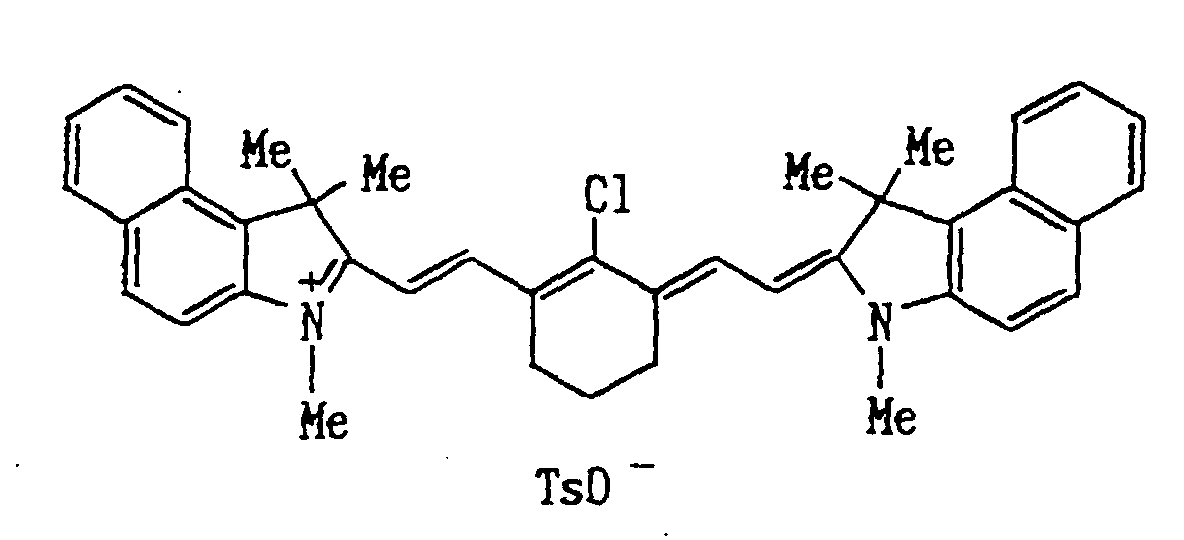
- CB: Carbon Black (MHI Black, #5257M, manufactured by Mikuni Sikiso Co., Ltd.)
-
- The heat-sensitive lithographic printing plates obtained in Examples I-1 to I-12 were exposed imagewise with an LD laser emitting an infrared ray having a wavelength of 830 nm. After exposure, the resulting plates were each mounted on a Hidel SOR-M printing machine as such without development to conduct printing. When 2,000 sheets were printed, all printed sheets were clear, and no stains were observed in non-image areas.
- As described above, according to the heat-sensitive lithographic printing plates of the invention, the hydrophilic layers composed of the materials lower in heat sensitivity than aluminum are provided between the supports and the recording layers, which makes it possible to prevent a decrease in the temperature of the recording layers due to the infrared laser exposure and to completely convert the solubility of the polymers contained in the recording layers in water, and which causes the occurrence of stains in printing to be prevented without increasing the exposure amount of a laser. That is to say, the effect of increasing sensitivity is obtained.
- Polyacrylic acid (molecular weight: 25,000, manufactured by Wako Pure Chemical Industries Ltd.) (18.0 g) was dissolved in dimethylacetamide, 5.5 g of 2-methacryloyloxyethylisocyanate (hereinafter abbreviated to MOI) and 0.1 g of dibutyltin dilaurate were added to the above solution and the reaction mixture was allowed to react for 3 hours. Subsequently, 80 equivalent % of the carboxyl group was partially neutralized with sodium hydroxide, acetone was added thereto to precipitate the polymer, the polymer was thoroughly washed and purified, thus hydrophilic Polymer (P-3) was obtained.
- An aluminum plate (material 1050) having a thickness of 0.30 mm was washed with trichloroethylene and degreased, the surface of the aluminum plate was grained with a nylon brush and an aqueous suspension of 400 mesh pumicestone powder, and thoroughly washed with water. The aluminum plate was immersed in a 25% aqueous solution of sodium hydroxide at 45°C for 9 seconds to perform etching. After washing with water, the aluminum plate was again immersed in 2% nitric acid for 20 seconds and then washed with water. The amount of aluminum removed from the grained surface by this etching was about 3 g/m. The plate was then anodized in a 7% sulfuric acid electrolyte at a current density of 15 A/dm to provide a direct current anodic oxidation film in an amount of 3 g/m, and the anodized plate was washed with water and dried.
- The following solution (A-4) was coated on the above-treated aluminum plate, dried at 100°C for 2 minutes, and the entire surface of the plate was exposed to UV ray of 700 count (Eye rotary printer, manufactured by Eye Graphic Co., Ltd.), thus crosslinked hydrophilic layer (A-4) was obtained. The dry coating weight was 1.0 g/m2.
-
Hydrophilic Polymer (P-3) 1.0 g Water-Soluble Triazine Initiator A 0.1 g Methyl Alcohol 10.0 g Pure Water 10.0 g -

- A coating solution for an image-forming layer was prepared by changing the kinds of a polymer having a carboxylic acid group and a light-heat converting agent respectively shown in Table 2. The coating solution was applied onto the surface of the above hydrophilic insulating layer or hydrophilic crosslinked insulating layer (A-4) as shown in Table 2, and dried at 80°C for 3 minutes, thereby heat-sensitive lithographic printing plate (B-5) was obtained. Dry weight of the coating solution was 1.0 g/m2.
-
Polymer having a carboxylic acid (see Table 2) 4.0 g Light-Heat Converting Agent (see Table 2) 0.4 g Megafac F-177 (fluorine surfactant, manufactured by Dainippon Ink & Chemicals, Inc.) 0.06 g Methyl Ethyl Ketone 20.0 g Methyl Alcohol 7.0 g -
- (1) Structure of Dye A

- (2) CB: Carbon Black (MHI Black, #5257M, manufactured by Mikuni Sikiso Co., Ltd.)
-
- Lithographic printing plate precursor (B-5) obtained was exposed with an infrared semiconductor laser emitting an infrared ray having a wavelength of 830 nm at plate surface laser power of 400 mW and scanning rate of 3.0 m/s. After exposure, the resulting plate was mounted on a Hidel KOR-D printing machine as such without development to conduct printing. The conditions of the fountain solution at this time are shown below. Fountain Solution: pH: 8.8 (water: 84.7%, isopropanol (IPA): 10%, triethylamine: 5%, concentrated hydrochloric acid: 0.3%)
- Adhesion of ink on the image part of the printed matters was evaluated. Adhesion of ink at printing was observed when 1,000 sheets were printed and 2,000 sheets were printed, respectively. Good results were obtained in any case.
- Polyacrylic acid (average molecular weight: 25,000) (18 g) was dissolved in 300 g of DMAc, and 0.41 g of hydroquinone, 19.4 g of 2-methacryloyloxyethylisocyanate and 0.25 g of dibutyltin dilaurate were added to the above solution and the reaction mixture was allowed to react for 4 hours at 65°C. The acid value of the obtained polymer was 7.02 meq/g. The carboxyl group was neutralized with an aqueous solution of 1N sodium hydroxide. The polymer was added to ethyl acetate to be precipitated, and thoroughly washed, thus a hydrophilic polymer was obtained.
- The surface of an aluminum plate having a thickness of 0.30 mm was grained with a nylon brush and an aqueous suspension of a 400 mesh pumicestone powder, then the aluminum plate was thoroughly washed with water. The aluminum plate was immersed in a 10 wt% aqueous solution of sodium hydroxide at 70°C for 60 seconds to perform etching, washed with flowing water, neutralized with 20 wt% nitric acid, and then washed with water. The resulting aluminum plate was subjected to electrolytic surface roughening treatment under the condition of VA = 12.7 V in a 1 wt% aqueous solution of nitric acid using sine wave alternating waveform electric current at anode-time electricity quantity of 160 C/dm. The substrate obtained had a surface roughness of 0.6 µm (indication in Ra). Subsequently, the aluminum plate was immersed in a 30 wt% aqueous solution of sulfuric acid at 55°C for 2 minutes to be desmutted, and then anodized in a 20 wt% aqueous solution of sulfuric acid at a current density of 2 A/dm2 for 2 minutes to form an anodic oxidation film in an amount of 2.7 g/m2.
- A liquid composition of a sol-gel method (a sol solution) was prepared according to the following procedure.
-
Methanol 130 g Water 20 g 85 wt% Phosphoric Acid 16 g Tetraethoxysilane 50 g 3-Methacryloxypropyltrimethoxysilane 60 g - The above composition of a sol solution was mixed and stirred. Exothermic heat was observed after about 5 minutes. The reaction mixture was allowed to react for 60 minutes, then the content was poured into other vessel and 3,000 g of methanol was added thereto, thus a sol solution was obtained. The sol solution was diluted with methanol/ethylene glycol (9/1, weight ratio), coated on the above-prepared substrate so that the amount of Si on the substrate reached 3 mg/m and dried at 100°C for 1 minute, thus an aluminum support was obtained.
- The following composition was coated on the aluminum support, dried at 100°C for 2 minutes, and subjected to UV exposure. Thus, a hydrophilic layer having a thickness of 1.55 µm was obtained.
-
Hydrophilic Polymer 1 or 2 (the structure is shown above) 1.0 g Photopolymerization Initiator PM 844 (the structure is shown below) 0.1 g Light-Heat Converting Agent (Dye A) (the structure is shown below) 0.14 g Distilled Water 11.0 g Acetonitrile 5.5 g -
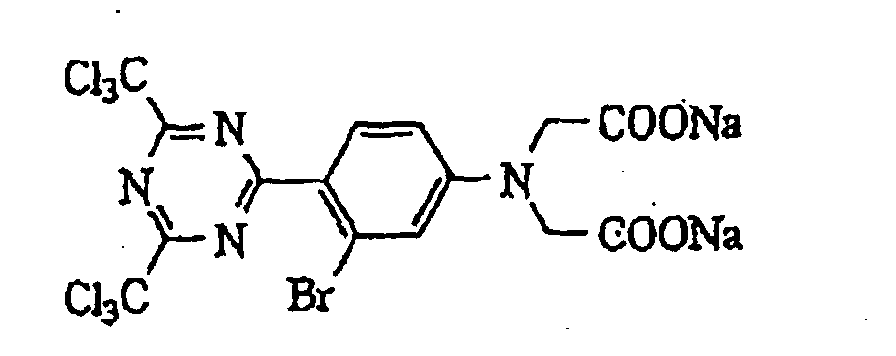
-

-
Hydrophilic Polymer 1 (the structure is shown above) 1.0 g Photopolymerization Initiator PM 844 (the structure is shown above) 0.1 g Distilled Water 9.8 g Acetonitrile 4.8 g - Each of the coating solution for a recording layer was prepared by changing the kinds of the polymer the solubility in water of which was changed by heat and a light-heat converting agent as shown in Table III-1. The prepared coating solution was coated on Hydrophilic Layer A or B, dried at 80°C for 3 minutes, thus a lithographic printing plate precursor was obtained. Dry coating amount of the coating solution was 1.0 g/m2.
-
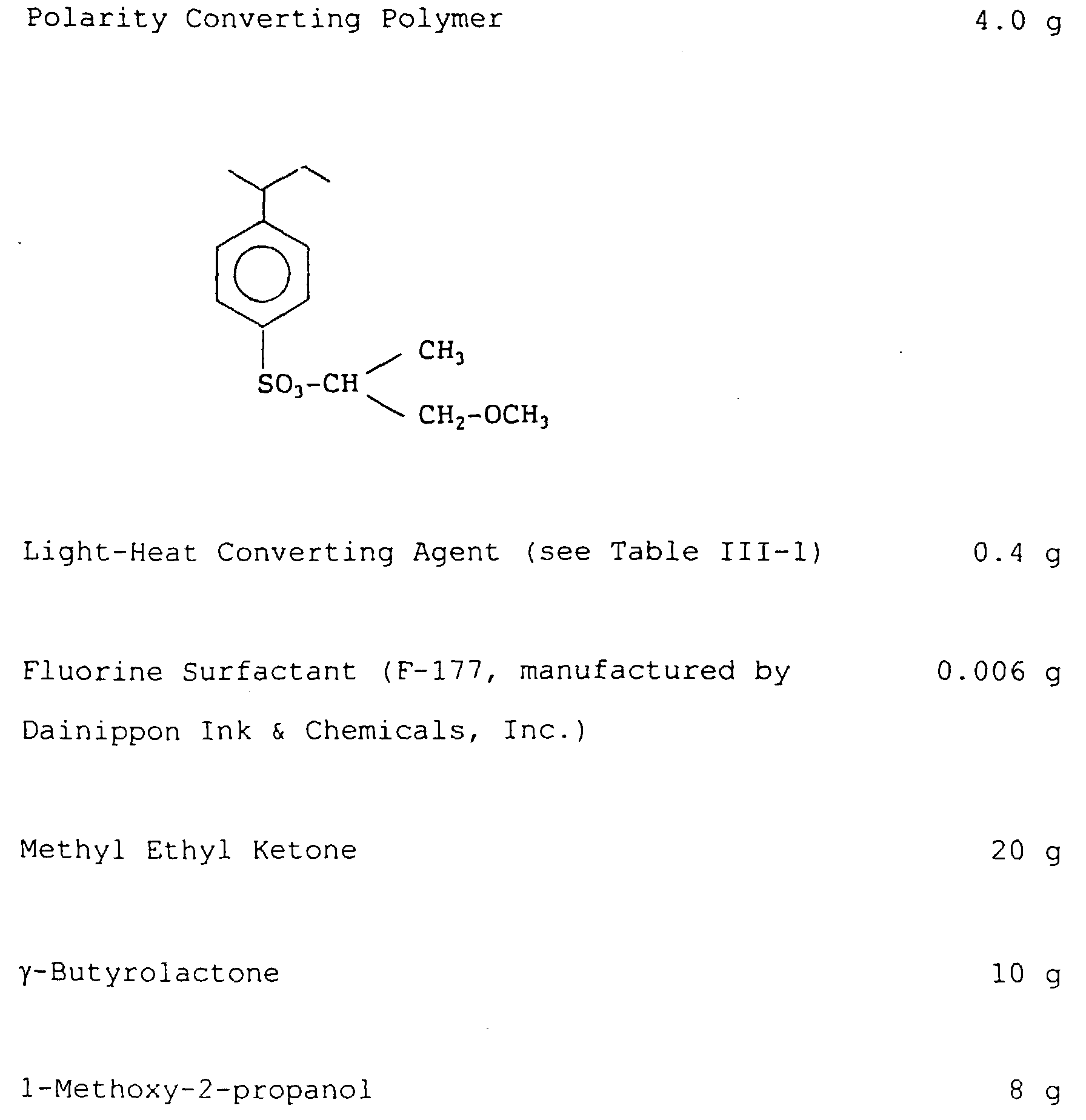
Example No. Lithographic Printing Plate Precursor Hydrophilic Layer Recording Layer Polymer (specific example No.) Light-Heat Converting Agent Ex. III-1 (1) (A) (1) Dye A (Note) CB: Carbon black (MHI Black, #5257M, manufactured by Mikuni Sikiso Co., Ltd.) - Substrates were prepared in the same manner as in the above production of substrate except that the coating solution was prepared by excluding 3-methacryloxypropyltrimethoxysilane in the sol solution of Example III-1, and the obtained solution was coated on the substrate to prepare each support. Each lithographic printing plate precursor was prepared according to the same procedure as in Example III-1. Evaluation of printing was performed in the same manner as in Example III-1 as described below. Any of the printing plates provided about 3000 sheets of prints. Evaluation of press life was inferior.
- The lithographic printing plates obtained in Example III-1 were exposed imaegwise with an LD laser emitting an infrared ray having a wavelength of 830 nm. after exposure, the resulting plates were each mounted on a Hidel KOR-D printing machine as such without development to conduct printing. When 5,000 sheets were printed, all printed sheets were clear, and no stains were observed in non-image areas.
- While the invention has been described in detail and with reference to specific embodiment thereof, it will be apparent to one skilled in the art that various changes and modifications can be made therein without departing form the spirit and scope thereof.
| Example | Heat-Sensitive Lithograph <->ic Printing Plate | Cross-linked Hydrophilic Layer | Image Recording Layer | ||
| Kind of Coating Solution | Polymer (Specific Example No.) | Light-Heat Converting Agent | |||
| I-1 | 1 | A | p-1 | 1 | Dye B |
| I-2 | 2 | A | p-2 | 24 | Dye B |
| I-3 | 3 | A | p-3 | 24 | CB |
| I-4 | 4 | B | p-4 | 1 | Not added |
| I-5 | 5 | B | p-5 | 24 | Not added |
| I-6 | 6 | B | p-6 | 21 | Not added |
| I-7 | 7 | C | p-2 | 24 | Dye B |
| I-8 | 8 | C | p-7 | 25 | Dye B |
| I-9 | 9 | C | p-8 | 1 | CB |
| I-10 | 10 | D | p-1 | 1 | Dye B |
| I-11 | 11 | D | p-9 | 19 | Dye B |
| I-12 | 12 | D | p-10 | 19 | CB |
| (Note: In Examples I-4 to I-6, the hydrophilic layers contain light-heat converting agents.) |
| Example No. | Heat-Sensitive Lithographic Printing Plate | Hydrophilic Insulating Layer | Image-Forming Layer | |
| Polymer Having a Carboxylic Acid Group | Light-Heat Converting Agent | |||
| Example II-1 | (B-5) | (A-4) | (8) | Dye A |
Claims (7)
- A heat-sensitive lithographic printing plate comprising a support having provided thereon a hydrophilic layer having a crosslinked structure, and a layer containing a polymer having on a side chain a group in which the solubility in water of the polymer can be changed by heat, said layer being provided on the hydrophilic layer.
- The heat-sensitive lithographic printing plate as claimed in claim 1, which comprises a support having provided thereon a hydrophilic layer having a crosslinked structure, and a layer containing a polymer having on a side chain a group in which the solubility in water of the polymer can be increased by heat, said layer being provided on the hydrophilic layer.
- The heat-sensitive lithographic printing plate as claimed in claim 1, wherein said polymer is a polymer having on the side chain at least one of functional groups (1) to (5):wherein L represents an organic group comprising a multivalent nonmetallic atom connected to a main chain of a polymer; R1 represents an aryl group, an alkyl group or a cyclic imido group; R2 and R3 each represents an aryl group or an alkyl group; R4 represents an aryl group, an alkyl group or -SO2R5; R5 represents an aryl group or an alkyl group; R6, R7 and R8 each independently represents an aryl group or an alkyl group; any two or three of R6, R7 and R8 may form a ring; one of R9 and R10 represents a hydrogen atom, and the other represents a hydrogen atom, an aryl group or an alkyl group; R11 represents an alkyl group; and R9 and R11 or R10 and R11 may form a ring.
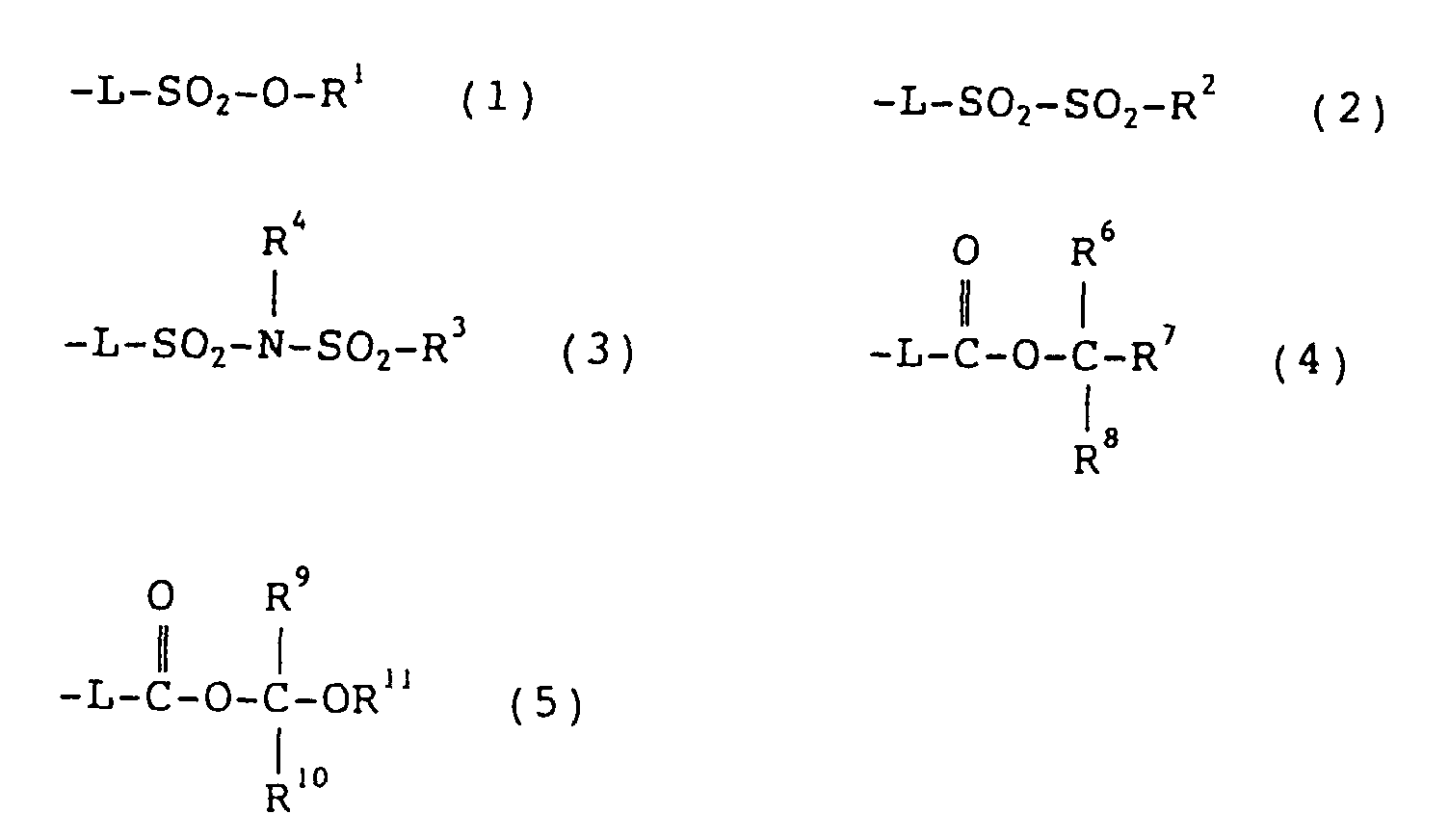
- A lithographic printing plate precursor comprising a support having provided thereon in order of a hydrophilic insulating layer and a layer containing a hydrophilic polymer in which a side chain changes to hydrophobic by heat.
- The lithographic printing plate precursor as claimed in claim 4, wherein said hydrophilic insulating layer contains a hydrophilic polymer having a crosslinked structure.
- The heat-sensitive lithographic printing plate as claimed in claim 1, wherein said hydrophilic layer is bonded to the support via a chemical bond by light.
- The lithographic printing plate precursor as claimed in claim 4, wherein said hydrophilic insulating layer is bonded to the support via a chemical bond by light.
Applications Claiming Priority (2)
| Application Number | Priority Date | Filing Date | Title |
|---|---|---|---|
| JP13285599 | 1999-05-13 | ||
| JP11132855A JP2000318331A (en) | 1999-05-13 | 1999-05-13 | Heat-sensitive lithographic printing plate |
Publications (2)
| Publication Number | Publication Date |
|---|---|
| EP1052113A1 true EP1052113A1 (en) | 2000-11-15 |
| EP1052113B1 EP1052113B1 (en) | 2005-09-14 |
Family
ID=15091110
Family Applications (1)
| Application Number | Title | Priority Date | Filing Date |
|---|---|---|---|
| EP00109173A Expired - Lifetime EP1052113B1 (en) | 1999-05-13 | 2000-05-08 | Heat-sensitive imaging element for providing a lithographic printing plate |
Country Status (5)
| Country | Link |
|---|---|
| US (1) | US6534237B1 (en) |
| EP (1) | EP1052113B1 (en) |
| JP (1) | JP2000318331A (en) |
| AT (1) | ATE304454T1 (en) |
| DE (1) | DE60022574T2 (en) |
Cited By (9)
| Publication number | Priority date | Publication date | Assignee | Title |
|---|---|---|---|---|
| EP1172696A1 (en) * | 2000-07-13 | 2002-01-16 | Fuji Photo Film Co., Ltd | Lithographic printing plate precursor |
| US6723490B2 (en) | 2001-11-15 | 2004-04-20 | Kodak Polychrome Graphics Llc | Minimization of ablation in thermally imageable elements |
| EP1219464A3 (en) * | 2000-12-20 | 2004-06-16 | Fuji Photo Film Co., Ltd. | Lithographic printing plate precursor |
| US6942957B2 (en) | 2003-07-17 | 2005-09-13 | Kodak Polychrome Graphics Llc | Ionic liquids as developability enhancing agents in multilayer imageable elements |
| EP1318027A3 (en) * | 2001-12-07 | 2006-01-04 | Fuji Photo Film Co., Ltd. | Planographic printing plate precursor |
| EP1547769A3 (en) * | 2003-12-22 | 2006-01-04 | Konica Minolta Medical & Graphic, Inc. | Printing process and manufacturing process of printing plate material |
| EP1742009A1 (en) * | 2005-07-05 | 2007-01-10 | Institut Franco-Allemand de Recherches de Saint-Louis | Explosive composition for thermal ignition using a laser source and ignition device therefor |
| US7192683B2 (en) | 2002-09-05 | 2007-03-20 | Fuji Photo Film Co., Ltd | Planographic printing plate precursor |
| US7306850B2 (en) | 2001-06-11 | 2007-12-11 | Fujifilm Corporation | Planographic printing plate precursor, substrate for the same and surface hydrophilic material |
Families Citing this family (17)
| Publication number | Priority date | Publication date | Assignee | Title |
|---|---|---|---|---|
| US7297462B2 (en) * | 2003-11-17 | 2007-11-20 | Agfa Graphics Nv | Heat-sensitive lithographic printing plate precursor |
| KR100574496B1 (en) * | 2004-12-15 | 2006-04-27 | 주식회사 하이닉스반도체 | Upper anti-reflective coating polymer, preparation method thereof and upper anti-reflective coating composition containing same |
| KR100574495B1 (en) * | 2004-12-15 | 2006-04-27 | 주식회사 하이닉스반도체 | Photoacid generator polymer, preparation method thereof, and upper anti-reflective coating composition containing same |
| US20060188813A1 (en) * | 2005-02-22 | 2006-08-24 | Fuji Photo Film Co., Ltd. | Hydrophilic film, and planographic printing material, stain-preventative member and defogging member using the same |
| EP1948750A1 (en) * | 2005-11-16 | 2008-07-30 | FUJIFILM Corporation | Surface-hydrophilic structure |
| JP5094081B2 (en) * | 2005-11-17 | 2012-12-12 | 富士フイルム株式会社 | Hydrophilic member and method for producing the same |
| US7531595B2 (en) * | 2006-03-08 | 2009-05-12 | 3M Innovative Properties Company | Pressure-sensitive adhesive containing silica nanoparticles |
| US7645827B2 (en) * | 2006-03-08 | 2010-01-12 | 3M Innovative Properties Company | High shear pressure-sensitive adhesive |
| JP2008074972A (en) * | 2006-09-21 | 2008-04-03 | Fujifilm Corp | Coating composition, hydrophilic member and method for producing the same |
| US8012591B2 (en) * | 2006-09-21 | 2011-09-06 | Fujifilm Corporation | Hydrophilic composition and hydrophilic member |
| US20080207849A1 (en) * | 2006-09-29 | 2008-08-28 | Sumiaki Yamasaki | Hydrophilic film forming composition and hydrophilic member |
| US20080177022A1 (en) * | 2006-09-29 | 2008-07-24 | Sumiaki Yamasaki | Hydrophilic film forming composition and hydrophilic member |
| US20080200587A1 (en) * | 2007-02-16 | 2008-08-21 | 3M Innovative Properties Company | Pressure-sensitive adhesive containing acicular silica particles crosslinked with polyfunctional aziridines |
| JP2008238711A (en) * | 2007-03-28 | 2008-10-09 | Fujifilm Corp | Hydrophilic member and undercoat composition |
| US20090029179A1 (en) * | 2007-05-14 | 2009-01-29 | Fujifilm Corporation | Two-liquid composition, hydrophilic composition and hydrophilic member |
| JP2009227809A (en) * | 2008-03-21 | 2009-10-08 | Fujifilm Corp | Hydrophilic composition and hydrophilic treating member |
| CN102566283B (en) * | 2011-12-23 | 2014-05-07 | 乐凯华光印刷科技有限公司 | Washed flexible resin plate capable of achieving laser direct imaging |
Citations (4)
| Publication number | Priority date | Publication date | Assignee | Title |
|---|---|---|---|---|
| GB1245924A (en) * | 1967-09-27 | 1971-09-15 | Agfa Gevaert | Improvements relating to thermo-recording |
| JPH106468A (en) * | 1996-06-21 | 1998-01-13 | Asahi Chem Ind Co Ltd | Improved original plate for thermosensitive direct lithography |
| EP0819986A1 (en) * | 1996-07-19 | 1998-01-21 | Agfa-Gevaert N.V. | An acid-sensitive substance and photosensitive compositions therewith |
| JPH10282672A (en) * | 1997-02-10 | 1998-10-23 | Fuji Photo Film Co Ltd | Heat-sensitive image forming material and lithographic printing master plate |
Family Cites Families (18)
| Publication number | Priority date | Publication date | Assignee | Title |
|---|---|---|---|---|
| GB9322705D0 (en) * | 1993-11-04 | 1993-12-22 | Minnesota Mining & Mfg | Lithographic printing plates |
| JP3589365B2 (en) * | 1996-02-02 | 2004-11-17 | 富士写真フイルム株式会社 | Positive image forming composition |
| EP0855267B1 (en) * | 1997-01-24 | 2002-04-17 | Fuji Photo Film Co., Ltd. | Planographic printing plate |
| EP0903224B1 (en) * | 1997-09-12 | 2007-11-14 | FUJIFILM Corporation | Radiation-sensitive planographic plate precursor and planographic plate |
| US6153352A (en) * | 1997-12-10 | 2000-11-28 | Fuji Photo Film Co., Ltd. | Planographic printing plate precursor and a method for producing a planographic printing plate |
| US6165679A (en) * | 1997-12-19 | 2000-12-26 | Agfa-Gevaert, N.V. | Heat-sensitive non-ablatable wasteless imaging element for providing a lithographic printing plate |
| US6165691A (en) * | 1997-12-19 | 2000-12-26 | Agfa-Gevaert, N.V. | Method for lithographic printing by use of a lithographic printing plate provided by a heat sensitive non-ablatable wasteless imaging element and a fountain containing water-insoluble compounds |
| US6132934A (en) * | 1998-02-09 | 2000-10-17 | Agfa-Gevaert, N.V. | Heat-sensitive imaging material for making lithographic printing plates requiring no processing |
| US6096479A (en) * | 1998-02-27 | 2000-08-01 | Fuji Photo Film Co., Ltd. | Photosensitive lithographic form plate using an image-forming material |
| JP3853967B2 (en) * | 1998-04-13 | 2006-12-06 | 富士写真フイルム株式会社 | Thermosetting composition, lithographic printing plate precursor using the same, and sulfonate compound |
| US6214515B1 (en) * | 1998-05-25 | 2001-04-10 | Agfa-Gevaert | Heat sensitive imaging element for providing a lithographic printing plate |
| US6096471A (en) * | 1998-05-25 | 2000-08-01 | Agfa-Gevaert, N.V. | Heat sensitive imaging element for providing a lithographic printing plate |
| US6242155B1 (en) * | 1998-08-14 | 2001-06-05 | Fuji Photo Film Co., Ltd. | Method of making lithographic printing plate and photopolymer composition |
| US5985514A (en) * | 1998-09-18 | 1999-11-16 | Eastman Kodak Company | Imaging member containing heat sensitive thiosulfate polymer and methods of use |
| US6162578A (en) * | 1998-12-18 | 2000-12-19 | Eastman Kodak Company | Imaging member containing heat sensitive hyperbranched polymer and methods of use |
| US6159657A (en) * | 1999-08-31 | 2000-12-12 | Eastman Kodak Company | Thermal imaging composition and member containing sulfonated ir dye and methods of imaging and printing |
| JP2001166462A (en) * | 1999-12-10 | 2001-06-22 | Fuji Photo Film Co Ltd | Original plate of planographic printing plate |
| US6672210B2 (en) * | 2000-07-13 | 2004-01-06 | Fuji Photo Film Co., Ltd. | Lithographic printing plate precursor with a graft polymerized hydrophilic layer |
-
1999
- 1999-05-13 JP JP11132855A patent/JP2000318331A/en not_active Abandoned
-
2000
- 2000-05-03 US US09/563,349 patent/US6534237B1/en not_active Expired - Fee Related
- 2000-05-08 AT AT00109173T patent/ATE304454T1/en not_active IP Right Cessation
- 2000-05-08 EP EP00109173A patent/EP1052113B1/en not_active Expired - Lifetime
- 2000-05-08 DE DE60022574T patent/DE60022574T2/en not_active Expired - Lifetime
Patent Citations (4)
| Publication number | Priority date | Publication date | Assignee | Title |
|---|---|---|---|---|
| GB1245924A (en) * | 1967-09-27 | 1971-09-15 | Agfa Gevaert | Improvements relating to thermo-recording |
| JPH106468A (en) * | 1996-06-21 | 1998-01-13 | Asahi Chem Ind Co Ltd | Improved original plate for thermosensitive direct lithography |
| EP0819986A1 (en) * | 1996-07-19 | 1998-01-21 | Agfa-Gevaert N.V. | An acid-sensitive substance and photosensitive compositions therewith |
| JPH10282672A (en) * | 1997-02-10 | 1998-10-23 | Fuji Photo Film Co Ltd | Heat-sensitive image forming material and lithographic printing master plate |
Non-Patent Citations (2)
| Title |
|---|
| PATENT ABSTRACTS OF JAPAN vol. 1998, no. 5 30 April 1998 (1998-04-30) * |
| PATENT ABSTRACTS OF JAPAN vol. 1999, no. 1 29 January 1999 (1999-01-29) * |
Cited By (14)
| Publication number | Priority date | Publication date | Assignee | Title |
|---|---|---|---|---|
| EP1172696A1 (en) * | 2000-07-13 | 2002-01-16 | Fuji Photo Film Co., Ltd | Lithographic printing plate precursor |
| US6672210B2 (en) | 2000-07-13 | 2004-01-06 | Fuji Photo Film Co., Ltd. | Lithographic printing plate precursor with a graft polymerized hydrophilic layer |
| EP1219464A3 (en) * | 2000-12-20 | 2004-06-16 | Fuji Photo Film Co., Ltd. | Lithographic printing plate precursor |
| US6890700B2 (en) | 2000-12-20 | 2005-05-10 | Fuji Photo Film Co., Ltd. | Lithographic printing plate precursor |
| US7306850B2 (en) | 2001-06-11 | 2007-12-11 | Fujifilm Corporation | Planographic printing plate precursor, substrate for the same and surface hydrophilic material |
| US6723490B2 (en) | 2001-11-15 | 2004-04-20 | Kodak Polychrome Graphics Llc | Minimization of ablation in thermally imageable elements |
| EP1318027A3 (en) * | 2001-12-07 | 2006-01-04 | Fuji Photo Film Co., Ltd. | Planographic printing plate precursor |
| US7192683B2 (en) | 2002-09-05 | 2007-03-20 | Fuji Photo Film Co., Ltd | Planographic printing plate precursor |
| US6942957B2 (en) | 2003-07-17 | 2005-09-13 | Kodak Polychrome Graphics Llc | Ionic liquids as developability enhancing agents in multilayer imageable elements |
| EP1547769A3 (en) * | 2003-12-22 | 2006-01-04 | Konica Minolta Medical & Graphic, Inc. | Printing process and manufacturing process of printing plate material |
| US7140297B2 (en) | 2003-12-22 | 2006-11-28 | Konica Minolta Medical & Graphic, Inc. | Printing process and manufacturing process of printing plate material |
| EP1742009A1 (en) * | 2005-07-05 | 2007-01-10 | Institut Franco-Allemand de Recherches de Saint-Louis | Explosive composition for thermal ignition using a laser source and ignition device therefor |
| FR2888234A1 (en) * | 2005-07-05 | 2007-01-12 | Saint Louis Inst | OPTICALLY DOPED ENERGETIC COMPOSITION |
| US7784403B2 (en) | 2005-07-05 | 2010-08-31 | Deutsch-Franzosisches Forschungsinstitut | Optically doped energetic igniter charge |
Also Published As
| Publication number | Publication date |
|---|---|
| ATE304454T1 (en) | 2005-09-15 |
| DE60022574T2 (en) | 2006-06-22 |
| JP2000318331A (en) | 2000-11-21 |
| EP1052113B1 (en) | 2005-09-14 |
| US6534237B1 (en) | 2003-03-18 |
| DE60022574D1 (en) | 2005-10-20 |
Similar Documents
| Publication | Publication Date | Title |
|---|---|---|
| EP1052113B1 (en) | Heat-sensitive imaging element for providing a lithographic printing plate | |
| EP1172696B1 (en) | Lithographic printing plate precursor | |
| DE60113174T2 (en) | Heat sensitive planographic printing plate precursor | |
| EP0980754B1 (en) | Photopolymer composition, lithographic printing plate precursor and method of making lithographic printing plate | |
| EP2548739B1 (en) | Lithographic printing plate precursor | |
| DE60014526T2 (en) | Heat-sensitive precursor for a planographic printing plate | |
| JP4343462B2 (en) | Planographic printing plate precursor | |
| EP1136256B1 (en) | Heat-sensitive lithographic printing plate precursor | |
| JP3853967B2 (en) | Thermosetting composition, lithographic printing plate precursor using the same, and sulfonate compound | |
| JP3866401B2 (en) | Planographic printing plate precursor and planographic printing method | |
| EP1075941B1 (en) | Photosensitive lithographic printing plate precursor containing metal oxide | |
| EP2295247B1 (en) | Lithographic printing plate precursor and lithographic printing method | |
| DE60026223T2 (en) | Heat-sensitive precursor for a planographic printing plate | |
| US20010006757A1 (en) | Radiant ray-sensitive lithographic printing plate precursor | |
| EP1228865B1 (en) | Lithographic printing plate precursor | |
| JP4040217B2 (en) | Method for producing planographic printing plate and photosensitive resin composition | |
| DE60020196T2 (en) | Precursor for a heat-sensitive planographic printing plate | |
| JP3722343B2 (en) | Thermal recording type lithographic printing plate precursor and method for producing lithographic printing plate | |
| JP3751703B2 (en) | Master for lithographic printing plate | |
| JP3993988B2 (en) | Planographic printing plate precursor | |
| JP2003001959A (en) | Plate for lithographic printing plate for heat mode laser drawing | |
| JP2003005366A (en) | Planographic printing original plate for heat mode laser pattern forming | |
| JP2000071635A (en) | Master for lithographic printing plate | |
| JP2002046360A (en) | Original plate for lithographic printing plate | |
| JP2000037967A (en) | Manufacture of lithographic printing plate |
Legal Events
| Date | Code | Title | Description |
|---|---|---|---|
| PUAI | Public reference made under article 153(3) epc to a published international application that has entered the european phase |
Free format text: ORIGINAL CODE: 0009012 |
|
| AK | Designated contracting states |
Kind code of ref document: A1 Designated state(s): AT BE CH CY DE DK ES FI FR GB GR IE IT LI LU MC NL PT SE |
|
| AX | Request for extension of the european patent |
Free format text: AL;LT;LV;MK;RO;SI |
|
| 17P | Request for examination filed |
Effective date: 20010418 |
|
| AKX | Designation fees paid |
Free format text: AT BE CH CY DE DK ES FI FR GB GR IE IT LI LU MC NL PT SE |
|
| 17Q | First examination report despatched |
Effective date: 20030901 |
|
| GRAP | Despatch of communication of intention to grant a patent |
Free format text: ORIGINAL CODE: EPIDOSNIGR1 |
|
| GRAS | Grant fee paid |
Free format text: ORIGINAL CODE: EPIDOSNIGR3 |
|
| GRAA | (expected) grant |
Free format text: ORIGINAL CODE: 0009210 |
|
| AK | Designated contracting states |
Kind code of ref document: B1 Designated state(s): AT BE CH CY DE DK ES FI FR GB GR IE IT LI LU MC NL PT SE |
|
| PG25 | Lapsed in a contracting state [announced via postgrant information from national office to epo] |
Ref country code: IT Free format text: LAPSE BECAUSE OF FAILURE TO SUBMIT A TRANSLATION OF THE DESCRIPTION OR TO PAY THE FEE WITHIN THE PRESCRIBED TIME-LIMIT;WARNING: LAPSES OF ITALIAN PATENTS WITH EFFECTIVE DATE BEFORE 2007 MAY HAVE OCCURRED AT ANY TIME BEFORE 2007. THE CORRECT EFFECTIVE DATE MAY BE DIFFERENT FROM THE ONE RECORDED. Effective date: 20050914 Ref country code: LI Free format text: LAPSE BECAUSE OF FAILURE TO SUBMIT A TRANSLATION OF THE DESCRIPTION OR TO PAY THE FEE WITHIN THE PRESCRIBED TIME-LIMIT Effective date: 20050914 Ref country code: CH Free format text: LAPSE BECAUSE OF FAILURE TO SUBMIT A TRANSLATION OF THE DESCRIPTION OR TO PAY THE FEE WITHIN THE PRESCRIBED TIME-LIMIT Effective date: 20050914 Ref country code: BE Free format text: LAPSE BECAUSE OF FAILURE TO SUBMIT A TRANSLATION OF THE DESCRIPTION OR TO PAY THE FEE WITHIN THE PRESCRIBED TIME-LIMIT Effective date: 20050914 Ref country code: FI Free format text: LAPSE BECAUSE OF FAILURE TO SUBMIT A TRANSLATION OF THE DESCRIPTION OR TO PAY THE FEE WITHIN THE PRESCRIBED TIME-LIMIT Effective date: 20050914 Ref country code: NL Free format text: LAPSE BECAUSE OF FAILURE TO SUBMIT A TRANSLATION OF THE DESCRIPTION OR TO PAY THE FEE WITHIN THE PRESCRIBED TIME-LIMIT Effective date: 20050914 Ref country code: AT Free format text: LAPSE BECAUSE OF FAILURE TO SUBMIT A TRANSLATION OF THE DESCRIPTION OR TO PAY THE FEE WITHIN THE PRESCRIBED TIME-LIMIT Effective date: 20050914 |
|
| REG | Reference to a national code |
Ref country code: GB Ref legal event code: FG4D |
|
| REG | Reference to a national code |
Ref country code: CH Ref legal event code: EP |
|
| REG | Reference to a national code |
Ref country code: IE Ref legal event code: FG4D |
|
| REF | Corresponds to: |
Ref document number: 60022574 Country of ref document: DE Date of ref document: 20051020 Kind code of ref document: P |
|
| PG25 | Lapsed in a contracting state [announced via postgrant information from national office to epo] |
Ref country code: GR Free format text: LAPSE BECAUSE OF FAILURE TO SUBMIT A TRANSLATION OF THE DESCRIPTION OR TO PAY THE FEE WITHIN THE PRESCRIBED TIME-LIMIT Effective date: 20051214 Ref country code: SE Free format text: LAPSE BECAUSE OF FAILURE TO SUBMIT A TRANSLATION OF THE DESCRIPTION OR TO PAY THE FEE WITHIN THE PRESCRIBED TIME-LIMIT Effective date: 20051214 Ref country code: DK Free format text: LAPSE BECAUSE OF FAILURE TO SUBMIT A TRANSLATION OF THE DESCRIPTION OR TO PAY THE FEE WITHIN THE PRESCRIBED TIME-LIMIT Effective date: 20051214 |
|
| PG25 | Lapsed in a contracting state [announced via postgrant information from national office to epo] |
Ref country code: ES Free format text: LAPSE BECAUSE OF FAILURE TO SUBMIT A TRANSLATION OF THE DESCRIPTION OR TO PAY THE FEE WITHIN THE PRESCRIBED TIME-LIMIT Effective date: 20051225 |
|
| PG25 | Lapsed in a contracting state [announced via postgrant information from national office to epo] |
Ref country code: PT Free format text: LAPSE BECAUSE OF FAILURE TO SUBMIT A TRANSLATION OF THE DESCRIPTION OR TO PAY THE FEE WITHIN THE PRESCRIBED TIME-LIMIT Effective date: 20060214 |
|
| NLV1 | Nl: lapsed or annulled due to failure to fulfill the requirements of art. 29p and 29m of the patents act | ||
| REG | Reference to a national code |
Ref country code: CH Ref legal event code: PL |
|
| PG25 | Lapsed in a contracting state [announced via postgrant information from national office to epo] |
Ref country code: IE Free format text: LAPSE BECAUSE OF NON-PAYMENT OF DUE FEES Effective date: 20060508 |
|
| PG25 | Lapsed in a contracting state [announced via postgrant information from national office to epo] |
Ref country code: MC Free format text: LAPSE BECAUSE OF NON-PAYMENT OF DUE FEES Effective date: 20060531 |
|
| PLBE | No opposition filed within time limit |
Free format text: ORIGINAL CODE: 0009261 |
|
| STAA | Information on the status of an ep patent application or granted ep patent |
Free format text: STATUS: NO OPPOSITION FILED WITHIN TIME LIMIT |
|
| 26N | No opposition filed |
Effective date: 20060615 |
|
| PG25 | Lapsed in a contracting state [announced via postgrant information from national office to epo] |
Ref country code: FR Free format text: LAPSE BECAUSE OF FAILURE TO SUBMIT A TRANSLATION OF THE DESCRIPTION OR TO PAY THE FEE WITHIN THE PRESCRIBED TIME-LIMIT Effective date: 20061020 |
|
| EN | Fr: translation not filed | ||
| EN | Fr: translation not filed | ||
| REG | Reference to a national code |
Ref country code: IE Ref legal event code: MM4A |
|
| REG | Reference to a national code |
Ref country code: GB Ref legal event code: 732E |
|
| PG25 | Lapsed in a contracting state [announced via postgrant information from national office to epo] |
Ref country code: LU Free format text: LAPSE BECAUSE OF NON-PAYMENT OF DUE FEES Effective date: 20060508 |
|
| PG25 | Lapsed in a contracting state [announced via postgrant information from national office to epo] |
Ref country code: FR Free format text: LAPSE BECAUSE OF FAILURE TO SUBMIT A TRANSLATION OF THE DESCRIPTION OR TO PAY THE FEE WITHIN THE PRESCRIBED TIME-LIMIT Effective date: 20050914 Ref country code: CY Free format text: LAPSE BECAUSE OF FAILURE TO SUBMIT A TRANSLATION OF THE DESCRIPTION OR TO PAY THE FEE WITHIN THE PRESCRIBED TIME-LIMIT Effective date: 20050914 |
|
| PGFP | Annual fee paid to national office [announced via postgrant information from national office to epo] |
Ref country code: GB Payment date: 20110504 Year of fee payment: 12 |
|
| PGFP | Annual fee paid to national office [announced via postgrant information from national office to epo] |
Ref country code: DE Payment date: 20110413 Year of fee payment: 12 |
|
| GBPC | Gb: european patent ceased through non-payment of renewal fee |
Effective date: 20120508 |
|
| REG | Reference to a national code |
Ref country code: DE Ref legal event code: R119 Ref document number: 60022574 Country of ref document: DE Effective date: 20121201 |
|
| PG25 | Lapsed in a contracting state [announced via postgrant information from national office to epo] |
Ref country code: GB Free format text: LAPSE BECAUSE OF NON-PAYMENT OF DUE FEES Effective date: 20120508 |
|
| PG25 | Lapsed in a contracting state [announced via postgrant information from national office to epo] |
Ref country code: DE Free format text: LAPSE BECAUSE OF NON-PAYMENT OF DUE FEES Effective date: 20121201 |