EP1048737A2 - Stereoselektive Synthese von 2-Hydroxyketonen - Google Patents
Stereoselektive Synthese von 2-Hydroxyketonen Download PDFInfo
- Publication number
- EP1048737A2 EP1048737A2 EP00108709A EP00108709A EP1048737A2 EP 1048737 A2 EP1048737 A2 EP 1048737A2 EP 00108709 A EP00108709 A EP 00108709A EP 00108709 A EP00108709 A EP 00108709A EP 1048737 A2 EP1048737 A2 EP 1048737A2
- Authority
- EP
- European Patent Office
- Prior art keywords
- substrate
- stereoselective synthesis
- hydroxyketones
- bfd
- synthesis
- Prior art date
- Legal status (The legal status is an assumption and is not a legal conclusion. Google has not performed a legal analysis and makes no representation as to the accuracy of the status listed.)
- Granted
Links
- 0 CC(C)Oc1cccc(C([C@@](C)*)=O)c1 Chemical compound CC(C)Oc1cccc(C([C@@](C)*)=O)c1 0.000 description 1
- LSSZVOMRMXYOQK-WOPFXOFLSA-N C[C@@H](C(c1cc([C@@H]2C(CC(C)=O)C2)ccc1)=O)O Chemical compound C[C@@H](C(c1cc([C@@H]2C(CC(C)=O)C2)ccc1)=O)O LSSZVOMRMXYOQK-WOPFXOFLSA-N 0.000 description 1
Images


Classifications
-
- C—CHEMISTRY; METALLURGY
- C12—BIOCHEMISTRY; BEER; SPIRITS; WINE; VINEGAR; MICROBIOLOGY; ENZYMOLOGY; MUTATION OR GENETIC ENGINEERING
- C12P—FERMENTATION OR ENZYME-USING PROCESSES TO SYNTHESISE A DESIRED CHEMICAL COMPOUND OR COMPOSITION OR TO SEPARATE OPTICAL ISOMERS FROM A RACEMIC MIXTURE
- C12P7/00—Preparation of oxygen-containing organic compounds
- C12P7/24—Preparation of oxygen-containing organic compounds containing a carbonyl group
- C12P7/26—Ketones
Definitions
- the invention relates to a process for the stereoselective synthesis of 2- hydroxyketones.
- the object of the invention is to provide a simple process for the stereoselective synthesis of 2- hydroxyketones, which can be applied to a wide range of substrates, and in which an increase in enantioselectivity is possible by varying the process parameters.
- the claimed method for the synthesis of 2- hydroxyketones uses an aldehyde, with the exception of benzaldehyde, or a 2-keto acid, with the exception of benzoyl formate, as the first substrate.
- An aldehyde, with the exception of benzaldehyde, is also used as a second substrate.
- Suitable aldehydes are, for example, substituted benzaldehydes, heteroaromatic aldehydes, but also non-aromatic aldehydes, such as cyclic aldehydes and also linear aldehydes.
- Suitable 2-keto acids include 2-oxopentanoic acid, 3-methoxyphenylglyoxylic acid, 4-methylphenylglyoxylic acid and fur-2-ylglyoxylic acid
- the enzymatic reaction of the substrates to 2- hydroxyketones takes place in the presence of thiamine diphosphate (ThDP) -dependent enzymes, which bring about a CC linkage between the two substrates.
- the thiamine diphosphate (ThDP) -dependent enzymes include, for example, benzoyl formate decarboxylase (BFD) and pyruvate decarboxylase (PDC).
- the method carried out in the presence of a 2-keto acid decarboxylase.
- the process is advantageous in the presence of a benzoyl formate decarboxylase carried out.
- An acetaldehyde is advantageous as a second substrate used.
- substances include, for example, unsubstituted aromatic aldehydes, substituted aromatic Aldehydes, heteroaromatic and substituted, heteroaromatic Aldehydes, but also cyclic and noncyclic, aliphatic or olefinic aldehydes.
- This wide range of uses opens up the possibility accordingly diverse 2-hydroxyketones in (S) configuration with high selectivity through the sophisticated Process easy to synthesize.
- the process according to the invention can be used to increase the enantioselectivity by selecting suitable substrates, for example in the case of benzaldehydes substituted in the 3 or 4 position.
- suitable substituents are -OBn, -OAc, -OPh or also -O i Pr. Your enantioselectivity is regularly> 99%.
- Substituents such as -Me - OMe or -OEt also lead to a higher selectivity compared to that of an unsubstituted benzaldehyde.
- benzaldehydes substituted in the 3- or 4-position can therefore be used as a first substrate.
- Another advantageous embodiment of the method sets non-aromatic aldehydes as a first substrate on. So far, with this class of substrate no enzymatic cross-coupling like the one according to the invention Synthesis of 2-hydroxyketones, successful.
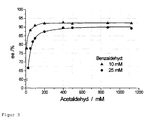
- the enantioselectivity in the process according to the invention can be increased regularly by a suitable choice of the concentration of the substrates used and a suitable temperature during the process. It was surprisingly found that the increase in enantioselectivity in the sophisticated enzymatic formation of 2-hydroxy-1-phenyl-propanone (2-HPP) can be achieved by reducing the concentration of benzaldehyde or by increasing the concentration of acetaldehyde .
- the concentration of the first substrate is advantageously below 500 mM, in particular below 50 mM. The lower the concentration of the second substrate, the greater the enantioselectivity. It is therefore advantageous to realize the smallest possible concentrations in the process.
- the lower limit for the concentration of the second substrate depends on the process and is about 1 ⁇ M for practical reasons.
- An upper concentration of the second substrate of approximately 1 M regularly causes the enzyme to be deactivated.
- An advantageous process design therefore provides concentrations for the second substrate which are less than 1 M, in particular less than 500 mM.
- the typical working range is 100-500 mM for procedural reasons, but does not regularly fall below 1 mM.
- a typical temperature range for enzymatic processes lies in the range from -10 ° C to 60 ° C. It has it turned out that the enantioselectivity at the method according to the claim a temperature dependency having. The selectivity increases regularly with falling temperature. In an advantageous embodiment the procedure is therefore during the procedure a temperature below 30 ° C, in particular set below 25 ° C. The lower temperature limit is determined by the system. she lies typically at -10 ° C and depends on the substrate.
- the present invention relates to the enantioselective Synthesis of chiral 2-hydroxyketones using benzoyl formate decarboxylase. Chiral 2-hydroxyketones are important Intermediates in the enantioselective organic Synthesis.
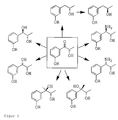
- the synthetic potential is shown in Fig. 1 shown.
- Wilcocks et al. (App. Env. Microbiol., 1992, 58 , 1699-1704) and Wilcocks and Ward (Biotech. Bioeng., 1992, 39 , 1058-1063) describe ( S ) -2-hydroxypropiophenone (formula II) as a reaction product of decarboxylation of benzoyl formate in the presence of acetaldehyde in the presence of whole cells of Pseudomonas putida (BFD from Ps . p .) or of crude extracts from these cells. They attribute the 2-hydroxypropiophenone synthesis to the enzyme benzoyl formate decarboxylase.
- the kinetics of the CC knotting was determined for the system considered here by adapting the kinetic equations to the measured values by means of non-linear regression.
- the K M values are very high at 310 mM ( ⁇ 80 mM) for acetaldehyde and 77 mM ( ⁇ 19 mM) for benzaldehyde.
- acetaldehyde concentrations greater than 800 mM a clear deactivation of the benzoyl formate decarboxylase can be observed. No product inhibition could be found.
- the kinetic parameters could be verified by means of the computer simulation of a batch reactor test.
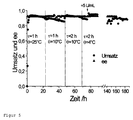
- the enzyme membrane reactor was operated continuously over a period of 180 hours.
- (S) -2-hydroxy-1-phenylpropanone with an ee of 93% and a space-time yield of 34.2 g L -1 d -1 (220 mmol L -1 d -1 ) are produced.
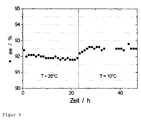
- By varying the operating temperature of the stirred tank it was also possible to show the influence of the temperature on the enantiomeric excess under continuous operating conditions (FIG. 6).
- the method according to the invention is exemplified in preferred embodiments.
- the method according to the invention is not restricted to the examples.
- the enzyme activity of the BFD is related to the decarboxylation of the benzoyl formate standard, ie 1 U of the enzyme is defined as the amount that decarboxylates 1 ⁇ mol of benzoyl formate per minute.
- Example 1 Cell-free synthesis of (S) -2-hydroxypropiophenone starting from 2-ketocarboxylic acids or aldehydes.
- the BFD is preferred after cleaning the crude extract by means of anion exchange chromatography in the invention Process used. Best results will be thereby by chromatography on Q-Sepharose FF the Pharmacia achieved with a linear NaCl gradient.
- the BFD fraction is desalted and lyophilized.
- the enzymatic syntheses are carried out in aqueous buffers, usually potassium phosphate buffers.
- aqueous buffers usually potassium phosphate buffers.
- the solubility of the aromatic aldehydes can be improved by adding organic solvents between 5-50% by volume.
- the pH of the reaction buffer depends on whether 2-ketocarboxylic acids or aldehydes are used as acyl donors. When using a 2-keto carboxylic acid, the optimal pH is between 6.0 and 7.0, while when using aldehydes, a pH of 6.5 to 7.5 is set.
- the cofactor thiamine diphosphate preferably in a concentration of 0.1 to 5.0 mmol / l, is added to the synthesis batch.
- Mg ions are also added, preferably in the form of Magnesium sulfate, too, preferably in a concentration from 1 to 10 mmol / l.
- the pH of the reaction mixture is measured by Addition of 0.1 M phosphoric acid kept constant. To 18 hours at 25 ° C the reaction mixture with chloroform extracted, the organic phase over magnesium sulfate dried, concentrated in vacuo and the (S) -2-HPP by silica gel chromatography (silica gel 60 (Merck), mobile phase: ether / hexane 3: 1) of excess Benzaldehyde separated.
- the reaction is carried out after 5 hours at 25 ° C as described above stopped.
- Example 2 Increasing the Enantioselectivity of the BFD-Catalyzed C-C formation reaction by varying the Substrates.
- the enzymatic syntheses are carried out in a batch reactor.
- a round-bottomed flask is used as the reaction flask or 2 ml Eppendorf reaction flasks when performing analytical runs.
- a potassium phosphate buffer (KH 2 PO 4 / K 2 HPO 4 , 50 mmol / l, pH 7.0) is used as the reaction medium, which additionally contains 2.5 mmol / l MgSO 4 and 0.5 mmol / l thiamine diphosphate.
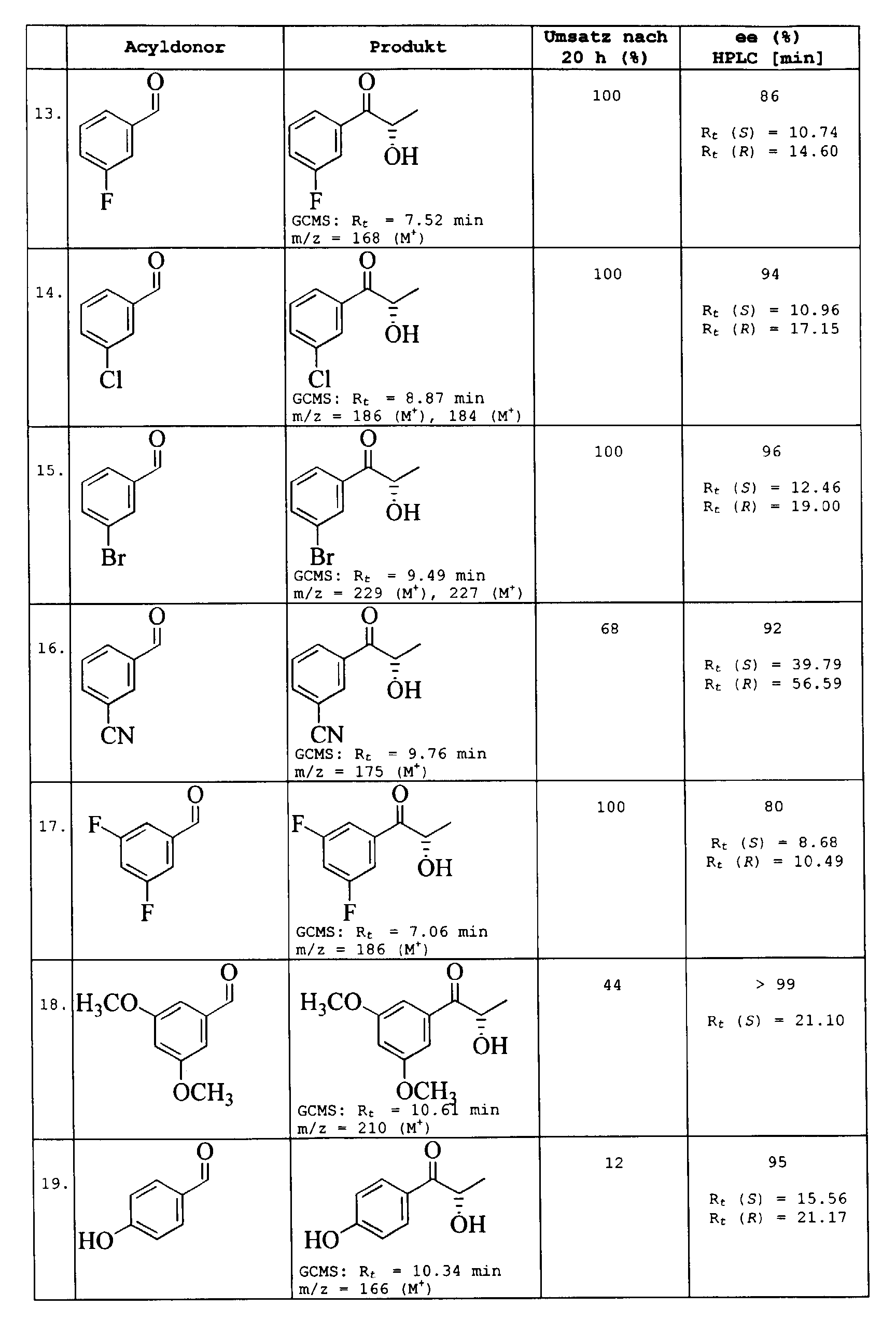
- the donor aldehyde (according to Table 1) is used in a concentration of 10 mmol / l, acetaldehyde in a concentration of 0.5 mol / l.
- the enzyme BFD-wt is added as the last component.
- Bovine Serum Albumin (BSA) is added in preparative reactions.
- 150 ⁇ l of a sample are taken and extracted with 150 ⁇ l n-heptane or trichlomethane. The phase separation is brought about by centrifugation at 13000 rpm. The organic phase is injected directly (HPLC, GC, GCMS).
- reaction management is the simplest form of reaction management described (batch reactor).
- a reaction vessel serves a round-bottomed flask of a suitable size.
- the piston content does not react or only stirred slowly.
- Example 3 Synthesis of (S) -2-hydroxy-1-phenyl-propanone taking into account the influence of substrate concentrations and the temperature.
- the reaction is carried out in a batch reactor with a reaction volume of 50 ml at 25 ° C.
- 50 mM benzaldehyde and 500 mM acetaldehyde in phosphate buffer (50 mM, pH 7.0, additionally contains 0.5 mM thiamine diphosphate and 0.05 mM MgCl 2 ) are used.
- the reaction is started by adding 50 U of benzoyl formate decarboxylase.
- the reaction was stopped after 5 h and (S) -2-HPP was extracted with hexane or trichloromethane.
- the organic phase is separated by centrifugation at 13,000 rpm and dried over MgSO 4 .
- Example 4 Continuous synthesis in the enzyme membrane reactor.
- EMR enzyme membrane reactor
- the membranes are placed in water before use and pre-loaded with 5 mg / ml BSA in the reactor.
- the System is rinsed with the substrate solution until Inlet and outlet concentration are identical to any Absorption effects of the materials used to exclude.
- the reaction is then by injection the enzyme solution into the septum of the bubble trap.
- the reactor is started by injection of 65 U BFD.
- the EMR is operated with a dwell time of 1 or 2 hours.
Landscapes
- Organic Chemistry (AREA)
- Chemical & Material Sciences (AREA)
- Engineering & Computer Science (AREA)
- Zoology (AREA)
- Life Sciences & Earth Sciences (AREA)
- Wood Science & Technology (AREA)
- Chemical Kinetics & Catalysis (AREA)
- Microbiology (AREA)
- General Chemical & Material Sciences (AREA)
- Biotechnology (AREA)
- Health & Medical Sciences (AREA)
- Biochemistry (AREA)
- Bioinformatics & Cheminformatics (AREA)
- General Engineering & Computer Science (AREA)
- General Health & Medical Sciences (AREA)
- Genetics & Genomics (AREA)
- Preparation Of Compounds By Using Micro-Organisms (AREA)
- Enzymes And Modification Thereof (AREA)
- Organic Low-Molecular-Weight Compounds And Preparation Thereof (AREA)
Abstract
Description
Als ein zweites Substrat wird ebenfalls ein Aldehyd, ausgenommen Benzaldehyd, eingesetzt. Geeignete Aldehyde sind beispielsweise substituierte Benzaldehyde, heteroaromatische Aldehyde, aber auch nicht-aromatische Aldehyde, wie z.B. cyclische Aldehyde und auch lineare Aldehyde. Geeignete 2-Ketosäuren sind u.a. 2-Oxopentansäure, 3-Methoxyphenylglyoxylsäure, 4-Methylphenylglyoxylsäure und Fur-2-ylglyoxylsäure
Die Konzentration des ersten Substrates liegt vorteilhaft unter 500 mM, insbesondere unter 50 mM. Die Enantioselektivität wird regelmäßig um so größer, je kleiner die Konzentration des zweiten Substrates ist. Daher ist es vorteilhaft, möglichst kleine Konzentrationen in dem Verfahren zu realisieren. Die Untergrenze für die Konzentration des zweiten Substrates ist verfahrensabhängig und liegt aus praktischen Gründen bei ca. 1 µM. Eine obere Konzentration des zweiten Substrates von ca. 1 M bewirkt regelmäßig eine Deaktivierung des Enzyms. Eine vorteilhafte Verfahrensausgestaltung sieht daher Konzentrationen für das zweite Substrat vor, die kleiner als 1 M, insbesondere kleiner als 500 mM sind. Der typische Arbeitsbereich liegt aus verfahrenstechnischen Gründen bei 100-500 mM, unterschreitet jedoch regelmäßig 1 mM nicht.
- Tabelle 1:
- Substrat- und Produktspektrum der BFD aus Ps. p. für die Carboligation. Die absolute Konfiguration der 2-Hydroxyketone ist (S).
- Figur 1:
- chirale 2-Hydroxyketone als Zwischenprodukte für die organische Synthese.
- Figur 2:
- Enantiomerenüberschuß als Funktion der Benzaldehydkonzentration und der Temperatur (500 mM Acetaldehyd, 0,5 mM ThDP, 0,05 mM MgCl2, 0,17 U/ml BFD, 50 mM Phosphatpuffer ph7)
- Figur 3:
- Enantiomerenüberschuß als Funktion der Acetaldehydkonzentration (0,5 mM ThDP, 0,05 mM MgCl2, 0,17 U/ml BFD, 50 mM Phosphatpuffer ph7)
- Figur 4:
- Enantiomerenüberschuß als Funktion des Umsatzes im Stahl-EMR (40 mM Benzaldehyd, 500 mM Acetaldehyd, 0,5 mM ThDP, 1 mM MgCl2, 6,5 U/ml BFD, 50 mM Phosphatpuffer pH7, 25 °C)
- Figur 5:
- Umsatz und ee als Funktion der Zeit im Polypropylen-EMR (10 mM Benzaldehyd, 100 mM Acetaldehyd, 4 mM ThDP, 0,5 mM MgCl2, 5 U/ml BFD, 50 mM Phosphatpuffer pH7)
- Figur 6:
- ee als Funktion der Zeit im Polypropylen-EMR für zwei verschiedene Betriebstemperaturen unter sonst gleichen Bedingungen (10 mM Benzaldehyd, 100 mM Acetaldehyd, 4 mM ThDP, 0,5 mM MgCl2, 5 U/ml BFD, 50 mM Phosphatpuffer pH7)


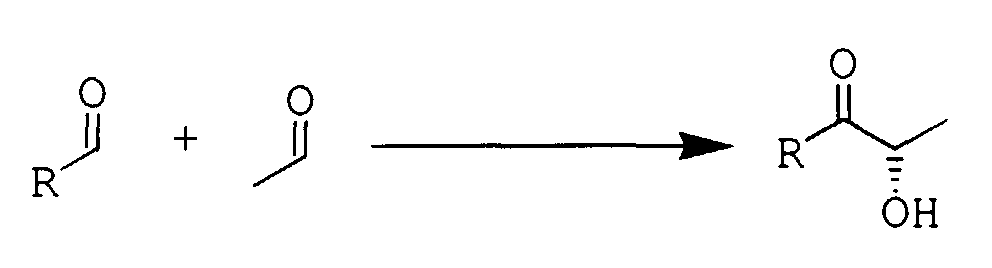
Wir haben nun überraschend festgestellt, daß das synthetische Potential der BFD durch die Verwendung von Aldehyden als Acyldonor wesentlich größer ist als bisher bekannt. Unsere Arbeiten zeigen, daß die primäre Decarboxylierung einer 2-Ketosäure zur Erzeugung eines Thiamindiphosphat-gebundenen Acyldonors nicht notwendig sind. Vielmehr wird diese Spezies auch durch Zugabe des korrespondierenden Aldehyds zur BFD gebildet. Die Reaktionsprodukte aus der erfindungsgemäßen Verknüpfung verschiedener Acyldonor-Aldehyde mit Acetaldehyd als Acylakzeptor entsprechen der allgemeinen Formel III. Alle Reaktionsprodukte des Typs III zeigen (S)-Konfiguration am chiralen Zentrum.




Diese erfindungsgemäße Beobachtung war v.a. deswegen unerwartet, da vergleichbare Einflüsse von Substituenten auf die optische Reinheit in PDC-katalysierten Reaktionen keinen Einfluß zeigten (Deutsche Patentanmeldung AZ. 197 36 104.8).
34.2 g L-1 d-1 (220 mmol L-1 d-1) produziert werden. Durch Variation der Betriebstemperatur des Rührkessels konnte ebenfalls der Einfluß der Temperatur auf den Enantiomerenüberschuß unter kontinuierlichen Betriebsbedingungen gezeigt werden (Fig. 6).
Der Einfachheit halber wird die Enzymaktivität der BFD auf die Decarboxylierung des Standards Benzoylformiat bezogen, d.h. 1 U des Enzyms ist definiert als die Menge, die 1 µmol Benzoylformiat pro Minute decarboxyliert.
Der pH-Wert des Reaktionspuffers richtet sich danach, ob als Acyldonoren 2-Ketocarbonsäuren oder Aldehyde eingesetzt werden. Bei der Verwendung einer 2-Ketocarbonsäure liegt der optimale pH-wert zwischen 6,0 und 7,0, während bei der Verwendung von Aldehyden ein pH-Wert von 6,5 bis 7,5 eingestellt wird.
Neben den beschriebenen Edukten und dem Enzym BFD fügt man dem Syntheseansatz noch den Cofaktor Thiamindiphosphat, bevorzugt in einer Konzentration von 0,1 bis 5,0 mmol/l, zu.

- Benzoylformiat:
- 100 mM
- Acetaldehyd:
- 500 mM
- Thiamindiphosphat:
- 1.5 mM
- MgSO4:
- 2,5 mM
- Kaliumphosphat:
- 200 mM, pH 6,5
- BFD:
- 5 Units/ ml (bez. auf die Decarboxylierung von Benzoylformiat)
Der Enantiomerenüberschuß beträgt 92 %.
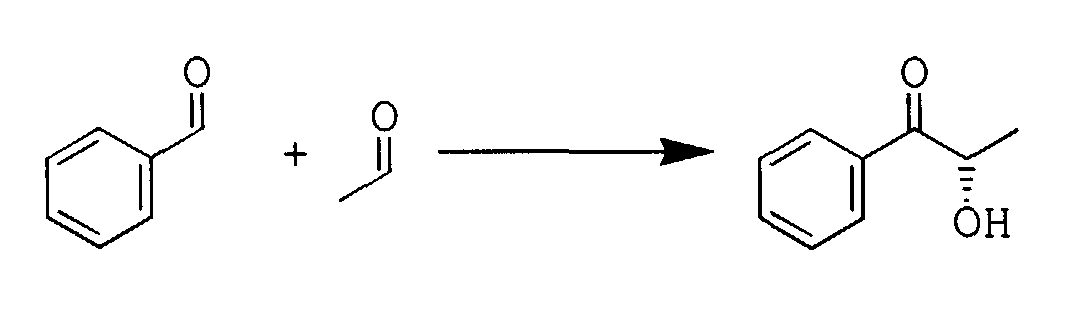
- Benzaldehyd:
- 50 mM
- Acetaldehyd:
- 500 mM
- Thiamindiphosphat:
- 1,5 mM
- MgSO4:
- 2,5 mM
- Kaliumphosphat:
- 100 mM, pH 7,0
- BFD:
- 5 Units/ml (bez. auf die Decarboxylierung von Benzoylformiat)

- Benzaldehyd:
- 50 mM
- Thiamindiphosphat:
- 1,5 mM
- MgSO4:
- 2,5 mM
- Kaliumphosphat:
- 100 mM, pH 7,0
- BFD:
- 15 Units/ml (bez. auf die Decarboxylierung von Benzoylformiat)
Der Reaktionsverlauf und Enantiomerenüberschuß des Produktes werden mittels HPLC an chiraler Phase (Chiralcel OB (Daicel Ltd.), Eluent n-Heptan : i-Propanol = 85:15, Fluß 0,75 ml/min, 25 °C) bzw. GC an chiraler Phase (Cyclodex β-I/P (Hewlett Packard), T(Injektor) = 200 °C, isotherm 150 °C) verfolgt. Die Produkte werden mittels NMR (AMX 300, Fa. Bruker) bzw. GCMS nachgewiesen (HP 6890 Series GC-System sowie HP 5973 Mass Selective Detector der Fa. Hewlett Packard; Säule HP-5MS (30 m x 250 µm), TGC (Injektor) = 250 °C,
TMS(Ionenquelle) = 200 °C, Zeitprogramm(Ofen): T0 min = 60 °C, T3 min = 60 °C, T14 min = 280 °C (Heizrate 20 °C/min), T19 min = 280 °C). Hierzu werden 150 µl einer Probe entnommen und diese mit 150 µl n-Heptan oder Trichlomethan extrahiert. Die Phasentrennung wird durch Zentrifugieren bei 13000 rpm herbeigeführt. Die organische Phase wird direkt injiziert (HPLC, GC, GCMS).
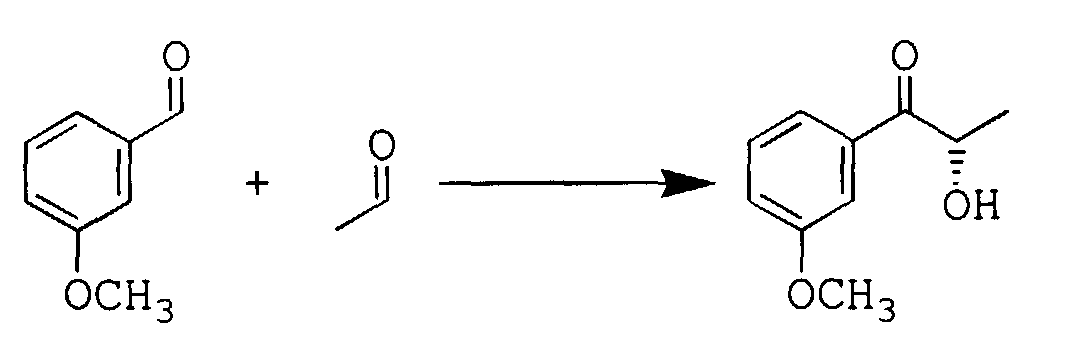

- HRMS: C12H16O3; kalk. 208.1099, gef. 208.1102
- CHN-Bestimmung: C12H16O3; kalk. C 69.21 %, H 7.74 %, gef. C 69.10 %, H 7.74 %.
- ee(HPLC) = 99.3 %, Rt(S) = 16.78 min, Rt(R) = 24.16 min (Eluent i-Hexan : i-Propanol = 9:1).
- [α]D 25 = -54.88° (CHCl3, c = 1.45).
Das Lösungsmittel wird im Vakuum entfernt und das Rohprodukt durch Säulenchromatographie (SiO2, Diethylether/n-Hexan (3:1, v/v), Rf = 0.49) aufgereinigt. Es werden 150 mg (1 mmol) (S)-2-HPP (40 % Ausbeute) mit einem ee = 90 % erhalten.
Der Reaktor wird durch Injektion von 50 U BFD gestartet. Betrieben wird der EMR unter folgenden Reaktionsbedingungen:
| Prozeßzeit/h | Verweilzeit/h | Temperatur/°C |
| 0-23 | 1 | 25 |
| 23-47 | 1 | 10 |
| 47-76 | 2 | 10 |
| 76-180 | 2 | 4 |
Claims (14)
- Verfahren zur stereoselektiven Synthese von 2-Hydroxyketonen ,
dadurch gekennzeichnet, daßals ein erstes Substrat ein Aldehyd, ausgenommen Benzaldehyd, oder eine 2-Ketosäure, ausgenommen Benzoylformiat, eingesetzt wird,als ein zweites Substrat ein Aldehyd, ausgenommen Benzaldehyd, eingesetzt wird,die Synthese in Gegenwart von Thiamindiphosphat (ThDP)-abhängigen Enzymen stattfindet. - Verfahren zur stereoselektiven Synthese von 2-Hydroxyketone nach Anspruch 1,
dadurch gekennzeichnet,
daß als Enzym eine 2-Ketosäuredecarboxylase eingesetzt wird. - Verfahren zur stereoselektiven Synthese von 2-Hydroxyketone nach Anspruch 1,
dadurch gekennzeichnet,
daß als Enzym eine Benzoylfomiatdecarboxylase (BFD) eingesetzt wird. - Verfahren zur stereoselektiven Synthese von 2-Hydroxyketone nach vorhergehendem Anspruch,
dadurch gekennzeichnet,
daß als Enzym eine Benzoylfomiatdecarboxylase (BFD) aus Pseudomonas putida eingesetzt wird. - Verfahren zur stereoselektiven Synthese von 2-Hydroxyketone nach Anspruch 1,
dadurch gekennzeichnet,
daß als ein zweites Substrat ein Acetaldehyd eingesetzt wird. - Verfahren zur stereoselektiven Synthese von 2-Hydroxyketone nach Anspruch 1,
dadurch gekennzeichnet,
daß als ein erstes Substrat ein aromatisches Aldehyd eingesetzt wird. - Verfahren zur stereoselektiven Synthese von 2-Hydroxyketone nach vorhergehendem Anspruch,
dadurch gekennzeichnet,
daß als ein erstes Substrat ein substituiertes aromatisches Aldehyd eingesetzt wird. - Verfahren zur stereoselektiven Synthese von 2-Hydroxyketone nach vorhergehendem Anspruch,
dadurch gekennzeichnet,
daß als ein erstes Substrat ein substituiertes hetero-aromatisches Aldehyd eingesetzt wird. - Verfahren zur stereoselektiven Synthese von 2-Hydroxyketone nach Anspruch 1,
dadurch gekennzeichnet,
daß als ein erstes Substrat ein nichtaromatisches Aldehyd eingesetzt wird. - Verfahren zur stereoselektiven Synthese von 2-Hydroxyketone nach Anspruch 9,
dadurch gekennzeichnet,
daß als ein erstes Substrat ein lineares, nichtaromatisches Aldehyd eingesetzt wird. - Verfahren zur stereoselektiven Synthese von 2-Hydroxyketone nach Anspruch 9,
dadurch gekennzeichnet,
daß als ein erstes Substrat ein cyclisches, nichtaromatisches Aldehyd eingesetzt wird. - Verfahren zur stereoselektiven Synthese von 2-Hydroxyketone nach vorhergehendem Anspruch,
dadurch gekennzeichnet,
daß als ein erstes Substrat ein cyclisches, nichtaromatisches hetero-Aldehyd eingesetzt wird. - Verfahren zur stereoselektiven Synthese von 2-Hydroxyketone nach Anspruch 1,
dadurch gekennzeichnet,
daß zur Steigerung der Enantioselektivität die Temperatur während des Verfahrens weniger als 30 °C, insbesondere weniger als 25 °C, und mehr als -10 °C beträgt. - Verfahren zur stereoselektiven Synthese von 2-Hydroxyketone nach Anspruch 1,
dadurch gekennzeichnet,
daß zur Steigerung der Enantioselektivität die Konzentration des ersten Substrates weniger als 500 mM, insbesondere weniger als 50 mM, jedoch mehr als 1 µM beträgt und die Konzentration des zweiten Substrates weniger als 1 M, insbesondere weniger als 500 mM, und mehr als 1 mM beträgt.
Applications Claiming Priority (2)
| Application Number | Priority Date | Filing Date | Title |
|---|---|---|---|
| DE1999118935 DE19918935A1 (de) | 1999-04-27 | 1999-04-27 | Stereoselektive Synthese von 2-Hydroxyketonen |
| DE19918935 | 1999-04-27 |
Publications (3)
| Publication Number | Publication Date |
|---|---|
| EP1048737A2 true EP1048737A2 (de) | 2000-11-02 |
| EP1048737A3 EP1048737A3 (de) | 2000-11-15 |
| EP1048737B1 EP1048737B1 (de) | 2007-06-06 |
Family
ID=7905911
Family Applications (1)
| Application Number | Title | Priority Date | Filing Date |
|---|---|---|---|
| EP20000108709 Expired - Lifetime EP1048737B1 (de) | 1999-04-27 | 2000-04-22 | Stereoselektive Synthese von 2-Hydroxyketonen |
Country Status (2)
| Country | Link |
|---|---|
| EP (1) | EP1048737B1 (de) |
| DE (2) | DE19918935A1 (de) |
Cited By (2)
| Publication number | Priority date | Publication date | Assignee | Title |
|---|---|---|---|---|
| WO2002002753A3 (de) * | 2000-07-03 | 2002-05-10 | Forschungszentrum Juelich Gmbh | Nukleotidsequenz kodierend für eine benzaldehyd-lyase und verfahren zur stereoselektiven synthese von 2-hydroxyketonen |
| WO2003062436A1 (en) * | 2002-01-24 | 2003-07-31 | Ben-Gurion University Of The Negev | PROCESS FOR PREPARING CHIRAL AROMATIC α-HYDROXY KETONES USING 2-HYDROXY-3-OXOACID SYNTHASE |
Family Cites Families (2)
| Publication number | Priority date | Publication date | Assignee | Title |
|---|---|---|---|---|
| DE19523269C2 (de) * | 1995-05-26 | 2000-05-31 | Forschungszentrum Juelich Gmbh | Verfahren zur Gewinnung von Acyloinen, dafür geeignete Pyruvat-decarboxylase sowie deren Herstellung und DNA-Sequenz des für diese kodierenden PDC-Gens |
| DE19736104A1 (de) * | 1997-08-20 | 1999-02-25 | Basf Ag | Verfahren zur Herstellung von enantiomerenreinen Phenylacetylcarbinolen aus Acetaldchyd und Benzaldehyd in Gegenwart von Pyruvatdecarboxylase aus Zymomonas |
-
1999
- 1999-04-27 DE DE1999118935 patent/DE19918935A1/de not_active Withdrawn
-
2000
- 2000-04-22 DE DE50014381T patent/DE50014381D1/de not_active Expired - Lifetime
- 2000-04-22 EP EP20000108709 patent/EP1048737B1/de not_active Expired - Lifetime
Cited By (4)
| Publication number | Priority date | Publication date | Assignee | Title |
|---|---|---|---|---|
| WO2002002753A3 (de) * | 2000-07-03 | 2002-05-10 | Forschungszentrum Juelich Gmbh | Nukleotidsequenz kodierend für eine benzaldehyd-lyase und verfahren zur stereoselektiven synthese von 2-hydroxyketonen |
| WO2003062436A1 (en) * | 2002-01-24 | 2003-07-31 | Ben-Gurion University Of The Negev | PROCESS FOR PREPARING CHIRAL AROMATIC α-HYDROXY KETONES USING 2-HYDROXY-3-OXOACID SYNTHASE |
| US7166749B2 (en) | 2002-01-24 | 2007-01-23 | Ben-Gurion University Of The Negev | Process for preparing chiral aromatic α-hydroxy ketones using 2-hydroxy-3-oxoacid synthase |
| CN100366749C (zh) * | 2002-01-24 | 2008-02-06 | 内盖夫本格里昂大学 | 使用2-羟基-3-含氧酸合酶制备手性的芳族α-羟基酮的方法 |
Also Published As
| Publication number | Publication date |
|---|---|
| DE50014381D1 (de) | 2007-07-19 |
| EP1048737B1 (de) | 2007-06-06 |
| EP1048737A3 (de) | 2000-11-15 |
| DE19918935A1 (de) | 2000-11-02 |
Similar Documents
| Publication | Publication Date | Title |
|---|---|---|
| DE60024615T2 (de) | Phosphine Stabilisatoren für oxidoreduktase Enzyme | |
| EP1141373A1 (de) | Verfahren zur enantioselektiven reduktion von 3,5-dioxocarbonsäuren, deren salze und ester | |
| EP1205555A1 (de) | Enzymkatalyse in Gegenwart ionischer Flüssigkeiten | |
| EP1194582A1 (de) | Verfahren zur reduktion von keto-carbonsäuren und deren estern | |
| CH619982A5 (de) | ||
| AT413541B (de) | Verfahren zur herstellung von 2-butanol | |
| DE102004007029A1 (de) | Verfahren zur enantioselektiven Reduktion von Ketoverbindungen durch Enzyme | |
| EP1582594A2 (de) | Verbessertes enzymatisches Verfahren zur Herstellung von Triglyzeriden ungesättigter Fettsäuren | |
| EP0539767B1 (de) | Enzymatisches Verfahren zur enantioselektiven Herstellung optisch aktiver Cyanhydrine | |
| WO2008003774A1 (de) | Verfahren zur herstellung enantiomerenreiner flavanone | |
| AT501928B1 (de) | Verfahren zur herstellung von chiralen alkoholen | |
| EP1048737B1 (de) | Stereoselektive Synthese von 2-Hydroxyketonen | |
| EP1974045B1 (de) | Verfahren zur enzymatischen herstellung von citronellal | |
| EP0507278A2 (de) | Immobilisierter Biokatalysator, dessen Herstellung und Verwendung zur Estersynthese in einem Säulenreaktor | |
| EP1870390B1 (de) | Aufarbeitung von Reaktionslösungen aus Ganzzell-Biotransformationen | |
| DE10032254B4 (de) | Nukleotidsequenz kodierend für eine Benzaldehyd-Lyase und Verfahren zur stereoselektiven Synthese von (R)-2-Hydroxyketonen | |
| EP0443406A2 (de) | Verfahren zur enzymatischen Racematspaltung von Pantolacton | |
| DE10208007A1 (de) | Verfahren zur Herstellung von Alkoholen aus Substraten mittels Oxidoreduktasen, Zweiphasensystem umfassend eine wässrige Phase und eine organische Phase sowie Vorrichtung zur Durchführung des Verfahrens | |
| EP1067195B1 (de) | Verfahren zur Reduktion von Ketogruppen enthaltende Verbindungen | |
| DE19928158C2 (de) | Verfahren zur Herstellung von aromatischen Carbonylverbindungen aus Styrolen | |
| DE10313971A1 (de) | Gekoppeltes cofaktorabhängiges enzymatisches Reaktionssystem | |
| EP1969133B1 (de) | Verfahren zur herstellung von optisch aktivem (1s)-3-chlor-1-(2-thienyl)-propan-1-ol | |
| AT408231B (de) | Verfahren zur herstellung von optisch aktiven cyanhydrinen unter verwendung von r-oxynitrilase | |
| DE60309830T2 (de) | Verfahren zur herstellung von chiralen aromatischen alpha-hydroxy-ketonen unter verwendung einer 2-hydroxy-3-oxosäure-synthase | |
| EP0303947A2 (de) | Verfahren zur enzymatischen Herstellung optisch aktiver phosphorhaltiger funktioneller Essigsäurederivate |
Legal Events
| Date | Code | Title | Description |
|---|---|---|---|
| PUAI | Public reference made under article 153(3) epc to a published international application that has entered the european phase |
Free format text: ORIGINAL CODE: 0009012 |
|
| PUAL | Search report despatched |
Free format text: ORIGINAL CODE: 0009013 |
|
| AK | Designated contracting states |
Kind code of ref document: A2 Designated state(s): CH DE FR GB LI |
|
| AX | Request for extension of the european patent |
Free format text: AL;LT;LV;MK;RO;SI |
|
| RIC1 | Information provided on ipc code assigned before grant |
Free format text: 7C 12P 7/26 A, 7C 12P 13/00 B, 7C 12P 17/00 B, 7C 12P 17/12 B, 7C 12P 17/04 B, 7C 12N 9/88 - |
|
| AK | Designated contracting states |
Kind code of ref document: A3 Designated state(s): AT BE CH CY DE DK ES FI FR GB GR IE IT LI LU MC NL PT SE |
|
| AX | Request for extension of the european patent |
Free format text: AL;LT;LV;MK;RO;SI |
|
| 17P | Request for examination filed |
Effective date: 20010214 |
|
| AKX | Designation fees paid |
Free format text: CH DE FR GB LI |
|
| RAP1 | Party data changed (applicant data changed or rights of an application transferred) |
Owner name: FORSCHUNGSZENTRUM JUELICH GMBH |
|
| 17Q | First examination report despatched |
Effective date: 20050704 |
|
| GRAP | Despatch of communication of intention to grant a patent |
Free format text: ORIGINAL CODE: EPIDOSNIGR1 |
|
| GRAS | Grant fee paid |
Free format text: ORIGINAL CODE: EPIDOSNIGR3 |
|
| GRAA | (expected) grant |
Free format text: ORIGINAL CODE: 0009210 |
|
| AK | Designated contracting states |
Kind code of ref document: B1 Designated state(s): CH DE FR GB LI |
|
| REG | Reference to a national code |
Ref country code: GB Ref legal event code: FG4D Free format text: NOT ENGLISH |
|
| REG | Reference to a national code |
Ref country code: CH Ref legal event code: EP |
|
| REF | Corresponds to: |
Ref document number: 50014381 Country of ref document: DE Date of ref document: 20070719 Kind code of ref document: P |
|
| GBV | Gb: ep patent (uk) treated as always having been void in accordance with gb section 77(7)/1977 [no translation filed] |
Effective date: 20070606 |
|
| EN | Fr: translation not filed | ||
| PLBE | No opposition filed within time limit |
Free format text: ORIGINAL CODE: 0009261 |
|
| STAA | Information on the status of an ep patent application or granted ep patent |
Free format text: STATUS: NO OPPOSITION FILED WITHIN TIME LIMIT |
|
| PG25 | Lapsed in a contracting state [announced via postgrant information from national office to epo] |
Ref country code: GB Free format text: LAPSE BECAUSE OF FAILURE TO SUBMIT A TRANSLATION OF THE DESCRIPTION OR TO PAY THE FEE WITHIN THE PRESCRIBED TIME-LIMIT Effective date: 20070606 |
|
| 26N | No opposition filed |
Effective date: 20080307 |
|
| PG25 | Lapsed in a contracting state [announced via postgrant information from national office to epo] |
Ref country code: FR Free format text: LAPSE BECAUSE OF FAILURE TO SUBMIT A TRANSLATION OF THE DESCRIPTION OR TO PAY THE FEE WITHIN THE PRESCRIBED TIME-LIMIT Effective date: 20080201 |
|
| REG | Reference to a national code |
Ref country code: CH Ref legal event code: PL |
|
| PG25 | Lapsed in a contracting state [announced via postgrant information from national office to epo] |
Ref country code: LI Free format text: LAPSE BECAUSE OF NON-PAYMENT OF DUE FEES Effective date: 20080430 Ref country code: CH Free format text: LAPSE BECAUSE OF NON-PAYMENT OF DUE FEES Effective date: 20080430 |
|
| PGFP | Annual fee paid to national office [announced via postgrant information from national office to epo] |
Ref country code: DE Payment date: 20120315 Year of fee payment: 13 |
|
| PG25 | Lapsed in a contracting state [announced via postgrant information from national office to epo] |
Ref country code: DE Free format text: LAPSE BECAUSE OF NON-PAYMENT OF DUE FEES Effective date: 20131101 |
|
| REG | Reference to a national code |
Ref country code: DE Ref legal event code: R119 Ref document number: 50014381 Country of ref document: DE Effective date: 20131101 |