EP1028206A1 - Verfahren zum Armieren von innenliegenden Wand- und Deckenflächen und Flächenarmierungsmaterial - Google Patents
Verfahren zum Armieren von innenliegenden Wand- und Deckenflächen und Flächenarmierungsmaterial Download PDFInfo
- Publication number
- EP1028206A1 EP1028206A1 EP99102669A EP99102669A EP1028206A1 EP 1028206 A1 EP1028206 A1 EP 1028206A1 EP 99102669 A EP99102669 A EP 99102669A EP 99102669 A EP99102669 A EP 99102669A EP 1028206 A1 EP1028206 A1 EP 1028206A1
- Authority
- EP
- European Patent Office
- Prior art keywords
- glass fleece
- wall
- glass
- fleece
- color
- Prior art date
- Legal status (The legal status is an assumption and is not a legal conclusion. Google has not performed a legal analysis and makes no representation as to the accuracy of the status listed.)
- Granted
Links
- 239000000463 material Substances 0.000 title claims abstract description 28
- 238000000034 method Methods 0.000 title claims abstract description 9
- 230000003014 reinforcing effect Effects 0.000 title claims description 5
- 239000011521 glass Substances 0.000 claims abstract description 81
- 239000003973 paint Substances 0.000 claims abstract description 33
- 239000000049 pigment Substances 0.000 claims abstract description 5
- 239000011230 binding agent Substances 0.000 claims abstract description 4
- 229910052500 inorganic mineral Inorganic materials 0.000 claims abstract description 4
- 239000011707 mineral Substances 0.000 claims abstract description 4
- 239000000853 adhesive Substances 0.000 claims description 15
- 230000001070 adhesive effect Effects 0.000 claims description 15
- 230000035699 permeability Effects 0.000 claims description 6
- 239000003795 chemical substances by application Substances 0.000 claims description 5
- 230000002787 reinforcement Effects 0.000 claims description 5
- 238000007639 printing Methods 0.000 claims description 2
- 238000004026 adhesive bonding Methods 0.000 abstract description 3
- 239000011505 plaster Substances 0.000 description 17
- XLYOFNOQVPJJNP-UHFFFAOYSA-N water Chemical compound O XLYOFNOQVPJJNP-UHFFFAOYSA-N 0.000 description 11
- 239000003292 glue Substances 0.000 description 10
- 230000002940 repellent Effects 0.000 description 8
- 239000005871 repellent Substances 0.000 description 8
- 230000008901 benefit Effects 0.000 description 7
- 238000010276 construction Methods 0.000 description 4
- 229920001296 polysiloxane Polymers 0.000 description 4
- 238000004040 coloring Methods 0.000 description 3
- 238000001035 drying Methods 0.000 description 3
- 238000004519 manufacturing process Methods 0.000 description 3
- 239000012779 reinforcing material Substances 0.000 description 3
- 238000009418 renovation Methods 0.000 description 3
- 239000000835 fiber Substances 0.000 description 2
- 239000003365 glass fiber Substances 0.000 description 2
- 238000002360 preparation method Methods 0.000 description 2
- 239000002253 acid Substances 0.000 description 1
- 239000000654 additive Substances 0.000 description 1
- 230000008859 change Effects 0.000 description 1
- 239000011248 coating agent Substances 0.000 description 1
- 238000000576 coating method Methods 0.000 description 1
- 239000003086 colorant Substances 0.000 description 1
- 230000000694 effects Effects 0.000 description 1
- 239000000839 emulsion Substances 0.000 description 1
- 238000005516 engineering process Methods 0.000 description 1
- 230000006872 improvement Effects 0.000 description 1
- 230000003287 optical effect Effects 0.000 description 1
- 238000004806 packaging method and process Methods 0.000 description 1
- 238000010422 painting Methods 0.000 description 1
- 230000009467 reduction Effects 0.000 description 1
- 238000005067 remediation Methods 0.000 description 1
- 238000005096 rolling process Methods 0.000 description 1
- 238000004078 waterproofing Methods 0.000 description 1
Images
Classifications
-
- C—CHEMISTRY; METALLURGY
- C03—GLASS; MINERAL OR SLAG WOOL
- C03C—CHEMICAL COMPOSITION OF GLASSES, GLAZES OR VITREOUS ENAMELS; SURFACE TREATMENT OF GLASS; SURFACE TREATMENT OF FIBRES OR FILAMENTS MADE FROM GLASS, MINERALS OR SLAGS; JOINING GLASS TO GLASS OR OTHER MATERIALS
- C03C25/00—Surface treatment of fibres or filaments made from glass, minerals or slags
- C03C25/10—Coating
-
- E—FIXED CONSTRUCTIONS
- E04—BUILDING
- E04F—FINISHING WORK ON BUILDINGS, e.g. STAIRS, FLOORS
- E04F13/00—Coverings or linings, e.g. for walls or ceilings
Definitions
- the invention relates to a method for reinforcing interior wall and ceiling surfaces, where a Glass fleece is glued to a surface. Furthermore concerns the invention a surface reinforcing material for internal wall and ceiling surfaces with one Glass fleece as the base material, which is used in sheets, plates, Roll or tape form.
- the invention has for its object in improved Results the economy of the interior to improve.
- This task is carried out in a method of the aforementioned Art solved in that the glass fleece before Stick on colored or use a pre-colored glass fleece becomes.
- the glass fleece dyed through. So the color is not just on the surface, but penetrates the glass fleece. This has advantages especially when used later. Smaller scratches or scratches will not result immediately visible damage, as is the case would be if only a superficially applied Color this would be removed. In this case you could namely see the plaster underneath, causing cracks or other damage would become visible again.
- the glass fleece is colored through, you would have to sever the glass fleece completely for visibility to release on the plaster.
- the glass fleece is advantageously colored by printing. With such application technology for the Color can preserve the open porosity of the glass fleece. Accordingly, both the adhesive can evaporate as well as residual moisture in the plaster or masonry escape. Also the risk of sticking the glass fleece on the wall air bubbles or the like Forming disturbances is drastically reduced.
- the task is for a surface reinforcement material of the type mentioned in that it is a Has paint application.
- the first paint job can for example already in the manufacture of Glass fleece have been made.
- the color preferably penetrates the glass fleece. It is a colored glass fleece. Minor damage to the surface of the glued Glass fleece then have no major negative Impact on the appearance of the wall. Man can easily imagine that, for example, in School area or in other public buildings increases the usability of the reinforcement material becomes.
- the air permeability of the colored is preferably Material at least 40% of the undyed material. As a rule, it will be even higher.
- Glass fleece itself is a relatively large porosity open to water vapor or permeable to air.
- the fibers of the glass fleece, the diameter of which is of the order of magnitude of 10 ⁇ m are, as is usual with a nonwoven is crisscrossed. Between them smallest openings remain free, for example one Ensure air permeability of 2,500 l / (m x s). With the paint application, of course, the size of these openings somewhat reduced. But you can do it ensure that the air permeability is still 1,000 up to 1,500 l / (m x s).
- the color application is preferably 30 to 70% of the Basis weight. This is a manageable relation. With higher paint orders there is a risk that the color when handling, for example when rolling out of the glass fleece flakes off or peels off. At lower ones Proportions could occur that the glass fleece still remains visible. With a color application of 50% the proportion by weight of the color is the same as that Weight fraction of the glass fleece.
- the paint application is preferably at least 60% from mineral color pigments and continues to show Binder. This is a relatively high degree of coverage reached.
- the color pigments are used in most Cases should be white so that after sticking of the glass fleece receives a white wall.
- the paint application has a particular advantage Affinity to a wall glue on than the glass of the Glass fleece. So far it has always been necessary to use glue, with which the glass fleece was glued to the wall, to compromise. The glue had to be on the one hand adhere to the plaster, but also to the plaster Glass of the glass fleece. Now if you have a pre-colored one Glass fleece used to reinforce the wall surfaces, then the surface of the glass fleece consists of a Layer of paint. The material of the color usually has a greater similarity to the material of the plaster than the glass of the glass fleece. Accordingly, you can Glue rather on the connection with the material of the Optimize plaster and the material of the paint, so that if necessary with a smaller amount of glue gets along.
- the sheet material with a water repellent is provided.
- This measure can also be used hit if the sheet material is not with a paint application is provided.
- a water repellent you can for example, use a building protection silicone.
- the use of a water repellent has the following Advantage. As stated above, it is for fastening of the reinforcing material necessary that an adhesive is applied to the wall or ceiling surface. The Glass fleece is then placed on this adhesive and pressed. Because the material webs are limited Width, one must have a plurality of such webs glue them side by side on the wall. To clean here To achieve joints, one fastens side by side lying webs so that they overlap each other. in the Overlap area then make a double cut out.
- the hydrophobizing agent is included in the paint application. This ensures that the hydrophobizing agent both on the visible side is available for subsequent application to facilitate the color the second time, so also on the wall side where it is in contact with the adhesive is coming. It also hereby manufactures of the reinforcement material simplified. It is just a single coating job is necessary.
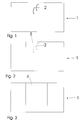
- Fig. 1 shows a wall 1 inside a building, the has been plastered. However, over the course of the Drying the plaster resulted in a crack 2.
- This crack 2 would have to be filled in and of itself, before doing any further work on wall 1 can. This filling is labor and time consuming.
- Fig. 2 now shows this wall with a conventional Glass fleece 3 is glued and once applied, i.e. has been painted over once.
- a conventional Glass fleece 3 is glued and once applied, i.e. has been painted over once.
- the color on the surface is missing of the glass fleece 3. This usually leads to a clearly discernible color deviation of the area at the crack compared to the other areas.
- Fig. 3 now shows the wall 1 with a pre-colored Fleece 4 has been pasted. Without laying the wall has been obtained, there is a smooth and in its coloring homogeneous surface where the crack is also without previous post-treatment is no longer visible.
- the Glass fleece 4 is open-pored and therefore water vapor and breathable. However, it is due to the previously applied color opaque. Another one too Paint application, which is then glued to the wall Glass fleece is applied, remains even, because the first color application, for example the same been applied during the manufacture of the glass fleece can be, the color holds sufficiently.
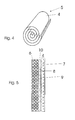
- the glass fleece 4 now shows a roll 5 of the glass fleece 4, that is a custom-made packaging unit, for example in 10, 50 or 100 m glass fleece Widths from 60 to 100 cm can be rolled up. Other configurations are possible, for example in arch form, plate form or band form.
- the glass fleece 4 on the roll 5 is already colored. Accordingly you save two work steps when reinforcing the wall, namely the improvement of the Plaster in the area of cracks and other damage and on the other hand a second creation.
- Fig. 5 shows a greatly enlarged sectional view a wall 6, which is glued with the glass fleece 4.
- the Glass fleece has a base made of a glass fleece layer 7 on. Through two layers of paint 8, 9 on both surfaces are arranged is schematic shown that the glass fleece 4 is colored. Between the wall 6 and the glass fleece 4 is one Glue 10. All layer lengths together.
- the adhesive 10 no longer has to be optimized in this regard be that he both on the wall 6 and the plaster on it as well as on the glass fibers can adhere. It only has to be designed so that he on the wall 6 or the plaster on it and the color 8 can stick.
- the color 8 is sufficient Dimensions connected to the glass fibers of the base 7, see above that a connection between the adhesive 10 and the paint 8 is sufficient to reliably connect the To effect glass fleece 4 with the wall 6.
- the glass fleece 4 is also open-pored after the paint has been applied and thus open to water vapor and permeable to air.
- the Base 7, for example, has an air permeability per se from 2,500 l / (m x s). After the order of the Color 8, 9 it still has an air permeability of 1,500 l / (m x s). This is sufficient to Allow adhesive 10 to evaporate and, on the other hand, escape to allow residual moisture from the masonry.
- the weight of the paint application 8, 9 corresponds approximately to that Weight of the base 7. Deviations upwards or downwards below are of course permitted within certain limits.
- color 8 consists of approximately 70% mineral color pigments and from binders and additives. This is sufficient color coverage the base 7 or the individual fibers guaranteed there.
- the paint 8, 9 contains a water repellent, for example Silicones, alkylchloro- and alkylalkoxysilanes.
- a water repellent for example Silicones, alkylchloro- and alkylalkoxysilanes.
- such building protection silicones can be use.
- the water repellent can also be used if the paint application 8, 9 is missing.
- the use of the water repellent leads to the fact that the adhesive 10 takes longer to get one enter into an intimate connection with the glass fleece 4. This has the advantage that when producing the edges no longer paste between adjacent glass fleece sheets got to. As before, the railways will glued overlapping on the wall. Then in Overlap area a so-called double cut.
- edge strip of the upper glass fleece web can then be easily removed.
- the edge strip the lower glass fleece must then be peeled off from the adhesive 10 become. So far, this has led to partial significant amounts of the adhesive on the edge strip are stuck, so that a subsequent attachment the edge of the other glass fleece web no longer was guaranteed. If you now ensure that the adhesive 10 no longer so quickly into the glass fleece 4 can penetrate, then there remains more Hang glue 10 on the wall 6, so that the re-gluing can be omitted.
Landscapes
- Engineering & Computer Science (AREA)
- Life Sciences & Earth Sciences (AREA)
- Architecture (AREA)
- Chemical & Material Sciences (AREA)
- Organic Chemistry (AREA)
- General Chemical & Material Sciences (AREA)
- Geochemistry & Mineralogy (AREA)
- Materials Engineering (AREA)
- Chemical Kinetics & Catalysis (AREA)
- General Life Sciences & Earth Sciences (AREA)
- Civil Engineering (AREA)
- Structural Engineering (AREA)
- Finishing Walls (AREA)
- Laminated Bodies (AREA)
- Application Of Or Painting With Fluid Materials (AREA)
- Reinforcement Elements For Buildings (AREA)
- Vehicle Interior And Exterior Ornaments, Soundproofing, And Insulation (AREA)
Abstract
Description
- Fig. 1
- eine zu armierende Wand,
- Fig. 2
- eine mit einem herkömmlichen Vlies armierte Wand nach dem ersten Anlegen,
- Fig. 3
- eine nach dem erfindungsgemäßen Verfahren armierte Wand,
- Fig. 4
- eine schematische Darstellung einer Vliesrolle und
- Fig. 5
- einen schematischen Schnitt durch eine mit einem Flächenarmierungsmaterial beklebte Wand in stark vergrößerter Schnittdarstellung.
Claims (11)
- Verfahren zum Armieren von innenliegenden Wand- und Deckenflächen, bei dem ein Glasvlies auf eine Fläche aufgeklebt wird, dadurch gekennzeichnet, daß das Glasvlies (4) vor dem Aufkleben gefärbt oder ein vorgefärbtes Glasvlies verwendet wird.
- Verfahren nach Anspruch 1, dadurch gekennzeichnet, daß das Glasvlies (4) durchgefärbt wird.
- Verfahren nach Anspruch 1 oder 2, dadurch gekennzeichnet, daß das Glasvlies (4) durch ein Bedrucken gefärbt wird.
- Flächenarmierungsmaterial für innenliegende Wand- und Deckenflächen mit einem Glasvlies als Basismaterial, das in Bogen-, Platten-, Rollen- oder Bandform vorliegt, dadurch gekennzeichnet, daß es einen Farbauftrag (8, 9) aufweist.
- Material nach Anspruch 4, dadurch gekennzeichnet, daß die Farbe (8, 9) das Glasvlies (4) durchdringt.
- Material nach Anspruch 4 oder 5, dadurch gekennzeichnet, daß die Luftdurchlässigkeit des gefärbten Materials (4) mindestens 40 % des ungefärbten Materials (7) beträgt.
- Material nach einem der Ansprüche 4 bis 6, dadurch gekennzeichnet, daß der Farbauftrag 30 bis 70 % des Flächengewichts beträgt.
- Material nach einem der Ansprüche 4 bis 7, dadurch gekennzeichnet, daß der Farbauftrag (8, 9) zumindest 60 % aus mineralischen Farbpigmenten besteht und weiterhin ein Bindemittel aufweist.
- Material nach einem der Ansprüche 4 bis 8, dadurch gekennzeichnet, daß der Farbauftrag (8, 9) eine bessere Affinität zu einem Wandkleber (10) als das Glas des Glasvlieses (7) aufweist.
- Flächenmaterial für innenliegende Wand- und Deckenflächen mit einem Glasvlies als Basismaterial, das in Bogen-, Platten-, Rollen- oder Bandform vorliegt, insbesondere nach einem der Ansprüche 1 bis 9, dadurch gekennzeichnet, daß es mit einem Hydrophobiermittel versehen ist.
- Material nach Anspruch 10, dadurch gekennzeichnet, daß das Hydrophobiermittel im Farbauftrag (8, 9) enthalten ist.
Priority Applications (5)
| Application Number | Priority Date | Filing Date | Title |
|---|---|---|---|
| DK99102669T DK1028206T3 (da) | 1999-02-12 | 1999-02-12 | Fremgangsmåde til armering af indvendigt liggende væg- og dækflader og fladearmeringsmateriale |
| AT99102669T ATE281572T1 (de) | 1999-02-12 | 1999-02-12 | Verfahren zum armieren von innenliegenden wand- und deckenflächen und flächenarmierungsmaterial |
| DE59910988T DE59910988D1 (de) | 1999-02-12 | 1999-02-12 | Verfahren zum Armieren von innenliegenden Wand- und Deckenflächen und Flächenarmierungsmaterial |
| EP99102669A EP1028206B1 (de) | 1999-02-12 | 1999-02-12 | Verfahren zum Armieren von innenliegenden Wand- und Deckenflächen und Flächenarmierungsmaterial |
| ES99102669T ES2227915T3 (es) | 1999-02-12 | 1999-02-12 | Procedimdiento para el armado de superficiers interiores de paredes y de techos y material de armado de superficies. |
Applications Claiming Priority (1)
| Application Number | Priority Date | Filing Date | Title |
|---|---|---|---|
| EP99102669A EP1028206B1 (de) | 1999-02-12 | 1999-02-12 | Verfahren zum Armieren von innenliegenden Wand- und Deckenflächen und Flächenarmierungsmaterial |
Publications (2)
| Publication Number | Publication Date |
|---|---|
| EP1028206A1 true EP1028206A1 (de) | 2000-08-16 |
| EP1028206B1 EP1028206B1 (de) | 2004-11-03 |
Family
ID=8237545
Family Applications (1)
| Application Number | Title | Priority Date | Filing Date |
|---|---|---|---|
| EP99102669A Expired - Lifetime EP1028206B1 (de) | 1999-02-12 | 1999-02-12 | Verfahren zum Armieren von innenliegenden Wand- und Deckenflächen und Flächenarmierungsmaterial |
Country Status (5)
| Country | Link |
|---|---|
| EP (1) | EP1028206B1 (de) |
| AT (1) | ATE281572T1 (de) |
| DE (1) | DE59910988D1 (de) |
| DK (1) | DK1028206T3 (de) |
| ES (1) | ES2227915T3 (de) |
Citations (3)
| Publication number | Priority date | Publication date | Assignee | Title |
|---|---|---|---|---|
| JPH0355353A (ja) * | 1989-07-24 | 1991-03-11 | ▲吉▼田 新三郎 | 壁装材 |
| US5433997A (en) * | 1993-07-16 | 1995-07-18 | Land; Frank J. | Textured glass yarn fabric for use in wallcoverings, acoustical panels and ceiling tiles |
| DE29812797U1 (de) * | 1998-07-17 | 1999-03-04 | Göbhardt, Thomas, 99817 Eisenach | Wand- und Deckenbeschichtungssystem |
-
1999
- 1999-02-12 DE DE59910988T patent/DE59910988D1/de not_active Expired - Lifetime
- 1999-02-12 AT AT99102669T patent/ATE281572T1/de not_active IP Right Cessation
- 1999-02-12 DK DK99102669T patent/DK1028206T3/da active
- 1999-02-12 EP EP99102669A patent/EP1028206B1/de not_active Expired - Lifetime
- 1999-02-12 ES ES99102669T patent/ES2227915T3/es not_active Expired - Lifetime
Patent Citations (3)
| Publication number | Priority date | Publication date | Assignee | Title |
|---|---|---|---|---|
| JPH0355353A (ja) * | 1989-07-24 | 1991-03-11 | ▲吉▼田 新三郎 | 壁装材 |
| US5433997A (en) * | 1993-07-16 | 1995-07-18 | Land; Frank J. | Textured glass yarn fabric for use in wallcoverings, acoustical panels and ceiling tiles |
| DE29812797U1 (de) * | 1998-07-17 | 1999-03-04 | Göbhardt, Thomas, 99817 Eisenach | Wand- und Deckenbeschichtungssystem |
Non-Patent Citations (1)
| Title |
|---|
| DATABASE WPI Section Ch Week 9116, Derwent World Patents Index; Class A25, AN 91-113895, XP002108757 * |
Also Published As
| Publication number | Publication date |
|---|---|
| DK1028206T3 (da) | 2004-12-06 |
| EP1028206B1 (de) | 2004-11-03 |
| ES2227915T3 (es) | 2005-04-01 |
| ATE281572T1 (de) | 2004-11-15 |
| DE59910988D1 (de) | 2004-12-09 |
Similar Documents
| Publication | Publication Date | Title |
|---|---|---|
| DE2548273C2 (de) | ||
| DE4110454C2 (de) | Wärmedämmsystem mit Platten und Verfahren zur Oberflächenbehandlung dieser Platten | |
| DE102017117375A1 (de) | Schalungselement für den Betonbau | |
| DE2850861A1 (de) | Verfahren zur herstellung von gedaemmten putzfassaden sowie daemmplattenelemente zur durchfuehrung des verfahrens | |
| DE202020005905U1 (de) | Zementfolien und -beschichtungen für den Hochbau | |
| EP1028206B1 (de) | Verfahren zum Armieren von innenliegenden Wand- und Deckenflächen und Flächenarmierungsmaterial | |
| DE2549247C2 (de) | Verfahren und Vorrichtung zur Herstellung von Platten | |
| EP0106165B1 (de) | Verfahren und Schablone zum Aufbringen eines Reliefverputzes auf eine Oberfläche | |
| DE3233848A1 (de) | Makulatur mit einer dehaesiv eingestellten oberflaeche fuer tapeten aller art und schwere wandbelaege | |
| DE2822744A1 (de) | Wand- und deckenverkleidungen | |
| DE202013004446U1 (de) | Bauoberfläche mit lmitation sowie Hilfsmittel zur Herstellung der Bauoberfläche mit der Imitation | |
| EP0928392B1 (de) | Dämmstoffelement | |
| EP0510225B1 (de) | Dekorationsverfahren und -mittel | |
| EP1858681A2 (de) | Verfahren und vorrichtung zur herstellung beschichteter gipsplatten | |
| EP3031992B1 (de) | Wärmedämmverbund und Wärmedämmverbundareal sowie Wandaufbau, umfassend den Wärmedämmverbund oder das Wärmedämmverbundareal, und Verfahren zur Herstellung von Wandaufbauten | |
| DE2148448A1 (de) | Dichtungsbelag für Bauelemente und Bauwerke | |
| DE2732415A1 (de) | Verfahren zum herstellen einer mineralfasern enthaltenden unterlegmatte o.dgl. | |
| DE3905314C2 (de) | ||
| DE20015297U1 (de) | Plastisch verformbares Abdeckmaterial | |
| EP1092822A1 (de) | Schutzbahn zum Abdecken von Bauwerksflächen | |
| EP3555224A1 (de) | Abdeckvlies | |
| DE3209871A1 (de) | Verfahren zum vollflaechigen verkleben von bituminoesen dachbahnen | |
| DE29806185U1 (de) | Vorrichtung zum Ausbilden von Reliefputz auf einer Wandfläche | |
| DE531053C (de) | Verfahren zur Herstellung von wasserfesten Platten | |
| DE1784432C3 (de) | Schalldämmender, elastischer Filz aus mit einem Elastomer gebundenen mineralischen Fasern, sowie Verfahren und Vorrichtung zu seiner Herstellung |
Legal Events
| Date | Code | Title | Description |
|---|---|---|---|
| PUAI | Public reference made under article 153(3) epc to a published international application that has entered the european phase |
Free format text: ORIGINAL CODE: 0009012 |
|
| AK | Designated contracting states |
Kind code of ref document: A1 Designated state(s): AT BE CH DE DK ES FI FR GB IT LI LU NL SE |
|
| AX | Request for extension of the european patent |
Free format text: AL;LT;LV;MK;RO;SI |
|
| 17P | Request for examination filed |
Effective date: 20001115 |
|
| AKX | Designation fees paid |
Free format text: AT BE CH DE DK ES FI FR GB IT LI LU NL SE |
|
| RAP1 | Party data changed (applicant data changed or rights of an application transferred) |
Owner name: JOHNS MANVILLE EUROPE GMBH |
|
| 17Q | First examination report despatched |
Effective date: 20031105 |
|
| GRAP | Despatch of communication of intention to grant a patent |
Free format text: ORIGINAL CODE: EPIDOSNIGR1 |
|
| GRAS | Grant fee paid |
Free format text: ORIGINAL CODE: EPIDOSNIGR3 |
|
| GRAA | (expected) grant |
Free format text: ORIGINAL CODE: 0009210 |
|
| AK | Designated contracting states |
Kind code of ref document: B1 Designated state(s): AT BE CH DE DK ES FI FR GB IT LI LU NL SE |
|
| REG | Reference to a national code |
Ref country code: GB Ref legal event code: FG4D Free format text: NOT ENGLISH |
|
| REG | Reference to a national code |
Ref country code: CH Ref legal event code: NV Representative=s name: LUCHS & PARTNER PATENTANWAELTE Ref country code: CH Ref legal event code: EP |
|
| REG | Reference to a national code |
Ref country code: DK Ref legal event code: T3 |
|
| REF | Corresponds to: |
Ref document number: 59910988 Country of ref document: DE Date of ref document: 20041209 Kind code of ref document: P |
|
| REG | Reference to a national code |
Ref country code: SE Ref legal event code: TRGR |
|
| PGFP | Annual fee paid to national office [announced via postgrant information from national office to epo] |
Ref country code: AT Payment date: 20050228 Year of fee payment: 7 |
|
| GBT | Gb: translation of ep patent filed (gb section 77(6)(a)/1977) |
Effective date: 20050217 |
|
| PGFP | Annual fee paid to national office [announced via postgrant information from national office to epo] |
Ref country code: CH Payment date: 20050330 Year of fee payment: 7 |
|
| REG | Reference to a national code |
Ref country code: ES Ref legal event code: FG2A Ref document number: 2227915 Country of ref document: ES Kind code of ref document: T3 |
|
| PLBE | No opposition filed within time limit |
Free format text: ORIGINAL CODE: 0009261 |
|
| STAA | Information on the status of an ep patent application or granted ep patent |
Free format text: STATUS: NO OPPOSITION FILED WITHIN TIME LIMIT |
|
| ET | Fr: translation filed | ||
| 26N | No opposition filed |
Effective date: 20050804 |
|
| PG25 | Lapsed in a contracting state [announced via postgrant information from national office to epo] |
Ref country code: AT Free format text: LAPSE BECAUSE OF NON-PAYMENT OF DUE FEES Effective date: 20060212 |
|
| PGFP | Annual fee paid to national office [announced via postgrant information from national office to epo] |
Ref country code: ES Payment date: 20060224 Year of fee payment: 8 |
|
| PG25 | Lapsed in a contracting state [announced via postgrant information from national office to epo] |
Ref country code: LI Free format text: LAPSE BECAUSE OF NON-PAYMENT OF DUE FEES Effective date: 20060228 Ref country code: CH Free format text: LAPSE BECAUSE OF NON-PAYMENT OF DUE FEES Effective date: 20060228 |
|
| PGFP | Annual fee paid to national office [announced via postgrant information from national office to epo] |
Ref country code: LU Payment date: 20060310 Year of fee payment: 8 |
|
| REG | Reference to a national code |
Ref country code: CH Ref legal event code: PL |
|
| REG | Reference to a national code |
Ref country code: ES Ref legal event code: FD2A Effective date: 20070213 |
|
| PG25 | Lapsed in a contracting state [announced via postgrant information from national office to epo] |
Ref country code: ES Free format text: LAPSE BECAUSE OF NON-PAYMENT OF DUE FEES Effective date: 20070213 |
|
| PG25 | Lapsed in a contracting state [announced via postgrant information from national office to epo] |
Ref country code: LU Free format text: LAPSE BECAUSE OF NON-PAYMENT OF DUE FEES Effective date: 20070212 |
|
| PGFP | Annual fee paid to national office [announced via postgrant information from national office to epo] |
Ref country code: IT Payment date: 20110224 Year of fee payment: 13 |
|
| PG25 | Lapsed in a contracting state [announced via postgrant information from national office to epo] |
Ref country code: IT Free format text: LAPSE BECAUSE OF NON-PAYMENT OF DUE FEES Effective date: 20120212 |
|
| REG | Reference to a national code |
Ref country code: FR Ref legal event code: PLFP Year of fee payment: 18 |
|
| REG | Reference to a national code |
Ref country code: FR Ref legal event code: PLFP Year of fee payment: 19 |
|
| REG | Reference to a national code |
Ref country code: FR Ref legal event code: PLFP Year of fee payment: 20 |
|
| PGFP | Annual fee paid to national office [announced via postgrant information from national office to epo] |
Ref country code: NL Payment date: 20180226 Year of fee payment: 20 |
|
| PGFP | Annual fee paid to national office [announced via postgrant information from national office to epo] |
Ref country code: FI Payment date: 20180227 Year of fee payment: 20 Ref country code: DK Payment date: 20180223 Year of fee payment: 20 Ref country code: DE Payment date: 20180227 Year of fee payment: 20 Ref country code: GB Payment date: 20180227 Year of fee payment: 20 |
|
| PGFP | Annual fee paid to national office [announced via postgrant information from national office to epo] |
Ref country code: SE Payment date: 20180227 Year of fee payment: 20 Ref country code: FR Payment date: 20180227 Year of fee payment: 20 Ref country code: BE Payment date: 20180227 Year of fee payment: 20 |
|
| REG | Reference to a national code |
Ref country code: DE Ref legal event code: R082 Ref document number: 59910988 Country of ref document: DE Representative=s name: KEIL & SCHAAFHAUSEN PATENT- UND RECHTSANWAELTE, DE |
|
| REG | Reference to a national code |
Ref country code: DE Ref legal event code: R071 Ref document number: 59910988 Country of ref document: DE |
|
| REG | Reference to a national code |
Ref country code: NL Ref legal event code: MK Effective date: 20190211 |
|
| REG | Reference to a national code |
Ref country code: DK Ref legal event code: EUP Effective date: 20190212 |
|
| REG | Reference to a national code |
Ref country code: GB Ref legal event code: PE20 Expiry date: 20190211 |
|
| REG | Reference to a national code |
Ref country code: BE Ref legal event code: MK Effective date: 20190212 |
|
| REG | Reference to a national code |
Ref country code: SE Ref legal event code: EUG |
|
| PG25 | Lapsed in a contracting state [announced via postgrant information from national office to epo] |
Ref country code: GB Free format text: LAPSE BECAUSE OF EXPIRATION OF PROTECTION Effective date: 20190211 |