EP1026281A2 - Method of producing anti-corrosion member and anti-corrosion member - Google Patents
Method of producing anti-corrosion member and anti-corrosion member Download PDFInfo
- Publication number
- EP1026281A2 EP1026281A2 EP00300754A EP00300754A EP1026281A2 EP 1026281 A2 EP1026281 A2 EP 1026281A2 EP 00300754 A EP00300754 A EP 00300754A EP 00300754 A EP00300754 A EP 00300754A EP 1026281 A2 EP1026281 A2 EP 1026281A2
- Authority
- EP
- European Patent Office
- Prior art keywords
- corrosion
- base member
- aluminum
- fluoride
- fluorine compound
- Prior art date
- Legal status (The legal status is an assumption and is not a legal conclusion. Google has not performed a legal analysis and makes no representation as to the accuracy of the status listed.)
- Granted
Links
Images




Classifications
-
- C—CHEMISTRY; METALLURGY
- C23—COATING METALLIC MATERIAL; COATING MATERIAL WITH METALLIC MATERIAL; CHEMICAL SURFACE TREATMENT; DIFFUSION TREATMENT OF METALLIC MATERIAL; COATING BY VACUUM EVAPORATION, BY SPUTTERING, BY ION IMPLANTATION OR BY CHEMICAL VAPOUR DEPOSITION, IN GENERAL; INHIBITING CORROSION OF METALLIC MATERIAL OR INCRUSTATION IN GENERAL
- C23C—COATING METALLIC MATERIAL; COATING MATERIAL WITH METALLIC MATERIAL; SURFACE TREATMENT OF METALLIC MATERIAL BY DIFFUSION INTO THE SURFACE, BY CHEMICAL CONVERSION OR SUBSTITUTION; COATING BY VACUUM EVAPORATION, BY SPUTTERING, BY ION IMPLANTATION OR BY CHEMICAL VAPOUR DEPOSITION, IN GENERAL
- C23C8/00—Solid state diffusion of only non-metal elements into metallic material surfaces; Chemical surface treatment of metallic material by reaction of the surface with a reactive gas, leaving reaction products of surface material in the coating, e.g. conversion coatings, passivation of metals
- C23C8/06—Solid state diffusion of only non-metal elements into metallic material surfaces; Chemical surface treatment of metallic material by reaction of the surface with a reactive gas, leaving reaction products of surface material in the coating, e.g. conversion coatings, passivation of metals using gases
-
- C—CHEMISTRY; METALLURGY
- C23—COATING METALLIC MATERIAL; COATING MATERIAL WITH METALLIC MATERIAL; CHEMICAL SURFACE TREATMENT; DIFFUSION TREATMENT OF METALLIC MATERIAL; COATING BY VACUUM EVAPORATION, BY SPUTTERING, BY ION IMPLANTATION OR BY CHEMICAL VAPOUR DEPOSITION, IN GENERAL; INHIBITING CORROSION OF METALLIC MATERIAL OR INCRUSTATION IN GENERAL
- C23C—COATING METALLIC MATERIAL; COATING MATERIAL WITH METALLIC MATERIAL; SURFACE TREATMENT OF METALLIC MATERIAL BY DIFFUSION INTO THE SURFACE, BY CHEMICAL CONVERSION OR SUBSTITUTION; COATING BY VACUUM EVAPORATION, BY SPUTTERING, BY ION IMPLANTATION OR BY CHEMICAL VAPOUR DEPOSITION, IN GENERAL
- C23C8/00—Solid state diffusion of only non-metal elements into metallic material surfaces; Chemical surface treatment of metallic material by reaction of the surface with a reactive gas, leaving reaction products of surface material in the coating, e.g. conversion coatings, passivation of metals
- C23C8/60—Solid state diffusion of only non-metal elements into metallic material surfaces; Chemical surface treatment of metallic material by reaction of the surface with a reactive gas, leaving reaction products of surface material in the coating, e.g. conversion coatings, passivation of metals using solids, e.g. powders, pastes
- C23C8/62—Solid state diffusion of only non-metal elements into metallic material surfaces; Chemical surface treatment of metallic material by reaction of the surface with a reactive gas, leaving reaction products of surface material in the coating, e.g. conversion coatings, passivation of metals using solids, e.g. powders, pastes only one element being applied
-
- Y—GENERAL TAGGING OF NEW TECHNOLOGICAL DEVELOPMENTS; GENERAL TAGGING OF CROSS-SECTIONAL TECHNOLOGIES SPANNING OVER SEVERAL SECTIONS OF THE IPC; TECHNICAL SUBJECTS COVERED BY FORMER USPC CROSS-REFERENCE ART COLLECTIONS [XRACs] AND DIGESTS
- Y10—TECHNICAL SUBJECTS COVERED BY FORMER USPC
- Y10T—TECHNICAL SUBJECTS COVERED BY FORMER US CLASSIFICATION
- Y10T428/00—Stock material or miscellaneous articles
- Y10T428/12—All metal or with adjacent metals
- Y10T428/12493—Composite; i.e., plural, adjacent, spatially distinct metal components [e.g., layers, joint, etc.]
- Y10T428/12535—Composite; i.e., plural, adjacent, spatially distinct metal components [e.g., layers, joint, etc.] with additional, spatially distinct nonmetal component
- Y10T428/12556—Organic component
Definitions
- the present invention relates to a method of producing an anti-corrosion member and an anti-corrosion member.
- a micro-fabrication technique is improved more and more, and a process which requires a chemical reaction is improved accordingly
- a corrosion gas of halogen series such as chlorine gas, fluorine gas and so on as a deposition gas, an etching gas and a cleaning gas.
- a semiconductor cleaning gas made of a corrosion gas of halogen series such as ClF 3 , NF 3 , CF 4 , HF and HCl after a deposition operation.
- a corrosion gas of halogen series such as WF 6 , SiH 2 Cl as a film forming gas.
- Members constructing the semiconductor manufacturing apparatus are formed, for example, by anodized aluminum, aluminum nitride and so on.
- SiC silicon carbide
- JP-A-2-263972 discloses a technique such that a fluorine passivated film made of a metal fluoride as a main ingredient in a stoichiometric state is formed on a surface of a metal member and an anti-corrosion property of the metal member with respect to the corrosion gas of halogen series is improved by the thus formed fluorine passivated film.
- a surface oxidization film is shrunk at a temperature about 300°C and thus cracks are generated. Therefore, if it is exposed in the corrosion gas of halogen series at a high temperature, a base aluminum is corroded via crack portions, and the surface oxidization film corresponding to the thus corroded portion is peeled off from the member to generate particles.
- silicon carbide shows a relatively high anti-corrosion property with respect to the corrosion gas of halogen series, but there is a drawback such that it is difficult to make a large construction member by using silicon carbide since it is hard to be sintered.
- An object of the invention is to provide a new method of producing a anti-corrosion member and an anti-corrosion member which shows a high anti-corrosion property with respect to a corrosion gas of halogen series.
- a method of producing an anti-corrosion member having a base member made of a metal in which aluminum is included, ceramics in which aluminum element is included, or a composition member constructed by a metal in which aluminum is included and ceramics, and an anti-corrosion film formed on the base member comprises the steps of: setting the base member in a container in which a solid fluorine compound is filled; heating the container at a temperature higher than a decomposed temperature of the fluorine compound to generate a decomposed gas of the fluorine compound and to subject the base member to a heat treatment with the decomposed gas of the fluorine compound; and forming an anti-corrosion film made of a fluoride on a surface of the base member.
- an anti-corrosion member comprises a base member made of a metal in which aluminum is included, ceramics in which aluminum element is included or a composite member constructed by a metal in which aluminum is included and ceramics, and an anti-corrosion film made of a fluoride generated on a surface of the base member by setting the base member in a container in which a solid fluorine compound is filled and by heating the container at a temperature higher than a decomposed temperature of the solid fluorine compound.
- the inventors tried to find a new method of producing an anti-corrosion member and a new anti-corrosion member so as to improve an anti-corrosion property of a member which constructs a semiconductor manufacturing apparatus with respect to a corrosion gas of halogen series especially a plasma gas of halogen series.
- a fluoride layer preferably having a main crystal phase of AlF 3 was formed on a surface of a base member by setting the base member made of aluminum in a sealed container in which a solid fluorine compound such as NaHF 2 is included and by heating the sealed container at a temperature higher than a decomposed temperature of the fluorine compound to perform a heat treatment for a predetermined time interval. Then, it was found that the thus formed anti-corrosion member had a high anti-corrosion property with respect to the corrosion gas of halogen series especially the plasma gas of halogen series such as a chlorine plasma gas.
- the base member mentioned above is formed by aluminum metal, aluminum alloy, ceramic material in which aluminum element is included, and composite member. Therefore, it is possible to easily perform casting and sintering operations, and thus a manufacturing of the large construction member becomes easy.
- the anti-corrosion member manufactured according to the method of the invention has an excellent anti-corrosion property with respect to the corrosive gas of halogen series, and it is possible to easily manufacture the large construction member by using this anti-corrosion member. In addition, it is not necessary to use a complicated manufacturing equipment, and thus there occurs no problem due to high cost.
- Fig. 1 is a schematic view showing an X-ray diffraction pattern of an anti-corrosion member according to the invention.
- Fig. 2 is an SEM cross sectional photograph showing a surface of the anti-corrosion member mentioned above.
- an alumina (Al 2 O 3 ) passivated film is formed on a surface made of, for example, an aluminum metal. Then, the thus formed alumina passivated film is reacted with the HF mentioned above according to the following formula (2), and alumina is transformed into aluminum trifluoride (AlF 3 ). In this manner, a fluoride layer is formed on a surface of the base member. Al 2 O 3 + 6HF ⁇ 2AlF 3 + 3H 2 O
- the fluoride layer according to the invention is not necessarily existed as a complete continuous layer, but includes the case such that fluoride particles are aligned thickly.
- an anti-corrosion member In a method of producing an anti-corrosion member according to the invention, it is necessary to subject a base member made of aluminum metal and so on to a heat treatment with a decomposed gas of a solid fluorine compound.
- This heat treatment can be performed under an atmosphere by using an open container, but it is preferred that this heat treatment is performed under a pressurized state by using a sealed container. In this manner, it is possible to produce an anti-corrosion member having an extremely high corrosion property with respect to a corrosion gas of halogen series especially a plasma gas of halogen series such as a chlorine plasma gas.
- the heat treatment is performed under a pressurized state
- an upper limit of the pressure is preferred to be 20 atm and is further preferred to be 10 atm if taking into consideration of a withstanding pressure of the container.
- a temperature of the heat treatment is not limited, if only it is higher than a decomposed temperature of a solid fluorine compound and it is possible to generate a decomposed gas by decomposing the fluorine compound.
- the heat treatment in order to obtain the anti-corrosion member having a high anti-corrosion property with respect to the plasma gas of halogen series by subjecting the base member to the heat treatment under a pressurized state mentioned above, it is preferred to perform the heat treatment at a temperature 0-200°C higher than the decomposed temperature of the solid fluorine compound, and it is further preferred to perform the heat treatment at a temperature more than 10°C higher but at maximum 150°C higher.
- a time interval of the heat treatment is varied in accordance with a thickness of a fluoride layer to be formed, a pressure in the container and kinds of fluorine gases, but it is preferred to be 5-40 hours.
- the solid fluorine compound used in this invention is not limited if only it has a specific decomposed temperature and generate a decomposed gas by heating it at a temperature higher than the decomposed temperature. However, it is preferred to use the solid fluorine compound having the decomposed temperature of 100-300°C. If the solid fluorine compound has a relatively low decomposed temperature mentioned above, it is possible to easily heat the container during the heat treatment. Moreover, it is possible to easily perform the heat treatment of the base member under a pressurized state. As the solid fluorine compound, use is made of NaHF 2 , KHF 2 and NH 4 HF 2 , decomposed temperatures of which are 140-160°C, 240°C and 120-160°C respectively.
- the fluorine compound which includes no metal element it is particularly preferred to use the fluorine compound which generates hydrogen fluoride by the decomposition.
- a meaning of the solid fluorine compound includes a bulk type, a particle type and a powder type. Since the solid fluorine compound of the powder type has a large surface area, it is possible to make a temperature of overall powders uniform in a relatively short time, and thus it is possible to easily generate the decomposed gas by the decomposition.
- the base member which constructs the anti-corrosion member use is made of the following materials.
- the producing method according to the invention can be applied to the base member having a large dimension or the base member having a specific shape, and thus it is possible to easily form the anti-corrosion member having a large dimension or the anti-corrosion member having a specific shape. As a result, the producing method according to the invention can be applied to wide applications such as a semiconductor manufacturing apparatus.
- the anti-corrosion member according to the invention is remarkable since it has an extremely high corrosion property with respect to the chlorine plasma gas in addition to the fluorine plasma gas.
- a weight loss of the anti-corrosion member is preferred to be smaller than 15 mg/cm 2 and is further preferred to be smaller than 1 mg/cm 2 when it is exposed at 460°C for 5 hours in the chlorine plasma gas obtained by exciting at a high frequency of 13.56 MHz and 800 W.
- the anti-corrosion member having the properties mentioned above is used for the semiconductor manufacturing apparatus as one example, it is possible to use the anti-corrosion member for a sufficiently long time interval under a normal condition as compared with the known materials.
- a method of producing an anti-corrosion member having a base member made of a metal in which aluminum is included and an anti-corrosion film formed on the base member comprises the steps of: setting the base member in a container in which a solid fluorine compound is filled; heating the container at a temperature higher than a decomposed temperature of the fluorine compound to generate a decomposed gas of the fluorine compound and to subject the base member to a heat treatment with the decomposed gas of the fluorine compound, so that an intermediate film made of a fluoride is formed on a surface of the base member; subjecting the base member and the intermediate film to a heat treatment to react each other; and forming an anti-corrosion film made of a fluoride.
- the intermediate film made of the fluoride having no anti-corrosion property mentioned above has an appearance, for example, shown in Fig. 3.
- the film obtained by subjecting the intermediate film to the heat treatment has an appearance shown in Fig. 4.
- the inventors investigated characteristics and anti-corrosion property of the thus finally obtained fluoride anti-corrosion film and found that it had remarkable features as follows.
- the anti-corrosion film was formed by fluoride particles which cover a surface of the base member.
- the fluoride particle has a large particle size, and when a line is drawn on a surface of the anti-corrosion film, the number of boundary phases across the line is smaller than 100 and larger than 5 per the line having a length of 10 ⁇ m on an average.
- This definition corresponds to a particle size of 0.1 ⁇ m-2.0 ⁇ m.
- the fluoride film generated by contacting the fluoride gas to the metal in which aluminum is include or by contacting the decomposed gas of the solid fluorine compound mentioned above, is very fine since it is obtained by means of a vapor method, and particles of the fluoride film are not distinctly observed by a microscope having 5000 magnification. On the contrary, the thus obtained anti-corrosion film has the features such that a particle size is very large, particles are thickly contacted each other and there is no boundary phase.
- the fluoride particles include at least one preferably both of aluminum fluoride phase and magnesium fluoride phase.
- Aluminum element and magnesium element are transferred from a surface of the base member to the film.
- a thickness of the anti-corrosion film is assumed to be 0.1-2.0 ⁇ m in a normal condition since it is not observed by an SEM microscope having 5000 magnification.
- An atmosphere during the heat treatment of the base member and the intermediate film is not limited if only it affects the base member, but it is particularly preferred to use an atmosphere in which oxygen and inert gas are included.
- a temperature of the heat treatment is preferred to be higher than 200°C from the view point of improving the reaction between the intermediate film and the base member, and it is further preferred to be higher than 300°C.
- the solid fluorine compound which is accommodated in the container is preferred to be the fluorine compound including no metal element.
- a fluorine compound is not limited if only it can be decomposed, but it is particularly preferred to be NH 4 HF 2 .
- the intermediate film is generated by the reaction between the base member and fluoride gas, and it is particularly preferred to be an aluminum fluoride ammonium film.
- the aluminum fluoride ammonium film is firstly generated as the intermediate film by heating the solid fluorine compound and the base member in the container. Then, the base member and the aluminum fluoride ammonium film are subjected to the heat treatment mentioned above in the container to generate the anti-corrosion film.
- the another method it is possible to perform the heat treatment under a condition such that powders of aluminum fluoride ammonium are contacted to a surface of the base member.
- the powders mentioned above can be generated by a chemical reaction for example between aluminum hydroxide and ammonium fluoride saturated solution.
- the aluminum fluoride ammonium powders are further accommodated in the container, and the base member is embedded in the powders. Then, the heat treatment is performed under the condition mentioned above.
- a formed film is obtained by mixing the aluminum fluoride ammonium powders with suitable organic solvent, binder and so on, preparing a coating slurry, and coating the coating slurry on the base member. The thus obtained formed film is subjected to the heat treatment together with the base member.
- the aluminum fluoride ammonium may be made of (NH 4 ) 3 AlF 6 crystal only.
- aluminum element of (NH 4 ) 3 AlF 6 crystal may be substituted by the other metal elements if only (NH 4 ) 3 AlF 6 crystal maintains its crystal structure.
- the other metal elements it is generally preferred to use metal elements which are included in the aluminum alloy.
- metal elements it is preferred to use silicon, magnesium, manganese, copper, iron and so on. Particularly, in an application of the semiconductor manufacturing, it is preferred to use silicon or magnesium.
- the anti-corrosion member according to the invention can be applied to suscepter which is heated by means of an infrared lamp, heater for heating a semiconductor, suscepter provided on a heating surface of an heater for heating a semiconductor, suscepter in which an electrode for a static chuck is embedded, suscepter in which an electrode for a static chuck and a resistance heater are embedded, and suscepter in which an electrode for a high frequency plasma generation and a resistance heater are embedded.
- the anti-corrosion member according to the invention can be used as the base member of the semiconductor manufacturing apparatus such as dummy wafer, shadow ring, tube for generating a high frequency plasma, dome for generating a high frequency plasma, high frequency transmitting window, infrared transmitting window, lift pin for supporting a semiconductor wafer, shadow plate and so on.
- the thus prepared Teflon container was accommodated in a stainless container, and the stainless container was sealed. After that, the sealed stainless container was set in an oven, and a heat treatment was performed.
- the heat treatment was performed at 300°C for 10 hours. After that, the sealed stainless container was cooled in a room to an extent such that an inner temperature of the sealed stainless container was lower than 30°C. In this case, a pressure in the Teflon container during the heat treatment was about 20 atm. After that, the aluminum plate was picked up, and a surface of the thus picked up aluminum plate was examined by means of an X-ray.
- the fluoride having AlF 3 as a main crystal phase is formed on a surface of the aluminum plate.
- the anti-corrosion member was obtained in the same manner as that of the example 1 except that a temperature of the heat treatment was 200°C.
- the anti-corrosion member was obtained in the same manner as that of the example 1 except that a temperature of the heat treatment was 130°C.
- the anti-corrosion member was obtained in the same manner as that of the example 2 except that a temperature of the heat treatment was 100°C.
- the anti-corrosion member in which the fluoride layer formed by heating the container at a temperature higher than the decomposed temperature of NaHF 2 or KHF 2 as the solid fluorine compound and forming the fluoride layer on a surface of the base member by using the decomposed gas of the fluorine compound, according to the producing method of the invention, has a high corrosion property with respect to the corrosion gas of halogen series such as Cl 2 gas.
- the anti-corrosion member in which the fluoride layer is not formed on a surface of the base member, shows a low anti-corrosion property with respect to the corrosion gas of halogen series such as Cl 2 gas since it has a large weight variation before and after the corrosion test.
- the thus sealed fluorine resin container was set in an oven, and a heat treatment was performed at 300°C for 10 hours. After that, the sealed fluorine resin container was cooled in a room to an extent such that an inner temperature of the sealed fluorine resin container was lower than 30°C. In this case, a pressure in the fluorine resin container during the heat treatment was about 20atm.
- the aluminum alloy plate was picked up, and a surface of the thus picked up aluminum alloy plate was examined by an X-ray diffraction. As a result, no peak from other than the base member was observed. Moreover, a surface and a cross section of the aluminum alloy plate were observed by an SEM, but no phase other than the base member was observed. However, when a surface composition of the aluminum alloy plate was examined by an EDS, an F element was strongly detected other than Al, Mg, Si which were contained in the base member From this result, it was understood that the fluoride layer was formed on a surface of the base member.
- a corrosion test A a mix gas of NF 3 and N 2 was excited.
- NF 3 gas and N 2 gas had flow amounts of 75sccm and 100sccm respectively and had a pressure of 0.1Torr.
- the mix gas was excited by using an induction coupling plasma having a frequency of 13.56MHz and 800W.
- the anti-corrosion member was maintained in this fluorine plasma gas at 550°C for 5 hours.
- an anti-corrosion property was estimated corresponding to a weight increase before and after the corrosion test A.
- a sample was provided at a position apart by 300mm from an excitation coil having a diameter of 120mm. In this case, if the weight increase is larger, the anti-corrosion property becomes lower.
- a corrosion test B a mix gas of Cl 2 and N 2 was excited.
- Cl 2 gas and N 2 gas had flow amounts of 300sccm and 100sccm respectively and had a pressure of 0.1Torr.
- the mix gas was excited by using an induction coupling plasma having a frequency of 13.56MHz and 800W.
- an anti-corrosion property was estimated corresponding to a weight loss before and after the corrosion test B.
- a sample was provided at a position apart by 300mm from an excitation coil having a diameter of 120mm. In this case, if the weight loss is larger, the anti-corrosion property becomes lower.
- the aluminum alloy plate was picked up from the container. Then, the thus picked up aluminum alloy plate was set in a heat treating furnace, and a heat treatment was performed in an atmosphere, at 550°C for 2 hours.
- the anti-corrosion member was obtained in the same manner as that of the experiment 4 except that an amount of NaHF 2 powders was 0.5 g instead of 1g and a temperature of the heat treatment was 200°C instead of 300°C. In this case, a pressure in the container during the heat treatment was about 9atm.
- the anti-corrosion member was obtained in the same manner as that of the experiment 4 except that an amount of NaHF 2 powders was 0.3 g instead of 1 g and a temperature of the heat treatment was 150°C instead of 300°C. In this case, a pressure in the container during the heat treatment was about 5 atm.
- the anti-corrosion member was obtained in the same manner as that of the experiment 4 except that KHF 2 powders were used instead of NaHF 2 powders. In this case, a pressure in the container during the heat treatment was about 20atm.
- the anti-corrosion member was obtained in the same manner as that of the experiment 4 except that an amount of NaHF 2 powders was 0.2g instead of 1g, a material of the base member was JIS5052 aluminum alloy instead of JIS6061 aluminum alloy, and a temperature of the heat treatment was 200°C instead of 300°C. In this case, a pressure in the container during the heat treatment was about 3atm.
- the anti-corrosion member was obtained in the same manner as that of the experiment 9 except that a material of the base member was JIS1050 alloy instead of JIS5052 aluminum alloy. In this case, a pressure in the container during the heat treatment was about 3atm.
- An aluminum alloy plate (JIS6061) having a length of 10mm, a breadth of 10mm and a thickness of 2mm was provided in a chamber made of Ni. Then, the aluminum alloy plate was baked at 350°C for 1 hour under a condition such that an N 2 gas was flowed under an atmosphere. Then, 100% F 2 gas was flowed under an atmosphere, and a heat treatment was performed at 350°C for 10 hours with respect to the aluminum alloy plate. After that, an atmosphere in the chamber was exchanged by using a nitrogen gas, and a heat treatment was performed at 350°C for 1 hour in this N 2 atmosphere. Then, the chamber was cooled to an extent such that a temperature in the chamber was lower than 30°C, and the aluminum alloy plate was picked up.
- a surface of the thus picked up aluminum alloy plate was examined by an X-ray diffraction, but no peak other than the aluminum alloy as the base member was detected. Moreover, a surface and a cross section of the aluminum alloy plate were observed by an SEM, but no layer other than the aluminum alloy plate was detected. However, when a chemical composition of a surface of the aluminum alloy plate was examined by an EDS, an F element was strongly detected other than Al, Mg, Si which were contained in the aluminum alloy plate. From this result, it was understood that the fluoride layer was formed on a surface of the aluminum alloy plate.
- the results of two kinds of the corrosion tests A and B are shown in Table 2.
- the anti-corrosion member was obtained in the same manner as that of the comparative example 3 except that JIS1050 aluminum alloy plate was used instead of JIS6061 aluminum alloy plate.
- the corrosion tests A and B were performed with respect to an aluminum alloy plate (JIS6061) having a length of 10mm, a breadth of 10mm and a thickness of 2mm.
- the results of the corrosion tests A and B are shown in Table 2.
- the corrosion tests A and B were performed with respect to an aluminum alloy plate (JIS1050) having a length of 10mm, a breadth of 10mm and a thickness of 2mm. The results of the corrosion tests A and B are shown in Table 2.
- Anti-corrosion test A weight increase due to fluorine plasma gas exposure mg/cm 2
- Anti-corrosion test B weight loss due to chlorine plasma gas exposure mg/cm 2
- Example 4 exist NaHF 2 decomposed gas 20 ⁇ 0.1 0.1
- Example 5 exist NaHF 2 decomposed gas 20 ⁇ 0.1 ⁇ 0.1
- Example 6 exist NaHF 2 decomposed gas 9 ⁇ 0.1 0.2
- Example 7 exist NaHF 2 decomposed gas 5 0.1 0.3
- Example 8 exist KHF 2 decomposed gas 20 ⁇ 0.1 0.1
- Example 9 exist NaHF 2 decomposed gas 3 ⁇ 0.1 0.3
- Example 10 exist NaHF 2 decomposed gas 3 ⁇ 0.1 12.9 Comparative Example 3 exist F 2 gas
- the anti-corrosion member obtained according to the invention in which the fluoride layer was formed on a surface of the anti-corrosion layer by heating the base member by using the decomposed gas of NaHF 2 or KHF 2 as the solid fluorine compound, shows a high anti-corrosion property with respect to the fluorine plasma gas and the chlorine plasma gas. Particularly, there is a remarkable difference on the anti-corrosion property with respect to the chlorine plasma gas.
- the anti-corrosion property with respect to the fluorine plasma gas and the chlorine plasma gas is low if the anti-corrosion member is obtained by using the F 2 gas instead of the solid fluorine compound.
- NH 4 F ⁇ HF hydrogen fluoride ammonium
- a fluorine resin mesh was provided on the powders, and then an aluminum alloy (JIS6061 alloy) plate having a length of 10 mm, a breadth of 10 mm and a thickness of 2 mm was provided on the fluorine resin mesh.
- the aluminum alloy plate was not directly contacted to the NH 4 F ⁇ HF powders by using the mesh.
- a plug was provided to an open portion of the cylindrical container, and the cylindrical container was set in an open stainless container. After that, the cylindrical container was sealed by embedding it.
- the thus sealed fluorine resin container was set in an oven, and a heat treatment was performed at 250°C for 16 hours. After that, the
- the aluminum alloy plate was picked up from the container.
- a surface of the aluminum alloy plate was covered with a powdery precipitation member having a reddish color as shown in the photograph of Fig. 3.
- the precipitation member was identified, by an X-ray diffraction method, to be a compound having the same crystal structure as that of (NH 4 ) 3 AlF 6 .
- the aluminum alloy plate was subjected to a heat treatment in an atmosphere at 500°C for 2 hours under a condition such that a surface of the aluminum alloy plate was maintained to be covered with the precipitation member. After the heat treatment, a reddish color was slightly faded, but an adhesion of aluminum fluoride ammonium remained on a surface of the aluminum alloy plate.
- This sample was subjected to an ultrasonic cleaning in acetone. As a result, aluminum fluoride ammonium was easily peeled off, and the aluminum alloy plate appeared from inside. A surface of the aluminum alloy plate showed a state such that a brilliance of the plate was lost as shown in the photograph of Fig. 4. Therefore, it was thought that some thin film was formed on a surface of the aluminum alloy plate.
- Photographs of a surface of the thus obtained anti-corrosion member taken by a scanning electron microscope (SEM) are shown in Fig. 5 (5000 magnification) and Fig. 6 (2000 magnification). From these photographs, it is understood that a thin film formed by crystal particles having a particle size of about 1 ⁇ m covers a surface of the base member.
- SEM scanning electron microscope
- magnification (5000) which can detect particles and boundary phases respectively. Then, an arbitrary line is drawn on the thus picked up photograph, and the number of boundary phases across this line is calculated. In this case, a length of the line required for crossing 500 boundary phases is assumed to be L (unit is ⁇ m). On the basis of a calculation formula of (500/L) ⁇ 10, the number of boundary phases per 10 ⁇ m is calculated.
- Fig. 7 is a chart showing a result of the X-ray diffraction analysis on a surface region of this anti-corrosion member. As shown in Fig. 7, a crystal phase having the same structure as that of AlF 3 (JCPDS43-0435) and a crystal phase having the same structure as that of MgF 2 (JCPDS41-1443) are identified other than a peak of JIS6061 alloy constructing the base member.
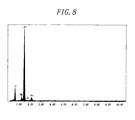
- Fig. 8 is a chart showing a result of the EDS analysis on a surface of the anti-corrosion member. It is understood that an F element is existent on a surface of the anti-corrosion member.
- the corrosion tests A and B mentioned above were performed.
- the results of the corrosion tests are shown in Table 3.
- the corrosion test A weight increase due to fluorine plasma gas exposure
- the corrosion test B weight loss due to chlorine plasma gas exposure
- the anti-corrosion member was produced in the same manner as that of the example 11. However, in the process of the example 11, the heat treatment was performed at 100°C for 16 hours after the sealed fluorine resin container was set in the oven. In this case, a pressure in the container during the heat treatment was about 2atm.
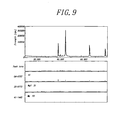
- Fig. 9 is a chart showing a result of the X-ray diffraction analysis. As shown in Fig. 9, a crystal phase having the same structure as that of MgF 2 (JCPDS41-1443) is only detected other than JIS6061 alloy constructing the base member.
- the anti-corrosion member was produced in the same manner as that of the example 11. However, in the process of the example 11, the aluminum alloy (JIS1050 alloy) plate having a length of 10 mm, a breadth of 10 mm and a thickness of 2 mm was used instead of JIS6061 alloy.
- JIS1050 alloy JIS1050 alloy
- the aluminum alloy plate was picked up from the sealed container after the fluorizing treatment.
- a surface of the aluminum alloy plate was covered with a powdery precipitation member having a white color.
- the X-ray diffraction method confirmed that the precipitation member was a compound having the same crystal structure as that of (NH 4 ) 3 AlF 6 .
- the aluminum alloy plate was subjected to a heat treatment in an atmosphere at 500°C for 2 hours under a condition such that a surface of the aluminum alloy plate was maintained to be covered with the precipitation member. After the heat treatment, an adhesion of aluminum fluoride ammonium remained on a surface of the aluminum alloy plate.
- This sample was subjected to an ultrasonic cleaning in acetone. As a result, aluminum fluoride ammonium was easily peeled off, and the aluminum alloy plate appeared from inside. A surface of the aluminum alloy plate showed a state such that a brilliance of the plate was lost. Therefore, it was thought that some thin film was formed on a surface of the aluminum alloy plate.
- Photographs of a surface of the thus obtained anti-corrosion member taken by a scanning electron microscope (SEM) are shown in Fig. 10 (5000 magnification) and Fig. 12 (2000 magnification). From these photographs, it is understood that a thin film formed by crystal particles having a particle size of about 0.5 ⁇ m covers a surface of the base member. When a line was drawn on a surface of the anti-corrosion film, the number of boundary phases across the line was average 21 per the line having a length of 10 ⁇ m.
- Fig. 12 is a chart showing a result of the X-ray diffraction analysis on a surface region of this anti-corrosion member. As shown in Fig. 12, a crystal phase having the same structure as that of AlF 3 (JCPDS43-0435) is only detected other than a peak of JIS1050 alloy constructing the base member.
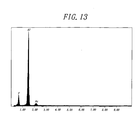
- Fig. 13 is a chart showing a result of the EDS analysis on a surface of the anti-corrosion member It is understood that an F element is formed on a surface of the anti-corrosion member. With respect to the anti-corrosion member, the corrosion tests A and B mentioned above were performed. The results of the corrosion tests are shown in Table 3.
- (NH 4 ) 3 AlF 6 powders were produced by reacting aluminum hydroxide and fluoride ammonium saturated solution. The thus produced powders were filled in an open type alumina crucible, and an aluminum alloy (JIS6061) plate having a length of 10mm, a breadth of 10mm and a thickness of 2mm was embedded in the powders. Then, a heat treatment was performed in an atmosphere at 500°C for 2 hours. The aluminum alloy plate was picked up after the heat treatment. A surface of the aluminum alloy plate had no brilliance.
- the anti-corrosion member which shows a high corrosion property with respect to the corrosion gas of halogen series and its plasma, particularly with respect to the chlorine gas and its plasma.
Landscapes
- Chemical & Material Sciences (AREA)
- Chemical Kinetics & Catalysis (AREA)
- Engineering & Computer Science (AREA)
- Materials Engineering (AREA)
- Mechanical Engineering (AREA)
- Metallurgy (AREA)
- Organic Chemistry (AREA)
- Drying Of Semiconductors (AREA)
- Physical Or Chemical Processes And Apparatus (AREA)
- Chemically Coating (AREA)
Abstract
Description
| Fluorine compound | Heat treatment temperature (°C) | Pressure in container | Fluoride layer | Weight loss of member mg/cm2 | |
| Example 1 | NaHF2 | 300 | 20 atm | exist | <0.1 |
| Example 2 | KHF2 | 300 | 20 atm | exist | 0.3 |
| Example 3 | NaHF2 | 200 | 16 atm | exist | 0.6 |
| Comparative Example 1 | NaHF2 | 130 | atmosphere | not exist | 19.2 |
| Comparative Example 2 | NaHF2 | 100 | atmosphere | not exist | 17.3 |
| Fluoride layer | Kind of fluorine gas | Pressure in container (atm) | Anti-corrosion test A: weight increase due to fluorine plasma gas exposure mg/cm2 | Anti-corrosion test B: weight loss due to chlorine plasma gas exposure mg/cm2 | |
| Example 4 | exist | NaHF2 decomposed | 20 | <0.1 | 0.1 |
| Example 5 | exist | NaHF2 decomposed | 20 | <0.1 | <0.1 |
| Example 6 | exist | NaHF2 decomposed gas | 9 | <0.1 | 0.2 |
| Example 7 | exist | NaHF2 decomposed gas | 5 | 0.1 | 0.3 |
| Example 8 | exist | KHF2 decomposed | 20 | <0.1 | 0.1 |
| Example 9 | exist | NaHF2 decomposed gas | 3 | <0.1 | 0.3 |
| Example 10 | exist | NaHF2 decomposed gas | 3 | <0.1 | 12.9 |
| Comparative Example 3 | exist | F2 gas | 1 | 0.3 | 33.1 |
| Comparative Example 4 | exist | F2 gas | 1 | 2.6 | 82.5 |
| Comparative Example 5 | not exist | ― | - | 0.7 | 35.6 |
| Comparative Example 6 | not exist | ― | - | 3.2 | 85.9 |
| Example 11 | Example 12 | Example 13 | Example 14 | Example 15 | ||
| Material of | JIS | 6061 | | JIS 1050 | | JIS 5083 |
| Kind of fluorine compound | NH4 HF2 | NH4 HF2 | NH4 HF2 | - | - | |
| Temperature of fluoridized treatment (°C) | 250 | 100 | 250 | - | - | |
| Time internal of fluoridized treatment (hour) | 16 | 16 | 16 | - | - | |
| Inner pressure of sealed container (atm) | 12 | 2 | 12 | - | - | |
| Temperature of heat treatment under atmosphere (°C) | 500 | 500 | 500 | 500 | 450 | |
| Time internal of heat treatment under atmosphere (hour) | 2 | 2 | 2 | 2 | 10 | |
| Generation phase other than aluminum alloy | AlF3 MgF2 | MgF2 | AlF3 | AlF3 MgF2 | AlF3 MgF2 | |
| Number of boundary phases of | 10 | 32 | 21 | 9 | 11 | |
| Anti-corrosion test A: weight increase due to fluorine plasma gas exposure (mg/cm2) | <0.1 | <0.1 | 0.3 | <0.1 | 0.1 | |
| Anti-corrosion test B: weight loss due to chlorine plasma gas exposure (mg/cm2) | <0.1 | 0.3 | 0.8 | <0.1 | 0.2 |
Claims (27)
- A method of producing an anti-corrosion member having a base member made of a metal in which aluminum is included, ceramics in which aluminum element is included, or a composition member constructed by a metal in which aluminum is included and ceramics, and an anti-corrosion film formed on the base member, comprising the steps of:setting the base member in a container in which a solid fluorine compound is present;heating the container at a temperature higher than a decomposition temperature of the fluorine compound to generate a decomposed gas of the fluorine compound and to subject the base member to a heat treatment with the decomposed gas of the fluorine compound; andforming an anti-corrosion film made of a fluoride on a surface of the base member.
- The method according to claim 1, wherein the container is a sealed container.
- The method according to claim 1, wherein the heat treatment is performed at a temperature 0-200°C higher than the decomposed temperature of the fluorine compound
- The method according to claim 1, wherein the decomposition temperature of the fluorine compound is 100-300°C.
- The method according to claim 4, wherein the fluorine compound is selected from NaHF2, KHF2 and NH4HF2.
- The method according to claim 1, wherein the fluorine compound does not include a metal element.
- The method according to claim 1, wherein the fluoride at least includes a crystal phase of aluminum fluoride.
- An anti-corrosion member comprising a base member made of a metal in which aluminum is included, ceramics in which aluminum element is included or a composite member constructed by a metal in which aluminum is included and ceramics, and an anti-corrosion film made of a fluoride generated on a surface of the base member by setting the base member in a container in which a solid fluorine compound is filled and by heating the container at a temperature higher than a decomposed temperature of the solid fluorine compound.
- The anti-corrosion member according to claim 8, wherein the fluorine compound is selected from NaHF2, KHF2 and NH4HF2.
- The anti-corrosion member according to claim 8, wherein the fluoride at least includes a crystal phase of aluminum fluoride.
- The anti-corrosion member according to claim 8, wherein the fluoride at least includes a crystal phase of magnesium fluoride.
- An anti-corrosion member in which an anti-corrosion film made of a fluoride is provided on a surface of the base member made of a metal in which aluminum is included, ceramics in which aluminum element is included or a composite member constructed by a metal in which aluminum is included and ceramics; comprising a structure such that a weight loss of the anti-corrosion member, when the anti-corrosion member is exposed at 460°C for 5 hours in a chlorine plasma gas obtained by exciting at a high frequency of 13.56MHz and 800W, is smaller than 15mg/cm2.
- An anti-corrosion member having a base member made of a metal in which aluminum is included, ceramics in which aluminum element is included or a composite member constructed by a metal in which aluminum is included and ceramics, and an anti-corrosion film made of a fluoride generated on a surface of the base member by setting the base member in a container in which a solid fluorine compound is filled and by heating the container at a temperature higher than a decomposed temperature of the solid fluorine compound, comprising a structure such that a weight loss of the anti-corrosion member, when the anti-corrosion member is exposed at 460°C for 5 hours in a chlorine plasma gas obtained by exciting at a high frequency of 13.56MHz and 800W, is smaller than 15mg/cm2.
- A method of producing an anti-corrosion member having a base member made of a metal in which aluminum is included and an anti-corrosion film formed on the base member, comprising the steps of:setting the base member in a container in which a solid fluorine compound is present;heating the container at a temperature higher than a decomposition temperature of the fluorine compound to generate a decomposed gas of the fluorine compound and to subject the base member to a heat treatment with the decomposed gas of the fluorine compound, so that an intermediate film is formed on a surface of the base member;subjecting the base member and the intermediate film to a heat treatment to react each other; andforming an anti-corrosion film made of a fluoride.
- The method according to claim 14, wherein the heat treatment of the base member and the intermediate film is performed under an atmosphere in which oxygen and inert gas are included.
- The method according to claim 14, wherein the container is a sealed container.
- The method according to claim 14, wherein the fluorine compound is a solid fluorine compound which does not include a metal element at room temperature.
- The method according to claim 17, wherein the fluorine compound is NH4HF2.
- The method according to claim 14, wherein the intermediate film includes aluminum fluoride ammonium (a part of aluminum may be substituted by the other metal).
- A method of producing an anti-corrosion member having a base member made of a metal in which aluminum is included and an anti-corrosion film formed on the base member, comprising the steps of:subjecting the base member and aluminum fluoride ammonium to a heat treatment under a condition such that the base member is contacted to the aluminum fluoride ammonium (a part of aluminum may be substituted by the other metal) to react each other; andforming an anti-corrosion film made of a fluoride.
- The method according to claim 20, wherein the heat treatment is performed under a condition such that powders of the aluminum fluoride ammonium are contacted to a surface of the base member.
- The method according to claim 21, wherein the heat treatment is performed under a condition such that the base member is embedded in the powders of the aluminum fluoride ammonium.
- The method according to claim 21, wherein a formed film, in which powders of the aluminum fluoride ammonium are included, is arranged on the base member, and then the formed film and the base member are subjected to a heat treatment.
- The method according to claim 20, wherein the heat treatment for the base member and the aluminum fluoride ammonium is performed under an atmosphere in which oxygen and inert gas are included.
- An anti-corrosion member having a base member made of a metal in which aluminum is included and an anti-corrosion film made of a fluoride formed on a surface of the base member, comprising a structure such that:(1) the anti-corrosion film is made of particles of the fluoride which covers a surface of the base member;(2) when a line is drawn on a surface of the anti-corrosion film, the number of boundary phases across the line is average smaller than 100 and larger than 5 per the line having a length of 10µm; and(3) the particles include at least one of aluminum fluoride phase and magnesium fluoride phase.
- The anti-corrosion member according to claim 25, wherein the particles include at least the aluminum fluoride phase and the magnesium fluoride phase.
- The anti-corrosion member according to claim 25, wherein the anti-corrosion film is generated by reacting the base member with aluminum fluoride ammonia (a part of aluminum may be substituted by the other metal).
Applications Claiming Priority (6)
| Application Number | Priority Date | Filing Date | Title |
|---|---|---|---|
| JP2392699 | 1999-02-01 | ||
| JP2392699 | 1999-02-01 | ||
| JP14124099 | 1999-05-21 | ||
| JP14124099 | 1999-05-21 | ||
| JP32268799 | 1999-11-12 | ||
| JP32268799A JP4054148B2 (en) | 1999-02-01 | 1999-11-12 | Corrosion-resistant member manufacturing method and corrosion-resistant member |
Publications (3)
| Publication Number | Publication Date |
|---|---|
| EP1026281A2 true EP1026281A2 (en) | 2000-08-09 |
| EP1026281A3 EP1026281A3 (en) | 2001-02-14 |
| EP1026281B1 EP1026281B1 (en) | 2005-05-11 |
Family
ID=27284439
Family Applications (1)
| Application Number | Title | Priority Date | Filing Date |
|---|---|---|---|
| EP00300754A Expired - Lifetime EP1026281B1 (en) | 1999-02-01 | 2000-02-01 | Method of producing anti-corrosion member and anti-corrosion member |
Country Status (4)
| Country | Link |
|---|---|
| US (2) | US6406799B1 (en) |
| EP (1) | EP1026281B1 (en) |
| JP (1) | JP4054148B2 (en) |
| DE (1) | DE60019985T2 (en) |
Cited By (4)
| Publication number | Priority date | Publication date | Assignee | Title |
|---|---|---|---|---|
| WO2003056055A1 (en) * | 2001-12-24 | 2003-07-10 | Universität Hannover | Magnesium workpiece and method for generation of an anti-corrosion coating on a magnesium workpiece |
| WO2003067634A1 (en) * | 2002-02-07 | 2003-08-14 | Applied Materials, Inc. | Article for use in a semiconductor processing chamber and method of fabricating the same |
| EP1637626A2 (en) | 2004-08-23 | 2006-03-22 | Air Products And Chemicals, Inc. | Method to protect internal components of semiconductor processing equipment |
| KR20220035202A (en) * | 2019-10-04 | 2022-03-21 | 쇼와 덴코 가부시키가이샤 | lack of corrosion resistance |
Families Citing this family (9)
| Publication number | Priority date | Publication date | Assignee | Title |
|---|---|---|---|---|
| JP4166386B2 (en) * | 1999-09-30 | 2008-10-15 | 日本碍子株式会社 | Corrosion resistant member and manufacturing method thereof |
| JP2002038252A (en) * | 2000-07-27 | 2002-02-06 | Ngk Insulators Ltd | Structure resistant to heat, and material and structure resistant to corrosive halogen-based gas |
| US20060037861A1 (en) * | 2004-08-23 | 2006-02-23 | Manos Paul D | Electrodeposition process |
| JP5058548B2 (en) * | 2006-10-02 | 2012-10-24 | 株式会社アルバック | Surface treatment method of aluminum material |
| TWI411703B (en) | 2006-10-02 | 2013-10-11 | 愛發科股份有限公司 | Surface treatment of aluminum alloy and surface treatment of magnesium alloy |
| KR101143571B1 (en) | 2009-12-28 | 2012-05-22 | 그린웍스 주식회사 | Method of ammonium bifluoride destruction and retrieving hydrogen fluoride form by-product gas of ammonium bifluoride destruction and apparatus therefor |
| US8748515B2 (en) | 2010-04-15 | 2014-06-10 | Henry Company Llc | Mixtures and emulsions for use in providing strength to gypsum compositions |
| JP5876259B2 (en) * | 2011-04-14 | 2016-03-02 | 信越化学工業株式会社 | Method for manufacturing member covered with aluminum nitride film |
| CN113924382B (en) | 2020-03-11 | 2024-04-12 | 株式会社力森诺科 | Corrosion resistant components |
Family Cites Families (11)
| Publication number | Priority date | Publication date | Assignee | Title |
|---|---|---|---|---|
| BE393994A (en) | 1932-12-21 | |||
| DE1198074B (en) | 1957-09-18 | 1965-08-05 | Aluminum Co Of America | Process for the pretreatment of semi-finished and finished parts made of an aluminum alloy |
| JPS6133752A (en) | 1984-07-26 | 1986-02-17 | Toyota Central Res & Dev Lab Inc | Manufacturing method for composite aluminum parts |
| JP2867376B2 (en) | 1988-12-09 | 1999-03-08 | ステラケミファ株式会社 | Metal material having fluorinated passivation film formed thereon, gas apparatus using the metal material, and method of forming fluorinated passivation film |
| EP0460700B1 (en) | 1990-06-07 | 1997-04-16 | Applied Materials, Inc. | Corrosion-resistant protective coating on aluminum substrate or surface and method of forming same |
| US5069938A (en) * | 1990-06-07 | 1991-12-03 | Applied Materials, Inc. | Method of forming a corrosion-resistant protective coating on aluminum substrate |
| JP2986859B2 (en) | 1990-07-05 | 1999-12-06 | 三菱アルミニウム株式会社 | Aluminum alloy material and method of manufacturing the same |
| JPH051365A (en) | 1991-06-25 | 1993-01-08 | Kokusai Electric Co Ltd | Surface treatment of metal |
| US5756222A (en) | 1994-08-15 | 1998-05-26 | Applied Materials, Inc. | Corrosion-resistant aluminum article for semiconductor processing equipment |
| FR2730746B1 (en) * | 1995-02-16 | 1997-04-30 | Fond Et Ateliers Du Belier | METHOD OF WETTING AN ALUMINUM INSERT IN AN ALUMINUM MOLDED PART |
| EP0770702A1 (en) | 1995-10-23 | 1997-05-02 | DECHEMA Deutsche Gesellschaft für Chemisches Apparatewesen, Chemische Technik und Biotechnologie e.V. | Process for increasing the corrosion-resistance of TiAl based alloys |
-
1999
- 1999-11-12 JP JP32268799A patent/JP4054148B2/en not_active Expired - Fee Related
-
2000
- 2000-01-31 US US09/494,987 patent/US6406799B1/en not_active Expired - Lifetime
- 2000-02-01 EP EP00300754A patent/EP1026281B1/en not_active Expired - Lifetime
- 2000-02-01 DE DE60019985T patent/DE60019985T2/en not_active Expired - Lifetime
-
2002
- 2002-04-04 US US10/116,426 patent/US20020179192A1/en not_active Abandoned
Cited By (7)
| Publication number | Priority date | Publication date | Assignee | Title |
|---|---|---|---|---|
| WO2003056055A1 (en) * | 2001-12-24 | 2003-07-10 | Universität Hannover | Magnesium workpiece and method for generation of an anti-corrosion coating on a magnesium workpiece |
| WO2003067634A1 (en) * | 2002-02-07 | 2003-08-14 | Applied Materials, Inc. | Article for use in a semiconductor processing chamber and method of fabricating the same |
| US6632325B2 (en) | 2002-02-07 | 2003-10-14 | Applied Materials, Inc. | Article for use in a semiconductor processing chamber and method of fabricating same |
| EP1637626A2 (en) | 2004-08-23 | 2006-03-22 | Air Products And Chemicals, Inc. | Method to protect internal components of semiconductor processing equipment |
| US7119032B2 (en) | 2004-08-23 | 2006-10-10 | Air Products And Chemicals, Inc. | Method to protect internal components of semiconductor processing equipment using layered superlattice materials |
| KR20220035202A (en) * | 2019-10-04 | 2022-03-21 | 쇼와 덴코 가부시키가이샤 | lack of corrosion resistance |
| EP4039845A4 (en) * | 2019-10-04 | 2023-01-11 | Showa Denko K.K. | CORROSION RESISTANT ELEMENT |
Also Published As
| Publication number | Publication date |
|---|---|
| EP1026281B1 (en) | 2005-05-11 |
| DE60019985D1 (en) | 2005-06-16 |
| EP1026281A3 (en) | 2001-02-14 |
| JP4054148B2 (en) | 2008-02-27 |
| US6406799B1 (en) | 2002-06-18 |
| JP2001040464A (en) | 2001-02-13 |
| US20020179192A1 (en) | 2002-12-05 |
| DE60019985T2 (en) | 2006-05-04 |
Similar Documents
| Publication | Publication Date | Title |
|---|---|---|
| US6139983A (en) | Corrosion-resistant member, wafer-supporting member, and method of manufacturing the same | |
| EP1026281B1 (en) | Method of producing anti-corrosion member and anti-corrosion member | |
| US7776774B2 (en) | Composite material and method of producing the same | |
| CN101018885B (en) | Semiconductor processing components and semiconductor processing using the components | |
| TW202231899A (en) | Erosion resistant metal fluoride coated articles, methods of preparation and methods of use thereof | |
| JP2000160343A (en) | Corrosion resistant CVD-SiC and corrosion resistant CVD-SiC coating | |
| JP2001220637A (en) | Aluminum alloy for anodic oxidation treatment, aluminum alloy member having anodic oxide film, and plasma processing apparatus | |
| KR100500495B1 (en) | Aluminium nitride ceramics, members for use in a system for producing semiconductors, and corrosion resistant members | |
| JP3623054B2 (en) | Components for plasma process equipment | |
| KR20120046007A (en) | A corrosion-resistant article coated with aluminum nitride and method for producing the same | |
| EP0924317B1 (en) | Process for producing corrosion resistant members | |
| JP4373487B2 (en) | Corrosion resistant CVD-SiC coating material and jig for CVD equipment | |
| JP3078671B2 (en) | Corrosion resistant member, method of using the same and method of manufacturing the same | |
| JPH11279761A (en) | Corrosion resistant materials | |
| JP3500278B2 (en) | Corrosion resistant materials for semiconductor manufacturing | |
| JPH11278944A (en) | Silicon nitride corrosion-resistant member and method of manufacturing the same | |
| JP4212737B2 (en) | Corrosion-resistant member against halogen-based corrosive gas | |
| JP2002038252A (en) | Structure resistant to heat, and material and structure resistant to corrosive halogen-based gas | |
| JP2000143348A (en) | Aluminum nitride sintered body, method for manufacturing the same, and member for semiconductor manufacturing apparatus using the same | |
| EP1580294A1 (en) | Corrosion-resistant member and process of producing the same | |
| JP2000355754A (en) | Method for producing member having fluoride film, member to be treated used therefor, and corrosion-resistant seal member having fluoride film | |
| KR20250136858A (en) | Formation of metal films on electroless metal plating of surfaces | |
| JP2000212769A (en) | Corrosion resistant member and method of manufacturing the same | |
| JP2007001862A (en) | Aluminum nitride sintered body and method for producing the same | |
| JPH0995765A (en) | Coating film having excellent halogen gas corrosion resistance and halogen plasma corrosion resistance, and laminated structure having the coating film |
Legal Events
| Date | Code | Title | Description |
|---|---|---|---|
| PUAI | Public reference made under article 153(3) epc to a published international application that has entered the european phase |
Free format text: ORIGINAL CODE: 0009012 |
|
| AK | Designated contracting states |
Kind code of ref document: A2 Designated state(s): DE FR GB |
|
| AX | Request for extension of the european patent |
Free format text: AL;LT;LV;MK;RO;SI |
|
| PUAL | Search report despatched |
Free format text: ORIGINAL CODE: 0009013 |
|
| AK | Designated contracting states |
Kind code of ref document: A3 Designated state(s): AT BE CH CY DE DK ES FI FR GB GR IE IT LI LU MC NL PT SE |
|
| AX | Request for extension of the european patent |
Free format text: AL;LT;LV;MK;RO;SI |
|
| RIC1 | Information provided on ipc code assigned before grant |
Free format text: 7C 23C 8/06 A, 7C 23C 8/62 B |
|
| 17P | Request for examination filed |
Effective date: 20010731 |
|
| AKX | Designation fees paid |
Free format text: DE FR GB |
|
| 17Q | First examination report despatched |
Effective date: 20031104 |
|
| GRAP | Despatch of communication of intention to grant a patent |
Free format text: ORIGINAL CODE: EPIDOSNIGR1 |
|
| GRAS | Grant fee paid |
Free format text: ORIGINAL CODE: EPIDOSNIGR3 |
|
| GRAA | (expected) grant |
Free format text: ORIGINAL CODE: 0009210 |
|
| AK | Designated contracting states |
Kind code of ref document: B1 Designated state(s): DE FR GB |
|
| REG | Reference to a national code |
Ref country code: GB Ref legal event code: FG4D |
|
| REF | Corresponds to: |
Ref document number: 60019985 Country of ref document: DE Date of ref document: 20050616 Kind code of ref document: P |
|
| PLBE | No opposition filed within time limit |
Free format text: ORIGINAL CODE: 0009261 |
|
| STAA | Information on the status of an ep patent application or granted ep patent |
Free format text: STATUS: NO OPPOSITION FILED WITHIN TIME LIMIT |
|
| ET | Fr: translation filed | ||
| 26N | No opposition filed |
Effective date: 20060214 |
|
| REG | Reference to a national code |
Ref country code: FR Ref legal event code: PLFP Year of fee payment: 17 |
|
| REG | Reference to a national code |
Ref country code: FR Ref legal event code: PLFP Year of fee payment: 18 |
|
| REG | Reference to a national code |
Ref country code: FR Ref legal event code: PLFP Year of fee payment: 19 |
|
| PGFP | Annual fee paid to national office [announced via postgrant information from national office to epo] |
Ref country code: GB Payment date: 20180131 Year of fee payment: 19 Ref country code: DE Payment date: 20180117 Year of fee payment: 19 |
|
| PGFP | Annual fee paid to national office [announced via postgrant information from national office to epo] |
Ref country code: FR Payment date: 20180111 Year of fee payment: 19 |
|
| REG | Reference to a national code |
Ref country code: DE Ref legal event code: R119 Ref document number: 60019985 Country of ref document: DE |
|
| GBPC | Gb: european patent ceased through non-payment of renewal fee |
Effective date: 20190201 |
|
| PG25 | Lapsed in a contracting state [announced via postgrant information from national office to epo] |
Ref country code: GB Free format text: LAPSE BECAUSE OF NON-PAYMENT OF DUE FEES Effective date: 20190201 Ref country code: DE Free format text: LAPSE BECAUSE OF NON-PAYMENT OF DUE FEES Effective date: 20190903 |
|
| PG25 | Lapsed in a contracting state [announced via postgrant information from national office to epo] |
Ref country code: FR Free format text: LAPSE BECAUSE OF NON-PAYMENT OF DUE FEES Effective date: 20190228 |