EP1024840B1 - Bone substitute materials - Google Patents
Bone substitute materials Download PDFInfo
- Publication number
- EP1024840B1 EP1024840B1 EP98949664A EP98949664A EP1024840B1 EP 1024840 B1 EP1024840 B1 EP 1024840B1 EP 98949664 A EP98949664 A EP 98949664A EP 98949664 A EP98949664 A EP 98949664A EP 1024840 B1 EP1024840 B1 EP 1024840B1
- Authority
- EP
- European Patent Office
- Prior art keywords
- article
- osteoconductive
- interstices
- ceramic
- osteoconductive composition
- Prior art date
- Legal status (The legal status is an assumption and is not a legal conclusion. Google has not performed a legal analysis and makes no representation as to the accuracy of the status listed.)
- Expired - Lifetime
Links
- 239000000463 material Substances 0.000 title claims description 81
- 239000000316 bone substitute Substances 0.000 title claims description 15
- MCMNRKCIXSYSNV-UHFFFAOYSA-N Zirconium dioxide Chemical compound O=[Zr]=O MCMNRKCIXSYSNV-UHFFFAOYSA-N 0.000 claims description 96
- 210000000988 bone and bone Anatomy 0.000 claims description 60
- 230000000278 osteoconductive effect Effects 0.000 claims description 54
- 229910052588 hydroxylapatite Inorganic materials 0.000 claims description 47
- XYJRXVWERLGGKC-UHFFFAOYSA-D pentacalcium;hydroxide;triphosphate Chemical compound [OH-].[Ca+2].[Ca+2].[Ca+2].[Ca+2].[Ca+2].[O-]P([O-])([O-])=O.[O-]P([O-])([O-])=O.[O-]P([O-])([O-])=O XYJRXVWERLGGKC-UHFFFAOYSA-D 0.000 claims description 45
- 239000000919 ceramic Substances 0.000 claims description 43
- 239000000203 mixture Substances 0.000 claims description 36
- 238000000034 method Methods 0.000 claims description 26
- 239000011148 porous material Substances 0.000 claims description 25
- 239000001506 calcium phosphate Substances 0.000 claims description 18
- QORWJWZARLRLPR-UHFFFAOYSA-H tricalcium bis(phosphate) Chemical compound [Ca+2].[Ca+2].[Ca+2].[O-]P([O-])([O-])=O.[O-]P([O-])([O-])=O QORWJWZARLRLPR-UHFFFAOYSA-H 0.000 claims description 17
- 235000011010 calcium phosphates Nutrition 0.000 claims description 15
- 238000005245 sintering Methods 0.000 claims description 13
- 229910000389 calcium phosphate Inorganic materials 0.000 claims description 12
- 239000011248 coating agent Substances 0.000 claims description 11
- 238000000576 coating method Methods 0.000 claims description 11
- 239000011800 void material Substances 0.000 claims description 11
- -1 calcium phosphate compound Chemical class 0.000 claims description 8
- 230000002138 osteoinductive effect Effects 0.000 claims description 8
- 210000003127 knee Anatomy 0.000 claims description 2
- 239000002639 bone cement Substances 0.000 claims 2
- 238000007493 shaping process Methods 0.000 claims 2
- 230000003319 supportive effect Effects 0.000 description 18
- 239000006260 foam Substances 0.000 description 17
- 229910052751 metal Inorganic materials 0.000 description 15
- 239000002184 metal Substances 0.000 description 15
- 229910010293 ceramic material Inorganic materials 0.000 description 12
- 239000002131 composite material Substances 0.000 description 12
- 239000010410 layer Substances 0.000 description 9
- 239000011368 organic material Substances 0.000 description 7
- 239000000843 powder Substances 0.000 description 7
- 239000002904 solvent Substances 0.000 description 7
- 239000011230 binding agent Substances 0.000 description 6
- 230000001054 cortical effect Effects 0.000 description 6
- XLYOFNOQVPJJNP-UHFFFAOYSA-N water Substances O XLYOFNOQVPJJNP-UHFFFAOYSA-N 0.000 description 6
- MHAJPDPJQMAIIY-UHFFFAOYSA-N Hydrogen peroxide Chemical compound OO MHAJPDPJQMAIIY-UHFFFAOYSA-N 0.000 description 5
- PNEYBMLMFCGWSK-UHFFFAOYSA-N aluminium oxide Inorganic materials [O-2].[O-2].[O-2].[Al+3].[Al+3] PNEYBMLMFCGWSK-UHFFFAOYSA-N 0.000 description 5
- 239000002270 dispersing agent Substances 0.000 description 5
- 238000001035 drying Methods 0.000 description 5
- 229910052587 fluorapatite Inorganic materials 0.000 description 5
- 229940077441 fluorapatite Drugs 0.000 description 5
- VSIIXMUUUJUKCM-UHFFFAOYSA-D pentacalcium;fluoride;triphosphate Chemical compound [F-].[Ca+2].[Ca+2].[Ca+2].[Ca+2].[Ca+2].[O-]P([O-])([O-])=O.[O-]P([O-])([O-])=O.[O-]P([O-])([O-])=O VSIIXMUUUJUKCM-UHFFFAOYSA-D 0.000 description 5
- 239000004094 surface-active agent Substances 0.000 description 5
- 239000000725 suspension Substances 0.000 description 5
- 239000000080 wetting agent Substances 0.000 description 5
- 238000000498 ball milling Methods 0.000 description 4
- 239000008367 deionised water Substances 0.000 description 4
- 229910021641 deionized water Inorganic materials 0.000 description 4
- 238000010438 heat treatment Methods 0.000 description 4
- 239000004615 ingredient Substances 0.000 description 4
- 239000011159 matrix material Substances 0.000 description 4
- 150000002739 metals Chemical class 0.000 description 4
- 229910002077 partially stabilized zirconia Inorganic materials 0.000 description 4
- 230000008439 repair process Effects 0.000 description 4
- 102000004887 Transforming Growth Factor beta Human genes 0.000 description 3
- 108090001012 Transforming Growth Factor beta Proteins 0.000 description 3
- 239000002518 antifoaming agent Substances 0.000 description 3
- 230000015572 biosynthetic process Effects 0.000 description 3
- 230000010478 bone regeneration Effects 0.000 description 3
- OSGAYBCDTDRGGQ-UHFFFAOYSA-L calcium sulfate Chemical compound [Ca+2].[O-]S([O-])(=O)=O OSGAYBCDTDRGGQ-UHFFFAOYSA-L 0.000 description 3
- 239000004568 cement Substances 0.000 description 3
- 239000003795 chemical substances by application Substances 0.000 description 3
- 239000011162 core material Substances 0.000 description 3
- 210000001624 hip Anatomy 0.000 description 3
- 238000003754 machining Methods 0.000 description 3
- 239000002245 particle Substances 0.000 description 3
- 238000011160 research Methods 0.000 description 3
- 210000003660 reticulum Anatomy 0.000 description 3
- 239000000758 substrate Substances 0.000 description 3
- 229910052715 tantalum Inorganic materials 0.000 description 3
- GUVRBAGPIYLISA-UHFFFAOYSA-N tantalum atom Chemical compound [Ta] GUVRBAGPIYLISA-UHFFFAOYSA-N 0.000 description 3
- ZRKFYGHZFMAOKI-QMGMOQQFSA-N tgfbeta Chemical compound C([C@H](NC(=O)[C@H](C(C)C)NC(=O)CNC(=O)[C@H](CCC(O)=O)NC(=O)[C@H](CCCNC(N)=N)NC(=O)[C@H](CC(N)=O)NC(=O)[C@H](CC(C)C)NC(=O)[C@H]([C@@H](C)O)NC(=O)[C@H](CCC(O)=O)NC(=O)[C@H]([C@@H](C)O)NC(=O)[C@H](CC(C)C)NC(=O)CNC(=O)[C@H](C)NC(=O)[C@H](CO)NC(=O)[C@H](CCC(N)=O)NC(=O)[C@@H](NC(=O)[C@H](C)NC(=O)[C@H](C)NC(=O)[C@@H](NC(=O)[C@H](CC(C)C)NC(=O)[C@@H](N)CCSC)C(C)C)[C@@H](C)CC)C(=O)N[C@@H]([C@@H](C)O)C(=O)N[C@@H](C(C)C)C(=O)N[C@@H](CC=1C=CC=CC=1)C(=O)N[C@@H](C)C(=O)N1[C@@H](CCC1)C(=O)N[C@@H]([C@@H](C)O)C(=O)N[C@@H](CC(N)=O)C(=O)N[C@@H](CCC(O)=O)C(=O)N[C@@H](C)C(=O)N[C@@H](CC=1C=CC=CC=1)C(=O)N[C@@H](CCCNC(N)=N)C(=O)N[C@@H](C)C(=O)N[C@@H](CC(C)C)C(=O)N1[C@@H](CCC1)C(=O)N1[C@@H](CCC1)C(=O)N[C@@H](CCCNC(N)=N)C(=O)N[C@@H](CCC(O)=O)C(=O)N[C@@H](CCCNC(N)=N)C(=O)N[C@@H](CO)C(=O)N[C@@H](CCCNC(N)=N)C(=O)N[C@@H](CC(C)C)C(=O)N[C@@H](CC(C)C)C(O)=O)C1=CC=C(O)C=C1 ZRKFYGHZFMAOKI-QMGMOQQFSA-N 0.000 description 3
- 229910000391 tricalcium phosphate Inorganic materials 0.000 description 3
- 235000019731 tricalcium phosphate Nutrition 0.000 description 3
- 229940078499 tricalcium phosphate Drugs 0.000 description 3
- VTYYLEPIZMXCLO-UHFFFAOYSA-L Calcium carbonate Chemical compound [Ca+2].[O-]C([O-])=O VTYYLEPIZMXCLO-UHFFFAOYSA-L 0.000 description 2
- 229920003171 Poly (ethylene oxide) Polymers 0.000 description 2
- 239000004721 Polyphenylene oxide Substances 0.000 description 2
- 229920005830 Polyurethane Foam Polymers 0.000 description 2
- 239000004699 Ultra-high molecular weight polyethylene Substances 0.000 description 2
- 239000007864 aqueous solution Substances 0.000 description 2
- 230000008468 bone growth Effects 0.000 description 2
- 230000010072 bone remodeling Effects 0.000 description 2
- 210000004027 cell Anatomy 0.000 description 2
- 238000012512 characterization method Methods 0.000 description 2
- PBAYDYUZOSNJGU-UHFFFAOYSA-N chelidonic acid Natural products OC(=O)C1=CC(=O)C=C(C(O)=O)O1 PBAYDYUZOSNJGU-UHFFFAOYSA-N 0.000 description 2
- 239000000470 constituent Substances 0.000 description 2
- 238000001816 cooling Methods 0.000 description 2
- 239000006261 foam material Substances 0.000 description 2
- 230000035876 healing Effects 0.000 description 2
- 230000003116 impacting effect Effects 0.000 description 2
- 208000014674 injury Diseases 0.000 description 2
- 238000004519 manufacturing process Methods 0.000 description 2
- 238000002156 mixing Methods 0.000 description 2
- 238000012986 modification Methods 0.000 description 2
- 230000004048 modification Effects 0.000 description 2
- 229910001000 nickel titanium Inorganic materials 0.000 description 2
- HLXZNVUGXRDIFK-UHFFFAOYSA-N nickel titanium Chemical compound [Ti].[Ti].[Ti].[Ti].[Ti].[Ti].[Ti].[Ti].[Ti].[Ti].[Ti].[Ni].[Ni].[Ni].[Ni].[Ni].[Ni].[Ni].[Ni].[Ni].[Ni].[Ni].[Ni].[Ni].[Ni] HLXZNVUGXRDIFK-UHFFFAOYSA-N 0.000 description 2
- 210000000963 osteoblast Anatomy 0.000 description 2
- 230000035515 penetration Effects 0.000 description 2
- 229920000728 polyester Polymers 0.000 description 2
- 229920000570 polyether Polymers 0.000 description 2
- 229920000642 polymer Polymers 0.000 description 2
- 229920002635 polyurethane Polymers 0.000 description 2
- 239000004814 polyurethane Substances 0.000 description 2
- 239000011496 polyurethane foam Substances 0.000 description 2
- 229910052596 spinel Inorganic materials 0.000 description 2
- 239000011029 spinel Substances 0.000 description 2
- 229910001220 stainless steel Inorganic materials 0.000 description 2
- 239000002344 surface layer Substances 0.000 description 2
- 229920000785 ultra high molecular weight polyethylene Polymers 0.000 description 2
- 229910001233 yttria-stabilized zirconia Inorganic materials 0.000 description 2
- 208000030016 Avascular necrosis Diseases 0.000 description 1
- 238000012935 Averaging Methods 0.000 description 1
- 102000007350 Bone Morphogenetic Proteins Human genes 0.000 description 1
- 108010007726 Bone Morphogenetic Proteins Proteins 0.000 description 1
- 206010005949 Bone cancer Diseases 0.000 description 1
- 208000018084 Bone neoplasm Diseases 0.000 description 1
- VYZAMTAEIAYCRO-UHFFFAOYSA-N Chromium Chemical compound [Cr] VYZAMTAEIAYCRO-UHFFFAOYSA-N 0.000 description 1
- 102000008186 Collagen Human genes 0.000 description 1
- 108010035532 Collagen Proteins 0.000 description 1
- 102000012422 Collagen Type I Human genes 0.000 description 1
- 108010022452 Collagen Type I Proteins 0.000 description 1
- MYMOFIZGZYHOMD-UHFFFAOYSA-N Dioxygen Chemical compound O=O MYMOFIZGZYHOMD-UHFFFAOYSA-N 0.000 description 1
- 229910000990 Ni alloy Inorganic materials 0.000 description 1
- 206010031264 Osteonecrosis Diseases 0.000 description 1
- 208000001132 Osteoporosis Diseases 0.000 description 1
- 239000004698 Polyethylene Substances 0.000 description 1
- 229920001247 Reticulated foam Polymers 0.000 description 1
- FAPWRFPIFSIZLT-UHFFFAOYSA-M Sodium chloride Chemical compound [Na+].[Cl-] FAPWRFPIFSIZLT-UHFFFAOYSA-M 0.000 description 1
- RTAQQCXQSZGOHL-UHFFFAOYSA-N Titanium Chemical compound [Ti] RTAQQCXQSZGOHL-UHFFFAOYSA-N 0.000 description 1
- 102000009618 Transforming Growth Factors Human genes 0.000 description 1
- 108010009583 Transforming Growth Factors Proteins 0.000 description 1
- 208000027418 Wounds and injury Diseases 0.000 description 1
- HZEWFHLRYVTOIW-UHFFFAOYSA-N [Ti].[Ni] Chemical compound [Ti].[Ni] HZEWFHLRYVTOIW-UHFFFAOYSA-N 0.000 description 1
- 230000006978 adaptation Effects 0.000 description 1
- 229910045601 alloy Inorganic materials 0.000 description 1
- 239000000956 alloy Substances 0.000 description 1
- 239000005313 bioactive glass Substances 0.000 description 1
- 239000012620 biological material Substances 0.000 description 1
- 210000002805 bone matrix Anatomy 0.000 description 1
- 229940112869 bone morphogenetic protein Drugs 0.000 description 1
- 230000037118 bone strength Effects 0.000 description 1
- 229910000019 calcium carbonate Inorganic materials 0.000 description 1
- ZOMBKNNSYQHRCA-UHFFFAOYSA-J calcium sulfate hemihydrate Chemical compound O.[Ca+2].[Ca+2].[O-]S([O-])(=O)=O.[O-]S([O-])(=O)=O ZOMBKNNSYQHRCA-UHFFFAOYSA-J 0.000 description 1
- 239000013043 chemical agent Substances 0.000 description 1
- 238000005229 chemical vapour deposition Methods 0.000 description 1
- 229910017052 cobalt Inorganic materials 0.000 description 1
- 239000010941 cobalt Substances 0.000 description 1
- GUTLYIVDDKVIGB-UHFFFAOYSA-N cobalt atom Chemical compound [Co] GUTLYIVDDKVIGB-UHFFFAOYSA-N 0.000 description 1
- 229920001436 collagen Polymers 0.000 description 1
- 238000005049 combustion synthesis Methods 0.000 description 1
- 239000000109 continuous material Substances 0.000 description 1
- 229910052593 corundum Inorganic materials 0.000 description 1
- 238000005520 cutting process Methods 0.000 description 1
- 230000006378 damage Effects 0.000 description 1
- 230000007547 defect Effects 0.000 description 1
- 230000001419 dependent effect Effects 0.000 description 1
- 229910001882 dioxygen Inorganic materials 0.000 description 1
- 201000010099 disease Diseases 0.000 description 1
- 208000037265 diseases, disorders, signs and symptoms Diseases 0.000 description 1
- 239000006185 dispersion Substances 0.000 description 1
- 238000005516 engineering process Methods 0.000 description 1
- 238000001125 extrusion Methods 0.000 description 1
- 230000002349 favourable effect Effects 0.000 description 1
- 238000011049 filling Methods 0.000 description 1
- 238000010304 firing Methods 0.000 description 1
- 239000012530 fluid Substances 0.000 description 1
- 238000005187 foaming Methods 0.000 description 1
- 239000004088 foaming agent Substances 0.000 description 1
- 239000012634 fragment Substances 0.000 description 1
- 230000004927 fusion Effects 0.000 description 1
- 239000007789 gas Substances 0.000 description 1
- 238000000227 grinding Methods 0.000 description 1
- 230000012010 growth Effects 0.000 description 1
- 239000011507 gypsum plaster Substances 0.000 description 1
- 238000003306 harvesting Methods 0.000 description 1
- 210000004394 hip joint Anatomy 0.000 description 1
- 239000007943 implant Substances 0.000 description 1
- 238000010348 incorporation Methods 0.000 description 1
- 238000001746 injection moulding Methods 0.000 description 1
- 230000010354 integration Effects 0.000 description 1
- 239000011872 intimate mixture Substances 0.000 description 1
- 230000001788 irregular Effects 0.000 description 1
- 210000000629 knee joint Anatomy 0.000 description 1
- 238000013150 knee replacement Methods 0.000 description 1
- 238000003698 laser cutting Methods 0.000 description 1
- 239000010985 leather Substances 0.000 description 1
- 210000003141 lower extremity Anatomy 0.000 description 1
- 229910001092 metal group alloy Inorganic materials 0.000 description 1
- 239000007769 metal material Substances 0.000 description 1
- 238000001000 micrograph Methods 0.000 description 1
- 230000000399 orthopedic effect Effects 0.000 description 1
- 230000011164 ossification Effects 0.000 description 1
- 201000008482 osteoarthritis Diseases 0.000 description 1
- 210000002997 osteoclast Anatomy 0.000 description 1
- 210000005009 osteogenic cell Anatomy 0.000 description 1
- 230000001590 oxidative effect Effects 0.000 description 1
- 230000037361 pathway Effects 0.000 description 1
- 238000007747 plating Methods 0.000 description 1
- 229920000573 polyethylene Polymers 0.000 description 1
- 238000002360 preparation method Methods 0.000 description 1
- 238000003825 pressing Methods 0.000 description 1
- 238000011069 regeneration method Methods 0.000 description 1
- 230000010076 replication Effects 0.000 description 1
- 239000012858 resilient material Substances 0.000 description 1
- 230000000717 retained effect Effects 0.000 description 1
- 238000012552 review Methods 0.000 description 1
- 206010039073 rheumatoid arthritis Diseases 0.000 description 1
- 238000001878 scanning electron micrograph Methods 0.000 description 1
- 238000007569 slipcasting Methods 0.000 description 1
- 239000002002 slurry Substances 0.000 description 1
- 239000003381 stabilizer Substances 0.000 description 1
- 239000010935 stainless steel Substances 0.000 description 1
- 230000001954 sterilising effect Effects 0.000 description 1
- 238000004659 sterilization and disinfection Methods 0.000 description 1
- 239000000126 substance Substances 0.000 description 1
- 238000001356 surgical procedure Methods 0.000 description 1
- 238000010345 tape casting Methods 0.000 description 1
- 210000001519 tissue Anatomy 0.000 description 1
- 239000010936 titanium Substances 0.000 description 1
- 229910052719 titanium Inorganic materials 0.000 description 1
- 238000011541 total hip replacement Methods 0.000 description 1
- 238000012546 transfer Methods 0.000 description 1
- 230000008733 trauma Effects 0.000 description 1
- 230000000472 traumatic effect Effects 0.000 description 1
- 210000000689 upper leg Anatomy 0.000 description 1
- 229910001845 yogo sapphire Inorganic materials 0.000 description 1
Images
Classifications
-
- A—HUMAN NECESSITIES
- A61—MEDICAL OR VETERINARY SCIENCE; HYGIENE
- A61F—FILTERS IMPLANTABLE INTO BLOOD VESSELS; PROSTHESES; DEVICES PROVIDING PATENCY TO, OR PREVENTING COLLAPSING OF, TUBULAR STRUCTURES OF THE BODY, e.g. STENTS; ORTHOPAEDIC, NURSING OR CONTRACEPTIVE DEVICES; FOMENTATION; TREATMENT OR PROTECTION OF EYES OR EARS; BANDAGES, DRESSINGS OR ABSORBENT PADS; FIRST-AID KITS
- A61F2/00—Filters implantable into blood vessels; Prostheses, i.e. artificial substitutes or replacements for parts of the body; Appliances for connecting them with the body; Devices providing patency to, or preventing collapsing of, tubular structures of the body, e.g. stents
- A61F2/02—Prostheses implantable into the body
- A61F2/28—Bones
-
- A—HUMAN NECESSITIES
- A61—MEDICAL OR VETERINARY SCIENCE; HYGIENE
- A61F—FILTERS IMPLANTABLE INTO BLOOD VESSELS; PROSTHESES; DEVICES PROVIDING PATENCY TO, OR PREVENTING COLLAPSING OF, TUBULAR STRUCTURES OF THE BODY, e.g. STENTS; ORTHOPAEDIC, NURSING OR CONTRACEPTIVE DEVICES; FOMENTATION; TREATMENT OR PROTECTION OF EYES OR EARS; BANDAGES, DRESSINGS OR ABSORBENT PADS; FIRST-AID KITS
- A61F2/00—Filters implantable into blood vessels; Prostheses, i.e. artificial substitutes or replacements for parts of the body; Appliances for connecting them with the body; Devices providing patency to, or preventing collapsing of, tubular structures of the body, e.g. stents
- A61F2/02—Prostheses implantable into the body
- A61F2/30—Joints
- A61F2/30767—Special external or bone-contacting surface, e.g. coating for improving bone ingrowth
-
- A—HUMAN NECESSITIES
- A61—MEDICAL OR VETERINARY SCIENCE; HYGIENE
- A61L—METHODS OR APPARATUS FOR STERILISING MATERIALS OR OBJECTS IN GENERAL; DISINFECTION, STERILISATION OR DEODORISATION OF AIR; CHEMICAL ASPECTS OF BANDAGES, DRESSINGS, ABSORBENT PADS OR SURGICAL ARTICLES; MATERIALS FOR BANDAGES, DRESSINGS, ABSORBENT PADS OR SURGICAL ARTICLES
- A61L27/00—Materials for grafts or prostheses or for coating grafts or prostheses
- A61L27/40—Composite materials, i.e. containing one material dispersed in a matrix of the same or different material
- A61L27/42—Composite materials, i.e. containing one material dispersed in a matrix of the same or different material having an inorganic matrix
- A61L27/425—Composite materials, i.e. containing one material dispersed in a matrix of the same or different material having an inorganic matrix of phosphorus containing material, e.g. apatite
-
- A—HUMAN NECESSITIES
- A61—MEDICAL OR VETERINARY SCIENCE; HYGIENE
- A61L—METHODS OR APPARATUS FOR STERILISING MATERIALS OR OBJECTS IN GENERAL; DISINFECTION, STERILISATION OR DEODORISATION OF AIR; CHEMICAL ASPECTS OF BANDAGES, DRESSINGS, ABSORBENT PADS OR SURGICAL ARTICLES; MATERIALS FOR BANDAGES, DRESSINGS, ABSORBENT PADS OR SURGICAL ARTICLES
- A61L27/00—Materials for grafts or prostheses or for coating grafts or prostheses
- A61L27/40—Composite materials, i.e. containing one material dispersed in a matrix of the same or different material
- A61L27/42—Composite materials, i.e. containing one material dispersed in a matrix of the same or different material having an inorganic matrix
- A61L27/427—Composite materials, i.e. containing one material dispersed in a matrix of the same or different material having an inorganic matrix of other specific inorganic materials not covered by A61L27/422 or A61L27/425
-
- A—HUMAN NECESSITIES
- A61—MEDICAL OR VETERINARY SCIENCE; HYGIENE
- A61L—METHODS OR APPARATUS FOR STERILISING MATERIALS OR OBJECTS IN GENERAL; DISINFECTION, STERILISATION OR DEODORISATION OF AIR; CHEMICAL ASPECTS OF BANDAGES, DRESSINGS, ABSORBENT PADS OR SURGICAL ARTICLES; MATERIALS FOR BANDAGES, DRESSINGS, ABSORBENT PADS OR SURGICAL ARTICLES
- A61L27/00—Materials for grafts or prostheses or for coating grafts or prostheses
- A61L27/50—Materials characterised by their function or physical properties, e.g. injectable or lubricating compositions, shape-memory materials, surface modified materials
- A61L27/56—Porous materials, e.g. foams or sponges
-
- A—HUMAN NECESSITIES
- A61—MEDICAL OR VETERINARY SCIENCE; HYGIENE
- A61F—FILTERS IMPLANTABLE INTO BLOOD VESSELS; PROSTHESES; DEVICES PROVIDING PATENCY TO, OR PREVENTING COLLAPSING OF, TUBULAR STRUCTURES OF THE BODY, e.g. STENTS; ORTHOPAEDIC, NURSING OR CONTRACEPTIVE DEVICES; FOMENTATION; TREATMENT OR PROTECTION OF EYES OR EARS; BANDAGES, DRESSINGS OR ABSORBENT PADS; FIRST-AID KITS
- A61F2/00—Filters implantable into blood vessels; Prostheses, i.e. artificial substitutes or replacements for parts of the body; Appliances for connecting them with the body; Devices providing patency to, or preventing collapsing of, tubular structures of the body, e.g. stents
- A61F2/02—Prostheses implantable into the body
- A61F2/30—Joints
- A61F2/32—Joints for the hip
- A61F2/36—Femoral heads ; Femoral endoprostheses
-
- A—HUMAN NECESSITIES
- A61—MEDICAL OR VETERINARY SCIENCE; HYGIENE
- A61F—FILTERS IMPLANTABLE INTO BLOOD VESSELS; PROSTHESES; DEVICES PROVIDING PATENCY TO, OR PREVENTING COLLAPSING OF, TUBULAR STRUCTURES OF THE BODY, e.g. STENTS; ORTHOPAEDIC, NURSING OR CONTRACEPTIVE DEVICES; FOMENTATION; TREATMENT OR PROTECTION OF EYES OR EARS; BANDAGES, DRESSINGS OR ABSORBENT PADS; FIRST-AID KITS
- A61F2/00—Filters implantable into blood vessels; Prostheses, i.e. artificial substitutes or replacements for parts of the body; Appliances for connecting them with the body; Devices providing patency to, or preventing collapsing of, tubular structures of the body, e.g. stents
- A61F2/02—Prostheses implantable into the body
- A61F2/30—Joints
- A61F2/32—Joints for the hip
- A61F2/36—Femoral heads ; Femoral endoprostheses
- A61F2/3662—Femoral shafts
- A61F2/367—Proximal or metaphyseal parts of shafts
-
- A—HUMAN NECESSITIES
- A61—MEDICAL OR VETERINARY SCIENCE; HYGIENE
- A61F—FILTERS IMPLANTABLE INTO BLOOD VESSELS; PROSTHESES; DEVICES PROVIDING PATENCY TO, OR PREVENTING COLLAPSING OF, TUBULAR STRUCTURES OF THE BODY, e.g. STENTS; ORTHOPAEDIC, NURSING OR CONTRACEPTIVE DEVICES; FOMENTATION; TREATMENT OR PROTECTION OF EYES OR EARS; BANDAGES, DRESSINGS OR ABSORBENT PADS; FIRST-AID KITS
- A61F2/00—Filters implantable into blood vessels; Prostheses, i.e. artificial substitutes or replacements for parts of the body; Appliances for connecting them with the body; Devices providing patency to, or preventing collapsing of, tubular structures of the body, e.g. stents
- A61F2/02—Prostheses implantable into the body
- A61F2/30—Joints
- A61F2/38—Joints for elbows or knees
- A61F2/389—Tibial components
-
- A—HUMAN NECESSITIES
- A61—MEDICAL OR VETERINARY SCIENCE; HYGIENE
- A61F—FILTERS IMPLANTABLE INTO BLOOD VESSELS; PROSTHESES; DEVICES PROVIDING PATENCY TO, OR PREVENTING COLLAPSING OF, TUBULAR STRUCTURES OF THE BODY, e.g. STENTS; ORTHOPAEDIC, NURSING OR CONTRACEPTIVE DEVICES; FOMENTATION; TREATMENT OR PROTECTION OF EYES OR EARS; BANDAGES, DRESSINGS OR ABSORBENT PADS; FIRST-AID KITS
- A61F2/00—Filters implantable into blood vessels; Prostheses, i.e. artificial substitutes or replacements for parts of the body; Appliances for connecting them with the body; Devices providing patency to, or preventing collapsing of, tubular structures of the body, e.g. stents
- A61F2/02—Prostheses implantable into the body
- A61F2/28—Bones
- A61F2002/2817—Bone stimulation by chemical reactions or by osteogenic or biological products for enhancing ossification, e.g. by bone morphogenetic or morphogenic proteins [BMP] or by transforming growth factors [TGF]
-
- A—HUMAN NECESSITIES
- A61—MEDICAL OR VETERINARY SCIENCE; HYGIENE
- A61F—FILTERS IMPLANTABLE INTO BLOOD VESSELS; PROSTHESES; DEVICES PROVIDING PATENCY TO, OR PREVENTING COLLAPSING OF, TUBULAR STRUCTURES OF THE BODY, e.g. STENTS; ORTHOPAEDIC, NURSING OR CONTRACEPTIVE DEVICES; FOMENTATION; TREATMENT OR PROTECTION OF EYES OR EARS; BANDAGES, DRESSINGS OR ABSORBENT PADS; FIRST-AID KITS
- A61F2/00—Filters implantable into blood vessels; Prostheses, i.e. artificial substitutes or replacements for parts of the body; Appliances for connecting them with the body; Devices providing patency to, or preventing collapsing of, tubular structures of the body, e.g. stents
- A61F2/02—Prostheses implantable into the body
- A61F2/30—Joints
- A61F2002/30001—Additional features of subject-matter classified in A61F2/28, A61F2/30 and subgroups thereof
- A61F2002/30003—Material related properties of the prosthesis or of a coating on the prosthesis
- A61F2002/3006—Properties of materials and coating materials
- A61F2002/30092—Properties of materials and coating materials using shape memory or superelastic materials, e.g. nitinol
-
- A—HUMAN NECESSITIES
- A61—MEDICAL OR VETERINARY SCIENCE; HYGIENE
- A61F—FILTERS IMPLANTABLE INTO BLOOD VESSELS; PROSTHESES; DEVICES PROVIDING PATENCY TO, OR PREVENTING COLLAPSING OF, TUBULAR STRUCTURES OF THE BODY, e.g. STENTS; ORTHOPAEDIC, NURSING OR CONTRACEPTIVE DEVICES; FOMENTATION; TREATMENT OR PROTECTION OF EYES OR EARS; BANDAGES, DRESSINGS OR ABSORBENT PADS; FIRST-AID KITS
- A61F2/00—Filters implantable into blood vessels; Prostheses, i.e. artificial substitutes or replacements for parts of the body; Appliances for connecting them with the body; Devices providing patency to, or preventing collapsing of, tubular structures of the body, e.g. stents
- A61F2/02—Prostheses implantable into the body
- A61F2/30—Joints
- A61F2/30767—Special external or bone-contacting surface, e.g. coating for improving bone ingrowth
- A61F2/30771—Special external or bone-contacting surface, e.g. coating for improving bone ingrowth applied in original prostheses, e.g. holes or grooves
- A61F2002/30878—Special external or bone-contacting surface, e.g. coating for improving bone ingrowth applied in original prostheses, e.g. holes or grooves with non-sharp protrusions, for instance contacting the bone for anchoring, e.g. keels, pegs, pins, posts, shanks, stems, struts
- A61F2002/30884—Fins or wings, e.g. longitudinal wings for preventing rotation within the bone cavity
-
- A—HUMAN NECESSITIES
- A61—MEDICAL OR VETERINARY SCIENCE; HYGIENE
- A61F—FILTERS IMPLANTABLE INTO BLOOD VESSELS; PROSTHESES; DEVICES PROVIDING PATENCY TO, OR PREVENTING COLLAPSING OF, TUBULAR STRUCTURES OF THE BODY, e.g. STENTS; ORTHOPAEDIC, NURSING OR CONTRACEPTIVE DEVICES; FOMENTATION; TREATMENT OR PROTECTION OF EYES OR EARS; BANDAGES, DRESSINGS OR ABSORBENT PADS; FIRST-AID KITS
- A61F2/00—Filters implantable into blood vessels; Prostheses, i.e. artificial substitutes or replacements for parts of the body; Appliances for connecting them with the body; Devices providing patency to, or preventing collapsing of, tubular structures of the body, e.g. stents
- A61F2/02—Prostheses implantable into the body
- A61F2/30—Joints
- A61F2/3094—Designing or manufacturing processes
- A61F2002/30968—Sintering
-
- A—HUMAN NECESSITIES
- A61—MEDICAL OR VETERINARY SCIENCE; HYGIENE
- A61F—FILTERS IMPLANTABLE INTO BLOOD VESSELS; PROSTHESES; DEVICES PROVIDING PATENCY TO, OR PREVENTING COLLAPSING OF, TUBULAR STRUCTURES OF THE BODY, e.g. STENTS; ORTHOPAEDIC, NURSING OR CONTRACEPTIVE DEVICES; FOMENTATION; TREATMENT OR PROTECTION OF EYES OR EARS; BANDAGES, DRESSINGS OR ABSORBENT PADS; FIRST-AID KITS
- A61F2210/00—Particular material properties of prostheses classified in groups A61F2/00 - A61F2/26 or A61F2/82 or A61F9/00 or A61F11/00 or subgroups thereof
- A61F2210/0014—Particular material properties of prostheses classified in groups A61F2/00 - A61F2/26 or A61F2/82 or A61F9/00 or A61F11/00 or subgroups thereof using shape memory or superelastic materials, e.g. nitinol
-
- A—HUMAN NECESSITIES
- A61—MEDICAL OR VETERINARY SCIENCE; HYGIENE
- A61F—FILTERS IMPLANTABLE INTO BLOOD VESSELS; PROSTHESES; DEVICES PROVIDING PATENCY TO, OR PREVENTING COLLAPSING OF, TUBULAR STRUCTURES OF THE BODY, e.g. STENTS; ORTHOPAEDIC, NURSING OR CONTRACEPTIVE DEVICES; FOMENTATION; TREATMENT OR PROTECTION OF EYES OR EARS; BANDAGES, DRESSINGS OR ABSORBENT PADS; FIRST-AID KITS
- A61F2310/00—Prostheses classified in A61F2/28 or A61F2/30 - A61F2/44 being constructed from or coated with a particular material
- A61F2310/00005—The prosthesis being constructed from a particular material
- A61F2310/00011—Metals or alloys
- A61F2310/00017—Iron- or Fe-based alloys, e.g. stainless steel
-
- A—HUMAN NECESSITIES
- A61—MEDICAL OR VETERINARY SCIENCE; HYGIENE
- A61F—FILTERS IMPLANTABLE INTO BLOOD VESSELS; PROSTHESES; DEVICES PROVIDING PATENCY TO, OR PREVENTING COLLAPSING OF, TUBULAR STRUCTURES OF THE BODY, e.g. STENTS; ORTHOPAEDIC, NURSING OR CONTRACEPTIVE DEVICES; FOMENTATION; TREATMENT OR PROTECTION OF EYES OR EARS; BANDAGES, DRESSINGS OR ABSORBENT PADS; FIRST-AID KITS
- A61F2310/00—Prostheses classified in A61F2/28 or A61F2/30 - A61F2/44 being constructed from or coated with a particular material
- A61F2310/00005—The prosthesis being constructed from a particular material
- A61F2310/00011—Metals or alloys
- A61F2310/00023—Titanium or titanium-based alloys, e.g. Ti-Ni alloys
-
- A—HUMAN NECESSITIES
- A61—MEDICAL OR VETERINARY SCIENCE; HYGIENE
- A61F—FILTERS IMPLANTABLE INTO BLOOD VESSELS; PROSTHESES; DEVICES PROVIDING PATENCY TO, OR PREVENTING COLLAPSING OF, TUBULAR STRUCTURES OF THE BODY, e.g. STENTS; ORTHOPAEDIC, NURSING OR CONTRACEPTIVE DEVICES; FOMENTATION; TREATMENT OR PROTECTION OF EYES OR EARS; BANDAGES, DRESSINGS OR ABSORBENT PADS; FIRST-AID KITS
- A61F2310/00—Prostheses classified in A61F2/28 or A61F2/30 - A61F2/44 being constructed from or coated with a particular material
- A61F2310/00005—The prosthesis being constructed from a particular material
- A61F2310/00011—Metals or alloys
- A61F2310/00029—Cobalt-based alloys, e.g. Co-Cr alloys or Vitallium
-
- A—HUMAN NECESSITIES
- A61—MEDICAL OR VETERINARY SCIENCE; HYGIENE
- A61F—FILTERS IMPLANTABLE INTO BLOOD VESSELS; PROSTHESES; DEVICES PROVIDING PATENCY TO, OR PREVENTING COLLAPSING OF, TUBULAR STRUCTURES OF THE BODY, e.g. STENTS; ORTHOPAEDIC, NURSING OR CONTRACEPTIVE DEVICES; FOMENTATION; TREATMENT OR PROTECTION OF EYES OR EARS; BANDAGES, DRESSINGS OR ABSORBENT PADS; FIRST-AID KITS
- A61F2310/00—Prostheses classified in A61F2/28 or A61F2/30 - A61F2/44 being constructed from or coated with a particular material
- A61F2310/00005—The prosthesis being constructed from a particular material
- A61F2310/00011—Metals or alloys
- A61F2310/00035—Other metals or alloys
- A61F2310/00131—Tantalum or Ta-based alloys
-
- A—HUMAN NECESSITIES
- A61—MEDICAL OR VETERINARY SCIENCE; HYGIENE
- A61F—FILTERS IMPLANTABLE INTO BLOOD VESSELS; PROSTHESES; DEVICES PROVIDING PATENCY TO, OR PREVENTING COLLAPSING OF, TUBULAR STRUCTURES OF THE BODY, e.g. STENTS; ORTHOPAEDIC, NURSING OR CONTRACEPTIVE DEVICES; FOMENTATION; TREATMENT OR PROTECTION OF EYES OR EARS; BANDAGES, DRESSINGS OR ABSORBENT PADS; FIRST-AID KITS
- A61F2310/00—Prostheses classified in A61F2/28 or A61F2/30 - A61F2/44 being constructed from or coated with a particular material
- A61F2310/00005—The prosthesis being constructed from a particular material
- A61F2310/00179—Ceramics or ceramic-like structures
-
- A—HUMAN NECESSITIES
- A61—MEDICAL OR VETERINARY SCIENCE; HYGIENE
- A61F—FILTERS IMPLANTABLE INTO BLOOD VESSELS; PROSTHESES; DEVICES PROVIDING PATENCY TO, OR PREVENTING COLLAPSING OF, TUBULAR STRUCTURES OF THE BODY, e.g. STENTS; ORTHOPAEDIC, NURSING OR CONTRACEPTIVE DEVICES; FOMENTATION; TREATMENT OR PROTECTION OF EYES OR EARS; BANDAGES, DRESSINGS OR ABSORBENT PADS; FIRST-AID KITS
- A61F2310/00—Prostheses classified in A61F2/28 or A61F2/30 - A61F2/44 being constructed from or coated with a particular material
- A61F2310/00005—The prosthesis being constructed from a particular material
- A61F2310/00179—Ceramics or ceramic-like structures
- A61F2310/00185—Ceramics or ceramic-like structures based on metal oxides
- A61F2310/00203—Ceramics or ceramic-like structures based on metal oxides containing alumina or aluminium oxide
-
- A—HUMAN NECESSITIES
- A61—MEDICAL OR VETERINARY SCIENCE; HYGIENE
- A61F—FILTERS IMPLANTABLE INTO BLOOD VESSELS; PROSTHESES; DEVICES PROVIDING PATENCY TO, OR PREVENTING COLLAPSING OF, TUBULAR STRUCTURES OF THE BODY, e.g. STENTS; ORTHOPAEDIC, NURSING OR CONTRACEPTIVE DEVICES; FOMENTATION; TREATMENT OR PROTECTION OF EYES OR EARS; BANDAGES, DRESSINGS OR ABSORBENT PADS; FIRST-AID KITS
- A61F2310/00—Prostheses classified in A61F2/28 or A61F2/30 - A61F2/44 being constructed from or coated with a particular material
- A61F2310/00005—The prosthesis being constructed from a particular material
- A61F2310/00179—Ceramics or ceramic-like structures
- A61F2310/00185—Ceramics or ceramic-like structures based on metal oxides
- A61F2310/00239—Ceramics or ceramic-like structures based on metal oxides containing zirconia or zirconium oxide ZrO2
-
- A—HUMAN NECESSITIES
- A61—MEDICAL OR VETERINARY SCIENCE; HYGIENE
- A61F—FILTERS IMPLANTABLE INTO BLOOD VESSELS; PROSTHESES; DEVICES PROVIDING PATENCY TO, OR PREVENTING COLLAPSING OF, TUBULAR STRUCTURES OF THE BODY, e.g. STENTS; ORTHOPAEDIC, NURSING OR CONTRACEPTIVE DEVICES; FOMENTATION; TREATMENT OR PROTECTION OF EYES OR EARS; BANDAGES, DRESSINGS OR ABSORBENT PADS; FIRST-AID KITS
- A61F2310/00—Prostheses classified in A61F2/28 or A61F2/30 - A61F2/44 being constructed from or coated with a particular material
- A61F2310/00005—The prosthesis being constructed from a particular material
- A61F2310/00179—Ceramics or ceramic-like structures
- A61F2310/00293—Ceramics or ceramic-like structures containing a phosphorus-containing compound, e.g. apatite
-
- A—HUMAN NECESSITIES
- A61—MEDICAL OR VETERINARY SCIENCE; HYGIENE
- A61L—METHODS OR APPARATUS FOR STERILISING MATERIALS OR OBJECTS IN GENERAL; DISINFECTION, STERILISATION OR DEODORISATION OF AIR; CHEMICAL ASPECTS OF BANDAGES, DRESSINGS, ABSORBENT PADS OR SURGICAL ARTICLES; MATERIALS FOR BANDAGES, DRESSINGS, ABSORBENT PADS OR SURGICAL ARTICLES
- A61L2430/00—Materials or treatment for tissue regeneration
- A61L2430/02—Materials or treatment for tissue regeneration for reconstruction of bones; weight-bearing implants
Definitions
- the present invention relates in general to bone substitute materials, and particularly to porous materials capable of supporting or encouraging bone ingrowth into its pores.
- a successful bone graft requires an osteoconductive matrix providing a scaffold for bone ingrowth, osteoinductive factors providing chemical agents that induce bone regeneration and repair, osteogenic cells providing the basic building blocks for bone regeneration by their ability to differentiate into osteoblasts and osteoclasts, and structural integrity provided to the graft site suitable for the loads to be carried by the graft.
- Bone graft materials include autografts (the use of bone from the patient), allografts (the use of cadaver bone), and a variety of artificial or synthetic bone substitute materials.
- Autografts grafts are comprised of cancellous bone and/or cortical bone.
- Cancellous bone grafts provide virtually no structural integrity. Bone strength increases as the graft incorporates and new bone is laid down. For cortical bone, the graft initially provides some structural strength. However, as the graft is incorporated by the host bone, nonviable bone is removed by resorption significantly reducing the strength of the graft.
- autograft bone may result in severe patient pain at the harvest site, and there is of course a limit to the amount of such bone that can be harvested from the patient.
- Allografts are similar to autografts in that they are comprised of cancellous and/or cortical bone with greater quantities and sizes being available. Sterilization techniques for allografts may compromise the structural and biochemical properties of the graft.
- the use of allograft bone bears at least some risk of transfer of disease and the risk that the graft may not be well incorporated.
- a variety of materials have been proposed for use as bone substitute materials, ranging from shaped porous metal objects suitable for defect filling around knee and hip joint replacements on the one hand to shaped ceramic materials on the other. Ceramic materials by and large have been formed through a sintering process in which a powder of a ceramic material such as zirconia is compressed to a desired shape in a mold and is then heated to sintering temperatures. The porosity of the resulting material is commonly quite low. Materials employing calcium phosphates (for example: fluorapatite, hydroxyapatite, and tricalcium phosphate) can also be sintered in this manner, the calcium phosphate having the capacity for acting as a substrate for bone growth (osteoconductivity).
- calcium phosphates for example: fluorapatite, hydroxyapatite, and tricalcium phosphate
- metal or ceramic materials that have been proposed for bone substitutes have been of low porosity.
- the art contains examples of substantially dense metals and ceramics with a semi-porous surface which is filled or coated with a calcium phosphate based material.
- the resulting structure has a dense metal or ceramic core and a surface which is a composite of the core material and a calcium phosphate, or a surface which is essentially a calcium phosphate.
- the bone substitute materials of this type commonly are heavy and dense, and often are significantly stiffer in structure than bone. Reference here is made to U.S.
- Patents 5,306,673 (Hermansson et al.), 4,599,085 (Riess et al.), 4,626,392 (Kondo et al.), and 4,967,509 (Tamari et al.).
- the present invention provides a strong, open-celled article that is useful as a bone substitute material and that is highly porous so as to accommodate bone ingrowth, is of low density, and which includes a material that fosters bone ingrowth.
- the invention relates to an open-celled article or reticulum having an outer surface defining a bulk volume and having interconnecting openings extending throughout the volume and opening through the outer surface.
- the article comprises a continuous strong supportive framework, preferably ceramic, having struts defining a plurality of interconnecting interstices throughout the bulk volume, and a porous osteoconductive composition carried by said supporting framework and exposed to the interconnected openings.
- the porous osteoconductive composition occupies at least a portion of the same bulk volume as the framework component.
- the articles of the invention have void volumes that are in the range of 20% to 90% and preferably at least 50%.
- the mean size of the openings of the supportive framework component desirably are at least 50 ⁇ m and preferably are in the range of 200 ⁇ m to 600 ⁇ m
- the supportive framework and the osteoconductive composition each are continuous three dimensional structures that exhibit 3,3 connectivity and occupy at least a portion and preferably the entirety of the same bulk volume, each continuous structure having interconnected openings that interconnect with the openings of the other.
- the osteoconductive composition may be carried within the openings of the supportive framework preferably as a continuous phase on the surface of the struts, and pores of the osteoconductive composition communicate with but may or may not be coextensive with the interstices of the supportive framework.
- the struts are comprised of a mixture or composite which contains the supportive material as well as osteoconductive material, the support material providing strength to the article and the osteoconductive material being carried at least partially on the surface of the interstices so as to be exposed to the interconnected openings to provide an osteoconductive environment favoring bone growth.
- the invention comprises an open celled article of any of the several types described above and including a second substantially dense continuous material component attached to a surface of the bulk volume of the first material, the second component having a porosity not greater than 10% of its bulk volume.
- This substantially dense phase may be either a ceramic, a polymer, a metal, or a composite material, and the product may find utility as a hip stem or tibial tray of an implantable prosthesis.
- a hard, strong, open framework having interstices in the size range of about 50 ⁇ m to about 1000 ⁇ m and preferably from about 200 ⁇ m to about 600 ⁇ m and having void volumes of at least about 30%, preferably at least about 50% and most preferably at least about 70%.
- the material of the framework may comprise any strong, hard, biologically-compatible material such as ceramic materials, metals and composites such as zirconia/hydroxyapatite or zirconia toughened alumina.
- the framework component is of a ceramic material, zirconia and alumina being preferred.
- a slip of ceramic material is made by combining a ceramic powder such as zirconia with an organic binder and water to form a dispersion.
- the strut surfaces of an organic reticulated foam such as one of the various commercially available foams made of polyurethane, polyester, polyether, or the like are wetted and coated with the ceramic slip.
- the reticulated material may be immersed in the slip, and then removed and drained to remove excess slip. If desired, further excess slip can be removed by any of a variety of methods including passing the material between a pair of closely spaced rollers or by impacting the material with a jet of air.
- Varying the slip concentration, viscosity, and surface tension provides control over the amount of slip that is retained on the foam strut surfaces.
- Wetting agents and viscosity control agents also may be used for this purpose.
- a wide variety of reticulated, open cell materials can be employed, including natural and synthetic sponge materials and woven and non-woven materials, it being necessary in this embodiment only that the open cell material enables ceramic slip material to penetrate substantially fully through the openings in the structure.
- the slip solvent is removed by drying, accompanied desirably by mild heating, and the structure is then raised to sintering temperatures at which the ceramic particles at least partially sinter to one another to form a rigid, light framework structure that mimics the configuration of the reticular struts.
- the slip-treated sponge desirably is held at a temperature at which the organic material pyrolizes or bums away, leaving behind an incompletely sintered ceramic framework structure which then is raised to the appropriate sintering temperature.
- Pyrolizing or oxidizing temperatures for most organics are in the range of about 200° C to about 600° C. and sintering temperatures for most ceramics of relevance to this invention are in the range of about 1100° C to about 1600° C.
- Zirconia and alumina or composites based on zirconia and alumina are the preferred ceramic materials for the structural elements.
- Ceramic materials for the osteoconductive portion include calcium phosphates (e.g., hydroxyapatite, fluorapatite, and tricalcium phosphate and mixtures thereof), bioactive glasses, osteoconductive cements, and compositions containing calcium sulfate or calcium carbonate.
- Metals which can be used to form the hard, strong, continuous framework component include titanium, stainless steels, cobalt/chrome alloys, tantalum, titanium-nickel alloys such as Nitinol and other superelastic metal alloys.
- Metals can be formed into a hard, strong, continuous supportive frameworks by a variety of manufacturing procedures including combustion synthesis, plating onto a "foam" substrate, chemical vapor deposition (see U.S. patent 5,282,861), lost mold techniques (see U.S. patent 3,616,841), foaming molten metal (see U.S. patents 5,281,251, 3,816,952 and 3,790,365) and replication of reticulated polymeric foams with a slurry of metal powder as described for ceramic powders.
- the osteoconductive and osteoinductive materials that are appropriate for use in the present invention are biologically acceptable and include such osteoconductive materials as collagen and the various forms of calcium phosphates including hydroxyapatite; tricalcium phosphate; and fluorapatite, and such osteoinductive substances as: bone morphogenetic proteins (e.g., rhBMP-2); demineralized bone matrix; transforming growth factors (e.g., TGF- ⁇ ); osteoblast cells, and various other organic species known to induce bone formation.
- bone morphogenetic proteins e.g., rhBMP-2
- demineralized bone matrix transforming growth factors (e.g., TGF- ⁇ ); osteoblast cells, and various other organic species known to induce bone formation.
- Osteoinductive materials such as BMP may be applied to articles of the invention, for example, by immersing the article in an aqueous solution of this material in a dilute suspension of type I collagen.
- Osteoinductive materials such as TGF- ⁇ may be applied to an
- the continuous supporting framework having interconnecting interstices or openings may be considered to be the primary load bearing element, and the osteoconductive material commonly is much weaker than the supporting framework.
- the supporting framework is preferably formed, as mentioned above, of a ceramic material such as zirconia.
- the framework structure is formed such that the interstices or openings themselves, on average, are wider than are the thicknesses of the struts which separate neighboring interstices.
- the load bearing framework is essentially completely continuous and self interconnected in three dimensions, and the void portion is also essentially completely continuous and self interconnected in three dimensions. These two three dimensionally interconnected parts are intercolated with one another.
- the concept of connectivity is explained at greater length in Newnham et al. "Connectivity and Piezoelectric-Pyroelectric Composites," Materials Research Bulletin, Vol. 13 pp. 525-536 (1978), the teachings of which are incorporated herein by reference.
- the framework With the supporting framework described herein, the framework itself is given a 3 as it is connected in 3 dimensions, and the void portion is treated likewise.
- partially sintered assemblages of powders invariably contain isolated pores or voids which are not connected to all other voids.
- a material with all isolated (that is, dead end) pores in a dense matrix would have 3-0 connectivity.
- a material having pores that pass completely through the matrix in one dimension would yield 3-1 connectivity, and a material having pores that interconnect two perpendicular faces but not the third would have 3-2 connectivity.
- the opening sizes in the supportive framework preferably are at least about 50 ⁇ m and preferably are on the order of 200 ⁇ m to about 600 ⁇ m. It is preferred that there be substantially no pores or voids less than 50 ⁇ m. It should be understood that the openings in the supportive framework are of myriad irregular shapes.
- the interconnected openings or interstices through which biological ingrowth processes can take place define in three dimensions a labyrinth in which bone ingrowth and vascularization can occur; that is, the openings have many junctures with other openings to thus define tortuous pathways through the framework. In general, it is believed that in order to adequately support the growth of bone into the framework openings, the openings must be capable of accommodating the passage of tissue having transverse dimensions of at least about 50 ⁇ m.
- a 50 ⁇ m opening in materials of the invention is capable of accommodating the passage through it of a "worm" having a round cross section and a transverse diameter of 50 ⁇ m.
- a 50 ⁇ m opening should enable passage through it of a sphere having a 50 ⁇ m diameter.
- a scanning electron micrograph of a cross section of an article of the invention and viewing it as a planar projection of the structure, drawing several lines across the micrograph, measuring the openings that intersected by the lines, and using averaging and standard deviation techniques to permit the size of the openings to be assessed
- interstices of the article remain at least partially open even with the presence of the osteoconductive and/or osteoinductive material. "Open”, in this sense, means that the interstices are not plugged and that a fluid may pass entirely through the article from one side to the other.
- Zirconia and other ceramics when used to form the supportive framework, are exceedingly hard and are far more rigid than is bone.
- bone substitute materials of the invention employing rigid materials having quite open interstices work well. It is believed that the ultimate union of bone with such porous articles during the healing process occurs over a large surface area and depth as the encroaching bone penetrates deeply into the interstices of the article.
- the substantial bone/ceramic interface that results enables forces to be readily transmitted to and from the ceramic framework with significantly less stress concentration in comparison to structure resulting from a bone/ceramic union that occurs within a small area of surface-to-surface contact and with little or no penetration of bone into the article.
- the osteoconductive material utilized is a ceramic, e.g., a calcium phosphate such as hydroxyapatite, for example, and the supportive framework is a ceramic such as zirconia
- the supportive zirconia framework structure can be fabricated as indicated above, by coating a slip of zirconia on the surface of the struts of a reticulated organic material such as a foam of polyurethane, polyester, polyether or the like, and subsequently raising the temperature of the coated foam to drive off slip solvent, to pyrolize or burn off the organic foam material, and finally to heat the ceramic to cause the ceramic particles to at least partially sinter.
- the ceramic framework may be coated with a slip containing a calcium phosphate (e.g., hydroxyapatite), the latter material forming a coating upon the framework material with excess slip draining from the framework structure.
- a calcium phosphate e.g., hydroxyapatite
- the resulting material may again be heated to drive off the slip solvent and, if desired, to sinter the hydroxyapatite material to cause particles thereof to at least partially fuse to one another.
- the resulting interstices of the supportive framework are open from one surface to the other, and the interstices of the second osteoconductive material are continuous, interconnect with one another, and interconnect with (and are coextensive with) the interstices of the supportive framework component.
- the zirconia framework component In forming the article, it may be desirable to heat the zirconia framework component to a temperature at which the slip solvent has substantially all been driven off and partial sintering has begun, this condition being referred to as a partially sintered stage. At this point, a hydroxyapatite slip or composite zirconia and hydroxyapatite slip may be applied, the slip solvent driven off with heat, and the zirconia and hydroxyapatite are raised to a sintering temperature and sintered together.
- the slip of hydroxy apatite may have added to it viscosity control agents and a foaming agent such as hydrogen peroxide, or compressed gas.
- a foaming agent such as hydrogen peroxide, or compressed gas.
- the slip used to coat the polymeric foam and produce the reticulum contains fractions of both the supportive framework material (such as zirconia) and the osteoconductive material (such as hydroxyapatite.)
- the reticulated polymeric substrate is coated with slip and the excess is allowed to drain. Further excess slip is removed by passing the article through squeeze rollers or by impacting the article with compressed air. The resulting material is heated to drive off solvent, to pyrolyze the organic constituents, and to co-sinter the two components of the composite.
- the osteoconductive material is preferably included in a range of up to about 50 volume percent and more preferably about 10 to 25 volume percent with respect to the total zirconia/hydroxyapatite volume, sufficient osteoconductive material being used so as to provide an osteoconductive surface with respect to growing bone.
- Appropriate structures may use, for example, 25 volume per cent of hydroxyapatite and 75% of YSZ (yttria-stabilized zirconia).
- the reticulated article that results has struts which are comprised of an intimate mixture of the two materials.
- the hydroxyapatite may appear as very small islands on the surface of the zirconia strut.
- the osteoconductive material remains exposed to the openings in the article so as to provide an osteoconductive affect with respect to encroaching bone.
- the two-part system with interconnected pores can be formed in the same manner as when the framework component is of ceramic materials, that is, the osteoconductive material may be incorporated within the struts or may be coated upon the walls of the metal struts, or foamed within the interstices and sintered.
- the bone substitute materials of the invention can be formed into the appropriate configurations for use as a bone substitute by several methods.
- an organic material with open interstices such as a reticulated polyurethane foam is simply cut using ordinary cutting instruments such as scissors, scalpels, hot wire cutters and the like until it has the configuration desired.
- the thus configured foam material is used in any of the foregoing methods to produce the article of the invention.
- an organic foam such as that referred to earlier is coated with a zirconia or other ceramic slip and is heated to drive off solvent and convert the ceramic to the "green" state, at which point it can be shaped into the desired configuration.
- a bone substitute of the invention which has been fully sintered can be shaped by standard machining methods such as sawing and grinding, water jet or laser cutting, etc.
- the supporting framework of the article is of metal, it can be shaped through appropriate machining to the desired form before introducing an osteoconductive or osteoinductive material. It is contemplated that the pores of a metal material may be first filled with wax and the resulting structure frozen so that the wax supports the metal structure during machining, following which the wax is simply melted to enable the wax to escape. This procedure may have utility particularly when the metal framework component comprises a very thin walled structure with large void openings, the struts of which, accordingly, can be unintentionally easily bent.
- articles of the invention comprise a supporting framework with added resilient materials, the framework itself having relatively large openings and a high void volume and being attached, as by sintering to a second, denser structural element which may be of the same or different material but which has smaller openings and a smaller void volume.
- this denser portion is substantially fully dense, that is, it has a void volume less than 10%.
- the denser portion may take the form a semitubular plate, a rod useful as a stem receivable in the intramedullary canal of a long bone for a total hip or knee replacement, or a plate useful as a tibial tray of a knee prosthesis, etc.
- the latter material may be formed as a rod or stem, as may be useful for femoral hip stem prostheses or tibial tray prostheses, or may be formed as a thin layer relative to the first portion so that the resulting structure mimics natural bone in that the second portion may resemble cortical bone - the hard, dense, outer layer of a bone - whereas the first portion may be somewhat more open and porous and hence more closely resembles cancellous bone.
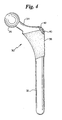
- Figure 4 shows a femoral hip stem prosthesis 30 made entirely of ceramic, the prosthesis having a dense stem portion 32, an angular neck 34 terminating in an articulating ball 36, and an angular shoulder portion 38.
- the shoulder portion includes a thick layer 40 of an article of the invention having a framework with relatively large openings, carried by the denser portion 42 of the prosthesis.
- the coating 38 promotes bone ingrowth when the prosthesis has been implanted in the femur of a patent.
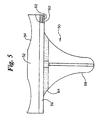
- Figure 4 depicts a tibial tray 50 having an upper plate 52 of ultra high molecular weight polyethylene having an articulating upper surface 54.
- the ultra high molecular weight polyethylene plate is supported by a plate 56 of the dense material of the invention, the plate 56 being integrally formed with a downwardly extending stem 58.
- the open framework material of the invention is shown in the form of a plate 60 which is received within a downwardly open recess 62 formed in the bottom of the plate 56, the framework 60 extending downwardly about the upper end of the stem, as shown at 64 in a relatively thick layer to promote bone ingrowth in this area.
- the dense portion of the above described constructs can be prepared by any of the common ceramic forming techniques such as slip casting, , tape casting, or coating and drying successive layers of slip onto a surface of a "foam" until a dense layer is formed. Dry pressing, injection molding and extrusion techniques may also be appropriate.
- the "green" dense portion is joined to the "green" low density portion through the use of a ceramic slip of substantially similar composition to the slip used in the formation of the low density portion or of a substantially similar composition to the slip used in the formation of the dense portion in the case of slip cast dense portion.
- Green here refers to the state of a ceramic article which has been formed and dried to a self-supporting structure but from which the organic constituents have not yet been removed.
- the dense portion may be alternatively comprised of a resorbable polymeric material, a resorbable ceramic material, or a resorbable composite material in addition to materials enumerated above.
- the openings of the articles of the invention may be filled with a calcium phosphate cement, to adhere the articles to bone, for example.
- the calcium phosphate cement hardens within the interstices and provides a secure bond to the articles.
- a zirconia slip was prepared by combining the following ingredients and mixing them thoroughly by ball milling in a polyethylene container using zirconia media:
- the resulting product was a strong, light weight, porous zirconia framework or reticulum of zirconia having a void volume of about 76%.
- the framework was then coated with a slip containing both zirconia and hydroxyapatite.
- the slip was prepared by combining and ball milling, as described above, the following ingredients:
- Pieces of the zirconia prepared as described above were immersed in the slip and mechanically agitated to remove air bubbles and to assure complete penetration of the slip into the openings. Excess slip was allowed to drain, and further slip was removed with a stream of compressed air. The pieces were dried and were then raised at the rate of 5° C per minute to a sintering temperature of 1400° C and were held at this temperature for one hour.
- the resulting product comprises a strong ceramic framework of zirconia, the struts of which have a surface layer comprised of 75 volume percent zirconia and 25 volume percent hydroxyapatite.
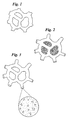
- the structure of this product is illustrated in Figure 1, and note may be made of the open nature of the supporting zirconia supporting framework and the 3,3-connectivity of the framework and the hydroxyapatite.
- an additional layer or layers may be added to the above structure.
- specimens of the above structure were immersed in a slip containing approximately 50% by volume of zirconia and hydroxyapatite, the specimens being drained, dried, and sintered as above at 1400°C.
- This example describes the preparation of a zirconia-hydroxyapatite composite supporting framework, the struts of which bear a coating of hydroxyapatite.
- the first comprising zirconia containing 15 volume percent hydroxyapatite and referred to as a ZHA-15 slip, was prepared by ball milling as in Example 1 using the following ingredients:
- Example 1 Specimens of the reticulated polyester-polyurethane foam referred to in Example 1 were coated as in Example 1 with the ZHA-15 slip. The coated specimens were dried to the "green” state and then heat treated as in Example 1 to remove organic materials and were sintered at 1400° C.
- the hydroxyapatite may appear as small "islands" on the surface of the struts; this is illustrated in Figure 3. Sufficient hydroxyapatite or other osteoconductive material is employed so provide the surface of the struts with osteoconductive properties.
- the specimens were coated with the HA slip, dried, heated to remove organic materials, and were sintered at 1404° C.
- the struts of the resulting structure were comprised of a core of partially stabilized zirconia composite with 15 volume percent hydroxyapatite and a surface layer of hydroxyapatite.
- An "exoskeletal" structure was prepared consisting of an open pore structure as described above bonded to a dense support "plate” comprised of zirconia in one embodiment and ZHA-15 in another embodiment, the open pore structure simulating cancellous bone and the dense structure simulating cortical bone.
- Support plates of zirconia and ZHA-15 were slip cast onto flat plaster of paris surfaces utilizing the zirconia slip of Example 1 and the ZHA-15 slip of Example 2, respectively.
- Green reticulated structures of ZHA-15 as prepared in Example 2 were placed into the wet slip of each embodiment immediately after the latter were cast.
- the resulting specimens were dried and heated, and the plate portions were trimmed when they reached the "leather hard" stage. Drying was done in air followed by drying in an oven at temperatures up to 100° C.
- the specimens were further heated to remove organic materials, and each was sintered as a unit at 1400° C. Following cooling, the porous portion of each specimen that simulated cancellous bone was recoated with the ZHA-15 slip.
- An hydroxyapatite-containing suspension was prepared by combining and mixing:
- Specimens of zirconia were prepared and sintered as in Example 1, forming an endoskeletal framework, and the framework openings were filled with the hydroxyapatite suspension.
- the specimens were heated at the rate of 10° C per hour to a temperature of 80° C and were held at this temperature for 2 hours. Heating of the suspension causes the hydrogen peroxide to decompose and release oxygen gas bubbles. These bubbles cause the suspension to foam and rise. Upon further heating, the hydroxyapatite foamed structure stabilizes.
- the specimens were further heated to remove organic materials and was sintered at 1300° C for one hour.
- the resulting structure is illustrated in Figure 2, and comprises a zirconia framework having openings partially filled with a highly porous (approximately 50 volume percent pore space) hydroxyapatite foam.
- the interstices or openings of the zirconia framework remain open and unplugged, as shown, and the openings of the zirconia framework communicate with the pores of the foamed hydroxyapatite coating.
Landscapes
- Health & Medical Sciences (AREA)
- Chemical & Material Sciences (AREA)
- Animal Behavior & Ethology (AREA)
- Oral & Maxillofacial Surgery (AREA)
- Transplantation (AREA)
- Veterinary Medicine (AREA)
- Public Health (AREA)
- General Health & Medical Sciences (AREA)
- Life Sciences & Earth Sciences (AREA)
- Engineering & Computer Science (AREA)
- Dermatology (AREA)
- Medicinal Chemistry (AREA)
- Epidemiology (AREA)
- Cardiology (AREA)
- Vascular Medicine (AREA)
- Inorganic Chemistry (AREA)
- Composite Materials (AREA)
- Materials Engineering (AREA)
- Orthopedic Medicine & Surgery (AREA)
- Biomedical Technology (AREA)
- Heart & Thoracic Surgery (AREA)
- Dispersion Chemistry (AREA)
- Prostheses (AREA)
- Materials For Medical Uses (AREA)
Applications Claiming Priority (3)
| Application Number | Priority Date | Filing Date | Title |
|---|---|---|---|
| US08/942,557 US6136029A (en) | 1997-10-01 | 1997-10-01 | Bone substitute materials |
| US942557 | 1997-10-01 | ||
| PCT/US1998/020549 WO1999016479A1 (en) | 1997-10-01 | 1998-09-30 | Bone substitute materials |
Publications (2)
| Publication Number | Publication Date |
|---|---|
| EP1024840A1 EP1024840A1 (en) | 2000-08-09 |
| EP1024840B1 true EP1024840B1 (en) | 2004-06-30 |
Family
ID=25478272
Family Applications (1)
| Application Number | Title | Priority Date | Filing Date |
|---|---|---|---|
| EP98949664A Expired - Lifetime EP1024840B1 (en) | 1997-10-01 | 1998-09-30 | Bone substitute materials |
Country Status (8)
| Country | Link |
|---|---|
| US (1) | US6136029A (enExample) |
| EP (1) | EP1024840B1 (enExample) |
| JP (1) | JP4101458B2 (enExample) |
| CN (1) | CN1230207C (enExample) |
| AU (1) | AU736513B2 (enExample) |
| CA (1) | CA2305431C (enExample) |
| DE (1) | DE69824876T2 (enExample) |
| WO (1) | WO1999016479A1 (enExample) |
Families Citing this family (142)
| Publication number | Priority date | Publication date | Assignee | Title |
|---|---|---|---|---|
| US6667049B2 (en) | 1999-06-14 | 2003-12-23 | Ethicon, Inc. | Relic process for producing bioresorbable ceramic tissue scaffolds |
| US6458162B1 (en) * | 1999-08-13 | 2002-10-01 | Vita Special Purpose Corporation | Composite shaped bodies and methods for their production and use |
| US6451059B1 (en) * | 1999-11-12 | 2002-09-17 | Ethicon, Inc. | Viscous suspension spinning process for producing resorbable ceramic fibers and scaffolds |
| US6723334B1 (en) * | 2000-03-01 | 2004-04-20 | Iowa State University Research Foundation, Inc. | Biologically compatible bone cements and orthopedic methods |
| US7001551B2 (en) * | 2000-07-13 | 2006-02-21 | Allograft Research Technologies, Inc. | Method of forming a composite bone material implant |
| US6599516B1 (en) | 2000-09-14 | 2003-07-29 | Etex Corporation | Malleable implant containing solid element that resorbs or fractures to provide access channels |
| US7052517B2 (en) * | 2000-10-24 | 2006-05-30 | Vita Special Purpose Corporation | Delivery device for biological composites and method of preparation thereof |
| US6736799B1 (en) | 2000-10-24 | 2004-05-18 | Vita Licensing, Inc. | Delivery device for biological composites and method of preparation thereof |
| US20020114795A1 (en) | 2000-12-22 | 2002-08-22 | Thorne Kevin J. | Composition and process for bone growth and repair |
| US7014749B2 (en) * | 2000-12-28 | 2006-03-21 | Board Of Regents Of The University Of Nebraska | Electrolytic deposition of coatings for prosthetic metals and alloys |
| US7294187B2 (en) * | 2001-01-24 | 2007-11-13 | Ada Foundation | Rapid-hardening calcium phosphate cement compositions |
| US6793725B2 (en) | 2001-01-24 | 2004-09-21 | Ada Foundation | Premixed calcium phosphate cement pastes |
| US7709029B2 (en) * | 2001-01-24 | 2010-05-04 | Ada Foundation | Calcium-containing restoration materials |
| CA2438801A1 (en) * | 2001-02-19 | 2002-08-29 | Isotis N.V. | Porous metals and metal coatings for implants |
| US7597715B2 (en) | 2005-04-21 | 2009-10-06 | Biomet Manufacturing Corp. | Method and apparatus for use of porous implants |
| US8123814B2 (en) | 2001-02-23 | 2012-02-28 | Biomet Manufacturing Corp. | Method and appartus for acetabular reconstruction |
| US6743232B2 (en) | 2001-02-26 | 2004-06-01 | David W. Overaker | Tissue scaffold anchor for cartilage repair |
| US6949251B2 (en) | 2001-03-02 | 2005-09-27 | Stryker Corporation | Porous β-tricalcium phosphate granules for regeneration of bone tissue |
| US7122057B2 (en) * | 2001-04-12 | 2006-10-17 | Therics, Llc | Method and apparatus for engineered regenerative biostructures such as hydroxyapatite substrates for bone healing applications |
| US20020169066A1 (en) | 2001-04-16 | 2002-11-14 | Cerabio, L.L.C. | Dense porous structures for use as bone substitutes |
| FI117963B (fi) * | 2001-04-26 | 2007-05-15 | Eija Marjut Pirhonen | Luuta korvaavat materiaalit |
| US7776085B2 (en) | 2001-05-01 | 2010-08-17 | Amedica Corporation | Knee prosthesis with ceramic tibial component |
| US7695521B2 (en) * | 2001-05-01 | 2010-04-13 | Amedica Corporation | Hip prosthesis with monoblock ceramic acetabular cup |
| ATE419810T1 (de) * | 2001-05-01 | 2009-01-15 | Amedica Corp | Röntgendurchlässiges knochentransplantat |
| EP1408874B1 (en) | 2001-06-14 | 2012-08-08 | Amedica Corporation | Metal-ceramic composite articulation |
| US6626950B2 (en) | 2001-06-28 | 2003-09-30 | Ethicon, Inc. | Composite scaffold with post anchor for the repair and regeneration of tissue |
| US20040162619A1 (en) | 2001-08-27 | 2004-08-19 | Zimmer Technology, Inc. | Tibial augments for use with knee joint prostheses, method of implanting the tibial augment, and associated tools |
| US20030065397A1 (en) | 2001-08-27 | 2003-04-03 | Hanssen Arlen D. | Prosthetic implant support structure |
| US7892288B2 (en) | 2001-08-27 | 2011-02-22 | Zimmer Technology, Inc. | Femoral augments for use with knee joint prosthesis |
| AU2002325762B2 (en) * | 2001-09-24 | 2008-11-06 | Warsaw Orthopedic, Inc. | Porous ceramic composite bone grafts |
| CA2471403A1 (en) * | 2001-12-21 | 2003-07-10 | Gensci Orthobiologics, Inc. | End-capped polyalkylene glycols and compositions containing such compounds |
| US7205337B2 (en) * | 2001-12-21 | 2007-04-17 | Isotis Orthobiologics, Inc. | End-capped polymers and compositions containing such compounds |
| DE10201340A1 (de) * | 2002-01-16 | 2003-07-24 | Biovision Gmbh | Knochen-Ersatzmaterial und Verfahren zu seiner Herstellung |
| US6955716B2 (en) | 2002-03-01 | 2005-10-18 | American Dental Association Foundation | Self-hardening calcium phosphate materials with high resistance to fracture, controlled strength histories and tailored macropore formation rates |
| US20040127563A1 (en) * | 2002-03-22 | 2004-07-01 | Deslauriers Richard J. | Methods of performing medical procedures which promote bone growth, compositions which promote bone growth, and methods of making such compositions |
| US7159272B2 (en) * | 2002-05-14 | 2007-01-09 | Emerson Electric Co. | Detachable accessory holder |
| US20030220696A1 (en) * | 2002-05-23 | 2003-11-27 | Levine David Jerome | Implantable porous metal |
| US20030225347A1 (en) * | 2002-06-03 | 2003-12-04 | Argenta Louis C. | Directed tissue growth employing reduced pressure |
| US6797006B2 (en) | 2002-06-18 | 2004-09-28 | Zimmer Technology, Inc. | Porous unicondylar knee |
| USD684693S1 (en) | 2002-08-22 | 2013-06-18 | Zimmer, Inc. | Prosthetic implant support structure |
| US7323011B2 (en) * | 2002-10-18 | 2008-01-29 | Musculoskeletal Transplant Foundation | Cortical and cancellous allograft cervical fusion block |
| US6744454B2 (en) * | 2002-10-18 | 2004-06-01 | Eastman Kodak Company | Method and apparatus for reducing uneven use of heating elements on thermal print head |
| US7309361B2 (en) * | 2002-10-23 | 2007-12-18 | Wasielewski Ray C | Biologic modular tibial and femoral component augments for use with total knee arthroplasty |
| US6761739B2 (en) * | 2002-11-25 | 2004-07-13 | Musculoskeletal Transplant Foundation | Cortical and cancellous allograft spacer |
| AU2003297195A1 (en) | 2002-12-17 | 2004-07-22 | Amedica Corporation | Total disc implant |
| WO2004065329A1 (en) * | 2003-01-23 | 2004-08-05 | University Of Bath | Bone substitute material |
| US20050158535A1 (en) * | 2003-05-15 | 2005-07-21 | Miqin Zhang | Methods for making porous ceramic structures |
| GB0318901D0 (en) * | 2003-08-12 | 2003-09-17 | Univ Bath | Improvements in or relating to bone substitute material |
| WO2005037137A2 (en) * | 2003-10-17 | 2005-04-28 | Therics, Inc. | Spinal cage insert, filler piece and method of manufacturing |
| US7189263B2 (en) | 2004-02-03 | 2007-03-13 | Vita Special Purpose Corporation | Biocompatible bone graft material |
| EP1789088A4 (en) * | 2004-03-24 | 2009-12-30 | Doctor S Res Group Inc | METHOD FOR IMPLEMENTING MEDICAL METHODS FOR PROMOTING BONE GROWTH, METHOD FOR PRODUCING COMPOUNDS FOR PROMOTING BONE GROWTH AND DEVICE FOR USE IN SUCH PROCEDURES |
| US7384430B2 (en) * | 2004-06-30 | 2008-06-10 | Depuy Products, Inc. | Low crystalline polymeric material for orthopaedic implants and an associated method |
| US7473678B2 (en) | 2004-10-14 | 2009-01-06 | Biomimetic Therapeutics, Inc. | Platelet-derived growth factor compositions and methods of use thereof |
| US7799754B2 (en) | 2004-10-14 | 2010-09-21 | Biomimetic Therapeutics, Inc. | Compositions and methods for treating bone |
| US7250550B2 (en) | 2004-10-22 | 2007-07-31 | Wright Medical Technology, Inc. | Synthetic bone substitute material |
| US7883653B2 (en) | 2004-12-30 | 2011-02-08 | Depuy Products, Inc. | Method of making an implantable orthopaedic bearing |
| US7879275B2 (en) * | 2004-12-30 | 2011-02-01 | Depuy Products, Inc. | Orthopaedic bearing and method for making the same |
| US7896921B2 (en) * | 2004-12-30 | 2011-03-01 | Depuy Products, Inc. | Orthopaedic bearing and method for making the same |
| US8221504B2 (en) | 2005-02-23 | 2012-07-17 | Wright Medical Technology, Inc. | Coating an implant for increased bone in-growth |
| US8021432B2 (en) | 2005-12-05 | 2011-09-20 | Biomet Manufacturing Corp. | Apparatus for use of porous implants |
| US8266780B2 (en) | 2005-04-21 | 2012-09-18 | Biomet Manufacturing Corp. | Method and apparatus for use of porous implants |
| US8066778B2 (en) | 2005-04-21 | 2011-11-29 | Biomet Manufacturing Corp. | Porous metal cup with cobalt bearing surface |
| US8292967B2 (en) | 2005-04-21 | 2012-10-23 | Biomet Manufacturing Corp. | Method and apparatus for use of porous implants |
| US8025903B2 (en) | 2005-09-09 | 2011-09-27 | Wright Medical Technology, Inc. | Composite bone graft substitute cement and articles produced therefrom |
| ES2402651T3 (es) | 2005-09-09 | 2013-05-07 | Agnovos Healthcare, Llc | Cemento sustituto de injerto óseo de material compuesto y artículos producidos del mismo |
| EP2431060B1 (en) | 2005-11-17 | 2020-04-08 | BioMimetic Therapeutics, LLC | Maxillofacial bone augmentation using RHPDGF-BB and a biocompatible matrix |
| US20070116734A1 (en) * | 2005-11-18 | 2007-05-24 | Akash Akash | Porous, load-bearing, ceramic or metal implant |
| US8252058B2 (en) | 2006-02-16 | 2012-08-28 | Amedica Corporation | Spinal implant with elliptical articulatory interface |
| US7635447B2 (en) | 2006-02-17 | 2009-12-22 | Biomet Manufacturing Corp. | Method and apparatus for forming porous metal implants |
| WO2007105600A1 (ja) * | 2006-03-10 | 2007-09-20 | Takiron Co., Ltd. | インプラント複合材料 |
| US20100131064A1 (en) * | 2006-04-05 | 2010-05-27 | University Of Nebraska | Bioresorbable polymer reconstituted bone and methods of formation thereof |
| US9155646B2 (en) * | 2006-04-27 | 2015-10-13 | Brs Holdings, Llc | Composite stent with bioremovable ceramic flakes |
| US9101505B2 (en) * | 2006-04-27 | 2015-08-11 | Brs Holdings, Llc | Composite stent |
| WO2007130648A2 (en) * | 2006-05-05 | 2007-11-15 | Ceramatec, Inc. | Fully or partially bioresorbable orthopedic implant |
| EP2040765A2 (en) | 2006-06-29 | 2009-04-01 | Orthovita, INC. | Bioactive bone graft substitute |
| ES2664229T3 (es) | 2006-06-30 | 2018-04-18 | Biomimetic Therapeutics, Llc | Composiciones y métodos de biomatriz-PDGF para el tratamiento de lesiones del manguito rotador |
| US9161967B2 (en) | 2006-06-30 | 2015-10-20 | Biomimetic Therapeutics, Llc | Compositions and methods for treating the vertebral column |
| US20080022644A1 (en) * | 2006-07-28 | 2008-01-31 | Derosa Michael Edward | Reticulated pore formers for ceramic articles |
| JP5552315B2 (ja) | 2006-11-03 | 2014-07-16 | バイオミメティック セラピューティクス, エルエルシー | アースロデティック術のための組成物および方法 |
| US7718616B2 (en) * | 2006-12-21 | 2010-05-18 | Zimmer Orthobiologics, Inc. | Bone growth particles and osteoinductive composition thereof |
| US8163028B2 (en) | 2007-01-10 | 2012-04-24 | Biomet Manufacturing Corp. | Knee joint prosthesis system and method for implantation |
| US8328873B2 (en) | 2007-01-10 | 2012-12-11 | Biomet Manufacturing Corp. | Knee joint prosthesis system and method for implantation |
| WO2008118247A1 (en) | 2007-01-10 | 2008-10-02 | Biomet Manufacturing Corp. | Knee joint prosthesis system and method for implantation |
| US8187280B2 (en) | 2007-10-10 | 2012-05-29 | Biomet Manufacturing Corp. | Knee joint prosthesis system and method for implantation |
| US8562616B2 (en) | 2007-10-10 | 2013-10-22 | Biomet Manufacturing, Llc | Knee joint prosthesis system and method for implantation |
| US20080195476A1 (en) * | 2007-02-09 | 2008-08-14 | Marchese Michael A | Abandonment remarketing system |
| US8512342B2 (en) * | 2007-08-11 | 2013-08-20 | Thomas L. Meredith | Portable bone grinder |
| DE102008044951A1 (de) * | 2008-02-05 | 2009-08-06 | Smith & Nephew Orthopaedics Ag | Offenporige biokompatible Oberflächenschicht für ein Implantat, Verfahren zur Herstellung und Verwendung |
| WO2009100454A1 (en) | 2008-02-07 | 2009-08-13 | Biomimetic Therapeutics, Inc. | Compositions and methods for distraction osteogenesis |
| US20090248162A1 (en) * | 2008-03-25 | 2009-10-01 | Warsaw Orthopedic, Inc. | Microparticle delivery syringe and needle for placing suspensions and removing vehicle fluid |
| EP2130516B1 (en) * | 2008-06-03 | 2014-03-05 | DePuy (Ireland) | Porous titanium tibial sleeves |
| EP2130518B1 (en) | 2008-06-03 | 2013-05-15 | DePuy Products, Inc. | Porous titanium femoral sleeves |
| US20090304775A1 (en) * | 2008-06-04 | 2009-12-10 | Joshi Ashok V | Drug-Exuding Orthopedic Implant |
| US10842645B2 (en) | 2008-08-13 | 2020-11-24 | Smed-Ta/Td, Llc | Orthopaedic implant with porous structural member |
| CA2734254C (en) * | 2008-08-13 | 2018-06-05 | Smed-Ta/Td, Llc | Orthopaedic screws |
| WO2010019781A1 (en) | 2008-08-13 | 2010-02-18 | Smed-Ta/Td, Llc | Drug delivery implants |
| US9700431B2 (en) | 2008-08-13 | 2017-07-11 | Smed-Ta/Td, Llc | Orthopaedic implant with porous structural member |
| US9616205B2 (en) | 2008-08-13 | 2017-04-11 | Smed-Ta/Td, Llc | Drug delivery implants |
| JP5596686B2 (ja) * | 2008-08-13 | 2014-09-24 | スメド−ティーエイ/ティーディー・エルエルシー | 空間的に変動する孔隙率を備えた整形外科用移植片 |
| EP2341852B1 (en) * | 2008-08-29 | 2018-08-15 | SMed-TA/TD, LLC | Orthopaedic implant |
| NZ602861A (en) | 2008-09-09 | 2014-03-28 | Biomimetic Therapeutics Llc | Platelet-derived growth factor compositions and methods for the treatment of tendon and ligament injuries |
| US8614189B2 (en) * | 2008-09-24 | 2013-12-24 | University Of Connecticut | Carbon nanotube composite scaffolds for bone tissue engineering |
| US20100125335A1 (en) * | 2008-11-20 | 2010-05-20 | Daley Robert J | Methods and apparatus for replacing biological joints using bone cement in a suspended state |
| US20100125303A1 (en) * | 2008-11-20 | 2010-05-20 | Daley Robert J | Methods and apparatus for replacing biological joints using bone mineral substance in a suspended state |
| EP2401000A2 (en) * | 2009-02-25 | 2012-01-04 | Howmedica Osteonics Corp. | Bone graft material containment structures |
| US8609127B2 (en) | 2009-04-03 | 2013-12-17 | Warsaw Orthopedic, Inc. | Medical implant with bioactive material and method of making the medical implant |
| US9399086B2 (en) | 2009-07-24 | 2016-07-26 | Warsaw Orthopedic, Inc | Implantable medical devices |
| US20120215310A1 (en) * | 2009-08-19 | 2012-08-23 | Smith & Nephew, Inc. | Porous implant structures |
| CA2790403C (en) | 2010-02-22 | 2019-08-27 | Biomimetic Therapeutics, Inc. | Platelet-derived growth factor compositions and methods for the treatment of tendinopathies |
| US8795691B2 (en) * | 2010-03-16 | 2014-08-05 | Brown University | Nanotubes and compositions thereof |
| WO2011143187A2 (en) | 2010-05-10 | 2011-11-17 | University Of Connecticut | Lactoferrin -based biomaterials for tissue regeneration and drug delivery |
| US9265857B2 (en) | 2010-05-11 | 2016-02-23 | Howmedica Osteonics Corp. | Organophosphorous, multivalent metal compounds, and polymer adhesive interpenetrating network compositions and methods |
| US9878272B2 (en) | 2010-05-28 | 2018-01-30 | Corning Incorporated | Porous inorganic membranes and method of manufacture |
| WO2012068135A1 (en) | 2010-11-15 | 2012-05-24 | Zimmer Orthobiologics, Inc. | Bone void fillers |
| US8551525B2 (en) | 2010-12-23 | 2013-10-08 | Biostructures, Llc | Bone graft materials and methods |
| WO2012158527A2 (en) | 2011-05-13 | 2012-11-22 | Howmedica Osteonics | Organophosphorous & multivalent metal compound compositions & methods |
| US8900317B2 (en) | 2011-05-20 | 2014-12-02 | Zimmer, Inc. | Stabilizing prosthesis support structure |
| GB201119966D0 (en) * | 2011-11-18 | 2012-01-04 | Biocomposites Ltd | Mould mat for producing bone cement pellets |
| US9180223B2 (en) | 2012-05-10 | 2015-11-10 | The Trustees Of The Stevens Institute Of Technology | Biphasic osteochondral scaffold for reconstruction of articular cartilage |
| BR102012032608B1 (pt) * | 2012-12-18 | 2021-06-01 | Universidade Estadual De Campinas - Unicamp | Processo de obtenção de esponjas de hidroxiapatita e fosfato tricálcico, esponjas assim obtidas e uso das mesmas |
| US9681966B2 (en) | 2013-03-15 | 2017-06-20 | Smed-Ta/Td, Llc | Method of manufacturing a tubular medical implant |
| US9408699B2 (en) | 2013-03-15 | 2016-08-09 | Smed-Ta/Td, Llc | Removable augment for medical implant |
| US9724203B2 (en) | 2013-03-15 | 2017-08-08 | Smed-Ta/Td, Llc | Porous tissue ingrowth structure |
| US10118827B2 (en) * | 2013-05-10 | 2018-11-06 | Reed A. Ayers | Combustion synthesis of calcium phosphate constructs and powders doped with atoms, molecules, ions, or compounds |
| AU2014331971B2 (en) * | 2013-10-08 | 2018-07-19 | Vivorte, Inc. | Processed bone particle compositions and related methods |
| TWI651103B (zh) | 2013-12-13 | 2019-02-21 | 萊特醫技股份有限公司 | 多相骨移植替代材料 |
| CN105343935A (zh) * | 2014-12-15 | 2016-02-24 | 四川大学 | 一种磷酸钙晶须骨架和多孔复合支架及其制备方法 |
| EP3570787B1 (en) | 2017-01-20 | 2022-05-04 | Biomet Manufacturing, LLC | Modular augment component |
| WO2018220848A1 (ja) * | 2017-06-02 | 2018-12-06 | オリンパス株式会社 | 骨補填材及び骨補填材の製造方法 |
| TWI647032B (zh) * | 2017-12-28 | 2019-01-11 | 財團法人工業技術研究院 | 醫療元件的製作方法及其應用 |
| US10512495B2 (en) | 2017-12-28 | 2019-12-24 | Industrial Technology Research Institute | Method for fabricating medical device and applications thereof |
| CN109730811B (zh) * | 2018-12-17 | 2021-07-13 | 中国科学院上海硅酸盐研究所 | 仿骨哈弗斯系统生物活性支架及其制备方法和应用 |
| WO2020146600A1 (en) * | 2019-01-10 | 2020-07-16 | University Of Utah Research Foundation | Fluorapatite coated implants and related methods statement regarding federally sponsored research |
| KR102649798B1 (ko) * | 2019-06-28 | 2024-03-20 | 후지필름 가부시키가이샤 | 압전 필름 |
| USD901012S1 (en) | 2019-08-12 | 2020-11-03 | Ortho Development Corporation | Porous implant |
| USD901014S1 (en) | 2019-08-12 | 2020-11-03 | Ortho Development Corporation | Porous implant |
| USD901013S1 (en) | 2019-08-12 | 2020-11-03 | Ortho Development Corporation | Porous implant |
| US11565021B1 (en) | 2019-08-12 | 2023-01-31 | Ortho Development Corporation | Composite structure porous implant for replacing bone stock |
| US12434302B2 (en) | 2019-11-25 | 2025-10-07 | Ortho Development Corporation | Method for manufacturing porous structures using additive manufacturing |
| US11498124B1 (en) | 2019-11-25 | 2022-11-15 | Ortho Development Corporation | Method for sintering porous structures from powder using additive manufacturing |
| CN110882417B (zh) * | 2019-12-20 | 2021-02-19 | 上海贝奥路生物材料有限公司 | 复合多孔生物陶瓷的金属假体及其制备方法 |
| US20230100859A1 (en) | 2021-09-27 | 2023-03-30 | Thomas Matthew Industries, Inc. | Bone grinder promoting bone osteoinductivity |
Citations (4)
| Publication number | Priority date | Publication date | Assignee | Title |
|---|---|---|---|---|
| US4599085A (en) * | 1979-07-11 | 1986-07-08 | Neodontics, Inc. | Bone implant member for prostheses and bone connecting elements and process for the production thereof |
| US4967509A (en) * | 1990-01-05 | 1990-11-06 | Storey Leonard M | Security window shutter |
| US5306673A (en) * | 1989-04-10 | 1994-04-26 | Stiftelsen Centrum For Dentalteknik Och Biomaterial I Huddinge | Composite ceramic material and method to manufacture the material |
| WO1995032008A1 (en) * | 1994-05-24 | 1995-11-30 | Implico B.V. | A biomaterial and bone implant for bone repair and replacement |
Family Cites Families (35)
| Publication number | Priority date | Publication date | Assignee | Title |
|---|---|---|---|---|
| US4000525A (en) * | 1975-08-21 | 1977-01-04 | The United States Of America As Represented By The Secretary Of The Navy | Ceramic prosthetic implant suitable for a knee joint plateau |
| US4237559A (en) * | 1979-05-11 | 1980-12-09 | General Electric Company | Bone implant embodying a composite high and low density fired ceramic construction |
| US4343704A (en) * | 1981-01-22 | 1982-08-10 | Swiss Aluminium Ltd. | Ceramic foam filter |
| US4626392A (en) * | 1984-03-28 | 1986-12-02 | Ngk Spark Plug Co., Ltd. | Process for producing ceramic body for surgical implantation |
| US5001169A (en) * | 1984-10-24 | 1991-03-19 | Collagen Corporation | Inductive collagen-based bone repair preparations |
| US5522894A (en) * | 1984-12-14 | 1996-06-04 | Draenert; Klaus | Bone replacement material made of absorbable beads |
| US4722870A (en) * | 1985-01-22 | 1988-02-02 | Interpore International | Metal-ceramic composite material useful for implant devices |
| US5007930A (en) * | 1985-02-19 | 1991-04-16 | The Dow Chemical Company | Composites of unsintered calcium phosphates and synthetic biodegradable polymers useful as hard tissue prosthetics |
| US5133755A (en) * | 1986-01-28 | 1992-07-28 | Thm Biomedical, Inc. | Method and apparatus for diodegradable, osteogenic, bone graft substitute device |
| JPS62202884A (ja) * | 1986-02-28 | 1987-09-07 | 工業技術院長 | 生体代替セラミツク材料 |
| FI80605C (fi) * | 1986-11-03 | 1990-07-10 | Biocon Oy | Benkirurgisk biokompositmaterial. |
| JPS6418973A (en) * | 1987-07-10 | 1989-01-23 | Agency Ind Science Techn | Bioceramic material |
| US5192325A (en) * | 1988-02-08 | 1993-03-09 | Mitsubishi Kasei Corporation | Ceramic implant |
| EP0328041B1 (en) * | 1988-02-08 | 1994-09-07 | Mitsubishi Chemical Corporation | Ceramic implant and process for its production |
| US5185177A (en) * | 1988-02-08 | 1993-02-09 | Mitsubishi Kasei Corporation | Producing a ceramic implant by coating a powder mixture of zirconia and either tricalcium phosphate or hydroxyapatite on a molded unsintered body of partially stabilized zirconia and then sintering the article |
| US4976736A (en) * | 1989-04-28 | 1990-12-11 | Interpore International | Coated biomaterials and methods for making same |
| US5356436A (en) * | 1989-06-06 | 1994-10-18 | Tdk Corporation | Materials for living hard tissue replacements |
| EP0585978A3 (en) * | 1989-06-30 | 1994-03-23 | TDK Corporation | Living hard tissue replacement, its preparation, and preparation of integral body |
| US5037438A (en) * | 1989-07-25 | 1991-08-06 | Richards Medical Company | Zirconium oxide coated prosthesis for wear and corrosion resistance |
| US5152791A (en) * | 1989-12-07 | 1992-10-06 | Olympus Optical Co., Ltd. | Prosthetic artificial bone having ceramic layers of different porosity |
| JP2921918B2 (ja) * | 1990-05-07 | 1999-07-19 | 旭光学工業株式会社 | 多相構造の生体材料及びその製造方法 |
| US5231169A (en) * | 1990-10-17 | 1993-07-27 | Norian Corporation | Mineralized collagen |
| US5205921A (en) * | 1991-02-04 | 1993-04-27 | Queen's University At Kingston | Method for depositing bioactive coatings on conductive substrates |
| JP3007903B2 (ja) * | 1991-03-29 | 2000-02-14 | 京セラ株式会社 | 人工椎間板 |
| SE469653B (sv) * | 1992-01-13 | 1993-08-16 | Lucocer Ab | Poroest implantat |
| US5282861A (en) * | 1992-03-11 | 1994-02-01 | Ultramet | Open cell tantalum structures for cancellous bone implants and cell and tissue receptors |
| JP3362267B2 (ja) * | 1993-12-29 | 2003-01-07 | 日本特殊陶業株式会社 | 生体インプラント材料及びその製造方法 |
| US5549685A (en) * | 1994-02-23 | 1996-08-27 | Zimmer, Inc. | Augmentation for an orthopaedic implant |
| US5626861A (en) * | 1994-04-01 | 1997-05-06 | Massachusetts Institute Of Technology | Polymeric-hydroxyapatite bone composite |
| US5947893A (en) * | 1994-04-27 | 1999-09-07 | Board Of Regents, The University Of Texas System | Method of making a porous prothesis with biodegradable coatings |
| US6105235A (en) * | 1994-04-28 | 2000-08-22 | Johnson & Johnson Professional, Inc. | Ceramic/metallic articulation component and prosthesis |
| AU3795395A (en) * | 1994-11-30 | 1996-06-06 | Ethicon Inc. | Hard tissue bone cements and substitutes |
| DE19504955A1 (de) * | 1995-02-15 | 1996-08-22 | Merck Patent Gmbh | Verfahren zur Herstellung von Spongiosa-Knochenkeramikformkörpern |
| US5783248A (en) * | 1995-08-28 | 1998-07-21 | National Science Council Of R.O.C. | Process for producing a bioceramic composite material containing natural bone material on an alumina substrate |
| DE19610715C1 (de) * | 1996-03-19 | 1997-06-26 | Axel Kirsch | Verfahren zum Herstellen eines Knochenersatzmaterials |
-
1997
- 1997-10-01 US US08/942,557 patent/US6136029A/en not_active Expired - Lifetime
-
1998
- 1998-09-30 AU AU95941/98A patent/AU736513B2/en not_active Ceased
- 1998-09-30 JP JP2000513611A patent/JP4101458B2/ja not_active Expired - Fee Related
- 1998-09-30 CA CA002305431A patent/CA2305431C/en not_active Expired - Fee Related
- 1998-09-30 WO PCT/US1998/020549 patent/WO1999016479A1/en not_active Ceased
- 1998-09-30 DE DE69824876T patent/DE69824876T2/de not_active Expired - Lifetime
- 1998-09-30 EP EP98949664A patent/EP1024840B1/en not_active Expired - Lifetime
- 1998-09-30 CN CN98811730.4A patent/CN1230207C/zh not_active Expired - Fee Related
Patent Citations (4)
| Publication number | Priority date | Publication date | Assignee | Title |
|---|---|---|---|---|
| US4599085A (en) * | 1979-07-11 | 1986-07-08 | Neodontics, Inc. | Bone implant member for prostheses and bone connecting elements and process for the production thereof |
| US5306673A (en) * | 1989-04-10 | 1994-04-26 | Stiftelsen Centrum For Dentalteknik Och Biomaterial I Huddinge | Composite ceramic material and method to manufacture the material |
| US4967509A (en) * | 1990-01-05 | 1990-11-06 | Storey Leonard M | Security window shutter |
| WO1995032008A1 (en) * | 1994-05-24 | 1995-11-30 | Implico B.V. | A biomaterial and bone implant for bone repair and replacement |
Also Published As
| Publication number | Publication date |
|---|---|
| WO1999016479A1 (en) | 1999-04-08 |
| JP4101458B2 (ja) | 2008-06-18 |
| JP2001518322A (ja) | 2001-10-16 |
| CA2305431A1 (en) | 1999-04-08 |
| AU9594198A (en) | 1999-04-23 |
| EP1024840A1 (en) | 2000-08-09 |
| CN1290181A (zh) | 2001-04-04 |
| US6136029A (en) | 2000-10-24 |
| AU736513B2 (en) | 2001-07-26 |
| DE69824876T2 (de) | 2005-07-14 |
| DE69824876D1 (de) | 2004-08-05 |
| CN1230207C (zh) | 2005-12-07 |
| CA2305431C (en) | 2009-09-08 |
Similar Documents
| Publication | Publication Date | Title |
|---|---|---|
| CA2305431C (en) | Bone substitute materials | |
| US6527810B2 (en) | Bone substitutes | |
| US7740897B2 (en) | Process for producing rigid reticulated articles | |
| Hing et al. | Mediation of bone ingrowth in porous hydroxyapatite bone graft substitutes | |
| EP1492475B1 (en) | Dense/porous structures for use as bone substitutes | |
| Sopyan et al. | Porous hydroxyapatite for artificial bone applications | |
| Fu et al. | Mechanical and in vitro performance of 13–93 bioactive glass scaffolds prepared by a polymer foam replication technique | |
| US6479418B2 (en) | Porous ceramic body | |
| EP1231951B8 (en) | Process for producing rigid reticulated articles | |
| Vitale-Brovarone et al. | Feasibility and tailoring of bioactive glass-ceramic scaffolds with gradient of porosity for bone grafting | |
| Dorozhkin | Calcium orthophosphate-based bioceramics and its clinical applications | |
| EP3946488B1 (en) | Collagen matrix or granulate blend of bone substitute material | |
| Daculsi et al. | Performance for bone ingrowth of biphasic calcium phosphate ceramic versus bovine bone substitute | |
| Li | Porous titanium for biomedical applications: development, characterization and biological evaluation | |
| Dorozhkin | JOURNAL OF BIOTECHNOLOGY AND BIOMEDICAL SCIENCE | |
| HK40061207A (en) | Collagen matrix or granulate blend of bone substitute material | |
| HK40061207B (en) | Collagen matrix or granulate blend of bone substitute material | |
| Gittings | Fabrication and properties of novel open porous calcium phosphate bioceramics |
Legal Events
| Date | Code | Title | Description |
|---|---|---|---|
| PUAI | Public reference made under article 153(3) epc to a published international application that has entered the european phase |
Free format text: ORIGINAL CODE: 0009012 |
|
| 17P | Request for examination filed |
Effective date: 20000426 |
|
| AK | Designated contracting states |
Kind code of ref document: A1 Designated state(s): AT BE CH CY DE DK ES FI FR GB GR IE IT LI LU MC NL PT SE |
|
| 17Q | First examination report despatched |
Effective date: 20020403 |
|
| GRAP | Despatch of communication of intention to grant a patent |
Free format text: ORIGINAL CODE: EPIDOSNIGR1 |
|
| GRAS | Grant fee paid |
Free format text: ORIGINAL CODE: EPIDOSNIGR3 |
|
| GRAA | (expected) grant |
Free format text: ORIGINAL CODE: 0009210 |
|
| RBV | Designated contracting states (corrected) |
Designated state(s): DE FR GB |
|
| AK | Designated contracting states |
Kind code of ref document: B1 Designated state(s): DE FR GB |
|
| REG | Reference to a national code |
Ref country code: GB Ref legal event code: FG4D |
|
| REG | Reference to a national code |
Ref country code: IE Ref legal event code: FG4D |
|
| REF | Corresponds to: |
Ref document number: 69824876 Country of ref document: DE Date of ref document: 20040805 Kind code of ref document: P |
|
| PGFP | Annual fee paid to national office [announced via postgrant information from national office to epo] |
Ref country code: FR Payment date: 20040908 Year of fee payment: 7 |
|
| PGFP | Annual fee paid to national office [announced via postgrant information from national office to epo] |
Ref country code: GB Payment date: 20040929 Year of fee payment: 7 |
|
| ET | Fr: translation filed | ||
| PLBE | No opposition filed within time limit |
Free format text: ORIGINAL CODE: 0009261 |
|
| STAA | Information on the status of an ep patent application or granted ep patent |
Free format text: STATUS: NO OPPOSITION FILED WITHIN TIME LIMIT |
|
| 26N | No opposition filed |
Effective date: 20050331 |
|
| REG | Reference to a national code |
Ref country code: IE Ref legal event code: MM4A |
|
| PG25 | Lapsed in a contracting state [announced via postgrant information from national office to epo] |
Ref country code: GB Free format text: LAPSE BECAUSE OF NON-PAYMENT OF DUE FEES Effective date: 20050930 |
|
| GBPC | Gb: european patent ceased through non-payment of renewal fee |
Effective date: 20050930 |
|
| PG25 | Lapsed in a contracting state [announced via postgrant information from national office to epo] |
Ref country code: FR Free format text: LAPSE BECAUSE OF NON-PAYMENT OF DUE FEES Effective date: 20060531 |
|
| REG | Reference to a national code |
Ref country code: FR Ref legal event code: ST Effective date: 20060531 |
|
| PGFP | Annual fee paid to national office [announced via postgrant information from national office to epo] |
Ref country code: DE Payment date: 20160927 Year of fee payment: 19 |
|
| REG | Reference to a national code |
Ref country code: DE Ref legal event code: R119 Ref document number: 69824876 Country of ref document: DE |
|
| PG25 | Lapsed in a contracting state [announced via postgrant information from national office to epo] |
Ref country code: DE Free format text: LAPSE BECAUSE OF NON-PAYMENT OF DUE FEES Effective date: 20180404 |