EP1024705B1 - Abdichtung des afters eines schlachttier körpers - Google Patents
Abdichtung des afters eines schlachttier körpers Download PDFInfo
- Publication number
- EP1024705B1 EP1024705B1 EP98946154A EP98946154A EP1024705B1 EP 1024705 B1 EP1024705 B1 EP 1024705B1 EP 98946154 A EP98946154 A EP 98946154A EP 98946154 A EP98946154 A EP 98946154A EP 1024705 B1 EP1024705 B1 EP 1024705B1
- Authority
- EP
- European Patent Office
- Prior art keywords
- clamp
- plug
- rectum
- anus
- anal seal
- Prior art date
- Legal status (The legal status is an assumption and is not a legal conclusion. Google has not performed a legal analysis and makes no representation as to the accuracy of the status listed.)
- Expired - Lifetime
Links
Images
Classifications
-
- A—HUMAN NECESSITIES
- A22—BUTCHERING; MEAT TREATMENT; PROCESSING POULTRY OR FISH
- A22B—SLAUGHTERING
- A22B5/00—Accessories for use during or after slaughtering
- A22B5/0094—Cutting or blocking the rectum of a carcass, e.g. for avoiding fecal contamination
Definitions
- This invention relates to sealing the anus of carcasses of slaughtered animals, e.g. sheep, cattle, calves, pigs, and other species.
- a number of different systems are known for sealing the anus of the carcass of a slaughtered animal.
- For smaller animals such as sheep and calves, it is known to provide one piece internal plugs made from plastics material, recycled paper, and the like. These plugs are inserted through the anus into the rectum.
- One shortcoming of this type of system is that the natural elasticity of the rectum allows faecal material to move past or to dislodge these internal plugs, so that they are ineffective in preventing contamination of the carcass.
- Another limitation of this type of prior system is that an abattoir worker needs to manually grasp the anus and to cut around the rectum to enable the plugged rectum to be removed along with other abdominal viscera. This grasping and cutting operation can lead to contamination of the worker's hands and can increase the risk of the worker contracting some disease or being injured.
- Another known system, particularly for cattle, called "bagging the anus” involves applying a plastic bag or the like over the end section of the rectum thereby enclosing the anus, the plastic bag being held in position with an elastic ring or the like tightly clamping the plastic bag around the rectum.
- This system has been used in manual anus sealing operations and also in mechanised or semi-automatic systems such as the one described in international patent application No. PCT/AU95/00637 (publication No. WO-96/09770). Bagging of the anus can be unsuitable where the time available for the operations on each carcass is too short to perform all the necessary operations to complete the bagging.
- Another drawback of this system is the unwanted introduction of polyethylene in the rendered tallow.
- a process for sealing the anus of the carcass of a slaughtered animal including the steps of clearing the hide, skin or pelt from the immediate vicinity of the anus, leaving the anal sphincter substantially intact, inserting a plug through the anus and into the rectum of the carcass of the slaughtered animal to a depth such that the sphincter muscle contracts behind and around the periphery of a back end of the plug, clamping the sphincter muscle by moving a clamp associated with the plug into a clamping position in which it engages with the sphincter muscle that has contracted behind the back end of the plug so as to clamp the sphincter muscle between the plug and the clamp, and holding the clamp in its clamping position so that the anus is sealed prior to subsequent processing of the carcass.
- the plug is provided with a stem extending out from the back end of the plug, and the clamp includes a clamping member which is slidably movable along the stem and is moved along the stem to clamp the anal sphincter against the back end of the plug.
- the stem may be pulled in the caudal direction relative to the carcass to thereby apply tension to the rectum, the tensioning of the rectum being followed by the step of cutting tissues around the rectum to separate it, without puncturing or piercing the rectum, to the desired depth into the pelvic cavity of the carcass.
- Cutting around the rectum may be carried out by a cylindrical cutting device having a leading cutting edge and a diameter chosen to cut through the tissues surrounding the rectum but without cutting into the rectum, the cutting around the rectum being carried out by relatively advancing the cutting device while the rectum is relatively drawn in the caudal direction concentrically through the cutting device.
- the rectum with the anal seal remaining attached may be pulled through the pelvic canal and into the body cavity of the carcass during an evisceration process, followed by removing the rectum together with the viscera with the anal seal still in place and effectively sealing the anus, and subsequently releasing the anal seal and recovering it prior to further processing of the viscera.
- an anal seal for sealing the anus of the carcass of a slaughtered animal, the anal seal including a plug for insertion through the anus and into the rectum of the carcass of the slaughtered animal so that tissues contract behind the plug, a clamp associated with the plug and arranged for movement towards the plug to a clamping position in which it engages with tissues that have contracted behind the plug so as to clamp the tissues between the plug and the clamp, and retaining means to hold the clamp in its clamping position so that the anus is sealed prior to subsequent processing of the carcass.
- the anal seal in the drawings is for sealing the anus of the carcass 10 of a slaughtered animal.
- the seal includes a plug 15 for insertion through the anus and into the rectum of the carcass 10 so that tissues 11 contract behind the plug 15.
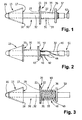
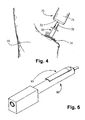
- a clamp 20 is associated with the plug 15 and is arranged for movement from a retracted position (Figs. 1 and 3) towards the plug 15 to a clamping position (Figs. 2 and 4) in which it engages with tissues 11 that have contracted behind the plug so as to clamp the tissues 11 between the plug 15 and the clamp 20.
- Retaining means 40 holds the clamp 20 in its clamping position so that the anus is sealed prior to subsequent processing of the carcass 10.
- the plug 15 may be of any suitable shape, but in the illustrated embodiments the plug is rotationally symmetrical about a longitudinal axis, the longitudinal axis being a general direction along which the plug 15 is advanced in being inserted through the anus into the rectum.
- a particularly suitable shape of the plug 15 is a generally conical shape, preferably having a rounded nose 16 to avoid any sharp point which could puncture a wall of the rectum.
- the conical plug 15 also has a back end 17.
- the back end 17 is concave and has an annular peripheral area 18 which faces rearwardly and which forms a main sealing region as further described below.
- the plug 15 illustrated is a frustconical plastics moulding.
- the clamp 20 which engages with the tissues 11 around the anus to clamp the tissues between the plug 15 and clamp 20 comprises a clamping member 21 which in use is located in its clamping position behind the plug 15 after the plug has been inserted into the rectum.
- the clamping member 21 is operable to clamp around the entire circumference of the back end 17 of the plug 15.
- the clamping member 21 is in the shape of a clamping disc 22 having a diameter generally equal to the diameter of the back end 17 of the conical plug 15.
- the clamping disc 22 can be slightly larger in diameter than the peripheral area 18 and can have a complementary depression 23 to fit around the outside of the back end 17 as shown in Fig. 2.
- the plug 15 and clamp 20 are provided with co-operating male and female formations 30, 31 so that the clamp 20 can be guided into its clamping position.
- the plug 15 is provided with a projection such as a stem 32 extending back from the back end 17 of the plug, and the clamp 20 is provided with a hole 33 which the stem 32 passes through so that, with this arrangement, the clamp 20 can be slid along the stem 32 to readily and accurately adopt its clamping position.
- the clamp 20 is in the form of a spool 35 with the clamping disc 22 at the front end, a sleeve 36 through which the hole 33 passes, and a rear disc 37 discussed later.
- Fig. 1 the clamp 20 is in the form of a spool 35 with the clamping disc 22 at the front end, a sleeve 36 through which the hole 33 passes, and a rear disc 37 discussed later.
- the spool 35 has clamping disc 22 and sleeve 36.
- a particular advantage of providing a stem 32 extending out from the back end 17 of the plug 15 is that this stem 32 provides a means for mounting or holding the plug 15 while it is being inserted through the anus into the rectum, for holding the plug at its desired depth of insertion to ensure effective clamping of tissues 11 which have contracted behind the plug 15, and for subsequent manipulation during cutting of the rectum free of the carcass 10 as will be described later.
- the retaining means 40 for holding the clamp 20 in its clamping position comprises a positive acting latch arrangement 41 which is operated to latch or lock the clamp 20 in its clamping position and prevent release of the clamped tissues 11 by movement of the clamp 20 away from the plug 15.
- the positive acting latch 41 illustrated includes a row of teeth 42 along the projecting stem 32 and a co-operating resilient projection 43 on the clamp 20, e.g. at the back end of the spool 35 behind the rear disc 37, which engages with the teeth 42 as the clamping disc 22 is advanced towards its clamping position but which prevents movement of the clamping disc in the opposite direction outwardly away from its clamping position.
- the damp 20 can be deliberately disengaged by providing the teeth 42 along a line at one side only of the stem 32 and not around the entire circumference whereby rotation of the spool 35 by grasping and twisting the rear disc 37 which acts as a retractor handle by, say 90°, when in its clamping position will disengage the projection 43 from the teeth 42 thereby enabling the clamping disc 22 to be retracted back along the projecting stem 32 away from its clamping position.
- Such deliberate disengagement can be desirable to enable for example the anal seal to be retrieved from the viscera prior to the viscera being further processed in a rendering operation.
- the stem 32 is provided with a helical guide 44 which cooperates with the projection 43 provided on the clamp when the clamp 20 is being retracted along the stem to cause the clamp 20 to rotate and align the projection with the line of teeth 42 ready for a subsequent use of the seal.
- the projection 43 engages over the ridge 45 provided around the stem 32 to releasably hold the clamp 15 in its retracted position (Fig. 1).
- Figs. 2 and 4 show an embodiment in which there are two lines of teeth 42 on opposite sides of the stem 32 and respective cooperating projections 43.
- the retaining means 40 of the anal seal which holds the clamp 20 in its clamping position in Fig. 3 comprises biasing means 48.
- the biasing means 48 comprises a compression spring 49 located between a collar 50 fixed to the stem 32 and acting against the clamping disc 22 to bias the clamping disc into its clamping position.
- the clamping disc is initially held retracted during the step of inserting the plug through the anus into the rectum.
- the clamping disc 22 may be held retracted against the force of the spring 49 by manually holding the disc back away from the back end 17 of the plug 15.
- the clamping disc 22 can be released to enable the spring 49 to move the disc along the stem 32 into the clamping position.
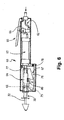
- the anal seal of Figs. 1 and 2 is designed for installation using an applicator tool 60 (Figs. 5 and 6) which mounts the anal seal by means of the formation 61 so that the plug 15 is located forwardly of the tool and a length of the stem 32 is also projecting forwardly of the applicator tool.
- the clamp 20 is initially located in the retracted inoperative position enabling the applicator tool 60 to be manipulated to insert the plug 15 through the anus into the rectum and, when the plug 15 is in position and tissues 11 have contracted behind the plug, the clamp 20 can then be advanced into its operative clamping position.
- the applicator tool 60 includes an operating mechanism 62 which in use is operative to cause or enable the clamp 20 to advance along the stem 32 from its inoperative position to its operative clamping position.
- the operating mechanism 62 includes drive means 63 shown as an air ram for advancing the clamp 20 along the stem 32 upon operation of the operating mechanism 62.
- the operating mechanism 62 includes a trigger arrangement 65 which an operator uses to initiate operation of the drive means 63 to advance the clamp 20 by opening valve 66 to supply compressed air to the drive means 63. As the rod of the air ram constituting the drive means 63 advances, it operates the shuttle mechanism 64 to advance the clamp 20 along the stem 32 to its clamping position.
- the applicator tool 60 also includes a release means 67 operative when the clamp reaches its operative clamping position to substantially simultaneously release the projecting stem 32 from its operative association with the applicator tool 60, thereby leaving the anal seal in position sealing the anus of the carcass 10 and enabling the applicator tool 60 to have another anal seal mounted thereby and to be re-used for sealing the anus of a subsequently presented carcass.
- the release means 67 includes a projection 75 which projects inwardly to cooperate with the formation 61 at the end of the stem 32 to retain the anal seal mounted to the applicator tool.
- the projection 75 is provided by a lever 76 pivoted at point 77 and biased by spring 78 into its anal seal retaining position shown in Fig. 6.
- the cam follower 80 provided on the lever 76 is moved downwardly against the action of the spring 78 to release the projection 75 from the formation 61 on the stem 32, thus releasing the anal seal from the applicator tool 60.
- the operator can then release the trigger arrangement 65 to release the air pressure behind the piston of the air ram 63 allowing the air ram to return the shuttle mechanism 64 and enable another anal seal to be mounted by the tool.
- the cutting of the rectum free of the carcass 10 can be facilitated making use of the anal seal.
- the tension thereby applied to the rectum will help the operator to clearly identify the rectum and to cut around the rectum to separate it, without puncturing or piercing the rectum, to the desired depth into the pelvic cavity of the carcass.
- the application of the tension by pulling the anal seal also tends to straighten the rectum thereby helping the operator to cut around the rectum without piercing the rectum and contaminating the carcass.
- a mechanical cutting device 70 may be provided in association with the applicator tool 60 which holds the projecting stem 32 and applies tension in the caudal direction.
- the mechanical cutting device 70 comprises a cylindrical cutting member 71 surrounding and concentric with the axis of the stem 32, the cutting device having a leading cutting edge 72 having a diameter chosen to cut into the tissues surrounding the rectum but without cutting into the rectum.
- the cutting member 71 can be relatively advanced to cut around the rectum as the rectum is relatively drawn in the caudal direction concentrically through the cutting member. This mechanical cutting of the tissues to separate the rectum can be possible because the pulling force straightens the rectum so that it can pass concentrically into the cylindrical cutting member 71.
- the processing of the carcass can be continued with, for example, further steps comprising:
- the process of clearing the rectum by applying tension in the caudal direction and cutting around the rectum to the desired depth into the pelvic cavity can then be carried out, after which the bag is everted to extend along and surround the cleared rectum.
- the bag is then tied, clipped, or clamped around the rectum.
- the anal seal can then be disengaged by retracting the clamp 20 from its clamping position and withdrawing the plug 15 thereby leaving the bag in place tied around the terminal end of the rectum thereby enclosing the anus to prevent contamination of the carcass by discharge of contents from the rectum through the anus.
- the present invention according to the preferred embodiments as described and illustrated provides an effective anal seal which can be relatively simple and quick to apply.
- the seal effectively seals the anus and can be used to facilitate cutting of the rectum free from the carcass either by manual cutting or by mechanised cutting.
Landscapes
- Life Sciences & Earth Sciences (AREA)
- Engineering & Computer Science (AREA)
- Food Science & Technology (AREA)
- Infusion, Injection, And Reservoir Apparatuses (AREA)
- Orthopedics, Nursing, And Contraception (AREA)
- Processing Of Meat And Fish (AREA)
Claims (24)
- Verfahren zum Abdichten des Afters des Körpers eines Schlachttieres, wobei das Verfahren die Schritte einschließt: Reinigen des Fells, der Haut oder des Pelzes von der direkten Nähe des Afters, Belassen des Afterschließmuskels im wesentlichen Intakt, Einsetzen eines Pfropfens (15) mit einem Rückende (18) mit einer Ausnehmung (17) durch den After und in das Rektum des Körpers des Schlachttieres in eine Tiefe, so daß sich der Schließmuskel innerhalb, hinter und um die Peripherie eines Rückendes des Pfropfens (18) zusammenzieht, Klemmen des Schließmuskels durch Bewegung einer Klemme (20), die mit dem Pfropfen (15) verbunden ist, in eine Klemmposition, in welcher sie mit dem Schließmuskel im Eingriff ist, welcher sich hinter und innerhalb des Rückendes (18) des Pfropfens (15) zusammengezogen hat, um den Schließmuskel zwischen dem Pfropfen (15) und der Klemme (20) zu klemmen; Halten der Klemme (20) in ihrer Klemmposition durch Einwirkung eines Haltemittels (40), das mit der Klemme (20) verbunden ist, so daß der After abgedichtet ist; und Freigeben der Afterabdichtungsanordnung, welche den Pfropfen (15), Klemme (20) und Haltemittel (40) umfaßt, so daß die Afterabdichtungsanordnung an Ort und Stelle verbleibt und den After in dem abgedichteten Zustand vor und während anschließender Verarbeitung des Körpers hält.
- Verfahren nach Anspruch 1, dadurch gekennzeichnet, daß der Pfropfen mit einem Stiel bereitgestellt ist, der sich von dem Rückende des Pfropfens heraus erstreckt, und die Klemme ein Klemmbauteil einschließt, welches entlang des Stieles gleitbar beweglich ist und entlang des Stiels bewegt wird, um den Afterschließmuskel gegen das Rückende des Pfropfens zu klemmen.
- Verfahren nach Anspruch 2, dadurch gekennzeichnet, daß, nachdem das Klemmen des Schließmuskels bewirkt worden ist, der Stiel in der Schwanzrichtung relativ zu dem Körper gezogen wird, um dadurch Spannung für das Rektum zu beaufschlagen, der Spannungsgebung des Rektums der Schritt eines Schneidens von Gewebe um das Rektum folgt, um es, ohne Durchstechen oder Durchbohren des Rekturns, zu der gewünschten Tiefe in der Beckenaushöhlung des Körpers zu trennen.
- Verfahren nach Anspruch 3, dadurch gekennzeichnet, daß das Schneiden um das Rektum durchgeführt wird durch eine zylindrische Schneidevorrichtung mit einer Vorderschneidkante und einem Durchmesser, der ausgewählt ist, um durch die Gewebe, welche das Rektum umgeben, zu schneiden, jedoch ohne in das Rektum zu schneiden, wobei das Schneiden um das Rektum durchgeführt wird durch ein verhältnismäßiges Vorbewegen der Schneidevorrichtung, während das Rektum verhältnismäßig in der Schwanzrichtung konzentrisch durch die Schneidevorrichtung gezogen wird.
- Verfahren nach Anspruch 3 oder 4, dadurch gekennzeichnet, daß, nachdem der After abgedichtet worden ist und das Rektum von umgebenden Geweben geschnitten worden ist, so daß es von dem Körper freigeschnitten ist, das Rektum mit der angefügt verbleibenden Afterabdichtungsanordnung durch den Beckenkanal und in die Körperaushöhlung des Körpers gezogen wird während eines Ausnehmverfahrens, gefolgt von dem Entfernen des Rektums zusammen mit den Eingeweiden, mit der Afterabdichtungsanordnung noch an Ort und Stelle und effektiv abdichtend den After, und einer anschließenden Freigabe der Afterabdichtungsanordnung und dem Zurückerhalten derselben vor einer weiteren Verarbeitung der Eingeweide.
- Afterabdichtung zum Abdichten des Afters des Körpers eines Schlachttieres, wobei die Afterabdichtung einen Pfropfen (15) zum Einsetzen durch den After und in das Rektum des Körpers des Schlachttieres, so daß Gewebe hinter dem Pfropfen (15) sich zusammenziehen, eine Klemme (20), die mit dem Pfropfen (15) in Verbindung ist und für eine Bewegung auf den Pfropfen (15) zu einer Klemmposition angeordnet ist, in welcher sie mit Geweben in Eingriff ist, die sich hinter dem Pfropfen (15) zusammengezogen haben, wobei der Pfropfen (15) ein Rückende (18) aufweist, welcher eine Ausnehmung (17) aufweist, um so die zusammengezogenen Gewebe zwischen der Pfropfenausnehmung (17) und der Klemme (20) zu klemmen, um den After abzudichten, und Haltemittel (40) einschließt, die mit der Klemme (20) verbunden sind und welche einwirken, um die Klemme (20) in ihrer Klemmposition zu halten, so daß der After abgedichtet ist, und wobei die Afterabdichtungsanordnung, welche den Pfropfen (15), Klemme (20) und Haltemittel (40), welche die Klemme (20) in ihrer Klemmposition halten, umfaßt, freigebbar ist und an Ort und Stelle verbleiben kann, was den After in dem abgedichteten Zustand vor und während anschließender Verarbeitung des Körpers hält.
- Afterabdichtung nach Anspruch 6, dadurch gekennzeichnet, daß der Pfropfen rotationssymmetrisch um eine Längsachse ist, wobei die Längsachse eine generelle Richtung ist, entlang welcher der Pfropfen beim Einsetzen durch den After in das Rektum vorbewegt wird, und wobei die Klemme, welche mit Geweben in Eingriff ist, welche sich hinter dem Pfropfen zusammengezogen haben, ein Klemmbauteil einschließt, welches, wenn es in seiner Klemmposition angeordnet ist, einwirkt, um die zusammengezogenen Gewebe um den gesamten Umfang des Rückendes des Pfropfens zu klemmen.
- Afterabdichtung nach Anspruch 7, dadurch gekennzeichnet, daß das Klemmbauteil in der Form einer Klemmscheibe mit einem Durchmesser ist, welcher im allgemeinen gleich ist zu dem Durchmesser des Rückendes des Pfropfens.
- Afterabdichtung nach Anspruch 7 oder 8, dadurch gekennzeichnet, daß das Rückende des Pfropfens einen ringförmigen peripheren Bereich aufweist und der ausgenommene Bereich radial nach innen des ringförmigen peripheren Bereichs angeordnet ist, wobei das Klemmbauteil angeordnet ist, um die zusammengezogenen Gewebe zwischen ihm selbst und dem ringförmigen peripheren Bereich zu klemmen.
- Afterabdichtung nach einem der Ansprüche 6 bis 9, dadurch gekennzeichnet, daß der Pfropfen und die Klemme bereitgestellt sind mit kooperierenden männlichen und weiblichen Gebilden, die so einwirken, um die Klemme in ihre Klemmposition zu führen, um die Gewebe zu klemmen, die sich hinter dem Pfropfen zusammengezogen haben.
- Afterabdichtung nach Anspruch 10, dadurch gekennzeichnet, daß der Pfropfen einen Vorsprung einschließt, der sich von dem Rückende desselben erstreckt, und die Klemme bereitgestellt ist mit einem Loch, durch welches der Vorsprung gelangt, so daß die Klemme entlang des Vorsprungs rutschen kann, um ihre Klemmposition hinter dem Rückende des Pfropfens genau anzupassen.
- Afterabdichtung nach Anspruch 10, dadurch gekennzeichnet, daß der Pfropfen bereitgestellt ist mit einem Vorsprung, der sich von dem Rückende desselben erstreckt, wobei der Vorsprung ein Mittel zum Halten des Pfropfens ausbildet, während er durch den After in das Rektum eingeführt wird, und zum Halten des Pfropfens bei seiner gewünschten Einsetztiefe in das Rektum, um ein wirksames Klemmen der Gewebe zu gewährleisten, welche sich hinter dem Pfropfen zusammengezogen haben.
- Afterabdichtung nach einem der Ansprüche 6 bis 12, dadurch gekennzeichnet, daß das Haltemittel, welches die Klemme in ihrer Klemmposition hält, ein Ausrichtungsmittel umfaßt, welches die Klemme in ihre Klemmposition drängt.
- Afterabdichtung nach Anspruch 13, dadurch gekennzeichnet, daß das Ausrichtungsmittel eine Kompressionsfeder umfaßt, welche gegen die Klemme wirkt, um die Klemme in ihrer Klemmposition auszurichten.
- Afterabdichtung nach einem der Ansprüche 6 bis 14, dadurch gekennzeichnet, daß das Haltemittel eine positiv wirkende Einrastanordnung einschließt, welche einwirkt, um die Klemme in ihrer Klemmposition einzurasten und eine Freigabe der geklemmten Gewebe durch Bewegung der Klemme weg von ihrer Klemmposition zu verhindern.
- Afterabdichtung nach Anspruch 15, dadurch gekennzeichnet, daß die Einrastanordnung eine Reihe von Zähnen einschließt, bereitgestellt entlang eines hervorstehenden Stiels, der sich von dem Rückende des Pfropfens erstreckt, und einen kooperierenden Vorsprung, bereitgestellt an der Klemme, und welcher eingreift mit den Zähnen, wenn die Klemme in ihre Klemmposition vorbewegt wird, wobei die Zähne eine Bewegung der Klemme in die entgegengesetzte Richtung weg von ihrer Klemmposition verhindern.
- Afterabdichtung nach Anspruch 16, dadurch gekennzeichnet, daß die Zähne bereitgestellt sind in einer Linie entlang des hervorstehenden Stiels, wodurch eine Drehung der Klemme um den hervorstehenden Stiel, wenn sie in ihrer Klemmposition ist, die Projektion seitlich von den Zähnen außer Eingriff bringt, wodurch die Klemme entlang des hervorstehenden Stiels weg von ihrer Klemmposition zurückgezogen werden kann.
- Afterabdichtung nach Anspruch 17, dadurch gekennzeichnet, daß der Stiel bereitgestellt ist mit einer helixförmigen Führung, welche mit dem Vorsprung kooperiert, der auf der Klemme bereitgestellt ist, wenn die Klemme entlang des Stieles zurückgezogen wird, um zu bewirken, daß die Klemme sich dreht, und um den Vorsprung mit der Linie der Zähne auszurichten, um für eine anschließende Verwendung der Abdichtung bereit zu sein.
- Afterabdichtung nach einem der Ansprüche 6 bis 18 und weiter einschließend ein verbundenes Applikatorwerkzeug zum Installieren der Afterabdichtung bei Verwendung, wobei das Applikatorwerkzeug die Afterabdichtung montiert, so daß der Pfropfen vorne auf dem Werkzeug angeordnet ist und eine Länge des hervorstehenden Stiels, der sich von dem Rückende des Pfropfens erstreckt, einwirkend verbunden ist mit dem Applikatorwerkzeug, so daß eine Länge des Stiels sich nach vorne von dem Applikatorwerkzeug erstreckt, und wobei die Klemme in einer zurückgezogenen, nicht einwirkenden Position angeordnet ist, damit das Applikatorwerkzeug manipuliert werden kann, um den Pfropfen durch den After in das Rektum einzusetzen und, wenn der Pfropfen in Position ist und sich Gewebe hinter dem Pfropfen zusammengezogen haben, der Pfropfen dann in seine einwirkende Klemmposition vorbewegt werden kann.
- Afterabdichtung nach Anspruch 19, dadurch gekennzeichnet, daß das Applikatorwerkzeug einen Einwirkmechanismus einschließt, welcher bei Verwendung einwirkend ist, um zu bewirken oder zu ermöglichen, daß die Klemme sich entlang des Stiels von ihrer nicht einwirkenden Position zu ihrer einwirkenden Klemmposition vorbewegen kann.
- Afterabdichtung nach Anspruch 20, dadurch gekennzeichnet, daß das Applikatorwerkzeug Antriebsmittel zum Vorbewegen der Klemme entlang des Stiels bei Betrieb des Einwirkmechanismus einschließt.
- Afterabdichtung nach Anspruch 21, dadurch gekennzeichnet, daß der Einwirkmechanismus eine Auslöseordnung einschließt, welche ein Operator verwendet, um eine Einwirkung des Antriebsmittels zu initiieren, um die Klemme vorzubewegen.
- Afterabdichtung nach einem der Ansprüche 19 bis 22, dadurch gekennzeichnet, daß das Applikatorwerkzeug ein Freigabemittel einschließt, welches einwirkend ist, wenn die Klemme ihre einwirkende Klemmposition erreicht, um im wesentlichen gleichzeitig den hervorstehenden Stiel von seiner einwirkenden Verbindung mit dem Applikatorwerkzeug freizugeben, wodurch die Afterabdichtung in Position belassen wird, welche den After des Körpers abdichtet, und wodurch das Applikatorwerkzeug eine weitere Afterabdichtung, die dadurch montiert ist, aufweisen kann und zum Abdichten des Afters eines anschließend vorliegenden Körpers wiederverwendbar ist.
- Afterabdichtung nach einem der Ansprüche 19 bis 23, dadurch gekennzeichnet, daß mit dem Applikatorwerkzeug eine mechanische Schneidevorrichtung verbunden ist, wobei die mechanische Schneidevorrichtung einwirkend ist, wenn für das Rektum in der Schwanzrichtung Spannung beaufschlagt wird durch das Applikatorwerkzeug, um Gewebe um das Rektum zu einer gewünschten Tiefe zu schneiden.
Applications Claiming Priority (3)
| Application Number | Priority Date | Filing Date | Title |
|---|---|---|---|
| AUPO9439A AUPO943997A0 (en) | 1997-09-26 | 1997-09-26 | Anal sealing |
| AUPO943997 | 1997-09-26 | ||
| PCT/AU1998/000818 WO1999016320A1 (en) | 1997-09-26 | 1998-09-28 | Anal sealing of carcasses |
Publications (3)
| Publication Number | Publication Date |
|---|---|
| EP1024705A1 EP1024705A1 (de) | 2000-08-09 |
| EP1024705A4 EP1024705A4 (de) | 2000-12-20 |
| EP1024705B1 true EP1024705B1 (de) | 2004-04-21 |
Family
ID=3803721
Family Applications (1)
| Application Number | Title | Priority Date | Filing Date |
|---|---|---|---|
| EP98946154A Expired - Lifetime EP1024705B1 (de) | 1997-09-26 | 1998-09-28 | Abdichtung des afters eines schlachttier körpers |
Country Status (14)
| Country | Link |
|---|---|
| US (1) | US6338674B1 (de) |
| EP (1) | EP1024705B1 (de) |
| JP (1) | JP2001517462A (de) |
| AR (1) | AR017155A1 (de) |
| AU (1) | AUPO943997A0 (de) |
| BR (1) | BR9815374A (de) |
| CA (1) | CA2304754A1 (de) |
| DE (1) | DE69823378T2 (de) |
| DK (1) | DK1024705T3 (de) |
| ES (1) | ES2221200T3 (de) |
| NZ (1) | NZ504206A (de) |
| UY (1) | UY25195A1 (de) |
| WO (1) | WO1999016320A1 (de) |
| ZA (1) | ZA988708B (de) |
Families Citing this family (5)
| Publication number | Priority date | Publication date | Assignee | Title |
|---|---|---|---|---|
| NL1015137C2 (nl) * | 1999-12-24 | 2001-06-26 | Stork Mps Bv | Werkwijze voor het uit een karkas verwijderen van een uiteinde van het darmkanaal en aarsboor. |
| WO2003013261A1 (en) | 2001-08-08 | 2003-02-20 | Thiam Huay Gary Choo | Sealing animal carcass orifices |
| US20100323598A1 (en) * | 2009-06-23 | 2010-12-23 | Russell Lowell | Apparatus to aid in the eviseration of food animals and method for its use |
| NZ587148A (en) * | 2009-08-03 | 2011-05-27 | Andrew Charles Simpson | A plug for livestock butchering with cover moved along member inserted into animal orifice to clamp flesh |
| US9485996B2 (en) * | 2014-12-31 | 2016-11-08 | Robert E. Ellis | Game dressing tool |
Family Cites Families (6)
| Publication number | Priority date | Publication date | Assignee | Title |
|---|---|---|---|---|
| NL156025B (nl) * | 1975-04-29 | 1978-03-15 | Meyn Pieter | Inrichting voor het uitsnijden van de aars van een vogel. |
| DK484689A (da) * | 1989-09-29 | 1991-03-30 | Slagteriernes Forskningsinst | Fremgangsmaade ved udtagning eller behandling af indvolde fra svineslagtekroppe |
| NL189443C (nl) * | 1990-04-03 | 1994-06-16 | Stork Pmt | Cloaca-snijder. |
| NL9300686A (nl) * | 1993-04-22 | 1994-11-16 | Stork Rms Bv | Bestuurde inrichting voor het verwijderen van de aars van slachtdieren. |
| NZ293519A (en) | 1994-09-26 | 1996-11-26 | Commw Scient Ind Res Org | Rectum separating for use with slaughtered animal carcass: gripper located inside a closure bag |
| US5741176A (en) | 1996-07-26 | 1998-04-21 | Stork Gamco Inc. | Skin-holding vent cutter |
-
1997
- 1997-09-26 AU AUPO9439A patent/AUPO943997A0/en not_active Abandoned
-
1998
- 1998-09-23 ZA ZA988708A patent/ZA988708B/xx unknown
- 1998-09-25 AR ARP980104809A patent/AR017155A1/es active IP Right Grant
- 1998-09-25 UY UY25195A patent/UY25195A1/es not_active IP Right Cessation
- 1998-09-28 NZ NZ504206A patent/NZ504206A/en unknown
- 1998-09-28 EP EP98946154A patent/EP1024705B1/de not_active Expired - Lifetime
- 1998-09-28 JP JP2000513472A patent/JP2001517462A/ja not_active Abandoned
- 1998-09-28 ES ES98946154T patent/ES2221200T3/es not_active Expired - Lifetime
- 1998-09-28 CA CA002304754A patent/CA2304754A1/en not_active Abandoned
- 1998-09-28 DK DK98946154T patent/DK1024705T3/da active
- 1998-09-28 US US09/509,572 patent/US6338674B1/en not_active Expired - Fee Related
- 1998-09-28 WO PCT/AU1998/000818 patent/WO1999016320A1/en not_active Ceased
- 1998-09-28 BR BR9815374-9A patent/BR9815374A/pt not_active IP Right Cessation
- 1998-09-28 DE DE69823378T patent/DE69823378T2/de not_active Expired - Fee Related
Also Published As
| Publication number | Publication date |
|---|---|
| BR9815374A (pt) | 2000-10-24 |
| DE69823378T2 (de) | 2005-05-04 |
| WO1999016320A1 (en) | 1999-04-08 |
| EP1024705A4 (de) | 2000-12-20 |
| NZ504206A (en) | 2002-04-26 |
| ZA988708B (en) | 1999-05-20 |
| AUPO943997A0 (en) | 1997-10-16 |
| CA2304754A1 (en) | 1999-04-08 |
| AR017155A1 (es) | 2001-08-22 |
| JP2001517462A (ja) | 2001-10-09 |
| DK1024705T3 (da) | 2004-08-16 |
| ES2221200T3 (es) | 2004-12-16 |
| US6338674B1 (en) | 2002-01-15 |
| DE69823378D1 (de) | 2004-05-27 |
| UY25195A1 (es) | 1999-03-16 |
| EP1024705A1 (de) | 2000-08-09 |
Similar Documents
| Publication | Publication Date | Title |
|---|---|---|
| EP0049091B1 (de) | Verfahren und Vorrichtung zum Entfleischen der Glieder von Geflügel | |
| CA1098388A (en) | Method and apparatus for spaying large animals | |
| DE69502271T2 (de) | Afterabtrennung | |
| JPH1084860A (ja) | 屠殺した動物から肛門を除去する装置 | |
| EP1024705B1 (de) | Abdichtung des afters eines schlachttier körpers | |
| US6883216B2 (en) | Fastener installation tool including fastener-parts collection means | |
| US3871084A (en) | Deer skinning apparatus and method of using same | |
| AU735096B2 (en) | Anal sealing of carcasses | |
| US6244949B1 (en) | Method and apparatus for removing internal organs from a slain deer | |
| CN109329360B (zh) | 一种将备烤鸡扒开辅助装置 | |
| US5830053A (en) | Oesophagus sealing | |
| MXPA00002951A (en) | Anal sealing of carcasses | |
| US7367877B1 (en) | Big game field dressing tool and method | |
| EP0652711B1 (de) | Verfahren und vorrichtung zum entfernen von fleisch von knochen | |
| CS226704B2 (en) | Apparatus for cropping slaughterhouse pigs | |
| AU699115B2 (en) | Oesophagus sealing | |
| EP0630185B1 (de) | Verfahren und vorrichtung zum herausschneiden und zum abdichten des afters von schlachttieren | |
| CA2017852A1 (en) | Method and apparatus for beheading fish, and method and apparatus for extracting roe or milt from a fish | |
| AU2018307577B2 (en) | Lamb castration clamp and apparatus | |
| US6280310B1 (en) | Apparatus for putting gullet ligatures into place | |
| EP1260141A2 (de) | Kloakenschneider | |
| JP2000125752A (ja) | 屠殺した動物の頭から肉を回収する装置 | |
| NL8303633A (nl) | Inrichting voor het reinigen van de halshuid van geslachtgevogelte. |
Legal Events
| Date | Code | Title | Description |
|---|---|---|---|
| PUAI | Public reference made under article 153(3) epc to a published international application that has entered the european phase |
Free format text: ORIGINAL CODE: 0009012 |
|
| 17P | Request for examination filed |
Effective date: 20000425 |
|
| AK | Designated contracting states |
Kind code of ref document: A1 Designated state(s): BE DE DK ES FR GB IE IT NL SE |
|
| A4 | Supplementary search report drawn up and despatched |
Effective date: 20001107 |
|
| AK | Designated contracting states |
Kind code of ref document: A4 Designated state(s): BE DE DK ES FR GB IE IT NL SE |
|
| 17Q | First examination report despatched |
Effective date: 20020905 |
|
| GRAP | Despatch of communication of intention to grant a patent |
Free format text: ORIGINAL CODE: EPIDOSNIGR1 |
|
| GRAS | Grant fee paid |
Free format text: ORIGINAL CODE: EPIDOSNIGR3 |
|
| GRAA | (expected) grant |
Free format text: ORIGINAL CODE: 0009210 |
|
| AK | Designated contracting states |
Kind code of ref document: B1 Designated state(s): BE DE DK ES FR GB IE IT NL SE |
|
| PG25 | Lapsed in a contracting state [announced via postgrant information from national office to epo] |
Ref country code: NL Free format text: LAPSE BECAUSE OF FAILURE TO SUBMIT A TRANSLATION OF THE DESCRIPTION OR TO PAY THE FEE WITHIN THE PRESCRIBED TIME-LIMIT Effective date: 20040421 Ref country code: IT Free format text: LAPSE BECAUSE OF FAILURE TO SUBMIT A TRANSLATION OF THE DESCRIPTION OR TO PAY THE FEE WITHIN THE PRESCRIBED TIME-LIMIT;WARNING: LAPSES OF ITALIAN PATENTS WITH EFFECTIVE DATE BEFORE 2007 MAY HAVE OCCURRED AT ANY TIME BEFORE 2007. THE CORRECT EFFECTIVE DATE MAY BE DIFFERENT FROM THE ONE RECORDED. Effective date: 20040421 Ref country code: BE Free format text: LAPSE BECAUSE OF FAILURE TO SUBMIT A TRANSLATION OF THE DESCRIPTION OR TO PAY THE FEE WITHIN THE PRESCRIBED TIME-LIMIT Effective date: 20040421 |
|
| REG | Reference to a national code |
Ref country code: GB Ref legal event code: FG4D |
|
| REG | Reference to a national code |
Ref country code: IE Ref legal event code: FG4D |
|
| REF | Corresponds to: |
Ref document number: 69823378 Country of ref document: DE Date of ref document: 20040527 Kind code of ref document: P |
|
| PG25 | Lapsed in a contracting state [announced via postgrant information from national office to epo] |
Ref country code: SE Free format text: LAPSE BECAUSE OF FAILURE TO SUBMIT A TRANSLATION OF THE DESCRIPTION OR TO PAY THE FEE WITHIN THE PRESCRIBED TIME-LIMIT Effective date: 20040721 |
|
| REG | Reference to a national code |
Ref country code: DK Ref legal event code: T3 |
|
| NLV1 | Nl: lapsed or annulled due to failure to fulfill the requirements of art. 29p and 29m of the patents act | ||
| REG | Reference to a national code |
Ref country code: ES Ref legal event code: FG2A Ref document number: 2221200 Country of ref document: ES Kind code of ref document: T3 |
|
| ET | Fr: translation filed | ||
| PLBE | No opposition filed within time limit |
Free format text: ORIGINAL CODE: 0009261 |
|
| STAA | Information on the status of an ep patent application or granted ep patent |
Free format text: STATUS: NO OPPOSITION FILED WITHIN TIME LIMIT |
|
| 26N | No opposition filed |
Effective date: 20050124 |
|
| PGFP | Annual fee paid to national office [announced via postgrant information from national office to epo] |
Ref country code: IE Payment date: 20050922 Year of fee payment: 8 |
|
| PGFP | Annual fee paid to national office [announced via postgrant information from national office to epo] |
Ref country code: DK Payment date: 20050923 Year of fee payment: 8 |
|
| PGFP | Annual fee paid to national office [announced via postgrant information from national office to epo] |
Ref country code: GB Payment date: 20050928 Year of fee payment: 8 |
|
| PGFP | Annual fee paid to national office [announced via postgrant information from national office to epo] |
Ref country code: ES Payment date: 20050929 Year of fee payment: 8 |
|
| PGFP | Annual fee paid to national office [announced via postgrant information from national office to epo] |
Ref country code: FR Payment date: 20050930 Year of fee payment: 8 |
|
| PGFP | Annual fee paid to national office [announced via postgrant information from national office to epo] |
Ref country code: DE Payment date: 20051122 Year of fee payment: 8 |
|
| PG25 | Lapsed in a contracting state [announced via postgrant information from national office to epo] |
Ref country code: IE Free format text: LAPSE BECAUSE OF NON-PAYMENT OF DUE FEES Effective date: 20060928 |
|
| PG25 | Lapsed in a contracting state [announced via postgrant information from national office to epo] |
Ref country code: DK Free format text: LAPSE BECAUSE OF NON-PAYMENT OF DUE FEES Effective date: 20061002 |
|
| PG25 | Lapsed in a contracting state [announced via postgrant information from national office to epo] |
Ref country code: DE Free format text: LAPSE BECAUSE OF NON-PAYMENT OF DUE FEES Effective date: 20070403 |
|
| REG | Reference to a national code |
Ref country code: DK Ref legal event code: EBP |
|
| GBPC | Gb: european patent ceased through non-payment of renewal fee |
Effective date: 20060928 |
|
| REG | Reference to a national code |
Ref country code: IE Ref legal event code: MM4A |
|
| REG | Reference to a national code |
Ref country code: FR Ref legal event code: ST Effective date: 20070531 |
|
| PG25 | Lapsed in a contracting state [announced via postgrant information from national office to epo] |
Ref country code: GB Free format text: LAPSE BECAUSE OF NON-PAYMENT OF DUE FEES Effective date: 20060928 |
|
| REG | Reference to a national code |
Ref country code: ES Ref legal event code: FD2A Effective date: 20060929 |
|
| PG25 | Lapsed in a contracting state [announced via postgrant information from national office to epo] |
Ref country code: ES Free format text: LAPSE BECAUSE OF NON-PAYMENT OF DUE FEES Effective date: 20060929 |
|
| PG25 | Lapsed in a contracting state [announced via postgrant information from national office to epo] |
Ref country code: FR Free format text: LAPSE BECAUSE OF NON-PAYMENT OF DUE FEES Effective date: 20061002 |