EP1024429A2 - Benutzerstufenplanung von kommunizierenden Echtzeitaufgaben - Google Patents
Benutzerstufenplanung von kommunizierenden Echtzeitaufgaben Download PDFInfo
- Publication number
- EP1024429A2 EP1024429A2 EP99122335A EP99122335A EP1024429A2 EP 1024429 A2 EP1024429 A2 EP 1024429A2 EP 99122335 A EP99122335 A EP 99122335A EP 99122335 A EP99122335 A EP 99122335A EP 1024429 A2 EP1024429 A2 EP 1024429A2
- Authority
- EP
- European Patent Office
- Prior art keywords
- time
- real
- messages
- priority
- queue
- Prior art date
- Legal status (The legal status is an assumption and is not a legal conclusion. Google has not performed a legal analysis and makes no representation as to the accuracy of the status listed.)
- Withdrawn
Links
Images
Classifications
-
- G—PHYSICS
- G06—COMPUTING OR CALCULATING; COUNTING
- G06F—ELECTRIC DIGITAL DATA PROCESSING
- G06F9/00—Arrangements for program control, e.g. control units
- G06F9/06—Arrangements for program control, e.g. control units using stored programs, i.e. using an internal store of processing equipment to receive or retain programs
- G06F9/46—Multiprogramming arrangements
- G06F9/48—Program initiating; Program switching, e.g. by interrupt
- G06F9/4806—Task transfer initiation or dispatching
- G06F9/4843—Task transfer initiation or dispatching by program, e.g. task dispatcher, supervisor, operating system
- G06F9/4881—Scheduling strategies for dispatcher, e.g. round robin, multi-level priority queues
- G06F9/4887—Scheduling strategies for dispatcher, e.g. round robin, multi-level priority queues involving deadlines, e.g. rate based, periodic
-
- G—PHYSICS
- G06—COMPUTING OR CALCULATING; COUNTING
- G06F—ELECTRIC DIGITAL DATA PROCESSING
- G06F9/00—Arrangements for program control, e.g. control units
- G06F9/06—Arrangements for program control, e.g. control units using stored programs, i.e. using an internal store of processing equipment to receive or retain programs
- G06F9/46—Multiprogramming arrangements
- G06F9/54—Interprogram communication
- G06F9/544—Buffers; Shared memory; Pipes
Definitions
- This invention relates generally to multi-tasking computer systems, and more particularly, to user level scheduling of real-time tasks that intercommunicate over a network.
- IP Internet Protocol
- Real-time application requirements must be mapped into requirements imposed on the schedulable entities of the system, e.g., tasks. Predictable execution of the tasks must be ensured in the face of possible priority inversions, limited OS level real-time scheduling support, and limited number of priorities. Real-time and non real-time tasks must be integrated in the hardware environment.
- scheduling support for integrating real-time and non real-time tasks has been done by either extending existing operating systems, or by virtualizing the underlying hardware to multiplex a real-time kernel with the operating system.
- These approaches have certain drawbacks.
- the first approach needs to modify the existing operating system.
- access to the source programs of the operating system might not always be available.
- it is difficult to support real-time and non real-time activities that are closely related, e.g., in the case where there are multiple execution threads associated with the process, and there is a need by the tasks to share a common address space.
- the current generation of operating systems has produced versions that provide some support for real-time scheduling, such as non-degradable priorities, and real-time threads. Support for these scheduling functions is not present in the older generation of these operating systems.
- Windows NT 4.0 provides a REALTIME class such that threads in this class have non-degradable priorities.
- Executing threads in this class have precedence over timesharing threads.
- These newer OS versions also provide timers with one millisecond granularity, and periodic callback routines which can be used for real-time periodic tasks.
- Real-time applications require that tasks are scheduled, executed, and completed with predictable and bounded variability in time. In reality, predictability comes in different granularities.
- a maximum delay or deadline value of one second is good enough for a video-on-demand file server, or database transactions for financial tasks. These tasks can be directly built with existing operating system primitives.
- the invention provides a multi-tasking distributed computer system with user level scheduling of the transmission of real-time and non real-time messages.
- the real-time messages having predetermined timing deadlines.
- At least one writer task generates the real-time and non real-time messages.
- the messages can have multiple priority levels organized in a plurality of priority bands, for example four.
- the generated messages are stored in ring buffers of a reflective memory and are indexed by pointers stored in queue entries. Pointers in a fourth queue index the real-time messages having low priority levels. Pointers in a third queue index the non real-time messages.
- a first and second queue store pointers for indexing the high and highest priority real-time messages, respectively.
- a dispatcher moves pointers from the fourth to the second queue in response to time-out signals.
- the time-out signals ensure that the timing deadlines are met.
- a data push agent transmits the messages indexed by the pointers in the queues according to the associated priority levels.
- a reader task receives the messages transmitted by the data pusher agent.
- the writer and reader tasks execute on different nodes of the system, and the nodes are connected by a network.
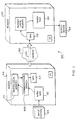
- Figure 1 shows a distributed multi-tasking system 100 that employs the user level scheduling according to our invention.
- the system 100 includes a writer node 110 connected to a reader node 120 by a network 130.
- the writer node 110 includes a writer memory 111, a writer task 112, and a data push agent (DPA) 113.
- the reader node 120 includes a corresponding reader memory 121, a reader task 122, and a data receive agent (DRA) 123.
- the memories 111 and 121 are reflective as described in U.S. Patent Application No. 08/760,110 "Real-time Channel-Based Reflective Memory” filed on December 3, 1996 by Shen et al. incorporated herein by reference.
- data can be acquired from a real-time data input device 114, such as a sensor.
- the data are written to the reflective memory 111 by the writer task 112.
- the data are transmitted from the writer node to the reader node over a virtual memory channel 131 of the network 130 by the DPA 113.
- the data are received by the DRA 123.
- the reader task 122 can read the data from its local reflective memory 121, and render the data on an data output device 124, such as a display terminal.
- system 100 can include multiple nodes and tasks performing concurrent data transfer operations.
- a reader task can only receive data from one writer task at the time, although one writer task can concurrently transmit data to multiple reader tasks.
- Contemporary operating systems such as NTTM, IRIXTM and SolarisTM, typically include the following scheduling features: preemptive priority-based scheduling, round-robin scheduling, non-degradable priorities, mechanisms for priority adjustment, and periodic timers that can trigger periodic events and release execution of threads.
- socket is used to describe the actual connection that is used to transmit data from the sender to the receiver.
- Tasks that execute on the system 100 can have any of the following data transfer characteristics. Some tasks, such as a task that is responsive to sporadic user issued commands, needs to transmit data to the reader task immediately after the command is generated, and the data need to be read immediately upon receipt.
- a camera can acquire data at a rate of thirty frames per second, while the video can be displayed at a rate of fifteen frames per second, at least during normal operating conditions.
- Synchronous Data Write Data send operations are triggered by task writes.
- Asynchronous Data Write Data are sent periodically, and the period of sending is independent of the period of writing the data.
- Synchronous or Blocking Read Execution of the reader task is suspended while awaiting the arrival of data from a writer task. When the data are received, the reader task is signaled to continue operation and process the received data.
- Asynchronous or Non-Blocking Read Execution of the reader task can be continuous, and the responsibility for detecting received data lies with the reader task.
- the synchronous and asynchronous data transfer modes correspond to event-based and state-based approaches.
- event-based approach there is a reaction to each event as the event occurs.
- state-based approach there is a reaction to the current state. We allow both modes to co-exist.
- SB synchronous blocking
- AN asynchronous non-blocking
- G guaranteed
- NG no guarantee.
- aspects of our invention include mapping of task requirements into schedulable entities, end-to-end scheduling of tasks with limited number of priorities, and accommodating both real-time and non-real-time tasks in the same system configured with standard off-the-shelf hardware and software components.
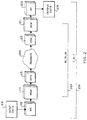
- FIG. 2 shows the components involved in end-to-end computations and communications.
- the end-to-end computation and communication entities include the tasks 112 and 122 that write and read data, agents 113 and 123 that send and receive data, and other network interfaces and network transfer protocols 130.
- the specific schedulable items are the write and read tasks, and the DPA and DRA.
- the user has no control over the network 130.
- Two end-to-end spans can be identified.
- the first span 201 is task-to-task (T-to-T), and the second span 202 is memory-to-memory (M-to-M). Associated with the spans are maximum permissible delays, or deadline guarantees.
- T-to-T delay i.e., deadline
- M-to-M delay guarantees we schedule all the tasks from task writes to task reads as a precedence constrained task graph.
- T-to-T maximum delay guarantees we schedule all the tasks from task writes to task reads as a precedence constrained task graph.
- M-to-M maximum delays we schedule task writes and reads independently, while treating all the rest of the tasks as one precedence constrained task set.
- synchronous data write operations as well as blocking read operations impose precedence constraints between the tasks involved, while asynchronous data write, and non-blocking read operations support independent task representation naturally.
- a precedence constraint exists between a task write operation and the DPA 113 for synchronous operations, and between the DRA 123 and task read operations for blocking mode.
- J write 0
- J DPA C write
- J DRA J DPA + C DPA + C ntwk
- J read J DRA + C DRA .
- Writer and reader tasks specify their maximum permissible delay, synchronous or asynchronous data reception, as well as blocking or non-blocking data retrieval requirements.
- the respective release jitters are determined according to the M-to-M case, as described above. Actual timing metrics can be collected by a profiler (P1 and P2 in Figure 1) described in greater detail below.
- a priority inversion can occur when the transmission of a high priority message is blocked while transmitting a very long low priority message.
- priority assignments fall into four priority bands that are related as follows: P one > P two > P three > P four , where " one " is the highest priority band, and "four" is the lowest.
- P one > P two > P three > P four is the highest priority band, and "four" is the lowest.
- the manner in which these four priority bands are mapped to specific operating system priority levels depends on the number of priority levels available. The use of these priority bands is described in greater detail below.
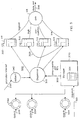
- FIG. 3 shows an asynchronous server 300 according to a preferred embodiment of the invention.
- the server 300 can be implemented as software programs and data structures on the writer node 110.
- the server 300 includes a dispatcher 310, a manager 330, and a callback facility 340.
- the server 300 also includes multiple queues, one for each priority band. for example, four queues 311-314.
- the data queues are allocated in the writer's local reflective memory 111. Entries in the queues can be pointers to the actual messages to be transmitted. In other words, the pointers in the queue entries index the actual data to be transmitted as messages.
- the entries can be sorted in the queues in an order of priorities associated with the data. This accommodates the problem where the number of priority levels available in the operating system is smaller than the number of priorities required by the applications. Effectively, the communication server 300 acts as a rate controller.
- the DPA pushes out data via the queues in the order of the priorities. For example, no messages will be pushed via queue 314 as long as there messages in any of the queues 311-313.
- a flag (F) is associated with each of the queues 311-314 to determine if the queue is empty or not.
- reader and writer tasks "register” with the server using the manager 330 and requests 301.
- tasks "attach” and “detach” with the server 300 using the manager 330.
- the manager maintains a database 331 storing task specific parameters, such as timing information, and task identities (IDs).
- the registration process calculates appropriate timer parameters 302 associated with the requests to define maximum permissible delays, as described above.
- the callback facility uses the timer parameters to activate system level timers that generate periodic promotion time-out signals 303 when a message needs to be pushed out at a high priority. Communication between the callback facility 340 and the dispatcher 310 can use standard operating system messaging primitives.
- Writer tasks store data in ring buffers 304.
- the ring buffers are allocated in the reflective memory 111 by the manager 330 in response to requests by the tasks.
- data are stored in the ring buffers as fixed size messages 350.
- Pointers to the messages are stored in the queues 311-314 according to the corresponding priorities P one - P four .
- the DPA normally pushes out real-time data in priority band P four via queue 314.
- the system schedules the DPA to push data only when there are no tasks executing at higher priority bands.
- Non real-time data can be pushed out via queue 313 using standard static round robin scheduling at priority P three .
- Real-time data in the highest priority band P one is always pushed out via queue 311.
- the dispatcher moves (305) the pointer from queue 314 to queue 312. This is done in response to the callback activated promotion time-out signal 303.
- the DRA 123 is scheduled using a simple event driven model, that is, we do not explicitly account for the priority of the received messages.
- the server 300 is a message transmission manager. All network communications are handled by the server. The server knows the priorities of the tasks that are requesting message transmission and schedules the DPAs that push data onto the network in such a way that priority tracking is achieved.
- the server handles the socket establishment, and schedules the data transmission according to the specification. Allowing users to specify the requirements of task components in terms of timing, data, and relationships among tasks, such as periods, rates, data size, delay, response bounds, and precedence relations is a much more intuitive and effective proposition than requiring task designers to assign relative priorities to their tasks.
- the user specified real-time requirements are translated into unique priority levels to be used within the server. This approach also alleviates the problem of limited priority levels supported by a typical operating system.
- we assign and manage priorities of tasks explicitly in our server while providing the users with the ability to specify task timing, message size and precedence, and synchronization constraints.
- our server minimizes the effect of priority inversion, handles priority tracking with limited operating system priority levels, and permits user specified timing requirements.
- Our server 300 uses a modified dual priority scheduling procedure to accommodate different real-time and non-real-time task activities.
- Typical activities to be supported include the following.
- command and control activities users sporadically issue commands and need immediate data transmission, and delay bounded data reception.
- Video/audio applications require data transmissions with low jitter display.
- device and instrument monitoring data are acquired periodically, but some signals, such as alarms, require immediate attention.
- Trend graph rely on periodic data collection and transmission, and periodic data display. Most background activities only require best effort data transmission and reception.
- the real-time tasks demand synchronous (S) or asynchronous (A) data transmission and blocking (B) or non-blocking (N) data reception.
- S synchronous
- A data transmission and blocking
- B blocking
- N non-blocking
- the synchronous tasks constitute the more urgent time critical tasks, while the asynchronous ones are periodic in nature.
- the non-real-time activities can be serviced with best effort.
- All SB tasks are assigned to the P one band, and will have priorities according to a deadline monotonic algorithm. That is, within the P one band, SB tasks have unique priorities determined by the deadlines of the SB tasks. In many tasks, e.g., plant monitoring, there are only one or two such entities in a system.
- All AN data with timing constraints are initially assigned to priority P four band according to the deadline monotonic algorithm, and promoted to P two when a deadline is imminent. All the non real-time tasks are assigned a priority in the P three band. These priorities can either be assigned according to their requested execution rate, or randomly when the tasks do not specify any rate.
- Dual priority scheduling executes real-time tasks such that the tasks will not miss their timing constraints while at the same time improving the responsiveness of the system to non real-time tasks. This is in contrast with always giving real-time tasks the higher priority. To this end, each real-time task normally executes with a priority lower than the priorities assigned to non real-time tasks.
- the server executes at the lowest priority P four while servicing real-time tasks, until one of two events happens, the arrival of a request to serve a non-real-time task, or the occurrence of the promotion time of a real-time task.
- the priority of the server can be raised to P three , and stays at P three as long as there are any non-real-time tasks to service, or until the promotion time of one or more real-time tasks occurs.
- the priority of the server is raised to P two , or P one depending on whether the task is an SB task or an AN task. In some sense, the priority P one can be viewed as lying at the high-end of the P two band.
- the server services all the communication tasks according to their respective periodicity, data size, and priority. It implements the dual priority algorithm such that task data communications are explicitly scheduled within the server.
- the optimal message size for a particular system configuration can be determined empirically by, for example, a profiler.
- the message size will serve as the non-preemptive unit of computation time and transmission time.
- S 0 can serve as either the unit message size, or the time needed to send and receive a message of this size. All data pushed are organized into messages of unit size S 0 .
- the profiler includes two tasks that collect timing information as data are transferred in an operational system.
- a first profiler task determines the end-to-end timing parameters of different entities in the network, for example, the individual tasks and agents.
- Other profiling data that can be collected include memory-to-memory round trip time, computation time and overhead of asynchronous DPA server scheduler, jitter introduced at each stage of the data path, time to complete read and write calls, time to push the data, and optimal size for messages.
- a second profiler task can determine throughput at the reader node. This information can be used to tune memory allocations.
- the scheduling schemes comprise a combination of server-based execution, rate control of message communication, and dual priority scheduling.
- rate control of message communication and dual priority scheduling.
- dual priority scheduling it is well known that in order to predictably schedule real-time activities the worst case execution time is required. To obtain these times, we provide a profiler together with our scheduler support to extract the execution time and message delay parameters for the server components.
Landscapes
- Engineering & Computer Science (AREA)
- Software Systems (AREA)
- Theoretical Computer Science (AREA)
- Physics & Mathematics (AREA)
- General Engineering & Computer Science (AREA)
- General Physics & Mathematics (AREA)
- Computer And Data Communications (AREA)
- Telephonic Communication Services (AREA)
Applications Claiming Priority (2)
| Application Number | Priority Date | Filing Date | Title |
|---|---|---|---|
| US239583 | 1999-01-28 | ||
| US09/239,583 US6490611B1 (en) | 1999-01-28 | 1999-01-28 | User level scheduling of inter-communicating real-time tasks |
Publications (2)
| Publication Number | Publication Date |
|---|---|
| EP1024429A2 true EP1024429A2 (de) | 2000-08-02 |
| EP1024429A3 EP1024429A3 (de) | 2002-12-18 |
Family
ID=22902798
Family Applications (1)
| Application Number | Title | Priority Date | Filing Date |
|---|---|---|---|
| EP99122335A Withdrawn EP1024429A3 (de) | 1999-01-28 | 1999-11-09 | Benutzerstufenplanung von kommunizierenden Echtzeitaufgaben |
Country Status (3)
| Country | Link |
|---|---|
| US (1) | US6490611B1 (de) |
| EP (1) | EP1024429A3 (de) |
| JP (1) | JP2000284980A (de) |
Cited By (7)
| Publication number | Priority date | Publication date | Assignee | Title |
|---|---|---|---|---|
| WO2002054263A1 (en) * | 2000-12-28 | 2002-07-11 | Future System Consulting Corp. | Framework system |
| EP1451708A4 (de) * | 2001-12-10 | 2006-10-11 | Sap Portals Israel Ltd | Vorrichtung und verfahren für optimierte und gesicherte reflexion von netzwerkdiensten zu abgesetzten standorten |
| US7411966B2 (en) | 2001-03-16 | 2008-08-12 | Siemens Aktiengesellschaft | Method and system for coupling data networks |
| CN102831007A (zh) * | 2011-06-14 | 2012-12-19 | 中兴通讯股份有限公司 | 实时处理系统中的共享资源访问方法和实时处理系统 |
| WO2016036983A1 (en) * | 2014-09-04 | 2016-03-10 | Home Box Office, Inc. | Asynchronous task multiplexing and chaining |
| CN109783573A (zh) * | 2018-12-18 | 2019-05-21 | 北京华夏电通科技有限公司 | 多路推送的数据同步方法及终端 |
| CN111475869A (zh) * | 2020-03-31 | 2020-07-31 | 东软集团股份有限公司 | 通信方法、装置、介质、安全计算模块和安全芯片 |
Families Citing this family (46)
| Publication number | Priority date | Publication date | Assignee | Title |
|---|---|---|---|---|
| JP2000305796A (ja) * | 1999-04-22 | 2000-11-02 | Hitachi Ltd | 電子計算機間のジョブ転送方法およびジョブ転送システム |
| US6625639B1 (en) * | 1999-10-20 | 2003-09-23 | International Business Machines Corporation | Apparatus and method for processing a task in a clustered computing environment |
| US6658449B1 (en) | 2000-02-17 | 2003-12-02 | International Business Machines Corporation | Apparatus and method for periodic load balancing in a multiple run queue system |
| US6748593B1 (en) * | 2000-02-17 | 2004-06-08 | International Business Machines Corporation | Apparatus and method for starvation load balancing using a global run queue in a multiple run queue system |
| US7165134B1 (en) * | 2000-06-28 | 2007-01-16 | Intel Corporation | System for selectively generating real-time interrupts and selectively processing associated data when it has higher priority than currently executing non-real-time operation |
| JP3584859B2 (ja) * | 2000-06-29 | 2004-11-04 | 日本電気株式会社 | パケットスケジューリング装置 |
| JP4531280B2 (ja) * | 2001-03-21 | 2010-08-25 | 株式会社 キューズ・クリエイティブ | プッシュ型情報配信方法、プッシュ型情報配信用プログラム、及びプッシュ型情報配信装置、記憶媒体 |
| US6976072B2 (en) * | 2001-03-30 | 2005-12-13 | Sharp Laboratories Of America, Inc. | Method and apparatus for managing job queues |
| US7373644B2 (en) * | 2001-10-02 | 2008-05-13 | Level 3 Communications, Llc | Automated server replication |
| US7733888B2 (en) * | 2002-06-04 | 2010-06-08 | Alcatel-Lucent Usa Inc. | Pointer allocation by prime numbers |
| US7210070B2 (en) * | 2003-07-11 | 2007-04-24 | Unisys Corporation | Maintenance interface unit for servicing multiprocessor systems |
| US20050147130A1 (en) * | 2003-12-23 | 2005-07-07 | Intel Corporation | Priority based synchronization of data in a personal area network |
| US7594227B2 (en) * | 2004-03-08 | 2009-09-22 | Ab Initio Technology Llc | Dependency graph parameter scoping |
| US8789051B2 (en) | 2004-11-18 | 2014-07-22 | Hamilton Sundstrand Corporation | Operating system and architecture for embedded system |
| US7742581B2 (en) | 2004-11-24 | 2010-06-22 | Value-Added Communications, Inc. | Electronic messaging exchange |
| JP4667859B2 (ja) * | 2004-12-28 | 2011-04-13 | インターナショナル・ビジネス・マシーンズ・コーポレーション | エージェントの、メッセージ処理装置、メッセージ処理方法、及びメッセージ処理プログラム |
| US9876915B2 (en) | 2005-01-28 | 2018-01-23 | Value-Added Communications, Inc. | Message exchange |
| US20060171310A1 (en) * | 2005-02-03 | 2006-08-03 | Utstarcom, Inc. | Method and system of consolidating mobile IP messages within a network |
| US7802256B2 (en) * | 2005-06-27 | 2010-09-21 | Microsoft Corporation | Class scheduler for increasing the probability of processor access by time-sensitive processes |
| US7657671B2 (en) * | 2005-11-04 | 2010-02-02 | Sun Microsystems, Inc. | Adaptive resilvering I/O scheduling |
| CN100440871C (zh) * | 2006-07-07 | 2008-12-03 | Ut斯达康通讯有限公司 | 用于无线通信系统的分组调度方法和装置 |
| JP2009080690A (ja) * | 2007-09-26 | 2009-04-16 | Nec Corp | 情報記録再生システム,情報記録再生方法及びプログラム |
| US8732236B2 (en) | 2008-12-05 | 2014-05-20 | Social Communications Company | Managing network communications between network nodes and stream transport protocol |
| US9229792B1 (en) * | 2007-11-21 | 2016-01-05 | Marvell International Ltd. | Method and apparatus for weighted message passing |
| US8601069B1 (en) | 2007-11-21 | 2013-12-03 | Marvell International Ltd. | Method and apparatus for message multicasting |
| JP2009151685A (ja) * | 2007-12-21 | 2009-07-09 | Fujitsu Ltd | ディスクアレイ装置管理システム、ディスクアレイ装置、ディスクアレイ装置の制御方法および管理サーバ |
| KR100953099B1 (ko) * | 2007-12-26 | 2010-04-19 | 전자부품연구원 | 소형 저전력 임베디드 시스템 및 그의 선점 회피 방법 |
| US8484645B2 (en) * | 2008-06-10 | 2013-07-09 | Hewlett-Packard Development Company, L.P. | Apparatus, and associated method, for handling content pursuant to transfer between enterprise content management repositories |
| WO2010065848A2 (en) * | 2008-12-05 | 2010-06-10 | Social Communications Company | Realtime kernel |
| US9621714B2 (en) | 2009-01-27 | 2017-04-11 | Value-Added Communications, Inc. | System and method for electronic notification in institutional communication |
| US8839209B2 (en) * | 2010-05-12 | 2014-09-16 | Salesforce.Com, Inc. | Software performance profiling in a multi-tenant environment |
| US20110321052A1 (en) * | 2010-06-23 | 2011-12-29 | International Business Machines Corporation | Mutli-priority command processing among microcontrollers |
| US20120192147A1 (en) * | 2011-01-25 | 2012-07-26 | Argen Wong | Develop real time software without an RTOS |
| WO2012118917A2 (en) | 2011-03-03 | 2012-09-07 | Social Communications Company | Realtime communications and network browsing client |
| CN102495758A (zh) * | 2011-12-05 | 2012-06-13 | 中南大学 | 分布式高性能计算环境中实时任务的调度方法 |
| US9270610B2 (en) * | 2013-02-27 | 2016-02-23 | Apple Inc. | Apparatus and method for controlling transaction flow in integrated circuits |
| WO2015187965A1 (en) * | 2014-06-05 | 2015-12-10 | Huawei Technologies Co., Ltd | System and method for real time virtualization |
| US9983902B2 (en) * | 2015-05-14 | 2018-05-29 | General Electric Company | System and method for multi-level real-time scheduling analyses |
| US20170324834A1 (en) * | 2016-05-06 | 2017-11-09 | Global Tel*Link Corp. | System and method for generating and transmitting a non-real time communication |
| JP6615726B2 (ja) * | 2016-09-16 | 2019-12-04 | 株式会社東芝 | 情報処理装置、情報処理方法及びプログラム |
| US10749827B2 (en) | 2017-05-11 | 2020-08-18 | Global Tel*Link Corporation | System and method for inmate notification and training in a controlled environment facility |
| JP7363684B2 (ja) * | 2020-06-30 | 2023-10-18 | トヨタ自動車株式会社 | リソース管理装置及びリソース管理方法 |
| CN112134783A (zh) * | 2020-08-11 | 2020-12-25 | 广州市贺氏办公设备有限公司 | 基于用户亲密度的即时通讯系统、方法、装置及介质 |
| CN114428674B (zh) * | 2022-01-25 | 2026-04-03 | 北京百度网讯科技有限公司 | 任务调度方法、装置、设备以及存储介质 |
| CN116339955B (zh) * | 2023-05-25 | 2023-08-11 | 中国人民解放军国防科技大学 | 计算换通信框架的局部优化方法、装置和计算机设备 |
| CN116795603B (zh) * | 2023-08-22 | 2024-03-29 | 北京遥感设备研究所 | 一种数据库系统中备份事务的高效发布时间分配方法 |
Family Cites Families (10)
| Publication number | Priority date | Publication date | Assignee | Title |
|---|---|---|---|---|
| US4658351A (en) * | 1984-10-09 | 1987-04-14 | Wang Laboratories, Inc. | Task control means for a multi-tasking data processing system |
| JPS6229242A (ja) * | 1985-07-30 | 1987-02-07 | Hitachi Ltd | パソコンネツトワ−クシステムでのデ−タ通信方法 |
| JPH0244455A (ja) * | 1988-08-05 | 1990-02-14 | Matsushita Electric Ind Co Ltd | Fifo装置 |
| JPH04295951A (ja) * | 1991-03-25 | 1992-10-20 | Omron Corp | マルチプロセッサシステムにおけるデータ通信装置 |
| JPH05268291A (ja) * | 1992-03-19 | 1993-10-15 | Hitachi Ltd | デ−タバッファ管理システム |
| JPH076043A (ja) * | 1993-03-05 | 1995-01-10 | Mitsubishi Electric Corp | マルチスレッド・サーバ |
| US5519867A (en) * | 1993-07-19 | 1996-05-21 | Taligent, Inc. | Object-oriented multitasking system |
| JPH0877029A (ja) * | 1994-09-09 | 1996-03-22 | Hitachi Ltd | 負荷率に基づいた処理要求実行順序制御方式 |
| US5999534A (en) * | 1996-12-26 | 1999-12-07 | Daewoo Electronics Co., Ltd. | Method and apparatus for scheduling cells for use in a static priority scheduler |
| EP0972379A4 (de) * | 1997-04-04 | 2000-07-05 | Ascend Communications Inc | Verfahren und vorrichtung zur schnellen paketablaufsteuerung |
-
1999
- 1999-01-28 US US09/239,583 patent/US6490611B1/en not_active Expired - Fee Related
- 1999-11-09 EP EP99122335A patent/EP1024429A3/de not_active Withdrawn
- 1999-12-20 JP JP11361211A patent/JP2000284980A/ja active Pending
Non-Patent Citations (2)
| Title |
|---|
| DAVIS R ET AL: "Dual priority scheduling" , REAL-TIME SYSTEMS SYMPOSIUM, 1995. PROCEEDINGS., 16TH IEEE PISA, ITALY 5-7 DEC. 1995, LOS ALAMITOS, CA, USA,IEEE COMPUT. SOC, US, PAGE(S) 100-109 XP010159915 ISBN: 0-8186-7337-0 * page 101, column 1, section 2, paragraph 1 - paragraph 4 * * |
| KITAYAMA T ET AL: "RT-IPC: An IPC extension for Real-Time Mach" , PROCEEDINGS OF THE USENIX SYMPOSIUM ON MICROKERNELS AND OTHER KERNEL ARCHITECTURES, PROCEEDINGS OF THE USENIX SYMPOSIUM ON MICROKERNELS AND OTHER KERNEL ARCHITECTURES, SAN DIEGO, CA, USA, 20-21 SEPT. 1993 , 1993, BERKELEY, CA, USA, USENIX ASSOC, USA, PAGE(S) 91 - 104 XP002217503 * page 94, paragraph 1; figure 2 * * page 97, section 4.3 * * |
Cited By (15)
| Publication number | Priority date | Publication date | Assignee | Title |
|---|---|---|---|---|
| WO2002054263A1 (en) * | 2000-12-28 | 2002-07-11 | Future System Consulting Corp. | Framework system |
| US7177899B2 (en) | 2000-12-28 | 2007-02-13 | Future System Consulting Corp. | Framework system |
| US7366751B2 (en) | 2000-12-28 | 2008-04-29 | Future Architect, Inc. | Framework system |
| US7411966B2 (en) | 2001-03-16 | 2008-08-12 | Siemens Aktiengesellschaft | Method and system for coupling data networks |
| EP2284721A1 (de) * | 2001-12-10 | 2011-02-16 | SAP Portals Israel Ltd. | Vorrichtung und Verfahren für optimierte und gesicherte Reflexion von Netzwerkdiensten zu abgesetzten Standorten |
| EP2275947A1 (de) * | 2001-12-10 | 2011-01-19 | SAP Portals Israel Ltd. | Vorrichtung und Verfahren für optimierte und gesicherte Reflexion von Netzwerkdiensten zu abgesetzten Standorten |
| EP1451708A4 (de) * | 2001-12-10 | 2006-10-11 | Sap Portals Israel Ltd | Vorrichtung und verfahren für optimierte und gesicherte reflexion von netzwerkdiensten zu abgesetzten standorten |
| CN102831007A (zh) * | 2011-06-14 | 2012-12-19 | 中兴通讯股份有限公司 | 实时处理系统中的共享资源访问方法和实时处理系统 |
| CN102831007B (zh) * | 2011-06-14 | 2017-04-12 | 中兴通讯股份有限公司 | 实时处理系统中的共享资源访问方法和实时处理系统 |
| WO2016036983A1 (en) * | 2014-09-04 | 2016-03-10 | Home Box Office, Inc. | Asynchronous task multiplexing and chaining |
| US9658885B2 (en) | 2014-09-04 | 2017-05-23 | Home Box Office, Inc. | Asynchronous task multiplexing and chaining |
| US10268511B2 (en) | 2014-09-04 | 2019-04-23 | Home Box Office, Inc. | Asynchronous task multiplexing and chaining |
| CN109783573A (zh) * | 2018-12-18 | 2019-05-21 | 北京华夏电通科技有限公司 | 多路推送的数据同步方法及终端 |
| CN111475869A (zh) * | 2020-03-31 | 2020-07-31 | 东软集团股份有限公司 | 通信方法、装置、介质、安全计算模块和安全芯片 |
| CN111475869B (zh) * | 2020-03-31 | 2023-10-27 | 东软集团股份有限公司 | 通信方法、装置、介质、安全计算模块和安全芯片 |
Also Published As
| Publication number | Publication date |
|---|---|
| US6490611B1 (en) | 2002-12-03 |
| JP2000284980A (ja) | 2000-10-13 |
| EP1024429A3 (de) | 2002-12-18 |
Similar Documents
| Publication | Publication Date | Title |
|---|---|---|
| US6490611B1 (en) | User level scheduling of inter-communicating real-time tasks | |
| US5528513A (en) | Scheduling and admission control policy for a continuous media server | |
| JP7060724B2 (ja) | タスクスケジューリング方法、リソース共有使用方法、スケジューラ、コンピュータ可読記憶媒体および装置 | |
| EP0798638B1 (de) | Verfahren zum Planen von periodischen Prozessabläufen | |
| US6633942B1 (en) | Distributed real-time operating system providing integrated interrupt management | |
| AU649642B2 (en) | Communications interface adapter | |
| US5613129A (en) | Adaptive mechanism for efficient interrupt processing | |
| Pyarali et al. | Evaluating and optimizing thread pool strategies for real-time CORBA | |
| Lee et al. | Predictable communication protocol processing in real-time Mach | |
| WO2005069155A2 (en) | Method and apparatus for task schedulin in a multi-processor system based on memory requirements | |
| Deng et al. | An open environment for real-time applications | |
| Levine et al. | Empirical evaluation of OS endsystem support for real-time CORBA object request brokers | |
| US6477600B1 (en) | Apparatus and method for processing isochronous interrupts | |
| Gopalakrishna et al. | Efficient quality of service support in multimedia computer operating systems | |
| Wolf et al. | The system architecture of the Heidelberg transport system | |
| Schulzrinne | Operating system issues for continuous media | |
| US5946466A (en) | System and method for deterministic response to audio/video commands in a multimedia system | |
| Jeffay et al. | Rate-based resource allocation models for embedded systems | |
| Shen et al. | User Level Scheduling of Communicating Real-Time Tasks. | |
| EP1753204B1 (de) | System mit ausführenden Knoten für auszuführende Zeitpläne | |
| Sha et al. | Distributed real-time system design: Theoretical concepts and applications | |
| Obermaisser | End-to-end delays of event-triggered overlay networks in a time-triggered architecture | |
| CN114675944B (zh) | 事件处理方法、装置、智能终端及计算机可读存储介质 | |
| EP1684475A1 (de) | Gewichtete gerechte Warteschlangen (WFQ) Verfahren und System zur Jitter Steuerung | |
| Poellabauer | Q-fabric: system support for continuous online quality management |
Legal Events
| Date | Code | Title | Description |
|---|---|---|---|
| PUAI | Public reference made under article 153(3) epc to a published international application that has entered the european phase |
Free format text: ORIGINAL CODE: 0009012 |
|
| AK | Designated contracting states |
Kind code of ref document: A2 Designated state(s): AT BE CH CY DE DK ES FI FR GB GR IE IT LI LU MC NL PT SE |
|
| AX | Request for extension of the european patent |
Free format text: AL;LT;LV;MK;RO;SI |
|
| PUAL | Search report despatched |
Free format text: ORIGINAL CODE: 0009013 |
|
| RIC1 | Information provided on ipc code assigned before grant |
Free format text: 7G 06F 9/48 A, 7G 06F 9/54 B |
|
| AK | Designated contracting states |
Kind code of ref document: A3 Designated state(s): AT BE CH CY DE DK ES FI FR GB GR IE IT LI LU MC NL PT SE |
|
| AX | Request for extension of the european patent |
Free format text: AL;LT;LV;MK;RO;SI |
|
| GRAH | Despatch of communication of intention to grant a patent |
Free format text: ORIGINAL CODE: EPIDOS IGRA |
|
| 17P | Request for examination filed |
Effective date: 20030102 |
|
| RTI1 | Title (correction) |
Free format text: USER LEVEL SCHEDULING OF REAL-TIME MESSAGES IN INTERTASK COMMUNICATION |
|
| AKX | Designation fees paid |
Designated state(s): DE FR GB |
|
| STAA | Information on the status of an ep patent application or granted ep patent |
Free format text: STATUS: THE APPLICATION IS DEEMED TO BE WITHDRAWN |
|
| 18D | Application deemed to be withdrawn |
Effective date: 20030704 |