EP1022988B1 - Delivery catheter for occlusive device - Google Patents
Delivery catheter for occlusive device Download PDFInfo
- Publication number
- EP1022988B1 EP1022988B1 EP98953436A EP98953436A EP1022988B1 EP 1022988 B1 EP1022988 B1 EP 1022988B1 EP 98953436 A EP98953436 A EP 98953436A EP 98953436 A EP98953436 A EP 98953436A EP 1022988 B1 EP1022988 B1 EP 1022988B1
- Authority
- EP
- European Patent Office
- Prior art keywords
- catheter
- vaso
- lumen
- catheter assembly
- balloon
- Prior art date
- Legal status (The legal status is an assumption and is not a legal conclusion. Google has not performed a legal analysis and makes no representation as to the accuracy of the status listed.)
- Expired - Lifetime
Links
- 239000003550 marker Substances 0.000 claims description 30
- 239000012530 fluid Substances 0.000 claims description 12
- 238000004891 communication Methods 0.000 claims description 3
- 230000003247 decreasing effect Effects 0.000 claims description 2
- 206010002329 Aneurysm Diseases 0.000 abstract description 38
- 239000000463 material Substances 0.000 abstract description 19
- 208000009443 Vascular Malformations Diseases 0.000 abstract description 3
- 238000007599 discharging Methods 0.000 abstract description 3
- 230000036244 malformation Effects 0.000 abstract description 2
- 238000010276 construction Methods 0.000 description 12
- 230000003073 embolic effect Effects 0.000 description 8
- -1 devices Substances 0.000 description 6
- 239000007943 implant Substances 0.000 description 6
- 238000000034 method Methods 0.000 description 6
- 208000005189 Embolism Diseases 0.000 description 5
- 239000003795 chemical substances by application Substances 0.000 description 5
- 210000005166 vasculature Anatomy 0.000 description 5
- 238000011282 treatment Methods 0.000 description 4
- 230000002792 vascular Effects 0.000 description 3
- 201000008450 Intracranial aneurysm Diseases 0.000 description 2
- 239000004698 Polyethylene Substances 0.000 description 2
- 239000004743 Polypropylene Substances 0.000 description 2
- 238000004026 adhesive bonding Methods 0.000 description 2
- 210000001367 artery Anatomy 0.000 description 2
- 230000001788 irregular Effects 0.000 description 2
- BASFCYQUMIYNBI-UHFFFAOYSA-N platinum Chemical compound [Pt] BASFCYQUMIYNBI-UHFFFAOYSA-N 0.000 description 2
- 229920000573 polyethylene Polymers 0.000 description 2
- 229920001155 polypropylene Polymers 0.000 description 2
- 229920000915 polyvinyl chloride Polymers 0.000 description 2
- 239000004800 polyvinyl chloride Substances 0.000 description 2
- 238000007789 sealing Methods 0.000 description 2
- 102000008186 Collagen Human genes 0.000 description 1
- 108010035532 Collagen Proteins 0.000 description 1
- 229920001651 Cyanoacrylate Polymers 0.000 description 1
- 241000124008 Mammalia Species 0.000 description 1
- MWCLLHOVUTZFKS-UHFFFAOYSA-N Methyl cyanoacrylate Chemical compound COC(=O)C(=C)C#N MWCLLHOVUTZFKS-UHFFFAOYSA-N 0.000 description 1
- 206010028980 Neoplasm Diseases 0.000 description 1
- 229920002614 Polyether block amide Polymers 0.000 description 1
- 239000004642 Polyimide Substances 0.000 description 1
- 208000004002 Vascular Fistula Diseases 0.000 description 1
- 229910045601 alloy Inorganic materials 0.000 description 1
- 239000000956 alloy Substances 0.000 description 1
- 239000011324 bead Substances 0.000 description 1
- 230000015572 biosynthetic process Effects 0.000 description 1
- 230000000740 bleeding effect Effects 0.000 description 1
- 229920001400 block copolymer Polymers 0.000 description 1
- 230000000903 blocking effect Effects 0.000 description 1
- 239000008280 blood Substances 0.000 description 1
- 210000004369 blood Anatomy 0.000 description 1
- 230000036770 blood supply Effects 0.000 description 1
- 210000004556 brain Anatomy 0.000 description 1
- 210000001627 cerebral artery Anatomy 0.000 description 1
- 229920001436 collagen Polymers 0.000 description 1
- 239000002131 composite material Substances 0.000 description 1
- 230000008878 coupling Effects 0.000 description 1
- 238000010168 coupling process Methods 0.000 description 1
- 238000005859 coupling reaction Methods 0.000 description 1
- 230000007547 defect Effects 0.000 description 1
- 238000013461 design Methods 0.000 description 1
- 239000003814 drug Substances 0.000 description 1
- 229940079593 drug Drugs 0.000 description 1
- BFMKFCLXZSUVPI-UHFFFAOYSA-N ethyl but-3-enoate Chemical compound CCOC(=O)CC=C BFMKFCLXZSUVPI-UHFFFAOYSA-N 0.000 description 1
- 230000003890 fistula Effects 0.000 description 1
- 229920002313 fluoropolymer Polymers 0.000 description 1
- 239000004811 fluoropolymer Substances 0.000 description 1
- PCHJSUWPFVWCPO-UHFFFAOYSA-N gold Chemical compound [Au] PCHJSUWPFVWCPO-UHFFFAOYSA-N 0.000 description 1
- 229910052737 gold Inorganic materials 0.000 description 1
- 239000010931 gold Substances 0.000 description 1
- 238000002347 injection Methods 0.000 description 1
- 239000007924 injection Substances 0.000 description 1
- 229920000126 latex Polymers 0.000 description 1
- 210000004185 liver Anatomy 0.000 description 1
- 229910052751 metal Inorganic materials 0.000 description 1
- 239000002184 metal Substances 0.000 description 1
- 108700005457 microfibrillar Proteins 0.000 description 1
- 239000000203 mixture Substances 0.000 description 1
- 238000012986 modification Methods 0.000 description 1
- 230000004048 modification Effects 0.000 description 1
- 238000011017 operating method Methods 0.000 description 1
- 230000037361 pathway Effects 0.000 description 1
- 229910052697 platinum Inorganic materials 0.000 description 1
- 229920000728 polyester Polymers 0.000 description 1
- 229920000139 polyethylene terephthalate Polymers 0.000 description 1
- 239000005020 polyethylene terephthalate Substances 0.000 description 1
- 229920001721 polyimide Polymers 0.000 description 1
- 229920000642 polymer Polymers 0.000 description 1
- 239000002861 polymer material Substances 0.000 description 1
- 239000002952 polymeric resin Substances 0.000 description 1
- 229920002635 polyurethane Polymers 0.000 description 1
- 239000004814 polyurethane Substances 0.000 description 1
- 229920005604 random copolymer Polymers 0.000 description 1
- 238000007493 shaping process Methods 0.000 description 1
- 229920000260 silastic Polymers 0.000 description 1
- 229920002379 silicone rubber Polymers 0.000 description 1
- 239000004945 silicone rubber Substances 0.000 description 1
- 239000002356 single layer Substances 0.000 description 1
- 238000004513 sizing Methods 0.000 description 1
- 238000001356 surgical procedure Methods 0.000 description 1
- 229920003002 synthetic resin Polymers 0.000 description 1
- 230000001225 therapeutic effect Effects 0.000 description 1
- 238000002560 therapeutic procedure Methods 0.000 description 1
- WFKWXMTUELFFGS-UHFFFAOYSA-N tungsten Chemical compound [W] WFKWXMTUELFFGS-UHFFFAOYSA-N 0.000 description 1
- 229910052721 tungsten Inorganic materials 0.000 description 1
- 239000010937 tungsten Substances 0.000 description 1
- 238000012800 visualization Methods 0.000 description 1
Images


Classifications
-
- A—HUMAN NECESSITIES
- A61—MEDICAL OR VETERINARY SCIENCE; HYGIENE
- A61B—DIAGNOSIS; SURGERY; IDENTIFICATION
- A61B17/00—Surgical instruments, devices or methods
- A61B17/12—Surgical instruments, devices or methods for ligaturing or otherwise compressing tubular parts of the body, e.g. blood vessels or umbilical cord
- A61B17/12022—Occluding by internal devices, e.g. balloons or releasable wires
-
- A—HUMAN NECESSITIES
- A61—MEDICAL OR VETERINARY SCIENCE; HYGIENE
- A61B—DIAGNOSIS; SURGERY; IDENTIFICATION
- A61B17/00—Surgical instruments, devices or methods
- A61B17/12—Surgical instruments, devices or methods for ligaturing or otherwise compressing tubular parts of the body, e.g. blood vessels or umbilical cord
- A61B17/12022—Occluding by internal devices, e.g. balloons or releasable wires
- A61B17/12099—Occluding by internal devices, e.g. balloons or releasable wires characterised by the location of the occluder
- A61B17/12109—Occluding by internal devices, e.g. balloons or releasable wires characterised by the location of the occluder in a blood vessel
- A61B17/12113—Occluding by internal devices, e.g. balloons or releasable wires characterised by the location of the occluder in a blood vessel within an aneurysm
-
- A—HUMAN NECESSITIES
- A61—MEDICAL OR VETERINARY SCIENCE; HYGIENE
- A61B—DIAGNOSIS; SURGERY; IDENTIFICATION
- A61B17/00—Surgical instruments, devices or methods
- A61B17/12—Surgical instruments, devices or methods for ligaturing or otherwise compressing tubular parts of the body, e.g. blood vessels or umbilical cord
- A61B17/12022—Occluding by internal devices, e.g. balloons or releasable wires
- A61B17/12131—Occluding by internal devices, e.g. balloons or releasable wires characterised by the type of occluding device
- A61B17/12136—Balloons
-
- A—HUMAN NECESSITIES
- A61—MEDICAL OR VETERINARY SCIENCE; HYGIENE
- A61B—DIAGNOSIS; SURGERY; IDENTIFICATION
- A61B17/00—Surgical instruments, devices or methods
- A61B17/12—Surgical instruments, devices or methods for ligaturing or otherwise compressing tubular parts of the body, e.g. blood vessels or umbilical cord
- A61B17/12022—Occluding by internal devices, e.g. balloons or releasable wires
- A61B17/12131—Occluding by internal devices, e.g. balloons or releasable wires characterised by the type of occluding device
- A61B17/1214—Coils or wires
-
- A—HUMAN NECESSITIES
- A61—MEDICAL OR VETERINARY SCIENCE; HYGIENE
- A61B—DIAGNOSIS; SURGERY; IDENTIFICATION
- A61B17/00—Surgical instruments, devices or methods
- A61B2017/00535—Surgical instruments, devices or methods pneumatically or hydraulically operated
- A61B2017/00557—Surgical instruments, devices or methods pneumatically or hydraulically operated inflatable
-
- A—HUMAN NECESSITIES
- A61—MEDICAL OR VETERINARY SCIENCE; HYGIENE
- A61B—DIAGNOSIS; SURGERY; IDENTIFICATION
- A61B90/00—Instruments, implements or accessories specially adapted for surgery or diagnosis and not covered by any of the groups A61B1/00 - A61B50/00, e.g. for luxation treatment or for protecting wound edges
- A61B90/39—Markers, e.g. radio-opaque or breast lesions markers
-
- A—HUMAN NECESSITIES
- A61—MEDICAL OR VETERINARY SCIENCE; HYGIENE
- A61M—DEVICES FOR INTRODUCING MEDIA INTO, OR ONTO, THE BODY; DEVICES FOR TRANSDUCING BODY MEDIA OR FOR TAKING MEDIA FROM THE BODY; DEVICES FOR PRODUCING OR ENDING SLEEP OR STUPOR
- A61M25/00—Catheters; Hollow probes
- A61M25/0067—Catheters; Hollow probes characterised by the distal end, e.g. tips
- A61M25/0074—Dynamic characteristics of the catheter tip, e.g. openable, closable, expandable or deformable
- A61M2025/0079—Separate user-activated means, e.g. guidewires, guide tubes, balloon catheters or sheaths, for sealing off an orifice, e.g. a lumen or side holes, of a catheter
-
- A—HUMAN NECESSITIES
- A61—MEDICAL OR VETERINARY SCIENCE; HYGIENE
- A61M—DEVICES FOR INTRODUCING MEDIA INTO, OR ONTO, THE BODY; DEVICES FOR TRANSDUCING BODY MEDIA OR FOR TAKING MEDIA FROM THE BODY; DEVICES FOR PRODUCING OR ENDING SLEEP OR STUPOR
- A61M25/00—Catheters; Hollow probes
- A61M25/10—Balloon catheters
- A61M2025/1043—Balloon catheters with special features or adapted for special applications
- A61M2025/1052—Balloon catheters with special features or adapted for special applications for temporarily occluding a vessel for isolating a sector
-
- A—HUMAN NECESSITIES
- A61—MEDICAL OR VETERINARY SCIENCE; HYGIENE
- A61M—DEVICES FOR INTRODUCING MEDIA INTO, OR ONTO, THE BODY; DEVICES FOR TRANSDUCING BODY MEDIA OR FOR TAKING MEDIA FROM THE BODY; DEVICES FOR PRODUCING OR ENDING SLEEP OR STUPOR
- A61M25/00—Catheters; Hollow probes
- A61M25/10—Balloon catheters
- A61M2025/1043—Balloon catheters with special features or adapted for special applications
- A61M2025/1063—Balloon catheters with special features or adapted for special applications having only one lumen used for guide wire and inflation, e.g. to minimise the diameter
Definitions
- This invention is in the general field of surgical instruments and relates specifically to a single lumen valved balloon catheter for delivering occlusive implants to a desired site in a mammal.
- Endovascular therapy has been used to treat a variety of different conditions, including control of internal bleeding, occlusion of blood supply to tumors, and relief of vessel wall pressure in the region of an aneurysm.
- Such therapeutic treatments typically require the use of a catheter to place various treatment materials, devices, and drugs at remote locations within the body.
- Microcatheters such as those shown by Engleson. "Catheter Guidewire” , U.S. Patent No. 4,884,579 and as described in Engleson. "Catheter for Guidewire Tracking" , U.S. Patent No. 4.739.768. allow navigation through the body's tortuous vasculature to access such remote sites as the liver or the cerebral arteries of the brain.
- a catheter is typically used to place a vaso-occlusive device or agent within the vasculature of the body to either block the flow of blood through a vessel making up that portion of the vasculature by forming an embolus or by forming such an embolus within an aneurysm stemming from the vessel.
- an aneurysm in a parent vessel or artery for example, the distal end of a delivery catheter is placed within the aneurysm and a suitable vaso-occlusion material or device is delivered through the distal end of the catheter and into the aneurysm, thus forming the desired embolus.
- Formation of the embolus may involve the injection of a fluid embolic agent such as microfibrillar collagen. Silastic beads, or polymeric resins such as cyanoacrylate.
- the embolizing agent adapts itself to the irregular shape of the internal walls of the malformation or aneurysm.
- a fluid embolic agent such as microfibrillar collagen.
- Silastic beads, or polymeric resins such as cyanoacrylate.
- the embolizing agent adapts itself to the irregular shape of the internal walls of the malformation or aneurysm.
- One risk with this procedure is inadvertent embolism in the parent artery due to the inability to contain the fluid agent within the aneurysm. This is especially true when the opening to the aneurysm is relatively large.
- vaso-occlusive devices are also well known.
- One widely used vaso-occlusive device is a wire coil or braid which can be introduced through a delivery catheter in a stretched linear form and which assumes an irregular shape upon discharge of the device from the end of the catheter to engage and fill an opening such as an aneurysm.
- U.S. Patent No. 4,994,069 to Ritchart et al. shows a flexible, preferably coiled, wire for use in a small vessel vaso-occlusion.
- Ritchart teaches a coil which is fairly soft that may be delivered to the site using a catheter and pusher.
- the catheter may be guided to the site through the use of a guidewire (see U.S. Patent No. 4.884.579) or by flow-directed means such as a balloon placed at the distal end of the catheter.
- the catheter lumen is cleared by removing the guidewire (if a guidewire has been used), and one or more coils are placed into the proximal open end of the catheter and advanced through the catheter with a pusher.
- the pusher is typically a wire having a distal end adapted to engage and push the coil through the catheter lumen as the pusher itself is advanced through the catheter. Once the coil reaches the distal end of the catheter, it is discharged from the catheter by the pusher into the vascular site.
- the Ritchart et al coils are typically pushed into the desired vascular site in a linear configuration. Upon discharge from the catheter, the coil may undertake any of a number of random or regular configurations designed to till the site.
- the coils are relatively permanent, can be easily imaged radiographically, and may be retrieved.
- the vaso-occlusive coils may be discharged from the catheter in a variety of other ways.
- U.S. Patent Nos. 5,354,295 and 5,122,136 both to Guglielmi et al., describe an electrolytically detachable embolic device.
- U.S Patent No. 5,234,437 shows a method of unscrewing a helically wound coil from a pusher having interlocking surfaces.
- U.S. Patent No. 5,250,071, to Palermo shows an embolic coil assemby using interlocking clasps mounted both on the pusher and on the embolic coil.
- U.S. Patent No. 5,350,397 to Palermo et al., shows a pusher having a throat at its distal end and a pusher through its axis. The pusher sheath will hold onto the end of an embolic coil and will then be released upon pushing the axially placed pusher wire against the member found-on the proximal end of the vaso-occlusive coil.
- U.S Patent No. 5,669.931 shows hydraulic discharge of embolic coils.
- the coils are provided in an introducer cartridge.
- embolic coils are subject to the same placement risk as that of fluid embolic agents. That is, as the length of coil is discharged from the distal end of the catheter into an aneurysm, for example, it is difficult to ensure that the coil is contained within the open space of the aneurysm.
- the distal end or an intermediate section of the discharged coil may be deflected or routed back through the opening to the aneurysm as the coil proceeds to conform to and fill the open space within the aneurysm.
- a delivery system which overcomes the limitations described above. More specifically, there is a need for a catheter for delivering vaso-occlusive materials or devices which can control the placement of the materials or devices upon discharge from the catheter.
- the delivery catheter must have a small diameter and have a highly flexible construction which permits movement along a small-diameter, tortuous vessel path.
- EP-A-0 664 104 discloses an arrangement in accordance with the precharacterising section of claim 1.
- a catheter assembly for delivering a vaso-occlusive member comprising:
- the inside diameter of the lumen in the area of the tip section is preferably less than the outside diameter of the vaso-occlusive member.
- the inner diameter is about 0.025-0.076 mm (0.001 to 0.003 inches) smaller than the outer diameter of the vaso-occlusive member.
- a decreased diameter in the tip area may be created using an annular band positioned around the exterior of the tip section.
- the tip section may typically have a length greater than 1 cm and may be cut or trimmed to yield the desired length depending on the preference of the operating surgeon.
- the tip section may be shapeable, for instance using steam.
- the present invention generally involves a catheter for the controlled delivery or discharge or vaso-occlusive materials or implants.
- the placement of the implant is controlled by way of a single-lumen valved balloon catheter.
- the catheter may have a shapeable section distal to the balloon and radioopaque markers positioned to provide improved visualization of the implant during delivery.
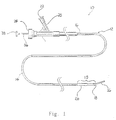
- FIG. 1 shows a catheter assembly 10 constructed according to one embodiment of the present invention.
- Catheter assembly 10 includes a catheter 12 composed of a flexible, thin walled body or tube 14 having an inner lumen (not shown) extending between proximal and distal catheter ends 16,18 respectively.
- Tube 14 may be made from any medically acceptable material, preferrably a nondistensible polymer having the appropriate mechanical properties. Preferred materials include polyethylene, polyester, polypropylene, polyimide, polyvinyl chloride, ethylvinyl acetate, polyethylene terephthalate, polyurethane, PEBAX. fluoropolymers, and their mixtures and block or random copolymers.
- Tube 14 may be a single layer construction or a multiple layer composite construction.
- Tube 14 may have a spiral wound construction, as shown in U.S. Patent No. 5,658,264, or a braided construction, as shown in co-pending U.S. Patent Application Serial No. 08/607,847, titled "BRAIDED BODY BALLOON CATHETER".
- the proximal catheter end 16 is provided with a syringe fitting 20 through which fluid can be supplied to the catheter lumen through a port 22 .
- the fitting includes an axially extending port 24 also communicating with the catheter's inner lumen.
- Tube 14 preferably has an inner diameter of approximately 0.000254-1.524 mm (0.010-60 mils) and walls that are approximately 0.0762-0.381 mm (3-15 mils) thick. The total tube length is preferably between about 50-300 cm.
- the catheter of Figure I is shown with an optional elongate torqueable guidewire 36 which is constructed to extend through the catheter for axial sliding therein.
- Optional guidewire 36 may have any suitable construction for guiding the flexible catheter to its intended site within the body.
- the length of the guidewire is at least about 10-50 cm longer than the catheter such that the distal end of the guidewire can be extended several centimeters or more beyond the distal end of the catheter, while allowing the proximal end of the wire to be manipulated, such as by torqueing.
- the proximal end of the guidewire is equipped with a handle 38 for applying torque to the wire during a catheter operation.
- the guidewire may have a variable or step diameter along its length, typically including a larger-diameter, stiffer proximal region, and one or more smaller-diameter, more flexible distal end regions, giving the wire good torqueability in its more proximal region, and better flexibility and maneuverability along its more distal region where the wire is advanced along smaller-diameter tortuous pathways.
- Typical wire dimensions, for a catheter having a lumen diameter of between about 0.51-1.27 mm (20-50 mils), are a proximal segment extending along all but the last 20-50 cm of wire and having a diameter of between about 0.46-1.02 mm (18-40 mils), and one or more reduced diameter segments 20-50 cm in length having diameters of between about 0.2-0.46 mm (8-18 mils).
- the distal end portion of the wire may have a substantially constant taper, down to a final wire thickness of about 0.0254-0.127 mm (1-5 mils) for greater distal-end flexibility. This tapered region may be encased in a constant-diameter coil and may terminate in a bent tip to facilitate steering through the vasculature.
- the distal end region 15 of catheter 12 is provided with an inflatable balloon 26 .
- balloon 26 when inflated in position, aids in controlling the placement of vaso-occlusive materials or devices by blocking the entrance to the aneurysm.
- the balloon is preferably about 0.5 to 3 cm in length, and has a wall section which can be inflated by fluid supplied through the catheter lumen when the distal end of the catheter tube is partially blocked in a manner to be described below.
- the balloon wall section is preferably formed from a thin sleeve of polymeric material and attached at its opposite sleeve ends to relatively more rigid tube sections. Details of the construction of exemplar balloons may be found in co-owned U.S. Patent Nos. 5,171,221 and 5,135,494.
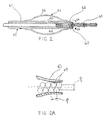
- FIGS 2 through 4 illustrate various constructions of the distal end region 15 and balloon 26 of the catheter illustrated in Figure 1 for the controlled delivery of vaso-occlusive materials or devices.
- catheter tube 52 has an inflatable balloon 54 which is formed by an inflatable sleeve 56 secured at its ends to the catheter wall.
- the balloon sleeve may be formed of a thin polymer material, and preferably an elastomeric, stretchable material such as silicone rubber, latex rubber, or polyvinyl chloride, or alternatively, a non-stretchable film material such as polyethylene or polypropylene. Attachment of the sleeve ends to the catheter tube is by gluing, heat sealing or the like, or other known methods.
- One advantage of an elastomeric sleeve is that it tends to remain flush with the tube in an uninflated state, and also tends to deflate itself when the fluid pressure is released.
- Non-stretchable materials may be preferred in some instances because they require less pressure to inflate.
- At least one opening 60 is formed in the catheter tube 52 to provide for fluid communication between the catheter lumen 61 and the balloon 54 .
- Distal to opening 60 is constricted region 63 of catheter tube 52 .
- pusher 66 discharges vaso-occlusive coil 65 from the catheter lumen 61
- coil 65 passes through constricted region 63 to at least partially or completely block catheter lumen 61 .
- any fluid pressure supplied by way of port 22 is communicated to balloon 54 by way of opening 60 . thus inflating the balloon.
- This construction provides for a single lumen catheter having a valve which is inflated simultaneously with delivery of the vaso-occlusive implant to the aneurysm.
- the inside surface of catheter tube 52 provides a suitable guide for the delivery of vaso-occlusive implants such as coils using a suitable pusher.
- the inside diameter of catheter tube 52 in the region before constricted region 63 is generally somewhat larger than that of the expected coil outside diameter.
- the inside diameter in that area may be oversized 0.051 to 0.635 mm (0.002 to 0.025 inches) or more, preferably about 0.127 mm (0.005 inches) to about 0.254 mm (0.010 inches).
- Constricted region 63 may be constructed to be significantly smaller than the outsided diameter of the vaso-occlusive coil or may be designed to be a close fit. Constricted region 63 typically has a region with an inside diameter which is slightly smaller than the outside diameter of the coil. For example, in a vaso-occlusive coil having an outside diameter of 0.381 mm (0.015 inches), the inside diameter of constricted region 63 is between about 0.254 to 0.381 mm (0.01 to 0.015 inches), preferably about 0.33 mm (0.013 inches).
- the inside diameter of the constricted region 63 is sized to be from about 0.178 to 0.254 mm (0.007 to 0.010 inches), preferably about 0.229 mm (0.009 inches).
- the wall of the catheter tube in that area is flexible enough to allow the coils to pass through without requiring excessively high axial discharge forces from the pusher, and yet maintain a seal sufficient to facilitate inflation of the balloon.
- the vaso-occlusive coil may be constructed such that the axial pitch, p 1 between successive coils 69 are substantially the same as the wire diameter of the coils 69 . Some amount of deviation is acceptable, however, because the axial forces required for discharge of the coil 65 through the constricted region 63 will compress the coils together essentially as shown. Although not necessarily required, sealing may also be improved if the radial pitch, p2 is close to the same as the wire diameter as shown.
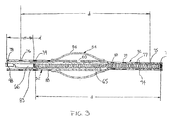
- FIG. 3 shows a further embodiment of the inventive catheter.
- the catheter again has a catheter tube 52 and an inflatable balloon 54 which is formed by an inflatable sleeve 56 secured at its ends to the catheter wall in the manner described above with reference to Figure 2.
- a lengthened distal section 72 is provided distal of balloon 54. At least a portion, or preferably substantially all, of distal section 72 is constricted such that the inside diameter of the catheter tube 52 in the region of distal section 72 cooperates with the outside diameter of vaso-occlusive coil 65 as it is discharged by pusher 66.
- pusher 66 may be of any suitable type adapted to discharge and release coil 65 .
- inventive catheter or the present invention has been described with reference to a wire type pusher, it should be appreciated that many other types of discharge devices, such as those described above, may be suitable for use with the present invention.
- Other types of discharge devices such as the hydraulic delivery described U.S. Patent No. 5,669,931 to Kupiecki et al. are believed to be particularly suited for use with the present invention.
- Lengthened distal section 72 is preferably heat shapeable, for instance using a shaping mandrel and steam as is known in the art.
- the distal section 72 may be given any desired shape by the operating surgeon to optimize steerability for accessing the delivery site or for optimizing the fill of the aneurysm by the vaso-occlusive coil or coils.
- it may be desirable to shape the area of the catheter tube 52 in the area of the inflatable balloon 54 to facilitate optimum positioning of the balloon.
- distal section 72 extends through the opening at aneurysm neck 82 and into the aneurysm sac. As shown, distal section may be advantageously shaped to optimally fill the aneurysm according to the surgeon's preference and experience.
- the balloon is positioned such that upon inflation, it blocks the opening of the aneurysm neck 82 to ensure that the discharged coils are contained within aneurysm sac 80 and do not escape to either the of the intersection body lumen 84, 86 .
- the balloon is automatically inflated as the coil 65 is discharged as coil 65 cooperates with the constricted portion of the distal section 72 to seal off the catheter lumen distal of balloon 54. As coil 65 passes out of distal section 72 and completely in the aneurysm sac 80. the balloon is automatically deflated as the catheter is no longer blocked or sealed.
- catheter tube 52 is provided with a number of variable markers both proximal to and distal to the balloon 54 .
- Lengthened distal section 72 is provided with number of spaced radioopaque markers 73, 75, 77, 79 , and 80.
- each distal marker has a corresponding proximal marker positioned proximally at a distance, d .
- proximal marker 74 is at a distance, d from distal marker 73
- proximal marker 76 is at a distance, d from distal marker 75
- proximal marker 78 is at a distance, d from distal marker 77
- Balloon markers 80, 88 may be provided to indicate the position of the balloon during the operating procedure.
- Pusher 66 may also be provided with tip marker 83 at its distal tip and a tail marker 98 proximally located at a distance, d which as described above corresponds to the length of the coil to be discharged.
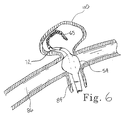
- the marker pairs allow the lengthened distal section 72 to be cut to a shorter length to accommodate the operating surgeon's preference. For instance, it may be desirable to have a shortened distal section 72 when accessing and treating a relatively smaller aneurysm site such as aneurysm 110 as shown in Figure 6. In that case, distal section 72 is cut back, preferably in such a manner as to place one of the distal variable markers at or near the cut tip.
- the marker pair to be used would be distal marker 73 and proximal marker 74.
- Distal marker 73 is especially useful as the catheter is accessing the vasculature in route to and entering the delivery site or aneurysm.
- a coil is loaded into the proximal end of the catheter at port 24 ( Figure 1) and advanced through the catheter distally by pusher 66. its proper position prior to discharge may be appreciated by aligning each end of coil 65 with the respective distal and proximal markers 73, 74 as shown in Figure 3.
- Proximal marker 74 may be used to determine the position of the coil. For instance, when tip marker 83 is aligned with proximal marker 74. the coil is in place to be discharged as shown in Figure 3. When pusher 66 has been advanced until tail marker 98 is aligned with proximal marker 74 then. by virtue of the spacing of the markers, it can be determined that the coil has been fully discharged by pusher 66 and no further advancement of pusher 66 is necessary. This same procedure may be employed with any of the variable marker pairs as necessitated because the length of distal section 72 has been cut. For example, if distal section 72 is cut at location 94, distal marker 77 would be used in conjunction with proximal marker 78 in the same manner as just described with reference to marker pair 73,74 .
- lengthened distal section 72 has a length of about 0.50 cm to about 3.0 cm or more.
- the length of distal section 72 is about 1.0 cm to 2.0 cm.
- Distal markers are typically radioopaque wires or bands made from gold, tungsten, platinum, alloys of these materials, or other suitable radioopaque materials typically having a width of about 0.10 mm to about 0.50 mm.
- the distal markers may be placed at increments of about 2 mm to 10 mm or more, preferably about 3 mm to 7 mm.
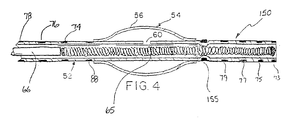
- Lengthened distal section 150 is constructed similar to that of distal section 72 except that the lumen is constricted only in the location of constricting band 155.
- Constricting band 155 is preferably a metal band positioned over the catheter tube and held in place by heat bonding, gluing, or any number of other suitable techniques.
- This contruction allows a substantial portion of the distal section 150 to be radially unrestricted, thus reducing the axial force required to discharge the vaso-occlusive coil.
- inventive aspects of the catheter described in detail above are not limited solely to the treatment of terminal aneurysms as shown in the prior figures.
- Such devices as have been described have utility at a number of vascular sites including, but not limited to, vascular malformations, fistulas, and other types of aneurysms.
- Figure 7, for example illustrates the use of the present invention with respect to berry aneurysm 120 extending from body lumen 122 .
- Lengthened distal section 72 extends through the opening at the neck 124 , but is biased against the side as shown. In this position, balloon 54 is inflated as coil 65 passes through the constricted section of lengthened section 72 and is able to adequately contain coil 65 within the aneurysm.
Landscapes
- Health & Medical Sciences (AREA)
- Surgery (AREA)
- Life Sciences & Earth Sciences (AREA)
- Heart & Thoracic Surgery (AREA)
- Molecular Biology (AREA)
- Vascular Medicine (AREA)
- Engineering & Computer Science (AREA)
- Biomedical Technology (AREA)
- Reproductive Health (AREA)
- Medical Informatics (AREA)
- Nuclear Medicine, Radiotherapy & Molecular Imaging (AREA)
- Animal Behavior & Ethology (AREA)
- General Health & Medical Sciences (AREA)
- Public Health (AREA)
- Veterinary Medicine (AREA)
- Neurosurgery (AREA)
- Surgical Instruments (AREA)
Applications Claiming Priority (3)
| Application Number | Priority Date | Filing Date | Title |
|---|---|---|---|
| US08/950,002 US6074407A (en) | 1997-10-14 | 1997-10-14 | Delivery catheter for occlusive implants |
| US950002 | 1997-10-14 | ||
| PCT/US1998/021571 WO1999018861A1 (en) | 1997-10-14 | 1998-10-13 | Delivery catheter for occlusive device |
Publications (2)
| Publication Number | Publication Date |
|---|---|
| EP1022988A1 EP1022988A1 (en) | 2000-08-02 |
| EP1022988B1 true EP1022988B1 (en) | 2006-12-06 |
Family
ID=25489817
Family Applications (1)
| Application Number | Title | Priority Date | Filing Date |
|---|---|---|---|
| EP98953436A Expired - Lifetime EP1022988B1 (en) | 1997-10-14 | 1998-10-13 | Delivery catheter for occlusive device |
Country Status (7)
| Country | Link |
|---|---|
| US (1) | US6074407A (enExample) |
| EP (1) | EP1022988B1 (enExample) |
| JP (1) | JP4170587B2 (enExample) |
| AU (1) | AU1081499A (enExample) |
| CA (1) | CA2306625A1 (enExample) |
| DE (1) | DE69836590T2 (enExample) |
| WO (1) | WO1999018861A1 (enExample) |
Families Citing this family (66)
| Publication number | Priority date | Publication date | Assignee | Title |
|---|---|---|---|---|
| US6080170A (en) * | 1996-07-26 | 2000-06-27 | Kensey Nash Corporation | System and method of use for revascularizing stenotic bypass grafts and other occluded blood vessels |
| US6830577B2 (en) * | 1996-07-26 | 2004-12-14 | Kensey Nash Corporation | System and method of use for treating occluded vessels and diseased tissue |
| US6652546B1 (en) * | 1996-07-26 | 2003-11-25 | Kensey Nash Corporation | System and method of use for revascularizing stenotic bypass grafts and other occluded blood vessels |
| US5779721A (en) | 1996-07-26 | 1998-07-14 | Kensey Nash Corporation | System and method of use for revascularizing stenotic bypass grafts and other blood vessels |
| US6905505B2 (en) * | 1996-07-26 | 2005-06-14 | Kensey Nash Corporation | System and method of use for agent delivery and revascularizing of grafts and vessels |
| EP1016430B1 (en) * | 1997-09-12 | 2004-12-15 | Nippon Zeon Co., Ltd. | Balloon catheter |
| US6790218B2 (en) * | 1999-12-23 | 2004-09-14 | Swaminathan Jayaraman | Occlusive coil manufacture and delivery |
| US20050187564A1 (en) * | 1999-12-23 | 2005-08-25 | Swaminathan Jayaraman | Occlusive coil manufacturing and delivery |
| US6544225B1 (en) * | 2000-02-29 | 2003-04-08 | Cordis Neurovascular, Inc. | Embolic coil hydraulic deployment system with purge mechanism |
| US6726700B1 (en) * | 2000-08-21 | 2004-04-27 | Counter Clockwise, Inc. | Manipulatable delivery catheter for occlusive devices |
| US6482221B1 (en) * | 2000-08-21 | 2002-11-19 | Counter Clockwise, Inc. | Manipulatable delivery catheter for occlusive devices (II) |
| US6527790B2 (en) * | 2000-12-07 | 2003-03-04 | Scimed Life Systems, Inc. | Intravascular balloon catheter for embolic coil delivery |
| US6636758B2 (en) | 2001-05-01 | 2003-10-21 | Concentric Medical, Inc. | Marker wire and process for using it |
| US6702782B2 (en) | 2001-06-26 | 2004-03-09 | Concentric Medical, Inc. | Large lumen balloon catheter |
| US6638245B2 (en) * | 2001-06-26 | 2003-10-28 | Concentric Medical, Inc. | Balloon catheter |
| EP1434526A1 (en) * | 2001-10-12 | 2004-07-07 | Boston Scientific Limited | Catheter with piezo elements for lesion diagnostics |
| US7309345B2 (en) * | 2003-07-25 | 2007-12-18 | Boston Scientific-Scimed, Inc. | Method and system for delivering an implant utilizing a lumen reducing member |
| US20050137646A1 (en) * | 2003-12-22 | 2005-06-23 | Scimed Life Systems, Inc. | Method of intravascularly delivering stimulation leads into brain |
| US8060207B2 (en) | 2003-12-22 | 2011-11-15 | Boston Scientific Scimed, Inc. | Method of intravascularly delivering stimulation leads into direct contact with tissue |
| US7295875B2 (en) | 2004-02-20 | 2007-11-13 | Boston Scientific Scimed, Inc. | Method of stimulating/sensing brain with combination of intravascularly and non-vascularly delivered leads |
| US7177702B2 (en) | 2004-03-12 | 2007-02-13 | Scimed Life Systems, Inc. | Collapsible/expandable electrode leads |
| US20050203600A1 (en) | 2004-03-12 | 2005-09-15 | Scimed Life Systems, Inc. | Collapsible/expandable tubular electrode leads |
| US7590454B2 (en) * | 2004-03-12 | 2009-09-15 | Boston Scientific Neuromodulation Corporation | Modular stimulation lead network |
| US7231260B2 (en) | 2004-05-06 | 2007-06-12 | Boston Scientific Scimed, Inc. | Intravascular self-anchoring electrode body with arcuate springs, spring loops, or arms |
| AU2005247490B2 (en) | 2004-05-25 | 2011-05-19 | Covidien Lp | Flexible vascular occluding device |
| US8617234B2 (en) | 2004-05-25 | 2013-12-31 | Covidien Lp | Flexible vascular occluding device |
| US8267985B2 (en) | 2005-05-25 | 2012-09-18 | Tyco Healthcare Group Lp | System and method for delivering and deploying an occluding device within a vessel |
| US20060206200A1 (en) | 2004-05-25 | 2006-09-14 | Chestnut Medical Technologies, Inc. | Flexible vascular occluding device |
| KR101300437B1 (ko) | 2004-05-25 | 2013-08-26 | 코비디엔 엘피 | 동맥류용 혈관 스텐트 |
| US8628564B2 (en) | 2004-05-25 | 2014-01-14 | Covidien Lp | Methods and apparatus for luminal stenting |
| US7286879B2 (en) | 2004-07-16 | 2007-10-23 | Boston Scientific Scimed, Inc. | Method of stimulating fastigium nucleus to treat neurological disorders |
| US7879064B2 (en) | 2004-09-22 | 2011-02-01 | Micro Therapeutics, Inc. | Medical implant |
| EP1793743B1 (de) | 2004-09-22 | 2009-11-18 | Dendron GmbH | Vorrichtung zur implantation von mikrowendeln |
| US7937160B2 (en) * | 2004-12-10 | 2011-05-03 | Boston Scientific Neuromodulation Corporation | Methods for delivering cortical electrode leads into patient's head |
| US8273101B2 (en) | 2005-05-25 | 2012-09-25 | Tyco Healthcare Group Lp | System and method for delivering and deploying an occluding device within a vessel |
| AU2005332044B2 (en) | 2005-05-25 | 2012-01-19 | Covidien Lp | System and method for delivering and deploying and occluding device within a vessel |
| US8152833B2 (en) | 2006-02-22 | 2012-04-10 | Tyco Healthcare Group Lp | Embolic protection systems having radiopaque filter mesh |
| CN101448464B (zh) | 2006-04-17 | 2011-05-04 | 微治疗公司 | 用于以机械方式定位血管内植入物的系统和方法 |
| US8777979B2 (en) | 2006-04-17 | 2014-07-15 | Covidien Lp | System and method for mechanically positioning intravascular implants |
| WO2008106480A1 (en) * | 2007-03-01 | 2008-09-04 | Boston Scientific Scimed, Inc. | Microcatheter introducer sheath |
| CN101677821B (zh) | 2007-03-13 | 2014-05-14 | 泰科保健集团有限合伙公司 | 植入物和轴柄 |
| WO2008112435A2 (en) | 2007-03-13 | 2008-09-18 | Micro Therapeutics, Inc. | An implant including a coil and a stretch-resistant member |
| US20080287982A1 (en) * | 2007-05-16 | 2008-11-20 | Boston Scientific Scimed, Inc. | Catheters for electrolytically detachable embolic devices |
| US10028747B2 (en) | 2008-05-01 | 2018-07-24 | Aneuclose Llc | Coils with a series of proximally-and-distally-connected loops for occluding a cerebral aneurysm |
| US10716573B2 (en) | 2008-05-01 | 2020-07-21 | Aneuclose | Janjua aneurysm net with a resilient neck-bridging portion for occluding a cerebral aneurysm |
| WO2009140437A1 (en) | 2008-05-13 | 2009-11-19 | Nfocus Neuromedical, Inc. | Braid implant delivery systems |
| JP5612279B2 (ja) * | 2009-06-26 | 2014-10-22 | 日本合成化学工業株式会社 | 心筋梗塞非ヒト動物モデル及びその作製方法 |
| US20110046657A1 (en) * | 2009-08-20 | 2011-02-24 | Boston Scientific Scimed, Inc. | Embolic Coil Introducer Catheter Locking Mechanisms |
| US9358140B1 (en) | 2009-11-18 | 2016-06-07 | Aneuclose Llc | Stent with outer member to embolize an aneurysm |
| US9017366B2 (en) * | 2011-08-19 | 2015-04-28 | Empirilon Technology, Llc | Methods and systems for performing intralumenal procedures |
| US9579104B2 (en) | 2011-11-30 | 2017-02-28 | Covidien Lp | Positioning and detaching implants |
| US9011480B2 (en) | 2012-01-20 | 2015-04-21 | Covidien Lp | Aneurysm treatment coils |
| US9687245B2 (en) | 2012-03-23 | 2017-06-27 | Covidien Lp | Occlusive devices and methods of use |
| US9155647B2 (en) | 2012-07-18 | 2015-10-13 | Covidien Lp | Methods and apparatus for luminal stenting |
| US9114001B2 (en) | 2012-10-30 | 2015-08-25 | Covidien Lp | Systems for attaining a predetermined porosity of a vascular device |
| US9452070B2 (en) | 2012-10-31 | 2016-09-27 | Covidien Lp | Methods and systems for increasing a density of a region of a vascular device |
| US9943427B2 (en) | 2012-11-06 | 2018-04-17 | Covidien Lp | Shaped occluding devices and methods of using the same |
| US9157174B2 (en) | 2013-02-05 | 2015-10-13 | Covidien Lp | Vascular device for aneurysm treatment and providing blood flow into a perforator vessel |
| JP6467129B2 (ja) * | 2013-10-17 | 2019-02-06 | メディカル・イノベイション株式会社 | カテーテル |
| US9713475B2 (en) | 2014-04-18 | 2017-07-25 | Covidien Lp | Embolic medical devices |
| WO2015167997A1 (en) * | 2014-04-30 | 2015-11-05 | Stryker Corporation | Implant delivery system and method of use |
| KR101563172B1 (ko) * | 2014-05-20 | 2015-10-27 | (주) 타우피엔유메디칼 | 승모판막 서클라지 시술용 조직보호기구 |
| WO2018061598A1 (ja) * | 2016-09-30 | 2018-04-05 | 株式会社タケモリ | カテーテル |
| US20180104454A1 (en) * | 2016-10-19 | 2018-04-19 | Daniel E. Walzman | Disc balloon microcatheter |
| US10786259B2 (en) * | 2018-03-30 | 2020-09-29 | DePuy Synthes Products, Inc. | Split balloon assist device and method for using the same |
| CN110946632B (zh) * | 2019-11-05 | 2021-04-13 | 杭州未名信科科技有限公司 | 血液阻断装置 |
Family Cites Families (34)
| Publication number | Priority date | Publication date | Assignee | Title |
|---|---|---|---|---|
| US5033998A (en) * | 1984-01-20 | 1991-07-23 | Eliot Corday | Retrograde delivery of pharmacologic and diagnostic agents via venous circulation |
| JPS62261371A (ja) * | 1986-05-08 | 1987-11-13 | テルモ株式会社 | カテ−テル |
| US4739768B2 (en) * | 1986-06-02 | 1995-10-24 | Target Therapeutics Inc | Catheter for guide-wire tracking |
| US4850960A (en) * | 1987-07-08 | 1989-07-25 | Joseph Grayzel | Diagonally tapered, bevelled tip introducing catheter and sheath and method for insertion |
| US4813934A (en) * | 1987-08-07 | 1989-03-21 | Target Therapeutics | Valved catheter device and method |
| US4884579A (en) * | 1988-04-18 | 1989-12-05 | Target Therapeutics | Catheter guide wire |
| US5135494A (en) * | 1988-08-01 | 1992-08-04 | Target Therapeutics | Valved catheter device and method |
| US4994069A (en) * | 1988-11-02 | 1991-02-19 | Target Therapeutics | Vaso-occlusion coil and method |
| US5122136A (en) * | 1990-03-13 | 1992-06-16 | The Regents Of The University Of California | Endovascular electrolytically detachable guidewire tip for the electroformation of thrombus in arteries, veins, aneurysms, vascular malformations and arteriovenous fistulas |
| US5354295A (en) * | 1990-03-13 | 1994-10-11 | Target Therapeutics, Inc. | In an endovascular electrolytically detachable wire and tip for the formation of thrombus in arteries, veins, aneurysms, vascular malformations and arteriovenous fistulas |
| US5171221A (en) * | 1991-02-05 | 1992-12-15 | Target Therapeutics | Single lumen low profile valved balloon catheter |
| US5454788A (en) * | 1991-04-24 | 1995-10-03 | Baxter International Inc. | Exchangeable integrated-wire balloon catheter |
| CA2104121C (en) * | 1991-04-24 | 1998-12-22 | Blair D. Walker | Exchangeable integrated-wire balloon catheter |
| US5795325A (en) * | 1991-07-16 | 1998-08-18 | Heartport, Inc. | Methods and apparatus for anchoring an occluding member |
| US5261916A (en) * | 1991-12-12 | 1993-11-16 | Target Therapeutics | Detachable pusher-vasoocclusive coil assembly with interlocking ball and keyway coupling |
| US5234437A (en) * | 1991-12-12 | 1993-08-10 | Target Therapeutics, Inc. | Detachable pusher-vasoocclusion coil assembly with threaded coupling |
| CA2084524C (en) * | 1991-12-12 | 1996-07-23 | Robert H. Twyford, Jr. | Detachable pusher-vasoocclusive coil assembly with interlocking coupling |
| US5324259A (en) * | 1991-12-18 | 1994-06-28 | Advanced Cardiovascular Systems, Inc. | Intravascular catheter with means to seal guidewire port |
| US5334143A (en) * | 1992-04-17 | 1994-08-02 | Carroll Brendon J | Method to remove common bile duct stones |
| US5348537A (en) * | 1992-07-15 | 1994-09-20 | Advanced Cardiovascular Systems, Inc. | Catheter with intraluminal sealing element |
| US5350397A (en) * | 1992-11-13 | 1994-09-27 | Target Therapeutics, Inc. | Axially detachable embolic coil assembly |
| US5312415A (en) * | 1992-09-22 | 1994-05-17 | Target Therapeutics, Inc. | Assembly for placement of embolic coils using frictional placement |
| US5250071A (en) * | 1992-09-22 | 1993-10-05 | Target Therapeutics, Inc. | Detachable embolic coil assembly using interlocking clasps and method of use |
| FR2696636A1 (fr) * | 1992-10-13 | 1994-04-15 | Balt Sa | Système d'occlusion vasculaire et son procédé d'utilisation. |
| US5304198A (en) * | 1992-11-13 | 1994-04-19 | Target Therapeutics | Single-lumen balloon catheter having a directional valve |
| US5437632A (en) * | 1993-06-02 | 1995-08-01 | Target Therapeutics, Inc. | Variable stiffness balloon catheter |
| US5795331A (en) * | 1994-01-24 | 1998-08-18 | Micro Therapeutics, Inc. | Balloon catheter for occluding aneurysms of branch vessels |
| US5429605A (en) * | 1994-01-26 | 1995-07-04 | Target Therapeutics, Inc. | Microballoon catheter |
| US5522836A (en) * | 1994-06-27 | 1996-06-04 | Target Therapeutics, Inc. | Electrolytically severable coil assembly with movable detachment point |
| US5658264A (en) * | 1994-11-10 | 1997-08-19 | Target Therapeutics, Inc. | High performance spiral-wound catheter |
| US5573508A (en) * | 1994-11-22 | 1996-11-12 | Advanced Cardiovascular Systems, Inc. | Catheter with an expandable perfusion lumen |
| CA2173023C (en) * | 1995-03-30 | 2001-08-28 | David Kupiecki | Liquid coils with secondary shape |
| US6440097B1 (en) * | 1995-10-06 | 2002-08-27 | Target Therapeutics, Inc. | Balloon catheter with delivery side holes |
| JP2000504594A (ja) * | 1996-02-02 | 2000-04-18 | トランスバスキュラー インコーポレイテッド | 血管内の流れを遮断する方法及び装置 |
-
1997
- 1997-10-14 US US08/950,002 patent/US6074407A/en not_active Expired - Lifetime
-
1998
- 1998-10-13 JP JP2000515503A patent/JP4170587B2/ja not_active Expired - Fee Related
- 1998-10-13 AU AU10814/99A patent/AU1081499A/en not_active Abandoned
- 1998-10-13 EP EP98953436A patent/EP1022988B1/en not_active Expired - Lifetime
- 1998-10-13 DE DE69836590T patent/DE69836590T2/de not_active Expired - Lifetime
- 1998-10-13 WO PCT/US1998/021571 patent/WO1999018861A1/en not_active Ceased
- 1998-10-13 CA CA002306625A patent/CA2306625A1/en not_active Abandoned
Also Published As
| Publication number | Publication date |
|---|---|
| JP4170587B2 (ja) | 2008-10-22 |
| DE69836590D1 (de) | 2007-01-18 |
| CA2306625A1 (en) | 1999-04-22 |
| WO1999018861A1 (en) | 1999-04-22 |
| EP1022988A1 (en) | 2000-08-02 |
| US6074407A (en) | 2000-06-13 |
| JP2001519194A (ja) | 2001-10-23 |
| AU1081499A (en) | 1999-05-03 |
| DE69836590T2 (de) | 2007-09-27 |
Similar Documents
| Publication | Publication Date | Title |
|---|---|---|
| EP1022988B1 (en) | Delivery catheter for occlusive device | |
| US6976991B2 (en) | Manipulatable delivery catheter for occlusive devices (LL) | |
| US6726700B1 (en) | Manipulatable delivery catheter for occlusive devices | |
| US8273073B2 (en) | Long nose manipulatable catheter | |
| US7766049B2 (en) | Balloon catheter | |
| JP3132806B2 (ja) | 二次形状を有する液体様コイル | |
| US8182544B2 (en) | Method for placing a medical agent into a vessel of the body | |
| EP4126176B1 (en) | BALLOON CATHETER | |
| US7108708B2 (en) | Method for placing a medical agent into a vessel of the body | |
| MXPA06003468A (es) | Cateter de globo orientable |
Legal Events
| Date | Code | Title | Description |
|---|---|---|---|
| PUAI | Public reference made under article 153(3) epc to a published international application that has entered the european phase |
Free format text: ORIGINAL CODE: 0009012 |
|
| 17P | Request for examination filed |
Effective date: 20000509 |
|
| AK | Designated contracting states |
Kind code of ref document: A1 Designated state(s): DE FR GB IE IT NL |
|
| RAP1 | Party data changed (applicant data changed or rights of an application transferred) |
Owner name: BOSTON SCIENTIFIC LIMITED |
|
| GRAP | Despatch of communication of intention to grant a patent |
Free format text: ORIGINAL CODE: EPIDOSNIGR1 |
|
| GRAS | Grant fee paid |
Free format text: ORIGINAL CODE: EPIDOSNIGR3 |
|
| GRAA | (expected) grant |
Free format text: ORIGINAL CODE: 0009210 |
|
| RAP1 | Party data changed (applicant data changed or rights of an application transferred) |
Owner name: BOSTON SCIENTIFIC LIMITED |
|
| AK | Designated contracting states |
Kind code of ref document: B1 Designated state(s): DE FR GB IE IT NL |
|
| REG | Reference to a national code |
Ref country code: GB Ref legal event code: FG4D |
|
| REG | Reference to a national code |
Ref country code: IE Ref legal event code: FG4D |
|
| REF | Corresponds to: |
Ref document number: 69836590 Country of ref document: DE Date of ref document: 20070118 Kind code of ref document: P |
|
| ET | Fr: translation filed | ||
| PLBE | No opposition filed within time limit |
Free format text: ORIGINAL CODE: 0009261 |
|
| STAA | Information on the status of an ep patent application or granted ep patent |
Free format text: STATUS: NO OPPOSITION FILED WITHIN TIME LIMIT |
|
| 26N | No opposition filed |
Effective date: 20070907 |
|
| PGFP | Annual fee paid to national office [announced via postgrant information from national office to epo] |
Ref country code: NL Payment date: 20071219 Year of fee payment: 10 |
|
| NLV4 | Nl: lapsed or anulled due to non-payment of the annual fee |
Effective date: 20090501 |
|
| PG25 | Lapsed in a contracting state [announced via postgrant information from national office to epo] |
Ref country code: NL Free format text: LAPSE BECAUSE OF NON-PAYMENT OF DUE FEES Effective date: 20090501 |
|
| PGFP | Annual fee paid to national office [announced via postgrant information from national office to epo] |
Ref country code: GB Payment date: 20100923 Year of fee payment: 13 |
|
| PGFP | Annual fee paid to national office [announced via postgrant information from national office to epo] |
Ref country code: DE Payment date: 20101029 Year of fee payment: 13 |
|
| PGFP | Annual fee paid to national office [announced via postgrant information from national office to epo] |
Ref country code: IT Payment date: 20101019 Year of fee payment: 13 |
|
| PGFP | Annual fee paid to national office [announced via postgrant information from national office to epo] |
Ref country code: FR Payment date: 20111118 Year of fee payment: 14 Ref country code: IE Payment date: 20111025 Year of fee payment: 14 |
|
| REG | Reference to a national code |
Ref country code: GB Ref legal event code: 732E Free format text: REGISTERED BETWEEN 20121011 AND 20121017 |
|
| REG | Reference to a national code |
Ref country code: DE Ref legal event code: R081 Ref document number: 69836590 Country of ref document: DE Owner name: STRYKER NV OPERATIONS LTD., IE Free format text: FORMER OWNER: BOSTON SCIENTIFIC LTD., BARBADOS, WEST INDIES, BB Effective date: 20121129 Ref country code: DE Ref legal event code: R081 Ref document number: 69836590 Country of ref document: DE Owner name: STRYKER CORP., KALAMAZOO, US Free format text: FORMER OWNER: BOSTON SCIENTIFIC LTD., BARBADOS, WEST INDIES, BB Effective date: 20121129 Ref country code: DE Ref legal event code: R081 Ref document number: 69836590 Country of ref document: DE Owner name: STRYKER NV OPERATIONS LTD., IE Free format text: FORMER OWNER: BOSTON SCIENTIFIC LTD., BARBADOS, BB Effective date: 20121129 Ref country code: DE Ref legal event code: R081 Ref document number: 69836590 Country of ref document: DE Owner name: STRYKER CORP., US Free format text: FORMER OWNER: BOSTON SCIENTIFIC LTD., BARBADOS, BB Effective date: 20121129 |
|
| REG | Reference to a national code |
Ref country code: FR Ref legal event code: TP Owner name: STRYKER CORPORATION, US Effective date: 20130103 |
|
| GBPC | Gb: european patent ceased through non-payment of renewal fee |
Effective date: 20121013 |
|
| REG | Reference to a national code |
Ref country code: IE Ref legal event code: MM4A |
|
| REG | Reference to a national code |
Ref country code: FR Ref legal event code: ST Effective date: 20130628 |
|
| PG25 | Lapsed in a contracting state [announced via postgrant information from national office to epo] |
Ref country code: DE Free format text: LAPSE BECAUSE OF NON-PAYMENT OF DUE FEES Effective date: 20130501 Ref country code: IE Free format text: LAPSE BECAUSE OF NON-PAYMENT OF DUE FEES Effective date: 20121013 Ref country code: GB Free format text: LAPSE BECAUSE OF NON-PAYMENT OF DUE FEES Effective date: 20121013 |
|
| REG | Reference to a national code |
Ref country code: DE Ref legal event code: R119 Ref document number: 69836590 Country of ref document: DE Effective date: 20130501 |
|
| PG25 | Lapsed in a contracting state [announced via postgrant information from national office to epo] |
Ref country code: FR Free format text: LAPSE BECAUSE OF NON-PAYMENT OF DUE FEES Effective date: 20121031 Ref country code: IT Free format text: LAPSE BECAUSE OF NON-PAYMENT OF DUE FEES Effective date: 20121013 |