EP1007888B1 - Integrale luftauslassmodule und dazugehörige heiz- und kühlsysteme - Google Patents
Integrale luftauslassmodule und dazugehörige heiz- und kühlsysteme Download PDFInfo
- Publication number
- EP1007888B1 EP1007888B1 EP19980943257 EP98943257A EP1007888B1 EP 1007888 B1 EP1007888 B1 EP 1007888B1 EP 19980943257 EP19980943257 EP 19980943257 EP 98943257 A EP98943257 A EP 98943257A EP 1007888 B1 EP1007888 B1 EP 1007888B1
- Authority
- EP
- European Patent Office
- Prior art keywords
- air
- flow
- damper
- modular terminal
- terminal
- Prior art date
- Legal status (The legal status is an assumption and is not a legal conclusion. Google has not performed a legal analysis and makes no representation as to the accuracy of the status listed.)
- Expired - Lifetime
Links
- 238000001816 cooling Methods 0.000 title claims abstract description 73
- 238000010438 heat treatment Methods 0.000 title claims abstract description 53
- 230000001143 conditioned effect Effects 0.000 claims abstract description 64
- 238000000034 method Methods 0.000 claims abstract description 27
- 230000004044 response Effects 0.000 claims abstract description 20
- 230000006698 induction Effects 0.000 claims abstract description 14
- 238000002156 mixing Methods 0.000 claims abstract description 12
- 230000003750 conditioning effect Effects 0.000 claims abstract description 8
- 238000004891 communication Methods 0.000 claims description 8
- 238000007791 dehumidification Methods 0.000 claims description 6
- 239000012530 fluid Substances 0.000 claims description 6
- 239000000203 mixture Substances 0.000 claims description 4
- 238000004140 cleaning Methods 0.000 claims description 2
- 230000000903 blocking effect Effects 0.000 claims 1
- 238000009423 ventilation Methods 0.000 abstract description 14
- 238000009429 electrical wiring Methods 0.000 abstract description 3
- 238000013461 design Methods 0.000 description 28
- 238000009826 distribution Methods 0.000 description 17
- XLYOFNOQVPJJNP-UHFFFAOYSA-N water Substances O XLYOFNOQVPJJNP-UHFFFAOYSA-N 0.000 description 14
- 238000004378 air conditioning Methods 0.000 description 11
- 230000008901 benefit Effects 0.000 description 8
- 238000010586 diagram Methods 0.000 description 6
- 238000001914 filtration Methods 0.000 description 6
- 239000000779 smoke Substances 0.000 description 6
- 238000010276 construction Methods 0.000 description 4
- 230000007246 mechanism Effects 0.000 description 4
- 230000002829 reductive effect Effects 0.000 description 4
- 238000005057 refrigeration Methods 0.000 description 4
- 230000008859 change Effects 0.000 description 3
- 230000001276 controlling effect Effects 0.000 description 3
- 230000003068 static effect Effects 0.000 description 3
- CURLTUGMZLYLDI-UHFFFAOYSA-N Carbon dioxide Chemical compound O=C=O CURLTUGMZLYLDI-UHFFFAOYSA-N 0.000 description 2
- 230000009286 beneficial effect Effects 0.000 description 2
- 238000004364 calculation method Methods 0.000 description 2
- 239000003086 colorant Substances 0.000 description 2
- 230000007423 decrease Effects 0.000 description 2
- 230000001419 dependent effect Effects 0.000 description 2
- 238000009434 installation Methods 0.000 description 2
- 238000004519 manufacturing process Methods 0.000 description 2
- 239000000463 material Substances 0.000 description 2
- 230000036961 partial effect Effects 0.000 description 2
- 238000010926 purge Methods 0.000 description 2
- 230000009467 reduction Effects 0.000 description 2
- 230000001154 acute effect Effects 0.000 description 1
- 210000003423 ankle Anatomy 0.000 description 1
- 238000013459 approach Methods 0.000 description 1
- 229910002092 carbon dioxide Inorganic materials 0.000 description 1
- 239000001569 carbon dioxide Substances 0.000 description 1
- 238000009833 condensation Methods 0.000 description 1
- 230000005494 condensation Effects 0.000 description 1
- 239000000356 contaminant Substances 0.000 description 1
- 238000011109 contamination Methods 0.000 description 1
- 238000005520 cutting process Methods 0.000 description 1
- 238000013016 damping Methods 0.000 description 1
- 230000003247 decreasing effect Effects 0.000 description 1
- 238000005315 distribution function Methods 0.000 description 1
- 230000000694 effects Effects 0.000 description 1
- 230000005611 electricity Effects 0.000 description 1
- 230000008030 elimination Effects 0.000 description 1
- 238000003379 elimination reaction Methods 0.000 description 1
- 238000005265 energy consumption Methods 0.000 description 1
- 238000005516 engineering process Methods 0.000 description 1
- 239000003344 environmental pollutant Substances 0.000 description 1
- 238000007710 freezing Methods 0.000 description 1
- 230000008014 freezing Effects 0.000 description 1
- 230000006872 improvement Effects 0.000 description 1
- 238000010348 incorporation Methods 0.000 description 1
- 230000010354 integration Effects 0.000 description 1
- 230000000670 limiting effect Effects 0.000 description 1
- 230000007774 longterm Effects 0.000 description 1
- 238000012423 maintenance Methods 0.000 description 1
- 238000005259 measurement Methods 0.000 description 1
- 239000002184 metal Substances 0.000 description 1
- 238000012986 modification Methods 0.000 description 1
- 230000004048 modification Effects 0.000 description 1
- 230000000737 periodic effect Effects 0.000 description 1
- 239000004033 plastic Substances 0.000 description 1
- 229920003023 plastic Polymers 0.000 description 1
- 231100000719 pollutant Toxicity 0.000 description 1
- 239000004417 polycarbonate Substances 0.000 description 1
- 229920000515 polycarbonate Polymers 0.000 description 1
- 238000003908 quality control method Methods 0.000 description 1
- 230000001105 regulatory effect Effects 0.000 description 1
- 238000003303 reheating Methods 0.000 description 1
- 230000006903 response to temperature Effects 0.000 description 1
- 230000006641 stabilisation Effects 0.000 description 1
- 238000011105 stabilization Methods 0.000 description 1
- 238000013517 stratification Methods 0.000 description 1
- 229920002994 synthetic fiber Polymers 0.000 description 1
Images






Classifications
-
- F—MECHANICAL ENGINEERING; LIGHTING; HEATING; WEAPONS; BLASTING
- F24—HEATING; RANGES; VENTILATING
- F24F—AIR-CONDITIONING; AIR-HUMIDIFICATION; VENTILATION; USE OF AIR CURRENTS FOR SCREENING
- F24F13/00—Details common to, or for air-conditioning, air-humidification, ventilation or use of air currents for screening
- F24F13/02—Ducting arrangements
- F24F13/06—Outlets for directing or distributing air into rooms or spaces, e.g. ceiling air diffuser
- F24F13/068—Outlets for directing or distributing air into rooms or spaces, e.g. ceiling air diffuser formed as perforated walls, ceilings or floors
-
- F—MECHANICAL ENGINEERING; LIGHTING; HEATING; WEAPONS; BLASTING
- F24—HEATING; RANGES; VENTILATING
- F24F—AIR-CONDITIONING; AIR-HUMIDIFICATION; VENTILATION; USE OF AIR CURRENTS FOR SCREENING
- F24F7/00—Ventilation
- F24F7/04—Ventilation with ducting systems, e.g. by double walls; with natural circulation
- F24F7/06—Ventilation with ducting systems, e.g. by double walls; with natural circulation with forced air circulation, e.g. by fan positioning of a ventilator in or against a conduit
- F24F7/10—Ventilation with ducting systems, e.g. by double walls; with natural circulation with forced air circulation, e.g. by fan positioning of a ventilator in or against a conduit with air supply, or exhaust, through perforated wall, floor or ceiling
-
- F—MECHANICAL ENGINEERING; LIGHTING; HEATING; WEAPONS; BLASTING
- F24—HEATING; RANGES; VENTILATING
- F24F—AIR-CONDITIONING; AIR-HUMIDIFICATION; VENTILATION; USE OF AIR CURRENTS FOR SCREENING
- F24F13/00—Details common to, or for air-conditioning, air-humidification, ventilation or use of air currents for screening
- F24F13/08—Air-flow control members, e.g. louvres, grilles, flaps or guide plates
- F24F13/10—Air-flow control members, e.g. louvres, grilles, flaps or guide plates movable, e.g. dampers
- F24F13/14—Air-flow control members, e.g. louvres, grilles, flaps or guide plates movable, e.g. dampers built up of tilting members, e.g. louvre
-
- F—MECHANICAL ENGINEERING; LIGHTING; HEATING; WEAPONS; BLASTING
- F24—HEATING; RANGES; VENTILATING
- F24F—AIR-CONDITIONING; AIR-HUMIDIFICATION; VENTILATION; USE OF AIR CURRENTS FOR SCREENING
- F24F2221/00—Details or features not otherwise provided for
- F24F2221/36—Modules, e.g. for an easy mounting or transport
Definitions
- the present invention relates to heating and air conditioning systems and air distribution terminals that are preferably incorporated into underfloor heating and air conditioning systems.
- HVAC underfloor heating, ventilating, and air conditioning
- Such devices are pressure dependent devices that have an air velocity that is dependent upon the entering air pressure at the grille face. This produces another disadvantage - namely, at low flow, "puddling" of the more dense conditioned air may take place, which is very uncomfortable to the ankles and fee of the occupants. Yet another drawback results from the high cost to adequately cool different zones. For example, to provide temperature control, often these systems include a number of different zones that are separated by plenum dividers. In sum, the underfloor devices and systems known to the applicant are inflexible in construction, have high operating costs, and are generally intended to meet a limited range of air distribution conditions.
- EP-A-0,207,718 discloses a modular terminal for applying conditioned air to one or more spaces within a building having one or more surfaces including walls, floors, and ceilings, the modular terminal comprising:
- a modular terminal for applying conditioned air to one or more spaces within a building having one or more surfaces including walls, floors, and ceilings, the modular terminal comprising:
- a method for applying conditioned air to one or more spaces within a building having one or more surfaces including walls, floors, and ceilings comprising:
- the hereinafter described embodiment comprises a modular design for providing heating, ventilating, and air conditioning to the interior of a building, the modular design comprising a box capable of accepting a plurality of attachments, said box comprising two pairs of opposed side wals, a bottom surface, at least one inlet air passageway formed through at least one of said side walls, and at least two outwardly engagement flanges formed along the upper portion of at least two of said side walls.
- a system for heating, ventilating, and air conditioning individual spaces on a building floor comprises a plurality of modular boxes, air handling units, plenums, ducts, and controls.
- a method for providing heating, ventilating, and air conditioning to meet a varying range of conditions in discrete spaces on a building floor comprising means for an occupant of said discrete space to adjust the heating, ventilating, and air conditioning output of the modular boxes.
- the present invention is directed to modular integrated terminals, and systems and methods in which one or more of the modular integrated terminals are incorporated, for controlling the airflow of supply air to be conditioned by an HVAC system.
- the terminal of the present invention has one or more common chasses or housings to which a variety of different components can be added to provide an optimum terminal for a given circumstance.
- One or several of the modular terminals can then be integrated into an HVAC system to heat and/or cool the building.
- the terminals are preferably designed to be installed in the floor of a building having an underfloor HVAC system. They can, however, be used in other HVAC applications.
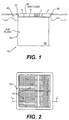
- the terminal 10 of the present invention includes a housing 20 to which various components can be attached.
- the illustrated terminal 10 has four side walls or panels and a bottom which forms a housing 20 with an opening at the top.
- the housing 20 preferably includes at its top outwardly extending lips 30 that extend from at least two opposite sides of the housing 20. The lips 30 engage the floor 40 when the terminal 10 is installed and thereby hold it in place.
- the terminal 10 preferably includes a trim ring 50 that runs around its perimeter.
- the trim ring 50 preferably includes an outwardly extending flange or lip at its top and an inwardly extending flange or lip at its bottom.
- the trim ring 50 preferably fits within the housing 20 and extends over the housing's lip 30.
- the trim ring 50 can be fixed to or formed with the housing 20 of the terminal 10 and thus be an integral part of the terminal 10.
- the terminal 10 is installed into a hole cut in the floor 40.
- the hole is preferably sized to snugly accept the terminal 10.
- the outwardly extending lip 30 of the housing 20 engages the top surface of the floor 40 and holds the terminal 10 in place.
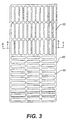
- the terminal 10 of the present invention includes one or more grilles 60 that fit within the trim ring 50 and are held in position by the inwardly extending flange of the trim ring 50.
- the terminal 10 of the present invention preferably includes one or more separate grilles 60, to permit increased control of the direction of air flow from the terminal 10 and into the space being conditioned.
- two identical grilles 60 can be positioned in the trim ring 50. Each of those grilles 60 can have different flow channels at different locations of the grille 60, as well as on opposite sides of the grille 60.
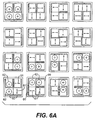
- the grille 60 can be made such that the air can be delivered vertically upward when the grilles 60 are held in one position. By turning the grilles 60 over and positioning them property, the air can be directed from the terminal in up to 16 distinct flow patterns, as shown in Fig. 6A, where the arrows 61 indicate the direction of air leaving the grille 60 at an acute angle and the cross-haired circles 62 indicate air leaving the grille 60 vertically.
- one section of the grille 60 can be positioned to direct air vertically, while the other grille 60 directs air outwardly in two directions, at a pre-selected angle or angles.
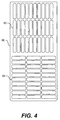
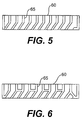
- the two.grilles 60 (one of which is illustrated in Figs. 3 through 6) having dimensions of 9.94 inches (25.3 cm) by 4.92 inches (12.5 cm) are placed in the opening of the trim ring 50 having an opening of 9.94 inches (25.3 cm) by 9.44 inches (24.0 cm).
- the grille 60 has three horizontal rows of 11 elongated air flow channels 65 at the top and three vertical columns of 11 elongated air flow channels 65 at the bottom. In one example, these channels 65 are approximately 1.5 inches (3.8 cm) long and 0.31 inch (0. 8cm) wide. As shown by the cross-section at Figs.
- the channels 65 on one side of the grille 60 direct the flow of air vertically from the face of the grille 60, while the channels 65 on the other side direct the flow at an angle.
- One exemplary angle of deflection is 31 °.
- the grille design shown in Fig. 5 provides standard induction, while the grille design shown in Fig. 6 provides high induction. As is apparent, different grille designs and sizes can be designed to provide different flow patterns. The invention thus provides versatility in arranging and modifying air patterns and flow into the space to be conditioned.
- Trim rings 50 of different colors or designs can then be fitted onto the terminal 10, and grilles 60 of different colors or designs can be fitted within the trim ring 50.
- the terminal 10 of the present invention permits the use of a wide range of aesthetic and engineering design considerations.
- the portion of the terminal 10 visible to room occupants can be selected to match room appurtenances such as electrical distribution devices, telecommunications equipment, carpet, tile, furniture, and other furnishings.
- the terminal 10 of the present invention can be formed in a wide variety of shapes and can be made of a wide variety of materials, depending upon the application and other design considerations.
- the walls and bottom of the terminal 10 can be formed of sheet metal, and the trim ring 50 and grille 60 can be formed of plastics or similar synthetic materials meeting flame spread and smoke retardant characteristics as mandated by applicable building codes.
- One such material is polycarbonate.
- the terminal 10 is symmetrically designed so that it can be rotated to a variety of positions within the hole in the floor 40 where it is to be installed.
- the illustrated embodiment is generally square in cross-section.
- An exemplary terminal 10 might have a horizontal cross-section of 10 inches (25.4 cm) by 10 inches (25.4 cm).
- the terminal 10 can have a variety of heights, with presently preferred heights being either ten inches (25.4 cm) or five inches (12.7 cm), for a terminal 10 having a horizontal cross-section of 10 inches (25.4 cm) by 10 inches (25.4 cm). Other shapes, such as regular polygons or a circular cross-section are also acceptable. As explained below, the symmetrical shape of the preferred terminals 10 permits a user of the terminal invention to after the air flow characteristics of a given terminal 10, by simply rotating the terminal 10 to a different position relative to the air flow in the floor plenums.
- each embodiment of the terminals 10 of the present invention includes at least one air inlet formed in at least one side or bottom panel of the terminal 10.
- the air inlet 70 in the embodiment shown in Fig. 1 is formed in the left side panel and, by means of example only, is in the form of a cut-out having dimensions of 10.5 inches (26.7 cm) by 10.5 inches (26.7 cm).
- a plurality of apertures formed in the side wall can also be used.
- Several embodiments of the terminal 10 include multiple air inlets, along with one or more devices integrally incorporated into the terminal 10 to control the air flow.
- All of the modular integrated terminals (“MITs") of the present invention are purposely designed to fit in a hole in the floor 40 that can be standardized.
- the MIT will share dimensions (in addition to color) with electrical devices used in the floor 40 so that one floor opening can be commonly used for terminals 10 of the invention, as well as electrical and mechanical devices. This feature minimizes costs.
- the elimination of the need for odd sized openings reduces production and installation costs, as well as a need to inventory different spare parts and panels.
- the use of standard openings also allows standard panels to be made at the factory, which is much less expensive than a field-cut panel. This aspect of the invention also permits the use of standard templates and cut-out techniques, when field cut-outs must be made.
- FIG. 1 and 2 The embodiment shown in Figs. 1 and 2 is, for purposes of reference, designated a model MIT-A terminal.
- This terminal 10 includes the basic housing 20 or chassis described above, one or more grilles 60, and at least one inlet 70 formed in a side or bottom panel of the housing 20.
- the inlet 70 is cut into a side wall of the housing 20 and is sized to accept flow of air applied to the terminal 10 through a plenum, preferably in the floor of a building.
- the air handling system of the HVAC system for the building supplies air, preferably pressurized air, to the plenum.
- the air supplied to the plenum flows through the inlet 70, into the terminal 10, and then out through the channels 65 in the grille 60 into the space to be conditioned.
- Either heating or cooling air can be supplied to the plenum, depending upon the environment where the terminal 10 is placed. In most applications, cool, conditioned air will be supplied to the plenum and then to the spaces to be conditioned, through the model MIT
- the MIT-A can be placed in various positions in the hole in the floor, to thereby change the orientation of the inlet 70 relative to the velocity or direction of the air supplied to the plenum.
- This aspect of the invention allows the user to control to some degree the relative output of air applied through the terminal 10, particularly if there is a velocity pressure component present in the plenum.
- the supply air inlet 70 can be faced into, parallel, or against the velocity component to adjust the volume of air entering the device.
- the inlet 70 is aimed into the air stream the unit will deliver more air.
- it is aimed to the side of or opposite the air flow in the plenum, the air delivery volume will be reduced.
- This form of pressure adjustment provides better control over the air flow, with or without other control devices, which are described below.
- the model MIT-A also permits the direction of flow into the room (conditioned space) to be controlled, by varying the position and orientation of the grilles 60 of the invention.
- the air can be directed to flow upwardly throughout, or can be directed at angles away from the face of the terminal 10. It also can be directed in a combination of upward and angular flow.
- the terminal 10 can be modified to accept more than two grilles 60, e.g., four separate grilles 60, without departing from the scope of the invention.
- Each of the four grilles 60 can have a pre-selected flow pattern.
- one or all of the grilles 60 can be replaced with an impervious plate, to decrease or stop the flow of air.
- the grilles 60 can be replaced with grille inserts that provide a connection point for a flexible duct that directs air to a specific location. Such a design allows the MIT to act as an air source for the distribution of air to furniture or desktop outlets. This aspect is described more fully below.
- the MIT-A terminal can be used as a grille plus chassis or as a grille alone to apply air to spaces where the air is transferred through plenums, preferably plenums in the floor.
- these terminals 10 can be used in interior spaces where only cooling is required, on a regular basis. Cooling air typically would be applied to the plenum in a slightly pressurized state, so that the air will flow from the plenum, through the terminal 10, and into the space to be conditioned.
- a second embodiment of the terminal 10 of the present invention is shown in Fig. 7.
- This embodiment is similar to the MIT-A, with the exception that in this embodiment one panel includes a hole, or hole and flange arrangement, which accepts a duct 80.
- the air supplied by the terminal 10 to the space is supplied to the terminal 10 only by ducting 80.
- the MIT-B can incorporate an individual single-speed or variable speed fan that is controlled to control the flow of air.
- a terminal 10 with its own fan or fan/coil/filter can be used, for example, in a system where the air in the plenum is not pressurized, where flow control through the use of a variable speed fan is desired, or where some further conditioning of the plenum air is desired.
- the terminal 10 receives air from only one source and supplies the air to the space through one or more grilles 60, which can be repositioned or replaced with different grille designs, as needed. Furthermore, all MITs are designed to fit into the floor opening by tilting the terminal 10 or removing the duct 80 (and motor, if one is used), as required.
- FIG. 8 A third embodiment, the model MIT-C, is shown in Fig. 8.
- This embodiment includes the air inlet 70 to the plenum and a grille 60 and is in that respect similar to the model MIT-A, as shown in Fig. 1.
- this terminal also includes a damper 90 that is located in the housing 20 and is positioned opposite the air inlet 70 through which air from the plenum can enter into the terminal 10.
- the damper 90 preferably is a slidable damper 90 that is at least large enough to cover most, if not all, of the inlet 70 when it is slid to a position most proximate to the inlet 70.
- the damper 90 extends from the top to the bottom of the housing 20, and from one side to the opposite side.
- the damper 70 preferably is sized to snugly fit within a vertical cross-section of the housing 20.
- the damper 90 is slid toward and away from the air inlet 70 by an acceptable mechanism. While the damper 90 can be moved solely by hand operation, for example by use of a recessed handle, key, or knob extending to the top of the terminal 10 (thereby avoiding obstruction), it preferably is moved by a control device and system.
- the damper 90 receives a threaded drive screw 160 that in turn is rotated by a motor 100, according to control signals generated by a thermostat or similar control. As the motor 100 rotates, the screw 160 engages a threaded aperture or nut on the damper 90 and causes it to slide relative to the housing 20.
- the terminal 10 of the present invention is designed to permit simple attachment of a motor 100 in the field. For example, the motor 100 can be snapped onto the terminal housing 20 wall using toolless, quick connection. Other mechanical and electrical arrangements and devices, such as a plunger, can also be used to move the damper 90, in response to a control signal.
- the integral, sliding damper 90 modulates the flow of air in a very specific manner.
- the preferred embodiment of the MIT-C damper 90 performs two functions.
- the damper 90 reduces the flow of air into the terminal 10 and reduces the active face area of the grille 60 of the terminal 10 at the same time. Unlike conventional remote dampers, this causes the static pressure acting on the air leaving the grille 60 to remain relatively constant rather than diminish, as air flow is reduced.
- the air leaving the grille 60 at the various damper 90 positions exits at a relatively constant velocity, with the result that the air flowing from the terminal 10 retains kinetic energy so it can mix better with space air.
- the air distribution provided by the MIT-C provides improved comfort conditions, particularly at lower room air conditioning load levels. Conventional damper mechanisms limit air mixing at low flow and load conditions, potentially causing cold drafts and discomfort.
- the MIT-C thus can be applied to achieve an acceptable variable air volume system, an advantage over conventional terminal units limited to constant volume systems.
- the MIT-C complements the MIT-A and MIT-B units, which operate most effectively in a constant volume system.
- the damper 90 of the MIT-C can be placed at any position within the range of the drive mechanism.
- the model MIT-C terminal can include one or more stops, formed on the housing 20, to limit the travel of the damper 90 and thereby set pre-selected minimum and maximum flow positions for the damper 90.
- This terminal 10 like terminals MIT-A and MIT-B, also applies only one source of air. In the MIT-C, the air is supplied to the terminal through a plenum with pressurized air.
- the MIT-C can be used in applications where hot and/or cold air is supplied to the space served by the terminal 10.
- the slidable damper 90 is preferably controlled according to sensed parameters in the space.
- the motor 100 can be controlled to slide the damper 90 toward open or closed positions, in response to temperatures sensed in the space.
- a fourth embodiment, the MIT-D is shown in Fig. 9.
- This embodiment includes the components of the MIT-C, with the addition of a ducted inlet 80.
- air flow is introduced into the terminal 10 through the duct 80, and the flow of that air is controlled by the movement of the damper 90.
- the effect and application of the damper 90 is the same as that described with respect to the MIT-C.
- the MIT-D can incorporate an individual single speed or variable speed fan that is controlled to control the flow of air if the plenum is not pressurized.
- the MIT-D can have its own fan/coil/filter. This is desirable, for example, in medical rooms where quick warm-up or extra filtration is required. In this case, the fan overcomes the additional pressure requirement of the coil/filter.
- the fan can be single-speed or variable-speed, as required, to balance the desired air flow.
- a fifth embodiment, the MIT-E is shown in Fig. 10.
- This embodiment includes the components of the MIT-D with the addition of an induction sleeve 110 that is fixed to the damper 90 and includes a plurality of apertures 115 along its length.
- the induction sleeve 110 is designed to slide within a duct connection 80 for receiving conditioned air.
- the MIT-E includes a plenum air inlet 130 to accept air supplied by the air plenum.
- the induction sleeve 110 moves with the damper 90 and provides two functions. It first modulates the flow of the ducted supply air. Second, it distributes the conditioned air in a manner that causes high induction and mixing of the conditioned air and plenum air before entering the grille 60.
- the apertures 115 are arranged along the sleeve 110 in horizontal, parallel rows, aligned with the direction of the inlet primary air flow. This arrangement provides effective induction of the secondary plenum air.
- the sleeve 110 construction is adjusted so that the ratio of conditioned air to plenum air can be precisely controlled throughout the modulation range of the damper 90.
- the sleeve 110 is an elongated cylinder having a plurality of apertures 115 formed about its circumference and along its length.
- the sleeve 110 can have a diameter of 4.76 inches and a length of 9.5 inches.
- Such a sleeve 110 can have 12 rows of 7/16 inch diameter apertures 115, spaced 30° on center, parallel to the sleeve 110 axis.
- the sleeve 110 and duct 80 are positioned about a horizontal axis of the terminal 10, with positioning buttons 120 formed on the sleeve 110 or duct 80 to maintain concentric clearance between the sleeve 110 and duct 80.
- the sleeve 110 is located closer to the bottom of the terminal 10. This design allows the sleeve 110 to introduce primary conditioned air into the terminal 10, with the sleeve 110 surrounded by the secondary plenum air. This design promotes good mixing and eliminates the need to insulate the sleeve 110 for condensation. There is adequate air motion and mixture available to carry away any condensate that may form.
- the sleeve construction combined with the grille design provides desired induction and mixing within the terminal 10 and externally of the MIT-E, above the terminal 10. As a result, cold, conditioned primary air can be used in an underfloor system with terminals 10 of the present invention, without causing discomfort to persons in the spaces being conditioned.
- a supply of cold, conditioned primary air is supplied to the duct of the terminal 10, and return air, preferably from the ceiling, is supplied to the floor plenum.
- the conditioned air supplied to the duct 80 can be cold air within the range of 45 °F (7°C) or colder and the plenum air might be in the order of 78°F (26°C).
- This air is mixed within the terminal 10, and further mixes with room air as it exits the grille 60, so that the air ultimately applied to the space is at a comfortable temperature range.
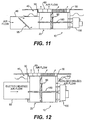
- a sixth embodiment of the terminal of the invention is the MIT-F, shown in Fig. 11.
- This terminal is akin to the MIT-D, but with the capability of pressure independent operation.
- the MIT-F includes an inlet duct 80 containing a pressure control damper 95, which is controlled by a thermostat sensing inlet pressure and velocity to maintain a constant flow of air for given thermal loads regardless of fluctuations in underfloor plenum pressure.
- the unit has dimensions of 10 inches (25.4 cm) long by 10 inches (25.4 cm) wide by 5 inches (12.7 cm) tall. The reduced height and pressure independent operation of this embodiment permits the MIT-F to operate in low floors, where the tighter space and varying plenum pressure render other units impractical or ineffective.
- a seventh embodiment of the modular terminal of the present invention is the MIT-G, shown in Fig. 12.
- This terminal is like the MIT-D, with the addition of a second air inlet 140 at the end of the terminal opposite the duct 80. Because of the combination of this second air inlet 140 with the damper 90, the MIT-G can provide three functions. First, by sliding the damper all the way to the right so the inlet to the plenum is closed, the MIT-G acts as a return unit. With the damper 90 in this position, the terminal 10 only can supply air from the duct 80. Second, the MIT-G provides a supply function from a pressurized floor plenum when the damper 90 is in an intermediate position or slid to the left. Third, this embodiment can act as a heating supply when the fan heater is on with the damper 90 all the way to the right, or can provide minimum ventilation by placing the damper 90 in an intermediate position to mix heated return air from the space and ventilating air from the floor plenum.
- the modular terminal components can also provide a FAM module, a floor module for electrical power and/or telecommunications applications.
- This module shares the size, appearance, and trim ring of the above described MITs, but is not used for HVAC application. Instead, the module has plates including electrical outlets or terminals for acceptance of computer components or telephones.
- the adaptability of the FAM module allows aesthetic coordination with room fixtures, outlets, and terminals, while reducing system costs.
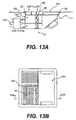
- the terminals of the invention also include the MIT-H, which includes either an MIT-A or MIT-B combined with an FAM unit, as shown in Fig. 13.
- both air flow and electrical wiring are introduced into the module, and the terminal 10 includes accessible outlets 150 at the floor 40.
- the terminal 10 includes accessible outlets 150 at the floor 40.
- one half of the upper portion of the module might have a grille 60, while another half might include outlets 150 for electricity or telecommunications purposes.
- Another embodiment of the present invention combines the functions of an MIT-C with a FAM unit to deliver an MIT-I, shown in Fig. 13A.
- the air is introduced on the motor 100 side of the housing 20, such as with the MIT-G.
- Fig. 14 illustrates a PAM, which is a personal air delivery module.
- This module can be any of the MITs previously discussed for air flow delivery function.
- all or a portion of the grille 60 is replaced with a duct connection for flexible duct serving a desktop and/or furniture.
- the damper motor 100 drives the damper 90 from one side of the housing 20 to the other in response to the control system commands.
- the damper 90 In the unoccupied mode, the damper 90 is typically driven to a minimum position or closed.
- the damper 90 In the occupied mode, the damper 90 is driven to the open position in response to a control device, which is preferably a thermostat or controller/thermostat. The position of the damper 90 is incrementally changed, either further open or closed, to satisfy the thermostat command.
- the controller operation may include a minimum position for ventilation purposes.
- Global control functions may include a reporting of the damper 90 position for purposes of adjusting the supply pressure delivered by the conditioned air handling system. Local temperature, setpoint, and occupancy may also be reported. Response of the damper motor 100 may be altered in software to provide damping and stabilization of the control response.
- Another mode of operation is a life safety mode that supports engineered smoke control functions. In the event of a fire, the temperature control and occupied/unoccupied modes are overridden to either fully close or open the damper 90 in response to the system requirements.
- the controller may additionally include an input point to monitor the position of the FAM cover 150 for security purposes, and an output point to control either power or telecommunications devices within the FAM portion of the unit.
- the MIT-F includes two dampers.
- the grille damper 90 within the housing 21 provides volumetric control, and is controlled in the same manner as discussed above.
- the pressure control damper 95 within the duct connection 80 modulates to maintain a relatively constant pressure at the inlet point to the grille damper 90, thereby providing pressure independent operation for the MIT-F.
- the pressure is regulated by the opening and closing of the pressure control damper 95 using the inlet pressure and space pressure as references.
- the inlet pressure to the grille damper 90 may be adjusted to deliver the quantity of air desired for the unit at maximum flow.
- the MIT-G follows the same control sequence as the MIT-C, MIT-D, and MIT-E when not in heating switchover operation.
- the damper 90 is typically driven to the plenum side of the housing 20, either fully or partially eliminating, to reduce to minimum ventilation settings the delivery of plenum air.
- the duct connection 80 is connected to a heated air source and/or another MIT-G, which acts as a return unit for a fan powered terminal or air handling system. In heating mode, the flow of air is governed by the air handling system connected to the duct with temperature and volume controlled by the air handling unit.
- the controls may include a switchover interlock in software to prevent the simultaneous operation of the heating and cooling.
- the unit may be desirable to permit the unit to deliver both warmed air from the duct and conditioned air from the plenum at the same time to provide reheat while cooling is being accomplished.
- the position of the damper 90 controls the volume or mixing of warmed and cooled air as needed to meet space conditions.
- the various models of the MIT of the present invention can be applied to a variety of HVAC systems, or more broadly to building designs, to provide a highly integrated and flexible system to meet the building user's needs. Without in any manner limiting the full scope and spirit of the invention, a few examples of systems incorporating the module terminals of the present invention will be described in more detail below. It is understood, however, that these examples are merely representative of the wide variety of applications and uses of the present invention.
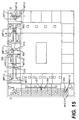
- FIG. 15 there is shown a partial plan view of a floor of a building incorporating an integrated HVAC system that includes the modular terminals and principles of the present invention.
- the building includes one or more equipment rooms having heating, refrigeration, and/or air handling equipment to serve the building.
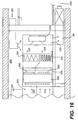
- An illustration of air handling equipment used to supply conditioned air to the floor plenums is described more fully in Figs. 16, 18, and 19 for purposes of example only.
- pressurized conditioned air is supplied to the underfloor plenum.
- the air is supplied through either conventional air handling systems, or from systems specifically modified to include the preferred dehumidification and filtering aspects described more fully below.
- heated air can be introduced to the terminals, in this embodiment, through ducts located in the outer perimeter of the building.
- the heated air is supplied by conventional heating and air handling systems known to persons skilled in the art.
- the outer perimeter zones of the building have to be periodically heated or cooled to provide the desired temperature within the perimeter zones.
- the interior spaces of the building typically only require constant or periodic cooling, which is achieved by the application of the conditioned air in the underfloor plenum system to modular terminals of the present invention, such as the MIT-A and MIT-C.
- the interior MITs receive air from the air handling system through the plenums and apply that air directly to the interior spaces.
- terminals such as the MIT-A can be used.
- sensors are placed in the system and those sensors control the motors, which in turn control the position of the dampers in variable air volume type MIT units, and thus the air flow.
- the perimeter zones need to be heated or cooled at different times of the year, or day. Moreover, the relative degree of cooling or heating needs to be controlled, relative to the load and the desired comfort of the person inhabiting the space.
- the modular terminals of the present invention can be applied in systems which optimally provide cooling and heating in response to individual or zone sensors and controls. Many different systems and combinations are possible, depending upon the HVAC characteristics of the building. Some exemplary examples are described below.
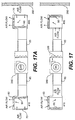
- FIG. 15 In space A of Fig. 15, there is shown a system in which two terminals of the present invention are controlled by a sensor 300 responsive to the temperature loads and needs in a single office in the perimeter of a building. Illustrative components of that system are set forth in Fig. 17, for purposes of illustrating how specific MITs and principles of the invention can be applied to provide heating and cooling of perimeter zones.
- the MIT 400 adjacent the exterior wall 350 of the building is an MIT-G.
- the inward MIT 410 in this embodiment is also an MIT-G, but is pointed in the opposite direction.
- the damper 90 in the outward MIT-G 400 is slid all the way to the right or to the stop required for minimum ventilation from the underfloor supply, and the damper 90 in the inward MIT-G 410 is slid all the way to the left, by control signals applied to the respective motors.
- the openings of the terminals to the plenum are closed to their respective minimum positions and the only air that can be supplied to the space is minimum ventilation or heated air returned from one or more terminals supplied through ducts applied to one or more other MITs.
- the air required for heating is returned from the space by the inward MIT-G 410 and supplied by the fan/heater 310 through the outward MIT-G 400 back to the space.
- the supply grille 60 is fully opened to the minimum ventilation stop.
- the damper on the inward MIT 410 is slid all the way to the left, thereby placing the grille 60 in the full open position and allowing it to function as a return from the conditioned space. This reduces the heating load of the equipment by not reheating cooled air in the plenum 230 for heating purposes.
- Fig. 17A when cooling of the space is required, the heating system and then subsequently the heating fan 310 are turned off, thereby cutting off the supply of hot air to and through the ducts 85.
- the slidable dampers 90 in the MITs 400, 410 can then be positioned through control signals to selectively open the inlets to the plenum and selectively vary the flow of cool air to the space, by changing the position of the dampers 90 in the MITs 400, 410. If additional cooling beyond the capacity of the MIT-G terminals is required, additional MIT-C cooling-only terminals can be added to the space, as illustrated in Fig. 15.
- the system disclosed in Figs. 15, 17, and 17A can be controlled through a thermostat 300 and actuator serving a given office or conference room space, or a larger zone. As shown in Fig. 15, several spaces can be controlled by a common thermostat 300, such system being shown as areas B and C.
- a corner office E similarly can have its own control.
- area D the heating is supplied for an entire wall of a given floor of a building and is independently controlled from a thermostat in a representative area to offset the cold transmitted through the wall or from any air leakage through the wall.
- individual room thermostats "trim" the temperature in response to individual room cooling loads.
- the return air is returned from vents in the ceiling into the equipment room 200, shown schematically in Fig. 16. Based upon the air handling system and its controls, some of that return air 220 may be exhausted to the outdoors at a given time.
- outside air 210 is introduced into the air handling unit 205 as desired, where it is mixed with return air 220 in the plenum 235, and then cooled and dehumidified through the coils 250.
- the conditioned air 225 is then mixed with bypassed return air 220, which has been cleaned by the high efficiency filter to achieve the desired supply air 228 temperature, as controlled by the top and bottom dampers 260.
- the fan 240 is then introduced into the underfloor plenum 230 by a fan 240 either directly or through the distribution duct 85 to pressurize the space.
- the fan 240 is a plenum type that provides additional sound attenuation and lower discharge velocity into the raised floor system or its distribution duct
- return air 220 from the ceiling of the spaces being conditioned returns at a temperature within the range of 78°F (26°C) to 80°F (27°C), and the air supplied to the plenum 230 is approximately 60°F (16°C) to 65°F (18°C), so that it is not uncomfortably cold when applied into the space.
- These temperatures represent examples of temperatures that can be optimally applied to an underfloor system.
- One aspect of the present invention is to control the flow and conditioning of the air in a manner which properly dehumidifies the air to beneficial limits, while also cleaning the air to achieve improved air quality.
- this is achieved by placing controllable dampers 260 in front of the cooling coils 250 of the refrigeration system and the high efficiency filter 265 to provide two flow channels to the fan 240.
- One channel flows air to the cooling coil 250, and the other channel flows the remaining air through a high efficiency filter 265 to filter out contaminants in the return air.
- the lower damper 260 is preferably controlled so that the air cooled by the cooling coil 250 reaches a temperature (e.g., 50°F (10°C)), to get desired dehumidification and cooling of the air as it flows through the coil 250.
- This conditioned air 225 for example in the range of 50°F (10°C), is then mixed with the filtered return air at approximately 78°F (26°C) before and while it is supplied to and through the fan.
- the mixed air temperature is controlled by modulating the upper damper 260.
- the high efficiency filter 265 is selected such that the pressure drop through the filter 265 is essentially the same as the pressure drop through the conditioning coil 250. Therefore, the mixed filtered air and cooled air are at substantially the same pressure and ultimately leave the fan 240 at substantially the same temperature, preferably in the range of 60°F (16°C) to 65°F (18°C).
- This aspect of the present invention thus provides air which is well dehumidified and clean, at substantially no increased operating cost.
- the underfloor system utilizes a greater flow of air for cooling (because of the higher temperature) and thereby provides very good filtering and excellent ventilation.
- a percentage of the air for example, 30% to 50%, is bypassed around the cooling coil 250, to thereby provide better dehumidification of the air. This permits the air passing through the coil to be cooled below the saturation temperature and thereby dehumidify the air as it passes through the coil.
- FIG. 19 Another air handling unit designed for application with an underfloor system of the present invention is the system illustrated in the block diagram in Fig. 19.
- a cooling fan 242 circulates air through a cooling coil 258 at a constant volume through a primary air side loop, and the other plenum pressurization fan 370 acts to maintain the desired flow pressure in response to varying air conditioning loads in the building.
- the cooling fan 242 preferably operates at a relatively low pressure and serves to maintain coil circulation as a function of load.
- the primary loop/cooling fan 242 would preferably be constant volume to prevent coil freeze-up, a problem common with variable air volume.
- This design permits the plenum fan 370 to maintain the plenum pressure at a fixed or adjustable set point.
- the air temperature applied to the plenum 230 is controlled by dampers 380, 385 that adjust the amount of air exchanged between the coil loop and the plenum loop. Through these dampers 380, 385 and the related components, the mixed air temperature applied to the plenum 230 can be precisely set to maintain the desired plenum temperature, which can be reset by load or fixed, as desired.
- the plenum fan 370 will vary the air volume and pressure to compensate for building load and the pressure increase from dirty filters.
- the dampers 380, 385 are preferably factory interlocked to work together to maintain proper mixing.
- the plenum pressurized fan 370 is speed controlled according to the pressure sensed in the plenum 230.
- the system of the present invention preferably includes either a chilled water air handling unit or a direct expansion air handling unit. Both units are preferably connected to a local return ceiling plenum and have full access to outside air through a duct connection.
- the outside air damper is normally closed and the return damper is normally open.
- the return damper is throttled to increase the negative pressure in the mixed air plenum and thereby draw in more outside air.
- the control system shall monitor the plenum pressure and adjust the damper position to obtain a plenum pressure that corresponds to the desired quantity of outside air. Because the plenum and dampers are generally constructed as a unit in the factory, the setpoints and calibration of the controls can be made prior to delivery to the field.
- the setpoints would be obtained by air balance readings.
- the unit is purposely packaged with the outside air damper more directly aligned with the chilled water coil section to create stratification of the outside stream from the return air stream. This feature assists in dehumidification of the outside air by directing the outside air to the cooling coil.
- the desired amount of outside air may be determined by measurement of carbon dioxide on a demand basis, by calculation of occupancy, by design setpoint, or from operator input.
- the control sequence shall convert the CFM requirement into a required mixed air plenum pressure and damper position. If the pressure losses in the outside air duct is large, a fan may be installed to deliver outside air to the unit.
- the make-up air fan speed would be modulated in response to the mixed air plenum pressure to maintain the setpoint rather than modulate the return air damper, or the air flow through the make-up fan could be measured with an air flow measuring device and the fan speed or outside air damper position could be controlled to maintain the desired air flow.
- the basic ventilation cycle is modified by an economizer cycle operation. If calculations indicate from comparison of the outside air conditions to the return air conditions that use of outside air beyond ventilation requirements is beneficial to energy reduction, the outside air damper is opened further as the return damper is further throttled to a fully closed position if necessary. Typically, the return damper closes to lower the ratio of return air to outside air and lower the discharge temperature when the outside air is cooler than the return air.
- the outside and return dampers modulate to maintain the desired mixed air temperature as established by a variable setpoint. This setpoint shall be the same, or slightly lower to account for fan heat, as the discharge air setpoint when the unit is used without chilled water.
- the temperature control dampers installed on the coil 250 and bypass are both typically open.
- the bypass damper shall be modulated closed to lower the temperature and modulated open to raise the temperature. If the bypass damper is fully open and the discharge temperature is below the setpoint, then the chilled water coil face damper shall modulate closed to raise the discharge air setpoint. If the chilled water coil face damper is partially in the open position, it first modulates open if the discharge temperature is above the setpoint, and then the bypass damper modulates closed, in sequence. Alternatively, a less energy efficient option would allow one damper to close as the other opens, the dampers operating in unison but opposite to each other.
- the temperature control dampers installed on the cooling inlet and system bypass are both normally open.
- the system bypass damper shall be modulated closed to lower the temperature and modulated open to raise the temperature. If the bypass damper is fully open and the discharge temperature is below the setpoint, then the cooling inlet discharge damper shall modulate closed to raise the discharge air setpoint. If the cooling inlet discharge damper is partially in the open position, it is first modulated open if the discharge temperature is above the setpoint, and then the bypass damper shall modulate closed, in sequence.
- the coil fan 242 shall operate whenever mechanical cooling is required and shutdown in economizer mode.
- This design provides a primary/secondary airside loop with the DX coil 258 in a constant volume primary loop and the ventilation/pressurization fan in a variable air volume secondary loop.
- Mechanical cooling requirements shall be controlled by demand starting/stopping the compressor, or compressors, and a coil fan 242.
- Both units utilize the same control method for fan speed.
- the units In the unoccupied and occupied modes, the units maintain a static pressure setpoint by raising or lowering the fan speed in response to a sensor that measures the plenum or duct static pressure.
- the setpoint may be an operator input value or a dynamic value determined from MIT demands. It shall also be adjusted to maintain desired air flow for occupied and unoccupied conditions.
- the fan speed In the event of a life safety or smoke purge command, the fan speed may be overridden to the full speed output for smoke purge or pressurization.
- the chilled water valve is modulated closed whenever the coil discharge air temperature is below the setpoint and modulated open when it is above the setpoint.
- the setpoint is determined from the return air temperature and relative humidity. On high humidity or high load, as determined by high return temperatures, the setpoint shall be lowered, and on low humidity or low load, as determined by low return temperatures, the setpoint shall be raised.
- the exhaust air is preferably controlled by a duct and damper that relieves air from the return plenum to the exterior.
- the damper shall be controlled to maintain a stable space pressure as established by the setpoint.
- an exhaust fan may also be used, with the fan speed modulated to maintain the stable space pressure setpoint.
- the chilled water air handling unit has good humidity control, delivers a constant volume of ventilation air while varying supply air volume, and provides a low airside pressure drop by placing the high efficiency filter restriction in parallel with the coil.
- This sidestream filtration method takes maximum advantage of the bypass design used to maintain a relatively high dry bulb discharge temperature with a colder coil discharge temperature.
- the direct expansion air handling unit delivers the same advantages as the chilled water air handling unit.
- two fans are used so the unit can operate in a variable air volume delivery mode while maintaining constant air flow across the DX coil.
- the coil fan can be turned off with the refrigeration to save energy.
- the economizer mode further energy is saved by shutting down the DX coil fan.
- this unit does not pass air through the coil when in the economizer mode. From a service and operational view, the constant air flow through the DX coil helps prevent coil freezing by lowering the humidity and maintaining the air velocity regardless of load on the system. This allows the unit to operate at lower load points and total air flow.
- the modular integrated terminals of the present invention can be incorporated into air distribution systems and HVAC systems that have unique properties.
- the MIT can be used to produce a perimeter heating/cooling system that can both heat and cool a zone with automatic switchover. It can also provide simultaneous heating in some spaces and cooling in others.
- the MIT air terminal can be used for air return and supply functions, and can switch over using the integral damper assembly. It can switch from plenum supply to duct supply, or use both. To applicant's knowledge, no known floor terminal systems have these capabilities.
- the invention permits the use of a modular terminal design that can be readily modified to meet a wide variety of HVAC needs and characteristics, while still keeping the same shape and size. This provides significant benefits in the design and manufacture phase of the terminal, as well as in the incorporation of the terminals of the present invention into a building. Moreover, the modular design permits the user to readily modify the HVAC system even after it is installed, since different modular terminals can be substituted for an installed terminal. The system is thus flexible and easy to modify, change, or add to at any given time.
- the modular integrated terminal of the present invention is designed to match the appearance of non-air distribution devices like electrical distribution boxes that preferably share components with the modular integrated terminals to match appearance.
- the modular terminal devices are designed to have a symmetrical shape, most preferably square, which permits the terminals to be rotated to a plurality of positions in standard sized holes in the floor. This allows the air inlets and other mechanisms in a given model of the terminal to be positioned in a manner that provides the optimum air flow characteristics for the particular system and space where the terminal is to be applied.
- the terminals of the present invention can also be designed to include non-air distribution functions such as the distribution of electrical power and/or telecommunication services.
- the present invention introduces the integration of specific interchangeable components within a common housing to produce terminals that have a broad range of applications.
- the interchangeable modular components allow the terminals of the present invention to be incorporated in plenum air distribution systems (pressurized or non-pressurized), ducted air distribution systems, or a simultaneous ducted and plenum distribution system.
- the terminals can be used to supply a single source of heated or cooled air.
- the modular system particularly when used for all HVAC, electrical, and telecommunications needs, provides the owner of a building with the ability to cost effectively adapt the interior environment to changing requirements over the life of the building structure. This allows a building to evolve in a real time mode, day-to-day, to accommodate user needs.
- the MIT-based HVAC system can be modified by people of limited skill levels as compared with the high skill levels demanded by present systems. Such modifications can be performed quickly and easily without specialized tools and equipment.
- the basic chassis can support one of several grille designs to provide the desired air flow characteristics. Grilles having different exit patterns on its opposite side can be turned in the chassis or flipped over to change the air pattern produced. The grilles can also be replaced to meet changing conditions. For example, one grille insert provides a connection point for a flexible duct that allows the terminal to act as an air valve for the distribution of air to furniture or desktop outlets. Because of the modularity of the present invention, major aspects of the system can be varied to meet space conditioning needs, even after the terminals are originally installed.
- the present invention when applied to underfloor HVAC systems is cost effective in original installation and application.
- the system can be readily revised, should changes in the space usage or refinements in the HVAC application be desired.
- the system also provides improved HVAC comfort and efficiency.
- the terminals and systems of the present invention can readily be incorporated into control systems that best meet the needs of the space and system into which they are incorporated.
- the terminals and any dampers or fans in the terminals can be fully integrated with controls to manage the flow of air in response to comfort, air quality, and life safety needs. Spaces to be heated can be zoned to personal preference with relative ease and expense.
- the terminals can provide comfort control by variable air volume delivery in response to a thermostat, air quality control by modulation of air flow in response to air quality need, and smoke control by modulation of air flow in response to sensed smoke.
- the terminals can operate in a stand alone, interconnected, or integrated mode with other building controls and systems.
- the present invention also substantially eliminates the need for much ductwork.
- the interior spaces of the building are cooled by the combination of the open plenum in the floor and the modular integrated terminals that are open to the plenum and supply cooling air as desired. While some ductwork may be needed to heat the outside perimeter of the building, even the terminals in that area apply cool air through the floor plenum.
- the present invention is relatively inexpensive to build and install.
- the present invention also provides better indoor air quality. Because the cooling air is introduced at a warmer temperature than a ceiling system, the system of the present invention applies a greater flow of air and therefore provides better ventilation. At the same time, the system pressure losses are typically less than conventional ceiling systems, thus resulting in opportunities for even lower operating costs than many overhead designs.
- the preferred embodiment of the invention also provides improved filtering of the air, at no increased operating cost. The air is also kept within acceptable humidity levels through the air handling aspects of the preferred embodiment. This decreases the risk of biological contamination.
- the present invention also provides relatively low operating costs.
- the system requires few fans and has low energy consumption.
- the underfloor system of the present invention can be applied with no increased building height.
- the overall first cost of the package is less than traditional ceiling designs.
- the system of the present invention is easier to engineer and has long term benefits for the building owner, such as less operation costs and lower costs associated with easier maintenance or revision.
Landscapes
- Engineering & Computer Science (AREA)
- Chemical & Material Sciences (AREA)
- Combustion & Propulsion (AREA)
- Mechanical Engineering (AREA)
- General Engineering & Computer Science (AREA)
- Duct Arrangements (AREA)
- Air-Flow Control Members (AREA)
- Central Air Conditioning (AREA)
Claims (71)
- Luftauslassmodul (10) zum Einbringen klimatisierter Luft in einen oder mehrere Räume innerhalb eines Gebäudes mit einer oder mehreren Oberflächen einschließlich Wänden, Böden und Decken, wobei das Luftauslassmodul (10) folgendes umfasst:wobei das Gehäuse (20) symmetrisch geformt ist, so dass es in einer Vielzahl von Ausrichtungen in die Öffnung passt, wodurch der Luftstrom durch das Gehäuse (20) durch Verändern der Ausrichtung des Gehäuses (20) innerhalb der Öffnung gesteuert werden kann.ein Gehäuse (20), das so bemessen ist, dass es in eine Öffnung in einer Fläche (40) des Gebäudes passt und einen Innenraum definiert; mindestens einen in dem Gehäuse (20) ausgebildeten Einlassluftdurchgang (70) zum Aufnehmen klimatisierter Luft von einer Quelle und in das Gehäuse (20), wobei der oder jeder Einlassluftdurchgang in einer Seitenwand des Gehäuses (20) ausgebildet ist;mindestens einen oben in dem Gehäuse (20) ausgebildeten Auslassluftdurchgang zum Zuführen klimatisierter Luft von dem Gehäuse (20) zu einem Raum innerhalb des Gebäudes,
- Luftauslassmodul nach Anspruch 1, das weiter einen Eingriffsflansch (30) umfasst, der auf dem Gehäuse ausgebildet ist, um mit einer Fläche (40) des Gebäudes in Eingriff zu kommen und das Gehäuse (20) relativ zu dem Gebäude an Ort und Stelle zu halten.
- Luftauslassmodul nach Anspruch 1, das weiter einen Flansch neben dem mindestens einen Lufteinlassdurchgang (70) als Verbindung zu einer Zufuhrleitung aufweist.
- Luftauslassmodul nach Anspruch 1, wobei die Steuerungsvorrichtung mindestens ein Gitter (60) zum Abdecken mindestens eines Teils des Auslassluftdurchgangs umfasst, wobei das Gitter (60) eine Vielzahl Luftstromschlitze (65) zum Leiten des Luftstroms von dem Gehäuse (20) nach außen aufweist.
- Luftauslassmodul nach Anspruch 4, wobei die Steuerungsvorrichtung des Weiteren mindestens einen elektrischen Auslass (150) aufweist.
- Luftauslassmodul nach Anspruch 1, wobei die Steuerungsvorrichtung mindestens eine Leitungsverbindung zum Abdecken mindestens eines Teils des Auslassluftdurchgangs umfasst, wobei die Leitungsverbindung eine Leitung zum Leiten des Luftstroms von dem Gehäuse (20) nach außen zu Einrichtungen innerhalb eines Gebäuderaums aufnimmt.
- Luftauslassmodul nach Anspruch 4, wobei die in dem Gitter (60) ausgebildeten Stromschlitze (65) den Luftstrom in eine erste Richtung leiten, wenn das Gitter (60) in einer ersten Position über dem Auslassluftdurchgang platziert ist, und den Luftstrom in eine zweite Richtung leiten, wenn das Gitter (60) in einer zweiten Position über dem Auslassluftdurchgang platziert ist.
- Luftauslassmodul nach Anspruch 4, wobei die Stromschlitze (65) senkrecht zur Außenfläche des Gitters (60) auf der einen Seite sind und in Bezug auf die Außenfläche des Gitters (60) auf der anderen Seite winkelig sind.
- Luftauslassmodul nach Anspruch 4, wobei die Stromschlitze (65) den Luftstrom in mindestens zwei unterschiedliche Richtungen leiten, wenn das Gitter (60) über den Auslassluftdurchgang des Gehäuses eingepasst ist.
- Luftauslassmodul nach Anspruch 4, wobei der Luftstrom durch mindestens einen der Stromschlitze (65) blockiert ist.
- Luftauslassmodul nach Anspruch 4, wobei mindestens zwei Gitter (60) mit ihren jeweiligen Luftstromschlitzen (65) über den Auslassluftdurchgang passen.
- Luftauslassmodul nach Anspruch 1, wobei die Steuerungsvorrichtung einen Schieber (90) im Inneren des Gehäuses (20) aufweist.
- Luftauslassmodul nach Anspruch 12, wobei der Schieber (90) gegenüber dem Lufteinlassdurchgang (70) ausgerichtet ist und relativ zum Lufteinlassdurchgang (70) beweglich ist, um dadurch den Strom klimatisierter Luft zum Gehäuse (20) durch den Lufteinlassdurchgang (70) zu steuern.
- Luftauslassmodul nach Anspruch 13, wobei ein Gitter (60) mit einer Vielzahl Stromschlitze über den Auslassluftdurchgang passt, wobei der Schieber (90) innerhalb des Gehäuses (20) beweglich ist und wobei der Schieber (90) sowohl den Luftstrom durch den Lufteinlassdurchgang (70) wie auch den Luftstrom durch den Auslassluftdurchgang beeinflusst, wenn der Schieber (90) von einer Position in die andere bewegt wird.
- Luftauslassmodul nach Anspruch 1, das weiterhin ein Gitter (60) mit einer Vielzahl Stromschlitze (65) umfasst, das über den Ausgangsluftdurchgang passt.
- Luftauslassmodul nach Anspruch 15, wobei die mindestens eine mit dem Gehäuse (20) verbundene Vorrichtung zum Steuern des Luftstroms durch das Gehäuse (20) einen Schieber (90) im Inneren des Gehäuses (20) aufweist, wobei der Schieber (90) gegenüber dem Lufteinlassdurchgang (70) ausgerichtet und relativ zum Lufteinlassdurchgang (70) beweglich ist, um dadurch den Strom klimatisierter Luft zum Gehäuse (20) durch den Lufteinlassdurchgang (70) zu steuern, und wobei weiterhin der Schieber (90) sowohl den Luftstrom durch den Lufteinlassdurchgang (70) wie auch den Luftstrom durch den Auslassluftdurchgang beeinflusst, wenn der Schieber (90) von einer Position zur anderen bewegt wird, wobei der Schieber des Weiteren eine verschiebbare Platte (90) aufweist, die so bemessen ist, dass sie den Luftstrom vom Lufteinlassdurchgang (70) abblockt, wenn sie sich neben dem Lufteinlassdurchgang (70) befindet, wobei die Platte (90) sich neben den Stromschlitzen des Gitters (60) erstreckt und den Luftstrom zu den Stromschlitzen (65) des Gitters (60) auf der Seite der Platte gegenüber dem Lufteinlassdurchgang (70) blockiert.
- Luftauslassmodul nach Anspruch 16, wobei der Schieber (90) so bemessen ist, dass er das meiste oder den gesamten Lufteinlassdurchgang abdeckt, wenn er direkt neben dem Lufteinlassdurchgang (70) platziert wird.
- Luftauslassmodul nach Anspruch 17, das weiterhin eine Vorrichtung (100) zum selektiven Verändern der Position des Schiebers (90) umfasst.
- Luftauslassmodul nach Anspruch 18, wobei die Vorrichtung einen Motor (100) und eine mechanische Verbindung (160) zwischen dem Motor und dem Schieber (90) aufweist.
- Luftauslassmodul nach Anspruch 19, wobei die mechanische Verbindung eine Gewindeführungsschraube (160) ist.
- Luftauslassmodul nach Anspruch 15, das weiterhin einen Flansch umfasst, der sich neben dem Lufteinlassdurchgang (70) als Verbindung zu einer Zufuhrleitung befindet.
- Luftauslassmodul nach Anspruch 21, das weiterhin mindestens einen zweiten Einlassluftdurchgang (140) zum Aufnehmen eines Luftstroms von einem Kanal innerhalb des Gebäudes umfasst.
- Luftauslassmodul nach Anspruch 22, wobei der mindestens eine zweite Einlassluftdurchgang (140) von dem anderen Einlassluftdurchgang (70) radial positioniert ist.
- Luftauslassmodul nach Anspruch 22, das weiterhin einen Schieber (90) gegenüber mindestens einem von dem ersten und zweiten Lufteinlassdurchgang (70, 140) und eine Induktionshülse (110) umfasst, die innerhalb der Flansche neben dem ersten Lufteinlassdurchgang (70) verschiebbar ist.
- Luftauslassmodul nach Anspruch 24, wobei der Schieber (90) eine Platte ist, die innerhalb des Innenraums des Gehäuses (20) verschiebbar ist, und die Induktionshülse (110) an der Platte (90) befestigt ist.
- Luftauslassmodul nach Anspruch 24, wobei die Platte (90) so bemessen ist, dass sie den Luftstrom durch den Einlassluftdurchgang (70) im Wesentlichen blockiert, wenn sie direkt neben den Einlassluftdurchgang (70) geschoben wird.
- Luftauslassmodul nach Anspruch 26, wobei die Induktionshülse (110) eine zylindrische Hülse mit einer Vielzahl von Löchern (115) ist, die auf ihr in Längsrichtung ausgebildet sind.
- Luftauslassmodul nach Anspruch 27, wobei eine Vielzahl von Positionierungsknöpfen (120) zum Vorsehen eines Abstands zwischen der Induktionshülse (110) und dem Flansch neben dem Einlassluftdurchgang (70) auf mindestens einer Fläche der Oberflächen der Induktionshülse (110) und des Flansches ausgebildet sind.
- Luftauslassmodul nach Anspruch 21, das des Weiteren einen Drucksteuerungsschieber (95) umfasst, der innerhalb des neben dem Einlassluftdurchgang (70) positionierten Flansches ausgebildet ist.
- Luftauslassmodul nach Anspruch 29, wobei der Drucksteuerungsschieber (95) drehbar an dem Flansch befestigt ist.
- Luftauslassmodul nach Anspruch 1, wobei die mindestens eine mit dem Gehäuse (20) verbundene Vorrichtung zum Steuern des Luftstroms durch das Gehäuse einen Schieber (90) in Form einer Platte aufweist, die im Innenraum des Gehäuses verschiebbar ist und wobei das Modul zwei in dem Gehäuse ausgebildete Einlassluftdurchgänge (70, 140) aufweist, wovon einer auf jeder Seite des Schiebers (90) ausgebildet ist.
- Luftauslassmodul nach Anspruch 31, das weiterhin einen Flansch neben einem der zwei Einlassluftdurchgänge (70, 140) als Verbindung zu einer Leitung umfasst.
- Luftauslassmodul nach Anspruch 32, wobei die Platte (90) so bemessen ist, dass sie im Wesentlichen den Luftstrom durch jeden der Lufteinlassdurchgänge (70, 140) blockiert, wenn sie direkt neben den jeweiligen Einlassluftdurchgang (70, 140) geschoben wird.
- Luftauslassmodul nach Anspruch 33, wobei mindestens ein in dem Gehäuse (20) ausgebildeter Anschlag verhindert, dass die Platte (90) eine Position neben mindestens einem Einlassluftdurchgang (70, 140) erreicht.
- Luftauslassmodul nach Anspruch 1, wobei das Gehäuse (20) sich in fluidischer Verbindung mit einem Unterboden-Kanal innerhalb des Gebäudes befindet, dem klimatisierte Luft zugeführt werden soll, und wobei die klimatisierte Luft dem Unterboden-Kanal durch ein Luftbeförderungssystem zugeleitet wird.
- Luftauslassmodul nach Anspruch 35, wobei der mindestens eine Einlassluftdurchgang (70) auf jeweils mindestens einer lateralen Seite des Gehäuses (20) ausgebildet ist und wobei die mindestens eine Vorrichtung zum Steuern des Luftstroms einen Schieber (90) im Inneren des Gehäuses (20) aufweist, wobei der Schieber (90) gegenüber dem einen Einlassluftdurchgang (70) ausgerichtet ist und relativ zu jenem Einlassluftdurchgang (70) beweglich ist, um dadurch den Strom klimatisierter Luft zum Gehäuse (20) durch jenen Einlassluftdurchgang (70) zu steuern, wobei der Schieber (90) des Weiteren eine verschiebbare Platte (90) aufweist, die so bemessen ist, dass sie den Luftstrom von dem Einlassluftdurchgang (70) blockiert, wenn sie sich neben jenem Einlassluftdurchgang (70) befindet, und den Luftstrom von jenem Einlassluftdurchgang (70) zum Auslassluftdurchgang auf der Seite der Platte (90) gegenüber dem Einlassluftdurchgang (70) blockiert.
- Luftauslassmodul nach Anspruch 36, das weiterhin eine Vielzahl der Luftauslassmodule (10) aufweist, die in fluidischer Verbindung mit dem Unterboden-Kanal platziert sind.
- Luftauslassmodul nach Anspruch 37, wobei das Luftbeförderungssystem des Weiteren folgendes aufweist:mindestens einen Lüfter (240) zum Zuführen klimatisierter Luft zum Unterboden-Kanal (230);einen Ablufteinlass zum Aufnehmen von Abluft (220) aus dem Gebäude; einen Eingangskanal zum selektiven Mischen bei Bedarf und zum Leiten von Abluft (220) und Außenluft (210);eine Kühlschlange (250);ein Filter (265);einen ersten Stromschlitz von dem Eingangskanal (235) zu dem Filter (265) und einen zweiten Stromschlitz von dem Eingangskanal (235) zur Kühlschlange (250); undein Schiebersystem (260) zum selektiven Leiten eines Teils des Luftstroms von dem Eingangskanal (235) durch die Kühlschlange (250) und des restlichen Teils der Luft von dem Eingangskanal (235) durch das Filter (265); undeinen dritten Stromschlitz stromabwärts von der Kühlschlange (250) und dem Filter (265) zum Aufnehmen von Luft (220, 225) von der Kühlschlange (250) und dem Filter (265), zum Mischen der Luft und zum Zuführen der vermischten Luft zu dem Unterboden-Kanal (230).
- Luftauslassmodul nach Anspruch 38, das des Weiteren ein Steuerungssystem umfasst, welches das Schiebersystem (260) selektiv betreibt, so dass die von der Kühlschlange gekühlte Luft eine Temperatur erreicht, die ausreichend niedrig ist, um eine Entfeuchtung der Luft vorzusehen, wenn sie durch die Kühlschlange (250) strömt.
- Luftauslassmodul nach Anspruch 39, wobei das Steuerungssystem das Schiebersystem (260) selektiv betreibt, so dass das Luftvolumen, das das Filter (265) verlässt, sich mit der Luft vermischt, die aus der Kühlschlange (250) austritt, um einen vorgegebenen Temperaturbereich beizubehalten.
- Luftauslassmodul nach Anspruch 38, wobei das Filter (265) ein Hochleistungsfilter ist, das so ausgewählt ist, dass der Druckabfall durch das Filter (265) im Wesentlichen derselben ist wie der Druckabfall durch die Klimatisierungsschlange (250), wodurch die vermischte gefilterte Luft und die dem dritten Stromschlitz zugeführte gekühlte Luft im Wesentlichen im selben Druckbereich liegen.
- Luftauslassmodul nach Anspruch 38, wobei das Schiebersystem einen mit der Kühlschlange (250) ausgerichteten Außenschieber (260) aufweist.
- Luftauslassmodul nach Anspruch 38, wobei das Schiebersystem einen mit dem Filter (265) ausgerichteten Rückschieber (260) aufweist.
- Luftauslassmodul nach Anspruch 39, wobei das Steuerungssystem das Schiebersystem (280) betreibt, um zu bewirken, dass mindestens ein Teil der letztendlich dem dritten Schlitz zugeführten Luft dem Filter (265) zugeführt wird.
- Luftauslassmodul nach Anspruch 37, wobei das Luftbeförderungssystem folgendes aufweist: einen Primärkanal zum Mischen der Abluft (220) und der klimatisierten Luft und zum Zuführen der vermischten Luft zu dem Unterboden-Kanal (230);
mindestens einen Lüfter (370) innerhalb des Primärkanals zum Zuführen von Druckluft zu dem Kanal (230);
ein Sekundärkühlkreis in fluidischer Verbindung mit dem Primärkanal; mindestens eine Kühlschlange (258) innerhalb des Sekundärkühlkreises; mindestens einen Lüfter (242) innerhalb des Sekundärkühlkreises, um Luft durch die Schlange (258) strömen zu lassen und zurück zum Primärkanal zu führen; und
ein Schiebersystem (380, 385) zum Steuern des Luftstroms in den Sekundärkühlkreis hinein und aus ihm heraus nach Maßgabe vorher gewählter Kriterien. - Luftauslassmodul nach Anspruch 45, wobei die dem Kanal (230) zugeführte Lufttemperatur durch Schieber (380, 385) gesteuert bzw. geregelt wird, welche die zwischen dem Sekundärkühlkreis und dem Primärkanal ausgetauschte Luftmenge justieren.
- Luftauslassmodul nach Anspruch 45, das des Weiteren ein Hochleistungsfilter innerhalb des Primärkanals aufweist.
- Luftauslassmodul nach Anspruch 45, wobei der mindestens eine Lüfter (370) innerhalb des Primärkanals das Luftvolumen und den Luftdruck verändert, um eine sich aufbauende Belastung auszugleichen.
- Luftauslassmodul nach Anspruch 45, das weiterhin Schieber aufweist, um dem Primärkanal selektiv Außenluft zuzuführen.
- Luftauslassmodul nach Anspruch 47, wobei Warmluft in ausgewählte Auslässe durch Leitungen (85) eingeführt wird und gekühlte Luft den ausgewählten Auslässen durch den Unterboden-Kanal (230) zugeführt wird.
- Luftauslassmodul nach Anspruch 50, das ein erstes und ein zweites Luftauslassmodul (400, 410) aufweist, die durch eine Heizleitung (85) miteinander verbunden sind, die mit einer Heizspule und einem Lüfter (310) verbunden ist, wobei die Auslässe (400, 410) Einlässe in die Heizleitung (85) bzw. den Kanal (230) bzw. den Innenraum aufweisen.
- Luftauslassmodul nach Anspruch 51, das ein Schiebersystem (90) zum Verschließen der Einlässe in den Kanal (230) aufweist, wenn die Auslässe (400, 410), die mit der Heizleitung (85) verbunden sind, sich in einem Heizmodus befinden, wodurch gestattet wird, dass ein Auslass (410) Abluft vom Innenraum zu der Heizspule und zu dem Lüfter (310) zuführt und der andere Auslass (400) dem Innenraum erwärmte Luft von der Heizspule und dem Lüfter (310) zuführt.
- Luftauslassmodul nach Anspruch 51, das ein Schiebersystem (90) zum teilweisen Verschließen der Einlässe in den Kanal (230) aufweist, wenn die Auslässe, die mit dem Heizkanal (85) verbunden sind, sich in einem Heizmodus befinden, wodurch gestattet wird, dass ein Auslass (410) Abluft vom Innenraum der Heizspule und dem Lüfter (310) zuführt und der andere Auslass (400) dem Innenraum erwärmte Luft von der Heizspule und dem Lüfter (310) und Lüftungsluft von dem Kanal (230) zuführt.
- Luftauslassmodul nach Anspruch 51, wobei das Schiebersystem (90) den Luftstrom von dem Kanal (230) in die Auslässe (400, 410) mit ausgewählter Geschwindigkeit gestattet, wenn sich die Auslässe (400, 401) in einem Abkühlmodus befinden.
- Luftauslassmodul nach Anspruch 54, wobei das Schiebersystem (90) den Strom gekühlter Luft zu dem Raum selektiv verändert, indem es die Position der Schieber (90) innerhalb der Auslässe (400, 401) verändert.
- Luftauslassmodul nach Anspruch 37, wobei einzelne Räume innerhalb des Gebäudes eine Temperaturfühlvorrichtung (300) aufweisen und wobei die Stromsteuerungsvorrichtungen innerhalb der Auslässe in Ansprechung auf die gemessene Raumtemperatur selektiv geöffnet und geschlossen werden.
- Luftauslassmodul nach Anspruch 1, wobei das Gehäuse (20) in fluidischer Verbindung mit einem Kanal innerhalb des Gebäudes steht, dem klimatisierte Luft zugeführt werden soll, und wobei die klimatisierte Luft dem Kanal durch ein Luftbeförderungssystem zugeführt wird, wobei das Luftbeförderungssystem weiterhin folgendes aufweist:mindestens einen Lüfter (240) zum Zuführen klimatisierter Luft zu dem Unterboden-Kanal (230);einen Ablufteinlass zum Aufnehmen von Abluft (220) aus dem Gebäude; einen Eingangskanal zum selektiven Mischen bei Bedarf und zum Leiten von Abluft (220) und Außenluft (210);eine Kühlschlange (250);ein Filter (265);einen ersten Stromkanal vom Eingangskanal (235) zu dem Filter (265) und einen zweiten Stromkanal vom Eingangskanal (235) zu der Kühlschlange (250);ein Schiebersystem (260) zum selektiven Leiten eines Teils des Luftstroms vom Eingangskanal (235) durch die Kühlschlange (250) und des übrigen Teils der Luft vom Eingangskanal (235) durch das Filter (265); undeinen dritten Stromkanal stromabwärts von der Kühlschlange (250) und dem Filter (265) zum Aufnehmen von Luft (220, 225) von der Kühlschlange (250) und dem Filter (265), zum Vermischen der Luft und zum Zuführen der vermischten Luft zu dem Unterboden-Kanal (230).
- Verfahren zum Zuführen klimatisierter Luft in einen oder mehrere Räume innerhalb eines Gebäudes mit einer oder mehreren Flächen einschließlich Wänden, Böden und Decken, wobei das Verfahren folgendes umfasst:dadurch gekennzeichnet, dass das Verfahren weiterhin das selektive Verändern der Ausrichtung des Auslasses (10) und von dessen Einlassluftdurchgang (70) hinsichtlich des Stroms klimatisierter Luft in dem Kanal umfasst, um dadurch den Luftstrom in den Auslass (10) zu verändern.Ausbilden eines Unterboden-Kanals (230) innerhalb des Gebäudes; Zuführen klimatisierter Luft zu dem Unterboden-Kanal (230) durch ein Luftbeförderungssystem;Platzieren einer Vielzahl Luftauslassmodule (10) innerhalb des Bodens des Gebäudes, wobei jedes Luftauslassmodul (10) ein Gehäuse, mindestens einen Einlassluftdurchgang (70) in fluidischer Verbindung mit einer Luftquelle in einer Seitenwand des Gehäuses und mindestens einen Auslassluftdurchgang oben in dem Gehäuse zum Zuführen klimatisierter Luft zu einem Raum innerhalb des Gebäudes besitzt;Messen eines Parameters innerhalb eines oder mehrerer Räume, die innerhalb des Gebäudes klimatisiert werden sollen; undSteuern des Stroms klimatisierter Luft durch die Luftauslassmodule (10) nach Maßgabe des gemessenen Parameters;
- Verfahren nach Anspruch 58, wobei die Luftquelle für mindestens ein Luftauslassmodul (10) der Unterboden-Kanal (230) ist.
- Verfahren nach Anspruch 58, wobei die Luftquelle für mindestens ein Luftauslassmodul (10) eine Leitung (85) ist.
- Verfahren nach Anspruch 59, wobei der Schritt des Steuerns mindestens zum Teil durch eine Vorrichtung (90) erreicht wird, die in einem oder mehreren der Luftauslassmodule (10) eingebaut ist.
- Verfahren nach Anspruch 61, wobei die Vorrichtung ein beweglicher Schieber (90) ist.
- Verfahren nach Anspruch 62, wobei der bewegliche Schieber (90) gesteuert wird, um einen im Wesentlichen konstanten Luftstrom ungeachtet von Schwankungen in dem Unterboden-Kanal (230) beizubehalten.
- Verfahren nach Anspruch 62, das den Schritt des Zuführens klimatisierter Luft durch einen Auslassluftdurchgang mindestens eines Auslasses (10) mit im Wesentlichen derselben Geschwindigkeit bei allen Belastungsbedingungen aufweist, bei denen klimatisierte Luft erforderlich ist.
- Verfahren nach Anspruch 60, das weiterhin den Schritt des selektiven Zuführens erwärmter Luft zu mindestens einigen Auslässen (10) umfasst, wenn das Heizen eines Raums erforderlich ist.
- Verfahren nach Anspruch 65, das des Weiteren den Schritt des selektiven Absaugens von Abluft durch einige Auslässe (10), des Erwärmens dieser Luft und dann des Zuführens der erwärmten Luft zu anderen Auslässen umfasst, wenn das Heizen eines Raums erforderlich ist.
- Verfahren nach Anspruch 59, wobei ein justierbarer Schieber (90) direkt mit mindestens einem Auslass (10) verbunden ist und das weiterhin den Schritt des selektiven Justierens der Position des Schiebers (90) in Ansprechung auf den gemessenen Parameter in dem Raum, der von dem Auslass (10) beschickt wird, umfasst.
- Verfahren nach Anspruch 67, wobei der Schieber (90) sowohl den Luftstrom durch den Einlassluftdurchgang (70) wie auch den Luftstrom durch den Ausgangsluftdurchgang beeinflusst, wenn er von einer Position zur anderen justiert wird.
- Verfahren nach Anspruch 58, welches weiterhin folgendes umfasst:Aufnehmen der Abluft von der Decke;Zirkulieren mindestens eines Teils der Abluft, falls erforderlich, durch eine Kühlschlange auf eine Temperatur, die ausreichend niedrig ist, um eine Entfeuchtung der Abluft vorzusehen, wenn sie durch die Schlange strömt; Zuführen mindestens eines Teils der übrigen Abluft durch ein Filter zum Reinigen der Luft; undZuführen eines Gemisches der gekühlten und gefilterten Abluft zu dem Unterboden-Kanal.
- Verfahren nach Anspruch 59, das weiterhin das Umgehen einer Kühlschlange umfasst, wenn das Kühlen eines Raums mit Außenluft gewünscht ist, um dadurch Druckverluste im Zusammenhang mit durch die Kühlschlange strömender Luft zu vermeiden.
- Verfahren nach Anspruch 58, das den Schritt des Zirkulierens von Abluft von Öffnungen in der Decke zu einem Luftbeförderungssystem, das Klimatisieren der Abluft mit dem Luftbeförderungssystem und das Zuführen der klimatisierten Luft zu dem Unterboden-Kanal aufweist.
Applications Claiming Priority (3)
| Application Number | Priority Date | Filing Date | Title |
|---|---|---|---|
| US08/916,218 US6019677A (en) | 1997-08-22 | 1997-08-22 | Modular integrated terminals and associated systems for heating and cooling |
| US916218 | 1997-08-22 | ||
| PCT/US1998/017213 WO1999010685A1 (en) | 1997-08-22 | 1998-08-20 | Modular integrated terminals and associated systems for heating and cooling |
Publications (2)
| Publication Number | Publication Date |
|---|---|
| EP1007888A1 EP1007888A1 (de) | 2000-06-14 |
| EP1007888B1 true EP1007888B1 (de) | 2004-06-16 |
Family
ID=25436895
Family Applications (1)
| Application Number | Title | Priority Date | Filing Date |
|---|---|---|---|
| EP19980943257 Expired - Lifetime EP1007888B1 (de) | 1997-08-22 | 1998-08-20 | Integrale luftauslassmodule und dazugehörige heiz- und kühlsysteme |
Country Status (11)
| Country | Link |
|---|---|
| US (2) | US6019677A (de) |
| EP (1) | EP1007888B1 (de) |
| CN (1) | CN1161571C (de) |
| AU (1) | AU9108898A (de) |
| CA (1) | CA2300861C (de) |
| DE (1) | DE69824602T2 (de) |
| ES (1) | ES2218850T3 (de) |
| MY (1) | MY123190A (de) |
| TW (1) | TW403826B (de) |
| WO (1) | WO1999010685A1 (de) |
| ZA (1) | ZA987589B (de) |
Cited By (1)
| Publication number | Priority date | Publication date | Assignee | Title |
|---|---|---|---|---|
| RU2471127C2 (ru) * | 2007-03-23 | 2012-12-27 | Биг Дачман Интернэшнл Гмбх | Шторный воздушный клапан для вентиляции закрытых зданий |
Families Citing this family (73)
| Publication number | Priority date | Publication date | Assignee | Title |
|---|---|---|---|---|
| US6571711B1 (en) * | 1999-10-29 | 2003-06-03 | Air Motion Systems, Inc. | Print cylinder cooling system |
| US6234894B1 (en) * | 2000-03-13 | 2001-05-22 | Mark A. Goracke | Forced air vent register |
| US6540605B1 (en) | 2001-12-21 | 2003-04-01 | Gaetan Lesage | Air circulating method and device |
| CN100390470C (zh) * | 2002-04-03 | 2008-05-28 | 陆国强 | 室内空气自动保洁器 |
| US6986708B2 (en) * | 2002-05-17 | 2006-01-17 | Airfixture L.L.C. | Method and apparatus for delivering conditioned air using dual plenums |
| US6945866B2 (en) * | 2002-05-17 | 2005-09-20 | Airfixture L.L.C. | Method and apparatus for delivering conditioned air using pulse modulation |
| US20070066213A1 (en) * | 2002-05-17 | 2007-03-22 | Andrew Helgeson | Variable air volume time modulated floor terminal |
| US7232369B2 (en) * | 2003-04-04 | 2007-06-19 | Smithgroup, Inc. | System and method for providing heating, ventilation and air conditioning |
| US6919809B2 (en) * | 2003-11-03 | 2005-07-19 | American Standard International Inc. | Optimization of building ventilation by system and zone level action |
| US7497773B1 (en) * | 2003-11-06 | 2009-03-03 | Schmidt Gary D | Ceiling mounted fan ventilation device |
| US20050124408A1 (en) * | 2003-12-08 | 2005-06-09 | Vlazny Kenneth A. | Systems and methods for accessing, manipulating and using funds associated with pari-mutuel wagering |
| US8128485B2 (en) * | 2003-12-08 | 2012-03-06 | United Tote Company | Systems and methods for accessing, manipulating and using funds associated with lottery-type games |
| US7922585B2 (en) * | 2003-12-08 | 2011-04-12 | United Tote Company | Methods and systems for communicating parimutuel wager details and results |
| US7057506B2 (en) * | 2004-01-16 | 2006-06-06 | Hewlett-Packard Development Company, L.P. | Cooling fluid provisioning with location aware sensors |
| US6981915B2 (en) * | 2004-03-15 | 2006-01-03 | Hewlett-Packard Development Company, L.P. | Airflow volume control system |
| CA2506008C (en) * | 2004-04-30 | 2013-01-15 | David Gau | Repositionable attenuator |
| CA2567142C (en) * | 2004-05-27 | 2011-03-29 | E.H. Price Ltd. | Modular floor terminal with damper |
| CN101014524A (zh) * | 2004-06-30 | 2007-08-08 | 奥蒂斯电梯公司 | 带有消散性通风通道的电梯轿厢轿顶 |
| US8540557B1 (en) | 2004-08-02 | 2013-09-24 | Bard Manufacturing Company | Wall curb for air treatment system |
| US7722449B2 (en) * | 2004-10-20 | 2010-05-25 | E.H. Price, Limited | Air channel grill for security institutions |
| US8066558B2 (en) * | 2004-11-24 | 2011-11-29 | Honeywell International Inc. | Demand control ventilation sensor failure |
| US20080207109A1 (en) * | 2005-01-06 | 2008-08-28 | Oy Halton Group Ltd. | Ventilation Register and Ventilation Systems |
| US7628686B2 (en) * | 2005-04-29 | 2009-12-08 | E.H. Price Ltd. | Modular floor terminal basket with damper |
| US7819730B2 (en) * | 2005-05-27 | 2010-10-26 | Virgil David Ascroft | Flush mount or drop in wood and/or wood composition floor vent |
| US7889516B2 (en) * | 2007-05-22 | 2011-02-15 | At&T Intellectual Property I, L.P. | Cable management system with inspection window |
| DK2030651T3 (da) * | 2007-09-03 | 2012-06-18 | Erwin Gasser | Beskyttelsesindretning til ventilationskanaler |
| US20090186572A1 (en) * | 2008-01-22 | 2009-07-23 | Gerald Farrell | Air distributing apparatus for reducing energy consumption |
| US8382565B2 (en) | 2008-06-09 | 2013-02-26 | International Business Machines Corporation | System and method to redirect and/or reduce airflow using actuators |
| US8251784B2 (en) | 2008-06-09 | 2012-08-28 | International Business Machines Corporation | System and method to route airflow through dynamically changing ducts |
| SE0801663L (sv) * | 2008-07-10 | 2009-09-22 | Lindab Ab | Tryckfördelningslåda |
| US20100070092A1 (en) * | 2008-09-16 | 2010-03-18 | Williams Furnace Company | System and method for controlling a room environment |
| US20100130121A1 (en) * | 2008-11-26 | 2010-05-27 | Ming-Tsung Chiu | Air intake switching device for portable air conditioner |
| FR2944861A1 (fr) * | 2009-04-24 | 2010-10-29 | Ltb Sa | Salon fumoir a renouvellement d'air par flux laminaire |
| EP2430372A1 (de) * | 2009-05-01 | 2012-03-21 | Mark Clawsey | Ventilatorsystem zur luftrückführung und zur regulierung der innentemperatur |
| US8483883B1 (en) * | 2009-06-16 | 2013-07-09 | David Stanley Watson | System and method for controlling supply fan speed within a variable air volume system |
| US20110097989A1 (en) * | 2009-10-22 | 2011-04-28 | Walnut Manufacturing LLC | Method and apparatus for desktop air conditioning |
| US20110121087A1 (en) * | 2009-11-20 | 2011-05-26 | Airfixture Llc | Under-floor trough with heating element |
| US20100130117A1 (en) * | 2010-01-20 | 2010-05-27 | Larsen Arthur E | Method and apparatus for data center air conditioning |
| US8733060B2 (en) * | 2010-09-09 | 2014-05-27 | Tate Access Floors Leasing, Inc. | Directional grate access floor panel |
| USD636099S1 (en) | 2010-09-09 | 2011-04-12 | Tate Access Floors Leasing, Inc. | Grate access floor panel |
| US9148981B2 (en) * | 2010-10-15 | 2015-09-29 | Kevin Brandon Beck | Apparatus and method for facilitating cooling of an electronics rack |
| US20120100798A1 (en) * | 2010-10-20 | 2012-04-26 | Kingspan Holdings (Irl) Limited | Data center modular integrated floor diffuser and assembly |
| US10058012B2 (en) * | 2010-12-17 | 2018-08-21 | Tate Access Flooring Leasing, Inc. | Multizone variable damper for use in an air passageway |
| US8641492B2 (en) * | 2010-12-27 | 2014-02-04 | Gary Meyer | Directional flow raised floor air-grate |
| CN102022783A (zh) * | 2010-12-31 | 2011-04-20 | 广东欧科空调制冷有限公司 | 一种地槽式风机盘管机组 |
| US9551496B2 (en) * | 2011-04-20 | 2017-01-24 | Dan P. McCarty | Displacement-induction neutral wall air terminal unit |
| US20130052936A1 (en) * | 2011-08-31 | 2013-02-28 | John C. Jordan | Heating and cooling ventilation system |
| USD668359S1 (en) | 2011-12-01 | 2012-10-02 | Tate Access Floors Leasing, Inc. | Access floor panel |
| US8511022B2 (en) * | 2012-01-20 | 2013-08-20 | Tate Access Floors Leasing, Inc. | Access floor panel having intermingled directional and non-directional air passageways |
| US9127854B2 (en) | 2012-04-12 | 2015-09-08 | Airfixture Llc | Damper vane and housing construction |
| US8782976B2 (en) * | 2012-11-05 | 2014-07-22 | Gary Meyer | Bi-surfaced raised access floor panel and cold isle forming system in a data center |
| EP2740665B1 (de) * | 2012-12-10 | 2017-02-08 | Airbus Operations GmbH | Verbessertes verfahren und system für notbelüftung und -bedruckung einer flugzeugkabine |
| JP5670529B1 (ja) * | 2013-09-10 | 2015-02-18 | 新日鉄住金エンジニアリング株式会社 | サーバーラック室内システム |
| US10365006B2 (en) * | 2013-10-08 | 2019-07-30 | Airfixture, Llc | Air diffuser with manual and motorized plates |
| TWI588419B (zh) * | 2014-03-24 | 2017-06-21 | 台達電子工業股份有限公司 | 分離式模組之空調設備組合 |
| DE202015101093U1 (de) * | 2015-03-06 | 2016-06-07 | Werner Wildeboer | Volumenstromregleranordnung |
| WO2016143455A1 (ja) * | 2015-03-11 | 2016-09-15 | 株式会社デンソー | 空気吹出装置 |
| US9832912B2 (en) * | 2015-05-07 | 2017-11-28 | Dhk Storage, Llc | Computer server heat regulation utilizing integrated precision air flow |
| CN105627449A (zh) * | 2016-01-05 | 2016-06-01 | 青岛海尔空调电子有限公司 | 一种带有进风缓冲功能的桌式空调 |
| US10251313B2 (en) * | 2016-03-21 | 2019-04-02 | Raymond & Lae Engineering, Inc. | Air-grate floor panel sub-plenum retrofit add on multi-directional plume |
| US10663189B2 (en) * | 2016-11-19 | 2020-05-26 | Harris Environmental Systems, Inc. | Environmental room with reduced energy consumption |
| KR102391356B1 (ko) * | 2017-04-28 | 2022-04-28 | 삼성전자주식회사 | 공기조화기 |
| US10641518B2 (en) * | 2017-12-06 | 2020-05-05 | Perfect Vents, Inc. | Floor vent assembly |
| JP7072164B2 (ja) * | 2018-03-09 | 2022-05-20 | 清水建設株式会社 | 床吹出口装置 |
| DE102018215410A1 (de) * | 2018-09-11 | 2020-03-12 | Wilhelm Bruckbauer | Mauerkasten-System für ein Lüftungssystem |
| CN109579185A (zh) * | 2018-12-07 | 2019-04-05 | 安徽省人防建筑设计研究院 | 一种人防工程用送风系统 |
| EP4154920A1 (de) * | 2021-09-24 | 2023-03-29 | Carrier Corporation | Luftbehandlungseinheit |
| CN113843246A (zh) * | 2021-10-09 | 2021-12-28 | 广东天赐湾实验室装备制造有限公司 | 适于整流的风箱及通风柜 |
| US12410934B2 (en) * | 2022-08-31 | 2025-09-09 | Tyco Fire & Security Gmbh | Air handling unit and method using reinforcement learning model that replicates model predictive control simulation |
| US20240102674A1 (en) * | 2022-09-28 | 2024-03-28 | Carrier Corporation | Bypass Ventilator |
| US12504185B2 (en) | 2022-10-05 | 2025-12-23 | Daniel P. McCarty | Integrated ventilation and heat recovery terminal |
| SK9838Y1 (sk) | 2022-12-22 | 2023-08-23 | Systemair Production a.s. | Vzduchotechnická komora s nastaviteľným prvkom na reguláciu a/alebo smerovanie prietoku |
| CN117442188B (zh) * | 2023-11-07 | 2026-08-04 | 中科(安徽)G60智慧健康创新研究院 | 基于标准气通气的代谢质检装置 |
Family Cites Families (34)
| Publication number | Priority date | Publication date | Assignee | Title |
|---|---|---|---|---|
| US2075258A (en) * | 1933-07-01 | 1937-03-30 | American Blower Corp | Gas mixing apparatus |
| US2209121A (en) * | 1938-12-31 | 1940-07-23 | Anemostat Corp America | Fluid distributing device |
| US2281615A (en) * | 1939-08-09 | 1942-05-05 | Jr Gustave Adolphus Peple | Method and apparatus for air conditioning |
| US2339629A (en) * | 1939-09-02 | 1944-01-18 | Modine Mfg Co | Diffusion grille |
| US2477619A (en) * | 1945-10-08 | 1949-08-02 | Barber Colman Co | Air outlet |
| US2996972A (en) * | 1958-10-17 | 1961-08-22 | Svenska Flaektfabriken Ab | Ventilating grille |
| US3122087A (en) * | 1960-10-11 | 1964-02-25 | Charles Demuth & Sons Inc | Air diffuser |
| US3409274A (en) * | 1967-11-22 | 1968-11-05 | Combustion Eng | Mixing apparatus for high pressure fluids at different temperatures |
| US3946647A (en) * | 1973-05-07 | 1976-03-30 | Aktiebolaget Svenska Flaktfabriken | Device for preferably cooling a room by a ventilation air stream |
| US3929285A (en) * | 1974-03-25 | 1975-12-30 | Jr Carl Francis Daugherty | Air conditioning system |
| US4020753A (en) * | 1975-10-06 | 1977-05-03 | Ernest Efstratis | Ventilation extension unit |
| DE2614559B2 (de) * | 1976-04-03 | 1981-06-19 | MERO-Werke Dr.-Ing. Max Mengeringhausen, GmbH & Co, 8700 Würzburg | Doppelbodenplatte mit in einem Einsatzelement vorgesehenen Luft-Durchtrittsöffnungen |
| US4084616A (en) * | 1976-09-30 | 1978-04-18 | Kta Corporation | Fluid proportioning device |
| US4657178A (en) * | 1980-09-05 | 1987-04-14 | Camp Dresser & Mckee | Mixing box |
| US4417687A (en) * | 1982-06-07 | 1983-11-29 | Grant Willie T | Multi-blade automatic air register damper |
| US4513574A (en) * | 1984-04-30 | 1985-04-30 | Tempmaster Corporation | Low Temperature air conditioning system and method |
| DE3417002C2 (de) * | 1984-05-09 | 1993-11-18 | Schmidt Reuter | Luftauslaß für Hohlraumböden |
| EP0207718B1 (de) * | 1985-07-05 | 1990-12-27 | Atlas Air (Australia) Pty. Limited | Klimaanlage für begrenzten Wirkungsbereich |
| IN167573B (de) * | 1985-11-22 | 1990-11-17 | Atlas Air Australia | |
| US4773197A (en) * | 1987-06-18 | 1988-09-27 | Sullivan John F | Air duct boot |
| US5005636A (en) * | 1988-01-29 | 1991-04-09 | Staefa Control System, Inc. | Variable air volume ventilating system and method of operating same |
| FI80518C (fi) * | 1988-06-30 | 1990-06-11 | Halton Oy | Luftfoerdelningsfoerfarande och anlaeggning foer anvaendning vid foerfarandet. |
| DE3918218C2 (de) * | 1989-06-03 | 1999-08-19 | Griepentrog | Luftdurchlaß |
| US5238452A (en) * | 1990-03-05 | 1993-08-24 | Argon Corporation | Personalized air conditioning system |
| US5135436A (en) * | 1990-03-05 | 1992-08-04 | Argon Associates, L. P. | Personalized air conditioning system |
| US5209035A (en) * | 1991-01-10 | 1993-05-11 | Steelcase Inc. | Utility panel system |
| CA2252987C (en) * | 1991-11-08 | 2002-07-30 | Peter Mill | Air distribution system |
| US5304094A (en) * | 1992-07-23 | 1994-04-19 | Maccracken Calvin D | Method of mixing cold introduced air with warmer room air |
| US5344364A (en) * | 1992-12-21 | 1994-09-06 | United Dominion Industries | Circulation air distribution system |
| US5338254A (en) * | 1992-12-22 | 1994-08-16 | Midwest Research Institute | Increasing jet entrainment, mixing and spreading |
| AT401423B (de) * | 1993-01-13 | 1996-09-25 | Hiross Int Corp Bv | Endstück für raumklimaanlagen |
| DE4301757C1 (de) * | 1993-01-23 | 1994-05-05 | Kesslertech Gmbh | Luftauslaß, insbesondere Fußbodenluftauslaß oder Deckenluftauslaß, für lufttechnische Anlagen |
| AU674057B2 (en) * | 1993-04-23 | 1996-12-05 | Liebert Corporation | Modular floor sub-structure for the operational support of computer systems |
| US5358444A (en) * | 1993-04-27 | 1994-10-25 | Steelcase Inc. | Workstation ventilation system |
-
1997
- 1997-08-22 US US08/916,218 patent/US6019677A/en not_active Expired - Lifetime
-
1998
- 1998-08-19 TW TW087113666A patent/TW403826B/zh active
- 1998-08-20 CA CA002300861A patent/CA2300861C/en not_active Expired - Fee Related
- 1998-08-20 DE DE69824602T patent/DE69824602T2/de not_active Expired - Lifetime
- 1998-08-20 ES ES98943257T patent/ES2218850T3/es not_active Expired - Lifetime
- 1998-08-20 CN CNB988083914A patent/CN1161571C/zh not_active Expired - Fee Related
- 1998-08-20 AU AU91088/98A patent/AU9108898A/en not_active Abandoned
- 1998-08-20 WO PCT/US1998/017213 patent/WO1999010685A1/en not_active Ceased
- 1998-08-20 EP EP19980943257 patent/EP1007888B1/de not_active Expired - Lifetime
- 1998-08-21 ZA ZA987589A patent/ZA987589B/xx unknown
- 1998-08-21 MY MYPI98003830A patent/MY123190A/en unknown
-
1999
- 1999-10-15 US US09/418,589 patent/US6099406A/en not_active Expired - Lifetime
Cited By (1)
| Publication number | Priority date | Publication date | Assignee | Title |
|---|---|---|---|---|
| RU2471127C2 (ru) * | 2007-03-23 | 2012-12-27 | Биг Дачман Интернэшнл Гмбх | Шторный воздушный клапан для вентиляции закрытых зданий |
Also Published As
| Publication number | Publication date |
|---|---|
| MY123190A (en) | 2006-05-31 |
| ZA987589B (en) | 1999-05-25 |
| ES2218850T3 (es) | 2004-11-16 |
| DE69824602T2 (de) | 2005-07-14 |
| WO1999010685A1 (en) | 1999-03-04 |
| HK1029389A1 (en) | 2001-03-30 |
| US6019677A (en) | 2000-02-01 |
| CA2300861A1 (en) | 1999-03-04 |
| AU9108898A (en) | 1999-03-16 |
| CN1161571C (zh) | 2004-08-11 |
| DE69824602D1 (de) | 2004-07-22 |
| US6099406A (en) | 2000-08-08 |
| CA2300861C (en) | 2004-08-03 |
| EP1007888A1 (de) | 2000-06-14 |
| TW403826B (en) | 2000-09-01 |
| CN1268217A (zh) | 2000-09-27 |
Similar Documents
| Publication | Publication Date | Title |
|---|---|---|
| US6019677A (en) | Modular integrated terminals and associated systems for heating and cooling | |
| US5976010A (en) | Energy efficient air quality maintenance system and method | |
| US6079626A (en) | Terminal unit with active diffuser | |
| US5725148A (en) | Individual workspace environmental control | |
| US6213867B1 (en) | Venturi type air distribution system | |
| US6698219B2 (en) | Energy-efficient variable-air-volume (VAV) system with zonal ventilation control | |
| US5238452A (en) | Personalized air conditioning system | |
| EP0399003B1 (de) | Klimaüberwachung für einen individuellen arbeitsplatz | |
| US9885494B2 (en) | System and method for delivering air | |
| US20050028970A1 (en) | Dual-compartmet ventilation and air-conditioning system having a shared heating coil | |
| EP0207718B1 (de) | Klimaanlage für begrenzten Wirkungsbereich | |
| JP7217596B2 (ja) | 空調システム | |
| US5318099A (en) | Method and apparatus for emulating a perimeter induction unit air conditioning system | |
| KR840000064B1 (ko) | 공기 조화장치 | |
| US12480682B2 (en) | Displacement diffuser | |
| PL196161B1 (pl) | Sposób sterowania układem wentylacyjnym i układ wentylacyjny | |
| JP2832503B2 (ja) | 室内個別空調方法及びこれに用いる室内個別空調装置 | |
| US20090124188A1 (en) | Personal distribution terminal | |
| US3824800A (en) | Air conditioning unit and control | |
| MXPA00001834A (en) | Modular integrated terminals and associated systems for heating and cooling | |
| US20100319875A1 (en) | Displacement diffuser with heat/cool changeover | |
| HK1029389B (en) | Modular integrated terminals and associated systems for heating and cooling | |
| EP4726276A1 (de) | Proaktives hlk-system und verfahren zur proaktiven steuerung des hlk-systems | |
| JP2021017999A (ja) | 空気調和装置 | |
| Stanke | Ventilation for changeover-bypass VAV systems |
Legal Events
| Date | Code | Title | Description |
|---|---|---|---|
| PUAI | Public reference made under article 153(3) epc to a published international application that has entered the european phase |
Free format text: ORIGINAL CODE: 0009012 |
|
| 17P | Request for examination filed |
Effective date: 20000321 |
|
| AK | Designated contracting states |
Kind code of ref document: A1 Designated state(s): DE ES FR GB IT |
|
| 17Q | First examination report despatched |
Effective date: 20020704 |
|
| GRAP | Despatch of communication of intention to grant a patent |
Free format text: ORIGINAL CODE: EPIDOSNIGR1 |
|
| GRAS | Grant fee paid |
Free format text: ORIGINAL CODE: EPIDOSNIGR3 |
|
| GRAA | (expected) grant |
Free format text: ORIGINAL CODE: 0009210 |
|
| AK | Designated contracting states |
Kind code of ref document: B1 Designated state(s): DE ES FR GB IT |
|
| REG | Reference to a national code |
Ref country code: GB Ref legal event code: FG4D |
|
| REF | Corresponds to: |
Ref document number: 69824602 Country of ref document: DE Date of ref document: 20040722 Kind code of ref document: P |
|
| REG | Reference to a national code |
Ref country code: ES Ref legal event code: FG2A Ref document number: 2218850 Country of ref document: ES Kind code of ref document: T3 |
|
| ET | Fr: translation filed | ||
| PLBE | No opposition filed within time limit |
Free format text: ORIGINAL CODE: 0009261 |
|
| STAA | Information on the status of an ep patent application or granted ep patent |
Free format text: STATUS: NO OPPOSITION FILED WITHIN TIME LIMIT |
|
| 26N | No opposition filed |
Effective date: 20050317 |
|
| REG | Reference to a national code |
Ref country code: GB Ref legal event code: 732E Free format text: REGISTERED BETWEEN 20100617 AND 20100623 |
|
| REG | Reference to a national code |
Ref country code: FR Ref legal event code: TP |
|
| PGFP | Annual fee paid to national office [announced via postgrant information from national office to epo] |
Ref country code: ES Payment date: 20100826 Year of fee payment: 13 |
|
| PGFP | Annual fee paid to national office [announced via postgrant information from national office to epo] |
Ref country code: IT Payment date: 20100825 Year of fee payment: 13 Ref country code: FR Payment date: 20100831 Year of fee payment: 13 Ref country code: DE Payment date: 20100827 Year of fee payment: 13 |
|
| PGFP | Annual fee paid to national office [announced via postgrant information from national office to epo] |
Ref country code: GB Payment date: 20100825 Year of fee payment: 13 |
|
| GBPC | Gb: european patent ceased through non-payment of renewal fee |
Effective date: 20110820 |
|
| REG | Reference to a national code |
Ref country code: FR Ref legal event code: ST Effective date: 20120430 |
|
| PG25 | Lapsed in a contracting state [announced via postgrant information from national office to epo] |
Ref country code: IT Free format text: LAPSE BECAUSE OF NON-PAYMENT OF DUE FEES Effective date: 20110820 |
|
| REG | Reference to a national code |
Ref country code: DE Ref legal event code: R119 Ref document number: 69824602 Country of ref document: DE Effective date: 20120301 |
|
| PG25 | Lapsed in a contracting state [announced via postgrant information from national office to epo] |
Ref country code: GB Free format text: LAPSE BECAUSE OF NON-PAYMENT OF DUE FEES Effective date: 20110820 Ref country code: FR Free format text: LAPSE BECAUSE OF NON-PAYMENT OF DUE FEES Effective date: 20110831 |
|
| REG | Reference to a national code |
Ref country code: ES Ref legal event code: FD2A Effective date: 20130404 |
|
| PG25 | Lapsed in a contracting state [announced via postgrant information from national office to epo] |
Ref country code: ES Free format text: LAPSE BECAUSE OF NON-PAYMENT OF DUE FEES Effective date: 20110821 |
|
| PG25 | Lapsed in a contracting state [announced via postgrant information from national office to epo] |
Ref country code: DE Free format text: LAPSE BECAUSE OF NON-PAYMENT OF DUE FEES Effective date: 20120301 |