EP1007310B1 - Method of making paper or other molded or extruded product and a dry paper sheet obtainable by the method - Google Patents
Method of making paper or other molded or extruded product and a dry paper sheet obtainable by the method Download PDFInfo
- Publication number
- EP1007310B1 EP1007310B1 EP98913255A EP98913255A EP1007310B1 EP 1007310 B1 EP1007310 B1 EP 1007310B1 EP 98913255 A EP98913255 A EP 98913255A EP 98913255 A EP98913255 A EP 98913255A EP 1007310 B1 EP1007310 B1 EP 1007310B1
- Authority
- EP
- European Patent Office
- Prior art keywords
- weight percent
- dispersant
- sludge
- papermaking sludge
- product
- Prior art date
- Legal status (The legal status is an assumption and is not a legal conclusion. Google has not performed a legal analysis and makes no representation as to the accuracy of the status listed.)
- Expired - Lifetime
Links
- 238000000034 method Methods 0.000 title claims description 38
- 238000004519 manufacturing process Methods 0.000 title claims description 7
- 235000012438 extruded product Nutrition 0.000 title claims description 4
- 239000010802 sludge Substances 0.000 claims description 100
- 239000002270 dispersing agent Substances 0.000 claims description 42
- VTYYLEPIZMXCLO-UHFFFAOYSA-L Calcium carbonate Chemical compound [Ca+2].[O-]C([O-])=O VTYYLEPIZMXCLO-UHFFFAOYSA-L 0.000 claims description 32
- 239000000203 mixture Substances 0.000 claims description 28
- 238000001035 drying Methods 0.000 claims description 22
- XLYOFNOQVPJJNP-UHFFFAOYSA-N water Substances O XLYOFNOQVPJJNP-UHFFFAOYSA-N 0.000 claims description 19
- 239000000835 fiber Substances 0.000 claims description 17
- 229910000019 calcium carbonate Inorganic materials 0.000 claims description 16
- 239000004927 clay Substances 0.000 claims description 16
- 238000002156 mixing Methods 0.000 claims description 12
- 238000005096 rolling process Methods 0.000 claims description 12
- 229920003043 Cellulose fiber Polymers 0.000 claims description 9
- 229910010272 inorganic material Inorganic materials 0.000 claims description 7
- 239000011147 inorganic material Substances 0.000 claims description 7
- 238000000518 rheometry Methods 0.000 claims description 7
- 238000001125 extrusion Methods 0.000 claims description 6
- 239000012634 fragment Substances 0.000 claims description 6
- 229920002401 polyacrylamide Polymers 0.000 claims description 6
- 238000000465 moulding Methods 0.000 claims description 3
- 229920005646 polycarboxylate Polymers 0.000 claims description 2
- 239000000463 material Substances 0.000 description 21
- 239000000047 product Substances 0.000 description 15
- -1 e.g. Substances 0.000 description 9
- 239000000945 filler Substances 0.000 description 9
- 229920000642 polymer Polymers 0.000 description 9
- 239000002245 particle Substances 0.000 description 8
- 239000007787 solid Substances 0.000 description 8
- 229910001369 Brass Inorganic materials 0.000 description 6
- 229920001131 Pulp (paper) Polymers 0.000 description 6
- 239000010951 brass Substances 0.000 description 6
- 238000009864 tensile test Methods 0.000 description 6
- 239000002761 deinking Substances 0.000 description 5
- 239000000976 ink Substances 0.000 description 5
- 229920003023 plastic Polymers 0.000 description 5
- 239000004033 plastic Substances 0.000 description 5
- 238000004064 recycling Methods 0.000 description 5
- 210000001519 tissue Anatomy 0.000 description 5
- 239000005995 Aluminium silicate Substances 0.000 description 4
- 229920002472 Starch Polymers 0.000 description 4
- 235000012211 aluminium silicate Nutrition 0.000 description 4
- 229920002678 cellulose Polymers 0.000 description 4
- 235000010980 cellulose Nutrition 0.000 description 4
- 238000000576 coating method Methods 0.000 description 4
- 239000011256 inorganic filler Substances 0.000 description 4
- 229910003475 inorganic filler Inorganic materials 0.000 description 4
- NLYAJNPCOHFWQQ-UHFFFAOYSA-N kaolin Chemical compound O.O.O=[Al]O[Si](=O)O[Si](=O)O[Al]=O NLYAJNPCOHFWQQ-UHFFFAOYSA-N 0.000 description 4
- 239000000178 monomer Substances 0.000 description 4
- 238000007639 printing Methods 0.000 description 4
- 235000019698 starch Nutrition 0.000 description 4
- VZCYOOQTPOCHFL-UHFFFAOYSA-N trans-butenedioic acid Natural products OC(=O)C=CC(O)=O VZCYOOQTPOCHFL-UHFFFAOYSA-N 0.000 description 4
- SMZOUWXMTYCWNB-UHFFFAOYSA-N 2-(2-methoxy-5-methylphenyl)ethanamine Chemical compound COC1=CC=C(C)C=C1CCN SMZOUWXMTYCWNB-UHFFFAOYSA-N 0.000 description 3
- NIXOWILDQLNWCW-UHFFFAOYSA-N 2-Propenoic acid Natural products OC(=O)C=C NIXOWILDQLNWCW-UHFFFAOYSA-N 0.000 description 3
- VZCYOOQTPOCHFL-OWOJBTEDSA-N Fumaric acid Chemical compound OC(=O)\C=C\C(O)=O VZCYOOQTPOCHFL-OWOJBTEDSA-N 0.000 description 3
- 238000005054 agglomeration Methods 0.000 description 3
- 230000002776 aggregation Effects 0.000 description 3
- 210000000988 bone and bone Anatomy 0.000 description 3
- 150000001735 carboxylic acids Chemical class 0.000 description 3
- 239000001913 cellulose Substances 0.000 description 3
- 239000000919 ceramic Substances 0.000 description 3
- 239000011248 coating agent Substances 0.000 description 3
- 229920001519 homopolymer Polymers 0.000 description 3
- 239000002985 plastic film Substances 0.000 description 3
- 230000008569 process Effects 0.000 description 3
- 150000003839 salts Chemical class 0.000 description 3
- 239000008107 starch Substances 0.000 description 3
- 239000000725 suspension Substances 0.000 description 3
- 239000002699 waste material Substances 0.000 description 3
- JAHNSTQSQJOJLO-UHFFFAOYSA-N 2-(3-fluorophenyl)-1h-imidazole Chemical compound FC1=CC=CC(C=2NC=CN=2)=C1 JAHNSTQSQJOJLO-UHFFFAOYSA-N 0.000 description 2
- OKTJSMMVPCPJKN-UHFFFAOYSA-N Carbon Chemical compound [C] OKTJSMMVPCPJKN-UHFFFAOYSA-N 0.000 description 2
- CERQOIWHTDAKMF-UHFFFAOYSA-N Methacrylic acid Chemical compound CC(=C)C(O)=O CERQOIWHTDAKMF-UHFFFAOYSA-N 0.000 description 2
- 239000004698 Polyethylene Substances 0.000 description 2
- 229920000388 Polyphosphate Polymers 0.000 description 2
- OFOBLEOULBTSOW-UHFFFAOYSA-N Propanedioic acid Natural products OC(=O)CC(O)=O OFOBLEOULBTSOW-UHFFFAOYSA-N 0.000 description 2
- VYPSYNLAJGMNEJ-UHFFFAOYSA-N Silicium dioxide Chemical compound O=[Si]=O VYPSYNLAJGMNEJ-UHFFFAOYSA-N 0.000 description 2
- GWEVSGVZZGPLCZ-UHFFFAOYSA-N Titan oxide Chemical compound O=[Ti]=O GWEVSGVZZGPLCZ-UHFFFAOYSA-N 0.000 description 2
- 229920002522 Wood fibre Polymers 0.000 description 2
- 238000013019 agitation Methods 0.000 description 2
- 229920000615 alginic acid Polymers 0.000 description 2
- 235000010443 alginic acid Nutrition 0.000 description 2
- 235000014633 carbohydrates Nutrition 0.000 description 2
- 150000001720 carbohydrates Chemical class 0.000 description 2
- 229910052799 carbon Inorganic materials 0.000 description 2
- 239000000470 constituent Substances 0.000 description 2
- 238000010276 construction Methods 0.000 description 2
- 238000011437 continuous method Methods 0.000 description 2
- 229920001577 copolymer Polymers 0.000 description 2
- 239000006185 dispersion Substances 0.000 description 2
- 239000004744 fabric Substances 0.000 description 2
- 239000012530 fluid Substances 0.000 description 2
- WSFSSNUMVMOOMR-UHFFFAOYSA-N formaldehyde Natural products O=C WSFSSNUMVMOOMR-UHFFFAOYSA-N 0.000 description 2
- 239000000446 fuel Substances 0.000 description 2
- 239000004615 ingredient Substances 0.000 description 2
- VZCYOOQTPOCHFL-UPHRSURJSA-N maleic acid Chemical compound OC(=O)\C=C/C(O)=O VZCYOOQTPOCHFL-UPHRSURJSA-N 0.000 description 2
- LVHBHZANLOWSRM-UHFFFAOYSA-N methylenebutanedioic acid Natural products OC(=O)CC(=C)C(O)=O LVHBHZANLOWSRM-UHFFFAOYSA-N 0.000 description 2
- 239000010893 paper waste Substances 0.000 description 2
- 239000008188 pellet Substances 0.000 description 2
- 238000005453 pelletization Methods 0.000 description 2
- 238000001935 peptisation Methods 0.000 description 2
- 229920000573 polyethylene Polymers 0.000 description 2
- 239000001205 polyphosphate Substances 0.000 description 2
- 235000011176 polyphosphates Nutrition 0.000 description 2
- 150000004760 silicates Chemical class 0.000 description 2
- 238000003756 stirring Methods 0.000 description 2
- 239000002025 wood fiber Substances 0.000 description 2
- CBQFBEBEBCHTBK-UHFFFAOYSA-N 1-phenylprop-2-ene-1-sulfonic acid Chemical compound OS(=O)(=O)C(C=C)C1=CC=CC=C1 CBQFBEBEBCHTBK-UHFFFAOYSA-N 0.000 description 1
- IYBRQBXVGHQGHV-UHFFFAOYSA-N 2-but-3-enylbenzenesulfonic acid Chemical compound OS(=O)(=O)C1=CC=CC=C1CCC=C IYBRQBXVGHQGHV-UHFFFAOYSA-N 0.000 description 1
- AGBXYHCHUYARJY-UHFFFAOYSA-N 2-phenylethenesulfonic acid Chemical class OS(=O)(=O)C=CC1=CC=CC=C1 AGBXYHCHUYARJY-UHFFFAOYSA-N 0.000 description 1
- FGRNGWICZYRNSJ-UHFFFAOYSA-N 3-bromo-2-ethenylbenzenesulfonic acid Chemical compound OS(=O)(=O)C1=CC=CC(Br)=C1C=C FGRNGWICZYRNSJ-UHFFFAOYSA-N 0.000 description 1
- OFNISBHGPNMTMS-UHFFFAOYSA-N 3-methylideneoxolane-2,5-dione Chemical compound C=C1CC(=O)OC1=O OFNISBHGPNMTMS-UHFFFAOYSA-N 0.000 description 1
- QISOBCMNUJQOJU-UHFFFAOYSA-N 4-bromo-1h-pyrazole-5-carboxylic acid Chemical compound OC(=O)C=1NN=CC=1Br QISOBCMNUJQOJU-UHFFFAOYSA-N 0.000 description 1
- AXJOJPLYAKIIKI-UHFFFAOYSA-N 4-ethenylfuran-2-sulfonic acid Chemical compound OS(=O)(=O)C1=CC(C=C)=CO1 AXJOJPLYAKIIKI-UHFFFAOYSA-N 0.000 description 1
- GJCOSYZMQJWQCA-UHFFFAOYSA-N 9H-xanthene Chemical compound C1=CC=C2CC3=CC=CC=C3OC2=C1 GJCOSYZMQJWQCA-UHFFFAOYSA-N 0.000 description 1
- 229920002126 Acrylic acid copolymer Polymers 0.000 description 1
- 229920001817 Agar Polymers 0.000 description 1
- LSNNMFCWUKXFEE-UHFFFAOYSA-M Bisulfite Chemical compound OS([O-])=O LSNNMFCWUKXFEE-UHFFFAOYSA-M 0.000 description 1
- GAWIXWVDTYZWAW-UHFFFAOYSA-N C[CH]O Chemical group C[CH]O GAWIXWVDTYZWAW-UHFFFAOYSA-N 0.000 description 1
- 229920002134 Carboxymethyl cellulose Polymers 0.000 description 1
- 229920001560 Cyanamer® Polymers 0.000 description 1
- XZMCDFZZKTWFGF-UHFFFAOYSA-N Cyanamide Chemical compound NC#N XZMCDFZZKTWFGF-UHFFFAOYSA-N 0.000 description 1
- 240000007472 Leucaena leucocephala Species 0.000 description 1
- 235000010643 Leucaena leucocephala Nutrition 0.000 description 1
- 229920002774 Maltodextrin Polymers 0.000 description 1
- 229910019142 PO4 Inorganic materials 0.000 description 1
- 239000004115 Sodium Silicate Substances 0.000 description 1
- 240000001058 Sterculia urens Species 0.000 description 1
- 235000015125 Sterculia urens Nutrition 0.000 description 1
- PPBRXRYQALVLMV-UHFFFAOYSA-N Styrene Natural products C=CC1=CC=CC=C1 PPBRXRYQALVLMV-UHFFFAOYSA-N 0.000 description 1
- 240000008042 Zea mays Species 0.000 description 1
- 235000005824 Zea mays ssp. parviglumis Nutrition 0.000 description 1
- 235000002017 Zea mays subsp mays Nutrition 0.000 description 1
- 239000002250 absorbent Substances 0.000 description 1
- 230000002745 absorbent Effects 0.000 description 1
- 238000009825 accumulation Methods 0.000 description 1
- 239000002253 acid Substances 0.000 description 1
- 239000008272 agar Substances 0.000 description 1
- 150000004781 alginic acids Chemical class 0.000 description 1
- 125000005250 alkyl acrylate group Chemical group 0.000 description 1
- PNEYBMLMFCGWSK-UHFFFAOYSA-N aluminium oxide Inorganic materials [O-2].[O-2].[O-2].[Al+3].[Al+3] PNEYBMLMFCGWSK-UHFFFAOYSA-N 0.000 description 1
- HPTYUNKZVDYXLP-UHFFFAOYSA-N aluminum;trihydroxy(trihydroxysilyloxy)silane;hydrate Chemical compound O.[Al].[Al].O[Si](O)(O)O[Si](O)(O)O HPTYUNKZVDYXLP-UHFFFAOYSA-N 0.000 description 1
- 150000001408 amides Chemical class 0.000 description 1
- 125000000129 anionic group Chemical group 0.000 description 1
- 238000013459 approach Methods 0.000 description 1
- 239000007900 aqueous suspension Substances 0.000 description 1
- 239000011230 binding agent Substances 0.000 description 1
- 230000000740 bleeding effect Effects 0.000 description 1
- 229920005551 calcium lignosulfonate Polymers 0.000 description 1
- 238000003490 calendering Methods 0.000 description 1
- 239000001768 carboxy methyl cellulose Substances 0.000 description 1
- 235000010948 carboxy methyl cellulose Nutrition 0.000 description 1
- 125000002057 carboxymethyl group Chemical group [H]OC(=O)C([H])([H])[*] 0.000 description 1
- 239000008112 carboxymethyl-cellulose Substances 0.000 description 1
- 239000000969 carrier Substances 0.000 description 1
- 230000015271 coagulation Effects 0.000 description 1
- 238000005345 coagulation Methods 0.000 description 1
- 229910052681 coesite Inorganic materials 0.000 description 1
- 235000014510 cooky Nutrition 0.000 description 1
- 235000005822 corn Nutrition 0.000 description 1
- 229910052593 corundum Inorganic materials 0.000 description 1
- 229910052906 cristobalite Inorganic materials 0.000 description 1
- LDHQCZJRKDOVOX-NSCUHMNNSA-N crotonic acid Chemical class C\C=C\C(O)=O LDHQCZJRKDOVOX-NSCUHMNNSA-N 0.000 description 1
- 239000010779 crude oil Substances 0.000 description 1
- 238000005520 cutting process Methods 0.000 description 1
- 230000008021 deposition Effects 0.000 description 1
- 238000000151 deposition Methods 0.000 description 1
- 229910001649 dickite Inorganic materials 0.000 description 1
- 150000001993 dienes Chemical class 0.000 description 1
- 238000010017 direct printing Methods 0.000 description 1
- 238000002845 discoloration Methods 0.000 description 1
- 238000009826 distribution Methods 0.000 description 1
- 230000007613 environmental effect Effects 0.000 description 1
- 150000002148 esters Chemical class 0.000 description 1
- 238000001704 evaporation Methods 0.000 description 1
- 230000008020 evaporation Effects 0.000 description 1
- 239000003337 fertilizer Substances 0.000 description 1
- 239000008394 flocculating agent Substances 0.000 description 1
- 230000016615 flocculation Effects 0.000 description 1
- 238000005189 flocculation Methods 0.000 description 1
- 235000013305 food Nutrition 0.000 description 1
- IVJISJACKSSFGE-UHFFFAOYSA-N formaldehyde;1,3,5-triazine-2,4,6-triamine Chemical class O=C.NC1=NC(N)=NC(N)=N1 IVJISJACKSSFGE-UHFFFAOYSA-N 0.000 description 1
- 239000001530 fumaric acid Substances 0.000 description 1
- 229910052621 halloysite Inorganic materials 0.000 description 1
- 229920001903 high density polyethylene Polymers 0.000 description 1
- 239000004700 high-density polyethylene Substances 0.000 description 1
- 235000019692 hotdogs Nutrition 0.000 description 1
- 238000010348 incorporation Methods 0.000 description 1
- 238000001746 injection moulding Methods 0.000 description 1
- 229910003480 inorganic solid Inorganic materials 0.000 description 1
- 230000003993 interaction Effects 0.000 description 1
- 238000011005 laboratory method Methods 0.000 description 1
- 239000007788 liquid Substances 0.000 description 1
- 230000007774 longterm Effects 0.000 description 1
- 239000011976 maleic acid Substances 0.000 description 1
- FPYJFEHAWHCUMM-UHFFFAOYSA-N maleic anhydride Chemical compound O=C1OC(=O)C=C1 FPYJFEHAWHCUMM-UHFFFAOYSA-N 0.000 description 1
- 238000005007 materials handling Methods 0.000 description 1
- 150000002734 metacrylic acid derivatives Chemical class 0.000 description 1
- 229920003145 methacrylic acid copolymer Polymers 0.000 description 1
- 229920005615 natural polymer Polymers 0.000 description 1
- 239000010742 number 1 fuel oil Substances 0.000 description 1
- 239000005022 packaging material Substances 0.000 description 1
- 235000014594 pastries Nutrition 0.000 description 1
- 230000000737 periodic effect Effects 0.000 description 1
- 235000021317 phosphate Nutrition 0.000 description 1
- 150000003013 phosphoric acid derivatives Chemical class 0.000 description 1
- 239000000049 pigment Substances 0.000 description 1
- 229920000867 polyelectrolyte Polymers 0.000 description 1
- 229920005862 polyol Polymers 0.000 description 1
- 150000003077 polyols Chemical class 0.000 description 1
- 238000001556 precipitation Methods 0.000 description 1
- 238000012545 processing Methods 0.000 description 1
- 230000000384 rearing effect Effects 0.000 description 1
- 230000009467 reduction Effects 0.000 description 1
- 230000001105 regulatory effect Effects 0.000 description 1
- 239000012783 reinforcing fiber Substances 0.000 description 1
- 239000012763 reinforcing filler Substances 0.000 description 1
- 230000000452 restraining effect Effects 0.000 description 1
- 239000006254 rheological additive Substances 0.000 description 1
- 229920006395 saturated elastomer Polymers 0.000 description 1
- 238000007493 shaping process Methods 0.000 description 1
- 239000000377 silicon dioxide Substances 0.000 description 1
- FQENQNTWSFEDLI-UHFFFAOYSA-J sodium diphosphate Chemical compound [Na+].[Na+].[Na+].[Na+].[O-]P([O-])(=O)OP([O-])([O-])=O FQENQNTWSFEDLI-UHFFFAOYSA-J 0.000 description 1
- GCLGEJMYGQKIIW-UHFFFAOYSA-H sodium hexametaphosphate Chemical compound [Na]OP1(=O)OP(=O)(O[Na])OP(=O)(O[Na])OP(=O)(O[Na])OP(=O)(O[Na])OP(=O)(O[Na])O1 GCLGEJMYGQKIIW-UHFFFAOYSA-H 0.000 description 1
- 235000019982 sodium hexametaphosphate Nutrition 0.000 description 1
- NTHWMYGWWRZVTN-UHFFFAOYSA-N sodium silicate Chemical compound [Na+].[Na+].[O-][Si]([O-])=O NTHWMYGWWRZVTN-UHFFFAOYSA-N 0.000 description 1
- 229910052911 sodium silicate Inorganic materials 0.000 description 1
- 235000019794 sodium silicate Nutrition 0.000 description 1
- 239000002910 solid waste Substances 0.000 description 1
- 229910001220 stainless steel Inorganic materials 0.000 description 1
- 239000010935 stainless steel Substances 0.000 description 1
- 229910052682 stishovite Inorganic materials 0.000 description 1
- 239000000126 substance Substances 0.000 description 1
- 150000003871 sulfonates Chemical class 0.000 description 1
- 150000003460 sulfonic acids Chemical class 0.000 description 1
- 239000013589 supplement Substances 0.000 description 1
- 229920001059 synthetic polymer Polymers 0.000 description 1
- 235000020357 syrup Nutrition 0.000 description 1
- 239000006188 syrup Substances 0.000 description 1
- 239000008399 tap water Substances 0.000 description 1
- 235000020679 tap water Nutrition 0.000 description 1
- 238000012360 testing method Methods 0.000 description 1
- 235000019818 tetrasodium diphosphate Nutrition 0.000 description 1
- 239000001577 tetrasodium phosphonato phosphate Substances 0.000 description 1
- 239000004408 titanium dioxide Substances 0.000 description 1
- 230000032258 transport Effects 0.000 description 1
- 229910052905 tridymite Inorganic materials 0.000 description 1
- 229920001567 vinyl ester resin Polymers 0.000 description 1
- 125000000391 vinyl group Chemical group [H]C([*])=C([H])[H] 0.000 description 1
- 229920002554 vinyl polymer Polymers 0.000 description 1
- NLVXSWCKKBEXTG-UHFFFAOYSA-N vinylsulfonic acid Chemical compound OS(=O)(=O)C=C NLVXSWCKKBEXTG-UHFFFAOYSA-N 0.000 description 1
- 229920001285 xanthan gum Polymers 0.000 description 1
- 229910001845 yogo sapphire Inorganic materials 0.000 description 1
Images


Classifications
-
- C—CHEMISTRY; METALLURGY
- C04—CEMENTS; CONCRETE; ARTIFICIAL STONE; CERAMICS; REFRACTORIES
- C04B—LIME, MAGNESIA; SLAG; CEMENTS; COMPOSITIONS THEREOF, e.g. MORTARS, CONCRETE OR LIKE BUILDING MATERIALS; ARTIFICIAL STONE; CERAMICS; REFRACTORIES; TREATMENT OF NATURAL STONE
- C04B18/00—Use of agglomerated or waste materials or refuse as fillers for mortars, concrete or artificial stone; Treatment of agglomerated or waste materials or refuse, specially adapted to enhance their filling properties in mortars, concrete or artificial stone
- C04B18/04—Waste materials; Refuse
- C04B18/18—Waste materials; Refuse organic
- C04B18/24—Vegetable refuse, e.g. rice husks, maize-ear refuse; Cellulosic materials, e.g. paper, cork
- C04B18/241—Paper, e.g. waste paper; Paper pulp
- C04B18/243—Waste from paper processing or recycling paper, e.g. de-inking sludge
-
- B—PERFORMING OPERATIONS; TRANSPORTING
- B29—WORKING OF PLASTICS; WORKING OF SUBSTANCES IN A PLASTIC STATE IN GENERAL
- B29C—SHAPING OR JOINING OF PLASTICS; SHAPING OF MATERIAL IN A PLASTIC STATE, NOT OTHERWISE PROVIDED FOR; AFTER-TREATMENT OF THE SHAPED PRODUCTS, e.g. REPAIRING
- B29C33/00—Moulds or cores; Details thereof or accessories therefor
- B29C33/38—Moulds or cores; Details thereof or accessories therefor characterised by the material or the manufacturing process
-
- D—TEXTILES; PAPER
- D21—PAPER-MAKING; PRODUCTION OF CELLULOSE
- D21H—PULP COMPOSITIONS; PREPARATION THEREOF NOT COVERED BY SUBCLASSES D21C OR D21D; IMPREGNATING OR COATING OF PAPER; TREATMENT OF FINISHED PAPER NOT COVERED BY CLASS B31 OR SUBCLASS D21G; PAPER NOT OTHERWISE PROVIDED FOR
- D21H17/00—Non-fibrous material added to the pulp, characterised by its constitution; Paper-impregnating material characterised by its constitution
- D21H17/01—Waste products, e.g. sludge
-
- D—TEXTILES; PAPER
- D21—PAPER-MAKING; PRODUCTION OF CELLULOSE
- D21H—PULP COMPOSITIONS; PREPARATION THEREOF NOT COVERED BY SUBCLASSES D21C OR D21D; IMPREGNATING OR COATING OF PAPER; TREATMENT OF FINISHED PAPER NOT COVERED BY CLASS B31 OR SUBCLASS D21G; PAPER NOT OTHERWISE PROVIDED FOR
- D21H11/00—Pulp or paper, comprising cellulose or lignocellulose fibres of natural origin only
- D21H11/14—Secondary fibres
-
- D—TEXTILES; PAPER
- D21—PAPER-MAKING; PRODUCTION OF CELLULOSE
- D21H—PULP COMPOSITIONS; PREPARATION THEREOF NOT COVERED BY SUBCLASSES D21C OR D21D; IMPREGNATING OR COATING OF PAPER; TREATMENT OF FINISHED PAPER NOT COVERED BY CLASS B31 OR SUBCLASS D21G; PAPER NOT OTHERWISE PROVIDED FOR
- D21H21/00—Non-fibrous material added to the pulp, characterised by its function, form or properties; Paper-impregnating or coating material, characterised by its function, form or properties
- D21H21/06—Paper forming aids
- D21H21/08—Dispersing agents for fibres
-
- Y—GENERAL TAGGING OF NEW TECHNOLOGICAL DEVELOPMENTS; GENERAL TAGGING OF CROSS-SECTIONAL TECHNOLOGIES SPANNING OVER SEVERAL SECTIONS OF THE IPC; TECHNICAL SUBJECTS COVERED BY FORMER USPC CROSS-REFERENCE ART COLLECTIONS [XRACs] AND DIGESTS
- Y02—TECHNOLOGIES OR APPLICATIONS FOR MITIGATION OR ADAPTATION AGAINST CLIMATE CHANGE
- Y02W—CLIMATE CHANGE MITIGATION TECHNOLOGIES RELATED TO WASTEWATER TREATMENT OR WASTE MANAGEMENT
- Y02W30/00—Technologies for solid waste management
- Y02W30/50—Reuse, recycling or recovery technologies
- Y02W30/91—Use of waste materials as fillers for mortars or concrete
Definitions
- sludges from deinking operations are dewatered prior to disposal because it reduces the weight of material going to the landfill and reduces the charges for landfill disposal because these are typically based on weight. Since the majority of the weight in the sludge comes from water, it behooves the sludge processor to remove as much water as possible. The resulting material typically is a crumbly, not very cohesive material that appears to be dry. At thirty percent consistency, most sludges are more like dry solids as opposed to a suspension or dispersion. Because of the non-cohesive character of sludge, the materials handling equipment for moving, storing and transporting are generally the same as for dry materials.
- the prior art sets forth basically five different approaches for utilizing the sludge as a product: (1) Pelletizing the sludge using high pressure and binders where the sludge is dried before pelletizing.
- the pellets can be used as absorbents or chemical carriers, e.g., fertilizer. Alternatively, large diameter pellets or cylinders are used as fuel.
- sludge into large shapes i.e., large cross section
- These products are construction blocks or boards and can be made using both wet and dry processes. Some of these can be fired to bum out the cellulosic and polymeric materials leaving a ceramic product.
- Some sludges are formed into particulates or briquettes of various forms and sizes. These are subsequently carbonized to make an activated carbon product.
- GB-A-2117753 discloses a method of combining mostly dry ingredients together with waste paper pulp to achieve high dry integrity of blocks and shapes.
- WO-A-95/07384 discloses a method of adding two polymers to waste paper pulp; the first to flocculate and accelerate the settling of the solids in the mixture and the second to cause the solids to agglomerate.
- JP-A-55142092 discloses a method of adding activated sludge to coal and crude oil to obtain a fuel dispersion and low viscosity.
- JP-B-55004899 discloses a method of adding dried and lightly ground sludge to a wall-finishing composition.
- the purpose for the added inorganic material is to provide superior opacity.
- incorporation of day as a coating or filler and calcium carbonate as a filler also provides improvements to the surface of the paper such that the quality of the printing is improved.
- wood pulp even though it is a renewable resource, is becoming more expensive. The cost of wood pulp currently exceeds the cost of calcium carbonate or clay, and it therefore makes economic sense to include considerable amounts of these fillers in paper.
- This invention provides a method of making a paper or other molded or extruded product comprising: (a) combining papermaking sludge (1) with a dispersant; (b) mixing the papermaking sludge (1) and the dispersant; (c) forming the mixture of papermaking sludge (1) and dispersant into a product (4), wherein the method used to form the product comprises injecting moulding, profile or sheet extrusion, or rolling; and (d) drying the product (4).
- the invention also provides a dry paper sheet obtainable by this method comprising from about 5 to about 40 weight percent cellulose fibers and fiber fragments, from about 5 to about 30 weight percent clay, from about 5 to about 30 weight percent calcium carbonate and from about 1 to about 30 weight percent dispersant.
- sludge from papermaking and/or paper recycling can be altered and controlled when mixed with a small amount of dispersant (hereinafter defined).
- the cellulose fibers, cellulose fines, clays and fillers normally present in papermaking sludge have been agglomerated by the use of flocculants and dewatering polymers in the water treatment process that leads to the generation of papermaking sludge in a tissue mill.
- papermaking sludge typically has a dry, crumbly texture even though it contains large amounts of water
- the modified papermaking sludge of this invention has a consistency, appearance. and feel (rheology) closely resembling modeling day.
- the modified sludge of this invention can be formed into a very thin cross section which has integrity and uniformity. This can be done by injection molding or profile or sheet extrusion in a manner similar to that used to form polymer or food products. Therefore, as a resutt of this invention.
- papermaking sludge can be modified and thereafter converted to a useful form of paper or other molded or extruded products.
- the addition of the dispersant to the papermaking sludge acts as a deflocculant and effectively reverses the agglomeration of the cellulose fibers, fines, days and fillers which took place in the tissue mill.
- This desired reversal is not easily accomplished and is made more difficult by the minimal water level present in the papermaking sludge when deflocculation is initiated, therefore rearing high shear and mixing.
- the initial distribution of water and particles is non uniform and the papermaking sludge is crumbly. After adding the dispersant and initial mixing of the crumbs, the loose agglomerates begin to grow.
- the water and colloidal partides begin to redistribute and fill the interstices between the particles and to coat the exterior surfaces of crumbs with water films.
- the crumbs grow by interaction and accretion and are increasingly worked or plastically deformed by the mixer.
- the indicated viscosity rises irregularly.
- the growing crumbs are gradually consolidated and there is increasing interchange among them by shear and tearing.
- Large dumps form in the mixer that have a ptastic character that exhibits a rather uniform viscosity within the dump. The exterior surface condition of the large dumps allow them to be brought together where they readily cohere into larger dumps.
- the desired condition to allow forming into a paper-like sheet is an empirical fine tuning between an insufficiently plastic mix which will tear or delaminate on passing through a die and a too compliant or incohesive mixture which will slump and not retain the extruded shape.
- the quantity of dispersant added, moisture level of the sludge and mixing intensity/time and temperature are the controllable variables to obtain the fine tuning of the rheological properties.
- papermaking sludge is modified comprising adding from about 0.5 to about 20 dry weight percent of a dispersant to the papermaking sludge and mixing the dispersant and the papermaking sludge until the rheology of the mixture is substantial the same as that of modeling day.
- the modified sludge like modeling clay, exhibits changing rheological properties with temperature and liquid addition.
- a rheology which is substantially the same as that of modeling day is a rheology substantially the same as that of Roma Plastilina Grade No.1 gray/green modeling day, commercially available from Sculpture House, 38 East 30 th Street. New York, New York, held at a temperature from 65° to 85°.
- the papermaking sludge mixture behaves like modeling day within this temperature range, it can be further processed into other products as described herein.
- a possible modified papermaking sludge comprises from about 0.5 to about 20 dry weight percent of a dispersant, said modified sludge having a tensile strength (maximum stress at failure) of about 5 kilopascals or greater, more specifically about 10 kilopascals or greater, still more specifically from about 5 to about 70 kilospascals, and still more specifically from about 10 to about 35 kilopascals.
- the modified sludge can also have a strain at failure of about 0.02 or greater millimeter per millimeter, more specifically about 0.03 or greater millimeter per millimeter, and still more specifically from about 0.02 to about 0.1 millimeter per millimeter.
- a typical papermaking sludge has an estimated maximum stress at failure of onty about 0.88 kilopascals.
- the tensile test method and apparatus used to measure the tensile strength and strain are described in connection with Figures 5 and 6 herein.
- the amount of dispersant added to the sludge can be from about 0.5 to about 20 weight percent or greater, more Specifically from about 1 to about 12 weight percent, and still more specifically from about 2 to about 8 weight percent
- a possible method of making a paper sheet comprises: (a) combining papermaking sludge with a dispersant; (b) mixing the papermaking sludge and the dispersant; (c) forming the mixture into a sheet, such as by extruding and rolling the extruded material: and (d) drying the sheet.
- the extrusion of the mixture and rolling the extrudate can be achieved using conventional extrusion and rolling equipment where the mass of malleable material is extruded into a uniform size continuous strand, ribbon or thick sheet.
- the extrudate is passed through a nip or series of nips to further extrude it into a thin sheet, In some instances it may be necessary to have the extrudate carried on a conveyor because of the very low tensile strength in the thin, wet condition.
- the drying can be accomplished by using can dryers and passing the extruded sheet over the circumference of a series of heated rotating cans to vaporize the water. Drying of the sheet can be accelerated by impinging the sheet with high velocity hot air. Considerable shrinkage will occur during the drying and a calendering of the sheet may be needed to create a smooth sheet. The rate of water removal will be a function of the thickness of the sheet, the drying temperature and the adjacent air turbulence. Because of the unique form and composition of this production, other drying methods that would not be efficient for conventional paper, such as microwave drying, might find efficient application in the drying of products of the present invention.
- a possible modified sludge composition comprises from about 5 to about 60 weight percent cellulose fibers and fiber fragments (fines), from about 10 to about 50 weight percent inorganic material such as calcium carbonate and days, from about 0.5 to about 20 weight percent dispersant, and from about 30 to about 70 weight percent water.
- a possible dry (air dry) paper sheet comprises : from about 5 to about 30 weight percent cellulose fibers of traditional papermaking length (greater than 1.0 millimeter), from about 1 to about 10 weight percent cellulose fiber fragments, from about 5 to about 30 weight percent calcium carbonate, from about 5 to about 30 weight percent day, and from about 1 to about 30 weight percent dispersant.
- the dry paper sheet of this invention is much weaker in tensile strength for comparable basis weight than conventional papers due to the absence of significantly high quantities of long cellulosic fibers. It also has lower stretch properties than normal paper stocks such as writing or copier paper. However the tensile properties are not directional.
- the sludge paper surface is very tightly bonded and any inorganic materials are not free to shake loose. It readily accepts ink and provides a sharp edge to an ink line, which is needed for direct printing of complex graphics on paper or board stock.
- the paper does not readily redisperse in water from its dry state. It is more brittle and less porous than conventional paper. The density is higher than typical paper and the bulk is lower.
- the paper sheets of this invention can substitute for light or heavyweight printing papers, newsprint, linerboard, corrugating medium, S2S, clay coated board such as carton board and packaging materials. The paper sheet value exceeds the costs of processing and alternative disposal.
- composition of the papermaking sludge there is an organic portion, an inorganic portion and water.
- the amount of water in the sludge can be from about 30 to about 70 weight percent, more specifically from about 40 to about 60 weight percent.
- the organic portion of the papermaking sludge comprises cellulose fibers and fines and can be from about 5 to about 40 weight percent, more specifically from about 10 to about 35 weight percent, and still more specifically from about 15 to about 30 weight percent of the papermaking sludge. From about 10 to about 70 weight percent of the organic portion can be fiber fragments or fines. From about 30 to about 90 weight percent can be whole fibers or fibers having an average length of about 1 millimeter or greater.
- the inorganic portion of the papermaking sludge can be from about 10 to about 65 weight percent, more specifically from about 30 to about 50 weight percent. From about 10 to about 90 weight percent, more specifically from about 20 to about 80 weight percent, and still more specifically from about 40 to about 60 weight percent of the inorganic portion can be calcium carbonate. From about 10 to about 90 weight percent, more specifically from about 20 to about 80 weight percent, and still more specifically from about 40 to about 60 weight percent of the inorganic portion can be clay. Suitable clay materials include kaolin clay or any sedimentary clay of colloidal size that is iron-free and has an Al 2 O 3 : SiO 2 mole ratio of about 1:2; e.g. Dickite, Halloysite and Nacrite.
- a "dispersant” is a material that helps maintain fine solid particles in a state of suspension and inhibit their agglomeration or settling in a fluid medium. With the help of mechanical agitation, dispersants can also break up agglomerates of particles to form particle suspensions. Overall, dispersants are useful in preventing settling, deposition, precipitation, agglomeration, flocculation, coagulation, adherence or caking of solid particles in a fluid medium.
- Suitable dispersants include: organic polyelectrolytes including polycarboxylates, polysulfonates, polysulfates and polyphosphates; inorganic sulfonates, polyphosphates and silicates; and polymers containing polar groups such as polyacrylamides and polyols.
- Suitable synthetic polymer dispersants are the co-polymers of ethylenically unsaturated monomers with mono-ethylenically unsaturated carboxylic acids or their partially neutralized salts.
- the preferred, ⁇ , ⁇ -monounsaturated carboxylic acids include acrylic acid, methacrylic acid, maleic acid, maleic anhydride, itaconic acid, itaconic anhydride, fumaric acid, half esters or half amides of maleic, fumaric and itaconic acid, crotonic acids, alkyl acrylates and methacrylates containing 1-18 carbon alkyl groups, vinyl esters, vinyl aromatic compounds, dienes, etc.
- Homopolymers of monethylenically unsaturated carboxylic acids or mixtures of these monomers may also be used.
- Examples include acrylic acid and methacrylic acid homopolymers and acrylic acid/methacrylic acid copolymers.
- polyacrylamides of use include polyacrylamides and polymethracrylamides and their N and N,N dialkyl derivatives containing 1-18 carbon alkyl groups.
- Exemplary of the sulfonic acid containing polymer dispersants are the homopolymers of monoethylenically unsaturated sulfonic acids (or salts thereof) and copolymers thereof with the aforementioned ethylenically unsaturated monomers.
- Suitable sulfonated containing monomers include aromatic sulfonic acids (such as styrene sulfonic acids, 2-vinyl ethylbenzenesulfonic acid, 2-vinyl-3-bromobenzenesulfonic acid, 2-allylbenzenesulfonic acid, vinylphenyl methanesulfonic acid), heterocyclic sulfonic acids (such as 2-sulfo-4-vinyl-furane and 2-sulfo-5-allylfurane), and aliphatic sulfonic acids (such as ethylenesulfonic acid and 1-phenylethylene sulfonic acid).
- aromatic sulfonic acids such as styrene sulfonic acids, 2-vinyl ethylbenzenesulfonic acid, 2-vinyl-3-bromobenzenesulfonic acid, 2-allylbenzenesulfonic acid, vinylphenyl methanesulfonic
- sulfonated polymers that have been found to be of value in bringing about changes in the rheology of the mixtures of interest include calcium lignosulfonates, formaldehyde modified napthalene sulfonates, sulfonated melamine-formaldehyde polymers and other sulfonated polymers.
- Exemplary of natural polymers and their derivatives that have been found to be useful as dispersants in the present invention include the carboxylated, sulfonated and phosphated derivatives of cellulose and starch such as carboxymethyl cellulose and carboxymethyl starch and neutralized or partially neutralized salts thereof.
- Other water soluble derivatives of cellulose and starch such as the hydroxyethyl and ethoxylated celluloses and starches are also of use in the present invention.
- Carbohydrate based materials such as corn syrups, maltodextrins, as well as naturally occurring carbohydrates (alginic acids, carrageenen, and gums such as arabic, algin, agar, ghatti, karaya, acacia, xanthan and chemically modified derivatives thereof).
- Other carboxylated polymers have also been found to be of value in modifying the rheology of the clay-carbonate-wood pulp blends.
- inorganic dispersants and rheology modifiers such as the condensed phosphates, and the silicates that are commonly used to disperse particulates in the water treatment and ceramics industries. These include tetrasodium pyrophosphate, sodium hexametaphosphate, and sodium silicate.
- Figure 1 illustrates a method of rolling a quantity of sludge modified in accordance with this invention into a flat sheet. Shown is a quantity of hand rolled modified sludge 1 sandwiched between a top plastic sheet 2 and a bottom plastic sheet 3 supported on a flat surface (not shown). The modified sludge is flattened into a wet sheet 4 using a brass roll 6. This method is further described in connection with Example 1.
- Figure 2 illustrates an alternative method of drying a modified sludge sheet as more fully described in Example 2. Shown is a steam heated platen 21, a wet, flattened modified sludge sheet 4 such as that illustrated in Figure 1, a bottom plastic sheet 3 and a canvas cover 22 which is adapted to overlay the modified sludge sheet and apply tension while the sheet is drying.
- FIG. 3 is a schematic illustration of a continuous method of making modified sludge sheets. Shown is a hopper/mixer 31 in which the sludge and dispersant are received and mixed, an extruder 32 which continuously feeds the mixture through a shaping die to produce the appropriate shaped extrudate 33, a pair of rollers 34 and 35 which provide a nip through which the extrudate passes and is flattened into a wet modified sludge sheet 36, a carrier and drying fabric 37 which supports the modified sludge sheet and carries it through the process, and drier rolls 38 and 39 which dry the modified sludge sheet to the desired moisture level, which is typically from about 1 to about 10 weight percent.
- the dried modified sludge sheet 40 is peeled away from the support fabric after the dryer roll 39.
- FIG 4 is a schematic illustration of an alternative method of making a sludge product, in which the sludge product is profile extruded into a desired shape such as the tube shape shown. Shown is the hopper/mixer 31, the extruder 41, the drying chamber 42, and the profile extrudate 43. Such a process is useful for making roll cores for bath tissue and towels, in which the dried tube 44 is cut into appropriate lengths for producing rolls of bath tissue.
- the extrudate can be L-shaped to be used as comer supports. It will be understood that the number of possible shapes is unlimited, depending only upon the desired end use of the sludge product.
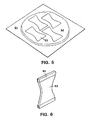
- Figure 5 illustrates preparing "dog bone"-shaped samples of sludge materials for tensile testing.
- An amount of a sludge sample to be tested is placed between two sheets of polyethylene film 51.
- the sample is then rolled with a 10 kg (22 pound) brass rolling pin having a diameter of 125 millimeters and a width of 175 millimeters. The rolling is stopped when the flattened sample 52 has been reduced in thickness to about 0.15 cm (0.060 inch).
- the top sheet of polyethylene is removed and dog bone shaped tensile test specimens 53 are cut out using a knife blade, similar to cutting out cookies from rolled dough.
- the length of the samples is about 60miliimeters.
- the maximum width (at the ends) of the samples is about 24 millimeters.
- the minimum width (at the center) is about 8.5 millimeters.
- Multiple tensile test samples can be cut from the sludge sample to provide meaningful average tensile values.
- a small piece of Saran® wrap 54 is placed over each end of the sample, as illustrated in Figure 6, in order to prevent the sample from sticking to the testing machine clamps.
- sample specimens are tested at room temperature by placing them in the Model 2712-001 pneumatic grips of an Instron Model 55 tensile machine with a 500 Newton loadcell and a gage length of about 38 millimeters and a grip pressure of 103 ⁇ 10 3 Nm -2 (15 psi).
- the specimen elongation rate is set at 10 millimeters per minute. The maximum stress and strain are measured at the instant failure occurs.
- the mixture was easily rolled to a uniform thin thickness of about 0.13 mm (0.005 inch).
- the top cover of plastic was carefully removed and the sheet left overnight to air dry. There was considerable curling and shrinkage to the sheet when dry.
- the surface of the sheet in contact with the plastic during drying had a very smooth feel while the air contact surface was more rough and bumpy. Both sides were easily written upon using a felt tip pen yielding very sharp edge lines. There was no bleeding of ink at the edge of the line that one experiences with paper made of recycled fiber or virgin fiber but using no clay or filler.
- a piece of the dried sheet was placed in a beaker of tap water and remained intact for over 5 days at room temperature in spite of periodic stirring with a spatula.
- Samples of the papermaking sludge were obtained from a deinking mill where paper to be recycled (mixed office waste) was processed to remove both ink and inorganic fillers and coatings to create a pulp fiber useful for making tissues.
- the solid waste stream coming from this mill contained about 50% moisture.
- the inorganic portion of the sludge constituted about 55-60 percent of the solids and was a function of the feed stock coming into the mill.
- the inorganic portion of the sludge was approximately 50% day commonly used for coating of papers (kaolin) and 50% filler commonly used for paper (calcium carbonate).
- the organic portion of the solids contained about 8% long fiber useful for papermaking.
- the balance of the organic portion was predominantly cellulosic fines (materials that can pass through a 200 mesh screen).
- the samples were taken from the deinking mill at the discharge of the conveyor that transports sludge from the screw press to the accumulation container.
- the samples were collected in clean 19 litre (5 gallon) buckets.
- the samples were refrigerated at -1°C (30°F.) prior to use.
- a smaller sample (about 500 grams) of the sludge was taken from the container of sludge and allowed to warm to room temperature, 22°C (72°F.). The warmed sample was placed into the stainless steel bowl of a model K45SS Kitchenaid Mixer 4 litre (4 quart) and mixed at the "stir" speed using the pastry dough agitator. 7.5 grams of polyacrylamide anionic dispersant (Cyanamer A-370 from Cyanamid Corp.) was added by sprinkling on the mixing sludge mass. This sprinkling was completed over approximately 20 seconds trying to keep the dispersant on the sludge and off of the bottom of the bowl.
- Adequate mixing was accomplished in approximately 5 minutes of agitation and could be observed as the mass of sludge changed from several small pieces and particles to a single clay like mass.
- the sludge changed from a crumbly, particulate mass to a moldable, clay like single mass.
- a 20 gram sample of the sludge/dispersant mixture was briefly worked by hand into an approximate cylindrical shape (like a pencil) about 1.5 cm in diameter. This small sample was placed between 2 sheets of 0.13 mm (5 mil) high density polyethylene (HOPE) bag material. A 19.5 kg (43 pound) brass rolling pin 13 cm (5 inch) dia. X 18 cm (7 inch) was used to roll the sample into a thin sheet as shown in Figure 1.
- HOPE high density polyethylene
- a second sheet sample was dried by an altemate method using a steam-heated brass platen (Valley Laboratory Equipment by Voith Serial No. 119-434 & 77062) as illustrated in Figure 2.
- This hot platen has a convex curvature of approximately 55 cm (21.5 inch) diameter which allows a canvas sheet to be applied over the vented side of the paper sheet which restrains it during drying and precludes warpage.
- Tension can be applied to the canvas at a level of from 2.2 kg to 8.2 kg (4.75 to 18 pounds) over a 25 cm (9.8 inch) width to create a restraining pressure of from approximately 310 Nm -2 to 1200 Nm -2 (0.045 to 0.17 psi).
- the temperature of the brass platen is set by a continuous flow of saturated steam at 25000 Nm -2 (3.5 psi) which is approximately 102°C (215°F).
Landscapes
- Engineering & Computer Science (AREA)
- Chemical & Material Sciences (AREA)
- Ceramic Engineering (AREA)
- Civil Engineering (AREA)
- Sustainable Development (AREA)
- Environmental & Geological Engineering (AREA)
- Life Sciences & Earth Sciences (AREA)
- Materials Engineering (AREA)
- Structural Engineering (AREA)
- Organic Chemistry (AREA)
- Mechanical Engineering (AREA)
- Manufacturing & Machinery (AREA)
- Paper (AREA)
- Treatment Of Sludge (AREA)
- Moulds For Moulding Plastics Or The Like (AREA)
Applications Claiming Priority (5)
| Application Number | Priority Date | Filing Date | Title |
|---|---|---|---|
| US84196097A | 1997-04-08 | 1997-04-08 | |
| US841960 | 1997-04-08 | ||
| US906249 | 1997-08-05 | ||
| US08/906,249 US5795377A (en) | 1997-04-08 | 1997-08-05 | Method for modifying papermaking sludge and products made from modified papermaking sludge |
| PCT/US1998/006172 WO1998045102A1 (en) | 1997-04-08 | 1998-03-27 | Method for modifying papermaking sludge and products made therefrom |
Publications (2)
| Publication Number | Publication Date |
|---|---|
| EP1007310A1 EP1007310A1 (en) | 2000-06-14 |
| EP1007310B1 true EP1007310B1 (en) | 2004-10-27 |
Family
ID=27126305
Family Applications (1)
| Application Number | Title | Priority Date | Filing Date |
|---|---|---|---|
| EP98913255A Expired - Lifetime EP1007310B1 (en) | 1997-04-08 | 1998-03-27 | Method of making paper or other molded or extruded product and a dry paper sheet obtainable by the method |
Country Status (11)
| Country | Link |
|---|---|
| US (1) | US5795377A (enExample) |
| EP (1) | EP1007310B1 (enExample) |
| JP (1) | JP2001518853A (enExample) |
| KR (1) | KR20010006110A (enExample) |
| AU (1) | AU726654B2 (enExample) |
| BR (1) | BR9814239A (enExample) |
| CA (1) | CA2284544C (enExample) |
| DE (1) | DE69827272T2 (enExample) |
| ES (1) | ES2227821T3 (enExample) |
| NZ (1) | NZ500256A (enExample) |
| WO (1) | WO1998045102A1 (enExample) |
Families Citing this family (30)
| Publication number | Priority date | Publication date | Assignee | Title |
|---|---|---|---|---|
| US6146498A (en) * | 1997-04-30 | 2000-11-14 | Kimberly-Clark Worldwide, Inc. | Wound product cores and processes for making them |
| US6562192B1 (en) | 1998-10-02 | 2003-05-13 | Kimberly-Clark Worldwide, Inc. | Absorbent articles with absorbent free-flowing particles and methods for producing the same |
| US6673982B1 (en) | 1998-10-02 | 2004-01-06 | Kimberly-Clark Worldwide, Inc. | Absorbent article with center fill performance |
| US6667424B1 (en) | 1998-10-02 | 2003-12-23 | Kimberly-Clark Worldwide, Inc. | Absorbent articles with nits and free-flowing particles |
| US6503233B1 (en) | 1998-10-02 | 2003-01-07 | Kimberly-Clark Worldwide, Inc. | Absorbent article having good body fit under dynamic conditions |
| US6187135B1 (en) | 1999-03-30 | 2001-02-13 | Sun Ho Chung | Process for making recycled paper having improving strength properties |
| US6544447B1 (en) * | 1999-04-07 | 2003-04-08 | Thomas C. Faerber | Method of paper sludge and plastics formulation |
| US6409883B1 (en) | 1999-04-16 | 2002-06-25 | Kimberly-Clark Worldwide, Inc. | Methods of making fiber bundles and fibrous structures |
| US6340407B1 (en) * | 1999-12-22 | 2002-01-22 | Sun Ho Chung | Process of making recycled linerboard or Kraft paper from old corrugated container |
| CA2300237A1 (en) * | 2000-03-09 | 2001-09-09 | Mikhail Pildysh | A coated substrate having controlled release properties and a method for the production thereof |
| AU785075C (en) | 2000-07-03 | 2007-07-12 | Nft Industries, Llc | Controlled release agricultural products and processes for making same |
| US6562882B2 (en) * | 2001-06-29 | 2003-05-13 | Scott Harrison | Soil formulation for resisting erosion |
| US7407993B2 (en) * | 2001-06-29 | 2008-08-05 | Terra Novo, Inc. | Compositions and methods for resisting soil erosion and fire retardation |
| US20100125111A1 (en) * | 2001-06-29 | 2010-05-20 | Scott Harrison | Compositions and methods for resisting soil erosion and fire retardation |
| US20040055720A1 (en) * | 2002-09-19 | 2004-03-25 | Torras Joseph H. | Paper compositions, imaging methods and methods for manufacturing paper |
| US20090028650A1 (en) * | 2007-07-26 | 2009-01-29 | Dennis Delamore | Composition and method for increasing resistance to erosion |
| US8133354B2 (en) * | 2008-01-04 | 2012-03-13 | USG Interiors, LLC. | Acoustic ceiling tiles made with paper processing waste |
| EP2292685B1 (en) * | 2009-09-07 | 2012-06-27 | The Procter & Gamble Company | Bottle cap made from a material comprising polypropylene, particulate calcium carbonate and additives |
| CN102561100B (zh) * | 2010-12-21 | 2015-09-02 | 上峰集团有限公司 | 污泥瓦楞原纸的配方、生产工艺及用其生产的瓦楞纸板 |
| FR2969669B1 (fr) * | 2010-12-22 | 2013-01-04 | Arjo Wiggins Fine Papers Ltd | Procede de fabrication de papier a partir de fibres issues de boues d'epuration de machines a papier |
| CN104250942B (zh) * | 2013-06-25 | 2016-08-24 | 立诚包装有限公司 | 中小型包装纸厂污泥回用工艺 |
| US20160010279A1 (en) * | 2013-12-06 | 2016-01-14 | University Of Maryland At College Park | Scalable, highly transparent paper with microsized fiber |
| US9777129B2 (en) * | 2014-04-11 | 2017-10-03 | Georgia-Pacific Consumer Products Lp | Fibers with filler |
| US9777143B2 (en) | 2014-04-11 | 2017-10-03 | Georgia-Pacific Consumer Products Lp | Polyvinyl alcohol fibers and films with mineral fillers and small cellulose particles |
| FI125895B (en) | 2014-09-05 | 2016-03-31 | Upm Kymmene Corp | composite Material |
| FI20145775A7 (fi) * | 2014-09-05 | 2016-03-06 | Upm Kymmene Corp | Komposiittimateriaali |
| JP6744672B1 (ja) * | 2019-05-20 | 2020-08-19 | 株式会社Tbm | 印刷用シート及び印刷用シートの製造方法 |
| CN110117101A (zh) * | 2019-05-24 | 2019-08-13 | 武汉市拓美环保科技有限公司 | 一种可回收污泥的农村污水处理装置 |
| CN112709092B (zh) * | 2019-10-24 | 2022-06-17 | 夏振明 | 一种以纺织、工业、农业废渣制造的纸张和造纸方法 |
| CN112030596A (zh) * | 2020-08-20 | 2020-12-04 | 锦上包装江苏有限公司 | —种利用造纸污泥再生的环保纸板配方 |
Family Cites Families (12)
| Publication number | Priority date | Publication date | Assignee | Title |
|---|---|---|---|---|
| GB1405587A (en) * | 1971-07-21 | 1975-09-10 | Nat Res Dev | Production of shaped articles |
| US3895998A (en) * | 1972-02-08 | 1975-07-22 | Nat Res Dev | Production of shaped articles from paper sludge |
| JPS554899B2 (enExample) * | 1975-02-19 | 1980-02-01 | ||
| FR2354293A2 (fr) * | 1975-08-19 | 1978-01-06 | Alsthom Cgee | Procede pour le compactage et l'essorage des boues fluides chargees de matieres fibreuses |
| US4256491A (en) * | 1977-09-01 | 1981-03-17 | Champion International Corporation | Waterproofing composition and method of making the same |
| JPS55142092A (en) * | 1979-04-20 | 1980-11-06 | Dai Ichi Kogyo Seiyaku Co Ltd | Additive for slurry fuel |
| US4356060A (en) * | 1979-09-12 | 1982-10-26 | Neckermann Edwin F | Insulating and filler material comprising cellulose fibers and clay, and method of making same from paper-making waste |
| NL169828C (nl) * | 1980-05-02 | 1982-09-01 | Kok Cornelis Jacobus M | Werkwijze voor de vervaardiging van een vloeistof- en schokabsorberend materiaal. |
| JPS5836299A (ja) * | 1981-08-24 | 1983-03-03 | 凸版印刷株式会社 | 繊維質材 |
| GB2117753A (en) * | 1982-04-06 | 1983-10-19 | Printsulate Limited | Compositions |
| WO1995007384A1 (en) * | 1993-09-09 | 1995-03-16 | Marcal Paper Mills, Inc. | Process and apparatus for manufacturing absorbent granular material |
| US5562994A (en) * | 1994-09-21 | 1996-10-08 | Kimberly-Clark Corporation | Un-coated paper-making sludge substrate for metallizing |
-
1997
- 1997-08-05 US US08/906,249 patent/US5795377A/en not_active Expired - Fee Related
-
1998
- 1998-03-27 NZ NZ500256A patent/NZ500256A/en unknown
- 1998-03-27 WO PCT/US1998/006172 patent/WO1998045102A1/en not_active Ceased
- 1998-03-27 CA CA 2284544 patent/CA2284544C/en not_active Expired - Fee Related
- 1998-03-27 EP EP98913255A patent/EP1007310B1/en not_active Expired - Lifetime
- 1998-03-27 ES ES98913255T patent/ES2227821T3/es not_active Expired - Lifetime
- 1998-03-27 DE DE1998627272 patent/DE69827272T2/de not_active Expired - Fee Related
- 1998-03-27 AU AU67849/98A patent/AU726654B2/en not_active Ceased
- 1998-03-27 KR KR1019997009188A patent/KR20010006110A/ko not_active Abandoned
- 1998-03-27 JP JP54282898A patent/JP2001518853A/ja not_active Ceased
- 1998-03-27 BR BR9814239A patent/BR9814239A/pt not_active Application Discontinuation
Also Published As
| Publication number | Publication date |
|---|---|
| DE69827272T2 (de) | 2005-03-10 |
| BR9814239A (pt) | 2000-10-03 |
| CA2284544A1 (en) | 1998-10-15 |
| JP2001518853A (ja) | 2001-10-16 |
| US5795377A (en) | 1998-08-18 |
| NZ500256A (en) | 2002-06-28 |
| WO1998045102A1 (en) | 1998-10-15 |
| EP1007310A1 (en) | 2000-06-14 |
| KR20010006110A (ko) | 2001-01-26 |
| CA2284544C (en) | 2005-06-21 |
| DE69827272D1 (de) | 2004-12-02 |
| AU6784998A (en) | 1998-10-30 |
| AU726654B2 (en) | 2000-11-16 |
| ES2227821T3 (es) | 2005-04-01 |
Similar Documents
| Publication | Publication Date | Title |
|---|---|---|
| EP1007310B1 (en) | Method of making paper or other molded or extruded product and a dry paper sheet obtainable by the method | |
| FI69333C (fi) | Foerfarande foer framstaellning av formade produkter | |
| US5879722A (en) | System for manufacturing sheets from hydraulically settable compositions | |
| RU2142878C1 (ru) | Изделие производства, способ производства этого изделия, система для его производства | |
| US5496441A (en) | Utilization of deinking by-product in building materials | |
| DE69430548T2 (de) | Absorbierendes körniges Material | |
| US5322879A (en) | Process for preparing a treated paper coating pigment | |
| JP3012196B2 (ja) | 粒状吸収材料、その製法及び装置 | |
| US5882480A (en) | Process for making granular material | |
| US6146498A (en) | Wound product cores and processes for making them | |
| DE2543007A1 (de) | Abwasserbehandlungsmaterial | |
| AU746280B2 (en) | Method for modifying papermaking sludge and products made therefrom | |
| KR970001730A (ko) | 재활용지로부터 제조된 착색 미립물 또는 입상물 및 이의 제조 방법 | |
| CN1481463A (zh) | 由脱墨淤浆中回收无机物的方法 | |
| US4410573A (en) | Board made of fibrous material | |
| DE2713311A1 (de) | Verfahren zur herstellung von papier, karton oder pappe | |
| AU695974B2 (en) | Waste paper treatment process | |
| CN101492329A (zh) | 一种用造纸泥浆制备的纤维复合物颗粒及其制备方法 | |
| CN119177586B (zh) | 一种零量化VOCs可降解的育苗纸的制备方法 | |
| CN1179829C (zh) | 造纸方法 | |
| JP2012117177A (ja) | 新聞用紙 | |
| JP4660907B2 (ja) | 顔料塗工紙の製造方法 | |
| Ghaffarzadeh et al. | Evaluation of Printability Indexes of Testliner Paper Sized by The Extracted Lignin of Soda Pulping | |
| MXPA99009639A (en) | Wound product cores and processes for making them | |
| WO2005070847A1 (en) | Process for particulate material |
Legal Events
| Date | Code | Title | Description |
|---|---|---|---|
| PUAI | Public reference made under article 153(3) epc to a published international application that has entered the european phase |
Free format text: ORIGINAL CODE: 0009012 |
|
| 17P | Request for examination filed |
Effective date: 19991021 |
|
| AK | Designated contracting states |
Kind code of ref document: A1 Designated state(s): BE DE ES FR GB IT NL SE |
|
| 17Q | First examination report despatched |
Effective date: 20010305 |
|
| GRAP | Despatch of communication of intention to grant a patent |
Free format text: ORIGINAL CODE: EPIDOSNIGR1 |
|
| RTI1 | Title (correction) |
Free format text: METHOD OF MAKING PAPER OR OTHER MOLDED OR EXTRUDED PRODUCT AND A DRY PAPER SHEET OBTAINABLE BY THE METHOD |
|
| GRAS | Grant fee paid |
Free format text: ORIGINAL CODE: EPIDOSNIGR3 |
|
| GRAA | (expected) grant |
Free format text: ORIGINAL CODE: 0009210 |
|
| RAP1 | Party data changed (applicant data changed or rights of an application transferred) |
Owner name: PAPER TECHNOLOGY FOUNDATION, INC. |
|
| AK | Designated contracting states |
Kind code of ref document: B1 Designated state(s): BE DE ES FR GB IT NL SE |
|
| PG25 | Lapsed in a contracting state [announced via postgrant information from national office to epo] |
Ref country code: BE Free format text: LAPSE BECAUSE OF FAILURE TO SUBMIT A TRANSLATION OF THE DESCRIPTION OR TO PAY THE FEE WITHIN THE PRESCRIBED TIME-LIMIT Effective date: 20041027 |
|
| REG | Reference to a national code |
Ref country code: GB Ref legal event code: FG4D |
|
| REG | Reference to a national code |
Ref country code: SE Ref legal event code: TRGR |
|
| REF | Corresponds to: |
Ref document number: 69827272 Country of ref document: DE Date of ref document: 20041202 Kind code of ref document: P |
|
| PGFP | Annual fee paid to national office [announced via postgrant information from national office to epo] |
Ref country code: ES Payment date: 20050304 Year of fee payment: 8 |
|
| PGFP | Annual fee paid to national office [announced via postgrant information from national office to epo] |
Ref country code: GB Payment date: 20050317 Year of fee payment: 8 |
|
| PGFP | Annual fee paid to national office [announced via postgrant information from national office to epo] |
Ref country code: NL Payment date: 20050322 Year of fee payment: 8 |
|
| PGFP | Annual fee paid to national office [announced via postgrant information from national office to epo] |
Ref country code: SE Payment date: 20050324 Year of fee payment: 8 |
|
| PGFP | Annual fee paid to national office [announced via postgrant information from national office to epo] |
Ref country code: FR Payment date: 20050325 Year of fee payment: 8 |
|
| REG | Reference to a national code |
Ref country code: ES Ref legal event code: FG2A Ref document number: 2227821 Country of ref document: ES Kind code of ref document: T3 |
|
| PGFP | Annual fee paid to national office [announced via postgrant information from national office to epo] |
Ref country code: DE Payment date: 20050429 Year of fee payment: 8 |
|
| PLBE | No opposition filed within time limit |
Free format text: ORIGINAL CODE: 0009261 |
|
| STAA | Information on the status of an ep patent application or granted ep patent |
Free format text: STATUS: NO OPPOSITION FILED WITHIN TIME LIMIT |
|
| 26N | No opposition filed |
Effective date: 20050728 |
|
| ET | Fr: translation filed | ||
| PG25 | Lapsed in a contracting state [announced via postgrant information from national office to epo] |
Ref country code: GB Free format text: LAPSE BECAUSE OF NON-PAYMENT OF DUE FEES Effective date: 20060327 |
|
| PG25 | Lapsed in a contracting state [announced via postgrant information from national office to epo] |
Ref country code: SE Free format text: LAPSE BECAUSE OF NON-PAYMENT OF DUE FEES Effective date: 20060328 Ref country code: ES Free format text: LAPSE BECAUSE OF NON-PAYMENT OF DUE FEES Effective date: 20060328 |
|
| PGFP | Annual fee paid to national office [announced via postgrant information from national office to epo] |
Ref country code: IT Payment date: 20060331 Year of fee payment: 9 |
|
| PG25 | Lapsed in a contracting state [announced via postgrant information from national office to epo] |
Ref country code: NL Free format text: LAPSE BECAUSE OF NON-PAYMENT OF DUE FEES Effective date: 20061001 |
|
| PG25 | Lapsed in a contracting state [announced via postgrant information from national office to epo] |
Ref country code: DE Free format text: LAPSE BECAUSE OF NON-PAYMENT OF DUE FEES Effective date: 20061003 |
|
| EUG | Se: european patent has lapsed | ||
| GBPC | Gb: european patent ceased through non-payment of renewal fee |
Effective date: 20060327 |
|
| NLV4 | Nl: lapsed or anulled due to non-payment of the annual fee |
Effective date: 20061001 |
|
| REG | Reference to a national code |
Ref country code: FR Ref legal event code: ST Effective date: 20061130 |
|
| REG | Reference to a national code |
Ref country code: ES Ref legal event code: FD2A Effective date: 20060328 |
|
| PG25 | Lapsed in a contracting state [announced via postgrant information from national office to epo] |
Ref country code: FR Free format text: LAPSE BECAUSE OF NON-PAYMENT OF DUE FEES Effective date: 20060331 |
|
| PG25 | Lapsed in a contracting state [announced via postgrant information from national office to epo] |
Ref country code: IT Free format text: LAPSE BECAUSE OF NON-PAYMENT OF DUE FEES Effective date: 20070327 |