EP1000610B1 - Polymere für kosmetische Formulierungen - Google Patents
Polymere für kosmetische Formulierungen Download PDFInfo
- Publication number
- EP1000610B1 EP1000610B1 EP99121703A EP99121703A EP1000610B1 EP 1000610 B1 EP1000610 B1 EP 1000610B1 EP 99121703 A EP99121703 A EP 99121703A EP 99121703 A EP99121703 A EP 99121703A EP 1000610 B1 EP1000610 B1 EP 1000610B1
- Authority
- EP
- European Patent Office
- Prior art keywords
- polymers
- formula
- hair
- polymer
- monomers
- Prior art date
- Legal status (The legal status is an assumption and is not a legal conclusion. Google has not performed a legal analysis and makes no representation as to the accuracy of the status listed.)
- Expired - Lifetime
Links
- 0 CN(C(*)C(*)N1)C1=* Chemical compound CN(C(*)C(*)N1)C1=* 0.000 description 4
Images

Classifications
-
- A—HUMAN NECESSITIES
- A61—MEDICAL OR VETERINARY SCIENCE; HYGIENE
- A61Q—SPECIFIC USE OF COSMETICS OR SIMILAR TOILETRY PREPARATIONS
- A61Q5/00—Preparations for care of the hair
- A61Q5/06—Preparations for styling the hair, e.g. by temporary shaping or colouring
-
- A—HUMAN NECESSITIES
- A61—MEDICAL OR VETERINARY SCIENCE; HYGIENE
- A61K—PREPARATIONS FOR MEDICAL, DENTAL OR TOILETRY PURPOSES
- A61K8/00—Cosmetics or similar toiletry preparations
- A61K8/18—Cosmetics or similar toiletry preparations characterised by the composition
- A61K8/72—Cosmetics or similar toiletry preparations characterised by the composition containing organic macromolecular compounds
- A61K8/81—Cosmetics or similar toiletry preparations characterised by the composition containing organic macromolecular compounds obtained by reactions involving only carbon-to-carbon unsaturated bonds
- A61K8/817—Compositions of homopolymers or copolymers of compounds having one or more unsaturated aliphatic radicals, each having only one carbon-to-carbon double bond, and at least one being terminated by a single or double bond to nitrogen or by a heterocyclic ring containing nitrogen; Compositions or derivatives of such polymers, e.g. vinylimidazol, vinylcaprolactame, allylamines (Polyquaternium 6)
-
- A—HUMAN NECESSITIES
- A61—MEDICAL OR VETERINARY SCIENCE; HYGIENE
- A61P—SPECIFIC THERAPEUTIC ACTIVITY OF CHEMICAL COMPOUNDS OR MEDICINAL PREPARATIONS
- A61P43/00—Drugs for specific purposes, not provided for in groups A61P1/00-A61P41/00
Definitions
- VOC Volatile organic compounds
- aqueous plastic dispersions those made from polymers, which also contain an ureido methacrylate is used as a monomer component, for painting described by plastic surfaces.
- aqueous plastic dispersions those made from polymers, which also contain an ureido methacrylate is used as a monomer component, for painting described by plastic surfaces.
- AU 8425444 describes ureidomethacrylate-containing vinyl acetate copolymers described, which can be used as a binder for textile nonwovens are.
- the use of ureidomethacrylate as a copolymer improves the adhesion of the polymer to the fiber.
- WO 97/45468 describes acetacetoxy-modified polymers reported with surfactant effect. These are especially as Suitable coating materials. Your use in shampoos is also mentioned. In addition to acetoacetoxy groups, the polymers mentioned can among other things also contain ureidomethacrylate.
- the invention has for its object the composition of polymers commonly used in hair cosmetic applications be used or could be used in principle to vary so that their processing or application properties and their usage properties improve without certain properties such as surfactant forcibly occur. This should especially with regard to consolidation, Washability and viscosity during and after application be valid. There are further properties to be optimized from the respective application. So are when used in hair sprays specifically the following properties of interest: viscosity, Film formation, strengthening effect, stickiness (even with high Humidity), combability, washability, grip, gloss, Adhesion, antistatic effect and solubility in water, Alcohol, dimethyl ether, propane and butane and in mixtures it. These properties of hair setting polymers as well Characterization of polymers with regard to these properties are known to the person skilled in the art. Furthermore, the manufacturing costs and the effect per amount of polymer used is important.
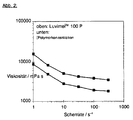
- the polymers P though Monomers of formula II normally used in polymer synthesis Agent is used to increase the adhesion of the polymer, are easy to wash out of human hair. While containing ureidomethacrylate Binders for textiles as they stand correspond to the technology, coatings are obtained, the Washability reduced by ureidomethacrylate, draw the polymers P are suitable for the application according to the invention, for example the use as a hairspray, due to its good washability out. It is also good when used in hair sprays Firming effect, good grip and good combability found, the commercially available polymers, for example Luvimer TM 100 P from BASF Aktiengesellschaft, are equivalent. Also the Solution viscosity is, with otherwise the same or improved Performance characteristics lower than that of Luvimer TM 100 P. This is advantageous for application as a spray or aerosol. Overall, a profile of usage and application properties found that is superior to commercial products.
- the polymers P can be spread out from solution to form films. After drying, these films show greater hardness than commercially available Hair-setting polymers. This is also an indication of their superior suitability compared to commercial products Use as a hair fixer.
- the polymers P can also be used in cosmetics become. Also when used in cosmetics according to the invention for example, there is the advantage of low viscosity out.
- the polymers P can be obtained from monomers of the formula II alone or in Mixture made with ethylenically unsaturated compounds become. 0.05 to 100% by weight of those used are preferred Monomers Monomers of formula II and 0 to 99.95 wt .-% more copolymerizable monomers.
- the polymers P from prepolymers to obtain.
- prepolymers which consists of acrylic acid, methacrylic acid and the esters, amides, Halides and other derivatives of these acids are produced were converted into polymers that are a group of Formula I included.
- 2-hydroxyethyl (ethylene urea) (CAS No. 3699-54-5) polymers are obtained, contain type III repeat units.
- the on this Polymers P synthesized from prepolymers can also be used according to the invention for use in cosmetic and hair cosmetic Preparations are used.
- Ethyleneically unsaturated monomers can preferably be used as suitable copolymerizable monomers (E).
- E copolymerizable monomers
- the monomers used can be polymerized using any conventional synthetic method.
- these can be solution polymerization, emulsion polymerization, reverse emulsion polymerization, suspension polymerization, reverse suspension polymerization or precipitation polymerization, without the methods which can be used being restricted thereto.
- solution polymerization water or conventional organic solvents can be used as the solvent. Production in the melt is also possible.
- Monomers with a free radical initiated reaction can be polymerized are preferred.
- ethylenically unsaturated means that the monomers have at least one have polymerizable carbon-carbon double bond, which can be mono-, di-, tri-, or tetrasubstituted.
- the monomers (E) in the polymer P can be up to 99.95% by weight, preferably Make up 85 to 98 wt .-%.
- Monomers (E) are, for example, acrylic acid and its salts, esters and amides.
- the salts can be of any non-toxic Metal, ammonium or substituted ammonium counterions derived his.
- the esters can be derived from C 1 -C 40 linear, C 3 -C 40 branched chain, or C 3 -C 40 carbocyclic alcohols, from multifunctional alcohols with 2 to about 8 hydroxyl groups such as ethylene glycol, hexylene glycol, glycerol, and 1,2 , 6-hexanetriol, from amino alcohols or from alcohol ethers such as methoxyethanol and ethoxyethanol or polyethylene glycols.
- the amides can be unsubstituted, N-alkyl or N-alkylamino monosubstituted, or N, N-dialkyl-substituted or N, N-dialkylamino, where the alkyl or alkylamino groups of C 1 -C 40 linear, C 3 -C 40 branched, or C 3 -C 40 carbocyclic units are derived.
- the alkylamino groups can be quaternized.
- Preferred monomers of the formula EII are N, N-dimethylaminomethyl (meth) acrylate, N, N-diethylaminomethyl (meth) acrylate, N, N-dimethylaminoethyl (meth) acrylate, N, N-diethylaminoethyl (meth) acrylate.
- Monomers (E) which can also be used are substituted acrylic acids and salts, esters and amides thereof, the substituents on the carbon atoms being in the two or three position of acrylic acid and being selected independently of one another from the group consisting of C 1 -C 4 alkyl , -CN, COOH, particularly preferably methacrylic acid, ethacrylic acid and 3-cyanoacrylic acid.
- These salts, esters and amides of these substituted acrylic acids can be selected as described above for the salts, esters and amides of acrylic acid.
- Suitable monomers (E) are vinyl and allyl esters of C 1 -C 40 linear, C 3 -C 40 branched chain or C 3 -C 40 carbocyclic carboxylic acids (eg vinyl acetate, vinyl propionate, vinyl neononanoate, vinyl neoundecanoic acid or t-butyl benzoic acid vinyl ester) ); Vinyl or allyl halides, preferably vinyl chloride and allyl chloride, vinyl ethers, preferably methyl, ethyl, butyl or dodecyl vinyl ether, vinylformamide, vinyl methylacetamide, vinylamine; Vinyl lactams, preferably vinyl pyrrolidone and vinyl caprolactam, vinyl or allyl-substituted heterocyclic compounds, preferably vinyl pyridine, vinyl oxazoline and allyl pyridine.
- N-vinylimidazoles of the general formula EIII in which R 14 to R 16 independently of one another are hydrogen, C 1 -C 4 -alkyl or phenyl:
- Suitable monomers (E) are vinylidene chloride; and hydrocarbons with at least one carbon-carbon double bond, preferably styrene, alpha-methylstyrene, tert-butylstyrene, Butadiene, isoprene, cyclohexadiene, ethylene, propylene, 1-butene, 2-butene, isobutylene, vinyl toluene, and mixtures of these Monomers.
- Particularly suitable monomers (E) are acrylic acid, methacrylic acid, ethyl acrylic acid, methyl acrylate, ethyl acrylate, propyl acrylate, n-butyl acrylate, iso-butyl acrylate, t-butyl acrylate, 2-ethylhexyl acrylate, decyl acrylate, methyl methacrylate, ethyl methacrylate, butyl methacrylate, nyl butyl acrylate , t-butyl methacrylate, 2-ethylhexyl methacrylate, decyl methacrylate, methyl ethacrylate, ethyl ethacrylate, n-butyl ethacrylate, iso-butyl ethacrylate, t-butyl ethacrylate, 2-ethylhexyl ethacrylate, decyl ethacrylate, 2,3-d
- Monomers with a basic nitrogen atom can be quaternized as follows:
- Alkyl halides are suitable for quaternization of the amines with 1 to 24 carbon atoms in the alkyl group, e.g. Methylene chloride, Methyl bromide, methyl iodide, ethyl chloride, ethyl bromide, Propyl chloride, hexyl chloride, dodecyl chloride, lauryl chloride and Benzyl halides, especially benzyl chloride and benzyl bromide.
- Other suitable quaternizing agents are dialkyl sulfates, in particular Dimethyl sulfate or diethyl sulfate.
- the quaternization The basic amines can also be mixed with alkylene oxides such as ethylene oxide or propylene oxide in the presence of acids.
- Preferred quaternizing agents are methyl chloride, dimethyl sulfate or diethyl sulfate.
- the quaternization can take place before the polymerization or after the Polymerization can be carried out.
- reaction products of unsaturated acids such as acrylic acid or methacrylic acid
- Examples of this are e.g. (Meth) acryloyloxyhydroxypropyltrimethylammonium chloride and (meth) acryloyloxyhydroxypropyltriethylammonium chloride.
- the basic monomers can also be cationized by with mineral acids, e.g. Sulfuric acid, hydrochloric acid, Hydrobromic acid, hydroiodic acid, phosphoric acid or Nitric acid, or with organic acids, e.g. formic acid, Acetic acid, lactic acid, or citric acid, neutralized become.
- mineral acids e.g. Sulfuric acid, hydrochloric acid, Hydrobromic acid, hydroiodic acid, phosphoric acid or Nitric acid
- organic acids e.g. formic acid, Acetic acid, lactic acid, or citric acid
- monomers can be used as monomers (E) so-called macromonomers such as silicone-containing Macromonomers with one or more radically polymerizable Groups or alkyloxazoline macromonomers can be used, such as they e.g. are described in EP 408 311.
- macromonomers such as silicone-containing Macromonomers with one or more radically polymerizable Groups or alkyloxazoline macromonomers can be used, such as they e.g. are described in EP 408 311.
- fluorine-containing monomers such as, for example are described in EP 558 423, crosslinking or the molecular weight regulating compounds in combination or be used alone.
- the invention also relates to the use of polymers which be prepared using monomers of the formula II or contain at least one repeating unit of the formula III, characterized in that they do not contain groups that Have a surfactant character associated with an acetoacetoxy function, in cosmetics, especially in hair cosmetic products, Hair care products and hair fixatives, as well as the use of polymers using monomers of the formula II be produced or at least one repeat unit of the Contain formula III, characterized in that the polymer in Solution or is prepared by bulk polymerization or used in the dissolved state, in cosmetics, in particular in hair cosmetics, hair care products and hair fixatives.
- the invention also relates to hair fixatives containing a polymer, to the groups of formula I with the meanings given above are bound.
- hair set preferably includes hair spray, Foam setting, hair mousse, hair gel, setting lotion and setting cream.
- the polymer P can be used in Solution, suspension, emulsion or melt can be prepared or in the dissolved, suspended or emulsified state for Be put into action.
- the polymer P can in particular be dissolved in a fluid, be suspended or emulsified, the at least one of the Substances dimethyl ether, propane, butane, ethanol, isopropanol, Contains water and / or halogenated hydrocarbons.
- the invention further relates to the use of polymers, are bound to the groups of the formula I, and to 95 to 99.95 wt .-% consist of a monomer that no groups of Formula I has in cosmetics, especially hair cosmetics Products.
- the usual compounds known to the person skilled in the art e.g. sulfur compounds (e.g. mercaptoethanol, 2-ethylhexylthioglycolate, Thioglycolic acid or dodecyl mercaptan), and tribromochloromethane or other compounds that regulate molecular weight of the polymers obtained act.
- sulfur compounds e.g. mercaptoethanol, 2-ethylhexylthioglycolate, Thioglycolic acid or dodecyl mercaptan
- tribromochloromethane or other compounds that regulate molecular weight of the polymers obtained act.
- silicone compounds containing thiol groups can also be used be used.
- Silicone-free controllers are preferably used.
- Crosslinking monomers include compounds with at least two ethylenically unsaturated double bonds are used, such as e.g. Esters of ethylenically unsaturated carboxylic acids, such as acrylic acid or methacrylic acid and polyhydric alcohols, ethers of at least dihydric alcohols, e.g. Vinyl ether or Allyl ethers. Straight-chain or branched, linear or cyclic aliphatic or aromatic hydrocarbons, which have at least two double bonds, which does not conjugate with aliphatic hydrocarbons may be. Amides of acrylic and methacrylic acid are also suitable and N-allylamines of at least divalent amines, such as e.g.
- 1,2-diaminoethane, 1,3-diaminopropane also triallylamine or corresponding ammonium salts, N-vinyl compounds of Urea derivatives, at least divalent amides, cyanurates or urethanes.
- Other suitable crosslinkers are Divinyldioxane, tetraallylsilane or tetravinylsilane.
- crosslinkers are, for example, methylene bisacrylamide, Triallylamine and triallylammonium salts, divinylimidazole, N, N'-divinylethylene urea, reaction products more polyvalent Alcohols with acrylic acid or methacrylic acid, methacrylic acid ester and acrylic acid esters of polyalkylene oxides or polyvalent ones Alcohols. those with ethylene oxide and / or propylene oxide and / or epichlorohydrin have been implemented.
- the polymers P can optionally also be used other polymers, e.g. Polyamides, polyurethanes, polyesters, Homopolymers and copolymers of ethylenically unsaturated monomers be present. Examples of such in cosmetics
- the polymers used are those known under the trade names Polymers Amerhold TM, Ultrahold TM, Ultrahold Strong TM, Luviflex TM VBM, Luvimer TM, Acronal TM, Acudyne TM, Stepanhold TM, Lovocryl TM, Versatyl TM, Amphomer TM or Eastman AQ TM.
- the monomers (E) can before or after the polymerization, partially or completely neutralized with acids or bases, e.g. the water solubility or dispersibility to a desired one Adjust dimension.
- a neutralizing agent for monomers bearing acid groups can e.g. Mineral bases such as sodium carbonate, alkali hydroxides as well as ammonia, organic bases such as amino alcohols, especially 2-amino-2-methyl-1-propanol, monoethanolamine, diethanolamine, triethanolamine, Triisopropanolamine, tri [(2-hydroxy) 1-propyl] amine, 2-amino-2-methyl-1,3-propanediol, 2-amino-2-hydroxymethyl-1,3-propanediol, as well as diamines, e.g. Lysine.
- Mineral bases such as sodium carbonate, alkali hydroxides as well as ammonia
- organic bases such as amino alcohols, especially 2-amino-2-methyl-1-propanol, monoethanolamine, diethanolamine, triethanolamine, Triisopropanolamine, tri [(2-hydroxy) 1-propyl] amine, 2-amino-2-methyl-1,3-propanediol, 2-a
- Monomers can e.g. Mineral acids such as hydrochloric acid, sulfuric acid or phosphoric acid and organic acids such as carboxylic acids, Lactic acid, citric acid or others can be used.
- Auxiliaries such as plasticizers, film-forming aids, Pigments, perfumes or others, alone or in combination, be present during the polymerization and / or after the Polymerization are added.
- the surfactant character associated with an acetoacetoxy function have used (WO 97/45468). This makes it possible the polymer only after production by mixing with suitable Surfactants provide the optimum interface properties for the respective application to give.
- the polymers P As hair setting according to the invention it is advantageous to adjust the glass transition temperature of the polymers by a suitable combination of ethylenically unsaturated monomers set to values greater than 20 ° C.
- Particularly preferred ethylenically unsaturated monomers (E) for use in hair setting polymers are n-butyl acrylate, Methyl methacrylate, t-butyl acrylate, ethyl acrylate, styrene, N-t-butylacrylamide, methacrylic acid, acrylic acid, crotonic acid, Vinyl acetate, vinyl propionate, vinyl caprolactam, vinyl pyrrolidone, Vinylimidazole and N-methylvinylimidazolinium salt.
- polymers P in Mix with other polymers are particularly suitable here Polymers that are commonly used in cosmetics.
- Such polymers are, for example, poly (meth) acrylates, polyesters, Polyurethanes, polymers with quaternized nitrogen atoms, Polymers with vinylpyrrolidone, vinylcaprolactam, vinylalacetate or vinyl ether repeat unit, polymers with N-alkylated Repeat acrylamide units, polymers with 1- (N, N-dimethylamino) -2-ethyl methacrylate repeat units, Polymers with Imidazolyl residues (trade names, for example Amerhold TM, Ultrahold TM, Ultrahold Strong TM, Luviflex TM VBM, Luvimer TM, Acronal TM, Acudyne TM, Stepanhold TM, Lovocryl TM, Versatyl TM, Amphomer TM or Eastman AQ TM).
- polymers which, in addition to the monomers mentioned, contain other groups (IX) which, for example, result from the by-products mentioned in DE 4301673 A1 for the synthesis of ureidomethacrylate, in particular hydroxyethylethylene urea (CAS No. 3699-54-5) and N - (Methacryloyloxyethyl) -N '- (methacryloyl) ethylene urea (CAS No. 157312-17-9).
- groups (IX) which, for example, result from the by-products mentioned in DE 4301673 A1 for the synthesis of ureidomethacrylate, in particular hydroxyethylethylene urea (CAS No. 3699-54-5) and N - (Methacryloyloxyethyl) -N '- (methacryloyl) ethylene urea (CAS No. 157312-17-9).
- At least one of the two residues Pm 1 and Pm 2 stands for a high molecular weight residue.
- feed 1 and 3.75 g of feed are added to a stirred template 2 dropped.
- the mixture is then heated to 78 ° C. After that the rest of feed 1 within 1.5 h and the remainder within 2 h The rest of feed 2 was added dropwise. The mixture is further 2 h touched. Then feed 3 is within 15 min. added dropwise and stirred at 78 ° C for 2 h.
- the polymers from Examples 1 to 4 and a commercially available Each polymer is dissolved in ethanol and with 2-amino-2-methyl-1-propanol (AMP) neutralized so that the solids content is 20% by weight.
- AMP 2-amino-2-methyl-1-propanol
- the solutions come with a box squeegee (Slot width 200 ⁇ m) on a glass plate scraped into films and dried for 24 hours at room temperature.
- the pendulum hardness after King and the redispersibility in water is from the table refer to.
- Luvimer TM 100 P The commercial hair setting polymer Luvimer TM 100 P from BASF Aktiengesellschaft is used for comparison purposes.
- Luvimer 100 P is a copolymer of tert-butyl acrylate, ethyl acrylate and methacrylic acid.
- Example 2 The washability is compared as in Example 2, however the polymers are used in VOC-80 formulations (4 parts by weight of the polymer, neutralization of the polymer with 2-aminomethyl-1-propanol, 16 parts by weight of water, 40 parts by weight of dimethyl ether, Make up to 100 parts by weight with ethanol).
- the washability for the polymer from Example 1 is considered good (evaluation "2") was assessed while Luvimer 100 P as satisfactory (rating "3") is judged.
Landscapes
- Health & Medical Sciences (AREA)
- Life Sciences & Earth Sciences (AREA)
- Animal Behavior & Ethology (AREA)
- General Health & Medical Sciences (AREA)
- Public Health (AREA)
- Veterinary Medicine (AREA)
- Birds (AREA)
- Epidemiology (AREA)
- Engineering & Computer Science (AREA)
- Bioinformatics & Cheminformatics (AREA)
- Chemical & Material Sciences (AREA)
- Chemical Kinetics & Catalysis (AREA)
- General Chemical & Material Sciences (AREA)
- Medicinal Chemistry (AREA)
- Nuclear Medicine, Radiotherapy & Molecular Imaging (AREA)
- Organic Chemistry (AREA)
- Pharmacology & Pharmacy (AREA)
- Cosmetics (AREA)
- Addition Polymer Or Copolymer, Post-Treatments, Or Chemical Modifications (AREA)
Applications Claiming Priority (2)
| Application Number | Priority Date | Filing Date | Title |
|---|---|---|---|
| DE19850363 | 1998-11-02 | ||
| DE19850363A DE19850363A1 (de) | 1998-11-02 | 1998-11-02 | Polymere für kosmetische Formulierungen |
Publications (2)
| Publication Number | Publication Date |
|---|---|
| EP1000610A1 EP1000610A1 (de) | 2000-05-17 |
| EP1000610B1 true EP1000610B1 (de) | 2004-04-07 |
Family
ID=7886351
Family Applications (1)
| Application Number | Title | Priority Date | Filing Date |
|---|---|---|---|
| EP99121703A Expired - Lifetime EP1000610B1 (de) | 1998-11-02 | 1999-11-02 | Polymere für kosmetische Formulierungen |
Country Status (7)
| Country | Link |
|---|---|
| US (1) | US6380338B1 (enExample) |
| EP (1) | EP1000610B1 (enExample) |
| JP (1) | JP2000136216A (enExample) |
| CN (1) | CN1188105C (enExample) |
| AT (1) | ATE263542T1 (enExample) |
| DE (2) | DE19850363A1 (enExample) |
| ES (1) | ES2219979T3 (enExample) |
Families Citing this family (6)
| Publication number | Priority date | Publication date | Assignee | Title |
|---|---|---|---|---|
| DE10256148A1 (de) * | 2002-11-29 | 2004-06-17 | Basf Ag | Gegenstand der vorliegenden Erfindung sind Zusammensetzungen enthaltend mindestens ein Copolymer (A) und mindestens ein Copolymer (B) sowie deren Verwendung in kosmetischen Zubereitungen |
| US9072672B2 (en) * | 2005-06-28 | 2015-07-07 | Colgate-Palmolive Company | Compositions and methods for altering the color of teeth |
| CN102428111A (zh) * | 2009-05-15 | 2012-04-25 | 巴斯夫欧洲公司 | 沉淀聚合物 |
| US20110218295A1 (en) * | 2010-03-02 | 2011-09-08 | Basf Se | Anionic associative rheology modifiers |
| JP5569881B2 (ja) * | 2010-04-13 | 2014-08-13 | 東レ・ファインケミカル株式会社 | アクリルシラップの製造方法 |
| WO2019131117A1 (ja) * | 2017-12-27 | 2019-07-04 | 株式会社カネカ | 人工毛髪、それを含む頭飾製品、及び人工毛髪の製造方法 |
Family Cites Families (10)
| Publication number | Priority date | Publication date | Assignee | Title |
|---|---|---|---|---|
| US3645965A (en) * | 1967-10-23 | 1972-02-29 | Sankyo Co | Stabilization of synthetic polymers with imidazolidine compounds |
| CA1217195A (en) | 1983-03-10 | 1987-01-27 | Carmine P. Iovine | Polymerizable imidazolidinones and polymers thereof useful as nonwoven binders |
| DE3902067A1 (de) | 1989-01-25 | 1990-07-26 | Roehm Gmbh | Filmbildende, selbstvernetzende waessrige kunststoffdispersion |
| DE3902555A1 (de) | 1989-01-28 | 1990-08-02 | Roehm Gmbh | Waessrige polyacrylat-systeme fuer lackierung von kunststoffoberflaechen |
| US5158762A (en) | 1992-03-09 | 1992-10-27 | Isp Investments Inc. | Water-based hair spray compositions containing multiple polymers |
| US5288602A (en) | 1992-08-24 | 1994-02-22 | Agfa-Gevaert Aktiengesellschaft | Photographic silver halide element containing silicone oil |
| DE4428003A1 (de) | 1994-08-08 | 1996-02-15 | Basf Ag | Sulfonatgruppentragende Polyamide und deren Verwendung in Haarfestigungsmitteln |
| US5536740A (en) * | 1995-06-01 | 1996-07-16 | Elizabeth Arden Company, Division Of Conopco, Inc. | Skin care compositions containing dimethyl imidazolidinone and retinol or retinyl ester |
| WO1997045468A1 (en) | 1996-05-28 | 1997-12-04 | Eastman Chemical Company | Surfactant-containing acetoacetoxy-functional and enamine-functional polymers |
| US5972431A (en) * | 1998-07-29 | 1999-10-26 | Air Products And Chemicals, Inc. | Cyclic urea surfactants |
-
1998
- 1998-11-02 DE DE19850363A patent/DE19850363A1/de not_active Withdrawn
-
1999
- 1999-11-01 JP JP11311319A patent/JP2000136216A/ja not_active Withdrawn
- 1999-11-02 US US09/432,281 patent/US6380338B1/en not_active Expired - Lifetime
- 1999-11-02 AT AT99121703T patent/ATE263542T1/de not_active IP Right Cessation
- 1999-11-02 ES ES99121703T patent/ES2219979T3/es not_active Expired - Lifetime
- 1999-11-02 DE DE59909101T patent/DE59909101D1/de not_active Expired - Lifetime
- 1999-11-02 CN CNB991273605A patent/CN1188105C/zh not_active Expired - Fee Related
- 1999-11-02 EP EP99121703A patent/EP1000610B1/de not_active Expired - Lifetime
Also Published As
| Publication number | Publication date |
|---|---|
| CN1258497A (zh) | 2000-07-05 |
| DE19850363A1 (de) | 2000-05-04 |
| ES2219979T3 (es) | 2004-12-01 |
| JP2000136216A (ja) | 2000-05-16 |
| CN1188105C (zh) | 2005-02-09 |
| DE59909101D1 (de) | 2004-05-13 |
| ATE263542T1 (de) | 2004-04-15 |
| EP1000610A1 (de) | 2000-05-17 |
| US6380338B1 (en) | 2002-04-30 |
Similar Documents
| Publication | Publication Date | Title |
|---|---|---|
| EP0998254B1 (de) | Verwendung von polysiloxanhaltigen polymeren für kosmetische formulierungen | |
| EP1002811B1 (de) | Wasserlösliche oder wasserdispergierbare Pfropfcopolymerisate auf der Basis eines Polyvinyllactams, deren Herstellung und Verwendung | |
| DE2342683C3 (de) | Haarbehandlungsmittel | |
| EP0929285B1 (de) | Verwendung wasserlöslicher copolymere als wirkstoffe in kosmetischen formulierungen | |
| DE69634337T2 (de) | Lack auf wasserbasis für die behandlung von keratinmaterialien, der in einem aerosolbehälter verpackt ist, der mindestens ein gepfropftes siliconpolymer enthält, und dessen verwendungen | |
| DE10059827A1 (de) | Kosmetische und dermatologische Haarbehandlungsmittel | |
| DE2317484A1 (de) | Haarfixierungsmittel | |
| DE4443568A1 (de) | Als Wirkstoffe in kosmetischen Zubereitungen wie Haarstylingmitteln geeignete quaternierte Copolymerisate | |
| EP1490016B1 (de) | Kationische polymerisate und deren verwendung in kosmetischen formulierungen | |
| DE69600273T2 (de) | Filmformendes Harz und dieses Harz enthaltende Haarpflegemittel | |
| WO1992007545A1 (de) | Mittel zur festigung der haare | |
| EP1000610A1 (de) | Polymere für kosmetische Formulierungen | |
| DE60302340T2 (de) | Triblock-copolymere für kosmetik- oder pflegezusammensetzungen | |
| EP0939611B1 (de) | Wässrige zubereitungen und ihre verwendung | |
| EP0758222B1 (de) | Haarbehandlungsmittel | |
| EP1083184A2 (de) | Silikonhaltige Polymerisate, deren Herstellung und Verwendung | |
| EP1117711B1 (de) | Kationische polymerisate und ihre verwendung | |
| EP0911018B1 (de) | Verwendung von kationischen Copolymerisaten aus ungesättigten Säuren und N-Vinylimidazoliumsalzen in haarkosmetischen Zubereitungen | |
| EP1567115B1 (de) | Zusammensetzungen, die mindestens ein copolymer (a) und mindestens ein copolymer (b) enthalten, und deren verwendung in kosmetischen zubereitungen | |
| DE19951877A1 (de) | Silikonhaltige Polymerisate, deren Herstellung und Verwendung | |
| DE4403952A1 (de) | Haarbehandlungsmittel mit Polymeren | |
| DE19710192A1 (de) | Filmbildendes Harz und haarkosmetische Zusammensetzung, die dieses enthält | |
| WO2004078810A2 (de) | Polymere produkte | |
| DE69815208T2 (de) | Polymerisches N-vinylacetamid enthaltende Haarbehandlungszusammensetzungen und Verfahren zur Haarbehandlung | |
| EP1458811A1 (de) | Verfahren zur herstellung von polymerisaten |
Legal Events
| Date | Code | Title | Description |
|---|---|---|---|
| PUAI | Public reference made under article 153(3) epc to a published international application that has entered the european phase |
Free format text: ORIGINAL CODE: 0009012 |
|
| AK | Designated contracting states |
Kind code of ref document: A1 Designated state(s): AT BE CH CY DE DK ES FI FR GB GR IE IT LI LU MC NL PT SE |
|
| AX | Request for extension of the european patent |
Free format text: AL;LT;LV;MK;RO;SI |
|
| 17P | Request for examination filed |
Effective date: 20000510 |
|
| AKX | Designation fees paid |
Free format text: AT BE CH CY DE DK ES FI FR GB GR IE IT LI LU MC NL PT SE |
|
| AXX | Extension fees paid |
Free format text: RO PAYMENT 20000510;SI PAYMENT 20000510 |
|
| 17Q | First examination report despatched |
Effective date: 20021118 |
|
| GRAP | Despatch of communication of intention to grant a patent |
Free format text: ORIGINAL CODE: EPIDOSNIGR1 |
|
| GRAS | Grant fee paid |
Free format text: ORIGINAL CODE: EPIDOSNIGR3 |
|
| GRAA | (expected) grant |
Free format text: ORIGINAL CODE: 0009210 |
|
| AK | Designated contracting states |
Kind code of ref document: B1 Designated state(s): AT BE CH CY DE DK ES FI FR GB GR IE IT LI LU MC NL PT SE |
|
| AX | Request for extension of the european patent |
Extension state: RO SI |
|
| PG25 | Lapsed in a contracting state [announced via postgrant information from national office to epo] |
Ref country code: NL Free format text: LAPSE BECAUSE OF FAILURE TO SUBMIT A TRANSLATION OF THE DESCRIPTION OR TO PAY THE FEE WITHIN THE PRESCRIBED TIME-LIMIT Effective date: 20040407 Ref country code: IE Free format text: LAPSE BECAUSE OF FAILURE TO SUBMIT A TRANSLATION OF THE DESCRIPTION OR TO PAY THE FEE WITHIN THE PRESCRIBED TIME-LIMIT Effective date: 20040407 Ref country code: FI Free format text: LAPSE BECAUSE OF FAILURE TO SUBMIT A TRANSLATION OF THE DESCRIPTION OR TO PAY THE FEE WITHIN THE PRESCRIBED TIME-LIMIT Effective date: 20040407 Ref country code: CY Free format text: LAPSE BECAUSE OF FAILURE TO SUBMIT A TRANSLATION OF THE DESCRIPTION OR TO PAY THE FEE WITHIN THE PRESCRIBED TIME-LIMIT Effective date: 20040407 |
|
| REG | Reference to a national code |
Ref country code: GB Ref legal event code: FG4D Free format text: NOT ENGLISH |
|
| REG | Reference to a national code |
Ref country code: CH Ref legal event code: EP |
|
| REF | Corresponds to: |
Ref document number: 59909101 Country of ref document: DE Date of ref document: 20040513 Kind code of ref document: P |
|
| REG | Reference to a national code |
Ref country code: IE Ref legal event code: FG4D Free format text: GERMAN |
|
| GBT | Gb: translation of ep patent filed (gb section 77(6)(a)/1977) |
Effective date: 20040517 |
|
| PG25 | Lapsed in a contracting state [announced via postgrant information from national office to epo] |
Ref country code: SE Free format text: LAPSE BECAUSE OF FAILURE TO SUBMIT A TRANSLATION OF THE DESCRIPTION OR TO PAY THE FEE WITHIN THE PRESCRIBED TIME-LIMIT Effective date: 20040707 Ref country code: GR Free format text: LAPSE BECAUSE OF FAILURE TO SUBMIT A TRANSLATION OF THE DESCRIPTION OR TO PAY THE FEE WITHIN THE PRESCRIBED TIME-LIMIT Effective date: 20040707 Ref country code: DK Free format text: LAPSE BECAUSE OF FAILURE TO SUBMIT A TRANSLATION OF THE DESCRIPTION OR TO PAY THE FEE WITHIN THE PRESCRIBED TIME-LIMIT Effective date: 20040707 |
|
| NLV1 | Nl: lapsed or annulled due to failure to fulfill the requirements of art. 29p and 29m of the patents act | ||
| PG25 | Lapsed in a contracting state [announced via postgrant information from national office to epo] |
Ref country code: LU Free format text: LAPSE BECAUSE OF NON-PAYMENT OF DUE FEES Effective date: 20041102 Ref country code: AT Free format text: LAPSE BECAUSE OF NON-PAYMENT OF DUE FEES Effective date: 20041102 |
|
| PG25 | Lapsed in a contracting state [announced via postgrant information from national office to epo] |
Ref country code: MC Free format text: LAPSE BECAUSE OF NON-PAYMENT OF DUE FEES Effective date: 20041130 Ref country code: LI Free format text: LAPSE BECAUSE OF NON-PAYMENT OF DUE FEES Effective date: 20041130 Ref country code: CH Free format text: LAPSE BECAUSE OF NON-PAYMENT OF DUE FEES Effective date: 20041130 Ref country code: BE Free format text: LAPSE BECAUSE OF NON-PAYMENT OF DUE FEES Effective date: 20041130 |
|
| REG | Reference to a national code |
Ref country code: ES Ref legal event code: FG2A Ref document number: 2219979 Country of ref document: ES Kind code of ref document: T3 Ref country code: IE Ref legal event code: FD4D |
|
| ET | Fr: translation filed | ||
| PLBE | No opposition filed within time limit |
Free format text: ORIGINAL CODE: 0009261 |
|
| STAA | Information on the status of an ep patent application or granted ep patent |
Free format text: STATUS: NO OPPOSITION FILED WITHIN TIME LIMIT |
|
| 26N | No opposition filed |
Effective date: 20050110 |
|
| BERE | Be: lapsed |
Owner name: *BASF A.G. Effective date: 20041130 |
|
| REG | Reference to a national code |
Ref country code: CH Ref legal event code: PL |
|
| BERE | Be: lapsed |
Owner name: *BASF A.G. Effective date: 20041130 |
|
| PG25 | Lapsed in a contracting state [announced via postgrant information from national office to epo] |
Ref country code: PT Free format text: LAPSE BECAUSE OF NON-PAYMENT OF DUE FEES Effective date: 20040907 |
|
| REG | Reference to a national code |
Ref country code: FR Ref legal event code: PLFP Year of fee payment: 17 |
|
| REG | Reference to a national code |
Ref country code: FR Ref legal event code: PLFP Year of fee payment: 18 |
|
| PGFP | Annual fee paid to national office [announced via postgrant information from national office to epo] |
Ref country code: GB Payment date: 20161130 Year of fee payment: 18 Ref country code: FR Payment date: 20161128 Year of fee payment: 18 |
|
| PGFP | Annual fee paid to national office [announced via postgrant information from national office to epo] |
Ref country code: ES Payment date: 20161223 Year of fee payment: 18 Ref country code: IT Payment date: 20161123 Year of fee payment: 18 |
|
| PGFP | Annual fee paid to national office [announced via postgrant information from national office to epo] |
Ref country code: DE Payment date: 20170131 Year of fee payment: 18 |
|
| REG | Reference to a national code |
Ref country code: DE Ref legal event code: R119 Ref document number: 59909101 Country of ref document: DE |
|
| GBPC | Gb: european patent ceased through non-payment of renewal fee |
Effective date: 20171102 |
|
| REG | Reference to a national code |
Ref country code: FR Ref legal event code: ST Effective date: 20180731 |
|
| PG25 | Lapsed in a contracting state [announced via postgrant information from national office to epo] |
Ref country code: IT Free format text: LAPSE BECAUSE OF NON-PAYMENT OF DUE FEES Effective date: 20171102 Ref country code: FR Free format text: LAPSE BECAUSE OF NON-PAYMENT OF DUE FEES Effective date: 20171130 Ref country code: DE Free format text: LAPSE BECAUSE OF NON-PAYMENT OF DUE FEES Effective date: 20180602 |
|
| PG25 | Lapsed in a contracting state [announced via postgrant information from national office to epo] |
Ref country code: GB Free format text: LAPSE BECAUSE OF NON-PAYMENT OF DUE FEES Effective date: 20171102 |
|
| REG | Reference to a national code |
Ref country code: ES Ref legal event code: FD2A Effective date: 20181226 |
|
| PG25 | Lapsed in a contracting state [announced via postgrant information from national office to epo] |
Ref country code: ES Free format text: LAPSE BECAUSE OF NON-PAYMENT OF DUE FEES Effective date: 20171103 |