EP1000428B1 - High temperature superconducting cable and process for manufacturing the same - Google Patents
High temperature superconducting cable and process for manufacturing the same Download PDFInfo
- Publication number
- EP1000428B1 EP1000428B1 EP98946296A EP98946296A EP1000428B1 EP 1000428 B1 EP1000428 B1 EP 1000428B1 EP 98946296 A EP98946296 A EP 98946296A EP 98946296 A EP98946296 A EP 98946296A EP 1000428 B1 EP1000428 B1 EP 1000428B1
- Authority
- EP
- European Patent Office
- Prior art keywords
- metal
- superconducting
- cable according
- tubular support
- tapes
- Prior art date
- Legal status (The legal status is an assumption and is not a legal conclusion. Google has not performed a legal analysis and makes no representation as to the accuracy of the status listed.)
- Expired - Lifetime
Links
- 238000000034 method Methods 0.000 title claims description 12
- 238000004519 manufacturing process Methods 0.000 title claims description 11
- 230000008569 process Effects 0.000 title claims description 10
- 229910052751 metal Inorganic materials 0.000 claims description 62
- 239000002184 metal Substances 0.000 claims description 62
- 239000000463 material Substances 0.000 claims description 52
- 238000004804 winding Methods 0.000 claims description 21
- 239000004411 aluminium Substances 0.000 claims description 9
- 229910052782 aluminium Inorganic materials 0.000 claims description 9
- XAGFODPZIPBFFR-UHFFFAOYSA-N aluminium Chemical compound [Al] XAGFODPZIPBFFR-UHFFFAOYSA-N 0.000 claims description 9
- RYGMFSIKBFXOCR-UHFFFAOYSA-N Copper Chemical compound [Cu] RYGMFSIKBFXOCR-UHFFFAOYSA-N 0.000 claims description 6
- PXHVJJICTQNCMI-UHFFFAOYSA-N Nickel Chemical compound [Ni] PXHVJJICTQNCMI-UHFFFAOYSA-N 0.000 claims description 6
- BQCADISMDOOEFD-UHFFFAOYSA-N Silver Chemical compound [Ag] BQCADISMDOOEFD-UHFFFAOYSA-N 0.000 claims description 6
- 229910052802 copper Inorganic materials 0.000 claims description 6
- 239000010949 copper Substances 0.000 claims description 6
- 230000008878 coupling Effects 0.000 claims description 6
- 238000010168 coupling process Methods 0.000 claims description 6
- 238000005859 coupling reaction Methods 0.000 claims description 6
- 229910052709 silver Inorganic materials 0.000 claims description 6
- 239000004332 silver Substances 0.000 claims description 6
- 239000010935 stainless steel Substances 0.000 claims description 6
- 229910001220 stainless steel Inorganic materials 0.000 claims description 6
- 238000005219 brazing Methods 0.000 claims description 5
- 238000003466 welding Methods 0.000 claims description 5
- 238000004026 adhesive bonding Methods 0.000 claims description 4
- FYYHWMGAXLPEAU-UHFFFAOYSA-N Magnesium Chemical compound [Mg] FYYHWMGAXLPEAU-UHFFFAOYSA-N 0.000 claims description 3
- 239000011777 magnesium Substances 0.000 claims description 3
- 229910052749 magnesium Inorganic materials 0.000 claims description 3
- 229910052759 nickel Inorganic materials 0.000 claims description 3
- 229910000906 Bronze Inorganic materials 0.000 claims description 2
- 229910045601 alloy Inorganic materials 0.000 claims description 2
- 239000000956 alloy Substances 0.000 claims description 2
- 239000010974 bronze Substances 0.000 claims description 2
- KUNSUQLRTQLHQQ-UHFFFAOYSA-N copper tin Chemical compound [Cu].[Sn] KUNSUQLRTQLHQQ-UHFFFAOYSA-N 0.000 claims description 2
- 239000004020 conductor Substances 0.000 description 19
- IJGRMHOSHXDMSA-UHFFFAOYSA-N Atomic nitrogen Chemical compound N#N IJGRMHOSHXDMSA-UHFFFAOYSA-N 0.000 description 10
- 239000007788 liquid Substances 0.000 description 8
- 229910000831 Steel Inorganic materials 0.000 description 6
- 239000010959 steel Substances 0.000 description 6
- 239000002887 superconductor Substances 0.000 description 6
- 238000005452 bending Methods 0.000 description 5
- 238000009434 installation Methods 0.000 description 5
- 229910052757 nitrogen Inorganic materials 0.000 description 5
- 239000011796 hollow space material Substances 0.000 description 4
- 238000009413 insulation Methods 0.000 description 4
- 230000007935 neutral effect Effects 0.000 description 4
- 229920000642 polymer Polymers 0.000 description 4
- 229910010293 ceramic material Inorganic materials 0.000 description 3
- 230000000694 effects Effects 0.000 description 3
- 239000001307 helium Substances 0.000 description 3
- 229910052734 helium Inorganic materials 0.000 description 3
- SWQJXJOGLNCZEY-UHFFFAOYSA-N helium atom Chemical compound [He] SWQJXJOGLNCZEY-UHFFFAOYSA-N 0.000 description 3
- 230000006872 improvement Effects 0.000 description 3
- 238000005057 refrigeration Methods 0.000 description 3
- 238000011282 treatment Methods 0.000 description 3
- 229910001316 Ag alloy Inorganic materials 0.000 description 2
- 239000004698 Polyethylene Substances 0.000 description 2
- 230000008901 benefit Effects 0.000 description 2
- 230000015572 biosynthetic process Effects 0.000 description 2
- 230000006835 compression Effects 0.000 description 2
- 238000007906 compression Methods 0.000 description 2
- 230000008602 contraction Effects 0.000 description 2
- 238000001816 cooling Methods 0.000 description 2
- 239000003989 dielectric material Substances 0.000 description 2
- -1 polyethylene Polymers 0.000 description 2
- 229920000573 polyethylene Polymers 0.000 description 2
- 239000002243 precursor Substances 0.000 description 2
- 238000005096 rolling process Methods 0.000 description 2
- OYPRJOBELJOOCE-UHFFFAOYSA-N Calcium Chemical compound [Ca] OYPRJOBELJOOCE-UHFFFAOYSA-N 0.000 description 1
- 229920006362 Teflon® Polymers 0.000 description 1
- ATJFFYVFTNAWJD-UHFFFAOYSA-N Tin Chemical compound [Sn] ATJFFYVFTNAWJD-UHFFFAOYSA-N 0.000 description 1
- 229920003235 aromatic polyamide Polymers 0.000 description 1
- 229910052788 barium Inorganic materials 0.000 description 1
- DSAJWYNOEDNPEQ-UHFFFAOYSA-N barium atom Chemical compound [Ba] DSAJWYNOEDNPEQ-UHFFFAOYSA-N 0.000 description 1
- 229910052797 bismuth Inorganic materials 0.000 description 1
- JCXGWMGPZLAOME-UHFFFAOYSA-N bismuth atom Chemical compound [Bi] JCXGWMGPZLAOME-UHFFFAOYSA-N 0.000 description 1
- 229910052791 calcium Inorganic materials 0.000 description 1
- 239000011575 calcium Substances 0.000 description 1
- 239000002131 composite material Substances 0.000 description 1
- 238000010276 construction Methods 0.000 description 1
- 238000009792 diffusion process Methods 0.000 description 1
- 239000006185 dispersion Substances 0.000 description 1
- 238000001125 extrusion Methods 0.000 description 1
- 239000012530 fluid Substances 0.000 description 1
- 239000008187 granular material Substances 0.000 description 1
- 238000010438 heat treatment Methods 0.000 description 1
- 238000011900 installation process Methods 0.000 description 1
- 239000011810 insulating material Substances 0.000 description 1
- QSHDDOUJBYECFT-UHFFFAOYSA-N mercury Chemical compound [Hg] QSHDDOUJBYECFT-UHFFFAOYSA-N 0.000 description 1
- 229910052753 mercury Inorganic materials 0.000 description 1
- 150000002739 metals Chemical class 0.000 description 1
- 239000004033 plastic Substances 0.000 description 1
- 229920003023 plastic Polymers 0.000 description 1
- 229920001225 polyester resin Polymers 0.000 description 1
- 239000004645 polyester resin Substances 0.000 description 1
- 239000002861 polymer material Substances 0.000 description 1
- 239000000843 powder Substances 0.000 description 1
- 238000003825 pressing Methods 0.000 description 1
- 238000005086 pumping Methods 0.000 description 1
- 230000009467 reduction Effects 0.000 description 1
- 238000009877 rendering Methods 0.000 description 1
- 125000006850 spacer group Chemical group 0.000 description 1
- 229910052712 strontium Inorganic materials 0.000 description 1
- CIOAGBVUUVVLOB-UHFFFAOYSA-N strontium atom Chemical compound [Sr] CIOAGBVUUVVLOB-UHFFFAOYSA-N 0.000 description 1
- 229910052716 thallium Inorganic materials 0.000 description 1
- BKVIYDNLLOSFOA-UHFFFAOYSA-N thallium Chemical compound [Tl] BKVIYDNLLOSFOA-UHFFFAOYSA-N 0.000 description 1
- 230000000930 thermomechanical effect Effects 0.000 description 1
- 238000009827 uniform distribution Methods 0.000 description 1
- 229910052727 yttrium Inorganic materials 0.000 description 1
- VWQVUPCCIRVNHF-UHFFFAOYSA-N yttrium atom Chemical compound [Y] VWQVUPCCIRVNHF-UHFFFAOYSA-N 0.000 description 1
Images
Classifications
-
- H—ELECTRICITY
- H01—ELECTRIC ELEMENTS
- H01B—CABLES; CONDUCTORS; INSULATORS; SELECTION OF MATERIALS FOR THEIR CONDUCTIVE, INSULATING OR DIELECTRIC PROPERTIES
- H01B12/00—Superconductive or hyperconductive conductors, cables, or transmission lines
- H01B12/02—Superconductive or hyperconductive conductors, cables, or transmission lines characterised by their form
-
- H—ELECTRICITY
- H01—ELECTRIC ELEMENTS
- H01B—CABLES; CONDUCTORS; INSULATORS; SELECTION OF MATERIALS FOR THEIR CONDUCTIVE, INSULATING OR DIELECTRIC PROPERTIES
- H01B12/00—Superconductive or hyperconductive conductors, cables, or transmission lines
- H01B12/02—Superconductive or hyperconductive conductors, cables, or transmission lines characterised by their form
- H01B12/06—Films or wires on bases or cores
-
- Y—GENERAL TAGGING OF NEW TECHNOLOGICAL DEVELOPMENTS; GENERAL TAGGING OF CROSS-SECTIONAL TECHNOLOGIES SPANNING OVER SEVERAL SECTIONS OF THE IPC; TECHNICAL SUBJECTS COVERED BY FORMER USPC CROSS-REFERENCE ART COLLECTIONS [XRACs] AND DIGESTS
- Y02—TECHNOLOGIES OR APPLICATIONS FOR MITIGATION OR ADAPTATION AGAINST CLIMATE CHANGE
- Y02E—REDUCTION OF GREENHOUSE GAS [GHG] EMISSIONS, RELATED TO ENERGY GENERATION, TRANSMISSION OR DISTRIBUTION
- Y02E40/00—Technologies for an efficient electrical power generation, transmission or distribution
- Y02E40/60—Superconducting electric elements or equipment; Power systems integrating superconducting elements or equipment
Definitions
- the present invention relates to a superconducting cable of the so-called high temperature type, and a manufacturing process for the same.
- superconducting material refers to any material, such as for instance ceramic materials based on mixed oxides of copper, barium and yttrium or of bismuth, lead, strontium, calcium, copper, thallium and mercury, comprising a superconducting stage having an almost null resistivity at temperatures below a so-called critical temperature Tc.
- high temperature refers to any temperature near to or higher than the temperature of liquid nitrogen (about 77°K), compared to the temperature of liquid helium (about 4°K), usually indicated as low temperature.
- High temperature superconducting cables are known for instance from DE-A-3811050 and EP-A-0747975.
- Superconducting materials are known that have a critical temperature higher than 77°K, i.e. that show superconductivity characteristics at least up to such temperature. These materials are usually referred to as high temperature superconductors. Such materials are obviously of a greater technical interest with respect to low temperature superconductors, as their working may be ensured by liquid nitrogen refrigeration at 77°K instead of liquid helium at 4°K, with much lower implementation difficulties and energy costs.
- the conductor comprising the very brittle superconducting ceramic material achieves on one hand an improved resistance to various bending stresses to which it is submitted during each manufacturing, shipping and installing operations of the cable containing it, and on the other hand it provides better performances with regard to critical current density, because of the more advantageous orientation and compacting degree of the superconducting material.
- the above conductors generally comprise a plurality of tapes, formed each by a core of superconducting material enclosed in a metal envelope - generally of silver or silver alloys - coupled together to obtain a multi-filament composite structure.
- this multi-filament structure of the conductor is obtained starting from small metal tubes filled with a suitable powder precursor, said tubes being in their turn enclosed in another external metal tube or a billet, so as to obtain a compact bundle of tubes which are submitted first to several subsequent permanent deformation, extrusion and/or drawing treatments, then to rolling mill and/or pressing treatments, until the desired tape-shaped structure is obtained. See for instance EP-A-0627773.
- the tape being worked is submitted to one or more heat treatments to cause formation of the superconducting ceramic material starting from its precursor and, above all, its syntherisation, i.e. the mutual "welding" of the granules of the powdered superconductor.
- EP-A-0786783 relates to a high power superconducting cable having at least one phase comprising a superconducting core including a phase conductor and a neutral conductor.
- Each phase comprises a plurality of magnetically uncoupled conductive elements, and each of said conductive elements comprises a couple of phase and neutral coaxial conductors.
- the tapes of high temperature superconductors are rather brittle, both at the working temperature of 77°K and at room temperature, and are unsuited to stand mechanical stresses, especially tensile stresses. In fact, apart from an actual mechanical breaking, exceeding a given tensile deformation threshold irreversibly jeopardises the superconduction characteristics of the material. Therefore, using these materials in cables is particularly complex and delicate.
- a first critical stage is winding of several tapes on a flexible tubular support according to a spiral arrangement, until the desired section of superconducting material is obtained. Both winding and pull cause tensile, bending and torsion deformations in tapes. The resulting stress applied to the superconducting material is mainly a tensile stress. Besides, the so formed conductor (support plus superconducting material) is surrounded by heat and electric insulation means, and is submitted, during these operations, to tractions and bendings that introduce more stresses in superconducting tapes.
- a second critical stage concerns cable installation.
- the cable is indeed installed at room temperature, so as to cause additional tensile and bending stresses, and mechanical connections (locking of cable heads), electric and hydraulic connections (for liquid nitrogen) are carried out at room temperature.
- the cable is brought to its working temperature by feeding liquid nitrogen, and during such cooling each cable component is subject to mechanical stresses of thermal origin, different according to the thermal expansion coefficient of the constituting material and of the characteristics of the other elements.
- the differences of expansion coefficients between the support and the superconducting tape may cause stresses in the latter and therefore in the superconducting material.
- the superconducting material cannot shrink freely being tied to a less shrinkable support, tensile strains generate in the superconducting material. Such tensile strains add to those already present, due to winding.
- supports that are made of a material having an expansion coefficient higher than that of the superconducting material (usually equal to 10 ⁇ 20 10 -6 /K), i.e. in the order of at least 75 10 -6 /K.
- Such material would not be a metal, as no metal has such values, but only a polymeric material, such as for instance teflon®, polyethylene, and derivatives thereof.
- the unavoidably high values of heat contraction of the conductor cause the formation of a wide radial hollow space between the conductor itself and the surrounding insulating means (thermal and/or electric insulation).
- This hollow space may cause electric inconveniences, with deformation or breaking of the insulation, and/or mechanical inconveniences, namely lack of cohesion, misalignment and slipping of the conductor.
- the invention relates, in a first aspect, to a high temperature superconducting cable, comprising a tubular support, a plurality of superconducting tapes including a superconducting material enveloped in a metal covering (for instance, silver or a silver-based alloy with magnesium and/or aluminium and/or nickel), said tapes being spirally wound on the support, so as to form an electroinsulated, thermally-insulated and refrigerated superconducting layer, characterised in that the superconducting tapes comprise at least a metal strip coupled to the metal covering and have a maximum tensile deformation greater than 3 ⁇ .
- a metal covering for instance, silver or a silver-based alloy with magnesium and/or aluminium and/or nickel
- the metal strip of the invention not only a lower deformation under the same applied strains has been observed, but especially an improved tensile deformation resistance; elongation values equal to about 5.5 ⁇ have been actually reached without any damage. This effect is thought to be due to a more uniform distribution of strains in the superconducting material, that allows to better exploit the mechanical characteristics of said superconducting material.
- only one strip coupled to the metal covering, or two strips, located at the opposite sides of the tape, can be provided.
- the metal strip is coupled to the metal covering by welding, brazing or gluing.
- the strip is made of non magnetic stainless steel having a low electric conductivity, or also of bronze or aluminium.
- the tubular. support of the cable is made of metal.
- the greater capability of bearing tensile stresses allows indeed to use a support made of metal instead of polymeric material, as will be better explained in the following.
- nonmagnetic steel preferably stainless steel.
- copper or aluminium may also be used.
- the structure of the tubular support may be continuous, either smooth or corrugated.
- the tubular support may have a structure formed by a spirally wound metal tape, or may have a so-called tile-structure, i.e. with spirally connected adjacent sectors.
- the invention relates to a process for manufacturing high temperature superconducting cables, comprising the steps of:
- This process allows to manufacture cables according to the first aspect of the invention.
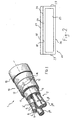
- 1 indicates a one-phase superconducting cable 1 of the so-called co-axial type as a whole.
- Cable 1 comprises a superconducting core, globally indicated by 2, comprising at least a conducing element 3; the illustrated example relates (according to cited EP-A-0 786 783) to a cable wherein four conducting elements are provided, indicated by 3 I , 3 II , 3 III , 3 IV , housed - preferably loosely - within a tubular casing 9, for instance of metal, such as steel, aluminium and the like.
- Each of the conducting elements 3 comprises a couple of co-axial conductors, respectively of phase 4 and of neutral 5, including each at least a layer of superconducting material.
- the superconducting material is incorporated in a plurality of superposed superconducting tapes 20, spirally wound on respective tubular supports 6 and (possibly) 7, with a sufficiently low winding angle ⁇ ; if the tubular support is metal, the angle ⁇ is preferably smaller than 40°, as will be illustrated in the following.
- Co-axial phase 4 and neutral 5 conductors are electrically insulated from one another by means of an interposed layer 8 of dielectric material.
- Cable 1 also comprises suitable means to refrigerate the superconducting core 3 to a temperature suitably lower than the critical temperature of the chosen superconducting material, which in the cable of Figure 1 is of the so-called "high temperature" type.
- the aforesaid means comprise suitable, known and thus not represented, pumping means, whose purpose is feeding a suitable refrigerating fluid, for instance liquid nitrogen at a temperature of from 65° to 90°K, both in the interior of each of the conducting elements 3, and in the interstices between such elements and the tubular casing 9.
- a suitable refrigerating fluid for instance liquid nitrogen at a temperature of from 65° to 90°K
- the superconducting core 2 is enclosed in a holding structure, or cryostat, 10 comprising a thermal insulation formed, for instance, by a plurality of superposed layers, and at least a protection sheath.
- cryostat known in the art, is described for instance in an article by IEEE TRANSACTIONS ON POWER DELIVERY, vol. 7, no. 4, October 1992, pp. 1745-1753.
- cryostat 10 comprises a layer 11 of insulating material, constituted for instance by several tapes (some dozens) from surface-metallised plastic material (for instance polyester resin), known in the art as "thermal superinsulator", loosely wound, possibly with the aid of interposed spacers 13.
- Such tapes are housed in an annular hollow space 12, delimited by a tubular element 14, in which vacuum of about 10 -2 N/m 2 is maintained by means of known apparatuses.
- the metal tubular element 14 is suitable to give the annular hollow space 12 the desired impermeability, and is covered by an external sheath 15, for instance of polyethylene.
- the metal tubular element 14 is formed by a tape wound in tubular shape and longitudinally welded, made of steel, copper, aluminium and the like, or by an extruded tube or the like.
- element 14 may be corrugated.
- cable traction elements may also be present, axially or peripherally located based on the construction and use requirements of the same, to ensure limitation of mechanical stresses applied to superconducting elements 3; such traction elements, not shown, may be constituted, according to techniques known in the art, by peripherally placed metal armours, for instance by roped steel wires, or by one or more axial metal cords, or by armouring fibres of dielectric material, for instance aramid fibres.
- tubular supports 6 and 7 are made of non magnetic stainless steel, and may have a continuous, either smooth or corrugated, structure; alternatively, tubular supports 6 and 7 may be realised with a spirally wound steel strip or with a tile structure. Materials different from steel may also be used, such as copper or aluminium.
- Each superconducting tape 20, as shown in Figure 2 comprises superconducting material 23, a metal covering 24 (preferably from silver or silver alloy with magnesium, aluminium or nickel), wherein the superconducting material 23 is enclosed, and at least a metal strip (or band or laminate) 25 coupled to covering 24.
- covering 24 has a substantially rectangular flattened section with two long sides 26 and two short sides 27; also strip 25 has a substantially rectangular flattened section with two long sides 28 of a length almost equal to the long sides 26 of covering 24.
- Strip 25 is fastened to covering 24 by welding, brazing or gluing. It should be noted that there may be two strips 25, either equal or different, fastened to opposite parts of covering 24.
- the tables show the feasibility either by a conventional superconducting tape with a maximum bearable tensile deformation equal to 3 ⁇ , and by a superconducting tape according to the invention (provided with two strips 25 located along sides 26 of the section, having a thickness of 0.045 mm and a length of 3,8 mm, made of stainless steel, bonded to covering 24 of the strip by tin brazing), with a maximum bearable tensile deformation equal to 5.5 ⁇ , therefore with a 2.5 ⁇ improvement.
- the minimum increase value of tensile deformation resistance necessary to ensure feasibility has been indicated, assuming (as indicated above and practically verified) that the superconducting non-reinforced tape can bear a 3 ⁇ tensile deformation. Double-underlined values indicate that the 3 ⁇ limit has been exceeded.
- Table 1 summarises the situation in the case of a polymeric support, table 2 that relating to the case of a metal support.
- the example shows, in a specific case, that generally the invention allows a greater design freedom as concerns winding angles, support diameter, winding pull value, and, to some extent, choice of material for the support.
- a metal for the support is particularly advantageous, as such support, besides imparting a greater solidity to the cable, therefore with a better protection for the superconducting material, above all allows to prevent those drawbacks of polymeric supports mentioned above for the prior art; this means that no dangerous hollow spaces form at the working temperature between the conductor and the surrounding layers, due to differences in heat expansion coefficient. Because in the cable the layers external with respect to the conductor are - as has been seen - prevailingly metal, using a metal support minimises expansion differences and therefore drastically reduces inconveniences due to hollow spaces.
- the metal support lends a greater mechanical resistance to the conductor, understood as the whole of the support and the superconducting material wound on the same.
- possible mechanical stresses on the conductor are not transmitted to a great extent to superconducting tapes (as happens with polymer supports because of their high deformability), but are instead almost entirely borne by the same support.
- the invention allows to realise less delicate and more resistant superconducting cables.
Landscapes
- Superconductors And Manufacturing Methods Therefor (AREA)
Priority Applications (1)
| Application Number | Priority Date | Filing Date | Title |
|---|---|---|---|
| EP98946296A EP1000428B1 (en) | 1997-08-05 | 1998-07-28 | High temperature superconducting cable and process for manufacturing the same |
Applications Claiming Priority (6)
| Application Number | Priority Date | Filing Date | Title |
|---|---|---|---|
| EP97202433 | 1997-08-05 | ||
| EP97202433 | 1997-08-05 | ||
| US5998697P | 1997-09-25 | 1997-09-25 | |
| EP98946296A EP1000428B1 (en) | 1997-08-05 | 1998-07-28 | High temperature superconducting cable and process for manufacturing the same |
| PCT/EP1998/004991 WO1999008289A1 (en) | 1997-08-05 | 1998-07-28 | High temperature superconducting cable and process for manufacturing the same |
| US59986 | 2002-01-29 |
Publications (2)
| Publication Number | Publication Date |
|---|---|
| EP1000428A1 EP1000428A1 (en) | 2000-05-17 |
| EP1000428B1 true EP1000428B1 (en) | 2005-05-04 |
Family
ID=8228623
Family Applications (1)
| Application Number | Title | Priority Date | Filing Date |
|---|---|---|---|
| EP98946296A Expired - Lifetime EP1000428B1 (en) | 1997-08-05 | 1998-07-28 | High temperature superconducting cable and process for manufacturing the same |
Country Status (9)
| Country | Link |
|---|---|
| EP (1) | EP1000428B1 (enExample) |
| JP (1) | JP2003526175A (enExample) |
| CN (1) | CN1154118C (enExample) |
| AR (1) | AR015717A1 (enExample) |
| AU (1) | AU724690B2 (enExample) |
| BR (1) | BR9811069A (enExample) |
| CA (1) | CA2299245C (enExample) |
| DE (1) | DE69830060T2 (enExample) |
| WO (1) | WO1999008289A1 (enExample) |
Families Citing this family (5)
| Publication number | Priority date | Publication date | Assignee | Title |
|---|---|---|---|---|
| AU3148900A (en) | 1998-12-24 | 2000-07-31 | Pirelli Cavi E Sistemi S.P.A. | Superconducting cable |
| EP1328948B1 (en) * | 2000-09-27 | 2017-08-16 | IGC-Superpower, LLC | Low alternating current (ac) loss superconducting coils |
| DE102009047865A1 (de) * | 2009-09-30 | 2011-03-31 | Siemens Aktiengesellschaft | Verfahren zum Aufbringen von Kunststoff auf Einzelleiter und HTS-Verbund hergestellt aus den Einzelleitern |
| US20150045230A1 (en) * | 2012-04-10 | 2015-02-12 | Sumitomo Electric Industries, Ltd. | Reinforcing-member-equipped oxide superconducting wire |
| FR3000854B1 (fr) | 2013-01-10 | 2015-01-23 | Renault Sa | Systeme et procede correspondant de commande de la vitesse de rotation d'un moteur electrique d'un vehicule automobile |
Family Cites Families (2)
| Publication number | Priority date | Publication date | Assignee | Title |
|---|---|---|---|---|
| US5620798A (en) * | 1995-05-17 | 1997-04-15 | The Babcock & Wilcox Company | Aluminum stabilized superconductor supported by aluminum alloy sheath |
| IT1277740B1 (it) * | 1995-12-28 | 1997-11-12 | Pirelli Cavi S P A Ora Pirelli | Cavo superconduttore per alta potenza |
-
1998
- 1998-07-28 CN CNB988080249A patent/CN1154118C/zh not_active Expired - Fee Related
- 1998-07-28 JP JP2000506661A patent/JP2003526175A/ja active Pending
- 1998-07-28 AU AU93402/98A patent/AU724690B2/en not_active Ceased
- 1998-07-28 EP EP98946296A patent/EP1000428B1/en not_active Expired - Lifetime
- 1998-07-28 BR BR9811069-1A patent/BR9811069A/pt active Search and Examination
- 1998-07-28 WO PCT/EP1998/004991 patent/WO1999008289A1/en not_active Ceased
- 1998-07-28 CA CA002299245A patent/CA2299245C/en not_active Expired - Fee Related
- 1998-07-28 DE DE69830060T patent/DE69830060T2/de not_active Expired - Lifetime
- 1998-08-03 AR ARP980103827A patent/AR015717A1/es active IP Right Grant
Also Published As
| Publication number | Publication date |
|---|---|
| CA2299245C (en) | 2006-10-03 |
| DE69830060D1 (de) | 2005-06-09 |
| AR015717A1 (es) | 2001-05-16 |
| CA2299245A1 (en) | 1999-02-18 |
| CN1266532A (zh) | 2000-09-13 |
| EP1000428A1 (en) | 2000-05-17 |
| BR9811069A (pt) | 2000-08-15 |
| DE69830060T2 (de) | 2006-01-12 |
| AU9340298A (en) | 1999-03-01 |
| AU724690B2 (en) | 2000-09-28 |
| WO1999008289A1 (en) | 1999-02-18 |
| JP2003526175A (ja) | 2003-09-02 |
| CN1154118C (zh) | 2004-06-16 |
Similar Documents
| Publication | Publication Date | Title |
|---|---|---|
| EP0786783B1 (en) | Method for transmitting a predetermined current by a high power superconducting cable | |
| US3749811A (en) | Superconducting cable | |
| JP3474602B2 (ja) | 超電導導体 | |
| US20150111756A1 (en) | Superconducting cables and methods of making the same | |
| EP0650205A1 (en) | Superconducting cable conductor | |
| US7743485B1 (en) | Method of manufacturing a superconducting cable | |
| US6284979B1 (en) | Low resistance cabled conductors comprising superconducting ceramics | |
| AU755112B2 (en) | Superconducting cable | |
| US5298679A (en) | Current lead for cryostat using composite high temperature superconductors | |
| CN1279817A (zh) | 电力变压器 | |
| US4857675A (en) | Forced flow superconducting cable and method of manufacture | |
| US20020098985A1 (en) | Superconducting cable | |
| AU3148900A (en) | Superconducting cable | |
| US6794579B1 (en) | High temperature superconducting cable | |
| AU724690B2 (en) | High temperature superconducting cable and process for manufacturing the same | |
| JPH10214713A (ja) | 超電導コイル | |
| JPH11506564A (ja) | 導電体とケーブル | |
| US7417192B2 (en) | Superconductor components | |
| JP2002140943A (ja) | 超電導ケーブル | |
| Tallon | Industry warms to superconductors | |
| Mukai et al. | Multifilamentary Bismuth (2223) Multilayer-Wound Conductors for Power Transmission Lines | |
| Von Dollen et al. | Development of a High Temperature Superconducting Power Transmission Cable | |
| KR20010099962A (ko) | 초전도 케이블 | |
| HK1030675B (en) | High temperature superconducting cable and process for manufacturing the same |
Legal Events
| Date | Code | Title | Description |
|---|---|---|---|
| PUAI | Public reference made under article 153(3) epc to a published international application that has entered the european phase |
Free format text: ORIGINAL CODE: 0009012 |
|
| 17P | Request for examination filed |
Effective date: 20000208 |
|
| AK | Designated contracting states |
Kind code of ref document: A1 Designated state(s): CH DE DK ES FR GB IT LI NL SE |
|
| RAP1 | Party data changed (applicant data changed or rights of an application transferred) |
Owner name: PIRELLI S.P.A. |
|
| RAP1 | Party data changed (applicant data changed or rights of an application transferred) |
Owner name: PIRELLI & C. S.P.A. |
|
| 17Q | First examination report despatched |
Effective date: 20040521 |
|
| GRAP | Despatch of communication of intention to grant a patent |
Free format text: ORIGINAL CODE: EPIDOSNIGR1 |
|
| GRAS | Grant fee paid |
Free format text: ORIGINAL CODE: EPIDOSNIGR3 |
|
| GRAA | (expected) grant |
Free format text: ORIGINAL CODE: 0009210 |
|
| AK | Designated contracting states |
Kind code of ref document: B1 Designated state(s): CH DE DK ES FR GB IT LI NL SE |
|
| PG25 | Lapsed in a contracting state [announced via postgrant information from national office to epo] |
Ref country code: NL Free format text: LAPSE BECAUSE OF FAILURE TO SUBMIT A TRANSLATION OF THE DESCRIPTION OR TO PAY THE FEE WITHIN THE PRESCRIBED TIME-LIMIT Effective date: 20050504 Ref country code: LI Free format text: LAPSE BECAUSE OF FAILURE TO SUBMIT A TRANSLATION OF THE DESCRIPTION OR TO PAY THE FEE WITHIN THE PRESCRIBED TIME-LIMIT Effective date: 20050504 Ref country code: CH Free format text: LAPSE BECAUSE OF FAILURE TO SUBMIT A TRANSLATION OF THE DESCRIPTION OR TO PAY THE FEE WITHIN THE PRESCRIBED TIME-LIMIT Effective date: 20050504 |
|
| REG | Reference to a national code |
Ref country code: GB Ref legal event code: FG4D |
|
| REG | Reference to a national code |
Ref country code: CH Ref legal event code: EP |
|
| REF | Corresponds to: |
Ref document number: 69830060 Country of ref document: DE Date of ref document: 20050609 Kind code of ref document: P |
|
| PG25 | Lapsed in a contracting state [announced via postgrant information from national office to epo] |
Ref country code: SE Free format text: LAPSE BECAUSE OF FAILURE TO SUBMIT A TRANSLATION OF THE DESCRIPTION OR TO PAY THE FEE WITHIN THE PRESCRIBED TIME-LIMIT Effective date: 20050804 Ref country code: DK Free format text: LAPSE BECAUSE OF FAILURE TO SUBMIT A TRANSLATION OF THE DESCRIPTION OR TO PAY THE FEE WITHIN THE PRESCRIBED TIME-LIMIT Effective date: 20050804 |
|
| PG25 | Lapsed in a contracting state [announced via postgrant information from national office to epo] |
Ref country code: ES Free format text: LAPSE BECAUSE OF FAILURE TO SUBMIT A TRANSLATION OF THE DESCRIPTION OR TO PAY THE FEE WITHIN THE PRESCRIBED TIME-LIMIT Effective date: 20050815 |
|
| NLV1 | Nl: lapsed or annulled due to failure to fulfill the requirements of art. 29p and 29m of the patents act | ||
| REG | Reference to a national code |
Ref country code: CH Ref legal event code: PL |
|
| ET | Fr: translation filed | ||
| PLBE | No opposition filed within time limit |
Free format text: ORIGINAL CODE: 0009261 |
|
| STAA | Information on the status of an ep patent application or granted ep patent |
Free format text: STATUS: NO OPPOSITION FILED WITHIN TIME LIMIT |
|
| 26N | No opposition filed |
Effective date: 20060207 |
|
| REG | Reference to a national code |
Ref country code: FR Ref legal event code: TP Ref country code: FR Ref legal event code: CD |
|
| REG | Reference to a national code |
Ref country code: GB Ref legal event code: 732E |
|
| REG | Reference to a national code |
Ref country code: GB Ref legal event code: 732E |
|
| PGFP | Annual fee paid to national office [announced via postgrant information from national office to epo] |
Ref country code: DE Payment date: 20140729 Year of fee payment: 17 |
|
| PGFP | Annual fee paid to national office [announced via postgrant information from national office to epo] |
Ref country code: FR Payment date: 20140717 Year of fee payment: 17 Ref country code: GB Payment date: 20140729 Year of fee payment: 17 |
|
| PGFP | Annual fee paid to national office [announced via postgrant information from national office to epo] |
Ref country code: IT Payment date: 20140724 Year of fee payment: 17 |
|
| REG | Reference to a national code |
Ref country code: DE Ref legal event code: R119 Ref document number: 69830060 Country of ref document: DE |
|
| GBPC | Gb: european patent ceased through non-payment of renewal fee |
Effective date: 20150728 |
|
| PG25 | Lapsed in a contracting state [announced via postgrant information from national office to epo] |
Ref country code: GB Free format text: LAPSE BECAUSE OF NON-PAYMENT OF DUE FEES Effective date: 20150728 Ref country code: IT Free format text: LAPSE BECAUSE OF NON-PAYMENT OF DUE FEES Effective date: 20150728 Ref country code: DE Free format text: LAPSE BECAUSE OF NON-PAYMENT OF DUE FEES Effective date: 20160202 |
|
| REG | Reference to a national code |
Ref country code: FR Ref legal event code: ST Effective date: 20160331 |
|
| PG25 | Lapsed in a contracting state [announced via postgrant information from national office to epo] |
Ref country code: FR Free format text: LAPSE BECAUSE OF NON-PAYMENT OF DUE FEES Effective date: 20150731 |