EP0997505B1 - Ink-jet inks with improved performance - Google Patents
Ink-jet inks with improved performance Download PDFInfo
- Publication number
- EP0997505B1 EP0997505B1 EP99308352A EP99308352A EP0997505B1 EP 0997505 B1 EP0997505 B1 EP 0997505B1 EP 99308352 A EP99308352 A EP 99308352A EP 99308352 A EP99308352 A EP 99308352A EP 0997505 B1 EP0997505 B1 EP 0997505B1
- Authority
- EP
- European Patent Office
- Prior art keywords
- ink
- decel
- liquid
- colorant
- component
- Prior art date
- Legal status (The legal status is an assumption and is not a legal conclusion. Google has not performed a legal analysis and makes no representation as to the accuracy of the status listed.)
- Expired - Lifetime
Links
- 239000000976 ink Substances 0.000 title description 116
- 239000007788 liquid Substances 0.000 claims description 85
- 239000003086 colorant Substances 0.000 claims description 57
- 229910052751 metal Inorganic materials 0.000 claims description 40
- 239000002184 metal Substances 0.000 claims description 40
- NHNBFGGVMKEFGY-UHFFFAOYSA-N Nitrate Chemical compound [O-][N+]([O-])=O NHNBFGGVMKEFGY-UHFFFAOYSA-N 0.000 claims description 35
- 150000003839 salts Chemical class 0.000 claims description 24
- 150000001875 compounds Chemical class 0.000 claims description 22
- 239000003795 chemical substances by application Substances 0.000 claims description 21
- 150000001768 cations Chemical class 0.000 claims description 20
- 230000001376 precipitating effect Effects 0.000 claims description 17
- -1 complex Chemical class 0.000 claims description 16
- 150000001450 anions Chemical class 0.000 claims description 15
- 125000000129 anionic group Chemical group 0.000 claims description 13
- 125000002091 cationic group Chemical group 0.000 claims description 9
- 150000002736 metal compounds Chemical class 0.000 claims description 9
- 239000008135 aqueous vehicle Substances 0.000 claims description 6
- 125000000524 functional group Chemical group 0.000 claims description 4
- 229910001870 ammonium persulfate Inorganic materials 0.000 claims description 3
- 230000003100 immobilizing effect Effects 0.000 claims description 3
- 229910002651 NO3 Inorganic materials 0.000 description 83
- 239000000203 mixture Substances 0.000 description 40
- 239000000049 pigment Substances 0.000 description 25
- QGZKDVFQNNGYKY-UHFFFAOYSA-N Ammonia Chemical compound N QGZKDVFQNNGYKY-UHFFFAOYSA-N 0.000 description 24
- 125000003178 carboxy group Chemical group [H]OC(*)=O 0.000 description 24
- 239000000975 dye Substances 0.000 description 23
- YIXJRHPUWRPCBB-UHFFFAOYSA-N magnesium nitrate Inorganic materials [Mg+2].[O-][N+]([O-])=O.[O-][N+]([O-])=O YIXJRHPUWRPCBB-UHFFFAOYSA-N 0.000 description 18
- 239000000463 material Substances 0.000 description 15
- 239000000243 solution Substances 0.000 description 15
- 239000003446 ligand Substances 0.000 description 13
- 150000002739 metals Chemical class 0.000 description 12
- 238000007639 printing Methods 0.000 description 12
- XLYOFNOQVPJJNP-UHFFFAOYSA-N water Substances O XLYOFNOQVPJJNP-UHFFFAOYSA-N 0.000 description 11
- 238000007641 inkjet printing Methods 0.000 description 10
- 239000002270 dispersing agent Substances 0.000 description 9
- 238000010304 firing Methods 0.000 description 9
- 230000006872 improvement Effects 0.000 description 9
- 239000000758 substrate Substances 0.000 description 9
- 230000001747 exhibiting effect Effects 0.000 description 8
- 238000000034 method Methods 0.000 description 8
- 229910006069 SO3H Inorganic materials 0.000 description 7
- 239000006185 dispersion Substances 0.000 description 7
- 125000000896 monocarboxylic acid group Chemical group 0.000 description 7
- NLXLAEXVIDQMFP-UHFFFAOYSA-N Ammonia chloride Chemical compound [NH4+].[Cl-] NLXLAEXVIDQMFP-UHFFFAOYSA-N 0.000 description 6
- 239000004094 surface-active agent Substances 0.000 description 6
- PAWQVTBBRAZDMG-UHFFFAOYSA-N 2-(3-bromo-2-fluorophenyl)acetic acid Chemical compound OC(=O)CC1=CC=CC(Br)=C1F PAWQVTBBRAZDMG-UHFFFAOYSA-N 0.000 description 5
- CPLXHLVBOLITMK-UHFFFAOYSA-N Magnesium oxide Chemical compound [Mg]=O CPLXHLVBOLITMK-UHFFFAOYSA-N 0.000 description 5
- 239000000654 additive Substances 0.000 description 5
- 239000008365 aqueous carrier Substances 0.000 description 5
- 239000011654 magnesium acetate Substances 0.000 description 5
- 239000003002 pH adjusting agent Substances 0.000 description 5
- TWRXJAOTZQYOKJ-UHFFFAOYSA-L Magnesium chloride Chemical compound [Mg+2].[Cl-].[Cl-] TWRXJAOTZQYOKJ-UHFFFAOYSA-L 0.000 description 4
- 239000011575 calcium Substances 0.000 description 4
- 230000015556 catabolic process Effects 0.000 description 4
- 239000011777 magnesium Substances 0.000 description 4
- 238000004519 manufacturing process Methods 0.000 description 4
- 125000000020 sulfo group Chemical group O=S(=O)([*])O[H] 0.000 description 4
- QTBSBXVTEAMEQO-UHFFFAOYSA-N Acetic acid Chemical compound CC(O)=O QTBSBXVTEAMEQO-UHFFFAOYSA-N 0.000 description 3
- VHUUQVKOLVNVRT-UHFFFAOYSA-N Ammonium hydroxide Chemical compound [NH4+].[OH-] VHUUQVKOLVNVRT-UHFFFAOYSA-N 0.000 description 3
- 239000002253 acid Substances 0.000 description 3
- NIXOWILDQLNWCW-UHFFFAOYSA-N acrylic acid group Chemical group C(C=C)(=O)O NIXOWILDQLNWCW-UHFFFAOYSA-N 0.000 description 3
- 150000007942 carboxylates Chemical group 0.000 description 3
- 239000006184 cosolvent Substances 0.000 description 3
- 238000000354 decomposition reaction Methods 0.000 description 3
- 238000006731 degradation reaction Methods 0.000 description 3
- MTHSVFCYNBDYFN-UHFFFAOYSA-N diethylene glycol Chemical compound OCCOCCO MTHSVFCYNBDYFN-UHFFFAOYSA-N 0.000 description 3
- 230000009545 invasion Effects 0.000 description 3
- 150000002500 ions Chemical class 0.000 description 3
- 239000000395 magnesium oxide Substances 0.000 description 3
- 230000007246 mechanism Effects 0.000 description 3
- 150000001455 metallic ions Chemical class 0.000 description 3
- 230000006911 nucleation Effects 0.000 description 3
- 238000010899 nucleation Methods 0.000 description 3
- 239000000047 product Substances 0.000 description 3
- 230000009467 reduction Effects 0.000 description 3
- 230000004044 response Effects 0.000 description 3
- 239000003981 vehicle Substances 0.000 description 3
- IJGRMHOSHXDMSA-UHFFFAOYSA-N Atomic nitrogen Chemical compound N#N IJGRMHOSHXDMSA-UHFFFAOYSA-N 0.000 description 2
- UXVMQQNJUSDDNG-UHFFFAOYSA-L Calcium chloride Chemical compound [Cl-].[Cl-].[Ca+2] UXVMQQNJUSDDNG-UHFFFAOYSA-L 0.000 description 2
- CURLTUGMZLYLDI-UHFFFAOYSA-N Carbon dioxide Chemical compound O=C=O CURLTUGMZLYLDI-UHFFFAOYSA-N 0.000 description 2
- DHMQDGOQFOQNFH-UHFFFAOYSA-N Glycine Chemical compound NCC(O)=O DHMQDGOQFOQNFH-UHFFFAOYSA-N 0.000 description 2
- CSNNHWWHGAXBCP-UHFFFAOYSA-L Magnesium sulfate Chemical compound [Mg+2].[O-][S+2]([O-])([O-])[O-] CSNNHWWHGAXBCP-UHFFFAOYSA-L 0.000 description 2
- GRYLNZFGIOXLOG-UHFFFAOYSA-N Nitric acid Chemical compound O[N+]([O-])=O GRYLNZFGIOXLOG-UHFFFAOYSA-N 0.000 description 2
- 230000000996 additive effect Effects 0.000 description 2
- JLDSOYXADOWAKB-UHFFFAOYSA-N aluminium nitrate Chemical compound [Al+3].[O-][N+]([O-])=O.[O-][N+]([O-])=O.[O-][N+]([O-])=O JLDSOYXADOWAKB-UHFFFAOYSA-N 0.000 description 2
- VSCWAEJMTAWNJL-UHFFFAOYSA-K aluminium trichloride Chemical compound Cl[Al](Cl)Cl VSCWAEJMTAWNJL-UHFFFAOYSA-K 0.000 description 2
- 239000003945 anionic surfactant Substances 0.000 description 2
- 239000001110 calcium chloride Substances 0.000 description 2
- 229910001628 calcium chloride Inorganic materials 0.000 description 2
- 159000000007 calcium salts Chemical class 0.000 description 2
- 238000004364 calculation method Methods 0.000 description 2
- 238000006243 chemical reaction Methods 0.000 description 2
- UFMZWBIQTDUYBN-UHFFFAOYSA-N cobalt dinitrate Chemical compound [Co+2].[O-][N+]([O-])=O.[O-][N+]([O-])=O UFMZWBIQTDUYBN-UHFFFAOYSA-N 0.000 description 2
- XTVVROIMIGLXTD-UHFFFAOYSA-N copper(II) nitrate Chemical compound [Cu+2].[O-][N+]([O-])=O.[O-][N+]([O-])=O XTVVROIMIGLXTD-UHFFFAOYSA-N 0.000 description 2
- 230000001419 dependent effect Effects 0.000 description 2
- 239000001041 dye based ink Substances 0.000 description 2
- 238000009472 formulation Methods 0.000 description 2
- 239000007789 gas Substances 0.000 description 2
- 239000004615 ingredient Substances 0.000 description 2
- JVTAAEKCZFNVCJ-UHFFFAOYSA-N lactic acid Chemical compound CC(O)C(O)=O JVTAAEKCZFNVCJ-UHFFFAOYSA-N 0.000 description 2
- 229910001629 magnesium chloride Inorganic materials 0.000 description 2
- 230000000813 microbial effect Effects 0.000 description 2
- 150000002823 nitrates Chemical class 0.000 description 2
- 229910017604 nitric acid Inorganic materials 0.000 description 2
- 229910052757 nitrogen Inorganic materials 0.000 description 2
- 239000003960 organic solvent Substances 0.000 description 2
- 230000035515 penetration Effects 0.000 description 2
- 239000002244 precipitate Substances 0.000 description 2
- 238000001556 precipitation Methods 0.000 description 2
- 238000007086 side reaction Methods 0.000 description 2
- 239000000126 substance Substances 0.000 description 2
- QOPUBSBYMCLLKW-UHFFFAOYSA-N 2-[2-[bis(carboxymethyl)amino]ethyl-(carboxymethyl)amino]-4-hydroxybutanoic acid Chemical compound OCCC(C(O)=O)N(CC(O)=O)CCN(CC(O)=O)CC(O)=O QOPUBSBYMCLLKW-UHFFFAOYSA-N 0.000 description 1
- ADCWDMYESTYBBN-UHFFFAOYSA-N 2-[n-(2-hydroxyethyl)-3-methyl-4-[(4-nitrophenyl)diazenyl]anilino]ethanol Chemical compound CC1=CC(N(CCO)CCO)=CC=C1N=NC1=CC=C([N+]([O-])=O)C=C1 ADCWDMYESTYBBN-UHFFFAOYSA-N 0.000 description 1
- QGZKDVFQNNGYKY-UHFFFAOYSA-O Ammonium Chemical compound [NH4+] QGZKDVFQNNGYKY-UHFFFAOYSA-O 0.000 description 1
- USFZMSVCRYTOJT-UHFFFAOYSA-N Ammonium acetate Chemical compound N.CC(O)=O USFZMSVCRYTOJT-UHFFFAOYSA-N 0.000 description 1
- OYPRJOBELJOOCE-UHFFFAOYSA-N Calcium Chemical compound [Ca] OYPRJOBELJOOCE-UHFFFAOYSA-N 0.000 description 1
- OKTJSMMVPCPJKN-UHFFFAOYSA-N Carbon Chemical compound [C] OKTJSMMVPCPJKN-UHFFFAOYSA-N 0.000 description 1
- 229910021580 Cobalt(II) chloride Inorganic materials 0.000 description 1
- 229910021592 Copper(II) chloride Inorganic materials 0.000 description 1
- RPNUMPOLZDHAAY-UHFFFAOYSA-N Diethylenetriamine Chemical compound NCCNCCN RPNUMPOLZDHAAY-UHFFFAOYSA-N 0.000 description 1
- KCXVZYZYPLLWCC-UHFFFAOYSA-N EDTA Chemical compound OC(=O)CN(CC(O)=O)CCN(CC(O)=O)CC(O)=O KCXVZYZYPLLWCC-UHFFFAOYSA-N 0.000 description 1
- HMEKVHWROSNWPD-UHFFFAOYSA-N Erioglaucine A Chemical compound [NH4+].[NH4+].C=1C=C(C(=C2C=CC(C=C2)=[N+](CC)CC=2C=C(C=CC=2)S([O-])(=O)=O)C=2C(=CC=CC=2)S([O-])(=O)=O)C=CC=1N(CC)CC1=CC=CC(S([O-])(=O)=O)=C1 HMEKVHWROSNWPD-UHFFFAOYSA-N 0.000 description 1
- PIICEJLVQHRZGT-UHFFFAOYSA-N Ethylenediamine Chemical compound NCCN PIICEJLVQHRZGT-UHFFFAOYSA-N 0.000 description 1
- SXRSQZLOMIGNAQ-UHFFFAOYSA-N Glutaraldehyde Chemical compound O=CCCCC=O SXRSQZLOMIGNAQ-UHFFFAOYSA-N 0.000 description 1
- 239000004471 Glycine Substances 0.000 description 1
- 229920001732 Lignosulfonate Polymers 0.000 description 1
- FYYHWMGAXLPEAU-UHFFFAOYSA-N Magnesium Chemical compound [Mg] FYYHWMGAXLPEAU-UHFFFAOYSA-N 0.000 description 1
- FSVCELGFZIQNCK-UHFFFAOYSA-N N,N-bis(2-hydroxyethyl)glycine Chemical compound OCCN(CCO)CC(O)=O FSVCELGFZIQNCK-UHFFFAOYSA-N 0.000 description 1
- QPCDCPDFJACHGM-UHFFFAOYSA-N N,N-bis{2-[bis(carboxymethyl)amino]ethyl}glycine Chemical compound OC(=O)CN(CC(O)=O)CCN(CC(=O)O)CCN(CC(O)=O)CC(O)=O QPCDCPDFJACHGM-UHFFFAOYSA-N 0.000 description 1
- JYXGIOKAKDAARW-UHFFFAOYSA-N N-(2-hydroxyethyl)iminodiacetic acid Chemical compound OCCN(CC(O)=O)CC(O)=O JYXGIOKAKDAARW-UHFFFAOYSA-N 0.000 description 1
- 229910017504 Nd(NO3)3 Inorganic materials 0.000 description 1
- 229910021586 Nickel(II) chloride Inorganic materials 0.000 description 1
- 229910009253 Y(NO3)3 Inorganic materials 0.000 description 1
- 238000009825 accumulation Methods 0.000 description 1
- 150000001412 amines Chemical class 0.000 description 1
- 229910021529 ammonia Inorganic materials 0.000 description 1
- BFNBIHQBYMNNAN-UHFFFAOYSA-N ammonium sulfate Chemical compound N.N.OS(O)(=O)=O BFNBIHQBYMNNAN-UHFFFAOYSA-N 0.000 description 1
- 229910052921 ammonium sulfate Inorganic materials 0.000 description 1
- 239000002280 amphoteric surfactant Substances 0.000 description 1
- 238000013459 approach Methods 0.000 description 1
- 239000007864 aqueous solution Substances 0.000 description 1
- DMSMPAJRVJJAGA-UHFFFAOYSA-N benzo[d]isothiazol-3-one Chemical compound C1=CC=C2C(=O)NSC2=C1 DMSMPAJRVJJAGA-UHFFFAOYSA-N 0.000 description 1
- 239000003139 biocide Substances 0.000 description 1
- 230000015572 biosynthetic process Effects 0.000 description 1
- 235000012745 brilliant blue FCF Nutrition 0.000 description 1
- 239000004161 brilliant blue FCF Substances 0.000 description 1
- 229910052791 calcium Inorganic materials 0.000 description 1
- 239000001569 carbon dioxide Substances 0.000 description 1
- 229910002092 carbon dioxide Inorganic materials 0.000 description 1
- 239000003093 cationic surfactant Substances 0.000 description 1
- PSWOBQSIXLVPDV-CXUHLZMHSA-N chembl2105120 Chemical compound C1=C(O)C(OC)=CC(\C=N\NC(=O)C=2C=CN=CC=2)=C1 PSWOBQSIXLVPDV-CXUHLZMHSA-N 0.000 description 1
- 238000001311 chemical methods and process Methods 0.000 description 1
- 239000000084 colloidal system Substances 0.000 description 1
- 230000000295 complement effect Effects 0.000 description 1
- 235000009508 confectionery Nutrition 0.000 description 1
- 239000000356 contaminant Substances 0.000 description 1
- ORTQZVOHEJQUHG-UHFFFAOYSA-L copper(II) chloride Chemical compound Cl[Cu]Cl ORTQZVOHEJQUHG-UHFFFAOYSA-L 0.000 description 1
- XCJYREBRNVKWGJ-UHFFFAOYSA-N copper(II) phthalocyanine Chemical compound [Cu+2].C12=CC=CC=C2C(N=C2[N-]C(C3=CC=CC=C32)=N2)=NC1=NC([C]1C=CC=CC1=1)=NC=1N=C1[C]3C=CC=CC3=C2[N-]1 XCJYREBRNVKWGJ-UHFFFAOYSA-N 0.000 description 1
- 239000013078 crystal Substances 0.000 description 1
- 239000000986 disperse dye Substances 0.000 description 1
- 238000001035 drying Methods 0.000 description 1
- 230000000694 effects Effects 0.000 description 1
- 238000004880 explosion Methods 0.000 description 1
- 239000000417 fungicide Substances 0.000 description 1
- 229910052736 halogen Inorganic materials 0.000 description 1
- 150000002367 halogens Chemical class 0.000 description 1
- 238000010438 heat treatment Methods 0.000 description 1
- NBZBKCUXIYYUSX-UHFFFAOYSA-N iminodiacetic acid Chemical compound OC(=O)CNCC(O)=O NBZBKCUXIYYUSX-UHFFFAOYSA-N 0.000 description 1
- 239000001023 inorganic pigment Substances 0.000 description 1
- 229910017053 inorganic salt Inorganic materials 0.000 description 1
- 238000011835 investigation Methods 0.000 description 1
- 125000003010 ionic group Chemical group 0.000 description 1
- 239000004310 lactic acid Substances 0.000 description 1
- 235000014655 lactic acid Nutrition 0.000 description 1
- 229910052747 lanthanoid Inorganic materials 0.000 description 1
- SXQCTESRRZBPHJ-UHFFFAOYSA-M lissamine rhodamine Chemical compound [Na+].C=12C=CC(=[N+](CC)CC)C=C2OC2=CC(N(CC)CC)=CC=C2C=1C1=CC=C(S([O-])(=O)=O)C=C1S([O-])(=O)=O SXQCTESRRZBPHJ-UHFFFAOYSA-M 0.000 description 1
- 229910052749 magnesium Inorganic materials 0.000 description 1
- UEGPKNKPLBYCNK-UHFFFAOYSA-L magnesium acetate Chemical compound [Mg+2].CC([O-])=O.CC([O-])=O UEGPKNKPLBYCNK-UHFFFAOYSA-L 0.000 description 1
- 235000011285 magnesium acetate Nutrition 0.000 description 1
- 229940069446 magnesium acetate Drugs 0.000 description 1
- OTCKOJUMXQWKQG-UHFFFAOYSA-L magnesium bromide Chemical compound [Mg+2].[Br-].[Br-] OTCKOJUMXQWKQG-UHFFFAOYSA-L 0.000 description 1
- 229910001623 magnesium bromide Inorganic materials 0.000 description 1
- 229910052943 magnesium sulfate Inorganic materials 0.000 description 1
- AXZKOIWUVFPNLO-UHFFFAOYSA-N magnesium;oxygen(2-) Chemical compound [O-2].[Mg+2] AXZKOIWUVFPNLO-UHFFFAOYSA-N 0.000 description 1
- 239000008204 material by function Substances 0.000 description 1
- 229910000000 metal hydroxide Inorganic materials 0.000 description 1
- 150000004692 metal hydroxides Chemical class 0.000 description 1
- 239000000178 monomer Substances 0.000 description 1
- QMMRZOWCJAIUJA-UHFFFAOYSA-L nickel dichloride Chemical compound Cl[Ni]Cl QMMRZOWCJAIUJA-UHFFFAOYSA-L 0.000 description 1
- KBJMLQFLOWQJNF-UHFFFAOYSA-N nickel(II) nitrate Inorganic materials [Ni+2].[O-][N+]([O-])=O.[O-][N+]([O-])=O KBJMLQFLOWQJNF-UHFFFAOYSA-N 0.000 description 1
- MGFYIUFZLHCRTH-UHFFFAOYSA-N nitrilotriacetic acid Chemical compound OC(=O)CN(CC(O)=O)CC(O)=O MGFYIUFZLHCRTH-UHFFFAOYSA-N 0.000 description 1
- 239000002736 nonionic surfactant Substances 0.000 description 1
- 150000002891 organic anions Chemical class 0.000 description 1
- 239000012860 organic pigment Substances 0.000 description 1
- 229910052760 oxygen Inorganic materials 0.000 description 1
- 125000004430 oxygen atom Chemical group O* 0.000 description 1
- 238000010979 pH adjustment Methods 0.000 description 1
- 239000003973 paint Substances 0.000 description 1
- 238000010422 painting Methods 0.000 description 1
- 229960003330 pentetic acid Drugs 0.000 description 1
- 230000000737 periodic effect Effects 0.000 description 1
- 229910052698 phosphorus Inorganic materials 0.000 description 1
- 229920000058 polyacrylate Polymers 0.000 description 1
- 229920000642 polymer Polymers 0.000 description 1
- 230000008569 process Effects 0.000 description 1
- AOHJOMMDDJHIJH-UHFFFAOYSA-N propylenediamine Chemical compound CC(N)CN AOHJOMMDDJHIJH-UHFFFAOYSA-N 0.000 description 1
- WPPDXAHGCGPUPK-UHFFFAOYSA-N red 2 Chemical compound C1=CC=CC=C1C(C1=CC=CC=C11)=C(C=2C=3C4=CC=C5C6=CC=C7C8=C(C=9C=CC=CC=9)C9=CC=CC=C9C(C=9C=CC=CC=9)=C8C8=CC=C(C6=C87)C(C=35)=CC=2)C4=C1C1=CC=CC=C1 WPPDXAHGCGPUPK-UHFFFAOYSA-N 0.000 description 1
- 239000007787 solid Substances 0.000 description 1
- 230000003381 solubilizing effect Effects 0.000 description 1
- 239000002904 solvent Substances 0.000 description 1
- 150000005846 sugar alcohols Polymers 0.000 description 1
- BDHFUVZGWQCTTF-UHFFFAOYSA-M sulfonate Chemical compound [O-]S(=O)=O BDHFUVZGWQCTTF-UHFFFAOYSA-M 0.000 description 1
- 229910052717 sulfur Inorganic materials 0.000 description 1
- UJMBCXLDXJUMFB-GLCFPVLVSA-K tartrazine Chemical compound [Na+].[Na+].[Na+].[O-]C(=O)C1=NN(C=2C=CC(=CC=2)S([O-])(=O)=O)C(=O)C1\N=N\C1=CC=C(S([O-])(=O)=O)C=C1 UJMBCXLDXJUMFB-GLCFPVLVSA-K 0.000 description 1
- 235000012756 tartrazine Nutrition 0.000 description 1
- 239000004149 tartrazine Substances 0.000 description 1
- 239000004753 textile Substances 0.000 description 1
- 238000005979 thermal decomposition reaction Methods 0.000 description 1
- 229910052723 transition metal Inorganic materials 0.000 description 1
- 150000003624 transition metals Chemical class 0.000 description 1
- 239000004034 viscosity adjusting agent Substances 0.000 description 1
- 239000003021 water soluble solvent Substances 0.000 description 1
- BXJPTTGFESFXJU-UHFFFAOYSA-N yttrium(3+);trinitrate Chemical compound [Y+3].[O-][N+]([O-])=O.[O-][N+]([O-])=O.[O-][N+]([O-])=O BXJPTTGFESFXJU-UHFFFAOYSA-N 0.000 description 1
- 239000002888 zwitterionic surfactant Substances 0.000 description 1
Images




Classifications
-
- C—CHEMISTRY; METALLURGY
- C09—DYES; PAINTS; POLISHES; NATURAL RESINS; ADHESIVES; COMPOSITIONS NOT OTHERWISE PROVIDED FOR; APPLICATIONS OF MATERIALS NOT OTHERWISE PROVIDED FOR
- C09D—COATING COMPOSITIONS, e.g. PAINTS, VARNISHES OR LACQUERS; FILLING PASTES; CHEMICAL PAINT OR INK REMOVERS; INKS; CORRECTING FLUIDS; WOODSTAINS; PASTES OR SOLIDS FOR COLOURING OR PRINTING; USE OF MATERIALS THEREFOR
- C09D11/00—Inks
- C09D11/30—Inkjet printing inks
- C09D11/32—Inkjet printing inks characterised by colouring agents
- C09D11/328—Inkjet printing inks characterised by colouring agents characterised by dyes
-
- C—CHEMISTRY; METALLURGY
- C09—DYES; PAINTS; POLISHES; NATURAL RESINS; ADHESIVES; COMPOSITIONS NOT OTHERWISE PROVIDED FOR; APPLICATIONS OF MATERIALS NOT OTHERWISE PROVIDED FOR
- C09D—COATING COMPOSITIONS, e.g. PAINTS, VARNISHES OR LACQUERS; FILLING PASTES; CHEMICAL PAINT OR INK REMOVERS; INKS; CORRECTING FLUIDS; WOODSTAINS; PASTES OR SOLIDS FOR COLOURING OR PRINTING; USE OF MATERIALS THEREFOR
- C09D11/00—Inks
- C09D11/30—Inkjet printing inks
- C09D11/40—Ink-sets specially adapted for multi-colour inkjet printing
Definitions
- the present invention relates to ink-jet liquids, and, more particularly, to liquids with improved performance for use in ink-jet printing.
- Printing liquids are used in many applications such as painting, gravure and press printing, xerographic printing using liquid toners, and ink-jet printing.
- Printing liquids typically comprise a colorant in a liquid media or vehicle. Examples include paints, liquid toners, and inks.
- the vehicle may be organic-based (solvent-based) or water-based (aqueous-based).
- the colorant may be dye or pigment.
- the printing liquid may further include additional ingredients based on the particular application.
- Ink-jet printing is a non-impact printing process in which droplets of ink are deposited on print media, such as paper, transparency film, or textiles. Essentially, ink-jet printing involves the ejection of fine droplets of ink onto print media in response to electrical signals generated by a microprocessor.
- thermal ink-jet printing the energy for drop ejection is generated by electrically-heated resistor elements, which heat up rapidly in response to electrical signals from a microprocessor to create a vapor bubble, resulting in the expulsion of ink through nozzles associated with the resistor elements.
- piezoelectric ink-jet printing the ink droplets are ejected due to the vibrations of piezoelectric crystals, again, in response to electrical signals generated by the microprocessor.
- the ejection of ink droplets in a particular order forms alphanumeric characters, area fills, and other patterns on the print medium.
- Ink-jet printers offer low cost, high quality printing with relatively noise-free operation. As such, ink-jet printers have become a popular alternative to other types of printers.
- a successful ink set for color ink-jet printing should have the following properties: good crusting resistance, good stability, proper viscosity, proper surface tension, good color-to-color bleed alleviation, rapid dry time, no negative reaction with the vehicle, consumer-safety, good permanence (e.g., smearfastness, lightfastness, waterfastness), and low strike-through.
- the ink set When placed into a thermal ink-jet system, the ink set should also be kogation-resistant and have stable drop ejection performance (e.g. little or no drop velocity degradation over the time).
- bleed is defined to be the invasion of one color into another, once the ink is deposited on the print medium, as evidenced by a ragged border therebetween. Bleed occurs as colors mix both on the surface of the paper substrate as well as within the substrate itself. The occurrence of bleed is especially problematic between a black ink and an adjacently-printed color ink because it is all the more visible. Hence, to achieve good print quality, bleed should be substantially reduced or eliminated such that borders between colors are clean and free from the invasion of one color into the other.
- Several approaches have been utilized in controlling bleed between the printed images, many of which utilize reactive ink mechanisms.
- Shields et. al., 5,428,383 discloses a method for printing multi-color images on a substrate in which color bleed between adjacent colored regions is controlled by providing a first ink composition comprising a first colorant; providing a second ink composition comprising a second colorant and a precipitating agent which will react with the first colorant in the first ink composition in order to form a precipitate therefrom; applying the first ink composition to the substrate in a first region thereon; applying the second ink composition to the substrate in a second region thereon, the second region being directly adjacent to and in contact with the first region; and reacting the precipitating agent in the second ink composition with the first colorant in the first ink composition at a position on the substrate where the first region contacts the second region so that the precipitate is formed at the position in order to prevent color bleed between the first ink composition in the first region and the second ink composition in the second region.
- US-A-5534051 describes an ink set for use with thermal ink-jet printers.
- the colored inks may contain an inorganic salt, such as a calcium salt, as a precipitating agent to reduce bleed between the black ink and the colored inks.
- the colored inks may optionally include ammonium nitrate as an additive to prevent the precipitation of the calcium salts upon exposure to the carbon dioxide in the air. Similar compositions are disclosed in US-A-5536306.
- the present invention provides the use of a compound selected from the group consisting of NH 4 NO 3 , NH 4 NO 2 , NH 4 N 3 , N 2 H 5 NO 3 , N 2 H 6 (NO 3 ) 2 , and (NH 4 ) 2 S 2 O 8 as a decel-alleviating component in an ink-jet liquid comprising an aqueous vehicle.
- the present invention will enable the production of high quality prints while maintaining high ink-jet drop ejection performance, particularly, alleviation of decel.
- liquid includes either or both inks, and clear liquids not containing colorants.
- the present invention is used to formulate ink-jet liquids, and more particularly, to provide enhanced drop ejection performance, such as decel (rapid drop velocity degradation during continuous operation of the firing resistor), when the liquid contains a precipitating agent, such as, a multi-valent metal compound such as a metal salt or metal coordination compound, and more particularly, when the liquid contains both a multi-valent metal salt and a colorant.
- a precipitating agent such as, a multi-valent metal compound such as a metal salt or metal coordination compound
- the use of precipitating agents may be employed to enhance any one of a number of print quality attributes, such as, but not limited to: bleed control between two adjacently printed areas when one area is printed with at least the first liquid and the other area is printed with at least the second ink; or when an area is printed, at least partially, with at least the first liquid and at least the second ink.
- print quality attributes such as, but not limited to: bleed control between two adjacently printed areas when one area is printed with at least the first liquid and the other area is printed with at least the second ink; or when an area is printed, at least partially, with at least the first liquid and at least the second ink.
- the liquids and liquid sets formulated according to the present invention, and methods using the same can be employed in printing adjacent areas and in situations when an area is under or over-printed with the liquids employing the present invention.
- colorant includes dyes and pigments
- pigment refers to a colorant that is insoluble in the aqueous vehicle, and includes disperse dyes, self-stabilized pigments, and pigments dispersed with the aid of a dispersing agent.
- the liquid containing the multi-valent metal is used as a first liquid, preferably an ink, to bring about the immobilization of a colorant in a second ink, wherein the colorant in the second ink comprises at least one second colorant having a functional group that upon contact, for example on the print medium, with the first liquid, can associate to form an insoluble salt, complex, or compound; with the metal, thereby immobilizing the second colorant in the second ink.
- Each liquid comprises an aqueous vehicle, and optionally additional components, as described below.
- the aqueous carrier medium is water or a mixture of water and at least one water-soluble organic solvent. Selection of a suitable mixture depends on requirements of the specific application, such as desired surface tension and viscosity, the selected colorant, drying time of the ink, and the type of substrate onto which the ink will be printed. Representative water-soluble organic solvents that may be selected are disclosed in U.S. Pat. No. 5,085,698. A mixture of water and a polyhydric alcohol, such as diethylene glycol, is preferred as the aqueous carrier medium.
- the aqueous carrier medium usually comprises from about 30% to about 95% water.
- the preferred compositions are about 60% to about 95% water, based on the total weight of the aqueous carrier medium.
- the amount of aqueous carrier medium in the ink is in the range from about 70 to about 99.8%, preferably from about 94 to about 99.8%, based on total weight of the ink when an organic pigment is selected; from about 25 to about 99.8%, preferably from about 70 to 99.8%, based on total weight of the ink when an inorganic pigment is selected; and from about 80 to about 99.8% when a dye is selected as the colorant.
- the first liquid comprises an aqueous vehicle, a precipitating agent, a decel-alleviating component, and preferably, further comprises at least one first colorant.
- the precipitating agent is of a type which upon contact (for example on the print medium) reacts with the anionic group (e.g., the anionic group such as carboxyl or sulfonate) associated with a colorant (such as a dye, or a self-stabilized pigment, or the anionic group on a dispersant associated with a dispersed pigment) in an ink composition to form an insoluble salt, complex, or compound.
- the precipitating agent will comprise of a multi-valent metal compound, such as a metal salt or metal coordination compound, preferably a metal salt.
- Multi-valent metal cations suitable for use in the multi-valent metal compound include the following cations listed below in Table I: Multi-valent metal cation groups Multi-valent metal cations Transition metals Cr +3 , Mn +2 , Fe +2 , Fe +3 , Co +3 , Ni +2 , Cu +2 , Zn +2 , Y +3 , Cd +2 Group IIA metals Mg +2 , Ca +2 , Sr +2 , Ba +2 Group IIIA metals Al +3 , Ga +3 , In +3 Lanthanoid metals La +3 , Pr +3 , Nd +3 , Sm +3 , Eu +3 , Gd +2 , Tb +3 , Dy +2 , Ho +3 , Er +3 , Tm +3 , YB +3 , Lu +3
- Preferred metal cations suitable for use in the multi-valent metal compound include, but are not limited to, Zn +2 , Mg +2 , Ca +2 , Cu +2 , Co +2 , Ni +2 , Fe +2 , La +3 , Nd +3 , Y +3 , and Al +3 .
- Exemplary anions which may be coupled with these cations include but are limited to NO 3 - , F - , Cl - , Br - , I - , CH 3 COO - , and SO 4 -2 .
- the metal compound may be a metallic coordination compound.
- the metallic coordination compound generally refers to compounds in which a metallic ion is surrounded by an electron donor, i.e. ligand, which is capable of coordinating with the metallic ion.
- Elements composing the ligand, which are capable of coordinating with the metallic ion are limited to the group V and VI elements in the periodic table. Typical elements are N, O, P, and S.
- Metallic coordination compounds containing nitrogen and oxygen atoms in the ligand are preferably used in the present invention.
- the ligands composed of these elements are classified into two categories: unidentate ligands having one electron donor group per ligand or molecule, and multidentate ligands having two or more electron donor groups per ligand or molecule.
- Table II shows examples of ligands classified by the coordination number.
- metallic coordination compounds having ligands of a coordination number of 2 or more are desirably used in the present invention.
- Preferred metallic coordination compounds have ligands of a coordination number of 3 or more.
- any other metallic coordination compound having a ligand of a coordination number of 2 or more, other than compounds shown in Table II, may also be suitably used without restriction.
- preferred multi-valent metal salts derived from the above-described cations and anions include but are not limited to: Ca (NO 3 ) 2 , CaCl 2 , Ca(CH 3 COO) 2 , Al(NO 3 ) 3 , Nd(NO 3 ) 3 , Y(NO 3 ) 3 , Cu(NO 3 ) 2 , CuCl 2 , CoCl 2 , Co(NO 3 ) 2 , NiCl 2 , Ni(NO 3 ) 2 , MgCl 2 , MgBr 2 , MgSO 4 , Mg(CH 3 COO) 2 , and Mg(NO 3 ) 2 .
- multi-valent metal salts derived from the above-listed cations and anions may also be prepared and used in the manner described herein.
- the exercise of basic chemical techniques will dictate which compounds are most appropriate and which are not.
- AlCl 3 produces a violent reaction when combined with water (e.g. the production of HCl gas).
- HCl gas e.g. the production of HCl gas
- the desirability of other multi-valent metal salts or coordination compound may also be determined in this manner.
- the pH of the first liquid may be adjusted, depending on the specific metal compound, e.g.
- a side reaction may occur in which the metal cations in the first liquid form insoluble metal hydroxides if the pH of the first liquid is too high.
- Preliminary pilot tests with the selected liquid compositions will provide an indication as to whether this situation will occur.
- the side reaction may be controlled by adjusting the pH of the first liquid downward using a selected acid (e.g. HNO 3 ).
- a selected acid e.g. HNO 3
- the amount and type of pH adjusting agent, as well as the general need for pH adjustments with respect to the first liquid are all determined using pilot tests as noted above, in conjunction with the exercise of routine chemical procedures which are well known in the art.
- the first liquid will comprise from about 0.3 to about 40% by weight multi-valent metal compound, preferably, from about 1 to about 15%, and most preferably from about 0.5 to about 5%.
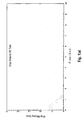
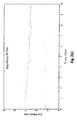
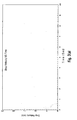
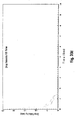
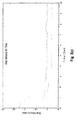
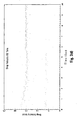
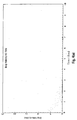
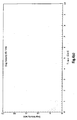
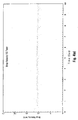
- FIG. 1(a) through 4(e) illustrate examples of liquids exhibiting decel and inks having reduced or eliminated decel as a result of practicing the present invention. As the demand for faster throughput of ink-jet printing systems becomes greater, thus ejecting the ink-jet drops at higher frequencies, it has become more important to alleviate decel.
- the present ink-jet liquids alleviate decel by formulating the first liquid to comprise a "decel-alleviating component.”
- the decel-alleviating component comprises a liquid-soluble compound capable of undergoing rapid, preferably exothermic, thermal decomposition upon heating, the decomposition products of the decel alleviating component, preferably, being a gas and/or liquid and not a solid compound.
- the decel-alleviating components are selected from: NH 4 NO 3 , NH 4 NO 2 , NH 4 N 3 , N 2 H 5 NO 3 , N 2 H 6 (NO 3 ) 2 , (NH 4 ) 2 S 2 O 8 , preferably, NH 4 NO 3 .
- the cationic and the anionic components of the decel-alleviating component may be present in the liquid from various independent sources.
- the ammonium cation may be introduced into the liquid as: the cation associated with some anionic dyes, the pH adjusting agent (e.g., NH 4 OH addition), the cation associated with an anionic surfactant, the cation associated with inorganic or simple organic anion added to the first ink as complementary bleed-alleviating agent (for example NH 4 Cl, (NH 4 ) 2 SO 4 , CH 3 COONH 4 ), or from added ammonium nitrate; while the nitrate anion may be introduced into the liquid as: the anion associated with some cationic dyes, the pH adjusting agent (HNO 3 addition), the anion associated with a cationic surfactant, the anion associated with a metal salt (e.g., a bleed control additive), or from added ammonium nitrate.
- the pH adjusting agent e.g.,
- dyes used in inkjet inks are associated with Na + , Li + or TMA + counter-ions.
- These counter-ions are, at least partially, substituted with Mg 2+ or Ca 2+ counter-ions when a salt of Mg 2+ or Ca 2+ , such as MgCl 2 or CaCl 2 is added to the ink (for example in a bleed control tool).
- the metal salt undergoes a thermal breakdown on the firing resistor during its operation (at, for examples, temperatures as high as about 300° to about 450°C) it may result in the formation of the oxide of that metal.
- MgO accumulation on the firing resistor may, in turn, affect nucleating properties of the drive bubble.
- These magnesium oxide sites may trap micro-bubbles causing the pre-nucleation of the drive bubble. This is believed to be more problematic when using salts of metals (eg., Mg 2+ salts) having lower thermal stability than salts of other metals (e.g., Ca 2+ salts).
- salts of metals e.g., Mg 2+ salts
- other metals e.g., Ca 2+ salts
- solubility of the oxides of certain metals, such as magnesium in water is a few orders of magnitude lower than that of some other metals, such as calcium, yet another reason why liquids containing the former metals may exhibit more decel than liquids containing the latter metals.
- the decel-alleviating component such as ammonium nitrate
- the occurrence of these micro-explosions on the firing resistor helps clean the resistor surfaces from extraneous material which can negatively impact the drive-bubble nucleation.
- the presence of healthy uniform drive bubble eliminates.or substantially reduces decel and improves nozzle directionality.
- the decel-alleviating component is preferably, present, in sufficient effective concentration to allow for the proper cleansing of the firing resistors.
- the decel-alleviating component is present in the liquid in sufficient concentration to provide an effective concentration of from about 0.05 to about 0.1 wt.% decel-alleviating component based on the initial weight of the ink, more preferably from about 0.5 to about 1.5 %.
- the liquid comprises sufficient concentration of: the cation that is the same as that for the decel-alleviating component in a range from about 0.01 to about 10 %, preferably, from about 0.02 to about 3 %, and most preferably, from about 0.1 to about 1 %; the anion that is the same as that for the decel-alleviating component in a range from about 0.03 to about 20 %, preferably, from about 0.06 to about 10 %, and most preferably, from about 0.2 to 6 %.
- the efficiency of NH 4 NO 3 added to the liquid is dependent on the presence, if any, of other ionic species in the liquid. For example, adding 1 wt% of NH 4 NO 3 to a liquid containing nitrates from other sources (such as Mg(NO 3 ) 2 *6H 2 O) would be more efficient than adding the same amount of NH 4 NO 3 to a liquid containing few % wt. of material not containing nitrates (such as magnesium acetate).
- the ratio of the total cations which are the same as the cationic component of the decel-alleviating component to the total anions which are same as the anionic component of the decel-alleviating component is about 1 to about 4.
- the preferred ratio for total NH 4 + to total NO 3 - regardless of the source of the ions, is about 1 to about 4.
- the first liquid may be an ink or a clear liquid.
- the first liquid when used as an ink, it furthermore, contains at least one colorant.
- the colorant of the first ink must be carefully selected for a variety of reasons.
- the colorant should be of a type which is preferably lighter in color than the colorant used in the second ink composition. If a black colorant is used in the second ink composition, then almost any other color may be appropriately selected for the colorant in the first ink.
- the colorant in the first ink must be of a type which will not react with the precipitating agent when these two materials are formulated in the same ink. More specifically, the colorant in the first ink must be of a type which remains soluble when formulated with the precipitating agent.
- the colorant may be a dye, a pigment, the pigment being self-stabilized or dispersed with the aid of a dispersing agent; the colorant preferably being a dye.
- exemplary and preferred dyes suitable for use in the first ink shall include but are not limited to the following materials presented below in Table III: Color Index Number Name 42090 Acid Blue 9 45100 Acid Red 52 19140 Acid Yellow 23 45110 Acid Red 289 Not available Direct Blue 199 Not available Direct Blue 189 Reactive Red 180 AR52 M377* M377*, available from Ilford AG, Rue de l'Industrie, CH-1700 Frileid, Switzerland.
- pigment dispersion materials may also be used in the first ink.
- Such pigment dispersion materials shall be of a type which will not react with the foregoing precipitating agents.
- suitable compositions for this purpose would include nonionic pigment dispersions, lignosulfonate dispersions, and/or amine dispersions known in the art which, as determined by preliminary pilot studies, would not react with the precipitating agents described herein.
- the colorant when present in the ink as a dye, a pigment, or a combination of both, may be present from about 0.05 to about 20%, by weight, preferably, from about 0.1 to about 8%, by weight, and more preferably, from about 0.5 to about 5%, by weight, based on the total weight of the ink.
- the second ink comprises at least one second colorant having a functional group that upon contact, for example on the print medium, with the first liquid, can associate to form an insoluble salt, complex, or compound; with the metal in the first liquid, thereby immobilizing the second colorant in the second ink.
- the second colorant preferably has at least one and preferably two or more carboxyl and/or carboxylate groups. Exemplary carboxylated dye materials suitable for use in the present invention are listed in U.S Pat. No. 4,963,189 to Hindagolla which is incorporated herein by reference.
- Such materials are black and involve the following basic structure: wherein W is COOH, X is H, or COOH, Y is H, COOH, or SO 3 H, Z is H, COOH, or SO 3 H, and R is H, CH 2 COOH, or CH 2 CH 2 COOH.
- the second ink comprises a colorant concentration ranging from about 0.5% up to the solubility limit of the colorant in the ink composition.
- the solubility level of the colorant will necessarily vary, depending on the specific colorant being used and other ingredients in the ink composition.
- the second ink will comprise from about 2 to about 7% colorant.
- the colorant when the colorant is a pigment, the colorant may be a carboxylated pigment dispersion materials basically comprising a water insoluble colorant (e.g. a pigment) which is rendered soluble through association with a dispersant having the appropriate ionic group (e.g., caroboxylated, sulfonated), preferably, a carboxylate solubilizing groups (e.g. an acrylic dispersant).
- a pigment may be self-stabilized through the presence of functional groups on the pigment surface without the aid of any dispersants.
- Colorants in combination with the dispersants which are used to produce the foregoing pigment dispersions normally comprise of inorganic and organic dye compositions (e.g. pigments) known in the art.
- pigments examples include but are not limited to the following compositions which are listed in the Color Index, supra: Pigment Black 7 (C.I. #77266), Pigment Blue 15 (C.I. #74160), Pigment Red 2 (C.I. #12310), and Disperse Red 17 (C.I. # #11210). All of these materials are listed on pages 4018, 4035, 4618, and 4661 of the Color Index, supra, which are again incorporated herein by reference.
- dispersants having at least one and preferably multiple carboxyl groups which basically consist of acrylic monomers and polymers known in the art.
- An exemplary dispersant includes a product sold by W. R. Grace and Co.
- the pigment may be self-dispersed, as those provided under the Trade name Cabojet, by Cabot Company.
- Cabojet trademark of Cabot Company.
- Other chemically comparable materials may be used which are determined by reasonable investigation to be suitable for the purposes set forth herein.
- the colorant is present in the second ink ranges from about 0.05 to about 20%, preferably, from about 0.1 to about 8%, and more preferably, from about 0.5 to,about 5%.
- the second ink is may be adjusted to an appropriate pH, preferably above 3, more preferably above 5, and most preferably adjusted to a pH of about 8 to about 9, through the addition of pH adjusting compounds such as NH 4 OH.
- pH adjusting compounds such as NH 4 OH.
- a base e.g. NH 4 OH
- a base is preferably added to the ink composition in order to place the colorant back into solution.
- the amount of base suitable for this purpose and the resulting pH of the composition is then noted and used in subsequent formulations.
- a pH adjusting agent (if necessary) will depend on the type of colorant being used. Also, the amount of pH adjusting agent and the type thereof is readily determinable using pilot tests in conjunction with the exercise of routine chemical procedures which are well known in the art.
- various types of additives may be employed in the liquids to optimize the properties of the liquid composition for specific applications.
- one or more biocides, fungicides, and/or slimicides may be used in the liquid composition as is commonly practiced in the art.
- suitable microbial agents include, but are not limited to, NUOSEPT (Nudex, Inc.), UCARCIDE (Union Carbide), VANCIDE (RT Vanderbilt Co.), and PROXEL (ICI America).
- Anionic, non-ionic, or amphoteric surfactants may also be used.
- Non-polymeric surfactants as well as some polymeric surfactants are listed at pages 110-129, of 1990 McCutcheon's Functional Materials, North American Edition, Manufacturing Confection Publishing Co., Glen Rock, N.J.
- the choice of a specific surfactant is highly dependent on the particular liquid composition and type of media substrate to be printed on.
- Cosolvents may be included to improve penetration of liquid into the printing substrate and/or the performance of the ink-jet printing mechanism (e.g., drop generator). Such cosolvents are well known in the art. Representative cosolvents that can be used are exemplified in U.S. Patent 5,272,201. Other known additives such as viscosity modifiers and other acrylic or non-acrylic polymers may be added to improve various properties of the liquid compositions as desired.
- inks were made comprising the compositions listed in Table VI, below: Liquid # / Figure Colorant % Precipitating Agent % Added Decel-Alleviating Component "Candidate" % wt.
- % effective DAC (M.W. DAC) * [(molar content of cationic component of DAC per 100g of ink) * (molar content of anionic component of DAC per 100g of ink)] / [sum of the molar content of all anions per 100g of ink] wherein:
- inks containing the decel-alleviating components of the present invention demonstrated a significant improvement in drop velocity performance. It should be appreciated, that although the decel-alleviating components of the present invention were evaluated in "inks" and not clear liquids, the invention, as described above, is equally applicable to clear liquids.
- liquids and liquid sets formulated according to the present invention and methods for using the same will enable the production of high quality prints while maintaining high ink-jet drop ejection performance, particularly, alleviation of decel.
Landscapes
- Chemical & Material Sciences (AREA)
- Life Sciences & Earth Sciences (AREA)
- Engineering & Computer Science (AREA)
- Materials Engineering (AREA)
- Wood Science & Technology (AREA)
- Organic Chemistry (AREA)
- Ink Jet Recording Methods And Recording Media Thereof (AREA)
- Inks, Pencil-Leads, Or Crayons (AREA)
- Ink Jet (AREA)
Applications Claiming Priority (2)
| Application Number | Priority Date | Filing Date | Title |
|---|---|---|---|
| US182826 | 1988-04-18 | ||
| US09/182,826 US6059868A (en) | 1998-10-29 | 1998-10-29 | Ink-jet inks with improved performance |
Publications (2)
| Publication Number | Publication Date |
|---|---|
| EP0997505A1 EP0997505A1 (en) | 2000-05-03 |
| EP0997505B1 true EP0997505B1 (en) | 2004-01-02 |
Family
ID=22670209
Family Applications (1)
| Application Number | Title | Priority Date | Filing Date |
|---|---|---|---|
| EP99308352A Expired - Lifetime EP0997505B1 (en) | 1998-10-29 | 1999-10-22 | Ink-jet inks with improved performance |
Country Status (4)
| Country | Link |
|---|---|
| US (3) | US6059868A (enExample) |
| EP (1) | EP0997505B1 (enExample) |
| JP (1) | JP4215913B2 (enExample) |
| DE (1) | DE69913920T2 (enExample) |
Families Citing this family (47)
| Publication number | Priority date | Publication date | Assignee | Title |
|---|---|---|---|---|
| US6261353B1 (en) * | 1998-05-29 | 2001-07-17 | Fuji Xerox Co., Ltd | Recording material and image forming method using the same |
| MXPA01006393A (es) * | 1998-12-21 | 2002-04-24 | Avecia Ltd | Composicion quimica para tinta. |
| US6506239B1 (en) * | 1999-09-16 | 2003-01-14 | Canon Kabushiki Kaisha | Liquid composition, ink set, recording process, ink cartridge, recording unit, process for forming multi-color image, ink-jet apparatus, process for facilitating fixing of ink to recording medium, and process for improving quality of multi-color image |
| EP1125994B1 (en) | 2000-02-17 | 2005-04-27 | Canon Kabushiki Kaisha | Liquid composition, ink set for ink-jet recording, ink-jet recording process, recording unit and ink-jet recording apparatus |
| US6533406B2 (en) | 2000-02-23 | 2003-03-18 | Canon Kabushiki Kaisha | Liquid composition, ink set for ink-jet recording, ink-jet recording process, recording unit and ink-jet recording apparatus |
| GB0004527D0 (en) * | 2000-02-26 | 2000-04-19 | Avecia Ltd | Inks |
| US6833008B2 (en) * | 2001-01-16 | 2004-12-21 | Aprion Digital Ltd. | Surface treatment for printing applications using water-based ink |
| US20050051051A1 (en) * | 2001-01-16 | 2005-03-10 | Boaz Nitzan | Pretreatment liquid for water-based ink printing applications |
| US6524378B2 (en) | 2001-02-27 | 2003-02-25 | Eastman Kodak Company | Ink jet printing method |
| US6527844B2 (en) * | 2001-02-27 | 2003-03-04 | Eastman Kodak Company | Metal complex for ink jet ink |
| US6540821B2 (en) | 2001-05-04 | 2003-04-01 | Hewlett-Packard Company | Inkjet color ink set |
| US6841592B2 (en) | 2001-07-23 | 2005-01-11 | Baker Hughes Incorporated | Waterfastness additives for aqueous jet inks |
| DE60209244T2 (de) * | 2001-09-21 | 2006-10-26 | Ricoh Co., Ltd. | Tinte, entsprechendes tintenstrahldruckverfahren, tintenpatrone, druckeinheit und tintenstrahldruckvorrichtung |
| US6726757B2 (en) * | 2001-10-19 | 2004-04-27 | Hewlett-Packard Development Company, L.P. | Ink additives to improve decel |
| US6682589B2 (en) | 2001-10-30 | 2004-01-27 | Hewlett-Packard Development Company, L.P. | Lightfast ink-jet dye set having color gamut of silver halide prints |
| US6730152B2 (en) | 2001-10-30 | 2004-05-04 | Hewlett-Packard Development Company, L.P. | Methods of controlling bleed between black and color dye based inks in printing applications |
| US6616273B1 (en) | 2002-03-25 | 2003-09-09 | Hewlett-Packard Development Company, L.P. | Addition of copper salts and copper complexes to thermal inkjet inks for kogation reduction |
| US6814793B2 (en) | 2002-12-18 | 2004-11-09 | Lexmark International, Inc. | Bleed control using cationic dyes as dispersant in pigment dispersions |
| US20040209015A1 (en) * | 2003-04-15 | 2004-10-21 | Palitha Wickramanayake | Additives for use in print media to reduce bronzing |
| JP4517588B2 (ja) * | 2003-05-29 | 2010-08-04 | 富士ゼロックス株式会社 | インクジェット用インクセット、及びインクジェット記録方法 |
| JP4442122B2 (ja) * | 2003-06-13 | 2010-03-31 | 富士ゼロックス株式会社 | インクジェット記録用インクセット、インクジェット記録方法及びインクジェット記録装置 |
| JP2005008725A (ja) * | 2003-06-18 | 2005-01-13 | Fuji Xerox Co Ltd | インクジェット記録用インク、インクジェット記録用インクセット、それを用いたインクジェット記録方法並びにインクジェット記録装置 |
| US6997978B2 (en) * | 2003-07-18 | 2006-02-14 | Hewlett-Packard Development Company, L.P. | Magneta ink-jet inks |
| US6991676B2 (en) * | 2003-07-18 | 2006-01-31 | Hewlett-Packard Development Company, L.P. | Dye sets and ink sets for ink-jet ink imaging |
| ATE385512T1 (de) * | 2004-01-28 | 2008-02-15 | Ilford Imaging Ch Gmbh | Tintensatz für den tintenstrahldruck |
| TWI313288B (en) * | 2004-03-23 | 2009-08-11 | Qisda Corp | Red colorant composition and magenta inkjet ink composition with good ph value stability |
| EP1582569A1 (de) * | 2004-03-25 | 2005-10-05 | ILFORD Imaging Switzerland GmbH | Tintensatz für den Tintenstrahldruck |
| US7404849B2 (en) * | 2004-04-21 | 2008-07-29 | E. I. Du Pont De Nemours And Company | Inkjet ink set for improved color reproduction |
| US7188943B2 (en) * | 2004-07-14 | 2007-03-13 | Hewlett-Packard Development Company, Lp. | Ink set for inkjet printing |
| US7105045B2 (en) * | 2004-07-14 | 2006-09-12 | Hewlett-Packard Development Company, L.P. | Inkjet ink formulation |
| EP1781683B1 (en) * | 2004-08-24 | 2011-11-16 | BTG International Limited | Process for the preparation of 17-vinyl- triflates as intermediates |
| EP1788047B1 (en) | 2004-08-25 | 2013-11-20 | Daikin Industries, Ltd. | Water-repellent/oil-repellent composition |
| US7264662B2 (en) * | 2005-03-09 | 2007-09-04 | Hewlett-Packard Development Company, L.P. | Ink sets for ink-jet ink imaging |
| US7247195B2 (en) * | 2005-03-09 | 2007-07-24 | Hewlett-Packard Development Company, L.P. | Dye sets for ink-jet ink imaging |
| US7279032B2 (en) * | 2005-09-12 | 2007-10-09 | E.I. Du Pont De Nemours & Co | Inkjet ink and ink set |
| US7470314B2 (en) * | 2005-09-12 | 2008-12-30 | E.I. Du Pont De Nemours And Company | Inkjet ink and ink set |
| US20070098927A1 (en) * | 2005-10-28 | 2007-05-03 | Uhlir-Tsang Linda C | Ink compositions and methods for controlling color on a print medium |
| US7478903B2 (en) * | 2005-10-31 | 2009-01-20 | Hewlett-Packard Development Company, L.P. | Ink set for inkjet printing, inkjet printer including the ink set, and method of inkjet printing using the ink set |
| US7811369B2 (en) * | 2007-01-31 | 2010-10-12 | Hewlett-Packard Development Company, L.P. | Phthalocyanine dyes formulated with salts and anti-flocculent aromatic polyamines for ink-jet imaging |
| US7476270B2 (en) * | 2007-01-31 | 2009-01-13 | Hewlett-Packard Development Company, L.P. | Ink-jet ink formulations containing magnesium sulfate |
| WO2008103424A1 (en) * | 2007-02-21 | 2008-08-28 | E. I. Du Pont De Nemours And Company | Inkjet ink and ink set |
| WO2009036125A1 (en) * | 2007-09-12 | 2009-03-19 | E. I. Du Pont De Nemours And Company | Inkjet ink and ink set |
| CN101519551B (zh) * | 2008-02-25 | 2011-07-20 | 明德国际仓储贸易(上海)有限公司 | 墨水组成物 |
| EP2516563A1 (en) | 2009-12-21 | 2012-10-31 | Hewlett Packard Development Company, L.P. | Inkjet ink composition containing anti-kogation agents |
| GB201003010D0 (en) * | 2010-02-23 | 2010-04-07 | Fujifilm Imaging Colorants Inc | Inks |
| JP2011195782A (ja) * | 2010-03-23 | 2011-10-06 | Seiko Epson Corp | インク組成物 |
| JP2021535239A (ja) | 2018-08-24 | 2021-12-16 | メムジェット テクノロジー リミテッド | 改善されたプリントヘッド寿命を有する顔料系インク配合物 |
Family Cites Families (48)
| Publication number | Priority date | Publication date | Assignee | Title |
|---|---|---|---|---|
| NL7002175A (enExample) * | 1969-02-18 | 1970-08-20 | ||
| JPS582364A (ja) * | 1981-06-29 | 1983-01-07 | Ricoh Co Ltd | インクジエツト記録用インク組成物 |
| JPS6067190A (ja) * | 1983-09-22 | 1985-04-17 | Ricoh Co Ltd | インクジェット記録用媒体 |
| US4761180A (en) * | 1986-08-27 | 1988-08-02 | Hewlett-Packard Company | Dyes containing tetramethylammonium cation for ink-jet printing inks |
| US4786327A (en) * | 1986-09-29 | 1988-11-22 | Hewlett-Packard Company | Dye preparation for thermal ink-jet printheads using ion exchange |
| US5279652A (en) * | 1988-03-24 | 1994-01-18 | Rainer Kaufmann | Use of solids as antiblocking additives for marker liquids |
| US4963189A (en) * | 1989-08-24 | 1990-10-16 | Hewlett-Packard Company | Waterfast ink formulations with a novel series of anionic dyes containing two or more carboxyl groups |
| JPH05320550A (ja) * | 1990-01-11 | 1993-12-03 | Lexmark Internatl Inc | 熱インクジェット用インク |
| US5272201A (en) * | 1990-04-11 | 1993-12-21 | E. I. Du Pont De Nemours And Company | Amine-containing block polymers for pigmented ink jet inks |
| US5085698A (en) * | 1990-04-11 | 1992-02-04 | E. I. Du Pont De Nemours And Company | Aqueous pigmented inks for ink jet printers |
| US5061316A (en) * | 1990-04-12 | 1991-10-29 | Hewlett-Packard Company | Ph-insensitive anti-kogating agent for ink-jet pens |
| US5062893A (en) * | 1990-06-22 | 1991-11-05 | Hewlett-Packard Company | Ink formulations by mixing anionic waterfast dyes containing two or more carboxyl groups |
| JPH04293378A (ja) * | 1991-03-22 | 1992-10-16 | Nec Corp | 画像メモリ装置 |
| US5108503A (en) * | 1991-04-16 | 1992-04-28 | Hewlett-Packard Company | Smear resistant inks for ink-jet printers |
| US5116409A (en) * | 1991-04-17 | 1992-05-26 | Hewlett-Packard Company | Bleed alleviation in ink-jet inks |
| US5133803A (en) * | 1991-07-29 | 1992-07-28 | Hewlett-Packard Company | High molecular weight colloids which control bleed |
| US5106416A (en) * | 1991-08-28 | 1992-04-21 | Hewlett-Packard Company | Bleed alleviation using zwitterionic surfactants and cationic dyes |
| US5181045A (en) * | 1991-09-23 | 1993-01-19 | Hewlett-Packard Company | Bleed alleviation using pH-sensitive dyes |
| US5320668A (en) * | 1991-09-23 | 1994-06-14 | Hewlett-Packard Company | Bleed alleviation using pH-sensitive agents |
| US5188664A (en) * | 1991-11-26 | 1993-02-23 | Hewlett-Packard Company | Anti-coalescent ink composition and method for making the same |
| JPH0633006A (ja) * | 1992-07-14 | 1994-02-08 | Ricoh Co Ltd | インクジェット記録用インク組成物およびインクジェット記録方法 |
| US5462592A (en) * | 1992-06-09 | 1995-10-31 | Ricoh Company, Ltd. | Aqueous ink composition |
| US5198023A (en) * | 1992-06-26 | 1993-03-30 | Hewlett-Packard Company | Cationic dyes with added multi-valent cations to reduce bleed in thermal ink-jet inks |
| US5428383A (en) * | 1992-08-05 | 1995-06-27 | Hewlett-Packard Corporation | Method and apparatus for preventing color bleed in a multi-ink printing system |
| US5554213A (en) * | 1992-12-17 | 1996-09-10 | Xerox Corporation | Ink compositions for ink jet printing |
| DE4306433A1 (de) * | 1993-03-02 | 1994-09-08 | Hoechst Ag | Ink-Jet-Einphasen-Reaktivdruck |
| US5342439A (en) * | 1993-09-24 | 1994-08-30 | Hewlett-Packard Corporation | Bleed resistance of dyes by counter-ion substitution |
| JP3247784B2 (ja) * | 1993-12-22 | 2002-01-21 | 株式会社リコー | 水性インク及びこれを用いた記録方法 |
| US5431724A (en) * | 1994-03-30 | 1995-07-11 | Hewlett-Packard Corporation | Low water content inks for minimizing wet cockle in thermal ink-jet inks |
| DE4417718A1 (de) * | 1994-05-20 | 1995-11-23 | Hoechst Ag | Reaktivfarbstoffe für den Tintenstrahldruck |
| US5611847A (en) * | 1994-12-08 | 1997-03-18 | Eastman Kodak Company | Aqueous pigment dispersions containing sequestering agents for use as ink jet printing inks |
| JP3635376B2 (ja) * | 1994-12-12 | 2005-04-06 | コニカミノルタホールディングス株式会社 | インクジェット記録用インクとシート及びインクジェット記録方法 |
| US5448402A (en) * | 1995-01-12 | 1995-09-05 | Lorenzana; Moises B. | Bicycle light reflector |
| US5792249A (en) * | 1995-01-25 | 1998-08-11 | Canon Kabushiki Kaisha | Liquid composition, ink set, image-forming method and apparatus using the same |
| GB9502341D0 (en) * | 1995-02-07 | 1995-03-29 | Ilford Ag | Magenta dyes |
| US5626655A (en) * | 1995-07-11 | 1997-05-06 | Hewlett-Packard Company | Use of co-surfactants to adjust properties of ink-jet inks |
| US5534051A (en) * | 1995-07-11 | 1996-07-09 | Hewlett-Packard Company | Specific dye set for thermal ink-jet printing |
| US5536306A (en) * | 1995-07-11 | 1996-07-16 | Hewlett-Packard Company | Thermal ink-jet inks having reduced black to color and color to color bleed |
| GB9515304D0 (en) * | 1995-07-26 | 1995-09-20 | Ilford Ag | Azo dyes |
| JP3154333B2 (ja) * | 1995-11-02 | 2001-04-09 | セイコーエプソン株式会社 | インクジェット記録用カラーインクセット |
| US5609674A (en) * | 1995-12-01 | 1997-03-11 | Hewlett-Packard Company | Mitigation of dye crystallization in images on transparencies and glossy media |
| US5785743A (en) * | 1995-12-06 | 1998-07-28 | Hewlett-Packard Company | Bleed alleviation in ink-jet inks using organic acids |
| US5679143A (en) * | 1995-12-06 | 1997-10-21 | Hewlett-Packard Company | Bleed alleviation in ink jet inks using acids containing a basic functional group |
| US5954866A (en) * | 1996-06-11 | 1999-09-21 | Seiko Epson Corporation | Ink for ink jet recording and image forming method using the same |
| US5730789A (en) * | 1996-07-29 | 1998-03-24 | Scitex Digital Printing, Inc. | Waterfast infrared scannable inks for ink jet printing |
| US5858075A (en) | 1997-03-03 | 1999-01-12 | Hewlett-Packard Company | Dye set for improved ink-jet image quality |
| US5772742A (en) * | 1997-05-06 | 1998-06-30 | Hewlett-Packard Company | Dye set for improved color quality for ink-jet printers |
| US5958120A (en) * | 1998-02-02 | 1999-09-28 | Xerox Corporation | Ink compositions with improved waterfastness |
-
1998
- 1998-10-29 US US09/182,826 patent/US6059868A/en not_active Expired - Lifetime
-
1999
- 1999-04-30 US US09/304,011 patent/US6053969A/en not_active Expired - Lifetime
- 1999-04-30 US US09/304,010 patent/US6176913B1/en not_active Expired - Lifetime
- 1999-10-22 DE DE69913920T patent/DE69913920T2/de not_active Expired - Lifetime
- 1999-10-22 EP EP99308352A patent/EP0997505B1/en not_active Expired - Lifetime
- 1999-10-29 JP JP30902999A patent/JP4215913B2/ja not_active Expired - Fee Related
Also Published As
| Publication number | Publication date |
|---|---|
| DE69913920D1 (de) | 2004-02-05 |
| US6053969A (en) | 2000-04-25 |
| JP4215913B2 (ja) | 2009-01-28 |
| DE69913920T2 (de) | 2004-12-16 |
| EP0997505A1 (en) | 2000-05-03 |
| US6176913B1 (en) | 2001-01-23 |
| US6059868A (en) | 2000-05-09 |
| JP2000136337A (ja) | 2000-05-16 |
Similar Documents
| Publication | Publication Date | Title |
|---|---|---|
| US6059868A (en) | Ink-jet inks with improved performance | |
| US6653367B2 (en) | Ink composition capable of realizing image possessing excellent rubbing/scratch resistance | |
| EP1400364B1 (en) | Reaction solution for ink-jet recording, apparatus and ink-jet recording method using the solution | |
| EP0952195B1 (en) | Ink set for improved print quality | |
| EP0839880B1 (en) | Bleed alleviation in ink jet inks using acids containing a basic functional group | |
| US5695820A (en) | Method for alleviating marangoni flow-induced print defects in ink-jet printing | |
| US5785743A (en) | Bleed alleviation in ink-jet inks using organic acids | |
| EP0778321B2 (en) | Ink set for ink jet recording and ink jet recording method using the same | |
| EP0877064B1 (en) | Dye set for improved color quality for ink-jet printers | |
| US6080229A (en) | Reaction solution for ink jet recording method using two liquids | |
| EP0801118B1 (en) | Black to color bleed control using cationic surfactants | |
| WO2007022162A1 (en) | Improved pigment ink jet ink composition | |
| JPH1095941A (ja) | にじみの少ない画像を形成可能な顔料系インク組成物 | |
| EP1648972A1 (en) | Use of styrene-maleic anhydride copolymer to control black-to-color bleed | |
| EP0959112B1 (en) | Reaction solution for ink jet recording and ink jet recording method using the same | |
| US20060028521A1 (en) | Ink composition and ink-jet printing method using the same for improving ink-jet print quality | |
| EP1435381B1 (en) | Ink set for inkjet recording and inkjet recording method | |
| EP0997504B1 (en) | Inks for ink-jet printers | |
| EP0779345B1 (en) | Mitigation of dye crystallization in images on transparencies and glossy media | |
| EP0975700B1 (en) | Ink additives | |
| HK1004129B (en) | Reaction solution for ink jet recording method using two liquids |
Legal Events
| Date | Code | Title | Description |
|---|---|---|---|
| PUAI | Public reference made under article 153(3) epc to a published international application that has entered the european phase |
Free format text: ORIGINAL CODE: 0009012 |
|
| AK | Designated contracting states |
Kind code of ref document: A1 Designated state(s): DE FR GB |
|
| AX | Request for extension of the european patent |
Free format text: AL;LT;LV;MK;RO;SI |
|
| 17P | Request for examination filed |
Effective date: 20001009 |
|
| AKX | Designation fees paid |
Free format text: DE FR GB |
|
| RAP1 | Party data changed (applicant data changed or rights of an application transferred) |
Owner name: HEWLETT-PACKARD COMPANY, A DELAWARE CORPORATION |
|
| 17Q | First examination report despatched |
Effective date: 20021023 |
|
| GRAH | Despatch of communication of intention to grant a patent |
Free format text: ORIGINAL CODE: EPIDOS IGRA |
|
| GRAS | Grant fee paid |
Free format text: ORIGINAL CODE: EPIDOSNIGR3 |
|
| GRAA | (expected) grant |
Free format text: ORIGINAL CODE: 0009210 |
|
| AK | Designated contracting states |
Kind code of ref document: B1 Designated state(s): DE FR GB |
|
| REG | Reference to a national code |
Ref country code: GB Ref legal event code: FG4D |
|
| REF | Corresponds to: |
Ref document number: 69913920 Country of ref document: DE Date of ref document: 20040205 Kind code of ref document: P |
|
| ET | Fr: translation filed | ||
| PLBE | No opposition filed within time limit |
Free format text: ORIGINAL CODE: 0009261 |
|
| STAA | Information on the status of an ep patent application or granted ep patent |
Free format text: STATUS: NO OPPOSITION FILED WITHIN TIME LIMIT |
|
| 26N | No opposition filed |
Effective date: 20041005 |
|
| REG | Reference to a national code |
Ref country code: GB Ref legal event code: 732E Free format text: REGISTERED BETWEEN 20120329 AND 20120404 |
|
| REG | Reference to a national code |
Ref country code: FR Ref legal event code: PLFP Year of fee payment: 17 |
|
| PGFP | Annual fee paid to national office [announced via postgrant information from national office to epo] |
Ref country code: GB Payment date: 20150924 Year of fee payment: 17 |
|
| PGFP | Annual fee paid to national office [announced via postgrant information from national office to epo] |
Ref country code: FR Payment date: 20150925 Year of fee payment: 17 |
|
| PGFP | Annual fee paid to national office [announced via postgrant information from national office to epo] |
Ref country code: DE Payment date: 20161020 Year of fee payment: 18 |
|
| GBPC | Gb: european patent ceased through non-payment of renewal fee |
Effective date: 20161022 |
|
| REG | Reference to a national code |
Ref country code: FR Ref legal event code: ST Effective date: 20170630 |
|
| PG25 | Lapsed in a contracting state [announced via postgrant information from national office to epo] |
Ref country code: FR Free format text: LAPSE BECAUSE OF NON-PAYMENT OF DUE FEES Effective date: 20161102 Ref country code: GB Free format text: LAPSE BECAUSE OF NON-PAYMENT OF DUE FEES Effective date: 20161022 |
|
| REG | Reference to a national code |
Ref country code: DE Ref legal event code: R119 Ref document number: 69913920 Country of ref document: DE |
|
| PG25 | Lapsed in a contracting state [announced via postgrant information from national office to epo] |
Ref country code: DE Free format text: LAPSE BECAUSE OF NON-PAYMENT OF DUE FEES Effective date: 20180501 |