EP0997008B1 - Method and apparatus for downlink power control in macro diversity radio systems - Google Patents
Method and apparatus for downlink power control in macro diversity radio systems Download PDFInfo
- Publication number
- EP0997008B1 EP0997008B1 EP98930004A EP98930004A EP0997008B1 EP 0997008 B1 EP0997008 B1 EP 0997008B1 EP 98930004 A EP98930004 A EP 98930004A EP 98930004 A EP98930004 A EP 98930004A EP 0997008 B1 EP0997008 B1 EP 0997008B1
- Authority
- EP
- European Patent Office
- Prior art keywords
- links
- downlink
- base station
- uplink
- mobile station
- Prior art date
- Legal status (The legal status is an assumption and is not a legal conclusion. Google has not performed a legal analysis and makes no representation as to the accuracy of the status listed.)
- Expired - Lifetime
Links
- 238000000034 method Methods 0.000 title claims description 25
- 238000004891 communication Methods 0.000 claims description 32
- 230000005540 biological transmission Effects 0.000 claims description 28
- 230000004044 response Effects 0.000 claims description 3
- 230000008054 signal transmission Effects 0.000 claims 5
- 238000005259 measurement Methods 0.000 description 22
- 238000004088 simulation Methods 0.000 description 12
- 238000012545 processing Methods 0.000 description 8
- 230000008569 process Effects 0.000 description 6
- 230000001413 cellular effect Effects 0.000 description 5
- 238000005562 fading Methods 0.000 description 5
- 230000000694 effects Effects 0.000 description 4
- 238000010586 diagram Methods 0.000 description 3
- 230000006872 improvement Effects 0.000 description 3
- 230000010287 polarization Effects 0.000 description 3
- 230000010267 cellular communication Effects 0.000 description 2
- 238000013461 design Methods 0.000 description 2
- 230000003044 adaptive effect Effects 0.000 description 1
- 238000004364 calculation method Methods 0.000 description 1
- 230000008859 change Effects 0.000 description 1
- 230000001186 cumulative effect Effects 0.000 description 1
- 238000012217 deletion Methods 0.000 description 1
- 230000037430 deletion Effects 0.000 description 1
- 230000001419 dependent effect Effects 0.000 description 1
- 238000005315 distribution function Methods 0.000 description 1
- 230000003028 elevating effect Effects 0.000 description 1
- 230000007774 longterm Effects 0.000 description 1
- 238000004519 manufacturing process Methods 0.000 description 1
- 238000012986 modification Methods 0.000 description 1
- 230000004048 modification Effects 0.000 description 1
- 230000003287 optical effect Effects 0.000 description 1
- 238000001228 spectrum Methods 0.000 description 1
- 238000012546 transfer Methods 0.000 description 1
Images


Classifications
-
- H—ELECTRICITY
- H04—ELECTRIC COMMUNICATION TECHNIQUE
- H04W—WIRELESS COMMUNICATION NETWORKS
- H04W52/00—Power management, e.g. Transmission Power Control [TPC] or power classes
- H04W52/04—Transmission power control [TPC]
- H04W52/30—Transmission power control [TPC] using constraints in the total amount of available transmission power
- H04W52/34—TPC management, i.e. sharing limited amount of power among users or channels or data types, e.g. cell loading
- H04W52/343—TPC management, i.e. sharing limited amount of power among users or channels or data types, e.g. cell loading taking into account loading or congestion level
-
- H—ELECTRICITY
- H04—ELECTRIC COMMUNICATION TECHNIQUE
- H04W—WIRELESS COMMUNICATION NETWORKS
- H04W52/00—Power management, e.g. Transmission Power Control [TPC] or power classes
- H04W52/04—Transmission power control [TPC]
- H04W52/18—TPC being performed according to specific parameters
- H04W52/24—TPC being performed according to specific parameters using SIR [Signal to Interference Ratio] or other wireless path parameters
-
- H—ELECTRICITY
- H04—ELECTRIC COMMUNICATION TECHNIQUE
- H04W—WIRELESS COMMUNICATION NETWORKS
- H04W52/00—Power management, e.g. Transmission Power Control [TPC] or power classes
- H04W52/04—Transmission power control [TPC]
- H04W52/30—Transmission power control [TPC] using constraints in the total amount of available transmission power
- H04W52/34—TPC management, i.e. sharing limited amount of power among users or channels or data types, e.g. cell loading
- H04W52/346—TPC management, i.e. sharing limited amount of power among users or channels or data types, e.g. cell loading distributing total power among users or channels
-
- H—ELECTRICITY
- H04—ELECTRIC COMMUNICATION TECHNIQUE
- H04W—WIRELESS COMMUNICATION NETWORKS
- H04W52/00—Power management, e.g. Transmission Power Control [TPC] or power classes
- H04W52/04—Transmission power control [TPC]
- H04W52/38—TPC being performed in particular situations
- H04W52/40—TPC being performed in particular situations during macro-diversity or soft handoff
Definitions
- This invention generally relates to the field of communication systems having a macro diversity capability and, more particularly, to controlling the transmission power of one or more transmitters used to send information to a mobile station.
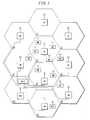
- FIG. 1 A simplified layout of a cellular communications system is depicted in Figure 1 .
- Mobile stations M1-M10 communicate with the fixed part of a public switched telephone network (PSTN) by transmitting radio signals to, and receiving radio signals from, cellular base stations B1-B10.
- the cellular base stations B1-B10 are, in turn, connected to the PSTN via a Mobile Switching Center (MSC).
- MSC Mobile Switching Center
- Each base station B1-B10 transmits signals within a corresponding area, or "cell" C1-C10.
- a base station transmits to the mobile units over downlink RF channels, while the mobile units transmit information to the base station over uplink RF channels.
- an idealized arrangement of base stations can be organized so that the cells substantially cover an area in which mobile telephone communication ordinarily occurs (e.g., a metropolitan area), with a minimum amount of overlap.
- Conventional spatial diversity techniques employ two or more separated antennas in a single base station, or two or more base stations, to communicate with a mobile station. However, diversity is not limited to spatially offsetting base stations or antennas (i.e., multiple transmission paths). Diversity transmission can be generated using one or more of an offset in time, polarization, or frequency. An example of time diversity is interleaving, which is used in the
- macro diversity can also involve an arrangement wherein antennas used for the diversity transmissions are located close to one another, or even co-located in a same base station.
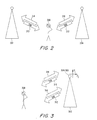
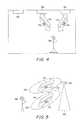
- Figures 2-5 depict several exemplary macro diversity arrangements.
- Figure 2 illustrates a macro diversity arrangement wherein a first base station 202 and a second base station 204 each transmit a same message 206 to a mobile station 208.
- the message 206 is transmitted to the mobile station 208 over different signal paths in the forms of a first downlink 210 and a second downlink 212.
- the first and second downlink signals 210 and 212 are recombined in the mobile station 208 to extract the message 206.
- the mobile station 208 transmits to the base stations 202 and 204 over first and second uplink paths 214 and 216, respectively.
- Figure 3 illustrates a macro diversity arrangement wherein the same message 306 is broadcast from a first antenna 304 and a second antenna 305.
- the antennas 304 and 305 have different polarization characteristics, e.g., horizontal and vertical polarization, but are located in the same base station 302.
- First and second downlinks 310 and 312 communicate the message 306 from the base station 302 to the mobile station 308, while first and second corresponding uplinks 314 and 316 communicate from the mobile station 308 to the base station 302.
- Figure 4 depicts a macro diversity arrangement for an indoor RF communication system in which one or more of first, second and third antennas 402, 404 and 410 transmit a signal containing the same message 406 to a mobile unit 408.
- first and second downlinks 410 and 412 communicate the message 406 from antennas 404 and 410, respectively, to the mobile station 408.
- First and second uplinks 414 and 416 communicate from the mobile station 408 to the antennas 404 and 410, respectively.
- Figure 5 depicts a single base station macro diversity arrangement wherein first and second directional lobes 518 and 520, generated by an antenna array 504, each cover a separate coverage area.
- the first directional lobe 518 maintains a first macro diversity link including a first downlink 510 which carries a message 506.
- the second directional lobe 520 maintains a second macro diversity link including a second downlink 512 which also carries the message 506.
- First and second uplinks 514 and 516 communicate from the mobile station 508 to the antenna array 504 within each lobe 518 and 520, respectively.
- the base stations and/or antennas communicating with a particular mobile station are known as "active set" members.
- antennas 404 and 410 would be considered members of the active set.
- Members of an active set can change as the mobile station passes into and out of coverage areas handled by base stations and/or antennas in the system.
- the addition and deletion of base stations and/or antennas to and from an active set can be used to achieve handoff.
- Macro diversity increases robustness, achieves improved downlink quality, and combats fading.
- the additional active transmitting elements in a macro diversity scheme increases interference (i.e., the C/I ratio) for surrounding mobile and/or base stations operating in the vicinity.
- Conventional macro diversity systems ordinarily utilize the same amount of downlink transmit power for each antenna in the active set. For instance, in IS-95 systems, the same transmit power level is used for all downlinks in the active set. Because of the undesirable interference to other users, careful consideration is required in adding and deleting members from the active set so that the interference in unrelated links is minimized. Accordingly, one method for controlling interference is to limit the number of base stations and/or antennas in an active set.
- the downlink transmit power may be equally split between each active base station and/or antenna in an active set. That is, in the case where there are three downlinks, and a total transmission power of P is available, each of the downlinks has a transmission power level of P/3.
- the link may, in effect provide a small improvement in communications robustness, but introduce, on balance, a greater amount of disruption to surrounding communications by unduly introducing interference. Consequently, the C/I ratio for adjacent cells can be negatively impacted with only a minimal gain in communications efficiency.
- a proportional downlink transmission power control method is used that allots downlink transmit power in accordance with the characteristics of the downlink signal received by mobile stations. More specifically, an amount of transmit power used for a downlink is defined based on pilot channel signal strength and interference values of downlink signals as measured at the mobile station. The measurement information is then reported to the system by the mobile station.
- Such a system is desirable because it permits only a minimum amount of power to be used to maintain a desirable level of communication efficiency, while at the same time introducing a minimal amount of interference to adjacent, unrelated, links.
- the DS-CDMA system has many shortcomings.
- DS-CDMA systems require significant information overhead and consume important resources to carry out downlink power control.
- the DS-CDMA downlink power control system uses mobile stations to periodically measure path gain characteristics for cells adjacent to the mobile station. Measurement reports are regularly transmitted reported back on associated uplinks. Because so-called "fast" power control is frequently used in DS-CDMA systems, the measure and transfer of information can require that approximately 10% of uplink frame capacity be dedicated to downlink measurement information and reports. Consequently, there is less frame capacity for other information.
- the mobile station must also perform additional processing to measure, format and transmit the measurement information. This has the effect of consuming processing resources, elevating design complexity and increasing handset power consumption.
- What is needed is a system of downlink transmit power control for each antenna and/or base station downlink which does not diminish the information capacity of frames transmitted by a mobile station. It would be further desirable to provide a downlink power control system that does not burden the mobile station with additional tasks such as measuring the quality of a downlink, and processing and transmitting the measurement data.
- WO95/22873 discloses a method for allocating downlink power based upon long-term SNR measurements on the uplink.
- the present invention solves the forgoing problems by providing a power control system for controlling downlink power in a macro diversity system by measuring the quality of an uplink signal at a base station as disclosed in the appended claims.
- the present invention relieves the mobile station from having to perform extra processing or sacrificing uplink frame capacity for measurement information. As a result, production costs, design complexity and power consumption related to the mobile station are reduced while still providing downlink power control.
- uplink quality can be gauged either by taking measurements of the uplink, or using uplink quality factors that are already available in accordance with system standards (e.g.. GSM or D-AMPS).
- the uplink quality information is used by control means within one or more base stations, or node connected thereto, associated with the active set to control downlink transmission power levels.
- control means within one or more base stations, or node connected thereto, associated with the active set to control downlink transmission power levels.
- control means within one or more base stations, or node connected thereto, associated with the active set to control downlink transmission power levels.
- those members of the active set most likely to achieve the best downlink quality are controlled to transmit at an appropriate power level.
- Remaining downlinks typically are controlled to transmit at a lower power level. In this way, downlinks in the active set transmit at a level to minimize an amount of interference while still maintaining robust
- systems in accordance with exemplary embodiments of the present invention provide a method for controlling transmission power used in a downlink signal from a base station to a mobile station in a macro diversity radio system.
- An exemplary method includes measuring a quality of an uplink signal received in the base station and then controlling a downlink transmission power level in response to the measure of quality of the uplink signal.
- Exemplary embodiments may involve an apparatus for controlling transmission power in a downlink between a base station and a mobile station in a macro diversity radio system.
- the apparatus typically includes a means for measuring a quality of an uplink signal received in the base station from the mobile station.
- a means for controlling the amount of transmission power level used for the downlink signal operates based on the quality of the uplink signal measured by the measurement means.
- downlink transmission power control is rendered in accordance with the path gain of a corresponding uplink, and/or the carrier-to-interference ratio of a corresponding uplink.
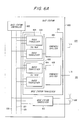
- FIG. 6A is a block diagram depicting the elements of an exemplary base station 600 that has a macro diversity capability and thus can be operated in accordance with the present invention.
- the base station 600 includes a base station control unit 602 which controls radio transceivers 606. Signals communicated to and from the radio transceivers 606 are combined and duplexed, respectively, by one or - more combiners 608.
- the combiners 608 may each be connected to an antennas array or to respective vertical and horizontal polarized antennas.
- the antenna array may have beam lobes 614 and 616 which cover separate geographic areas (see e.g., Figure 5 ). The latter antenna arrangement is analogous to the one illustrated in Figure 3 .
- the base station control unit 602 communicates with elements of the base station transceivers 606 over a traffic bus 620, a timing bus 622 and a baseband bus 624.
- a traffic bus 620 a traffic bus 620
- a timing bus 622 a baseband bus 624.
- a baseband bus 624 a baseband bus 624
- an exemplary mobile station 650 includes a controller 652 which is coupled to a radio transceiver 654, which, in turn, is connected to an antenna 656.
- a controller 652 which is coupled to a radio transceiver 654, which, in turn, is connected to an antenna 656.
- the mobile station 650 has the capability to recombine downlink diversity signals received from one or more base stations and/or antennas.
- an exemplary embodiment of the present invention can involve a first base station 202 and a second base station 204, both of which communicate common information 206 using separate downlink paths 210 and 212, respectively, to a mobile station 208.
- Communication from the mobile station 208 to the base stations 202 and 204 involves a first uplink 214 to the first base station 202, and a second uplink 216 to the second base station 204.
- the level of transmission power used for each of the first and second downlinks 210 and 212 depends upon a quality measurement taken for the corresponding uplinks 214 and 216, respectively, at the base stations 202 and 204.
- the inventive process is preferably adaptive in the sense that it can be used to continually adjust downlink power levels for the active set members during the process of active communication. Accordingly, the process begins at step 700 with the establishment of a communication link between a base station and/or antenna in an active set, and a mobile station.
- the active set member monitors and measures characteristics, or qualities, of an uplink from the mobile station at step 702.
- Control systems, transceivers, or like elements in the base station, or a node connected thereto calculate a downlink transmission power level as a function of the uplink signal quality measurements (step 704).
- the calculated power level is then applied to control the level of downlink transmission power used for the active link (step 706).
- systems operating in accordance with the invention can apply an optimal amount of downlink power for each of the active members serving a mobile station, without introducing unnecessary amounts of RF interference to the system.
- the level of downlink transmit power employed in response to the associated uplink quality can be calculated in a variety of ways to control downlink power.
- Uplink quality can be measured by any variety of signal characteristics, as will be appreciated by those skilled in the art.
- One exemplary characteristic that can be used in accordance with an exemplary embodiment of the invention is a path gain, g i , measured for a particular link i.
- Path gain (also referred to as negative path loss) is generally related to attenuation of a signal as related to an increase in a distance from a transmitter from which the signal originated.
- Using the C/I ratio to determine downlink power allocation may be more appropriate in situations where, for example, there is a higher probability of other active mobile units being in the vicinity. In such as situation, it is important to avoid disturbing surrounding communications by introducing more interference than is necessary to achieve one's own desired level of communications quality.
- the ratio can then be used to adjust the downlink transmission power levels so as to avoid unnecessarily increasing interference while maintaining a desirable level of communication quality.
- uplink characteristics for determining an appropriate power level for a corresponding downlink in accordance with the present invention.
- the overhead and resources consumed by such a system are substantial.
- measuring uplink quality and utilizing the resulting measurements provides an effective means for assessing downlink characteristics.
- the uplink characteristics are measured at the active set base station(s). Consequently, there is no requirement for dedicating frame capacity to measurement reports in frames transmitted on the uplink.
- a base station does not have the same processing and power limitations as a mobile station and can more readily dedicate the processing resources necessary for assessing the uplink measurements. Any additional power consumption dedicated to processing uplink data and applying the results to control downlink power levels is insignificant in view of the power resources generally available at a base station.
- uplink quality factors may be readily available at a base station, as they are gathered pursuant to the requirements of an operating standard under which the system is operating. For example, in GSM and D-AMPS systems, measurements are taken for uplink signal strength, path gain and C/I ratios. Hence, while there as yet appears to be no use of such factors in determining a corresponding downlink power level using the foregoing information, the factors are nonetheless already available to the system for use in accordance with exemplary embodiments of the invention.
- Processing of uplink quality information in a base station can be performed in a variety of ways as will be fully understood by those skilled in the art.
- system variables for uplink quality that are maintained under existing standards can be used to perform downlink power control calculations.
- the base station control unit 602 can operate in concert with the amplifiers (not shown) used to drive an antenna array and/or to control a level of downlink transmission power applied.
- componentry in the radio transceivers 606 can be utilized to measure uplink quality and thereafter apply such measurements to amplifier controls to adjust downlink transmission power levels, accordingly.
- transmission power control and uplink measurement can also be performed in one or more nodes to which the base station 600 is connected. Further discussion is omitted as those skilled in the art will readily be able to perform amplifier control and uplink signal measurement in accordance with the present invention.
- the downlink power used for the link i is denoted by P i and the average path gain, g i , between a mobile and an antenna was modeled according to well known path loss prediction techniques.
- Fast fading was modeled as Rayleigh fading, denoted r i , and was dependent on both time and frequency.
- an equalizer in a mobile station can resolve multiple rays and add them coherently using maximal ratio combining, for instance. This can be achieved, for example, by delaying the transmission from one of the antennas by approximately one symbol time. Alternatively, a frequency offset can be selected for one of the links.
- the simulation involved five floors and a large number of mobile - stations.
- the mobile stations were modeled to appear at equal probability levels over each of the floors.
- An individual floor used in the simulation is depicted in Figure 10 .
- Each of the floors was covered by seven antennas which were located in the same position on each floor.
- Each floor in the simulation was generally treated as an individual cell, which cell was covered exclusively by the seven antennas.
- Channel reuse was limited to one within each cell.
- Channels were randomly allocated to the mobiles on each floor.
- the two antennas with the highest average gain were chosen as macro diversity links. No more than two of the seven antennas were permitted to serve an individual mobile station.
- the simulation results were compared to a variety of conventional single-antenna operating arrangements. These included a singlecast arrangement wherein the average best link antenna in a cell was used for the downlink transmission to a mobile station. Also used for comparison purposes was an ideal singlecast arrangement wherein the system sends information from a single strongest link (one of seven in a cell) from burst to burst. Those skilled in the art will appreciate that the ideal singlecast method is generally infeasible in conventional systems because fast fading in the up- and downlinks is independent due to the frequency duplex distance.
- Figure 8 illustrates a comparison of the path gain ( g i ) and C/I proportional downlink power allocation schemes with the conventional singlecast case.
- Gain in the ( g i ) and C/I proportional downlink control schemes are similar at 1.0-1.5 dB at the 10% probability level for the cumulative distribution function (C.D.F.). However at lower dB levels, the gain is even larger.
- Figure 9 shows a comparison of ideal singlecast with the macro diversity scenario wherein downlink power for a link i is proportional to a path gain g i measured for the uplink portion of the link i (i.e., p i ⁇ g i ).
- the improvement is noted in that operation in macro diversity with power allocation in accordance with the invention shows that performance levels rivaling those of an ideal singlecast scheme can be achieved.
- uplink quality factors can be used in assessing whether or not a given link should be included or removed from an active set. Such an arrangement effectively assists in determining handoff. For example, the uplink measurements taken at each base station and/or antenna in the vicinity of a mobile station can be compared to a predetermined number, or level of quality, that indicates whether or not the base station and/or antenna should be added or deleted from the active set handling the mobile station. In the case where a mobile station moves out of one coverage area, whereby the uplink quality measurement for that coverage area (as measured by its corresponding base station) drops below a predetermined level, that link is dropped.
- the invention disclosed herein relates to macro diversity radio communication systems.
- exemplary aspects of the invention are set out in the context of cellular telephone and indoor RF communication systems having macro diversity capabilities.
- the present invention can be applied to any RF communication system that can operate using macro diversity.
- Such systems also include, but are not limited to, optical (e.g. infra red) communications, and PCS systems.
- systems in accordance with the present invention can be applied in conventional systems, such as the power spilt system described in the Background section above. Accordingly, the scope of the invention is not intended to be limited by the exemplary embodiments set out herein, but rather by the claims appended hereto and equivalents thereof.
Landscapes
- Engineering & Computer Science (AREA)
- Computer Networks & Wireless Communication (AREA)
- Signal Processing (AREA)
- Mobile Radio Communication Systems (AREA)
- Transmitters (AREA)
Applications Claiming Priority (3)
| Application Number | Priority Date | Filing Date | Title |
|---|---|---|---|
| US08/880,746 US6104933A (en) | 1997-06-23 | 1997-06-23 | Method and apparatus for control of base stations in macro diversity radio systems |
| US880746 | 1997-06-23 | ||
| PCT/SE1998/001169 WO1998059433A2 (en) | 1997-06-23 | 1998-06-16 | Method and apparatus for downlink power control in macro diversity radio systems |
Publications (2)
| Publication Number | Publication Date |
|---|---|
| EP0997008A2 EP0997008A2 (en) | 2000-05-03 |
| EP0997008B1 true EP0997008B1 (en) | 2010-10-20 |
Family
ID=25376983
Family Applications (1)
| Application Number | Title | Priority Date | Filing Date |
|---|---|---|---|
| EP98930004A Expired - Lifetime EP0997008B1 (en) | 1997-06-23 | 1998-06-16 | Method and apparatus for downlink power control in macro diversity radio systems |
Country Status (8)
| Country | Link |
|---|---|
| US (1) | US6104933A (enExample) |
| EP (1) | EP0997008B1 (enExample) |
| JP (1) | JP4138028B2 (enExample) |
| AU (1) | AU7948898A (enExample) |
| CA (1) | CA2295085C (enExample) |
| DE (1) | DE69841958D1 (enExample) |
| TW (1) | TW387176B (enExample) |
| WO (1) | WO1998059433A2 (enExample) |
Families Citing this family (55)
| Publication number | Priority date | Publication date | Assignee | Title |
|---|---|---|---|---|
| US6700879B1 (en) * | 1998-03-30 | 2004-03-02 | Nortel Networks Limited | Modem loop rate adaptation |
| KR100317011B1 (ko) * | 1998-09-07 | 2001-12-22 | 마츠시타 덴끼 산교 가부시키가이샤 | 통신 단말 장치, 기지국 통신 장치 및 무선 통신 방법 |
| US6512925B1 (en) * | 1998-12-03 | 2003-01-28 | Qualcomm, Incorporated | Method and apparatus for controlling transmission power while in soft handoff |
| FR2789534B1 (fr) * | 1999-02-04 | 2001-06-08 | Cit Alcatel | Procede d'estimation du rapport signal a bruit d'un signal numerique recu par un recepteur de radiocommunications |
| US6862447B1 (en) * | 1999-02-16 | 2005-03-01 | Lucent Technologies Inc. | Method of making downlink operational measurements in a wireless communication system |
| US7076264B2 (en) * | 1999-02-19 | 2006-07-11 | Qualcomm, Inc. | Power control in a cellular system using ES/IO and NT/I0 values |
| US6515975B1 (en) * | 1999-04-22 | 2003-02-04 | Nortel Networks Limited | Fast forward power control during soft handoff |
| GB2350753B (en) * | 1999-06-04 | 2003-12-10 | Fujitsu Ltd | Measuring channel characteristics in mobile communications networks |
| DE69926737T2 (de) * | 1999-06-18 | 2006-06-08 | Alcatel | Verfahren zur Abwärtsrichtungsleistungssteuerung und Zellulares Netzwerk welches dieses Verfahren |
| JP2001077724A (ja) | 1999-09-07 | 2001-03-23 | Nec Corp | 送信電力制御装置および送信電力制御方法 |
| JP4695803B2 (ja) * | 1999-09-08 | 2011-06-08 | モトローラ・インコーポレイテッド | 通信システムにおけるリンクの選択 |
| FI19991940A7 (fi) | 1999-09-10 | 2001-03-11 | Nokia Corp | Lähetysdiversiteetti |
| US6628958B1 (en) | 1999-09-15 | 2003-09-30 | Lucent Technologies Inc. | Method for adjusting the transmit power level during soft handoff in wireless communication systems |
| US6563810B1 (en) * | 1999-09-30 | 2003-05-13 | Qualcomm Incorporated | Closed loop resource allocation |
| GB9926438D0 (en) | 1999-11-08 | 2000-01-12 | Nokia Networks Oy | A method of reducing transmission power in a wireless communication system |
| JP3365379B2 (ja) | 1999-12-13 | 2003-01-08 | 日本電気株式会社 | 基地局選択型送信電力制御方法及び基地局装置 |
| US6553016B1 (en) * | 1999-12-20 | 2003-04-22 | Telfonaktiebolaget Lm Ericsson (Publ) | Downlink power control at soft handover |
| US6512933B1 (en) * | 2000-02-29 | 2003-01-28 | Verizon Laboratories Inc. | Iterative system and method for optimizing CDMA load distribution using reverse interference measurements |
| FR2809252B1 (fr) | 2000-05-17 | 2003-10-03 | Cit Alcatel | Procede d'ajustement de puissance d'emission par des stations de base transmettant en macro-diversite |
| US8099122B1 (en) | 2000-06-05 | 2012-01-17 | Qualcomm Incorporated | Method and apparatus for improved forward link power control while in soft handoff |
| JP3848068B2 (ja) * | 2000-09-12 | 2006-11-22 | 株式会社エヌ・ティ・ティ・ドコモ | Cdma無線送信装置、cdma無線送受信システムおよびcdma無線送信装置の送信電力制御方法ならびにcdma無線送受信システムにおける無線送信装置の送信電力制御方法 |
| US8155096B1 (en) * | 2000-12-01 | 2012-04-10 | Ipr Licensing Inc. | Antenna control system and method |
| US7016332B2 (en) * | 2000-12-05 | 2006-03-21 | Science Applications International Corporation | Method and system for a remote downlink transmitter for increasing the capacity of a multiple access interference limited spread-spectrum wireless network |
| US7061891B1 (en) | 2001-02-02 | 2006-06-13 | Science Applications International Corporation | Method and system for a remote downlink transmitter for increasing the capacity and downlink capability of a multiple access interference limited spread-spectrum wireless network |
| WO2002080382A1 (en) * | 2001-03-30 | 2002-10-10 | Science Applications International Corporation | Multistage reception of code division multiple access transmissions |
| US7961616B2 (en) | 2001-06-07 | 2011-06-14 | Qualcomm Incorporated | Method and apparatus for congestion control in a wireless communication system |
| GB2376843B (en) * | 2001-06-18 | 2005-01-12 | Ubinetics Ltd | A transmitter station and a radiotelephone system including a transmitter station |
| US7209511B2 (en) * | 2001-08-31 | 2007-04-24 | Ericsson Inc. | Interference cancellation in a CDMA receiving system |
| US7224942B2 (en) | 2001-07-26 | 2007-05-29 | Telefonaktiebolaget Lm Ericsson (Publ) | Communications system employing non-polluting pilot codes |
| US20030045297A1 (en) * | 2001-08-24 | 2003-03-06 | Dent Paul W. | Communication system employing channel estimation loop-back signals |
| US6996380B2 (en) * | 2001-07-26 | 2006-02-07 | Ericsson Inc. | Communication system employing transmit macro-diversity |
| US7197282B2 (en) * | 2001-07-26 | 2007-03-27 | Ericsson Inc. | Mobile station loop-back signal processing |
| US7006461B2 (en) | 2001-09-17 | 2006-02-28 | Science Applications International Corporation | Method and system for a channel selective repeater with capacity enhancement in a spread-spectrum wireless network |
| CA2408423C (en) * | 2001-10-17 | 2013-12-24 | Nec Corporation | Mobile communication system, communication control method, base station and mobile station to be used in the same |
| AU2002223706A1 (en) * | 2001-11-16 | 2003-06-17 | Nokia Corporation | Optimizing data transfer in radio system |
| US7389112B2 (en) * | 2001-12-07 | 2008-06-17 | Telefonaktiebolaget L M Ericsson (Publ) | Mobile terminal for optimal spectrum utilization in cellular systems |
| WO2004002181A1 (en) | 2002-06-25 | 2003-12-31 | Nokia Corporation | Method and system to optimise soft handover gain in networks such as cdma networks |
| US7680052B2 (en) * | 2002-12-16 | 2010-03-16 | Qualcomm Incorporated | Closed loop resource allocation |
| US7184492B2 (en) * | 2003-02-10 | 2007-02-27 | Ericsson Inc. | Using antenna arrays in multipath environment |
| JP4084683B2 (ja) * | 2003-03-04 | 2008-04-30 | 株式会社エヌ・ティ・ティ・ドコモ | 移動通信システム、無線制御装置、基地局及び送信電力制御方法 |
| AU2003221237A1 (en) * | 2003-03-28 | 2004-10-18 | Utstarcom (China) Co, Ltd. | A method for determining reference power in the downlink power balance technology in the case of soft hand-off |
| US6978139B2 (en) * | 2003-05-16 | 2005-12-20 | Motorola, Inc. | Method and apparatus for performing soft-handoff in a wireless communication system |
| CN100508630C (zh) * | 2003-06-30 | 2009-07-01 | 摩托罗拉公司 | 在无线通信系统中执行软切换的方法和设备 |
| FI120570B (fi) * | 2003-12-23 | 2009-11-30 | Teliasonera Finland Oyj | Datan lähettäminen merellä |
| EP1739858A4 (en) * | 2004-03-01 | 2014-12-24 | Nec Corp | WIRELESS BASE STATION UNIT AND METHOD OF TRANSMISSION POWER MANAGEMENT |
| EP1727296A1 (en) * | 2005-05-23 | 2006-11-29 | Siemens S.p.A. | Method and device for downlink resource allocation for packet transmission of users of radio communication systems |
| US8023955B2 (en) | 2005-08-22 | 2011-09-20 | Sony Corporation | Uplink resource allocation to control intercell interference in a wireless communication system |
| KR20070047636A (ko) * | 2005-11-02 | 2007-05-07 | 삼성전자주식회사 | 무선 통신 시스템에서 역방향 로드 제어 장치 및 방법 |
| WO2007083948A1 (en) * | 2006-01-20 | 2007-07-26 | Samsung Electronics Co., Ltd. | Method and apparatus for open loop power control in frequency division multiple access system |
| US8032091B2 (en) * | 2007-03-14 | 2011-10-04 | Magnolia Broadband Inc. | Method, apparatus and system for providing transmit diversity feedback during soft handoff |
| US8699968B2 (en) | 2007-03-14 | 2014-04-15 | Google Inc. | Using multiple and a single feedback for UE uplink beamforming in soft handoff |
| US8194623B2 (en) * | 2008-06-27 | 2012-06-05 | Ntt Docomo, Inc. | Evolving-type user resource structure/channelization with enhanced diversity for OFDMA based time-varying channels |
| WO2010099028A2 (en) * | 2009-02-24 | 2010-09-02 | Ryan David J | Determining time varying radio frequency isolation characteristics between network cells |
| WO2013184051A1 (en) * | 2012-06-05 | 2013-12-12 | Telefonaktiebolaget L M Ericsson (Publ) | Method for selecting antennas to be included in a set of receiving antennas |
| US9591543B2 (en) | 2014-10-08 | 2017-03-07 | Telefonaktiebolaget Lm Ericsson (Publ) | Handover control |
Family Cites Families (16)
| Publication number | Priority date | Publication date | Assignee | Title |
|---|---|---|---|---|
| US5056109A (en) * | 1989-11-07 | 1991-10-08 | Qualcomm, Inc. | Method and apparatus for controlling transmission power in a cdma cellular mobile telephone system |
| US5175867A (en) * | 1991-03-15 | 1992-12-29 | Telefonaktiebolaget L M Ericsson | Neighbor-assisted handoff in a cellular communications system |
| US5309503A (en) * | 1991-12-06 | 1994-05-03 | Motorola, Inc. | Dynamic channel assignment in a communication system |
| US5345598A (en) * | 1992-04-10 | 1994-09-06 | Ericsson-Ge Mobile Communications Holding, Inc. | Duplex power control system in a communication network |
| DE59408295D1 (de) * | 1993-03-19 | 1999-07-01 | Siemens Ag | Verfahren zur Sendeleistungsregelung einer Mobilstation in einem zellularen Mobilfunknetz |
| US5507035A (en) * | 1993-04-30 | 1996-04-09 | International Business Machines Corporation | Diversity transmission strategy in mobile/indoor cellula radio communications |
| ZA948133B (en) * | 1993-10-28 | 1996-05-17 | Qualcomm Inc | Method and apparatus for reducing the average transmit power from a sectorized base station |
| IT1261365B (it) * | 1993-12-02 | 1996-05-20 | Cselt Centro Studi Lab Telecom | Procedimento e dispositivo per il controllo di potenza nella tratta stazione base-mezzo mobile di un sistema radiomobile con accesso a divisione di codice |
| JP2974274B2 (ja) * | 1994-05-12 | 1999-11-10 | エヌ・ティ・ティ移動通信網株式会社 | 送信電力制御方法および送信電力制御装置 |
| US5586170A (en) * | 1994-08-19 | 1996-12-17 | Georgia Tech Research Corporation | Cellular devices, systems and methods using intercell macro-diversity and dynamic channel allocation |
| US5475870A (en) * | 1994-09-12 | 1995-12-12 | Qualcomm Incorporated | Apparatus and method for adding and removing a base station from a cellular communications system |
| US5574466A (en) * | 1995-03-31 | 1996-11-12 | Motorola, Inc. | Method for wireless communication system planning |
| WO1997008847A1 (en) * | 1995-08-31 | 1997-03-06 | Nokia Telecommunications Oy | Method and device for controlling transmission power of a radio transmitter in a cellular communication system |
| WO1997008911A1 (en) * | 1995-08-31 | 1997-03-06 | Nokia Telecommunications Oy | A handover method, and a cellular radio system |
| US5926747A (en) * | 1996-09-05 | 1999-07-20 | Airnet Communications Corp. | Method and apparatus for dynamically optimizing the forward-link transmit power of a broadband multi-carrier radio signal |
| US5946621A (en) * | 1996-10-28 | 1999-08-31 | Northern Telecom Limited | Method of optimizing neighbor set during soft handoff of a mobile unit in a CDMA cellular environment |
-
1997
- 1997-06-23 US US08/880,746 patent/US6104933A/en not_active Expired - Lifetime
-
1998
- 1998-06-16 EP EP98930004A patent/EP0997008B1/en not_active Expired - Lifetime
- 1998-06-16 WO PCT/SE1998/001169 patent/WO1998059433A2/en not_active Ceased
- 1998-06-16 AU AU79488/98A patent/AU7948898A/en not_active Abandoned
- 1998-06-16 CA CA002295085A patent/CA2295085C/en not_active Expired - Lifetime
- 1998-06-16 JP JP50429799A patent/JP4138028B2/ja not_active Expired - Lifetime
- 1998-06-16 DE DE69841958T patent/DE69841958D1/de not_active Expired - Lifetime
- 1998-06-18 TW TW087109745A patent/TW387176B/zh not_active IP Right Cessation
Also Published As
| Publication number | Publication date |
|---|---|
| WO1998059433A3 (en) | 1999-07-08 |
| TW387176B (en) | 2000-04-11 |
| DE69841958D1 (de) | 2010-12-02 |
| AU7948898A (en) | 1999-01-04 |
| WO1998059433A2 (en) | 1998-12-30 |
| EP0997008A2 (en) | 2000-05-03 |
| CA2295085A1 (en) | 1998-12-30 |
| JP4138028B2 (ja) | 2008-08-20 |
| US6104933A (en) | 2000-08-15 |
| CA2295085C (en) | 2007-01-09 |
| JP2002505819A (ja) | 2002-02-19 |
Similar Documents
| Publication | Publication Date | Title |
|---|---|---|
| EP0997008B1 (en) | Method and apparatus for downlink power control in macro diversity radio systems | |
| EP1169785B1 (en) | Adaptive power control in a mobile radio communications system | |
| KR101287648B1 (ko) | 전력 제어 방법 및 송신 전력 변경 시스템 | |
| EP1087631B1 (en) | Method and system for channel allocation using power control and mobile-assisted handover measurements | |
| US6574485B1 (en) | Power control in a radio system | |
| EP1334633B1 (en) | Mode switching in adaptive array communications systems | |
| EP2824976B1 (en) | Uplink signal sending and receiving method and device in a wireless communication system | |
| WO2000028756A1 (en) | Use of mobile locating and power control for radio network optimization | |
| JP2006512829A (ja) | Cdma−tddシステムの移動局用の電力制御 | |
| KR20120094222A (ko) | 재구성 가능한 안테나를 사용하는 기지국에서 인접 기지국 사이의 하향링크 간섭을 제거하기 위한 방법 및 장치 | |
| JP2001223636A (ja) | Cdma移動通信システム及び該cdma移動通信システムにおける下り回線送信電力制御方法 | |
| KR20190084716A (ko) | 무선 통신 시스템에서 송신 전력을 조절하기 위한 방법 및 장치 | |
| US7200407B1 (en) | Multiple reuse patterns for channels of wireless networks | |
| US20030013475A1 (en) | Communication system and communication method | |
| EP1453222B1 (en) | Mobile communication system, radio controller, base station and transmission power controlling method | |
| JP2004072663A (ja) | アンテナ制御装置 | |
| US9609654B1 (en) | Beam steering techniques applied to cellular systems | |
| JP2002058063A (ja) | セルラシステム及び基地局 | |
| KR100715753B1 (ko) | 무선 통신 시스템, 기지국 장치 및 그것에 이용하는 하향 송신 지향 특성 제어 방법 및 기록 매체 | |
| JP3478250B2 (ja) | 送信電力制御方式および送信電力制御方法 | |
| US20070049203A1 (en) | System and method for adjusting the coverage footprint of an antenna | |
| Zurbes | Power control in simulcast digital cellular radio networks | |
| Mori et al. | Downlink packet transmission control for asymmetric traffic in CDMA/shared-TDD cellular communication systems | |
| KR20080054148A (ko) | 무선통신시스템에서 서비스 영역 제어 장치 및 방법 | |
| Saunders et al. | Optimised resource management for personal communications systems |
Legal Events
| Date | Code | Title | Description |
|---|---|---|---|
| PUAI | Public reference made under article 153(3) epc to a published international application that has entered the european phase |
Free format text: ORIGINAL CODE: 0009012 |
|
| 17P | Request for examination filed |
Effective date: 19991222 |
|
| AK | Designated contracting states |
Kind code of ref document: A2 Designated state(s): DE GB |
|
| RIN1 | Information on inventor provided before grant (corrected) |
Inventor name: KRONESTEDT, FREDRIC Inventor name: GUDMUNDSON, MIKAEL Inventor name: FRODIGH, MAGNUS Inventor name: ALMGREN, MAGNUS |
|
| RAP1 | Party data changed (applicant data changed or rights of an application transferred) |
Owner name: TELEFONAKTIEBOLAGET LM ERICSSON (PUBL) |
|
| 17Q | First examination report despatched |
Effective date: 20071121 |
|
| GRAP | Despatch of communication of intention to grant a patent |
Free format text: ORIGINAL CODE: EPIDOSNIGR1 |
|
| RIC1 | Information provided on ipc code assigned before grant |
Ipc: H04W 4/00 20090101ALI20100511BHEP Ipc: H04B 7/005 20060101AFI20100511BHEP |
|
| GRAS | Grant fee paid |
Free format text: ORIGINAL CODE: EPIDOSNIGR3 |
|
| GRAA | (expected) grant |
Free format text: ORIGINAL CODE: 0009210 |
|
| AK | Designated contracting states |
Kind code of ref document: B1 Designated state(s): DE GB |
|
| REG | Reference to a national code |
Ref country code: GB Ref legal event code: FG4D |
|
| REF | Corresponds to: |
Ref document number: 69841958 Country of ref document: DE Date of ref document: 20101202 Kind code of ref document: P |
|
| PLBE | No opposition filed within time limit |
Free format text: ORIGINAL CODE: 0009261 |
|
| STAA | Information on the status of an ep patent application or granted ep patent |
Free format text: STATUS: NO OPPOSITION FILED WITHIN TIME LIMIT |
|
| 26N | No opposition filed |
Effective date: 20110721 |
|
| REG | Reference to a national code |
Ref country code: DE Ref legal event code: R097 Ref document number: 69841958 Country of ref document: DE Effective date: 20110721 |
|
| PGFP | Annual fee paid to national office [announced via postgrant information from national office to epo] |
Ref country code: GB Payment date: 20170627 Year of fee payment: 20 |
|
| PGFP | Annual fee paid to national office [announced via postgrant information from national office to epo] |
Ref country code: DE Payment date: 20170628 Year of fee payment: 20 |
|
| REG | Reference to a national code |
Ref country code: DE Ref legal event code: R071 Ref document number: 69841958 Country of ref document: DE |
|
| REG | Reference to a national code |
Ref country code: GB Ref legal event code: PE20 Expiry date: 20180615 |
|
| PG25 | Lapsed in a contracting state [announced via postgrant information from national office to epo] |
Ref country code: GB Free format text: LAPSE BECAUSE OF EXPIRATION OF PROTECTION Effective date: 20180615 |