EP0984434A1 - Magnetic recording medium and magnetic recording apparatus - Google Patents
Magnetic recording medium and magnetic recording apparatus Download PDFInfo
- Publication number
- EP0984434A1 EP0984434A1 EP99116615A EP99116615A EP0984434A1 EP 0984434 A1 EP0984434 A1 EP 0984434A1 EP 99116615 A EP99116615 A EP 99116615A EP 99116615 A EP99116615 A EP 99116615A EP 0984434 A1 EP0984434 A1 EP 0984434A1
- Authority
- EP
- European Patent Office
- Prior art keywords
- magnetic
- recording medium
- film
- magnetic recording
- temperature
- Prior art date
- Legal status (The legal status is an assumption and is not a legal conclusion. Google has not performed a legal analysis and makes no representation as to the accuracy of the status listed.)
- Withdrawn
Links
- 230000005291 magnetic effect Effects 0.000 title claims abstract description 172
- 239000013078 crystal Substances 0.000 claims description 47
- 239000000758 substrate Substances 0.000 claims description 20
- 230000001419 dependent effect Effects 0.000 claims description 19
- 230000007423 decrease Effects 0.000 claims description 15
- 238000012545 processing Methods 0.000 claims description 3
- 230000005415 magnetization Effects 0.000 abstract description 50
- 239000010408 film Substances 0.000 description 79
- 238000000034 method Methods 0.000 description 18
- 239000000203 mixture Substances 0.000 description 16
- 230000008569 process Effects 0.000 description 15
- 239000010409 thin film Substances 0.000 description 15
- 230000004907 flux Effects 0.000 description 10
- 229910045601 alloy Inorganic materials 0.000 description 8
- 239000000956 alloy Substances 0.000 description 8
- 238000004544 sputter deposition Methods 0.000 description 8
- 230000007704 transition Effects 0.000 description 8
- 230000009467 reduction Effects 0.000 description 7
- 238000002441 X-ray diffraction Methods 0.000 description 6
- 230000015572 biosynthetic process Effects 0.000 description 6
- 238000001755 magnetron sputter deposition Methods 0.000 description 6
- 238000009826 distribution Methods 0.000 description 5
- 230000005294 ferromagnetic effect Effects 0.000 description 5
- 230000003993 interaction Effects 0.000 description 5
- OKTJSMMVPCPJKN-UHFFFAOYSA-N Carbon Chemical compound [C] OKTJSMMVPCPJKN-UHFFFAOYSA-N 0.000 description 4
- 229910052799 carbon Inorganic materials 0.000 description 4
- 238000000151 deposition Methods 0.000 description 4
- 230000008021 deposition Effects 0.000 description 4
- 238000010438 heat treatment Methods 0.000 description 4
- 239000000654 additive Substances 0.000 description 3
- 230000000996 additive effect Effects 0.000 description 3
- 238000004458 analytical method Methods 0.000 description 3
- 238000005259 measurement Methods 0.000 description 3
- 239000000126 substance Substances 0.000 description 3
- 229910000838 Al alloy Inorganic materials 0.000 description 2
- 229910000531 Co alloy Inorganic materials 0.000 description 2
- 229910000599 Cr alloy Inorganic materials 0.000 description 2
- 230000005540 biological transmission Effects 0.000 description 2
- 230000015556 catabolic process Effects 0.000 description 2
- 238000006731 degradation reaction Methods 0.000 description 2
- 230000000694 effects Effects 0.000 description 2
- 238000009616 inductively coupled plasma Methods 0.000 description 2
- 239000000696 magnetic material Substances 0.000 description 2
- 238000004519 manufacturing process Methods 0.000 description 2
- 238000012856 packing Methods 0.000 description 2
- 239000010453 quartz Substances 0.000 description 2
- 230000000717 retained effect Effects 0.000 description 2
- 238000005204 segregation Methods 0.000 description 2
- VYPSYNLAJGMNEJ-UHFFFAOYSA-N silicon dioxide Inorganic materials O=[Si]=O VYPSYNLAJGMNEJ-UHFFFAOYSA-N 0.000 description 2
- 238000004611 spectroscopical analysis Methods 0.000 description 2
- 238000003917 TEM image Methods 0.000 description 1
- 238000000137 annealing Methods 0.000 description 1
- 238000013459 approach Methods 0.000 description 1
- 238000013461 design Methods 0.000 description 1
- 238000001514 detection method Methods 0.000 description 1
- 230000006866 deterioration Effects 0.000 description 1
- 238000011161 development Methods 0.000 description 1
- 230000001747 exhibiting effect Effects 0.000 description 1
- 229910001004 magnetic alloy Inorganic materials 0.000 description 1
- 239000000463 material Substances 0.000 description 1
- 230000004044 response Effects 0.000 description 1
- 230000035945 sensitivity Effects 0.000 description 1
Images

Classifications
-
- G—PHYSICS
- G11—INFORMATION STORAGE
- G11B—INFORMATION STORAGE BASED ON RELATIVE MOVEMENT BETWEEN RECORD CARRIER AND TRANSDUCER
- G11B5/00—Recording by magnetisation or demagnetisation of a record carrier; Reproducing by magnetic means; Record carriers therefor
- G11B5/62—Record carriers characterised by the selection of the material
- G11B5/64—Record carriers characterised by the selection of the material comprising only the magnetic material without bonding agent
- G11B5/65—Record carriers characterised by the selection of the material comprising only the magnetic material without bonding agent characterised by its composition
- G11B5/656—Record carriers characterised by the selection of the material comprising only the magnetic material without bonding agent characterised by its composition containing Co
-
- G—PHYSICS
- G11—INFORMATION STORAGE
- G11B—INFORMATION STORAGE BASED ON RELATIVE MOVEMENT BETWEEN RECORD CARRIER AND TRANSDUCER
- G11B5/00—Recording by magnetisation or demagnetisation of a record carrier; Reproducing by magnetic means; Record carriers therefor
- G11B5/62—Record carriers characterised by the selection of the material
- G11B5/68—Record carriers characterised by the selection of the material comprising one or more layers of magnetisable material homogeneously mixed with a bonding agent
- G11B5/70—Record carriers characterised by the selection of the material comprising one or more layers of magnetisable material homogeneously mixed with a bonding agent on a base layer
- G11B5/714—Record carriers characterised by the selection of the material comprising one or more layers of magnetisable material homogeneously mixed with a bonding agent on a base layer characterised by the dimension of the magnetic particles
-
- G—PHYSICS
- G11—INFORMATION STORAGE
- G11B—INFORMATION STORAGE BASED ON RELATIVE MOVEMENT BETWEEN RECORD CARRIER AND TRANSDUCER
- G11B5/00—Recording by magnetisation or demagnetisation of a record carrier; Reproducing by magnetic means; Record carriers therefor
- G11B5/62—Record carriers characterised by the selection of the material
- G11B5/64—Record carriers characterised by the selection of the material comprising only the magnetic material without bonding agent
-
- Y—GENERAL TAGGING OF NEW TECHNOLOGICAL DEVELOPMENTS; GENERAL TAGGING OF CROSS-SECTIONAL TECHNOLOGIES SPANNING OVER SEVERAL SECTIONS OF THE IPC; TECHNICAL SUBJECTS COVERED BY FORMER USPC CROSS-REFERENCE ART COLLECTIONS [XRACs] AND DIGESTS
- Y10—TECHNICAL SUBJECTS COVERED BY FORMER USPC
- Y10S—TECHNICAL SUBJECTS COVERED BY FORMER USPC CROSS-REFERENCE ART COLLECTIONS [XRACs] AND DIGESTS
- Y10S428/00—Stock material or miscellaneous articles
- Y10S428/90—Magnetic feature
-
- Y—GENERAL TAGGING OF NEW TECHNOLOGICAL DEVELOPMENTS; GENERAL TAGGING OF CROSS-SECTIONAL TECHNOLOGIES SPANNING OVER SEVERAL SECTIONS OF THE IPC; TECHNICAL SUBJECTS COVERED BY FORMER USPC CROSS-REFERENCE ART COLLECTIONS [XRACs] AND DIGESTS
- Y10—TECHNICAL SUBJECTS COVERED BY FORMER USPC
- Y10T—TECHNICAL SUBJECTS COVERED BY FORMER US CLASSIFICATION
- Y10T428/00—Stock material or miscellaneous articles
- Y10T428/12—All metal or with adjacent metals
- Y10T428/12465—All metal or with adjacent metals having magnetic properties, or preformed fiber orientation coordinate with shape
-
- Y—GENERAL TAGGING OF NEW TECHNOLOGICAL DEVELOPMENTS; GENERAL TAGGING OF CROSS-SECTIONAL TECHNOLOGIES SPANNING OVER SEVERAL SECTIONS OF THE IPC; TECHNICAL SUBJECTS COVERED BY FORMER USPC CROSS-REFERENCE ART COLLECTIONS [XRACs] AND DIGESTS
- Y10—TECHNICAL SUBJECTS COVERED BY FORMER USPC
- Y10T—TECHNICAL SUBJECTS COVERED BY FORMER US CLASSIFICATION
- Y10T428/00—Stock material or miscellaneous articles
- Y10T428/12—All metal or with adjacent metals
- Y10T428/12493—Composite; i.e., plural, adjacent, spatially distinct metal components [e.g., layers, joint, etc.]
- Y10T428/12771—Transition metal-base component
- Y10T428/12861—Group VIII or IB metal-base component
-
- Y—GENERAL TAGGING OF NEW TECHNOLOGICAL DEVELOPMENTS; GENERAL TAGGING OF CROSS-SECTIONAL TECHNOLOGIES SPANNING OVER SEVERAL SECTIONS OF THE IPC; TECHNICAL SUBJECTS COVERED BY FORMER USPC CROSS-REFERENCE ART COLLECTIONS [XRACs] AND DIGESTS
- Y10—TECHNICAL SUBJECTS COVERED BY FORMER USPC
- Y10T—TECHNICAL SUBJECTS COVERED BY FORMER US CLASSIFICATION
- Y10T428/00—Stock material or miscellaneous articles
- Y10T428/26—Web or sheet containing structurally defined element or component, the element or component having a specified physical dimension
Definitions
- the present invention relates to a magnetic recording medium which is suitable for the high- density magnetic recording and to a magnetic recording apparatus which uses this magnetic recording medium.
- the longitudinal recording is a scheme of magnetic recording in which a magnetic recording head is used to form record bits by magnetizing the magnetic recording medium in parallel to the medium surface and in such directions that N poles or S poles of adjacent bits face to each other.
- the perpendicular recording is a scheme of magnetic recording in which a magnetic recording head is used to form record bits by magnetizing the magnetic recording medium perpendicularly to the medium surface such that adjacent bits are magnetized in anti- parallel directions.
- Both schemes are designed to read recorded information out of the recording medium based on the detection with the magnetic head of the magnetic flux straying from recorded bits. Therefore, the greater the quantity of stray magnetic flux, the higher is the detected output level of recorded information by the magnetic head.
- the quantity of stray magnetic flux from a bit is approximately proportional to the magnetic moment which forms the bit. Namely, for magnetization M which is the magnetic moment per unit volume of the medium and the volume V of a recorded bit, the stray magnetic flux ⁇ from a bit is approximately proportional to MV.
- the magnitude of magnetization of the magnetic recording medium varies depending on the temperature.
- ferromagnetic substance has a trend of directing the magnetic moment of ferromagnetic atoms to the same direction due to the exchange interaction between magnetic moments.
- the magnetic moment except for the state of 0 °K, is fluctuating by receiving thermal energy.
- the magnetization which is the value of the average magnetic moment per unit volume decreases gradually with the rise of temperature, causing the transition of the medium from ferromagnetic substance to non-magnetic substance at the Curie temperature.
- the length of transition region of the medium is generally proportional to the product of the thickness t of the magnetic recording layer of the medium and the residual magnetization Br of the recording layer. Accordingly, the smaller the product Br ⁇ t of the residual magnetization and film thickness, the smaller is the noise and more improved is the medium S/ N at a high linear recording density. However, a smaller product Br ⁇ t in excess causes the stray magnetic flux from recorded bits to decrease, resulting in a reduced reproduction head output. On this account, in order to prevent the deterioration of the medium S/ N and head output at a high linear recording density, the product of the residual magnetization and film thickness needs to be set in the range: 30 Gauss ⁇ ⁇ m ⁇ Br ⁇ t ⁇ 80 Gauss ⁇ ⁇ m.
- the bit length becomes about 60 nm, and assuming that magnetic crystal grains of the recording film have an average size of 15 nm or more, the bit length is filled by four crystal grains at most.
- the fluctuation of zig- zag domain in the transition region attributable to the distribution of crystal grain sizes and the distribution of crystal grain orientation will increase, resulting in an increased medium noise which is derived from the transition noise. Therefore, it is necessary to increase the number of crystal grains in the bit length direction and reduce the average crystal grain size below 15 nm.
- a magnetic crystal grain with a size smaller than or equal to 5 nm is too small in its volume, causing the thermal fluctuation energy of magnetic moment to supersede the magnetic anisotropic energy of magnetic crystal grain for directing its magnetic moment to the easy axis of magnetization, and it cannot have the magnetic moment orientation stabled in the direction of easy axis of magnetization, exhibiting the property of super-paramagnetism.
- the size d of magnetic crystal grains needs to be in the range: 5 nm ⁇ d ⁇ 15 nm.
- the medium structure needs to be designed so that the temperature-dependent variation in the quantity of stray magnetic flux from recorded bits decreases at least in the operating temperature range of the magnetic recording apparatus.
- the inventive magnetic recording medium adopts the ferromagnetic thin film structure having a small temperature-dependent variation of saturation magnetization at least in the temperature range smaller than or equal to 350 °K.
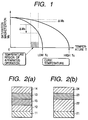
- Fig. 1 is a brief graphical representation of the temperature-dependent variation of saturation magnetization.
- the temperature-dependent variation of saturation magnetization increases as the temperature approaches the Curie temperature. Accordingly, if the Curie temperature of the medium is close to the operating temperature range of the magnetic recording apparatus, the medium has its magnetization varied greatly in response to the temperature variation even within the operating temperature range. Therefore, the Curie temperature needs to be high enough outside the operating temperature range of the apparatus.
- Magnetic alloy has its Curie temperature affected greatly by the combination and proportion of elements which compose the magnetic material and is also dependent on as to whether the material is in the order state or disorder state in the case of order alloy.
- the Curie temperature in the alloy state is prone to be lower as compared with the Curie temperature of the simple Co element. This trend is more pronounced as the quantity of additive element increases. The reason for this phenomenon is the emergence of portions where the exchange interaction between Co atoms weakens due to the replacement of the Co element in the crystal orientation with the non- magnetic element.
- the magnetic recording medium is a polycrystalline thin film formed of magnetic crystal grains having sizes of around 15 nm or less.
- the magnetic characteristics of the whole film are derived generally from the magnetic characteristics of each crystal grain. Provided that each magnetic crystal grain has a sufficiently high Curie temperature outside the operating temperature range of the magnetic recording apparatus and has a property of smaller variation of magnetization within the operating temperature range, the film of medium will have the same trend of general magnetic characteristics.
- a magnetic recording medium which meets these two conflicting characteristics can be accomplished based on the film forming process with higher sputtering energy as compared with the conventional sputtering process for a magnetic material of Co- Cr alloy, for example, and the subsequent annealing process so that the additive element in magnetic crystal grains diffuses and segregates to grain boundaries, as will be described in the following embodiment of invention.
- the average size d of magnetic crystal grains is preferably greater than 5 nm and smaller than 15 nm.
- the average size d of magnetic crystal grains satisfies: 12 > L/d > 4.
- the thickness t ( ⁇ m) of the magnetic recording film and the average residual magnetization Br (Gauss) of the magnetic recording film at 300 °K satisfy preferably: 30 Gauss ⁇ ⁇ m ⁇ Br ⁇ t ⁇ 80 Gauss ⁇ ⁇ m.
- the normalized saturation magnetization m(T) has a temperature-dependent variation per 1 °K of 0.002 at maximum within the temperature range: 5 °K ⁇ T ⁇ 350 °K.
- Magnetic recording apparatus are designed to operate at temperatures ranging from the lowest 0°C (273 °K) up to the highest 50°C (323 °K) in general, and the apparatus interior temperature will rise up to around 75°C (348 °K). Accordingly, if the constant A and T1 and the temperature- dependent variation of m(T) meet the above conditions, the variation of saturation magnetization within the temperature range from about 273 °K to about 350 °K can be as small as around 15%, and the variation of head output signal level attributable to the temperature-dependent variation of saturation magnetization is confined within the allowable range for the operation of apparatus.
- the present invention also resides in a magnetic recording apparatus which includes a magnetic recording medium, a recording medium driver, a magnetic head, a head driver, and a recording/ reproduction signal processing system, with the above- mentioned magnetic recording medium being used for the recording medium.
- the inventive magnetic recording medium can be adapted to longitudinal recording in which the average magnetic moment of recorded bits on the medium is virtually parallel to the film surface, and also to perpendicular recording and oblique recording in which the magnetic moment of recorded bit is not parallel to the film surface.
- Figs. 2A and 2B are brief cross- sectional views showing examples of the inventive and conventional magnetic recording media, respectively, for longitudinal recording.
- the inventive recording medium has a structure in which an growth-orientation control underlayer 12 and a lattice mismatch adjusting layer 15 are formed sequentially on a substrate 11, with a magnetic recording film 13 and a protection film 14 being formed thereon.
- the conventional recording medium has a structure in which a thin film 23 of cobalt alloy is formed as recording layer on the substrate 21 through an orientation control underlayer 22 of magnetic film, with a protection film 24 being formed thereon.
- a cleaned quartz substrate 11 for the 3.5- inch disk was placed on the sputtering device for film formation, the chamber was evacuated to a degree of vacuum of 1 x 10 -8 Torr or lower, the substrate 11 was heated to 300°C, and it was kept at the steady- state temperature for one hour.
- a Cr film (thickness: 10 nm) for the orientation control underlayer 12 and a Cr- 15 at% Ti film (thickness: 30 nm) for the lattice mismatch adjusting layer 15 were formed sequentially.
- These two underlayers were formed by the d.c. magnetron sputtering process at an Ar gas pressure of 3 mTorr and at a deposition rate of 2 nm/ s.
- a magnetic film (thickness: 15 nm) 13 having an average composition of Co- 15 at% Cr- 10 at% Pt- 3 at% Ta was formed by the ECR (Electron Cyclotron Resource) sputtering process which is higher in energy at film formation than the d.c. magnetron sputtering process.
- the Ar gas pressure was kept at 0.5 mTorr and the d.c. voltage applied to the targets was adjusted so that the deposition rate is 0.3 nm/ s.
- the heating chamber was evacuated to a degree of vacuum of 5 x 10 -9 Torr, the substrate with the film formed thereon was heated to a steady- state temperature of 450°C, kept heated for one hour, and cooled down to the room temperature at 25°C/ min. After that, a carbon protection film (thickness:15 nm) was formed on the outmost surface at the room temperature.
- a magnetic recording medium for comparison having a cross-sectional structure shown in Fig. 2B was fabricated in the following manner. Shown is an example of fabrication of a medium having a magnetic film composition of Co- 20 at% Cr- 8 at% Pt.
- a cleaned NiP- plated Al alloy disk 21 for the magnetic disk was placed on the sputtering device for film formation, the chamber was evacuated to a degree of vacuum of 1 x 10 -8 Torr or lower, the substrate 21 was heated to 270°C, and it was kept at the steady- state temperature for one hour.
- a Cr film (thickness: 50 nm) for the orientation control underlayer 22 On the substrate 21, a Cr film (thickness: 50 nm) for the orientation control underlayer 22, a Co- Cr- Pt magnetic film (thickness: 15 nm) 23 and a carbon protection film 24 were formed sequentially. These thin films were formed by the d.c. magnetron sputtering process at an Ar gas pressure of 3 mTorr.
- sample B This sample of medium will be called “sample B" hereinafter.
- the fabricated medium samples underwent the assessment of recording/ reproduction characteristics, and were thereafter cut into pieces and examined for the film structure and magnetic characteristics.
- the structure of medium thin film was examined based on the x- ray diffraction scheme.
- the (200) surface reflection of the Cr underlayer 22 and the (11.0) surface reflection of the hexagonal close packing structure of the Co- Cr- Pt magnetic film 23 were observed.
- the major reflection of the magnetic film 13 was the (11.0) surface reflection, and a (10.1) surface reflection peak which is about 1/ 15 in strength of the major reflection peak was observed.
- the measurement result suggests the growth of the magnetic film 13 in the (10.1) orientation based on that most crystal grains of the Cr- Ti underlayer 15 are in the (100) orientation, the magnetic film 13 of epitaxial growth on this underlayer is in the (11.0) orientation, and partial magnetic crystal grains form the Cr-Ti underlayer in the (110) orientation.
- the diffraction surface of the magnetic film was displayed in the manner of four-index display, with the third term being omitted. There was confirmed no clear x- ray diffraction peak from the Cr underlayer 12.
- Sample B of the conventional structure has a broad distribution of crystal grain sizes with an average size of about 15 nm.
- sample A has a crystal grain size distribution narrower by about 20% than that of sample B, with the average size being about 12 nm.
- the Cr- Ti underlayer and magnetic film have a continuous crystal lattice and are created based on epitaxial growth.
- the size of a crystal grain is defined in terms of the diameter of a circle having the same area as the crystal grain along the film surface.
- composition analysis was conducted at arbitrary measuring points of the magnetic film by use of an EDX (Energy Dispersive X- ray) spectroscope having a spatial resolution of 2 nm.
- EDX Electronic Dispersive X- ray
- the result of analysis for sample A reveals that the Cr element is as much as 30 at% or more at the grain boundary and has an average value of about 8 at% inside the crystal grain.
- the quantity of Cr inside the crystal grain is half the average composition of the film.
- sample B The analysis result for sample B reveals that the concentration of Cr element is as much as 23 at% at the grain boundary, which is merely greater by about 3 at% than the average composition. Although the observation inside the crystal grain indicates the reduction of Cr concentration by about 3 at% at the section near the grain boundary relative to the average composition due to the segregation of Cr at the grain boundary, the central section of crystal grain is virtually consistent with the average composition. Namely, sample B did not exhibit a clear composition segregation structure that causes the variation of composition of the entire crystal grain which was observed in sample A.
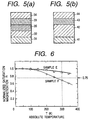
- constants A and B of the approximate expression are evaluated by using the least square method as follows.
- m(T) 1.00 - (1.11 x 10 -6 )T 2
- the magnetic recording media having the foregoing magnetic characteristics were used to build a magnetic recording apparatus.
- This magnetic recording apparatus has the known structure, as shown by a plan view in Fig. 7A and a cross-sectional view in Fig. 7B taken along the line A- A of Fig. 7A. It includes a magnetic recording medium 91, a medium driver 92 which turns the recording medium 91, a magnetic head 93 which records and reproduces signals by moving across the turning recording medium 91, a head driver 94 which moves the magnetic head 93 across the recording medium 91, and a recording/reproduction signal processing system 95 which supplies a signal to be recorded to the magnetic head and processes the reproduced signal from the magnetic head.
- the magnetic recording media of samples A and B were mounted on the magnetic recording apparatus shown in Figs. 7A and 7B to compare their recording/ reproduction characteristics.
- a thin- film head with a track width of 2.5 ⁇ m and a gap length of 0.3 ⁇ m was used for recording, and a head of the magneto-resistive effect type with a track width of 2 ⁇ m was used for reproduction.
- the head was afloat over the medium protection film surface with a clearance of 0.07 ⁇ m, with the slider having a relative speed of 11 m/s with respect to the substrate.
- the magnetic recording apparatus in operation has its internal temperature varying depending on the operational environment of the apparatus. It is necessary for the apparatus to meet the operational condition even if its temperature rises. Specifically, the variation of reproduction output signal must be within 30% for the room temperature when the apparatus is at 350 °K. This condition is met by sample A of the inventive medium which has an output reduction of about 20%, whereas sample B has its reproduction output falling to a half and does not ensure the normal operation of the apparatus.
- a transmission electron microscope was used to observe the surface image of magnetic crystal grains of the magnetic film, revealing an average crystal grain size of 11 nm for sample C and 14 nm for sample D.
- the product Br ⁇ t of residual magnetization and film thickness was 50 Gauss ⁇ ⁇ m for sample C and 85 Gauss ⁇ ⁇ m for sample D.
- Sample D is conceived to barely meet the condition for the normal operation of the magnetic disk apparatus in terms of the fall of reproduced signal level caused by the temperature variation.
- Figs. 5A and 5B are brief cross- sectional views showing examples of the inventive and conventional magnetic recording media, respectively, for perpendicular recording.
- the conventional recording medium has a structure in which a thin film 43 of cobalt alloy is formed as recording layer on a substrate 41 through an orientation control underlayer 42, with a protection film 44 being formed thereon.
- the inventive recording medium has a structure in which another orientation control underlayer 35 is formed on the conventional orientation control underlayer 32 on the substrate 31 with the intention of improving the crystal orientation, and a magnetic recording film 33 and a protection film 34 are formed on it.
- a cleaned quartz substrate 31 for the 3.5- inch disk was placed on the sputtering device for film formation, the chamber was evacuated to a degree of vacuum of 1 x 10 -8 Torr or lower, the substrate 31 was heated to 300°C, and it was kept at the steady- state temperature for one hour.
- a Ti film (thickness: 30 nm) for the orientation control underlayer 32 and a Ti- 15 at% Cr film (thickness: 30 nm) for the orientation control underlayer 35 were formed sequentially. These two underlayers were formed by the d.c. magnetron sputtering process at an Ar gas pressure of 3 mTorr and at a deposition rate of 2 nm/ s.
- a magnetic film (thickness: 50 nm) 33 having an average composition of Co- 15 at% Cr- 10 at% Pt- 3 at% Ta was formed by the ECR sputtering process which is higher in energy at film formation than the d.c. magnetron sputtering process.
- the Ar gas pressure was kept at 0.5 mTorr and the d.c. voltage applied to the targets was adjusted so that the deposition rate is 0.3 nm/ s.
- the heating chamber was evacuated to a degree of vacuum of 5 x 10 -9 Torr, the substrate with the film formed thereon was heated to a steady- state temperature of 450°C, kept heated for one hour, and cooled down to the room temperature at 25°C/ min. After that, a carbon protection film (thickness:15 nm) 34 was formed on the outmost surface at the room temperature.
- a conventional magnetic recording medium having a cross-sectional structure shown in Fig. 5B was fabricated in the following manner. Shown is an example of fabrication of a medium having a magnetic film composition of Co- 20 at% Cr- 8 at% Pt.
- a cleaned NiP- plated Al alloy disk 41 for the magnetic disk was placed on the sputtering device for film formation, the chamber was evacuated to a degree of vacuum of 1 x 10 -8 Torr or lower, the substrate 41 was heated to 270°C, and it was kept at the steady- state temperature for one hour.
- a Ti film (thickness: 50 nm) for the orientation control underlayer 42, a Co- Cr- Pt magnetic film (thickness: 50 nm) 43 and a carbon protection film 44 were formed sequentially. These thin films were formed by the d.c. magnetron sputtering process at an Ar gas pressure of 3 mTorr.
- sample F This sample of medium
- the fabricated medium samples underwent the assessment of recording/ reproduction characteristics, and were thereafter cut into pieces and examined for the film structure and magnetic characteristics.
- the structure of medium thin film was examined based on the x- ray diffraction scheme.
- the (00.2) surface reflection of the hexagonal close packing structure was observed on the magnetic film.
- Sample F has a broader peak than sample E.
- sample E has the better c- axis alignment as compared with sample F.
- a transmission electron microscope was used to observe magnetic crystal grains of the magnetic film, revealing an average crystal grain size of 14 nm for sample E and 16 nm for sample F.
- the normalized saturation magnetization m(T) has the largest temperature- dependent variations per 1 °K of 0.0008 and 0.0026 for samples E and F, respectively, within the temperature range 5 °K ⁇ T ⁇ 350 °K.
- the magnetic recording media having the foregoing magnetic characteristics were mounted in the magnetic recording apparatus shown in Figs. 7A and 7B thereby to compare their recording/ reproduction characteristics.
- a thin- film head with a track width of 2.5 ⁇ m and a gap length of 0.3 ⁇ m was used for recording, and a head of the magneto- resistive effect type with a track width of 2 ⁇ m was used for reproduction.
- the head was afloat over the medium protection film surface with a clearance of 0.07 ⁇ m, with the slider having a relative speed of 11 m/ s with respect to the substrate.
- the magnetic recording apparatus in operation has its internal temperature varying depending on the operational environment of the apparatus. It is necessary for the apparatus to meet the operational condition even if its temperature rises. Specifically, the variation of reproduction output signal must be within 30% for the room temperature when the apparatus is at 350 °K. This condition is met by sample E of the inventive medium which has an output reduction of about 15%, whereas sample F has its reproduction output falling to a half and does not ensure the normal operation of the apparatus.
- the present invention accomplishes the structure of magnetic recording medium having a smaller temperature-dependent variation of saturation magnetization and a smaller temperature- dependent variation of recording/ reproduction characteristics, thereby providing a magnetic recording medium which is advantageous to the achievement of high- density recording.
Landscapes
- Magnetic Record Carriers (AREA)
Applications Claiming Priority (2)
| Application Number | Priority Date | Filing Date | Title |
|---|---|---|---|
| JP10248702A JP2000076637A (ja) | 1998-09-02 | 1998-09-02 | 磁気記録媒体及び磁気記憶装置 |
| JP24870298 | 1998-09-02 |
Publications (1)
| Publication Number | Publication Date |
|---|---|
| EP0984434A1 true EP0984434A1 (en) | 2000-03-08 |
Family
ID=17182070
Family Applications (1)
| Application Number | Title | Priority Date | Filing Date |
|---|---|---|---|
| EP99116615A Withdrawn EP0984434A1 (en) | 1998-09-02 | 1999-08-25 | Magnetic recording medium and magnetic recording apparatus |
Country Status (4)
| Country | Link |
|---|---|
| US (1) | US6572988B1 (enExample) |
| EP (1) | EP0984434A1 (enExample) |
| JP (1) | JP2000076637A (enExample) |
| KR (1) | KR20000022770A (enExample) |
Families Citing this family (2)
| Publication number | Priority date | Publication date | Assignee | Title |
|---|---|---|---|---|
| JP2002210648A (ja) * | 2001-01-15 | 2002-07-30 | Japan Science & Technology Corp | 磁性材の加工方法およびその装置 |
| JP5916985B2 (ja) * | 2010-03-31 | 2016-05-11 | ダブリュディ・メディア・シンガポール・プライベートリミテッド | 熱アシスト記録用磁気ディスクへの磁気記録方法 |
Citations (2)
| Publication number | Priority date | Publication date | Assignee | Title |
|---|---|---|---|---|
| US5413873A (en) * | 1991-04-26 | 1995-05-09 | Victor Company Of Japan, Ltd. | Magnetic recording medium having a glass or amorphous carbon substrate, vanadium or molybdenum precoat layer, chromium primer layer and cobalt magnetic layer |
| US5660929A (en) * | 1984-11-12 | 1997-08-26 | Sumitomo Special Metals Co., Ltd. | Perpendicular magnetic recording medium and method of producing same |
Family Cites Families (3)
| Publication number | Priority date | Publication date | Assignee | Title |
|---|---|---|---|---|
| JPH0654532B2 (ja) * | 1984-07-12 | 1994-07-20 | 富士写真フイルム株式会社 | 磁気記録媒体 |
| JP3803180B2 (ja) * | 1997-09-25 | 2006-08-02 | 富士通株式会社 | 磁気記録媒体及びその製造方法ならびに磁気ディスク装置 |
| US6139950A (en) * | 1998-06-04 | 2000-10-31 | Seagate Technology Llc | Magnetic recording medium containing a Cr(HfO2) or Cr(ZrO2) |
-
1998
- 1998-09-02 JP JP10248702A patent/JP2000076637A/ja active Pending
-
1999
- 1999-08-25 EP EP99116615A patent/EP0984434A1/en not_active Withdrawn
- 1999-08-27 KR KR1019990035889A patent/KR20000022770A/ko not_active Withdrawn
- 1999-08-30 US US09/385,682 patent/US6572988B1/en not_active Expired - Fee Related
Patent Citations (2)
| Publication number | Priority date | Publication date | Assignee | Title |
|---|---|---|---|---|
| US5660929A (en) * | 1984-11-12 | 1997-08-26 | Sumitomo Special Metals Co., Ltd. | Perpendicular magnetic recording medium and method of producing same |
| US5413873A (en) * | 1991-04-26 | 1995-05-09 | Victor Company Of Japan, Ltd. | Magnetic recording medium having a glass or amorphous carbon substrate, vanadium or molybdenum precoat layer, chromium primer layer and cobalt magnetic layer |
Also Published As
| Publication number | Publication date |
|---|---|
| JP2000076637A (ja) | 2000-03-14 |
| US6572988B1 (en) | 2003-06-03 |
| KR20000022770A (ko) | 2000-04-25 |
Similar Documents
| Publication | Publication Date | Title |
|---|---|---|
| JP3143611B2 (ja) | 磁気薄膜媒体用の超薄核形成層および該層の製造方法 | |
| JP3809418B2 (ja) | 磁気記録媒体及び磁気記録装置 | |
| US6013161A (en) | Thin film magnetic alloy having low noise, high coercivity and high squareness | |
| JP3846900B2 (ja) | 多層磁気記録媒体と磁気抵抗型駆動システム | |
| US6596409B2 (en) | Onset layer for thin film disk with CoPtCrB alloy | |
| US6080476A (en) | Magnetic recording medium and magnetic recording system using such a magnetic recording medium | |
| US20050142378A1 (en) | Perpendicular magnetic recording medium having alternatively layered structure of Co alloy and Pt thin film, its production method and apparatus | |
| JP2002208129A (ja) | 磁気記録媒体及びその製造方法並びに磁気記録装置 | |
| US20020018920A1 (en) | Magnetic recording medium and magnetic recording apparatus | |
| US6083599A (en) | Perpendicular magnetic recording media and magnetic recording and reproducing apparatus using the same | |
| US20070275269A1 (en) | Magnetic recording medium and magnetic storage unit | |
| US6914749B2 (en) | Magnetic anisotropy of soft-underlayer induced by magnetron field | |
| US20020110707A1 (en) | Magnetic recording disk, method of the magnetic recording disk and magnetic recording apparatus | |
| US6572988B1 (en) | Magnetic recording medium and magnetic recording apparatus | |
| US6706426B1 (en) | Longitudinal magnetic recording media | |
| US7294419B2 (en) | High density magnetic recording medium having uniform local coercivity distribution and grain size distribution and fine grains and manufacturing method thereof | |
| US20100173175A1 (en) | Magnetic recording medium, process for producing same, and magnetic recording reproducing apparatus | |
| JP2002074639A (ja) | 垂直磁気記録媒体及び磁気記憶装置 | |
| USRE38544E1 (en) | Thin film magnetic alloy having low noise, high coercivity and high squareness | |
| US6703148B2 (en) | Magnetic recording medium and magnetic disk apparatus using the same | |
| US6365287B1 (en) | Magnetic recording media and magnetic storage device | |
| JP2991689B2 (ja) | 垂直磁気記録媒体及びそれを用いた磁気記録再生装置 | |
| US20020001736A1 (en) | Magnetic recording medium | |
| JP3157806B2 (ja) | 磁気記録媒体 | |
| JPWO1996027187A1 (ja) | 磁気記録媒体及び磁気記憶装置 |
Legal Events
| Date | Code | Title | Description |
|---|---|---|---|
| PUAI | Public reference made under article 153(3) epc to a published international application that has entered the european phase |
Free format text: ORIGINAL CODE: 0009012 |
|
| AK | Designated contracting states |
Kind code of ref document: A1 Designated state(s): DE FR GB |
|
| AX | Request for extension of the european patent |
Free format text: AL;LT;LV;MK;RO;SI |
|
| 17P | Request for examination filed |
Effective date: 20000831 |
|
| AKX | Designation fees paid |
Free format text: DE FR GB |
|
| 17Q | First examination report despatched |
Effective date: 20020806 |
|
| STAA | Information on the status of an ep patent application or granted ep patent |
Free format text: STATUS: THE APPLICATION IS DEEMED TO BE WITHDRAWN |
|
| 18D | Application deemed to be withdrawn |
Effective date: 20021217 |