EP0973869B1 - Verfahren zur steigerung des wachstums von pflanzenzellkulturen - Google Patents
Verfahren zur steigerung des wachstums von pflanzenzellkulturen Download PDFInfo
- Publication number
- EP0973869B1 EP0973869B1 EP98903959A EP98903959A EP0973869B1 EP 0973869 B1 EP0973869 B1 EP 0973869B1 EP 98903959 A EP98903959 A EP 98903959A EP 98903959 A EP98903959 A EP 98903959A EP 0973869 B1 EP0973869 B1 EP 0973869B1
- Authority
- EP
- European Patent Office
- Prior art keywords
- culture
- plant cell
- cell
- growth
- plant
- Prior art date
- Legal status (The legal status is an assumption and is not a legal conclusion. Google has not performed a legal analysis and makes no representation as to the accuracy of the status listed.)
- Expired - Lifetime
Links
Images
Classifications
-
- C—CHEMISTRY; METALLURGY
- C12—BIOCHEMISTRY; BEER; SPIRITS; WINE; VINEGAR; MICROBIOLOGY; ENZYMOLOGY; MUTATION OR GENETIC ENGINEERING
- C12N—MICROORGANISMS OR ENZYMES; COMPOSITIONS THEREOF; PROPAGATING, PRESERVING, OR MAINTAINING MICROORGANISMS; MUTATION OR GENETIC ENGINEERING; CULTURE MEDIA
- C12N5/00—Undifferentiated human, animal or plant cells, e.g. cell lines; Tissues; Cultivation or maintenance thereof; Culture media therefor
- C12N5/0018—Culture media for cell or tissue culture
- C12N5/0025—Culture media for plant cell or plant tissue culture
Definitions
- the invention relates to a method for increasing the growth of plant cell culture for the production of economically important complex chemicals of plant origin (phytochemicals) at an industrial level.
- Phytochemicals are non-proteinic biomolecules which cannot be synthesized at reasonable yields and costs by conventional chemical processes nor can they be produced through genetic manipulation of microorganisms due to the complex, and often poorly understood, biochemical pathways involved.
- the production of these precious molecules is mostly achieved through the extraction and purification, at low yields ( ⁇ 1-5%), of imported exotic plant biomass, whose reproductive agriculture and secure long term supply are often very difficult, if not impossible to guarantee. Consequently, these supply problems have seriously hindered the development of these unique biomolecules into valuable active principles for the pharmaceutical, nutraceutical and cosmetic industries.
- This type of bioprocess comprises basically three stages: 1) a first stage where the plant cell biomass is grown to produce a high concentration; 2) a production stage during which this biomass is stimulated or challenged to biosynthesize the secondary metabolites of interest at high rate and concentration; and 3) a final stage of extraction and purification of phytochemicals from the culture broth. This last stage (downstream processing) is performed using conventional chemical engineering technologies.
- One aim of the present invention is to provide for faster true (cellular) growth rate of cultured plant cells.
- Another aim of the present invention is to provide for much higher cell concentrations (at least -20 to 60 x 10 6 cells ml -1 ) of plant cell cultures than obtained using conventional (batch) cultures ( ⁇ 2 to 2.5 x 10 6 cells ml -1 ).
- Another aim of the present invention is that these high cell concentrations ( ⁇ 20 to 60 x 10 6 cells ml -1 ) will provide for high production of secondary metabolites, recombinant proteins and antibodies from plant cell based bioprocesses.
- a novel dynamic culture method which provide for re-induction and stimulation of the cell division of in vitro cultivated plant cells.
- This culture method may be combined with other culture techniques developed to induce secondary metabolites as well as recombinant proteins and antibodies production in order that very high, economical productivity levels may be obtained from plant cell based bioprocesses
- One embodiment of the method of the present invention consists in dynamically feeding plant cell cultures, initially grown in the batch mode, with additional ammonium ions to re-induce, stimulate, maintain and increase the rate of cell division, as well as the extent of cell proliferation, for increased plant cell concentration in culture.
- This original approach differs significantly from the conventional belief and approaches in this field, in that supplementation of culture media with properly chosen plant growth regulators will result in induction of sustainable cellular division.
- Another embodiment of the method of the present invention consists also of dynamically feeding plant cell cultures with NH 4 and, simultaneously, with other macronutrients critical for their survival (mainly carbohydrates, dissolved oxygen, phosphate and potassium), since lack of the latter before or during cell division re-induction, upon ammonium addition, will limit the expected increase in cellular proliferation, and in fact may result in decreased growth and possibly culture death.
- macronutrients critical for their survival mainly carbohydrates, dissolved oxygen, phosphate and potassium
- Another embodiment of the method of the present invention consists also of dynamically feeding plant cell cultures at specific physiological states of the cultures with these specific macronutrients to increase cellular proliferation since empirical macronutrients addition may not yield the expected maximum increase in cellular proliferation, and in fact may result in a longer lag phase and decreased growth because of toxicity problems and undesirable metabolism of these macronutrients when in excess.
- Another embodiment of the method of the present invention consists also in dynamically feeding plant cell cultures with these specific macronutrients under proper programmed addition regimes to increase cellular proliferation since increasing the initial concentration of these macronutrients, or their empirical batch addition to the cultures may not yield the expected maximum increase in cellular proliferation, and in fact may result in a longer lag phase and decreased growth because of toxicity problems and undesirable metabolism of these macronutrients when in excess.
- Another embodiment of the method of the present invention consists in using a plant cell culture of a given volume, grown according to the method of the present invention to a high cell concentration (20 to 60 x 10 6 cells/ml -1 ), to inoculate a new, much larger (20 to 60-fold larger) culture volume than previously possible using conventional plant cell culture methods (3 to 10-fold larger), which results in a much simpler, less expensive and faster scale up to industrial size of a plant cell based culture process.
- the method of the present invention may be performed in flasks with limited success, it is best carried out using suitable culture vessels, or bioreactors, which allow for the high dissolved oxygen transfer rates and continuous nutrient addition under the supervision of an efficient control strategy, required for maximum results.
- One embodiment of the method of the present invention is also better applied to plant cell suspension cultures, although immobilized, transformed and organ plant cell cultures will respond positively in terms of improved growth performance.
- Plant cell species which may be used in accordance with the present invention include, without limitation, Vitis vinifera, Eschscholtzia californica, Ginkgo biloba, Daucus carota, Datura stramonium, Lycopersicon escul entum, Lycopersi con pimpinellifolium, Medicago sativa, Physalis exocarpa, Solanum melanocerasum, Tagetes patula, Tagetes erecta, Trifolium pratense, Catharanthus roseus, Tripterygium wilfordii, Taxus species, Papaver somniferum and Nicotiana tabacum.
- Modifications of plant cells for the production of phytochemicals include, without limitation, their culture, during and/or following the growth method of the present invention, under physical, chemical and/or biological stresses, the use of production media, elicitation, the use of immobilized, organ or transformed cultures as well as genetic manipulations.
- Modifications of plant cell cultures for the production of properly configured recombinant proteins and antibodies include, without limitation, genetic manipulations, their culture, during and/or following the growth method of the present invention, under physical, chemical and/or biological stresses, the use of production media and the use of immobilized, organ or transformed cultures.
- a method for increasing the growth rate and cell concentration of in vitro cultivated plant cells by re-induction and stimulation of the cellular growth of plant cells which comprises the steps of:
- the growing of step a) may be conducted while monitoring oxygen uptake rate of the culture.
- the ammonium ions of step b) may be added when the oxygen uptake rate has substantially plateaued.
- ammonium ions include without limitation, (NH 4 ) 2 SO 4 , NH 4 NO 3 , (NH 4 ) 2 PO 4 , NH 4 acetate, and glutamine.
- Additional nutrients which include without limitation, carbohydrates, dissolved oxygen, phosphate and potassium may also be added.
- the carbohydrates include, without limitation, sucrose, glucose and fructose.
- the growing of step a) may be effected in flasks, any suitable culture vessels, or bioreactors.
- the growing of step a) is effected in vessels or bioreactors and in batch, fedbatch or continuous mode, and more preferably in bioreactors while in batch mode.
- suitable growth conditions when used herein is intended to refer to sterility, mixing rate, temperature, light, oxygen supply and nutrient medium.
- the method may further comprise two steps carried out after step b),
- phytochemicals when used herein is intended to refer to alkaloids, taxanes, taxines, terpenes, steroids, quinones, flavonoids, tannins, saponins, coumarins, carotenoids and any biosynthesis intermediates thereof.
- the method may further comprise two steps carried out after step b),
- a method for scaling up towards industrial size of a plant based culture process which comprises the steps of:
- high concentration when used herein is intended to mean a concentration ranging from about 3 x 10 6 to 60 x 10 6 cells/ml.
- volumetric inoculation ratio when used herein is intended to mean a ratio ranging from about 1:20 to 1:60.
- the method of the present invention has been successfully tested for V. vinifera and E. californica cell cultures in 2-L and 5-L helical ribbon impeller (HRI) computer monitored and controlled bioreactors.
- Cell concentration increases of up to -3-fold (or 7.2 x 10 6 cells ml -1 for V. vinifera cultures (see EXAMPLE I) and ⁇ 10-fold (or 20 x 10 6 cells ml -1 for E. californica cultures) have been achieved as compared to conventional batch cultures ( ⁇ 2-2.5 x 10 6 cells ml -1 ).
- Cell increases of at least up to ⁇ 30-fold ( ⁇ 60 x 10 6 cells ml -1 ) are expected upon proper operation and control of the resulting culture method.
- Shake flask suspension cultures were carried out in 500-ml flasks containing 115 ml suspension, maintained at 25°C and agitated at 115 RPM.
- the inoculum for the bioreactor culture was prepared similarly in 1-L flasks.
- the culture was carried out in a 2-L helical ribbon impeller (HRI) bioreactor equipped for continuous monitoring and control of temperature, mixing speed, dissolved oxygen concentration (DO) and medium conductivity (monitoring only) using a computer based system.
- the bioreactor and medium were steam sterilized for 1 h.
- the culture was carried out at 25°C without light according to the specific requirement of the cell line used.
- the inoculation volume yielded an initial biomass concentration of -1.6 g dw L -1 .
- the initial mixing speed was set at 60 RPM.
- the dissolved oxygen concentration (DO) of the bioreactor culture was measured using a prepolarized INGOLDTM polarographic probe calibrated before the experiment.
- the dissolved oxygen concentration was controlled at 50% air saturation by manipulating the oxygen partial pressure of the bioreactor head space gassed at a rate of 0. 2 L min -1 ( ⁇ 0.1 VVM).
- This composition was automatically adjusted using a gas mixing system regulated by computer according to proper control algorithms. Obviously, the initial oxygen transfer rate (OTR) of this culture system was low. When saturation of the DO controller occurred, the mixing speed of the bioreactor was gradually increased to meet the culture's oxygen demand. The highest speed attained was 100 RPM. The resulting slow increase in mixing shear did not affect the cells and suspension in view of the low amount of cellular debris ( ⁇ 1-2% of the total biomass volume) observed during the experiment.
- Aqueous concentrated solutions of (NH 4 ) 2 SO 4 and glucose were prepared separately and their pH were adjusted to 5.8 using 0.1 N KOH before steam sterilization ( 20 min). Because of the drastic effect of extracellular carbohydrate depletion on the viability of Vitis vinifera cells (Pépin, M.F. et al. (1995) Biotechnology and Bioengineering , 47 :131-138), the feeding strategy included glucose to prevent carbohydrate limitation and insure that the medium could sustain continued cell proliferation. These solutions were mixed before use.
- the feeding strategy consisted of adding the (NH 4 ) 2 SO 4 + glucose solution at a constant rate of 8.5 L h -1 , corresponding to a feed rate of 0.22 mM NH 4 h -1 and to a 5 g L -1 total increase of the glucose concentration.
- Cell number was measured using a Fusch-Rosenthal haemacytometer after dissociation of cell aggregates of a 1-ml suspension sample using 2 ml of a 10% (w/v) chromium trioxide solution. This mixture was maintained at 60°C for 60 minutes. Cell viability was assayed after coloration with a solution of 5 g fluorescien diacetate dissolved in 1 L acetone. The pH and conductivity of a plant cell suspension sample were measured using conventional pH and conductivity probes. Biomass concentration was measured by filtering a known volume ( ⁇ 10 ml) of plant cell suspension through a fiberglass filter (Whatman No. 41 ashless, 5 ⁇ m). The medium sample was frozen (-20°C) for further analysis.
- the oxygen uptake rate (OUR) of the bioreactor culture was measured periodically by simultaneously stopping the action of the dissolved oxygen concentration (DO) controller and reducing the mixing speed of the bioreactor to 12 rounds per minute (RPM). These operating conditions minimized the oxygen transfer rate (OTR) to the culture without overly affecting the DO measurement dynamics and mixing efficiency of the plant cell suspension.
- OTR oxygen transfer rate
- the average specific growth rates were computed using a linear regression on the linear section of the logarithmic dry biomass and cell concentration growth curves.
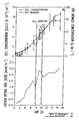
- Fig. 1 A for the fed-batch bioreactor culture with programmed addition of the glucose-enriched (NH 4 ) 2 SO 4 solution.
- the addition of NH4 from day 7.9 to day 9.7 allowed sustaining cell division after the first leveling off of OUR (Fig. 1B: day 6.3) and increasing cell concentration.
- the specific cell growth rate ( ) remained constant at 0.28 h -1 , the same value since the beginning of the culture.
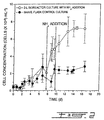
- the increase of the cell proliferation duration allowed reaching a concentration of 7.2 x 10 6 viable cells ml -1 for the bioreactor culture while the cell concentration leveled off at 2.3 x 10 6 viable cells ml -1 at day 6.5 for the shake flask control culture (Fig. 2).
- the feeding of a concentrated solution of nutrients when OUR reached its maximum value proved to be an effective strategy to increase cell proliferation.
- the volumetric oxygen uptake rate increased from 1.5-2.0 to 2.6-2.8 mmol h -1 , where it plateaued thereafter.
- the relative NH 4 addition decreased from 9.9 to 5.5 mmol NH 4 (10 6 cells h) -1 due to the viable cell concentration increase, which may have not been sufficient to sustain higher increases in oxygen uptake rates and cell division.
- the feeding of a concentrated solution of nutrients when OUR reached its maximum value has proven to be an effective strategy to increase cell division of Vitis vinifera cell cultures .
- the addition of a glucose-enriched (NH 4 ) 2 SO 4 aqueous solution allowed sustaining cell proliferation duration.
- the concentration of viable cells reached 7.2 x 10 6 cells ml -1 for a (NH 4 ) 2 SO 4 supplemented culture as compared to 2.3 x 10 6 cells ml -1 for the control shake culture.
Landscapes
- Engineering & Computer Science (AREA)
- Life Sciences & Earth Sciences (AREA)
- Biotechnology (AREA)
- Health & Medical Sciences (AREA)
- Biomedical Technology (AREA)
- Wood Science & Technology (AREA)
- Zoology (AREA)
- Bioinformatics & Cheminformatics (AREA)
- Genetics & Genomics (AREA)
- Organic Chemistry (AREA)
- Chemical & Material Sciences (AREA)
- Microbiology (AREA)
- Botany (AREA)
- Biochemistry (AREA)
- General Engineering & Computer Science (AREA)
- General Health & Medical Sciences (AREA)
- Cell Biology (AREA)
- Micro-Organisms Or Cultivation Processes Thereof (AREA)
- Enzymes And Modification Thereof (AREA)
- Preparation Of Compounds By Using Micro-Organisms (AREA)
Claims (15)
- Verfahren zum Erhöhen der Wachstumsrate und Zellkonzentration von in vitro kultivierten Pflanzenzellen durch Re-Induktion und Stimulation des Zellwachstums von Pflanzenzellen, welches folgende Schritte umfaßt:wodurch die Zellteilung re-induziert, stimuliert, aufrechterhalten und gesteigert wird, um eine erhöhte Pflanzenzellkonzentration in der Kultur zu erhalten.a) Züchten von Pflanzenzellenkulturen in einem Nährmedium unter Wachstumsbedingungen, die geeignet sind zur Initiierung von Zellteilung; undb) Ergänzung der Zellkultur mit zusätzlichen Ammonium-Ionen zu irgendeinem Zeitpunkt zwischen einer anfänglichen Wachstumsstufe und vor dem Zellkulturtod in einer genügenden Menge, um Zellteilung zu re-induzieren, ohne daß sie für die Zellkultur toxisch ist;
- Verfahren nach Anspruch 1, worin die Züchtung des Schritts a) durchgeführt wird, während die Sauerstoffaufnahmerate der Kultur überwacht wird.
- Verfahren nach Anspruch 2, worin die Ammonium-Ionen des Schritts b) zugesetzt werden, wenn die Sauerstoffaufnahmerate im wesentlichen ein Plateau erreicht hat.
- Verfahren nach Anspruch 1, worin die Ammonium-Ionen des Schritts b) ausgewählt sind aus der Gruppe bestehend aus (NH4)2SO4, NH4NO3, (NH4)2PO4, NH4-Acetat und Glutamin.
- Verfahren nach Anspruch 1, worin der Schritt b) weiter umfaßt die Zugabe von Nährstoffen, die ausgewählt sind aus der Gruppe Kohlenhydrate, gelöster Sauerstoff, Phosphat und Kalium.
- Verfahren nach Anspruch 5, worin die Kohlenhydrate ausgewählt sind aus der Gruppe, die aus Sucrose, Glucose und Fructose besteht.
- Verfahren nach Anspruch 5, worin das Züchten im Schritt a) vorgenommen wird in Glaskolben, irgendwelchen geeigneten Kulturgefäßen oder Bioreaktoren.
- Verfahren nach Anspruch 7, worin das Züchten im Schritt a) in Gefäßen oder Bioreaktoren und im Chargen-, Fedbatch- oder kontinuierlichen Modus durchgeführt wird.
- Verfahren nach Anspruch 7, worin die geeigneten Wachstumsbedingungen Sterilität, Mischrate, Temperatur, Licht, Sauerstoffzufuhr und Nährmedium sind.
- Verfahren nach Anspruch 9, welches weiterhin zwei Schritte umfaßt, die nach dem Schrittb) durchgeführt werden, nämlichc) Modifizierung von Pflanzenzellkulturen zur Herstellung von Phytochemikalien; undd) Ermöglichung der Herstellung der Phytochemikalien und Isolieren der hergestellten Phytochemikalien aus der gewachsenen Pflanzenzellenbiomasse und dem Medium.
- Verfahren nach Anspruch 10, worin die Phytochemikalien ausgewählt sind aus der Gruppe, die besteht aus Alkaloiden, Taxanen, Taxinen, Terpenen, Steroiden, Chinonen, Flavonoiden, Tanninen, Saponinen, Cumarinen, Carotenoiden und allen Zwischenprodukten von deren Biosynthese.
- Verfahren nach Anspruch 9, welches außerdem zwei Schritte umfaßt, die nach dem Schritt b) durchgeführt werden, nämlichc) Modifizierung von Pflanzenzellkulturen für die Herstellung von rekombinanten Proteinen und Antikörpern; undd) Ermöglichung der Produktion der rekombinanten Proteinen und Antikörper und Isolieren der hergestellten rekombinanten Proteine und Antikörper aus gewachsener Pflanzenzellenbiomasse und dem Medium.
- Verfahren zur Übertragung eines auf Pflanzenkultur beruhenden Verfahrens auf industrielle Größenordnung, welches folgende Schritte umfaßt:a) Züchten von Pflanzenzellkulturen gemäß dem Verfahren von Anspruch 1, um ein erstes Volumen von Kultur mit hoher Zellkonzentration zu erhalten; undb) Impfen eines zweiten Kulturvolumens mit wenigstens einem Teil des konzentrierten ersten Volumens, um eine Pflanzenzellenkultur in Richtung auf industrielle Größe zu vergrößern, wobei das zweite Volumen größer als das erste Volumen ist, wodurch das volumetrische Impfverhältnis der Pflanzenzellkultur niedriger ist als bei Anwendung des üblichen chargenweisen Kulturverfahrens.
- Verfahren nach Anspruch 13, worin die hohe Konzentration von etwa 3 x 10⁶ bis 60 x 106 Zellen/ml beträgt.
- Verfahren nach Anspruch 14, worin das volumetrische Impfverhältnis von etwa 1:20 bis 1:60 beträgt.
Applications Claiming Priority (3)
| Application Number | Priority Date | Filing Date | Title |
|---|---|---|---|
| US80226897A | 1997-02-19 | 1997-02-19 | |
| US802268 | 1997-02-19 | ||
| PCT/CA1998/000121 WO1998037176A1 (en) | 1997-02-19 | 1998-02-18 | Method for increasing the growth of plant cell cultures |
Publications (2)
| Publication Number | Publication Date |
|---|---|
| EP0973869A1 EP0973869A1 (de) | 2000-01-26 |
| EP0973869B1 true EP0973869B1 (de) | 2004-01-28 |
Family
ID=25183260
Family Applications (1)
| Application Number | Title | Priority Date | Filing Date |
|---|---|---|---|
| EP98903959A Expired - Lifetime EP0973869B1 (de) | 1997-02-19 | 1998-02-18 | Verfahren zur steigerung des wachstums von pflanzenzellkulturen |
Country Status (8)
| Country | Link |
|---|---|
| US (1) | US6069009A (de) |
| EP (1) | EP0973869B1 (de) |
| JP (1) | JP3558652B2 (de) |
| AT (1) | ATE258594T1 (de) |
| AU (1) | AU727388B2 (de) |
| CA (1) | CA2278588C (de) |
| DE (1) | DE69821343T2 (de) |
| WO (1) | WO1998037176A1 (de) |
Families Citing this family (12)
| Publication number | Priority date | Publication date | Assignee | Title |
|---|---|---|---|---|
| US7264951B1 (en) | 1992-02-20 | 2007-09-04 | Phyton, Inc. | Enhanced production of taxol and taxanes by cell cultures of Taxus species |
| KR20140062179A (ko) * | 1996-05-24 | 2014-05-22 | 디에프비 바이오테크 인코포레이티드 | 탁수스종의 세포 배양에 의한 탁산의 생산 증진 방법 |
| US7534933B2 (en) * | 2000-08-18 | 2009-05-19 | University Of Connecticut | Transgenic plants overexpressing a plant vacuolar H + -ATPase |
| US8697950B2 (en) * | 1999-11-10 | 2014-04-15 | University Of Connecticut | Vacuolar pyrophosphatases and uses in plants |
| US20020178464A1 (en) * | 1999-11-10 | 2002-11-28 | Whitehead Institute For Biomedical Research | Proton transporters and uses in plants |
| JP4200655B2 (ja) * | 2000-12-26 | 2008-12-24 | 味の素株式会社 | 焼結金属膜を用いた好気的培養方法 |
| JP2004529645A (ja) * | 2001-04-18 | 2004-09-30 | フラームス・インテルウニフェルシタイル・インステイチュート・フォール・ビオテヒノロヒー・ヴェーゼットウェー | 生物学的細胞での2次代謝物の生産促進のための膜トランスポーターポンプをコードする遺伝子の使用 |
| WO2006129988A1 (en) * | 2005-06-03 | 2006-12-07 | Samyang Genex Corporation | Mass production of secondary metabolite in plant cell culture by treatment of saccharide mixture in medicum |
| FR2952072B1 (fr) * | 2009-11-05 | 2013-09-27 | Pf Medicament | Procede de production de triptolide |
| WO2015102003A1 (en) * | 2014-01-05 | 2015-07-09 | Bioharvest Ltd. | Pomegranate derived cell culture and methods for preparing and using the same |
| JP2020005511A (ja) * | 2018-07-03 | 2020-01-16 | 株式会社日立製作所 | 培養方法及び培養装置 |
| US11299700B1 (en) | 2021-02-19 | 2022-04-12 | Acequia Biotechnology, Llc | Bioreactor containers and methods of growing hairy roots using the same |
Family Cites Families (4)
| Publication number | Priority date | Publication date | Assignee | Title |
|---|---|---|---|---|
| US4801545A (en) * | 1983-05-19 | 1989-01-31 | Plant Genetics, Inc. | Enhanced somatic embryogenesis using maltose |
| JPH01165391A (ja) * | 1987-12-21 | 1989-06-29 | Seitai Kinou Riyou Kagakuhin Shinseizou Gijutsu Kenkyu Kumiai | ベルベリン型アルカロイドの生産方法 |
| JPH0779685B2 (ja) * | 1991-01-28 | 1995-08-30 | 株式会社ナーサリーテクノロジー | 植物細胞培養法 |
| JPH08131161A (ja) * | 1994-11-08 | 1996-05-28 | Food Design Gijutsu Kenkyu Kumiai | 植物組織の指数関数的流加培養方法、培養物の生育係数算出方法および植物組織培養装置 |
-
1998
- 1998-02-18 EP EP98903959A patent/EP0973869B1/de not_active Expired - Lifetime
- 1998-02-18 AT AT98903959T patent/ATE258594T1/de not_active IP Right Cessation
- 1998-02-18 DE DE69821343T patent/DE69821343T2/de not_active Expired - Fee Related
- 1998-02-18 JP JP53610798A patent/JP3558652B2/ja not_active Expired - Fee Related
- 1998-02-18 AU AU62016/98A patent/AU727388B2/en not_active Ceased
- 1998-02-18 WO PCT/CA1998/000121 patent/WO1998037176A1/en not_active Ceased
- 1998-02-18 CA CA002278588A patent/CA2278588C/en not_active Expired - Fee Related
- 1998-06-18 US US09/099,578 patent/US6069009A/en not_active Expired - Fee Related
Also Published As
| Publication number | Publication date |
|---|---|
| DE69821343D1 (de) | 2004-03-04 |
| CA2278588C (en) | 2005-02-08 |
| EP0973869A1 (de) | 2000-01-26 |
| JP2001504710A (ja) | 2001-04-10 |
| WO1998037176A1 (en) | 1998-08-27 |
| DE69821343T2 (de) | 2004-10-07 |
| CA2278588A1 (en) | 1998-08-27 |
| JP3558652B2 (ja) | 2004-08-25 |
| AU6201698A (en) | 1998-09-09 |
| AU727388B2 (en) | 2000-12-14 |
| US6069009A (en) | 2000-05-30 |
| ATE258594T1 (de) | 2004-02-15 |
Similar Documents
| Publication | Publication Date | Title |
|---|---|---|
| Zhou et al. | Effects of β-cyclodextrin and methyl jasmonate on the production of vindoline, catharanthine, and ajmalicine in Catharanthus roseus cambial meristematic cell cultures | |
| Dörnenburg et al. | Strategies for the improvement of secondary metabolite production in plant cell cultures | |
| EP0973869B1 (de) | Verfahren zur steigerung des wachstums von pflanzenzellkulturen | |
| Zhang et al. | Enhancement of ginseng saponin production in suspension cultures of Panax notoginseng: manipulation of medium sucrose | |
| Raval et al. | Necessity of a two-stage process for the production of azadirachtin-related limonoids in suspension cultures of Azadirachta indica | |
| Drapeau et al. | Growth kinetics of Dioscorea deltoidea and Catharanthus roseus in batch culture | |
| Sivakumar et al. | Optimization of organic nutrients for ginseng hairy roots production in large-scale bioreactors | |
| Brodelius | The potential role of immobilization in plant cell biotechnology | |
| Schlatmann et al. | Scaleup of ajmalicine production by plant cell cultures of Catharanthus roseus | |
| Kwok et al. | Kinetic and stoichiometric analysis of hairy roots in a segmented bubble column reactor | |
| Uozumi et al. | Fed-batch culture of hairy root using fructose as a carbon source | |
| Ilieva et al. | Rosmarinic acid production by Lavandula vera MM cell-suspension culture | |
| Zhong et al. | Recent advances in plant cell cultures in bioreactors | |
| CN114958626A (zh) | 一株产赤霉素ga4菌株及其应用 | |
| Mersinger et al. | Formation of forskolin by suspension cultures of Coleus forskohlii1 | |
| Byun et al. | Two‐phase airlift fermentor operation with elicitation for the enhanced production of enzophenanthridine alkaloids in cell suspensions of Escherichia californica | |
| Yue et al. | Impact of external calcium and calcium sensors on ginsenoside Rb1 biosynthesis by Panax notoginseng cells | |
| Chattopadhyay et al. | Optimization of culture parameters for production of podophyllotoxin in suspension culture of Podophyllum hexandrum | |
| Lian et al. | Growth and uptake of sucrose and mineral ions by bulblets of Lilium oriental hybrid ‘Casablanca’during bioreactor culture | |
| Su et al. | A perfusion air-lift bioreactor for high density plant cell cultivation and secreted protein production | |
| Van Gulik et al. | The application of continuous culture for plant cell suspensions | |
| Schripsema et al. | Screening of plant cell cultures for new industrially interesting compounds | |
| Kurz et al. | Continuous culture of plant cells | |
| WO2008052630A1 (en) | Semi-continuous fermentation process for pantothenate production | |
| MXPA99007627A (en) | Method for increasing the growth of plant cell cultures |
Legal Events
| Date | Code | Title | Description |
|---|---|---|---|
| PUAI | Public reference made under article 153(3) epc to a published international application that has entered the european phase |
Free format text: ORIGINAL CODE: 0009012 |
|
| 17P | Request for examination filed |
Effective date: 19990803 |
|
| AK | Designated contracting states |
Kind code of ref document: A1 Designated state(s): AT BE CH DE DK ES FI FR GB GR IE IT LI LU NL PT SE |
|
| GRAH | Despatch of communication of intention to grant a patent |
Free format text: ORIGINAL CODE: EPIDOS IGRA |
|
| GRAS | Grant fee paid |
Free format text: ORIGINAL CODE: EPIDOSNIGR3 |
|
| GRAA | (expected) grant |
Free format text: ORIGINAL CODE: 0009210 |
|
| AK | Designated contracting states |
Kind code of ref document: B1 Designated state(s): AT BE CH DE DK ES FI FR GB GR IE IT LI LU NL PT SE |
|
| PG25 | Lapsed in a contracting state [announced via postgrant information from national office to epo] |
Ref country code: FI Free format text: LAPSE BECAUSE OF FAILURE TO SUBMIT A TRANSLATION OF THE DESCRIPTION OR TO PAY THE FEE WITHIN THE PRESCRIBED TIME-LIMIT Effective date: 20040128 Ref country code: ES Free format text: LAPSE BECAUSE OF FAILURE TO SUBMIT A TRANSLATION OF THE DESCRIPTION OR TO PAY THE FEE WITHIN THE PRESCRIBED TIME-LIMIT Effective date: 20040128 Ref country code: BE Free format text: LAPSE BECAUSE OF FAILURE TO SUBMIT A TRANSLATION OF THE DESCRIPTION OR TO PAY THE FEE WITHIN THE PRESCRIBED TIME-LIMIT Effective date: 20040128 |
|
| REG | Reference to a national code |
Ref country code: GB Ref legal event code: FG4D |
|
| REG | Reference to a national code |
Ref country code: CH Ref legal event code: EP |
|
| PG25 | Lapsed in a contracting state [announced via postgrant information from national office to epo] |
Ref country code: LU Free format text: LAPSE BECAUSE OF NON-PAYMENT OF DUE FEES Effective date: 20040218 |
|
| REG | Reference to a national code |
Ref country code: IE Ref legal event code: FG4D |
|
| REF | Corresponds to: |
Ref document number: 69821343 Country of ref document: DE Date of ref document: 20040304 Kind code of ref document: P |
|
| PG25 | Lapsed in a contracting state [announced via postgrant information from national office to epo] |
Ref country code: SE Free format text: LAPSE BECAUSE OF FAILURE TO SUBMIT A TRANSLATION OF THE DESCRIPTION OR TO PAY THE FEE WITHIN THE PRESCRIBED TIME-LIMIT Effective date: 20040428 Ref country code: GR Free format text: LAPSE BECAUSE OF FAILURE TO SUBMIT A TRANSLATION OF THE DESCRIPTION OR TO PAY THE FEE WITHIN THE PRESCRIBED TIME-LIMIT Effective date: 20040428 Ref country code: DK Free format text: LAPSE BECAUSE OF FAILURE TO SUBMIT A TRANSLATION OF THE DESCRIPTION OR TO PAY THE FEE WITHIN THE PRESCRIBED TIME-LIMIT Effective date: 20040428 |
|
| REG | Reference to a national code |
Ref country code: CH Ref legal event code: NV Representative=s name: ISLER & PEDRAZZINI AG |
|
| ET | Fr: translation filed | ||
| PLBE | No opposition filed within time limit |
Free format text: ORIGINAL CODE: 0009261 |
|
| STAA | Information on the status of an ep patent application or granted ep patent |
Free format text: STATUS: NO OPPOSITION FILED WITHIN TIME LIMIT |
|
| 26N | No opposition filed |
Effective date: 20041029 |
|
| REG | Reference to a national code |
Ref country code: CH Ref legal event code: PFA Owner name: AVANCE PHARMA INC. Free format text: PHYTOBIOTECH INC.#248, RUE SAINT-RAPHAEL#ILE BIZARD, QUEBEC H9E 1S2 (CA) -TRANSFER TO- AVANCE PHARMA INC.#248, RUE SAINT-RAPHAEL#ILE BIZARD, QUEBEC H9E 1S2 (CA) |
|
| NLT1 | Nl: modifications of names registered in virtue of documents presented to the patent office pursuant to art. 16 a, paragraph 1 |
Owner name: AVANCE PHARMA INC. |
|
| PGFP | Annual fee paid to national office [announced via postgrant information from national office to epo] |
Ref country code: FR Payment date: 20060216 Year of fee payment: 9 |
|
| PGFP | Annual fee paid to national office [announced via postgrant information from national office to epo] |
Ref country code: AT Payment date: 20060220 Year of fee payment: 9 |
|
| PGFP | Annual fee paid to national office [announced via postgrant information from national office to epo] |
Ref country code: IT Payment date: 20060228 Year of fee payment: 9 |
|
| PGFP | Annual fee paid to national office [announced via postgrant information from national office to epo] |
Ref country code: IE Payment date: 20070115 Year of fee payment: 10 |
|
| PGFP | Annual fee paid to national office [announced via postgrant information from national office to epo] |
Ref country code: GB Payment date: 20070122 Year of fee payment: 10 |
|
| PGFP | Annual fee paid to national office [announced via postgrant information from national office to epo] |
Ref country code: NL Payment date: 20070206 Year of fee payment: 10 |
|
| PG25 | Lapsed in a contracting state [announced via postgrant information from national office to epo] |
Ref country code: LI Free format text: LAPSE BECAUSE OF NON-PAYMENT OF DUE FEES Effective date: 20070228 Ref country code: CH Free format text: LAPSE BECAUSE OF NON-PAYMENT OF DUE FEES Effective date: 20070228 |
|
| REG | Reference to a national code |
Ref country code: CH Ref legal event code: PUE Owner name: MILLENIA HOPE PHARMACEUTICALS INC. Free format text: AVANCE PHARMA INC.#248, RUE SAINT-RAPHAEL#ILE BIZARD, QUEBEC H9E 1S2 (CA) -TRANSFER TO- MILLENIA HOPE PHARMACEUTICALS INC.#16800 TRANS CANADA HWY.#KIRKLAND, QUEBEC, H9H 4M7 (CA) |
|
| PGFP | Annual fee paid to national office [announced via postgrant information from national office to epo] |
Ref country code: DE Payment date: 20070301 Year of fee payment: 10 |
|
| NLS | Nl: assignments of ep-patents |
Owner name: MILLENIA HOPE PHARMACEUTICALS INC. Effective date: 20070207 |
|
| REG | Reference to a national code |
Ref country code: GB Ref legal event code: 732E |
|
| REG | Reference to a national code |
Ref country code: FR Ref legal event code: TP |
|
| REG | Reference to a national code |
Ref country code: CH Ref legal event code: PL |
|
| PG25 | Lapsed in a contracting state [announced via postgrant information from national office to epo] |
Ref country code: AT Free format text: LAPSE BECAUSE OF NON-PAYMENT OF DUE FEES Effective date: 20070218 |
|
| REG | Reference to a national code |
Ref country code: FR Ref legal event code: ST Effective date: 20071030 |
|
| REG | Reference to a national code |
Ref country code: CH Ref legal event code: AEN Free format text: LE BREVET A ETE REACTIVE SELON LA DEMANDE DE POURSUITE DE LA PROCEDURE DU 29.11.2007. |
|
| PG25 | Lapsed in a contracting state [announced via postgrant information from national office to epo] |
Ref country code: PT Free format text: LAPSE BECAUSE OF NON-PAYMENT OF DUE FEES Effective date: 20040628 |
|
| PGFP | Annual fee paid to national office [announced via postgrant information from national office to epo] |
Ref country code: CH Payment date: 20071205 Year of fee payment: 10 |
|
| PGRI | Patent reinstated in contracting state [announced from national office to epo] |
Ref country code: CH Effective date: 20071210 |
|
| PG25 | Lapsed in a contracting state [announced via postgrant information from national office to epo] |
Ref country code: FR Free format text: LAPSE BECAUSE OF NON-PAYMENT OF DUE FEES Effective date: 20070228 |
|
| REG | Reference to a national code |
Ref country code: CH Ref legal event code: PL |
|
| GBPC | Gb: european patent ceased through non-payment of renewal fee |
Effective date: 20080218 |
|
| PG25 | Lapsed in a contracting state [announced via postgrant information from national office to epo] |
Ref country code: LI Free format text: LAPSE BECAUSE OF NON-PAYMENT OF DUE FEES Effective date: 20080229 Ref country code: CH Free format text: LAPSE BECAUSE OF NON-PAYMENT OF DUE FEES Effective date: 20080229 |
|
| NLV4 | Nl: lapsed or anulled due to non-payment of the annual fee |
Effective date: 20080901 |
|
| REG | Reference to a national code |
Ref country code: IE Ref legal event code: MM4A |
|
| PG25 | Lapsed in a contracting state [announced via postgrant information from national office to epo] |
Ref country code: NL Free format text: LAPSE BECAUSE OF NON-PAYMENT OF DUE FEES Effective date: 20080901 |
|
| PG25 | Lapsed in a contracting state [announced via postgrant information from national office to epo] |
Ref country code: IE Free format text: LAPSE BECAUSE OF NON-PAYMENT OF DUE FEES Effective date: 20080218 Ref country code: DE Free format text: LAPSE BECAUSE OF NON-PAYMENT OF DUE FEES Effective date: 20080902 |
|
| PG25 | Lapsed in a contracting state [announced via postgrant information from national office to epo] |
Ref country code: GB Free format text: LAPSE BECAUSE OF NON-PAYMENT OF DUE FEES Effective date: 20080218 |
|
| PG25 | Lapsed in a contracting state [announced via postgrant information from national office to epo] |
Ref country code: IT Free format text: LAPSE BECAUSE OF NON-PAYMENT OF DUE FEES Effective date: 20070218 |