EP0961302A2 - Bobinage électique, transformateur et moteur électrique comportant un tel bobinage - Google Patents
Bobinage électique, transformateur et moteur électrique comportant un tel bobinage Download PDFInfo
- Publication number
- EP0961302A2 EP0961302A2 EP99401186A EP99401186A EP0961302A2 EP 0961302 A2 EP0961302 A2 EP 0961302A2 EP 99401186 A EP99401186 A EP 99401186A EP 99401186 A EP99401186 A EP 99401186A EP 0961302 A2 EP0961302 A2 EP 0961302A2
- Authority
- EP
- European Patent Office
- Prior art keywords
- electric winding
- winding according
- resistance
- electric
- coating
- Prior art date
- Legal status (The legal status is an assumption and is not a legal conclusion. Google has not performed a legal analysis and makes no representation as to the accuracy of the status listed.)
- Withdrawn
Links
Images
Classifications
-
- H—ELECTRICITY
- H01—ELECTRIC ELEMENTS
- H01F—MAGNETS; INDUCTANCES; TRANSFORMERS; SELECTION OF MATERIALS FOR THEIR MAGNETIC PROPERTIES
- H01F27/00—Details of transformers or inductances, in general
- H01F27/28—Coils; Windings; Conductive connections
- H01F27/32—Insulating of coils, windings, or parts thereof
- H01F27/323—Insulation between winding turns, between winding layers
-
- Y—GENERAL TAGGING OF NEW TECHNOLOGICAL DEVELOPMENTS; GENERAL TAGGING OF CROSS-SECTIONAL TECHNOLOGIES SPANNING OVER SEVERAL SECTIONS OF THE IPC; TECHNICAL SUBJECTS COVERED BY FORMER USPC CROSS-REFERENCE ART COLLECTIONS [XRACs] AND DIGESTS
- Y10—TECHNICAL SUBJECTS COVERED BY FORMER USPC
- Y10T—TECHNICAL SUBJECTS COVERED BY FORMER US CLASSIFICATION
- Y10T428/00—Stock material or miscellaneous articles
- Y10T428/29—Coated or structually defined flake, particle, cell, strand, strand portion, rod, filament, macroscopic fiber or mass thereof
- Y10T428/2913—Rod, strand, filament or fiber
- Y10T428/2927—Rod, strand, filament or fiber including structurally defined particulate matter
-
- Y—GENERAL TAGGING OF NEW TECHNOLOGICAL DEVELOPMENTS; GENERAL TAGGING OF CROSS-SECTIONAL TECHNOLOGIES SPANNING OVER SEVERAL SECTIONS OF THE IPC; TECHNICAL SUBJECTS COVERED BY FORMER USPC CROSS-REFERENCE ART COLLECTIONS [XRACs] AND DIGESTS
- Y10—TECHNICAL SUBJECTS COVERED BY FORMER USPC
- Y10T—TECHNICAL SUBJECTS COVERED BY FORMER US CLASSIFICATION
- Y10T428/00—Stock material or miscellaneous articles
- Y10T428/29—Coated or structually defined flake, particle, cell, strand, strand portion, rod, filament, macroscopic fiber or mass thereof
- Y10T428/2913—Rod, strand, filament or fiber
- Y10T428/2933—Coated or with bond, impregnation or core
- Y10T428/2936—Wound or wrapped core or coating [i.e., spiral or helical]
-
- Y—GENERAL TAGGING OF NEW TECHNOLOGICAL DEVELOPMENTS; GENERAL TAGGING OF CROSS-SECTIONAL TECHNOLOGIES SPANNING OVER SEVERAL SECTIONS OF THE IPC; TECHNICAL SUBJECTS COVERED BY FORMER USPC CROSS-REFERENCE ART COLLECTIONS [XRACs] AND DIGESTS
- Y10—TECHNICAL SUBJECTS COVERED BY FORMER USPC
- Y10T—TECHNICAL SUBJECTS COVERED BY FORMER US CLASSIFICATION
- Y10T428/00—Stock material or miscellaneous articles
- Y10T428/29—Coated or structually defined flake, particle, cell, strand, strand portion, rod, filament, macroscopic fiber or mass thereof
- Y10T428/2913—Rod, strand, filament or fiber
- Y10T428/2933—Coated or with bond, impregnation or core
- Y10T428/294—Coated or with bond, impregnation or core including metal or compound thereof [excluding glass, ceramic and asbestos]
-
- Y—GENERAL TAGGING OF NEW TECHNOLOGICAL DEVELOPMENTS; GENERAL TAGGING OF CROSS-SECTIONAL TECHNOLOGIES SPANNING OVER SEVERAL SECTIONS OF THE IPC; TECHNICAL SUBJECTS COVERED BY FORMER USPC CROSS-REFERENCE ART COLLECTIONS [XRACs] AND DIGESTS
- Y10—TECHNICAL SUBJECTS COVERED BY FORMER USPC
- Y10T—TECHNICAL SUBJECTS COVERED BY FORMER US CLASSIFICATION
- Y10T428/00—Stock material or miscellaneous articles
- Y10T428/29—Coated or structually defined flake, particle, cell, strand, strand portion, rod, filament, macroscopic fiber or mass thereof
- Y10T428/2913—Rod, strand, filament or fiber
- Y10T428/2933—Coated or with bond, impregnation or core
- Y10T428/294—Coated or with bond, impregnation or core including metal or compound thereof [excluding glass, ceramic and asbestos]
- Y10T428/2942—Plural coatings
- Y10T428/2947—Synthetic resin or polymer in plural coatings, each of different type
-
- Y—GENERAL TAGGING OF NEW TECHNOLOGICAL DEVELOPMENTS; GENERAL TAGGING OF CROSS-SECTIONAL TECHNOLOGIES SPANNING OVER SEVERAL SECTIONS OF THE IPC; TECHNICAL SUBJECTS COVERED BY FORMER USPC CROSS-REFERENCE ART COLLECTIONS [XRACs] AND DIGESTS
- Y10—TECHNICAL SUBJECTS COVERED BY FORMER USPC
- Y10T—TECHNICAL SUBJECTS COVERED BY FORMER US CLASSIFICATION
- Y10T428/00—Stock material or miscellaneous articles
- Y10T428/29—Coated or structually defined flake, particle, cell, strand, strand portion, rod, filament, macroscopic fiber or mass thereof
- Y10T428/2913—Rod, strand, filament or fiber
- Y10T428/2933—Coated or with bond, impregnation or core
- Y10T428/294—Coated or with bond, impregnation or core including metal or compound thereof [excluding glass, ceramic and asbestos]
- Y10T428/2958—Metal or metal compound in coating
Definitions
- the present invention relates to the field of electrical windings, in particularly rotor or stator windings of electric motors.
- PCT patent application WO96 / 42089 discloses for example a conductor coated with an insulating layer whose resistance varies with voltage of excitement.
- the examples of insulation layer described in this art document previous, are matrices comprising metallic oxides. This solution does not allow the evacuation of electrical charges formed during transients of voltage.
- composite coatings such as describe in DE4438187 comprising a polymer matrix including mineral fillers with non-linear resistance such as zinc oxide or silicon carbide
- Non-linear resistance material means a material of low conductivity in the absence of an electric field, the resistance of which is a non-function linear of the electric field to which said material is subjected or of the difference of potential, applied to said material. The resistance of such materials decreases when the tension applied to it increases.
- the object of the present invention is to provide an electric winding having a coating of non-linear resistance composite material overcoming the above defects.
- the invention relates to an electrical winding constituted by winding of an electrical conductor having a coating to form a a plurality of turns, said coating comprising a polymer matrix and at least one material having a nonlinear resistance characterized in that the material to nonlinear resistance is a doped or undoped conductive polymer.
- the matrix and the conductive polymer use a common solvent.
- the coating consists of a alternating layers of non-linear resistance materials, and layers insulating.
- the coating consists of a inner and outer insulating layer and an intermediate layer of materials to nonlinear resistance.
- the coating has a gradient of concentration of non-linear resistance materials.
- the coating consists of a single layer chosen from materials with non-linear resistance.
- the non-linear resistance material can be PANi and its derivatives.
- the concentration of conductive polymer can be between 1 and 30% in volume.
- the concentration of conductive polymer is between 15 and 18% by volume.
- the non-linear resistance material may further comprise doped zinc oxide particles.
- the conductive polymer is a polymer chosen from a polyaniline, the N-phenyl P-phenylene diamine, a polythiophene, a polyarylthiopene, a polypyrolle, a polyarylvinylene, a poly (P-phenylene sulfide), a poly (P-phenylene), a para-phenylene vinylene (PPV), their copolymers and their mixtures.
- the first polymer is a self-doped copolymer chosen from a copolymer N-phenyl P-phenylene diamine with an amino-naphthalene sulphonic acid, a copolymer of aniline with an amino) naphthalene sulphonic acid, a copolymer of aniline with 3- (3-aminobenzyloxy) -1-propane sulfonic acid, a copolymer of laniline with 3- (2-aminophenoxy) -1-propane sulfonic acid, a copolymer of aniline with 4- (2) aminophenoxy) -1-butane sulfonic acid, a copolymer of aniline with 1-amino 2, 6-bis (4-sulfobutoxy) benzene, and their mixtures.
- the synthesis of these copolymers is described in European patent EP-0 512 926 published November 11, 1992.
- the dopant can be for example acid hydrochloric (HC1), Sulfuric acid (H2SO4), camphrosulphonic acid, or still a substituted sulfonic acid.
- a patent published under the number FR2719595 describes crystalline compounds with ferromagnetic properties of inclusion of metal salts in copolymers the elementary motif of which includes a link of a first group of aminoaromatic compounds derived from 1-naphthylamine and oxidized forms and a link in a second group of amino aromatic compounds substituted, chosen from substituted lead compounds comprising at least two fused benzene rings, substituted polycyclic compounds comprising at least one aniline unit in their structure, compounds derived from aniline bearing a substituent linked to the nucleus by an ethynylidene or paraphenylene link and the corresponding oxidized compounds.
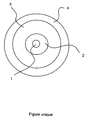
- the winding according to the invention consists of a plurality of turns formed by winding a wire having a structure whose single figure represents a section view.
- the wire consists of an unglazed conductive core (1) surrounded by a three-layer coating.
- the first layer (2) is an insulation layer, for example a varnish insulation usually used for insulation of conductive wires.
- the second layer (3) is a layer of non-resistant material linear.
- the third outer layer (4) is like the inner layer (2) formed by an insulating varnish usually used for the insulation of conductive wires.
- the intermediate layer (3) constitutes an equipotential screen ensuring the flow of charges forming during rapid transients, especially when the winding is supplied with high periodic voltages, whose signals have stiff fronts.
- This intermediate layer has a high resistance when the field electric current resulting from the current flowing through the conductive wire (1) is low. On the other hand, when the electric field increases, this intermediate layer becomes conductive and contributes to limiting the risks of breakdown of the insulating layer.
- the non-linear material is produced by a matrix containing a polymer conductor doped or not, in particular polyaniline at concentrations of the order from 1 to 30% by volume, and preferably of the order of 15 to 18%.
- the non-linear material can be chosen from crystalline compounds, ferromagnetic properties of inclusion of metal salts in copolymers the elementary motif of which includes contiguous, a link in a first group of aminoaromatic compounds derived from 1-naphthylamine and oxidized forms and a link in a second group of amino aromatic compounds substituted chosen from substituted amine compounds comprising at least two fused benzene rings, substituted polycyclic compounds comprising at least one aniline unit in their structure, compounds derived from aniline bearing a substituent linked to the nucleus by an ethynylidene or para-phenylene link, and the corresponding oxide compounds.
- the nonlinear material may further include oxide particles metals embedded in the matrix, in particular doped zinc oxide.
Landscapes
- Engineering & Computer Science (AREA)
- Power Engineering (AREA)
- Compositions Of Macromolecular Compounds (AREA)
- Insulation, Fastening Of Motor, Generator Windings (AREA)
- Laminated Bodies (AREA)
- Paints Or Removers (AREA)
- Insulated Conductors (AREA)
- Conductive Materials (AREA)
Abstract
Description
Claims (12)
- Bobinage électrique constitué par enroulement d'un conducteur électrique comportant un revêtement pour former une pluralité de spires, ledit revêtement comprenant une matrice polymère et au moins un matériau ayant une résistance non linéaire caractérisé en ce que le matériau à résistance non linéaire est un polymère conducteur dopé ou non dopé.
- Bobinage électrique selon la revendication 1 caractérisé en ce que la matrice et le polymère conducteur utilisent un solvant commun.
- Bobinage électrique selon la revendication 1, caractérisé en ce que le revêtement est constitué par une alternance de couches de matériaux à résistance non linéaire, et de couches isolantes.
- Bobinage électrique selon la revendication 1, caractérisé en ce que le revêtement est constitué par une couche intérieure et extérieure isolante et une couche intermédiaire de matériaux à résistance non linéaire.
- Bobinage électrique selon la revendication 1, caractérisé en ce que le revêtement présente un gradient de concentration de matériaux à résistance non linéaire.
- Bobinage électrique selon la revendication 1, caractérisé en ce que le revêtement est constitué d'une couche unique choisie parmi les matériaux à résistance non linéaire.
- Bobinage électrique selon la revendication 1, caractérisé en ce que le matériau à résistance non linéaire est la PANi et ses dérivés.
- Bobinage électrique selon la revendication 1, caractérisé en ce que la concentration en polymère conducteur est comprise entre 1 et 30 % en volume.
- Bobinage électrique selon la revendication 1, caractérisé en ce que la concentration en polymère conducteur est comprise entre 15 et 18 % en volume.
- Bobinage électrique selon la revendication 1 caractérisé en ce que le matériau à résistance non linéaire comprend en outre des particules d'oxyde de zinc dopé.
- Bobinage électrique selon la revendication 10, caractérisé en ce que la concentration d'oxyde de zinc est comprise entre 1 et 30% en volume.
- Bobinage électrique selon la revendication 10, caractérisé en ce que la concentration d'oxyde de zinc est comprise entre 15% et 18% en volume.
Applications Claiming Priority (2)
| Application Number | Priority Date | Filing Date | Title |
|---|---|---|---|
| FR9806647 | 1998-05-27 | ||
| FR9806647A FR2779268B1 (fr) | 1998-05-27 | 1998-05-27 | Bobinage electrique, transformateur et moteur electrique comportant un tel bobinage |
Publications (2)
| Publication Number | Publication Date |
|---|---|
| EP0961302A2 true EP0961302A2 (fr) | 1999-12-01 |
| EP0961302A3 EP0961302A3 (fr) | 2000-04-19 |
Family
ID=9526745
Family Applications (1)
| Application Number | Title | Priority Date | Filing Date |
|---|---|---|---|
| EP99401186A Withdrawn EP0961302A3 (fr) | 1998-05-27 | 1999-05-17 | Bobinage électique, transformateur et moteur électrique comportant un tel bobinage |
Country Status (5)
| Country | Link |
|---|---|
| US (1) | US6287691B1 (fr) |
| EP (1) | EP0961302A3 (fr) |
| JP (1) | JP2000030926A (fr) |
| CA (1) | CA2272832A1 (fr) |
| FR (1) | FR2779268B1 (fr) |
Cited By (1)
| Publication number | Priority date | Publication date | Assignee | Title |
|---|---|---|---|---|
| EP2752448A1 (fr) | 2013-01-02 | 2014-07-09 | Nexans | Couche de calibrage de champs |
Families Citing this family (8)
| Publication number | Priority date | Publication date | Assignee | Title |
|---|---|---|---|---|
| FR2779268B1 (fr) * | 1998-05-27 | 2000-06-23 | Alsthom Cge Alcatel | Bobinage electrique, transformateur et moteur electrique comportant un tel bobinage |
| US6482521B1 (en) * | 2000-07-31 | 2002-11-19 | Hughes Electronics Corp. | Structure with blended polymer conformal coating of controlled electrical resistivity |
| KR100639953B1 (ko) | 2004-09-24 | 2006-11-01 | 주식회사 효성 | 초전도 선재 전위 방법 |
| DE102006041738A1 (de) * | 2006-09-04 | 2008-03-06 | Leibniz-Institut Für Neue Materialien Gemeinnützige Gmbh | Zusammensetzung zur Beschichtung elektrischer Leiter und Verfahren zur Herstellung einer solchen Zusammensetzung |
| US8288911B2 (en) * | 2006-12-15 | 2012-10-16 | General Electric Company | Non-linear dielectrics used as electrical insulation for rotating electrical machinery |
| US20080143465A1 (en) * | 2006-12-15 | 2008-06-19 | General Electric Company | Insulation system and method for a transformer |
| US20100181094A1 (en) * | 2007-04-13 | 2010-07-22 | Magnekon, S.A. De C. V. | Magnetic wire with corona-resistant coating |
| CN101546624B (zh) * | 2009-05-04 | 2011-01-19 | 山东赛特电工股份有限公司 | 180级特细型自粘漆包线及其生产方法 |
Family Cites Families (13)
| Publication number | Priority date | Publication date | Assignee | Title |
|---|---|---|---|---|
| JPS62260310A (ja) * | 1986-05-07 | 1987-11-12 | Toshiba Corp | 箔巻変圧器 |
| US5069820A (en) * | 1987-08-07 | 1991-12-03 | Allied-Signal Inc. | Thermally stable forms of electrically conductive polyaniline |
| US4983690A (en) * | 1988-02-22 | 1991-01-08 | Lockheed Corporation | Conductive polymer-maleimide blends and method of producing same |
| US5463014A (en) * | 1988-05-13 | 1995-10-31 | The Ohio State University Research Foundation | Electromagnetic radiation absorbers and modulators comprising polyaniline |
| CA2067331A1 (fr) * | 1989-10-03 | 1991-04-04 | Joseph Unsworth | Enveloppe a circuits electriques de detection de tentatives d'acces frauduleux |
| DE4218928A1 (de) * | 1992-06-10 | 1993-12-16 | Asea Brown Boveri | Glimmschutzanordnung für die Statorwicklung einer elektrischen Maschine |
| JP3098651B2 (ja) * | 1993-03-31 | 2000-10-16 | 松下電器産業株式会社 | 高分子電気デバイス |
| JP3037525B2 (ja) * | 1993-04-12 | 2000-04-24 | 松下電器産業株式会社 | 発熱シート |
| FR2710183B3 (fr) * | 1993-09-17 | 1995-10-13 | Alcatel Cable | Câble d'énergie à rigidité diélectrique améliorée. |
| US5514337A (en) * | 1994-01-11 | 1996-05-07 | American Research Corporation Of Virginia | Chemical sensor using eddy current or resonant electromagnetic circuit detection |
| DE4438187A1 (de) * | 1994-10-26 | 1996-05-02 | Abb Management Ag | Elektrischer Leiter für Wicklungen mit verteiltem Überspannungsschutz |
| JP3193976B2 (ja) * | 1996-03-27 | 2001-07-30 | 松下電器産業株式会社 | 高電圧ノイズフィルタ及びマグネトロン装置 |
| FR2779268B1 (fr) * | 1998-05-27 | 2000-06-23 | Alsthom Cge Alcatel | Bobinage electrique, transformateur et moteur electrique comportant un tel bobinage |
-
1998
- 1998-05-27 FR FR9806647A patent/FR2779268B1/fr not_active Expired - Fee Related
-
1999
- 1999-05-17 EP EP99401186A patent/EP0961302A3/fr not_active Withdrawn
- 1999-05-20 CA CA002272832A patent/CA2272832A1/fr not_active Abandoned
- 1999-05-26 US US09/318,749 patent/US6287691B1/en not_active Expired - Fee Related
- 1999-05-26 JP JP11147230A patent/JP2000030926A/ja not_active Withdrawn
Cited By (1)
| Publication number | Priority date | Publication date | Assignee | Title |
|---|---|---|---|---|
| EP2752448A1 (fr) | 2013-01-02 | 2014-07-09 | Nexans | Couche de calibrage de champs |
Also Published As
| Publication number | Publication date |
|---|---|
| US6287691B1 (en) | 2001-09-11 |
| EP0961302A3 (fr) | 2000-04-19 |
| JP2000030926A (ja) | 2000-01-28 |
| CA2272832A1 (fr) | 1999-11-27 |
| FR2779268A1 (fr) | 1999-12-03 |
| FR2779268B1 (fr) | 2000-06-23 |
Similar Documents
| Publication | Publication Date | Title |
|---|---|---|
| US6056995A (en) | Method of coating electrical conductors with corona resistant multi-layer insulation | |
| EP2765581B1 (fr) | Câble électrique résistant aux décharges partielles | |
| CA2272832A1 (fr) | Bobinage electrique, transformateur et moteur electrique comportant un tel bobinage | |
| KR20090055017A (ko) | 스탭 전압 응답을 가진 전압 가변 유전 재료를 위한 조성물및 그 제조 방법 | |
| FR2884825A1 (fr) | Vernis isolant resistant a une decharge partielle, fil isole et son procede de realisation | |
| JP6338686B2 (ja) | 電気機械用のコロナシールド系、特に外側コロナシールド系 | |
| KR100821109B1 (ko) | 후크 정류자 | |
| CA1250916A (fr) | Isolateur electrique presentant une insensibilite amelioree a la pollution | |
| EP2136376A1 (fr) | Câble électrique a haute tension | |
| EP0248781A1 (fr) | Elément chauffant et procédé pour sa fabrication | |
| EP2783372B1 (fr) | Cable electrique haute tension adapte aux conditions extremes | |
| US7800003B2 (en) | Insulator with enhanced insulating capacity | |
| EP0554174A1 (fr) | Composition à base de poly(chlorure de vinyle), de polymère fluoré et de talc, utilisable, notamment, comme isolant pour câbles électriques, et procédé de préparation | |
| EP0645781B1 (fr) | Câble d'énergie à rigidité diélectrique améliorée | |
| CN111357060B (zh) | 绝缘体系、用于制造绝缘体系的绝缘物质和绝缘材料 | |
| JP4091402B2 (ja) | 電界緩和材料及びこの材料を用いた電界緩和部材並びに電磁コイル | |
| KR20200039352A (ko) | 내수성 전도성 고분자의 구조 및 형태적 개선 | |
| FR2629626A1 (fr) | Cable pour courant continu | |
| CA2142496A1 (fr) | Bobine supraconductrice a transition generale | |
| JP7310476B2 (ja) | コイルエンド放電防止構造 | |
| JP3139500B2 (ja) | 耐熱電線 | |
| CN117809884A (zh) | 一种电接触导体及其制备方法 | |
| BE531150A (fr) | ||
| FR2762441A1 (fr) | Ceinture resistive souple et appareil comportant cette ceinture | |
| WO2025219276A1 (fr) | Capteur, procédé de fabrication d'un capteur et utilisation de certains polymères pour recouvrir un composant de thermistance |
Legal Events
| Date | Code | Title | Description |
|---|---|---|---|
| PUAI | Public reference made under article 153(3) epc to a published international application that has entered the european phase |
Free format text: ORIGINAL CODE: 0009012 |
|
| AK | Designated contracting states |
Kind code of ref document: A2 Designated state(s): AT CH DE ES FR GB IT LI SE |
|
| AX | Request for extension of the european patent |
Free format text: AL;LT;LV;MK;RO;SI |
|
| PUAL | Search report despatched |
Free format text: ORIGINAL CODE: 0009013 |
|
| AK | Designated contracting states |
Kind code of ref document: A3 Designated state(s): AT BE CH CY DE DK ES FI FR GB GR IE IT LI LU MC NL PT SE |
|
| AX | Request for extension of the european patent |
Free format text: AL;LT;LV;MK;RO;SI |
|
| 17P | Request for examination filed |
Effective date: 20001019 |
|
| AKX | Designation fees paid |
Free format text: AT CH DE ES FR GB IT LI SE |
|
| RAP1 | Party data changed (applicant data changed or rights of an application transferred) |
Owner name: NEXANS |
|
| STAA | Information on the status of an ep patent application or granted ep patent |
Free format text: STATUS: THE APPLICATION HAS BEEN WITHDRAWN |
|
| 18W | Application withdrawn |
Effective date: 20030312 |