EP0959130B9 - Cloning and expression of a new glucoamylase gene from endomyces fibuliger - Google Patents
Cloning and expression of a new glucoamylase gene from endomyces fibuliger Download PDFInfo
- Publication number
- EP0959130B9 EP0959130B9 EP98201473A EP98201473A EP0959130B9 EP 0959130 B9 EP0959130 B9 EP 0959130B9 EP 98201473 A EP98201473 A EP 98201473A EP 98201473 A EP98201473 A EP 98201473A EP 0959130 B9 EP0959130 B9 EP 0959130B9
- Authority
- EP
- European Patent Office
- Prior art keywords
- gla2
- gene
- enzyme
- amino acid
- recombinant
- Prior art date
- Legal status (The legal status is an assumption and is not a legal conclusion. Google has not performed a legal analysis and makes no representation as to the accuracy of the status listed.)
- Expired - Lifetime
Links
- 108010073178 Glucan 1,4-alpha-Glucosidase Proteins 0.000 title claims abstract description 45
- 241000235004 Saccharomycopsis fibuligera Species 0.000 title claims abstract description 45
- 238000010367 cloning Methods 0.000 title description 7
- 108090000623 proteins and genes Proteins 0.000 claims abstract description 73
- 102100022624 Glucoamylase Human genes 0.000 claims abstract description 46
- 102000004190 Enzymes Human genes 0.000 claims abstract description 40
- 108090000790 Enzymes Proteins 0.000 claims abstract description 40
- 108020004414 DNA Proteins 0.000 claims abstract description 39
- 150000001413 amino acids Chemical class 0.000 claims abstract description 29
- 102000053602 DNA Human genes 0.000 claims abstract description 19
- 102000004169 proteins and genes Human genes 0.000 claims abstract description 18
- 125000003275 alpha amino acid group Chemical group 0.000 claims abstract description 14
- 150000001720 carbohydrates Chemical class 0.000 claims abstract description 12
- 235000014633 carbohydrates Nutrition 0.000 claims abstract description 12
- 239000000463 material Substances 0.000 claims abstract description 12
- 108010076504 Protein Sorting Signals Proteins 0.000 claims abstract description 10
- 239000001963 growth medium Substances 0.000 claims abstract description 10
- 102000007056 Recombinant Fusion Proteins Human genes 0.000 claims abstract description 8
- 108010008281 Recombinant Fusion Proteins Proteins 0.000 claims abstract description 8
- 238000004519 manufacturing process Methods 0.000 claims abstract description 7
- 240000007594 Oryza sativa Species 0.000 claims abstract description 6
- 235000007164 Oryza sativa Nutrition 0.000 claims abstract description 6
- 235000009566 rice Nutrition 0.000 claims abstract description 6
- 239000012141 concentrate Substances 0.000 claims abstract description 4
- 238000005516 engineering process Methods 0.000 claims abstract description 3
- 240000006439 Aspergillus oryzae Species 0.000 claims description 21
- 235000002247 Aspergillus oryzae Nutrition 0.000 claims description 14
- 230000001105 regulatory effect Effects 0.000 claims description 12
- 239000002773 nucleotide Substances 0.000 claims description 11
- 125000003729 nucleotide group Chemical group 0.000 claims description 11
- 239000013598 vector Substances 0.000 claims description 7
- LWGJTAZLEJHCPA-UHFFFAOYSA-N n-(2-chloroethyl)-n-nitrosomorpholine-4-carboxamide Chemical compound ClCCN(N=O)C(=O)N1CCOCC1 LWGJTAZLEJHCPA-UHFFFAOYSA-N 0.000 claims description 6
- 230000002068 genetic effect Effects 0.000 claims description 2
- 210000004027 cell Anatomy 0.000 description 43
- 229940088598 enzyme Drugs 0.000 description 31
- 239000013612 plasmid Substances 0.000 description 31
- 239000012634 fragment Substances 0.000 description 24
- WQZGKKKJIJFFOK-GASJEMHNSA-N Glucose Natural products OC[C@H]1OC(O)[C@H](O)[C@@H](O)[C@@H]1O WQZGKKKJIJFFOK-GASJEMHNSA-N 0.000 description 21
- 240000004808 Saccharomyces cerevisiae Species 0.000 description 21
- 235000014680 Saccharomyces cerevisiae Nutrition 0.000 description 20
- 229920002472 Starch Polymers 0.000 description 20
- 239000008107 starch Substances 0.000 description 20
- 239000008103 glucose Substances 0.000 description 19
- 235000019698 starch Nutrition 0.000 description 19
- 238000000034 method Methods 0.000 description 17
- 230000000694 effects Effects 0.000 description 12
- 239000000203 mixture Substances 0.000 description 11
- 101150091270 GLU1 gene Proteins 0.000 description 10
- 101100449607 Arabidopsis thaliana GRXC4 gene Proteins 0.000 description 9
- 101100004028 Avena sativa P60A gene Proteins 0.000 description 9
- 101100378201 Saccharomyces cerevisiae (strain ATCC 204508 / S288c) ACO1 gene Proteins 0.000 description 9
- 230000002538 fungal effect Effects 0.000 description 9
- 239000000047 product Substances 0.000 description 9
- IJGRMHOSHXDMSA-UHFFFAOYSA-N Atomic nitrogen Chemical compound N#N IJGRMHOSHXDMSA-UHFFFAOYSA-N 0.000 description 8
- 108050008938 Glucoamylases Proteins 0.000 description 8
- ISAKRJDGNUQOIC-UHFFFAOYSA-N Uracil Chemical compound O=C1C=CNC(=O)N1 ISAKRJDGNUQOIC-UHFFFAOYSA-N 0.000 description 8
- 108091008146 restriction endonucleases Proteins 0.000 description 8
- 241000196324 Embryophyta Species 0.000 description 7
- 239000002609 medium Substances 0.000 description 7
- 108010065511 Amylases Proteins 0.000 description 6
- 102000013142 Amylases Human genes 0.000 description 6
- 101100009548 Arabidopsis thaliana DHFS gene Proteins 0.000 description 6
- 241000588724 Escherichia coli Species 0.000 description 6
- 108091028043 Nucleic acid sequence Proteins 0.000 description 6
- 241000952054 Rhizopus sp. Species 0.000 description 6
- 101100216053 Saccharomycopsis fibuligera GLA1 gene Proteins 0.000 description 6
- FAPWRFPIFSIZLT-UHFFFAOYSA-M Sodium chloride Chemical compound [Na+].[Cl-] FAPWRFPIFSIZLT-UHFFFAOYSA-M 0.000 description 6
- 235000019418 amylase Nutrition 0.000 description 6
- 238000012217 deletion Methods 0.000 description 6
- 230000037430 deletion Effects 0.000 description 6
- 229930182830 galactose Natural products 0.000 description 6
- 101150054232 pyrG gene Proteins 0.000 description 6
- QKNYBSVHEMOAJP-UHFFFAOYSA-N 2-amino-2-(hydroxymethyl)propane-1,3-diol;hydron;chloride Chemical compound Cl.OCC(N)(CO)CO QKNYBSVHEMOAJP-UHFFFAOYSA-N 0.000 description 5
- 239000004382 Amylase Substances 0.000 description 5
- 108700039887 Essential Genes Proteins 0.000 description 5
- 101710194570 Glucoamylase I Proteins 0.000 description 5
- 244000068988 Glycine max Species 0.000 description 5
- 235000010469 Glycine max Nutrition 0.000 description 5
- 241000831652 Salinivibrio sharmensis Species 0.000 description 5
- 241000209140 Triticum Species 0.000 description 5
- 235000021307 Triticum Nutrition 0.000 description 5
- 230000003321 amplification Effects 0.000 description 5
- 230000002255 enzymatic effect Effects 0.000 description 5
- 238000000855 fermentation Methods 0.000 description 5
- 230000004151 fermentation Effects 0.000 description 5
- 239000000499 gel Substances 0.000 description 5
- 125000001475 halogen functional group Chemical group 0.000 description 5
- 238000003199 nucleic acid amplification method Methods 0.000 description 5
- 230000003362 replicative effect Effects 0.000 description 5
- 239000000523 sample Substances 0.000 description 5
- 239000000725 suspension Substances 0.000 description 5
- WQZGKKKJIJFFOK-SVZMEOIVSA-N (+)-Galactose Chemical compound OC[C@H]1OC(O)[C@H](O)[C@@H](O)[C@H]1O WQZGKKKJIJFFOK-SVZMEOIVSA-N 0.000 description 4
- 229920001817 Agar Polymers 0.000 description 4
- 241000228245 Aspergillus niger Species 0.000 description 4
- UXVMQQNJUSDDNG-UHFFFAOYSA-L Calcium chloride Chemical compound [Cl-].[Cl-].[Ca+2] UXVMQQNJUSDDNG-UHFFFAOYSA-L 0.000 description 4
- 241000502261 Endomyces sp. Species 0.000 description 4
- 108091034117 Oligonucleotide Proteins 0.000 description 4
- 238000012181 QIAquick gel extraction kit Methods 0.000 description 4
- 101150050575 URA3 gene Proteins 0.000 description 4
- DRTQHJPVMGBUCF-XVFCMESISA-N Uridine Chemical compound O[C@@H]1[C@H](O)[C@@H](CO)O[C@H]1N1C(=O)NC(=O)C=C1 DRTQHJPVMGBUCF-XVFCMESISA-N 0.000 description 4
- JLCPHMBAVCMARE-UHFFFAOYSA-N [3-[[3-[[3-[[3-[[3-[[3-[[3-[[3-[[3-[[3-[[3-[[5-(2-amino-6-oxo-1H-purin-9-yl)-3-[[3-[[3-[[3-[[3-[[3-[[5-(2-amino-6-oxo-1H-purin-9-yl)-3-[[5-(2-amino-6-oxo-1H-purin-9-yl)-3-hydroxyoxolan-2-yl]methoxy-hydroxyphosphoryl]oxyoxolan-2-yl]methoxy-hydroxyphosphoryl]oxy-5-(5-methyl-2,4-dioxopyrimidin-1-yl)oxolan-2-yl]methoxy-hydroxyphosphoryl]oxy-5-(6-aminopurin-9-yl)oxolan-2-yl]methoxy-hydroxyphosphoryl]oxy-5-(6-aminopurin-9-yl)oxolan-2-yl]methoxy-hydroxyphosphoryl]oxy-5-(6-aminopurin-9-yl)oxolan-2-yl]methoxy-hydroxyphosphoryl]oxy-5-(6-aminopurin-9-yl)oxolan-2-yl]methoxy-hydroxyphosphoryl]oxyoxolan-2-yl]methoxy-hydroxyphosphoryl]oxy-5-(5-methyl-2,4-dioxopyrimidin-1-yl)oxolan-2-yl]methoxy-hydroxyphosphoryl]oxy-5-(4-amino-2-oxopyrimidin-1-yl)oxolan-2-yl]methoxy-hydroxyphosphoryl]oxy-5-(5-methyl-2,4-dioxopyrimidin-1-yl)oxolan-2-yl]methoxy-hydroxyphosphoryl]oxy-5-(5-methyl-2,4-dioxopyrimidin-1-yl)oxolan-2-yl]methoxy-hydroxyphosphoryl]oxy-5-(6-aminopurin-9-yl)oxolan-2-yl]methoxy-hydroxyphosphoryl]oxy-5-(6-aminopurin-9-yl)oxolan-2-yl]methoxy-hydroxyphosphoryl]oxy-5-(4-amino-2-oxopyrimidin-1-yl)oxolan-2-yl]methoxy-hydroxyphosphoryl]oxy-5-(4-amino-2-oxopyrimidin-1-yl)oxolan-2-yl]methoxy-hydroxyphosphoryl]oxy-5-(4-amino-2-oxopyrimidin-1-yl)oxolan-2-yl]methoxy-hydroxyphosphoryl]oxy-5-(6-aminopurin-9-yl)oxolan-2-yl]methoxy-hydroxyphosphoryl]oxy-5-(4-amino-2-oxopyrimidin-1-yl)oxolan-2-yl]methyl [5-(6-aminopurin-9-yl)-2-(hydroxymethyl)oxolan-3-yl] hydrogen phosphate Polymers Cc1cn(C2CC(OP(O)(=O)OCC3OC(CC3OP(O)(=O)OCC3OC(CC3O)n3cnc4c3nc(N)[nH]c4=O)n3cnc4c3nc(N)[nH]c4=O)C(COP(O)(=O)OC3CC(OC3COP(O)(=O)OC3CC(OC3COP(O)(=O)OC3CC(OC3COP(O)(=O)OC3CC(OC3COP(O)(=O)OC3CC(OC3COP(O)(=O)OC3CC(OC3COP(O)(=O)OC3CC(OC3COP(O)(=O)OC3CC(OC3COP(O)(=O)OC3CC(OC3COP(O)(=O)OC3CC(OC3COP(O)(=O)OC3CC(OC3COP(O)(=O)OC3CC(OC3COP(O)(=O)OC3CC(OC3COP(O)(=O)OC3CC(OC3COP(O)(=O)OC3CC(OC3COP(O)(=O)OC3CC(OC3COP(O)(=O)OC3CC(OC3CO)n3cnc4c(N)ncnc34)n3ccc(N)nc3=O)n3cnc4c(N)ncnc34)n3ccc(N)nc3=O)n3ccc(N)nc3=O)n3ccc(N)nc3=O)n3cnc4c(N)ncnc34)n3cnc4c(N)ncnc34)n3cc(C)c(=O)[nH]c3=O)n3cc(C)c(=O)[nH]c3=O)n3ccc(N)nc3=O)n3cc(C)c(=O)[nH]c3=O)n3cnc4c3nc(N)[nH]c4=O)n3cnc4c(N)ncnc34)n3cnc4c(N)ncnc34)n3cnc4c(N)ncnc34)n3cnc4c(N)ncnc34)O2)c(=O)[nH]c1=O JLCPHMBAVCMARE-UHFFFAOYSA-N 0.000 description 4
- 239000008272 agar Substances 0.000 description 4
- 238000003556 assay Methods 0.000 description 4
- 239000001110 calcium chloride Substances 0.000 description 4
- 229910001628 calcium chloride Inorganic materials 0.000 description 4
- 238000006243 chemical reaction Methods 0.000 description 4
- 239000013611 chromosomal DNA Substances 0.000 description 4
- 239000013604 expression vector Substances 0.000 description 4
- 230000007062 hydrolysis Effects 0.000 description 4
- 238000006460 hydrolysis reaction Methods 0.000 description 4
- 239000012528 membrane Substances 0.000 description 4
- 244000005700 microbiome Species 0.000 description 4
- 229910052757 nitrogen Inorganic materials 0.000 description 4
- 230000028327 secretion Effects 0.000 description 4
- 229940035893 uracil Drugs 0.000 description 4
- 210000005253 yeast cell Anatomy 0.000 description 4
- 108091093088 Amplicon Proteins 0.000 description 3
- 241000228212 Aspergillus Species 0.000 description 3
- 241000228257 Aspergillus sp. Species 0.000 description 3
- 241000894006 Bacteria Species 0.000 description 3
- 108091026890 Coding region Proteins 0.000 description 3
- 101100246753 Halobacterium salinarum (strain ATCC 700922 / JCM 11081 / NRC-1) pyrF gene Proteins 0.000 description 3
- 241000235395 Mucor Species 0.000 description 3
- 239000004677 Nylon Substances 0.000 description 3
- 108010029485 Protein Isoforms Proteins 0.000 description 3
- 102000001708 Protein Isoforms Human genes 0.000 description 3
- 108020004511 Recombinant DNA Proteins 0.000 description 3
- 240000005384 Rhizopus oryzae Species 0.000 description 3
- 210000000349 chromosome Anatomy 0.000 description 3
- 239000012228 culture supernatant Substances 0.000 description 3
- 238000001962 electrophoresis Methods 0.000 description 3
- 230000003301 hydrolyzing effect Effects 0.000 description 3
- 230000001939 inductive effect Effects 0.000 description 3
- 229930027917 kanamycin Natural products 0.000 description 3
- SBUJHOSQTJFQJX-NOAMYHISSA-N kanamycin Chemical compound O[C@@H]1[C@@H](O)[C@H](O)[C@@H](CN)O[C@@H]1O[C@H]1[C@H](O)[C@@H](O[C@@H]2[C@@H]([C@@H](N)[C@H](O)[C@@H](CO)O2)O)[C@H](N)C[C@@H]1N SBUJHOSQTJFQJX-NOAMYHISSA-N 0.000 description 3
- 229960000318 kanamycin Drugs 0.000 description 3
- 229930182823 kanamycin A Natural products 0.000 description 3
- 239000003550 marker Substances 0.000 description 3
- 229920001778 nylon Polymers 0.000 description 3
- 239000008363 phosphate buffer Substances 0.000 description 3
- 230000008569 process Effects 0.000 description 3
- 238000000746 purification Methods 0.000 description 3
- 238000011160 research Methods 0.000 description 3
- 239000011780 sodium chloride Substances 0.000 description 3
- 238000013518 transcription Methods 0.000 description 3
- 230000035897 transcription Effects 0.000 description 3
- OWEGMIWEEQEYGQ-UHFFFAOYSA-N 100676-05-9 Natural products OC1C(O)C(O)C(CO)OC1OCC1C(O)C(O)C(O)C(OC2C(OC(O)C(O)C2O)CO)O1 OWEGMIWEEQEYGQ-UHFFFAOYSA-N 0.000 description 2
- 241001513093 Aspergillus awamori Species 0.000 description 2
- 108091027551 Cointegrate Proteins 0.000 description 2
- LFQSCWFLJHTTHZ-UHFFFAOYSA-N Ethanol Chemical compound CCO LFQSCWFLJHTTHZ-UHFFFAOYSA-N 0.000 description 2
- GHASVSINZRGABV-UHFFFAOYSA-N Fluorouracil Chemical compound FC1=CNC(=O)NC1=O GHASVSINZRGABV-UHFFFAOYSA-N 0.000 description 2
- 101000893906 Fowl adenovirus A serotype 1 (strain CELO / Phelps) Protein GAM-1 Proteins 0.000 description 2
- 101150094690 GAL1 gene Proteins 0.000 description 2
- 102100028501 Galanin peptides Human genes 0.000 description 2
- 101100121078 Homo sapiens GAL gene Proteins 0.000 description 2
- 101000807008 Homo sapiens Uracil phosphoribosyltransferase homolog Proteins 0.000 description 2
- 108010044467 Isoenzymes Proteins 0.000 description 2
- GUBGYTABKSRVRQ-PICCSMPSSA-N Maltose Natural products O[C@@H]1[C@@H](O)[C@H](O)[C@@H](CO)O[C@@H]1O[C@@H]1[C@@H](CO)OC(O)[C@H](O)[C@H]1O GUBGYTABKSRVRQ-PICCSMPSSA-N 0.000 description 2
- 239000008118 PEG 6000 Substances 0.000 description 2
- 244000046052 Phaseolus vulgaris Species 0.000 description 2
- 235000010627 Phaseolus vulgaris Nutrition 0.000 description 2
- 241000235648 Pichia Species 0.000 description 2
- 229920002584 Polyethylene Glycol 6000 Polymers 0.000 description 2
- 108010019653 Pwo polymerase Proteins 0.000 description 2
- 241000235545 Rhizopus niveus Species 0.000 description 2
- 235000013752 Rhizopus oryzae Nutrition 0.000 description 2
- 241000235070 Saccharomyces Species 0.000 description 2
- 241001123650 Schwanniomyces occidentalis Species 0.000 description 2
- 102100037717 Uracil phosphoribosyltransferase homolog Human genes 0.000 description 2
- XSQUKJJJFZCRTK-UHFFFAOYSA-N Urea Chemical compound NC(N)=O XSQUKJJJFZCRTK-UHFFFAOYSA-N 0.000 description 2
- 230000009471 action Effects 0.000 description 2
- 238000007792 addition Methods 0.000 description 2
- 239000011543 agarose gel Substances 0.000 description 2
- 108090000637 alpha-Amylases Proteins 0.000 description 2
- BFNBIHQBYMNNAN-UHFFFAOYSA-N ammonium sulfate Chemical compound N.N.OS(O)(=O)=O BFNBIHQBYMNNAN-UHFFFAOYSA-N 0.000 description 2
- 229910052921 ammonium sulfate Inorganic materials 0.000 description 2
- 239000007900 aqueous suspension Substances 0.000 description 2
- 230000001580 bacterial effect Effects 0.000 description 2
- 230000008901 benefit Effects 0.000 description 2
- DRTQHJPVMGBUCF-PSQAKQOGSA-N beta-L-uridine Natural products O[C@H]1[C@@H](O)[C@H](CO)O[C@@H]1N1C(=O)NC(=O)C=C1 DRTQHJPVMGBUCF-PSQAKQOGSA-N 0.000 description 2
- 230000015572 biosynthetic process Effects 0.000 description 2
- 239000000872 buffer Substances 0.000 description 2
- 230000015556 catabolic process Effects 0.000 description 2
- 210000002421 cell wall Anatomy 0.000 description 2
- 238000005119 centrifugation Methods 0.000 description 2
- 235000013339 cereals Nutrition 0.000 description 2
- 238000004440 column chromatography Methods 0.000 description 2
- 235000008504 concentrate Nutrition 0.000 description 2
- 238000010276 construction Methods 0.000 description 2
- 238000006731 degradation reaction Methods 0.000 description 2
- 238000001914 filtration Methods 0.000 description 2
- ZDXPYRJPNDTMRX-UHFFFAOYSA-N glutamine Natural products OC(=O)C(N)CCC(N)=O ZDXPYRJPNDTMRX-UHFFFAOYSA-N 0.000 description 2
- 150000004676 glycans Chemical class 0.000 description 2
- 230000013595 glycosylation Effects 0.000 description 2
- 238000006206 glycosylation reaction Methods 0.000 description 2
- 238000000338 in vitro Methods 0.000 description 2
- 238000011534 incubation Methods 0.000 description 2
- 238000002955 isolation Methods 0.000 description 2
- 230000007246 mechanism Effects 0.000 description 2
- 230000035772 mutation Effects 0.000 description 2
- 102000039446 nucleic acids Human genes 0.000 description 2
- 108020004707 nucleic acids Proteins 0.000 description 2
- 150000007523 nucleic acids Chemical class 0.000 description 2
- 210000001322 periplasm Anatomy 0.000 description 2
- 229920001282 polysaccharide Polymers 0.000 description 2
- 239000005017 polysaccharide Substances 0.000 description 2
- 239000002244 precipitate Substances 0.000 description 2
- 108090000765 processed proteins & peptides Proteins 0.000 description 2
- 210000001938 protoplast Anatomy 0.000 description 2
- 239000002994 raw material Substances 0.000 description 2
- 230000010076 replication Effects 0.000 description 2
- 235000015067 sauces Nutrition 0.000 description 2
- 238000012163 sequencing technique Methods 0.000 description 2
- VWDWKYIASSYTQR-UHFFFAOYSA-N sodium nitrate Chemical compound [Na+].[O-][N+]([O-])=O VWDWKYIASSYTQR-UHFFFAOYSA-N 0.000 description 2
- 241000894007 species Species 0.000 description 2
- 239000000126 substance Substances 0.000 description 2
- 238000006467 substitution reaction Methods 0.000 description 2
- 239000006188 syrup Substances 0.000 description 2
- 235000020357 syrup Nutrition 0.000 description 2
- 238000012360 testing method Methods 0.000 description 2
- 230000009466 transformation Effects 0.000 description 2
- 230000001131 transforming effect Effects 0.000 description 2
- 238000013519 translation Methods 0.000 description 2
- DRTQHJPVMGBUCF-UHFFFAOYSA-N uracil arabinoside Natural products OC1C(O)C(CO)OC1N1C(=O)NC(=O)C=C1 DRTQHJPVMGBUCF-UHFFFAOYSA-N 0.000 description 2
- 229940045145 uridine Drugs 0.000 description 2
- 108091032973 (ribonucleotides)n+m Proteins 0.000 description 1
- ZVIBYSCCHVFXMP-UHFFFAOYSA-N 2-morpholin-4-ylethanesulfonic acid;hydrochloride Chemical compound Cl.OS(=O)(=O)CCN1CCOCC1 ZVIBYSCCHVFXMP-UHFFFAOYSA-N 0.000 description 1
- 229920000936 Agarose Polymers 0.000 description 1
- 108010021809 Alcohol dehydrogenase Proteins 0.000 description 1
- 102000007698 Alcohol dehydrogenase Human genes 0.000 description 1
- 101100020344 Aspergillus niger pkiA gene Proteins 0.000 description 1
- 101100523058 Aspergillus niger pyrG gene Proteins 0.000 description 1
- 241000228251 Aspergillus phoenicis Species 0.000 description 1
- 208000035404 Autolysis Diseases 0.000 description 1
- 241000193830 Bacillus <bacterium> Species 0.000 description 1
- 108700003860 Bacterial Genes Proteins 0.000 description 1
- 244000062995 Cassia occidentalis Species 0.000 description 1
- 206010057248 Cell death Diseases 0.000 description 1
- 108010025880 Cyclomaltodextrin glucanotransferase Proteins 0.000 description 1
- FBPFZTCFMRRESA-FSIIMWSLSA-N D-Glucitol Natural products OC[C@H](O)[C@H](O)[C@@H](O)[C@H](O)CO FBPFZTCFMRRESA-FSIIMWSLSA-N 0.000 description 1
- 239000003298 DNA probe Substances 0.000 description 1
- 238000001712 DNA sequencing Methods 0.000 description 1
- KCXVZYZYPLLWCC-UHFFFAOYSA-N EDTA Chemical compound OC(=O)CN(CC(O)=O)CCN(CC(O)=O)CC(O)=O KCXVZYZYPLLWCC-UHFFFAOYSA-N 0.000 description 1
- 108010001817 Endo-1,4-beta Xylanases Proteins 0.000 description 1
- 241000588722 Escherichia Species 0.000 description 1
- 101150002048 FUR1 gene Proteins 0.000 description 1
- 239000005715 Fructose Substances 0.000 description 1
- 241000233866 Fungi Species 0.000 description 1
- 229920002527 Glycogen Polymers 0.000 description 1
- 101100295959 Halobacterium salinarum (strain ATCC 700922 / JCM 11081 / NRC-1) arcB gene Proteins 0.000 description 1
- 101000809140 Homo sapiens Uridine-cytidine kinase 1 Proteins 0.000 description 1
- AVXURJPOCDRRFD-UHFFFAOYSA-N Hydroxylamine Chemical compound ON AVXURJPOCDRRFD-UHFFFAOYSA-N 0.000 description 1
- AYRXSINWFIIFAE-SCLMCMATSA-N Isomaltose Natural products OC[C@H]1O[C@H](OC[C@@H](O)[C@@H](O)[C@H](O)[C@@H](O)C=O)[C@@H](O)[C@@H](O)[C@@H]1O AYRXSINWFIIFAE-SCLMCMATSA-N 0.000 description 1
- 239000007836 KH2PO4 Substances 0.000 description 1
- 241000235649 Kluyveromyces Species 0.000 description 1
- 241000186660 Lactobacillus Species 0.000 description 1
- 241000194036 Lactococcus Species 0.000 description 1
- 241001095209 Monascus sp. (in: Fungi) Species 0.000 description 1
- 241000306281 Mucor ambiguus Species 0.000 description 1
- 108700026244 Open Reading Frames Proteins 0.000 description 1
- 102100037214 Orotidine 5'-phosphate decarboxylase Human genes 0.000 description 1
- 108010055012 Orotidine-5'-phosphate decarboxylase Proteins 0.000 description 1
- 229910019142 PO4 Inorganic materials 0.000 description 1
- 241001123663 Penicillium expansum Species 0.000 description 1
- 241001219824 Penicillium fuscum Species 0.000 description 1
- 241000985513 Penicillium oxalicum Species 0.000 description 1
- 108091005804 Peptidases Proteins 0.000 description 1
- 102000011755 Phosphoglycerate Kinase Human genes 0.000 description 1
- 108010038555 Phosphoglycerate dehydrogenase Proteins 0.000 description 1
- 229920001213 Polysorbate 20 Polymers 0.000 description 1
- 239000004365 Protease Substances 0.000 description 1
- 108700005075 Regulator Genes Proteins 0.000 description 1
- 108020005091 Replication Origin Proteins 0.000 description 1
- 102100037486 Reverse transcriptase/ribonuclease H Human genes 0.000 description 1
- 241000235527 Rhizopus Species 0.000 description 1
- 244000205939 Rhizopus oligosporus Species 0.000 description 1
- 235000000471 Rhizopus oligosporus Nutrition 0.000 description 1
- 108091058545 Secretory proteins Proteins 0.000 description 1
- 102000040739 Secretory proteins Human genes 0.000 description 1
- DBMJMQXJHONAFJ-UHFFFAOYSA-M Sodium laurylsulphate Chemical compound [Na+].CCCCCCCCCCCCOS([O-])(=O)=O DBMJMQXJHONAFJ-UHFFFAOYSA-M 0.000 description 1
- 241000191940 Staphylococcus Species 0.000 description 1
- 241000194017 Streptococcus Species 0.000 description 1
- 101100370749 Streptomyces coelicolor (strain ATCC BAA-471 / A3(2) / M145) trpC1 gene Proteins 0.000 description 1
- 229930006000 Sucrose Natural products 0.000 description 1
- CZMRCDWAGMRECN-UGDNZRGBSA-N Sucrose Chemical compound O[C@H]1[C@H](O)[C@@H](CO)O[C@@]1(CO)O[C@@H]1[C@H](O)[C@@H](O)[C@H](O)[C@@H](CO)O1 CZMRCDWAGMRECN-UGDNZRGBSA-N 0.000 description 1
- 102000005924 Triose-Phosphate Isomerase Human genes 0.000 description 1
- 108700015934 Triose-phosphate isomerases Proteins 0.000 description 1
- 239000007983 Tris buffer Substances 0.000 description 1
- 239000013504 Triton X-100 Substances 0.000 description 1
- 229920004890 Triton X-100 Polymers 0.000 description 1
- 102100038442 Uridine-cytidine kinase 1 Human genes 0.000 description 1
- 108010048241 acetamidase Proteins 0.000 description 1
- 238000013019 agitation Methods 0.000 description 1
- WQZGKKKJIJFFOK-DVKNGEFBSA-N alpha-D-glucose Chemical compound OC[C@H]1O[C@H](O)[C@H](O)[C@@H](O)[C@@H]1O WQZGKKKJIJFFOK-DVKNGEFBSA-N 0.000 description 1
- 108010028144 alpha-Glucosidases Proteins 0.000 description 1
- 102000016679 alpha-Glucosidases Human genes 0.000 description 1
- 101150069003 amdS gene Proteins 0.000 description 1
- 125000000539 amino acid group Chemical group 0.000 description 1
- 235000011130 ammonium sulphate Nutrition 0.000 description 1
- 229940025131 amylases Drugs 0.000 description 1
- 230000003625 amylolytic effect Effects 0.000 description 1
- 238000004458 analytical method Methods 0.000 description 1
- 101150008194 argB gene Proteins 0.000 description 1
- 108010058966 bacteriophage T7 induced DNA polymerase Proteins 0.000 description 1
- 108010019077 beta-Amylase Proteins 0.000 description 1
- WQZGKKKJIJFFOK-VFUOTHLCSA-N beta-D-glucose Chemical compound OC[C@H]1O[C@@H](O)[C@H](O)[C@@H](O)[C@@H]1O WQZGKKKJIJFFOK-VFUOTHLCSA-N 0.000 description 1
- 108010051210 beta-Fructofuranosidase Proteins 0.000 description 1
- GUBGYTABKSRVRQ-QUYVBRFLSA-N beta-maltose Chemical compound OC[C@H]1O[C@H](O[C@H]2[C@H](O)[C@@H](O)[C@H](O)O[C@@H]2CO)[C@H](O)[C@@H](O)[C@@H]1O GUBGYTABKSRVRQ-QUYVBRFLSA-N 0.000 description 1
- 235000013361 beverage Nutrition 0.000 description 1
- 229940041514 candida albicans extract Drugs 0.000 description 1
- 101150014229 carA gene Proteins 0.000 description 1
- 101150070764 carB gene Proteins 0.000 description 1
- 239000004202 carbamide Substances 0.000 description 1
- 230000003197 catalytic effect Effects 0.000 description 1
- 150000001768 cations Chemical class 0.000 description 1
- 210000000170 cell membrane Anatomy 0.000 description 1
- 210000002230 centromere Anatomy 0.000 description 1
- 238000012512 characterization method Methods 0.000 description 1
- 239000007795 chemical reaction product Substances 0.000 description 1
- 239000003153 chemical reaction reagent Substances 0.000 description 1
- 238000004587 chromatography analysis Methods 0.000 description 1
- 230000000295 complement effect Effects 0.000 description 1
- 150000001875 compounds Chemical class 0.000 description 1
- 238000007796 conventional method Methods 0.000 description 1
- 210000000805 cytoplasm Anatomy 0.000 description 1
- 235000019621 digestibility Nutrition 0.000 description 1
- 230000029087 digestion Effects 0.000 description 1
- 239000012154 double-distilled water Substances 0.000 description 1
- 238000004520 electroporation Methods 0.000 description 1
- 230000006862 enzymatic digestion Effects 0.000 description 1
- 239000000706 filtrate Substances 0.000 description 1
- 239000007850 fluorescent dye Substances 0.000 description 1
- 229960002949 fluorouracil Drugs 0.000 description 1
- 235000013305 food Nutrition 0.000 description 1
- 235000021433 fructose syrup Nutrition 0.000 description 1
- 238000002523 gelfiltration Methods 0.000 description 1
- -1 glucamylase Proteins 0.000 description 1
- 229940096919 glycogen Drugs 0.000 description 1
- 238000003505 heat denaturation Methods 0.000 description 1
- 238000009396 hybridization Methods 0.000 description 1
- 230000002209 hydrophobic effect Effects 0.000 description 1
- 230000002779 inactivation Effects 0.000 description 1
- 238000010348 incorporation Methods 0.000 description 1
- 239000003262 industrial enzyme Substances 0.000 description 1
- 238000009776 industrial production Methods 0.000 description 1
- 239000001573 invertase Substances 0.000 description 1
- 235000011073 invertase Nutrition 0.000 description 1
- 238000011835 investigation Methods 0.000 description 1
- DLRVVLDZNNYCBX-RTPHMHGBSA-N isomaltose Chemical compound O[C@@H]1[C@@H](O)[C@H](O)[C@@H](CO)O[C@@H]1OC[C@@H]1[C@@H](O)[C@H](O)[C@@H](O)C(O)O1 DLRVVLDZNNYCBX-RTPHMHGBSA-N 0.000 description 1
- 238000002372 labelling Methods 0.000 description 1
- 229940039696 lactobacillus Drugs 0.000 description 1
- 101150039489 lysZ gene Proteins 0.000 description 1
- WRUGWIBCXHJTDG-UHFFFAOYSA-L magnesium sulfate heptahydrate Chemical compound O.O.O.O.O.O.O.[Mg+2].[O-]S([O-])(=O)=O WRUGWIBCXHJTDG-UHFFFAOYSA-L 0.000 description 1
- 238000002844 melting Methods 0.000 description 1
- 230000008018 melting Effects 0.000 description 1
- 108020004999 messenger RNA Proteins 0.000 description 1
- 238000002156 mixing Methods 0.000 description 1
- 230000004048 modification Effects 0.000 description 1
- 238000012986 modification Methods 0.000 description 1
- 238000010369 molecular cloning Methods 0.000 description 1
- 229910000402 monopotassium phosphate Inorganic materials 0.000 description 1
- 238000002703 mutagenesis Methods 0.000 description 1
- 231100000350 mutagenesis Toxicity 0.000 description 1
- 229920001542 oligosaccharide Polymers 0.000 description 1
- 150000002482 oligosaccharides Chemical class 0.000 description 1
- 239000003960 organic solvent Substances 0.000 description 1
- 101150035909 pepB gene Proteins 0.000 description 1
- 125000001997 phenyl group Chemical group [H]C1=C([H])C([H])=C(*)C([H])=C1[H] 0.000 description 1
- 239000010452 phosphate Substances 0.000 description 1
- 101150082708 pkiA gene Proteins 0.000 description 1
- 229920002401 polyacrylamide Polymers 0.000 description 1
- 238000002264 polyacrylamide gel electrophoresis Methods 0.000 description 1
- 238000003752 polymerase chain reaction Methods 0.000 description 1
- 239000000256 polyoxyethylene sorbitan monolaurate Substances 0.000 description 1
- 235000010486 polyoxyethylene sorbitan monolaurate Nutrition 0.000 description 1
- 230000004481 post-translational protein modification Effects 0.000 description 1
- GNSKLFRGEWLPPA-UHFFFAOYSA-M potassium dihydrogen phosphate Chemical compound [K+].OP(O)([O-])=O GNSKLFRGEWLPPA-UHFFFAOYSA-M 0.000 description 1
- 238000001556 precipitation Methods 0.000 description 1
- 239000002243 precursor Substances 0.000 description 1
- 125000002924 primary amino group Chemical group [H]N([H])* 0.000 description 1
- 210000001236 prokaryotic cell Anatomy 0.000 description 1
- 108060006633 protein kinase Proteins 0.000 description 1
- 101150089778 pyr-4 gene Proteins 0.000 description 1
- 238000011084 recovery Methods 0.000 description 1
- 230000003248 secreting effect Effects 0.000 description 1
- 230000028043 self proteolysis Effects 0.000 description 1
- 239000007787 solid Substances 0.000 description 1
- 239000000243 solution Substances 0.000 description 1
- 239000002904 solvent Substances 0.000 description 1
- 238000000527 sonication Methods 0.000 description 1
- 239000000600 sorbitol Substances 0.000 description 1
- 238000012289 standard assay Methods 0.000 description 1
- 238000010561 standard procedure Methods 0.000 description 1
- 238000011146 sterile filtration Methods 0.000 description 1
- 239000000758 substrate Substances 0.000 description 1
- 239000005720 sucrose Substances 0.000 description 1
- 239000006228 supernatant Substances 0.000 description 1
- 238000003786 synthesis reaction Methods 0.000 description 1
- 230000005030 transcription termination Effects 0.000 description 1
- 238000012546 transfer Methods 0.000 description 1
- 238000011426 transformation method Methods 0.000 description 1
- LENZDBCJOHFCAS-UHFFFAOYSA-N tris Chemical compound OCC(N)(CO)CO LENZDBCJOHFCAS-UHFFFAOYSA-N 0.000 description 1
- 101150016309 trpC gene Proteins 0.000 description 1
- 238000000108 ultra-filtration Methods 0.000 description 1
- 235000013311 vegetables Nutrition 0.000 description 1
- 238000005406 washing Methods 0.000 description 1
- XLYOFNOQVPJJNP-UHFFFAOYSA-N water Chemical compound O XLYOFNOQVPJJNP-UHFFFAOYSA-N 0.000 description 1
- 239000012138 yeast extract Substances 0.000 description 1
Images
Classifications
-
- C—CHEMISTRY; METALLURGY
- C12—BIOCHEMISTRY; BEER; SPIRITS; WINE; VINEGAR; MICROBIOLOGY; ENZYMOLOGY; MUTATION OR GENETIC ENGINEERING
- C12N—MICROORGANISMS OR ENZYMES; COMPOSITIONS THEREOF; PROPAGATING, PRESERVING, OR MAINTAINING MICROORGANISMS; MUTATION OR GENETIC ENGINEERING; CULTURE MEDIA
- C12N9/00—Enzymes; Proenzymes; Compositions thereof; Processes for preparing, activating, inhibiting, separating or purifying enzymes
- C12N9/14—Hydrolases (3)
- C12N9/24—Hydrolases (3) acting on glycosyl compounds (3.2)
- C12N9/2402—Hydrolases (3) acting on glycosyl compounds (3.2) hydrolysing O- and S- glycosyl compounds (3.2.1)
- C12N9/2405—Glucanases
- C12N9/2408—Glucanases acting on alpha -1,4-glucosidic bonds
- C12N9/2411—Amylases
- C12N9/2428—Glucan 1,4-alpha-glucosidase (3.2.1.3), i.e. glucoamylase
-
- C—CHEMISTRY; METALLURGY
- C12—BIOCHEMISTRY; BEER; SPIRITS; WINE; VINEGAR; MICROBIOLOGY; ENZYMOLOGY; MUTATION OR GENETIC ENGINEERING
- C12Y—ENZYMES
- C12Y302/00—Hydrolases acting on glycosyl compounds, i.e. glycosylases (3.2)
- C12Y302/01—Glycosidases, i.e. enzymes hydrolysing O- and S-glycosyl compounds (3.2.1)
- C12Y302/01003—Glucan 1,4-alpha-glucosidase (3.2.1.3), i.e. glucoamylase
-
- C—CHEMISTRY; METALLURGY
- C07—ORGANIC CHEMISTRY
- C07K—PEPTIDES
- C07K2319/00—Fusion polypeptide
- C07K2319/01—Fusion polypeptide containing a localisation/targetting motif
- C07K2319/02—Fusion polypeptide containing a localisation/targetting motif containing a signal sequence
Definitions
- the present invention relates to a new recombinant glucoamylase from Endomyces fibuliger , a gene encoding this enzyme, recombinant cells expressing this enzyme, and a method for hydrolysing carbohydrate containing materials.
- the glucoamylase e.g. 1,4-,1,6- ⁇ -D-glucan glucohydrase
- the glucoamylase is an exoglucosidase that catalyzes the removal of glucose progressively from nonreducing terminals of starch and related polysaccharides.
- This extracellular enzyme hydrolyzes ⁇ -1,4-glucosidic linkages at 30 to 50 times more efficiently than ⁇ -1,6-glucosidic linkages (Wong, In Food enzymes: structure and mechanism. Chapman and Hall, New York).
- Other names for this enzyme include ⁇ -amylase, amyloglucosidase, glucamylase, maltase and saccharogenic amylase.
- Glucoamylase belongs to a group of starch-degrading amylolytic enzymes that include ⁇ - and ⁇ - amylases, pullulanase and cyclodextrin glycosyltransferase.
- the end product is almost exclusively glucose, of the ⁇ -configuration.
- the reverse reaction especially at accumulating glucose concentrations, produces several oligosaccharides such as maltose and isomaltose from glucose.
- glucoamylase The industrial production of glucoamylase first started in 1959 where a Japanese corporation produced glucose with Rhizopus niveus. In the early stages, the enzyme was produced from wheat bran-koji culture using strains of Rhizopus sp. and Endomyces sp. Apart from Rhizopus sp., commercially-produced glucoamylase is now also available from cultures of Aspergillus sp. and used in the saccharification of starch (Amylase Research Society Of Japan, 1988).
- glucoamylase The most important application of glucoamylase can be found in the production of crystalline glucose and high glucose syrup consisting of 90 to 97% D-glucose.
- the glucose produced from starch is used as a substrate for enzymatic production of high fructose syrup.
- glucoamylase As one of the crucial industrial enzymes (Amylase Research Society of Japan, 1988).
- Demand on alcohol produced by fermentation is also on the increase, with requirements as alternative energy source, beverage, solvent and raw material in the chemical industry.
- Glucoamylases have been isolated from micro-organisms such as Aspergillus sp., Rhizopus sp., Endomyces sp., Monascus sp., Mucor rouxianus and Penicillium oxalicum . Multiple forms of the enzyme have been reported in several cases such as in the Aspergillus sp., Rhizopus sp. and Endomyces sp. (Futatsugi et al ., J. Ferment. Bioeng., 76 , 521-523, 1993). Different forms isolated from each strain itself may differ in raw starch digestibility, thermal stability, molecular size, amino acid and carbohydrate composition, and hydrolysis curves on glycogen.
- Rhizopus sp. In a Rhizopus sp., it was reported that the three forms have close enzymatic properties such as heat inactivation and susceptibility to extreme pH (Takahashi et al ., Biochem., 84 , 1183-1194, 1978).
- the first report on the isolation of the gene encoding Glucoamylase I was presented by Yamashita et al. (Appl. Microbiol. Biotech., 23 , 130-133, 1985). From a genomic library of E. fibuliger HUT7212, a DNA fragment cloned and transformed into S. cerevisiae gave transformants that formed turbid precipitates on soluble-starch (3% w/v) plates. Yamashita et al. further analyzed the glucoamylase secreted into culture medium from these transformants. Glucoamylase activity was detected by measuring the amount of glucose produced by reacting dialyzed culture supernatant with soluble starch.
- the activity was found to be 5.2 units per ml of dialyzed supernatant.
- One unit of the enzyme activity is defined by the amount of enzyme needed to produce 1 mg of glucose from soluble starch, under the selected reaction conditions.
- the secreted enzyme from S. cerevisiae transformants exhibited identical enzymatic properties, such as dependencies on temperature and pH, as did the parental E. fibuliger strain.
- GLU1 The genomic fragment which was previously expressed in S. cerevisiae to produce glucoamylase activity was 2,538 nucleotides long, encompassing the 1,564 bp GLU1 open reading frame and approximately 1,000 nucleotides of flanking DNA.
- the GLU1 DNA hybridized to a single 2.1 kb polyadenylated RNA.
- the ORF corresponds to a peptide of 519 amino acid residues.
- Glucoamylase II was 35% lower than that of Glucoamylase I. Activities of both the purified isoforms were not affected by various cations such as Mg 2+ , Ca 2+ , Fe 3+ , Zn 2+ and Cu 2+ , and of other reagents such as urea, SDS, EDTA, Triton X-100 and Tween-20.
- the differences between the two glucoamylases include thermal stability and molecular weight with glucoamylase II (57,000) being larger than glucoamylase I (55,000). Relative amounts of the enzymes depend on growth conditions and duration. Futatsugi et al .
- E. fibuliger glucoamylase gene was isolated and sequenced by Hostinova et al . (Biologia. Bratisl., 45 , 301-306, 1990; FEMS Lett., 83 , 103-108, 1990, 1991). Designated as GLA1 , the 2.5 kb genomic DNA fragment from E. fibuliger KZ was cloned and expressed in S. cerevisiae . Positive transformants were selected by characteristic opaque halo on starch-containing plates, due to the secreted glucoamylase. The entire 2.5 kb fragment was sequenced.
- GLA1 and GLU1 genes are due to the fact that GLA1 is indeed a GLU1 that was isolated from another E. fibuliger strain.
- Gasperik and Hostinova (Curr. Microbiol., 27 , 11-14, 1993) further studied the glucoamylases from these GLA1 and GLU1 transformants. Due to the heterogeneity of glycosylation, the glucoamylases of each gene were isolated and purified in two forms. The two forms of each gene were similar in catalytic and physiochemical characteristics such as pH dependencies and temperature optima, but differed in thermal stability and the capability to renature after heat denaturation.
- the aim of the invention is to provide the gene of a new glucoamylase from E. fibuliger , which enables the construction of new micro-organisms having new hydrolysing specificities against carbohydrate-containing materials.
- the present invention has for object a new recombinant glucoamylase from Endomyces fibuliger comprising the amino acid sequence starting from one of the amino acids 1-50 up to amino acid 963 of SEQ ID NO:2, or functional derivatives thereof having at least 85% identity.
- the invention has for object a DNA molecule which comprises a GLA2 gene encoding the enzyme according to the invention.
- the invention provides a cell which expresses the recombinant proteins according of the invention by recombinant technology.
- the invention provides a method for producing the enzyme of the invention, comprising cultivating recombinant cells of the invention in a suitable growth medium under conditions that the cells express the enzyme, and optionally isolating the enzyme in the form of a concentrate.
- the invention provides the use of the recombinant protein or the cells of the invention to hydrolyse carbohydrate-containing materials.
- the expression functional derivative of an enzyme includes all amino acid sequences which differ by substitution, deletion, addition of some amino acids, for instance 1-20 amino acids, but which keep their original activities or functions.
- the selection of a functional derivative is considered to be obvious to one skilled in the art, since one may easily creates variants of the GLA2 protein (having the amino acid sequence SEQ ID NO:2) by slightly adapting methods known to one skilled in the art, for instance the methods described by Adams et al . (EP402450; Genencor), by Dunn et al. (Protein Engineering, 2 , 283-291, 1988), by Greener et al. (Strategies, 7 , 32-34, 1994), and/or by Deng et al. (Anal. Biochem, 200 , 81, 1992).
- a functional derivative protein of the invention is considered as a derivative to another protein, if its sequence is at least 85% identical to the protein, preferably at least 95%, for example.
- the identity is determined by the ratio between the number of amino acids of a derivative sequence which are identical to those of the GLA2 having the amino acid sequence SEQ ID NO:2, and the total number of or amino acids of the said derivative sequence.
- koji designates the product of the fermentation with a koji mold culture of a mixture of a source of proteins and a source of carbohydrates, especially of a mixture of a leguminous plant or of a cooked oleagginous plant and of a cooked or roasted cereal source, for example of a mixture of soya or cooked beans and of cooked or roasted wheat or rice.
- the present invention thus concerns the glucoamylase GLA2 enzyme originating from Endomyces fibuliger which comprises the amino acid sequence starting from one of the amino acids 1 - 50 up to amino acid 963 of SEQ ID NO:2, or functional derivatives thereof having at least 85% identity.
- This enzyme may be operably fused to any leader peptide faciliting its secretion in a host where the enzyme is expressed, for example the Endomyces fibuliger leader peptide having the amino-acid sequence starting from amino acid 1 to one of the amino acids 15 - 30 of SEQ ID NO:2, or any functional derivatives thereof having at least 85% identity.
- a GLA2 gene encoding the GLA2 enzyme according to the invention may at least comprise the coding parts of the nucleotide sequence SEQ ID NO:1, or functional derivatives thereof due to the degeneracy of the genetic code.
- a GLA2 gene may be obtained in substantially purified form by using the method described within the following examples from any strain of Endomyces fibuliger , for example strains CNCM I-1991, ATCC 2082, ATCC 2080, ATCC 9947 or ATCC 2088.
- a GLA2 gene may be (1) detected also from other genera or species of microoganisms by use of DNA probes derived from the nucleotide sequence SEQ ID NO:1 in a stringent hybridization assay, and (2) recovered by the well known Reverse-PCR method by use of suitable primers, for example primers SEQ ID NO:7 and 8.
- a GLA2 gene may also be in-vitro synthesized and then multiplied by using the polymerase chain reaction, for instance.
- the DNA molecule according to the invention at least comprises a GLA2 gene encoding the GLA2 enzyme of the invention.
- This molecule may be in a form of a vector, i.e. a replicative plasmid or an integrative circular or linearized non replicative plasmid.
- the DNA molecule thus may comprise, operably linked to the GLA2 gene, regulatory sequences native to the organism from which derives the gene. Said native regulatory sequences may be the promoter, the terminator, and/or a DNA sequence encoding a signal sequence that originally regulated the secretion of the GLA2 gene, such as the Endomyces fibuliger nucleotide sequence coding for the GLA2 signal peptide.
- regulatory sequences may be native sequences that regulate a different gene in the said organism of origin or that regulate a different gene in a foreign organism, for example.
- a regulatory sequence other than the native regulatory sequence will generally be selected for its high efficiency or desirable characteristic, for example inducibility of a promoter or a sequence encoding a peptide signal which will permit secretion of the protein.
- the regulatory sequences are preferably derived from an organism similar or equal to the expression host.
- the expression host is a yeast cell
- the regulatory sequences will be derived from a yeast cell.
- the promoter suitable for constitutive expression may be a promoter from the following genes: glycerolaldhehyde-3-phosphate dehydrogenase, phospho-glycerate kinase, triose phosphate isomerase and acetamidase, for example.
- Promoter suitable for inducible expression may be a promoter from the following genes: endoxylanase IIA, glucoamylase A, cellobiosehydrolase, amylase, invertase, alcohol dehydrogenase and amyloglucosidase.
- endoxylanase IIA glucoamylase A
- cellobiosehydrolase cellobiosehydrolase
- amylase invertase
- alcohol dehydrogenase and amyloglucosidase.
- the DNA molecule according to the invention may also comprise a selection marker to discriminate host cells into which the recombinant DNA material has been introduced from cells that do not comprise the said recombinant material.
- marker genes are, for example in case fungal expression is preferred, the known ga -2, pyr G, pyr 4, pyr A, trp C , amd S or arg B genes.
- the DNA molecule may also comprise at least one suitable replication origin. Suitable transformation methods and suitable expression vectors provided with a suitable transcription promoter, suitable transcription termination signals and suitable marker genes for selecting transformed cells are already known in the literature for many organisms including different bacteria, fungal and plant species. In the event fungal expression is required, the expression system described in EP278355 (Novartis) may be thus particularly adapted.
- Recombinant cells may be obtained by any method enabling a foreign DNA to be introduced into a cell. Such methods include transformation, electroporation, or any other technique known to those skilled in the art.
- the invention thus encompasses a recombinant cell comprising the DNA molecule of the invention, the said cell being able to express the GLA2 of the invention or functional derivatives thereof.
- These cells may be derived from the group of fungal, yeast, bacterial and plant cells.
- yeast cells are of the genera Saccharomyces, Kluyveromyces, Hansenula and Pichia
- bacterial cells are Gram negative or positive bacteria, i.e.
- plant cells are of the vegetable group
- fungal cells are cells that are tradionnally used for making a koji, such as Aspergillus, Rhizopus and/or Mucor species, notably Aspergillus soyae, Aspergillus oryzae (ATCC 20386), Aspergillus phoenicis (ATCC 14332), Aspergillus niger (ATCC 1004).
- Recombinant cells of the invention may comprise the DNA molecule of the invention stably integrated into the chromosome or on a replicative plasmid.
- functional copies of the GLA2 gene are integrated at a predefined locus of the chromosomal DNA of the host cell.
- the DNA molecule of the invention may be integrated by using the process described in EP564966, i.e.,
- DNA molecule of the invention may be integrated by sligthly adapting the process of de Ruiter-Jacobs, Y.M.J.T., Broekhuijsen et al . (A gene transfer system based on the homologous pyr G gene and efficient expression of bacterial genes in Aspergillus oryzae . Curr. Genet. 16: 159-163, 1989), i.e.,
- Progeny of an expression host comprising a DNA molecule according to the invention is also included in the present invention. Accordingly, a preferred embodiment of the invention is directed to a cell comprising a recombinant DNA molecule of the invention in any of the embodiments described above, wherein the said cell is able to integrate the GLA2 into the cell wall or the cell membrane or secrete the enzymes into the periplasmic space or into the culture medium.
- the secreting route to be followed by the recombinant protein according to the invention will depend on the selected host cell and the composition of the recombinant DNA according to the invention. Most preferably, however, the protein will be secreted into the culture medium.
- the cell according to the invention may comprise a recombinant GLA2 gene further operably linked to a DNA encoding a foreign leader sequence (pre or prepro), for example.
- Cells over-expressing the GLA2 of the invention are preferably choosen, especially Aspergillus cells. These cells may be obtained by incorporation of the DNA molecule of the present invention in an expression host, said DNA molecule comprising one or more regulatory sequences which serve to increase expression levels of the protein(s) of the invention.
- the invention is also directed to a process for producing the GLA2 of the invention comprising, providing recombinant cells according to the invention in a suitable growth medium under conditions that the cells express the GLA2, and optionally isolating the said recombinant protein(s) in the form of a concentrate.
- the selection of the appropriate medium may be based on the choice of expression host and/or based on the regulatory requirements of the DNA recombinant material. Such media are well-known to those skilled in the art.
- the cells can be removed from the fermentation broth by centrifugation or filtration.
- the cells can undergo further treatment to obtain the recombinant protein.
- recovery may be accomplished by rupturing the cells for example by high pressure, sonication, enzymatic digestion or simply by cell autolysis followed by subsequent isolation of the desired product.
- the GLA2 can be separated from the cell mass by various methods, such as ultrafiltration, and then subsequently precipitated with an organic solvent.
- the isolated GLA2 may be further purified by conventional methods such as precipitation and/or chromatography.
- the present invention also relates to the use of the purified GLA2 or the above mentioned cells to hydrolyse carbohydrate-containing materials, such as mixtures of a source of proteins and a source of carbohydrates, especially of a mixture of a leguminous plant or of a cooked oleaginous plant and of a cooked or roasted cereal source, for example of a mixture of soya or cooked beans and of cooked or roasted wheat or rice.
- hydrolyse carbohydrate-containing materials such as mixtures of a source of proteins and a source of carbohydrates, especially of a mixture of a leguminous plant or of a cooked oleaginous plant and of a cooked or roasted cereal source, for example of a mixture of soya or cooked beans and of cooked or roasted wheat or rice.
- Chromosomal DNA was prepared from Endomyces fibuliger strain 8014 vegetative cells, also called Sacchromycopsis fibuliger , as described previously (Nga et al ., World Journal of Microbiology and Biotechnology, 10 , 465-471, 1994). This DNA was amplified with the oligonucleotides SEQ ID NO:3 and SEQ ID NO:4 for 30 cycles of 95°C for 30 seconds, 40°C for 30 seconds and 72°C for 2 minutes in a Perkin-Elmer DNA Thermal Cycler. The product was electrophoresed and the 470 bp amplicon cut out of the gel and purified using the QIAGEN QIAquick Gel Extraction Kit (Cat. No. 28704) according to the instructions.
- the amplicon was cloned using the Promega pGEM®-T vector (Cat. No. A3600) and electro-transformed into electro-competent E. coli strain BZ234.
- a plasmid was sequenced using the dideoxy chain termination method with Amersham Thermo Sequenase fluorescent labelled primer cycle sequencing kit (Cat. No. RPN2536) and the pUC19 sequencing primers labelled with the fluorescent dye IRD-41 (MWG Biotech).
- the reactions were analysed using the Li-cor dNA sequencer model 4000L and compiled with the GCG suite of programs (Devereux et al ., Nucleic Acids Res., 12 , 387 - 395, 1984).
- the E. fibuliger 8014 chromosomal DNA was digested with selected restriction enzymes, the fragments separated according to size by electrophoresis and transferred to a nylon membrane by capillary action.
- the above PCR amplicon was radioactively labelled using the redi prime random primer labelling kit from Amersham (Cat. No. RPN1633) and the nylon filter hybridised according to instructions. After washing and exposure, a 10 kb Eco RI restriction fragment was identified for cloning. Ten ⁇ g of chromosomal DNA was digested with the restriction enzyme Eco RI and the fragments separated according to size by electrophoresis.
- the region containing the 10 kb band size (8-12 kb) was cut out of the gel and the DNA purified using the QIAGEN QIAquick Gel Extraction Kit. This pool of fragments was cloned into the E. coli vector pK19 (Pridmore et al ., Gene, 56 , 309-312, 1987) previously digested with the restriction enzyme Eco RI and dephosphorylated. The ligation was electro-transformed into the E.
- coli strain BZ234 and the transformants selected on LB plates supplemented with 50 ⁇ g/ml kanamycin, 150 ⁇ g/ml 5-bromo-4-chloro-3-indolyl- ⁇ -D-galactotoside (Xgal) and 30 ⁇ g/ml isopropyl- ⁇ -thiogalactopyranoside (IPTG) and incubated at 37°C overnight.
- White colonies containing inserts were picked into microtiter wells containing 150 ⁇ l of LB medium supplemented with 50 ⁇ g/ml kanamycin and incubated at 37°C to form mini cultures.
- a restriction map of the plasmid pDP472 was prepared using standard techniques. From this a selection of single and double restriction digestions were performed, the resulting fragments separated according to size by electrophoresis and transferred to a nylon membrane. This membrane was hybridised with the radioactively labelled GLA2 PCR product to localise the GLA2 gene to a 4.0 kb Eco RI - Hpa I restriction fragment within the 10 kb Eco RI fragment of pDP472.
- This 4.0 kb Eco RI- Hpa I restriction fragment was subcloned into pUC19 (Yanisch-Perron et al ., Gene, 33 , 103-119, 1985) to give the clone pUC19-Sf-GLA2 and the DNA insert sequenced in its entirety on both strands.
- the DNA sequence shows the presence of one translation product of 963 amino acids with a predicted molecular weight of 107,473 Dalton.
- the E. fibuliger GLA2 protein shows no similarity to the E. fibuliger GLU1 or GLA1 protein, but does show a significant 82.5% similarity (71.5% identity) to the S. occidentalis GAM1 protein.
- the DNA sequence and the translation of the E. fibuliger GLA2 protein are shown in the listing of sequences below (see SEQ ID NO:1 and NO:2).
- E. fibuliger GLA2 gene in S. cerevisiae we chose to use the strong galactose inducible S. cerevisiae GAL1 promoter for the following reasons: i) the native E. fibuliger promoter is not active (or not strong enough) in S. cerevisiae (data not shown) and ii) that by growing the yeast on galactose we would not interfere with future glucose assays from starch degradation.
- the E. fibuliger GLA2 coding region was PCR amplified from plasmid pDP472 with the oligonucleotides SEQ ID NO:5 and SEQ ID NO:6 using a high fidelity Pwo DNA polymerase from Boehringer Mannheim (Cat. No. 1644947) using the amplification conditions of 95°C for 30 secconds, 40°C for 30 seconds, 72°C for 3 minutes and repeated for 30 cycles.
- the PCR product was purified using the QIAquick PCR Purification kit (Cat. No. 28104), an aliquot digested with the restriction enzyme Bam HI and the fragment electrophoresed on an agarose gel.
- the corresponding 2.9 kb fragment was cut out of the gel and the DNA purified using the QIAquick Gel Extraction Kit. This fragment was then ligated into the E.coli plasmid pUC19 previously digested with the restriction enzyme Bam HI and dephosphorylated. A positive insert-containing clone was sequenced in its entirety to confirm the fidelity of the amplification.
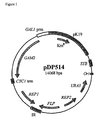
- the yeast expression vector pDP509 was used. This plasmid consists of the E.coli vector pK19 conferring kanamycin resistance and replication for construction and plasmid amplification in E. coli. pDP509 contains the yeast Saccharomyces cerevisiae natural 2 micron plasmid (Hartley et al., Nature, 286 , 860-864, 1980) for high stability, high/low copy number replication in this host and the URA3 (Rose et al ., Gene, 29 , 113-124, 1984) gene for selection of the plasmid in the appropriate host.
- yeast Saccharomyces cerevisiae natural 2 micron plasmid Hardtley et al., Nature, 286 , 860-864, 1980
- URA3 Rose et al ., Gene, 29 , 113-124, 1984
- Genes to be expressed are cloned into either the Bam HI or Xho I restriction sites, where expression is under control of the yeast GAL1 galactose inducible promoter (Johnston et al., Mol. Cell. Biol., 4 , 1440-1448, 1984) and the yeast CYC1 transcription terminator (Osborne et al ., Proc. Natl. Acad. Sci. U.S.A., 86 , 4097-4101, 1989). Plasmid pDP509 was digested with the restriction enzyme Bam HI plus dephosphorylated and ligated with the E. fibuliger GLA2 gene Bam HI fragment.
- the resulting plasmid was named pDP514 and is shown in Figure 1 [according to the following method, this plasmid is also available from the transformed S. cerevisiae YP107 strain (YP107/pDP514) which has been deposited at the C.N.C.M. under the number CNCM I-1992].
- the S. cerevisiae YP107 expression host is a diploid Baker's yeast strain from India. This strain was cured for its native 2 micron plasmid and the host URA3, FUR1 (Kern et al ., Gene, 88 , 149-157, 1990) and URK1 (Kern et al ., Nucleic Acids Res., 18 , 5279-5283, 1990) genes stepwise disrupted. This strain is incapable of synthesising uracil, or of utilising either uridine or cystidine from the growth medium (Napp et al., Biotechnology and Bioengineering, 41 , 801-810, 1993).
- YP107 a yeast centromere plasmid carrying the yeast FUR1 gene, allowing the strain to utilise uracil supplemented in the growth medium.
- This strain named YP107, can also ferment galactose efficiently.
- Strain YP107 was electro-transformed (Gysler et al ., Biotechnology Techniques, 4 , 285-290, 1990) with the plasmid pDP514 and the transformants selected on minimal medium plates (selecting for the plasmid URA3 gene and synthesis of uracil by the host).
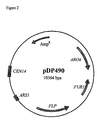
- transformants were then replica streaked on the same minimal medium plates containing 5-flourouracil (Sigma Cat. No. F-6627), a compound that lethally selects against FUR1 positive strains, hence against these yeast carrying pDP490.
- the final result is the yeast strain YP107 transformed with plasmid pDP514 that is stable under any growth conditions (strain YP107/pDP514).
- yeast strains YP107/pDP514 were patched onto agar plates containing 0.67% yeast nitrogen base (Difco, Cat. No. 0919-15-3), 2% D-galactose (Difco, Cat. No. 0163-17-4) and 3% soluble starch (Sigma, Cat. No. S-9765). After incubation at 30°C for several days, visible faint halos were seen surrounding the areas of yeast growth.
- the glucoamylase activity was then assayed in culture supernatant of the S. cerevisiae transformants that produced turbid precipitates in starch-containing plates.
- the assay is performed by reacting culture filtrate with soluble starch and detecting the glucose liberated using commercially-available kits.
- Example 3 Purification of the Endomyces fibuliger GLA2 recombinant protein produced by Saccharomyces cerevisiae.
- the yeast YP107/pDP514 of example 2 is grown in 1 l galactose minimal medium (6.7 g bacto-yeast nitrogen base, 20 g galactose) with areation by batch culture in a fermentor or in shake flasks at 30°C until a strong culture has developed.
- the yeast cells are removed by centrifugation or filtration and the culture medium loaded onto a Separose Q 16/200 column.
- the column is washed with 5 column volumes of 20 mM Tris HCl, pH 8.0 and the proteins then eluted in the same buffer with a NaCl gradient from 0 to 1 M over 10 column volumes.
- the fractions are assayed by incubating a 100 ⁇ l sample with 1% soluble starch in phosphate buffer pH 8.0 for 1 hour at 30 °C and the release of glucose measured with the TC D-glucose test kit from Boehringer Mannhein according to the included instructions.
- the active fractions are pooled and dialysed against 20 mM Tris HCI, pH 8.0.
- the sample is then loaded onto a Superose Q 16/200 column in 20 mM Tris HCl pH 8.0 and then eluted in the same buffer with a NaCl gradient from 0 to 1 M over 20 column volumes.
- the active fractions are identified as described above and pooled.
- Solid ammonium sulfate is added to a final concentration of 1 M and the sample is then loaded onto a phenyl sepherose 10/10 column and eluted in 50 mM phosphate buffer pH 7.0 and a gradient from 1 to 0 M (NH 4 ) 2 SO 4 over 10 column volumes.
- the active fractions are identified, pooled and concentrated.
- the sample is finally loaded on a superose 6 16/500 column and eluted with 50 mM phosphate buffer pH 7.0 plus 200 mM KCl.
- the active fractions are identified, pooled and stored frozen at -20°C.
- Endomyces fibuliger GLA2 gene in Aspergillus oryzae was achieved by amplification of the coding region of the GLA2 gene from Endomyces fibuliger and cloning of the PCR product into the expression vector pFBY182.
- the plasmid pFBY182, containing the pep B gene as a Eco RI- Xba I fragment under the control of the Aspergillus niger pki A promoter and terminator was obtained from Novartis, Switzerland, via Dr. Gabor Jarai.
- the nucleotide sequence of pFBY182 is available in the GenBank accession number S38698.
- the E. fibuliger GLA2 coding region was PCR amplified from plasmid pDP472 with the oligonucleotides SEQ ID NO:7 and SEQ ID NO:8 using a high fidelity Pwo DNA polymerase from Boehringer Mannheim (Cat. No. 1644947) using the amplification conditions of 95°C for 30 secconds, 40°C for 30 seconds, 72°C for 3 minutes and repeated for 30 cycles.
- the PCR product was purified using the QIAquick PCR Purification kit (Cat. No.
- the corresponding 2.9 kb fragment was cut out of the gel and the DNA purified using the QIAquick Gel Extraction Kit. This fragment was then ligated into the pFBY182 plasmid previously digested with the restriction enzyme restriction enzymes Eco RI and Xba I and dephosphorylated.
- GLA2 transcription is under control of the A. niger pki A promoter and terminator (Graaff, Curr. Genet., 22 , 21-27, 1992).
- pDP800 was then introduced into A. oryzae NF1 ( pyr G1) by co-transformation with pNFF28 containing the A. oryzae pyr G gene.
- Aspergillus oryzae NF1 ( pyr G1) is a uridine auxotroph derivative of A. oryzae TK3 in which the pyr G gene, encoding orotidine 5'-phosphate decarboxylase, was inactivated by targeted disruption.
- Plasmid pNFF28 contains the A. oryzae TK3 pyr G gene.
- the nucleotide sequence of pNFF28 is available in the GenBank accession number Y13811.
- A. oryzae NF1 was grown in MM with 0.1% yeast extract, 50 mM glucose and 5 mM glutamine (MM contains per litre 1.5 g KH 2 PO 4 , 0.5 g MgSO 4 .7H 2 O, 0.5 g KCl).
- the mycelium was harvested by sterile filtration, washed once with sterile double distilled water and once with K0.8MC (20 mM MES-HCl pH 5.8, 0.8 M KCl, 50 mM CaCl 2 ). 1.5 g of mycelium was resuspended in 20 ml of a filter sterilized 5 mg/ml solution of Novozyme 234 in K0.8MC.
- the mycelium suspension was incubated at 30°C for 2 hours with gentle agitation (120 rpm).
- the protoplasts were liberated from the mycelium by gentle resuspension with a pipet, washed twice with 20 ml of S1.0TC (10 mM Tris-HCl pH 7.5, 1 M Sorbitol, 50 mM CaCl 2 ) and were resuspended in a final concentration of 10 8 /ml in S1.0TC.
- 20 ⁇ l of DNA was mixed with 200 ⁇ l of protoplasts and 50 ⁇ l of 25% PEG 6000 in 10 mM Tris-HCl pH 7.5, 50 mM CaCl 2 and incubated for 20 min on ice.
- strain B exhibits high degree of hydrolysing specificities against starch containing materials.
- Functional derivatives of the recombinant glucoamylase GLA2 of Endomyces fibuliger are prepared according to a method adapted from the method described by Adams et al . (EP402450; Genencor). Briefly, the expression cassette pDP514 containing the GLA2 gene (SEQ ID NO:1) was subjected to an in-vitro chemical mutagenesis by hydroxylamine. According to example 2, the mutagenised DNA was then used to transform S. cerevisiae YP107. The transformants were patched onto agar plates containing 0.67% yeast nitrogen base (Difco, Cat. No. 0919-15-3), 2% D-galactose (Difco, Cat. No.
- a koji is prepared by mixing the Aspergillus oryzae strain B, previously grown as a koji culture, with a mixture of cooked soya and roasted wheat and rice, the koji is then hydrolysed in aqueous suspension for 3 to 8 hours at 45°C to 60°C with the enzymes produced during fermentation of the Aspergillus oryzae culture, a moromi is further prepared by adding suitable amount of sodium chloride to the hydrolysed koji suspension, the moromi is left to ferment and is then pressed and the liquor obtained is pasteurized and clarified.
- the Aspergillus oryzae strain B of example 4 was used for producing a flavouring agen sauce. Accordingly, a aqueous suspension of a mixture of cooked soya and roasted wheat and rice is prepared, the proteins are solubilized by hydrolysis of the suspension with a protease at pH6.0 to 11.0, the suspension is heat-trated at pH 4.6 to 6.5, and the suspension is ripened with enzymes of a koji culture fermented by Aspergillus oryzae strain B.
Landscapes
- Chemical & Material Sciences (AREA)
- Life Sciences & Earth Sciences (AREA)
- Organic Chemistry (AREA)
- Health & Medical Sciences (AREA)
- Zoology (AREA)
- Engineering & Computer Science (AREA)
- Bioinformatics & Cheminformatics (AREA)
- Genetics & Genomics (AREA)
- Wood Science & Technology (AREA)
- General Health & Medical Sciences (AREA)
- General Engineering & Computer Science (AREA)
- Biochemistry (AREA)
- Molecular Biology (AREA)
- Microbiology (AREA)
- Biotechnology (AREA)
- Biomedical Technology (AREA)
- Medicinal Chemistry (AREA)
- Enzymes And Modification Thereof (AREA)
- Micro-Organisms Or Cultivation Processes Thereof (AREA)
Priority Applications (4)
| Application Number | Priority Date | Filing Date | Title |
|---|---|---|---|
| EP98201473A EP0959130B9 (en) | 1998-05-06 | 1998-05-06 | Cloning and expression of a new glucoamylase gene from endomyces fibuliger |
| DE69813185T DE69813185T2 (de) | 1998-05-06 | 1998-05-06 | Klonierung und Expression eines neuen Glukoamylasegens aus endomyces fibuliger |
| AT98201473T ATE236982T1 (de) | 1998-05-06 | 1998-05-06 | Klonierung und expression eines neuen glukoamylasegens aus endomyces fibuliger |
| DK98201473T DK0959130T3 (da) | 1998-05-06 | 1998-05-06 | Kloning og udtrykkelse af nyt glucoamylasegen fra Endomyces fibuliger |
Applications Claiming Priority (1)
| Application Number | Priority Date | Filing Date | Title |
|---|---|---|---|
| EP98201473A EP0959130B9 (en) | 1998-05-06 | 1998-05-06 | Cloning and expression of a new glucoamylase gene from endomyces fibuliger |
Publications (3)
| Publication Number | Publication Date |
|---|---|
| EP0959130A1 EP0959130A1 (en) | 1999-11-24 |
| EP0959130B1 EP0959130B1 (en) | 2003-04-09 |
| EP0959130B9 true EP0959130B9 (en) | 2003-10-29 |
Family
ID=8233687
Family Applications (1)
| Application Number | Title | Priority Date | Filing Date |
|---|---|---|---|
| EP98201473A Expired - Lifetime EP0959130B9 (en) | 1998-05-06 | 1998-05-06 | Cloning and expression of a new glucoamylase gene from endomyces fibuliger |
Country Status (4)
| Country | Link |
|---|---|
| EP (1) | EP0959130B9 (da) |
| AT (1) | ATE236982T1 (da) |
| DE (1) | DE69813185T2 (da) |
| DK (1) | DK0959130T3 (da) |
-
1998
- 1998-05-06 DE DE69813185T patent/DE69813185T2/de not_active Expired - Lifetime
- 1998-05-06 AT AT98201473T patent/ATE236982T1/de not_active IP Right Cessation
- 1998-05-06 DK DK98201473T patent/DK0959130T3/da active
- 1998-05-06 EP EP98201473A patent/EP0959130B9/en not_active Expired - Lifetime
Also Published As
| Publication number | Publication date |
|---|---|
| DK0959130T3 (da) | 2003-08-04 |
| ATE236982T1 (de) | 2003-04-15 |
| DE69813185D1 (de) | 2003-05-15 |
| EP0959130A1 (en) | 1999-11-24 |
| DE69813185T2 (de) | 2004-03-04 |
| EP0959130B1 (en) | 2003-04-09 |
Similar Documents
| Publication | Publication Date | Title |
|---|---|---|
| US5731174A (en) | Process for the saccharification of starch | |
| EP0600865B1 (en) | Xylanase production | |
| US7060468B2 (en) | Thermostable glucoamylase | |
| EP1032654B1 (en) | Thermostable glucoamylase | |
| CN110582563B (zh) | 细胞相连的异源食品酶和/或饲料酶 | |
| EP1975237B1 (en) | Beta-fructofuranosidase variants and uses thereof | |
| CN109385413B (zh) | 葡萄糖淀粉酶TlGA1931及其基因和应用 | |
| CN106755015B (zh) | 一种新型普鲁兰酶基因和高产菌株的获得方法及产酶工艺 | |
| US5529926A (en) | Cloning and expression of DNA encoding a ripening form of a polypeptide having sulfhydryl oxidase activity | |
| CN103695388B (zh) | α淀粉酶及表达α淀粉酶的黑曲霉菌株 | |
| Steyn et al. | Cloning, sequence analysis and expression in yeasts of a cDNA containing a Lipomyces kononenkoae α-amylase-encoding gene | |
| US6338959B1 (en) | Gene for enzyme having both alkaline pullulanase and alkaline α-amylase activities | |
| EP0959130B9 (en) | Cloning and expression of a new glucoamylase gene from endomyces fibuliger | |
| US6300115B1 (en) | Pullulanase expression constructs containing α-amylase promoter and leader sequences | |
| CN102994475A (zh) | α淀粉酶及表达α淀粉酶的重组菌株 | |
| Matsuo et al. | Cloning and overexpression of β-N-acetylglucosaminidase encoding gene nagA from Aspergillus oryzae and enzyme-catalyzed synthesis of human milk oligosaccharide | |
| CN102925420B (zh) | 一种α淀粉酶及表达α淀粉酶的重组菌株 | |
| US10647970B2 (en) | L-type amylase variant and use thereof | |
| US10655117B2 (en) | Pullulanase and use thereof | |
| EP0402092A2 (en) | Alpha-amylase-pullulanase enzyme | |
| Kim et al. | Cloning and expression of raw-starch-digesting α-amylase gene from Bacillus circulans F-2 in Escherichia coli | |
| Mizukami et al. | Efficient production of thermostable Clostridium thermosulfurogenes β-amylase by Bacillus brevis | |
| RU2795707C1 (ru) | Трансформант Ogataea haglerorum - продуцент термостабильной α-амилазы | |
| CN119685236B (zh) | 一种缺失bglS基因的底盘菌株及其应用 | |
| RU2736441C1 (ru) | Штамм дрожжей Komagataella kurtzmanii, продуцирующий бета-глюканазу из Bacillus pumilus и бета-глюканазу из Paenibacillus jamilae |
Legal Events
| Date | Code | Title | Description |
|---|---|---|---|
| PUAI | Public reference made under article 153(3) epc to a published international application that has entered the european phase |
Free format text: ORIGINAL CODE: 0009012 |
|
| AK | Designated contracting states |
Kind code of ref document: A1 Designated state(s): AT BE CH DE DK ES FI FR GB GR IE IT LI LU NL PT SE |
|
| AX | Request for extension of the european patent |
Free format text: AL;LT;LV;MK;RO;SI |
|
| 17P | Request for examination filed |
Effective date: 20000524 |
|
| AKX | Designation fees paid |
Free format text: AT BE CH DE DK ES FI FR GB GR IE IT LI LU NL PT SE |
|
| GRAH | Despatch of communication of intention to grant a patent |
Free format text: ORIGINAL CODE: EPIDOS IGRA |
|
| GRAH | Despatch of communication of intention to grant a patent |
Free format text: ORIGINAL CODE: EPIDOS IGRA |
|
| GRAA | (expected) grant |
Free format text: ORIGINAL CODE: 0009210 |
|
| AK | Designated contracting states |
Designated state(s): AT BE CH DE DK ES FI FR GB GR IE IT LI LU NL PT SE |
|
| PG25 | Lapsed in a contracting state [announced via postgrant information from national office to epo] |
Ref country code: NL Free format text: LAPSE BECAUSE OF FAILURE TO SUBMIT A TRANSLATION OF THE DESCRIPTION OR TO PAY THE FEE WITHIN THE PRESCRIBED TIME-LIMIT Effective date: 20030409 Ref country code: IT Free format text: LAPSE BECAUSE OF FAILURE TO SUBMIT A TRANSLATION OF THE DESCRIPTION OR TO PAY THE FEE WITHIN THE PRESCRIBED TIME-LIMIT;WARNING: LAPSES OF ITALIAN PATENTS WITH EFFECTIVE DATE BEFORE 2007 MAY HAVE OCCURRED AT ANY TIME BEFORE 2007. THE CORRECT EFFECTIVE DATE MAY BE DIFFERENT FROM THE ONE RECORDED. Effective date: 20030409 Ref country code: FI Free format text: LAPSE BECAUSE OF FAILURE TO SUBMIT A TRANSLATION OF THE DESCRIPTION OR TO PAY THE FEE WITHIN THE PRESCRIBED TIME-LIMIT Effective date: 20030409 Ref country code: BE Free format text: LAPSE BECAUSE OF FAILURE TO SUBMIT A TRANSLATION OF THE DESCRIPTION OR TO PAY THE FEE WITHIN THE PRESCRIBED TIME-LIMIT Effective date: 20030409 Ref country code: AT Free format text: LAPSE BECAUSE OF FAILURE TO SUBMIT A TRANSLATION OF THE DESCRIPTION OR TO PAY THE FEE WITHIN THE PRESCRIBED TIME-LIMIT Effective date: 20030409 |
|
| REG | Reference to a national code |
Ref country code: GB Ref legal event code: FG4D |
|
| REG | Reference to a national code |
Ref country code: CH Ref legal event code: EP |
|
| PG25 | Lapsed in a contracting state [announced via postgrant information from national office to epo] |
Ref country code: LU Free format text: LAPSE BECAUSE OF NON-PAYMENT OF DUE FEES Effective date: 20030506 Ref country code: IE Free format text: LAPSE BECAUSE OF NON-PAYMENT OF DUE FEES Effective date: 20030506 |
|
| REG | Reference to a national code |
Ref country code: IE Ref legal event code: FG4D |
|
| PGFP | Annual fee paid to national office [announced via postgrant information from national office to epo] |
Ref country code: DK Payment date: 20030707 Year of fee payment: 6 |
|
| PG25 | Lapsed in a contracting state [announced via postgrant information from national office to epo] |
Ref country code: SE Free format text: LAPSE BECAUSE OF FAILURE TO SUBMIT A TRANSLATION OF THE DESCRIPTION OR TO PAY THE FEE WITHIN THE PRESCRIBED TIME-LIMIT Effective date: 20030709 Ref country code: PT Free format text: LAPSE BECAUSE OF FAILURE TO SUBMIT A TRANSLATION OF THE DESCRIPTION OR TO PAY THE FEE WITHIN THE PRESCRIBED TIME-LIMIT Effective date: 20030709 Ref country code: GR Free format text: LAPSE BECAUSE OF FAILURE TO SUBMIT A TRANSLATION OF THE DESCRIPTION OR TO PAY THE FEE WITHIN THE PRESCRIBED TIME-LIMIT Effective date: 20030709 |
|
| REG | Reference to a national code |
Ref country code: DK Ref legal event code: T3 |
|
| REG | Reference to a national code |
Ref country code: CH Ref legal event code: AEN Free format text: LA POURSUITE DE LA PROCEDURE REQUISE LE 18.07.2003 A ETE ACCORDEE. LE BREVET EST REACTIVE. |
|
| NLV1 | Nl: lapsed or annulled due to failure to fulfill the requirements of art. 29p and 29m of the patents act | ||
| PG25 | Lapsed in a contracting state [announced via postgrant information from national office to epo] |
Ref country code: ES Free format text: LAPSE BECAUSE OF FAILURE TO SUBMIT A TRANSLATION OF THE DESCRIPTION OR TO PAY THE FEE WITHIN THE PRESCRIBED TIME-LIMIT Effective date: 20031030 |
|
| ET | Fr: translation filed | ||
| PLBE | No opposition filed within time limit |
Free format text: ORIGINAL CODE: 0009261 |
|
| STAA | Information on the status of an ep patent application or granted ep patent |
Free format text: STATUS: NO OPPOSITION FILED WITHIN TIME LIMIT |
|
| REG | Reference to a national code |
Ref country code: IE Ref legal event code: MM4A |
|
| 26N | No opposition filed |
Effective date: 20040112 |
|
| PG25 | Lapsed in a contracting state [announced via postgrant information from national office to epo] |
Ref country code: DK Free format text: LAPSE BECAUSE OF NON-PAYMENT OF DUE FEES Effective date: 20040601 |
|
| REG | Reference to a national code |
Ref country code: DK Ref legal event code: EBP |
|
| PGFP | Annual fee paid to national office [announced via postgrant information from national office to epo] |
Ref country code: GB Payment date: 20100329 Year of fee payment: 13 |
|
| PGFP | Annual fee paid to national office [announced via postgrant information from national office to epo] |
Ref country code: FR Payment date: 20100525 Year of fee payment: 13 |
|
| PGFP | Annual fee paid to national office [announced via postgrant information from national office to epo] |
Ref country code: DE Payment date: 20100430 Year of fee payment: 13 |
|
| PGFP | Annual fee paid to national office [announced via postgrant information from national office to epo] |
Ref country code: CH Payment date: 20100514 Year of fee payment: 13 |
|
| REG | Reference to a national code |
Ref country code: DE Ref legal event code: R119 Ref document number: 69813185 Country of ref document: DE |
|
| REG | Reference to a national code |
Ref country code: DE Ref legal event code: R119 Ref document number: 69813185 Country of ref document: DE |
|
| REG | Reference to a national code |
Ref country code: CH Ref legal event code: PL |
|
| GBPC | Gb: european patent ceased through non-payment of renewal fee |
Effective date: 20110506 |
|
| PG25 | Lapsed in a contracting state [announced via postgrant information from national office to epo] |
Ref country code: CH Free format text: LAPSE BECAUSE OF NON-PAYMENT OF DUE FEES Effective date: 20110531 Ref country code: LI Free format text: LAPSE BECAUSE OF NON-PAYMENT OF DUE FEES Effective date: 20110531 |
|
| REG | Reference to a national code |
Ref country code: FR Ref legal event code: ST Effective date: 20120131 |
|
| PG25 | Lapsed in a contracting state [announced via postgrant information from national office to epo] |
Ref country code: FR Free format text: LAPSE BECAUSE OF NON-PAYMENT OF DUE FEES Effective date: 20110531 |
|
| PG25 | Lapsed in a contracting state [announced via postgrant information from national office to epo] |
Ref country code: GB Free format text: LAPSE BECAUSE OF NON-PAYMENT OF DUE FEES Effective date: 20110506 |
|
| PG25 | Lapsed in a contracting state [announced via postgrant information from national office to epo] |
Ref country code: DE Free format text: LAPSE BECAUSE OF NON-PAYMENT OF DUE FEES Effective date: 20111130 |