EP0958582B1 - Fil electrique ayant un isolant mince a base de polybutyleneterephtalate - Google Patents
Fil electrique ayant un isolant mince a base de polybutyleneterephtalate Download PDFInfo
- Publication number
- EP0958582B1 EP0958582B1 EP98958981A EP98958981A EP0958582B1 EP 0958582 B1 EP0958582 B1 EP 0958582B1 EP 98958981 A EP98958981 A EP 98958981A EP 98958981 A EP98958981 A EP 98958981A EP 0958582 B1 EP0958582 B1 EP 0958582B1
- Authority
- EP
- European Patent Office
- Prior art keywords
- electric wire
- extruded
- resistance
- accordance
- ethylene
- Prior art date
- Legal status (The legal status is an assumption and is not a legal conclusion. Google has not performed a legal analysis and makes no representation as to the accuracy of the status listed.)
- Expired - Lifetime
Links
- 229920001707 polybutylene terephthalate Polymers 0.000 title claims abstract description 10
- 238000009413 insulation Methods 0.000 title claims description 8
- 239000000956 alloy Substances 0.000 claims abstract description 21
- 229910045601 alloy Inorganic materials 0.000 claims abstract description 21
- 229920000642 polymer Polymers 0.000 claims abstract description 20
- 239000002184 metal Substances 0.000 claims abstract description 6
- 229910052751 metal Inorganic materials 0.000 claims abstract description 6
- 229920000098 polyolefin Polymers 0.000 claims abstract description 6
- 238000000034 method Methods 0.000 claims abstract description 5
- 239000011231 conductive filler Substances 0.000 claims abstract description 3
- 239000003340 retarding agent Substances 0.000 claims abstract 3
- 239000000203 mixture Substances 0.000 claims description 12
- VGGSQFUCUMXWEO-UHFFFAOYSA-N Ethene Chemical compound C=C VGGSQFUCUMXWEO-UHFFFAOYSA-N 0.000 claims description 8
- 239000005977 Ethylene Substances 0.000 claims description 8
- 230000001681 protective effect Effects 0.000 claims description 8
- 238000005299 abrasion Methods 0.000 claims description 7
- -1 polybutylene terephthalate Polymers 0.000 claims description 7
- 239000008187 granular material Substances 0.000 claims description 6
- 230000032683 aging Effects 0.000 claims description 5
- 229920001577 copolymer Polymers 0.000 claims description 5
- 238000004132 cross linking Methods 0.000 claims description 5
- 239000000654 additive Substances 0.000 claims description 4
- 239000003381 stabilizer Substances 0.000 claims description 2
- 230000008961 swelling Effects 0.000 claims description 2
- XLYOFNOQVPJJNP-UHFFFAOYSA-N water Substances O XLYOFNOQVPJJNP-UHFFFAOYSA-N 0.000 claims description 2
- 230000000996 additive effect Effects 0.000 claims 1
- 238000005452 bending Methods 0.000 claims 1
- 239000003223 protective agent Substances 0.000 abstract 1
- RNFJDJUURJAICM-UHFFFAOYSA-N 2,2,4,4,6,6-hexaphenoxy-1,3,5-triaza-2$l^{5},4$l^{5},6$l^{5}-triphosphacyclohexa-1,3,5-triene Chemical compound N=1P(OC=2C=CC=CC=2)(OC=2C=CC=CC=2)=NP(OC=2C=CC=CC=2)(OC=2C=CC=CC=2)=NP=1(OC=1C=CC=CC=1)OC1=CC=CC=C1 RNFJDJUURJAICM-UHFFFAOYSA-N 0.000 description 6
- 239000003063 flame retardant Substances 0.000 description 6
- BAPJBEWLBFYGME-UHFFFAOYSA-N Methyl acrylate Chemical compound COC(=O)C=C BAPJBEWLBFYGME-UHFFFAOYSA-N 0.000 description 4
- ADCOVFLJGNWWNZ-UHFFFAOYSA-N antimony trioxide Chemical compound O=[Sb]O[Sb]=O ADCOVFLJGNWWNZ-UHFFFAOYSA-N 0.000 description 4
- 229940082150 encore Drugs 0.000 description 4
- 238000001125 extrusion Methods 0.000 description 4
- 238000010438 heat treatment Methods 0.000 description 4
- RYGMFSIKBFXOCR-UHFFFAOYSA-N Copper Chemical compound [Cu] RYGMFSIKBFXOCR-UHFFFAOYSA-N 0.000 description 3
- 241001080024 Telles Species 0.000 description 3
- 239000002131 composite material Substances 0.000 description 3
- 239000012212 insulator Substances 0.000 description 3
- 239000000126 substance Substances 0.000 description 3
- 239000003963 antioxidant agent Substances 0.000 description 2
- 150000001875 compounds Chemical class 0.000 description 2
- 239000000470 constituent Substances 0.000 description 2
- 238000000605 extraction Methods 0.000 description 2
- 230000007062 hydrolysis Effects 0.000 description 2
- 238000006460 hydrolysis reaction Methods 0.000 description 2
- 238000004519 manufacturing process Methods 0.000 description 2
- 238000004804 winding Methods 0.000 description 2
- NINIDFKCEFEMDL-UHFFFAOYSA-N Sulfur Chemical compound [S] NINIDFKCEFEMDL-UHFFFAOYSA-N 0.000 description 1
- 229920000800 acrylic rubber Polymers 0.000 description 1
- 150000001336 alkenes Chemical class 0.000 description 1
- 239000003795 chemical substances by application Substances 0.000 description 1
- 238000005097 cold rolling Methods 0.000 description 1
- 239000004020 conductor Substances 0.000 description 1
- 229910052802 copper Inorganic materials 0.000 description 1
- 239000010949 copper Substances 0.000 description 1
- WHHGLZMJPXIBIX-UHFFFAOYSA-N decabromodiphenyl ether Chemical compound BrC1=C(Br)C(Br)=C(Br)C(Br)=C1OC1=C(Br)C(Br)=C(Br)C(Br)=C1Br WHHGLZMJPXIBIX-UHFFFAOYSA-N 0.000 description 1
- 229920001971 elastomer Polymers 0.000 description 1
- 239000000806 elastomer Substances 0.000 description 1
- 238000010292 electrical insulation Methods 0.000 description 1
- 238000001493 electron microscopy Methods 0.000 description 1
- 238000010348 incorporation Methods 0.000 description 1
- 239000000463 material Substances 0.000 description 1
- JRZJOMJEPLMPRA-UHFFFAOYSA-N olefin Natural products CCCCCCCC=C JRZJOMJEPLMPRA-UHFFFAOYSA-N 0.000 description 1
- 239000002530 phenolic antioxidant Substances 0.000 description 1
- 238000002360 preparation method Methods 0.000 description 1
- 239000002994 raw material Substances 0.000 description 1
- 230000000979 retarding effect Effects 0.000 description 1
- 229910052717 sulfur Inorganic materials 0.000 description 1
- 239000011593 sulfur Substances 0.000 description 1
- 230000009466 transformation Effects 0.000 description 1
Images
Classifications
-
- H—ELECTRICITY
- H01—ELECTRIC ELEMENTS
- H01C—RESISTORS
- H01C7/00—Non-adjustable resistors formed as one or more layers or coatings; Non-adjustable resistors made from powdered conducting material or powdered semi-conducting material with or without insulating material
- H01C7/02—Non-adjustable resistors formed as one or more layers or coatings; Non-adjustable resistors made from powdered conducting material or powdered semi-conducting material with or without insulating material having positive temperature coefficient
- H01C7/028—Non-adjustable resistors formed as one or more layers or coatings; Non-adjustable resistors made from powdered conducting material or powdered semi-conducting material with or without insulating material having positive temperature coefficient consisting of organic substances
-
- C—CHEMISTRY; METALLURGY
- C08—ORGANIC MACROMOLECULAR COMPOUNDS; THEIR PREPARATION OR CHEMICAL WORKING-UP; COMPOSITIONS BASED THEREON
- C08L—COMPOSITIONS OF MACROMOLECULAR COMPOUNDS
- C08L67/00—Compositions of polyesters obtained by reactions forming a carboxylic ester link in the main chain; Compositions of derivatives of such polymers
- C08L67/02—Polyesters derived from dicarboxylic acids and dihydroxy compounds
-
- H—ELECTRICITY
- H01—ELECTRIC ELEMENTS
- H01B—CABLES; CONDUCTORS; INSULATORS; SELECTION OF MATERIALS FOR THEIR CONDUCTIVE, INSULATING OR DIELECTRIC PROPERTIES
- H01B13/00—Apparatus or processes specially adapted for manufacturing conductors or cables
- H01B13/06—Insulating conductors or cables
- H01B13/14—Insulating conductors or cables by extrusion
-
- H—ELECTRICITY
- H01—ELECTRIC ELEMENTS
- H01B—CABLES; CONDUCTORS; INSULATORS; SELECTION OF MATERIALS FOR THEIR CONDUCTIVE, INSULATING OR DIELECTRIC PROPERTIES
- H01B3/00—Insulators or insulating bodies characterised by the insulating materials; Selection of materials for their insulating or dielectric properties
- H01B3/18—Insulators or insulating bodies characterised by the insulating materials; Selection of materials for their insulating or dielectric properties mainly consisting of organic substances
- H01B3/30—Insulators or insulating bodies characterised by the insulating materials; Selection of materials for their insulating or dielectric properties mainly consisting of organic substances plastics; resins; waxes
- H01B3/42—Insulators or insulating bodies characterised by the insulating materials; Selection of materials for their insulating or dielectric properties mainly consisting of organic substances plastics; resins; waxes polyesters; polyethers; polyacetals
- H01B3/421—Polyesters
- H01B3/422—Linear saturated polyesters derived from dicarboxylic acids and dihydroxy compounds
-
- H—ELECTRICITY
- H01—ELECTRIC ELEMENTS
- H01B—CABLES; CONDUCTORS; INSULATORS; SELECTION OF MATERIALS FOR THEIR CONDUCTIVE, INSULATING OR DIELECTRIC PROPERTIES
- H01B3/00—Insulators or insulating bodies characterised by the insulating materials; Selection of materials for their insulating or dielectric properties
- H01B3/18—Insulators or insulating bodies characterised by the insulating materials; Selection of materials for their insulating or dielectric properties mainly consisting of organic substances
- H01B3/30—Insulators or insulating bodies characterised by the insulating materials; Selection of materials for their insulating or dielectric properties mainly consisting of organic substances plastics; resins; waxes
- H01B3/44—Insulators or insulating bodies characterised by the insulating materials; Selection of materials for their insulating or dielectric properties mainly consisting of organic substances plastics; resins; waxes vinyl resins; acrylic resins
- H01B3/441—Insulators or insulating bodies characterised by the insulating materials; Selection of materials for their insulating or dielectric properties mainly consisting of organic substances plastics; resins; waxes vinyl resins; acrylic resins from alkenes
-
- H—ELECTRICITY
- H01—ELECTRIC ELEMENTS
- H01B—CABLES; CONDUCTORS; INSULATORS; SELECTION OF MATERIALS FOR THEIR CONDUCTIVE, INSULATING OR DIELECTRIC PROPERTIES
- H01B7/00—Insulated conductors or cables characterised by their form
- H01B7/17—Protection against damage caused by external factors, e.g. sheaths or armouring
- H01B7/29—Protection against damage caused by extremes of temperature or by flame
- H01B7/295—Protection against damage caused by extremes of temperature or by flame using material resistant to flame
Definitions
- the present invention relates to electrical son especially for the automobile whose protective insulator is thin and is made of extruded alloy of compatible polymers.
- the invention also relates to the method of manufacturing the electrical wire in which the compatible polymer alloy is implemented by extrusion without additional step of crosslinking or heat treatment around the electrically conductive wire.
- alloy of compatible polymers means a mixture of at least two polymers which are immiscible but which are compatible or a mixture of at least two immiscible and non-compatible polymers but made compatible by the addition of a compatibilizer.
- the polar polyolefin used in the composition of the alloy is very slightly crystalline.
- it is an elastomer and is selected from ethylene / C 1 -C 4 alkyl acrylate copolymers, or mixtures thereof. More preferably, a copolymer of ethylene / methyl acrylate is used.
- non-polymeric flame retardant means a flame retardant incorporated directly into the mixture of raw materials constituting the polymer alloy. It is therefore not a question of flame retarding a polymer of the alloy before its incorporation with the other constituents of the alloy. Thus, all the constituents of the alloy are standard compounds that are on the market and do not require any prior transformation.
- flame retardant can be a brominated compound such as decarbromodiphenyloxide, with antimony trioxide.
- the alloy constituting the protective insulator may incorporate various additives, for example antioxidants and electrically non-conductive fillers.
- the thickness of the insulation may be greater than the values indicated above when the conductor cross section is greater than 0.35mm 2 .
- the thickness of the sheath may be 0.6mm.
- the thickness of the sheath of compatible polymer alloys described above is always less than the thickness of conventional sheaths.
- the electrical wire according to the invention is characterized by the fact that it has good mechanical strength properties, in particular good abrasion resistance, good elongation at break, satisfactory cold rolling resistance, good resistance to hot pressure, and / or good fire resistance. Furthermore, it has good chemical resistance including good oil resistance and good resistance to hydrolysis. It also has aging characteristics quite satisfactory.
- the electrical son in accordance with the invention can be used without difficulty at low temperature.
- the abrasion resistance for wires with a cross-section greater than 0.35 mm 2 will of course be higher than the values indicated above for wires of larger section.
- the process according to the invention is very economical because, on the one hand, it allows the use of standard polybutylene terephthalate, no previous step of flame retardation of polybutylene terephthalate being necessary, and secondly, that it allows to obtain electrical son having good properties directly by extrusion without the need to add a heat treatment or crosslinking.
- flame retardant which is a combination of decabromodiphenyloxide with antimony trioxide and 15% by weight of stabilizers (including phenolic antioxidants, a sulfur co-antioxidant and a moisture sensor) are mixed with 30% by weight. % by weight of ethylene / methyl acrylate copolymer (EMA).
- EMA ethylene / methyl acrylate copolymer
- PBT polybutylene terephthalate
- Granules are obtained. These granules are then extruded at 260 ° C. around copper wires 0.75 mm in diameter. The result is 0.35mm 2 wire with a diameter of 1.35mm (D1) or 1.20mm diameter (D2).
Landscapes
- Engineering & Computer Science (AREA)
- Physics & Mathematics (AREA)
- Chemical & Material Sciences (AREA)
- Spectroscopy & Molecular Physics (AREA)
- Microelectronics & Electronic Packaging (AREA)
- Medicinal Chemistry (AREA)
- Health & Medical Sciences (AREA)
- Chemical Kinetics & Catalysis (AREA)
- Electromagnetism (AREA)
- Polymers & Plastics (AREA)
- Organic Chemistry (AREA)
- Ceramic Engineering (AREA)
- Manufacturing & Machinery (AREA)
- Compositions Of Macromolecular Compounds (AREA)
- Organic Insulating Materials (AREA)
- Insulated Conductors (AREA)
- Conductive Materials (AREA)
Abstract
Description
- La présente invention porte sur des fils électriques notamment pour l'automobile dont l'isolant protecteur est de faible épaisseur et est réalisée en alliage extrudé de polymères compatibles. L'invention porte également sur le procédé de fabrication du fil électrique dans lequel l'alliage de polymères compatibles est mis en oeuvre par extrusion sans étape complémentaire de réticulation ou de traitement thermique autour du fil électriquement conducteur.
- Il existe une demande importante dans l'industrie automobile pour des fils de moins en moins volumineux et de plus en plus légers qui néanmoins présentent d'excellentes propriétés, notamment d'excellentes propriétés d'isolant électrique et de résistance à l'abrasion.
- Ces fils électriques doivent en outre présenter un faible coefficient de retrait, d'excellentes propriétés de résistance mécanique et chimique ainsi qu'une bonne stabilité au vieillissement tout en étant économiques.
- La Société Déposante, après de nombreuses recherches, a eu le grand mérite de mettre au point des fils électriques présentant l'ensemble de ces caractéristiques. Ces fils électriques sont constitués d'un fil métallique conducteur autour duquel est extrudé un alliage de polymères compatibles comprenant, les pourcentages étant exprimés en poids par rapport au poids desdits polymères :
- de 5 à 40% d'au moins une polyoléfine polaire,
- de 50 à 80% de polybutylènetéréphtalate,
- jusqu'à 15%, de préférence jusqu'à 10% d'au moins un agent ignifugeant non polymère,
- et éventuellement des charges non conductrices,
- Dans la présente invention, on entend par "alliage de polymères compatibles" un mélange d'au moins deux polymères qui sont non miscibles mais qui sont compatibles ou un mélange d'au moins deux polymères non miscibles et non compatibles mais rendus compatibles par l'addition d'un agent de compatibilisation. La mise en oeuvre d'un tel alliage de polymères compatibles par extrusion permet d'obtenir une structure composite.
- Selon l'invention, la polyoléfine polaire entrant dans la composition de l'alliage est très peu cristalline. De préférence il s'agit d'un élastomère et elle est choisie parmi les copolymères d'éthylène/acrylate d'alkyle en C1-C4, ou leurs mélanges. Plus préférentiellement on utilise un copolymère d'éthylène/acrylate de méthyle.
- Dans la présente invention, on entend par "agent ignifugeant non polymère", un agent ignifugeant incorporé directement dans le mélange de matières premières constituant l'alliage polymère. Il ne s'agit donc pas d'ignifuger un polymère de l'alliage avant son incorporation avec les autres constituants de l'alliage. Ainsi, tous les constituants de l'alliage sont des composés standards que l'on trouve sur le marché et qui ne nécessitent aucune transformation préalable. Un tel agent ignifugeant peut être un composé bromé tel que le décarbromodiphényloxyde, avec du trioxyde d'antimoine.
- L'alliage constituant l'isolant protecteur peut incorporer différents additifs, par exemple des agents antioxydants et des charges électriquement non conductrices.
- Le choix des additifs sera bien entendu fonction des caractéristiques souhaitées pour le fil électrique selon l'invention.
- L'épaisseur de l'isolant peut être supérieure aux valeurs indiquées ci-dessus lorsque la section du fil conducteur est supérieure à 0,35mm2. En particulier, pour un fil de 2,5mm2 de section, l'épaisseur de la gaine peut être de 0,6mm. Cependant, quelle que soit la section du fil conducteur, l'épaisseur de la gaine en alliages de polymères compatibles décrit ci-dessus est toujours inférieure à l'épaisseur des gaines classiques.
- Le fil électrique selon l'invention est caractérisé par le fait qu'il présente de bonnes propriétés de résistance mécanique, notamment une bonne résistance à l'abrasion, un bon allongement à la rupture, une résistance à l'enroulement à froid satisfaisante, une bonne résistance à la pression à chaud, et/ou une bonne tenue au feu. Par ailleurs, il présente une bonne résistance chimique notamment, une bonne résistance à l'huile et une bonne résistance à l'hydrolyse. Il présente également des caractéristiques de vieillissement tout à fait satisfaisantes.
- Compte tenu de ces propriétés, les fils électriques conformes à l'invention peuvent être utilisés sans difficulté à basse température.
- Les fils électriques pour l'automobile selon l'invention :
- passent le test de tenue au feu, selon la norme ISO 6722;
- présentent une résistance à l'abrasion, telle que mesurée selon la norme ISO 6722, pour des fils de diamètre global 1,35mm, ayant une âme métallique de section 0,35 mm2, de 150 à 700, de préférence de 250 à 400 cycles, et plus préférentiellement encore de 350 cycles;
- présentent un allongement à la rupture supérieur à 200%, de préférence supérieur à 300% et plus préférentiellement encore de 400%;
- passent le test d'enroulement à froid, selon la norme ISO 6722 ;
- présentent une résistance à la pression à chaud à 150° C, telle que mesurée selon la norme ISO 6722, de 0,001 à 0,15mm, de préférence de 0,04 à 0,10mm, et plus préférentiellement encore de 0,03 à 0,08mm ;
- passent le test de vieillissement pendant 3000 heures à 150°C, selon la norme ISO 6722.
- En outre, ils peuvent présenter les caractéristiques supplémentaires suivantes :
- passent le test de résistance à l'eau chaude selon la norme FORD 597GG-14401-Aa ;
- présentent une résistance à l'huile, telle que mesurée selon la norme FORD 597GG-14401-AA inférieure à 4% de gonflement.
- La résistance à l'abrasion pour des fils de section supérieure à 0,35mm2 sera bien entendu supérieure aux valeurs indiquées ci-dessus pour des fils de plus grande section.
- La présente invention porte également sur le procédé d'obtention de ces fils électriques qui comprend les étapes suivantes, au cours desquelles :
- on mélange l'ignifugeant, les additifs éventuels et la polyoléfine polaire, dans les proportions indiquées ci-dessus,
- on extrude le mélange obtenu avec la quantité indiquée ci-dessus de polybutylènetéréphtalate pour obtenir des granulés,
- on extrude ensuite les granulés autour d'un fil électriquement conducteur, notamment d'un fil de cuivre, sans avoir recours à une étape supplémentaire de réticulation
- Ainsi, le procédé selon l'invention est très économique étant donné d'une part, qu'il permet l'utilisation de polybutylènetéréphtalate standard, aucune étape préalable d'ignifugation du polybutylènetéréphtalate n'étant nécessaire, et d'autre part, qu'il permet d'obtenir des fils électriques présentant de bonnes propriétés directement par extrusion sans qu'il soit nécessaire d'ajouter un traitement thermique ou une réticulation.
- Toutes les caractéristiques de ces fils électriques sont obtenues après simple extrusion de l'alliage de polymères compatibles décrit ci-dessus autour d'un fil métallique conducteur, sans qu'aucun traitement supplémentaire, tels qu'un traitement thermique ou une réticulation, ne soit nécessaire et malgré la faible épaisseur de l'isolant protecteur.
- La présente invention va maintenant être décrite plus en détail avec références aux dessins annexés, sur lesquels :
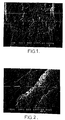
- les figures 1 et 2 représentent des photographies en microscopie électronique de la structure composite d'un alliage de polymères compatibles utilisé comme isolant de fils électriques pour l'automobile selon l'invention, après extraction de l'oléfine polaire, à un grossissement de 2500.
- On mélange 15% en poids d'ignifugeant qui est une association de décabromodiphényloxyde avec du trioxyde d'antimoine et 15% en poids de stabilisants (comprenant des anti-oxydants phénoliques, un co-antioxydant soufré et un capteur d'humidité) avec 30% en poids de copolymère éthylène/acrylate de méthyle (EMA). Puis on extrude ce mélange à 260°C avec 70% en poids de polybutylène téréphtalate (PBT). On obtient des granulés. On extrude alors ces granulés à 260°C autour de fils de cuivre de 0,75mm de diamètre. On obtient alors des fils de 0,35mm2 de section et de 1,35mm de diamètre (D1) ou de 1,20mm de diamètre (D2).
- Les caractéristiques physiques et chimiques de ce fil électrique sont les suivantes .
TYPE D'ESSAI NORME RESULTATS D1 D2 Abrasion ISO 6722 350 cycles 180 cycles Enroulement à froid ISO 6722 satisfaisant satisfaisant Pression à chaud à 150°C ISO 6722 satisfaisant satisfaisant Résistance à l'hydrolyse FORD S97GG-14401-AA satisfaisant satisfaisant Résistance à l'huile FORD S97GG-14401-AA satisfaisant satisfaisant Vieillissement 3000 heures à 150°C ISO 6722 satisfaisant satisfaisant - On extrait ensuite le copolymère d'éthylène/acrylate de méthyle et on observe le matériau au microscope électronique. Les photographies ainsi obtenues sont données sur les figures 1 et 2.
ledit alliage extrudé formant un isolant protecteur ayant une épaisseur inférieure à 0,25 mm, de préférence inférieure à 0,2 mm et plus préférentiellement encore inférieure à 0,16 mm, pour un fil métallique de 0,35 mm2 de section.
Claims (5)
- Fil électrique constitué d'un fil métallique conducteur autour duquel est extrudé un alliage de polymères compatibles comprenant, les pourcentages étant exprimés en poids par rapport au poids desdits polymères :- de 5 à 40% d'au moins une polyoléfine, choisie dans le groupe comprenant les copolymères éthylène / acylate d'alkyle en C1 éthylène / acylate d'alkyle en Cu et leurs mélanges.- de 50 à 80% de polybutylènetéréphtalate,- jusqu'à 15%, de préférence jusqu'à 10% d'un agent ignifugeant non polymère,- et éventuellement des charges non conductrices, ledit alliage extrudé formant un isolant protecteur ayant une épaisseur inférieure à 0,25 mm, de préférence inférieure à 0,2 mm et plus préférentiellement encore inférieure à 0,16 mm, pour un fil métallique de 0,35 mm2 de section.
- Fil électrique selon la revendication 1, caractérisé par le fait que l'alliage constituant l'isolant protecteur comprend au moins un agent stabilisant.
- Fil électrique selon l'une quelconque des revendications 1 ou 2, caractérisé par le fait qu'il :- passe le test de tenue au feu selon la norme ISO 6722 ;- présente une résistance à l'abrasion, telle que mesurée selon la norme ISO 6722, pour des fils de diamètre global 1,35mm ayant une âme métallique de section 0,35 mm2, de 150 à 700, de préférence de 250 à 400, et plus préférentiellement encore de 350 cycles ;- présente un allongement à la rupture supérieur à 200%, de préférence supérieur à 300% et plus préférentiellement encore de 400%;- passe le test d'enroulement à froid selon la norme ISO 6722 ;- présente une résistance à la pression à chaud à 150° C, telle que mesurée selon la norme ISO 6722, de 0,001 à 0, 15mm, de préférence de 0,04 à 0,10mm, et plus préférentiellement encore de 0,03 à 0,08mm ;- passe le test de vieillissement pendant 3000 heures à 150°C selon la norme ISO 6722 ;
- Fil électrique selon la revendication 3, caractérisé par le fait qu'il- passe le test de résistance à l'eau chaude, selon la norme FORD 59.7GG-14401-Aa ;- présente une résistance à l'huile, telle que mesurée selon la norme. FORD 597GG-14401-AA, inférieure à 4% de gonflement.
- Procédé de préparation de fils électriques, caractérisé par le fait qu'il comprend les étapes au cours desquelles :- on mélange au moins une polyoléfine choisi dans le groupe comprenant les copolymères éthylène/ acylate d'alkyle en C1, éthylène/acylate d'alkyle en Cu, et leurs mélanges, au moins un agent ignifugeant et éventuellement au moins un additif dans les proportions indiquées à la revendication 1,- on extrude le mélange obtenu ci-dessus avec du polybutylènetéréphtalate dans les proportions indiquées à la revendication 1, pour obtenir des granulés,- on extrude les granulés obtenus autour d'un fil électriquement conducteur sans avoir recours à une étape supplémentaire de réticulation ou à un traitement thermique pour obtenir l'épaisseur de l'isolant protecteur définie dans la revendication 1.
Applications Claiming Priority (3)
| Application Number | Priority Date | Filing Date | Title |
|---|---|---|---|
| FR9715501 | 1997-12-08 | ||
| FR9715501 | 1997-12-08 | ||
| PCT/FR1998/002658 WO1999030330A1 (fr) | 1997-12-08 | 1998-12-08 | Fil electrique ayant un isolant mince a base de polybutyleneterephtalate |
Publications (2)
| Publication Number | Publication Date |
|---|---|
| EP0958582A1 EP0958582A1 (fr) | 1999-11-24 |
| EP0958582B1 true EP0958582B1 (fr) | 2006-02-22 |
Family
ID=9514316
Family Applications (2)
| Application Number | Title | Priority Date | Filing Date |
|---|---|---|---|
| EP98958981A Expired - Lifetime EP0958582B1 (fr) | 1997-12-08 | 1998-12-08 | Fil electrique ayant un isolant mince a base de polybutyleneterephtalate |
| EP98958980A Expired - Lifetime EP0965138B1 (fr) | 1997-12-08 | 1998-12-08 | Cables auto-regulants extrudes et leur procede de fabrication |
Family Applications After (1)
| Application Number | Title | Priority Date | Filing Date |
|---|---|---|---|
| EP98958980A Expired - Lifetime EP0965138B1 (fr) | 1997-12-08 | 1998-12-08 | Cables auto-regulants extrudes et leur procede de fabrication |
Country Status (6)
| Country | Link |
|---|---|
| US (1) | US6303866B1 (fr) |
| EP (2) | EP0958582B1 (fr) |
| BR (1) | BR9807207A (fr) |
| DE (2) | DE69826986T2 (fr) |
| ES (1) | ES2259216T3 (fr) |
| WO (2) | WO1999030330A1 (fr) |
Families Citing this family (13)
| Publication number | Priority date | Publication date | Assignee | Title |
|---|---|---|---|---|
| US6455771B1 (en) * | 2001-03-08 | 2002-09-24 | Union Carbide Chemicals & Plastics Technology Corporation | Semiconducting shield compositions |
| EP2329883B1 (fr) | 2005-01-20 | 2013-05-01 | 3M Innovative Properties Co. | Films polymères structurés et leurs procédés de formation |
| ATE499408T1 (de) * | 2006-04-18 | 2011-03-15 | Borealis Tech Oy | Polymerschicht für kabel mit verbesserter weissbruchneigungsbeständigkeit |
| GB0609729D0 (en) * | 2006-05-17 | 2006-06-28 | Heat Trace Ltd | Material and heating cable |
| FR2919106B1 (fr) * | 2007-07-16 | 2009-10-09 | Acome Soc Coop Production | Materiau a comportement ctp pour application moyenne et haute temperature,stuctures autoregulantes le comprenant et leur procede de fabrication. |
| CN101488373B (zh) * | 2009-02-27 | 2011-11-23 | 邓华 | 导电复合材料的制备方法 |
| CN101697649B (zh) * | 2009-11-05 | 2013-12-25 | 安徽安邦控制系统有限公司 | 一种防爆型高分子自控温伴热带 |
| CN101697648B (zh) * | 2009-11-05 | 2013-12-25 | 安徽安邦控制系统有限公司 | 一种高分子自控温伴热带 |
| CN102170717B (zh) * | 2011-03-10 | 2013-03-20 | 山东科虹线缆有限公司 | 一种半导电高分子包铜电极自控温伴热电缆及其制造方法 |
| CN105489303A (zh) * | 2014-09-18 | 2016-04-13 | 瑞侃电子(上海)有限公司 | 线缆及其制造方法、电路保护器件及其制造方法、负载电路 |
| EP3449491A4 (fr) | 2016-04-29 | 2020-04-22 | Nvent Services Gmbh | Câble chauffant autorégulateur monolithique à nivellement de tension |
| FR3102769B1 (fr) | 2019-10-30 | 2022-04-01 | Acome | Matrice polymérique à base de PET pour fils électriques |
| US20230230724A1 (en) * | 2022-01-03 | 2023-07-20 | Nvent Services Gmbh | Self-Regulating Heater Cable |
Family Cites Families (31)
| Publication number | Priority date | Publication date | Assignee | Title |
|---|---|---|---|---|
| US3861029A (en) * | 1972-09-08 | 1975-01-21 | Raychem Corp | Method of making heater cable |
| JPS5247843A (en) * | 1975-10-15 | 1977-04-16 | Asahi Chem Ind Co Ltd | Conductive resin compositions |
| JPS5918804B2 (ja) * | 1976-07-07 | 1984-05-01 | 東レ株式会社 | 熱感応性素子 |
| US4876440A (en) * | 1976-12-13 | 1989-10-24 | Raychem Corporation | Electrical devices comprising conductive polymer compositions |
| US4866253A (en) * | 1976-12-13 | 1989-09-12 | Raychem Corporation | Electrical devices comprising conductive polymer compositions |
| GB1597007A (en) * | 1976-12-16 | 1981-09-03 | Raychem Corp | Conductive polymer compositions and devices |
| US4388607A (en) | 1976-12-16 | 1983-06-14 | Raychem Corporation | Conductive polymer compositions, and to devices comprising such compositions |
| JPS5468990A (en) * | 1977-11-14 | 1979-06-02 | Teijin Ltd | Coated wire |
| US4332855A (en) * | 1978-04-14 | 1982-06-01 | Raychem Corporation | Polymeric compositions |
| US4315237A (en) | 1978-12-01 | 1982-02-09 | Raychem Corporation | PTC Devices comprising oxygen barrier layers |
| US4242573A (en) * | 1979-01-24 | 1980-12-30 | Raychem Corporation | Water immersible heater |
| IT1126464B (it) * | 1978-12-01 | 1986-05-21 | Raychem Corp | Dispositivi ptc che comprendono barriere per l'ossigeno |
| CA1168433A (fr) | 1980-05-19 | 1984-06-05 | Umesh K. Sopory | Polymeres conducteurs ptc et dispositifs qui en contiennent |
| DE3375619D1 (en) * | 1983-06-13 | 1988-03-10 | Mitsui Du Pont Polychemical | Semiconducting compositions and wires and cables using the same |
| US5321119A (en) | 1986-08-26 | 1994-06-14 | Ems-Inventa Ag | Impact resistant polyamide compositions |
| US5321079A (en) | 1986-08-26 | 1994-06-14 | Ems - Inventa Ag | Impact resistant polyamide compositions |
| JPH0619927B2 (ja) | 1987-03-16 | 1994-03-16 | ポリプラスチックス株式会社 | 被覆電線 |
| JP2627894B2 (ja) * | 1987-05-22 | 1997-07-09 | 大日精化工業株式会社 | 自己温度制御性の向上された導電性樹脂組成物 |
| GB8716308D0 (en) * | 1987-07-10 | 1987-08-19 | Raychem Ltd | Electrical wire |
| GB8716306D0 (en) * | 1987-07-10 | 1987-08-19 | Raychem Ltd | Electrical wire |
| FI884126A7 (fi) | 1987-09-09 | 1989-03-10 | Raychem Ltd | Johtava polymeerikoostumus |
| JPH02296861A (ja) * | 1989-05-11 | 1990-12-07 | Sumitomo Electric Ind Ltd | ポリエステルエラストマー組成物 |
| EP0513569B1 (fr) * | 1991-05-15 | 1998-10-14 | BASF Aktiengesellschaft | Câbles électrique pour moyenne et haute tension ayant une résistance élevée à la formation et la croissance d'arborescences |
| US5741842A (en) * | 1991-07-10 | 1998-04-21 | Bayer Aktiengesellschaft | Thermoplastic moulding compounds, a process for their preparation and a process for the production of ceramic or metal moulded parts by sintering |
| TW257781B (fr) | 1991-10-24 | 1995-09-21 | Du Pont | |
| US5219941A (en) | 1992-03-16 | 1993-06-15 | Eastman Kodak Company | High impact polyester/ethylene copolymer blends |
| US5606152A (en) * | 1992-10-28 | 1997-02-25 | The Furukawa Electric Co., Ltd. | Multilayer insulated wire and a manufacturing method therefor |
| JP3175355B2 (ja) * | 1992-11-04 | 2001-06-11 | 住友電気工業株式会社 | 樹脂組成物からの熱収縮性チューブ |
| DE4314042A1 (de) * | 1993-04-29 | 1994-11-03 | Bayer Ag | Thermoplastische Formmassen auf Basis von Polyalkylenterephthalat und Ethylen-Vinylacetat-Polymeren |
| WO1995012636A1 (fr) * | 1993-11-04 | 1995-05-11 | Raychem Corporation | Compositions d'alliage de polyester thermoplastique stabilisees |
| US5798418A (en) * | 1995-07-31 | 1998-08-25 | Fmc Corporation | Star polymers from mixed initiators |
-
1998
- 1998-12-08 DE DE69826986T patent/DE69826986T2/de not_active Expired - Lifetime
- 1998-12-08 DE DE69833564T patent/DE69833564T2/de not_active Expired - Lifetime
- 1998-12-08 EP EP98958981A patent/EP0958582B1/fr not_active Expired - Lifetime
- 1998-12-08 ES ES98958981T patent/ES2259216T3/es not_active Expired - Lifetime
- 1998-12-08 WO PCT/FR1998/002658 patent/WO1999030330A1/fr not_active Ceased
- 1998-12-08 US US09/367,195 patent/US6303866B1/en not_active Expired - Lifetime
- 1998-12-08 WO PCT/FR1998/002657 patent/WO1999030334A1/fr not_active Ceased
- 1998-12-08 EP EP98958980A patent/EP0965138B1/fr not_active Expired - Lifetime
- 1998-12-08 BR BR9807207-2A patent/BR9807207A/pt not_active IP Right Cessation
Also Published As
| Publication number | Publication date |
|---|---|
| BR9807207A (pt) | 2000-05-23 |
| DE69833564T2 (de) | 2006-10-19 |
| DE69826986T2 (de) | 2006-02-09 |
| EP0965138A1 (fr) | 1999-12-22 |
| EP0965138B1 (fr) | 2004-10-13 |
| WO1999030330A1 (fr) | 1999-06-17 |
| ES2259216T3 (es) | 2006-09-16 |
| DE69833564D1 (de) | 2006-04-27 |
| US6303866B1 (en) | 2001-10-16 |
| DE69826986D1 (de) | 2004-11-18 |
| WO1999030334A1 (fr) | 1999-06-17 |
| EP0958582A1 (fr) | 1999-11-24 |
| WO1999030334B1 (fr) | 1999-09-02 |
Similar Documents
| Publication | Publication Date | Title |
|---|---|---|
| US5731082A (en) | Tree resistant cable | |
| EP2483894B1 (fr) | Câble électrique à moyenne ou haute tension | |
| EP0958582A1 (fr) | Fil electrique ayant un isolant mince a base de polybutyleneterephtalate | |
| KR20170139696A (ko) | 전압 안정화 열가소성 전기 절연층을 가진 에너지 케이블 | |
| US8017710B2 (en) | Crosslinkable high pressure polyethylene composition, a process for the preparation thereof, a pipe and a cable prepared thereof | |
| CA1052513A (fr) | Mode de fabrication d'un conducteur isole pour branchement d'abonne | |
| WO2017103511A1 (fr) | Composition polymère présentant une résistance au blanchiment sous contrainte améliorée | |
| HUP0103585A2 (hu) | Szigeteléssel ellátott villamos vezeték vagy kábel, továbbá eljárás ilyenek előállítására | |
| FR2912542A1 (fr) | Cable d'energie et/ou de telecommunication aux proprietes ignifugeantes ameliorees. | |
| JP2015017161A (ja) | エラストマー組成物、並びにこれを用いた絶縁電線及び絶縁ケーブル | |
| EP0554174B1 (fr) | Composition à base de poly(chlorure de vinyle), de polymère fluoré et de talc, utilisable, notamment, comme isolant pour câbles électriques, et procédé de préparation | |
| WO2015177423A1 (fr) | Câble électrique comprenant une couche réticulée | |
| US4810577A (en) | Heat and oil-resistant electric insulated wire | |
| FR2939234A1 (fr) | Composition reticulable pour cable d'energie a moyenne et haute tension | |
| FR3098636A1 (fr) | Câble comprenant une couche résistante au feu | |
| KR100764293B1 (ko) | 케이블의 제조방법 | |
| CA2267489C (fr) | Cable resitant aux arbres | |
| EP4742276A1 (fr) | Préparation d'un câble électrique par extrusion continue d'une couche isolante thermoplastique et d'une gaine externe thermoplastique | |
| EP4682908A1 (fr) | Cable electrique comprenant une couche isolante thermoplastique a base d'un polymere de propylene heterophasique | |
| EP3671768A1 (fr) | Câble électrique résistant aux arborescences d'eau | |
| WO2024158448A1 (fr) | Câble ignifuge et ses utilisations | |
| KR100479147B1 (ko) | 트리내성케이블 | |
| FR2933228A1 (fr) | Couche tubante electriquement isolante pour cable electrique | |
| JPH0376736A (ja) | 走水防止用組成物及びそれを用いた走水防止ケーブル | |
| FR3168290A1 (fr) | Couche isolante thermoplastique flexible pour câble électrique |
Legal Events
| Date | Code | Title | Description |
|---|---|---|---|
| PUAI | Public reference made under article 153(3) epc to a published international application that has entered the european phase |
Free format text: ORIGINAL CODE: 0009012 |
|
| 17P | Request for examination filed |
Effective date: 19990728 |
|
| AK | Designated contracting states |
Kind code of ref document: A1 Designated state(s): CH DE ES FR GB LI |
|
| 17Q | First examination report despatched |
Effective date: 20021007 |
|
| GRAP | Despatch of communication of intention to grant a patent |
Free format text: ORIGINAL CODE: EPIDOSNIGR1 |
|
| GRAS | Grant fee paid |
Free format text: ORIGINAL CODE: EPIDOSNIGR3 |
|
| GRAA | (expected) grant |
Free format text: ORIGINAL CODE: 0009210 |
|
| AK | Designated contracting states |
Kind code of ref document: B1 Designated state(s): CH DE ES FR GB LI |
|
| REG | Reference to a national code |
Ref country code: GB Ref legal event code: FG4D Free format text: NOT ENGLISH |
|
| REG | Reference to a national code |
Ref country code: CH Ref legal event code: EP |
|
| REF | Corresponds to: |
Ref document number: 69833564 Country of ref document: DE Date of ref document: 20060427 Kind code of ref document: P |
|
| REG | Reference to a national code |
Ref country code: CH Ref legal event code: NV Representative=s name: ISLER & PEDRAZZINI AG |
|
| GBT | Gb: translation of ep patent filed (gb section 77(6)(a)/1977) |
Effective date: 20060531 |
|
| REG | Reference to a national code |
Ref country code: ES Ref legal event code: FG2A Ref document number: 2259216 Country of ref document: ES Kind code of ref document: T3 |
|
| PLBE | No opposition filed within time limit |
Free format text: ORIGINAL CODE: 0009261 |
|
| STAA | Information on the status of an ep patent application or granted ep patent |
Free format text: STATUS: NO OPPOSITION FILED WITHIN TIME LIMIT |
|
| 26N | No opposition filed |
Effective date: 20061123 |
|
| REG | Reference to a national code |
Ref country code: CH Ref legal event code: PCAR Free format text: ISLER & PEDRAZZINI AG;POSTFACH 1772;8027 ZUERICH (CH) |
|
| REG | Reference to a national code |
Ref country code: FR Ref legal event code: CD |
|
| REG | Reference to a national code |
Ref country code: FR Ref legal event code: CD Owner name: ACOME SOCIETE COOPERATIVE ET PARTICIPATIVE SOC, FR Effective date: 20130530 Ref country code: FR Ref legal event code: CA Effective date: 20130530 |
|
| PGFP | Annual fee paid to national office [announced via postgrant information from national office to epo] |
Ref country code: CH Payment date: 20131212 Year of fee payment: 16 |
|
| PGFP | Annual fee paid to national office [announced via postgrant information from national office to epo] |
Ref country code: ES Payment date: 20141224 Year of fee payment: 17 Ref country code: GB Payment date: 20141218 Year of fee payment: 17 |
|
| PGFP | Annual fee paid to national office [announced via postgrant information from national office to epo] |
Ref country code: FR Payment date: 20141127 Year of fee payment: 17 |
|
| PGFP | Annual fee paid to national office [announced via postgrant information from national office to epo] |
Ref country code: DE Payment date: 20141211 Year of fee payment: 17 |
|
| REG | Reference to a national code |
Ref country code: CH Ref legal event code: PL |
|
| PG25 | Lapsed in a contracting state [announced via postgrant information from national office to epo] |
Ref country code: LI Free format text: LAPSE BECAUSE OF NON-PAYMENT OF DUE FEES Effective date: 20141231 Ref country code: CH Free format text: LAPSE BECAUSE OF NON-PAYMENT OF DUE FEES Effective date: 20141231 |
|
| REG | Reference to a national code |
Ref country code: DE Ref legal event code: R119 Ref document number: 69833564 Country of ref document: DE |
|
| GBPC | Gb: european patent ceased through non-payment of renewal fee |
Effective date: 20151208 |
|
| REG | Reference to a national code |
Ref country code: FR Ref legal event code: ST Effective date: 20160831 |
|
| PG25 | Lapsed in a contracting state [announced via postgrant information from national office to epo] |
Ref country code: DE Free format text: LAPSE BECAUSE OF NON-PAYMENT OF DUE FEES Effective date: 20160701 Ref country code: GB Free format text: LAPSE BECAUSE OF NON-PAYMENT OF DUE FEES Effective date: 20151208 |
|
| PG25 | Lapsed in a contracting state [announced via postgrant information from national office to epo] |
Ref country code: FR Free format text: LAPSE BECAUSE OF NON-PAYMENT OF DUE FEES Effective date: 20151231 |
|
| REG | Reference to a national code |
Ref country code: ES Ref legal event code: FD2A Effective date: 20170127 |
|
| PG25 | Lapsed in a contracting state [announced via postgrant information from national office to epo] |
Ref country code: ES Free format text: LAPSE BECAUSE OF NON-PAYMENT OF DUE FEES Effective date: 20151209 |