EP0951772B1 - Funkmodul zur integration in externe funktionseinheiten - Google Patents
Funkmodul zur integration in externe funktionseinheiten Download PDFInfo
- Publication number
- EP0951772B1 EP0951772B1 EP97912041A EP97912041A EP0951772B1 EP 0951772 B1 EP0951772 B1 EP 0951772B1 EP 97912041 A EP97912041 A EP 97912041A EP 97912041 A EP97912041 A EP 97912041A EP 0951772 B1 EP0951772 B1 EP 0951772B1
- Authority
- EP
- European Patent Office
- Prior art keywords
- module
- radio
- interface
- data
- radio module
- Prior art date
- Legal status (The legal status is an assumption and is not a legal conclusion. Google has not performed a legal analysis and makes no representation as to the accuracy of the status listed.)
- Expired - Lifetime
Links
- 238000006243 chemical reaction Methods 0.000 claims abstract 2
- 238000012545 processing Methods 0.000 claims description 3
- 230000015654 memory Effects 0.000 description 22
- 238000004891 communication Methods 0.000 description 7
- 230000006870 function Effects 0.000 description 6
- 230000001413 cellular effect Effects 0.000 description 5
- 230000003936 working memory Effects 0.000 description 5
- 238000000034 method Methods 0.000 description 4
- 230000005540 biological transmission Effects 0.000 description 2
- 230000010354 integration Effects 0.000 description 2
- 230000006978 adaptation Effects 0.000 description 1
- 238000013479 data entry Methods 0.000 description 1
- 238000011161 development Methods 0.000 description 1
- 238000011156 evaluation Methods 0.000 description 1
- 238000012546 transfer Methods 0.000 description 1
Images

Classifications
-
- H—ELECTRICITY
- H04—ELECTRIC COMMUNICATION TECHNIQUE
- H04M—TELEPHONIC COMMUNICATION
- H04M1/00—Substation equipment, e.g. for use by subscribers
- H04M1/60—Substation equipment, e.g. for use by subscribers including speech amplifiers
- H04M1/6033—Substation equipment, e.g. for use by subscribers including speech amplifiers for providing handsfree use or a loudspeaker mode in telephone sets
- H04M1/6041—Portable telephones adapted for handsfree use
- H04M1/6075—Portable telephones adapted for handsfree use adapted for handsfree use in a vehicle
-
- H—ELECTRICITY
- H04—ELECTRIC COMMUNICATION TECHNIQUE
- H04W—WIRELESS COMMUNICATION NETWORKS
- H04W88/00—Devices specially adapted for wireless communication networks, e.g. terminals, base stations or access point devices
- H04W88/02—Terminal devices
Definitions
- the invention relates to a radio module for exchanging digital Radio data with a central base station of a radio system and / or via this to the radio system connected participants, the radio module via a Set of commands is remotely controllable.
- the mobile radio system may, for example, according to (obile radio transmission system according to the recommendations of Subcommittee CEPT G roup S pecial M or G lobal S ystem for M obile Communication, GSM) to the GSM standard to be formed.
- GSM M obile Communication
- the exchanged digital data can be digitized Be voice signals, data for fax communication or whole general data for stationary or mobile data processing systems, like personal computers or notebooks.
- a radio from a user for example a so-called cell phone used.
- a communication system is known from US Pat. No. 5,465,401, where wireless and wired devices are used become.
- Application modules can be contacted in these end devices, which, for example, expand the memory, or about the implementation of commands for television sets and video recorder, or for a garage door opener.
- the applications mentioned here go far beyond beyond pure communication.
- PCMCIA card for communication, supplemented with a radio to use.
- This PCMCIA card needs as an external user interface for example a personal computer. Operation of the PCMCIA card for radio communication and data entry then on the keyboard of the personal computer, and the Messages from the PCMCIA card as well as the data received displayed on the monitor of the personal computer.
- radio module that has a certain similarity with the PCMCIA card with radio equipment, in general Consumer products or functional units too integrate.
- a consumer product can, for example a car radio, a portable radio or a GPS receiver.
- Such a radio module does not have its own input and output units, that means no separate user interface.
- this human-machine interface MMI
- Devices and modules become the user interface of the consumer device used, for example the display and the keyboard of the car radio.
- the adaptation of the human-machine interface to the single and The output unit of the functional unit is both from know-how and also complex in terms of development and coding.
- the radio module according to the GSM standard can be used via a standardized command set (AT Cellular) can be controlled remotely.
- AT Cellular standardized command set
- the specific user interface of the functional unit, by an operation or remote control of the Radio module is implemented, then runs in the functional unit itself or in an intelligent display device from.
- the hardware and software expenditure be increased in the functional unit, that is, it must a larger processor and a larger program and RAM are used. It may be necessary here instead of an 8-bit processor in a car radio to use a 16-bit processor.
- the mobile radio functionality not concentrated in one place, like this that every buyer of the consumer product also pays the increased effort, no matter whether he uses the mobile radio function or Not.
- the invention is based, the integration or Integration of a radio module in a consumer product or to simplify an external functional unit.
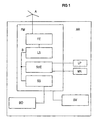
- Show 1 shows a radio module integrated into a car radio
- 2 shows the configuration of the radio module according to the invention.
- the radio module FM which is connected to an antenna A with a mobile radio system, not shown communicates.
- the antenna A is on a radio device FE turned on, the one RF transmitter and one receiver having.
- the radio device FE has a logic circuit LS connected.
- the logic circuit LS is used for digital Signal processing between the FM radio module and the mobile radio system transmitted data and to control the radio module FM itself.
- a signal converter SUE is used to process the analog voice signals, for example, through a speaker LP output or recorded by a microphone MK become.
- the signal converter SUE points to this A / D or D / A converter or codec circuits.
- the logic circuit LS and the signal converter SUE and a serial interface SS for example connected to each other via a bus B. Via the interface SS is a data exchange with external devices as well remote control of the radio module FM possible. On this remote control will be discussed in detail later.
- the radio module FM is in a consumer product, for example integrated an AR car radio.
- the MK microphone can be integrated into the AR car radio itself or it can be attached to the rearview mirror of a car his.
- a user interface BO is connected to the interface SS.
- the BO user interface is used to enter digits and for calling functions, and further for display of messages and digits. It is for example through the buttons already available and by the display device of the AR car radios implemented. On an existing one in the AR car radio Power supply SV, the radio module FM is also connected.
- the control or operation (remote control) of the Radio module FM takes place via the interface SS.
- the interface In the GSM recommendations 07.07 and 07.05 is an interface (Interface) specified for this purpose. Following these recommendations the interface is set up as a V.24 interface layer 1 (of the OSl layer model).
- a GSM command set AT Cellular
- the radio module is FM remote control, i.e. you can use the commands to send out Set up calls, accept incoming calls that are in the Radio module FM existing chip card (not in the drawing read out), receive short messages and other more.
- the radio module FM executes the commands and issues an answer about the failure or success.
- the FM radio module automatically generates messages about external function modules, that is, the display device of the User interface can be output. Granting this Commands, the evaluation of the answers, the implementation in a suitable user interface is the responsibility of the external Function modules, that is, those related to the radio module FM external user interface BO.
- FIG. 2 shows those necessary for understanding the invention Circuit details of the logic circuit LS shown.
- the logic circuit LS has a processor P, the one IO has input / output circuit.
- This input-output circuit IO is via a bus B for data and address connection connected to the interface SS.
- processor P On processor P are a program memory PS and a via a data address bus DAB Main memory AS switched on.
- the program memory PS contains an interface module SM, via which the send and receive routine for those exchanged via the SS interface Data expire.
- the program memory PS is preferably a flash EEPROM realized.
- the program memory PS contains no module, that realizes a user interface or through which a user interface could be controlled. Instead, there is a command module KM in the program memory PS implemented, via which the radio module FM using a GSM-specified command set is controllable. The control that is, the commands are supplied via the interface SS.
- an application module is in the program memory PS AM implemented.
- About address agreements between the KM command module and the AM application module established an internal implementation interface.
- the application-specific commands become an external application via the SS interface, i.e. in the embodiment of the user interface BO des AR car radios broadcast.
- Implementation interface from the application module AM to the command module KM A command for remote control of the radio module FM is given from the user interface BO of the car radio AR to the interface SS.
- the command goes from the interface SS to the application module AM, which converts this command into a GSM-specific command (AT Cellular) and writes it into a memory area VS in the working memory AS agreed with the command module KM.
- the application module AM informs the command module KM by calling up an agreed function address.
- the command module KM then reads the command from the working memory AS and executes it, that is to say, for example, a connection to a radio subscriber is established by the radio module FM.
- the radio module FM is called, for example, by an external radio subscriber. This message should be displayed on the BO user interface.
- the command module KM writes the command into a memory area VS in the working memory AS which has been agreed with the application module AM.
- the KM command module informs the AM application module by calling up an agreed function address.
- the AM application module then reads the command from the main memory AS, converts it into an application-specific command and displays the corresponding message on the BO user interface.
- the program memory PS has data exchange Interface module SM for the corresponding control of the Interface SS on.
- the data exchange between the user interface BO and radio module FM run as follows:
- the AT Cellular interface is located at the command level now in the FM radio module itself (for example V-24) interface SS become application-specific Commands used, for example for transportation the information of the user interface BO for the radio module FM, or the transfer of the strings to be displayed to the user interface BO.
- the application module AM can be retrofitted.
- One shipped from the factory Radio module FM has no such application module AM on, but this is subsequently in the logic circuit LS added.
- the application module AM can, for example be designed to be pluggable. It will then be added to the Logic circuit LS on a connected to the program memory PS Slot inserted.
- the retrofit can be done with Manufacturer of the consumer product, that is, in the embodiment at the manufacturer of the car radio AR.
- the factory A boot module BM implemented in the program memory PS.
- the program memory PS can the complete program and also parts of the program can be deleted and rewritten in segments. So modules can be added to the program memory PS are loaded, the data content via the interface SS becomes. For example, at the manufacturer of the AR car radio via the BM boot module, the AM application module into the free or in the previously deleted segments of the program memory PS loaded.
Landscapes
- Engineering & Computer Science (AREA)
- Signal Processing (AREA)
- Computer Networks & Wireless Communication (AREA)
- Mobile Radio Communication Systems (AREA)
Abstract
Description
Von der Bedienoberfläche BO des Autoradios AR wird ein Befehl zur Fernsteuerung des Funkmoduls FM an die Schnittstelle SS gegeben. Von der Schnittstelle SS geht der Befehl an das Applikationsmodul AM, das diesen Befehl in ein GSM-spezifisches Kommando (AT Cellular) umsetzt und in einen mit dem Kommandomodul KM vereinbarten Speicherbereich VS im Arbeitsspeicher AS schreibt. Das Applikationsmodul AM informiert das Kommandomodul KM durch Aufruf einer vereinbarten Funktionsadresse. Daraufhin liest das Kommandomodul KM das Kommando aus dem Arbeitsspeicher AS und führt es aus, das heißt durch das Funkmodul FM wird beispielsweise eine Verbindung zu einem Funkteilnehmer aufgebaut.
Das Funkmodul FM wird beispielsweise von einem externen Funkteilnehmer angerufen. Diese Meldung soll auf der Bedienoberfläche BO dargestellt werden. Das Kommandomodul KM schreibt das Kommando in einen mit dem Applikationsmodul AM vereinbarten Speicherbereich VS im Arbeitsspeicher AS. Das Kommandomodul KM informiert das Applikationsmodul AM durch Aufruf einer vereinbarten Funktionsadresse. Daraufhin liest das Applikationsmodul AM das Kommando aus dem Arbeitsspeicher AS, setzt es in einen applikationsspezifischen Befehl um und stellt die entsprechende Meldung auf der Bedienoberfläche BO dar.
Claims (4)
- Funkmodul (FM) zum Austausch digitaler Daten über Funk mit einer zentralen Basisstation eines Funksystems und/oder über diese mit weiteren, an das Funksystem angeschlossenen Teilnehmern,
mit einer Logikschaltung (LS) zur digitalen Signalverarbeitung und Steuerung der Datenkommunikation des Funksystems mit dem Funkmodul (FM),
mit einer mit der Logikschaltung (LS) in Verbindung stehenden Schnittstelle (SS) zur Anbindung einer externen Bedienoberfläche (BO),
bei dem die Logikschaltung (LS) ein Kommandomodul (KM) zur Fernsteuerung des Funkmoduls (FM) aufweist, und
bei dem die Logikschaltung (LS) ein Applikationsmodul (AM) zur Ansteuerung der externen Bedienoberfläche (BO) aufweist, wobei über Adressvereinbarungen zwischen dem Kommandomodul (KM) und dem Applikationsmodul (AM) eine interne Umsetzungsschnittstelle gebildet ist, so dass einerseits die vom Kommandomodul (KM) ausgegebenen Daten und Kommandos im Applikationsmodul (AM) ausgewertet und in für die Bedienoberfläche (BO) spezifische Daten und Befehle, und andrerseits die von der Bedienoberfläche (BO) ausgegebenen Daten und Befehle im Applikationsmodul (AM) ausgewertet und in Daten und Kommandos für das Kommandomodul (KM) umgesetzt werden. - Funkmodul (PM) nach Anspruch 1,
bei dem das Applikationsmodul (AM) nachrüstbar ausgebildet ist. - Funkmodul (FM) nach Anspruch 2,
bei dem das Applikationsmodul (AM) steckbar ausgebildet ist - Funkmodul (FM) nach Anspruch 2,
bei dem die Logikschaltung (LS) ein Bootmodul (BM) aufweist, durch das das Applikationsmodul (AM) in die Logikschaltung (LS) ladbar ist.
Applications Claiming Priority (3)
| Application Number | Priority Date | Filing Date | Title |
|---|---|---|---|
| DE19700622 | 1997-01-10 | ||
| DE19700622 | 1997-01-10 | ||
| PCT/DE1997/002287 WO1998031128A1 (de) | 1997-01-10 | 1997-10-06 | Funkmodul zur integration in externe funktionseinheiten |
Publications (2)
| Publication Number | Publication Date |
|---|---|
| EP0951772A1 EP0951772A1 (de) | 1999-10-27 |
| EP0951772B1 true EP0951772B1 (de) | 2003-03-05 |
Family
ID=7817107
Family Applications (1)
| Application Number | Title | Priority Date | Filing Date |
|---|---|---|---|
| EP97912041A Expired - Lifetime EP0951772B1 (de) | 1997-01-10 | 1997-10-06 | Funkmodul zur integration in externe funktionseinheiten |
Country Status (3)
| Country | Link |
|---|---|
| EP (1) | EP0951772B1 (de) |
| DE (1) | DE59709461D1 (de) |
| WO (1) | WO1998031128A1 (de) |
Families Citing this family (2)
| Publication number | Priority date | Publication date | Assignee | Title |
|---|---|---|---|---|
| US7376769B1 (en) * | 2000-09-14 | 2008-05-20 | Intel Corporation | Wireless computing device having an application and wireless subsystem and method therefore |
| DE602004032250D1 (de) * | 2003-10-10 | 2011-05-26 | Ericsson Telefon Ab L M | Mobil-endgerät-gateway |
Family Cites Families (2)
| Publication number | Priority date | Publication date | Assignee | Title |
|---|---|---|---|---|
| US5465401A (en) * | 1992-12-15 | 1995-11-07 | Texas Instruments Incorporated | Communication system and methods for enhanced information transfer |
| FR2703538B1 (fr) * | 1993-03-31 | 1995-05-19 | Alcatel Radiotelephone | Station d'un réseau de radiocommunication numérique à moyens d'échange de signaux de parole et moyens d'échange de signaux de données. |
-
1997
- 1997-10-06 WO PCT/DE1997/002287 patent/WO1998031128A1/de not_active Ceased
- 1997-10-06 EP EP97912041A patent/EP0951772B1/de not_active Expired - Lifetime
- 1997-10-06 DE DE59709461T patent/DE59709461D1/de not_active Expired - Lifetime
Also Published As
| Publication number | Publication date |
|---|---|
| WO1998031128A1 (de) | 1998-07-16 |
| DE59709461D1 (de) | 2003-04-10 |
| EP0951772A1 (de) | 1999-10-27 |
Similar Documents
| Publication | Publication Date | Title |
|---|---|---|
| EP1599991B1 (de) | Anordnung und schnittstellenmodul zur anbindung unterschiedlicher mobiler funktelefone an bedienkomponenten in einem kfz | |
| DE69923821T2 (de) | Verfahren zur Datenübertragung zwischen einem drahtlosen Gerät und einem elektronischen Gerät, und ein Datenübertragungsgerät | |
| DE60306735T2 (de) | Mobilkommunikationsgerät, Kommunikatsionsserver, Kommunikationssystem, Kommunikationssteuerungsverfahren und Kommunikationssteuerungsprogramm | |
| DE69328847T3 (de) | Mobiles Kommunikationsnetzwerk mit Femaktualisierung der Teilnehmerkennungsmodule in mobilen Endgeräten | |
| DE69304364T2 (de) | Datenadapter für Funktelefon | |
| DE69321858T2 (de) | Adapter zum Koppeln eines tragbaren Funktelefons an ein Mobiltelefon | |
| DE102008058442B4 (de) | Verbindungsverwaltung für eine Fahrzeugtelematikeinheit | |
| DE60108852T2 (de) | Fernsteuerschnittstelle zur umsetzung von funkfernsteuersignalen in infrarotfernsteuersignalen | |
| DE69721482T2 (de) | Tragbares multifunktionstelefon | |
| EP0929880B1 (de) | Bargeldlose bezahlung mit einem mobilfunkgerät | |
| EP1668839A1 (de) | Verfahren, telekommunikationssystem und telekommunikationshandapparat für die drahtlose kommunikation und telekommunikation in einer "smart home"-umgebung | |
| DE10219668A1 (de) | System zum Darbieten und Bezahlen von Produkten und Dienstleistungen für mobilen E-Commerce | |
| WO2000067429A1 (de) | Datenaustauschsystem mit einem mobilteil zur ansteuerung von verbrauchern | |
| DE10007806C2 (de) | Verfahren zum Betrieb eines in einem Fahrzeug eingebauten Funkgeräts und eines tragbaren Funktelefons | |
| EP0669746B1 (de) | Personalcomputer mit einer Verbindung zu einem Kommunikationsendgerät eines drahtlosen Fernsprechsystems | |
| EP0670637A2 (de) | Mobilfunkanlage für drahtlose Daten-und Fernsprechübertragung | |
| EP0670638A2 (de) | Mobilfunkanlage im PCMCIA-Standard | |
| DE4107998A1 (de) | Mobiltelefonanordnung | |
| DE10143701A1 (de) | Verfahren zum Wiederauffinden einer Mitteilung bei einem mobilen Telekommunikationsendgerät | |
| EP0951772A1 (de) | Funkmodul zur integration in externe funktionseinheiten | |
| EP1737135A1 (de) | Auto-Telefonanlage | |
| DE19521453A1 (de) | Vorrichtung und Verfahren zur drahtlosen Kommunikation mit einer Datenverarbeitungseinrichtung | |
| DE60026664T2 (de) | Informations-, Kommunikations- und Unterhaltungssystem für ein Fahrzeug | |
| DE19632108C2 (de) | Kommunikationssystem mit einer mobilen Telefoneinrichtung und einer Modemeinrichtung mit einer Einrichtung zum Übertragen eines Telefontreibers, Kommunikationsverfahren dafür und mobile Telefoneinrichtung | |
| EP0896488A1 (de) | Mobilfunkgerät sowie System zur Funkkommunikation unter Verwendung mindestens zweier Funksysteme |
Legal Events
| Date | Code | Title | Description |
|---|---|---|---|
| PUAI | Public reference made under article 153(3) epc to a published international application that has entered the european phase |
Free format text: ORIGINAL CODE: 0009012 |
|
| 17P | Request for examination filed |
Effective date: 19990706 |
|
| AK | Designated contracting states |
Kind code of ref document: A1 Designated state(s): DE FR GB IT |
|
| 17Q | First examination report despatched |
Effective date: 20010613 |
|
| GRAH | Despatch of communication of intention to grant a patent |
Free format text: ORIGINAL CODE: EPIDOS IGRA |
|
| GRAH | Despatch of communication of intention to grant a patent |
Free format text: ORIGINAL CODE: EPIDOS IGRA |
|
| GRAA | (expected) grant |
Free format text: ORIGINAL CODE: 0009210 |
|
| AK | Designated contracting states |
Designated state(s): DE FR GB IT |
|
| REG | Reference to a national code |
Ref country code: GB Ref legal event code: FG4D Free format text: NOT ENGLISH |
|
| REF | Corresponds to: |
Ref document number: 59709461 Country of ref document: DE Date of ref document: 20030410 Kind code of ref document: P |
|
| GBT | Gb: translation of ep patent filed (gb section 77(6)(a)/1977) | ||
| ET | Fr: translation filed | ||
| PLBE | No opposition filed within time limit |
Free format text: ORIGINAL CODE: 0009261 |
|
| STAA | Information on the status of an ep patent application or granted ep patent |
Free format text: STATUS: NO OPPOSITION FILED WITHIN TIME LIMIT |
|
| 26N | No opposition filed |
Effective date: 20031208 |
|
| REG | Reference to a national code |
Ref country code: FR Ref legal event code: TP |
|
| REG | Reference to a national code |
Ref country code: GB Ref legal event code: 732E Free format text: REGISTERED BETWEEN 20091022 AND 20091028 |
|
| REG | Reference to a national code |
Ref country code: GB Ref legal event code: 732E Free format text: REGISTERED BETWEEN 20091105 AND 20091111 |
|
| REG | Reference to a national code |
Ref country code: FR Ref legal event code: GC |
|
| REG | Reference to a national code |
Ref country code: FR Ref legal event code: RG |
|
| REG | Reference to a national code |
Ref country code: DE Ref legal event code: R082 Ref document number: 59709461 Country of ref document: DE Representative=s name: EISENFUEHR, SPEISER & PARTNER, DE |
|
| REG | Reference to a national code |
Ref country code: DE Ref legal event code: R082 Ref document number: 59709461 Country of ref document: DE Representative=s name: GREVIN, EMMANUEL, FR Effective date: 20130522 Ref country code: DE Ref legal event code: R082 Ref document number: 59709461 Country of ref document: DE Representative=s name: EISENFUEHR, SPEISER & PARTNER, DE Effective date: 20130522 Ref country code: DE Ref legal event code: R081 Ref document number: 59709461 Country of ref document: DE Owner name: GEMALTO M2M GMBH, DE Free format text: FORMER OWNER: CINTERION WIRELESS MODULES GMBH, 81669 MUENCHEN, DE Effective date: 20130522 |
|
| REG | Reference to a national code |
Ref country code: DE Ref legal event code: R082 Ref document number: 59709461 Country of ref document: DE Representative=s name: GREVIN, EMMANUEL, FR |
|
| REG | Reference to a national code |
Ref country code: FR Ref legal event code: PLFP Year of fee payment: 20 |
|
| PGFP | Annual fee paid to national office [announced via postgrant information from national office to epo] |
Ref country code: GB Payment date: 20160928 Year of fee payment: 20 |
|
| PGFP | Annual fee paid to national office [announced via postgrant information from national office to epo] |
Ref country code: FR Payment date: 20160921 Year of fee payment: 20 |
|
| PGFP | Annual fee paid to national office [announced via postgrant information from national office to epo] |
Ref country code: DE Payment date: 20160922 Year of fee payment: 20 |
|
| PGFP | Annual fee paid to national office [announced via postgrant information from national office to epo] |
Ref country code: IT Payment date: 20160923 Year of fee payment: 20 |
|
| REG | Reference to a national code |
Ref country code: DE Ref legal event code: R071 Ref document number: 59709461 Country of ref document: DE |
|
| REG | Reference to a national code |
Ref country code: GB Ref legal event code: PE20 Expiry date: 20171005 |
|
| PG25 | Lapsed in a contracting state [announced via postgrant information from national office to epo] |
Ref country code: GB Free format text: LAPSE BECAUSE OF EXPIRATION OF PROTECTION Effective date: 20171005 |