EP0951668B1 - Navigation in einer virtuellen umgebung - Google Patents
Navigation in einer virtuellen umgebung Download PDFInfo
- Publication number
- EP0951668B1 EP0951668B1 EP98945482A EP98945482A EP0951668B1 EP 0951668 B1 EP0951668 B1 EP 0951668B1 EP 98945482 A EP98945482 A EP 98945482A EP 98945482 A EP98945482 A EP 98945482A EP 0951668 B1 EP0951668 B1 EP 0951668B1
- Authority
- EP
- European Patent Office
- Prior art keywords
- virtual environment
- image
- user
- data
- objects
- Prior art date
- Legal status (The legal status is an assumption and is not a legal conclusion. Google has not performed a legal analysis and makes no representation as to the accuracy of the status listed.)
- Expired - Lifetime
Links
Images



Classifications
-
- G—PHYSICS
- G06—COMPUTING OR CALCULATING; COUNTING
- G06F—ELECTRIC DIGITAL DATA PROCESSING
- G06F3/00—Input arrangements for transferring data to be processed into a form capable of being handled by the computer; Output arrangements for transferring data from processing unit to output unit, e.g. interface arrangements
- G06F3/01—Input arrangements or combined input and output arrangements for interaction between user and computer
- G06F3/048—Interaction techniques based on graphical user interfaces [GUI]
- G06F3/0481—Interaction techniques based on graphical user interfaces [GUI] based on specific properties of the displayed interaction object or a metaphor-based environment, e.g. interaction with desktop elements like windows or icons, or assisted by a cursor's changing behaviour or appearance
- G06F3/04815—Interaction with a metaphor-based environment or interaction object displayed as three-dimensional [3D], e.g. changing the user viewpoint with respect to the environment or object
-
- A—HUMAN NECESSITIES
- A63—SPORTS; GAMES; AMUSEMENTS
- A63F—CARD, BOARD, OR ROULETTE GAMES; INDOOR GAMES USING SMALL MOVING PLAYING BODIES; VIDEO GAMES; GAMES NOT OTHERWISE PROVIDED FOR
- A63F2300/00—Features of games using an electronically generated display having two or more dimensions, e.g. on a television screen, showing representations related to the game
- A63F2300/80—Features of games using an electronically generated display having two or more dimensions, e.g. on a television screen, showing representations related to the game specially adapted for executing a specific type of game
- A63F2300/8082—Virtual reality
Definitions
- the present invention relates to apparatus for accessing, from a remote source, data defining a graphical representation of a virtual environment, with the user being enabled to navigate by selecting and controllably altering a viewpoint within the virtual environment, the apparatus having means for rendering a display of the virtual environment from that viewpoint.
- a description of a service providing a virtual environment (or cyber-space) accessible by remote users is given in European patent application EP-A-0 697 613 (Sony Corp.).
- the system described includes a server providing a virtual reality space, and user terminals connected to the server via a high-speed communications network (using optical fibres or the like).
- the server maintains a number of virtual environments and supports many differing terminal types by the use of conversion objects between information objects and user objects: the conversion objects provide individually tailored translation for communications back and forth between each type of terminal and each configuration of virtual environment supported.
- a particular benefit arises when the format of data storage and representation for virtual environments is at least partially standardised, allowing for greater interchange between systems of different manufacturers as well as a reduction in the necessity for individually tailored translation utilities. With at least partial standardisation, the necessary configuration of a browser for accessing such data, whether in hardware or software implementation or a mixture of the two, becomes simpler.
- VRML Virtual Reality Modelling Language
- FIG. 1 A notable example of standardisation in the field of data defining virtual environments is the so-called Virtual Reality Modelling Language (VRML) as described, for example, in the VRML standard, version 2.0, issued as ISO/IEC WD14772 on 4th August 1996.
- VRML is a file format for describing interactive three-dimensional objects and worlds to be experienced on the Internet/World Wide Web and it is generally analogous to the way HTML (HyperText Markup Language) is used to describe documents for transmission over the Internet.
- HTML HyperText Markup Language
- a number of examples of VRML browsers are discussed in "Building VRML Worlds" by E. Tittel et al, published by McGraw Hill 1997, ISBN 0-07-882233-5, at pages 26 to 31.
- the functionalities of the different browsers depend to a large extent on their target host system and the likely uses of the same, as well as whether they are purpose-built/written or whether they are modifications of earlier utilities.
- An indication of the separation or distance between the viewpoint and artefact may be determined such that the pose adopted by the artefact may alter as the viewpoint approaches or moves away from the artefact.
- the problem is one of perception coupled with expectation: even where the virtual environment is a close simulation of a real-world scenario, the inexperienced user may be put off by the process of learning a new way to navigate what should be a familiar situation. Because of the possibilities offered to the designer, many virtual environments present exotic and fantastic scenarios that even the experienced "virtual navigator" can find difficulty with at first.
- a data processing apparatus configured as a virtual environment data browser, the apparatus comprising a processor coupled with at least one memory device and data network interface means capable of receiving data defining a virtual environment and objects therein when coupled to a data network including a source of such data, the apparatus further comprising user input means and rendering means configured to periodically generate an image based on said data defining the virtual environment and objects and from a viewpoint at a location and with an orientation in said virtual environment determined at least partially by input from said user input means; characterised in that the apparatus further comprises a clip store containing data defining the appearance of a further virtual environment object when viewed from a plurality of directions, the rendering means being configured to generate an image of said further virtual environment object from a one of said plurality of directions determined by the user input commands to move said viewpoint, to patch said generated image into the image of the virtual environment and to generate an image based on said data defining the virtual environment and objects to relocate said viewpoint such that the object appears in front of the user and follows the user's navigational commands
- This locally stored and clipped-in object appears in front of the user and follows the user's navigational commands, giving a quicker understanding of the effects of particular control operations in the context of their result in the virtual environment. Due to the local storage within the browser of this "guiding" object, the same object (which might represent a cartoon character, for example) provides the user with a familiar point of reference when navigating unfamiliar environments.
- the apparatus clip store preferably contains data for at least one different further virtual environment object (guiding object) for each mode.
- guiding object a different further virtual environment object
- the apparatus may suitably be configured to detect such specification and to automatically select an appropriate further virtual environment object.
- the clip store may contain data defining a plurality of further virtual environment objects, with the apparatus being further configured to generate a display of said objects from which the user may select one such object.
- the selection may be made from a menu or line-up of the objects, requiring one or more user operations of the user input means to select a particular guiding object: in such circumstances, it is preferable that the same controls as the user employs for navigating are used for selection of the guiding object.
- the apparatus may suitably be configured to detect said specification and cause the rendering means to increase or decrease the size of the image of the further virtual environment object in accordance with this scale factor prior to patching of the rendered image into the image of the virtual environment.
- the received scale factor may comprise an indication of what, in terms of the virtual environment co-ordinate system, comprises a height of 1 metre thereby allowing the browser to scale the guiding object to an appropriate size in terms of the environment.
- this scaling of the guiding object may be controlled by the user, such as to reduce the size of an object that they would otherwise consider obtrusive.
- the browser may enable the user to disable the generation and patching in of the image of the further virtual environment object, effectively switching off the guiding object, which may be desirable once the user has become comfortable with the navigational controls.
- Figure 1 represents a data processing system, such as a personal computer, which acts as host for a software utility that configures the system as a browser for data defining a virtual environment.
- the system comprises a central processing unit (CPU) 10 coupled via an address and data bus 12 to random-access (RAM) and read-only (ROM) memory devices 14, 16.
- RAM random-access
- ROM read-only
- the capacity of these memory devices may be augmented by providing the system with means to read from additional memory devices, such as a CD-ROM.
- first and second user input devices 18, 20 which may suitably comprise a keyboard and a cursor control and selection device such as a mouse or trackball.
- Audio output from the system is via one or more speakers 22 driven by an audio processing stage 24; in addition to providing amplification, the audio processing stage is preferably also configured to provide a signal processing capability under the control of the CPU 10 to allow the addition of sound treatments such as echo to existing audio data.
- Video output from the system is presented on display screen 26 driven by display driver stage 28 under control of the CPU 10.
- a further source of data for the system is via online link to remote sites, for example via the Internet, to which end the system is provided with a network interface 30 coupled to the bus 12.
- the precise construction of the interface is not an essential feature of the present invention, although it will be recognised that the interface configuration will depend on the type of data network to which the system is to be coupled: for example, where the system is for use by a private home user, the data link is likely to be a telephone connection to a local service provider. In such a case, the interface 30 will suitably incorporate a modem. For other types of data link, such as an ISDN connection, the interface will be configured accordingly.
- FIG 2 the inter-relationship of a number of functions assembled to configure the hardware of Figure 1 as a browser is illustrated.
- the functions in the example illustrated are particularly suited for browsing virtual environments defined in accordance with the VRML standard, version 2.0, issued as ISO/IEC WD14772 on 4th August 1996, although it will be understood that the present invention is not restricted by, or limited to, conformance with this standard. Only those functions particularly required to support the navigational aid provided by the guiding object will be described in detail. A fuller description of the remaining features is given in the commonly assigned International Patent Application WO98/54636A2 published 3 rd December 1998.
- the browser is based around a scene manager 40 coupled with respective stores for functions 42, assets 44, and a hierarchy of scene nodes 52.
- the function, asset and hierarchy stores will generally be held in RAM 14, although some of the assets (including the clip-in files specifying the appearance of the various guiding objects as well as, for example, standardised texture maps) may be provided via off-line storage such as CD-ROM.
- the browser implementation program is suitably held in ROM 16, optionally linked to the boot-up utility of the system.
- Also coupled with the scene manager are four interfaces (IF.1-IF.4) 46-49 and a clock 50.
- the first of the four interfaces 46 corresponds in part to interface 30 of Figure 1 in that it represents the source of data received via the Internet: as represented by dashed line 54, the received data may be passed on from the interface to other (not shown) destinations, such as a further browser for HTML content in the received data.
- the first interface is the general arrival point for the data defining the virtual environment and, as such, it may also receive data from more local sources such as storage on the system RAM (14; Fig.1) or a CD-ROM.
- the data passes to a parsing stage 56 which divides it into data defining or relating to assets (which data is then passed to store 44) and data defining or relating to the run-time node hierarchy (which data is then passed to store 52).
- data defining or relating to assets which data is then passed to store 44
- data defining or relating to the run-time node hierarchy which data is then passed to store 52.
- the data held by the browser will suitably be a URL (uniform resource locator) so that the browser can simply call up the data, via the first interface IF.1, when the need for it becomes imminent.
- the second interface 47 is an external API (application programming interface) comprising a set of interfacing subroutines required to enable multiple-user extensions to the system, such as two or more users having respective viewpoints within a common environment.
- external API application programming interface
- the third interface 48 is for operational segments used to program behaviour in a scene: these segments are referred to in VRML as script nodes.
- the script nodes contain a program module which, in response to a change or user action within a scene, effect a change somewhere else in the scene depending on the contents of the program module.
- the program modules may suitably contain Java ® language segments (Java is the object-oriented platform-independent and general-purpose programming environment developed by Sun Microsystems Inc).
- the third interface 48 provides a path to a Java interpreter which converts the Java segments from their platform-independent form to a form recognised by the host system.
- script nodes may include a locally stored group associated with the clip-in guidance objects, such that the stored data defining the appearance of the object from multiple viewpoints may comprise a collection of three-dimensional VRML objects with a linking hierarchy defining their assembly to a three-dimensional guide character whose actions are partially straightforward responses to user navigational input, and partially due to one or more associated script nodes controlling a limited animation of the character.
- the components may assemble to a humanoid guide object that beckons or starts to jump up and down if the user does not input navigational commands for a predetermined period.
- the fourth interface 49 handles the passing of signals from (and in some instances to) the user input devices.
- the functions (functional modules) held in store 42 include an audio manager, an MPEG decoder, features for node run-time implementations (such as collision detectors, three-dimensional pickers, viewpoint control (handling changes to the viewpoint location and/or orientation from which the image of the virtual environment is to be generated, in response to program instruction or user input), and routing mechanisms.
- features for node run-time implementations such as collision detectors, three-dimensional pickers, viewpoint control (handling changes to the viewpoint location and/or orientation from which the image of the virtual environment is to be generated, in response to program instruction or user input), and routing mechanisms.
- the assets within store 44 are the basic building blocks and operational features from which the virtual environment is built up. These include three-dimensional geometry (defining the configuration and relative location of the polygons to be assembled for the virtual environment), textures, audio data, Java ® code, user interaction data (for example, viewpoint control modes, identification of different user input devices and so forth), and MPEG data.
- the further store for run-time structures 52 contains the VRML scene graph together with routes to allow dynamic behaviour.
- the scene graph is a hierarchical file specifying the connections between the various geometrical components making up an object within the virtual environment.
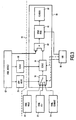
- FIG. 3 shows how various of the stored assets and internal functions of the browser of Figure 2 operate to provide the guide character or object.
- Dashed line 60 illustrates the division between those features provided by a remote source, including the VRML world (virtual environment) data from source 62, and those local to (and within) the browser, represented by box 64.
- VRML world virtual environment
- the browser 64 includes a VRML engine 66 which "builds" the virtual world based on stored three-dimensional geometry data, textures, and other contributing data including scripted run-time animations. All of these features are combined by the engine 66 into a data stream to renderer 68 which assembles and periodically updates the image provided to the user of the virtual environment.
- Coupled with the browser 64 are three stored clip-in files 70,72,74, each containing data defining one or more guide objects, with each stored filed being associated with a different mode for travelling through/interacting with the virtual environment.
- These files may suitably be stored in system ROM (16; Figure 1) or loaded from an external source (e.g CD-ROM).
- the different modes represented are "walking" for the clip-in file 70: as with the motion of the user's viewpoint, the guide object will be capable of motion predominantly in two dimensions (although climbing stairs, walking up ramps etc may be accommodated).
- the second mode for which the guide character specified in clip-in file 72 is designed is "flying" where the user has freedom of motion in three dimensions.
- the third mode is "examining" for which the guide object specified by clip-in file 74 may be under more direct user control, for example a simulation of a human hand which may be controlled to interact with other objects within the virtual environment.
- switch 76 Accessing the stored clip-in files, and selecting between them is switch 76.
- the external source of the virtual environment includes a specification (from 78) of the most appropriate navigation mode for the particular environment currently being downloaded, this specification may be passed as shown to the switch 76 which automatically selects the appropriate clip-in file and hence the appropriate guide object.
- user input from UID 80 may determine the selection of the user's desired navigational guide object.
- the output from switch 76 may be passed direct to a mixer 82 which adds the data defining the guide object to that defining the virtual environment and objects therein, as received from the remote source 62, such that the guide object will appear in the rendered image of the environment, with an object direction and/or orientation selected according to the input from UID 80, which input suitably thereafter effects relocation of the user viewpoint within the virtual environment.
- the guide object data is treated by scaling unit 84 to provide a guide in proportion to the virtual environment.
- An appropriate scaling factor may be included in the externally supplied data (from 86) or, as with the clip selection, it may be chosen in response to user input.
- Figure 4 schematically represents the operation of the guide object showing an image of a virtual environment 90 generated by browser 64 on the basis of data received from remote source 62 and in response to commands from UID 80.
- the image of the guide object 92 appears.
- This object 92 is preferably a predetermined distance (in terms of the co-ordinate system of the virtual environment) ahead of the user viewpoint location, such that it remains in view at all times.
- the UID 80 may comprise a number of specialist controls for navigation within a virtual environment: it should be noted that the following navigational controls should not be taken as essential features, nor as the only possible controls, but only as examples of what may be provided.
- the UID 80 may suitably include four keys 94,96,98,100 specifying movement in differing directions. Where only two dimensional movement is supported, the keys may support forward 94, backward 98, right 96 or left 100 motion. Where movement in three dimensions is supported, the keys may specify up 94, down 98, right 96, left 100, and forwards horizontally (94 and 98 together). A further key 102 may cause the object to rotate about a vertical axis, as indicated.
- Further specialist keys may be provided to increase (104) or decrease (106) the size of the guide character relative to its surroundings, to change the selected form of the guide character (108), or to switch it off altogether (110) as may be desired once the user feels confident navigating the virtual environment and no longer requires the assistance of the guide object.
Landscapes
- Engineering & Computer Science (AREA)
- General Engineering & Computer Science (AREA)
- Theoretical Computer Science (AREA)
- Human Computer Interaction (AREA)
- Physics & Mathematics (AREA)
- General Physics & Mathematics (AREA)
- Processing Or Creating Images (AREA)
- Navigation (AREA)
Claims (8)
- Datenverarbeitungsanordnung, ausgebildet als ein virtueller Umgebungsdatenbrowser (64), wobei die Anordnung einen Prozessor aufweist, der mit wenigstens einer Speicheranordnung gekoppelt ist, und Datennetzwerkschnittstellenmittel, die imstande sind, Daten zu empfangen, die eine virtuelle Umgebung und Gegenstände darin definieren, wenn mit einem Datennetzwerk gekoppelt, das eine Quelle (62) derartiger Daten enthält, wobei die Anordnung weiterhin Benutzereingabemittel (80) und Renderungsmittel (68) aufweist, ausgebildet zum periodischen Erzeugen eines Bildes (90) auf Basis der genannten Daten, welche die virtuelle Umgebung und Gegenstände definieren und von einem Gesichtspunkt an einer Stelle und mit einer Orientierung in der genannten virtuellen Umgebung wenigstens teilweise durch Eingabe von den genannten Benutzereingabemitteln aus bestimmt; dadurch gekennzeichnet, dass die Anordnung weiterhin einen Clipspeicher aufweist, der Daten (70, 72, 74) enthält, die das Bild eines weiteren virtuellen Umgebungsgegenstandes definieren, wenn aus vielen Richtungen betrachtet, wobei die Renderungsmittel dazu vorgesehen sind, ein Bild des genannten weiteren virtuellen Umgebungsgegenstandes (92) zu erzeugen, und zwar aus einer bestimmten Richtung der genannten vielen Richtungen, bestimmt durch die Benutzereingabebefehle zum Verlagern des genannten Gesichtspunktes, zum Einsetzen des genannten erzeugten Bildes in das Bild der virtuellen Umgebung und zum Erzeugen eines Bildes auf Basis der genannten Daten, welche die virtuelle Umgebung und Gegenstände definieren zum Verlagern des genannten Gesichtspunktes derart, dass der Gegenstand vor dem Benutzer erscheint und den Navigationsbefehlen des Benutzers folgt.
- Anordnung nach Anspruch 1, wobei die virtuelle Umgebung zwei oder mehr verschiedene Moden für Bewegung innerhalb der Umgebung unterstützt, und der Clipspeicher der Anordnung Daten enthält für wenigstens einen anderen weiteren virtuellen Umgebungsgegenstand für jede derartige Mode.
- Anordnung nach Anspruch 2, wobei die empfangenen Daten, welche die virtuelle Umgebung definieren eine Spezifikation einer Mode für Bewegung enthalten (78), wobei die Anordnung dazu vorgesehen ist, die genannte Spezifikation zu detektieren und automatisch einen geeigneten virtuellen Umgebungsgegenstand zu selektieren.
- Anordnung nach Anspruch 1, wobei der genannte Clipspeicher Daten enthält, die eine Anzahl weiterer virtueller Umgebungsgegenstände definieren, wobei die Anordnung ausgelegt ist zum Erzeugen einer Wiedergabe der genannten Gegenstände, aus denen der Benutzer einen selektieren kann, der in eine virtuelle Umgebung eingepasst werden soll, auf die danach zugegriffen wird.
- Anordnung nach Anspruch 4, wobei die genannte Benutzerselektion eines weiteren virtuellen Umgebungsgegenstandes eine oder mehrere Benutzeroperationen der genannten Benutzereingabemittel erfordert.
- Anordnung nach einem der Ansprüche 1 bis 5, wobei die empfangenen Daten, welche die virtuelle Umgebung definieren, eine Spezifikation des Skalierungsfaktors (86) enthalten, wobei die Anordnung ausgelegt ist zum Detektieren der genannten Spezifikation und dafür sorgt, dass die Renderungsmittel bevor das genannte Bild in das Bild der virtuellen Umgebung eingepasst wird, das Format des Bildes des weiteren virtuellen Umgebungsgegenstandes entsprechend dem Skalierungsfaktor vergrößern oder verkleinern.
- Anordnung nach einem der Ansprüche 1 bis 5, wobei die Anordnung in Reaktion auf Benutzereingabe funktioniert zum Vergrößern oder Verkleinern des Formats des gerenderten Bildes des weiteren virtuellen Umgebungsgegenstandes in Bezug auf das Bild der virtuellen Umgebung.
- Anordnung nach einem der vorstehenden Ansprüche, wobei diese Anordnung weiterhin in Reaktion auf einen Benutzerbefehl wirksam ist mit der Erzeugung und Einpassung des genannten Bildes des weiteren virtuellen Umgebungsgegenstandes aufzuhören.
Applications Claiming Priority (3)
| Application Number | Priority Date | Filing Date | Title |
|---|---|---|---|
| GB9721667 | 1997-10-14 | ||
| GBGB9721667.5A GB9721667D0 (en) | 1997-10-14 | 1997-10-14 | Virtual environment navigation aid |
| PCT/IB1998/001590 WO1999019787A2 (en) | 1997-10-14 | 1998-10-12 | Virtual environment navigation aid |
Publications (2)
| Publication Number | Publication Date |
|---|---|
| EP0951668A2 EP0951668A2 (de) | 1999-10-27 |
| EP0951668B1 true EP0951668B1 (de) | 2004-08-25 |
Family
ID=10820466
Family Applications (1)
| Application Number | Title | Priority Date | Filing Date |
|---|---|---|---|
| EP98945482A Expired - Lifetime EP0951668B1 (de) | 1997-10-14 | 1998-10-12 | Navigation in einer virtuellen umgebung |
Country Status (6)
| Country | Link |
|---|---|
| US (2) | US6995759B1 (de) |
| EP (1) | EP0951668B1 (de) |
| JP (1) | JP4465049B2 (de) |
| DE (1) | DE69825863T2 (de) |
| GB (1) | GB9721667D0 (de) |
| WO (1) | WO1999019787A2 (de) |
Families Citing this family (31)
| Publication number | Priority date | Publication date | Assignee | Title |
|---|---|---|---|---|
| US6775835B1 (en) * | 1999-07-30 | 2004-08-10 | Electric Planet | Web based video enhancement apparatus method and article of manufacture |
| US6381534B2 (en) * | 2000-02-14 | 2002-04-30 | Fujitsu Limited | Navigation information presenting apparatus and method thereof |
| GB0222554D0 (en) * | 2002-09-28 | 2002-11-06 | Koninkl Philips Electronics Nv | Data processing system and method of operation |
| US20050140696A1 (en) * | 2003-12-31 | 2005-06-30 | Buxton William A.S. | Split user interface |
| DE102005035908A1 (de) * | 2005-07-28 | 2007-02-08 | X-Aitment Gmbh | Taktische Analyse von Closed Combat Situationen |
| US20090079745A1 (en) * | 2007-09-24 | 2009-03-26 | Wey Fun | System and method for intuitive interactive navigational control in virtual environments |
| KR102597520B1 (ko) * | 2007-09-26 | 2023-11-06 | 에이큐 미디어 인크 | 오디오-비주얼 내비게이션 및 통신 |
| US8407605B2 (en) | 2009-04-03 | 2013-03-26 | Social Communications Company | Application sharing |
| US9357025B2 (en) | 2007-10-24 | 2016-05-31 | Social Communications Company | Virtual area based telephony communications |
| US7769806B2 (en) | 2007-10-24 | 2010-08-03 | Social Communications Company | Automated real-time data stream switching in a shared virtual area communication environment |
| US20090288007A1 (en) * | 2008-04-05 | 2009-11-19 | Social Communications Company | Spatial interfaces for realtime networked communications |
| US8397168B2 (en) | 2008-04-05 | 2013-03-12 | Social Communications Company | Interfacing with a spatial virtual communication environment |
| JP4650503B2 (ja) * | 2008-02-29 | 2011-03-16 | ソニー株式会社 | 情報処理装置、情報表示方法およびコンピュータプログラム |
| CN102084354A (zh) * | 2008-04-05 | 2011-06-01 | 社会传播公司 | 基于共享虚拟区域通信环境的装置和方法 |
| US9310992B2 (en) * | 2008-08-22 | 2016-04-12 | Google Inc. | Panning in a three dimensional environment on a mobile device |
| JP5721634B2 (ja) | 2008-12-05 | 2015-05-20 | ソーシャル・コミュニケーションズ・カンパニー | リアルタイムカーネル |
| US9319357B2 (en) | 2009-01-15 | 2016-04-19 | Social Communications Company | Context based virtual area creation |
| US9853922B2 (en) | 2012-02-24 | 2017-12-26 | Sococo, Inc. | Virtual area communications |
| US9065874B2 (en) | 2009-01-15 | 2015-06-23 | Social Communications Company | Persistent network resource and virtual area associations for realtime collaboration |
| US9288242B2 (en) | 2009-01-15 | 2016-03-15 | Social Communications Company | Bridging physical and virtual spaces |
| CA2686991A1 (en) * | 2009-12-03 | 2011-06-03 | Ibm Canada Limited - Ibm Canada Limitee | Rescaling an avatar for interoperability in 3d virtual world environments |
| CN103154982A (zh) | 2010-08-16 | 2013-06-12 | 社会传播公司 | 促进网络通信环境中的通信者交互 |
| KR20130077877A (ko) | 2010-09-11 | 2013-07-09 | 소우셜 커뮤니케이션즈 컴퍼니 | 가상 영역 컨텍스트에서 관계 기반 존재 표시 |
| TWI460601B (zh) * | 2010-12-16 | 2014-11-11 | Ind Tech Res Inst | 用於資訊致動的物件關聯系統與方法以及計算機系統 |
| DE102010061642A1 (de) | 2010-12-30 | 2012-07-05 | Condominio Los Cataros | Verfahren zur Erstellung von Planungsunterlagen |
| WO2012118917A2 (en) | 2011-03-03 | 2012-09-07 | Social Communications Company | Realtime communications and network browsing client |
| WO2012135231A2 (en) | 2011-04-01 | 2012-10-04 | Social Communications Company | Creating virtual areas for realtime communications |
| JP5586545B2 (ja) * | 2011-09-09 | 2014-09-10 | 任天堂株式会社 | ゲームシステム、携帯型ゲーム装置、情報処理部の制御方法、および情報処理部の制御プログラム |
| WO2013119802A1 (en) | 2012-02-11 | 2013-08-15 | Social Communications Company | Routing virtual area based communications |
| US8532675B1 (en) | 2012-06-27 | 2013-09-10 | Blackberry Limited | Mobile communication device user interface for manipulation of data items in a physical space |
| CN114632326B (zh) * | 2022-03-17 | 2025-10-10 | 网易(杭州)网络有限公司 | 一种画面显示方法、装置、电子设备及可读存储介质 |
Family Cites Families (4)
| Publication number | Priority date | Publication date | Assignee | Title |
|---|---|---|---|---|
| EP0697613B1 (de) | 1994-08-19 | 2005-10-19 | Sony Corporation | Cyberspace-System |
| GB9606129D0 (en) * | 1996-03-22 | 1996-05-22 | Philips Electronics Nv | Virtual environment navigation and interaction apparatus |
| US6058397A (en) * | 1997-04-08 | 2000-05-02 | Mitsubishi Electric Information Technology Center America, Inc. | 3D virtual environment creation management and delivery system |
| US6052123A (en) * | 1997-05-14 | 2000-04-18 | International Business Machines Corporation | Animation reuse in three dimensional virtual reality |
-
1997
- 1997-10-14 GB GBGB9721667.5A patent/GB9721667D0/en not_active Ceased
-
1998
- 1998-10-12 EP EP98945482A patent/EP0951668B1/de not_active Expired - Lifetime
- 1998-10-12 JP JP52136799A patent/JP4465049B2/ja not_active Expired - Fee Related
- 1998-10-12 DE DE69825863T patent/DE69825863T2/de not_active Expired - Fee Related
- 1998-10-12 WO PCT/IB1998/001590 patent/WO1999019787A2/en not_active Ceased
- 1998-10-13 US US09/170,468 patent/US6995759B1/en not_active Expired - Fee Related
-
2005
- 2005-11-10 US US11/271,474 patent/US7184037B2/en not_active Expired - Fee Related
Also Published As
| Publication number | Publication date |
|---|---|
| JP4465049B2 (ja) | 2010-05-19 |
| DE69825863D1 (de) | 2004-09-30 |
| US20060061568A1 (en) | 2006-03-23 |
| JP2001506038A (ja) | 2001-05-08 |
| US6995759B1 (en) | 2006-02-07 |
| DE69825863T2 (de) | 2005-08-11 |
| EP0951668A2 (de) | 1999-10-27 |
| WO1999019787A3 (en) | 1999-07-29 |
| WO1999019787A2 (en) | 1999-04-22 |
| GB9721667D0 (en) | 1997-12-10 |
| US7184037B2 (en) | 2007-02-27 |
Similar Documents
| Publication | Publication Date | Title |
|---|---|---|
| EP0951668B1 (de) | Navigation in einer virtuellen umgebung | |
| KR100624804B1 (ko) | Web 기반 3d-화상 디스플레이 시스템 | |
| US6552721B1 (en) | Graphic data generating apparatus, graphic data generation method, and medium of the same | |
| US6262734B1 (en) | Graphic data generating apparatus, graphic data generation method, and medium of the same | |
| US6144381A (en) | Systems, methods and computer program products for compass navigation of avatars in three dimensional worlds | |
| EP0753835B1 (de) | Verfahren zum anteiligen Nutzen eines dreidimensionalen Raumes in virtueller Realität und System dafür | |
| US6363404B1 (en) | Three-dimensional models with markup documents as texture | |
| US6331853B1 (en) | Display control apparatus display control method and presentation medium | |
| US5956039A (en) | System and method for increasing performance by efficient use of limited resources via incremental fetching, loading and unloading of data assets of three-dimensional worlds based on transient asset priorities | |
| US6518989B1 (en) | Graphic data generating apparatus, graphic data generation method, and medium of the same | |
| US6401237B1 (en) | Method and apparatus for editing data used in creating a three-dimensional virtual reality environment | |
| US20020085041A1 (en) | Method and apparatus for editing data used in creating a three-dimensional virtual reality environment | |
| Sowizral et al. | The Java 3D API and virtual reality | |
| EP0951685B1 (de) | Verteilter datenbankzugriff durch virtuellen umgebungsbrowser | |
| US6169545B1 (en) | Data management within a virtual environment browser | |
| Behr et al. | Beyond the web browser-x3d and immersive vr | |
| EP0895196A1 (de) | Musterdatengenerator, verfahren zum generieren von musterdaten und medium | |
| WO1998054636A2 (en) | Virtual environment data browser | |
| Seibert et al. | System architecture of a mixed reality framework | |
| Ball et al. | A prototype Hotel Browsing system using Java3D | |
| Colon et al. | Viewing and controlling a mobile robot with common Web technologies | |
| Kim et al. | 3D animation using visual script language | |
| Behr et al. | SIGGRAPH 2008 Class Notes: Don’t be a WIMP | |
| WO2001002998A1 (en) | Vrml event propagation with counting of incoming routes for every node |
Legal Events
| Date | Code | Title | Description |
|---|---|---|---|
| PUAI | Public reference made under article 153(3) epc to a published international application that has entered the european phase |
Free format text: ORIGINAL CODE: 0009012 |
|
| 17P | Request for examination filed |
Effective date: 19990714 |
|
| AK | Designated contracting states |
Kind code of ref document: A2 Designated state(s): DE FR GB |
|
| 17Q | First examination report despatched |
Effective date: 20020307 |
|
| GRAP | Despatch of communication of intention to grant a patent |
Free format text: ORIGINAL CODE: EPIDOSNIGR1 |
|
| GRAS | Grant fee paid |
Free format text: ORIGINAL CODE: EPIDOSNIGR3 |
|
| GRAA | (expected) grant |
Free format text: ORIGINAL CODE: 0009210 |
|
| AK | Designated contracting states |
Kind code of ref document: B1 Designated state(s): DE FR GB |
|
| REG | Reference to a national code |
Ref country code: GB Ref legal event code: FG4D |
|
| REF | Corresponds to: |
Ref document number: 69825863 Country of ref document: DE Date of ref document: 20040930 Kind code of ref document: P |
|
| PLBE | No opposition filed within time limit |
Free format text: ORIGINAL CODE: 0009261 |
|
| STAA | Information on the status of an ep patent application or granted ep patent |
Free format text: STATUS: NO OPPOSITION FILED WITHIN TIME LIMIT |
|
| ET | Fr: translation filed | ||
| 26N | No opposition filed |
Effective date: 20050526 |
|
| PGFP | Annual fee paid to national office [announced via postgrant information from national office to epo] |
Ref country code: DE Payment date: 20061227 Year of fee payment: 9 |
|
| PGFP | Annual fee paid to national office [announced via postgrant information from national office to epo] |
Ref country code: FR Payment date: 20071030 Year of fee payment: 10 |
|
| PG25 | Lapsed in a contracting state [announced via postgrant information from national office to epo] |
Ref country code: DE Free format text: LAPSE BECAUSE OF NON-PAYMENT OF DUE FEES Effective date: 20080501 |
|
| REG | Reference to a national code |
Ref country code: FR Ref legal event code: ST Effective date: 20090630 |
|
| PG25 | Lapsed in a contracting state [announced via postgrant information from national office to epo] |
Ref country code: FR Free format text: LAPSE BECAUSE OF NON-PAYMENT OF DUE FEES Effective date: 20081031 |
|
| PGFP | Annual fee paid to national office [announced via postgrant information from national office to epo] |
Ref country code: GB Payment date: 20121031 Year of fee payment: 15 |
|
| GBPC | Gb: european patent ceased through non-payment of renewal fee |
Effective date: 20131012 |
|
| PG25 | Lapsed in a contracting state [announced via postgrant information from national office to epo] |
Ref country code: GB Free format text: LAPSE BECAUSE OF NON-PAYMENT OF DUE FEES Effective date: 20131012 |