EP0946867B1 - Elektrochemischer sensor - Google Patents
Elektrochemischer sensor Download PDFInfo
- Publication number
- EP0946867B1 EP0946867B1 EP97951858A EP97951858A EP0946867B1 EP 0946867 B1 EP0946867 B1 EP 0946867B1 EP 97951858 A EP97951858 A EP 97951858A EP 97951858 A EP97951858 A EP 97951858A EP 0946867 B1 EP0946867 B1 EP 0946867B1
- Authority
- EP
- European Patent Office
- Prior art keywords
- electrode
- electrochemical sensor
- sensor according
- substance
- sub
- Prior art date
- Legal status (The legal status is an assumption and is not a legal conclusion. Google has not performed a legal analysis and makes no representation as to the accuracy of the status listed.)
- Expired - Lifetime
Links
Images




Classifications
-
- C—CHEMISTRY; METALLURGY
- C12—BIOCHEMISTRY; BEER; SPIRITS; WINE; VINEGAR; MICROBIOLOGY; ENZYMOLOGY; MUTATION OR GENETIC ENGINEERING
- C12Q—MEASURING OR TESTING PROCESSES INVOLVING ENZYMES, NUCLEIC ACIDS OR MICROORGANISMS; COMPOSITIONS OR TEST PAPERS THEREFOR; PROCESSES OF PREPARING SUCH COMPOSITIONS; CONDITION-RESPONSIVE CONTROL IN MICROBIOLOGICAL OR ENZYMOLOGICAL PROCESSES
- C12Q1/00—Measuring or testing processes involving enzymes, nucleic acids or microorganisms; Compositions therefor; Processes of preparing such compositions
- C12Q1/001—Enzyme electrodes
- C12Q1/005—Enzyme electrodes involving specific analytes or enzymes
- C12Q1/006—Enzyme electrodes involving specific analytes or enzymes for glucose
-
- C—CHEMISTRY; METALLURGY
- C12—BIOCHEMISTRY; BEER; SPIRITS; WINE; VINEGAR; MICROBIOLOGY; ENZYMOLOGY; MUTATION OR GENETIC ENGINEERING
- C12Q—MEASURING OR TESTING PROCESSES INVOLVING ENZYMES, NUCLEIC ACIDS OR MICROORGANISMS; COMPOSITIONS OR TEST PAPERS THEREFOR; PROCESSES OF PREPARING SUCH COMPOSITIONS; CONDITION-RESPONSIVE CONTROL IN MICROBIOLOGICAL OR ENZYMOLOGICAL PROCESSES
- C12Q1/00—Measuring or testing processes involving enzymes, nucleic acids or microorganisms; Compositions therefor; Processes of preparing such compositions
- C12Q1/001—Enzyme electrodes
- C12Q1/002—Electrode membranes
-
- G—PHYSICS
- G01—MEASURING; TESTING
- G01N—INVESTIGATING OR ANALYSING MATERIALS BY DETERMINING THEIR CHEMICAL OR PHYSICAL PROPERTIES
- G01N27/00—Investigating or analysing materials by the use of electric, electrochemical, or magnetic means
- G01N27/26—Investigating or analysing materials by the use of electric, electrochemical, or magnetic means by investigating electrochemical variables; by using electrolysis or electrophoresis
- G01N27/28—Electrolytic cell components
- G01N27/30—Electrodes, e.g. test electrodes; Half-cells
- G01N27/327—Biochemical electrodes, e.g. electrical or mechanical details for in vitro measurements
- G01N27/3271—Amperometric enzyme electrodes for analytes in body fluids, e.g. glucose in blood
- G01N27/3272—Test elements therefor, i.e. disposable laminated substrates with electrodes, reagent and channels
Definitions
- the invention relates to a sensor for determination of substance concentrations, activities or for substance detection based on electrochemical reactions.
- Electrode structure One commonly used in electrochemical sensors Structure consists of a planar support on which a planar detection electrode is arranged. This The electrode is in contact with the sample medium. As a result of electrochemical reactions on the Electrode surface can contain certain substances Platinum electrodes, for example hydrogen peroxide, can be detected electrochemically.
- the planar sensor electrode is often in contact with a substance-recognizing substance in the form of a thin membrane. As a result of a specific detection reaction formed substances which electrochemically detected on the electrode can.
- a thin membrane ensures short diffusion paths from the location of the chemical detection reaction to the electrode and therefore short response times. Another advantage thin membranes is also the avoidance of substrate limitations. For glucose sensors based For example, there is a risk of glucose oxidase an oxygen limitation and thus undesirable Non-linearities if that for the detection reaction required oxygen is insufficient Amount can diffuse into the membrane.
- EP 0 603 154 A2 describes an amperometric enzyme electrode for measuring the concentration of an enzyme substrate in a sample with an on or in an electrically conductive, porous electrode material described immobilized or adsorbed enzyme, the electrode material being a redox-inactive Conductor with a conductive pigment and a self-non-conductive binder and one in it has finely divided catalytic substance.
- EP 0 247 850 A1 suppresses Interferences related to redox-active metabolites and drugs such as. p-acetamol, ascorbate or uric acid are due.
- electrodes where finely divided particles of platinum metals consisting on the surface of a porous layer made of graphite and a porous polymeric binder are upset.
- the invention has for its object the disadvantages of the state of the art and to overcome one miniaturizable electrochemical sensor for analysis to create liquid or gaseous samples, which in particular in combination with substance-recognizing Substances have short response times and at the same time an enlarged linear measuring range and a has a long service life.
- Electrode with internal cavities in which the substance to be determined and / or reacted products can enter, and in these cavities at least in some areas a substance recognizer Substance is also stored advantageous for small outer electrode dimensions large active detection surfaces inside the electrodes achieve.
- Such a sensor allows Realization of high current densities and is particularly suitable also for miniaturization.
- Electrodes with internal cavities and consequently with inner surfaces show in contrast to the conventional planar electrodes essentially one three-dimensional functionality.
- Such electrodes For example, a grid, network, have filiform or porous structure.
- Important is that inside the electrode pores, tubes or there are other cavities with surfaces, via which the medium to be analyzed and the one to be verified Substance or reacted reaction products of the substance to be detected with the electrode surface can get in touch.
- the individual partial electrodes are flat in electrical Contact with each other so that only one Partial matrix connected to an electrical lead needs to be.
- the essentially three-dimensional sensor electrode stands preferably with one arranged on the carrier electrical discharge in contact and exposes itself several sub-electrodes together (multilayer structure). At least in individual or in all partial electrodes in some areas a specific substance recognizer Substance, for example by capillary forces, brought in. You can use different sub-electrodes the same or different substance recognizers Substances are embedded.
- the embedding is with a multilayer structure often easier to carry out than with solid electrodes with inner surfaces. This creates a layer electrode which is a simple, layer-by-layer production allowed from individual sub-electrodes.
- partial electrodes can also Layers of an electrically insulating material be arranged, which for each to be verified Substance and for reaction-supporting or reaction-accompanying Fabrics can be permeable.
- the Partial electrodes can also be formed by spacing layers (Spacer) be separated from each other, which in one central electrode area have openings.
- Spacer spacing layers
- the electrode or partial electrodes can be made from one conductive base body, for example made of metal, or from a conductive coated or metallized, non-conductive base body exist.
- suitable Conductive bodies are made of, for example Metals like platinum, silver or gold or from one Paste containing carbon and / or one of the aforementioned Contains metals. These substances are also suitable as a conductive coating for non-conductive bodies.
- Non-conductive base body for example, by etching or by laser treatment produce.
- Point non-conductive base body on the other hand, often an inner surface from the outset on.
- a non-conductive base body for the electrode or partial electrodes are suitable for papers such as Filter paper, cardboard, glass fibers, plastic fibers, textiles, Ceramics, mineral materials or Materials of vegetable or animal origin.
- the metallization can be applied, for example by sputtering, vapor deposition using pastes or glue or by chemical reaction.
- the three-dimensional electrode is preferably present from an insulating base body, which if possible completely from a very thin layer of a conductor is surrounded.
- a metallization thickness can be minimized significantly. It is also possible larger areas of the base body (e.g. paper webs) simultaneously and evenly with a metallization to provide. Smaller pieces of it are then called Electrode or partial electrode used for the sensors. This can reduce the manufacturing costs and increase signal reproducibility.
- the substance-recognizing substance embedded in the sensor electrode Substance preferably contains at least one active Component such as enzymes, microbes, bacteria or Yeast, which preferably using at least a gel-like or plasticized polymer such as polyvinyl alcohol, polyvinyl chloride, polyurethane, Acrylate or silicone is immobilized.
- the substance-recognizing Substance can get into the electrode body by utilizing the capillary effect, by vacuum infiltration or be introduced by pressure filling.
- Electrode space On the sensor carrier or in the carrier or at least partly in the carrier of the electrochemical sensor are advantageously one or more that at least an electrode receiving three-dimensional Electrode spaces arranged.
- This at least one Electrode space can advantageously with at least be provided with a cover. This allows the electrode in a simple manner and therefore inexpensively encapsulated in a protective manner and fixed on the carrier. This encapsulation method also avoids that Problem of membrane adhesion, which occurs with sensors the basis of thin-film membranes frequently occurs.
- the carrier and / or at least one of the covers advantageously has an opening which a Entry of the substance to be detected into the electrode space allowed.
- the opening diameter Through a suitable choice of the opening diameter the sensor behavior can be optimized.
- a small opening diameter for example reduces the diffusion out of those to be detected and the reacted substance.
- the carrier and cover advantageously consist of a film material based on, for example Polyethylene, polyester, polyvinyl chloride, polypropylene, Polytertrafluoroethylene, cellulose acetate, silicone or a combination of these substances.
- the material should be for reaction support or support Substances permeable, but for the substance to be determined be impermeable. In this way the linear measuring range of the electrochemical sensor extended, because impoverishment of the reaction supportive or accompanying substances, i.e. a substrate limitation, is delayed.
- a material for carriers and cover are particularly suitable foils such as hot adhesive films, laminating films, self-adhesive films or sealable films by fusing or glued together.
- One arranged on the carrier and the electrode Contacting electrical derivation is preferred from a metal such as platinum, silver or gold or from a paste the carbon and / or one contains the aforementioned metals, and can be screen printed, in the stencil printing process, in the dispensing process, by spraying, by steaming or applied to the carrier by sputtering.
- a reference or counter electrode can be on the carrier be arranged to have a reference not from the sample matrix or the reaction products is affected, and around at voltammetric Measurements to allow current to flow.
- a suitable material for this electrode is, for example a silver / silver chloride paste.
- Measuring electrode and reference or counter electrode can for example, one arranged on the carrier Flow channel with the medium to be analyzed in Get in touch.
- a sensor with an integrated flow channel is particularly suitable for automation the verification procedure or for long-term monitoring. But also direct contact with the sample medium by dipping or dropping is conceivable.
- the structure of the electrochemical according to the invention Sensor allows you to easily influence interfering substances and thus cross-sensitivities to minimize. There are two ways to do this. Firstly, between the sample to be analyzed and an interference protection layer is arranged on the electrode be, which by size and / or charge exclusion an occurrence of interfering substances in the Electrode space prevented.
- Such layers can for example polymer layers made of silicone, polytetrafluoroethylene, Polyacrylate, polyurethane, cellulose acetate, Nafion, polycarbonate or polyvinyl chloride consist. You can completely make the electrode space or also partially, for example in the area of the carrier or Cover opening, line.
- Another way to reduce the influence interfering substances is between the detection electrode and the one to be analyzed Sample another electrode, preferably in the area the carrier or cover opening to arrange and to connect to a voltage source.
- a voltage on this electrode can interfere Substances are oxidized or reduced, whereby cross-sensitivities can be reduced.
- the further electrode can be like the detection electrode be designed, but no substance-recognizing Substance is deposited in the cavities. To this ensures that interfering substances on their way through the further electrode to the detection electrode most likely at the Surface of the further electrode reduced or oxidized become.
- Sensor can be glucose, for example determine.
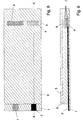
- the carrier 1 250 ⁇ m thick laminating film made of polyethylene / polyester used.
- the derivative 2 consists of a carbon paste, by means of screen printing on the carrier 1 is deposited and into the electrode space 4 enough.
- There is a metallized one in the electrode space 4 Three platinum sputtered electrode thin filter papers 7 of 3 mm in diameter. The individual layers are in flat electrical Contact and in their entirety form the three-dimensional, irregularly mesh-like electrode.
- the cover 3 consists of a 60 micron thick laminating film made of polyethylene / polyester, the whole is permeable to oxygen while it is to glucose only through the previously punched opening 5 with one Diameter of 1 mm is permeable. Over this opening is the diffusion of glucose into the electrode space 4 possible.
- the substance-recognizing membrane that in a solution of glucose oxidase in a photocrosslinkable Polyvinyl alcohol gel is made by the opening 5 in the pores of the metallized electrode space 4 introduced. The distribution takes place here the membrane in the electrode space 4 by capillary forces.
- the substance-recognizing membrane is caused by UV radiation polymerized and therefore insoluble in water made.
- the electrode space 4 represents the substance-recognizing Membrane represents a reservoir and thus extends the life of the sensor.
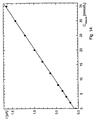
- the calibration curve is one Sensor shown. You can see it clearly good linearity even for high glucose concentrations up to 35 mmol / l due to the improved cosubstrate permeability. This is the case with conventional sensors End of the linear range at much lower Glucose concentrations.
- analyte substance-recognizing substance Cosubstrat detection cholesterol cholesterol oxygen hydrogen peroxide triglycerides Esterase, glycerokinase, glycerin phosphate oxidase oxygen hydrogen peroxide creatinine Creatininase, creatinase, sacrosin oxidase oxygen hydrogen peroxide uric acid uricase oxygen hydrogen peroxide
- the integration of the counter electrode 8 is shown in FIG. 3, 4 and 5. With a two-electrode arrangement the counter electrode 8 also takes over the function the reference electrode. Serves as material for this a silver / silver chloride paste that is screen printed is applied to the carrier 1.
- FIG. 6 and 7 The next example of the invention is in FIG. 6 and 7 the contacting of individual electrode spaces 4 and 4 'by separate leads 2 and 2' shown.
- the leads 2 and 2 ' are by a Isolation layer (spacer) 6 separated from each other.
- Electrode in electrode space 4 with a substance-recognizing Fill in the membrane.
- glucose determination serves the one stored in the electrode space 4 ' and electrode connected to a voltage source then add oxidizable substances like ascorbic acid or uric acid at 700 mV against a silver / silver chloride paste to oxidize so that when determining no longer interfere in the electrode space 4.
- FIG. 8 and 9 Another modification of the electrode is in Figure 8 and 9. Here is between the electrode space 4 and the reference electrode 8 and the cover 3 a flow channel 9 inserted, whereby a Adaptation of the sensor for flow measurements without great effort is made possible.
- FIGS. 12 and 13 show another example of the invention Sensor shown.
- the electrode room 4 is of a layer 11, which is a special has high cosubstrate permeability and in which the opening 5 is made covered.
- For the glucose sensor is 30 ⁇ m thin silicon foil used, a material with very high oxygen permeability. This way you can too Materials that don't fuse very easily or let glue, for the sensor assembly use.
Landscapes
- Chemical & Material Sciences (AREA)
- Life Sciences & Earth Sciences (AREA)
- Health & Medical Sciences (AREA)
- Organic Chemistry (AREA)
- Wood Science & Technology (AREA)
- Zoology (AREA)
- Engineering & Computer Science (AREA)
- Proteomics, Peptides & Aminoacids (AREA)
- Physics & Mathematics (AREA)
- Analytical Chemistry (AREA)
- Biochemistry (AREA)
- General Health & Medical Sciences (AREA)
- Immunology (AREA)
- Molecular Biology (AREA)
- Biophysics (AREA)
- Bioinformatics & Cheminformatics (AREA)
- Genetics & Genomics (AREA)
- General Engineering & Computer Science (AREA)
- Biotechnology (AREA)
- Microbiology (AREA)
- Electrochemistry (AREA)
- Emergency Medicine (AREA)
- Pathology (AREA)
- General Physics & Mathematics (AREA)
- Chemical Kinetics & Catalysis (AREA)
- Hematology (AREA)
- Investigating Or Analysing Biological Materials (AREA)
- Apparatus Associated With Microorganisms And Enzymes (AREA)
- Electric Double-Layer Capacitors Or The Like (AREA)
- Hybrid Cells (AREA)
Description
- Fig. 1, 2
- einen elektrochemischen Sensor (Aufsicht und Schnitt A-A'),
- Fig. 3, 4, 5
- einen elektrochemischen Sensor mit integrierter Referenzelektrode (Aufsicht, Schnitte A-A' und B-B'),
- Fig. 6, 7
- einen elektrochemischen Sensor mit Einzelkontaktierung der Teilelektroden (Aufsicht und Schnitt A-A'),
- Fig. 8, 9
- einen elektrochemischen Sensor mit integrierter Referenzelektrode in Durchflußanordnung (Aufsicht und Schnitt A-A'),
- Fig. 10, 11
- einen elektrochemischen Sensor mit Interferenzschutzschicht (Aufsicht und Schnitt A-A'),
- Fig. 12, 13
- einen elektrochemischen Sensor mit besonders hoher Cosubstratpermeabilität (Aufsicht und Schnitt A-A') und
- Fig. 14
- die Kalibrierkurve eines erfindungsgemäßen elektrochemischen Sensors mit erhöhter Cosubstratpermeabilität
| Analyt | stofferkennende Substanz | Cosubstrat | Detektion |
| Cholesterin | Cholesterinoxidase | Sauerstoff | Wasserstoffperoxid |
| Triglyceride | Esterase, Glycerokinase, Glycerinphosphatoxidase | Sauerstoff | Wasserstoffperoxid |
| Creatinin | Creatininase, Creatinase, Sacrosinoxidase | Sauerstoff | Wasserstoffperoxid |
| Harnsäure | Uricase | Sauerstoff | Wasserstoffperoxid |
Claims (21)
- Elektrochemischer Sensor zur Bestimmung von Stoffkonzentrationen mit einem Träger (1) und mindestens einer, im Bereich des Trägers (1) angeordneten Elektrode, die im Elektrodeninnern Hohlräume aufweist, in die zumindest bereichsweise eine stofferkennende Substanz eingelagert ist,
dadurch gekennzeichnet, daß die mindestens eine Elektrode aus mindestens zwei Teilelektroden (7) in Form von übereinander angeordneten Schichten besteht. - Elektrochemischer Sensor nach Anspruch 1, dadurch gekennzeichnet, daß zwischen Teilelektroden (7) Schichten (6) aus einem elektrisch isolierenden Material angeordnet sind.
- Elektrochemischer Sensor nach Anspruch 1 oder 2,
dadurch gekennzeichnet, daß isolierte Teilelektroden (7) mit separaten Ableitungen (2, 2') versehen sind. - Elektrochemischer Sensor nach mindesten einem der vorhergehenden Ansprüche, dadurch gekennzeichnet, daß die Teilelektroden (7) aus einem elektrisch leitenden Grundkörper besteht.
- Elektrochemischer Sensor nach Anspruch 4, dadurch gekennzeichnet, daß die Teilelektroden (7) aus einem leitfähig beschichteten, nichtleitenden Grundkörper besteht.
- Elektrochemischer Sensor nach Anspruch 4 oder 5,
dadurch gekennzeichnet, daß der leitende Grundkörper oder die leitfähige Beschichtung Platin, Silber, Gold oder Kohlenstoff oder eine Paste aus einem oder mehreren dieser Stoffe enthält. - Elektrochemischer Sensor nach einem der Ansprüche 5 oder 6, dadurch gekennzeichnet, daß der Grundkörper der Teilelektroden (7) aus Papier, Filterpapier, Pappe, Glasfasern, Kunststoffasern, Textil, Keramik, mineralischem Material oder aus Material pflanzlicher oder tierischer Herkunft besteht.
- Elektrochemischer Sensor nach mindestens einem der vorhergehenden Ansprüche, dadurch gekennzeichnet, daß die stofferkennende Substanz mindestens eine der Komponenten Enzyme, Mikroben, Bakterien oder Hefen enthält.
- Elektrochemischer Sensor nach mindestens einem der vorhergehenden Ansprüche, dadurch gekennzeichnet, daß die stofferkennende Substanz mit Hilfe mindestens eines gelartigen oder weichgemachten Polymers wie Polyvinylalkohol, Polyvinylchlorid, Polyurethan, Acrylat oder Silikon immobilisiert ist.
- Elektrochemischer Sensor nach mindestens einem der vorhergehenden Ansprüche, dadurch gekennzeichnet, daß auf dem, im oder teilweise im Träger (1) ein oder mehrere, die mindestens eine Elektrode oder die Teilelektroden (7) aufnehmende Elektrodenräume (4, 4') angeordnet sind.
- Elektrochemischer Sensor nach mindestens einem der vorhergehenden Ansprüche, dadurch gekennzeichnet, daß der mindestens eine Elektrodenraum (4, 4') mit mindestens einer Abdeckung (3, 11) versehen ist.
- Elektrochemischer Sensor nach mindestens einem der vorhergehenden Ansprüche, dadurch gekennzeichnet, daß der Träger (1) und/oder die mindestens eine Abdeckung (3, 11) für reaktionsunterstützende oder begleitende Stoffe permeabel und für den jeweils zu bestimmenden Stoff undurchlässig sind.
- Elektrochemischer Sensor nach mindestens einem der vorhergehenden Ansprüche, dadurch gekennzeichnet, daß der Träger (1) und/oder die mindestens eine Abdeckung (3, 11) mindestens eine Öffnung (5, 5') aufweist.
- Elektrochemischer Sensor nach mindestens einem der vorhergehenden Ansprüche, dadurch gekennzeichnet, daß der Träger (1) und/oder die mindestens eine Abdeckung (3, 11) aus einer Heißklebefolie, einer Laminierfolie, einer Selbstklebefolie oder einer siegelbaren Folie bestehen.
- Elektrochemischer Sensor nach mindestens einem der vorhergehenden Ansprüche, dadurch gekennzeichnet, daß auf dem Träger (1) eine Referenzund/oder Gegenelektrode (8) angeordnet ist.
- Elektrochemischer Sensor nach mindestens einem der vorhergehenden Ansprüche, dadurch gekennzeichnet, daß die Elektrode und bei der Ausgestaltung nach Anspruch 15 zusätzlich die Referenz- und/oder Gegenelektrode (8) über einen Fließkanal (9) mit dem zu analysierenden Probemedium in Kontakt treten.
- Elektrochemischer Sensor nach mindestens einem der vorhergehenden Ansprüche, dadurch gekennzeichnet, daß zwischen dem zu analysierendem Probenmedium und einer Teilelektrode eine Interferenzschutzschicht (10) angeordnet ist.
- Elektrochemischer Sensor nach mindestens einem der vorhergehenden Ansprüche, dadurch gekennzeichnet, daß die Interferenzschutzschicht (10) eine Polymerschicht aus Silikon, Polytetrafluorethylen, Polyacrylat, Polyurethan, Celluloseacetat, Nafion, Polycarbonat oder Polyvinylchlorid ist.
- Elektrochemischer Sensor nach mindestens einem der vorhergehenden Ansprüche, dadurch gekennzeichnet, daß zwischen zu analysierendem Probemedium und einer Teilelektrode eine weitere Elektrode oder Teilelektrode angeordnet ist, welche mit einer Spannungsquelle verbunden ist.
- Elektrochemischer Sensor nach Anspruch 19, dadurch gekennzeichnet, daß die weitere Elektrode im Bereich der Öffnung (5, 5') der Abdeckung (3, 11) angeordnet ist.
- Elektrochemischer Sensor nach mindestens einem der vorhergehenden Ansprüche, dadurch gekennzeichnet, daß die stofferkennende Membran Glucoseoxidase zur Bestimmung von Glucose enthält und der Träger oder die Abdeckung durchlässig für Sauerstoff ist.
Applications Claiming Priority (3)
| Application Number | Priority Date | Filing Date | Title |
|---|---|---|---|
| DE19653436 | 1996-12-20 | ||
| DE19653436A DE19653436C1 (de) | 1996-12-20 | 1996-12-20 | Elektrochemischer Sensor |
| PCT/DE1997/002960 WO1998028614A1 (de) | 1996-12-20 | 1997-12-18 | Elektrochemischer sensor |
Publications (2)
| Publication Number | Publication Date |
|---|---|
| EP0946867A1 EP0946867A1 (de) | 1999-10-06 |
| EP0946867B1 true EP0946867B1 (de) | 2002-08-28 |
Family
ID=7815634
Family Applications (1)
| Application Number | Title | Priority Date | Filing Date |
|---|---|---|---|
| EP97951858A Expired - Lifetime EP0946867B1 (de) | 1996-12-20 | 1997-12-18 | Elektrochemischer sensor |
Country Status (6)
| Country | Link |
|---|---|
| US (1) | US6695958B1 (de) |
| EP (1) | EP0946867B1 (de) |
| JP (1) | JP2001506366A (de) |
| AT (1) | ATE223039T1 (de) |
| DE (2) | DE19653436C1 (de) |
| WO (1) | WO1998028614A1 (de) |
Cited By (1)
| Publication number | Priority date | Publication date | Assignee | Title |
|---|---|---|---|---|
| US6801041B2 (en) | 2002-05-14 | 2004-10-05 | Abbott Laboratories | Sensor having electrode for determining the rate of flow of a fluid |
Families Citing this family (32)
| Publication number | Priority date | Publication date | Assignee | Title |
|---|---|---|---|---|
| US8527026B2 (en) | 1997-03-04 | 2013-09-03 | Dexcom, Inc. | Device and method for determining analyte levels |
| US6001067A (en) | 1997-03-04 | 1999-12-14 | Shults; Mark C. | Device and method for determining analyte levels |
| GB9717906D0 (en) * | 1997-08-23 | 1997-10-29 | Univ Manchester | Sensor Devices And Analytical Methods |
| US20060091006A1 (en) * | 1999-11-04 | 2006-05-04 | Yi Wang | Analyte sensor with insertion monitor, and methods |
| US6616819B1 (en) * | 1999-11-04 | 2003-09-09 | Therasense, Inc. | Small volume in vitro analyte sensor and methods |
| US7134999B2 (en) | 2003-04-04 | 2006-11-14 | Dexcom, Inc. | Optimized sensor geometry for an implantable glucose sensor |
| US8187446B2 (en) * | 2003-06-17 | 2012-05-29 | Chun-Mu Huang | Method of manufacturing a disposable electrochemical sensor strip |
| WO2005005974A1 (en) * | 2003-06-17 | 2005-01-20 | Huang, Alice, Y. | Structure and manufacturing method of disposable electrochemical sensor strip |
| WO2005012873A2 (en) * | 2003-07-25 | 2005-02-10 | Dexcom, Inc. | Electrode systems for electrochemical sensors |
| US7778680B2 (en) | 2003-08-01 | 2010-08-17 | Dexcom, Inc. | System and methods for processing analyte sensor data |
| US11633133B2 (en) | 2003-12-05 | 2023-04-25 | Dexcom, Inc. | Dual electrode system for a continuous analyte sensor |
| EP2239567B1 (de) * | 2003-12-05 | 2015-09-02 | DexCom, Inc. | Kalibrierverfahren für einen kontinuierlichen Analytsensor |
| US8423114B2 (en) | 2006-10-04 | 2013-04-16 | Dexcom, Inc. | Dual electrode system for a continuous analyte sensor |
| US7807043B2 (en) * | 2004-02-23 | 2010-10-05 | Oakville Hong Kong Company Limited | Microfluidic test device |
| US7918977B2 (en) * | 2005-11-08 | 2011-04-05 | Synkera Technologies, Inc. | Solid state electrochemical gas sensor and method for fabricating same |
| WO2007071562A1 (de) * | 2005-12-19 | 2007-06-28 | F. Hoffmann La-Roche Ag | Sandwichsensor zur ermittlung einer analytkonzentration |
| EP1797817A1 (de) * | 2005-12-19 | 2007-06-20 | F.Hoffmann-La Roche Ag | Sandwichsensor zur Ermittlung einer Analytkonzentration |
| US20090143658A1 (en) * | 2006-02-27 | 2009-06-04 | Edwards Lifesciences Corporation | Analyte sensor |
| US20080138663A1 (en) * | 2006-12-12 | 2008-06-12 | Canon Kabushiki Kaisha | Microbial electrode and fuel cell and sensor using the same |
| US20090024015A1 (en) * | 2007-07-17 | 2009-01-22 | Edwards Lifesciences Corporation | Sensing element having an adhesive backing |
| EP2254458A1 (de) | 2008-02-04 | 2010-12-01 | Bayer HealthCare, LLC | Analytensensoren auf halbleiterbasis und verfahren |
| EP2329255A4 (de) | 2008-08-27 | 2014-04-09 | Edwards Lifesciences Corp | Analytsensor |
| CA2735670A1 (en) | 2008-09-19 | 2010-03-25 | Swetha Chinnayelka | Analyte sensors, systems, testing apparatus and manufacturing methods |
| US9309551B2 (en) * | 2008-09-19 | 2016-04-12 | Ascensia Diabetes Care Holdings Ag | Electrical devices with enhanced electrochemical activity and manufacturing methods thereof |
| US20110057671A1 (en) * | 2009-09-04 | 2011-03-10 | Lifescan Scotland, Ltd. | Methods, system and device to identify a type of test strip |
| ES2865126T3 (es) * | 2012-06-29 | 2021-10-15 | Hoffmann La Roche | Elemento sensor para detectar un analito en un líquido corporal |
| KR101709344B1 (ko) * | 2014-12-11 | 2017-03-08 | 한국과학기술원 | 종이기판 및 그 제조방법과 종이기판을 이용하는 센서 및 그 제조방법 |
| WO2016196516A1 (en) | 2015-06-03 | 2016-12-08 | William Kenneth Ward | Measurement of glucose in an insulin delivery catheter by minimizing the adverse effects of insulin preservatives |
| JP6831839B2 (ja) | 2015-10-14 | 2021-02-17 | エスエフシー フルーイディクス、インコーポレイテッド | 溶液中の電気活性種の存在又は流れを検出する電気信号の測定 |
| US11630076B2 (en) | 2017-04-28 | 2023-04-18 | Corning Incorporated | Glass electrochemical sensor with wafer level stacking and through glass via (TGV) interconnects |
| CN108982619B (zh) * | 2018-08-06 | 2024-02-27 | 中国科学院地球化学研究所 | 一种用于高压水热体系的Eh化学传感器及其制备方法 |
| JP7827704B2 (ja) | 2020-08-23 | 2026-03-10 | パシフィック・ダイアビーツ・テクノロジーズ・インコーポレイテッド | インスリン保存剤の悪影響を最小限にすることによるインスリン送達カテーテル近傍でのグルコースの測定:代替配位子および酸化還元メディエーター金属 |
Family Cites Families (15)
| Publication number | Priority date | Publication date | Assignee | Title |
|---|---|---|---|---|
| US4053381A (en) * | 1976-05-19 | 1977-10-11 | Eastman Kodak Company | Device for determining ionic activity of components of liquid drops |
| CA1226036A (en) * | 1983-05-05 | 1987-08-25 | Irving J. Higgins | Analytical equipment and sensor electrodes therefor |
| JPS60244853A (ja) * | 1984-05-21 | 1985-12-04 | Matsushita Electric Works Ltd | バイオセンサ |
| JPS612060A (ja) * | 1984-06-15 | 1986-01-08 | Matsushita Electric Works Ltd | バイオセンサ |
| WO1987006701A1 (fr) * | 1986-04-22 | 1987-11-05 | Toray Industries, Inc. | Micro-electrode pour analyses electrochimiques |
| US5108564A (en) * | 1988-03-15 | 1992-04-28 | Tall Oak Ventures | Method and apparatus for amperometric diagnostic analysis |
| DE4137030A1 (de) * | 1991-11-11 | 1993-05-13 | Mst Micro Sensor Tech Gmbh | Elektrochemischer sensor zur messung der gaskonzentration |
| DE4137261C2 (de) * | 1991-11-13 | 1995-06-29 | Meinhard Prof Dr Knoll | Miniaturisiertes Sensorelement zur Bestimmung von Stoffkonzentrationen in Flüssigkeiten und Verfahren zu seiner Herstellung |
| EP0592805A3 (en) * | 1992-09-09 | 1996-07-24 | Agency Ind Science Techn | Carbon sensor electrode and process for producing the same |
| AT397513B (de) * | 1992-12-15 | 1994-04-25 | Avl Verbrennungskraft Messtech | Amperometrische enzymelektrode |
| US5385846A (en) * | 1993-06-03 | 1995-01-31 | Boehringer Mannheim Corporation | Biosensor and method for hematocrit determination |
| US5437999A (en) * | 1994-02-22 | 1995-08-01 | Boehringer Mannheim Corporation | Electrochemical sensor |
| WO1995029395A1 (en) * | 1994-04-26 | 1995-11-02 | The Regents Of University Of Michigan | Unitary sandwich enzyme immunoassay cassette, device and method of use |
| DE4442253A1 (de) * | 1994-11-28 | 1996-05-30 | Bayer Corp N D Ges D Staates I | Elektrochemischer Enzymbiosensor |
| AU6157898A (en) * | 1997-02-06 | 1998-08-26 | E. Heller & Company | Small volume (in vitro) analyte sensor |
-
1996
- 1996-12-20 DE DE19653436A patent/DE19653436C1/de not_active Expired - Fee Related
-
1997
- 1997-12-18 AT AT97951858T patent/ATE223039T1/de not_active IP Right Cessation
- 1997-12-18 EP EP97951858A patent/EP0946867B1/de not_active Expired - Lifetime
- 1997-12-18 DE DE59708087T patent/DE59708087D1/de not_active Expired - Lifetime
- 1997-12-18 WO PCT/DE1997/002960 patent/WO1998028614A1/de not_active Ceased
- 1997-12-18 JP JP52822598A patent/JP2001506366A/ja active Pending
- 1997-12-18 US US09/331,128 patent/US6695958B1/en not_active Expired - Fee Related
Cited By (1)
| Publication number | Priority date | Publication date | Assignee | Title |
|---|---|---|---|---|
| US6801041B2 (en) | 2002-05-14 | 2004-10-05 | Abbott Laboratories | Sensor having electrode for determining the rate of flow of a fluid |
Also Published As
| Publication number | Publication date |
|---|---|
| US6695958B1 (en) | 2004-02-24 |
| JP2001506366A (ja) | 2001-05-15 |
| DE19653436C1 (de) | 1998-08-13 |
| WO1998028614A1 (de) | 1998-07-02 |
| DE59708087D1 (de) | 2002-10-02 |
| EP0946867A1 (de) | 1999-10-06 |
| ATE223039T1 (de) | 2002-09-15 |
Similar Documents
| Publication | Publication Date | Title |
|---|---|---|
| DE19653436C1 (de) | Elektrochemischer Sensor | |
| DE69628948T2 (de) | Elektrochemische Zelle | |
| EP0750744B1 (de) | Miniaturisierte durchflussmesskammer mit integrierten chemo- und/oder biosensorelementen | |
| DE69323205T2 (de) | Gasdurchlässige Membranen für amperometrische Gaselektroden und deren Gebrauch | |
| US6863801B2 (en) | Electrochemical cell | |
| EP1472527B1 (de) | Mikrobandelektrode | |
| DE60035981T2 (de) | Elektrochemischer biosensor-teststreifen, verfahren zur herstellung und elektrochemischer biosensor | |
| EP1962668B1 (de) | Sandwichsensor zur ermittlung einer analytkonzentration | |
| DE68924026T2 (de) | Biosensor und dessen herstellung. | |
| DE60122588T2 (de) | Elektrochemische teststreifenkarten die ein eingebautes trockenmittel enthalten | |
| DE60020076T2 (de) | Kleinvolumiger in-vitro-analyt-sensor | |
| EP0566717B1 (de) | Miniaturisiertes sensorelement zur bestimmung von stoffkonzentrationen in flüssigkeiten und verfahren zu seiner herstellung | |
| DE19781229C2 (de) | Elektrochemische Testvorrichtung und Verfahren zu deren Herstellung | |
| DE19939011C1 (de) | Elektrochemischer Gassensor mit diamantartigen Kohlenstoffelektroden | |
| WO1990012314A1 (de) | Mikro-mehrelektrodenanordnung | |
| DE2638193C3 (de) | Laminierte Membran für die Verwendung in einer Enzymelektrode und Verfahren zur Herstellung einer solchen Membran | |
| DE19747875A1 (de) | Verfahren zum Messen veränderlicher Größen und Vorrichtung zum Durchführen des Verfahrens | |
| EP1035411B1 (de) | Elektrochemischer Sensor | |
| DE19681487B3 (de) | Elektrochemischer Sensor zum Aufspüren von Stickstoffdioxid | |
| DE4132441C2 (de) | Dickschicht-Leitfähigkeitselektroden als Biosensor | |
| DE19929264A1 (de) | Universaltransducer | |
| US20060008581A1 (en) | Method of manufacturing an electrochemical sensor | |
| WO1996004550A1 (de) | Elektrochemischer gassensor mit reduzierter querempfindlichkeit | |
| EP1738159B1 (de) | Fet-basierter gassensor | |
| DE4013593C2 (de) |
Legal Events
| Date | Code | Title | Description |
|---|---|---|---|
| PUAI | Public reference made under article 153(3) epc to a published international application that has entered the european phase |
Free format text: ORIGINAL CODE: 0009012 |
|
| 17P | Request for examination filed |
Effective date: 19990520 |
|
| AK | Designated contracting states |
Kind code of ref document: A1 Designated state(s): AT BE CH DE DK ES FI FR GB IE IT LI LU NL PT SE |
|
| 17Q | First examination report despatched |
Effective date: 20001219 |
|
| GRAG | Despatch of communication of intention to grant |
Free format text: ORIGINAL CODE: EPIDOS AGRA |
|
| GRAG | Despatch of communication of intention to grant |
Free format text: ORIGINAL CODE: EPIDOS AGRA |
|
| GRAH | Despatch of communication of intention to grant a patent |
Free format text: ORIGINAL CODE: EPIDOS IGRA |
|
| GRAH | Despatch of communication of intention to grant a patent |
Free format text: ORIGINAL CODE: EPIDOS IGRA |
|
| GRAA | (expected) grant |
Free format text: ORIGINAL CODE: 0009210 |
|
| AK | Designated contracting states |
Kind code of ref document: B1 Designated state(s): AT BE CH DE DK ES FI FR GB IE IT LI LU NL PT SE |
|
| PG25 | Lapsed in a contracting state [announced via postgrant information from national office to epo] |
Ref country code: NL Free format text: LAPSE BECAUSE OF FAILURE TO SUBMIT A TRANSLATION OF THE DESCRIPTION OR TO PAY THE FEE WITHIN THE PRESCRIBED TIME-LIMIT Effective date: 20020828 Ref country code: IT Free format text: LAPSE BECAUSE OF FAILURE TO SUBMIT A TRANSLATION OF THE DESCRIPTION OR TO PAY THE FEE WITHIN THE PRESCRIBED TIME-LIMIT;WARNING: LAPSES OF ITALIAN PATENTS WITH EFFECTIVE DATE BEFORE 2007 MAY HAVE OCCURRED AT ANY TIME BEFORE 2007. THE CORRECT EFFECTIVE DATE MAY BE DIFFERENT FROM THE ONE RECORDED. Effective date: 20020828 Ref country code: IE Free format text: LAPSE BECAUSE OF FAILURE TO SUBMIT A TRANSLATION OF THE DESCRIPTION OR TO PAY THE FEE WITHIN THE PRESCRIBED TIME-LIMIT Effective date: 20020828 Ref country code: GB Free format text: LAPSE BECAUSE OF FAILURE TO SUBMIT A TRANSLATION OF THE DESCRIPTION OR TO PAY THE FEE WITHIN THE PRESCRIBED TIME-LIMIT Effective date: 20020828 Ref country code: FI Free format text: LAPSE BECAUSE OF FAILURE TO SUBMIT A TRANSLATION OF THE DESCRIPTION OR TO PAY THE FEE WITHIN THE PRESCRIBED TIME-LIMIT Effective date: 20020828 |
|
| REF | Corresponds to: |
Ref document number: 223039 Country of ref document: AT Date of ref document: 20020915 Kind code of ref document: T |
|
| REG | Reference to a national code |
Ref country code: GB Ref legal event code: FG4D Free format text: NOT ENGLISH |
|
| REG | Reference to a national code |
Ref country code: CH Ref legal event code: EP |
|
| REG | Reference to a national code |
Ref country code: CH Ref legal event code: NV Representative=s name: TROESCH SCHEIDEGGER WERNER AG |
|
| REF | Corresponds to: |
Ref document number: 59708087 Country of ref document: DE Date of ref document: 20021002 |
|
| REG | Reference to a national code |
Ref country code: IE Ref legal event code: FG4D Free format text: GERMAN |
|
| PG25 | Lapsed in a contracting state [announced via postgrant information from national office to epo] |
Ref country code: SE Free format text: LAPSE BECAUSE OF FAILURE TO SUBMIT A TRANSLATION OF THE DESCRIPTION OR TO PAY THE FEE WITHIN THE PRESCRIBED TIME-LIMIT Effective date: 20021128 Ref country code: DK Free format text: LAPSE BECAUSE OF FAILURE TO SUBMIT A TRANSLATION OF THE DESCRIPTION OR TO PAY THE FEE WITHIN THE PRESCRIBED TIME-LIMIT Effective date: 20021128 |
|
| PG25 | Lapsed in a contracting state [announced via postgrant information from national office to epo] |
Ref country code: PT Free format text: LAPSE BECAUSE OF FAILURE TO SUBMIT A TRANSLATION OF THE DESCRIPTION OR TO PAY THE FEE WITHIN THE PRESCRIBED TIME-LIMIT Effective date: 20021211 |
|
| PG25 | Lapsed in a contracting state [announced via postgrant information from national office to epo] |
Ref country code: LU Free format text: LAPSE BECAUSE OF NON-PAYMENT OF DUE FEES Effective date: 20021218 |
|
| PG25 | Lapsed in a contracting state [announced via postgrant information from national office to epo] |
Ref country code: BE Free format text: LAPSE BECAUSE OF NON-PAYMENT OF DUE FEES Effective date: 20021231 |
|
| NLV1 | Nl: lapsed or annulled due to failure to fulfill the requirements of art. 29p and 29m of the patents act | ||
| GBV | Gb: ep patent (uk) treated as always having been void in accordance with gb section 77(7)/1977 [no translation filed] |
Effective date: 20020828 |
|
| PG25 | Lapsed in a contracting state [announced via postgrant information from national office to epo] |
Ref country code: ES Free format text: LAPSE BECAUSE OF FAILURE TO SUBMIT A TRANSLATION OF THE DESCRIPTION OR TO PAY THE FEE WITHIN THE PRESCRIBED TIME-LIMIT Effective date: 20030228 |
|
| ET | Fr: translation filed | ||
| REG | Reference to a national code |
Ref country code: IE Ref legal event code: FD4D Ref document number: 0946867E Country of ref document: IE |
|
| BERE | Be: lapsed |
Owner name: *INSTITUT FUR CHEMO- UND BIOSENSORIK MUNSTER E.V. Effective date: 20021231 |
|
| PLBE | No opposition filed within time limit |
Free format text: ORIGINAL CODE: 0009261 |
|
| STAA | Information on the status of an ep patent application or granted ep patent |
Free format text: STATUS: NO OPPOSITION FILED WITHIN TIME LIMIT |
|
| 26N | No opposition filed |
Effective date: 20030530 |
|
| PGFP | Annual fee paid to national office [announced via postgrant information from national office to epo] |
Ref country code: FR Payment date: 20031223 Year of fee payment: 7 |
|
| PGFP | Annual fee paid to national office [announced via postgrant information from national office to epo] |
Ref country code: AT Payment date: 20031230 Year of fee payment: 7 |
|
| PGFP | Annual fee paid to national office [announced via postgrant information from national office to epo] |
Ref country code: CH Payment date: 20040226 Year of fee payment: 7 |
|
| PG25 | Lapsed in a contracting state [announced via postgrant information from national office to epo] |
Ref country code: AT Free format text: LAPSE BECAUSE OF NON-PAYMENT OF DUE FEES Effective date: 20041218 |
|
| PG25 | Lapsed in a contracting state [announced via postgrant information from national office to epo] |
Ref country code: LI Free format text: LAPSE BECAUSE OF NON-PAYMENT OF DUE FEES Effective date: 20041231 Ref country code: CH Free format text: LAPSE BECAUSE OF NON-PAYMENT OF DUE FEES Effective date: 20041231 |
|
| REG | Reference to a national code |
Ref country code: CH Ref legal event code: PL |
|
| PG25 | Lapsed in a contracting state [announced via postgrant information from national office to epo] |
Ref country code: FR Free format text: LAPSE BECAUSE OF NON-PAYMENT OF DUE FEES Effective date: 20050831 |
|
| REG | Reference to a national code |
Ref country code: FR Ref legal event code: ST |
|
| PG25 | Lapsed in a contracting state [announced via postgrant information from national office to epo] |
Ref country code: DE Free format text: LAPSE BECAUSE OF NON-PAYMENT OF DUE FEES Effective date: 20050701 |
|
| PGRI | Patent reinstated in contracting state [announced from national office to epo] |
Ref country code: DE Effective date: 20090810 |
|
| PGFP | Annual fee paid to national office [announced via postgrant information from national office to epo] |
Ref country code: DE Payment date: 20101210 Year of fee payment: 14 |
|
| REG | Reference to a national code |
Ref country code: DE Ref legal event code: R119 Ref document number: 59708087 Country of ref document: DE Effective date: 20120703 |
|
| PG25 | Lapsed in a contracting state [announced via postgrant information from national office to epo] |
Ref country code: DE Free format text: LAPSE BECAUSE OF NON-PAYMENT OF DUE FEES Effective date: 20120703 |