EP0940041B1 - Motion estimation and motion-compensated interpolation - Google Patents
Motion estimation and motion-compensated interpolation Download PDFInfo
- Publication number
- EP0940041B1 EP0940041B1 EP98935253A EP98935253A EP0940041B1 EP 0940041 B1 EP0940041 B1 EP 0940041B1 EP 98935253 A EP98935253 A EP 98935253A EP 98935253 A EP98935253 A EP 98935253A EP 0940041 B1 EP0940041 B1 EP 0940041B1
- Authority
- EP
- European Patent Office
- Prior art keywords
- motion
- parameter set
- motion parameter
- image
- video data
- Prior art date
- Legal status (The legal status is an assumption and is not a legal conclusion. Google has not performed a legal analysis and makes no representation as to the accuracy of the status listed.)
- Expired - Lifetime
Links
- 230000033001 locomotion Effects 0.000 title claims abstract description 309
- 239000013598 vector Substances 0.000 claims abstract description 110
- 238000000034 method Methods 0.000 claims abstract description 97
- 230000003247 decreasing effect Effects 0.000 claims 1
- 230000011218 segmentation Effects 0.000 description 58
- 238000004422 calculation algorithm Methods 0.000 description 31
- 230000006870 function Effects 0.000 description 25
- 230000008569 process Effects 0.000 description 21
- 230000002123 temporal effect Effects 0.000 description 17
- 238000006243 chemical reaction Methods 0.000 description 15
- 238000012545 processing Methods 0.000 description 15
- 238000013459 approach Methods 0.000 description 13
- 239000013256 coordination polymer Substances 0.000 description 11
- 238000004364 calculation method Methods 0.000 description 9
- 230000009467 reduction Effects 0.000 description 7
- 238000002474 experimental method Methods 0.000 description 6
- 239000000203 mixture Substances 0.000 description 6
- 238000007906 compression Methods 0.000 description 5
- 230000006835 compression Effects 0.000 description 5
- 230000000694 effects Effects 0.000 description 5
- 238000009499 grossing Methods 0.000 description 5
- 239000000463 material Substances 0.000 description 5
- 238000004458 analytical method Methods 0.000 description 4
- 238000001914 filtration Methods 0.000 description 4
- 238000005457 optimization Methods 0.000 description 4
- 238000005070 sampling Methods 0.000 description 4
- 229910052710 silicon Inorganic materials 0.000 description 4
- 239000010703 silicon Substances 0.000 description 4
- 230000008859 change Effects 0.000 description 3
- 230000001419 dependent effect Effects 0.000 description 3
- 238000013461 design Methods 0.000 description 3
- 238000006073 displacement reaction Methods 0.000 description 3
- 230000001788 irregular Effects 0.000 description 3
- 241000287828 Gallus gallus Species 0.000 description 2
- 101001013272 Homo sapiens Mediator of RNA polymerase II transcription subunit 29 Proteins 0.000 description 2
- 238000007476 Maximum Likelihood Methods 0.000 description 2
- 102100029668 Mediator of RNA polymerase II transcription subunit 29 Human genes 0.000 description 2
- 230000008901 benefit Effects 0.000 description 2
- 238000010586 diagram Methods 0.000 description 2
- 238000009472 formulation Methods 0.000 description 2
- 238000003709 image segmentation Methods 0.000 description 2
- 238000003909 pattern recognition Methods 0.000 description 2
- 238000002922 simulated annealing Methods 0.000 description 2
- 238000013519 translation Methods 0.000 description 2
- 230000014616 translation Effects 0.000 description 2
- PXFBZOLANLWPMH-UHFFFAOYSA-N 16-Epiaffinine Natural products C1C(C2=CC=CC=C2N2)=C2C(=O)CC2C(=CC)CN(C)C1C2CO PXFBZOLANLWPMH-UHFFFAOYSA-N 0.000 description 1
- 238000012935 Averaging Methods 0.000 description 1
- 230000003044 adaptive effect Effects 0.000 description 1
- 239000000654 additive Substances 0.000 description 1
- 230000000996 additive effect Effects 0.000 description 1
- 230000006399 behavior Effects 0.000 description 1
- 230000005540 biological transmission Effects 0.000 description 1
- 230000000903 blocking effect Effects 0.000 description 1
- 230000015556 catabolic process Effects 0.000 description 1
- 230000001427 coherent effect Effects 0.000 description 1
- 238000006731 degradation reaction Methods 0.000 description 1
- 230000001934 delay Effects 0.000 description 1
- 230000003111 delayed effect Effects 0.000 description 1
- 230000002349 favourable effect Effects 0.000 description 1
- 238000005259 measurement Methods 0.000 description 1
- 230000003287 optical effect Effects 0.000 description 1
- 238000004091 panning Methods 0.000 description 1
- 230000008447 perception Effects 0.000 description 1
- 230000003068 static effect Effects 0.000 description 1
Images
Classifications
-
- H—ELECTRICITY
- H04—ELECTRIC COMMUNICATION TECHNIQUE
- H04N—PICTORIAL COMMUNICATION, e.g. TELEVISION
- H04N19/00—Methods or arrangements for coding, decoding, compressing or decompressing digital video signals
- H04N19/42—Methods or arrangements for coding, decoding, compressing or decompressing digital video signals characterised by implementation details or hardware specially adapted for video compression or decompression, e.g. dedicated software implementation
- H04N19/43—Hardware specially adapted for motion estimation or compensation
-
- H—ELECTRICITY
- H04—ELECTRIC COMMUNICATION TECHNIQUE
- H04N—PICTORIAL COMMUNICATION, e.g. TELEVISION
- H04N5/00—Details of television systems
- H04N5/14—Picture signal circuitry for video frequency region
- H04N5/144—Movement detection
- H04N5/145—Movement estimation
-
- H—ELECTRICITY
- H04—ELECTRIC COMMUNICATION TECHNIQUE
- H04N—PICTORIAL COMMUNICATION, e.g. TELEVISION
- H04N19/00—Methods or arrangements for coding, decoding, compressing or decompressing digital video signals
- H04N19/50—Methods or arrangements for coding, decoding, compressing or decompressing digital video signals using predictive coding
- H04N19/503—Methods or arrangements for coding, decoding, compressing or decompressing digital video signals using predictive coding involving temporal prediction
- H04N19/51—Motion estimation or motion compensation
-
- H—ELECTRICITY
- H04—ELECTRIC COMMUNICATION TECHNIQUE
- H04N—PICTORIAL COMMUNICATION, e.g. TELEVISION
- H04N7/00—Television systems
- H04N7/01—Conversion of standards, e.g. involving analogue television standards or digital television standards processed at pixel level
- H04N7/0112—Conversion of standards, e.g. involving analogue television standards or digital television standards processed at pixel level one of the standards corresponding to a cinematograph film standard
Definitions
- the invention relates to a method and a device for motion estimation, and to a video display apparatus comprising a motion-compensated interpolation device.
- Motion vectors are used in a range of applications, such as coding, noise reduction, and scan rate conversion. Some of these applications, particularly the frame rate conversion, require the true-motion of objects to be estimated [10,11]. Other applications, e.g. interlaced-to-sequential scan conversion, demand a high accuracy of the motion vectors to achieve a low amplitude of remaining alias [12,13]. Finally, there is a category of applications, e.g. consumer applications of motion estimation, where the cost of the motion estimator is of crucial importance [14,15]. Several algorithms have been proposed to achieve true-motion estimation [3,10,11,15-17]. Algorithms have also been proposed to realize motion estimation at a low complexity level, e.g.
- this task is performed by a so-called block-matcher which divides the image into blocks and calculates a motion vector for every block of pixels by minimizing a match criterion.
- the risk of such processing is that the motion-compensated image, interpolated from neighboring images and using the motion vectors, may show block distortions if the motion vector field suffers from unwanted inhomogeneities.
- the IC in [6] applies a block-matcher with improved consistency based on spatial and temporal prediction of candidate vectors [3].
- An advantageous side effect of this approach to motion estimation is the very significant reduction of processing power required for the function, which is particularly due to the very limited candidate vector count.
- a first aspect of the invention provides a method and a device as defined in claims 1 and 9.
- a second aspect of the invention provides a method and a device as defined in claims 7 and 10.
- a third aspect of the invention provides a video display apparatus as defined in claim 11. Advantageous embodiments are defined in the dependent claims.
- At least two motion parameter sets are generated from input video data, a motion parameter set being a set of parameters describing motion in an image, by means of which motion parameter set motion vectors can be calculated.
- One motion parameter set indicates a zero velocity for all image parts in an image, and each motion parameter set has corresponding local match errors, such as match errors determined per block of pixels.
- Output motion data are determined from the input video data in dependence on the at least two motion parameter sets, wherein the importance of each motion parameter set (determined by weighting factors W, see equations 17, 18 and between equations 20, 21) in calculating the output motion data depends on the motion parameter sets' local match errors. Local match errors are to be understood in contrast with global match errors, such as match errors calculated for the entire image.
- At least two motion parameter sets are generated from input video data, one motion parameter set indicating a zero velocity, and each motion parameter set having corresponding match errors, and output video data are interpolated from the input video data in dependence on the at least two motion parameter sets, wherein the importance of each motion parameter set in calculating the output video data depends on the motion parameter sets' match errors.
- At least two motion parameter sets are generated from input video data, one motion parameter set indicating a zero velocity, and each motion parameter set having corresponding match errors, and output video data are interpolated from the input video data in dependence on the at least two motion parameter sets, wherein the importance of each motion parameter set in calculating the output video data depends on the motion parameter sets' match errors.
- the reduction is so significant that the processing can run on a fully programmable device, more particularly the Philips TriMedia processor.
- the up-converter is adapted between the first and the second option, depending on the expected quality of the motion vectors.
- a favorable feature of the proposed interpolators is that switching between the two robust options is not very critical. This implies that a fairly rough decision is acceptable, which can be realized with little processing power on a (spatially) reduced size version of the input sequence. This reduced size input sequence is used to calculate match errors obtained with (at least) two motion vectors per location, either generated from a parameter model or the zero vector.
- the result is a segmentation which divides the image into layers where the zero vector model or the calculated parameter model is more appropriate.
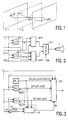
- the segmentation mask SM is now used as an extra input of the up-converter UC, which uses the mask SM to switch/fade between both previously described up-converters (see Fig. 2). In the case of a valid parameter model, the up-converter tends towards the interpolation of equation 2, otherwise towards the interpolation of equation 7.
- the values 1 and r are applied to a first averager AV1 to produce the value av.
- a first median filter MED1 determines the median of the values av, mcl, and mcr.
- the values mcl and mcr are applied to a second averager AV2 to produce the value mcav.
- a second median filter MED2 determines the median of the values mcav, 1, and r.
- the up-converter UC1 furnishes the interpolated value from the output signals of the median filters MED1, MED2 in dependence upon the segmentation mask SM.
- the output signal of the up-converter UC1 is applied to a display unit (D) for displaying the output video data (n-1 ⁇ 2) between the input video data (n, n-1).
- Fig. 3 current image data from the input field n and previous image data from the input field n-1 are applied to the parameter estimators PE2 .. PEn to determine motion parameters p21-p2m .. pn1-pnm.
- a first parameter estimator PE1 just furnishes zero parameters.
- the input fields n and n-1 are also applied to the segmentation circuit SC via down-samplers D1, D2.
- the up-converter UC2 calculates motion vectors in the manner indicated by equation 1 from the parameter set indicated by the segmentation mask SM, to interpolate the output field n-1 ⁇ 2 from the input fields n and n-1.
- the weighting factors W are explained below with reference to equations 17 and 18, and between equations 20 and 21.
- Each parameter estimator PE2 .. PEn comprises an error calculation to adjust the motion parameters. This calculation is preferably limited to those image parts which correspond to the parameter set delat with by the subject parameter estimator PE. To this end, a weight W is assigned which weight fits with the amount of correspondence (kind of fuzzy logic). In the end, at the interpolation, for each pixel that parameter set is used that yields the lowest estimation error for each pixel.
- this error function can be greatly simplified by applying a strong subsampling.
- a match criterion calculated on just some 300 pixels per field, i.e. a subsampling factor of the order of 1000!
- Penalties can be added to the match error of individual candidate vectors (parameters sets) to obtain e.g. temporal smoothness. Also temporal filtering of the parameter vectors, either within or outside the prediction loop, is considered to prevent a sudden change of motion vectors from one image to the other.
- a further alternative includes segmentation, and a fixed number of parameter estimators run in parallel, each focusing on a segment of the image indicated by the segmentation algorithm run on a previous image.
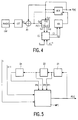
- Fig. 4 shows a block diagram of a motion parameter estimator according to the current invention.
- First and second candidate parameter sets Cp1, Cp2 are applied to a multiplexer MUX and to a parameter-to-vector converter PVC to obtain two candidate motion vectors Cv1, Cv2.
- the first candidate parameter set Cp1 is the previous output parameter set P(n) of the multiplexer MUX.
- the second candidate parameter set Cp2 is obtained by adding (adder AD) an update parameter set Up to the first candidate parameter set Cp1.
- the update parameter set Up is obtained by applying the result of a mod(n) counter CNT to a look-up table LUT.
- the candidate motion vectors Cv1, Cv2 are applied to an error calculator EC, to which the present and previous fields n, n-1 are also applied, to obtain two errors E1, E2.
- a minimum circuit MIN determines which error is the smaller, to obtain a selection signal s for the multiplexer MUX in order to obtain the output parameter set P(n).
- Motion estimation is applied in coding and scan rate conversion of video data.
- the picture rate of this video data at the input of the motion estimator is fixed, the picture rate of the video source from which this data originated may differ from that of the processed data. Particularly, this occurs when film material is converted to video, or when video material from one video standard is converted to another standard somewhere in the video chain prior to the motion estimator.
- a common way of dealing with the required picture rate conversions is to use the most recent picture until a new one becomes available.
- the resulting video exhibits an irregular motion pattern (judder), which violates the common assumption in motion estimators that motion has a strong temporal consistency.
- motion estimators that try to profit from this assumption by using temporal prediction vectors, the problem results that the irregular motion behavior eliminates the usefulness of these temporal prediction vectors. A serious degradation of the estimated motion vectors may result.
- the motion estimator takes temporal prediction vectors from more than one previous image pair (as much as the maximum length of the repetition pattern), and selects the best of these as a basis for the estimation process, or uses all of them as candidates in a matching process.
- Fig. 5 illustrates a preferred parameter estimator in accordance with the present invention.
- Current image data from the present field n and previous image data from the previous field n-1 are applied to a motion parameter estimator unit MPE to obtain motion parameters P(n).
- Picture delays D1, D2, .. Dn furnish delayed versions TP1, TP2, .. TPn of the motion parameters P(n) to the motion parameter estimator unit MPE.
- the following part of this disclosure relates to a layered motion estimation, i.e. the image is segmented into a plurality of layers.
- Region-based motion estimators have been introduced as an alternative to block-based motion estimators.
- Block-based motion compensation has been adopted in the international standards for video compression, such as H.261/263 (video-conferencing over ISDN lines), MPEG-1 (multimedia) and MPEG-2 (all-digital TV application). Although these standards do not specify a particular motion estimation method, block-based motion estimation becomes a natural choice.
- blocks as units for motion estimation may result in blocking artifacts, because the boundaries of objects do not generally correspond to block boundaries, and adjacent blocks may be assigned substantially different motion vectors if no spatio-temporal consistency constraint is present.
- a promising approach to solve the problem of block artifacts and to ) provide more accurate prediction along moving edges is to segment the motion field.
- Motion information and pattern information are used in order to achieve a region-based (arbitrarily shaped) motion estimation, the next goal being objects handling and possibly MPEG-4 'Audio-Visual (AV) objects'.
- the processing starts with an intra-frame segmentation of the image based on pattern information, or on a previously calculated dense motion vector field.
- the segmentation generally results in a number of small regions. Those regions are then merged, generally using information on their motion, i.e regions with similar motion are merged into one region, and motion parameters are then re-calculated. This procedure proves to be fairly popular when the aim is object-oriented coding. Examples in [26-29].
- the processing starts with an initial image segmentation in large regions. These are subdivided where the calculated motion model lacks accuracy, and motion parameters are re-calculated.
- the initial segmentation is generally based on a changed/unchanged rule, i.e. the current image is compared with the previous one: when, in the same position, the luminance value in one frame is considerably different from the one in the other one, this pixel is marked as 'changed', or 'unchanged' otherwise.
- the part of the image classified as 'changed' can be motion-compensated, in accordance with the motion field calculated for that region, and the previously described procedure is iterated in order to identify the different motion regions. Examples in [11,30,31,36].
- the two techniques can also be combined, e.g. the initial segmentation starts can be random, or based on a previous estimation [11,32], and successive refinements are in both directions.
- the estimation and the segmentation can also be performed simultaneously, using a statistical approach to the analysis of image sequences, e.g. with a Maximum Likelihood Estimation method [33].
- the ideal scene segmentation results in separate objects, and involves 3-D information, but this is difficult to obtain and computationally intensive. Therefore, the video data is segmented and described as a set of moving layers, i.e. of image parts, undergoing similar motion, even if disconnected. Then order (depth) of the layers is determined. Examples in [29,34,35]. A model which is less complicated than the full 3-D model and less complicated than a model that deals with all objects in the sequence has been proposed. Since it is the model adopted in a preferred embodiment, it will be described in more details in the following paragraphs.
- the video data is segmented and described as a set of moving layers, i.e. of regions undergoing similar motion, even if disconnected.
- the depth order of the layers can then be determined.
- a layered representation of a video sequence is interesting for several applications such as scan rate conversion, object tracking, video compression, coding, video annotation and indexing.
- a number of algorithms have already been presented for layered motion estimation [29,34-37] .
- the sequential approach resolves multiple layers by estimating sequentially a dominant motion, similarly to what is done in the top-down method.
- the main drawback of such an approach is that, since the final segmentation is not yet known while dealing with one layer, part of the image with a different motion can be included in the estimation of the motion parameters, affecting the results.
- the simultaneous approach attempts to estimate simultaneously all the layers in the image. This can be done by using a pre-computed dense motion vector field.
- the initial set of motion models can be derived by using a clustering algorithm on the given motion vector field [29] .
- some smoothness assumptions are generally made. This may lead to a motion vector field in which the boundaries do not correspond to objects/layers boundaries, so that a correct segmentation is not possible.
- the problem can be formulated as a stochastic problem, and a Maximum-Likelihood Estimation of the multiple models, and their layers of support, can be performed using an Expectation-Maximisation algorithm [36].
- the main drawback of the two last-mentioned methods is their complexity.
- the current aspect of the invention deals with motion estimation / segmentation aiming at a layered representation.
- the solution consists of a weighting process that limits the pollution of the optimization criterion of a parameter estimator for a given layer by information dealt with by the other parameter estimators running in parallel.
- Designing a motion estimator to run real-time on existing programmable architectures imposes severe constraints on the problem of motion estimation, since the complexity of the algorithm has to be drastically reduced.
- a layered motion estimator has been chosen for this purpose, since it is believed that it is potentially easier to implement on a programmable architecture than e.g. a block-based motion estimation, seeing that there are fewer layers than blocks.
- an image is divided into a number of layers, i.e. parts of the image undergoing a coherent motion, even if disconnected.
- the apparent motion (optical flow) in a sequence can then be described with parametric models, i.e. it is only due to a combination of camera motions and rigid motion of opaque objects.
- one set of motion parameters can be estimated for each layer instead of the motion field itself.
- the parameter vectors are then estimated in parallel, using a recursive approach, i.e. the earlier estimated parameter vector for each layer is used as a prediction to which update vectors are added.
- the selected parameter vector is the one resulting in the lowest match error. After this, the parameter vectors of all layers together are used in the segmentation of the image into the desired different layers.
- a first layer has 4 or 8 free parameters, while each subsequent layer has less free parameters than the preceding layer to reduce the computational burden.
- the invention is based on the recognition that the zero vector (no motion) is very common and important in video sequences, and especially important for the intended application in scan rate conversion. Therefore, the proposed algorithm starts with a layer 0, with motion described by the zero parameter vector (which is obviously not estimated).
- the parameter vectors of additional layers 1, 1 > 0, are estimated separately by their respective parameter estimators PE 1 .
- Each PE 1 has the same basic principle as the 3D recursive search block matcher of [3].
- a previously estimated parameter vector is updated in accordance with a pseudo- random noise vector, after which the best matching parameter vector is chosen.
- the parameters of layer 1, 1 > 0, are regarded as a parameter vector P ⁇ l :
- P ⁇ l n s x l , n s y ( l , n ) d x ( l , n ) d y ( l , n ) and we define our task as to select P ⁇ l n from a number of candidate parameter vectors CP ⁇ l n as the one that has the minimal value of a match criterion.
- W l x ⁇ is a weighting factor that depends on the position X ⁇
- F x x ⁇ , n is the luminance value at position x ⁇ in the sub-sampled image with index n
- X 1 is a set of positions x ⁇ where the motion of layer 1 is to be estimated (the mode of selecting of positions x ⁇ will be explained below).
- the images are sub-sampled with a factor of 4 horizontally and 2 vertically on a field base, generating a sub-sampled image F s (n) from each original field F(n). This contributes strongly to the desired reduction of operations count.
- the sub-sampling is permitted because the objects for which motion is estimated are large enough.
- interpolation is required on the subsampling grid [7].
- Temporal filtering of the parameter vectors is applied to prevent a sudden change of motion vectors from one image to the other.
- a hierarchical structure of the layers is proposed. This is achieved by:
- Each estimator apart from the highest in the hierarchy (the zero estimator), minimizes a match error calculated in regions in which all higher level estimators where unsuccessful in the previous image.
- the set of positions X 1 is filled with the positions x where the match error of all higher ranked layers exceeds the average block match error with a fixed factor.
- a correct selection of X 1 is necessary to prevent the current estimator from estimating motion that is already covered by previous layers.
- the location-dependent weighting factor W l x ⁇ is determined by the segmentation mask SM(n-1) found in the previous image. Positions x ⁇ that belong to the current layer 1 in accordance with the segmentation mask will have a weighting factor greater than one, where positions belonging to a different layer have a weighting factor of one. A correct selection of W l x ⁇ is necessary to prevent the current estimator from estimating motion that can be covered by subsequent layers in the hierarchy.
- the segmentation step is the most critical step in the algorithm. Its task is to assign one of the layers, i.e. one model of motion, in the image to each group of pixels. This is basically achieved by assigning the best matching model to each group of pixels (a block B ⁇ , which is typically as large as 8 x 8 pixels on frame base).
- Segmentation mask SM B ⁇ , n assigns the layer I with the lowest ⁇ to the block B ⁇ .
- the temporal position of the segmentation is defined by ⁇ , which was set to 1/2 in our experiments.
- the segmentation mask SM does not have to be calculated for every block B ⁇ . Instead, the calculated blocks can be sub-sampled in a quincunx pattern, after which the missing positions in the segmentation mask are interpolated (e.g. by choosing the most occurring layer number from a neighborhood) [7].
- Segmentation is more difficult as more layers are present, since the segmentation task will resemble more and more that of a full search block matcher.
- extra (smoothing) constraints have been added to the algorithm.
- Current smoothing constraints consist of:
- a simple pre-filtering of the sub-sampling is achieved by averaging pixel values in a block of 4 x 2 pixels. This takes approximately 10 operations per sub-sampled output pixel, or 180.144.10 720.288 ⁇ 1.25 operations per pixel of the input grid (CCIR 601 / 625 lines / 2:1).
- Calculation of the error criterion in a parameter estimator takes approximately 1000 operations per candidate vector per iteration. For the described implementation, this results in 3. 5 + 3 .1000 720.288 ⁇ 0.12 operations per pixel (this does not cover all functions of the parameter estimation).
- the calculation of the error criterion in the segmentation takes approximately 10 operations per layer per block, so 3. 72.90 / 2 .10 720.288 ⁇ operations per pixel (this does not cover all functions of the segmentation). This is a reduction of another order of magnitude as compared with the estimator of MELZONIC (SAA4991) [3].
- Measurements in partially optimized code for TriMedia indicate an achieved operation count of about 1.25 for the sub-sampling, 1.0 for the parameter estimator and 6.1 operations per pixel for the segmentation.
- the proposed layered motion estimator was simulated, including usage of the resulting displacement vector for picture rate conversion of 25 Hz film to 50 Hz display.
- the proposed Motion Estimation algorithm has no vector range limitation due to implementation, which is an advantage over MELZONIC (SAA4991).
- a method of extending global motion estimation algorithms to the estimation of motion parameters in a layered video representation has been presented.
- a fixed number of parameter estimators is run in parallel, each calculating parameters for one image layer.
- a segmentation assigns each part of the image to the correct layer.
- each estimator operates in parallel, some hierarchy exists. Each estimator, apart from the highest in the hierarchy, operates on image parts where higher ranked estimators in the hierarchy were unsuccessful in the previous image. Secondly, each estimator is prevented from pollution by parts of the image that will be better covered by estimators lower in the hierarchy.
- the algorithms in accordance with the present invention may be interesting for other application areas of motion estimation, such as video compression and coding, video annotation and indexing, object tracking and noise reduction.
- a first aspect of the invention can be summarized as follows.
- a new method for global motion-compensated up-conversion is described, and ways are indicated to extend the proposal to application in a layered video representation.
- parameters describing the global motion are estimated, preferably using a recursive approach.
- the local motion vectors generated with these parameters are used to generate a motion-compensated image.
- a segmentation mask is calculated on a reduced size image, the output of which is used to switch between different parameter sets or interpolation methods.
- An attractive low-cost version is detailed, which is suitable for implementation on currently available fully programmable devices (Natural Motion on a TriMedia).
- a method, and apparatus realizing this method, for motion compensating video data comprising:
- the interpolation means is an order statistical filter, e.g. a three-tap median filter, which produces an output pixel from either:
- a segmentation signal activates the first decision, in case the local motion vector calculated from the second parameter set yields the best match on the reduced size input image.
- the segmentation signal is derived from a reduced size version of the input signal.
- a method, and apparatus realizing this method, for motion-compensating video data comprising:
- one of the global motion parameter calculating means provides parameters indicating a zero velocity for the entire image, regardless of the image content.
- a second aspect of the invention can be summarized as follows.
- a new method for global motion parameter estimation is described.
- parameters, describing the global motion in the image are estimated using a recursive approach, i.e. an earlier n-dimensional (n is the number of parameters in the motion model) estimate is used as a prediction to which (n-dimensional) update vectors are added.
- the output parameter vector is the one resulting in the lowest match error.
- a method, and apparatus realizing this method, for estimating motion parameters (the parameter vector) of an image sequence comprising:
- penalties, temporal filtering, and temporal and/or spatial prediction are applied.
- a third aspect of the present invention can be summarized as follows.
- a method of estimating motion parameters from video data is disclosed.
- the invention allows temporal predictive motion estimation on video data that, due to simple picture rate conversion techniques (repetition of the most recent picture), exhibits an irregular motion.
- the solution consists of using multiple temporal prediction vectors taken from various previous image pairs. This solution is economically justifiable, particularly in object-based motion estimators, where the number of motion vectors to be stored is very small.
- a software version of the algorithm has been shown to run real-time on the Philips TM1000 (TriMedia) processor.
- a method, and apparatus realizing this method, of estimating motion parameter vectors from video data which furnishes, for at least some image-parts, at least two (temporal) prediction vectors estimated from data of different previous image pairs.
- the above-mentioned at least two prediction vectors are candidates in a vector selection process determining the output vector for an image (part).
- the best of the above-mentioned at least two prediction vectors is used as a basis for calculating candidate vectors (e.g. updating process) that are input of a vector selection process determining the output vector for an image (part).
- the decision information (which of the at least two prediction vectors is best, in accordance with a criterion function) over a number of successive images (image parts), is used to detect picture repetition patterns (e.g. 3-2 pull-down and 2-2 pull-down of movie material, but also other patterns due to source-destination picture frequency mismatches).
- picture repetition patterns e.g. 3-2 pull-down and 2-2 pull-down of movie material, but also other patterns due to source-destination picture frequency mismatches.
- a fourth aspect of the invention relates to a joint motion estimation and segmentation of video data, and can be summarized as follows.
- a method of segmenting an image into a fixed number of layers and estimate motion parameters for individual layers is disclosed.
- the invention provides a solution to the chicken and egg problem of combined motion estimation and segmentation.
- the solution consists of a weighting process that limits the pollution of the optimization criterion of a parameter estimator for a given layer by information dealt with by the other parameter estimators running in parallel.
- the extremely low complexity of the algorithm, and the high quality make it very attractive for future use in TV and Multi-Media applications.
- a software version of the algorithm has been shown to run real-time on the Philips TM1000 (TriMedia) processor.
- a layered motion estimation algorithm that permits quasi-simultaneous motion estimation / segmentation up to a fixed maximum number of layers.
- the estimation results in one motion parameter set per layer, and a segmentation map that assigns these sets to different parts of the image (motion layers).
- Motion in a layer is modelled with a maximum of four parameters capable of describing pan, tilt and zoom.
- the concept shows some hierarchy, i.e. a ranking of the motion layers.
- the motion parameter estimation concerning one layer excludes parts of the image that have been described by a layer ranked higher in the hierarchy and is not polluted by parts of the image that are better described by layers ranked lower in the hierarchy.
- the concept results in a very low operations count. It has been shown to perform well, even in critical scan rate conversion applications, particularly in picture rate up-conversion. A variant including three layers has been scheduled to run in real-time on a Philips TriMedia processor.
- a method, and apparatus realizing this method, for segmenting an image into a ranked set of layers and estimating motion parameters for every layer comprising:
- the first criterion is met if, in a previous iteration of the algorithm on the same or another picture pair, the image parts fell in regions which were adequately described by any of the motion parameter sets estimated by PEs active on layers with a higher rank number. "Adequately" means that an error function, using the parameter sets of the PEs active on layers higher in the hierarchy, stays below a threshold (either fixed, or adapted, e.g. to the average error).
- the second criterion is met if, in a previous iteration of the algorithm on the same or another picture pair, the image parts fell in regions which were best described by the motion parameter sets estimated by this given PE. "Best" means that an error function, using the parameter sets of the given PE, is lower than that of any of the other PEs.
- this error function is based upon the motion-compensated difference between the pixels in the current field and the corresponding pixels in the previous field, using the parameter sets to be evaluated (direct method).
- this error function is based upon the difference between motion vectors calculated with some method, and motion vectors resulting from the motion parameter set to be evaluated (indirect method).
- picture parts meeting the first criterion are eliminated in the error function of a given PE, and this first criterion is adapted in such a way that the picture area on which the criterion function is calculated remains within a given range (control loop to efficiently use maximum available processing power).
- the PE and/or the SP, and/or the WP operates on down-scaled and/or subsampled video data.
- the selection process selects for a given layer those (groups of) pixels, for which the parameter sets of layers higher in the hierarchy, in a previous picture did not give satisfactory results according to a rule.
- this rule involves the comparison of an error(sum) of (groups of) pixels with a fixed or adaptive threshold.
- this threshold is adapted in such a way that the number of pixels on which the criterion function is calculated remains within a given range.
- the criterion function is a summed error calculated between selected (groups of) pixels from the previous picture and corresponding pixels from the current picture compensated for motion in accordance with the candidate motion parameters.
- the contribution of the selected pixels to the criterion function is weighted, depending on which layer they were assigned to (in the previous picture).
- the contribution of the selected pixels to the criterion function is increased if they were assigned to the same layer previously.
- VGA-controllers Although originally designed to run as an application on the Philips TriMedia processor, more applications are possible. Particularly, the concept can be designed into next generation VGA-controllers. Since this is dedicated silicon, the total cost is negligible. Such a VGA-controller may have an improved performance as compared with the TriMedia solution, because much more processing power is available in dedicated silicon. Furthermore, it is expected that, if more than two parallel parameter estimators are applied, the performance can be brought to a level which is potentially better than that of the current high-end solutions at a possibly lower cost.
Landscapes
- Engineering & Computer Science (AREA)
- Multimedia (AREA)
- Signal Processing (AREA)
- Television Systems (AREA)
- Image Analysis (AREA)
- Compression Or Coding Systems Of Tv Signals (AREA)
- Picture Signal Circuits (AREA)
Priority Applications (1)
| Application Number | Priority Date | Filing Date | Title |
|---|---|---|---|
| EP98935253A EP0940041B1 (en) | 1997-09-23 | 1998-08-12 | Motion estimation and motion-compensated interpolation |
Applications Claiming Priority (4)
| Application Number | Priority Date | Filing Date | Title |
|---|---|---|---|
| EP97202912 | 1997-09-23 | ||
| EP97202912 | 1997-09-23 | ||
| PCT/IB1998/001241 WO1999016251A1 (en) | 1997-09-23 | 1998-08-12 | Motion estimation and motion-compensated interpolation |
| EP98935253A EP0940041B1 (en) | 1997-09-23 | 1998-08-12 | Motion estimation and motion-compensated interpolation |
Publications (2)
| Publication Number | Publication Date |
|---|---|
| EP0940041A1 EP0940041A1 (en) | 1999-09-08 |
| EP0940041B1 true EP0940041B1 (en) | 2006-11-22 |
Family
ID=8228750
Family Applications (1)
| Application Number | Title | Priority Date | Filing Date |
|---|---|---|---|
| EP98935253A Expired - Lifetime EP0940041B1 (en) | 1997-09-23 | 1998-08-12 | Motion estimation and motion-compensated interpolation |
Country Status (6)
| Country | Link |
|---|---|
| US (1) | US6385245B1 (enExample) |
| EP (1) | EP0940041B1 (enExample) |
| JP (1) | JP2001506472A (enExample) |
| KR (1) | KR100582856B1 (enExample) |
| DE (1) | DE69836473T2 (enExample) |
| WO (1) | WO1999016251A1 (enExample) |
Cited By (1)
| Publication number | Priority date | Publication date | Assignee | Title |
|---|---|---|---|---|
| WO2022169377A1 (en) * | 2021-02-08 | 2022-08-11 | Huawei Technologies Co., Ltd. | Switchable dense motion vector field interpolation |
Families Citing this family (123)
| Publication number | Priority date | Publication date | Assignee | Title |
|---|---|---|---|---|
| KR100308016B1 (ko) | 1998-08-31 | 2001-10-19 | 구자홍 | 압축 부호화된 영상에 나타나는 블럭현상 및 링현상 제거방법및 영상 복호화기 |
| US6909466B1 (en) * | 1998-09-30 | 2005-06-21 | Micronas Gmbh | Circuit for frame rate conversion using a motion-adaptive method |
| US6535643B1 (en) * | 1998-11-03 | 2003-03-18 | Lg Electronics Inc. | Method for recovering compressed motion picture for eliminating blocking artifacts and ring effects and apparatus therefor |
| JP4344964B2 (ja) * | 1999-06-01 | 2009-10-14 | ソニー株式会社 | 画像処理装置および画像処理方法 |
| EP1075147A1 (en) * | 1999-08-02 | 2001-02-07 | Koninklijke Philips Electronics N.V. | Motion estimation |
| JP4344968B2 (ja) * | 1999-10-28 | 2009-10-14 | ソニー株式会社 | 画像処理装置および画像処理方法、並びにデータ処理装置およびデータ処理方法 |
| JP3753578B2 (ja) * | 1999-12-07 | 2006-03-08 | Necエレクトロニクス株式会社 | 動きベクトル探索装置および方法 |
| JP2003517795A (ja) * | 1999-12-17 | 2003-05-27 | コーニンクレッカ フィリップス エレクトロニクス エヌ ヴィ | ビデオ画像における動き推定方法 |
| FI116819B (fi) * | 2000-01-21 | 2006-02-28 | Nokia Corp | Menetelmä kuvien lähettämiseksi ja kuvakooderi |
| US6714258B2 (en) * | 2000-03-15 | 2004-03-30 | Koninklijke Philips Electronics N.V. | Video-apparatus with noise reduction |
| JP4409035B2 (ja) * | 2000-03-22 | 2010-02-03 | 本田技研工業株式会社 | 画像処理装置、特異箇所検出方法、及び特異箇所検出プログラムを記録した記録媒体 |
| FR2809267B1 (fr) * | 2000-05-19 | 2002-09-27 | Thomson Multimedia Sa | Procede de detection de saturation d'un champ de vecteurs mouvement |
| US6532380B1 (en) * | 2000-06-30 | 2003-03-11 | Cedars Sinai Medical Center | Image guidance for coronary stent deployment |
| US6760376B1 (en) * | 2000-11-06 | 2004-07-06 | Koninklijke Philips Electronics N.V. | Motion compensated upconversion for video scan rate conversion |
| EP1352528A1 (en) * | 2001-01-11 | 2003-10-15 | Koninklijke Philips Electronics N.V. | Recognizing film and video objects occuring in parrallel in single television signal fields |
| US9781408B1 (en) | 2001-01-23 | 2017-10-03 | Visual Effect Innovations, Llc | Faster state transitioning for continuous adjustable 3Deeps filter spectacles using multi-layered variable tint materials |
| US10742965B2 (en) | 2001-01-23 | 2020-08-11 | Visual Effect Innovations, Llc | Faster state transitioning for continuous adjustable 3Deeps filter spectacles using multi-layered variable tint materials |
| US7405801B2 (en) * | 2001-01-23 | 2008-07-29 | Kenneth Jacobs | System and method for Pulfrich Filter Spectacles |
| US7850304B2 (en) * | 2001-01-23 | 2010-12-14 | Kenneth Martin Jacobs | Continuous adjustable 3Deeps filter spectacles for optimized 3Deeps stereoscopic viewing and its control method and means |
| US8750382B2 (en) | 2001-01-23 | 2014-06-10 | Kenneth Martin Jacobs | System and method for calculating 3Deeps action specs motion estimation from the motion vectors in an MPEG file |
| US7604348B2 (en) | 2001-01-23 | 2009-10-20 | Kenneth Martin Jacobs | Continuous adjustable 3deeps filter spectacles for optimized 3deeps stereoscopic viewing and its control method and means |
| US7508485B2 (en) * | 2001-01-23 | 2009-03-24 | Kenneth Martin Jacobs | System and method for controlling 3D viewing spectacles |
| US7522257B2 (en) * | 2001-01-23 | 2009-04-21 | Kenneth Jacobs | System and method for a 3-D phenomenoscope |
| AU2002367629A1 (en) * | 2001-02-05 | 2003-10-08 | Bristol-Myers Squibb Company | A novel human g-protein coupled receptor, hgprbmy14, related to the orphan gpcr, gpr73 |
| US7042945B2 (en) * | 2001-04-24 | 2006-05-09 | Bellers Erwin B | 3-D recursive vector estimation for video enhancement |
| US6738099B2 (en) * | 2001-02-16 | 2004-05-18 | Tektronix, Inc. | Robust camera motion estimation for video sequences |
| WO2002067576A1 (en) * | 2001-02-21 | 2002-08-29 | Koninklijke Philips Electronics N.V. | Facilitating motion estimation |
| US6704055B1 (en) | 2001-03-30 | 2004-03-09 | Pixelworks, Inc. | 3:2 pull-down film mode detection using fuzzy logic |
| US6782054B2 (en) * | 2001-04-20 | 2004-08-24 | Koninklijke Philips Electronics, N.V. | Method and apparatus for motion vector estimation |
| US20020196854A1 (en) * | 2001-06-15 | 2002-12-26 | Jongil Kim | Fast video encoder using adaptive hierarchical video processing in a down-sampled domain |
| KR100525785B1 (ko) * | 2001-06-15 | 2005-11-03 | 엘지전자 주식회사 | 이미지 화소 필터링 방법 |
| US7110525B1 (en) | 2001-06-25 | 2006-09-19 | Toby Heller | Agent training sensitive call routing system |
| KR100396558B1 (ko) * | 2001-10-25 | 2003-09-02 | 삼성전자주식회사 | 적응 움직임 보상형 프레임 및/또는 레이트 변환 장치 및그 방법 |
| US7085431B2 (en) * | 2001-11-13 | 2006-08-01 | Mitutoyo Corporation | Systems and methods for reducing position errors in image correlation systems during intra-reference-image displacements |
| EP1472881B1 (en) * | 2002-01-17 | 2007-08-08 | Koninklijke Philips Electronics N.V. | Unit for and method of estimating a current motion vector |
| US7092924B1 (en) * | 2002-02-28 | 2006-08-15 | Raytheon Company | Method and system for assigning observations |
| EP1361541B1 (en) * | 2002-04-09 | 2011-06-22 | STMicroelectronics Srl | Process and device for global motion estimation in a sequence of images, for instance for optical mice |
| JP4724351B2 (ja) | 2002-07-15 | 2011-07-13 | 三菱電機株式会社 | 画像符号化装置、画像符号化方法、画像復号装置、画像復号方法、および通信装置 |
| DE10236207A1 (de) * | 2002-08-07 | 2004-02-26 | Micronas Gmbh | Verfahren zur bewegungsvektorgestützten Interpolation eines Bildpunktes eines Zwischenbildes einer Bildfolge |
| US7197075B2 (en) * | 2002-08-22 | 2007-03-27 | Hiroshi Akimoto | Method and system for video sequence real-time motion compensated temporal upsampling |
| US8023563B2 (en) * | 2002-10-04 | 2011-09-20 | Stmicroelectronics S.R.L. | Method and system for processing signals via perceptive vectorial quantization, computer program product therefor |
| EP1406447A1 (en) * | 2002-10-04 | 2004-04-07 | STMicroelectronics S.r.l. | Method and system for processing signals via perceptive vectorial quantization, computer program product therefor |
| KR100486284B1 (ko) * | 2002-11-22 | 2005-04-29 | 삼성전자주식회사 | 연속되는 두 개의 디인터레이스 프레임들을 출력할 수있는 디인터레이스 장치 및 디인터레이스 방법 |
| US9818136B1 (en) | 2003-02-05 | 2017-11-14 | Steven M. Hoffberg | System and method for determining contingent relevance |
| US7197074B2 (en) * | 2003-02-20 | 2007-03-27 | The Regents Of The University Of California | Phase plane correlation motion vector determination method |
| DE10318620A1 (de) * | 2003-04-24 | 2004-11-25 | Micronas Gmbh | Verfahren und Vorrichtung zur Ermittlung eines Abstandes zwischen einer ersten und zweiten Signalfolge |
| DE10327577A1 (de) * | 2003-06-18 | 2005-01-13 | Micronas Gmbh | Verfahren zur Ermittlung eines Verschiebungsvektors in der Bildverarbeitung |
| DE10327576A1 (de) * | 2003-06-18 | 2005-01-13 | Micronas Gmbh | Verfahren und Vorrichtung zur bewegungsvektorgestützten Bildpunktinterpolation |
| US7596284B2 (en) * | 2003-07-16 | 2009-09-29 | Hewlett-Packard Development Company, L.P. | High resolution image reconstruction |
| US20050013496A1 (en) * | 2003-07-16 | 2005-01-20 | Bruls Wilhelmus Hendrikus Alfonsus | Video decoder locally uses motion-compensated interpolation to reconstruct macro-block skipped by encoder |
| US7620254B2 (en) * | 2003-08-07 | 2009-11-17 | Trident Microsystems (Far East) Ltd. | Apparatus and method for motion-vector-aided interpolation of a pixel of an intermediate image of an image sequence |
| US20050105621A1 (en) * | 2003-11-04 | 2005-05-19 | Ju Chi-Cheng | Apparatus capable of performing both block-matching motion compensation and global motion compensation and method thereof |
| KR20050045746A (ko) * | 2003-11-12 | 2005-05-17 | 삼성전자주식회사 | 계층 구조의 가변 블록 크기를 이용한 움직임 추정 방법및 장치 |
| US7830959B2 (en) * | 2003-12-26 | 2010-11-09 | Electronics And Telecommunications Research Institute | Apparatus and method for performing intra prediction for image decoder |
| JP4198608B2 (ja) * | 2004-01-15 | 2008-12-17 | 株式会社東芝 | 補間画像生成方法および装置 |
| KR100995398B1 (ko) * | 2004-01-20 | 2010-11-19 | 삼성전자주식회사 | 수직 및 수평 방향의 패턴을 고려한 전역 움직임 보상순차주사화 방법 |
| US7433497B2 (en) * | 2004-01-23 | 2008-10-07 | Hewlett-Packard Development Company, L.P. | Stabilizing a sequence of image frames |
| KR20050081730A (ko) * | 2004-02-16 | 2005-08-19 | 엘지전자 주식회사 | 움직임 보상 기반의 영상 신호 프레임율 변환 방법 |
| JP4375080B2 (ja) * | 2004-03-29 | 2009-12-02 | ソニー株式会社 | 画像処理装置および方法、記録媒体、並びにプログラム |
| US8036494B2 (en) * | 2004-04-15 | 2011-10-11 | Hewlett-Packard Development Company, L.P. | Enhancing image resolution |
| EP1592246A1 (en) * | 2004-04-30 | 2005-11-02 | Matsushita Electric Industrial Co., Ltd. | Film mode determination in video image still areas |
| EP1592255A1 (en) | 2004-04-30 | 2005-11-02 | Matsushita Electric Industrial Co., Ltd. | Motion vector estimation with improved motion vector selection |
| EP1592247A1 (en) * | 2004-04-30 | 2005-11-02 | Matsushita Electric Industrial Co., Ltd. | Block mode adaptive motion compensation |
| EP1592248B1 (en) * | 2004-04-30 | 2006-09-20 | Matsushita Electric Industrial Co., Ltd. | Motion vector estimation employing adaptive temporal prediction |
| EP1592250A1 (en) * | 2004-04-30 | 2005-11-02 | Matsushita Electric Industrial Co., Ltd. | Film-mode detection in video sequences |
| DE602004030993D1 (de) | 2004-04-30 | 2011-02-24 | Panasonic Corp | Bewegungsschätzung unter Verwendung von adaptiven räumlichen Verfeinerungsvektoren |
| WO2006003545A1 (en) * | 2004-06-30 | 2006-01-12 | Koninklijke Philips Electronics N.V. | Motion estimation with video mode detection |
| US7684628B2 (en) * | 2004-08-12 | 2010-03-23 | Industrial Technology Research Institute | System and method for non-iterative global motion estimation |
| US7730406B2 (en) * | 2004-10-20 | 2010-06-01 | Hewlett-Packard Development Company, L.P. | Image processing system and method |
| JP2006165935A (ja) * | 2004-12-07 | 2006-06-22 | Nec Corp | 制御情報の変換装置及び制御情報の変換方法 |
| WO2006061421A2 (en) * | 2004-12-09 | 2006-06-15 | Thomson Licensing | Method and apparatus for generating motion compensated pictures |
| EP1703736A1 (en) * | 2005-03-14 | 2006-09-20 | BRITISH TELECOMMUNICATIONS public limited company | Global motion estimation |
| US7522749B2 (en) * | 2005-04-08 | 2009-04-21 | Microsoft Corporation | Simultaneous optical flow estimation and image segmentation |
| US7760956B2 (en) | 2005-05-12 | 2010-07-20 | Hewlett-Packard Development Company, L.P. | System and method for producing a page using frames of a video stream |
| KR100676704B1 (ko) * | 2005-07-07 | 2007-02-01 | 삼성전자주식회사 | 움직임 추정장치 및 그 추정방법 |
| US7668366B2 (en) * | 2005-08-09 | 2010-02-23 | Seiko Epson Corporation | Mosaic image data processing |
| US20070076796A1 (en) * | 2005-09-27 | 2007-04-05 | Fang Shi | Frame interpolation using more accurate motion information |
| US20070074251A1 (en) * | 2005-09-27 | 2007-03-29 | Oguz Seyfullah H | Method and apparatus for using random field models to improve picture and video compression and frame rate up conversion |
| US9258519B2 (en) * | 2005-09-27 | 2016-02-09 | Qualcomm Incorporated | Encoder assisted frame rate up conversion using various motion models |
| EP1841231A1 (en) * | 2006-03-29 | 2007-10-03 | Sony Deutschland Gmbh | Method for motion estimation |
| JP2008035436A (ja) * | 2006-07-31 | 2008-02-14 | Fujitsu Ltd | プルダウンシーケンス検出装置およびプルダウンシーケンス検出方法 |
| US7809212B2 (en) * | 2006-12-20 | 2010-10-05 | Hantro Products Oy | Digital mosaic image construction |
| TWI327866B (en) * | 2006-12-27 | 2010-07-21 | Realtek Semiconductor Corp | Apparatus and related method for decoding video blocks in video pictures |
| JP4821642B2 (ja) * | 2007-02-15 | 2011-11-24 | 株式会社ニコン | 画像処理方法、画像処理装置、ディジタルカメラ及び画像処理プログラム |
| US20080212687A1 (en) * | 2007-03-02 | 2008-09-04 | Sony Corporation And Sony Electronics Inc. | High accurate subspace extension of phase correlation for global motion estimation |
| CN103124354B (zh) * | 2007-09-28 | 2016-01-20 | 杜比实验室特许公司 | 处理视频信息 |
| US20090161978A1 (en) * | 2007-12-20 | 2009-06-25 | Marinko Karanovic | Halo Artifact Removal Method |
| US8559518B2 (en) * | 2008-06-30 | 2013-10-15 | Samsung Electronics Co., Ltd. | System and method for motion estimation of digital video using multiple recursion rules |
| JP4687772B2 (ja) * | 2008-11-06 | 2011-05-25 | ソニー株式会社 | 画像処理装置、画像処理方法、プログラム |
| US20100201870A1 (en) * | 2009-02-11 | 2010-08-12 | Martin Luessi | System and method for frame interpolation for a compressed video bitstream |
| FI20095273A0 (fi) * | 2009-03-17 | 2009-03-17 | On2 Technologies Finland Oy | Digitaalinen videokoodaus |
| KR101710883B1 (ko) | 2009-11-04 | 2017-02-28 | 삼성전자주식회사 | 필터 정보를 이용한 영상 압축 장치 및 방법과 영상 복원 장치 및 방법 |
| US8233085B1 (en) | 2009-12-08 | 2012-07-31 | Kolorific, Inc. | Method and system for interpolating a pixel value of a pixel located at an on-screen display |
| US8488007B2 (en) * | 2010-01-19 | 2013-07-16 | Sony Corporation | Method to estimate segmented motion |
| JP5583992B2 (ja) * | 2010-03-09 | 2014-09-03 | パナソニック株式会社 | 信号処理装置 |
| US8285079B2 (en) * | 2010-03-19 | 2012-10-09 | Sony Corporation | Method for highly accurate estimation of motion using phase correlation |
| EP2405661B1 (en) | 2010-07-06 | 2017-03-22 | Google, Inc. | Loss-robust video transmission using two decoders |
| GB201113527D0 (en) * | 2011-08-04 | 2011-09-21 | Imagination Tech Ltd | External vectors in a motion estimation system |
| US9014265B1 (en) | 2011-12-29 | 2015-04-21 | Google Inc. | Video coding using edge detection and block partitioning for intra prediction |
| US9288484B1 (en) | 2012-08-30 | 2016-03-15 | Google Inc. | Sparse coding dictionary priming |
| US9210424B1 (en) | 2013-02-28 | 2015-12-08 | Google Inc. | Adaptive prediction block size in video coding |
| US9300906B2 (en) * | 2013-03-29 | 2016-03-29 | Google Inc. | Pull frame interpolation |
| US9313493B1 (en) | 2013-06-27 | 2016-04-12 | Google Inc. | Advanced motion estimation |
| US9286653B2 (en) | 2014-08-06 | 2016-03-15 | Google Inc. | System and method for increasing the bit depth of images |
| US9153017B1 (en) | 2014-08-15 | 2015-10-06 | Google Inc. | System and method for optimized chroma subsampling |
| US10726593B2 (en) * | 2015-09-22 | 2020-07-28 | Fyusion, Inc. | Artificially rendering images using viewpoint interpolation and extrapolation |
| US12261990B2 (en) | 2015-07-15 | 2025-03-25 | Fyusion, Inc. | System and method for generating combined embedded multi-view interactive digital media representations |
| US10242474B2 (en) | 2015-07-15 | 2019-03-26 | Fyusion, Inc. | Artificially rendering images using viewpoint interpolation and extrapolation |
| US10222932B2 (en) | 2015-07-15 | 2019-03-05 | Fyusion, Inc. | Virtual reality environment based manipulation of multilayered multi-view interactive digital media representations |
| US10147211B2 (en) | 2015-07-15 | 2018-12-04 | Fyusion, Inc. | Artificially rendering images using viewpoint interpolation and extrapolation |
| US11006095B2 (en) | 2015-07-15 | 2021-05-11 | Fyusion, Inc. | Drone based capture of a multi-view interactive digital media |
| US12495134B2 (en) | 2015-07-15 | 2025-12-09 | Fyusion, Inc. | Drone based capture of multi-view interactive digital media |
| US11095869B2 (en) | 2015-09-22 | 2021-08-17 | Fyusion, Inc. | System and method for generating combined embedded multi-view interactive digital media representations |
| US9807416B2 (en) | 2015-09-21 | 2017-10-31 | Google Inc. | Low-latency two-pass video coding |
| US11783864B2 (en) | 2015-09-22 | 2023-10-10 | Fyusion, Inc. | Integration of audio into a multi-view interactive digital media representation |
| US11202017B2 (en) | 2016-10-06 | 2021-12-14 | Fyusion, Inc. | Live style transfer on a mobile device |
| US10437879B2 (en) | 2017-01-18 | 2019-10-08 | Fyusion, Inc. | Visual search using multi-view interactive digital media representations |
| US20180227482A1 (en) | 2017-02-07 | 2018-08-09 | Fyusion, Inc. | Scene-aware selection of filters and effects for visual digital media content |
| US10595039B2 (en) | 2017-03-31 | 2020-03-17 | Nvidia Corporation | System and method for content and motion controlled action video generation |
| US10313651B2 (en) | 2017-05-22 | 2019-06-04 | Fyusion, Inc. | Snapshots at predefined intervals or angles |
| US11069147B2 (en) | 2017-06-26 | 2021-07-20 | Fyusion, Inc. | Modification of multi-view interactive digital media representation |
| AT520839B1 (de) * | 2018-01-25 | 2019-08-15 | Ait Austrian Inst Tech Gmbh | Verfahren zur Erstellung einer Bildstapel-Datenstruktur |
| US10592747B2 (en) | 2018-04-26 | 2020-03-17 | Fyusion, Inc. | Method and apparatus for 3-D auto tagging |
Family Cites Families (11)
| Publication number | Priority date | Publication date | Assignee | Title |
|---|---|---|---|---|
| US4862264A (en) * | 1985-12-24 | 1989-08-29 | British Broadcasting Corporation | Method of coding a video signal for transmission in a restricted bandwidth |
| EP0294960B1 (en) * | 1987-06-09 | 1994-09-28 | Sony Corporation | Motion vector processing in television images |
| US5093720A (en) * | 1990-08-20 | 1992-03-03 | General Instrument Corporation | Motion compensation for interlaced digital television signals |
| US5371539A (en) * | 1991-10-18 | 1994-12-06 | Sanyo Electric Co., Ltd. | Video camera with electronic picture stabilizer |
| KR0180170B1 (ko) * | 1995-06-30 | 1999-05-01 | 배순훈 | 움직임 추정 방법 및 추정 장치 |
| GB9519923D0 (en) * | 1995-09-29 | 1995-11-29 | Philips Electronics Nv | Motion estimation for predictive image coding |
| JP4159606B2 (ja) * | 1996-05-24 | 2008-10-01 | コーニンクレッカ フィリップス エレクトロニクス エヌ ヴィ | 動き推定 |
| US5825930A (en) * | 1997-03-05 | 1998-10-20 | Samsung Electronics Co., Ltd. | Motion estimating method |
| DE69727911D1 (de) * | 1997-04-24 | 2004-04-08 | St Microelectronics Srl | Verfahren zur Erhöhung der bewegungsgeschätzten und bewegungskompensierten Bildfrequenz für Videoanwendungen, und Vorrichtung zur Verwendung eines solchen Verfahrens |
| JPH10327415A (ja) * | 1997-05-22 | 1998-12-08 | Mitsubishi Electric Corp | 動きベクトル検出装置 |
| KR100235356B1 (ko) * | 1997-08-13 | 1999-12-15 | 전주범 | 개선된 움직임 추정 장치 및 그 추정 방법 |
-
1998
- 1998-08-12 EP EP98935253A patent/EP0940041B1/en not_active Expired - Lifetime
- 1998-08-12 KR KR1019997004575A patent/KR100582856B1/ko not_active Expired - Lifetime
- 1998-08-12 WO PCT/IB1998/001241 patent/WO1999016251A1/en not_active Ceased
- 1998-08-12 JP JP51871999A patent/JP2001506472A/ja active Pending
- 1998-08-12 DE DE69836473T patent/DE69836473T2/de not_active Expired - Lifetime
- 1998-09-18 US US09/156,935 patent/US6385245B1/en not_active Expired - Lifetime
Non-Patent Citations (1)
| Title |
|---|
| WANG J.Y.A.; ADELSON E.H.: "Representing moving images with layers", IEEE TRANSACTIONS ON IMAGE PROCESSING, IEEE INC., vol. 3, no. 5, September 1994 (1994-09-01), NEW YORK, US, pages 625 - 638, XP000476836 * |
Cited By (3)
| Publication number | Priority date | Publication date | Assignee | Title |
|---|---|---|---|---|
| WO2022169377A1 (en) * | 2021-02-08 | 2022-08-11 | Huawei Technologies Co., Ltd. | Switchable dense motion vector field interpolation |
| CN116848843A (zh) * | 2021-02-08 | 2023-10-03 | 华为技术有限公司 | 可切换的密集运动向量场插值 |
| US12634515B2 (en) | 2021-02-08 | 2026-05-19 | Huawei Technologies Co., Ltd. | Switchable dense motion vector field interpolation |
Also Published As
| Publication number | Publication date |
|---|---|
| KR20000069107A (ko) | 2000-11-25 |
| KR100582856B1 (ko) | 2006-05-24 |
| EP0940041A1 (en) | 1999-09-08 |
| US6385245B1 (en) | 2002-05-07 |
| DE69836473D1 (de) | 2007-01-04 |
| JP2001506472A (ja) | 2001-05-15 |
| WO1999016251A1 (en) | 1999-04-01 |
| DE69836473T2 (de) | 2007-09-20 |
Similar Documents
| Publication | Publication Date | Title |
|---|---|---|
| US6385245B1 (en) | Motion estimation and motion-compensated interpolition | |
| Choi et al. | Motion-compensated frame interpolation using bilateral motion estimation and adaptive overlapped block motion compensation | |
| US5929940A (en) | Method and device for estimating motion between images, system for encoding segmented images | |
| Nam et al. | A fast hierarchical motion vector estimation algorithm using mean pyramid | |
| Hilman et al. | Using motion-compensated frame-rate conversion for the correction of 3: 2 pulldown artifacts in video sequences | |
| US6278736B1 (en) | Motion estimation | |
| Jeon et al. | Coarse-to-fine frame interpolation for frame rate up-conversion using pyramid structure | |
| Xu et al. | Adaptive motion tracking block matching algorithms for video coding | |
| Choi et al. | New frame rate up-conversion using bi-directional motion estimation | |
| JP3226539B2 (ja) | ビデオ画像処理 | |
| JP2002511687A (ja) | 動き推定システムおよび方法 | |
| Jung et al. | An effective de-interlacing technique using motion compensated interpolation | |
| Choi et al. | Frame rate up-conversion using perspective transform | |
| Baek et al. | An efficient block-matching criterion for motion estimation and its VLSI implementation | |
| Hang et al. | Motion estimation for video coding standards | |
| Wang et al. | Evaluation of mesh-based motion estimation in H. 263-like coders | |
| Han et al. | Frame rate up-conversion for high-definition video applications | |
| Ju et al. | A fast rate-optimized motion estimation algorithm for low-bit-rate video coding | |
| Schutten et al. | Layered motion estimation | |
| Hang et al. | Motion estimation for image sequence compression | |
| Li et al. | High performance de-interlacing algorithm for digital television displays | |
| Yu et al. | A novel fast block motion estimation algorithm based on combined subsamplings on pixels and search candidates | |
| Kim et al. | A two-stage fast block matching algorithm using integral projections | |
| Cetin et al. | An adaptive true motion estimation algorithm for frame rate conversion of high definition video | |
| Han et al. | A novel hierarchical-search block matching algorithm and VLSI architecture considering the spatial complexity of the macroblock |
Legal Events
| Date | Code | Title | Description |
|---|---|---|---|
| PUAI | Public reference made under article 153(3) epc to a published international application that has entered the european phase |
Free format text: ORIGINAL CODE: 0009012 |
|
| AK | Designated contracting states |
Kind code of ref document: A1 Designated state(s): DE FR GB IT |
|
| 17P | Request for examination filed |
Effective date: 19991001 |
|
| 17Q | First examination report despatched |
Effective date: 20050404 |
|
| GRAP | Despatch of communication of intention to grant a patent |
Free format text: ORIGINAL CODE: EPIDOSNIGR1 |
|
| GRAS | Grant fee paid |
Free format text: ORIGINAL CODE: EPIDOSNIGR3 |
|
| GRAA | (expected) grant |
Free format text: ORIGINAL CODE: 0009210 |
|
| AK | Designated contracting states |
Kind code of ref document: B1 Designated state(s): DE FR GB IT |
|
| REG | Reference to a national code |
Ref country code: GB Ref legal event code: FG4D |
|
| REF | Corresponds to: |
Ref document number: 69836473 Country of ref document: DE Date of ref document: 20070104 Kind code of ref document: P |
|
| ET | Fr: translation filed | ||
| PLBE | No opposition filed within time limit |
Free format text: ORIGINAL CODE: 0009261 |
|
| STAA | Information on the status of an ep patent application or granted ep patent |
Free format text: STATUS: NO OPPOSITION FILED WITHIN TIME LIMIT |
|
| 26N | No opposition filed |
Effective date: 20070823 |
|
| REG | Reference to a national code |
Ref country code: GB Ref legal event code: 732E |
|
| REG | Reference to a national code |
Ref country code: FR Ref legal event code: TP |
|
| REG | Reference to a national code |
Ref country code: FR Ref legal event code: GC |
|
| REG | Reference to a national code |
Ref country code: FR Ref legal event code: GC |
|
| REG | Reference to a national code |
Ref country code: DE Ref legal event code: R084 Ref document number: 69836473 Country of ref document: DE Effective date: 20110426 |
|
| REG | Reference to a national code |
Ref country code: FR Ref legal event code: AU Effective date: 20120126 |
|
| REG | Reference to a national code |
Ref country code: FR Ref legal event code: CL Name of requester: KONINKLIJKE PHILIPS ELECTRONICS N.V., NL Effective date: 20120305 |
|
| PGFP | Annual fee paid to national office [announced via postgrant information from national office to epo] |
Ref country code: FR Payment date: 20120224 Year of fee payment: 14 |
|
| PGFP | Annual fee paid to national office [announced via postgrant information from national office to epo] |
Ref country code: GB Payment date: 20120130 Year of fee payment: 14 Ref country code: IT Payment date: 20120131 Year of fee payment: 14 |
|
| REG | Reference to a national code |
Ref country code: FR Ref legal event code: RG Effective date: 20120726 |
|
| REG | Reference to a national code |
Ref country code: FR Ref legal event code: TP Owner name: TRIDENT MICROSYSTEMS (FAR EAST) LTD., KY Effective date: 20120918 |
|
| REG | Reference to a national code |
Ref country code: DE Ref legal event code: R082 Ref document number: 69836473 Country of ref document: DE Representative=s name: EPPING HERMANN FISCHER, PATENTANWALTSGESELLSCH, DE |
|
| REG | Reference to a national code |
Ref country code: DE Ref legal event code: R082 Ref document number: 69836473 Country of ref document: DE Effective date: 20130129 Ref country code: DE Ref legal event code: R082 Ref document number: 69836473 Country of ref document: DE Representative=s name: EPPING HERMANN FISCHER, PATENTANWALTSGESELLSCH, DE Effective date: 20130129 Ref country code: DE Ref legal event code: R081 Ref document number: 69836473 Country of ref document: DE Owner name: NXP B.V., NL Free format text: FORMER OWNER: TRIDENT MICROSYSTEMS (FAR EAST) LTD., GRAND CAYMAN, KY Effective date: 20130129 |
|
| GBPC | Gb: european patent ceased through non-payment of renewal fee |
Effective date: 20120812 |
|
| REG | Reference to a national code |
Ref country code: FR Ref legal event code: ST Effective date: 20130430 |
|
| PG25 | Lapsed in a contracting state [announced via postgrant information from national office to epo] |
Ref country code: IT Free format text: LAPSE BECAUSE OF NON-PAYMENT OF DUE FEES Effective date: 20120812 |
|
| REG | Reference to a national code |
Ref country code: DE Ref legal event code: R082 Ref document number: 69836473 Country of ref document: DE |
|
| PG25 | Lapsed in a contracting state [announced via postgrant information from national office to epo] |
Ref country code: GB Free format text: LAPSE BECAUSE OF NON-PAYMENT OF DUE FEES Effective date: 20120812 |
|
| PG25 | Lapsed in a contracting state [announced via postgrant information from national office to epo] |
Ref country code: FR Free format text: LAPSE BECAUSE OF NON-PAYMENT OF DUE FEES Effective date: 20120831 |
|
| REG | Reference to a national code |
Ref country code: FR Ref legal event code: TP Owner name: NXP B.V., NL Effective date: 20131003 |
|
| PGFP | Annual fee paid to national office [announced via postgrant information from national office to epo] |
Ref country code: DE Payment date: 20170719 Year of fee payment: 20 |
|
| REG | Reference to a national code |
Ref country code: DE Ref legal event code: R071 Ref document number: 69836473 Country of ref document: DE |