EP0939619B1 - Kosmetisches reinigungsmittel und seine anwendung - Google Patents
Kosmetisches reinigungsmittel und seine anwendung Download PDFInfo
- Publication number
- EP0939619B1 EP0939619B1 EP97909389A EP97909389A EP0939619B1 EP 0939619 B1 EP0939619 B1 EP 0939619B1 EP 97909389 A EP97909389 A EP 97909389A EP 97909389 A EP97909389 A EP 97909389A EP 0939619 B1 EP0939619 B1 EP 0939619B1
- Authority
- EP
- European Patent Office
- Prior art keywords
- compositions according
- radical
- weight
- chosen
- alkyl
- Prior art date
- Legal status (The legal status is an assumption and is not a legal conclusion. Google has not performed a legal analysis and makes no representation as to the accuracy of the status listed.)
- Revoked
Links
Classifications
-
- A—HUMAN NECESSITIES
- A61—MEDICAL OR VETERINARY SCIENCE; HYGIENE
- A61Q—SPECIFIC USE OF COSMETICS OR SIMILAR TOILETRY PREPARATIONS
- A61Q5/00—Preparations for care of the hair
- A61Q5/12—Preparations containing hair conditioners
-
- A—HUMAN NECESSITIES
- A61—MEDICAL OR VETERINARY SCIENCE; HYGIENE
- A61K—PREPARATIONS FOR MEDICAL, DENTAL OR TOILETRY PURPOSES
- A61K8/00—Cosmetics or similar toiletry preparations
- A61K8/02—Cosmetics or similar toiletry preparations characterised by special physical form
- A61K8/04—Dispersions; Emulsions
- A61K8/06—Emulsions
-
- A—HUMAN NECESSITIES
- A61—MEDICAL OR VETERINARY SCIENCE; HYGIENE
- A61Q—SPECIFIC USE OF COSMETICS OR SIMILAR TOILETRY PREPARATIONS
- A61Q5/00—Preparations for care of the hair
- A61Q5/02—Preparations for cleaning the hair
-
- B—PERFORMING OPERATIONS; TRANSPORTING
- B82—NANOTECHNOLOGY
- B82Y—SPECIFIC USES OR APPLICATIONS OF NANOSTRUCTURES; MEASUREMENT OR ANALYSIS OF NANOSTRUCTURES; MANUFACTURE OR TREATMENT OF NANOSTRUCTURES
- B82Y5/00—Nanobiotechnology or nanomedicine, e.g. protein engineering or drug delivery
-
- A—HUMAN NECESSITIES
- A61—MEDICAL OR VETERINARY SCIENCE; HYGIENE
- A61K—PREPARATIONS FOR MEDICAL, DENTAL OR TOILETRY PURPOSES
- A61K2800/00—Properties of cosmetic compositions or active ingredients thereof or formulation aids used therein and process related aspects
- A61K2800/20—Chemical, physico-chemical or functional or structural properties of the composition as a whole
- A61K2800/21—Emulsions characterized by droplet sizes below 1 micron
-
- A—HUMAN NECESSITIES
- A61—MEDICAL OR VETERINARY SCIENCE; HYGIENE
- A61K—PREPARATIONS FOR MEDICAL, DENTAL OR TOILETRY PURPOSES
- A61K2800/00—Properties of cosmetic compositions or active ingredients thereof or formulation aids used therein and process related aspects
- A61K2800/40—Chemical, physico-chemical or functional or structural properties of particular ingredients
- A61K2800/41—Particular ingredients further characterized by their size
- A61K2800/413—Nanosized, i.e. having sizes below 100 nm
Definitions
- the present invention relates to new cosmetic compositions with properties materials intended simultaneously for cleaning and conditioning materials keratin such as the hair, and comprising, in an aqueous support cosmetically acceptable, a cleansing base consisting of surfactants with power detergent in which is also present as conditioning agents a nanoemulsion defined below.
- the invention also relates to the use of said compositions in the above-mentioned cosmetic application.
- detergent compositions for cleaning and / or washing keratin materials such as the hair, the use of detergent compositions (such as shampoos) based essentially of conventional surfactants of the type in particular anionic, nonionic and / or amphoteric, but more particularly of the anionic type, is common.
- shampoos based essentially of conventional surfactants of the type in particular anionic, nonionic and / or amphoteric, but more particularly of the anionic type, is common.
- compositions certainly have good washing power, but the properties intrinsic cosmetics attached to them, however, remain quite weak, in particular due to the fact that the relatively aggressive nature of such treatment of cleaning can lead to more or less damage to the hair fiber in the long run marked linked in particular to the progressive elimination of the lipids or proteins contained in or on the surface of the latter.
- conditioning agents complementary cosmetic agents primarily intended to repair or limit the harmful or undesirable effects induced by the different treatments or assaults that they undergo, more or less repeated, hair fibers.
- conditioning agents can of course also improve the cosmetic behavior of natural hair.
- compositions according to the invention give the hair, after rinsing, a remarkable treatment effect which is manifested in particular by ease of disentangling, as well that a contribution of volume, lightness, smoothness, softness and flexibility without no greasy feeling.
- the subject of the present invention is new detergent compositions and conditioning characterized by the fact that they comprise, in an aqueous medium cosmetically acceptable, (A) a washing base and (B) a conditioning system comprising at least one oil-in-water emulsion having oil globules whose average size is less than 150 nm and comprising an amphiphilic lipid phase, this amphiphilic lipid phase comprising at least one nonionic amphiphilic lipid liquid at an ambient temperature below 45 ° C.
- a subject of the invention is also the use in cosmetics of the above compositions for cleaning and / or removing makeup and / or packaging materials keratin such as hair and skin.
- the essential elements included in the composition products according to the invention are (A) a washing base, (B) a conditioning system comprising at least one oil-in-water emulsion having oil globules whose average size is less than 150 nm and comprising an amphiphilic lipid phase, characterized in that the amphiphilic lipid phase comprises at least one lipid non-ionic amphiphilic liquid at an ambient temperature below 45 ° C.
- compositions according to the invention necessarily comprise a base washing, generally aqueous.
- the surfactant (s) forming the washing base can be chosen indifferently, only or in mixtures, within anionic, amphoteric, nonionic surfactants and Cationic.
- the washing base preferably comprises surfactants anionics or mixtures of anionic surfactants and amphoteric surfactants, and even more preferably contains only this type of surfactant or mixture of surfactants.
- the minimum amount of washing base is that just sufficient to give the final composition satisfactory foaming and / or detergent power, while too much washing base does not provide much benefit additional.
- the washing base can represent from 4% to 50% by weight, preferably from 10% to 35% by weight, and even more preferably from 12% to 25% by weight, of the total weight of the final composition.
- the surfactants which are suitable for carrying out the present invention are in particular The following :
- anionic surfactants which can be used, alone or in mixtures, in the context of the present invention, mention may be made in particular (non-limiting list) of the salts (in particular alkaline salts, in particular sodium salts, salts of ammonium, amine salts, amino alcohol salts or magnesium salts) of the following compounds: alkyl sulfates, alkyl ether sulfates, alkylamidoethersulfates, alkylarylpolyethersulfates, monoglycerides sulfates; alkylsulfonates, alkylphosphates, alkylamidesulfonates, alkylarylsulfonates, ⁇ -olefin-sulfonates, paraffin-sulfonates; alkylsulfosuccinates, alkylethersulfosuccinates, alkylamidesulfosuccinates; alkyl sulfosuccinamates; alkyl sulf
- anionic surfactants which can still be used, mention may also be made of the salts of fatty acids such as the salts of oleic, ricinoleic, palmitic, stearic acids, coconut oil or hydrogenated coconut oil acids; acyl-lactylates whose acyl radical contains 8 to 20 carbon atoms.
- Weakly anionic surfactants can also be used, such as alkyl D galactoside uronic acids and their salts as well as polyoxyalkylenated (C 6 -C 24 ) alkyl ether acids, (C 6 -C 24 ) aryl ether carboxylic acids. polyoxyalkylenated, (C 6 -C 24 ) alkyl amido ether polyoxyalkylenated carboxylic acids and their salts, in particular those comprising from 2 to 50 ethylene oxide groups, and their mixtures.
- anionic surfactants it is preferred to use, according to the invention, the salts of alkyl sulfates and alkyl ether sulfates and mixtures thereof.
- Non-ionic surfactants are also well known compounds per se (see in particular in this regard "Handbook of Surfactants” by MR PORTER, Blackie & Son editions (Glasgow and London), 1991, pp 116-178) and their nature is not, in the context of the present invention, critical.
- alcohols can be chosen in particular from (nonlimiting list) alcohols, alpha-diols, alkylphenols or polyethoxylated, polypropoxylated or polyglycerolated fatty acids, having a fatty chain comprising for example 8 to 18 carbon atoms, the number of ethylene oxide or propylene oxide groups which can range in particular from 2 to 50 and the number of glycerol groups which can range in particular from 2 to 30.
- copolymers of ethylene oxide and of propylene, condensates of ethylene and propylene oxide on fatty alcohols polyethoxylated fatty amides preferably having from 2 to 30 moles of ethylene oxide, polyglycerolated fatty amides comprising on average 1 to 5 glycerol groups and in particular 1.5 to 4; polyethoxylated fatty amines preferably having 2 to 30 moles of ethylene oxide; fatty acid esters of sorbitan oxyethylenated having from 2 to 30 moles of ethylene oxide; sucrose fatty acid esters, polyethylene glycol fatty acid esters, alkylpolyglycosides, N-alkyl glucamine derivatives, amine oxides such as (C 10 -C 14 ) alkyl oxides or N-acylaminopropylmorpholine oxides.
- the alkylpolyglycosides constitute nonionic surfactants which are particularly well within the
- Amphoteric surfactants may in particular be (non-limiting list) derivatives of aliphatic secondary or tertiary amines, in which the aliphatic radical is a linear chain or branched having 8 to 22 carbon atoms and containing at least one water-soluble anionic group (for example carboxylate, sulfonate, sulfate, phosphate or phosphonate); Mention may also be made of (C 8 -C 20 ) alkyl betaines, sulfobetaines, (C 8 -C 20 ) alkyl amidoalkyl (C 1 -C 6 ) betaines or (C 8 -C 20 ) alkyl amidoalkyl (C 1 -C 6 ) sulfobetaines.
- mixtures are preferably used surfactants and in particular mixtures of anionic surfactants and amphoteric or nonionic surfactants.
- a particularly preferred mixture is a mixture consisting of at least one anionic surfactant and at least one amphoteric surfactant.
- cationic surfactants that may be mentioned in particular (non-limiting list): the salts of primary, secondary or tertiary fatty amines, optionally polyoxyalkylenated; quaternary ammonium salts such as chlorides or bromides of tetraalkylammonium, alkylamidoalkyltrialkylammonium, trialkylbenzylammonium, trialkylhydroxyalkylammonium or alkylpyridinium; imidazoline derivatives; or cationic amine oxides.
- the cationic surfactants do not constitute preferred surfactants for the implementation of the present invention.
- compositions according to the invention necessarily comprise as a system conditioner an oil-in-water emulsion having oil globules whose size average is less than 150 nm and comprising an amphiphilic lipid phase, characterized in that the amphiphilic lipid phase comprises at least one lipid non-ionic amphiphilic liquid at an ambient temperature below 45 ° C.
- the nonionic amphiphilic lipids of the invention are preferably chosen from silicone surfactants and esters of at least one polyol chosen from the group formed by polyethylene glycol comprising from 1 to 60 units of ethylene oxide, sorbitan, glycerol comprising from 2 to 30 units of ethylene oxide, polyglycerols comprising from 2 to 15 units of glycerol and at least one fatty acid comprising at least one C 8 -C 22 alkyl chain, saturated or unsaturated , linear or branched. Mixtures of the above compounds can also be used.
- silicone surfactants which can be used according to the present invention are silicone compounds comprising at least one oxyethylenated chain -OCH 2 CH 2 - and / or oxypropylenated -OCH 2 CH 2 CH 2 -.
- silicone surfactants which can be used according to the present invention mention may be made of those described in documents US-A-5,364,633 and US-A-5,411,744.
- the alkyl radical is a methyl radical
- x is an integer ranging from 2 to 6
- y is a whole number ranging from 4 to 30.
- silicone surfactants of formula (I) the compounds of formula (II): wherein A is an integer ranging from 20 to 105, B is an integer ranging from 2 to 10 and y is an integer ranging from 10 to 20.
- DC 5329, DC 7439-146, DC 2-5695 and Q4-3667 are compounds of formula (II) where respectively A is 22, B is 2 and y is 12; A is 103, B is 10 and y is 12; A is 27, B is 3 and there is 12.
- Compound Q4-3667 is a compound of formula (III) where A is 15 and y is 13.
- the weight ratio of the quantity of oil contained in the emulsion conforms to the invention on the amount of the amphiphilic lipid phase varies, preferably, from 2 to 10 and more preferably from 3 to 6.
- amphiphilic lipid phase additionally comprises one or more amphiphilic lipids Ionic.
- the ionic amphiphilic lipids, used in the nanoemulsions of the invention, are preferably chosen from the group formed by anionic lipids, lipids amphoteric and cationic lipids and mixtures thereof.
- the cationic amphiphilic lipids used in the nanoemulsions of the invention are preferably chosen from the group formed by quaternary ammonium salts, fatty amines and their salts.
- the alkyl radicals R 15 can be linear or branched and more particularly linear.
- R 15 denotes a methyl, ethyl, hydroxyethyl or dihydroxypropyl radical and more particularly a methyl or ethyl radical.
- the sum x + y + z is worth from 1 to 10.
- R 16 is a hydrocarbon radical R 20 , it can be long and have from 12 to 22 carbon atoms or short and have from 1 to 3 carbon atoms.
- R 18 is a hydrocarbon radical R 22 , it preferably has 1 to 3 carbon atoms.
- R 17 , R 19 and R 21 are chosen from C 11 -C 21 hydrocarbon radicals, linear or branched, saturated or unsaturated, and more particularly from C 11 -C alkyl and alkenyl radicals 21 , linear or branched, saturated or unsaturated.
- x and z are worth 0 or 1.
- y is equal to 1.
- n, p and r, identical or different, are worth 2 or 3 and even more particularly are equal to 2.
- the anion is preferably a halide (chloride, bromide or iodide) or an alkyl sulfate more particularly methyl sulfate.
- halide chloride, bromide or iodide
- alkyl sulfate more particularly methyl sulfate.
- methanesulfonate, phosphate, nitrate, tosylate, an anion derived from organic acid such as acetate or lactate or any other anion compatible with ammonium having an ester function is preferably a halide (chloride, bromide or iodide) or an alkyl sulfate more particularly methyl sulfate.
- methanesulfonate, phosphate, nitrate, tosylate an anion derived from organic acid such as acetate or lactate or any other anion compatible with ammonium having an ester function.
- the anion X - is even more particularly the chloride or the methyl sulphate.
- acyl radicals preferably have 14 to 18 atoms carbon and come more particularly from a vegetable oil such as palm or sunflower. When the compound contains several acyl radicals, these the latter may be the same or different,
- Such compounds are for example marketed under the names DEHYQUART by the company HENKEL, STEPANQUAT by the company STEPAN, NOXAMIUM by CECA, REWOQUAT WE 18 by REWO-WITCO.
- composition according to the invention preferably contains a mixture of mono, di salts and quaternary ammonium triester with a majority by weight of diester salts.
- the mixture of ammonium salts can for example be used containing 15 to 30% by weight of acyloxyethyl dihydroxyethyl methyl methylsutfate ammonium, 45 to 60% diacyloxyethyl hydroxyethyl methyl methyl ammonium sulfate and 15 to 30% of triacyloxyethyl methyl ammonium methyl sulfate, the acyl radicals having 14 to 18 carbon atoms and possibly from palm oil partially hydrogenated.
- ammonium salts containing at least one ester function described in patents US-A-4,874,554 and US-A-4,137,180.
- the tetraalkylammonium chlorides such as for example chlorides of dialkyldimethylammonium or alkyltrimethylammonium, in which the alkyl radical contains approximately 12 to 22 carbon atoms, in particular chlorides of behenyltrimethylammonium, distearldimethylammonium, cetyltrimethylammonium, benzyl dimethyl stearyl ammonium or, on the other hand, stearamidopropyldimethyl chloride (myristyl acetate) ammonium marketed under the name "CERAPHYL 70" by the company VAN DYK.
- chlorides of dialkyldimethylammonium or alkyltrimethylammonium in which the alkyl radical contains approximately 12 to 22 carbon atoms
- chlorides of behenyltrimethylammonium, distearldimethylammonium, cetyltrimethylammonium, benzyl dimethyl stearyl ammonium or, on the other hand,
- behenyltrimethylammonium chloride is the ammonium salt most particularly preferred quaternary.
- amphiphilic ionic lipids are present in the nanoemulsions of the invention, preferably in concentrations ranging from 0 to 60% by weight and more particularly from 10 to 50% by weight relative to the total weight of the amphiphilic lipid phase.
- the nanoemulsions in accordance with the invention comprise an amount of oil ranging from preferably from 5 to 40% by weight relative to the total weight of the emulsion and preferably 10 to 30% by weight.
- the average size of the oil globules is generally between 30 and 150 nm, preferably between 40 and 100 nm and even more particularly between 50 and 80 nm.
- compositions of the invention may contain water-soluble active agents or liposoluble, having cosmetic or dermopharmaceutical activity.
- Assets fat-soluble are in the oily globules of the emulsion, while the active water-soluble are in the aqueous phase of the emulsion.
- active ingredients vitamins such as vitamin E and its derivatives, provitamins such as panthenol, humectants, ceramides, pseudoceramides and filters solar.
- compositions according to the invention generally contain an emulsion such that defined above in concentrations of between 2 and 50% by weight relative to the total weight of the composition.
- the oil or oils can be used in the compositions in accordance with the invention in concentrations generally between 0.1 and 15%, and preferably between 0.2 and 10% by weight relative to the total weight of the composition.
- the cosmetically acceptable aqueous medium can consist solely of water or of a mixture of water and a cosmetically acceptable solvent such as a lower C 1 -C 4 alcohol, such as ethanol, isopropanol. tertiobutanol, n-butanol; alkylene glycols such as propylene glycol, glycol ethers.
- a cosmetically acceptable solvent such as a lower C 1 -C 4 alcohol, such as ethanol, isopropanol.
- alkylene glycols such as propylene glycol, glycol ethers.
- the detergent compositions according to the invention generally have a final pH between 3 and 10. Preferably, this pH is between 5 and 8. Adjusting the pH at the desired value can be done conventionally by adding a base (organic or mineral) in the composition, for example ammonia or a (poly) amine primary, secondary or tertiary such as monoethanolamine, diethanolamine, triethanolamine, isopropanolamine or 1,3-propane diamine, or by adding a acid, preferably a carboxylic acid such as for example citric acid.
- a base organic or mineral
- a (poly) amine primary, secondary or tertiary such as monoethanolamine, diethanolamine, triethanolamine, isopropanolamine or 1,3-propane diamine
- a acid preferably a carboxylic acid such as for example citric acid.
- compositions in accordance with the invention may contain, in addition to the combination defined above, viscosity regulating agents such as electrolytes, or thickening agents. Mention may in particular be made of sodium chloride, sodium xylene sulfonate, scleroglucans, xanthan gums, fatty acid alkanolamides, alkyl ether carboxylic acid alkanolamides optionally oxyethylenated with up to 5 moles of oxide ethylene such as the product sold under the name "AMINOL A15" by the company CHEM Y, crosslinked polyacrylic acids and copolymers of acrylic acid / crosslinked C 10 -C 30 alkyl acrylates. These viscosity regulating agents are used in the compositions according to the invention in proportions which can range up to 10% by weight relative to the total weight of the composition.
- compositions according to the invention can also contain up to 5% pearlescent or opacifying agents well known in the art such as example sodium or magnesium palmitates, stearates and hydroxystearates sodium or magnesium, acylated fatty chain derivatives such as ethylene glycol or polyethylene glycol monostearates or distearates.
- pearlescent or opacifying agents well known in the art such as example sodium or magnesium palmitates, stearates and hydroxystearates sodium or magnesium, acylated fatty chain derivatives such as ethylene glycol or polyethylene glycol monostearates or distearates.
- compositions according to the invention may optionally also contain other agents having the effect of improving the cosmetic properties of hair or the skin without, however, altering the stability of the compositions.
- Mention may be made in this connection of cationic surfactants, anionic or nonionic or cationic or amphoteric polymers, proteins, protein hydrolysates, ceramides, pseudoceramides, fatty acids with linear or branched chains at C 16 - C 40 such as 18-methyl eicosanoic acid, hydroxy acids, vitamins, panthenol, volatile or non-volatile silicones, soluble and insoluble in the medium and their mixtures.
- Conditioners of the cationic polymer type which can be used in accordance with the present invention can be chosen from all those already known per se as improving the - cosmetic properties of hair treated with compositions detergents, namely in particular those described in the patent application EP-A-0 337 354 and in French patent applications FR-A-2 270 846, 2 383 660, 2,598,611, 2,470,596 and 2,519,863.
- cationic polymer means any polymer containing cationic groups and / or groups which can be ionized into cationic groups.
- cationic polymers capable of being used in the context of present invention, it is preferred to use cellulose ether derivatives quaternaries such as the products marketed under the name "JR 400" by the UNION CARBIDE CORPORATION, cyclopolymers, in particular diallyldimethylammonium salt homopolymers and salt copolymers diallyldimethylammonium and acrylamide, in particular chlorides, sold under the names "MERQUAT 100", “MERQUAT 550" and “MERQUAT S” by MERCK, cationic polysaccharides and more particularly gums guar modified with 2,3-epoxypropyl trimethylammonium chloride marketed for example under the name "JAGUAR C13S" by the company MEYHALL.
- cellulose ether derivatives quaternaries such as the products marketed under the name "JR 400" by the UNION CARBIDE CORPORATION
- cyclopolymers in particular diallyldimethylammonium salt homopolymers and salt cop
- the cationic polymer (s) can represent from 0.001% to 10% by weight, preferably from 0.005% to 5% by weight, and even more preferably from 0.01% to 3% by weight, of the total weight of the final composition.
- compositions according to the invention may also contain foam synergists such as C 10 -C 18 1,2-alkanediols or fatty alkanolamides derived from mono or diethanolamine.
- foam synergists such as C 10 -C 18 1,2-alkanediols or fatty alkanolamides derived from mono or diethanolamine.
- compositions can be in the form of more or less thickened liquids, creams or gels and they are mainly suitable for washing, caring for hair.
- compositions in accordance with the invention are used as classic shampoos, they are simply applied to wet hair and the foam generated by massage or friction with the hands is then eliminated, after a possible pause time, by rinsing with water, the operation can be repeated once or several times.
- the subject of the invention is also a method of washing and conditioning keratin materials such as in particular the hair consisting in applying to said wetted materials an effective amount of a composition as defined above, then rinse with water after a possible pause time.
- compositions according to the invention are preferably used as shampoos for washing and conditioning the hair and they are applied in this case on wet hair in amounts effective for washing it, this application being followed by a water rinse.
- compositions according to the invention can also be used as shower gels for washing and conditioning the hair and / or skin, in which case it is applied to damp skin and / or hair and rinsed off after application.
- composition A Two shampoo compositions were produced, one in accordance with the invention (composition A) and the other comparative (composition B):
- the shampoo compositions are prepared by mixing the emulsion or the nanoemulsion with the other constituents of the shampoo at room temperature.
- Composition B is unstable and the oil is released on the surface of the liquid while the composition A is homogeneous and stable.
- Composition B has insufficient foaming power while composition A according to the invention has excellent foaming power.
- Shampooing was carried out by applying approximately 12 g of composition A to sensitized hair previously wet. We lather the shampoo and then rinse thoroughly with water.
- composition A All the experts indicate that the hair treated with composition A according to the invention are well individualized, not bonded while the hair treated with composition B look dirty and greasy.
Landscapes
- Health & Medical Sciences (AREA)
- Life Sciences & Earth Sciences (AREA)
- Chemical & Material Sciences (AREA)
- General Health & Medical Sciences (AREA)
- Veterinary Medicine (AREA)
- Engineering & Computer Science (AREA)
- Animal Behavior & Ethology (AREA)
- Public Health (AREA)
- Nanotechnology (AREA)
- Biophysics (AREA)
- Medicinal Chemistry (AREA)
- Bioinformatics & Cheminformatics (AREA)
- Birds (AREA)
- Biotechnology (AREA)
- General Engineering & Computer Science (AREA)
- Medical Informatics (AREA)
- Epidemiology (AREA)
- Molecular Biology (AREA)
- Pharmacology & Pharmacy (AREA)
- Crystallography & Structural Chemistry (AREA)
- Dispersion Chemistry (AREA)
- Dermatology (AREA)
- Cosmetics (AREA)
- Detergent Compositions (AREA)
- Compositions Of Macromolecular Compounds (AREA)
Claims (19)
- Reinigende und konditionierende Zusammensetzungen, dadurch gekennzeichnet, daß sie in einem kosmetisch akzeptablen, wäßrigen Medium (A) eine reinigende Basisformulierung und (B) ein Konditioniersystem enthalten, das mindestens eine Öl-in-Wasser-Emulsion enthält, deren Ölkügelchen eine mittlere Größe unter 150 nm aufweisen und die eine amphiphile Lipidphase enthält, wobei die amphiphile Lipidphase mindestens ein nichtionisches amphiphiles Lipid enthält, das bei einer Umgebungstemperatur unter 45 °C flüssig ist.
- Zusammensetzungen nach Anspruch 1, dadurch gekennzeichnet, daß die reinigende Basisformulierung einen oder mehrere grenzflächenaktive Stoffe enthält, die unter den anionischen, amphoteren, nichtionischen und kationischen grenzflächenaktiven Stoffen und deren Gemischen ausgewählt sind.
- Zusammensetzungen nach Anspruch 1 oder 2, dadurch gekennzeichnet, daß die reinigende Basisformulierung in einem Gewichtsanteil von 4 bis 50 Gew.-%, bezogen auf das Gesamtgewicht der Zusammensetzung, vorzugsweise 10 bis 35 Gew.-% und noch bevorzugter 12 bis 25 Gew.-% vorliegt.
- Zusammensetzungen nach einem der Ansprüche 1 bis 3, dadurch gekennzeichnet, daß das nichtionische amphiphile Lipid unter den siliconhaltigen grenzflächenaktiven Stoffen und den Estern mindestens eines Polyols, das unter Polyethylenglykol mit 1 bis 60 Ethylenoxideinheiten, Sorbitan, Glycerin mit 2 bis 30 Ethylenoxideinheiten und Polyglycerinen mit 2 bis 15 Glycerineinheiten ausgewählt ist, und mindestens einer Fettsäure, die mindestens eine gesättigte oder ungesättigte, geradkettige oder verzweigte C8-22-Alkylkette enthält, und deren Gemischen ausgewählt ist.
- Zusammensetzungen nach Anspruch 4, dadurch gekennzeichnet, daß der siliconhaltige grenzflächenaktive Stoff eine Verbindung der Formel (I) ist:worin bedeuten:
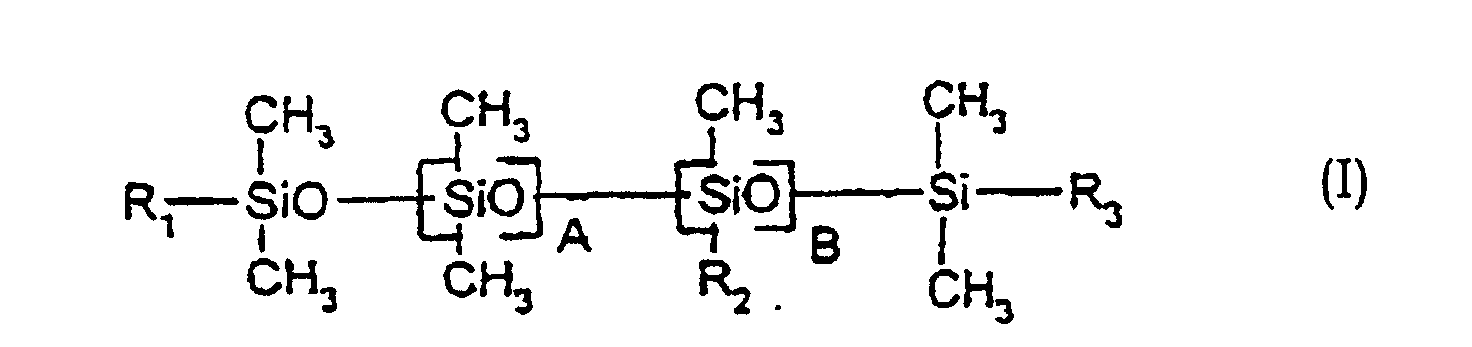 die Gruppen R1, R2 und R3 unabhängig voneinander C1-6-Alkyl oder eine Gruppe -(CH2)x - (OCH2CH2)y - (OCH2CH2CH2)z - OR4, wobei mindestens eine der Gruppen R1, R2 oder R3 keine Alkylgruppe bedeutet; und wobei R4 Wasserstoff, Alkyl oder Acyl ist;A 0 oder eine ganze Zahl von 1 bis 200;B 0 oder eine ganze Zahl von 1 bis 50, mit der Maßgabe, daß A und B nicht gleichzeitig Null sind;x eine ganze Zahl von 1 bis 6;y eine ganze Zahl von 1 bis 30;z 0 oder eine ganze Zahl von 1 bis 5.
 - Zusammensetzungen nach Anspruch 5, dadurch gekennzeichnet, daß der siliconhaltige grenzflächenaktive Stoff eine Verbindung der Formel (II) ist:worin A eine ganze Zahl von 20 bis 105, B eine ganze Zahl von 2 bis 10 und y eine ganze Zahl von 10 bis 20 bedeutet.

- Zusammensetzungen nach Anspruch 4, dadurch gekennzeichnet, daß der siliconhaltige grenzflächenaktive Stoff eine Verbindung der Formel (III) ist:
- Zusammensetzungen nach einem der vorhergehenden Ansprüche, dadurch gekennzeichnet, daß sie ferner mindestens ein ionisches amphiphiles Lipid enthalten.
- Zusammensetzungen nach dem vorhergehenden Anspruch, dadurch gekennzeichnet, daß das ionische amphiphile Lipid unter den anionischen Lipiden, amphoteren Lipiden, kationischen Lipiden und deren Gemischen ausgewählt ist.
- Zusammensetzungen nach Anspruch 9, dadurch gekennzeichnet, daß das kationische amphiphile Lipid unter den quartären Ammoniumsalzen und den Fettaminen ausgewählt ist.
- Zusammensetzungen nach Anspruch 10, dadurch gekennzeichnet, daß die quartären Ammoniumsalze ausgewählt sind unter:worin die Gruppen R1 bis R4, die identisch oder voneinander verschieden sein können, ein geradkettige oder verzweigte aliphatische Gruppe mit 1 bis 30 Kohlenstoffatomen oder eine aromatische Gruppe, wie Aryl oder Alkylaryl, bedeuten und X ein Anion ist, das unter den Halogeniden, Phosphaten, Acetaten, Lactaten, C2-6-Alkylsulfaten und Alkyl- oder Alkylarylsulfonaten ausgewählt ist;den quartären Ammoniumsalzen der folgenden allgemeinen Formel (VIII):
 worin R9 eine aliphatische Gruppe mit etwa 16 bis 30 Kohlenstoffatomen bedeutet, die Gruppen R10, R11, R12, R13 und R14 unter Wasserstoff oder den Alkylgruppen mit 1 bis 4 Kohlenstoffatomen ausgewählt sind und X ein Anion ist, das unter den Halogeniden, Acetaten, Phosphaten, Nitraten und Methylsulfaten ausgewählt ist; undden quartären Ammoniumsalzen von Imidazolinium;den quartären Diammoniumsalzen der Formel (X):
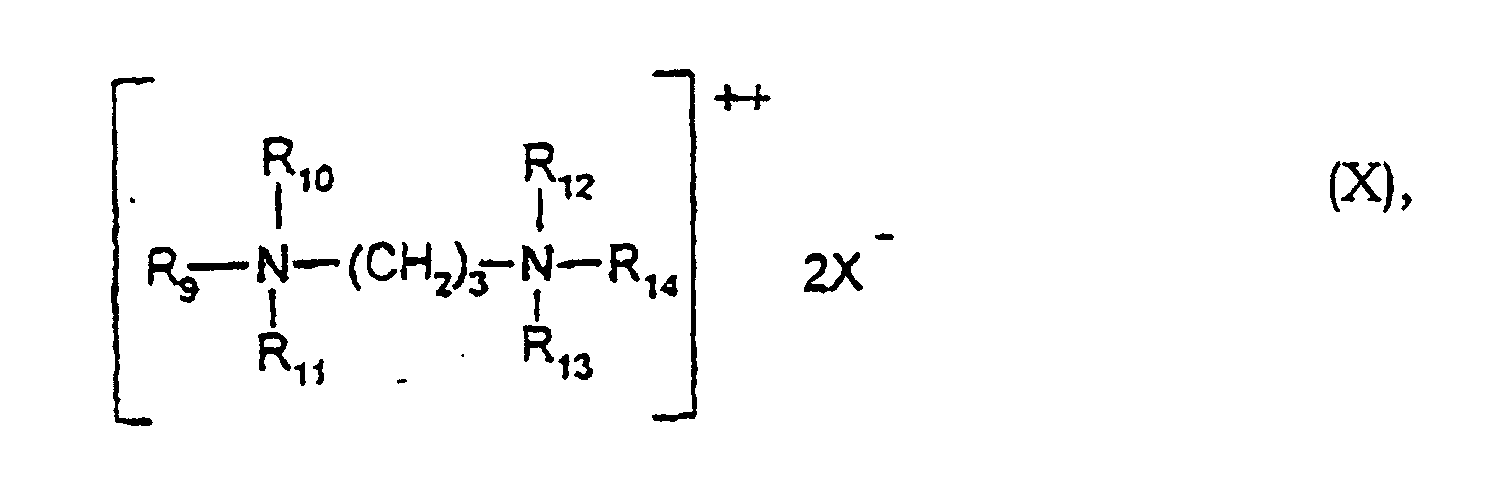 den quartären Ammoniumsalzen, die mindestens eine Estergruppe enthalten.
 - Zusammensetzungen nach einem der Ansprüche 8 bis 11, dadurch gekennzeichnet, daß das ionische amphiphile Lipid in Konzentrationen von 0 bis 60 Gew.-%, bezogen auf das Gesamtgewicht der amphiphilen Lipidphase, und vorzugsweise 10 bis 50 Gew.-% vorliegt.
- Zusammensetzungen nach einem der Ansprüche 1 bis 12, dadurch gekennzeichnet, daß das Gewichtsverhältnis der Menge des Öls und der Menge der amphiphilen Lipidphase im Bereich von 2 bis 10 liegt.
- Zusammensetzungen nach einem der Ansprüche 1 bis 13, dadurch gekennzeichnet, daß sie einen Ölanteil von 5 bis 40 Gew.-%, bezogen auf das Gesamtgewicht der Emulsion, und vorzugsweise von 10 bis 30 Gew.-% enthalten.
- Zusammensetzungen nach einem der Ansprüche 1 bis 14, dadurch gekennzeichnet, daß das Öl in Konzentrationen von 0,1 bis 15 Gew.-% und vorzugsweise 0,2 bis 10 Gew.-%, bezogen auf das Gesamtgewicht der Zusammensetzung, vorliegt.
- Zusammensetzungen nach einem der Ansprüche 1 bis 15, dadurch gekennzeichnet, daß sie ferner einen oder mehrere Zusatzstoffe enthalten, die dazu vorgesehen sind, die kosmetischen Eigenschaften zu verbessern, und die unter den kationischen grenzflächenaktiven Stoffen, anionischen, nichtionischen, kationischen oder amphoteren Polymeren, Proteinen, Ceramiden, Pseudoceramiden oder Siliconen ausgewählt sind.
- Zusammensetzungen nach einem der Ansprüche 1 bis 16, dadurch gekennzeichnet, daß die Ölkügelchen eine mittlere Größe von 30 bis 150 nm aufweisen.
- Verwendung einer Zusammensetzung nach einem der Ansprüche 1 bis 17 zur Reinigung und/oder zum Abschminken und/oder zur Konditionierung von Keratinsubstanzen.
- Verfahren zum Waschen und Konditionieren von Keratinsubstanzen, wie dem Haar, das darin besteht, auf die feuchten Keratinsubstanzen eine wirksame Menge einer Zusammensetzung nach einem der Ansprüche 1 bis 17 aufzutragen und anschließend, gegebenenfalls nach einer Einwirkzeit, mit Wasser zu spülen.
Applications Claiming Priority (5)
| Application Number | Priority Date | Filing Date | Title |
|---|---|---|---|
| FR9613977A FR2755850A1 (fr) | 1996-11-15 | 1996-11-15 | Compositions cosmetiques detergentes et utilisation |
| FR9613977 | 1996-11-15 | ||
| FR9703280 | 1997-03-18 | ||
| FR9703280A FR2755851B1 (fr) | 1996-11-15 | 1997-03-18 | Compositions cosmetiques detergentes et utilisation |
| PCT/FR1997/001815 WO1998022087A1 (fr) | 1996-11-15 | 1997-10-10 | Compositions cosmetiques detergentes et utilisation |
Publications (2)
| Publication Number | Publication Date |
|---|---|
| EP0939619A1 EP0939619A1 (de) | 1999-09-08 |
| EP0939619B1 true EP0939619B1 (de) | 2003-01-15 |
Family
ID=26233100
Family Applications (1)
| Application Number | Title | Priority Date | Filing Date |
|---|---|---|---|
| EP97909389A Revoked EP0939619B1 (de) | 1996-11-15 | 1997-10-10 | Kosmetisches reinigungsmittel und seine anwendung |
Country Status (9)
| Country | Link |
|---|---|
| US (1) | US6488780B2 (de) |
| EP (1) | EP0939619B1 (de) |
| JP (1) | JP2000504344A (de) |
| AT (1) | ATE230975T1 (de) |
| AU (1) | AU4709097A (de) |
| CA (1) | CA2267158A1 (de) |
| DE (1) | DE69718503T2 (de) |
| FR (1) | FR2755851B1 (de) |
| WO (1) | WO1998022087A1 (de) |
Families Citing this family (17)
| Publication number | Priority date | Publication date | Assignee | Title |
|---|---|---|---|---|
| FR2785181B1 (fr) * | 1998-11-04 | 2006-06-02 | Oreal | Compositions cosmetiques detergentes et utilisation |
| FR2804015B1 (fr) | 2000-01-21 | 2005-12-23 | Oreal | Nanoemulsion contenant des lipides amphiphiles et un polymere non ionique et utilisations |
| DE50106562D1 (de) * | 2000-02-19 | 2005-07-28 | Goldschmidt Gmbh | Kosmetische und pharmazeutische Öl-in-Wasser-Emulsionen von polyethermodifizierten Polysiloxanen |
| DE10114561A1 (de) † | 2001-03-24 | 2002-09-26 | Wella Ag | Verwendung von Mitteln enthaltend Kreatin, Kreatin und/oder deren Derivaten zur Verstärkung und Strukturverbesserung von keratinischen Fasern |
| US6689720B2 (en) * | 2001-11-14 | 2004-02-10 | Ndsu-Research Foundation | High-pH oil based adjuvant blend for enhancing efficacy of pesticides |
| US20040115159A1 (en) * | 2002-03-29 | 2004-06-17 | Tadlock Charles C | Novel nanoemulsions |
| EP1603518A4 (de) * | 2003-03-14 | 2006-11-22 | Oreal | Poss und eposs enthaltende kosmetika und produkte für die körperpflege |
| US20050208083A1 (en) * | 2003-06-04 | 2005-09-22 | Nanobio Corporation | Compositions for inactivating pathogenic microorganisms, methods of making the compositons, and methods of use thereof |
| US20060024258A1 (en) * | 2004-08-02 | 2006-02-02 | L'oreal | Water-in-oil emulsion comprising a non-volatile non-silicone oil, cationic and nonionic surfactants, and an alkylmonoglycoside or alkylpolyglycoside |
| JP2008512498A (ja) * | 2004-09-13 | 2008-04-24 | ロレアル | 改善された付着性及び/又は柔軟性を有するposs含有化粧品用組成物と改善された化粧品用組成物の製造方法 |
| US8277788B2 (en) | 2005-08-03 | 2012-10-02 | Conopco, Inc. | Quick dispersing hair conditioning composition |
| FR2940109B1 (fr) * | 2008-12-18 | 2011-02-11 | Natura Cosmeticos Sa | Nanoemulsion huile dans l'eau contenant de l'huile de noix du bresil, composition cosmetique et produit cosmetique renfermant cette emulsion et utilisation de cette derniere. |
| DE102009014380A1 (de) * | 2009-03-26 | 2010-10-07 | Bubbles And Beyond Gmbh | Verfahren und Zusammensetzung zum Reinigen von Gegenständen |
| US9809788B2 (en) | 2012-12-07 | 2017-11-07 | Colgate-Palmolive Company | Bar soap composition and method of manufacture |
| BR112018069630B1 (pt) | 2016-04-21 | 2021-10-26 | Unilever Ip Holdings B.V. | Composição de nanoemulsão, e processo para a preparação de uma emulsão |
| CA3019865C (en) | 2016-04-21 | 2024-03-19 | Unilever Plc | Process for producing small droplet emulsions at low pressure |
| JP2019014679A (ja) * | 2017-07-07 | 2019-01-31 | ロレアル | 超微細o/wエマルションの形態のケラチン繊維のためのシリコーン非含有組成物 |
Family Cites Families (16)
| Publication number | Priority date | Publication date | Assignee | Title |
|---|---|---|---|---|
| US2528378A (en) | 1947-09-20 | 1950-10-31 | John J Mccabe Jr | Metal salts of substituted quaternary hydroxy cycloimidinic acid metal alcoholates and process for preparation of same |
| US2781354A (en) | 1956-03-26 | 1957-02-12 | John J Mccabe Jr | Imidazoline derivatives and process |
| CH611156A5 (de) | 1974-05-16 | 1979-05-31 | Oreal | |
| GB1567947A (en) | 1976-07-02 | 1980-05-21 | Unilever Ltd | Esters of quaternised amino-alcohols for treating fabrics |
| CA1138292A (en) * | 1978-06-30 | 1982-12-28 | Johannes C.P. Schreuder | Handwashing composition |
| FR2470596A1 (fr) | 1979-11-28 | 1981-06-12 | Oreal | Composition destinee au traitement des fibres keratiniques a base de polymeres amphoteres et de polymeres cationiques |
| LU83876A1 (fr) | 1982-01-15 | 1983-09-02 | Oreal | Composition cosmetique destinee au traitement des fibres keratiniques et procede de traitement de celles-ci |
| LU86429A1 (fr) | 1986-05-16 | 1987-12-16 | Oreal | Compositions cosmetiques renfermant un polymere cationique et un polymere anionique comme agent epaississant |
| DE3623215A1 (de) | 1986-07-10 | 1988-01-21 | Henkel Kgaa | Neue quartaere ammoniumverbindungen und deren verwendung |
| MY105119A (en) | 1988-04-12 | 1994-08-30 | Kao Corp | Low irritation detergent composition. |
| FI79857C (fi) * | 1988-07-12 | 1990-03-12 | Orion Yhtymae Oy | Rengoeringsmedelkomposition och dess anvaendning. |
| US5364633A (en) | 1994-03-14 | 1994-11-15 | Dow Corning Corporation | Silicone vesicles and entrapment |
| FR2721210B1 (fr) | 1994-06-17 | 1996-08-02 | Oreal | Composition de nettoyage contenant des grains lipidiques. |
| FR2730932B1 (fr) * | 1995-02-27 | 1997-04-04 | Oreal | Nanoemulsion transparente a base de lipides amphiphiles non-ioniques fluides et utilisation en cosmetique ou en dermopharmacie |
| FR2742674B1 (fr) * | 1995-12-21 | 1998-02-06 | Oreal | Dispersion stable d'une phase non miscible a l'eau, dans une phase aqueuse au moyen de vesicules a base de tensioactif silicone |
| FR2760970B1 (fr) * | 1997-03-18 | 2000-03-10 | Oreal | Nanoemulsions a base de lipides amphiphiles non-ioniques et de silicones aminees et utilisations |
-
1997
- 1997-03-18 FR FR9703280A patent/FR2755851B1/fr not_active Expired - Fee Related
- 1997-10-10 JP JP10520846A patent/JP2000504344A/ja active Pending
- 1997-10-10 AU AU47090/97A patent/AU4709097A/en not_active Abandoned
- 1997-10-10 DE DE69718503T patent/DE69718503T2/de not_active Expired - Fee Related
- 1997-10-10 US US09/308,267 patent/US6488780B2/en not_active Expired - Fee Related
- 1997-10-10 AT AT97909389T patent/ATE230975T1/de not_active IP Right Cessation
- 1997-10-10 CA CA002267158A patent/CA2267158A1/fr not_active Abandoned
- 1997-10-10 EP EP97909389A patent/EP0939619B1/de not_active Revoked
- 1997-10-10 WO PCT/FR1997/001815 patent/WO1998022087A1/fr not_active Ceased
Also Published As
| Publication number | Publication date |
|---|---|
| AU4709097A (en) | 1998-06-10 |
| FR2755851A1 (fr) | 1998-05-22 |
| WO1998022087A1 (fr) | 1998-05-28 |
| DE69718503T2 (de) | 2003-09-25 |
| US20020032134A1 (en) | 2002-03-14 |
| EP0939619A1 (de) | 1999-09-08 |
| CA2267158A1 (fr) | 1998-05-28 |
| JP2000504344A (ja) | 2000-04-11 |
| DE69718503D1 (de) | 2003-02-20 |
| ATE230975T1 (de) | 2003-02-15 |
| FR2755851B1 (fr) | 1998-12-24 |
| US6488780B2 (en) | 2002-12-03 |
Similar Documents
| Publication | Publication Date | Title |
|---|---|---|
| EP0842652B1 (de) | Nanoemulsion auf Basis von nichtionischen und kationischen, amphiphilen Lipiden und ihre Verwendung | |
| EP0879589B1 (de) | Aus nicht-ionischen amphiphilen Fettstoffen und Aminosilikonen bestehende Nanoemulsionen und deren Verwendung. | |
| EP1129684B1 (de) | Aus amphiphilen Fettstoffen und ein kationisches Polymer bestehende Nanoemulsionen und deren Verwendungen in Kosmetica | |
| EP1337230B1 (de) | Zusammensetzung zur behandlung keratinischer fasern enthaltend ein assoziatives kationisches polyurethan und ein konditioniermittel | |
| EP1357884B2 (de) | Zusammensetzung zur behandlung von keratinfasern, die ein kationisches polyvinyllactam enthalten sowie ein konditioniermittel | |
| CA2332469A1 (fr) | Nanoemulsion contenant des lipides amphiphiles et un polymere non ionique et utilisations | |
| CA2332468A1 (fr) | Nanoemulsion contenant des lipides amphiphiles et un ester de peg et utilisations | |
| EP2729116B1 (de) | Körperpflegezusammensetzungen | |
| EP1093809A1 (de) | Kosmetische Zusammensetzungen enhaltend ein Vinyldimethicon/Dimethicon Copolymer und ein Konditionierungsmittel, und ihre Anwendungen | |
| WO1998022087A1 (fr) | Compositions cosmetiques detergentes et utilisation | |
| EP0966945A1 (de) | Reinigende kosmetische Zusammensetzungen und ihre Anwendung | |
| CA2323138C (fr) | Compositions cosmetiques contenant une emulsion d'un copolymere vinyldimethicone/dimethicone et un tensioactif cationique et leurs utilisations | |
| CA2361524A1 (fr) | Compositions cosmetiques detergentes et utilisation | |
| EP1126817B1 (de) | Kosmetische waschmittelzusammensetzungen und deren verwendung | |
| CA2298185A1 (fr) | Compositions cosmetiques detergentes contenant un tensioactif hydroxyalkylether anionique et une gomme de guar cationique et leurs utilisations | |
| EP0904045B1 (de) | Kosmetische haarwaschmittel und ihre verwendung | |
| CA2257188A1 (fr) | Compositions cosmetiques detergentes a usage capillaire et utilisation | |
| EP1047401B1 (de) | Kosmetische zusammensetzungen enthaltend einen anionischen tensid vom typ alkylpolyglykosidester und ein flüssiges wasserunlösliches konditionierungsmittel sowie deren verwendungen | |
| CA2298182A1 (fr) | Compositions cosmetiques detergentes contenant un tensioactif hydroxyalkylether anionique et une silicone et leurs utilisations | |
| EP1430871A1 (de) | Kosmetische Zusammensetzungen enthaltend ein amphoteres Tensid und ein Ceramid sowie ihre Verwedung | |
| FR2755850A1 (fr) | Compositions cosmetiques detergentes et utilisation |
Legal Events
| Date | Code | Title | Description |
|---|---|---|---|
| PUAI | Public reference made under article 153(3) epc to a published international application that has entered the european phase |
Free format text: ORIGINAL CODE: 0009012 |
|
| 17P | Request for examination filed |
Effective date: 19990615 |
|
| AK | Designated contracting states |
Kind code of ref document: A1 Designated state(s): AT BE CH DE ES FR GB IT LI NL SE |
|
| GRAH | Despatch of communication of intention to grant a patent |
Free format text: ORIGINAL CODE: EPIDOS IGRA |
|
| GRAH | Despatch of communication of intention to grant a patent |
Free format text: ORIGINAL CODE: EPIDOS IGRA |
|
| GRAA | (expected) grant |
Free format text: ORIGINAL CODE: 0009210 |
|
| AK | Designated contracting states |
Kind code of ref document: B1 Designated state(s): AT BE CH DE ES FR GB IT LI NL SE |
|
| PG25 | Lapsed in a contracting state [announced via postgrant information from national office to epo] |
Ref country code: NL Free format text: LAPSE BECAUSE OF FAILURE TO SUBMIT A TRANSLATION OF THE DESCRIPTION OR TO PAY THE FEE WITHIN THE PRESCRIBED TIME-LIMIT Effective date: 20030115 Ref country code: IT Free format text: LAPSE BECAUSE OF FAILURE TO SUBMIT A TRANSLATION OF THE DESCRIPTION OR TO PAY THE FEE WITHIN THE PRESCRIBED TIME-LIMIT;WARNING: LAPSES OF ITALIAN PATENTS WITH EFFECTIVE DATE BEFORE 2007 MAY HAVE OCCURRED AT ANY TIME BEFORE 2007. THE CORRECT EFFECTIVE DATE MAY BE DIFFERENT FROM THE ONE RECORDED. Effective date: 20030115 Ref country code: GB Free format text: LAPSE BECAUSE OF FAILURE TO SUBMIT A TRANSLATION OF THE DESCRIPTION OR TO PAY THE FEE WITHIN THE PRESCRIBED TIME-LIMIT Effective date: 20030115 Ref country code: AT Free format text: LAPSE BECAUSE OF FAILURE TO SUBMIT A TRANSLATION OF THE DESCRIPTION OR TO PAY THE FEE WITHIN THE PRESCRIBED TIME-LIMIT Effective date: 20030115 |
|
| REG | Reference to a national code |
Ref country code: GB Ref legal event code: FG4D Free format text: NOT ENGLISH Ref country code: CH Ref legal event code: EP |
|
| REF | Corresponds to: |
Ref document number: 69718503 Country of ref document: DE Date of ref document: 20030220 Kind code of ref document: P |
|
| PG25 | Lapsed in a contracting state [announced via postgrant information from national office to epo] |
Ref country code: SE Free format text: LAPSE BECAUSE OF FAILURE TO SUBMIT A TRANSLATION OF THE DESCRIPTION OR TO PAY THE FEE WITHIN THE PRESCRIBED TIME-LIMIT Effective date: 20030415 |
|
| NLV1 | Nl: lapsed or annulled due to failure to fulfill the requirements of art. 29p and 29m of the patents act | ||
| GBV | Gb: ep patent (uk) treated as always having been void in accordance with gb section 77(7)/1977 [no translation filed] |
Effective date: 20030115 |
|
| PG25 | Lapsed in a contracting state [announced via postgrant information from national office to epo] |
Ref country code: ES Free format text: LAPSE BECAUSE OF FAILURE TO SUBMIT A TRANSLATION OF THE DESCRIPTION OR TO PAY THE FEE WITHIN THE PRESCRIBED TIME-LIMIT Effective date: 20030730 |
|
| PGFP | Annual fee paid to national office [announced via postgrant information from national office to epo] |
Ref country code: CH Payment date: 20031017 Year of fee payment: 7 |
|
| PLBI | Opposition filed |
Free format text: ORIGINAL CODE: 0009260 |
|
| PLAX | Notice of opposition and request to file observation + time limit sent |
Free format text: ORIGINAL CODE: EPIDOSNOBS2 |
|
| 26 | Opposition filed |
Opponent name: HENKEL KGAA Effective date: 20031015 Opponent name: COGNIS DEUTSCHLAND GMBH & CO. KG Effective date: 20031015 |
|
| PG25 | Lapsed in a contracting state [announced via postgrant information from national office to epo] |
Ref country code: DE Free format text: LAPSE BECAUSE OF NON-PAYMENT OF DUE FEES Effective date: 20040501 |
|
| PG25 | Lapsed in a contracting state [announced via postgrant information from national office to epo] |
Ref country code: FR Free format text: LAPSE BECAUSE OF NON-PAYMENT OF DUE FEES Effective date: 20040630 |
|
| REG | Reference to a national code |
Ref country code: FR Ref legal event code: ST |
|
| RDAF | Communication despatched that patent is revoked |
Free format text: ORIGINAL CODE: EPIDOSNREV1 |
|
| PGFP | Annual fee paid to national office [announced via postgrant information from national office to epo] |
Ref country code: BE Payment date: 20041216 Year of fee payment: 8 |
|
| RDAG | Patent revoked |
Free format text: ORIGINAL CODE: 0009271 |
|
| STAA | Information on the status of an ep patent application or granted ep patent |
Free format text: STATUS: PATENT REVOKED |
|
| REG | Reference to a national code |
Ref country code: CH Ref legal event code: PL |
|
| 27W | Patent revoked |
Effective date: 20041022 |